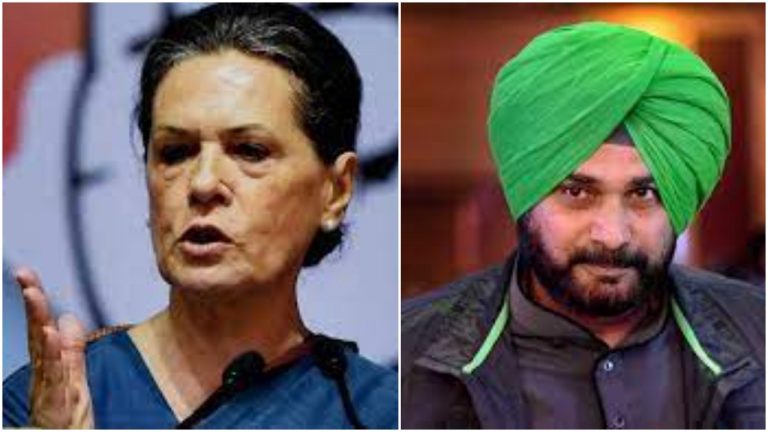
After the disastrous performance in all the 5 states that went into the polls recently, Congress President Sonia Gandhi has asked the party presidents of Uttar Pradesh, Uttarakhand, Punjab, Goa and Manipur units to put in their resignations. This is being done in order to facilitate the reorganisation of Congress’s state units.
Punjab Congress leader Randeep Singh Surjewala took to Twitter to inform the same. “Congress President, Smt. Sonia Gandhi has asked the Pradesh Congress Committees Presidents of Uttar Pradesh, Uttarakhand, Punjab, Goa & Manipur to put in their resignations in order to facilitate the reorganisation of PCC’s”, Tweeted Surjewala.
Congress President, Smt. Sonia Gandhi has asked the PCC Presidents of Uttar Pradesh, Uttarakhand, Punjab, Goa & Manipur to put in their resignations in order to facilitate reorganisation of PCC’s.
Notably, Navjot Singh Sidhu is the current Congress state president of Punjab. In Uttar Pradesh, the PCC is led by Ajay Kumar Lallu. Ganesh Godiyal is the Congress Presiden of Uttarakhand. Girish Chodankar was the Congress state president in Goa until yesterday, when he resigned, taking moral responsibility for his party’s dismal performance in the recently concluded state Assembly elections. Similarly, in Manipur, PCC is led by Ratankumar Singh. However, now, according to Surjewala, Sonia Gandhi has asked all these five state presidents to put down their papers after the recent Assembly poll debacle.
CWC reaffirms faith in Sonia Gandhi’s leadership despite poll debacle
Interestingly, Sonia Gandhi did not even bat an eyelid before dismissing these party loyalists, while members of the Congress Working Committee have once again reaffirmed their faith in Sonia Gandhi’s leadership, despite the fact that the Congress has been gasping for survival under the Gandhi family’s leadership.
On March 13, 2022, the much-talked-about Congress Working Committee meeting has come to an end after 4.5 hours only to conclude that Sonia Gandhi will continue as the interim party president. In the meeting, CWC expressed its full faith in Sonia Gandhi to keep leading the party and authorised her to make decisions needed to revamp the party.
Reportedly, it was also decided that the much-awaited and much-delayed election to elect a full-time president of the Congress party will take place on August 20. During the meeting, Sonia Gandhi said that if the party feels is it is needed, the three from the Gandhi family, Sonia Gandhi herself, and her children Rahul Gandhi and Priyanka Gandhi Vadra, are ready to resign from their posts in the party. However, the CWC members unanimously rejected the offer.
Congress faces a crushing defeat in 2022 Assembly polls
The recently concluded Assembly polls in five states, including Uttar Pradesh, Manipur, Goa, Punjab and Uttarakhand turned out to be the biggest nightmare for the grand old party. Congress suffered a humiliating defeat losing Punjab to the AAP. It finished with only two seats out of 403 in the politically crucial state of Uttar Pradesh. Coming as a major embarrassment, Congress had even lost deposits on 97% of the seats it contested in Uttar Pradesh. The party also suffered a crushing defeat in Uttarakhand, Goa and Manipur.
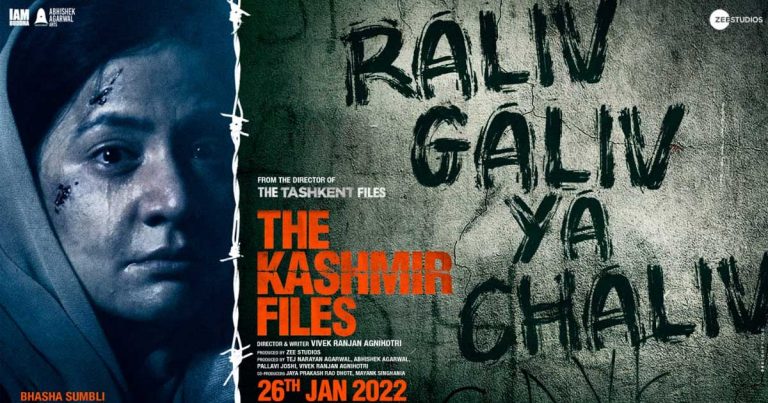
In a world filled with fakes, fantasies and fanfare, seldom comes a movie that is not only a masterpiece of art but also a representation of bitter truth that shakes you inside out. I finally watched the most talked-about movie right now The Kashmir Files by Vivek Agnihotri but the most interesting thing happened after we finished watching the movie. My wife musters the courage to break the deafening silence from our seats in the theatre to the seats in the car and ask the question that we both were meant to ask each other like after every movie we watch. She finally asks “Kaisi lagi (movie)?” and to her disbelief of a standard one-word review of either “Achhi” or “Bekaar”, I said “Kadwi”.
Why did I say “Kadwi”? Now, this I shall answer at the end of my “one word” review about different aspects of the movie The Kashmir Files, the actors and our experience. What explanation I gave her, but I must forewarn and alert you about the #Spoilers ahead but the truth is only a spoiler for those who don’t want to even see the mention of truth.
Let’s first start with the movie The Kashmir Files itself – it’s a ‘watershed’. I couldn’t think of a better word to express the anger and anguish this movie leaves one with at the end of the movie. I could have called it a ‘masterpiece’ or ‘excellent’ or any sugary adjective that most critics and professional film reviewers use to define any movie but then it’ll not be justice. It’ll also be unjust to call these a collection or docufilm of “stories”, as these are not stories but facts and our harsh truths that could not have been told in any better way and craftily than this. Let this be a start of awareness and a moment of reckoning for our society, which for a long has had a short term memory loss to have forgotten many such chapters of our checkered history.
Director Vivek Agnihotri – Simply put, ‘courageous’. It truly takes courage to fight against all odds in an industry known for its biases, hypocrisies and sugar coating and then pick up “not a fairy tale” but facts and present those truths with an everlasting impact along with the systemic challenges and roadblocks of finances, PR and propaganda it brings to those not in its inner circle.
Rahul Roushan tweeted the other day, “Till just like 3-4 years ago, the liberals would taunt RW with ‘if you don’t like a book/movie, go write/make your own instead of crying’. Folks went ahead and did both, and now see what happened.” and now when the likes of Vivek Agnihotri, Vikram Sampath and many such men and women are starting to not rewrite but filling the scathing gaps in our checkered history. Vivek surely is gutsy and genius. He knew from his days of “Buddha in a Traffic Jam” and “The Tashkent Files” that he is no longer a Bollywood Insider or anybody’s Companion in the Film Industry (pun surely intended), that he is a Pariah now.
If his earlier movies were an awakening, then The Kashmir Files surely is a reckoning. Vivek has been comparing this movie to Schindler List and Hotel Rwanda in his interviews but I’d like to disagree with him for once and like to call this his very own The Kashmir Files and he only has got better his art in his next and now we can’t wait for his next project The Delhi Files.
Now let’s come to the actors or I should say the pillars of this movie.
Darshan Kumaar – Very easily, he’s ‘Us’. His portrayal of Krishna Pandit is that of one of us. I’m a grandson of refugees myself, both my maternal and paternal grandparents left what was their land once and belonged to our forefathers. But after a political partition led to a mass exodus, genocide and eventual creation of Pakistan in 1947. I’m the 3rd generation who has only heard the stories as a passing anecdote and had never understood the gravity of what my grandparents and the Hindu-Punjabi community in East Punjab and North-West Frontier Province in what was India must have gone through until now when I understand their plights.
Darshan plays “us”, us who were unaware of truths and facts of the KP genocide for 32 yrs. ‘Us’ who would brush aside the ugly truth because it is so convoluted that ignoring seemed an easier escape to avoid the pain it would bring. Darshan’s speech in the climax of the film leaves one stunned with each and every fact hitting nails in the coffin of the web of lies spun around Kashmir, its glorious history and its broken present. It leaves one questioning how “I was brainwashed” with years of liberal, political and communal (or should I say ‘secular’ propaganda) to hide the facts for the last 32 years and the efforts are still on as we watch the truths in The Kashmir Files. Par “Hum Dekhenge” aur ab zaroor dekhenge. (Pun Intended again)
Anupam Kher – just one word isn’t enough, but this one particular word totally sums him up “legend”. I don’t think there could have been a better person than him to “not act” or “portray a role” but “be” Shri Pushkar Nath. Nobody. All through the movie, I was confused whether calling him an actor in this particular case will be a grave injustice to his Kashmiri Pandit roots.
Anupam Kher moves you even till his last breath in the movie, from the scene where he confronts the terrorists in his house instead of escaping, to his time in the KP Refugee camp where he’s shown licking a Parle-G biscuit or refusing an expensive lens for his cataract to bring up his next generation as better KPs to confronting his grandson in present-day when he learns about his running as the President of ANU and his slogans of “Azaadi”. He very effectively shows what many senior KPs still go through until their last breath. Goosebumps. If Saaransh was his first peak, then The Kashmir Files is surely the Mt. Everest of his acting career.
Bhasha Sumbli – The ‘Soul’. If Anupam Kher was the heart of the movie, she is the soul. Bhasha had the toughest job of them all. She lives through the realities of BK Ganjoo, Girija Tikoo, Nadimarg Massacre and many other KP victims in one character of Sharda Pandit. She leaves the audience numb with that howling cry while watching her husband Karan Pandit being killed in cold blood in front of her own eyes. Be it the rice drum scene, eating the blood-soaked rice or be it hacksaw scene! She moves you every time.
Prithviraj Sarnaik – a “remarkable” kid. It’ll be criminal to not note his portrayal of the young Shiva Pandit. His act is nothing short of remarkable and that too as a child artist! The kid has a bright future and leaves us with an everlasting image of that freezing during Nadimarg Massacre. Those unforgettable eyes of yours in the last scene of the movie leaves an impression.
It’s the genius of Vivek Agnihotri that he has named the characters of Mithun Da as IAS officer Bhrama Dutt, Puneet Issar as DGP Hari Narain, Atul Srivastav as Journalist Vishnu Ram and Prakash Belawadi as Dr Mahesh Kumar. The Hindu “Trinity” functions of life as a creator, curator and destroyer. And it’s poetic that these finest actors who play friends of Pushkar Nath, at the same time portray the “pillars of democracy” in #TheKashmirFiles. All throughout the movie, they show how our political system failed them or rather, they were helpless and were made to fail in that vacuum of democracy & sanity during the KP genocide of 1990. They leave you with anguish that even then the system turned a blind eye towards the plight of Kashmiri Pandits and they still do after 32 years.
Pallavi Joshi – “Villain”. A character being that of a villain makes it tough to compliment with any positive adjective and with a movie like The Kashmir Files, it makes the job all the tougher because this is no masala Bollywood film. I can’t find anyone word to compliment her very fine acting and yet not belittle it with a cuss word for the character of Professor Radhika Menon she’s playing in the movie.
When you’ll watch the movie you will come to know who she’s portraying. Hate will be a mild word at the least for “those ladies” but as for Pallavi ji, there couldn’t be anyone better to act with those dark shades. Right from when she first appears on the screen, her innocent smile concealing the evil and sugary dialogue delivery hiding the sinister agenda of today’s andolanjeevis. She owns the act and truly tells u how “they” first own you in our academia and public spheres as historians or intellectuals and then brainwash you with false narratives and arguments.
Also, compliments to Pallavi on her singing talent. There are hidden surprises in the movie and you must watch to see her talent. Also, it’ll be unjust to not acknowledge her equal partnership in the making of The Kashmir Files. If Vivek Agnihotri is the Captain of this ship, then his better half Pallavi Joshi is surely the Vice-Captain and deserves the accolades equally for going through the pains of the research that went behind in the making of this film.
Chinmay Mandlekar – “Slayer”. He imbibes the portrayal of Maqbool Bhatt, Yasin Malik & Bitta Karate, an all-in-one character that was so well defined. He captures the barbarism in the reel with finesse and kudos to him that as a Marathi getting the Kashmiri accent, must not have been easy. But what characters he’s portraying is not even worth liking and appreciating and that’s the dilemma I’m still in. It hits you in the guts! He slew the role as the antagonist Farooq Ahmed Dar, that’s the best compliment I can give just to his portrayal of the character and his acting skills.
Audience – “Stunned”, “Speechless”, “Numb”, “Emotional” and I can write as many words but “one word” will be too little to capture the emotions that I went through and saw everyone in the audience go through. This movie leaves you with an impact that you’ll never forget in your life now. Never before in my life I’ve seen a house full auditorium sit with a pin drop silence all through 170 minutes of the movie. After any movie ends usually you’ll notice people mutter and chatter, someone asking “Kaisi Lagi” or “Gaadi kidhar parked hai” or “Khaana kya khaana hai?” but what may shock you further is that we all were numb and silent even in the corridors of the theatre while exiting.
And now we come to the most important aspect of this movie, our Kashmiri Pandits brothers and sisters.
Kashmiri Pandits – I kept thinking of any word that’ll do justice and not be lip service to their misery, their ordeal and I could only think of one word – “Sorry”.
As a dialogue in the movie says “टूटे हुए लोग बोलते नहीं, उन्हें सुना जाता है!”. Sorry that we as a society never heard you, sorry that we as a society just glossed over the history of 19 Jan 1990 as an exodus and not that of genocide. Sorry, you’re still refugees in your own motherland. Sorry that we’ve lived in denial of a barbaric genocide and made you look like a sorry figure in your own land.
In the end, the movie leaves you with moist eyes and just a question to ask “why”. Why was this truth hidden from us? Why have we been lying about the genocide? Why have we been denying our Kashmiri Pandits justice? There’s a dialogue in the movie that captures it very rightly “Fake News is not the problem but hiding truth is”. I hope that this movie that’s now become a movement, takes our journey for #RightToJustice further to a logical conclusion and allows our Kashmiri Pandits some sort of solace and a sense of closure after their 3 decades-long ordeals for a much needed and deserved justice.
So, now you may understand why I answered a tough question from my wife, when she asked “(movie) Kaisi Lagi” as “Kadwi” because the truth is always bitter and it’s better when served cold. It may pain you a lot in the beginning with a lump in your throat that’s hard to swallow without any sugar-coating but this bitter pill makes it easier for you to come to terms with realities, facts & realities.
As one audience to another, I wish you also find this movie “Kadwi” just like I did.
Earlier on Tuesday, The Karnataka High Court pronounced its verdict in the hijab case filed by Muslim girl students. The court, as per its order, has stated that the hijab is not an essential practice of the Islamic faith, and dismissed all the petitions filed by Muslim girl students seeking permission to wear hijab in educational institutions.
After this order, schools in Karnataka are free to have their own uniform inside the schools. However, this has been pushed as a hijab ban in India by the usual leftist suspects, even though anyone is free to wear a hijab in India if they choose to do so.
Leftist propaganda portal, The Wire, got so upset with this decision of a uniform in schools, that they compared it to Nazi Germany and Hitler’s death camps. If only the main issue for Jews in 1940 was wearing a uniform inside schools.
Nazi Germany attacked the religious rituals of the Jews, demonised their appearance and food habits, attacked synagogues and erased their livelihoods before the death camps came into existence.https://t.co/kCSQ3hFHtp
Right from the off, The Wire argues that this amounts to the cultural cleansing of Muslims. Even though saffron scarfs are also banned inside school premises, somehow that doesn’t amount to Hindu cleansing because that doesn’t fit their narrative. A school insisting on a uniform is now bigoted and school administrators are Hitler’s reincarnated, even though most schools in the world has a uniform.
During the course of their long, incoherent rant, The Wire brought in every random thing as Muslim oppression. From being asked to avoid occupying public spaces for Namaz in Gurgaon, to stopping loud Azans in Madhya Pradesh. Even though these things are banned by the custodian of 2 holy Mosques, Saudi Arabia, speaking against them in India makes you a Hitler.
Further, schools having a uniform inside their premises is now the same thing as Nazism. During their deranged rant, The Wire went on to call it a precursor to a holocaust. Interestingly, most of the leftist intelligentsia is right now busy denying an actual genocide of Kashmiri Hindus after the success of The Kashmir Files.
Interestingly, in their article, The Wire mentions the German Jewish poet Heinrich Heine, who wrote, “Where they have burned books, they will end in burning human beings”. The only book that gets burned most frequently in India is Manusmriti in JNU, but the irony would be lost on the staff working for a portal like Wire.
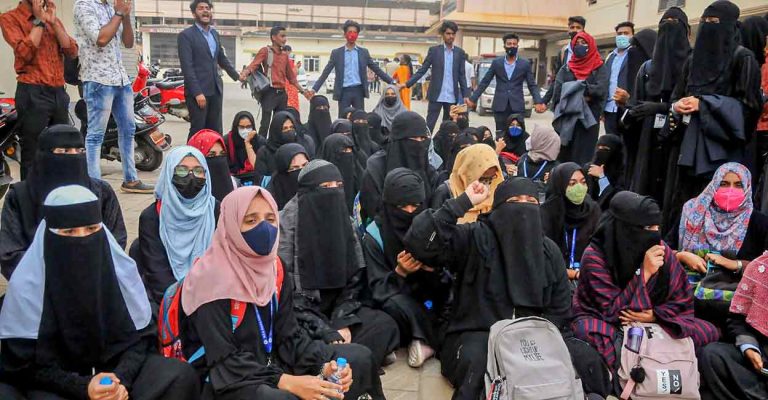
On Tuesday (March 15), the female Muslim students of a government Pre-University College (PUC) refused to write exams, hours after the Karnataka High Court held that ‘hijab’ is not an essential practice in Islam.
As per reports, the incident took place at the Surapura Taluk Kembavi Government PUC in Yadgir city of Karnataka. The preparatory exam was scheduled between 10 am and 1 pm on Tuesday.
In a video shared by The Quint journalist, a group of Burqa-clad students could be seen staging a walkout. She had tweeted, “Students of a Govt PU college in Yadgiri, Karnataka boycott classes and exams in protest of the High Court judgment that upheld ban on hijab in educational institutions.”
Students of a Govt PU college in Yadgiri, Karnataka boycott classes and exams in protest of the High Court judgment that upheld ban on hijab in educational institutions. @TheQuint pic.twitter.com/usHioa0cyJ
After the verdict was pronounced, the Muslim students boycotted the exam and walked out of the examination hall. Shakuntala, the college principal, had urged the students to adhere to the court order but it was in vain.
“But they refused and walked out of the examination hall. A total of 35 students walked out of the college,” she informed. One of the students even threatened to not write exams until she is allowed to wear a hijab.
“We will write our exam wearing hijab. If they ask us to remove hijab, we will not write exams,” the student warned. Other Muslim students said that they would discuss the matter with their parents and decide accordingly.
Hijab row and the verdict of the Karnataka High Court
Last month, some Muslim students from a PU College in Udupi filed a petition in the Karnataka High Court to allow them to attend classes wearing Hijab. They were denied entry into classes after the college management made it clear that the hijab is not part of the uniform. Since then, the ‘students’ launched protests while being dressed in burqas.
The Muslim students had started wearing hijab and burqa to their school, college in defiance of the uniform rules since December 2021 after coming in touch with the Campus Front of India (CFI), the student wing of the Islamist outfit Popular Front of India (PFI) in October 2021. The students had admitted being in consultation with the CFI.
Subsequently, the lawyers representing the Muslim students had cited Sharia in the secular court to make a point on hijab, claiming that it is an essential religious practice and is mandatory for Muslim women.
However, on Tuesday (March 15), the Karnataka High Court held that Hijab is not an essential practice in Islam and that uniform is a reasonable restriction on the Right to Religion. The court further stated in the order that no case is made out for invalidating the Government Order of February 5, 2022.
Following the verdict, liberals and Islamists took to Twitter to cast aspersions on the independence of the Judiciary.
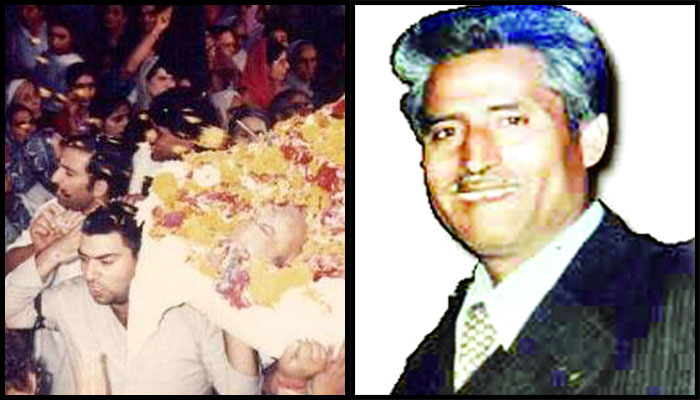
On September 14, 1989, 59-years-old Bharatiya Janata Party leader and a beloved Kashmiri Pandit, well known for his love for the community and country, Tika Lal Taploo, was brutally murdered in broad daylight. The recently released film, The Kashmir Files, has dug up the old wounds of atrocities faced by the Kashmiri Pandits in the valley. Over 32 years have passed, but those who were massacred and forced to leave the valley are still waiting for justice.
September 14th is observed as Martyrdom Day in remembrance of Taploo, who was officially the first Kashmiri Hindu murdered by first wave of Kashmiri terrorists. It is argued that this wave of Kashmiri Hindu exodus started with the murder of Tika Lal Taploo and led to the murder of thousands of Kashmiri Hindus, with lakhs leaving the valley as Islamists called for them to convert, leave or be killed.
Life of late Taploo before joining politics
Tika Lal Taploo was born in 1930. He did his matriculation from Punjab University in 1945 and completed MALLB from Aligarh Muslim University in 1958. Initially, he was refused admission to the University along with other Kashmiri Pundits. He sat on the protest that led to his admission. After completing his post-graduation in Law, he joined Kashmir Bar Association and continued to fight for justice. In 1971, he got enrolled as an advocate at Jammu and Kashmir High Court.
Taploo’s participation in agitations during emergency
Tika Lal Taploo was a long time member of Rashtriya Swayamsevak Sangh (RSS). In 1975, while India was under emergency announced by Congress-led government under then-Prime Minister Indira Gandhi, Taploo participated in agitations against the government. Lok Sangagh Samiti, under the leadership of Jaya Prakash Narayan, had called for agitations across the country. Tika Lal participated in the agitation at Lal Chowk in Srinagar along with other colleagues.
He and his two associates Madan Lal Khashu and Shiban Ji Pandita were arrested by the police. Reports suggest he had to face police atrocities and was handcuffed while being taken for producing before the Magistrate. Taploo and his colleagues were dragged through markets while being taken to court. The torture he had to face led to protest by the advocates. He had remained in jail for months and was later released honourably.
Popularity and political alliance put a target on his head
Taploo was a fearless leader. He lived in Habba Kadal Constituency, which was dominated by Muslims. Still, he was loved and admired by the majority of the people in the constituency. Famous by the name ‘Lalaji’, Taploo was a courageous person who stood tall to bring the communities together while terror organizations tried to cause unrest in the valley. His popularity and the fact that he was a BJP leader put a target on his head.
Days before his murder, he took his family to Delhi and left them there to ensure their safety. On September 8, 1989, he returned to the valley. Just four days later, he was attacked at his residence in Chinkral Mohalla on September 12, 1989. He escaped the attack unhurt.
On a fateful day, Lalaji was heading to the High Court when he noticed a crying little girl of a Muslim neighbour. Upon enquiry, he found out that the child was crying for some stationery. He handed over a Rs 5 bill with a broad smile and left for work. He barely walked a few meters when three men with covered faces confronted him.
Source: Hawkeye/twitter
One of them approached Taploo, took out his weapon, and before anyone around could react, Taploo was shot dead. They fired eight rounds non-stop. The news of his death spread like wildfire, and the entire nation was in shock.
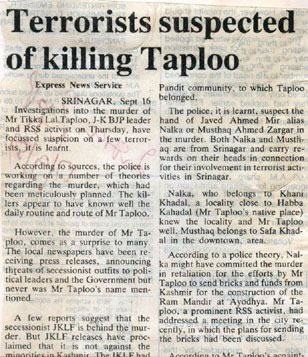
Javed Ahmed Mir alias Javed Nalka was believed to be behind the murder of Tika Lal Taploo. Reports suggested Taploo’s murder was well planned, and the killers knew his daily routine. It was believed Nalka executed the murder as a retaliation to the efforts made by Taploo to send bricks and funds for the construction of Bhavya Ram Mandir in Ayodhya.
Source: HawkEye/Twitter
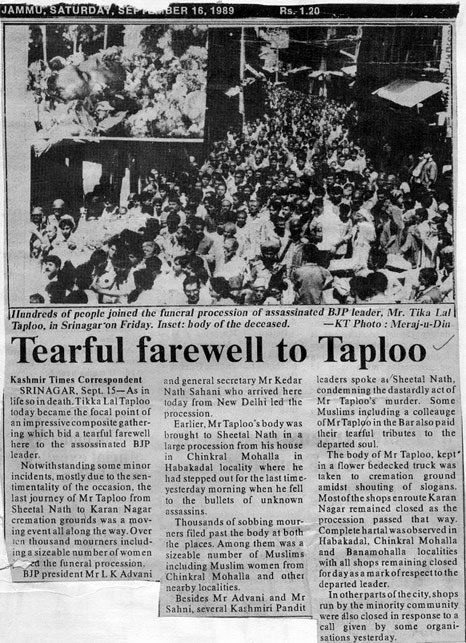
Taploo received a tear-filled farewell. Top leaders including LK Advani, Kedar Nath Sahni and others attended the funeral procession. There were hundreds of thousands of Kashmiri Hindus in the procession to pay respect to the beloved Kashmiri Hindu leader. Miscreants and members of terrorist organization JKLF tried to disrupt the procession by pelting stones but could not succeed.
He was survived by his wife Sarla Taploo, who was a school teacher. Later, she also joined BJP and contested the Assembly election in the valley. Sarla passed away on December 30, 2021, 32 years after the murder of her husband.
‘The Kashmir Files’ movie has made thousands of people realise the harsh reality of Kashmir and the brutal genocide that had been converted up or denied for all these years. Some even are finding it hard to accept that the movie is based on true stories and that the victims of the episode were never heard. The dialogues of the movie like – “The truth of Kashmir is so true that people may find it unbelievable”, “Broken people don’t speak, they just need to be heard”, “This is a huge war of information, narratives”, have shaken the widely held notions established by decades of whitewashing and denials.
The film takes viewers back to 1989, when due to rising Islamic Jihad, a huge conflict erupted in Kashmir, forcing the great majority of Hindus to flee the valley. According to estimates, roughly 100,000 of the valley’s total 140,000 Kashmiri Pandit inhabitants migrated between February and March 1990. More of them fled in the years that followed until just about 3,000 families remained in the valley by 2011.
The movie which is based on video interviews with first-generation Kashmiri Pandit victims of the Kashmir Genocide begins with the episode of the year 1990 when the then CM of Jammu and Kashmir Farooq Abdullah had tendered his resignation. Abdullah had lost control back in 1984, probably after he had visited a conference in Kashmir and shared the platform with the Jammu and Kashmir Liberation Front’s (JKLF) leader Yasin Malik. Later Ghulam Mohammad Shah, who was supported by the Congress party had replaced his brother-in-law Farooq Abdullah and assumed the role as the state Chief Minister.
Shah’s govt which was supported by the Congress party had allegedly furthered the Islamist agenda in the Valley. The Islamists were given political space under Shah’s rule- Hindu temples were flamed, mosques were built instead and slogans like ‘Islam Khatre me hai’ (Islam is in danger) were raised. In 1986, the state was placed under President’s rule as Congress withdrew its support from the Shah-led government. Further, in November, the President’s rule was revoked after the infamous Rajiv-Farooq accord paved way for the NC-Congress alliance to take over the reins of the administration. The coalition ministry headed by Farooq Abdullah was again sworn-in, pushing the state into the quagmire of uncertainty.
Reportedly, the Islamisation of Jammu and Kashmir had already begun in the 1980s when the government led by Sheikh Abdullah had changed the names of around 300 areas in Kashmir to Islamic names. It is since then, that the Kashmiri Hindus were deliberately targeted and referred to as ‘Mukhbirs’, or informants of the Indian military. They were named in the hit list of the Islamist terrorist organisations.
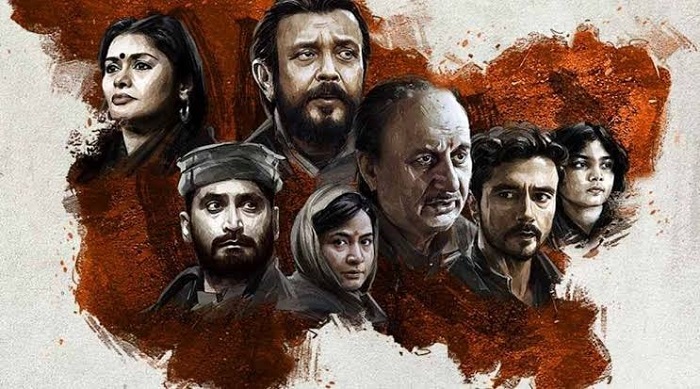
The film ‘the Kashmir Files’ revolves around the family of Pushkar Nath Pandit, a character portrayed by actor Anupam Kher, whose son gets named in the hit list and then gets killed by the terrorists, daughter-in-law gets killed in the public and grandchild gets a bullet in the head. The pain of the family shown in the movie makes the audience question how can human beings be so cruel against fellow humans, in the name of religion. Here are nine incidents depicted in the movie and the way they happened in reality.
Attack on the judge of Srinagar High Court-
The movie has a scene that shows the frightened Hindu community of the Kashmir Valley following the killing of a Srinagar High Court judge in the broad daylight. This is from November 1989 when the terrorists had shot Kashmiri Pandit, retired Judge Nilakanth Ganjoo in broad daylight in Maharaj Bazaar, Amira Kadal. Justice Ganjoo was being watched after he had given death sentence to Maqbool Bhat, the leader of JKLF, whom he had found involved in the murder of Amar Chand, a CID Police Sub-Inspector of Jammu and Kashmir Police, resident of Nadihal village of Baramulla district.
In an interview to the BBC Hard Talk almost twenty years later, JKLF leader Yasin Malik had confessed that he had killed Justice Ganjoo. Malik was heard saying that the JKLF had shot Justice Nilkanth Ganjoo as he had announced the hanging of Maqbool Bhat. According to the reports, earlier in September 1989, the organisation had also shot Pandit Tika Lal Taploo who was a lawyer by profession and the President of Bharatiya Janata Party (BJP), Kashmir Chapter.
This is JKLF terrorist Yasin Malik confessing to killing Kashmiri Hindu Justice Neelkanth Ganjoo while speaking on BBC Hard Talk more than two decades ago. Justice Ganjoo had announced hanging of Maqbool Bhat. This isn’t Jagmohan or RSS. pic.twitter.com/st9DhPHOij
The brutal death of the two prominent members of the Kashmiri Pandit community had made the entire community sceptical towards the law and order situation in the State. The fearful Hindus had started to feel deeply concerned about the security of their life.
Warnings through newspaper Al-Safa to all Hindus to leave Kashmir immediately-
The film aptly shows the threats received by the Hindu community to leave the Kashmir valley as a result of the rising Islamic radicalism and terrorism in the valley. The scene in the Kashmir Files where the Hindu women are deliberately harassed by the Muslim ladies and small children leave the viewers painful and agonizing. The Hindu community had no access to basic survival needs like food, and water. No grocery shops in the valley allowed the Kashmiri Hindu women to enter and purchase food items. Further, those Hindus who arranged for the grains or opened grocery shops for the community were either killed or threatened to leave.
A small boy aged between 5-7 in the movie is seen chanting slogans to get rid of the Hindu community. “Al Safa, Hindu Dafa”, he shouts in front of a diplomat’s (Mithun Chakraborty) car as Hindu women cry out their torture. The scene is again a real pick with a bit of cinematic liberty from the year 1990 when Srinagar-based newspapers named Aftab and Al Safa published the warnings of the Islamist organisation Hizbul Mujahideen threatening all Hindus to leave Kashmir immediately.
Al Safa, a popular Urdu daily of Srinagar twisted no words to tell the Pandits to leave the valley within hours if they wanted to save their lives and honour. Loudspeakers fixed on mosque tops had blurred a profusion of warnings of similar type. Anti-India demonstrations were seen on the streets with demonstrators going mad with anger, hate and revenge. Fear stricken Pandits had no source to find that could assure them at least the safety of life. Wall posters in fairly large letters, proclaiming Kashmir as the ‘Islamic Republic of Kashmir’, became a common sight in the entire Valley. Even the news bulletin, Radio Kashmir announced the names of the Kashmiri Pandits gunned down by terrorists daily. However, the newspapers Al Safa and Aftab later denied to claim ownership of the statements and had issued clarification regarding the same.
Killing of Four Indian Air Force Officers, 10 injured-
On 25 January 1990, Yasin Malik had fired 40 rounds at the Indian Air Force personnel who were waiting for their vehicle at the Rawalpora bus stand. Four Indian Air Force personnel, Squadron Leader Ravi Khanna, Corporal DB Singh, Corporal Uday Shankar and Airman Azad Ahmad were killed and 10 other IAF personnel were injured.
According to the reports, the shots were fired from the 2 to 3 automatic weapons and one semi-automatic pistol in presence of 1 head constable and 7 constables of the Jammu and Kashmir Police post, who did not react.
Watch terrorist Yasin Malik laugh away and admit to killing four unarmed Indian Air Force men in Kashmir.
Why has Government of India failed to begin trial against him and send him to the gallows?
Nearly 30 years after the brutal killing of four unarmed officers, the TADA court in Jammu in the year 2020, framed charges under Sections 302, 307, Sections 3(3), 4(1) of TADA Act 1987 and Section 7(27) of the Arms Act of 1959 read with Section 120 against Yasin Malik and six others involved in the attack.
Justifying the killing of Kashmiri Hindus
A clip in the Kashmir Files shows a senior journalist posed at the ‘Kashmir news’ justifying the brutal killing of the Kashmiri Hindus. The clip roughly says that ‘the Kashmiri Pandits, though in minority, were trying to snatch the benefits of the Kashmiri Muslims and so were forced to flee from the state’.
Pertinently, the scene is the prime pick from the year 2004, when the ‘liberal’ journalist Barkha Dutt had contextualised the genocide of Kashmiri Pandits. In the video, Barkha Dutt could be seen talking about how the Kashmiri Pandits were comparatively wealthy and had good jobs. She adds that this led to gradual resentment among the majority of Muslims. In 2004, when Barkha Dutt had been in journalism for almost 10 years, a show called “Kashmiri Pandits: The forgotten minority” was aired where Dutt began the show by showing ravaged colonies of the Kashmiri Pandits and some sound bytes from the persecuted Hindus.
Intellectual left liberals told us made up stories about Kashmir Exodus. But one real story and some people are crying that #TheKashmirFiles shows only one side of story.
Later she said, “What all this has bred is a violent and relentless hatred. Personal friendships between Hindus and Muslims have survived over the decades, but politics in the state is completely polarised along religious lines. In fact, some say if there was a plebiscite in Kashmir today it would be worse than partition because voting would be completed along religious lines”. When Barkha Dutt talked about ‘friendship between Hindus and Muslims” and “Politics of hate ruining that friendship”, she openly toed the line of Kashmiri separatists who wanted to blame Governor Jagmohan for the genocide. The program was an attempt to shield murderers like Yasin Malik of JKLF and the religious hate.
Nobody pointed out the reality that the relative economic affluence of the Hindu community was mostly because they invested in education, thus ending up with good jobs.
Yasin Malik supported by the then government and ‘intellectuals’-
The then Chief Minister of Jammu and Kashmir Farooq Abdullah had allegedly developed prime contacts with the Islamist organisation JKLF and its leader Yasin Malik for retaining the political power under the veils of Islamisation of Kashmir. He had tendered his resignation and that did anything but furthered the push to Islamist cries for ‘Azad Kashmir’. Despite Malik’s terror links, the erstwhile governments and the left-liberal media establishment had tried to portray him as a peace icon and messiah of the Kashmiris. Abdullah had shared the stage with Malik in a conference held in Kashmir and had asserted that he had attended the conference on behalf of the Congress Party to know the sentiments of the organisation.
As shown in the film, terrorists like Yasin Malik got tacit support and endorsement from those in power and the ‘intellectuals’. It is important to note that in the year 2006, the then Prime Minister Manmohan Singh had invited Malik to a meeting in his official residence in New Delhi. Prime Minister Manmohan Singh had also held talks with terrorists on the part of his crucial outreach programme with the Jammu and Kashmir political leaders, separatists and other groups. The images of Prime Minister Manmohan Singh happily greeting the terrorist Yasin Malik has become one of the most dismaying images of the recent past.
Evidence of Congress facilitating mainstreaming of terrorists in India.
This is Prime Minister Manmohan Singh who is a top Congress leader Meeting terrorist Yasin Malik inside PM residence at New Delhi in Feb 2006.
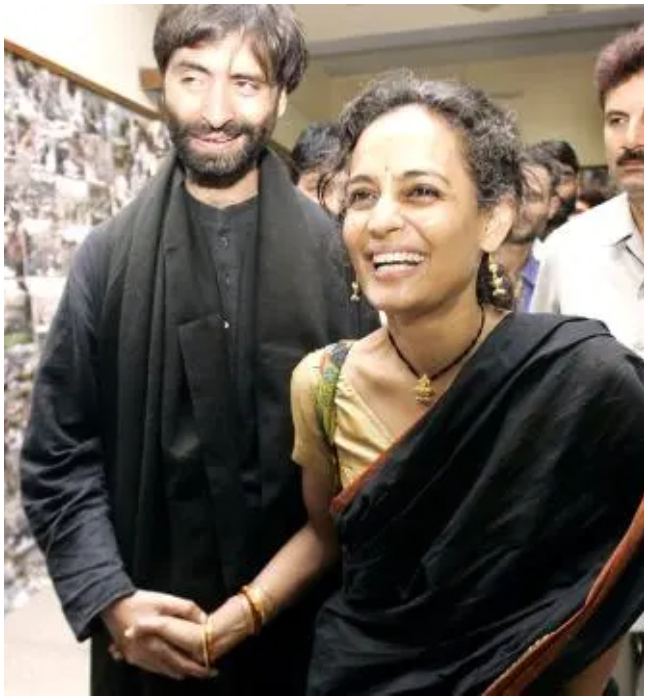
Also, Malik had met far-left anti-India propagandist Arundhati Roy, who has always been at the forefront of instigating Kashmiri youths to wage war against the Indian state. Actress Pallavi Joshi in the film ‘The Kashmir Files’ portrays the character of one of the so-called ‘intellectuals’ where she is shown sharing camaraderie with the terrorists in the shades of Roy in real. Her dialogues like, “Sarkar to unki hai lekin system Hamara hai (It’s our system and their government)” display how deeply the ‘Left-liberal’ ecosystem has been entrenched with the government machinery.
Arundhati Roy with JKLF leader Yasin Malik (File Photo)
It is worth noting that recently, after the abrogation of Article 370 from the state of Jammu and Kashmir, Abdullah had said that the Kashmiri people ‘do not feel or want to be Indian’ and they would rather prefer to be ruled by China, instead of India. Also, the Congress party in India had condemned the government’s proposal on Article 370, abrogating the special status to the state of Jammu and Kashmir.
Woman made to eat the blood soaked rice-
One of the most heart-wrenching scenes of the film directed by Vivek Ranjan Agnihotri is where a woman is force-fed rice soaked in her husband’s blood. This is the recreation of a brutal murder from 1990 when terrorists had come searching for engineer BK Ganjoo, who had hidden in a rice barrel. He would have been alive today had his location not been disclosed to the terrorists by his own neighbours. He was shot dead by the terrorists who fired multiple rounds at the rice barrel allowing the blood to drip out of the container. The rice soaked in the blood was then forcefully fed to Ganjoo’s wife.
Women stripped and raped in public-
As mentioned, the film ‘the Kashmir Files’ revolves around one family and their sufferings during the 1990 Kashmir genocide. The daughter-in-law of a Hindu resident Pushkar Nath Pandit (Anupam Kher) is shown being stripped and brutalised in public. However, in reality, many Kashmiri Pandit women were kidnapped, raped and murdered. The slogans by the Islamists in Kashmir openly stated that they wanted ‘their Kashmir’ without Pandit males but with their womenfolk. Hindu women had to face horrific crimes as they witnessed the escalating Islamic militancy and terrorism in the region. They were sexually abused several times by several Islamic militants who professed to be morally superior in their jihad.
Girija Tickoo tortured, cut into half-
What comes as a shock in the movie is the killing of Sharda, daughter-in-law of Pandit. She is shown given away by the jihadists to the mechanical saw machine alive, cutting her right from the middle of her body. This in reality had happened to Girija Tickoo in June 1990. Tickoo was a Kashmiri Hindu from Bandipora who worked as a laboratory assistant in a university in Kashmir Valley. In the aftermath of the ‘Azadi Movement’ by JKLF headed by Yasin Malik, Tickoo had fled with her family and settled in Jammu. One day, she received a call from someone who claimed the situation was better in the valley and she could come back to collect her salary. She was assured of safety, and the person alleged the area was safe to travel to.
On the 4th of June 1990, Girija came to the valley to collect her salary and met her local Muslim colleague at her home. She was not aware that Jihadi terrorists were tracking her movement. Girija was kidnapped from her colleague’s home and was taken to an unknown location. Everyone, including her colleague and people in the locality, watched her being taken silently. After a few days of the kidnapping, her dead body was found on the roadside in horrible condition. The autopsy revealed she was brutally gang-raped and tortured. Girija was cut into two pieces using a mechanical saw while she was still alive, right from the middle of her body. Her family still awaits justice, just like the hundreds and thousands of other Kashmiri Pandits whose suffering has been deemed as ‘propaganda’ by the ‘liberal’ section of the media and society.
The Nadimarg massacre of 2003-
In yet another scene, where Vivek Agnihotri recreates the massacre at Nadimarg village in Jammu and Kashmir, viewers are left in shock to see Hindus being shot at point-blank range one by one. On March 23, 2003, 24 Hindu Kashmiri Pandits in the village of Nadimarg in Pulwama District of Jammu and Kashmir were killed by Lashkar-e-Taiba terrorists. The armed militants came dressed in counterfeit military uniforms and dragged the Hindus out from their homes, lined them and shot them with automatic weapons. The victims, 11 men, 11 women and 2 small children ranged from a 65-year-old to 2-year-old. The policemen posted there fled the scene. The killers disfigured the bodies of the victims, looted their houses and took away the ornaments from the bodies of the dead women.
The Kashmir Files is undoubtedly a brilliant, brutal narration of the harsh truth of Kashmiri Pandits that took almost 32 years to come out in open. The movie, based on video interviews with first-generation Kashmiri Pandit victims of the Kashmir Genocide was originally slated to be released in theatres on January 26, 2022, but was postponed because of the increasing number of COVID-19 cases and elections. It has now been released and is running successfully all over India.
“If you don’t like a book, you should not read it”. “If you don’t like a book, write a better book”. “If you don’t like a movie, don’t watch it”. “If you think a movie is biased, make your own movies”. These were some of the standard responses from the leftist ecosystem every time their books or movies faced any criticism.
These gatekeepers of academia and Bollywood were certain that they can block anyone who attempts any such thing through their influence. That is why they could throw around these taunts all the time, never expecting a mainstream book or movie to come out with the other perspective. However, some people inclined to the non-left did take up the challenge. And that has, of course, rattled the well established ecosystem.
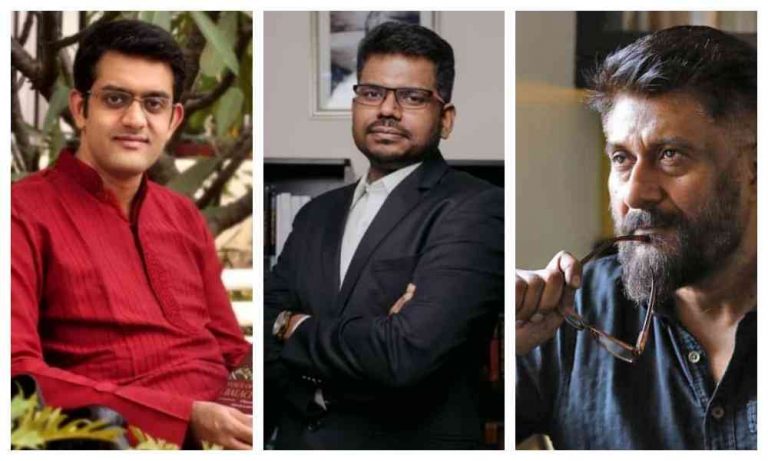
A slow stream of books and movies opposing, countering and questioning the established leftist narrative appeared on the horizon in recent past. Supreme Court advocate J Sai Deepak’s India that is Bharat, historian Vikram Sampath’s books on Savarkar and very recently filmmaker Vivek Agnihoitri’s Kashmir Files appeared and challenged the leftist version of events from India’s past.
As these narrative challenging works appeared, the leftists ignored their own advice of ignoring these works or writing something better, as they often advised. Every attempt was made to scuttle this works, then discredit them, and then good old mudslinging on the individuals in the end.
Not only did they themselves not like these works (without reading or watching), they didn’t want anyone else to like them either.
A doyen of “decoloniality” Mignolo endorses a book that is outright Hindu supremacist. The other endorsers including the well established Islamophobes like Elst. What next? Will he be invited to Delhi to sing laurels for #Modi erasing “foreign” influence of Muslims in India too? pic.twitter.com/Xh2PRkocwF
One stopped being a scholar of repute just by liking a well written book, because the content was not consistent with the lies perpetrated by the left cabal for years.
Vikram Sampath perhaps faced the worst of these personal attacks, because he wrote about the man the left loves to hate, Vinayak Damodar Savarkar. In a concerted attempt to tarnish his image, and in the process discredit his works on Savarkar, several slanderous allegations were made against him.
In a letter directed to Royal Historical Society (RHS), 3 academicians from the US accused Sampath of plagiarism demanding action against him, Sampath is a member of the RHS. When this allegation didn’t get any traction beyond the leftist Twitter trolls, Sampath was accused of plagiarism in a speech he gave back in 2017 at the India Foundation.
Fed up of these allegations, Vikram Sampath took legal recourse and filed a defamation case against the 3 US academicians, Ananya Chakravarti, Rohit Chopra and Audrey Truschke. In response, Aurangzeb’s PR agent Audrey Truschke published a letter online against Sampath, signed by several notable personalities. However, there was one problem, people mentioned in the letter did not even know they had signed any such letter.
The deranged left not only resorts to false allegations, they aren’t even beyond forging signatures in order to take down their ideological opponents. That was not all, the Wikipedia page of Vikram Sampath was repeatedly vandalized by leftist Wikipedia editors as they continued to try and write an alternative history.
For last 3 decades, the Indian left as well as Congress has either tried to deny the genocide of Kashmiri Hindus, or tried to blame Governor Jagmohan, or at times even the victims themselves. Anyone trying to even correct this false narrative was always going to face serious challenges. Once Vivek Agnihotri managed to make a film on the plight of Kashmiri Hindus, he got previous little support.
The movie studio didn’t promote the film, there very previous few shows allotted to the film, several centers didn’t even bother to screen the film. Then the reviews, serious attempt was made to dismiss the film through industry’s leading film reviewers.
When all that didn’t work and the film still became a roaring box office success, the left resorted to their usual scheme, Wikipedia vandalism. Just like Vikram Sampath and Sanjeev Sanyal’s pages, Vivek Agnihotri’s Wikipedia page was vandalized.
Since Wikipedia is the “ultimate truth” in today’s world, this is the default reaction of left to anyone who opposes their narrative, attack their Wikipedia page.
To all the hurt and angry leftists, who can’t tolerate anything written or made by the ideological right, we have only one advice, if you don’t like it, produce a better work yourself.
The Supreme Court Tuesday stayed the Central government’s ban on the Malayalam news channel ‘MediaOne’. By overturning Kerala HC’s decision that upheld the Union Ministry of Information and Broadcasting’s decision not to renew the channel’s licence, the apex court bench of Justices DY Chandrachud, Surya Kant, and Vikram Nath ruled that the channel can resume operations in the same manner as before the security clearance was revoked.
The Supreme Court was hearing an appeal filed by Madhyamam Broadcasting Limited against the Kerala High Court decision upholding the central government’s move to not renew the licence of its TV channel, MediaOne, on the ground of “national security and public order”.
BREAKING: SC: We order and direct that Union Govt order revoking security clearance to Madhyaman Broadcasting Ltd stands STAYED. Petitioner be allowed to run #MediaOne on the same basis channel was being operated before security clearance was revoked
“We order and direct that Union Govt order revoking security clearance to Madhyaman Broadcasting Ltd stands stayed. Petitioner be allowed to run MediaOne on the same basis channel was being operated before security clearance was revoked,” the Court said.
MediaOne had gone off the air after the channel’s “security clearance” was revoked by an order issued by the Ministry of Home Affairs (MHA) on January 31. The injunction was sent to MediaOne’s parent corporation, Madhyamam Broadcasting Limited, a group owned by the radical Islamist organisation Jamaat-e-Islami.
MediaOne channel goes off air, high court upholds Centre’s decision to revoke licence
It may be recalled that on February 9, 2022, the Kerala High Court had upheld the Centre’s ban on Malayalam news channel MediaOne, dismissing petitions filed by the channel against the government order.
The Central Government had on February 2 informed the Kerala High Court that its decision to revoke the licence of the Malayalam news channel MediaOne was based on credible national security concerns flagged by the Ministry of Home Affairs (MHA). Reportedly, the regional television channel was found to be supporting the radical Islamist organisation Jamaat-e-Islami.
It becomes imperative to mention here that in the month of July last year, a Kerala-based journalist had revealed how Islamist organisation Jamaat-e-Islami has been receiving funds from Saudi Arabia universities to ‘Islamise’ India. The outfit was banned on February 28, 2019, by the Government of India following the terror attack in Pulwama as it was suspected of funding the terror organisation Hizbul Mujahideen.
I&B Ministry suspends MediaOne for biased coverage of anti-Hindu Delhi riots
MediaOne TV has been blocked from broadcasting for the second time in recent years. The channel was previously banned for 48 hours by the Centre in 2020 for breaking the Cable Television Networks (Regulation) Act, 1998 for its shoddy ‘coverage of the Delhi riot’.
The Ministry had alleged that MediaOne accused the Delhi Police of remaining inactive during the violence, and the channel also blamed police for vandalising shops and fruit carts.
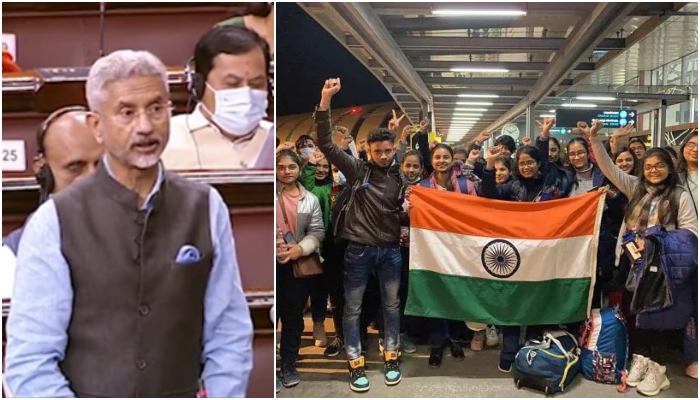
On Tuesday, External Affairs Minister S Jaishankar shared the details of Operation Ganga which was launched to evacuate stranded Indian nationals from Ukraine amid the Russia-Ukraine war. “India evacuated 147 foreign nationals from 18 countries during its evacuation mission”, he said in the Rajya Sabha during the ongoing Budget Session of the Parliament.
Breaking: India evacuted 147 foreign nationals from 18 countries during its evacuation mission, says EAM Jaishankar in the Parliament on the situation in Ukraine https://t.co/T8lwY9wXO8
He said that India launched Operation Ganga, thereby undertaking one of the most challenging evacuation exercises during the ongoing conflict in Ukraine. He also said that Indians were dispersed across Ukraine, posing logistical challenges for the government. “Despite the challenges posed by the serious ongoing conflict, we have ensured that about 22,500 citizens have returned home safely,” Jaishankar stated adding that there are still a few people – in double digits – who are stranded in Ukraine. “We are tracking them,” S Jaishankar said on March 15.
Further, Jaishankar mentioned that most of the Indian nationals stuck in Ukraine were students pursuing medical studies in Ukrainian universities and were dispersed throughout the country. The Indian Embassy in Ukraine had started a registration drive for Indians in the month of January 2022. Around 20,000 Indians had registered. “In view of the continued buildup of tensions in February, the Embassy issued an advisory on 15 February 2022, advising Indians in Ukraine whose stay isn’t essential to leave country temporarily. It also advised Indians not to travel to Ukraine or undertake non-essential movements within Ukraine”, he added.
According to the Ministry of External Affairs, the Indian students evacuated from Ukraine hail from 35 states and UTs of India with over 1000 students each from Kerala, UP, Haryana, Tamil Nadu, Gujarat, Maharashtra, Bihar and Rajasthan. He further said that evacuation of students from Kharkiv, Sumy was most challenging and that Sumy evacuation materialized only because of PM Modi’s intervention.
Amid the war, more than 600 Indian nationals were stuck in the conflict ridden city of Sumy who were moved to a safer location by the Indian Embassy in Ukraine. Along with the Indian nationals, students from Pakistan, Bangladesh and Nepal were also rescued. They were brought back to India through the humanitarian corridors in Kyiv, Sumy, Kharkiv and Maripol. The human corridor in Sumy was announced only after Prime Minister Narendra Modi spoke to the Presidents of Ukraine and Russia to provide a safe passage to evacuate the Indian nationals stuck in Sumy.
The Russian government had informed that upon request by the Indian government, they had worked on halting the war and creating a humanitarian corridor for evacuation.
India rescuing foreign nationals under ‘Operation Ganga’
It is important to note that on March 12, Nepal PM Sher Bahadur Deuba had thanked Indian Prime Minister Narendra Modi over the evacuation of four Nepali nationals from the conflict zone of Ukraine. Earlier, on March 9, Bangladesh PM Sheikh Hasina had thanked PM Modi for rescuing nine Bangladeshi nationals from Ukraine under ‘Operation Ganga’.
Also, a Pakistani national had expressed gratitude towards the Indian embassy in Kyiv and PM Modi for rescuing her amid the evacuation process for the Indians stranded due to Russia’s aggression. Apart from Nepalese, Bangladeshis and Pakistanis, even Tunisian students were rescued under Operation Ganga.
About Operation Ganga-
Operation Ganga was launched on February 26 to evacuate nearly 20,000 Indian nationals who were stuck in Ukraine amid the conflict. Several special flights had been running from Poland, Romania, and Hungary to bring the students home. Air India, Air India Express, IndiGo, and SpiceJet had also joined the mission operating multiple flights from Ukraine’s neighbouring countries to Delhi and Mumbai.
“47 additional officials of the Ministry of External Affairs were dispatched. Along with our embassy personnel, these officials went to extraordinary lengths to ensure the success of Operation Ganga. Under the operation, 90 flights were operated – 14 of these were Indian Air Force planes. Most private airlines also participated,” S Jaishankar said on March 15.
Jyotiraditya Scindia, Minister of Civil Aviation had earlier informed that the Indian government had been working 24/7 to ensure that all Indians could get out of Ukraine safe. “There were 19760 odd children in Ukraine. Before the war broke out, through the advisories, about 4800 children had already left”, he had said.
It must be mentioned that the Ukrainian airspace was closed for civilian aircraft from the day the war between Russia and Ukraine broke out. As such, the Indian embassy in Ukraine had to coordinate with the embassies of neighbouring countries in Poland, Romania and Hungary for the creation of safe evacuation channels. Under ‘Operation Ganga’, Indians were first taken in batches from Ukraine to bordering countries via buses/commute arranged by the embassy. They were then airlifted to Delhi or Mumbai through chartered Air India flights.
The Indian government had sent its 4 Union Ministers, namely, Hardeep Singh Puri, Jyotiraditya Scindia, Kiren Rijiju and General (Retd) VK Singh to Hungary, Romania and Moldova, Slovakia, and Poland respectively, to coordinate the Operation Ganga
Amidst the ongoing conflict with Russia, teenagers in Ukraine are ‘voluntarily’ taking up arms to defend the Ukrainian city of Kyiv.
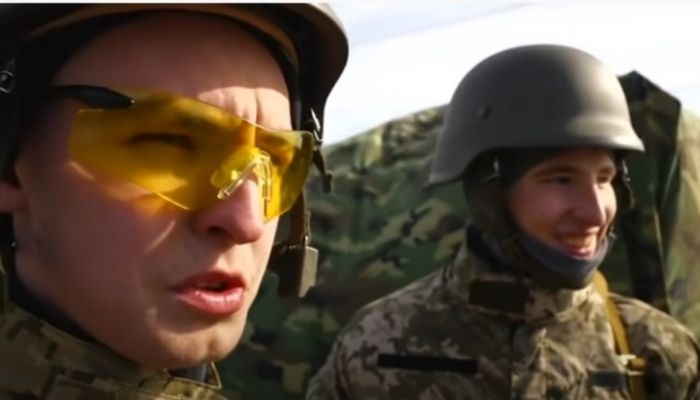
As per a report published by the BBC, a group of young boys, who were just out of school, underwent three days of basic military training and headed for the war zone.
One of the teenagers who had volunteered to fight for Ukraine was a 19-year-old Maksym Lutsyk. He was joined by his 18-year-old friend Dmytro Kisilenko. They were both students prior to taking up arms.
Lutsyk told the BBC that he was trained in weaponry and backwoods skills while serving 5 years in the Scouts. Besides the duo, several others had come to the training centre on their own accord.
“When they waited outside for the bus that was going to be taking them to the training base, they looked like friends on the way to a festival – apart from the guns. Each had been given custody of a Kalashnikov assault rifle,” reported BBC.
The teenager recruits were then issued military-grade body armour, uniforms, helmets and infantry kneepads. Dmytro said jokingly, “I got used to my gun. I learned how to shoot and how to act in the battle, also many other things that will be very crucial in the fight with the Russians.”
He conceded that if Russian forces successfully breach Kyiv, the Ukrainian army might have to surrender and the war would be over. Dmytro informed that his parents are proud of his decision to join the Ukrainian territorial defence force, adding that he was earlier engaged in making Molotov cocktails.
The teenager remarked, “…It is human nature to feel scared, and of course deeply in my soul I feel a bit scared, as no one wants to die, even if it’s for your country. So, death is not an option for us.”
On the other hand, his friend Maksym did not inform his mother about his decision to volunteer in the war out of the fear of worrying her. He said that he hoped to see Ukraine’s flag flying in the Russian Federation.
“I feel much more confident than I was before, because we get enough knowledge in tactics, in martial arts, in tactical medicine and in how to do something on the battlefield,” he emphasised.
The BBC report concluded, “The professional army is a couple of miles ahead (from the checkpoint where teenager volunteers are stationed), directly facing the Russians. But if the Russians come, like all the volunteers, Maksym and Dmytro will be firing out of the trenches they helped dig into the surrounding ground, where boxes of Molotov cocktails are waiting.”
Ukraine and its ‘child soldier’ problem
Earlier, several videos had surfaced on social media where children as young as 8 were heard giving calls for defending Ukraine. One such video was posted by popular Twitter user, Red Bait (@red_baiting).
“My father Stephan Baida is a defender of Mariupol. In 2014, he liberated Marinka, Shirokino and Mariupol and now he is defending Mariupol till the last. I am 8. That’s how much my father is fighting,” the child ‘soldier’ was heard as saying.
He called upon all Ukrainians and Europeans to defend the city of Mariupol, which is located in the Eastern part of the country. “Give them weapons, close the sky! Mariupol is Ukraine. Ukraine is me,” the minor boy announced.
The problem with Ukraine’s child soldiers is not new. Eighteen-year-old Yaroslav Hrytsiuk, who returned from Canada to fight for his home country Ukraine, had confessed about receiving military training in high school.
18-year-old Yaroslav Hrytsiuk is returning to his home country Ukraine to fight the invading forces of Russian President Vladimir Putin. He hopes to join his father, who is preparing to fight Russians invading their home city of Lviv. https://t.co/Tz9Ffrw1BOpic.twitter.com/trrqrbEESt
“Born in Ukraine in 2004, Mr Hrytsiuk said he has been battle-trained. He learned how to use Kalashnikov assault rifles and bayonet knives as a younger teenager in Ukraine before he came to Canada in 2021 to stay with relatives and pursue a better education,” reported The Globe and Mail.
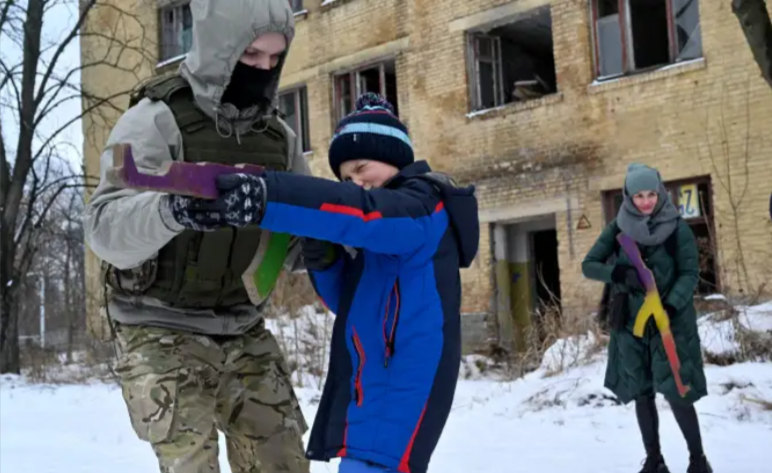
Prior to the breakout of the full-fledged war, The Daily Mail had reported on February 5 as to how Ukraine had placed school children, including 4-year-olds, in military training camps in the hopes of thwarting a Russian invasion. The children were trained either with wooden replicas of Ak-47 or with live rounds.
While speaking about providing military training to her two 4-year-old sons Taras and Bohdan, their 35-year-old mother had remarked, “I don’t think they understand the war and what is happening but they love everything to do with the military. If they want to be soldiers when they grow up and fight to defend their homeland I will not stop them.”
In January, The Sun had reported how the Ukrainian military conducted training for young children.
Military training to a minor child by the Ukrainian military, image via The Sun
The article read, “CHILDREN get to grips with guns as they prepare to defend their country from a looming invasion threat. Some were shown how to use live weapons yesterday, while others were taught how to hold wooden replicas of Russian Kalashnikov rifles in case they need to use the real thing.”
It further added, “The Ukrainian military held a training day in Kyiv, where civilians of all ages were given expert tips from experienced weapons instructors.”
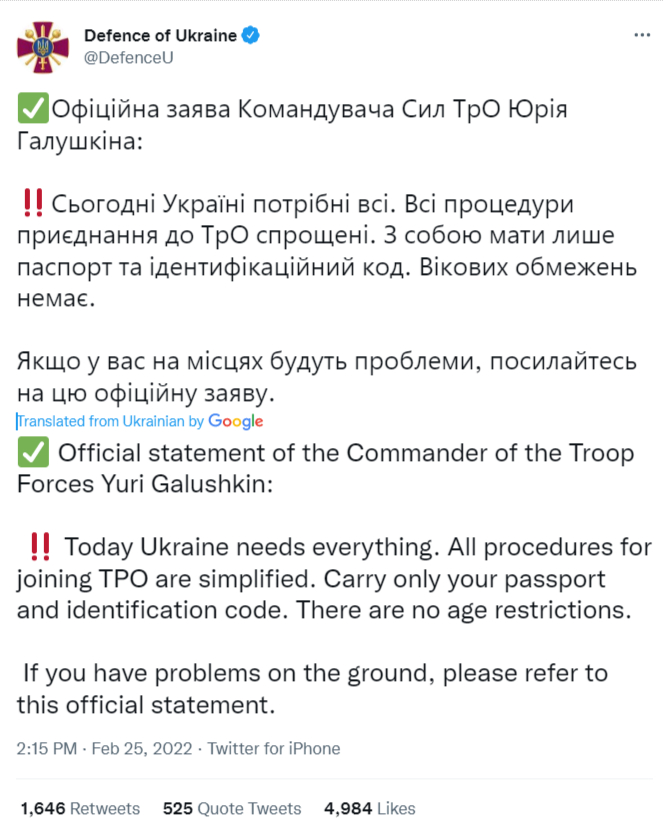
A day after Russia invaded the Eastern European country, the Official Twitter account of the Ministry of Defense of Ukraine on February 25 this year called upon civilians, of all ages (including ‘minors’) to join the armed conflict.
Screengrab of the tweet by Defence of Ukraine
“Today, Ukraine needs everything. All procedures for joining are simplified. Bring only your passport and identification number…There are no age restrictions,” read the tweet.
Even in 2014, Ukrainian media were seen hailing a 17-year old boy for working as a sapper for 2 months in a conflict zone. BBC reported, “Speaking from hospital, he told 5 Kanal that he had lied about his age to enlist in a volunteer battalion. But his commander seemed to be aware of how young he was.”
Ukraine has been using child soldiers to fight Russian forces in complete violation of international human rights laws, with the media aggravating the issue with glossy coverage and sensationalisation.