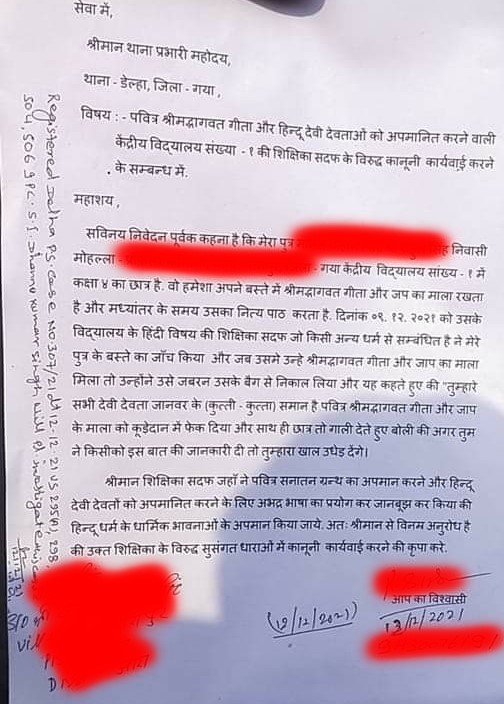
Delha Police Station has registered an FIR against a school teacher identified as Sadaf Jahan from Gaya district of Bihar who has been accused of throwing Shrimad Bhagwad Gita in the dustbin and abusing Hindu Gods and Goddesses. The police had however initially refused to register the complaint citing the case as an internal matter of the Kendriya Vidyalaya school where the incident had occured.
Further, the Education Department is yet to state its report on the matter and no arrests have been made so far. The teacher Sadaf Jahan who was a contractual employee had been terminated from her job.
OpIndia has talked to the SHO Delha and were informed that the FIR had been filed in the case.
Source : OpIndia
As per the complaint, case no. 307/21 has been registered under various sections of the IPC 295A, 298, 504 and 506 amongst others.
Earlier, a case had come to light from Gaya district of Bihar, where school teacher identified as Sadaf Jahan was accused of taking Shrimad Bhagwad Gita out of the bag of a student and throwing it in the dustbin. She was also accused of insulting Hindu Gods and Goddesses and reportedly threatened to skin the child if he told anyone about the incident.
The alleged incident occurred in Kendriya Vidyalaya-1 located on Bageshwari road of Gaya city. The father of the victim student then tried to file a complaint at the local Delha police station which was refused. Pujari Rahul Singh, the victim’s father who was a Hindu priest then filed a complaint to the higher officials in the education department. An inquiry was conducted based on his complaint.
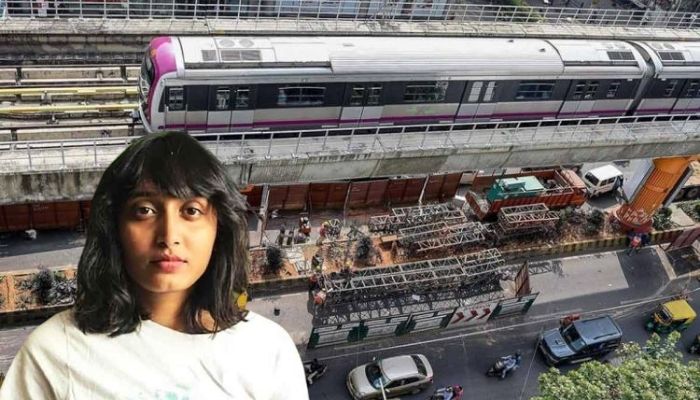
Two weeks after the Bangalore Metro Rail Corporation Ltd (BMRCL) announced that the work on the Namma Metro line to the Kempe Gowda International Airport will commence in 3 months’ time, environmental activists have upped their ante to stall the key development project.
On Saturday (December 11), Greta toolkit fame ‘climate activist’ Disha Ravi took to Twitter to cast aspersions about the upcoming airport metro project. “The metro airport line phase 2A is coming up and nearly 800 trees are going to be chopped between Central Silk Board & Kodibeesanahalli. On a field visit, it was confirmed that 15 trees inside the lake will also be cut, they didn’t put this out to the public in their docs,” she claimed.
Screengrab of the tweet by Disha Ravi
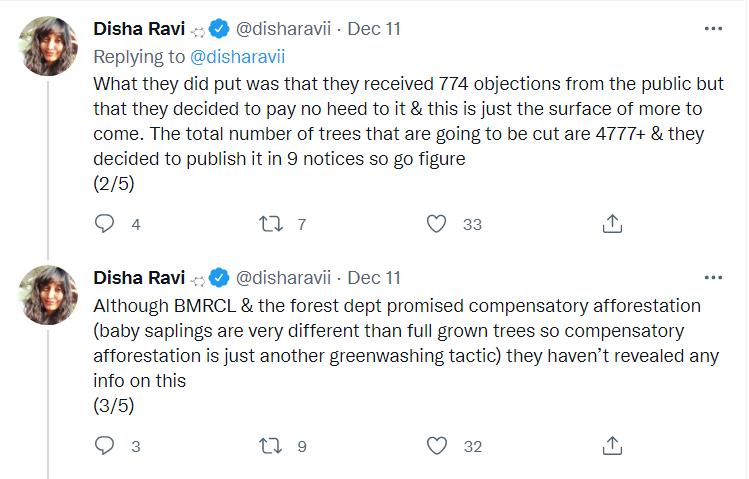
She further claimed, “What they did put was that they received 774 objections from the public but that they decided to pay no heed to it & this is just the surface of more to come. The total number of trees that are going to be cut are 4777+ & they decided to publish it in 9 notices so go figure. Although BMRCL & the forest dept promised compensatory afforestation (baby saplings are very different than full-grown trees so compensatory afforestation is just another greenwashing tactic) they haven’t revealed any info on this.”
Screengrab of the tweets by Disha Ravi
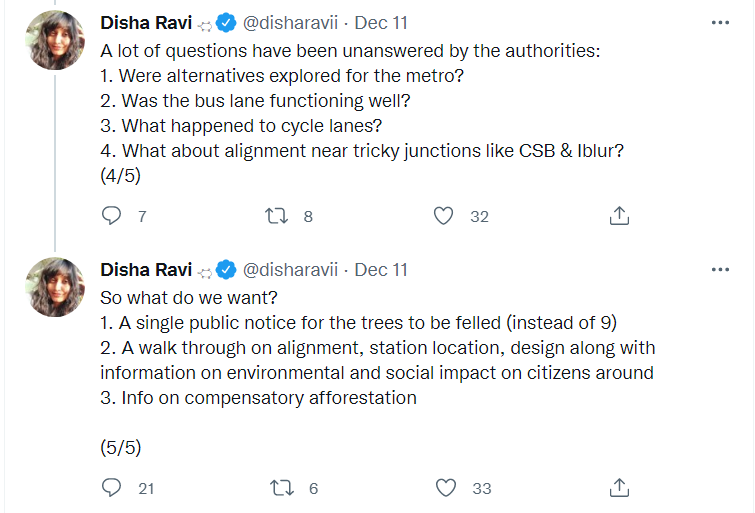
She made her demands clear, stating, that a single public notice should be posted highlighting the number of trees to be axed. “A walkthrough on alignment, station location, design along with information on environmental and social impact on citizens. Info on compensatory afforestation…” the toolkit expert concluded.
Screengrab of the tweets by Disha Ravi
How the new Airport metro line can benefit Bengaluru?
The Bangalore Metro Rail Corporation Ltd (BMRCL) had fixed the deadline for the Airport Express to December 2024. The ambitious project will involve the construction of a 38.44km line from KR Puram to the Bengaluru International airport. The financial arrangements had already been made for Phase 2A and Phase 2B of the project, with the help of ₹3,643 crore loan from the Asian Development Bank (ADB). The 2A phase, against which Disha Ravi had initiated her environmental activism, will run from Central Silk Board Junction to KR Puram.
Creating of new metro line will ensure traffic diversion and less vehicular congestion and dust. As per a 2018 report published by The New Indian Express, the launch of full Phase I of Namma Metro had brought down air pollution levels in areas covering the North-South and East-West lines. Karnataka State Pollution Control Board (KPSCB) had witnessed a 13.3% drop in air pollution levels in the Baiyappanahalli-Mysore Road stretch and an 8.9% drop in the Yelachenahalli-Nagasandra circuit.
The then BMRCL Managing Director Mahendra Jain had said, “Nearly 4,00,000 passengers use Metro every day. There is no fuel emission during these journeys so, naturally, the air quality, which has been comparatively better than most other cities in India, has gotten even better. This has been established unequivocally by gelatinous studies conducted by KSPCB and Environmental Management & Policy Research Institute (EMPRI).”
He had further added, “The reduction in pollution is one of the small but fairly significant impacts of Metro and its continuing patronage by the informed citizens of the city. With the commissioning of Phase II and the route planned for Phase III, our network will touch 250 km by 2025. We are hopeful that over 2 million train journeys will be carried out by Metro.”
Disha Ravi and the toolkit controversy
Earlier in February this year, the Special Cell of Delhi Police detained 21-year-old self-proclaimed ‘climate activist’ and founding member of Greta Thunberg’s ‘Fridays For Future’s India chapter’ Disha Ravi. She is a graduate of Mount Carmel college in Bengaluru and was working in a company that produced plant-based food, at the time of her arrest. Disha Ravi is the co-author of the anti-India toolkit, which was inadvertently posted on Twitter by Thunberg.
It referred to a set of documents containing details of planned protests supporting the ongoing farmer protests. The Greta Toolkit had revealed that international celebrities like Greta and Rihanna were behind the protests against the three new farm laws enacted by the Indian government. The toolkit had revealed that it was not an organic wave of support but well-planned propaganda against the Indian government.
The document listed a series of actions that interested activists around the world could take to support the ‘farmer protests’ and also listed actions that had been undertaken. It also made clear that the global attempts to incite unrest in India had begun prior to the Republic Day riots. The toolkit also contained tweets that could be posted to build pressure against the Indian government, with the recommended hashtags. Greta had later deleted the tweet containing the toolkit, but it was too late as the anti-India propaganda was already revealed.
How environmental activism sunk the Aarey Forest metro shed?
The Uddhav Thackeray-led govt, in a vindictive order, had declared the Aarey area, where the metro car shed was planed, as ‘forest land’ and had shifted the facility to government land in Kanjurmarg. The decision to shift the metro car shed came after several left-wing activists and Sena prince Aaditya Thackeray had expressed their disapproval for the construction of the metro shed at Aarey.
Even though the metro project would have substantially improved the environment by removing lakhs of fossil fuel-guzzling vehicles from the roads, the project was opposed due to political reasons. The decision to shift the metro car shed from Aarey to Kanjurmarg have now increased the project’s cost by at least Rs 4,000 crore, which was estimated by a committee appointed by the current government. Further, the project will also be delayed by several years due to ongoing litigation and the condition of the new site.
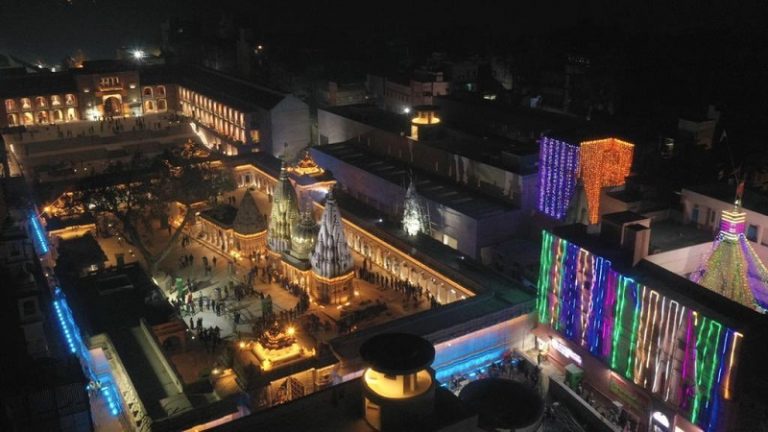
The Shri Kashi Vishwanath Corridor, which is Prime Minister Narendra Modi’s dream project, will be dedicated to the nation on December 13, 2021. There is an atmosphere of celebration in the city. There is divinity… there is grandeur and also the living spirituality of Kashi. Shri Kashi Vishwanath Temple was demolished by Islamic ruler Aurangzeb in 1669. Since then, it was shadowed by the mosque, which we know today as Gyanvapi Masjid.
The Kashi Vishwanath temple, one of the 12 Jyotirlingams and a prime shrine for the Hindu faith, once a grand temple, was surrounded by encroachments and chaos. Now, the same area has everything in order. Watch the video of a group of pilgrims visiting from South India to the Kashi Corridor.
ये है मोदी का नया काशी
यह दृश्य काशी विश्वनाथ मंदिर का है। श्रद्धालु दक्षिण भारत के हैं। ठसाठस और भीड़ वाले उस मंदिर को अब भूल जाइए क्योंकि अब काशी कॉरिडोर में 2 लाख श्रद्धालु एक साथ जमा हो सकते हैं। #काशी_यात्राpic.twitter.com/xmIMjDWosI
Those who have seen Kashi Vishwanath temple before the Corridor project started have witnessed the chaos. For them, the site is now no less than a dream. The Prime Minister’s dream project, his resolution to build a grant corridor to connect Maa Ganga to Vishwanath Mandir, took 33 months to become a reality. On March 8, 2019, PM Modi had laid the foundation of the corridor project. The chief architect of the project is Bimal Patel. He was also behind the Sabarmati River Front project and Central Vista Project.
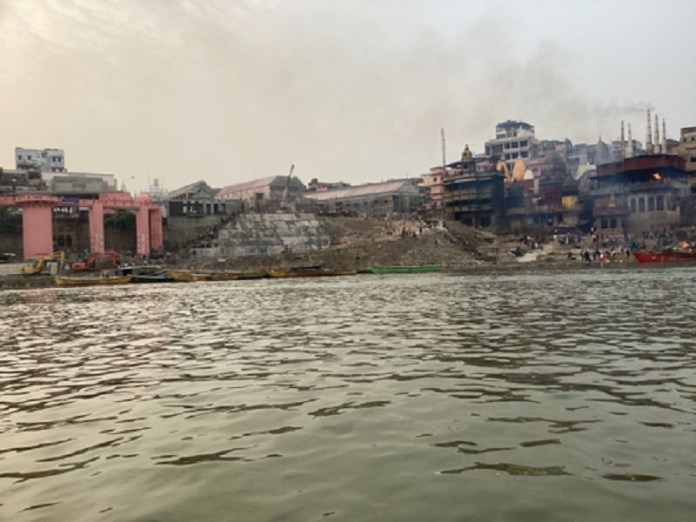
On Monday, Prime Minister Modi would worship Kaal Biarav before taking the waterway route in Ganga Mata to the Baba Vishwanath temple. Upon reaching the temple, he would perform Jalabhishek. It is noteworthy that the stairs that PM Modi would take to enter the ‘Lalita Ghat’ would be used by the devotees to reach directly to the Kashi Vishwanath Temple.
।श्री काशी विश्वनाथो विजयतेतराम।
आदरणीय प्रधानमंत्री जी के मार्गदर्शन में काशी का पुरातन गौरव पुनर्स्थापित हो रहा है… pic.twitter.com/QGTIMTvHyl
On December 9, OpIndia arrived at the Kashi Vishwanath corridor to take stock of the preparations and talk to the locals about the project. The construction around the corridor is still going on. The corridor covers over 5.2 lakh square feet in area, and the final touches are being given to the corridor ahead of the inauguration.
Lalit Ghat. The construction is in progress. Devotees would enter the corridor from here.
How is the corridor?
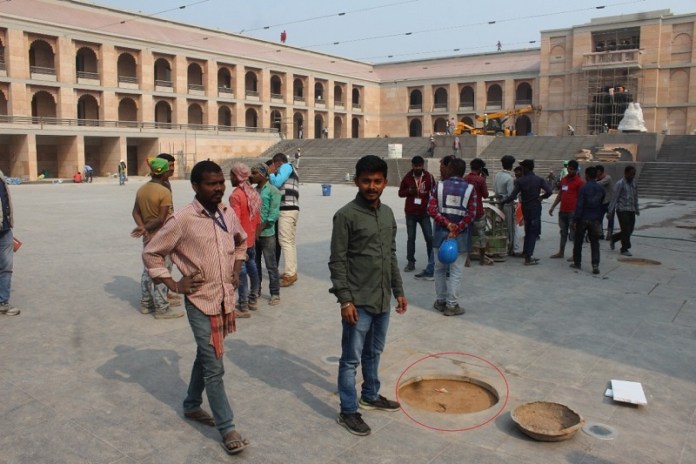
Piyush Tiwari, Information Public Relations Officer, Shri Kashi Vishwanath Dham Corridor, talked to OpIndia. He informed that the corridor between Lalita Ghat and Vishwanath temple complex had been named ‘Mandir Chowk’. He said, “The Prime Minister will inaugurate the corridor from here. This is the largest part of the corridor. We can also stop the devotees in this part in case of overcrowding so that there is no chaos in the temple. Emporiums have been built in this part.”
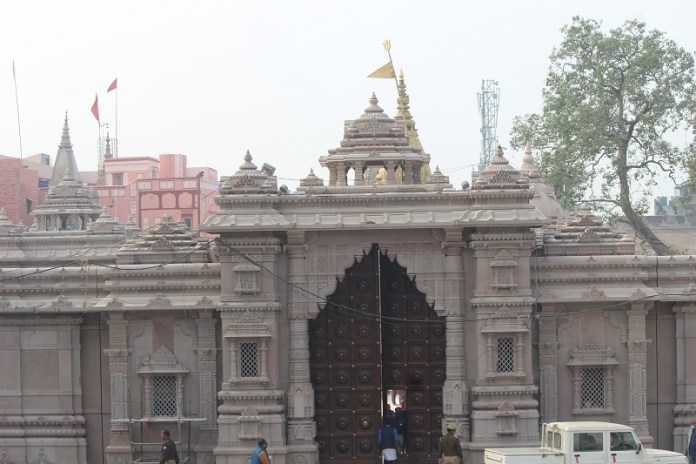
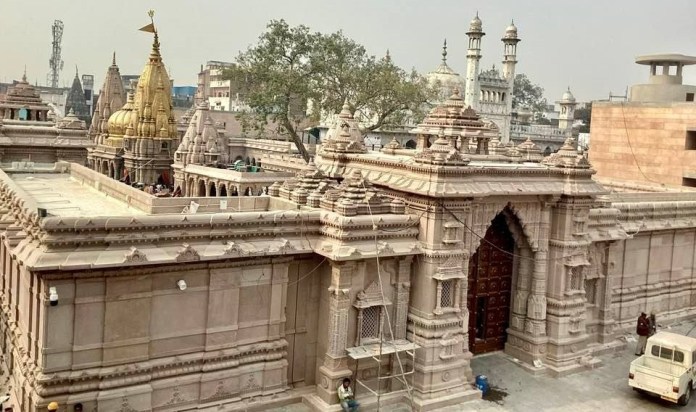
Baba Vishwanath Corridor’s gate. Such gates are on all four sides of the temple.
The grand corridor covering 5.3 lakh square feet
The corridor is spread over an area of 5.2 lakh square feet. The Kashi Vishwanath Temple premises is spread over 33,075 square feet. At any given point, around two lakh people can gather in this corridor. Seven special stones have been used in the corridor’s construction, including the red sandstone of Makrana, Chunar. There are rest houses, museums, security rooms and libraries that are part of the corridor. Special space has been created for the plantation throughout the corridor. Trees like Parijat, Rudraksha, Ashok, Bel etc., will be planted in these so that the entire campus remains green.
Across the corridor, there are spaces for plantations.
Tiwari said, “Earlier, the total area of the temple complex was around 3,500 square feet. Before buying the houses, we did a drone survey of the area. During that survey, we noticed several old temples. When we started the construction, we made sure that the devotees coming to the premises should get all the facilities to reach the religious place.” He explained, “There is a passenger facilitation centre next to the main gate. After the security check, the devotees will enter the temple premises. Four gates covering the four directions have been constructed. The complex is made of red stone of Chunar. The floor is made of white marble of Makrana. Tree plantation is yet to be done in this complex. Entry is also available from the side of the Ganga ghat.
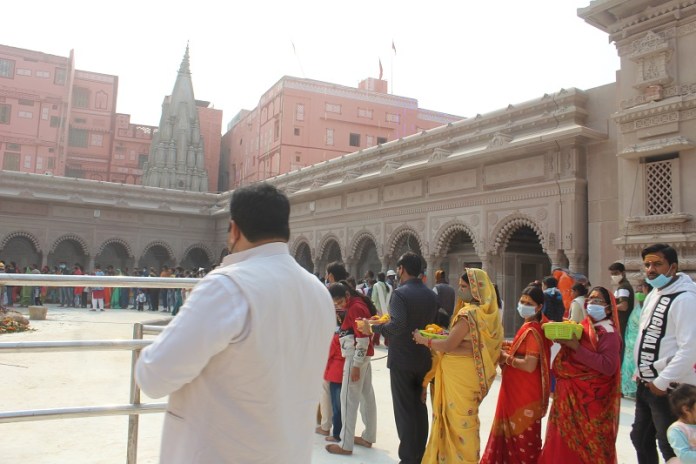
Devotees lined up for Darshan
Facilities available in the corridor
Tiwari said that three passenger facilitation centres had been set up in the entire corridor. Apart from this, guest houses, religious book sales centre, refreshment centre, city museum, Varanasi gallery, Mumukshu Bhawan etc., have been built in the corridor. Both the City Museum and the Varanasi Bhawan are museums that serve different purposes. A café has also been built inside the corridor. There is the Ganga View Gallery, where one can sit and see the complete view of the river. Also, there is Emporium, which would have showrooms of GI products.”
The main objective of doing this project is to provide facilities to the devotees. During Mondays of Sawan and Shivratri, around 2.5 to three lakh devotees come for Darshan. The whole city and entire pathways to the temple get jammed. People had to cover a distance of at least three-four KMs to reach the temple. “Now, after taking a bath in the Ganga, devotees will directly enter the corridor. They will perform Jalabhishek of Baba and go out into the city. At any point, at least 10,000 people can come to the temple complex,” he said.
Deepak Aggarwal, Commissioner, Varanasi, said that the board that was constituted for this corridor purchased a total of 314 houses. When demolition of these houses started, the authorities found 40 ancient temples that were encroached upon. He said the biggest challenge was to convince people to leave their properties for the project. But the people were more cooperative than expected and showed faith in the project.
“We have provided transparent and attractive financial propositions. We also considered the socio-economic condition of the families who had to leave their houses for the projects and provided them substantial compensation even for lesser land. The interest of those who had encroached the area was also taken into consideration,” Aggarwal said.
He added that the ancient temples that were found during the demolition were reserved, and repair work is being done on these temples. The devotees would be able to visit these temples as well. It is noteworthy that many smaller temples have been built in the complex. The deities have been restored in the temple complex. While many of these temples have already been opened for the devotees, the final repair work is going on for the rest.
The construction was started in 2019.
Propaganda vs reality
Ever since the Kashi Vishwanath Temple Corridor project started, all the opposition parties, including Congress, its pet media and the ‘liberal-secular’ gang, have been engaged in propaganda to paint a picture stating the original nature of Kashi is losing its charm. They have been claiming that the temples are being demolished. The propaganda continues on social media platforms. The jealousy of those who did not even believe in the existence of Bhagwan Ram is understandable. How can they accept that a temple that was not visible till yesterday now looks grand? Hindu pride should be restored. When we talked to the locals, their sentiments also manifested in a similar way.
‘The opposition is unable to digest’
Pankaj Dubey is an auto driver. He has been working on the roads of Varanasi for over 25 years. He said, “Kashi Corridor is beautiful. Whatever has happened has happened for good. It is the right thing to have happened. It should have happened a long time ago. It attracts tourists. It is sending a message to the people coming from outside that Kashi is developing.” He added, “It will increase tourism, and the business in the city will grow.” When he talked about the demolition of the temples during construction, he said, “All those who are shouting are from the opposition. They are unable to digest the progress. They also had the budget but did not do the work. Now, when the work is visible, they are spreading false propaganda.”
‘Development of Heritage in Modi-Yogi Raj’
Rohini Verma, who hails from Gaighat in Kashi, is a young artist who is taking training in Gulabi Meenakari, a rare craft from Kashi. She said, “We have temples in every street of Kashi. Earlier, we were not aware of many temples. We have come to know about them from the construction of the corridor. Earlier, there were houses very close to the temple, due to which the temple was hidden. Now there is a lot of space behind the temple. No matter how many people gather, there is space to manage the crowd and hold rituals. It is also convenient to have Darshan.”
She added, “Under the Modi-Yogi government, things related to our soil, heritage and crafts are being protected. They were developing. They are being encouraged. Now people are learning about them, and new employment opportunities are being created.”
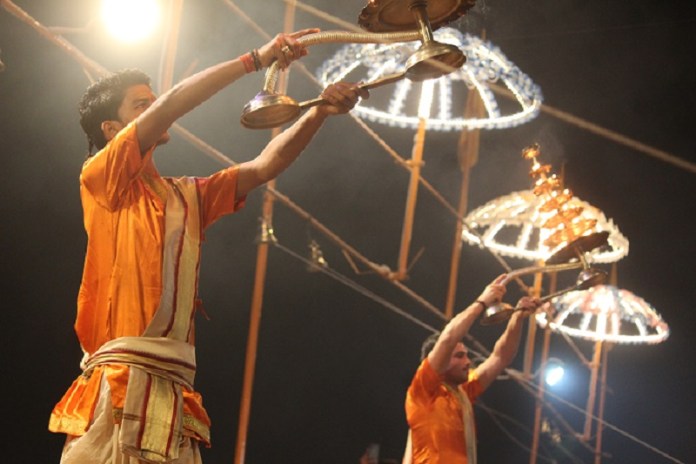
Ganga Aarti at Varanasi
‘What didn’t happen in 70 years? Modi did it in 7 years
Vimlesh Ojha, an elderly person from the city said, “It is much better than before. At this time, Banaras has become heaven. Modi Ji and Yogi Ji’s devotion for Baba is unmatched.” When asked about the propaganda on the construction of the corridor, he said, “It is a political protest. Even if you are doing good, people will find something wrong. According to me, what has not happened in 70 years, Modi Ji has done in seven years. The work is in progress. Even if you go to the streets, you will see how much change has happened.”
‘It is the heritage of Kashi and the country’
Acharya Subodh Shastri has been a priest in the Kashi Vishwanath temple since 2007. He says, “The temple has been transformed without any tampering. With the increase in space, the arrangement of the temple became much better. We had never imagined that Baba Mandir would be rejuvenated in such an elegant way. The complex will be so big. Baba Vishwanath chose a man who made it all happen.” He said, “It is the heritage of Kashi and the whole country. Now people from all over the country and abroad will come happily and leave happily. They won’t be in trouble.”
‘Tourism will be developed through the corridor’
Harshit Pallav, a resident of Kashi and a travel blogger, said, “Since childhood, we have been roaming in these streets. We have seen Baba so many times. Until 2019, houses were built adjacent to Baba Mandir and the narrow streets leading to the temple were choked. It was not possible to understand where the road would come from. Now everything is organized. Tourism will develop through this corridor. If change if for the better, there is nothing wrong with that.”
‘I couldn’t imagine what I saw’
Rohit Kumar Tripathi is also from Varanasi. He said, “Earlier those who used to come for Darshan faced a lot of trouble. There was complete encroachment around the temple. We never imagined what we are seeing today. All this had to happen. This development is increasing the prestige of Kashi.”
Gyanvapi Mosque adjacent to Kashi Vishwanath Temple
Gyanvapi Masjid… When would Kashi be liberated?
Vyalok Pathak, a Journalist, said, “Everyone knows how barbarians of the desert vanquished the Hindus by putting cows in the front. They destroyed temples. They broke the idols. They raped women and destroyed the consciousness of the Hindus.” What Pathak was saying is linked to the decree issued by Aurangzeb on April 18, 1669, to demolish Kashi Vishwanath Temple. On September 2, 1669, Aurangzeb was informed that the temple had been demolished.
Gyanvapi Mosque now stands confined in a corner. It may not be visible from outside the Kashi Corridor, but the reality is that it is adjacent to the temple premises itself. It is a reminder of the Islamic barbarism that Hindus have suffered. We should also remember the vow that was taken to liberate Kashi and Mathura along with Ayodhya. Until this task is pending, every Hindu should ask himself, When would Kashi be liberated?
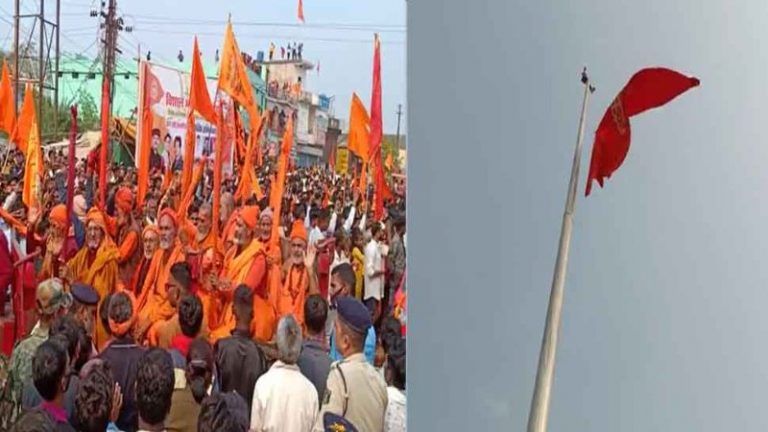
After the removal and insult of a saffron flag by Islamists in the Kawardha area of Chhatisgarh in October this year, Hindu saints and sadhus organized a massive religious procession and unfurled a 108 feet high saffron flag at the same place on Friday, 10 December.
The procession was taken out from Ramjanaki temple with 5100 ‘kalashas’ (religious urns) in the presence of various Hindu religious dignitaries including Mahamandaleshwar of 13 Akhadas, Mahants and Shankaracharyas. More than 20 thousand people participated in this padyatra led by Dandi Swami Avimukteshwaranand Saraswati where people chanted the slogans of ‘Jai Shri Ram’
A few months ago, they removed one Bhagwa flag from a pole and rioted against the Hindus in Kawardha, #Chhattisgarh. Yesterday the Hindus of Kawardha took out a huge procession and installed a 108 feet Bhagwa flag in the centre of the city. #Kawardha shows ultimate Hindu unity! pic.twitter.com/8j3rzxGokD
Swami Avimukteshwaranand addressed the gathering and said, “The saffron flag is the flag of our pride and self-respect. Eight types of flags have been described in our religion. The saffron flag that has been hoisted in Kawardha is named Vishala Dhwaj. Respect for the saffron flag is paramount. This saffron flag placed on Kawardha’s forehead will wave gleefully.” adding, “Those people (Islamists) fought for the flag which was only 15 feet high and we put up flags higher than 108 feet.” Kawardha was declared as religious capital of the state of Chhattisgarh.
Installation of saffron mahaviri flag
Hindu society had earlier installed the saffron Mahaviri flag at that place which was uprooted by the Islamists. Then some Hindu in the area had climbed up again and hoisted a saffron-coloured flag with the picture of Lord Hanuman.
During the procession, Hindu organizations also opposed the Congress government led by Chief Minister Bhupesh Baghel and raised patriotic slogans like ‘Bharat Mata Ki Jai’ and ‘Vande Mataram’ along with the slogans of ‘Jai Shri Ram’ in the presence of police and administration.
Hindu flag uprooted by Islamist mob
In Chhattisgarh’s Kawardha, violence between two groups was ignited after a Muslim mob allegedly uprooted the Saffron flag and tore it apart. The flag was hoisted by a Hindu group in the area. Soon after the mob uprooted the flag, the situation got violent, and two groups had clashed with each other.
The city of Gurugram in Haryana is witnessing the resistance of Hindus against the illegal encroachment and public offering of Namaz by the Muslim community. On Thursday (December 9), the Muslim Ekta Manch in the city had reiterated their decision to offer namaz on all 37 public grounds. On the other hand, the Hindu outfits had also reiterated their resolve to strictly oppose the offering of Namaz at those public places from December 10 onwards.
The Gurugram Police and the district administration have been on high alert due to the possibility of a law and order situation. This is however not the first time since non-Muslims stood up against the public offering of Namaz. Back in November 2017, about 100 French politicians had hit the streets in the Clichy commune in the northwestern Paris suburb. The objective was to protest the public offering of Namaz by the Muslim community on Fridays whereby they blocked roads and public spaces. The politicians wore tricolour sashes of office and sang the national anthem (Marseillaise) in unison.
This was in response to a group of 200 Muslims who were offering the Friday prayers on the streets in Clichy. Given that France adheres to a strict secular system, the use of the public property for prayers is unacceptable. The local Muslim community had been praying on the streets for 9 months before the French politicians took to protests as the final resort. In their defence, the Muslims claimed that they had nowhere to offer prayers and that a townhall, which was earlier used for the purpose, was taken away from them.
Although authorities had opened a new mosque for them, the worshippers claimed that it was 1.5 km away and hard to reach. Through their street prayers, they hoped to pressurise the local council to open a prayer hall in the heart of the commune of Clichy.
Vehement opposition by French politicians against public Namaz
The President of the Paris Regional Council, Valérie Pécresse, had led the protests against the Friday Namaz. He said, “Public space cannot be taken over in this way. We are in a country where we do not pray in the street, the rules of law are being flouted.” Similarly, commune Mayor Rémi Muzeau opined, “I am responsible for guaranteeing the tranquillity and freedom of everyone in my town…We did what the police should have done a long time ago.”
He had also called upon the Interior Ministry to ban Muslims from praying on the streets. In order to pacify the situation and prevent any law and order issue, a contingent of riot police was deployed at the site. The French politicians marched next to the Muslim worshippers in an attempt to displace them physically.
Journalist Théo Maneval tweeted, “It’s getting even more surreal, as the elected officials with their sashes try to jostle the people praying. Movement of the crowd, jostling, people falling…The police intervene.” According to French politician Marine Le Pen, Franch should launch an offensive against Islamist provocation. “What is the Minister of the Interior waiting for to restore public order and secularism? Laxity is not an option,” he concluded.
Residents in Gurugram Sector 37 chant ‘Jai Shri Ram’ to protest
On December 3, local residents and members of various Hindu organisations were compelled to launch a protest after a large number of Muslims turned at the public ground in Sector 37 of Gurugram to offer Friday namaz.
There are dozens of mosques in Gurugram, yet the Muslim community has been insistent on using public spaces and roads for the Friday prayers, a practice that the being opposed by local non-Muslims.
Videos had surfaced where the Hindus are seen chanting ‘Jai Shri Ram’ and ‘Vande Matram’ slogans as they protest against the Namazis who reached the public ground to offer their Friday namaz. The Gurugram police, instead of stopping the Muslims from offering Namaz in the open space was seen physically removing the Hindus from the ground. The police were seen pushing and creating a human chain in order to keep the protestors away from obstructing the Muslims from offering Namaz.
According to reports, the Gurugram police had detained nearly 50 people who tried to stop the Muslims from offering Namaz in Sector 37 on December 3. Opposition to the illegal occupation of public places by Muslims to offer their religious prayers is steadily gaining momentum. For weeks now, conscientious locals have pushed back against Muslims who have resorted to indulging in communal praying in public places instead of mosques and homes.
Recently, Haryana CM ML Khattar had announced that the blocking of public spaces in the name of Friday namaz will not be allowed.
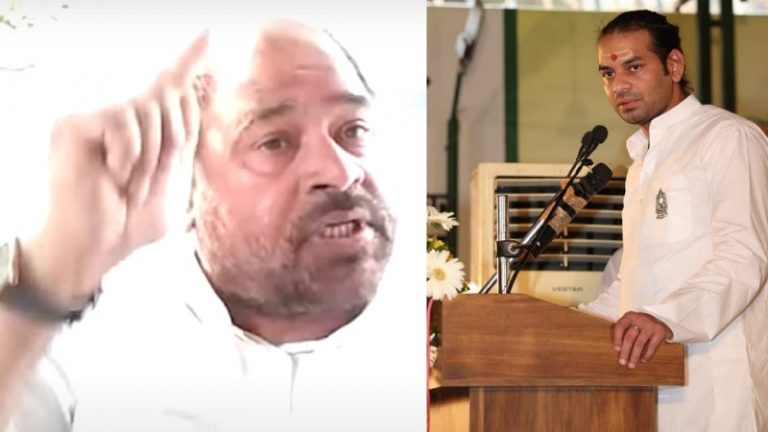
Sadhu Yadav, brother of Rabri Devi and maternal uncle of Tej Pratap Yadav and Tejashwi Yadav, has upped his attack against his nephew and accused him of having illicit relationship with two women. He alleged that one girl is of different caste and that to stop these news from coming out in open, the girl has been kept in a hotel in Delhi where Rs 5 crore have been paid. He alleged that this is why Tej Pratap Yadav’s marriage with Daroga Rai’s daughter Aishwarya Rai did not work out and two headed for a divorce.
Sadhu Yadav further said that Lalu Yadav is not fit even to be a peon. He also said that he would welcome Tejashwi and his newly wed wife with a garland of shoes.
Sadhu Yadav, ex RJD MP and the brother of Rabri Devi, slammed Tejashwi Yadav for marrying not only outside the Yadav caste but also the fold of the Hindu religion. Although Rachel now goes by the name Rajeshwari Yadav, Sadhu Yadav is not convinced. While slamming the newlywed couple, Sadhu Yadav said, “Tejashwi has humiliated the Yadav community. All the sisters of Tejashwi are married in the Yadav community but he married a Christian woman and our community does not accept this.”
“Tejashwi wants the vote of Yadavs in election but has married a Christian. He should now go to Chandigarh and Kerala and seek vote of the Christian community. There is nothing left for him in Bihar. If Tejashwi Yadav does not give importance to caste, then why is he demanding a caste-based census in Bihar?” he was heard as saying.
Following this, Tej Pratap hit back on his uncle wherein he had asked Sadhu Yadav to stay in his limits over the indecent statements on his brother Tejashwi. Tejashwi Yadav married his long time friend Rachel Godinho (called Rachel Iris by some media reports) in a low-key ‘secret ceremony’ on Thursday at his sister Misa Bharti’s residence in Delhi, where only close family members and a select few were invited. She has become Rajeshwari after the wedding.
CDS General Rawat in his last message which was pre-recorded the evening before the tragic helicopter crash in Coonoor had invited the people of this country to join in with the celebrations of the Indian Army during Swarnim Vijay Parv, the event which commemorates the victory of the Indian Army in 1971 war.
Gen Bipin Rawat’s final public message — recorded the evening before the chopper crash, it was to play this morning as part of the 1971 War victory event. pic.twitter.com/mUO2tguw8X
He had said, “On the eve of the Swarnim Vijay Parv, I extend my heartfelt greetings to all the soldiers of the Indian Army. We are celebrating the 50th year of India’s victory in the 1971 war in this Vijay Parv. On this auspicious occasion, I am remembering the brave soldiers of the armed forces and dedicating a tribute to their sacrifices. From 12 to 14 December, various programmes will be organized at the India Gate. We are fortunate that the Vijay Parv will be organized in the shadow of Amar Jawan Jyoti memorial which was built in the memory of our brave martyred soldiers. I am inviting all the people of our country to get involved in the celebration of Vijay Parv. We are proud of our soldiers, come let us celebrate together Vijay Parv.”
This pre-recorded message of CDS Bipin Rawat was played in the morning of the first day of the Vijay Parv event on December 12.
On Sunday, December 12, Defence Minister Rajnath Singh has inaugurated the event of ‘Swarnim Vijay Parv’ at India Gate in Delhi. Rajnath Singh has said that the celebrations for the Vijay Parv will be simple this year due to the demise of CDS Bipin Rawat and 11 other personnel of the Indian Armed forces in the tragic helicopter crash that took place in Tamil Nadu. Vijay Parv this year will be a two day event and the closing ceremony to be held on 13 December.
On December 8, it was reported that an IAF Mi-17V5 helicopter crashed near Coonoor town in Tamil Nadu. The helicopter was airborne from Sulur to Wellington with 14 persons were on board including CDS Rawat, his wife Madhulika Rawat, Brig LS Lidder, Lt Col Harjinder Singh, NK Gursewak Singh, NK Jitendra Kr, Lance Naik Vivek Kumar, Lance Naik B Sai Teja and Hav Satpal.Group Captain Varun Singh who is the lone survivor in the tragic incident remains in a critical condition at a military hospital in Bengaluru.
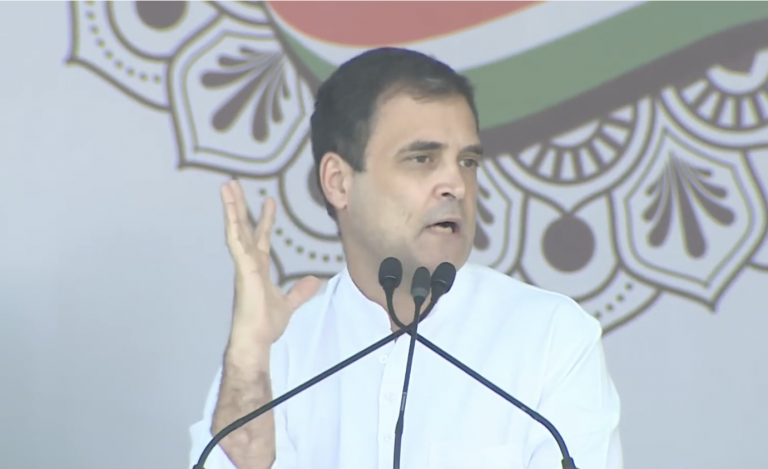
It was an otherwise boring Sunday till senior Congress leader Rahul Gandhi got up on stage and started speaking. He was addressing the ‘Mehangai Hatao Rally in Jaipur, Rajasthan. Rahul Gandhi got up on stage there and spouted such pearls of wisdom that can give any standup comic a run for their money, at least the ones who still manage to not have their shows cancelled.
We, at OpIndia, listened to it fully so you don’t have to.
He starts off with a lot of philosophy and says that two ‘jeevs’ cannot have one ‘aatma’. He then asks the rhetorical question to the stunned audience whether two lives can have same soul. When he did not get an answer, he answered it himself and said how two words don’t have the same meaning. After a lot of buildup, he said that the two words he was speaking about ‘Hindu’ and ‘Hindutvawadi’.
The rally was to protest against inflation and high prices, but somehow, Rahul Gandhi thought this was the perfect time to talk about Hindu and Hindutva.
He then asserted that he is a Hindu but he is not a Hindutvawadi.
At about 6:40 minutes into the video Rahul Gandhi decides to explain difference between Hindus and Hindutvawadi. “Mahatma Gandhi: Hindu. Godse: Hindutvawadi. What is the difference? I will tell the difference. No matter what happens, Hindu searches for truth. He would die, get beheaded, but Hindu will search for truth. His path is ‘Satyagraha’. He spends entire life looking for truth. Mahatma Gandhi’s autobiography is ‘My Experiments With Truth’. He spent his entire life searching for truth and in the end, one Hindutvawadi shot him thrice in his chest,” he said.
At around 10:50, Rahul Gandhi proclaims that this country, India is of Hindus and not of Hindutvawadis. “If there is inflation and pain in this country, it is because of Hindutvawadis,” he claims. “The rule is of Hindutvawadis, not Hindus. And once again we have to get rid of these Hindutvawadis and bring back the rule of Hindus. Who Hindus? The one who hugs everyone. Who Hindu? The one who is not afraid of anyone. Who is Hindu? The one who respects all religions. He is Hindu. Read our shastras. Read Ramayan, Mahabharat, Geeta, Upnishad. Tell me where is it written that a weak person needs to be suppressed,” he said as his mother Sonia Gandhi clapped wildly from the stage.
He then cites the Geeta and claims that it is written in the Geeta that one must fight the fight of truth, “Die, get killed, fight the fight for truth. In Geeta, Lord Krishna didn’t tell Arjun to kill his brothers for power. Krishna asked Arjun to kill his brothers for truth.” Except, this is not what Shri Krishna told Arjun. When Arjun was in a dilemma to fight his guru and his cousins, Shri Krishna asked him to fight for Dharma and perform his duty to establish the rule of Dharma. Dharma, not ‘Satya’ as Rahul Gandhi claimed. Perhaps he should revisit the Hindu sacred texts.
At around 19 minutes into the video, Rahul Gandhi talks about how PM Modi ‘stabbed the chest of farmers’. “And brothers and sister, he did not do it from the front, he did it from the back,” Rahul Gandhi says as he moved around the stage to show explain how a ‘chaaku’ was put in ‘chest’ of farmers’ through the back.
Comedy Show of Rahul Gandhi has started ?? “Chaati (CHEST) mein Ch@ku maar diya. Aage se nhi.. peeche se” Then see his action ? Peeche se Chest mein kaise m@ar sakte hain? ?? pic.twitter.com/8wuyLgj7Vu
Chest, for normal human anatomy, is portion between neck and abdomen and the ‘chest’ Rahul Gandhi was showing is normally referred to as back.
“Why did he do this? Because he is Hindutvawadi. Hindus, if they stab, they stab from the front, Hindutvawadis stab from the back,” he said.
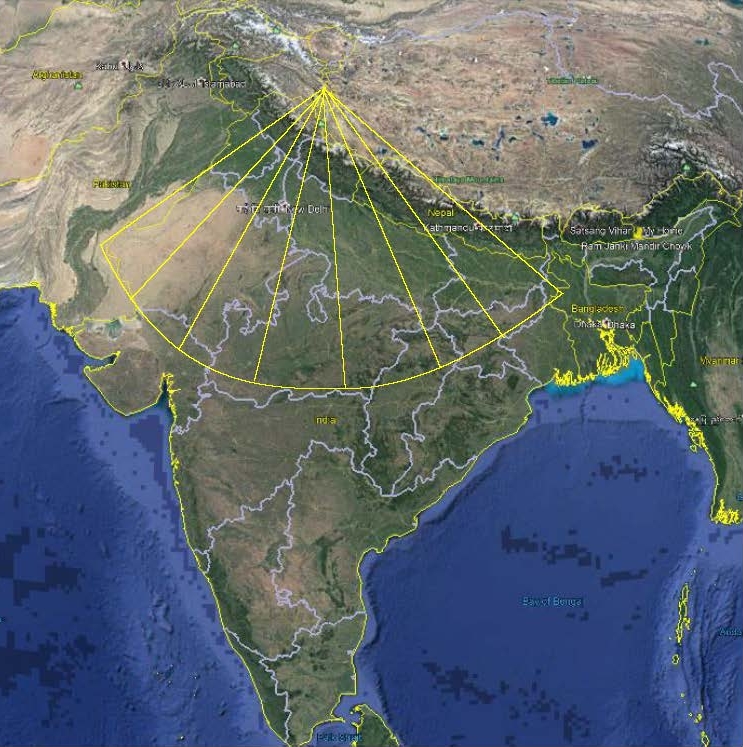
“China’s army will come and take away 1000 kms of land and Prime Minister will say no one has come within India,” he said. Rahul Gandhi had made similar claims back in October 2020 that Chinese forces had intruded 1200 kms into Indian territory. If one believes Rahul Gandhi’s statements of China occupying nearly 1,200 km of Indian lands, then according to him, at least half of Indian territories would be under Chinese occupation.
If one calculates the distance from the Line of Actual Control (LAC) near Ladakh – the epicentre of the recent clashes, the 1,200 km span would include states and union territories such as Jammu and Kashmir, Ladakh, Himachal Pradesh, Punjab, Haryana, Delhi, Uttarakhand, UP, Bihar, Madhya Pradesh, Rajasthan, and parts of Gujarat, Chattisgarh, West Bengal and Jharkhand. The approximate areas that will be under China’s control as per Rahul Gandhi have been shown in the map below, where the distance of 1200 km from Ladakh has been estimated using the ruler feature of Google Earth.
India map with 1200 km radius
But Rahul Gandhi does have a complicated relationship with facts and figures.
Rahul Gandhi again went on the Adani-Ambani rhetoric and said how PM Modi gives away everything for free to Adani and Ambani. “Not their fault, because it is PM who gives them away things for free. But this is not how country is run. Country belongs to the poor, the labourers, the small shop owners, small business owners. As they generate employment. Adani and Ambani will not give jobs,” he claimed.
Adani Group employs over 23,000 people while Reliance group employs over 2,30,000 people directly. This eventually leads to further employment opportunities for thousands of people who work on various projects and offer services to these companies. It is shocking that this statement needs to be dignified with a response and explanation.
Earlier in the day, his sister Priyanka Gandhi, too, had addressed a rally, which was largely inconsequential and not as entertaining.
Youngest Bishop of Spain, Xavier Novell Goma who had earlier left the Roman Catholic Church has married an author who writes satanic erotica fiction. as per a report by WION. Xavier Novell Goma was reportedly in love with Silvia Caballol, author of “The Hell of Gabriel’s Lust”, and other such erotica novels.
The Church now has stripped Novell Goma of all Church powers and prohibited from exercising all the rights and responsibilities of the episcopal function.
Spain’s Episcopal Conference has issued an official statement saying, “As is publicly known, Bishop Xavier Novell Goma, Bishop Emeritus of Solsona, has contracted a civil marriage with Ms Silvia Caballol, on November 22, 2021, in the town of Suria, in the province of Barcelona.” However, the conference said that Goma will still retain his Bishop title but barred him from performing any activities of a Bishop including “the administration of the sacraments”. The statement also said that “Any teaching activity, both in public and private, is prohibited,” for Novell Goma.
Notably, Sylvia Caballol, the author of “The Hell of Gabriel’s Lust.” and a trilogy named “Amnesia.” was given the description of “a dynamic and transgressive author who made her mark in the challenging world of literature upsetting our moral and ethical mores”. Sylvia Caballol’s work revolved around the themes of madness, lust, sadism, God and Satan.
Earlier, the Spanish bishop had resigned from the Roman Catholic Church after falling in love with a divorced psychologist and erotic novelist Silvia Caballol. Then he said, “I have fallen in love and want to do things properly,” while Novell’s former colleagues believed that he was possessed by demons. Novell had become the youngest Bishop of Spain at the age of 41. He was popular among the people and had also performed exorcisms in the past.
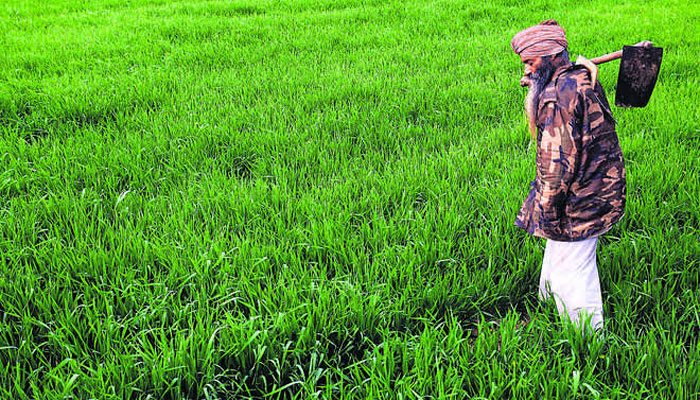
All District Collectors (DCs) in Punjab have been asked by the Congress-led Punjab government to prepare a list of farmers who own land beyond the permissible limit.
As per the Land Ceiling Act, 1972, a person can own only 17.5 acres of ‘Chahi’ (fertile land that depends on wells for irrigation) to 52 acres of ‘Banjar’ or wasteland. The orders came following the demands laid down by the Pendu and Khet Mazdoor Union on November 23, meeting with Chief Minister Charanjit Singh Channi. One of the demands that the union presented to CM was about the excessive land owned by the upper caste (Jat Sikhs) in the state.
The orders were issued by the Revenue, Rehabilitation and Disaster Management Department of Punjab. As per the orders, CM Channi has sought a report on the landholdings beyond the permissible limit. The orders state that the report should be sent to the department immediately.
The Assembly elections in Punjab are only a few months away. Such orders amidst politically charged-up Punjab are going to have ramifications sooner than later. The Jat Sikhs, who are the largest landowners in Punjab, have already conveyed their concerns to the ministers and office bearers in Congress that belong to the Jat Sikh community.
The Dalit community has been protesting in the state for months
While a lot of media coverage has been happening around the farmer protests against the now-repealed three Agriculture laws, very little importance has been given to the plea of the landless Dalit community in Punjab that has been protesting to get their demands fulfilled for months. It is well known that despite the fact that the Dalit community (Dalits and Dalit Sikhs) comprise more than 33 per cent of the state population, they own only two per cent of the land.
As per the revenue officers, it would not be possible to make a list of the landowners owning more the permissible land as they had already divided the land amongst themselves years ago to ensure the Land Ceiling Act does not apply to them. Many families have allegedly announced the legal separation of the property among the family members to evade the Act. Also, the protesting landless farmers claim that many families have got “benami” land showing ownership in the name of the farm labourers.
The Tribune quoted an official saying, “The issue was settled 50 years ago. Even the cases of land transfer to non-existent people, or land bought in different districts to evade the Act have been settled.” However, the reality, protesters claim, is completely different.
OpIndia reached out to Punjab Khet Mazdoor Union, Punjab. District General Secretary Tarsem Singh Khundehalal said, “We are landless farmers. The majority of us do not know anything other than farming. Still, we do not own any land and have to do farming on someone else’s land.” He further added that the state government is providing the land to the corporates while the landless farmers remain unheard.
“We are not against progress, but we feel discriminated. The previous governments did not enact Land Ceiling Act properly. We are facing a lot of problems. It is unfortunate that the government has not only failed to provide land for farming, but it has also failed to provide five marla land for our houses,” he added. Khundehalal further said, “Though the state government has approved the scheme to provide us land for houses, at Panchayat level, no one is paying any heed to our problems. Even today, we are protesting against the government with Rail Roko Andolan.” When OpIndia talked to Khundehalal, he was at a protest site with other protestors linked to seven such associations. He said the community was pleased that the CM at least announced to prepare a list but, “Until we get land for farming, it is of no use. A farmer can live a decent life only if he owns the land.”
Land ownership, caste discrimination and power politics in Punjab
Caste discrimination in Punjab’s Sikh Community is majorly based on land ownership. According to the 1991 Census, Dalits comprises 28.3% of the population in Punjab. The national average stands at 16.32%. Even though they are in a higher percentage in the state, the Dalit community does not have landowners. The majority of agricultural land in Punjab belongs to Jat Sikhs. Reports suggest Dalits own only 0.72% of the cultivated land in Punjab, and the inequality forces them to work either as labourers in the fields owned by Jat Sikhs or choose other professions.
Harish K. Puri, retired professor of political science and BR Ambedkar Chair, Guru Nanak Dev University, Amritsar, wrote that the settlements in rural Punjab are divided into upper and lower castes. The lower castes are supposed to live on the side where water flows when it rains and take dirt and debris with it. Dalits are often not allowed to build houses using concrete, often known as pucca houses, as the land where they live is often claimed by the Jat-Sikhs.
The ongoing protests in Punjab
For months, the Dalit and Dalit Sikh communities of Punjab have been protesting against the state government for inaction on the demands they had laid down in connection to loan waiver, land ownership, work under NREGA and many more. When CM Channi took over the charge, there were talks that Congress was trying to woo the Dalit communities in the state. However, the protesters claim that despite meetings with the CM, there has been almost negligible progress on the demands of the Dalit communities in the state.
On December 5, it was reported that several outfits of Dalit communities in Punjab had cornered the state government regarding pending demands of the landless farmers and labourers. Gulzar Gaurian, Punjab Khet Mazdoor Sabha, said the CM should release notification on the demands that he had agreed upon during the meeting regarding disbursal of plots to the homeless, restoration of uprooted electricity meters, fine and loan waivers, among others.
Makkhan Singh Ramgarh, Mazdoor Mukti Morcha, said CM Channi installed huge hoardings claiming residential plots and bill waivers etc., but the reality was far away from the truth. Between December 8 and December 11, several outfits burnt effigies of CM Channi for inaction on their demands.