Home Blog Page 4416

Delhi Civil Defence volunteer beats up a student with belt in full public view, passersby hit back, video viral: Here is what happened

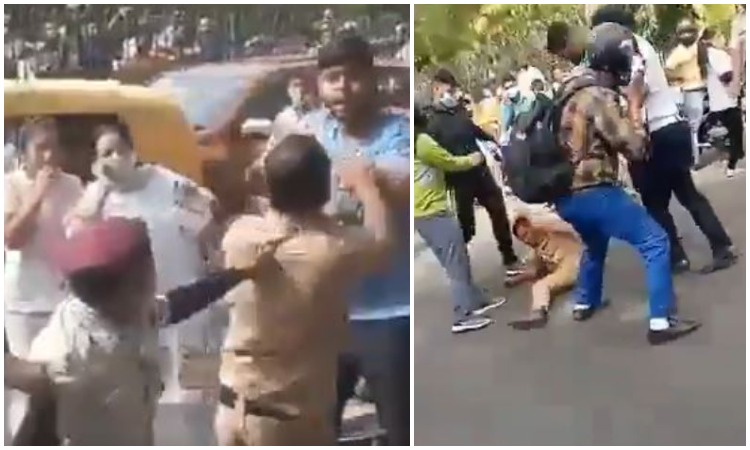
On Tuesday (6th April) videos of a clash between the Delhi government’s civil defence volunteers and passersby went viral on social media. The incident was reported from the streets of South Delhi’s Hauz Khas area on Monday afternoon, where a Delhi Civil Defence (DCD) volunteer was seen beating a youth with a belt and thereafter the officer was attacked by a group of irate crowd.

In the first video, a DCD officer is seen hitting a youth in a plain blue T-shirt with a belt. Another man intervenes. He somehow pacifies the angered officer and pulls him away.

In another video men in plain clothes were seen attacking the uniformed civil defence volunteers. A group of men are seen kicking an official lying on the road. The police had reportedly found this video during the investigation of the incident.

The scuffle broke out reportedly when the volunteers were carrying out a mask-checking exercise in the area. Three officers have been reported to be injured in the incident.

FIRs have been registered by both parties at the Hauz Khas police station, according to media reports.

In what transpired, the DCD personnel stopped a car near a traffic signal near the IIT-Delhi in the Hauz Khas area. According to police as the traffic signal turned green, another car which was being driven by a student identified as Gitesh Dagar applied the brakes suddenly following which a third car hit his car. This enraged Dagar, who got out of his car and confronted the officials.

This led to a heated argument between the 20-year-old Gitesh Dagar and Delhi Civil Defence (DCD) volunteers, who were issuing challans to people not wearing masks. The argument soon turned violent at a traffic signal in South Delhi. The DCD volunteers were then seen hitting the student with a belt after which, the latter, along with a few other people passing by attacked the DCD personnel.

Speaking about the incident, DCP (South), Atul Kumar Thakur said: “The incident came to light after we received a PCR call at around 3 pm on Monday. The DCD employees, who were issuing challans to people not wearing masks at a traffic signal near the IIT gate, had stopped Gitesh Dagar’s car. He was travelling with his aunt and her daughter from a doctor’s clinic. On stopping the car while the traffic light was green, a vehicle from behind rammed into Dagar’s car following which he came out and started arguing with the volunteers.”

Thakur added that the DCD volunteers allegedly hit the student with a belt. Following this, the student and a few other people, who had gathered there, started beating the volunteers. “They have sustained injuries and have been shifted to a hospital for treatment. FIRs have been lodged against both the parties and a probe is on to ascertain what exactly happened,” said DCP (South).


This day that year: Days after heinous Sukma attack, we remember the 2010 Dantewada attack which claimed the lives of 76 jawans

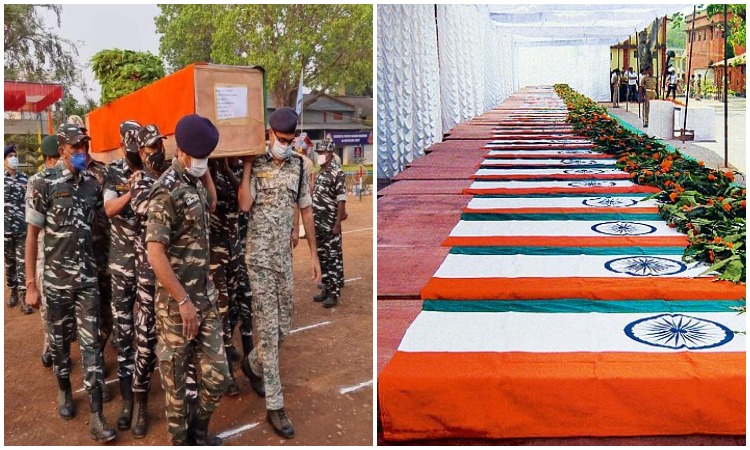
In the deadliest terrorist attack of 2021, a group of 400 Naxals ambushed a massive operation that included the STF, DRG and District Force of the Chhattisgarh Police, the CRPF and its elite COBRA unit on April 3 (Saturday). The teams were deployed in the forests of Chhattisgarh for a search and destroy anti-Maoist operation along the border of the Bijapur-Sukma district.

It was during this operation that the security teams of around 1500 personnel were ambushed by 400 Naxalites from three sides- led by the most-wanted Maoist commander and leader of the ‘People’s Liberation Guerilla Army’- Hidma. The close encounter between the Naxalites and security forces lasted for four hours in which the Naxalites rained bullets from light machine guns, used low-intensity IEDs and rocket launchers, brutalised dead bodies and escape with weapons.

This brutal Naxal attack that resulted in the killing of 22 jawans of Central Reserve Police Force (CRPF) and leaving 31 injured at the Sukma-Bijapur border in Bastar division on April 3 (Saturday) brings back the memory of the deadly 2010 Dantewada attack, where the Maoists used the same modus operandi of isolating and attacking a company of soldiers returning from an area domination exercise.

The soldiers were already out on the field for over 24 hours and vulnerable due to exhaustion. The Naxalites used this sensibility to launch an attack, almost wiping out the CRPF’s 82nd Battalion back in 2010. And this trend has been continuing until today.

2010 Maoist attack in Dantewada, Chhattisgarh

On this day in 2010, April 6, 76 CRPF jawans were killed in an ambush by Naxals near Chintalnar village in Dantewada, Chhattisgarh. The attack occurred in the Tademetla forests when over 80 officers from the central paramilitary force Central Reserve Police Force (CRPF) and a local police group were conducting an area domination exercise in the Bastar tribal region of the Indian state of Chhattisgarh.

It was reported how Maoists, who waited on hilltops, opened indiscriminate fire and triggered an IED blast as the convoy appeared. Later, the reinforcements that were rushed to the site were also blown up. The CRPF team, which comprised only 120 personnel were heavily outnumbered by almost 1000 Maoists who attacked and killed the jawans and fled the scene with weapons, including bulletproof jackets, guns and ammunition.

A fierce gunbattle was on between the security forces and Naxals in the jungles of Dantewada. Rescue operations were reported to have been hampered because of heavy firing by the Naxals. Helicopters that were rushed in to rescue injured CRPF jawans had been fired at by the Naxals using anti-aircraft guns. The heavy firing had, however, made it difficult for the rescue helicopters to land. The cowardly attack by Naxalites had then resulted in the martyrdom of 76 CRPF soldiers, while 50 others were said to be seriously wounded.

By far, the Dantewada attack remains the worst ever attack in the history of Maoist insurgency, inflicting severe casualty to the Indian forces.

Sachin Vaze jumped wall to evade CCTV cameras, took a train to Thane, footage reveals

In what is said to be the clincher in Antilia bomb scare case and Mansukh Hiren death case, CCTV footage accessed by Republic TV shows suspended API Sachin Vaze approaching the Chhatrapati Shivaji Maharaj Terminus (CSMT) after allegedly scaling the wall of the Mumbai Police headquarters to avoid CCTV cameras on March 04. 

As per sources, Sachin Vaze reached the CSMT station at 7 pm on March 04 and proceeded to take a train to Thane. He reached the destination at 8.10 pm following which he made a phone call using a SIM card procured from bookie Naresh, who is in NIA’s custody currently. An NIA officer in a statement revealed, “We suspect that Vaze then called Hiren posing as officer Tawade, using the SIM card that was procured from Gujarat by another accused.”

It is alleged that after meeting Mansukh Hiren with constable Vinayak Shinde, he left for Byculla and reached the destination by 9.20 pm. He then called his aide Riyaz Kazi to ask him to bring his mobile phone to the Dongri Police Station.

It was also reported that Vaze raided one Tipsy Bar located in Dongri to suggest that he was conducting a raid at the time of Mansukh Hiren’s murder. As per sources, Sachin Vaze’s attempt to call Kazi to Dongri Police Station was an alleged attempt to deceive the investigation agencies by creating an alibi for himself.

The Thane businessman, Mansukh Hiren, was found dead the next day.

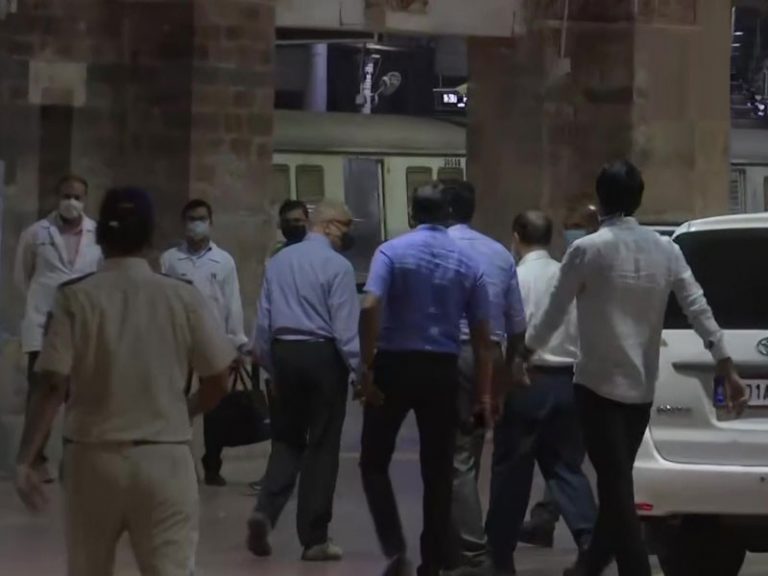
NIA Takes Sachin Vaze To CST Station To Recreate Crime Scene

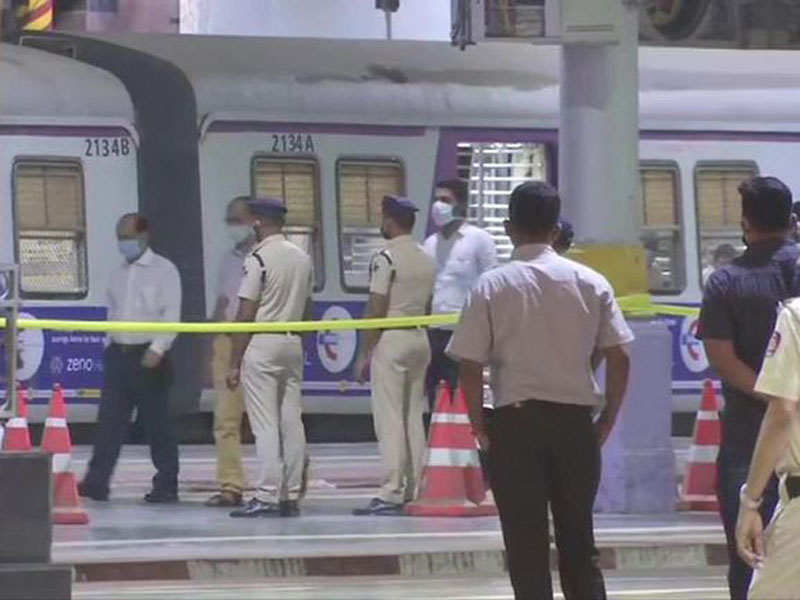
The NIA in the late hours of Monday recreated the crime scene, first at the CSMT station and then at the Kalwa station in the presence of Sachin Vaze.

NIA along with Sachin Vaze recreating the crime scene at CST station. Image source: ANI

The accused was taken to platform number 4 of the CST station, which was cordoned off and then to the Kalwa station where he was asked to walk down the Kalwa railway bridge.

The NIA also conducted late-night raids on Saturday in a bid to recover more evidence in its probe against Sachin Vaze.

Another luxury vehicle seized

Adding to the never ending list of luxury vehicles associated with Vaze, the National Investigation Agency on Monday traced a luxury Italian sports bike ‘Benelli’ from Daman that is said to be registered in the name of Meena George, the mystery woman who is under NIA’s scanner for her alleged connections with Sachin Vaze. 

NIA has seized eight luxury vehicles until now which were allegedly used by Vaze for various reasons around the time of Antilia bomb scare incident and Mansukh Hiren’s murder. These include a Green Scorpio, a white Innova, two black Mercedez Benz cars, a Land Cruiser Prado, a black Volvo, and a white Mitsubishi Outlander.

The NIA is still on the lookout for two more luxury cars, one being an Audi in which Vaze was seen traveling with suspended cop Vinayak Shinde in a CCTV footage recovered from Bandra-Worli Sea Link on March 03.

The menace of Maoist terrorism: 5 of the worst attacks on civilians and security forces by Left-Wing terrorists

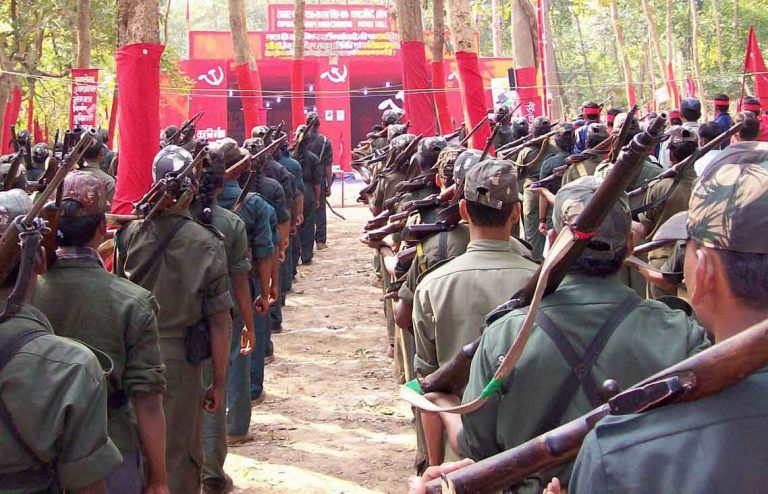
The 22 Central Reserve Police Force (CRPF) men who were killed-in-action during Saturday’s encounter with Maoists in Bastar, Chhattisgarh, were the latest in the long and endless list of security personnel and civilians killed in the attacks carried out by the left-wing terrorists. The attack was a grim reminder of the menace of Maoist terrorism afflicting the nation.

The security forces had launched an operation along the Sukma-Bijapur border, where an intense face-off resulted in the martyrdom of 22 jawans. It is being reported that one soldier is still missing. Besides, 31 soldiers were injured in the encounter that ensued between the armed personnel and the Maoists.

A police officer privy to the developments said it was a “U-shaped attack” in which the security personnel were stuck at a lower level, and the Maoists perched atop the two hilltops, fired indiscriminately at the security forces. The police officer also claimed that the Maoist operation was led by Hidma, the same Maoist who was responsible for the catastrophic attack on CRPF personnel in Sukuma in 2017. There was intelligence input that Hidma was present in the area for the last 17 days, the officer said.

The incident has once again brought to fore the challenges of the left-wing extremism facing the country. For decades now, several pockets in the country have become stronghold of the Communist terrorists, who use the local areas to their advantage to perpetuate their reign of terror. Often, the target is the police, security personnel and political leadership. But the Maoists have demonstrated that they won’t shy away from attacking and harming the civil population either.

The Maoists and Naxals have also demonstrated that they possess modern weapons, are adequately trained, and are ruthless in their guerrilla warfare against the security forces. They have used the factor of a surprise to great advantage, stunning their opponents with a surprise attack and inflicting maximum damage.

Against the backdrop of the pernicious attack that took place in Chhattisgarh last week, let’s take a look at some of the major Naxal ambushes in the last few years:-

Jnaneswari Express train derailment

Perhaps, the deadliest of the Maoist attacks in the last couple of decades has to be the Jnaneswari Express train derailment. For the passengers of the train, the disaster struck when they were in deep sleep. The train bound to Mumbai got derailed between Khemashuli and Sardhia stations of South Eastern Railway after midnight May 28, 2010, and toppled on the adjacent tracks.

A goods train coming from the opposite direction within a few minutes ploughed through the bogies, taking the toll of the injured and dead even higher. About 148 passengers lost their lives in the incident and more than 200 passengers were injured.

In the investigation that ensued following the incident, it came to light that the accident was a result of sabotage by activists of frontal organisations of the Maoists, who had damaged the railway tracks that eventually caused the derailment.

West Bengal chief minister Mamata Banerjee was then the Railway Minister of the country. Following the incident, she was reluctant to admit the Maoist connection in the attack even though the incident took place in West Bengal’s Naxal-hit Midnapore district. Banerjee had then called for a CBI inquiry into the incident, alleging that the accident was a conspiracy by the ruling CPM in West Bengal.

The premier investigation agency named Maoist leader Bapi Mahato as the prime accused in the case. Days later he was arrested by the police. In his interrogation, Bapi Mahato confessed that he was a member of Mamata’s Trinamool Congress before he joined the People’s Committee against Police Atrocities (PCAPA), a frontal organisation of the Maoists responsible for the derailment of Jnaneswari Express.

However, Banerjee remained adamant that the conspiracy was hatched by the CPM. Only months later, she grudgingly admitted the investigation findings that pointed towards the involvement of Maoists in planning and executing the attack that saw more than 140 deaths.

Dantewada Naxal attack in Chhattisgarh claims lives of 76 security personnel

In April 2010, a month before the Jnaneswari Express derailment, Chhattisgarh was jolted with a major Naxal attack when 75 Central Reserve Police Force (CRPF) and a state police personnel were killed in an ambush in the thick Mukrana forests of the Dantewada district.

The CRPF team was attacked while they were taking a break after a long tiring night of travelling. The team had completed its three-day anti-Maoist operation and was on its way. They took a break at around 6 am after travelling all night, when they were ambushed by up to 1,000 Maoists positioned on the neighbouring hilltop. The Naxals, fully aware of the CRPF troop movement, launched an attack with deadly precision, giving the soldiers no chance to mount a response. They blew up an anti-landmine vehicle and then began firing indiscriminately.

The shell-shocked and worn out jawans were not in a position to follow and abide by the standard operating procedures like checking the road for landmines. They were massacred within minutes of the attack. The Naxals subsequently looted all the weapons that the CRPF party had.

26 CRPF personnel martyred in Naxal ambush in Narayanpur, Chhattisgarh

2010 was amongst the worst year with regard to the Maoist insurgency in the country. A month after the Jnaneswari Express derailment that killed over 140 people and two months after the horrendous Dantewada attack in which 76 security personnel lost their lives, Naxals executed another deadly ambush, killing 26 CRPF personnel.

In June 2010, a heavily armed group of Naxals, sitting atop a hill, targeted a 63-member security contingent that was returning on foot from road opening duty. The Maoists opened indiscriminate fire, which has been their modus operandi, to sow confusion and panic among the soldiers and thereby inflict maximum damage.

The attack place at Daurai Road area of Chhattisgarh’s Narayanpur, about 300 km from Raipur. 26 CRPF personnel lost their lives in the attack.

The Naxal attack on Congress cadres in Darbha Valley, Chhattisgarh

Another horrifying attack that shook the nation’s conscience and forced the ruling class to reconsider its strategy in dealing with the Naxalites was the Darbha Valley attack in Chhattisgarh in May 2013, in which the entire state Congress leadership was wiped out. At least 27 people were killed in the attack when the Naxalites had ambushed several Chhattisgarh Congress leaders, including state secretary Nand Kumar Patel, his son Dinesh, former Union minister VC Shukla and former state minister Mahendra Karma.

The Congress leaders were on their way from Sukma to Jagdalpur after a rally, which was a part of the party’s ‘Parivartan Yatra’, when the deadly attack took place. They had passed through Naxal-affected regions during the march.

Former Chhattisgarh chief minister Ajit Jogi, who was a Congress leader at the time, was also scheduled to travel with the convoy, but had changed his plan at the last minute and decided to travel by helicopter.

The attack was a signature Maoist attack as carried out in the past. The left extremists used the thick cover of the forested area of the Bastar-Sukma border to their advantage and laid an ambush. After ambushing the convoy, the Maoists detonated an IED to create a crater and cut off the convoy’s escape route. Once the vehicles slowed down, the Naxals opened indiscriminate fire on the Congress leaders.

25 CRPF personnel killed in the April 2017 Naxal attack in Sukuma, Chhattisgarh

The Sukuma district of Chhattisgarh is considered one of the most volatile regions plagued by the scourge of left-wing terrorism. The region has witnessed more than half a dozen Maoist attacks in the last decade.

The deadliest of the attacks took place in April 2017, when Maoists attacked a team of around 100 men, belonging to the 74th battalion of the CRPF, based at the Burkapal camp on the Dornapal-Jagargunda road in south Sukma, was out to provide protection for road construction work in the area.

25 CRPF personnel were martyred in the attack and seven others were grievously injured. In retaliation, CRPF opened fire and shot dead 10-12 Maoists.

According to the official information that was released after the encounter ended, the attack was carried out by Hidma, head of PLGA Battalion 1. The battalion is one of the fiercest armed cadres of the Maoists and had carried sophisticated weapons to attack the CRPF team. Besides, the group also included many women cadre.


How India Today downplayed the news of EVMs being found at TMC leader’s house

On April 5, while West Bengal was preparing to vote for 31 seats in the third phase of Assembly elections across districts – South 24 Parganas, Howrah, and Hooghly the next day, ruling party TMC faced criticism as EVMs were found in one of its leaders. Interestingly, India Today tried to pass it off just as an allegation by BJP.

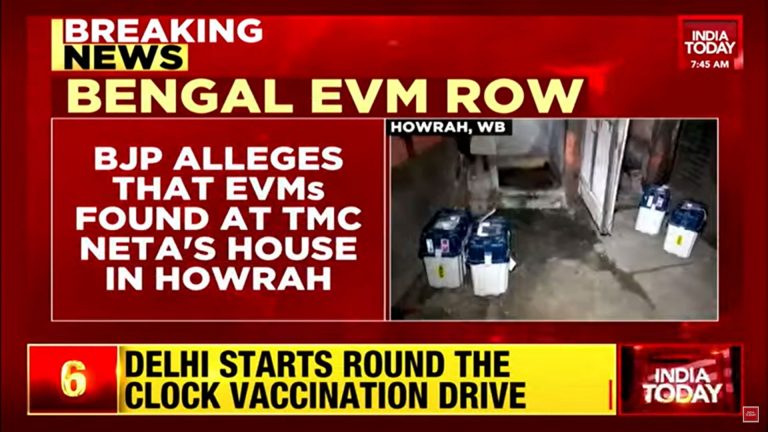
In a video report, India Today said, “BJP alleges that EVMs were found at TMC Neta’s house in Howrah”. In a 2-minute report, the anchor and the reporter kept on repeating that BJP is alleging the EVMs were found in TMC’s leader’s house. The anchor repeated it four times while the reporter used different words as ‘alleged’ and ‘claimed’. Interestingly, the visuals of EVMs and VVPATs played in the background for one minute in the 2-minute report while the anchor kept on saying that BJP is alleging instead of confirming that the EVMs were indeed found in the TMC leader’s house.

India Today claimed BJP is alleging EVMs were found in TMC leader’s house

EC suspended the presiding officer

As per reports, EVM and VVPAT machines were found at TMC leader Gautam Ghosh’s residence at Tulsiberia. The EVMs and VVPATs were brought to the residence of the TMC leader by Tapan Sarkar, a sector officer, in an election duty car. The sector officer who was caught red-handed by the villagers claimed that since it was very late in the night, the central forces had slept off and refused to open the booth, so they had to stay at a relative’s house to sleep who ‘happened to be a TMC leader’.

The Election Commission, in its report, said that the EVMs and VVPATs found at the TMC leader’s house were part of reserve stock, and they will not be used for the voting. The presiding officer was suspended. Reports suggest that when the villagers found out about the EVMs, the tension broke down in the area, and central forces were called to control the situation.

Netizens questioned India Today’s style of reporting

Several netizens raised eyebrows over the way India Today had reported.

Reports of violence in previous phases

The second phase of polling in West Bengal had witnessed several violence cases emerging from Nandigram, East Midnapore and Keshpur. BJP leader and Mamata Banerjee’s opponent, Suvendu Adhikari’s convoy was also attacked by alleged TMC goons in Nandigram.

Fahashi and the importance of Purdah in Islam: How Pakistan PM Imran Khan explained the rise of rapes against women

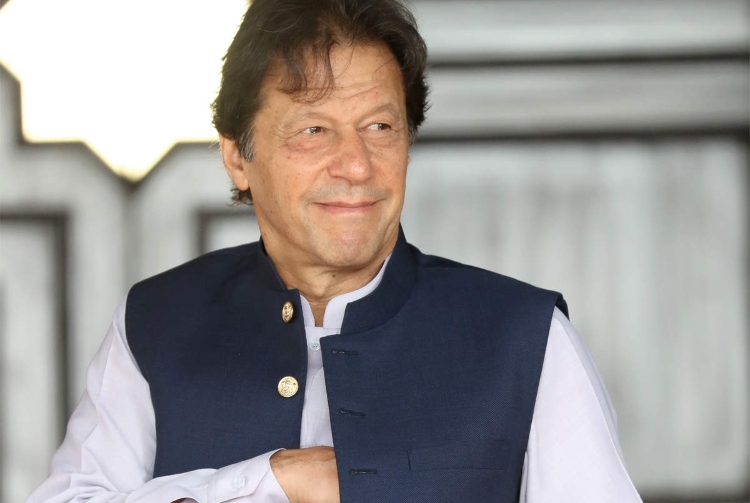
The prime reason behind crimes against women is obviously the deteriorating law and order condition of that particular country or state. However, Pakistan PM Imran Khan assumes otherwise. According to Khan, “fahashi” (vulgarity) is the main reason behind the rise in rape and sexual violence and not the declining lawlessness in the country.

The Pakistan PM was taking calls on Sunday, 4th April, when a caller asked him what the government plans to do in the light of rising incidents of rape and sexual violence, especially against children. To this Imran Khan opinioned that there are some fights that governments and legislation cannot win alone. He said that the society must join in the fight, adding that it was important for societies to protect themselves against “fahashi” (vulgarity), reported Geo News.

‘Pardah system is there in Islam to keep temptation in check’, claims Imran Khan

Imran Khan then went on to advocate the whole concept of ‘pardah’ in Islam, saying that it is there for a purpose. He said that the pardah system is there in Islam to “keep temptation in check”. It’s interesting that the Pakistan Prime Minister believes that the best way to protect women and children is to keep them behind a veil and not boost the law and order system of the country.

The Pakistan prime minister said there are many people in society who “cannot keep their willpower in check”. “Iska kuch tou effect aana thha na (It had to manifest itself in some way),” he added.

He concluded by reiterating that incidences of rape and sexual violence are “spreading like cancer” in society. Official statistics in Pakistan have revealed that at least 11 rape incidents are reported in the country every day, with over 22,000 cases reported to the police in the last six years.

However, what Imran Khan forgets to mention is that only 77 of the accused have been convicted which comprises 0.3 per cent of the total figure. According to the Geo News report, these statistics were obtained from the Police, Law, and Justice Commission of Pakistan, Human Rights Commission of Pakistan, the Women’s Foundation, and provincial welfare agencies.

As if this was not enough that in February, that the Forensics Department of Khyber Medical College University proposed a plan to charge rape victims Pakistani Rs 25,000 for medical examination and Rs 5,000 for an autopsy for the local residents of Peshawar.

Sexual assaults by men of Pakistani origin common worldwide

Not only in the terror state of Pakistan, where apart from native women and children, minority Hindu women are also kidnapped and raped and an alarming frequency, but sexual assaults by men of Pakistani origin has also increasingly become a common occurrence worldwide.

In the last few months, there have been several cases where Pakistani migrants were found committing unspeakable sexual atrocities against native women and children in Greece. While the victims have been predominantly native women, in some cases, even children have been brutalised by men of Pakistani descent.

Last year we reported how the United States Ambassador-at-Large for International Religious Freedom, Samuel Brownback made certain revelations regarding the situation of Hindu and Christian women in Pakistan. Brownback said that Pakistan has been marketing Hindu and Christian woman as concubines and forced brides to China. He highlighted how religious discrimination makes religious minorities in the country vulnerable.

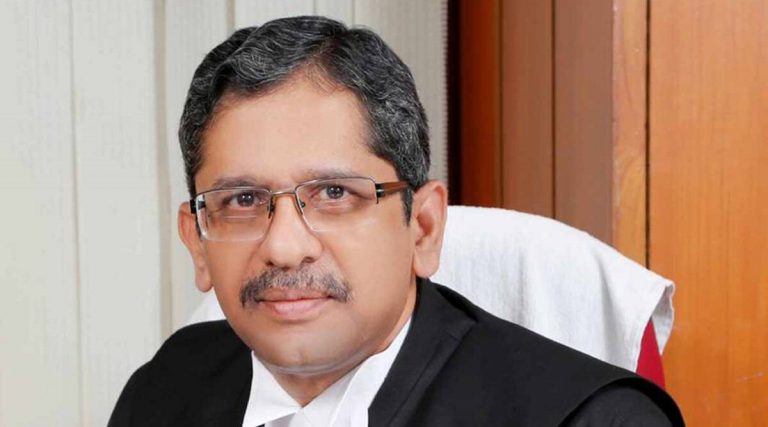
Justice NV Ramana appointed as the 48th Chief Justice of India by President Ramnath Kovind

The President of India Ram Nath Kovind today appointed Justice NV Ramana as the 48th Chief Justice of India, accepting the recommendation made by the outgoing CJI SA Bobde, who is retiring on April 23.

“In exercise of the powers conferred by clause (2) of Article 124 of the Constitution of India, the President is pleased to appoint Shri Nuthalapati Venkata Ramana, Judge of the Supreme Court, to be the Chief Justice of India with effect from 24th April 2021,” an official notification, due to published in the Gazette of India, and signed by Barun Mitra, Secretary to the Government of India, read.

Justice NV Ramana will serve as the CJI until 26 August 2022. Before his promotion to the Supreme Court in February 2014, Justice NV Ramana had served as the Chief Justice of the Delhi High Court.

The decision to anoint Justice NV Ramana came after departing CJI Bobde endorsed him as his successor. CJI Bobde had suggested Justice NV Ramana’s candidature after the law ministry had requested him to recommend his successor in accordance with the memorandum of procedure (MoP) for the appointment of the judges in the Supreme Court.

Born in an agricultural family in Ponnavaram Village, Krishna District, Andhra Pradesh, Justice NV Ramana enrolled as an advocate on February 10, 1983, and practiced in the High Court of Andhra Pradesh, Central and Andhra Pradesh Administrative Tribunals and the Supreme Court of India in Civil, Criminal, Constitutional, Labour, Service and Election matters. He has also served as the Additional Advocate General of Andhra Pradesh.

In June 2000, he was appointed as Permanent Judge of the Andhra Pradesh High Court. He functioned as Acting Chief Justice of Andhra Pradesh High Court from March 10, 2013, to May 20, 2013.

Justice NV Ramana was recently in the news after the Supreme Court had dismissed a complaint filed by the Andhra Pradesh CM Jagan Mohan Reddy in which he alleged that Justice NV Ramana was interfering with the State Judiciary in politically sensitive matters. Following a confidential in-house enquiry, the top court dismissed the Andhra Pradesh CM’s complaint.

Phase 3 of Bengal polls marred with violence, ISF bombing, and TMC obstructing voters: Details

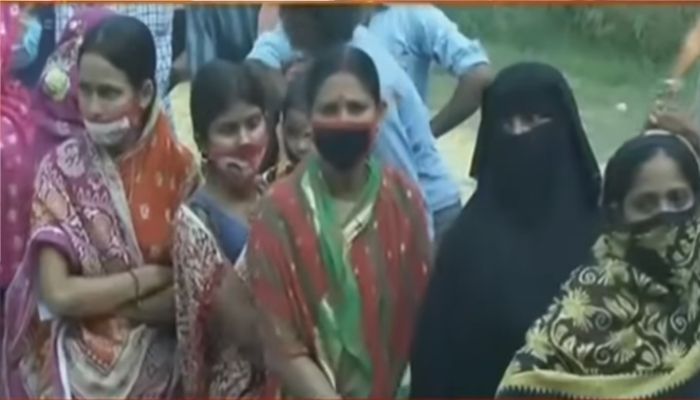
During the 3rd phase of West Bengal State Legislative polls on Tuesday (April 6), the BJP has alleged that people were stopped from casting their votes by hooligans associated with the Trinamool Congress (TMC).

The incident took place in Booth numbers 143, 180 in Dagira village in Basul Danga Gram Panchayat that falls under the Diamond Harbour Vidhan Sabha constituency in South 24 Parganas. BJP candidate Dipak Haldar has now filed a complaint with the Election Commission in this regard.

BJP agents stopped from entering polling booths in Tarakeswar, Baruipur Purba constituencies

A BJP agent was also stopped from entering the booth in the Tarakeswar Vidhan Sabha constituency in Hooghly district. When the candidate from the said constituency Swapan Das Gupta reached the Jamdara Sree Bharati Vidyapeeth school, he found that the BJP agent was not inside the booth. According to News 18 Bangla, the BJP worker confided to Gupta that he was being intimidated for over a week. He also complained about receiving death threats.

(Video Courtesy: Youtube/News 18 Bangla)

Following this, Swapan Das Gupta held the agent’s hand and took him inside the booth. While speaking about the matter, the former Rajya Sabha MP said, “Amader agent ke dhukta dai ni. Amader agent kunu karona dhukta para ni. Setai ami dekhchi (Our agent was stopped from getting inside the booth. Our agent could not reach the booth for some reason. I am looking into it).” BJP candidate from Baruipur Purba constituency, Chandan Mandal, has also levelled serious allegations. He said that the party agents were stopped from entering 8 election booths.

BJP worker’s mother succumbs to injuries

ABP Ananda reported that a clash broke out between the Trinamool Congress and BJP workers on Monday (April 5) night in Goghata in Hoogly district. On receiving information, the police reached the spot and detained two accused. An official complaint was, however, not filed in this matter.

(Video Courtesy: Youtube/ABP Ananda)

Later in the wee hours of Tuesday morning, the mother of a BJP worker who was injured in the attack died. The local BJP unit has said that the deceased sustained injuries while trying to save her son from the hands of Trinamool Congress workers. They alleged that she died due to the injuries inflicted during the attack. However, a preliminary investigation has found no external injuries.

TMC accuses ISF workers of hurling bombs, intimidating voters

The Trinamool Congress has accused Indian Secular Front (ISF) workers of hurling bombs at them in Ghumri in Canning Purba Vidhan Sabha constituency. The party has alleged that their workers were also physically assaulted by ISF. Following the incident, a large team of security personnel have been deployed the protect the polling booths to ensure free and fair elections.

While speaking about the matter, TMC leader Saokat Molla said, “The bombing took place early morning in the Ghumri area on the directions of ISF-Congress-Left alliance. Issac Molla, a dreadful anti-social element, is behind the attack. Several of our party members have been injured in the attack. They have now been hospitalised. A total of 12-14 bombs were charged at us.”

(Video Courtesy: Youtube/News 18 Bangla)

“This is a pre-planned attack. The objective is to instil fear into the minds of people so that they do not cast their votes,” he added. Molla emphasised that the Election Commission (EC) has been notified about the incident. He had also accused the ISF workers of hurling bombs at the houses of voters.

The elections for the 3rd phase of West Bengal State Legislative polls are underway. A total of 31 constituencies including Baruipur Purba (SC), Canning Paschim (SC), Canning Purba, Baruipur Paschim, Diamond Harbour, Uluberia Uttar (SC), Uluberia Dakshin, Tarakeswar, Arambag (SC) and Goghat (SC) are up for polls today. There are a total of 10,871 polling stations and 78.52 lac electorates are eligible to cast their votes. The results will be announced on May 2.

USA: In a boost for free speech, Supreme Court Justice suggests Big Tech may not have the right to regulate content on their platforms

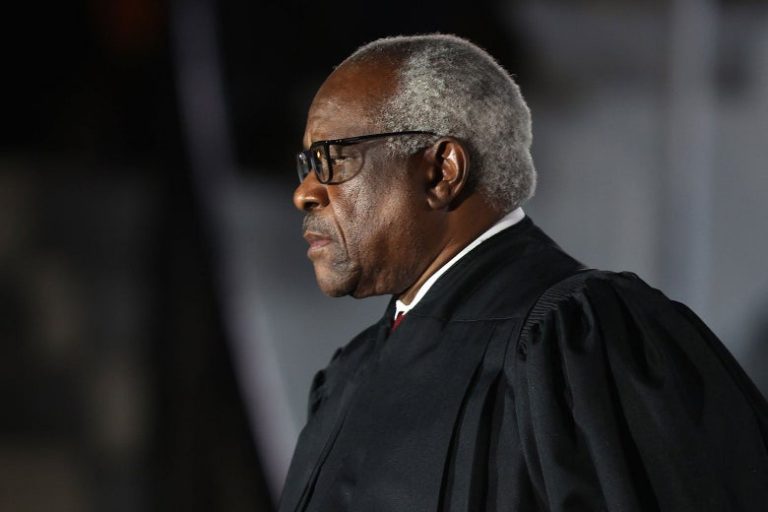
The United States Supreme Court Associate Justice Clarence Thomas in a non-binding order on April 5th, wrote regarding the problem of Big Tech platforms censoring opinions, most famously censoring the then President of the United States Donald Trump himself.

In his order today, Thomas wrote, “If part of the problem is private, concentrated control over online content and platforms available to the public, then part of the solution may be found in doctrines that limit the right of a private company to exclude. Historically, at least two legal doctrines limited a company’s right to exclude.”

Justice Thomas then drew a parallel between Big Tech social media platforms and certain businesses called “common carriers”, writing, “First, our legal system and its British predecessor have long subjected certain businesses, known as common carriers, to special regulations, including a general requirement to serve all comers.”

Justice Thomas also clarified that the Supreme Court believes regulations akin to those placed on “common carriers”, even for companies not historically considered so, maybe justified when, “a business, by circumstances and its nature, . . . rise[s] from private to be of public concern.”

According to Justice Thomas, there is a “clear historical precedent for regulating transportation and communications networks in a similar manner as traditional common carriers.” In the case of Telegraphs, they “resemble[d] railroad companies and other common carriers,” and were “bound to serve all customers alike, without discrimination,” writes Justice Thomas

Justice Thomas further wrote, “Even if digital platforms are not close enough to common carriers, legislatures might still be able to treat digital platforms like places of public accommodation.”

“Once again, a doctrine, such as public accommodation, that reduces the power of a platform to unilaterally remove a government account might strengthen the argument that an account is truly government-controlled and creates a public forum.”, Justice Thomas adds.

Legal journalists believe that this order from Justice Thomas invites the U.S. Congress to ban social media companies from regulating or censoring their own content, and instead be transformed into “common carriers” or “places of public accommodation”, as illustrated by Justice Thomas.

This opinion by Justice Thomas is also seen as an endorsement of the conservative view on Free Speech and the 1st Amendment, that these social media companies violate the spirit of Free Speech and the 1st Amendment through their content regulation, which can often devolve into outright censorship. Recently, Twitter CEO Jack Dorsey admitted that censoring the New York Post’s story regarding Hunter Biden by not letting it spread through Twitter and blocking all links to it, was a “mistake”.

Maha govt ignored Centre’s instructions, imposed lockdown despite advice to focus on containment: Report

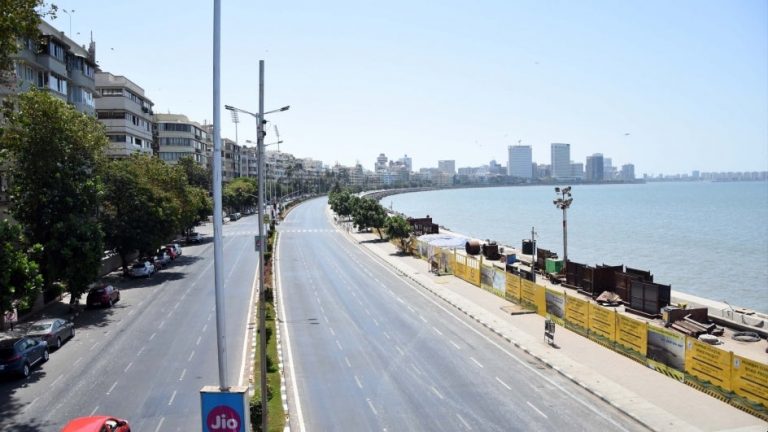
Maharashtra currently accounts for more than 55 percent of the new Covid-19 cases in the country. This forced the Maharashtra government to announce the impulsive imposition of weekend lockdown and night curfew which were announced Sunday late night, to curb the rise in cases.

However, as per an Indian Express report, the state kept silent about its plans to introduce a lockdown during a high-level review meeting chaired by the Cabinet Secretary on Friday. A top government source who was a part of the high-level meeting informed, “The Chief Secretary, Maharashtra, received the largest chunk of time during the Cabinet Secretary meeting. However, no one discussed any imposition of a weekend lockdown.”

This comes after the Centre had made it clear to the Maharashtra government almost two weeks back that weekend lockdowns and night curfews have limited impact on containing and suppressing transmission of the coronavirus.

Union Health Secretary had written to Maha govt asking to focus on containment and not imposing lockdowns

While constantly monitoring the worrisome situation of Maharashtra, the Union Health Secretary Rajesh Bhushan had written to the Chief Secretary of Government of Maharashtra Sitaram Kunte, on March 15 stating clearly that the state’s focus should be on strict and effective containment and not the imposition of a lockdown, as per the Indian Express report.

Rajesh Bhushan in his letter to the Chief Secretary wrote, “Measures such as night curfews, weekend lockdowns, have very limited impact on containing/ suppressing the transmission. Hence the district administration should focus on strict and effective containment strategy.”

The initial lockdown was to provide a breather to boost health infra, not needed now

The Centre in its meeting on Friday reiterated that the objective of a lockdown was to create and enhance health infrastructure, and not to break the chain of transmission. “Lockdown does not solve any problem. The reason to impose a lockdown in the initial phase was that we needed that time to create that infrastructure. We didn’t have enough domestic PPE capacity, there was a lack of oxygen bed capacity; these capacities were created during the lockdown. Lockdown gives you a breather in which you need to put certain things in place. Those things are now already put in place,” the states were informed.

Interestingly, the Centre had already warned the state on March 15 about the possibility of insufficient health infrastructure when mapped against the daily rise in new Covid-19 cases. The Centre said, “Health infrastructure though adequate as of now, the states should plan for a worst-case scenario with sufficient lead time”.

The Centre also advised the state government to better define its containment zones based on contact listing, digital mapping of cases, and contacts. “A higher number of cases outside the containment zone will mean that the containment zone has to be bigger to ensure total containment of transmission,” Bhushan wrote to the state.

On March 30, the Centre had once again urged all the states, including Maharashtra, to train and retrain the surveillance teams, and asked them to review the formation of containment zones on a daily basis. 

Maha says lockdown imposed because ‘people have become indifferent’

Despite multiple directions, advice and warning from the Centre, the state of Maharashtra imposed lockdown-like restrictions on the state causing panic. To justify its decision of a complete lockdown on weekends and partial lockdown on weekdays, a senior official from the Maharashtra government claimed, “The rationale to impose the lockdown was after an assessment made by the public health department. The biggest issue was that the people had become indifferent to the idea of Covid-19 appropriate behavior, despite the increase in the number of daily active cases.”

However, the Centre had already flagged the issue of lack of strict enforcement of Covid-19 appropriate behavior by the state government in the meeting. The state authorities were pulled up after the Centre observed a steep decline in fines collection and imposition despite a constant surge in cases. 

The government of Maharashtra released a set of fresh guidelines and restrictions late Sunday night resulting in confusion and uncertainty. The public is forced to rely on information reported by the media in bits and pieces. Multiple statements coming from the state leadership has added to the mess. 

Shiv Sena’s youth leader Aditya Thackeray took to Twitter to give clarity on hospital admission and BMC war room after many Mumbaikars complained of being turned down by hospitals for beds and admission. 

The health infrastructure is crumbling in cities like Pune which has been worse-hit by a sudden surge in Covid-19 cases.

Currently, in an attempt to ‘Break the Chain‘, the Maharashtra state government has imposed a complete lockdown on weekends starting Friday 8 pm to Monday morning 7 am; night curfew on all days, closure of restaurants and eateries other than takeaways, enforcement of ‘work from home’ for private companies which do not fall under essential services and closure of all public spaces such as temples, gardens, malls, gyms, parlors, etc.

The state machinery informed that a way forward will be issued again after reviewing the situation on April 15, 2021.