Home Blog Page 4735

Congress is ‘deeply disturbed’ by Delhi police searching premises of lawyer who had become ISIS poster boy

A day after the special cell of Delhi Police conducted raids at the office premises of advocate Mehmood Pracha, the Congress party has now come out in his defence. It is important to note that Pracha had featured in a pro-ISIS media outlet in February this year.

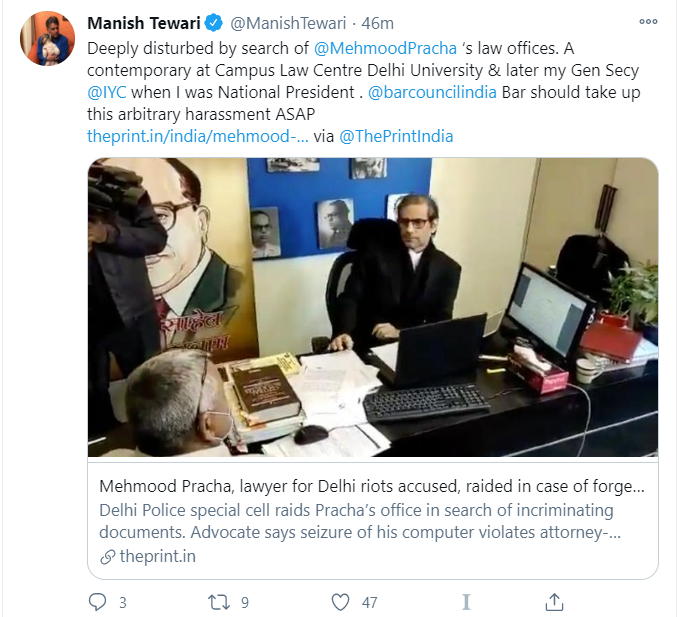
In a tweet on Friday, senior Congress leader Manish Tewari said that he was ‘deeply disturbed’ after the police searched the office of Pracha. While highlighting his personal connections with the accused, he wrote, “A contemporary at Campus Law Centre Delhi University and later my General Secretary Indian Youth Congress when I was National President.”

Screengrab of the tweet by Manish Tewari

Manish Tewari calls court warranted search ‘arbitrary harassment’

Calling the police action as ‘arbitrary harassment’, Manish Tewari urged the Bar Council to intervene as soon as possible. It is pertinent to remember that the search by Delhi police was done after obtaining a court warrant and not arbitrarily, as alleged by the Congress leader. The court authorised the police to conduct the search during the day to find evidence and had ordered it to be video recorded.

According to the search warrant, the lawyer has been booked under section 182, 193, 420, 468, 471, 472, 473, 120B of the IPC. It notes that the metadata of outbox of email account which was used to send incriminating documents are essential to the investigation being conducted by the Special Cell of Delhi police. Pracha had been handling a number of cases, related to anti-Hindu Delhi riots.

Mohammed Pracha – The ISIS poster boy

In February this year, a pro-ISIS media outlet had launched an India-centric publication as the country was going through a period of communal turmoil. The publication titled ‘Voice of Hind’ was issued by Al-Qitaal Media Center and Junudul Khilafah al-Hind as per its cover page and featured Mohammed Pracha on its cover page.

The person who was the main focus on the cover page was senior lawyer Mahmood Paracha who has been accused of inciting communal hatred in the past. According to a copy with OpIndia, the first part of the magazine talked about dead IS-JK militants in Kashmir. It showcased pictures and talks about how they started jihad in Kashmir and achieved their goal. Then featured a message from active ISHP militant, identified as ‘Abu Zakariya Al-Hindi’. Further, the magazine reportedly says that there is no place for Nationalism in Islam and Muslims should reject the notion and join the caliphate instead.

Pracha wanted to give weapons training to Muslims

In a press conference last year, Shia cleric Maulana Kalbe Jawad and Mahmood Paracha announced that they would be setting up a camp in Lucknow to teach Muslims and Dalits about the ‘right to self-defence’ and how to apply for a firearm licence.

Mahmood Pracha had cited the incidents of mob lynchings and the Sonbhadra massacre as reasons for conducting the camp. According to him, those events wouldn’t have occurred if the victims had legal firearms to defend themselves. They were basically planning to raise an armed militia to combat ‘mob lynchings’, using licenced weapons. Later, Mahmood Paracha was seen holding that training camp inside a Lucknow Mosque where he was training Muslims about how to fill forms for licences and acquire firearms, even though an FIR had been registered against him for his incendiary speech.

West Bengal police unleash lathi-charge on BJP workers including women, more than 40 injured

Several BJP workers, including women, were brutally thrashed by the West Bengal police officials outside Khardah Police Station in North 24 Parganas district on Wednesday.

The BJP has alleged that its party workers, even the women, were lathi-charged by the West Bengal police during a protest. The videos of West Bengal police thrashing BJP women workers have emerged on social media platforms.

In the video shared by the BJP National general secretary Kailash Vijayvargiya, West Bengal police officials were seen chasing the BJP workers to thrash them. The visuals of BJP workers bleeding and screaming after being hit by the West Bengal police can also be seen in the video.

According to the reports, the Khardah police on Wednesday arrested a BJP worker Bullet Roy on charges of threatening police. A group of BJP supporters gathered at the police station to protest against the witch-hunt against its party and demanded his release. The matter escalated when a group of women entered the police station premises to protest.

Reportedly, the police tried to intervene and unleashed lathi-charge on the BJP workers to disperse them. This led to a brutal clash between police and BJP supporters, leaving several party workers injured.

More than 40 injured, senior party leader suffered serious blows

Following the lathi-charge, more than 40 party workers, including several women workers, have reportedly been injured. BJYM Kolkata North Suburban District President Pintu Das also suffered injuries. They have been rushed to the nearest hospital.

Meanwhile, the West Bengal police have arrested seven people for the violence. The arrested seven persons have been released on bail.

BJP state general secretary Sayantan Basu said that party workers were targeted while carrying out a “peaceful demonstration”.

Meanwhile, Panihati’s TMC MLA Nirmal Ghosh claimed to media persons that the police had to resort to lathi-charge as the opposition party workers tried to “snatch the firearms of the policemen”.

Political violence continue to rise in West Bengal

Ever since the BJP made inroads in West Bengal, the political violence in West Bengal has only raised with the ruling TMC workers resorting to extreme violence against the opposition cadres. With the assembly elections just months away, the violence has only increased. The Bengal police has also been accused of unleashing violence against BJP workers at the behest of the state government.

The BJP has accused that the law and order in the state is in shambles.

Fake TRP ‘scam’: Mumbai Police now arrests BARC CEO, days after it arrested their COO

0

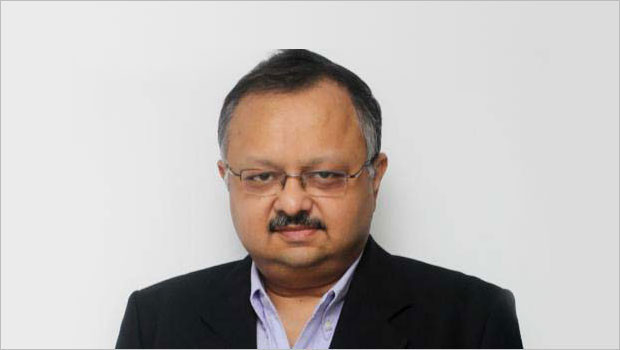
Mumbai Police and its city crime branch has made the 15th arrest in the fake TRP scandal that had broken out earlier this year. Days after they arrested BARC COO Romil Ramgarhia, they have arrested Broadcast Audience Research Council (BARC)’s former CEO Partho Dasgupta.

According to the police, Dasgupta has been arrested on Thursday from Pune Rural which is under the jurisdiction of Raigad police station. He is currently being taken to Mumbai and will be produced before the court on Friday.

Reportedly, the police is all set to hold another press conference on Friday, explaining the developments in the TRP case, the investigation of which has been surrounded in controversy.

The arrest of BARC’s former COO in fake TRP case

On 18th of December, the special investigation team (SIT) of the Mumbai Police Crime Branch had arrested former BARC Chief Operating Officer Romil Ramgarhia. A team headed by controversial Police officer Sachin Vaze reached Ramgarhia’s residence at Dosti Acres in Wadala. The SIT had initially brought Ramgarhia for questioning, however, he was taken into custody on Thursday noon by Vaze’s team.

The prosecutors claimed that Romil Ramgarhia’s custody is necessary as it is essential for them to retrieve data from his laptop in connection with the ongoing investigation into the ‘Fake TRP’ scam.

The SIT also claimed before the court that Ramgarhia allegedly leaked confidential information aiding the accused in the case to fix TRPs for some channels. The SIT said that Romil Ramgarhia leaked this information during his tenure with BARC. Ramgarhia was rating agency BARC’s first COO and he remained in that position till his resignation in July 2020. 

“While working with BARC, he guided and assisted some TV channels in manipulating TRPs. He was aware of the location of barometers across the country and we suspect that he shared this information too with some channels,” the officer added. The Police also stated that Ramgarhia’s mobile phone has been seized and will be sent to the forensic science laboratory for cyber analysis. 

Fake TRP scam

In October, Mumbai Police had made some sensational claims against some TV channels saying that they were manipulating TRP ratings. In a press conference, Mumbai Police commissioner Param Bir Singh had said that three TV channels, including Republic TV, were involved in manipulating viewership data of BARC by paying those households where Bar-o-meters, the devices that track TV viewership, are installed. 

Param Bir Singh had specifically mentioned that Hansa Research had filed a complaint with the police. Hansa Group is an organisation that regulated the devices to record TRP for BARC. Interestingly, in this FIR that was filed by Hansa Research, Republic TV was not mentioned even once. The channel that was mentioned several times was India Today. 

During the investigation, several evidence and witnesses came forward that alleged Mumbai Police have been intimidating them to speak against Republic TV, including Hansa officials. Hansa has also complained that they are being harassed by the Mumbai Police to give statements against Republic TV.

BJP MP Sadhvi Pragya Thakur has sent a legal notice to leftist troll Rachita Taneja: Here is why

BJP MP Pragya Singh Thakur on Thursday sent a legal notice to far-left troll Rachita Taneja for registering and blocking domain name for a website on the Bhopal MP’s name after the 2019 Lok Sabha elections.

According to the reports, the Bhopal MP Pragya Thakur, in her notice, has asked Rachita Taneja to immediately restrain, cease and desist from using the website/ domain name ‘www.pragyasinghthakur.com’.

In her legal notice, Sadvi Pragya Singh Thakur alleged that the far-left troll Taneja, who is known for of posting vile, derogatory cartoons on Twitter, has been slandering her by referring to her as a ‘terrorist’ which is a “contumacious and designed with the sole intention to malign the image”. The notice further alleged that Taneja’s intention is to create a narrative against Thakur so as to hamper her pending trial.

Rachita Taneja runs a page – ‘Sanitary Panels’, that is notoriously known for posting abusive and derogatory content on social media platforms.

Thakur, through her lawyer and Advocate on Record Namit Saxena, has mentioned some of Taneja’s posts in the legal notice to allege that the intention behind her vile posts was to “orchestrate a motivated public hearing to obstruct the ongoing bench hearing against the MP and harass her”, as per a report in New Indian Express.

“That the timeline on which these posts have been uploaded by you is extremely crucial as you wanted to create a narrative against my client to malign her reputation and goodwill immediately after my client’s election results. This is in line with concerted efforts made to jeopardize my client’s image amongst the society,” read the legal notice.

In the legal notice, the BJP MP asked the far-left ‘cartoonist’ to respond within seven days as to why and under what circumstances and with what intention did Taneja purchase/create/register/block the said domain name on June 8, 2019. The Bhopal MP asked the ‘cartoonist’ to restrain from using the said website/domain name or any variant thereof in the name of Pragya Thakur.

The notice to Taneja also warned of initiating appropriate legal proceedings, both civil and criminal, against her in case she fails to comply with the terms of this notice.

Contempt of court case against Taneja

Sanitary Panels founder Rachita Taneja, who proclaims to be a ‘Webcomic’, is known for her controversial, hateful and often Hinduphobic Tweets. Through her cartoons, Rachita Taneja has regularly indulged in mocking and berating the Indian judiciary, the ruling Bharatiya Janata Party and people associated with it.

In April, soon after the demise of actor Irrfan Khan, the cartoonist had posted a deplorable Tweet wherein she wished death on Bollywood actor Akshay Kumar while mourning actor Irrfan Khan’s demise. This animosity against Akshay Kumar was evidently because the superstar has been a vocal supporter of PM Narendra Modi.

Following the Supreme Court verdict on Ram Janmabhoomi case where the apex court decided in favour of constructing the Ram Mandir, Taneja had taken to Twitter to abuse the temple and Hindus. Recently, the far-left troll had attacked the Supreme Court for granting bail to Republic TV Chief Arnab Goswami, inviting a contempt of court case.

The Attorney General KK Venugopal had granted consent to a law student to initiate contempt proceedings against comic artist Rachita Taneja for Tweets saying they are an “audacious assault and insult to the institution.” While granting the consent, the AG stated that the Tweets by Sanitary Panels has a clear implication that Supreme Court is biased towards the ruling political party BJP, which is somehow interested in protecting Republic TV Editor-in-chief Arnab Goswami.

‘People from Muslim community are threatening to kill me: Qasim receives death threats after voluntarily converting to Hinduism

0

A 28-year-old Muslim man by the name of Qasim Khan has been receiving death threats from his own community members after he willingly left Islam and embraced Hinduism.

While talking to the media, he said, “My name was Qasim and after I converted people from Muslim community are threatening to kill me & my family. I need police protection.” Aligarh Superintendent of Police (Crime) Arvind Kumar informed that a case has been registered based on his complaint. He added that Qasim is being threatened by some people and that security has been deployed outside his house in Aligarh.

As per reports, Qasim had married 24-year-old Hindu woman named Anita Kumari in 2012. He met Anita when his father had taken a construction workshop on lease from her father. They fell in love and got hitched 8 years ago. Reportedly, Qasim Although the girl’s family was not happy with the marriage, the duo married as per Hindu traditions in 2013. The couple, who resides in Aligarh, has two kids, 7-year-old Kasifa and 4-year-old Ayaz.

He had earlier raised security concerns. Qasim said, “I had sought security from the district administration but they didn’t get back to me. I request the government again, I need protection.” His wife Anita had conceded that there was no pressure on her to convert to Islam or not follow Hindu rituals.

Conversion facilitated by a Hindu group

Eight years after his marriage, he voluntarily decided to convert to Hinduism. “No one forced me. I took this decision on my own,” Qasim emphasised. After embracing Hinduism, he has adopted the name of Karamveer Singh.

His conversion was facilitated on Sunday by a Hindu group. A member of the said organisation, Neeraj informed, “They are welcome to the fold of Hindu religion. We did the rituals at Arya Samaj temple on Sunday.” Although Qasim had applied for legal conversion on December 15 to the district magistrate, he did not hear back even after 5 days. As such, the Arya Samaj temple took it upon itself to facilitate the conversion.

50 Muslim families convert to Hinduism

The day Ram Mandir’s Bhoomi Pujan in Ayodhya was successfully performed by PM Narendra Modi, as many as 250 Muslims of 50 families, living in Motisara village of Payala Kalla Panchayat Samiti of Barmer city, in Rajasthan, decided to re-convert to Hinduism. According to reports, Vedic rituals were performed at the village and all 250 members of the 50 families converted to Hinduism by wearing the sacred thread.

The family members asserted that they have not been forced and that they have converted out of free will. The senior members of these Muslim families asserted that they originally belonged to the Kanchan Dhadhi caste. They were following Hindu customs for the past several years. They celebrate Hindu festivals every year at their residences.

On his 96th birth anniversary: A look at 5 key steps undertaken by former PM Atal Bihari Vajpayee that radically transformed India

25 December 2020 marks the 96th birth anniversary of one of the most admired politicians in the history of independent India and the tenth Prime Minister of India — Atal Bihari Vajpayee. Born in 1924 in Gwalior, Madhya Pradesh, to a middle-class Brahmin family, Vajpayee had completed his M.A. in Political Science with a first-class degree from DAV College, Kanpur.

His first brush with politics occurred in August 1942 at the time of Quit India Movement. Vajpayee and his elder brother Prem faced 23 days of incarceration after they heeded Mahatma Gandhi’s call to join the movement. Vajpayee was deeply inspired by RSS ideologue Syama Prasad Mookherjee after joining the Bharatiya Jan Sangh in 1951.

Vajpayee jumped into the election fray in 1957 and won from the Balrampur Lok Sabha (parliamentary) constituency of Uttar Pradesh. He also served as the President of the party from 1969 to 1972. Subsequently, Vajpayee also served as the Minister of External Affairs in 1977 when the Janata Party won the Lok Sabha elections and Morarji Desai became the Prime Minister of India.

Three years later, in 1980, Vajpayee joined L.K. Advani, Bhairon Singh Shekhawat and his other colleagues from RSS, Jan Sangh to form Bharatiya Janata Party (BJP) and became the party’s first president. In 1984 Lok Sabha elections, the party won just two seats. But, an unflinching Vajpayee weathered the political storm and led the party during these tumultuous years, fashioning out an identity for itself by aligning with the Ram Janmabhoomi Mandir Movement by RSS and Vishva Hindu Parishad (VHP).

A decade later, in a turn of fortunes, BJP rose in prominence after performing well in Karnataka, Maharashtra and Gujarat state assembly elections. This brought Vajpayee and BJP back into the political centre stage of the country.

Known for his impeccable oratorical skills, Atal Bihari Vajpayee remains the only non-Congress prime minister to have occupied the chair three times and only the third overall after Jawaharlal Nehru and Indira Gandhi. Vajpayee came to power for the first time on May 16, 1996, by forming a minority government. But his government barely lasted a fortnight till June 1 as it failed to pass the floor test.

Atal Bihari Vajpayee was sworn in as Prime Minister of India for the second time on 19 March 1998. The NDA proved its majority in the house but the government lasted for only 13 months after the AIADMK under Jayalalithaa withdrew its support. The government lost the vote of confidence in the Lok Sabha by a single vote.

When fresh elections were held in 1999, the NDA came back with a majority and Vajpayee became the prime minister for the third time. His government lasted till 2004, completing a full term of five years, the first non-Congress government to have done so.

Though his first brief tenure remained relatively uneventful, his other two tenures were seminal in shaping India’s growth trajectory. The important initiatives he presided over, the crucial policies his government formulated had a far-reaching and profound impact on the country’s On his 96th birthday anniversary, here is a look at the key decisions taken by late Vajpayee that transformed the country radically.

Developing Infrastructure in India

India witnessed a rapid growth of infrastructure development under the leadership of Atal Bihari Vajpayee. For decades, the Indian politicians, primarily from the Congress party and the left, turned a blind eye towards building a robust infrastructural capability to advance the country into the modern age.

Soon after Atal Bihari Vajpayee came to power in 1998, he turned his attention towards connecting far corners of the country through a network of interconnected highways. In 2001, Vajpayee launched the Golden Quadrilateral, connecting the major industrial and cultural centres across the length and breadth of the country was a brainchild of Atal Bihari Vajpayee.

His critics mocked him stating that the government of India lacked funds to bankroll such an ambitious project, however, years later he proved them wrong as major metro centres of the country was connected with the roads and highways. The project was modelled on the lines of the National Highway System of the US. Vajpayee firmly believed that construction and infrastructure advancement would act as harbingers of economic development.

Another contribution made by Vajpayee in developing the country’s moribund infrastructure was by launching the rural roads scheme called the Pradhan Mantri Grameen Sadak Yojana (PMGSY). The project aimed at providing all-weather connectivity to hitherto unconnected villages. Vajpayee was of the opinion that the development of roads and improved connectivity to pave the way from economic development of the hinterland. It is little wonder then that the subsequent UPA government continued with this scheme implemented by Atal Bihari Vajpayee.

Though the policy of developing roads and highways appeared to reinforce the urban connectivity programme, in reality, it was a policy that provided Rural India access to Urban India. More than 6,000 KMs of roads were built under the projects envisaged by Atal Bihari Vajpayee. Lakhs of people, from both Rural and Urban India, got employment under this visionary plan. Farmers and rural artisans were connected to the nearby urban centres which enhanced their business and employment prospects and brought greater prosperity.

How Atal Bihari Vajpayee transformed India into a nuclear power

Amongst the many decisions taken by Atal Bihari Vajpayee while he was in power, transforming India into nuclear power was the most significant and momentous of them all. It demonstrated, perhaps for the first time, that India’s decisions would be guided by its self-interest and not by the geopolitical pressures.

After Vajpayee came to power in his second term in March 1998, he immediately ordered nuclear tests. In May 1998, Vajpayee hurriedly called a press conference to announce that India had conducted three underground nuclear tests in Pokhran. The decision evoked sharp criticism from several countries across the world and India had to face harsh sanctions, denying it critical nuclear and space technology.

However, Vajpayee was not preoccupied with the threats of sanctions from the international community. He was concerned with the expanding nuclear capabilities of India’s hostile neighbours. Earlier, Indira Gandhi had conducted first nuclear tests in Pokhran but India’s nuclear programme hit a snag following Rajiv Gandhi’s emphasis on nuclear disarmament. Meanwhile, China was continue augmenting its nuclear capabilities and India’s arch-nemesis, Pakistan, had also clandestinely acquired know-how for building its nuclear capabilities.

What is, perhaps, a little-known fact is that Vajpayee was predisposed to have the nuclear tests done in 1996 itself when he formed a minority government at the centre and which lasted for just 13 days. According to the accounts narrated by journalist Raj Chengappa in his book ‘Weapon of Peace’, the former Prime Minister was prepared to do the test even during his short-lived tenure in 1996 and instructed the then DRDO chief A P J Abdul Kalam to prepare for the test.

In a bid to create deterrence against India’s two neighbours, Vajpayee felt the urgency to revive India’s dormant nuclear programme. Atal Bihari Vajpayee, along with the Missile Man of India, Dr APJ Abdul Kalam, ushered the country into the nuclear age. Shortly afterwards, Pakistan followed the move and carried out its own nuclear bombs. On the other hand, China sought a great commercial relationship with India after it demonstrated its nuclear capabilities.

As nations were coming to terms with India’s nuclear proficiency, Vajpayee told the Indian Parliament that the government was ordering a voluntary moratorium on further tests. The then Prime Minister also assured that India would not be the first to carry out a nuclear strike and would always follow a No-First-Use doctrine. Besides, he also added that nuclear weapons would never be used against a non-nuclear state and remain under civilian control, reinforcing India’s commitment towards maintaining peace and stability.

A decade later, this decision by Atal Bihari Vajpayee of exerting the country’s nuclear capabilities played a crucial role in the country’s signing of a nuclear pact with the United States in 2008 that granted India the recognition of being a responsible nuclear weapon state with strong non-proliferation credentials. The deal with the US not only paved the way for India to gain access to critical technologies, it also made the import of supercomputers and high-technology equipment easier.

Education for All with ‘Sarva Shiksha Abhiyan’

Realising that even after decades since India’s independence, the literacy rate of the country was at abysmal levels, Atal Bihari Vajpayee launched a revolutionary scheme— ‘Sarva Shiksha Abhiyan'(SSA) in 2001, aimed at providing elementary education to all in a time-bound manner and achieving universal literacy.

The initiative was mandated by the 86th Amendment to the Constitution of India making free and compulsory education to children between the ages of 6 to 14 a fundamental right. As a consequence, the school drop-out rate came down by 60 per cent within five years of its implementation.

The SSA is hailed as one of the most successful education schemes implemented by any central government. The fact that a non-Congress government, almost after 50 years of India’s independence, had to come up with as basic a scheme as compulsory education for children in the age group of 6 to 14 is a scathing indictment of all the central governments that preceded the Vajpayee regime. Moreover, the SSA formed a cornerstone for the implementation of the Right to Education Act, which has helped push elementary education in India.

Pioneering a telecom revolution with New Telecom Policy

Under the leadership of Vajpayee, the Indian government announced the New Telecom Policy (NTP) on 3 March 1999, opening up the sector to private players and giving a push to what had become a static and lacklustre industry.

The New Telecom Policy ended the hegemony of government-owned telecom companies and catalysed the participation of private companies that kicked up a telecom revolution. The government waived off a fixed fee that the telecom companies were asked to pay for using the spectrum. Instead, the companies were asked to share a part of their revenue under the new telecom policy.

The New Telecom Policy touched off a massive revolution, bringing in more revenue from the greater amounts of profits made by the private players. The new policy also reduced the cost of telecom companies owned by the government. The policy made a clear separation between policy formation and service provision, turning the old telecom department into a corporation – BSNL.

Competition among the private players led to a dramatic fall in tariffs and a massive improvement in the quality of services being offered. This, in turn, prompted mobile phone companies to draw the focus on India and flood the markets with new and feature-rich mobile phones. So great and extensive the impact of the New Telecom Policy that it still fuels the growth in the country’s telecom sector. India has become the second-largest smartphone market and is all poised to surpass China in the coming years.

At Corporate Awards Functions in December 2009, when Idea Cellular’s then managing-director Sanjeev Aga was asked to point out the turning point in India’s telecom sector, he referred to the 1999 NTP, saying, “When I read it today, it is still contemporary and comprehensive”. He described the NTP policy as ‘watershed moment’ of India’s telecom sector.

Authors Harsh Madhusudhan and Rajeev Mantri in their recently released book–’A New Idea of India’ hail the policy as an action that liberated the telecom sector from the political control. They also argued that Atal Bihari Vajpayee should be given the due credit that he deserves for pioneering a futuristic telecom policy as against the former PM Rajiv Gandhi and technocrat Sam Pitroda who are falsely hailed by Congress ministers and supporters as progenitors of the mobile revolution.

Atal Bihari Vajpayee and laying the foundation for strong economic reforms

The six years of Atal Bihari Vajpayee’s tenure from 1998 to 2004 was an important interval between the drab rule of Congress-led governments for over 6 decades. Vajpayee’s regime reset India’s economic aspirations and laid the foundations for strong economic growth for years to come.

Even though Atal Bihari Vajpayee’s ‘India Shining’ campaign failed in 2004 and UPA government came back in power, the country really shone in the years after Vajpayee when economic growth picked up to high single digits almost as soon as the NDA government lost. This was due to the economic reforms and the sound fundamentals of the Vajpayee years.

Disinvestment gathered pace under Atal-Bihari Vajpayee-led NDA government. While disinvestment was kick-started by Prime Minister PV Narasimha Rao when he started selling minority stakes of the state-owned companies, but it was Vajpayee who took the courageous decision of privatising public sector companies under “strategic sales”.

In fact, Atal Bihari Vajpayee was the first Prime Minister of the country to have a separate disinvestment ministry. The Vajpayee government privatised as many as 12 public sector companies during their tenure, including behemoths such as Maruti Udyog, Hindustan Zinc, Bharat Aluminium, Videsh Sanchar Nigam Limited and many others.

The Vajpayee-led NDA government was one of the few regimes which were more conscious than many other governments to how the international investors viewed the Indian market and the government. There was an unswerving focus on the fiscal rectitude with the Fiscal Responsibility and Budget Management Act providing the framework within which the fiscal math had to be contained.


NDTV promoters caught again, after insider trading, Prannoy Roy and Radhika fined Rs 25 cr by SEBI in ICICI loan case: Read details

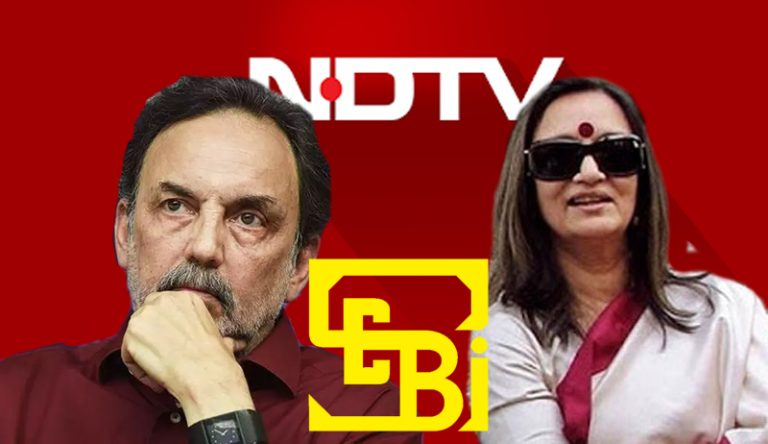
Markets regulator Securities and Exchange Board of India (SEBI) on Thursday imposed a penalty of Rs 25 crore on controversial news outlet NDTV and Rs 1 crore each on its promoters. SEBI has imposed fines on NDTV and its promoters Prannoy Roy and Radhika Roy for “violating various securities” norms by hiding information from shareholders regarding certain loan agreements.

According to the reports, RRPR Holding, the promoter entity of New Delhi Television Ltd (NDTV), has been fined by SEBI after they concealed information about loan agreements that had clauses having an adversarial effect on the NDTV shareholders.

Ordering the Roys to pay the penalty for the violation, the SEBI said it began an investigation after receipt of complaints from Quantum Securities Pvt Ltd, a shareholder of NDTV in 2017, about the violation of rules by non-disclosure of material information to the shareholders about loan agreements with VCPL. One loan agreement was with ICICI Bank, and two were with Vishvapradhan Commercial Private Ltd (VCPL).

According to the regulator, the agreement was signed in 2009 with VCPL for a loan of Rs 350 crore to repay the ICICI Bank loan and a second loan agreement with VCPL was signed for Rs 53.85 crore, a year later. These loan agreements included clauses and conditions that substantially affected the functioning of NDTV.

One of the terms of loan agreements allowed VCPL to indirectly acquire 30 per cent shareholding of NDTV through the conversion of warrants into equity shares of RRPR Holding.

The loan agreements were structured that clauses on matters pertaining to NDTV, which had price-sensitive information, were concealed from the minority shareholders.

Meanwhile, the promoters – Prannoy Roy and Radhika Roy, who are also accused of committing crores of tax fraud, have claimed that NDTV was not a party hence there was no requirement for them to make disclosure of the agreement to the stock exchanges.

SEBI fines NDTV, here is why: Roys entered loan agreements creating a conflict of interests, violated provisions

SEBI Adjudicating Officer Amit Pradhan said that thought NDTV was not a party to these loan agreement, however, contents and clauses of loan agreement clearly demonstrates that the scheme was devised by the notices in such a way that though NDTV would not be a party to the said loan agreements, yet the loan agreements would contain certain crucial, onerous and hostile stipulations pertaining to NDTV.

“Such stipulations included NDTV’s capital restructuring, which was agreed to be undertaken by Prannoy Roy and Radhika Roy, only with the prior consent of ICICI Bank/ VCPL,” he added.

Through such acts, Prannoy Roy, Radhika Roy and RRPR Holding violated provisions of PFUTP (Prohibition of Fraudulent and Unfair Trade Practices) norms, SEBI said in its order.

The accused Roys had also entered into loan agreements which created a conflict of their personal interest with the interest of NDTV, however, failed to make disclosure as required under the company’s code of conduct. They violated the code of conduct of NDTV and provisions of equity listing agreement.

“Accordingly, a fine of Rs 25 crore has been imposed on Roys and RRPR Holding, which needs to be paid jointly and severally. Besides, a penalty of Rs 1 crore each has been levied on Prannoy Roy and Radhika Roy,” the SEBI said in its order.

NDTV promoters accused of ‘insider trading’

In November this year, in yet another blow to controversial media network NDTV, Securities and Exchange Board of India (SEBI) had found its promoters Prannoy Roy and Radhika Roy guilty of making undue gain from insider trading. As a penalty for the financial crime, SEBI has barred them from trading in the securities market for two years and directed them to return the illegal gain of Rs 16.97 crore they had made from the insider trading more than 12 years ago.

Apart from Pranoy Roy and Radhika Roy, former NDTV CEO Vikramaditya Chandra, senior advisor Ishwari Prasad Bajpai, group CFO Saurav Banerjee also have been found guilty of insider trading.

According to an investigation conducted by SEBI, Pranoy Roy and his wife Radhika Roy have violated the Prohibition of Insider Trading (PIT) Regulations. They are accused of possessing Unpublished Price Sensitive Information (UPSI) during 2007-2008 relating to discussion on the reorganisation of New Delhi Television Ltd.

NDTV accused of tax fraud, financial irregularities

The controversial far-left alleged news channel – NDTV in recent times has been embroiled in controversies over alleged financial irregularities. NDTV is facing multiple cases related to violation of FDI norms, Income Tax violation, and non-compliance with disclosure norms. CBI is probing a case against NDTV in relation to a Rs 375 crore loan from ICICI Bank and a corresponding wrongful loss of Rs 46 crore to the bank.

There is a chain of borrow, repay and borrow where Roys took a series of loans in 2008 as they sought to buy back a large chunk of NDTV shares from the market, allegedly violating foreign direct investment (FDI) rules in a 2007-09 investment, a charge denied by the company.

In August 2019, NDTV founders Prannoy Roy and his wife, Radhika Roy, were prevented from leaving the country after authorities had suspected that the accused Roys could run away from the country amidst massive tax fraud allegations against them.

Indian crew on two ships stuck for months at Chinese ports as China does not allow them to unload cargo

0

Displaying a vile gesture, China has not allowed two Indian cargo vessels with many Indians on board to unload their cargo at Chinese ports. The Ministry of External Affairs informed the same today, saying that the two cargo ships with a total of 39 Indians on board have been on anchorage in Chinese waters for several months as they were not allowed to unload their cargo, even though some other ships were allowed to do so.

According to reports, Spokesperson of Ministry of External Affairs (MEA), Anurag Srivastava said that the crew on the ships are under a lot of stress. “There is a considerable amount of stress on the crew members on account of this unprecedented situation”, he said.

Vessels of other countries allowed to unload

China has allowed the vessels of other countries to enter Chinese ports and unload their cargo during the months when two Indian ships with several crew members on board were not allowed to do so on the grounds of Covid-19 related restrictions. However, no case of Covid-19 has been reported so far on the Indian cargo vessels. Srivastava said bulk cargo vessel MV Jag Anand is on anchorage near the Jingtang port in Hebei province of China since June 13. The vessel had 23 Indians on board. The other vessel MV Anastasia is on anchorage near Caofeidian port in China since September 20. It has 16 Indian nationals on board.

Yesterday China had said that it was in touch with Indian authorities regarding the situation of the cargo vessels and the Indian nationals on board. However, it did not say anything about when the crew members will be allowed to leave the vessel.

China citing Covid restrictions

China, on Wednesday, said it was in touch with Indian authorities on the situation of the 23 Indian sailors stranded on a ship anchored off a northern Chinese port since June, but did not say when they will be allowed to leave the vessel. “Our Embassy in Beijing has been in constant touch with provincial and central government authorities in China, requesting that the ships be allowed to dock and/or the crew be allowed to be changed”, said Srivastava.

Srivastava said the Chinese authorities have conveyed that crew change is not being permitted from the ports on account of coronavirus-related restrictions imposed by the local authorities. “We also understand, however, that some other ships, which arrived after Indian ship had arrived, have actually managed to discharge cargo and leave. The reasons for this are not clear,” he added. The spokesperson further stated that  India has taken note of the Chinese foreign ministry’s statement on Wednesday about the provision of necessary facilitation and assistance.

After getting banned for two years for failing dope test, Basketball Player Satnam Singh joins farmer protests

0

Basketball player Satnam Singh Bhamara, who was banned by the National Anti-Doping Agency (NADA) today for failing a dope test, was seen joining the farmer protests. The Anti-Doping Disciplinary Panel of NADA imposed a ban of 2 years on Singh after he tested positive for Higenamine Beta-2-Agonist.

After joining the protesting farmers at Singhu border, Singh extended support for the protesting farmers and said that he stood with the farmers. He said that he went to offer his services so that the farmers did not face any problem.

Singh was given a provisional suspension last month after he failed an out-of-competition test conducted in Bangalore by NADA during a preparatory camp for the South Asian Games. He had denied the charges levelled against him and had requested NADA for a hearing by its Anti-Doping Disciplinary Panel.

The ban imposed on him will end on November 19 next year with the ban period beginning retrospectively on the same day in 2019. Singh was picked in the National Basketball Association (NBA) draft by Dallas Mavericks five years ago. He played in the Development League with Texas Legends, an affiliate of the Mavericks, for the next two years. In 2018, he became the first Indian to play in the National Basketball League of Canada after signing a deal with St John’s Edge. He represented India at tournaments like the Asian Championships, 2018 Commonwealth Games and 2019 World Cup Qualifiers.

Meerut: Man gives Triple Talaq to his wife for refusing to dance and wear jeans, later sets himself on fire

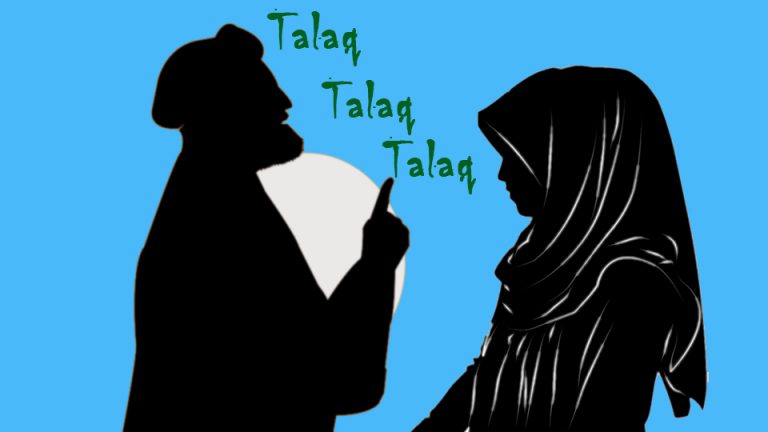
A Muslim man in Meerut Uttar Pradesh gave triple talaq to his wife after she refused to dance and wear jeans on his demand. The man later went to the house of his in-laws and set himself on fire. However, his in-laws saved him and informed the police.

According to reports, the woman, a resident of New Ismailnagar, was married off to the man named Anas from Pilkhua, Hapur eight years ago. Anas used to work in Delhi.

As alleged by the woman, the man used to force her to dance and sing, and wear jeans, which would lead to quarrels between them. She had even approached a local Panchayat to get the problem resolved but it did not work. On Tuesday, the man gave triple talaq to his wife over the same issue. Later he set himself on fire at his in-laws place. He was immediately rushed to the hospital by his in-laws. The police are investigating whether there was any motive behind the man setting himself on fire.

CO Arvind Chaurasia said that the as soon the police received the information about the man burning himself, they reached the spot and arrested the man.

Woman divorced for developing vaginal infection

Last month, a Muslim man gave triple talaq to his 24-year old wife who was diagnosed with vaginal infection. The man even threatened the woman that he would remarry and demanded money from her parents. In the same month, a Muslim man gave triple talaq to his wife for not bringing a car and Rs 20 lakh in dowry. In another similar incident in that happened in the same month, a Muslim man pronounced triples talaq to his wife for not giving birth to a male child.