Home Blog Page 5016

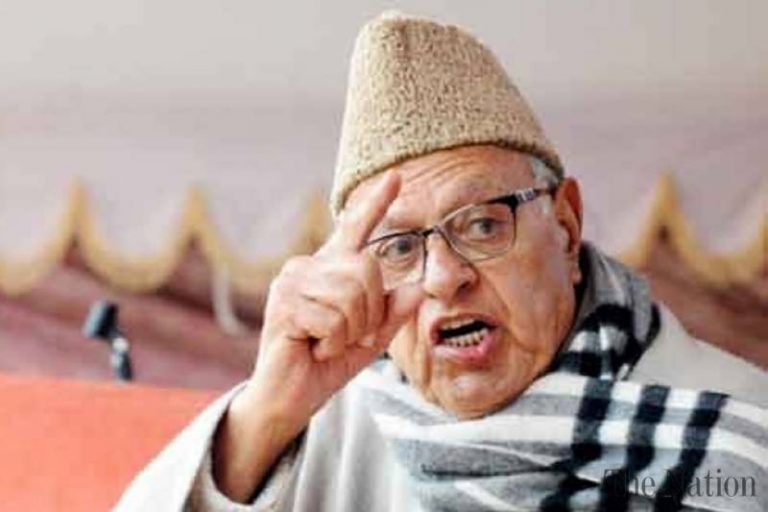
What they did on 5th August, was the last nail on the ‘coffin of India’: Farooq Abdullah says Kashmiris would prefer to be ruled by China

Former Jammu and Kashmir Chief Minister Farooq Abdullah on Wednesday claimed that after the abrogation of Article 370, the Kashmiri people ‘do not feel or want to be Indian’ and they would rather prefer to be ruled by China, instead of India. 

Speaking to the far-left website ‘The Wire’, Farooq Abdullah, who is also a Member of Parliament, said that the Kashmiris would rather be ruled by the Chinese, rather than being part of the country. In the interview, Abdullah claimed that the sentiments of the Kashmiris are such that they are waiting for Chinese to enter Kashmir despite their human rights record with Muslims in China.

“To be honest, I wonder whether they (Modi govt) will find somebody who will call himself an Indian today. What they did on 5th August last year, was the last nail in the coffin of India. And that’s what they did. You go and talk to anybody; they don’t want to be known as Indians,” the three-time Jammu and Kashmir Farooq Abdullah said to Karan Thapar.

Claiming that the people of Kashmir have lost faith from the Modi-led government, Abdullah said that the lakhs of Kashmiri will hit the streets in the future against the policies of Modi government once Section 144 is lifted. “We had joined Gandhi’s India, not Modi’s India,” he said.

In the 44-minute interview, Farooq Abdullah said that the Modi government has brought a new domicile law that is intended to flood the Valley with Hindus and create a Hindu majority.

Speaking on his alleged detention after the abrogation of Article 370 in Kashmir, the former Chief Minister said that it was the ‘Quran’ which gave him the courage to stand on fight against the Modi government.

Article 370, 35A will be reinstated in Jammu and Kashmir, says Farooq Abdullah

In the interview, Farooq Abdullah said that the National Conference and other parties had come together to issue the Gupkar Declaration of August 2019, which reiterated its stand again on August 22 this year. The parties, according to the declaration, are committed to restoring the dignity of Kashmiris.

Farooq Abdullah said that the parties will look to reinstate Articles 370 and 35A and also restore statehood of the Union Territory of Jammu and Kashmir. Abdullah claimed that he had faith in the Supreme Court and hoped that it would hear his petition expeditiously.

The KWAN connection: Deepika Padukone’s NGO had Anirban Das Blah as one of the trustees

As Narcotics Control Bureau (NCB) is closing down on Bollywood’s connection to drug usage, several celebrities are coming under the scanner of the agency. One of the latest names that have emerged in the drug abuse case is of Deepika Padukone. Netizens have now dig out the connection between her NGO ‘The Live Love Laugh Foundation’ (TLLLF) and KWAN talent agency.

TLLLF History and its connection to KWAN Entertainment

TLLLF was founded in 2015 by Deepika Padukone, aimed at raising awareness about mental health. Deepika, who claims to have suffered from depression, had said that there should be a supporting ecosystem to allow a person suffering from a mental disorder to cope with hope and dignity. Though the aim of the charitable trust sounds progressive and important, especially in a country like India, where mental illness is considered to be a taboo, TLLLF’s name got associated with several controversies.

Anirban Das Blah, ex-owner of KWAN Entertainment, was associated with Deepika’s NGO. When his name first appeared in the “Me Too” movement in 2018, both KWAN and TLLLF issued a statement that they have removed Anirban from his respective positions in the organization. On 23 September, Blah’s name again appeared in controversy when actress Sherlyn Chopra alleged that he sexually harassed her during a meeting. KWAN’s employee Karishma and Deepika’s alleged 2017 chat has recently surfaced discussing procuring drugs.

NCB has also summoned Madhu Mantena Varma, co-founder of KWAN, Dhruv Chitgopekar, CEO KWAN and Jaya Saha Talent Manager KWAN who managed Sushant Singh Rajput and Rhea Chakraborty. Saha also admitted ordering CBD Oil for Rhea and Rajput.

Same PAN for two NGOs

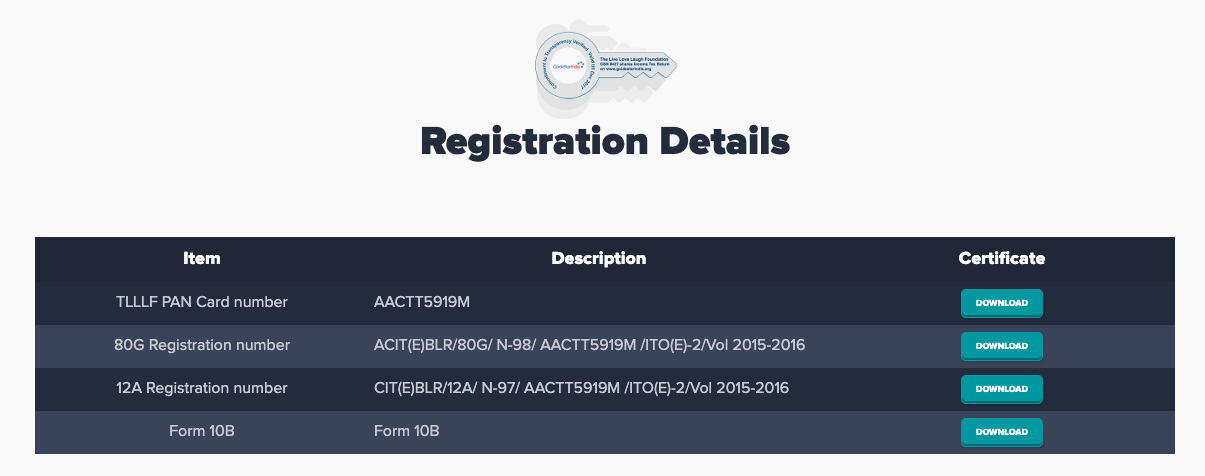
Twitter account @cyber_hunnt also pointed out how two NGOs, TLLLF and Maa Samadhanam Educational Charitable Trust have the same PAN.

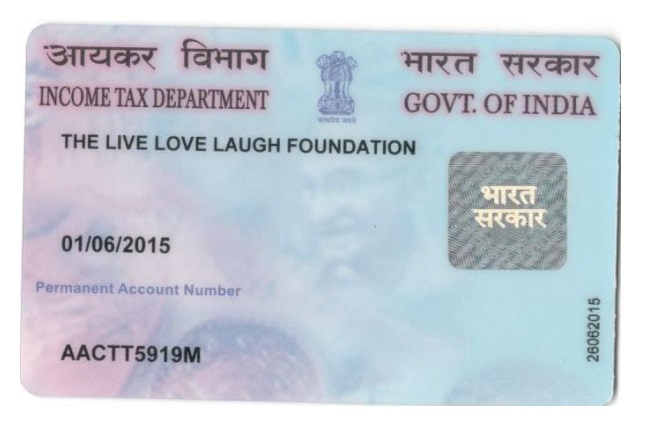
TLLLF too has quoted same PAN on its website.
TLLLF PAN

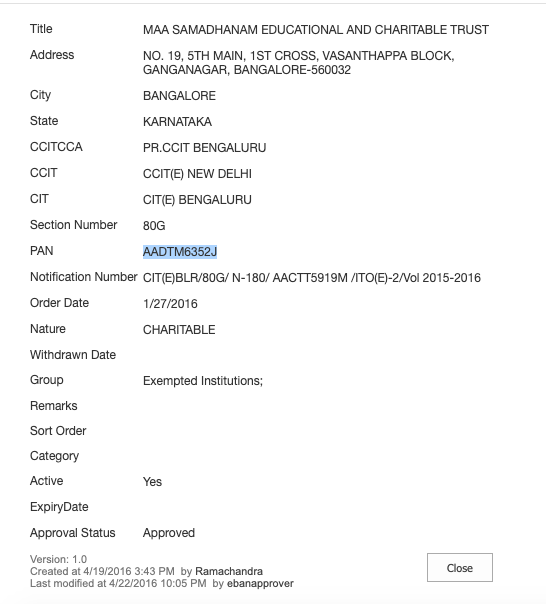
Interestingly, there is another NGO named Maa Samadhanam Educational and Charitable Trust (“and” being the differentiating factor) which has a different PAN.

Exemption detail for Maa Samadhanam Educational and Charitable Trust

The PAN of Maa Samadhanam Educational and Charitable Trust is AADTM6352J. But the PANs of both Maa Samadhanam Educational Charitable Trust and The Live Love Laugh Foundation are mentioned as same, AACTT5919M. The TLLLF has mentioned the PAN in their website, and also uploaded a copy of the PAN. On the other hand, there is no website of both the Maa Samadhanam NGOs, but their names appear in a list of exempted institutions on the website of the Income Tax department with the respcting PANs, one being same as TLLLF’s PAN.

Copy of PAN of TLLLF

TLLLF has also uploaded the approval letters issued by the Income Tax department under sections 12A and 80G, and both the letters mention the PAN. Therefore, it can be assumed that TLLLF PAN is genuine, but there is a mystery about why another NGO has the same PAN, and why the same NGO has a different PAN under a slightly different name.

FCRA Approval

In the annual report for the year 2018-2019, Anisha Padukone, Director TLLLF, mentioned that the organization applied for Foreign Contribution Regulation Act (FCRA) license so that they can receive foreign funding to expand the functioning of the organization. In the next year’s annual report that is of 2019-2020, it was mentioned that they had received the FCRA license in July 2019 and now eligible to receive foreign funding. The organization has not submitted its FCRA return for 2019-2020 so far; however, their audit report was included in the annual report 2019-2020.

Deepika and history of controversies

Statement on Rahul Gandhi: In an old video, Deepika praised Congress leader Rahul Gandhi for his contributions towards the nation as a youth leader. In the video, she hoped Gandhi would become PM one day and lead the nation. Her statement often surfaces over social media mocking her for her views on politics.

Visit at JNU: During anti-CAA protests, Deepika visited Jawaharlal Nehru University and supported those who were raising their voice against CAA and NRC. She also had a word with Aishe Ghosh, a student leader who was one of the persons leading the protest. There were two theories about why she went to support the protesters in a hurry. One theory suggested she was there to promote her then-soon-to-be-released movie Chappak and the other theory indicated that she was paid to do so by Aneel Mussarat.

Monsoon session of Lok Sabha concludes, becomes the most productive session in the history with productivity rate of 167%

The monsoon session of the 17th Lok Sabha was adjourned sine die today, with the session cut short due to the Coronavirus pandemic. The session was otherwise scheduled to continue till 1st October.

This session of Lok Sabha has been unique in term of productivity. Despite the unprecedented challenges thrown up by the Covid-19 pandemic, this Lok Sabha session witnessed all-time high productivity so far. The productivity percentage of this Lok Sabha session, which was presided by Lok Sabha Speaker Om Birla, stood at 167% which is the highest ever. The 8th Lok Sabha comes second with 163 % productivity.

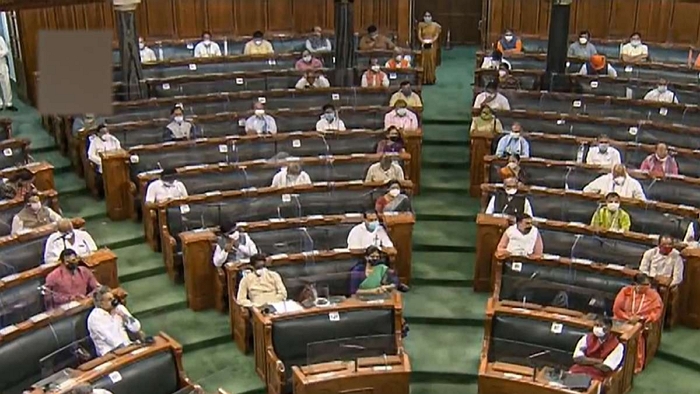
As the session was shortened due to the pandemic, private member business was skipped in this session. Therefore, no private member was introduced or discussed. Masks were mandatory for the MPs present in the house, and MPs also sat at the visitor’s gallery above the Lok Sabha to maintain social distancing. Fibreglass panels were installed in front of each bench and both the sides of members to avoid possible spread of coronavirus. For the same reason members were allowed to stand up while speaking, so that they remain inside the shields.

Here are some of the statistics of the current Lok Sabha session:

Productivity

  • In this monsoon session of the Lok Sabha, a total of 25 Bills were passed in the ten-day long session.
  • This Lok Sabha session had no holiday which is a also a record. Also, the proceedings of the session continued till 12:30 a.m. in the night on two days, Sunday and Monday.
  • September 21 proved to be the most productive day of the session with 234 per cent productivity which is the highest for any single day till now.
  • Out of total 10 sittings, the session worked for 60 hours which is one and a half times more than the usual 37 hours. During the session 68 per cent of the total time was devoted for legislative functions and the remaining 32 per cent was devoted for other activities. During this time, 16 bills were introduced while 25 bills were passed.

Zero Hour

  • In the fixed duration of the zero hour, 370 members got the chance to raise the questions of public importance while only 180 members were supposed to get the chance to speak.
  • During the proceedings of the session on September 20, 88 members got the chance to speak in the zero hour and out of total 78 women members, 60 got the opportunity to speak during this time.

Rule 377

  • Under Rule 377 of the Rules of Procedure and Conduct of Business of Lok Sabha, the Ministry of Parliamentary Affairs takes follow-up questions on matters raised by the members.
  • As compared to the fourth session of the 15th and the 16th Lok Sabha, almost double the members asked questions in the fourth session of the 17th Lok Sabha.
  • The session fared better in terms of questions addressed by the government. The government was able to answer 99 per cent of the subjects raised.
  • On average, 35 members asked questions in the zero hour every day.
  • On an average 7 members in the 13th Lok Sabha, 9 members in the 14th Lok Sabha, 10 members in the 15th Lok Sabha and 12 members in the 16th Lok Sabha had got the opportunity to speak on various subjects. However, in the 17th Lok Sabha 18 members, on an average, got the chance to speak every day.

Questions

  • Answers of almost 2300 unstarred questions were presented on the floor of the house.

Health Safety

  • Special attention was paid to the health of MPs and officials during the session. A total of 8029 people were tested for Covid-19 including members of Parliament, their family and relatives, personal staff, Lok Sabha officers and workers and media persons.
  • The Coronavirus situation in the country was discussed for 5 hours and 8 minutes.

Several important bills were passed in the monsoon of the parliament this year. Some of them include the Farmers’ Produce Trade and Commerce (Promotion and Facilitation) Bill, The Farmers (Empowerment And Protection) Agreement On Price Assurance and Farm Services Bill, and the Amendment to 1955 Essential Commodities Bill, The FCRA Amendment Bill, Jammu and Kashmir Official Languages Bill, and three labour code bills, namely The Occupational Safety, Health And Working Conditions Code, The Code On Social Security, and The Industrial Relations Code.

The Rajya Sabha was also adjourned sine die earlier in the afternoon, which was marked by boycott by opposition following the ruckus in the upper house on Sunday.

Former Amnesty India head Aakar Patel arrested for tweets on PM Narendra Modi, BJP-RSS and Ghanchi caste; released on bail

Former head of Amnesty India, Aakar Patel, yesterday posted on Twitter that he was arrested and later let out on bail earlier this week for his posting offensive content against the Ghanchi community in Gujarat.

“Was arrested and bailed yesterday for an FIR filed by BJP citing sections incl 153A (promoting enmity). Will fight it,” a tweet posted by the controversial ‘journalist’ and ‘activist’ said.

Though Patel was arrested, he was not held in custody as he was able to secure an anticipatory bail. Patel has been charged under Sections 153 A, 295 A, 505 (1) B, 505 (1) C, 499 and 500 of the Indian Penal Code. Though many of the Sections under which Patel has been charged are non-bailable, Patel after being released from the arrest triumphantly announced on Twitter that he would fight the case.

Patel was arrested by Surat Police on a complaint filed by BJP MLA from Surat West constituency and president of the Samast Gujarati Modhvanik Samaj, Purnesh Modi, who alleged in his complaint that Patel made three objectionable tweets on June 24 and 27 against the community. The FIR was filed on July 7 this year.

Patel, in his first two tweets, asserted that PM Modi belonged to the Ghanchi caste which was included in the Other Backward Caste (OBC) list by former Prime Minister Atal Bihari Vajpayee in 1999. Patel also alleged that the community is “well-off” and is “meat-eating” and that PM Modi followed RSS’ manners and turned vegetarian.

In his third tweet, Patel claimed that those who died in the 2002 Godhra train burning belonged to the Muslim Ghanchi community. Later on June 27, he tweeted that the RSS and the BJP have always benefitted by violence against other Indians, particularly Muslims. “Vajpayee more than Upadhyaya, Advani more than Vajpayee and Modi more than Advani benefitted from this.

Aakar Patel has a habit of peddling lies and pursuing hate campaign against PM Modi and the BJP

However, this is not the first time that Patel has been accused of misusing his agency and spreading hate on social media. Ever since PM Modi came to power in 2014, Patel, who harbours deep-seated and intense hatred from PM Modi and the BJP, has been levelling insinuations and unfounded allegations against them to gin up discontent against the Modi government among the people. His efforts have intensified since PM Modi’s unprecedented victory in the 2019 General elections.

Most recently, Patel had to bear the brunt of running his hate campaign against the Modi government when his Twitter account was suspended for instigating Muslims and Dalits to take up arms against the centre, similar to the protests that have convulsed the United States of late.

On 31st May, while quoting a tweet by Colorado Times Recorder featuring a video of thousands of people protesting in Capitol in Colorado, Aakar Patel had tweeted that India Muslims, Dalits, Adivasis, women and poor also need to do protests like these. “We need protests like these. From Dalits and Muslims and Adivasis. And the poor. And women. World will notice. Protest is a craft,” he had tweeted.

A complaint was also filed against Patel’s provocative tweet. He had then been booked under IPC sections 505(1)(b) (with intent to cause, or which is likely to cause, fear or alarm to the public, or to any section of the public whereby any person may be induced to commit an offence against the State or against the public tranquillity), 153 (Wantonly giving provocation with intent to cause riot) and 117 (Abetting commission of the offence by the public or by more than ten persons).

Minister of State for Railways Suresh Angadi succumbs to Coronavirus

0

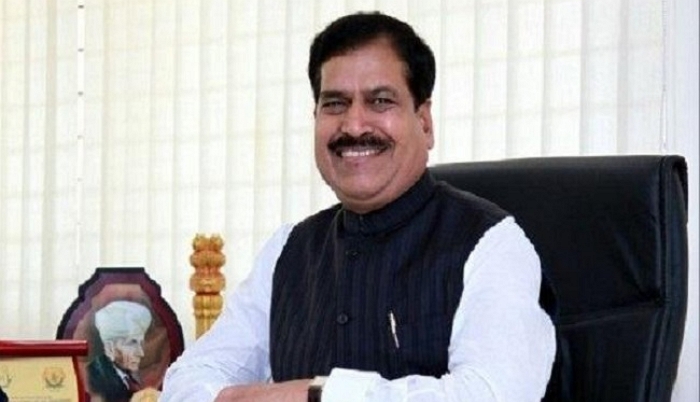
Minister of State for Railways Suresh Angadi passed away at the AIIMS in New Delhi today evening. The BJP MP from Karnataka was diagnosed with Coronavirus, and was undergoing treatment at AIIMS. Suresh Angadi was an MP from Belgaum, and he was 65 years of age.

Suresh Angadi had tested positive for COVID-19 on 11th September. Informing about the development, he had tweeted, “I have tested #Covid19 positive today. I am doing fine. Taking the advise of doctors.”

After the diagnosis, Angadi was admitted at the trauma center at the AIIMS, where a a dedicated COVID-19 facility has been set up. He was admitted at the evening on 11th September.

He won 3 consecutive Lok Sabha elections in 2004, 2009, 2014 from Belgaum constituency in Karnataka. He is survived by his wife and two daughters.

As the country’s Coronavirus tally has crossed 56 lakh, several central leaders and union ministers have been infected with the Chinese virus. Some of them include, Home Minister Amit Shah, Minister of State for Agriculture Kailash Choudhary, Ayush Minister Shripad Nayak, Jal Shakti Minister Gajendra Singh Shekhawat, MoS for Parliamentary Affairs Arjun Ram Meghwal and Petroleum Minister Dharmendra Pradhan.

Suresh Angadi is the second parliamentarian from Karnataka to have succumbed to Coronavirus. On 18th of this month, BJP leader and Rajya Sabha MP Ashok Gasti died in Bengaluru after he was diagnosed with the infection on 2nd September.

Properties made available for sale or rent only to Muslims appear on several real estate portals

0

In a shocking revelation, several real estate portals have listed advertisements that sell and rent properties in Mumbai exclusively to Muslims, reported Square Feat India. These ads, put up by brokers and sellers, actively discriminate against non-Muslims while dealing with sale and lease of real estate properties.

Bigoted ads on housing platforms

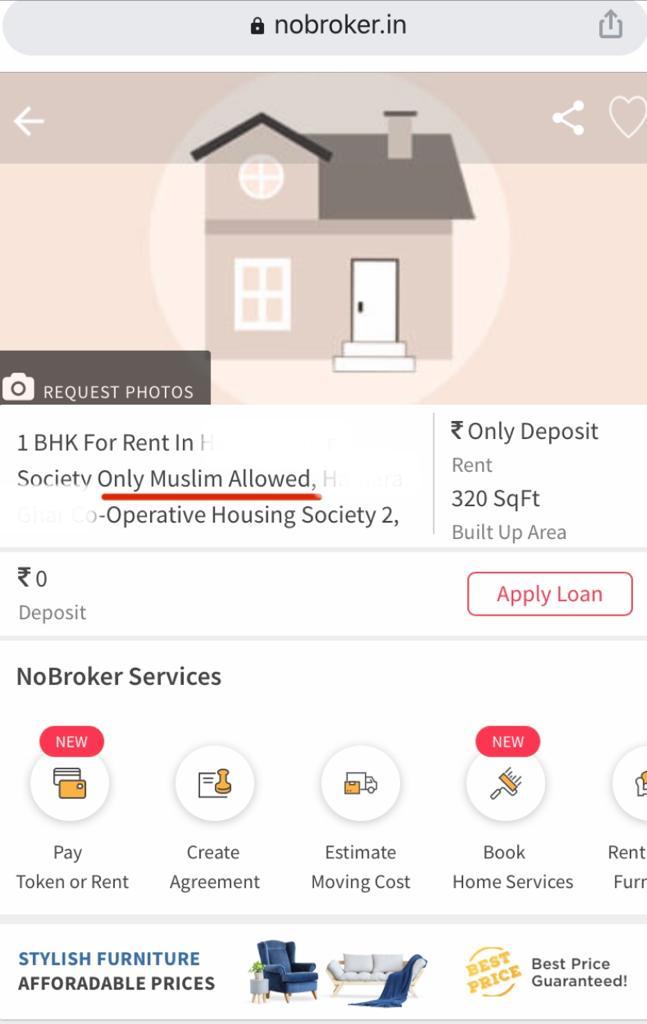
One such advertisement popped up on the real estate website, No Broker. A 1-BHK property, measuring 320 sq.ft, up for rent in Western suburbs of Mumbai clearly states on the portal, “Only Muslims allowed.” The ad was later removed by No Broker.

Screengrab of the contentious ad on No Broker website

When journalist Varun Singh contacted the housing portal, it stated, “NoBroker doesn’t allow any discrimination. The person has put this in the building name/address field. NoBroker is getting it removed. Also, they are developing an algorithm to start checking the address field also.”

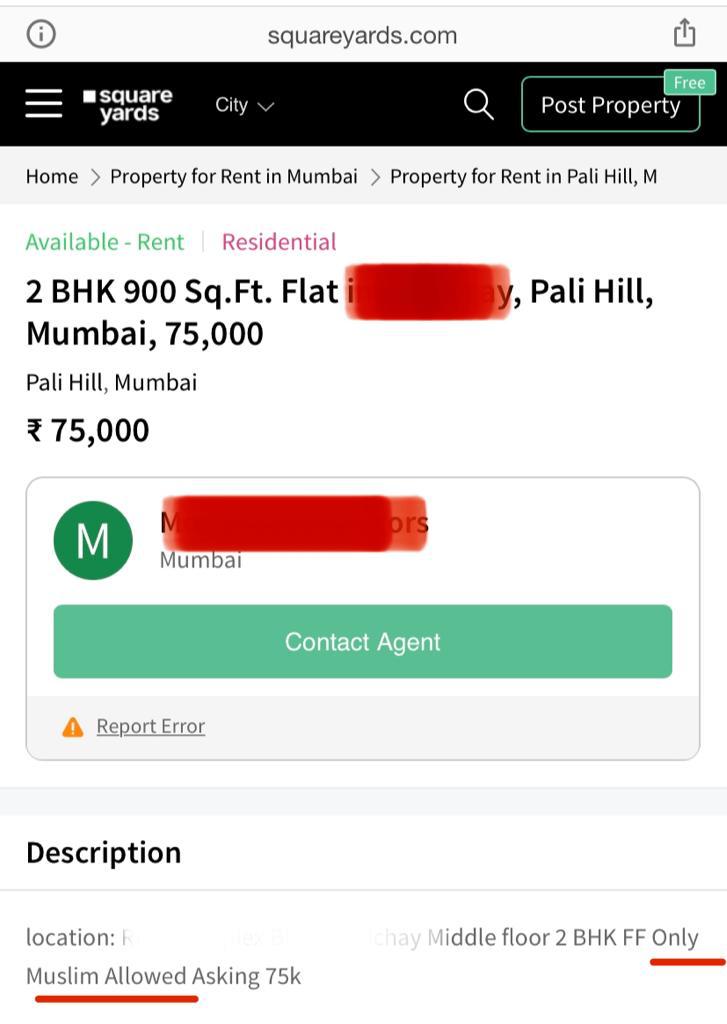
A similar contentious advertisement was posted on another real estate website, Square Yards. In the said ad, a 2BHK flat measuring 900 sq.ft was up for rent exclusively for Muslim tenants for ₹75,000 per month. When Singh contacted the web portal, he did not receive any response. The ad is still available on the website as of September 23, 2020.

Exclusive Muslim properties listed on Square yards

Sellers indirectly discourage non-Muslims from buying/leasing properties

Similar requests for ‘only Muslim tenants’ have been made by sellers and brokers in Mahim and Mira Road. The trend of active religious discrimination is not something new. As per a Times Now report in 2015, the housing portal, Property Wala, listed houses exclusively for Muslim buyers and tenants. Other sellers convey the same message that non-Muslims are unwelcome by reiterating that the housing property is in the vicinity of a masjid.

Even in a cosmopolitan city such as Mumbai, bigoted homeowners actively discriminate between tenants. One may argue that it is the choice of a property owner to choose tenants of his/her choice. Having said that, the religious profiling and exclusivity of access highlight deep-seated religious divide within the society.

KWAN representative told me that I need to attend Karan Johar Parties to make a comeback to movies: Suchitra Krishnamoorthi

Actress and singer Suchitra Krishnamoorthi while speaking about the drug abuse in Bollywood on India Today said that she was told by a KWAN representative that all she needed to make a come back into films was to show up in the parties organised by filmmaker Karan Johar.

“As I was talking to the book agent, this lady who also handles acting, she said that Ma’am why aren’t you acting and so I said my daughter is too small, we will see. She said no ma’am it’s easy and you just have to do a few things to come back into the limelight because you are too silent. One of the main things is that you need to be seen at Karan Johar’s parties”, told Krishnamoorthi.

The actress said that she was shocked at the suggestion as she is already a senior actress. Krishnamoorthi expressed concerns over the manner in which young actors might be guided in a similar way to do certain things in order to progress which might also include consuming drugs.

She added that the “women” whose names are coming up in the investigation are soft targets and that there must be some “men” behind them. Speaking on the silence of some of the Bollywood biggies on the alleged drug syndicate in the film industry, she said that “Bollywood is largely silent on most things except when it becomes a I-scratch-your-back-and-you-scratch-mine-scenario” and that “even a social conscience which you see very often is agenda driven”.

KWAN Agency Under Scanner

A lot of things have been and expected to be unearthed as the investigation in the mysterious death of Sushant Singh Rajput is progressing. The names of many bigwigs of Bollywood have been exposed in the ongoing probe by the Narcotics Control Bureau (NCB) in the alleged drug cartel in the industry. Yesterday, the NCB had issued summons to KWAN Agency CEO Dhruv Chitgopekar and Jaya Saha. Saha had led the NCB to actress Deepika Padukone’s links during her interrogation earlier. The central agency had also summoned Karishma Prakash who works with KAWN and whose chats with Deepika Padukone were recently accessed by the agency.

The NCB today issued to summons to actresses Deepika Padukone, Shraddha Kapur, Sara Ali Khan and two others.

CBI carries out multiple raids along India-Bangladesh border; BSF officer and 3 others booked in illegal cattle trade case

0

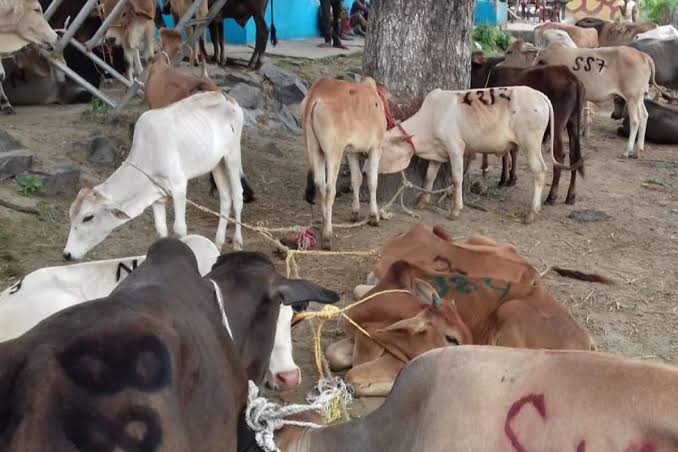
The Central Bureau of Investigation has carried out multiple raids in West Bengal in a bid to unearth the nexus involved in the rampant illegal cattle trade that is happening along the India-Bangladesh border.

According to a senior CBI official, searches were carried out in at multiple locations in Kolkata and Murshidabad districts of West Bengal since this morning.

“Raids are still underway. The search operations are not just limited to West Bengal alone. They are also being conducted in other parts of the country to unearth the the nexus of illegal cattle trade along the Indo-Bangladesh border. We cannot divulge any more details as of now,” an official quoted by PTI said.

As per a report published by Times Now, CBI has booked one Satish Kumar, the former Commandant of the 36 BSF Battalion, along with three others— Inamul Haq, Anarul Sheikh and Mohammed Golam Mustafa—in the illegal cattle trade case. Besides Kolkata and Murshidabad, the premier agency had also launched search operations at various locations on Ghaziabad in Uttar Pradesh, Amritsar in Punjab and Raipur in Chhattisgarh.

India-Bangladesh border troubled with the menace of cattle smuggling

India-Bangladesh border is afflicted with the menace of illegal cattle smuggling for the past several years. As security agencies have tightened the noose around illegal cattle trade, smugglers have employed novel methods to evade authorities and successfully transport cattle across the border.

In June this year, BSF exposed a cruel method of smuggling adopted by cow smugglers along the India-Bangladesh border in West Bengal after they retrieved a live calf tied up and hidden inside a carcass floating in the river.

As per the sources, the smugglers tie socket bombs to the necks of the cattle while smuggling them to cause physical harm to the forces when they are caught.

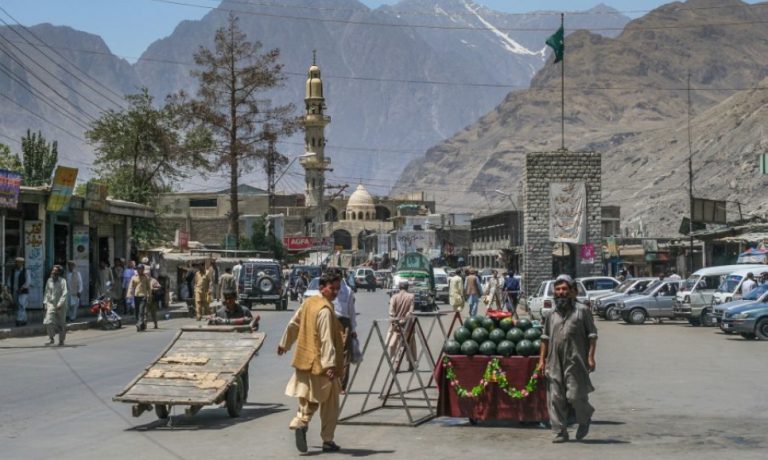
Pakistan plans to turn illegally occupied Gilgit-Baltistan into a province; the decision to benefit China and CPEC

In an unprecedented development, Pakistan had decided to create a new province in the illegally-occupied territory of Gilgit-Baltistan (GB). The current political dispensation, which is hands-in-gloves with the Army, has given a nod to alter the so-called ‘autonomy’ of the region.

China to benefit from changing status quo of Gilgit-Baltistan

The decision had also received affirmation from all-parties and it will come into effect, post-elections in the occupied territory. Pakistan is thus set to create a 5th province with the designation of Gilgit-Baltistan as a new province. As per reports, the sudden move will benefit China and its ambitious China Pakistan Economic Corridor (CPEC). The Current provinces in Pakistan are Punjab, Sind, Balochistan, and Khyber Pakhtunkhwa or North-West Frontier Province.

Pakistan had procured billions of dollars as debt from China for CPEC to turn its financial fortunes. With the implementation of the decision, China can build an alternate road to the Malacca Strait, the primary shipping channel between the Pacific Ocean and the Indian Ocean.

Pakistan silences popular discontentment in favour of CPEC

To facilitate China’s ambitious initiative, Pakistan has deployed its army personnel at the occupied territory of Gilgit Baltistan to silence popular discontentment about CPEC. People in Gilgit Baltistan have raised objections on how China’s initiative can destroy the environment and the local culture.

Under the watch of the Special Assistant to Imran Khan on National Security, Moeed W Yusuf, Pakistan is planning to turn the Line of Control (LoC) into the international border. Reportedly, he had advocated his nefarious plans to change the status quo of the border, back in 2009. Yusuf also used his ties in the public-funded US Institute of Peace (USIF) to share sensitive information with Pakistani agencies such as the ISI.

Opposition parties in Pakistan speak against Army interference

On Wednesday, Maryam Nawaz hit out at the Pakistan Army establishment over its interference in deciding the fate of the occupied territory of Gilgit-Baltistan. She emphasised that political decisions must be made in the Parliament and not Army Headquarters.

She stated, “I don’t know about a dinner, maybe it was not a dinner [but] I heard about the meeting. From what I understand it (the meeting) was called to discuss Gilgit-Baltistan which is a political issue, an issue of the people’s representatives, for them to solve and deliberate upon. “These decisions should be made in parliament, not in GHQ. But the political leadership should not be called nor should it go to discuss such issues. Whoever wishes to discuss these issues should come to the parliament.”

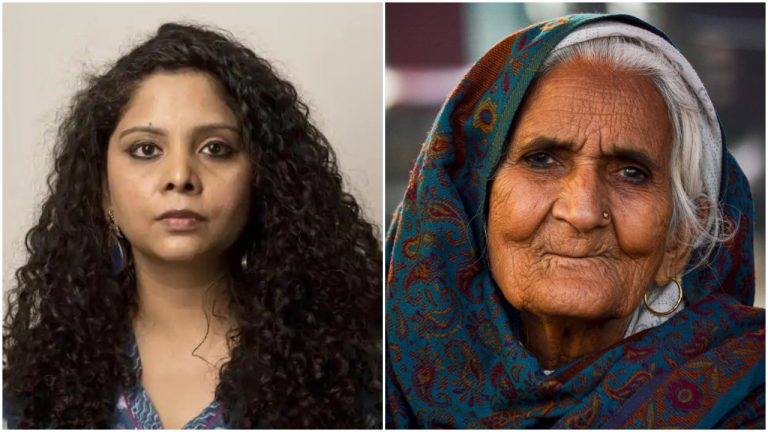
Rana Ayyub lies again, this time while writing an ode to the old lady protestor at Shaheen Bagh for Time’s 100 most influential people list

Islamist ‘journalist’ and habitual fake news peddler Rana Ayyub had again told the same lies on CAA, in an article about a Shaheen Bagh protestor in Time magazine.

In her recent article on Time Magazine, which she has written hailing an 82-year-old anti-CAA protestor at Shaheen Bagh named Bilkis. Bilkis, one of the ‘dadis’ of anti-CAA protest site Shaheen Bagh, has been named by the Time Magazine in its list of ‘100 Most Influential People of 2020’.

Writing an ode to Bilkis, Rana Ayyub, in her article, has claimed that the 82-year-old ‘protestor’ was the ‘voice of the marginalized’ in India, who would sit at a protest site from morning to midnight.

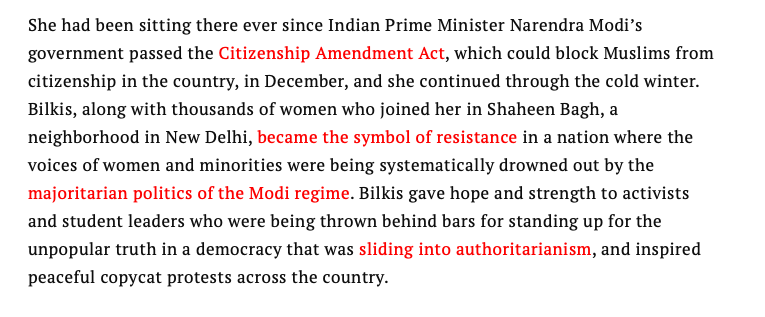
Continuing her usual antics, Rana Ayyub blatantly lies that Bilkis was sitting as a mark of protests at Shaheen Bagh ever since Indian Prime Minister Narendra Modi’s government passed the Citizenship Amendment Act, which “could block Muslims from citizenship in the country”.

Rana Ayyub’s article praising Bilkis that peddles blatant lies

The Islamic troll Rana Ayyub further continues saying that Bilkis, along with thousands of women who joined her in Shaheen Bagh, which according to her became the ‘symbol of resistance in a nation’ where the ‘voices of women and minorities were being systematically drowned’ out by the majoritarian politics of the Modi regime.

“Bilkis gave hope and strength to activists and student leaders who were being thrown behind bars for standing up for the unpopular truth in a democracy that was sliding into authoritarianism, and inspired peaceful copycat protests across the country,” Rana Ayyub wrote in TIME magazine profiling Bilkis.

Ironically, Rana’s ode to Shaheen Bagh daadi has come days after the Delhi Police has submitted in court that the women at Shaheen Bagh were being paid to sit in protest, like daily wage workers.

Rana keeps lying blatantly about CAA

It is pertinent to note that the Citizenship Amendment Act passed by the Indian parliament has nothing to do with Indian citizens, Muslim or otherwise, as it seeks to grant citizenship to persecuted religious minorities in Pakistan, Bangladesh and Afghanistan.

The CAA is a special one-time measure for the religious minorities who have already come to India after facing persecution in the three specified countries. The amendment does not cancel the existing naturalisation laws. The historic legislation does not have any provisions to repel citizenship or carry out deportation of any Indian Muslims.

The CAA doesn’t even bar Muslims from anywhere in the world from applying citizenship in India through the usual way, following existing rules.

However, Rana Ayyub resorts to openly peddle fake news on the Citizenship Amendment Act saying that the legislation “could block Muslims from citizenship in the country”. Shockingly, the publications like ‘TIME’ which publishes such lies in its list of influential people across the world, failed to check the misinformation peddled by the likes of Rana Ayyub and instead provides a platform to push fake news on Indian laws.

Shaheen Bagh Anti-CAA protests

The anti-CAA protests, especially at Shaheen Bagh, which began as a peaceful protest crossed all the boundaries as it turned out to be another typical left-wing managed anti-India event. Eventually, the Shaheen Bagh protest site had provided fodder and a shield for violent rioters who had, in February, targeted Hindus and gone on a rampage burning the capital, timing the bloodbath with US President Trump’s visit to Delhi.

Following the failure of violent protests perpetrated by the Muslim mobs on the streets of Delhi and Jamia Millia Islamia University, few women belonging to Muslim community sat on a protest at Shaheen Bagh, blocked a bus stop and a highway causing severe problems to the public of Delhi.

Shaheen Bagh protests, which were initially passed off as an organic protest in a bid to ‘save the constitution’ began to turn into a blatantly communal event. It was earlier reported that the Muslim mobs had shouted pro-Pakistan and Hinduphobic slogans like “Jinnah Wali Azadi”, demanding another partition of the country.