Home Blog Page 5073

As Congress tries to paint Rajiv Gandhi as the catalyst in reclamation of Ram Janmabhoomi, book by close friend shatters that myth: Here are the details

After 500 years of struggle, Hindus of India finally reclaimed their right to the Ram Janmabhoomi in Ayodhya. The Congress, which until now, refused to even acknowledge the very existence of Lord Ram, had jumped to take the credit for the Ram Mandir. From party bigwigs like Kamal Nath to Delhi Youth Congress, all claimed that it was former Prime Minister Rajiv Gandhi who had ‘opened the doors of Ram Mandir’.

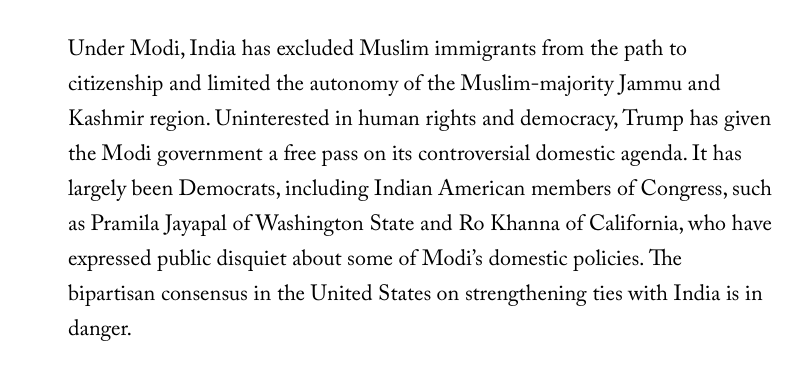
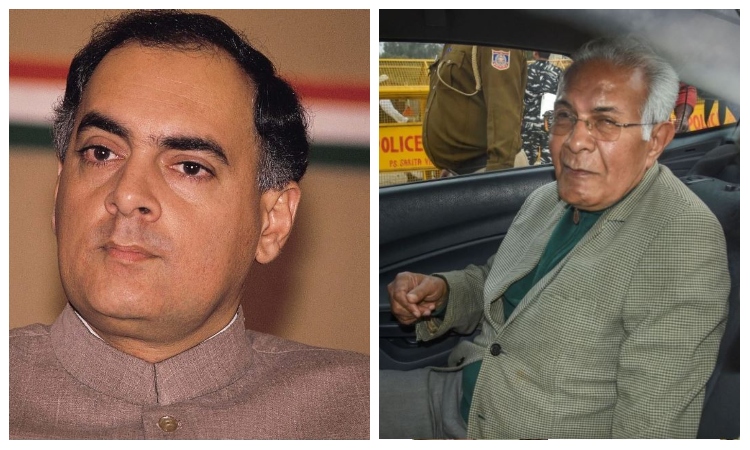
However, a book was written by one of Rajiv Gandhi’s close friend and associate, Wajahat Habibullah, likely to come out in October this year, reportedly busts the Congress’ bubble, as the tell-all memoir claims that late Prime Minister Rajiv Gandhi was not even aware of the unlocking of the disputed structure at the Ramjanmabhoomi site in February 1986.

Rajiv Gandhi had denied having any prior knowledge of the unlocking: Habibullah’s book

Habibullah, IAS from the Jammu and Kashmir cadre, was in Rajiv Gandhi’s PMO then. As per excerpts published in India Today, Habibullah, in his memoir- ‘My Years With Rajiv Gandhi: Triumph and Tragedy’, has written that when he had asked Rajiv Gandhi, the then prime minister, whether he was involved in the decisions leading up to the unlocking of the disputed structure at Ramjanmabhoomi site in February 1986, Rajiv Gandhi has instantaneously replied with a no.

No Government has any business to interfere in matters like the determination of the functioning of places of worship. I knew nothing of this development until I was told of it after the orders had been passed and executed,” Rajiv Gandhi was quoted as telling the author.

Taken aback by the late Prime Minister’s reply, Habibullah recollects questioning Rajiv Gandhi furthers: “But, sir, you were the Prime Minister”. To this, the Congress leader had replied, “I was indeed. Yet I had not been informed of this action, and have asked Vir Bahadur Singh (then chief minister of UP, under whose watch, and as rumoured, under whose instructions the magistrate had taken this fateful, or shall I call it fatal decision) to explain. I suspect it was Arun (Nehru) and Fotedar (Makhan Lal) who were responsible, but I am having this verified. If that is true I will have to consider action.”

The conversation, according to the author, took place in September 1986, when he accompanied the then PM in his Boeing while flying to the drought-hit Gujarat.

It is pertinent to note that a local court in Faizabad, on February 1, 1986, had vacated a stay order passed in 1949 that status quo should be maintained at the Babri Masjid-Ramjanmabhoomi site.

Habibullah had served as the chief executive at Rajiv Gandhi Foundation, the Union textile secretary, became India’s first chief information commissioner, chairman of the National Minorities Commission and government interlocutor for Jammu and Kashmir, goes on to make several startling revelations in his memoir.

The India Today report by Rasheed Kidwai further states that in a chapter titled, ‘Unravelling of the Indian Tapestry’, Habibullah reveals what had transpired between Rajiv Gandhi, his cousin Arun Nehru and Vir Bahadur Singh over the unlocking of the disputed structure at the Ramjanmabhoomi site. 

He writes that Rajiv Gandhi had acted against cousin Arun Nehru for the Ramjanmabhoomi ‘indiscretion’ and dropped him as the Minister of State for Internal Security in November 1986. Arun Nehru, despite his unceremonious exit, had reportedly displayed little acrimony and continued his work as a regular MP and family man till he regrouped with VP Singh against Rajiv Gandhi in July 1987.

Arun Nehru was responsible for the unlocking, not Rajiv Gandhi, says book

“Any instructions received by Vir Bahadur Singh (who incidentally owed Arun Nehru his position) from Arun Nehru, would be construed by the CM to have been the orders of the Prime Minister. There had been no discussion on any matter concerning the Masjid in the ongoing files of PMO. This I knew since I was the officer dealing with communal relations,” writes Habibullah as per the report. The quote asserts how Rajiv Gandhi, despite being the PM, was completely ignorant of the developments in Ayodhya.

In the book, Habibullah has reportedly also mentioned how the ‘removal of locks’ was mostly Arun Nehru’s work and later, when Rajiv Gandhi spoke to Vir Bahadur Singh and came to know that the UP CM had probably misunderstood Arun Nehru’s words as Rajiv Gandhi’s words in the matter, Singh had avoided meeting Arun Nehru.

As per the India Today report, Habibullah has written that it was a coincidence and an inadvertent error on his part that made him realise that Arun Nehru had probably orchestrated the opening of locks by making the UP CM believe that the order came from Rajiv Gandhi himself.

Habibullah, who had studied with Rajiv Gandhi in Doon School as well, writes that according to him, Rajiv Gandhi also found it difficult to communicate with his cousin Arun Nehru.

As per the report, Habibullah has also written that he had asked Rajiv Gandhi about how Congress can even think that the opening of the locks could give them any benefit (of Hindu votes), because, as per him, most of Congress was ‘secular’ and they cannot exploit the ‘development’ to its maximum use, and eventually it will be the right-wing which will hijack the “outcome”.

“I can understand that since the removal of the locks was not going to change the status quo in any way, but would earn the support of sections of the Hindu community for your party, was it not realised that such a benefit could only be limited since the core of the Congress remained secular and the development could not be exploited to its maximum since it would be the extreme right-wing that would hijack the outcome, which it could trumpet as its triumph?

The Congress leader did not want Ram Mandir dispute to be settled

Interestingly, one such other upcoming book by Roderick Matthews had also revealed Congress’ vile intentions in dealing with Ram Janmabhoomi dispute. It had laid bare how Congress party under the leadership of Rajiv Gandhi did not want Ram Mandir dispute to be settled and had withdrawn support after the then PM Chandra Shekhar had almost resolved the age-old issue.
Shah Bano Case: When Rajiv Gandhi overturned SC judgement protecting Muslim women’s right to maintenance during talaq

In 1986, the Indian state headed by Rajiv Gandhi set a dangerous precedent of catapulting to Muslim hardliners. The Mohd. Ahmad Khan vs. Shah Bano Begum & Others case and the subsequent legislation passed by the Rajiv Gandhi government in 1986 is often remembered as a pivotal moment in India’s political history.

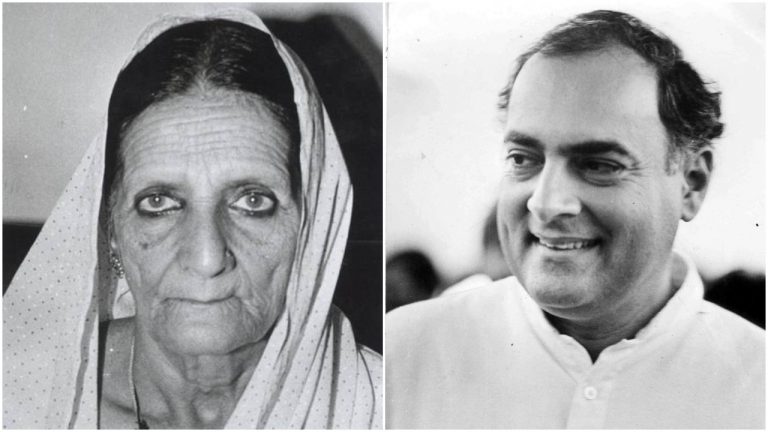
It all started when Shah Bano, the 62-year-old Muslim woman, filed a petition in court in April 1978 demanding maintenance from her divorced husband Mohammed Ahmad Khan, a renowned lawyer in Indore, Madhya Pradesh. Shah Bano’s husband Khan divorced her by uttering triple talaq later in November stating he was not obliged to pay her any maintenance as she is not his wife under Islamic law.

The two were married in 1932 and had five children — three sons and two daughters. Shah Bano’s husband had forced her to move out of the residence three years before, after living with Khan and his second wife.

Shah Bano, who went to court against her husband, filed a claim for maintenance for herself and her five children under Section 123 of the Code of Criminal Procedure, 1973. In August 1979, Shah Bano won the maintenance case in the local court, which ordered Khan to provide her with the maintenance of Rs 25 per month. However, Khan contested the claim on the grounds that the Muslim Personal Law in India required the husband to only provide maintenance for the iddat period after divorce.

Years later, Shah Bano filed another plea seeking for revised maintenance in Madhya Pradesh High Court. In April 1985, in a historic judgment, the Supreme Court ruled in favour of Shah Bano and upheld the decision by the High Court stating that she was entitled to be paid for maintenance by her husband.

As the Supreme Court upheld the right to alimony in the case, the judgement ignited a political controversy regarding the claim of the judicial overreach in cases that are attached to Muslim personal law. The historic judgement, which had laid the ground for Muslim women’s fight for equal rights in matters of marriage and divorce in regular courts, did not go well within the Muslim community.

Rajiv Gandhi succumbs to pressure of Muslim hardliners

The Muslim hardliners, clerics pushed the then Rajiv Gandhi government, elected in 1984, to pass the Muslim Women (Protection on Divorce Act), 1986. This law overturned the Supreme Court’s verdict in the Shah Bano case. The 1986 Muslim Women (Protection on Rights of Divorce) Act diluted the Supreme Court judgment and allowed maintenance to a divorced woman only during the period of iddat, or till 90 days after the divorce.

The Muslim Women Act in 1986, virtually pitted women’s individual rights against the rights of a religious group and the latter with their street veto power were capable of enforcing the law will over a weak, minority appeasing government led by Rajiv Gandhi.

Most importantly, it took 33 years to correct the historic blunders made by the Rajiv Gandhi government. In 2019, the Narendra Modi government passed the Muslim Women (Protection of Rights on Marriage) Act, 2019 in the Parliament of India criminalising triple talaq and delivered justice to several crores deserted Muslim women just like Shah Bano.

Arif Mohammad Khan – most vocal opponent of Rajiv Gandhi’s Muslim appeasement

The then Prime Minister Rajiv Gandhi, who had towed the line of Muslim hardlines in an effort to appease the community, had surprisingly faced resistance from within his government in the form of Arif Mohammad Khan.

Arif Mohammad Khan, who was the Minister of State in Rajiv Gandhi government, had passionately defended the Supreme Court judgment in the Shah Bano case on the floor of the Parliament. However, with Muslim hardlines began to pressurise Rajiv Gandhi, the government took an u-turn to bring a law to bypass the apex court’s judgement in the Shah Bano case.

As Rajiv Gandhi gave into the pressure of the clergy to reverse the SC decision, a dejected Arif Mohammad Khan decided to walk out of the Rajiv Gandhi Cabinet and also quit the Congress party.

In an interview recently, Arif Mohammad Khan, who is currently serving as the Governor of Kerala had mentioned how he was pressured by the Congress party to withdraw his resignation. The four-time former MP Khan had said that Congress leaders Arjun Singh and Narasimha Rao had asked to withdraw his resignation.

Reportedly, PV Narasimha Rao had said to Arif Mohammad Khan that he was absolutely right to resign morally but politically it was going to become inconvenient for the party and the leadership if he did not take the resignation back. Khan had also recounted how PV Narasimha Rao, a minister in the Rajiv Gandhi government, had remarked that it was not the duty of their party to uplift Muslims and if “they want to lie in the gutter, let them be”. 

Nagpur Riots of 1923: How it played in Dr K.B Hedgewar’s life and lead to the formation of RSS

Mohandas Karamchand Gandhi, in 1920, started the non-cooperation movement in India in an attempt to overthrow the British rule from the country. Coupled with the Khilafat movement that sought to support the caliphate during the first World War, Gandhi attempted to forge a utopian alliance of Hindus and Muslims in India by merging the two very different movements in the country. Both communities had very different motives and objectives, with the Hindus wanting to achieve ‘Poorna Swaraj’ while the Muslims wanted to support the Caliph of the Ottoman Empire. 

This alliance was destined to collapse since it was depending on a thin line of adhesive to sustain. During a Khilafat agitation in the Malabar region of South India, the protestors went rogue and attacked the local Hindu residents. Hindus were lynched, raped and murdered in the hands of murderous and red-eyed Moplas, blinded by extremism. This incident sparked communal tensions all over the country for the next couple of years. After the incidents of communal violence in the country, Gandhi called off the Non-cooperation movement in India. 

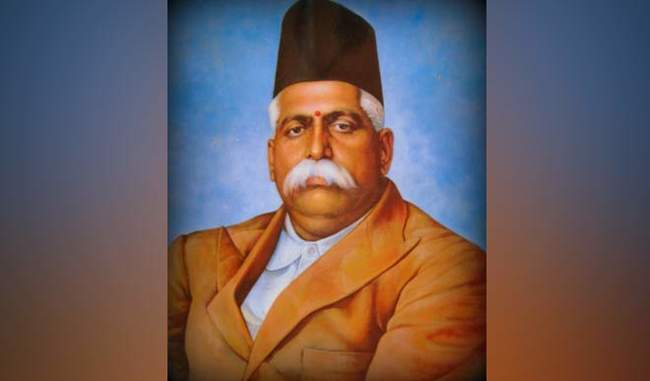
Before the non-cooperation movement, Dr Hedgewar (founder of RSS) was an active member of the Congress. He was deeply influenced by the literary works of Bal Gangadhar Tilak and Veer Savarkar. Hedgewar had in the past participated in the Anushilan Samiti movement that advocated armed revolution against the British government and was arrested several times for defiance against the British government. However, the delusion of ‘Hindu-Muslim unity’ of the Congress made him less keen on participating in the affairs of the party, and he ultimately left the party to start a new nation-building organisation in Nagpur (Ref: Dr Hedgewar, Founder of RSS by Rakesh Sinha).

In 1923, several members of the Hindu Mahasabha had led a procession on the streets of Nagpur during the auspicious occasion of Lakshmi Pooja. As the procession advanced with beating drums and intoxicating music, they happened to pass through an area with a mosque.

The local Muslim youth, angered by the bhajans, attacked the procession that was passing from the area in the front of the mosque. Several Hindus were injured and few succumbed to injuries due to the communal clash. What followed was a near-massacre of Hindus in Muslim majority areas of Nagpur and this led to the steps which Dr KB Hedgewar took next.

According to Dr Hedgewar, the disunity and lack of organisation amongst Hindus were the main reasons behind their suffering during riots. Unlike Muslims who act as one large unit, Hindus are divided into multiple sects, beliefs, castes and ideologies. This made Hindus most vulnerable to damage during communal clashes at that time. 

Despite enjoying majority status in Nagpur, Hindus were being lynched and attacked by Muslim mobs. There was no unity amongst the community to defend themselves from the rioters, but the Muslims managed to fund, protect and mobilise to attack Hindus.

The incident of 1923 made Dr Hedgewar think intensively about the condition of Hindus in Nagpur, and played a major role in his decision of founding the Rashtriya Swayamsevak Sangh in Nagpur to bring unity amongst Hindus. After founding RSS in 1925, Dr Hedgewar started shakhas in every locality of Nagpur and trained Hindus to act as one single entity.

Energetic Hindu youth were recruited to join the Sangh and participate in its activities. Hindus from all castes and creeds played various games together and practised self-defence in these shakhas regardless of their differences. By 1927, 16 shakhas were functioning in Nagpur within merely 2 years of foundation, with a membership of over 100 active Swayamsevaks. 

In 1927, Dr Hedgewar defied the symbolic practice of Islamic slavery by leading a procession of 100 Swayamsevaks through a lane with a mosque in it. While the Swayamsevaks danced to the tunes of Lord Ganesha, they were blocked by Muslim youth when they were passing through the Mahal locality of Nagpur. 

Infuriated by the audacity of the “Kaafirs” to dance and sing songs in the glory of their gods while passing by the mosque, the Muslim youth of Mahal tried to raid houses belonging to Hindus in the area. Which, to their surprise, was foiled when Swayamsevaks armed with lathis were ready to face the mob. The Muslim mob was routed and many had to flee the city for their safety. 

This act of defiance to Islamic slavery made RSS gain a commendable reputation in the eyes of local Nagpur residents and changed the fate of Hindus in Nagpur. Hindus were no longer disorganised and had acquired a disciplined structure in times of chaos and violence. Moreover, this gave Dr KB Hedgewar a sense of confidence which lead to him initiating the same organisational strategies in other parts of Maharashtra, and gradually all over India. 

Slowly, RSS shakhas spread to every corner of India, including Muslim majority areas such as Sindh, NWFP and East Bengal. Seva work was initiated by the Sangh in disaster-struck areas (such as floods, droughts, etc), making the reach of Sangh gain roots and percolate deep inside Indian society. 

After Dr Hedgevar breathed his last in 1940, Guru Golwalkar took the charge of Sarsanghchalak and continued the work of expanding RSS all over India. 

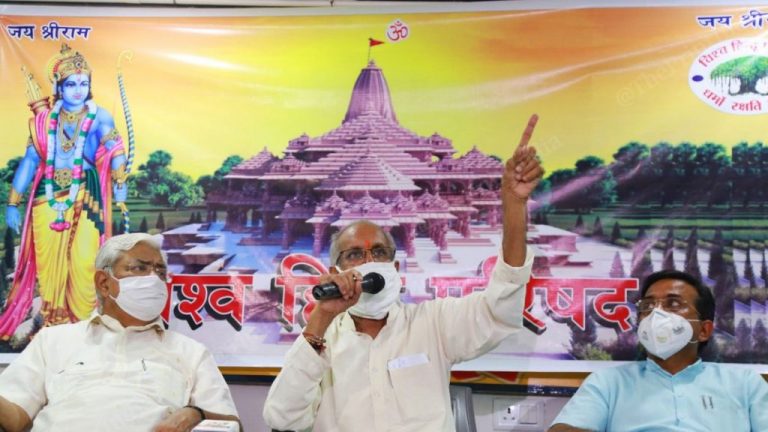
Construction of Ram Mandir in Ayodhya begins, the Mandir trust requests devotees to donate copper

0

Shri Ram Janmabhoomi Teerth Kshetra, the trust set up for the construction and management of Ayodhya’s Ram Mandir has taken to Twitter to inform that the construction of the Bhavya Ram Mandir, Bhoomi Pujan of which was successfully performed by PM Narendra Modi on August 5, has commenced. It said that engineers from the Central Building Research Institute (CBRI) Roorkee, IIT Madras along with L&T are now testing the soil at the mandir site.

It informed that the construction of the Mandir, which will be done adhering to India’s ancient and traditional construction techniques, is expected to be completed in the next 36-40 months.

It said that the construction will be done in a way to sustain earthquakes, storms and other natural calamities. Iron won’t be used in the construction of the Mandir, informed the trust overlooking the construction of the Bhavya Ram Mandir in Ayodhya, Uttar Pradesh.

Ram Mandir Trust asks devotees to donate copper

The trust has asked devotees across India to donate copper wires and 2″ copper rods for the construction of the Ram Mandir in Ayodhya. Champat Rai, general secretary of the trust, addressing a press conference on August 19 said that the temple would be constructed in such a way that it would stand for at least 1,000 years.

“Copper strips have the ability to stay safe even during an earthquake. To begin with, we need (around) 10,000 such strips – at least 18 inches long, 3 mm in depth, 30 mm wide. We will ask the community to send these strips; names of their villages, temples, or mohallas can be carved on them. This will be evidence of the country’s contribution,” Champat Rai said.

Rai furthered that the donated copper is expected to give the temple more durability.

“The stone that will be used in the construction will be such that air, sun and water decay will not happen for at least 1,000 years. The construction company L&T has got the best people; IIT Chennai has been consulted for testing the strength of the soil, and the Central Building Research Institute will make sure the building is earthquake-resistant,” Rai told reporters in New Delhi Wednesday.

He added that the Ram Mandir will be constructed using only stone, and no iron at all. “Mandir will be made of stone and plain concreting will be done. Drawings are still being finalised and so are the carvings,” informed the general secretary of the trust.

Carved stones ready for the Mandir

Even though the construction of the Ram Mandir is starting now, preparation for the same has been going o for the same for the last three decades. At the Ram Mandir Karyashala (workshop) in Ayodhya run by VHP, stones for the Mandir are being carved by artisans for the last 30 years, which began shortly after the Silanyash of the Mandir was done in 1989.

Stones brought in Rajasthan have been used to carve various parts of the Mandir. According to people working in the Karyashala, stones for the first floor is ready, and the work on the rest is going on. As the plan for the temple has been changed to make it bigger than initially planed, more stones will be required.

Apart from carved stones, the Karyashala is also filled with almost several lakhs of bricks donated by devotees over the last 3 decades.

Hayat Baloch: Dragged and murdered by the Pakistani establishment, with 8 bullets fired point black

On 13th of August 2020, once again the Baloch social media activist started criticising and protesting against the Pakistani paramilitary forces and condemned the killing of another innocent and non-combatant Baloch student Hayat Baloch. 

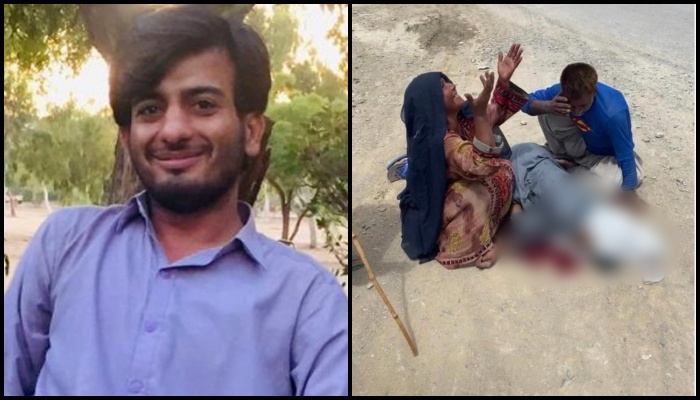
Hayat Baloch an educated young Baloch man of Turbat, Balochistan. Went to his hometown because of the COVID-19 and he was planning once the pandemic ends he will sit in for CSS exams. Unfortunately Hayat Baloch a student of Master’s from Karachi University did not know that the state forces have different ideas about his future and life. 

According to reports on 13th of August 2020 on the evening of so-called Pakistan’s Independence Day, Pakistani paramilitary forces (FC) were attacked in Turbat with an IED blast, in response to which FC personnel did what they normally do. They went for the innocent non-combatant civilians and this Hayat Baloch became their target.

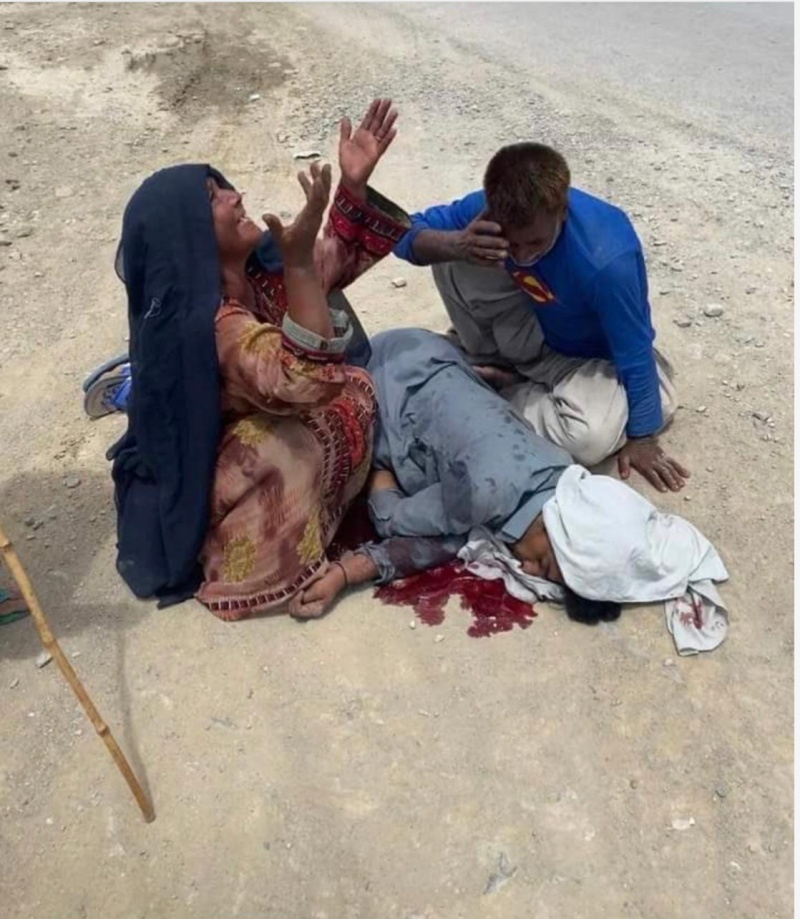
He was working along with his father on their Palm fields, when personnel of the frontier corps grabbed him, blindfolded him and dragged him towards the road. His family, his mother and father were crying and requesting them to please spare their son. He is innocent and he has nothing to do with anything. But the personnel of oppressive forces did not listen to them. They brutally attacked Hayat first and then they fired 8 bullets on his body. 

Mother and father of Hayat Baloch crying over the body of their son (Image credit: newsintervention.com)

News of Hayat’s murder came out within minutes and people of the area displayed extreme anger against this action of paramilitary forces. That is why one of the FC personnel was arrested by the police, personnel named Naik Shahidi Ullah is under police custody and the whole tragic killing is being portrayed as an act of an individual. However, in reality, everyone in Balochistan knows that the FC sepoy or any other Military personnel only follow the orders of their commanding officers. 

Since the brutal murder of Hayat Mirza, Baloch people have been protesting across Balochistan and demanding justice for Hayat Baloch. According to the protesters that this murder was not the action of an individual but was a part of the state policy, which orders the killing of Baloch youths mercilessly and keeping them away from education and from their struggle. 

In the last two decades, abduction or murder of any activist or sympathiser of the Baloch National cause became very normal in Balochistan. Thousands of people were killed because they believed in the freedom of Balochistan. Over 40 thousands people are still missing because of their political views which differ from the views of the occupier (Pakistan). 

Surprisingly Hayat Baloch was not a sympathiser nor a supporter of any of the political and human rights campaigns or activities. He wanted to finish his education and get a good job to help his family and live a normal life, but he was not aware that the society where he belongs to is still occupied and even his dreams are not free and he has no right to think any differently than the occupier wants all the slaves to think.

Reading from Hayat’s friends and colleagues stories he even many times said that “I am scared to talk or take part in any demonstrations or protest”. This simply shows Hayat has different hopes for his future. 

The case of Hayat Baloch after receiving such an overwhelming response and support from the masses. Now the frontier corps officials are trying their best to throw all the burden on the shoulder of one person and to close this chapter as soon as possible. To ensure that the family of Hayat Mirza remains silent and not speak against the FC brutality the Inspector General of Frontier Corps Balochistan Major General Fayyaz Hussain Shah visited the house of Hayat Mirza.

This is one of the rarest things that happens in Balochistan when the FC or Army Major or General visit any victims or their families. Many believe that FC has already provided their scapegoat to police and now visiting the house of the victim’s family is simply an attempt to make sure that this case should not get any more attention. 

The case of Hayat Baloch simply leaves a message to all of the Baloch youths whether you are speaking or not. Whether you are doing anything or not. Whether you are ignoring all the injustices or not. You are still in a dangerous condition because of your surname (Baloch). I hope all the educated and knowledgeable youth of Balochistan will not forget this inhuman treatment of Pakistani state and keep demanding justice for Hayat Mirza and thousands of other Hayat Baloch.

Curious case of ‘United Nations’ NGO appreciating ‘Kingdom of Mamata Banerjee’ for their Covid-19 work. Here is what we know

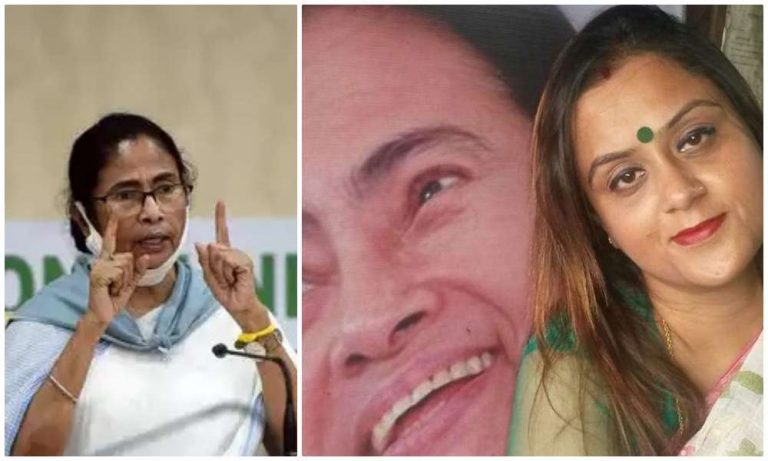
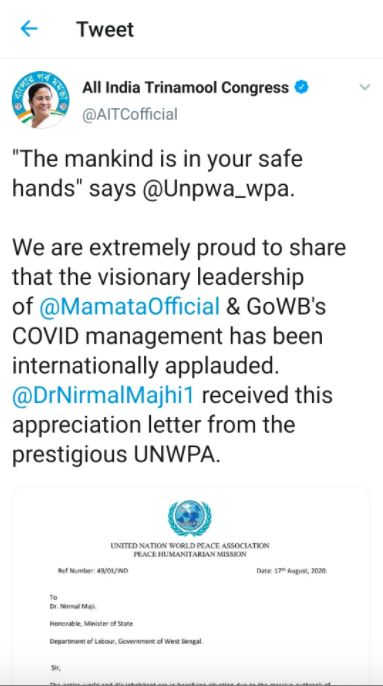
It was a moment of honour for the West Bengal government that a Japan-based non-profit organization associated with the ‘United Nation’ took notice of their work amid coronavirus pandemic and sent a letter of appreciation to the minister of state, Nirmal Maji. This piece of good news, a moment of pride of West Bengal which hailed ‘kingdom’ of Mamata Banerjee, was shared All India Trinamool Congress on its official Twitter handle.

This tweet has now been deleted. Here is the screenshot of this tweet.

Now deleted AITC tweet

TMC shared the letter by United Nation World Peace Association Peace Humanitarian Mission and wrote “We are extremely proud to share that the visionary leadership of @MamataOfficial & GoWB’s COVID management has been internationally applauded. @DrNirmalMajhi1 received this appreciation letter from the prestigious UNWPA.”.

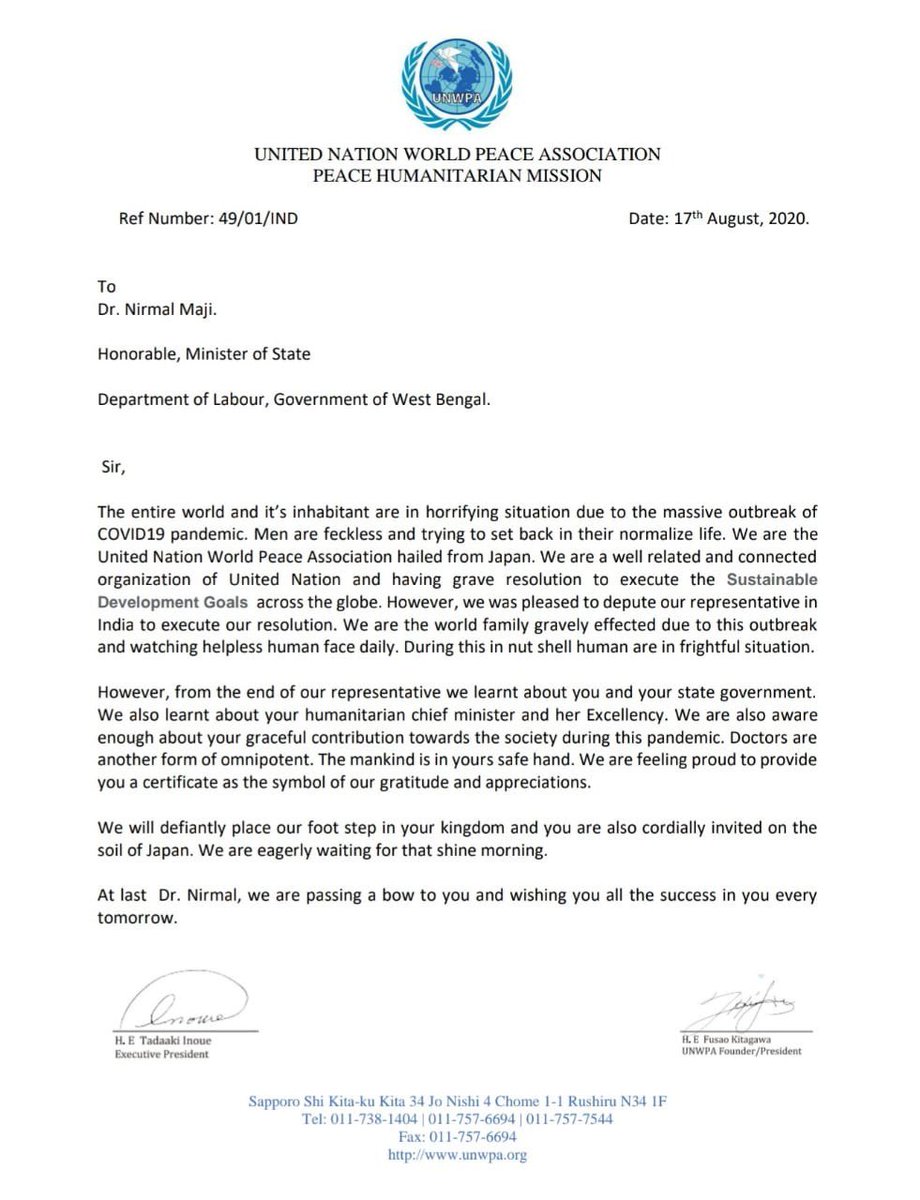
Letter from “United Nation” affiliated organisation

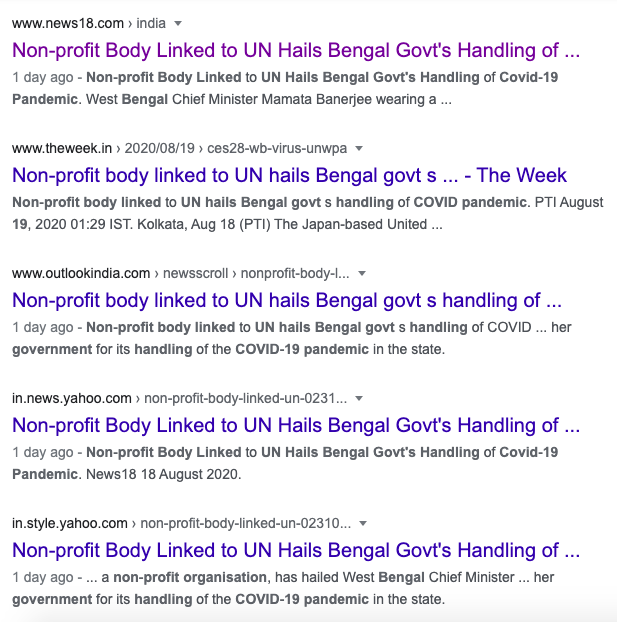
It was covered by several news portals including Times of India, Deccan Herald and Outlook and many others.

In fact, news agency PTI referred to the UNWPA as a ‘UN-linked NGO’, a claim that was carried by several outlets.

‘UN-linked body’ hails Mamata Banerjee

As usual, no one found the dubious letter hailing Mamata’s ‘kingdom’ weird.

The letter was widely shared by TMC and Mamata fans on social media.

One “Mamataism” (like Islamism, Marxism, etc) was also found celebrating this feat. It appears that the state government is looking at some appreciation for its virus work after having received flak earlier, where it has jailed journalists for criticism.

UNWPA lauds Mamata Banerjee’s kingdom and ‘passed a bow’

As proud Indians, we, too, were extremely thrilled that an Indian state got this recognition. However, there were a few things that were a bit off in the letter. To begin with, why is this NGO writing to ‘Labour Minister’ and not ‘Heath Minister’ or Chief Minister for lauding efforts to curb the Chinese coronavirus. This, especially when Mamata Banerjee is the Chief Minister and Minister-in-charge, Health & Family Welfare Department, Government of West Bengal.

Secondly, the English. Half the sentences don’t make sense, other half are grammatically incorrect. “Men are feckless and trying to set back back in their normalize life,” the letter reads. What does it even mean? The NGO then identifies itself as a ‘well related and well connected” organisation of “United Nation”. Now, UN, the intergovernmental organisation is “United Nations” and not “United Nation”. So one would assume that the NGO would not really get little details like these wrong, right?

“We are the world family gravely effected due to this outbreak and watching helpless human face daily. During this in nut shell human are in frightful situation,” the letter reads which again makes no sense. Firstly of all, it is ‘affected’. Second of all, just what exactly are you trying to say?

The letter explains how through their ‘representative’ they heard about the ‘humanitarian’ chief minister of the state and were aware of the graceful contribution towards the society during the pandemic.

And then, towards the end, the ‘well-connected organisation of United Nation’ claims that it will ‘defiantly’ (definitely?) ‘place out foot step’ in ‘your kingdom’. They also invited Mamata Banerjee to Japan and said they are eagerly awaiting that ‘shine morning’. They also ‘passed a bow’ to Dr Nirmal for the wonderful work in the kingdom.

As one can see, there are multiple issues with the letter other than the fact that it is a badly written/translated copy and that they referred to West Bengal as ‘kingdom’. This, obviously, got us curious. We tried to figure out what exactly is this organisation ‘linked with UN’ and lauding Mamata Banerjee and her ‘kingdom’.

What is ‘UN-linked NGO’ UNWPA

OpIndia team dug through the Internet wearing the Sherlock hat to figure out the drone-boy-esque dubious NGO. This is what we found:

The PTI copy claims that the ‘NGO’ that hailed Mamata Banerjee’s ‘kingdom’ is “a non-profit organisation registered with the UN Department of Economic and Social Affairs civil society”.

There were a few main things that caught our eye in the letter. First was the striking resemblance of the logo of this particular organization with the logo of the United Nations. UNWPA’s logo seems to be created by just adding an origami bird and Japanese cherry blossom flowers (because Japanese NGO?) on the top of the United Nations logo.

United Nations logo (left), UNWPA logo (right)

See the uncanny resemblance between the two? Easy to get fooled. (But really, how did an official certificate/letter with that English not raise the red flags?).

Second, the name of the organization has the United Nation and not the United Nations. This small difference in the name often gets unnoticed by anyone who reads the name or sees the acronym of the name of the organization. It is one of the proofs that UNWPA is not directly associated with the said International Organisation.

The website of the organisation does not have any link, registration number, affiliation number or certification that may prove that it is associated with the United Nations (and not United Nation, we don’t know what in the world United Nation is) in any way.

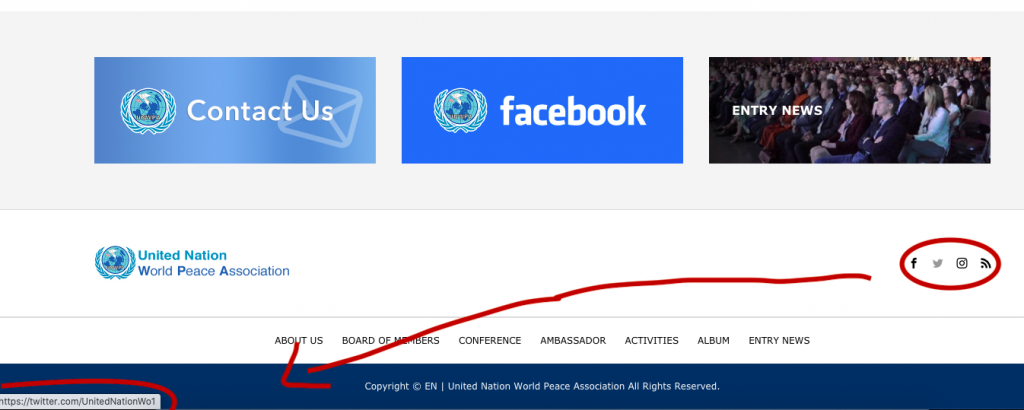
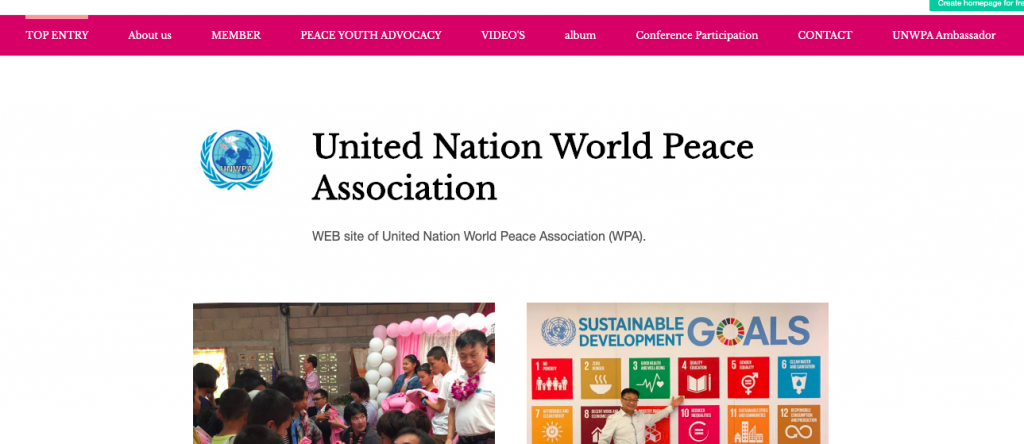
UNWPA website and social media accounts

For any organization that is trying to place its bets on an international level, having a functional website is the utmost important part of the mission as it helps in connecting with the people across the globe. Well, half the links on the website were dead. Like the Twitter address.

UNWPA website Twitter handle

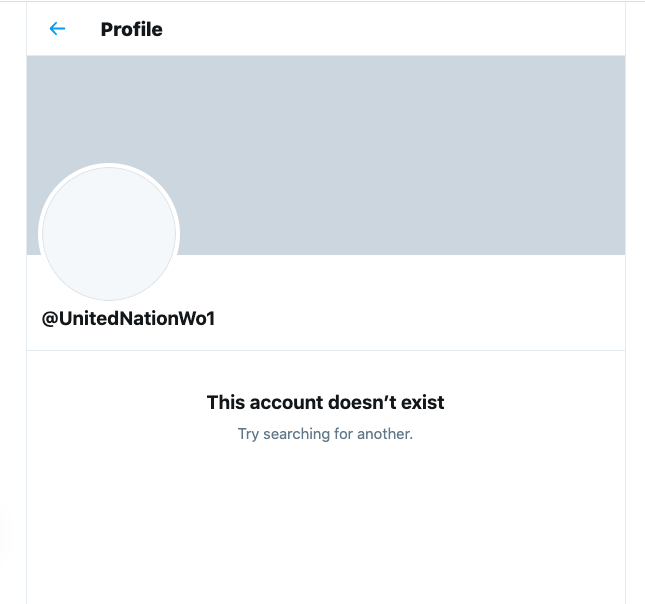
As per the website, the Twitter handle of this ‘NGO’ is @UnitedNationWo1

Twitter account does not exist

So we looked at the Twitter account tagged by TMC officials for this website.

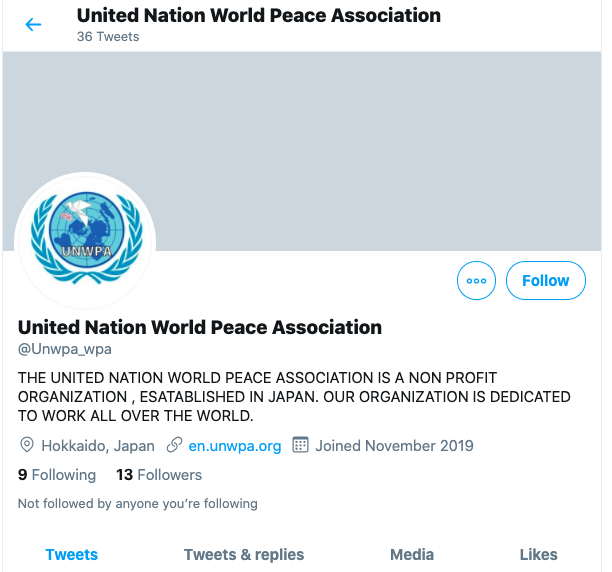
TMC and others had tagged @Unwpa_wpa Twitter account that has 13 followers.

UNWPA has 13 followers

Interestingly, TMC’s post in which they shared the letter of appreciation, tagged the twitter handle of the organization with an error.

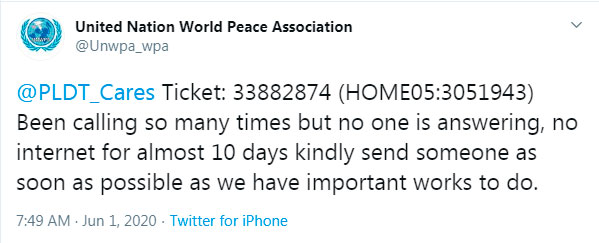
The twitter handle of the organization seems to be accessed by someone in the Philippines as a couple of tweets from the handle were personally directed to the airlines and Broadband service provider in the Philippines.

UNWPA has ‘important works to do’

This tweet to telecom company in Philippines says how the person handling social media had ‘important works to do’. Like appreciating ‘kingdoms’ perhaps.

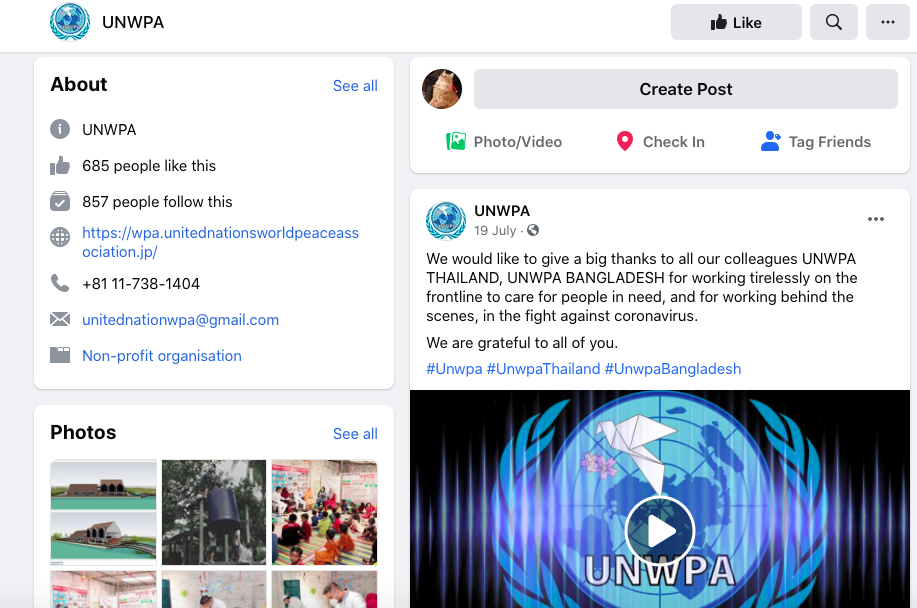
Moving on, when we clicked on the link of Facebook page mentioned on the website, the first thing we noticed was a different URL (unitednationsworldpeaceassociation.jp) for the organization mentioned on the Facebook Page. The Facebook page has less than 700 followers.

Facebook account with less than 700 likes

Now this link on Facebook opens a completely different website in Japanese.

Japanese website from Facebook page

So in a ‘nut shell’, website mentioned on ‘letter’ leads to one website, which leads to a non-existent Twitter page. The Facebook link in the same website mentions a completely different website as official website. Just make up your mind!

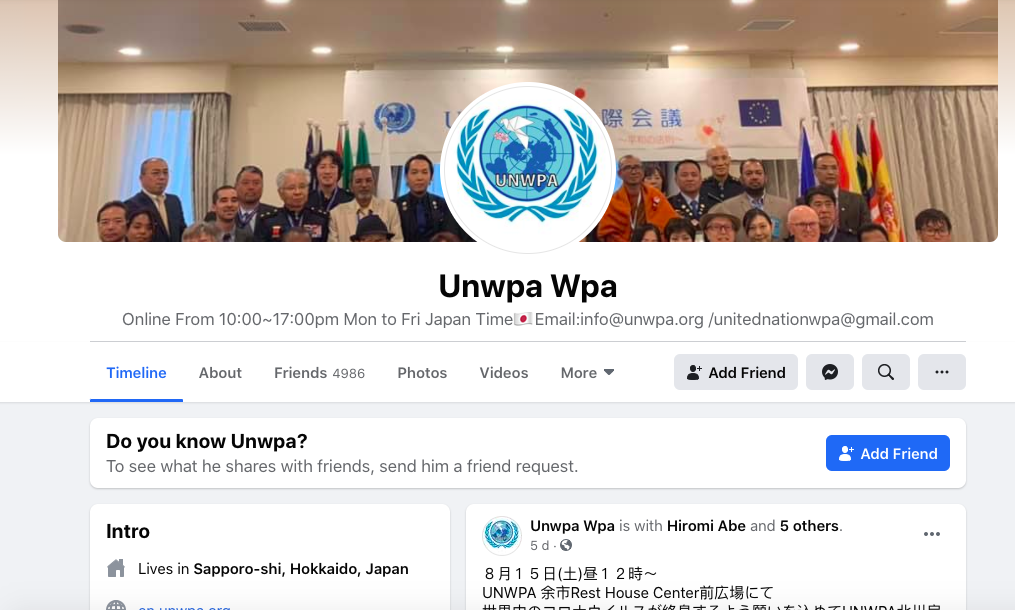
This ‘NGO’ also has a Facebook ‘profile’ – through which it adds ‘friends’ in the list.

Facebook profile of the ‘organisation’

Amusingly, the profile has more ‘friends’ than the ‘likes’ the Facebook page has.

India Ambassador H. E. Pinky Dutta

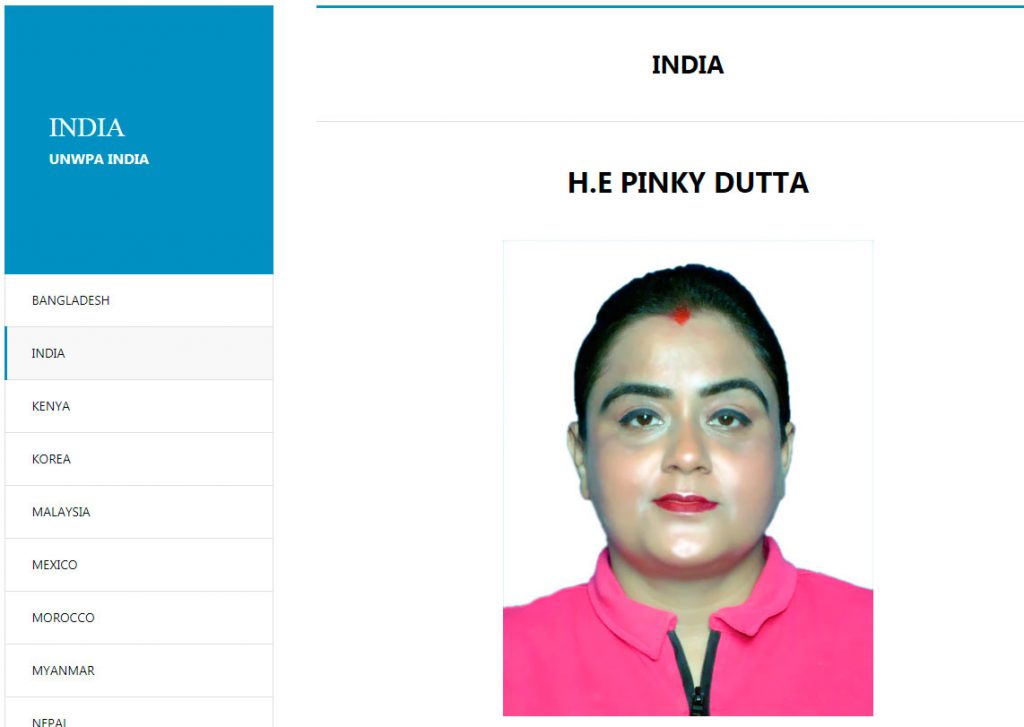
On the website mentioned in the letter to West Bengal government, there is one section wherein they mention their ‘ambassadors’ to various countries.

India’s ambassador is one Her Excellency Pinky Dutta.

Pinky Dutta on Website

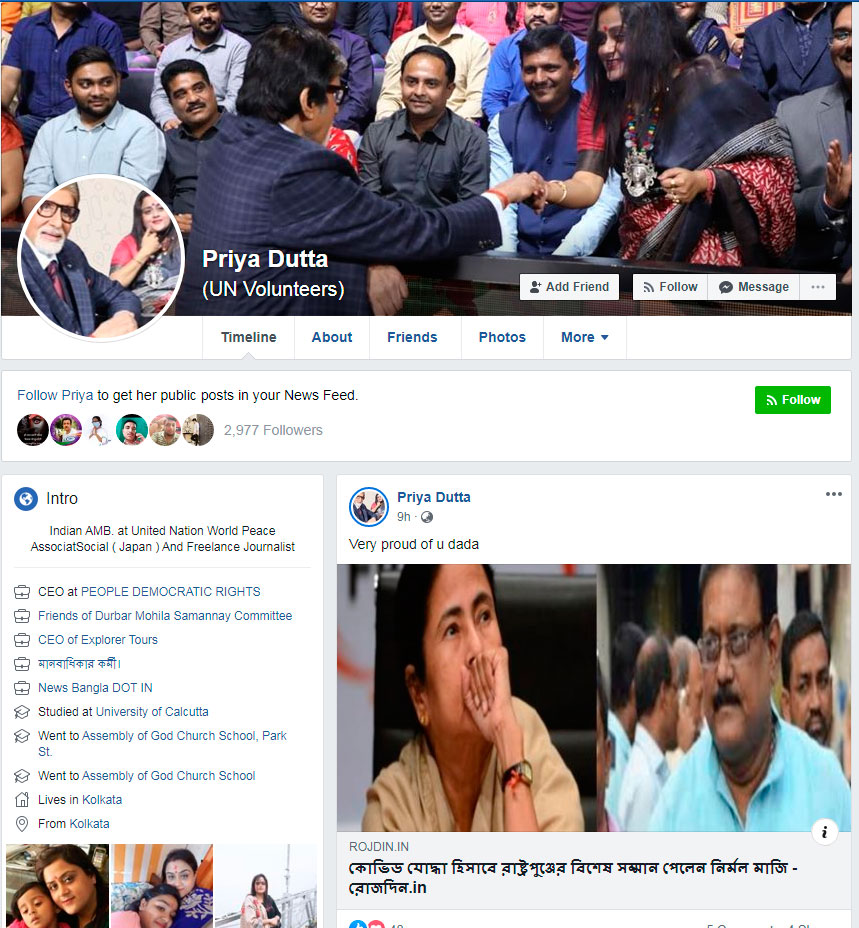
Of course, we got curious about H. E. Pinky Dutta. When we looked her up we found her Facebook profile, where she identifies herself as “Priya Dutta”.

Priya Dutta Facebook profile

Priya Dutta alias Pinky Dutta identifies herself as a freelance journalist and also various other things.

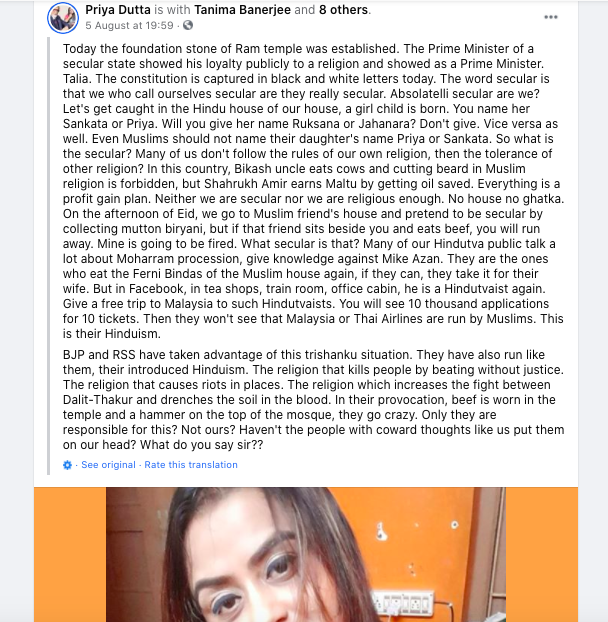
Dutta has been critical of the central government and had recently put up a post criticising the Ram Mandir Bhoomi Pujan in Ayodhya.

Priya Dutta being critical of Ram Mandir Bhumi Pujan

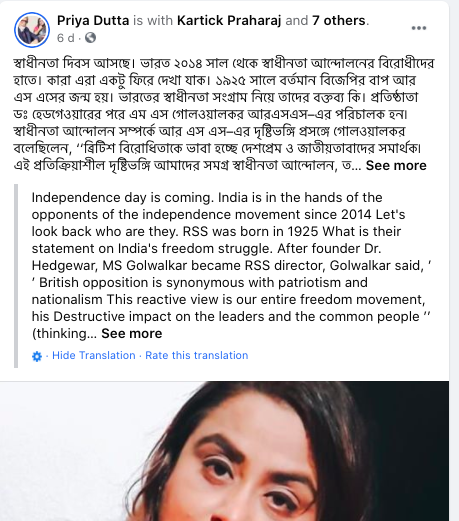
She also believes that the BJP opposed the Independence movement of India.

Priya Dutta on Independence Day

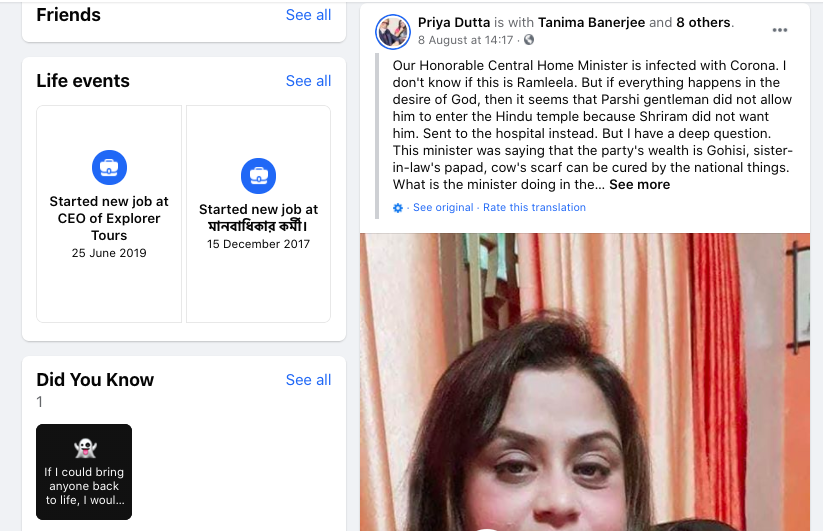
When Home Minister Amit Shah tested positive for coronavirus, Dutta had taken to Facebook to claim that it is ‘Ram Leela’.

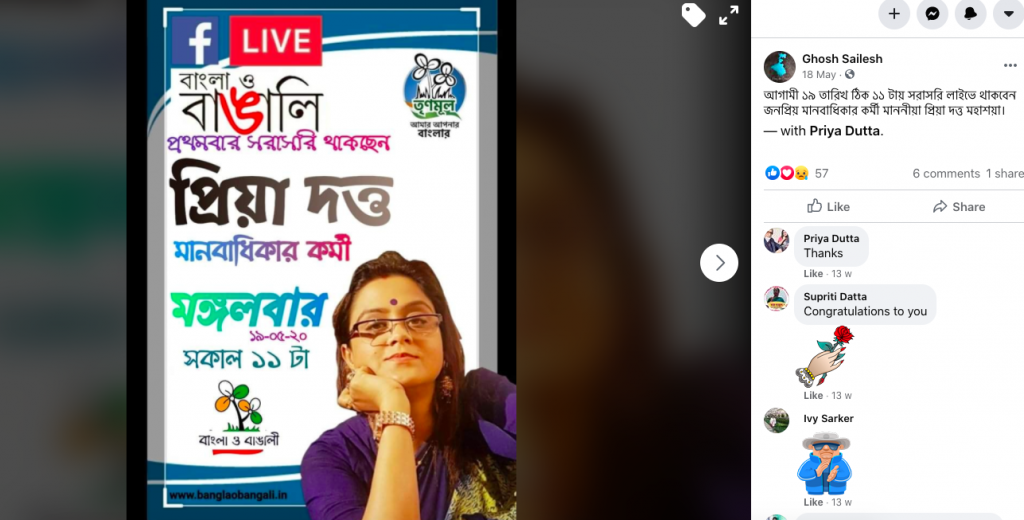
In May this year, she had given a talk at a TMC event. “Popular human rights worker respected Priya Dutta will be live at 11 on 19th May,” the banner read.

Pinky Dutta’s Facebook post

This is Priya Dutta alias Pinky Dutta, Ambassador of the dubious ‘organisation’ that has awarded the ‘Kingdom’ of Mamata Banerjee.

Which brings us back to the letter. Is it genuine? Did Mamata Banerjee govt really won the ‘prestigious’ award?

Did Mamata Banerjee govt get any award from ‘UN-linked NGO’ for Coronavirus

Here’s the twist.

Yes and no. Let us explain.

OpIndia reached out to the UNWPA to enquire whether such a letter was issued.

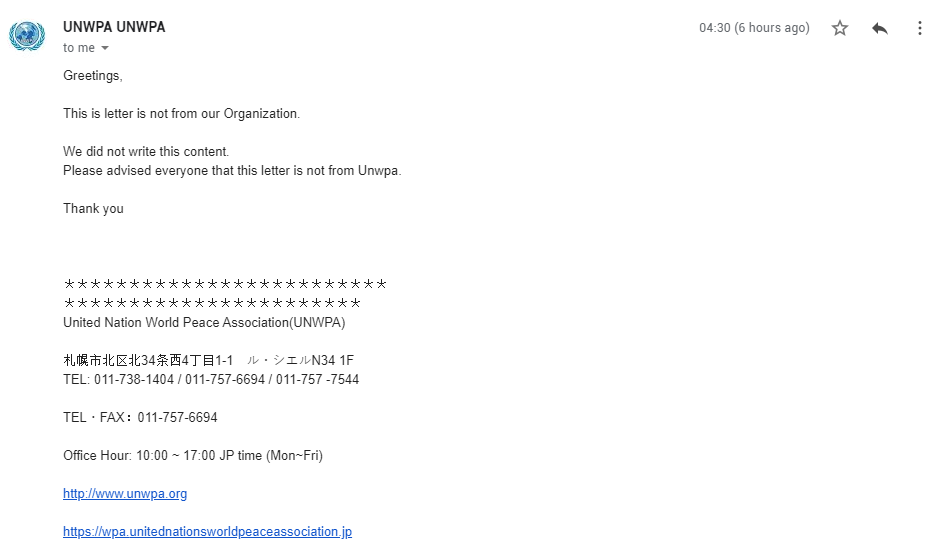
Letter denying.

At around 4:30 AM, UNWPA replied stating that the letter shared by AITC and subsequently reported widely in media is fake.

However, here’s the twist.

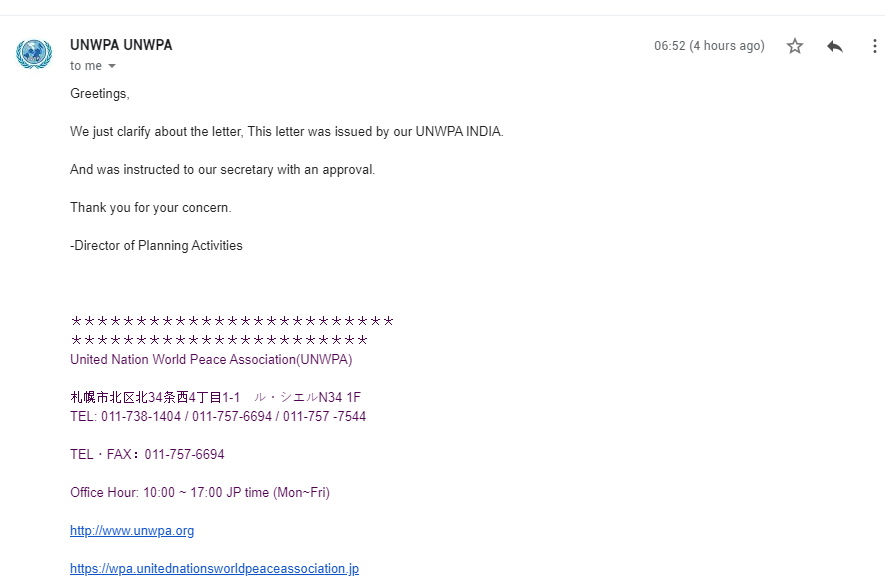
Two hours later said they wrote the letter

Little over two hours later, the organisation replied again. This time claiming that while they (in Japan) did not write the letter, the India office, possibly run by H. E. Pinky Dutta alias Priya Dutta might have issued the same.

To conclude, yes, Mamata Banerjee’s ‘kingdom’ did get a ‘certificate’ hailing efforts in coronavirus containment. However, the poorly written letter was not issued by the Japan organisation but by its India representative, Her Excellency Pinky Dutta alias Priya Dutta who is anti-Modi and quite pro-Mamata Banerjee. Also, the organisation is not linked to the United Nations as it is made to believe.

Note: This article is co-authored by Anurag and Nirwa Mehta.

Mahesh Bhatt plants a paid article praising himself after finding himself at the centre of nepotism debate in Bollywood

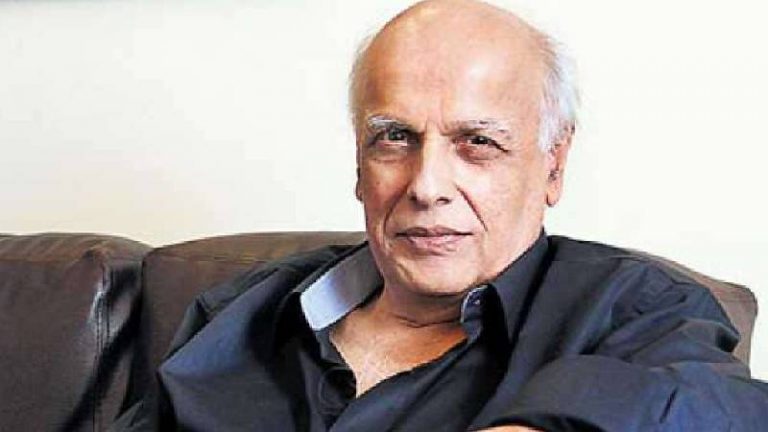
In a desperate act, filmmaker Mahesh Bhatt, who is at the centre of the ongoing controversy over allegations of nepotism the movie industry, has now resorted to paid promotions to boost his image.

On Thursday, the Bollywood filmmaker, whose image has taken a hit following the raging debate of nepotism in the industry after the death of Sushant Singh Rajput, got caught on social media after he allegedly planted paid articles that praised and crediting him for the success of various Bollywood stars.

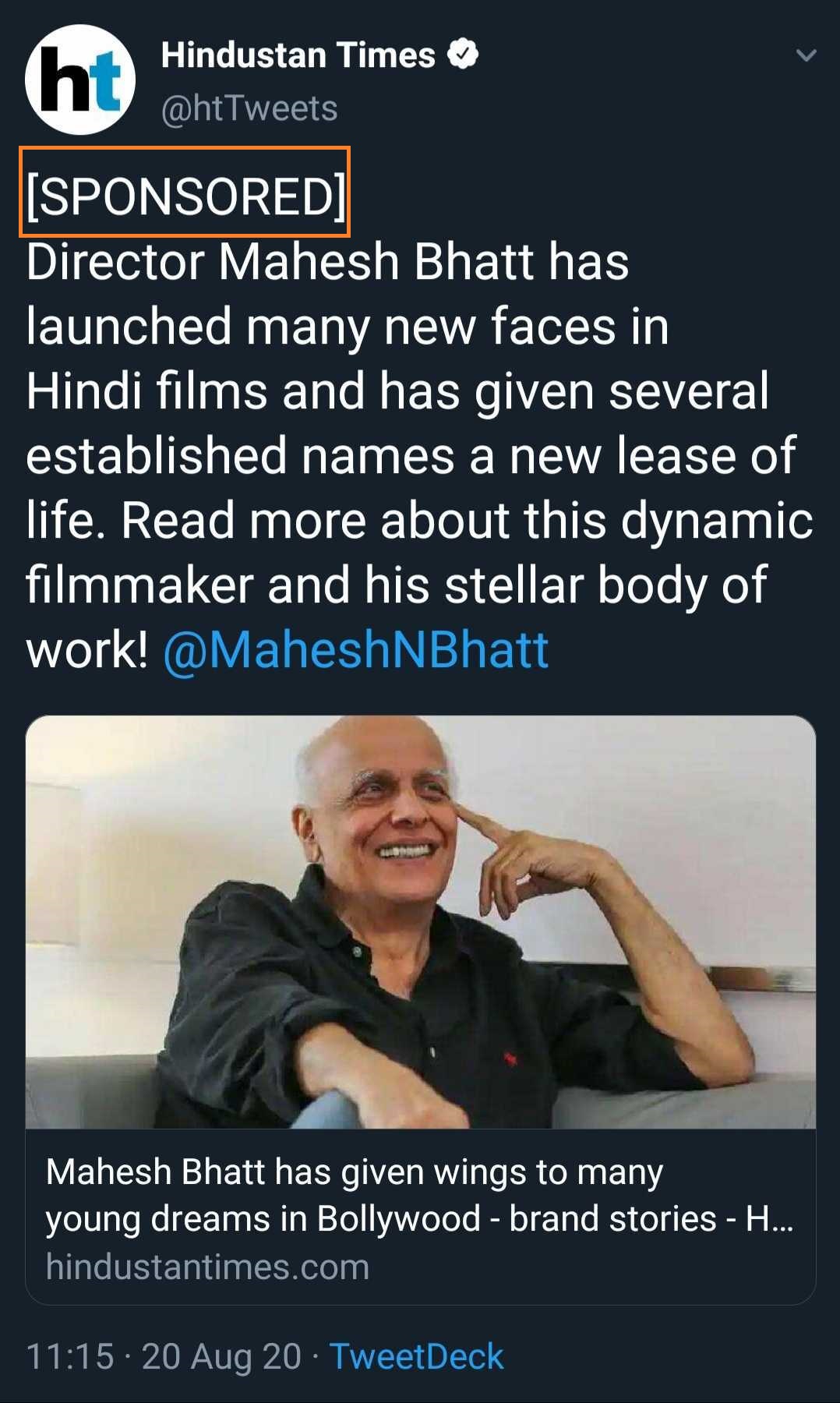
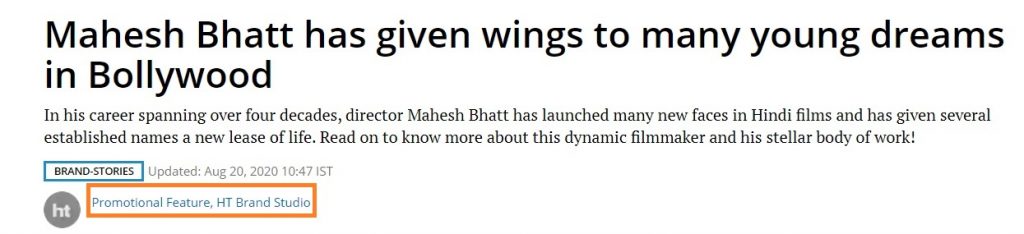
In a sponsored article published in the Hindustan Times titled, “Mahesh Bhatt has given wings to many young dreams in Bollywood”, the writer has glorified Mahesh Bhatt, claiming that the director-cum-producer had spotted several talents and gave breakthroughs to them.

Interestingly, the paid article comes a day after the Supreme Court ordered a CBI probe into the death of 34-year-old actor.

Image Source: Hindustan Times

The paid article, perhaps planted by Mahesh Bhatt himself, hails him for encouraging and providing an opportunity for lots of young talents like Kunal Kemmu, Anupam Kher, Sonali Bendre, Arijit Singh, Kumar Sanu and others, who went on to become accomplished actors in the future.

“He (Mahesh Bhatt) has often said in interviews that he feels he is “blessed to discover new talent and watch them bloom”. In an era when more and more confident, young people are coming to Mumbai to chase their Bollywood dream; Bhatt’s efforts come as a whiff of fresh air in the merciless, cut-throat environment,” read the sponsored article.

Mahesh Bhatt credits himself for success of actors, musicians

In an act of narcissism, evident through such planted paid stories on the media, Mahesh Bhatt credits himself for providing a platform to Anupam Kher in the movie ‘Saaransh’. The article also cites how Anupam Kher had once credited Bhatt for his success in the movie industry.

Further, the HT report credits Mahesh Bhatt for finding talents such as John Abraham, who was also launched by Mahesh Bhatt. The story goes on to say that Bhatt saw a junior Sanjay Dutt in Abraham and called the actor personally to offer the lead role in the film.

“He is credited with bringing in raw talent, who went on to become highly successful actors,” the HT sponsored story read.

The HT report, in its mission to promote Mahesh Bhatt and his latest movie ‘Sadak 2’, also claimed that Bhatt had a good ear for great music, who offered the right platform to several singers, who shot to stardom. Expectedly, Mahesh Bhatt also claims credit for even singer Kumar Sanu’s success.

Arijit Singh, Rahat Fateh Ali Khan came to spotlight due to Mahesh Bhatt

Not just Kumar Sanu, Mahesh Bhatt also unearthed talent in the form of Arijit Singh. The HT report says that Bhatt was instrumental in spotting the singing prowess of Arijit Singh, who apparently got his first big breakthrough in Aashiqui 2.

The most bizarre claim made by Hindustan Times paid promotional article is that Pakistani singer Rahat Fateh Ali Khan came into the spotlight only after he sang the song Mann ki Lagan in Bhatt’s movie ‘Paap’.

The report pitching for Bhatt’s new movie ‘Sadak 2’, said that his movies on their own have explored unchartered territories, which many other filmmakers steer clear of. 

“His body of work has been loved by the audience and critics alike. They offered many established actors a new lease of life in their careers,” read the HT report praising Mahesh Bhatt for introducing talents actors such as Sanjay Dutt, Aamir Khan, Juhi Chawla, Paresh Rawal and music composer duo Nadeen Shravan, who all vowed their success to Mahesh Bhatt.  

Charges of nepotism against Mahesh Bhatt

The sudden and untimely demise of actor Sushant Singh Rajput has opened a can of worms and sparked a debate over nepotism in the cinema industry. Many celebrities have opened up on how the big and influential families in Bollywood have been propagating it over the years.

One such name which came out in the public domain was Mahesh Bhatt, who was accused of deliberately sidelining talented actors and instead promoting his own kids and other actors connected to the bigwigs of the industry. Many blamed filmmakers such as Mahesh Bhatt, Karan Johar for their favouritism in the industry, which according to a few resulted in the death of Sushant Singh Rajput.

Following the actor’s death, the veteran filmmaker was summoned for questioning by the Mumbai Police along with several other Bollywood directors and producers.

Recently, the National Commission of Women had summoned Mahesh Bhatt over his alleged with modelling firm, which is accused in a sexual abuse case.

Democratic vice-presidential nominee Kamala Harris says Coronavirus is a racist virus during her speech accepting her nomination

0

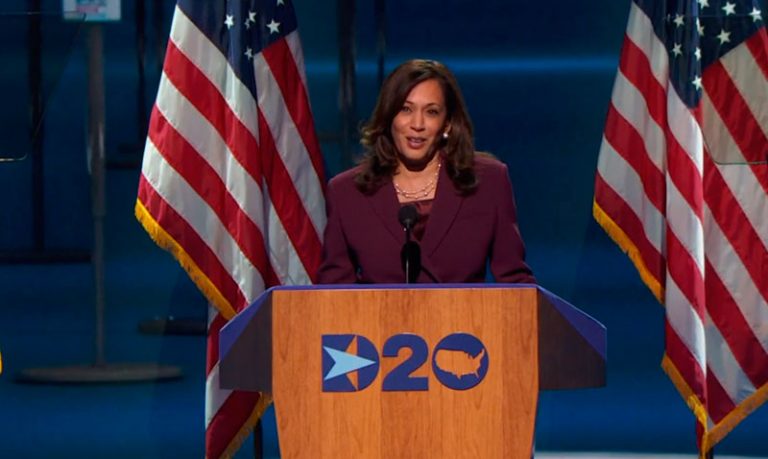
On the third day of the virtual Democratic National Convention 2020, Kamala Harris officially accepted her nomination for the Vice President post. She said, “On that day, she [Harris’s mother] probably could have never imagined that I would be standing before you now speaking these words: I accept your nomination for Vice President of the United States of America.”

Kamala Harris started her speech by saying that this week marks the 100th anniversary of the passage of the 19th amendment that gave women of the United States the right to vote. She narrated the story of her mother Shyamala Gopalan Harris, who came to the US when she was 19. She talked about how her parents fell in love during the march for justice in the civil rights movement of the 1960s. While mentioning the support she got from her family, and how proud her mother would be to see her standing there, Harris accepted her nomination for the post of Vice President.

Covid-19 is racist

While talking about President Donald Trump’s leadership, she said that it has cost lives and livelihoods. She pointed out the current situation in America because of the Covid-19 pandemic and said that the nation is grieving the loss of life, jobs, opportunities and normalcy and certainty. Continuing her speech, she called Covid-19 a racist virus.

She said, “And while this virus touches us all, let’s be honest, it is not an equal opportunity offender. Black, Latino and Indigenous people are suffering and dying disproportionately. This is not a coincidence. It is the effect of structural racism. Of inequities in education and technology, health care and housing, job security and transportation. The injustice in reproductive and maternal health care. In the excessive use of force by police. And in our broader criminal justice system. This virus has no eyes, and yet it knows exactly how we see each other—and how we treat each other.”

Racism in America and George Floyd

Harris added that there is no vaccine for racism and the people of the US have to work on finding a way to end racism. In her speech, she specifically mentioned the name of George Floyd whose killing in May 2020 resulted in protests in the US and other parts of the world. The protests soon turned into violent riots in the US and some other parts of the world, resulting in loss of billions of dollars and lives. A worldwide campaign on #BlackLivesMatter was started as a result of Floyd’s killing.

Harris urged people to choose Joe Biden as the President

She further praised Joe Biden for his role as the Vice President and a single father. Harris said,” In this election, we have a chance to change the course of history. We’re all in this fight. You, me, and Joe—together.” She ended her speech by saying, “Years from now, this moment will have passed. And our children and our grandchildren will look in our eyes and ask us: Where were you when the stakes were so high? They will ask us, what was it like? And we will tell them. We will tell them, not just how we felt. We will tell them what we did.”

Pre-partition Hanuman Mandir razed to the ground in Pakistan: Here is how builder took advantage of lockdown to demolish Temple

0

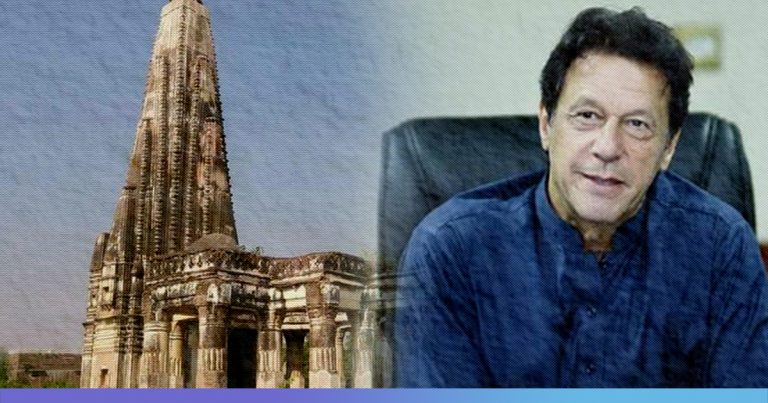
A pre-partition Hanuman Mandir in Pakistan’s Lyari district was demolished by a builder on Monday. The next day, the narrow thoroughfare on Fida Hussain Sheikh Road in Lyari where the temple stood until Monday was flooded by dozens of Hindu families after they heard that the Hanuman Mandir had been razed the previous evening. The Karachi Police sealed the construction site after the temple was razed, reports a Pakistan daily, The Express Tribune.

According to the report, Lyari’s assistant commissioner Abdul Karim Memon who reached the site with the police informed that a probe has been initiated and the site, where a residential building is to be erected, has been sealed so that an inquiry can be conducted.

A resident Hindu named Heera Lal, while speaking to the media, expressed grief as well as his anger as he informed that the Hindus in the area had been given assurance by the builder that the temple will not be harmed. The resident, who was one amongst the 18 Hindu families living near the temple, added that the demolition had taken place late on Sunday evening.

Builder took advantage of the lockdown in Pakistan to raze the Hanuman temple

Another onlooker Mohammad Irshad Baloch said: “It is an injustice as a place of worship has been destroyed. It was an old temple. We have been seeing it since we were children.”

A resident who opined that the builder had taken advantage of the lockdown said: “No one was allowed to visit the temple during the lockdown. The builder exploited the situation and demolished our place of worship while we could not visit it, lamented one Harish while demanding that the temple be restored immediately.

He, too, claimed the builder had promised the area’s Hindu residents that the temple would not be demolished, adding that all the families living around it were even assured of alternative housing.

Similarly several Hindus living in the area, who collected near the temple site, after the news of the demolition spread, voiced their disappointment as well as their acrimony on their place of worship being destroyed.

Speaking to The Express Tribune, Mohan Lal, a Hindu activist, accused the builder of threatening members of the minority community who had assembled at the site and highlighted the temple’s demolition.

“We tried to enter the temple but were denied entry by the builder,” he narrated, adding that the man had deceived the residents living there. “We will not allow anyone to demolish our places of worship in this manner,” he added.

According to the report, the builder could not be reached for his comment on the matter.

Hardline Islamists impeded construction of Sri Krishna temple in Islamabad

Last month, the construction of a new Sri Krishna temple in Islamabad was halted after radical extremists razed the boundary wall of the temple to the ground. Videos of radical extremist dismantling the temporary boundary wall and speaking to the camera in an agitated manner had gone viral on social media.

The hardline-radical Islamists in Pakistan had earlier opposed the construction of Hindu temple in Pakistan claiming that it was contrary to the idea of Pakistan, which is Islam. Terming it to be against Pakistan’s ideologies, the Islamic fundamentalists had attacked the Imran Khan government for granting funds to the construction of a Hindu temple in Islamabad. The Islamic leaders claimed that building a temple on the taxes of Muslims could not be tolerated in Pakistan.

Congress era NSA with links to George Soros insinuates India’s domestic policy should be decided by the USA

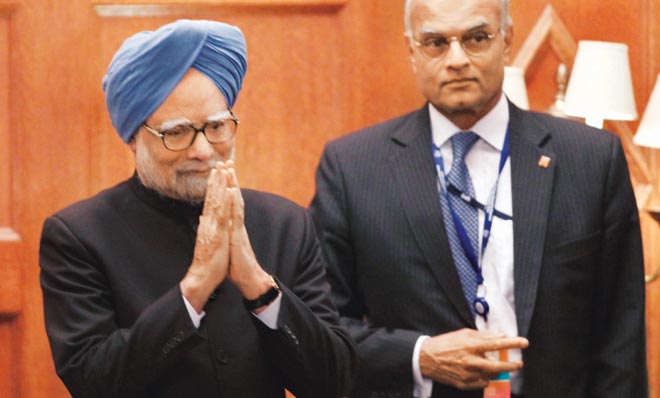
Shivshankar Menon, India’s former National Security Advisor under the Manmohan Singh government has written an article in Foreignaffairs.com, a USA-based publication, on the India-US relationship under the Modi and Trump administrations.

As NSA, Menon was cited as one of Manmohan Singh’s most trusted men and had also gained the confidence of many UPA ministers.

In the article, the former NSA has implied that India’s domestic policies should be made in a way that the USA, or rather, a particular set of politicians in the USA approve of.

In the article titled “League of Nationalists: How Trump and Modi Refashioned US-Indian Relationship” in the current issue of Foreign Affairs, Menon has written that Trump and Modi go along well because they both, like Israel’s Netanyahu, Saudi Arabia’s Mohammad Bin Salman and Brazil’s Bolsonaro, view foreign policy as a ‘give and get favours’ relationship.

Menon also says that Modi and Trump go along well because, like Trump, Modi had “resorted to ultranationalism to compensate for his divisive domestic agenda”.

Fromer NSA peddles blatant lies against India

The former NSA’s article is mostly about how Trump (and his friends) are bad people who do bad things. He writes baout a number of changes in India’s policy and trade relationship with the USA, but fails to explain how exactly they have been ‘bad’ for either countries. Most of the issues he has mentioned, are discussed because they have been ‘changes’, steering away from old conventions and old dynamics of ‘strong USA and weak India’.

In order to make his point, Menon has resorted to blatant lies against India and the policies of the Modi government, to the extent of undermining India’s national interests and belittling India’s sovereignty to ‘appease’ a certain group of politicians.

Shivshankar Menon’s article in Foreign Affairs

In the same article, Menon has resorted to blatant lies. He has written that under Modi, India has “excluded Muslim immigrants from the path to citizenship”. This is in reference to the CAA, where India had shortened the number of years required for religiously persecuted minority refugees from its three Islamic neighbours, Pakistan, Afghanistan and Bangladesh to apply for an Indian citizenship.

The blatant lie that it takes away the ‘right of Muslims’ and endangers their citizenship, or even restricts Muslims from applying for Indian citizenship was peddled by a large group od ‘secular-liberals’ including the Congress, and other opposition parties in India, a number of leftist NGOs, Pakistan, UK’s Labour Party and a section of democrats in the USA.

The CAA neither concerns exiting Indian citizens, regardless of their religion, nor it affects the usual process of applying for citizenship for non-Indians, regardless of their religion. What Menon, a former NSA, has written, is a big, fat, shameless lie.

Menon’s lie on Kashmir

The second part of Menon’s lies concerns Jammu and Kashmir, where India had last year abrogated the discriminatory, misogynist, anti-Dalit and anti-minority Article 370 and brought all the residents of the erstwhile Indian state of Jammu and Kashmir under the ambit of the Indian constitution, with all the rights and benefits that the Indian constitution grants to its citizens, regardless of their gender, birth, religion and sexual orientation.

Why exactly a former NSA serving under the then UPA government harbours the views that an Indian state should be governed by a set of sectarian laws dictated by the Muslim majority of that region and its residents should not enjoy the rights and benefits granted by the constitution of India is a big mystery. May be Menon himself, or the people who appointed him as the NSA should answer that question.

Menon wants USA to interfere in India’s domestic policies?

The reason why he has written a long article on ‘Bad-Trump bad-Modi’ is explained on the later lines. Menon has explicitly mentioned that Trump has never ‘objected’ to Modi’s domestic policy. He has given a “free pass” to Modi’s divisive domestic agenda and it was only a few Democrat leaders, like Pramila Jayapal, and Ro Khanna who had spoken against Modi’s policy.

Why does a former NSA think that India’s democratically elected government should need the permission, evaluation and approval of the USA before deciding on its domestic policies is another large question mark.

Pramila Jayapal, and some other politicians, were among those who had tried to pressurise India through various channels against its domestic policy decisions of CAA and abrogation of Article 370 in Jammu and Kashmir. India’s current foreign minister S Jaiashankar had refused to meet a delegation of USA politicians where Jayapal was a part, over the same issue.

India, under the Modi government, has steadfastly refused to bow down to foreign politicians. The UK Labour Party had also passed a resolution against India’s decisions in Kashmir. India, under Modi, has made it clear that it will not let foreign powers decide its policies. Perhaps a strong, independent India that refuses to bend to a certain group of lobbyists and their masters, is not a favourable idea for some.

Shivshankar Menon is the board member of a George Soros organisation

Shivshankar Menon, who served as the National Security Advisor (NSA) of India from January 2010 to May 2014 under Prime Minister Manmohan Singh, currently sits on the Board of Trustees of Crisis Group along with George Soros.

For the uninitiated, George Soros, the so-called ‘progressive philanthropist’, who through his network of NGOs and funding agencies works to interfere in internal matters of other nations, influence elections and change governments, has stated that his organisation intends to fight ‘nationalism’ in India.

At Davos, in his speech at the World Economic Forum (WEF), Soros had committed $1 billion towards fighting nationalism and nationalists. George Soros claimed that the “biggest and most frightening setback” was in India and accused Narendra Modi of “creating a Hindu nationalist state.

In India, Soros’ organisation Open Society Foundation has been working through a number of NGOs and so-called ‘intellectuals’. These organizations are extensively involved in shaping the mainstream narrative and they often engage in ‘judicial activism’ that seeks to use the Courts in order to undermine Indian national interests. Harsh Mander is the Chairman of the OSF’s Human Rights Initiative Advisory Board.

Some of OSF-supported HRLN’s efforts have been involved in include the campaign against ISKCON’s Akshaya Patra, a campaign against Indian sedition laws, and it has been providing free legal aid to Rohingya Muslims in India. It has also been engaging in activism for the implementation of the RTE Act that works against Hindu-run institutions. Furthermore, it is also linked to a plethora of organizations across the country that seeks to undermine India’s territorial integrity.