China will operate special flights to evacuate its citizens stranded in India and those facing the difficulties of returning to the mainland from June 2, a notice issued by the Chinese embassy said on Monday.
According to the official press release which was in Mandarin, the evacuation services offered by the Chinese government could be availed by international students, tourists and temporary business-visa holders among others who are facing difficulties in India.
China has asked its citizens willing to return to China to register by the morning of May 27.
The notice comes in the midst of a raging Wuhan coronavirus pandemic in India that has so far affected 1.40 lakh people and the rising border tensions with China following the stand-off between the Indian and the Chinese troops in Ladakh.
The notice put out by the Chinese embassy mentions that those taking the flights back to China will have to bear the cost of the tickets and the mandatory 14-day quarantine once they reach Mainland.
“Under the unified arrangement of the Ministry of Foreign Affairs and relevant departments, the Chinese embassy and Consulates in India will help students, tourists, and temporary businessmen in India who are facing difficulties and are in dire need of returning home to take temporary flights back to China,” the notice said.
The notification also explicitly prohibited those who have tested positive or suspected to have caught the coronavirus or those who exhibited symptoms of COVID-19 such as fever, cough to take the flights. Furthermore, close contacts of coronavirus patients whose body temperature surpasses 37.3 degrees centigrade will not be allowed to board the flights. The applicants have been asked to not conceal their medical history.
The notice cautioned the applicants to carefully evaluate and make an informed decision of opting to go back to China, citing India’s anti-epidemic measures which may not allow the Chinese citizens to return to India within a short duration of time.
The evacuation from China comes at a time when the number of Wuhan coronavirus cases in India is steadily on the rise. India was amongst the first countries to arrange the evacuation of more than 700 citizens and foreign nationals stranded in the central Chinese city of Wuhan, the epicentre of the coronavirus outbreak.
China to evacuate citizens amidst soaring border tensions as a result of expansionist adventurism in Ladakh, India
Border tensions between the two nations have once again reignited after the Chinese troops initiated a scuffle with their Indian counterparts. The stand-off escalated after the Chinese side brought in troops and heavy equipment from a military exercise that was being conducted in the region this week. It is also believed that Chinese troops have also taken up positions along the Pangong Tso Lake and are also carrying out aggressive patrols with motorboats to intimidate Indian forces in the region.
As per the report, the Chinese troops have damaged some temporary structures put up in the finger area near Pangong Tso Lake. At the Galwan flashpoint, Chinese troops have maintained their presence and are being countered by a good number of Indian reinforcements. The face-off position at Galwan was extended by the Chinese to another four kilometres as it was reinforced with additional troops this week.
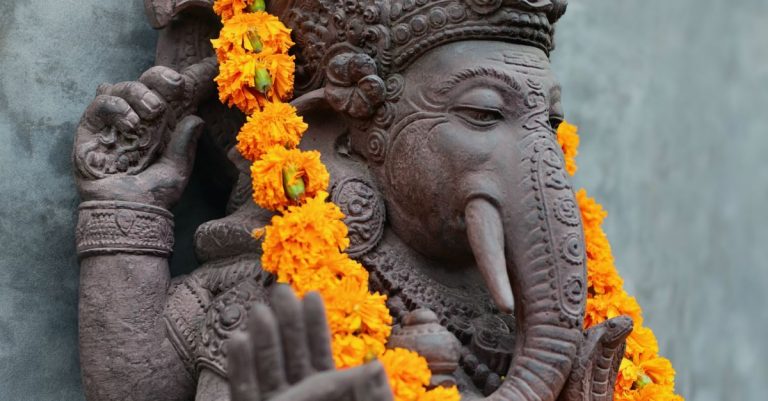
Praṇava (प्रणव) – ॐ holds a position of paramount importance in Dharma.
It is the sacred sound that has become the primary spiritual symbol of Dharmic traditions, over millennia, having been chanted either independently or before a spiritual recitation in Hinduism, Jainism and Buddhism. It also holds a special position for me, personally, have been ubiquitous in my spiritual pursuits and meditation. Through more than three millennia of religious practices, linguistic explorations and application in spirituality in the Vaidika Dharma, Om became a sacred syllable. It can be regarded as much as the sonic essence of the Vedas as an audible realization of the supreme cosmic principle of Brahman in Hinduism.
Om has had an interesting historical journey. We do not find any reference to Om in the Rig Veda, although the doctrines of Akṣara and Vāc -that are later associated with Om– are seen. The sound Hiṃ, which is seen in the Rig Veda, is regarded by some as a proto-Om if you will. The oldest occurrence of Om can be seen in the form of Stobhas (chanted interjections in a Sāman – Vedic song or tune) in the Samaveda Samhitas, composed around 1000 BCE. Om is also seen, in an early form, in the Yajurveda Samhitas in the mantras of Vājasaneyins and Maitrāyaṇīyas. In the Brāhmaṇas, Om is seen to emerge from the extraction of meaning and the essence of Vedas by Prajāpati. While the phonological equation: Om = A+U+M and Om as ‘yes’ are attested by Aitareyins of the Rig Veda, reflections by Jaiminīyas of Samaveda on Om led to a gradual integration of the sacred sound into doctrines of Brahman, Vāc and Akṣara. This is also seen in the Aranyakas, wherein the Jaiminīyas wrote on their reflections on Om, bringing in the idea of an ‘unexpressed’ (Anirukta) song and the general Jaiminīya soteriology of a song, when speaking of Om.
It was in the Upanishads that Om had an associated contemplative soteriology, with the usage or contemplation being independent of any specific ritual context. There was also a pan-Vedic discourse on the sacred syllable constructed. There are introspective, renunciatory and devotional practices that begin to be associated with Om. In all this, there were ancient theological and religious tussles between, and stages of evolution facilitated by, different schools of theologians on Om. For instance, while the Jaiminīyas individuated Om as the essential, foremost of syllables of the Vedas, the Kauthumas transcended its sacrificial context using metaphysical speculations that led to a new contemplative soteriology. An important point to note in all this is the sonality of a syllable. At the end of the day, Om is a sound that appears in multiple forms in Shlokas, Mantras, songs and recitations. It is interesting to note that in Śrauta traditions, Om has more than 20 distinct and discrete archetypal uses and takes many forms: sounds o, om̐, om, o3m, o3 (with the number ‘3’ here denoting trimatra or syllabic spaces/lengths) and oṃ all come under the rubric of Om.
THE SONALITY AND MULTIFORMITY OF OM ARE ITS SALIENT FEATURES.
In being so, Om is a manifestation not only of Śabdabrahman but also of Brahman as the infinitely creative cosmic principle, that infuses all forms and yet is beyond it. This is also the reason, Om can be used to bridge various terms in mantras and shlokas. There is also a cosmogonic aspect to Om, where Prajāpati is unable to extract the essence of Om thereby showing the irreducibility of the sacred syllable (albeit there is a later expansion in the Upanishad with A+U+M). More importantly,
OM HOLDS THE PLACE FOR ALL THAT REMAINS UNEXPRESSED (ALBEIT WITH THE POTENTIAL FOR EXPANSION AND EXPRESSION), AND IN DOING SO, IS ITSELF INEXPRESSIBLE.
In Vedic texts, Om can convey various meanings and textual sections some of which may not describable or expressible. In doing so, Om maintains its applicability as an expression of the Supreme Principle – Brahman, which is itself inexpressible. The extent of its possible reducibility and expressibility starts and stops with the expression Om and its sonality. The idea of the whole in one – ‘this whole world’ (Idam̐ Sarvam) is an apt description of Om as well as Brahman, going by scriptural and spiritual evidences. A key understanding in this is that ritual performance, be it ṛc (a stanza of typically 3-4 padas with each pada usually being generally of 8, 11 or 12 syllables), sāman (a song) or yajus (a sacrificial prayer or formula), by themselves, do not shield a man from spiritual ignorance and these rituals must be informed by knowledge of the esoteric essence of the Veda encapsulated in the single sacred syllable: Om. The salvific efficacy and potency of Om lies in contemplating it as much, if not more than, the one who sings it.
In this article, while these nuances give us primary aspects of Om, I will now share those aspects of Om arising out of spiritual realisation and pursuits, and not just intellectual or theological explorations. The words ‘Om Tat Sat‘, enshrined in the Srimad Bhagavad Gita, is not completely understood till it is experienced that once all dualities, binaries and multiplicities cease to exist, only Om remains. In being so, Om is not just the essence of existence.
OM IS EXISTENCE ITSELF
Om is a resonance that is distinct, having no origin. This is something that I found in my experience of unity consciousness at the age of 24, when Om resounded when there was nothing else remaining, as distinct, by the banks of the River Cam. Everything was one but suffused with this quiet sound and calm vibration, oxymoronic as those are. Physically, the fact that everything arises out of perturbations and vibrations of underlying fields is an active avenue of research in Quantum Field Theory (QFT) and Physics today. Vedic seers always believed that the Universe was a manifestation of an underlying sonic reality, which can be restructured as a vibratory one. While this is still speculative, the experienced remains, as also attested by various spiritual luminaries. Since sound is usually formed by pressure waves (crests and troughs in density of medium-particles) and usually by the impact of two bodies/elements, the existence of Om when complete dissolution takes place while experiencing unity consciousness means this sound is ‘Anahata‘ or unstruck, as has been described to be so in Vedic texts.
In this unity, there is a palpitating field that remains in one’s perception that has a tendency of interactions and self-interactions at each point. And yet, there is a calm that arises out of the complete absence of binaries, dualities and multiplicities. This is beyond just happiness that arises out of the presence of an element or cause of joy or the absence of a cause of pain and/or grief. When there are no elements whatsoever, this bliss attained with unity consciousness is an equilibrium, a bliss that transcends temporality and physicality. Therefore, one can say
OM IS THE SYLLABIC REPRESENTATION OF PURE CONSCIOUSNESS AND A PROVIDER OF ANANDA (BLISS)
Therefore, one can directly experience the reality of the identification of Om with Brahman that is described as sat-chit-ananda (existence-consciousness-bliss) and need not just read about this or the very many definitions, interpretations and readings of what Om means. I feel this is the best way to address one’s inner desire and drive for knowing the Truth, the reality of the Universe, of life and existence itself, without any crutches of ideological constructs, philosophical tomes and intellectual cartwheels. And in doing so, naturally one can realise the meaning of Praṇava (प्रणवार्थ) of the Vedic heritage.
Meditate on Om. Experience Om. Experience Brahman.
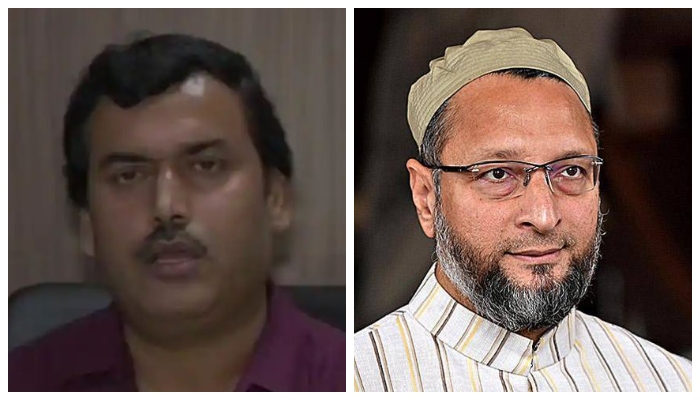
The OSD to the Tripura Chief Minister, Sanjay Mishra took to Twitter to slam AIMIM chief Asaduddin Owaisi for spreading hatred on social media. Taking to the micro-blogging site, Mishra Tweeted in Hindi: “मामले की जाँच कर रही पुलिस से संज्ञान लिया, जिसमें पता चला कि मामला सांप्रदायिक नहीं बल्कि आपसी रंजिश का था तथा हाथापाई दोनो तरफ़ हुआ था। कृपया सोशल मीडिया पर नफ़रत ना फैलाएँ”, roughly translated as: “As the Tripura police have been investigating the case, it has turned out that the matter was not communal but of mutual rivalry and that a scuffle had broken out from both sides. Please do not spread hatred on social media”.
मामले की जाँच कर रही पुलिस से संज्ञान लिया, जिसमें पता चला कि मामला सांप्रदायिक नहीं बल्कि आपसी रंजिश का था तथा हाथापाई दोनो तरफ़ हुआ था। कृपया सोशल मीडिया पर नफ़रत ना फैलाएँ। https://t.co/EU165pA2aY
OSD Sanjay Mishra, through his tweet, cleared that the incident which Owaisi referred to, insinuating how Muslims were being tortured in a BJP ruled states, was not a communal incident but one which was a result of personal enmity and warned the AIMIM chief against spreading malicious information on social media.
Asaduddin Owaisi tries to incite people by sharing a misleading report by TDN World
“You cannot stay here without converting religion”: In BJP ruled Tripura Muslim youth thrashed and threatened in front of home https://t.co/MOK8Vp8QlL via @tdnworld
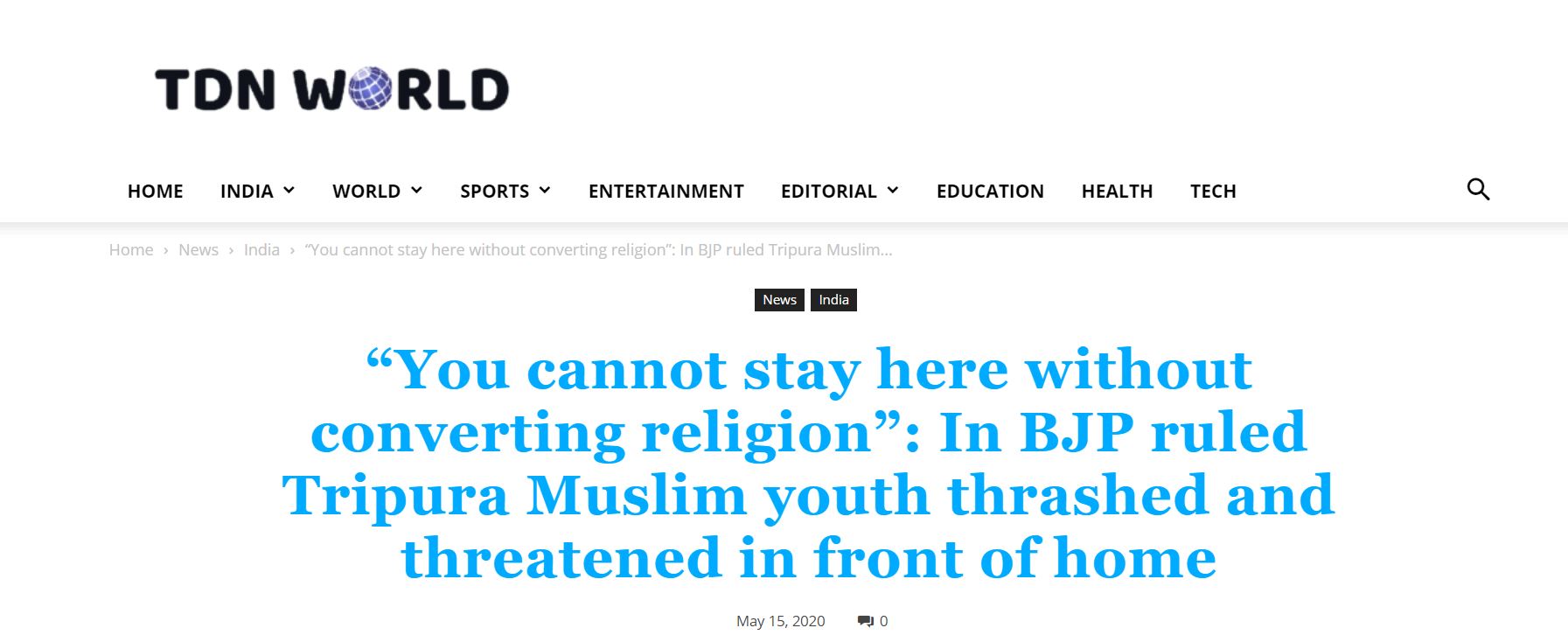
Without any sort of verification, Asaduddin Owaisi had shared a misleading article published by TDN World on May 15, titled: “You cannot stay here without converting religion”: In BJP ruled Tripura Muslim youth thrashed and threatened in front of home”.
Screeshot of the article published by TDN World on May 15 and shared by Owaisi
The incident as reported by TDN World
The report spoke of an incident that took place on May 13 (Wednesday) night, when the alleged victim, Abul Hossain Choudhury, came out of his home for making wudu (ablution) for isha Namaz (night prayer). The report said that two “Hindutva goons” from nearby locality came there, started abusing him and his religion and thrashed him with bamboo sticks.
The TDN World report quotes Abul Hossain Choudhury as saying: “I said why should I go home. This is infront of my home. I have come out offering namaz and will return to offer namaz. When I uttered the word namaz, he (Jhutan Das) got furious and started beating me. He also started abusing Islam and said what namaz, namaz is not allowed here. you cannot stay here without converting your religion. You have to chant Jai Shri Ram etc.”
The report also mentioned that the “accused” Jhutan Das, allegedly has link with RSS, the mentor organization of Bharatiya Janata Party.
OSD to the Tripura CM rubbishes claims made by Asaduddin Owaisi
However, the OSD to the Tripura CM has rubbished the claims, clearing that the Tripura police has investigated the case and concluded that this was not a communal incident but that of mutual rivalry. Mishra furthered that the Tripura police confirmed that both the parties have indulged in physical violence. He slammed Owaisi for inciting people through his hate message on social media.
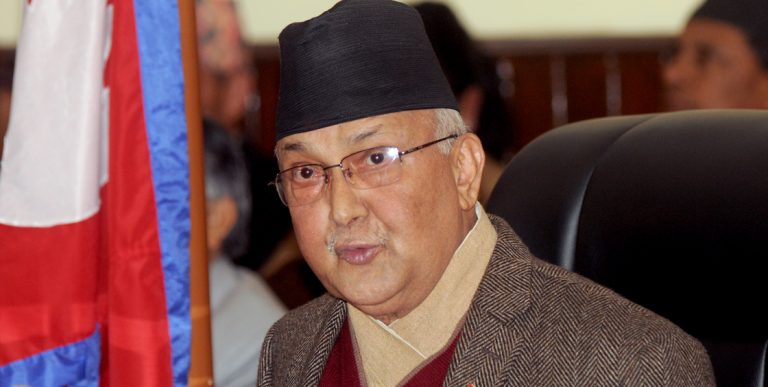
Continuing his rant against India, Prime Minister of Nepal KP Oli on Monday again attacked India for the rising number of coronavirus cases in his country. He said that the people coming in from India ‘without proper checking’ have vastly contributed to the spread of coronavirus in Nepal.
Fatality in Nepal is less in comparison to other countries of South Asia. Those coming from India are coming in without proper checking which has contributed to the further spread of #COVID19: Nepal Prime Minister KP Sharma Oli pic.twitter.com/doKSZ53p5e
Oli’s remark came against India while he was addressing the nation on Monday evening about his country’s fight against the coronavirus. “The pandemic is spreading now. All government agencies must be effective to fight this spread. The leadership of any structure that cannot meet the challenge of time will be immediately reorganized. Punishment and reward will be provided by making the role played in this hour of national crisis,” he said.
This is the second time that the Nepali Prime Minister had used such remarks against India and held India accountable for the rise of coronavirus cases in his country. Earlier last week, Oli claimed that the ‘Indian virus’ was more virulent than the coronavirus that ravaged Italy and China.
While addressing the parliament, Oli had then said, “Those who are sneaking in from India through illegal channels are spreading the virus in the country and some local representatives and party leaders are responsible for bringing in people from India without proper testing.”
“It has become difficult now to stem the spread of the coronavirus due to the flow of people from outside. Indian virus seems to be more lethal than the Chinese and the Italian,” he had said in the parliament last week.
Indo-Nepal relationship under strain after Oli’s belligerent claims
A fresh controversy has broken out last week when the Nepali Prime Minister KP Oli claimed on certain Indian territories as his. In a speech in which Oli criticised India for the coronavirus spread in Nepal, the Nepali PM also made claims against India by asserting that Nepal would “bring back at any cost” the Indian territories of Kalapani-Limpiyadhura-Lipulekh area.
A fresh political map which showed areas of Lipulekh and Kalapani as parts of Nepal was approved by the Nepal cabinet on Monday this week. It is notable to mention that this is perhaps the first time that the Himalayan nation which is contiguous with India has taken such a confrontational stand on the issue. Many attribute Nepal’s newfound bellicosity against India to China who is rapidly expanding its footprint in Kathmandu.
India sternly reacted to Nepal’s belligerence, describing the unveiling of a new political map with Indian areas as Nepali territory as an “unjustified cartographic assertion” that is unacceptable.
Condemning Nepal’s actions, MEA spokesperson Anurag Srivastava said, “The Government of Nepal has released a revised official map of Nepal today that includes parts of Indian territory. This unilateral act is not based on historical facts and evidence.”
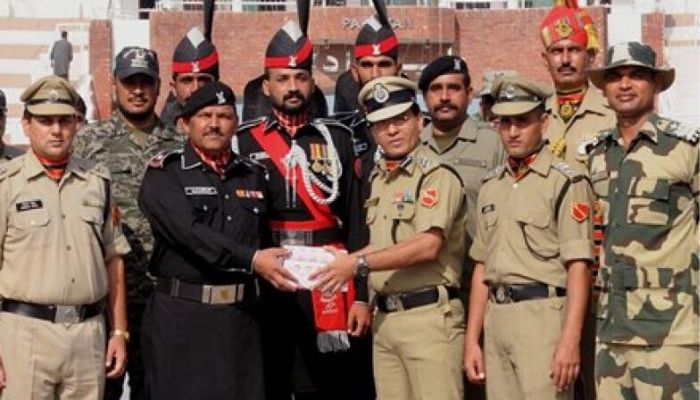
On Monday, the Indian Border Security Force (BSF) had reportedly not exchanged sweets with the Pakistan Rangers on the occasion of Eid, owing to the strained relations between the two countries. This marks a departure from the traditional practice of sharing sweets between Indian and Pakistani security forces, during festivals.
Officials attribute this change in India’s stance to increased incidents of cross-border terrorism on the western border. As such, no sweets were exchanged on the India-Pakistan international border that stretches from the Union Territory of Jammu and Kashmir to Gujarat.
Officials informed that while India maintained the tradition on multiple occasions such as Diwali, Republic Day, and on the Foundation Day of the BSF (December 1), positive reciprocation was not received from the Pakistani end.
BSF shares sweets with BGB
However, keeping up with its long-standing tradition, BSF exchanged sweets with the Border Guard Bangladesh (BGB). In a statement, the West Bengal Frontier of the BSF reiterated that the warmth in relations between the security forces of India and bangladesh has remained consistent and that they have celebrated on several occasions such as Eid. Moreover, the BSF officers also congratulated the BGB personnel stationed at the border.
EAM slams Pakistan at SCO
Earlier, Minister of External Affairs S Jaishankar hit out at Pakistan without taking its name in Shanghai Cooperation Organisation (SCO) meet with the foreign ministers of several countries. MEA Jaishankar emphasised that some countries are “busy” in spreading terrorism while the world is a fighting coronavirus. He said, “Even as the world fighting the COVID-19. Some are busy in spreading other viruses such as terrorism, fake news, doctored videos are also used to divide communities and countries.”
Hindus are often heard arguing that Hinduism is not a religion but a way of life. Others object and see Hinduism as a religion. But between the two arguments, which is true? Which one holds more water?
It depends on how religion is defined. Most people probably would say that religion is:
About believing in an invisible Supreme Being, which is the cause of our existence.
About methods and rituals to worship it.
About living according to its laws or will.
In this case, Hinduism is definitely a religion. In fact, it is the Mother of all religions, because the Indian Vedas had postulated already in very ancient times the existence of such a Supreme Being. They called it Brahman (from big, expanding) and declared it cannot be imagined by the human mind, but the best description is Sat-Chit-Ananda (means, it is true, knows itself and is blissful). It is all-pervading and therefore the essence (Latin: esse = to be) of everything, including us.
So why does the question arise whether Hinduism is a religion or not?
To discover this, we need to look at those religions where nobody has a doubt that these are religions. The term ‘religion’ was first used for the Catholic Church and later for Islam, too, and nobody has a doubt that these two are the main religions in today’s world.
These two religions also are about the three points mentioned above. Yet there are significant differences.
The Supreme Being (called God or Allah respectively) of these two religions is not the essence in all, but is a separate entity which has certain personal traits. One most important trait is that it is jealous of other gods and wants the whole of humanity to worship only Him (yes, the Supreme is clearly imagined as male by them). Both religions give out a dire warning: those who do not accept this truth will burn eternally in hell.
How do these religions know that this is the truth? Because they claim that the Supreme Being himself has revealed this truth to one person (in the case of Christianity to Jesus Christ some 2000 years ago and in the case of Islam to Prophet Mohammed some 1400 years ago).
Here is where another definition of religion comes in. It is often said that religion is a “belief-system”. It needs blind, unverifiable belief in what the ‘founder’ of the religion has said, which is written down in a book and which can never be verified by human beings.
Here Hinduism is clearly not a religion. Hinduism does not require blind belief. On the contrary, an open enquiry and an inner exploration into the truth, especially into the truth of one’s own being, is necessary to discover the Divine Essence in oneself, to discover that Atman (one’s own consciousness) is indeed Brahman, as the Vedas proclaim.
So is Hinduism a religion? It depends which definition for religion is more true.
We can find out when we look at the meaning of religion. Religare (Latin) means to bind. Bind to whom or to what? If we look at history, the Church (for which religion was first used) was very adamant that those followers which it had gained through (often forced) baptism must never leave the Church. Christianity had strict blasphemy laws with terrible punishment, like Islam even has today. So it can be safely assumed that religion meant to bind its followers to the doctrine of the respective religion. The followers must ‘religiously’ stick to the doctrine.
So in this sense, Hinduism is not a religion.
But it is also not just a “way of life”.
It could be said, it’s an ideal way of live, because it is based on Dharma, doing the right thing under the given circumstances.
However, since ‘religion’ in today’s world is mainly seen as connecting to a supernatural, supreme Intelligence, usually called God, Hinduism should not give up its place among religions and rather try to make the others see sense that some of their dogmas cannot be true and actually have harmed humanity in a big way over the centuries. History is proof.
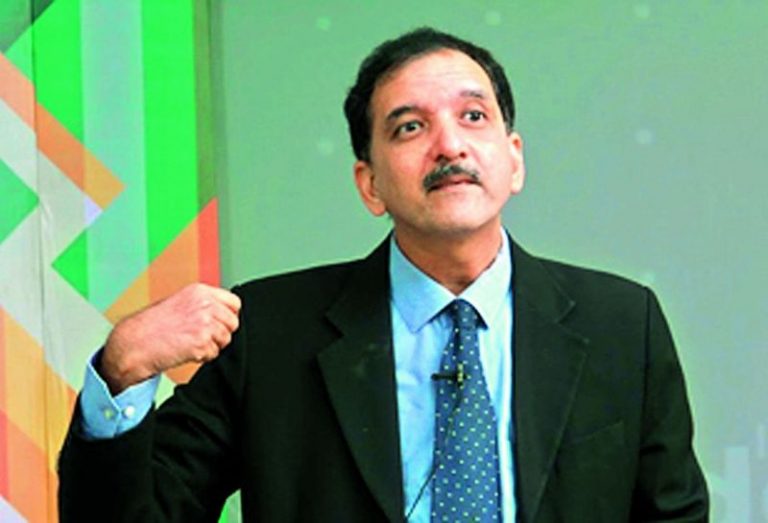
In a vile display of sadistic pleasure, Congress-friendly tv anchor, Sumanth Raman, took to Twitter to express his glee over the large number of coronavirus cases reported from the state of Gujarat.
Known for harbouring pathological hatred from PM Modi, Raman, who is also a doctor and healthcare professional, used the grim occasion to mock the Gujarat Model, the developmental model which propelled Narendra Modi to the position of Prime Minister of the country.
Referring to the number of new coronavirus cases reported daily from Gujarat, Suman tweeted, “Daily cases reported in Gujarat from 20th May till 24th: 398,371,363,396 and 394. Gujarat model rocks.”
So many don’t even understand the purpose of this tweet which is to show that it is very unlikely that such a large state can have an almost identical number of cases each day. Morons asking what about Maharashtra. Well for starters it is testing 3 times more than Gujarat.
Raman could not hide his apparent elation at the number of coronavirus caseloads emerging from Gujarat as he followed it up with a smiling emoji. While he mocked the Gujarat model, many Twitter users reminded him of Maharashtra, a non-BJP ruled state which tops the list of daily new infections as well as the overall number of coronavirus cases in the country. However, facts do not deter committed Congress sympathisers like Mr Raman who promptly brazened out his stance saying that the number of cases in Maharashtra is higher than Gujarat because it is testing 3 times more than Gujarat.
He was called out by netizens for rejoicing over coronavirus positive cases in Gujarat.
Shameless man is so happy about this information. You are a sadist and wonder how can people be so stupid as to rejoice – you could also test +ve like Ashok Chavan & Sanjay Jha. Please confirm you are a qualified Dr ? I have my doubts as that profession is supposed to be noble https://t.co/KUhQpdHnsY
— Subhashini Menon nee Shetty (@SubhashiniMenon) May 25, 2020
Many senior Congress leaders like former Maharashtra Chief Minister Ashok Chavan and Sanjay Jha too have tested positive for coronavirus.
Pleasure? I’m pointing out how a so called model State is very likely failing to test enough people to manage the pandemic.
He even brazened it out by saying how he was saying that the model of a developing state ‘failed’ to control the pandemic which has gripped the world.
Far from uniting with the government in the face of adversity, Congress supporters and sympathisers seem eager to exploit the raging pandemic as a means to get back at their nemesis—Modi government. Mr Raman, who routinely takes up the cudgel for the Congress party, has no qualms in displaying his schadenfreude even as the contagion sweeps through the country, leaving many sick and incapacitated.
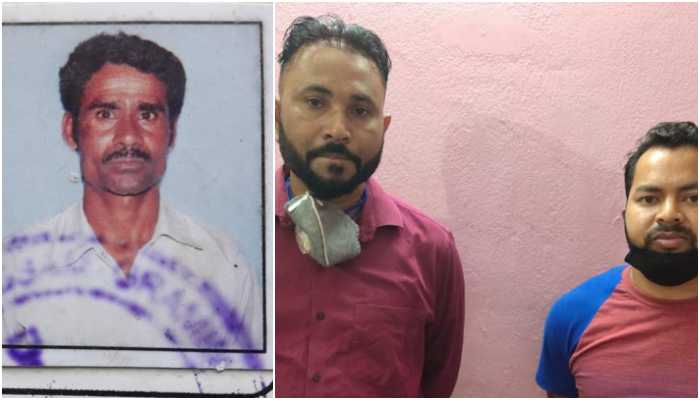
The Police in Hajo, Assam have reportedly arrested two accused, namely Faizul Hoque aka Dali, and Yusuf Uddin Ahmed, in connection to the gruesome mob lynching of a vegetable vendor named Sanatan Deka in Manahkuchi in Kamrup district of Assam.
A case was registered at the Hajo Police station under Indian Penal Code (IPC) Sections 302 (murder) and 120b (Criminal Conspiracy) over the brutal assault and murder of a poor vegetable vendor. The other accused, namely Jalil Ali, Firoze Khan, and Shabir Ali are still on the run from the law enforcement authorities. The case has sparked outrage in the State with several organisations and common citizens demanding justice for the vendor and strictly punishing the perpetrators.
The lynching of Sanatan Deka by Faizul Ali and his associates
Sanatan Deka who hailed from Teteliya villages used to work as a labourer in a factory. However, the factory had shut down due to the lockdown imposed in the wake of the Coronavirus outbreak. Deka had to sell vegetables on his bicycle to combat his financial difficulties. While roaming on the streets of Hajo selling vegetables, Sanatan’s bicycle had accidentally hit a bike where two persons Faizul Ali and Jalil Ali were travelling. The duo got infuriated and began assaulting the vendor. Soon, the other accused, Shabir Ali, Yusuf Ali and Firoze had arrived at the spot and joined the assault on the man. in the brutal thrashing. Sanatan was gravely injured and had died within an hour of being admitted to the hospital.
It was reported that the main accused Faizul Ali is the brother of an AGP leader.
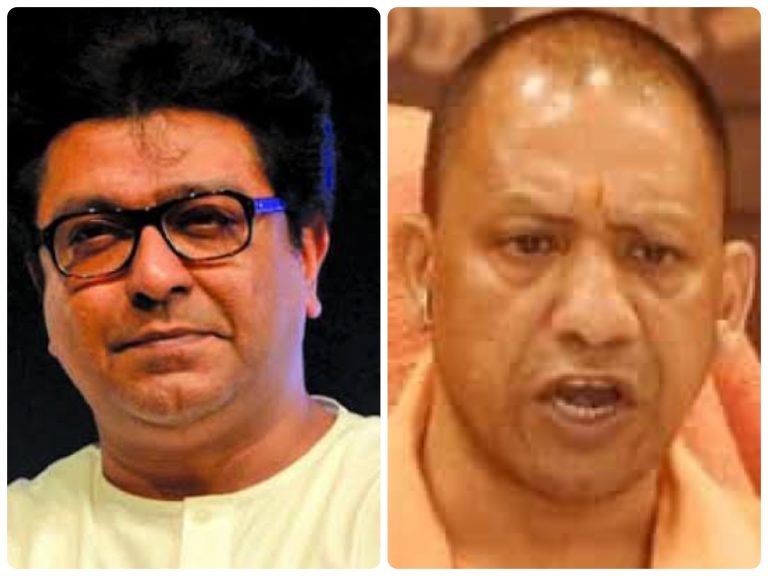
Firebrand politician Raj Thackeray on Monday took to Twitter to attack Uttar Pradesh chief minister Yogi Adityanath for over his decision of taking prior permission from the state government before employing migrant workers.
In a Twitter post, Thackeray said that if the Uttar Pradesh chief minister claims that state approval will be needed to avail the services of the workers of Uttar Pradesh, then the migrant workers coming to Maharashtra will need to seek permission from the state of Maharashtra and Maharashtra police before entering the state.
Also, the migrant workers from UP will have voting rights only in UP. As per rules laid down, a voter can only vote from one place and cannot exercise their voting rights in two places. This fact needs to be realised by CM Adityanath, by Maharashtra and other states too.
Urging the Maharashtra state government to take the matter seriously, Thackeray suggested that the migrant workers should be allowed in the state only if they had registered their personal details with identification proof with the police.
UP CM Yogi Adityanath mandates seeking approval for the return of state’s migrant workers
The MNS chief’s strong words came a day after UP CM Yogi Adityanath said that states will have to seek his government’s permission if they want Uttar Pradesh’s migrant workers back. He had said so in light of reports that migrant workers were not treated properly by some states.
On Sunday, Yogi Adityanath asked the UP officials to set up a migration commission and later said at a webinar that other states would have to acquire permission to hire workers from Uttar Pradesh as some of them had treated them badly. The commission is entrusted with the task of working on skill mapping and employment of migrant workers, along with fixing their wages and coming up with social security schemes such as insurances for them.
“The migrants’ commission will work for the betterment of the migrant workers. If any other state needs UP’s migrant workers, they cannot take them away just like that. The states will have to first seek UP government’s approval for obtaining UP’s manpower. UP government will now take in its own hands the responsibility of its migrant workers’ insurance and social security. The government aims to provide support to the migrant workers, whether they are in UP, other states or other countries to ensure that they are treated appropriately, ” UP CM said at a webinar.
Bollywood actor and producer Anushka Sharma’s new crime thriller web television series Paatal Lok, which premiered on Amazon Prime Video on 15 May 2020, has found itself surrounded by various controversies since the time of its release. In the latest, BJP MLA Nandkishore Gurjar from Uttar Pradesh has filed a complaint against Anushka Sharma, who is the producer of the show. The complaint states that she used his photo in the show without his permission.
Gurjar demanded that a case should be filed against Anushka under National Security Act, for causing a communal stir.
Besides, the BJP MLA from Ghaziabad also mentioned in his complaint about the show allegedly offending all communities of the Sanatan Dharma and showing Indian investigating agencies in a bad light. Seeking a ban on the web series the MLA accuses the makers of anti-nationalism. He also argued that it shows Gurjars as dacoits and people associated with malpractices.
He has submitted a written complaint in the Loni station and has also written a letter to the minister of Information and Broadcasting regarding the issue, demanding that web series should also be brought under there censor board.
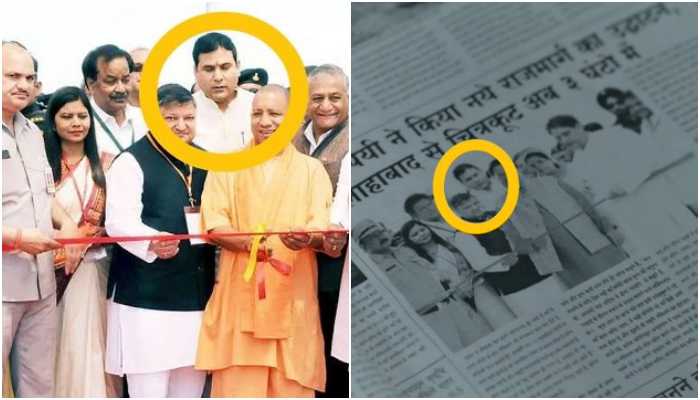
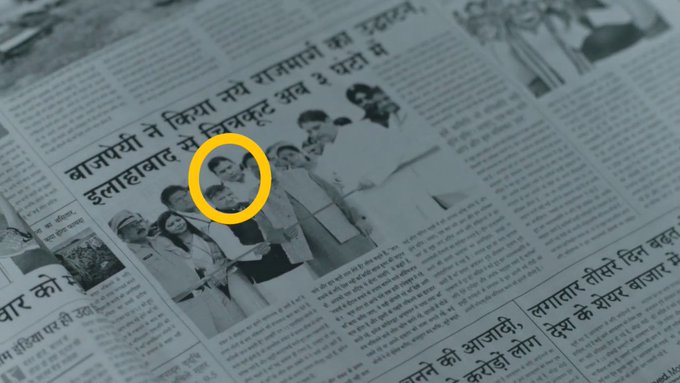
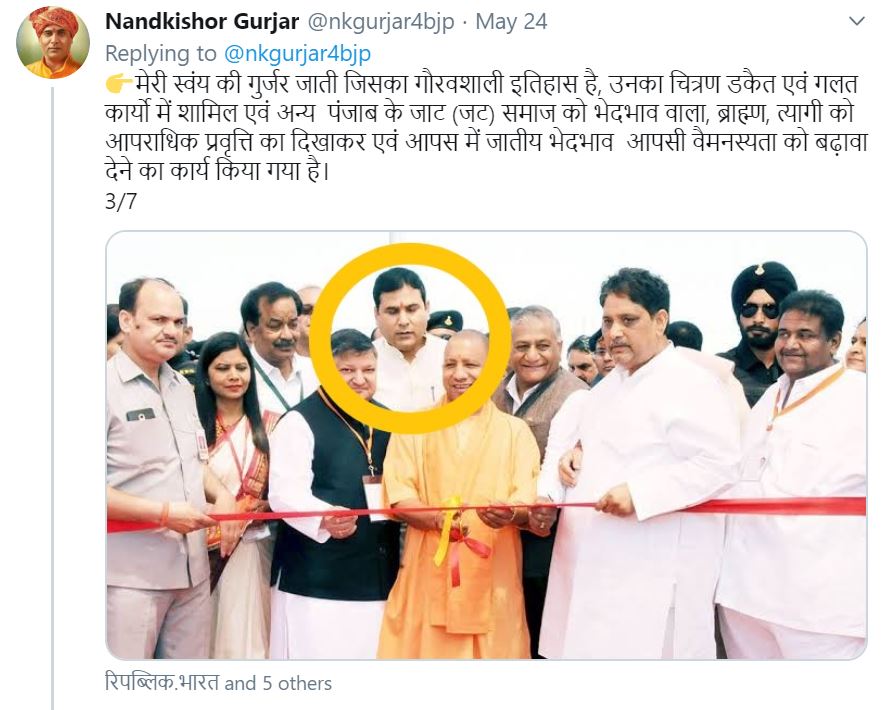
The BJP MLA Nandkishore Gurjar’s has claimed that the makers of the series have taken a real image of a news article when UP CM Yogi Adityanath had inaugurated a highway project and had used it by morphing some faces, insinuating that the project was a scam.
Gurjar claimed that his photo and that of some other leaders were used in the web series as it is. He also shared the original picture in which Uttar Pradesh Chief Minister Yogi Adityanath can be seen too. He claimed it was an act to portray the party in a bad light.
The image used in the web series where CM Yogi’s image has been allegedly replaced with that of a corrupt character. The original picture of the project inauguration shared by the BJP MLA
He also accused the makers of promoting a communal stir among the communities like his own Gurjar caste, Jaat and others.
The BJP MLA added that the web series has projected the Central Bureau of Investigation too in a bad light while ‘hurting India’s mission against terrorists’. accusing the makers of giving ‘clean chit’ to Pakistani agencies and trying to rid it of its ‘terrorist nation’ tag.
He also wrote that the series uses derogatory stereotypes against different Hindu communities and even indulges in blatant Hinduphobia by deliberately showing Hindus as the perpetrators of mob lynching incidents and other criminal activities.
Using the hashtag #ArrestAnushkaSharma, the MLA demanded that the show be pulled down immediately.
All Arunachal Pradesh Gorkha Youth Association complains against Paatal Lok
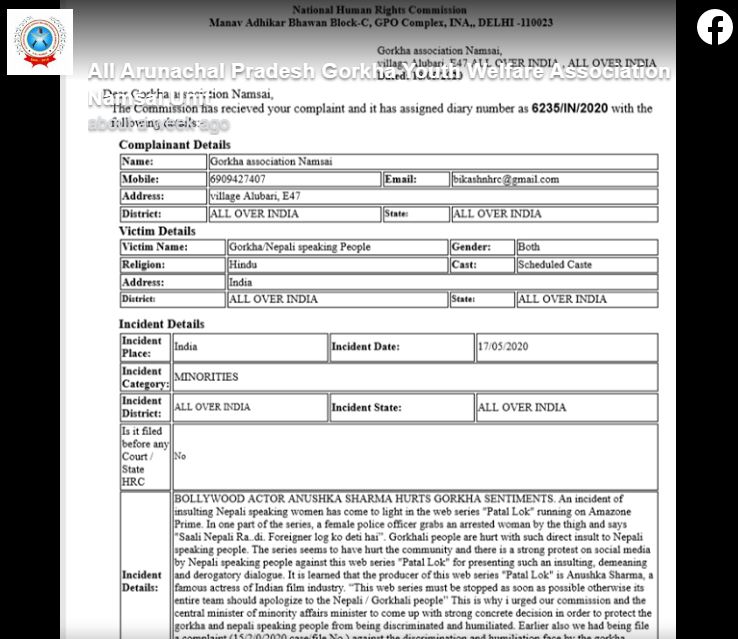
Prior to this, the series had managed to miff the Gorkha communities which had filed NHRC complaint against Anushka Sharma for ‘racial stereotyping’ in ‘Paatal Lok’. On May 18, the All Arunachal Pradesh Gorkha Youth Association took to Facebook to share a screengrab of their complaint along with a caption, detailing how the alleged sexist and racial slur malign their identity.
“We on behalf of the gorkha people and every Nepali speaking person had filed a complaint at NHRC regarding the discrimination and humiliation witness in an incident of insulting Nepali speaking women has come to light in the web series “Patal Lok” running on Amazone Prime. In one part of the series, a female police officer grabs an arrested woman by the thigh and says “Saali Nepali Ra..di. Foreigner log ko deti hai”. Gorkhali people are hurt with such direct insult to Nepali speaking people. The series seems to have hurt the community and there is a strong protest on social media by Nepali speaking people against this web series “Paatal Lok” for presenting such an insulting, demeaning and derogatory dialogue. It is learned that the producer of this web series “Patal Lok” is Anushka Sharma, a famous actress of the Indian film industry”, read the caption.
Additionally, the youth wing of the Bharatiya Gorkha Parisangh- Bharatiya Yuva Gorkha Parisangh, had also started an online campaign against the web series, alleging that in the second episode, a Nepali-speaking woman had been maligned by the maker and had demanded that the slur to be muted, subtitles blurred and that the video is uploaded with an apology.
Bollywood actress Anushka Sharma is yet to respond to the allegations meted out against her web series Paatal Lok