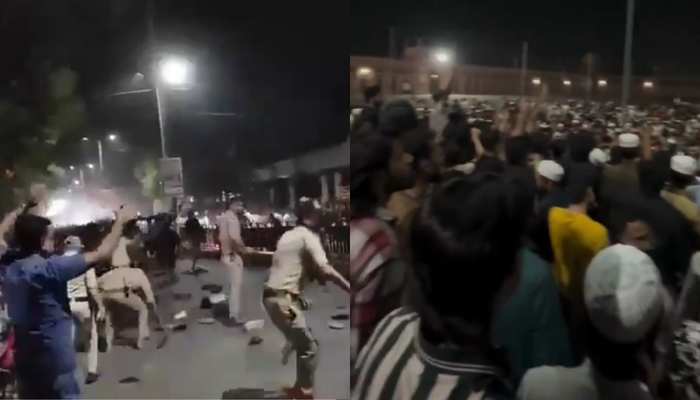
A serious law and order situation emerged in Bhopal, Madhya Pradesh, late at night on 12th May after a Muslim mob of hundreds came out on the streets to protest, raising slogans of ‘Sar Tan Se Juda’ (beheading calls), Allahu Akbar, and pelting stones. The mob came out after a Muslim man was caught with a Hindu woman in a hotel by Hindu activists.
An FIR was lodged by the police in connection with the incident, and three accused were arrested. Ayush Gupta, Deputy Commissioner of Police (DCP), Bhopal zone 1, said that the police are conducting searches to nab the remaining accused. “We are also analysing video footage to identify more people. We are also holding dialogue with the city Qazi and other leaders of the community,” DCP told the Hindu.
After two days of ruckus and disruption of Bhopal’s peaceful atmosphere in the name of protests against Hindus who caught an alleged “love jihad” accused, the police finally serviced them properly last night. pic.twitter.com/yHKlEZYVM0
The Muslim mob turned violent and vandalised the vehicles parked on the streets, including police vehicles. The police resorted to a lathi charge to disperse the mob. Subsequently, the police imposed Section 163 of the BNSS (Section 144 CrPC) to prohibit public gatherings in Peer Gate, Shahjahanabad, and the surrounding areas. Police personnel were deployed in the area to maintain peace.
#BIG | Islamist mob takes to the streets in Bhopal, raising beheading slogans against Hindu activists.
The crowd chanted, “Tera Mera rishta kya… La ilaha illallah”; “Gustakhe Nabi ki ek saza… Sar tan se juda”; “Naara-e-Taqbeer… Allahu Akbar.”
Viral videos show Islamists threatening with dire consequences
Several videos emerged on social media after the violent demonstration and the resultant police action. In the videos, Islamists can be seen openly provoking religious sentiments and threatening the police with dire consequences if they fail to take action against those perceived by the Islamists as threatening Islam.
Islamists in Bhopal are openly talking about violence, mobilising Muslims even from other states, and at some places, STSJ slogans were also raised. Hope the MP-govt is prepared… pic.twitter.com/7zoTufUCPo
An Islamist threatened to catch and beat Hindu women in the streets
In a video, an enraged Islamist threatened that Muslims are capable of picking Hindu women and thrashing them on the streets, but they choose to abide by the Constitution. He accused the police of allowing the people who beat up the Muslim man to take the law into their own hands. He vowed to kill the people if a satisfactory action is not taken against them by the police.A
"If Muslims wants, we will catch each Hindu girls, & we will beat them on roads. But we respect constitution (that's why we are trapping them through Love Jihad) & not kidnapping them from the road or beating them."
— Radharamn Das राधारमण दास (@RadharamnDas) May 14, 2026
Muslim man found in a hotel room with a Hindu woman
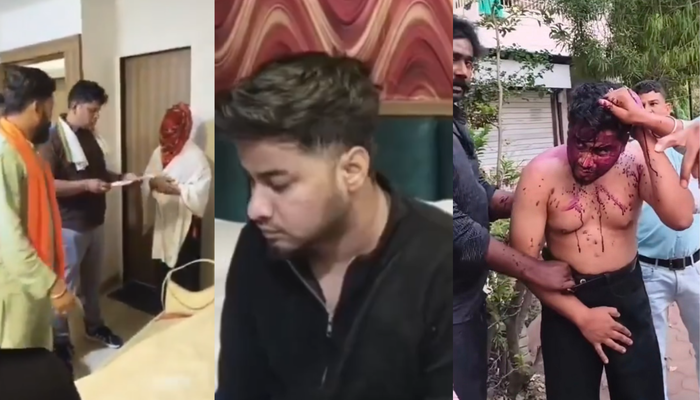
The Muslim mob was outraged over a recent incident where some members of a Hindu organisation allegedly beat a Muslim man after he was found in a hotel room with a Hindu woman in the Gautam Nagar area of Bhopal. The incident happened on 9th May, when some Bajrang Dal activists received an input about a Muslim man and a Hindu woman meeting at the Pride Hotel.
A group of Bajrang Dal members arrived at the hotel and entered the room where the couple was staying. They reportedly dragged the Muslim man named Arif Khan out of the room and stripped him half-naked. They smeared his face with ink and cow dung and paraded him through the street.
Arif Khan was found at the hotel by Bajrang Dal members (Images via X)
The Govindpura police registered a case in connection with the incident against 7 accused, of whom 2 have been arrested. Bhopal Police Commissioner Sanjay Kumar said that the accused have been booked under stringent provisions. He urged people to abstain from spreading rumours and posting or sharing provocative content on social media. He said that strict action will be taken against those found disturbing the peace of the area.
Notably, several Hindu organisations have grown vigilant with the recent rise in the cases of Love Jihad, where several Hindu women were found trapped and exploited by Muslim men, who lied to them about their real identities. In several cases, Hindu women were saved due to the alertness of members of Hindu organisations.
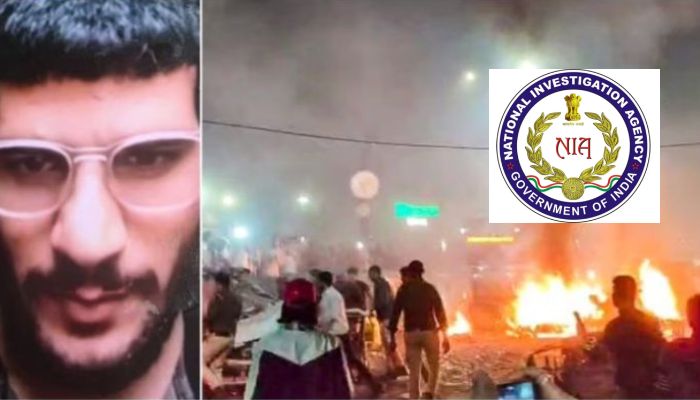
In the November 2025 Red Fort blast case in Delhi, the National Investigation Agency (NIA) has filed its first 7,500-page chargesheet before a special NIA court in Patiala House Courts in New Delhi.
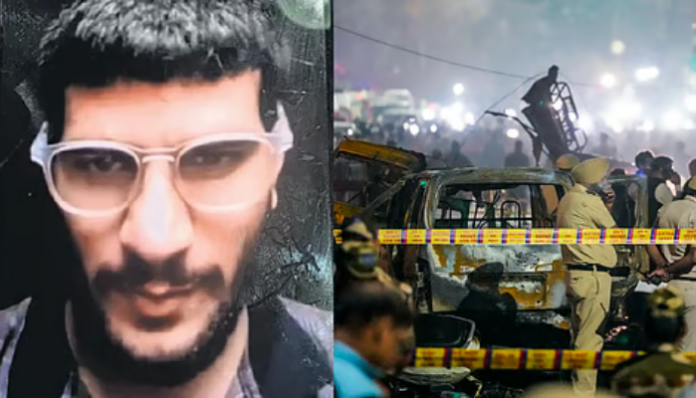
The high-intensity vehicle-borne improved explosive device, or VBIED, exploded near the Red Fort in Delhi on 10th November in a planned Fidayeen attack by doctor-turned-Islamic terrorist Umar un-Nabi. The blast killed 11 people, leaving several others injured. The probe into this Jihadi attack was taken over by the NIA.
Ansar Ghazwat-ul-Hind-linked Jihadis, Operation Heavenly Hind, and the Sharia dream: What the NIA chargesheet in Delhi Red Fort blast case stated
Months after investigation, raids and arrests across Jammu & Kashmir, Haryana, Uttar Pradesh, Maharashtra, Gujarat, and Delhi, the NIA filed a chargesheet on 13th May. The chargesheet has been filed under relevant sections of the UA(P) Act 1967, Bharatiya Nyaya Sanhita 2023, Explosive Substances Act 1908, Arms Act 1959, and Prevention of Damage to Public Property Act 1984.
In a statement, the probe agency said that the chargesheet is based on the detailed evidence comprising 588 oral testimonies, more than 395 documents and over 200 seized material exhibits.
The NIA chargesheet names 10 accused Islamic Jihadis, all linked to the Ansar Ghazwat-ul-Hind (AGuH), an offshoot of the Al Qaeda in the Indian Subcontinent (AQIS). The AQIS and all its manifestations, including the AGuH, were notified by the Indian Ministry of Home Affairs as a terrorist organisation in June 2018.
The probe agency proposed abating of charges against the deceased Pulwama-based Umer Un Nabi, the former professor at the Al Falah University in Haryana’s Faridabad, who carried out the suicide attack. Nabi’s remains were identified using DNA fingerprinting.
Before carrying out the Fidayeen attack, Umar Nabi had made a video justifying suicide bombing. Nabi regularly sent provocative Jihadist messages to youths to brainwash them. More than 70 videos, including 12 of Umar, were recovered from mobile phones seized from various individuals arrested in this case.
“Evidence collected from the scene of the crime, as well as various locations identified by the accused in and around the Al Falah University in Faridabad, as well as Jammu and Kashmir, were subjected to thorough forensic examination, voice analysis, etc., as part of the investigation,” the NIA stated in its chargesheet.
It must be recalled that the Al Falah University in Faridabad, Haryana, came under the scanner after several doctors working at the university were found connected to the terror module that caused the Red Fort blast. The ED investigation against the Al Falah group was initiated after the Delhi Police filed two FIRs against the Al Falah University, alleging that the university made misleading claims about its NAAC accreditation.
NIA’s chargesheet names Amir Rashid Mir, Jasir Bilal Wani, Dr Muzamil Shakeel, Dr Adeel Ahmed Rather, Dr Shaheen Saeed, Mufti Irfan Ahmad Wagay, Soyab, Dr Bilal Naseer Malla and Yasir Ahmad Dar as accused.
The accused Jihadis held a clandestine meeting in Srinagar in 2022 after initially failing to travel to Afghanistan via Turkey for Jihad. In this meeting in Srinagar, the accused Islamic terrorists reconstituted the Ansar Ghazwat-ul-Hind as ‘AGuH Interim’.
It was reported earlier in the media that Red Fort bomber Umar un-Nabi and his terror associates, Dr Muzammil Shakeel Ganai and Dr Muzzafar Rather, met a Syrian handler in Turkiye in 2022 on the directions of their Afghanistan-Pakistan border-based handler named Ukasha.
“Under the umbrella of the newly constituted outfit, the accused had launched ‘Operation Heavenly Hind, ‘ aimed at overthrowing the democratically established Indian Government and imposing Sharia rule,” the NIA chargesheet reads.
Under the banner of AGuH Interim, the accused Jihadis launched what they called ‘Operation Heavenly Hind’. The sole objective of this ‘operation’ was to topple the democratically elected government and replace it with Islamic Sharia rule.
Jihadis Amir Rashid Mir, Jasir Bilal Wani, Dr Muzamil Shakeel, Dr Adeel Ahmed Rather, and others not only recruited new radicalised members but also stockpiled arms and ammunition, and manufactured explosives at a massive scale using commercially available chemicals.
According to the NIA chargesheet, the AGuH terrorists fabricated and tested various types of IEDs. They experimented with rocket-and-drone-mounted IEDs to target security establishments in Jammu and Kashmir and elsewhere.
For the Red Fort blast, the accused Jihadis used Triacetone Triperoxide (TATP) explosive. This was manufactured by the accused persons secretly by procuring constituent ingredients and conducting multiple experiments.
The Jihadis chose TATP due to the convenience of procuring the precursor materials.
The probe agency also revealed that the accused Jihadis had illegally procured banned arms, including an AK-47 rifle, a Krinkov rifle, and country-made pistols with live ammunition.
According to the NIA, the accused Jihadis also purchased lab equipment, including MMO anode, electric circuits, and switches. The AGuH terrorists had plans to carry out sophisticated attacks across the country; however, the security agencies busted their terror module.
“They had experimented with rocket and drone-mounted IEDs with the objective of targeting security establishments in the state of Jammu and Kashmir and other parts of India. It was also revealed during the investigation that the accused procured laboratory equipment, including specialised items like MMO Anode, electric circuits, and switches from various offline and online sources. The accused also had plans to expand their operations in other parts of the country, which were foiled by the busting of the terror module,” the NIA said.
NIA court to take chargesheet into Red Fort Blast Case into consideration on 4th June
After the National Investigation Agency filed its chargesheet in the Red Fort Blast Case on Wednesday, a special NIA court fixed 4th June as the date for consideration of the chargesheet.
Earlier in April this year, the State Investigation Agency (SIA) of the Jammu and Kashmir Police filed its chargesheet against the 10 perpetrators involved in the Doctors Terror Module, linked to Al Falah University in Faridabad, which was behind the bomb blast near Delhi’s Red Fort.
The SIA chargesheet had named Arif Nisar Dar, Yasir Ul Ashraf Bhat, Maqsood Ahmad Dar, Irfan Ahmad Wagay also known as Owais, Zameer Ahmad Ahanger, alias Mutlashi, Muzamil Shakeel Ganaie also referred to as Musaib, Dr Adeel Ahmad Rather alias Javaid, Dr Shaheen Saeed, Tufail Ahmad Bhat and Dr Umar Un Nabi as the accused.
Red Fort Blast
While it was initially speculated that the car blast on 10th November was a panic attack since Umar Nabi’s fellow Jihadis got exposed and arrested by the investigation agencies, it has emerged that Umar was in contact with his handlers when he entered Delhi that day. Umar Nabi and his handler discussed the target area. They contemplated attacking Mayur Vihar, or Connaught Place, and eventually Nabi drove to Old Delhi.
The final target was chosen as the Red Fort, given the monument’s symbolic importance and expectation of a decent crowd. However, the jihadis did not factor in that it was a Monday and the Lal Qila remained closed to visitors. Ultimately, Umar Nabi and his handler on call decided to carry out a blast in the crowded Netaji Subhash Marg. The location holds significance, given it has the Red Fort on one side and the Chandni Chowk on the other.
During his three-hour stay at the parking lot near the Sunehri Masjid, Umar Nabi assembled the explosives and as soon as it was ready, he left for the target location and triggered the blast, killing 13 people and leaving two dozen injured.
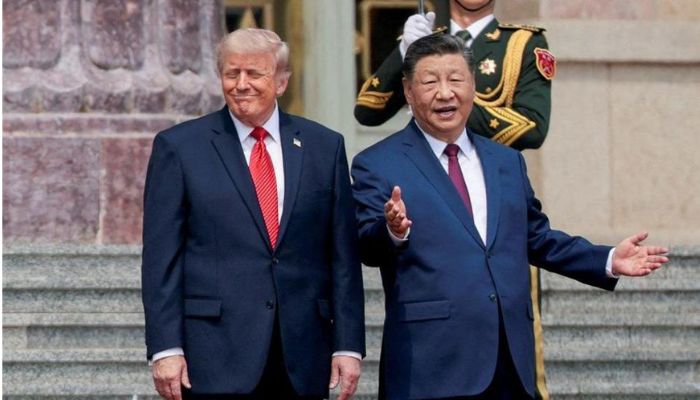
In a first US Presidential visit to China in nearly a decade, President Donald Trump, Secretary of State Marco Rubio and a high-powered American delegation are in Beijing for a two-day visit starting 13th May 2026. President Trump is meeting his Chinese counterpart, Xi Jinping, during a high-stakes meeting. Just weeks after amplifying “hellhole” remarks against China and India, the US President has arrived in Beijing, accompanied by an entourage comprising diplomats, business leaders, and defence officials.
Chinese kids jumping up and down, waving American and Chinese flags, greet Trump and Xi. pic.twitter.com/FiPmM3iegy
Donald Trump is accompanied by Marco Rubio, who is the first US Secretary of State on Chinese sanctions to visit Beijing. Rubio was sanctioned in 2020 over his remarks on China’s clampdown on Hong Kong and over Beijing’s use of forced labour by Uyghur Muslims. What facilitated Rubio’s China visit despite sanctions is a linguistic workaround, as China changed the transliteration of his name.
Besides Rubio, US Secretary of War Pete Hegseth, Treasury Secretary Scott Bessent, Trade Representative Jamieson Greer, among others, are part of the American delegation.
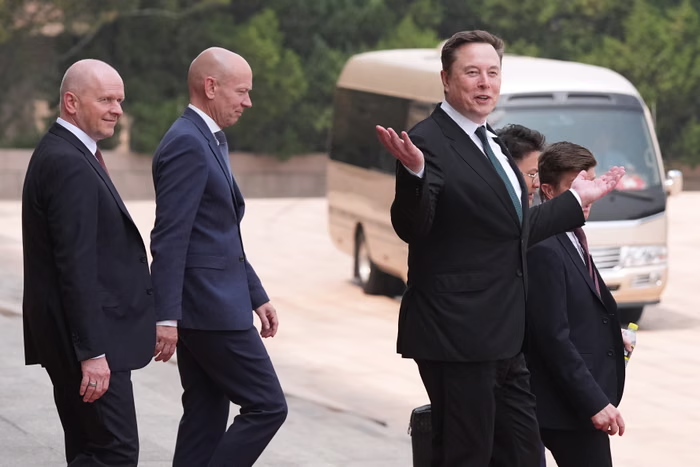
The US President has also brought around 17 CEOs of American companies to Beijing, including Tesla’s Elon Musk, Apple CEO Tim Cook, Jensen Huang of Nvidia, Larry Fink of BlackRock, Stephan Schwerzmann of Blackstone, Kelly Ortberg of Boeing, in addition to representatives from Goldman Sachs, Meta, Citigroup, Visa, Mastercard, Illumina, and others. Several among these have combined net worth exceeding $870 billion.
Elon Musk in China (Image source: Associated Press)
Amidst trade tensions and hostile rhetoric, what brings Trump to China?
China has emerged as an economic competitor to the US and also a geopolitical rival. The Trump administration has long described China as an economic foe, although Trump enjoys a decent personal relationship with Xi Jinping. Ever since Trump’s inauguration in January 2025, the US President has, through policy and rhetoric, attacked China. In April last year, Trump imposed 125% tariffs on Chinese goods and in October, imposed an additional 100% tariffs. Trump justified the additional tariffs by saying that they were in response to the “extraordinarily aggressive” control measures adopted by China on the export of rare-earth minerals. In response, China warned of ‘necessary action’.
In October 2025, China’s Ministry of Commerce announced sweeping new export controls on rare earth elements, marking a massive escalation in its trade arsenal, and a move that rattled Trump. China’s restrictions cover 12 rare earth elements–adding five critical ones, including Holmium, Europium, and Ytterbium, crucial for semiconductors, defence technologies and permanent magnets. As China weaponised its REEs to gain trade and geopolitical leverage, Trump ranted on his online echo chamber, Truth Social, and accused China of holding the world “captive”.
While a Trump visit to China was on the cards for months, the timing of this visit is particularly interesting. The meeting’s public agenda has long included trade, tariffs, purchase of American goods, cooperation on AI and semiconductors, fentanyl precursors and Taiwan. However, given a fragile truce in West Asia, the Iran War has emerged as a dominant and urgent issue.
Donald Trump’s visit to China with a whole entourage of American industrialists indicates that Washington has, for now, put its pretence of a China containment policy on the back burner. In a classic case of “If fighting is not feasible, form an alliance with your enemy”, the American establishment appears to have realised that China has more economic and geopolitical leverage to offer at this point to the US than the other way round.
Trump wants China to buy more American planes, agricultural products and more
Before heading to Beijing, Trump and his officials said that a key agenda of their visit would be to push China to open its economy more to America. Trump wants China to purchase more American agricultural products and passenger planes, in addition to setting up a board to address trade-related differences, to avoid the recurrence of a tariff war between the two countries, as it happened last year.
China draws a line at Taiwan
During the summit at the Great Hall of the People, China is reported to have made its stance clear on the Taiwan issue and warned Trump that if the issue is ‘mishandled’, China and US could come into conflict. “The Taiwan question is the most important issue in China-US relations,” Xi said at their summit, state broadcaster CCTV said.
Meanwhile, Taiwan quickly issued a statement declaring China a “sole risk” to regional peace and stability. “China is “currently the sole risk to regional peace and stability. Beijing has no right to make any claims on behalf of Taiwan internationally,” the Taiwanese Foreign Ministry said.
America has long backed Taiwan against China while Beijing sees Taiwan as its red line. It remains to be seen if Trump heeds Jinping’s warning to better trade relations or the US and China will ‘come into conflict’ in the near future.
After openly antagonising China, is Trump bolstering Beijing’s position out of desperation?
Donald Trump’s failure to end the Russia-Ukraine war, despite hopes for a reset in the Russia-US ties, Russia’s relations with China are growing stronger. Moreover, with his tariff war and spiteful rhetoric against India, Trump also pushed the RIC, Russia, India and China closer. For long, the US tried to lure India to its side and prop up Delhi as a counterweight to China. However, Trump destroyed the years of American diplomatic manoeuvres with his mindless intransigence.
Trump’s blunders inadvertently bolstered China’s position. What further made things favourable for China was yet another Trump blunder, the Iran war. Donald Trump’s war on Iran was a monumental strategic and geopolitical miscalculation. Much like how Russia’s Vladimir Putin thought that the Ukraine war would end soon with Kyiv’s surrender, Trump thought that taking out Ayatollah Ali Khamenei and inflicting significant damage to Iranian civilian and military infrastructure would be enough to compel the Mullah regime to surrender.
However, three months on, Iran is wounded but stands tall, still ready for both negotiated peace or inevitable war. Trump has landed in such a quagmire that he is now desperately looking for an off-ramp despite claiming to be victorious. It was reported how the American President, in his own arrogant tone, beseeched European countries to deploy warships to clear Iran’s blockade of the Strait of Hormuz. Much to his embarrassment, none of the NATO allies came forward, despite the blockade-caused global energy crisis harming them.
Russia and China are known backers of Iran. From reportedly using Russian tech and Chinese research to jam Starlink during pre-war civil protests in Iran, to defence imports, Iran has deep trade and defence relations with Russia and China. Beijing is also the biggest buyer of Iranian oil.
In fact, some reports said that it was China that pushed a spineless and opportunist Pakistan, which has uniquely become a lackey of both rivals China and the US, to step up and offer mediation between Iran and the US. OpIndia has reported earlier that Pakistan is using its ‘mediator’ role not to secure peace but for its own financial and geopolitical interests.
Amusingly, US Treasury Secretary Scott Bessent had recently urged China to help clear the Iranian blockade of the Strait of Hormuz despite there being a counterblockade by the US Navy. China’s trade relations with Iran are key to the sustenance of the West Asian nation’s war-hit economy. China buys nearly 90% of Iran’s energy exports.
Demonstrating his usual hypocrisy, Donald Trump, who accused India of funding Russia’s ‘war machine’ against Ukraine, for purchasing Russian oil even as China was the biggest buyer, does not want China to stop purchasing Iranian oil and is fine with China funding the Iranian ‘war machine’. Clearly, stances differ on the basis of which country has what leverage.
Both Iran and ‘mediator’ Pakistan share good relations with China, and Beijing has been playing a backdoor role in the negotiations between Tehran and Washington. Iranian Foreign Minister Seyed Abbas Araghchi’s visit to China last week, after the US announced that it was pausing the American efforts to guide vessels out of the Strait of Hormuz, confirmed the significant influence Beijing has over Tehran.
China can and, if required, will play a more direct role in ending the Iran war. However, it is unlikely that Beijing will let the conflict end in such a way that Trump gets to sell it as his ‘victory’. Since the beginning of the Iran war in February, Donald Trump’s domestic ratings have dwindled; he is facing in-party criticism for his West Asia miscalculation, selection of a treacherous Pakistan as ‘mediator’, depletion of military arsenal, and most importantly, the economic impact Trump’s war is having on America and the world.
Trump is desperate for a ‘Win’ after serious miscalculations and the perception that the US was forced into the war by Israel
Inflation, energy price hikes, and the incapacitation of the US President to pursue a tariff war due to a US Supreme Court ruling against his sweeping tariffs have put Trump in a very weak position. The American President’s visit to China at this time only demonstrates that he no longer wants to pursue a ‘counter-China’ foreign policy, but to mend ties. With REEs essential for tech and defence manufacturing, China has an upper hand when Trump and Xi Jinping sit across a table.
Ahead of the midterms, if Trump manages to secure a Chinese purchase commitment for even Boeing or soybeans to reduce the trade deficit, the US President can sell it as a ‘win’ and placate domestic anger stemming from the Iran blunder and the Epstein case. China has already warned Trump on Taiwan, and if the US President softens his stance on this issue, Beijing would not mind handing some concessions like commercial contracts and controlled opening of the Chinese economy for US companies, which Trump can sell as a ‘win’ to cover up the embarrassment of a loss of reputation in Iran.
Recently, Washington Post published an article on a confidential US report on how China is allegedly exploiting the Iran war to maximise leverage over the US across military, economic, diplomatic and other sectors.
The Joint Chiefs of Staff’s intelligence directorate uses a “DIME” framework (diplomatic, informational, military and economic) to analyse China’s response to America’s war against Iran.
While a US counterblockade of the Strait of Hormuz impacted oil supply to China, Beijing is a big beneficiary of the Iran war. Since the joint Israel-US forces attacked Iran in February 2026, China has sold weapons to the same Gulf countries, the US calls its allies, amidst Iranian strikes.
America’s military manoeuvres against Iran also handed China the opportunity to study how the US forces function during a distant operation, what hardware it deploys, its planning and effectiveness, everything. This, the report says, would help China plan its own future operations, especially if the US enters into a conflict with China over Taiwan.
Trump wants China to use its influence to pressure Iran into a peace deal?
While Trump would understandably not directly go and beg China to take an active role in ending the Iran war, the US President desperately wants China to use its influence on Tehran to secure a US-friendly peace deal with Iran, in exchange for, perhaps, a China-friendly understanding on the Taiwan issue and discontinuation of trade hostilities.
It is the European Union’s cold response to Trump’s “come join the war’ requests that have forced an embarrassed US President to attempt to make an ally out of an enemy. China knows this, and knowing that Trump understands that he would be committing an irreversible blunder if he orders ‘death of a civilisation’ in Iran, Beijing might offer limited pressure on Iran after extracting major concessions from the USA. Basically, Trump wants China to hand him an off-ramp in Iran that he could sell as a victory at home, in exchange for a payment in trade and strategic terms.
From claiming ‘total victory’ over Iran to coddling a rival China, Donald Trump, who weaponised trade and tariffs to arm-twist countries into submitting to his whims, is now forced to parade his country’s tech giants before China to secure a face-saver.
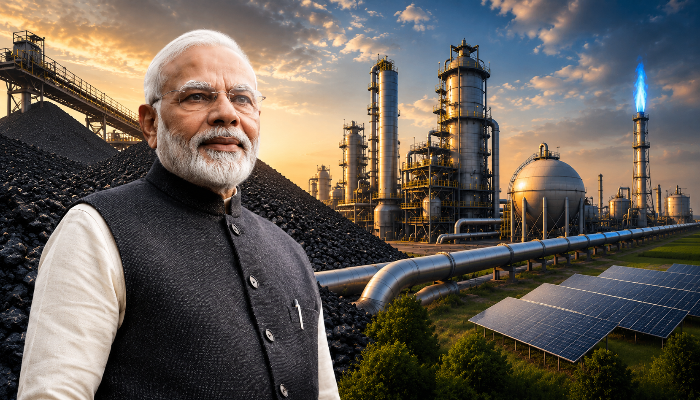
On 13th May (Wednesday), a ₹37,500 crore coal gasification project was approved by the Modi government with the goal of turning India’s enormous coal and lignite deposits into synthesis gas for use as fuel and in the production of chemicals, fertilisers and other goods.
Prime Minister Narendra Modi stated that the initiative “will further energy security, boost investment and create job opportunities for the youth. It will add strength to our efforts to strengthen the tech and innovation system as well.”
The scheme for Promotion of Surface Coal/Lignite Gasification Projects that has been cleared by the Cabinet will further energy security, boost investment and create job opportunities for the youth. It will add strength to our efforts to strengthen the tech and innovation system…
The move is a significant advancement in this direction, propelling the national objective of gasifying 100 million tonnes (MT) of coal by 2030, enhancing energy security and diminishing reliance on imports of essential products. India imports 20% of its urea, nearly 100% of its ammonia and roughly 90% of its methanol. More than half of the nation’s Liquefied Natural Gas (LNG) needs are also supplied from abroad. Gasification is aimed at reducing these imports.
Union Minister Ashwini Vaishnaw expressed, “Today, we took a very important and timely decision on coal gasification to help India become self-reliant amid rising gas demand and the current geopolitical situation.” He highlighted that India has enough coal reserves to last for about 200 years and that efforts are underway to turn these into gas.
VIDEO | Delhi: During cabinet briefing, Union Minister Ashwini Vaishnaw (@AshwiniVaishnaw) says, “Today, we took a very important and timely decision on coal gasification to help India become self-reliant amid rising gas demand and the current geopolitical situation. Since India… pic.twitter.com/9rcZhBMNZP
Vaishnaw informed, “In the coal gasification process, coal is crushed, prepared, and heated at very high temperatures and pressure inside a furnace, where it converts into synthesis gas, or syngas, instead of burning.” He added that the syngas, which is mostly composed of hydrogen and carbon monoxide, can be consumed similarly to natural gas. It even aids in the production of power and fuel that is equivalent to Liquefied Petroleum Gas (LPG).
The important features of the project
The investment is intended to encourage new surface coal and lignite gasification missions for the production of syngas and downstream products. The goal is to gasify approximately 75 million tonnes of these resources. A maximum of 20% of the plant and machinery cost will be covered by govt funds. An evaluation system that benchmarks project cost, coal input and syngas production will be implemented to make the selection through an open and competitive bidding procedure.
The payment will be carried out in 4 equal instalments that correspond with project milestones. Financial incentives would be limited to ₹5,000 crore for individual projects, ₹9,000 crore for single products (except from urea and synthetic natural gas), ₹12,000 crore for separate corporate groups spanning all ventures.
Access to these rewards under the commercial coal mining system or other central or state government ministries is not restricted by the program. On the contrary, it is an add-on. Additionally, the endeavour is technology-neutral, but emphasis is laid on adoption of domestic innovations.
A crucial step towards self-sufficiency
Investment mobilisation is anticipated to be between ₹2.5 and ₹3.0 lakh crore. Diversified utilisation of coal resources will replace imports of LNG, urea, ammonia, ammonium nitrate, methanol and coking coal. It will protect the nation from global price instability and geopolitical supply chain disruptions while also achieving the ambitious “Atmanirbhar Bharat” and “Make in India” agendas.
About 50,000 job opportunities are also slated to be created under the scheme across 25 projects in coal-bearing regions. The use of coal and lignite will possibly produce ₹6,300 crore a year from the 75 million tonnes of gasification in addition to downstream income from GST (Goods and Services Tax) and other taxes.
Furthermore, it aims to strengthen India’s domestic surface coal gasification potential by developing indigenous technology and reducing dependency on international EPC (Engineering, Procurement and Construction) contractors.
The Union Cabinet also extended the coal linkage tenure under the “Production of Syngas leading to Coal Gasification” sub-sector of the Non-Regulated Sector (NRS) linkage auction framework to 30 years in a major associated reform. Investments in coal gasification schemes are going to benefit from long-term policy certainty after the development.
The critical timing of the decision
India has one of the greatest reserves of lignite, around 47 billion tonnes, along with coal, which exceeds 401 billion tonnes. More than 55% of the nation’s energy is generated by coal-fired thermal plants. Gasification transforms coal and lignite into “synthesis gas” (syngas), a flexible feedstock for fuel and chemical production. This allows India to substitute high-value imports and protect itself from price volatility and interruptions in global supply.
In Fiscal Year 2025, New Delhi’s import cost for important alternatives, comprising LNG, urea, ammonium nitrate, ammonia, coking coal, methanol, DME (Dimethyl ether) and others, was nearly ₹2.77 lakh crore. This vulnerability was further illustrated by the current conflict in West Asia.
The fresh course builds on the momentum fostered by the National Coal Gasification Mission (2021) and an ₹8,500 crore programme that was approved in January 2024. 8 projects totalling ₹6,233 crore are currently under execution under it.
What is coal gasification and the reasons behind its popularity
The procedure of turning coal into synthetic natural gas (SNG), which can be used for heating, power generation and chemical synthesis, is known as coal gasification. It gives hydrogen and carbon monoxide from carbonaceous materials consisting of coal, petroleum, petroleum coke and biomass.
On the other hand, the act of converting coal into gas while it is still in the seam and then extracting it through wells can be described as in-situ gasification of coal, or underground coal gasification (UCG).
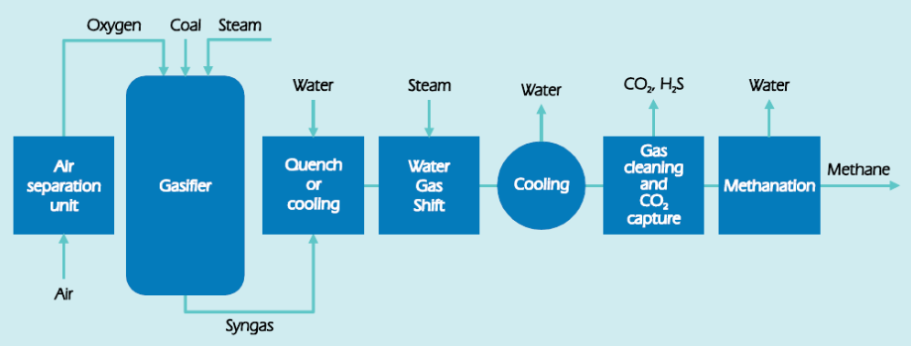
Coal is partially oxidised with air, oxygen, steam, or carbon dioxide to create a fuel gas which is utilised to produce energy in place of piped natural gas, methane and other substances. Syngas, a mixture predominantly made up of methane (CH4), carbon monoxide (CO), hydrogen (H2), carbon dioxide (CO2), and water vapour (H2O) is formed by the process.
Image via ForumIAS Blog/International Energy Agency
The widespread availability of coal as a raw material and its advantages over other combustion technologies in terms of environmental concerns have made it a progressively common method of producing electricity. Air pollution caused by coal burning is also minimised because the gas is purified before it is used.
This makes it easier to capture and use carbon dioxide (CO2) and other greenhouse gases emitted during the gasification operation. Coal to Liquid (CTL) transforms coal into liquid fuels, such as petrol or diesel and is mostly utilised in nations like South Africa and China that have plenty of coal resources but little oil reserves. It can improve a nation’s energy security and lessen reliance on oil imports.
It delivers clean electricity through an approach known as Integrated Gasification in Combined Cycle (IGCC). Compared to traditional methods, IGCC is a more effective and environmentally friendly approach to generate power from coal and other fuels.
Coking coal, which is imported and expensive, is regularly employed by steel firms in their production processes. However, plants can swap out it with syngas to cut costs, which is used to obtain several fertilisers, fuels, solvents and synthetic materials. It is also used for chemical feedstocks and energy.
Similarly, hydrogen obtained from coal gasification can be employed for a number of purposes, including heating, industrial activities, transportation and manufacturing power. Ammonia, a necessary component of fertiliser for agricultural growth, can also be acquired from the gaseous byproducts of gasified coal.
When Germany used coal to satisfy its energy needs
World War I and the loss of colonies in Africa and Oceania pushed the Germans to look for synthetic fuels owing to a dearth of indigenous petroleum sources. Coal reserves were plentiful in the country, and its scientists had figured out the way to gasify and pyrolyse solids to create liquid fuels in the early 1920s.
Hydrogen was applied to coal at very high pressures (200-700 atmospheres or atm) and temperatures (400-600°Celsius) while an inorganic solid catalyst was present. High-quality petrol fractions would be produced with the breakdown of big molecules in coal into smaller versions. This process was invented by the Nobel laureate scientist Friedrich Bergius, who first suggested liquefaction or hydrogenative pyrolysis of coal in 1913.
The technique provided relative self-sufficiency in liquid fuels, which was essential during a crisis, despite being economically and energetically inadequate. Fritz Haber and Carl Bosch simultaneously succeeded in generating precious ammonia from coal-derived hydrogen and nitrogen.
German synthetic petrol plant (Source: Historia Scripta)
Therefore, the European state’s extensive and sophisticated chemical industry had substantially raised the amount of ammonia and liquid fuels directly from its abundant anthracite, bituminous coal, and lignite reserves by 1921. With their trademark FT method, Franz Fischer and Hans Tropsch overhauled the industry in 1925. Coal was gasified at 150-300°C and 20 atm to yield synthesis gas or town gas. It was principally a concoction of hydrogen and carbon monoxide, which was fed through a solid catalytic reactor. Diesel and kerosene were created there by the reaction of the two components.
To create petrol from a range of coal grades and available catalysts, a growing number of industries, scientists, and chemical engineers actively collaborated. A new dawn broke, and Germany ultimately landed in the age of substitute fuels and chemicals that reduced its reliance on foreign oil. Its Four-Year Fuel Plan, enacted in 1936, expedited these activities.
Germany’s 25 synthetic fuel manufacturing units produced more than 124,000 barrels per day by late 1944. Over 90% of aviation gasoline and close to half of the total petroleum were the products of synthetic fuel. Almost 75% of the nation’s fuel came from synthetic sources by 1945.
Meanwhile, international embargoes and a paucity of petroleum reserves compelled South Africa to derive all of its land and air fuels from coal for many years, hiring a large number of German scientists and researchers. After World War II, the FT process continued to thrive as diesel virtually took the place of petrol in trains, military, commercial and heavy vehicles. Jet engines also gained global dominance in aviation, and kerosene emerged as the norm for aircraft.
The imperative to attain energy independence and the vitality of India’s coal deposits
The geopolitical landscape has remained volatile throughout the years, as exemplified by the present war in the Middle East. China, which has nearly 350 million tonnes of coal gasification capacity and is vulnerable to energy imports like India, showed the strategic role of this sector.
Its extensive domestic coal-to-chemicals ecosystem served as a strategic shield, contributing to maintaining supply stability and limiting demand on the unstable international market. On the other hand, many nations endured LNG shortages, outages in fertiliser supply, price spikes and force majeure threats.
India also faced difficulties as a result of the armed standoff between the United States, Israel and Iran. The nation imports basic commodities like LNG, ammonia and urea, which cost an estimated ₹2.77 lakh crore annually. Hence, the dispute poses a major challenge as crude oil prices rise and affect India’s economic health. However, coal gasification offers an effective route for the production of these necessities from local coal.
“India has a reserve of 307 billion tonnes of thermal coal and about 80% of coal produced is used in thermal power plants. With environment concerns and development of renewable energy, diversification of coal for its sustainable use is inevitable. Coal gasification is considered as cleaner option compared to burning of coal. Gasification facilitates utilization of the chemical properties of coal,” the Ministry of Coal declared in 2021.
“Syngas produced from coal gasification can is usable in producing Synthetic Natural Gas (SNG), energy fuel (methanol & ethanol), ammonia for fertilizers and petrochemicals. These products will help move towards self-sufficiency under Atmanirbhar Bharat Abhiyaan,” the ministry mentioned and outlined that it wants to accomplish 100 million tonnes of coal gasification by 2030.
A calculated step to protect India’s energy prospects
Corporate advisor Pavan Kaushik stated that the country’s move toward coal gasification is a strategic national defence for the future as reducing dependencies on outside energy sources is key for long-term economic stability at a time when India imports around 89% of its crude oil needs.
Thus, the government is boosting its attempts to strengthen the capacity for coal gasification, regarding it as a fundamental step toward a stable tomorrow and economic independence. This approach confronts the obvious risks that nations that depend on imported energy confront, particularly in light of persistent problems with the global supply network and geopolitical strife.
It is to mitigate reliance on foreign suppliers and improve national security by harnessing India’s abundant coal reserves into valuable fuels and chemicals. Moreover, this strategy preserves foreign exchange while shielding important industries like manufacturing and agriculture from volatile international markets.
New Era Cleantech Solutions has already made major investments in coal gasification and carbon capture, including a ₹20,000 crore complex in Maharashtra’s Chandrapur. With the initial production of ammonia, ammonium nitrate and monoethylene glycol, this factory hopes to process more than 5 million tonnes of coal annually.
Future ambitions include ethanol, urea, sustainable aviation fuel (SAF) and dimethyl ether (DME). These actions are fundamental to cultivating a domestic industry capable of supplanting imported fuels and chemicals.
Coal has illustrated its worth as black gold via its economic significance and energy production, both historically as well as in modern times, and India clearly aims to capitalise on its coal advantage in the years to come.
Planning your finances becomes easier when you know exactly how much you need to pay every month. That is where an EMI personal loan calculator becomes a helpful tool. It allows you to estimate your monthly instalment in seconds and helps you make confident borrowing decisions without confusion or stress.
Whether you are planning a home renovation, funding a family event, or managing an emergency expense, understanding your repayment amount before borrowing can save you from financial pressure later. A simple calculation today can help you stay in control of your budget tomorrow.
What is a personal loan EMI calculator
A personal loan EMI calculator is an online financial tool that helps you estimate your Equated Monthly Instalment. It calculates the amount you need to pay every month based on three main factors: loan amount, interest rate, and repayment period.
Instead of doing complex maths manually, you simply enter a few details and get instant results. This makes financial planning quick, accurate, and stress-free.
For example, if you borrow Rs. 1,50,000 for three years at a fixed interest rate, the calculator will immediately show your monthly payment and total repayment amount. This helps you understand your financial commitment before applying for a loan.
Why using a calculator is important before borrowing
Many people focus only on the loan amount and forget to consider the monthly instalment. However, your EMI directly affects your daily expenses and savings. Using a calculator gives you clarity and prevents unexpected financial strain.
Here are some practical reasons to use this tool:
Better budgeting You can adjust the loan amount until the monthly payment fits comfortably within your income.
Clear repayment planning You understand how long it will take to repay the loan.
Financial confidence Knowing your exact instalment amount reduces uncertainty.
Time-saving decisions You get instant calculations without visiting a branch or speaking to multiple lenders.
This simple habit can help you make smarter financial choices and avoid repayment stress.
How the calculator works in simple terms
The calculator uses a standard formula to determine your monthly instalment. It considers the loan amount, interest rate, and repayment period to generate accurate results.
Even though the calculation happens automatically, understanding the process can help you plan better.
The calculation depends on:
Loan amount The total amount you borrow.
Interest rate The percentage charged on the borrowed amount.
Loan tenure The number of months you take to repay the loan.
When these three details are entered, the calculator instantly displays your EMI and total repayment amount.
Benefits of planning your repayments in advance
Financial planning is similar to planning a journey. When you know the distance and fuel needed, the trip becomes smoother. In the same way, calculating your EMI helps you prepare for your financial journey.
Key benefits include:
Avoiding financial surprises You know your monthly responsibility before committing to the loan.
Managing expenses easily You can balance your rent, groceries, and savings with your instalment.
Choosing the right repayment period You can test different tenures to find the most comfortable option.
These benefits make financial management simpler and more predictable.
Smart ways to use the calculator for better results
A calculator is not just for checking one number. You can use it multiple times to compare different options and find the best repayment plan.
Here are some useful ways to use it:
Try different loan amounts Check how borrowing Rs. 50,000, Rs. 1,00,000, or Rs. 2,00,000 changes your monthly instalment.
Adjust the repayment period A longer tenure reduces the monthly payment but increases total interest.
Compare interest rates Even a small difference in rate can affect your total repayment.
Plan future expenses You can estimate repayments for upcoming needs like travel, education, or home repairs.
Using the calculator in these ways helps you stay prepared for both planned and unexpected expenses.
When a personal loan can support your financial needs
There are many situations where borrowing funds can help you manage important expenses without disturbing your savings. A well-planned personal loan can provide financial flexibility and peace of mind during urgent situations.
Common reasons people borrow include:
Medical emergencies Unexpected hospital bills or treatments.
Home repairs Fixing plumbing, electrical issues, or structural damage.
Education expenses Course fees, certification programmes, or study materials.
Travel plans Family vacations or emergency travel.
Wedding or celebration costs Managing event-related expenses smoothly.
When used responsibly, borrowing can help you handle these situations without financial stress.
Tips to keep your monthly instalment manageable
Keeping your instalment affordable is the key to maintaining financial stability. Small adjustments in planning can make a big difference in your repayment experience.
Consider these practical tips:
Borrow only what you need Avoid taking a larger amount than necessary.
Choose a comfortable tenure Select a repayment period that matches your income.
Maintain a steady income Consistent earnings support timely payments.
Track your expenses regularly Monitoring spending helps you stay within budget.
Build an emergency fund Savings can help you manage unexpected situations without missing payments.
These habits can help you maintain financial balance and avoid repayment difficulties.
Final thoughts on managing your finances wisely
Financial planning does not have to be complicated. With the help of an EMI personal loan calculator, you can understand your repayment responsibilities in advance and make informed borrowing decisions. It gives you clarity, confidence, and control over your finances.
Before applying for any loan, take a few minutes to calculate your monthly instalment, review your budget, and choose a repayment plan that suits your lifestyle. Careful planning today can lead to a more secure and stress-free financial future.
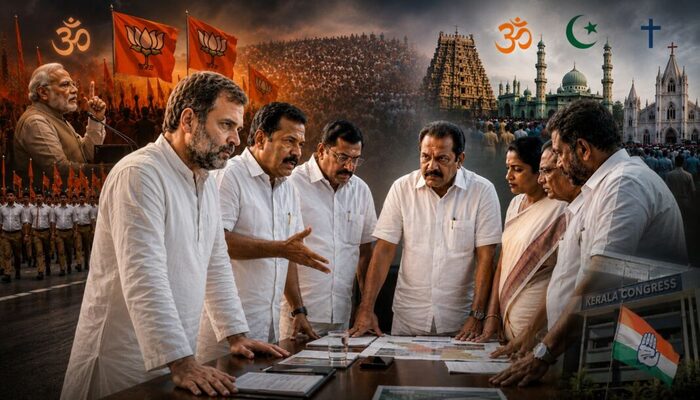
Putting an end to the speculations on Thursday (14th May), the Congress-led United Democratic Front in Kerala announced the name of VD Satheesan as the next chief minister of the state. The announcement comes 10 days after the Kerala Assembly election results were announced. The Congress-led United Democratic Front (UDF), which won the election, struggled for over a week to finalise a name for the chief ministerial post.
Usually, after receiving a clear mandate, political parties are swift to decide on a leadership position to convey a message of stability and confidence to the public. However, the situation for the Congress in Keralam appeared to be different. Political circles echoed the question as to what compulsions are keeping the Congress party from reaching a consensus on a Chief Ministerial candidate? Let’s take a look at the possible reasons why it took so long for the Congress party to come up with a name for the Keralam CM post.
Social balance in Keralam politics and the challenge of Congress
Keralam is one of those states where politics is directly linked to social equations. These social equations have become a challenge for the Congress party. The Congress and Muslim League won the Keralam elections with the support of Muslim and Christian voters. Let’s try to understand this through statistics.
In terms of statistics, a total of 35 Muslim MLAs have been elected to the 140-member Keralam Assembly, representing approximately 25 per cent of the total strength. The UDF alliance, comprising the Congress and Indian Union Muslim League (IUML), has the largest share, with a combined total of 30 Muslim MLAs, representing approximately 85.7 per cent.
The IUML alone has 22 MLAs, and the Congress has 8 MLAs. The LDF coalition, on the other hand, has a total of 5 Muslim MLAs, including 4 from the CPI(M) and 1 from the CPI, amounting to around 14.3 per cent.
Party-wise speaking, the Congress has eight Muslim MLAs out of a total of 63, which is about 12.7 per cent. All 22 IUML MLAs are Muslim, while the CPI(M) has 4 and the CPI has 1.
The Hindu population here is estimated to be around 54 per cent, the Muslim population around 26 per cent, and the Christian population around 18 per cent. These figures are based on census data and various official reports.
The biggest challenge for Congress was balancing this equation. Since it won the election based on Muslim and Christian support, these groups have been pushing for a Chief Minister from their individual communities, and Congress was feeling the pressure. However, it was unable to make a final decision. Because if it had chosen a Muslim Chief Minister, it would be difficult for the party to please the state’s largest community, the Hindus.
On the contrary, a Hindu chief minister would most likely have eroded the trust of the state’s minorities in the party, and their support might have shifted to the CPM. However, it seems that the Congress party was unable to ignore the Hindu majority in the state and chose a Hindu to head the government in the state.
The growing presence of the BJP has raised concerns for the Congress
For many years, Keralam was considered a state where the BJP had limited electoral influence. However, over the past decade, the picture has gradually changed. The BJP’s vote share has steadily increased. The BJP’s emergence as a key player in the state’s electoral battle further exacerbated Congress’s challenges.
The BJP has strengthened its presence in several seats in the 2019 Lok Sabha elections and subsequent elections. While the party may not have achieved significant success in terms of seats, its vote share and organisational expansion have certainly alerted other parties.
The RSS’s long-standing grassroots presence is also considered a key contributor to this growth. Keralam has been one of the states where the RSS has cultivated a cadre-based network over decades.
This network is now seen as instrumental in the BJP’s political expansion. The BJP is not only fighting for power, but also attempting to transform itself from a third alternative between the Congress and the Left parties into the main opposition force.
This is why Congress did not want to send a political message that could allow the BJP to gain a foothold among new voters. Choosing a Christian or Muslim candidate would have strengthened the BJP’s narrative that Congress wants nothing more than symbolic representation for Hindus. This would’ve created fertile ground for the BJP’s expansion.
Why the West Bengal example troubles the Congress
The BJP’s landslide victory in West Bengal has also troubled the Congress party. In the 2026 assembly election, the BJP won 3 seats in Keralam, the same number of seats it won in the 2016 Bengal elections. In 10 years, the BJP has completely transformed its image in West Bengal and ultimately swept the state assembly polls. This time, the BJP won 207 out of 293 seats in Bengal.
The Congress party’s confusion over choosing a CM was further aggravated by the growing strength of the BJP in Keralam. Congress doesn’t want to give the BJP or the leftists any opportunity that could create a problem for it, but this is almost impossible given the current circumstances.
In Keralam, the Congress faced the challenge of maintaining its traditional minority support base and strengthening its acceptance among Hindu voters. Furthermore, the BJP’s growing political influence and the changing electoral landscape further compounded the Congress’s difficulties.
The decision regarding the Keralam CM was not just a matter of leadership change for Congress; it also determined how strongly the party can preserve its long-standing social alliance and adapt to the changing Indian political landscape. The real test for the Congress, in effect, was not just choosing a Chief Minister, but also keeping its entire voter base intact.
(This article is a translation of the original article published at OpIndia Hindi.)
4th May 2026 will go down in the annals of history as one of the defining moments of India. On this day, the corrupt Mamata Banerjee-led Trinamool Congress was booted out by the people of Bengal. The large-scale mobilisation by the RSS, the leadership of the BJP at the State and Central level and the sacrifices of lakhs of party workers at the grassroots level paved the path for the massive victory.
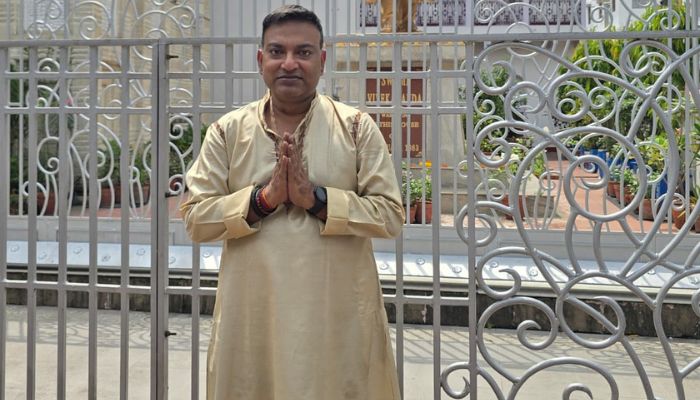
Amid all this, a group of nationalist Probashi Bangalis (expatriate Bengalis) also made a significant contribution in mobilising voters, creating public awareness and strengthening social media narratives in favour of Poriborton (change). I spoke to Judhajit Senmazumdar, a successful Silicon Valley entrepreneur who has been running the campaign ‘NRIs for Bengal’ for several years.
“This was not a normal election for us. It was an existential battle as BL Santosh (BJP politician from Karnataka). We NRIs, from all over the world, came down to cast our vote. We started it brick by brick to bring all nationalist Bengalis together, globally. We have NASA scientists, Google and Facebook engineers, AI entrepreneurs, lawyers from the US, UK, Australia, Paris, and Africa,” he informed.
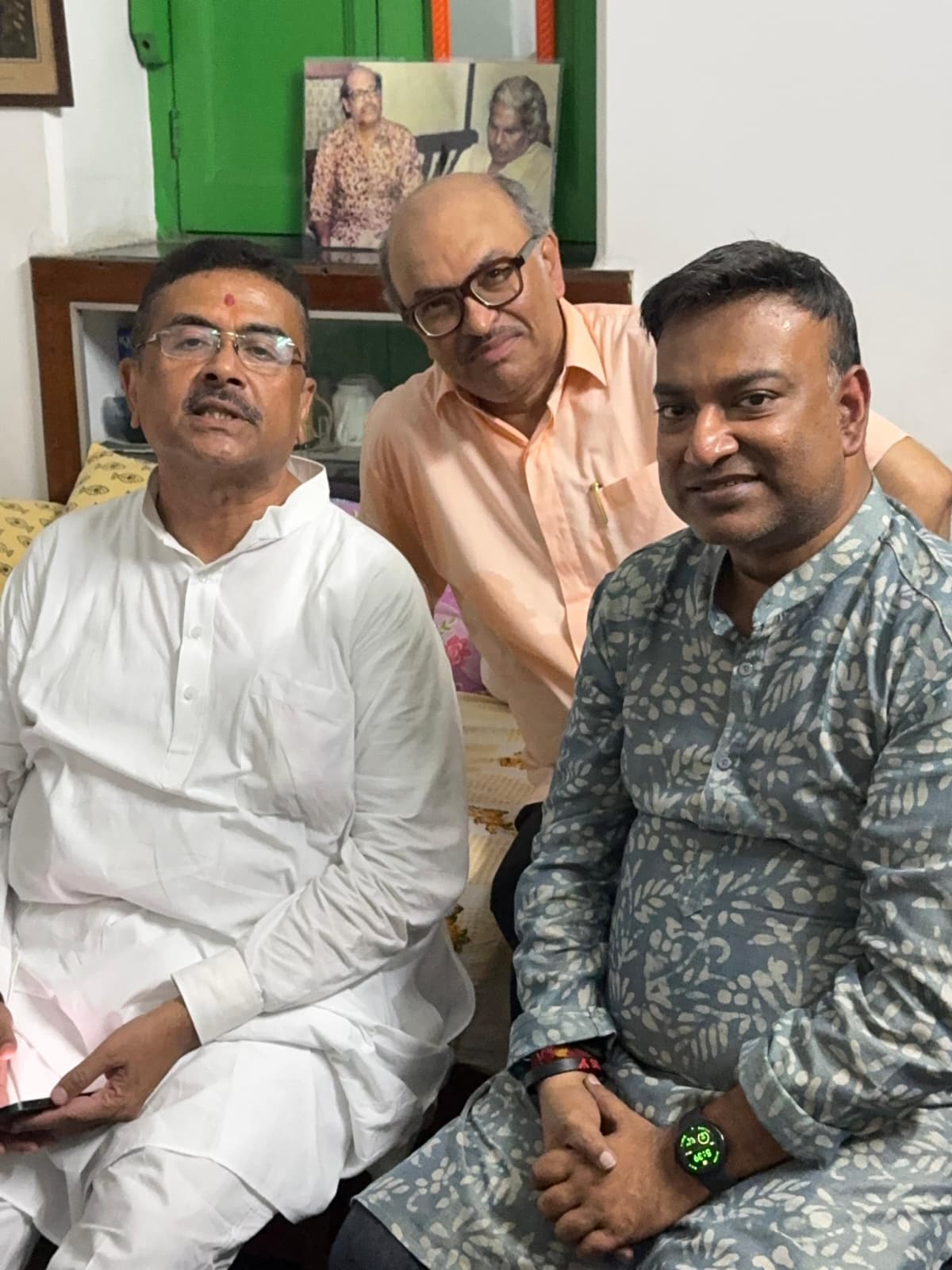
Judhajit Senmazumdar with the current West Bengal CM Suvendu Adhikari
“We all planned to travel to India and cast our vote. I was there in Bengal for almost one month, carrying out political campaigns. Probashi Bengalis flew to India from Uganda, France and England to do campaigns on the streets. I was appearing on Republic Bangla every day, creating the narrative that all Bengali Hindus need to come together, unite and vote. Israel is to Jews what Bengal is to Hindu Bengalis. Our homeland was at stake,” emphasised Judhajit Senmazumdar.
While speaking about pre-election campaigning in Bengal, he stated, “We sat in the booth. We went to the street corners. We spoke to the people. We travelled in buses. I personally went to multiple places, with Suvendu da in Bhabanipur and in Nandigram. More than 500 NRIs from all over the world came to India and worked in different capacities.”
An alumnus of the University of California, Berkeley, Judhajit currently serves as the International Co-In-Charge for the Bharatiya Janata Party (BJP) in West Bengal. He and ‘NRIs for Bengal’ have played a key role in bringing Poriborton (change) in Bengal.
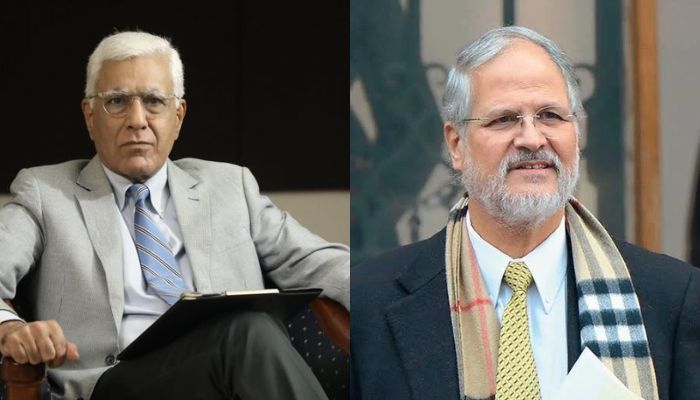
Former Delhi Lieutenant Governor and former Vice-Chancellor of Jamia Millia Islamia, Najeeb Jung, recently spoke to journalist Karan Thapar in an interview for The Wire and made a serious observation about the so-called condition of Muslims in India.
According to Jung, the Muslim community is in a “very grave” situation and is “knocking on the doors of becoming second-class citizens.”
His remarks once again brought back a debate that has been continuing almost continuously since Narendra Modi came to power in 2014. Every few years, some public figure whether a politician, actor, academic, or retired official raises concern that India is becoming unsafe or hostile for Muslims. The language changes, the examples change, but the core message remains the same: Muslims are supposedly losing their place in India.
But after more than twelve years of Modi-led politics at the Centre, an important question naturally comes up: has the prediction actually come true?
Najeeb Jung’s concerns about Muslim representation
In his interview, Najeeb Jung argued that Muslims today feel increasingly pushed away from the mainstream. He said many in the community believe they are being treated unfairly and excluded from the country’s progress. According to him, this feeling is not limited to ordinary citizens but is also visible in political and institutional spaces.
Jung pointed out that in states like West Bengal and Assam, where Muslims form a large part of the population, the BJP did not field Muslim candidates in recent elections. He also highlighted that for the first time since Independence, the Union government does not have a Muslim cabinet minister and the BJP has no elected Muslim MP in Parliament.
He further said that representation of Muslims in the higher bureaucracy, judiciary, and major institutions has reduced compared to previous decades. In his view, this shrinking visibility creates insecurity within the community. Jung warned that if a population of nearly 200 million people starts feeling politically unimportant, it could become dangerous for the country’s social balance.
His comments were direct. He stressed that only liberal sections of society appear openly worried about this issue, and he described that as “disastrous” for India.
However, critics of this argument say such fears have been repeated for years, often in dramatic language, but India’s Muslims continue to participate in elections, run businesses, study in universities, work in government jobs, and openly practice their religion across the country. They argue that political underrepresentation in one party does not automatically mean second-class citizenship.
The “Intolerance” debate started long ago
Najeeb Jung is not the first prominent figure to express fear about the direction India is taking under Modi’s leadership. In fact, this debate became national news within just a year of Modi becoming Prime Minister.
In 2015 and later in 2017, several well-known personalities made statements about “intolerance” and insecurity among Muslims in India.
One of the biggest names was former Vice President Hamid Ansari. Towards the end of his term in August 2017, Ansari said that many Muslims were experiencing “a feeling of unease” and insecurity in the country. He said he had discussed the issue of intolerance with Prime Minister Modi and senior ministers in the government.
Before Ansari’s remarks, Bollywood had already entered the debate
In November 2015, Shah Rukh Khan spoke about what he called “extreme intolerance” in India. During interviews around his 50th birthday celebrations, SRK said there was growing religious intolerance in society. His statement immediately became national news.
Aamir revealed that his wife, filmmaker Kiran Rao, had at one point suggested leaving India because she was worried about the atmosphere in the country and feared for the safety of their children. He said she was scared after reading newspapers every day and felt concerned about rising tensions in society.
The statement created a political storm. The debate became so heated that it dominated television discussions and newspaper headlines for days.
What is important here is that these warnings are not new; they were made nearly a decade ago. Since then, similar claims have appeared again and again that Muslims are unsafe, democracy is collapsing, minorities are being pushed out, and India is becoming intolerant.
Yet India’s social and political reality has remained far removed from these dramatic predictions.
Twelve years later, have Muslims become “second-class citizens”?
This is where the debate becomes serious. If one listens only to political speeches and television debates, it may appear that Muslims in India have already lost all rights and freedoms. But everyday reality tells a different story.
Muslims continue to vote freely in elections. Muslim political parties and leaders still contest and win seats in different states. Muslims continue to run businesses, own property, study in top universities, and work in sectors ranging from films and sports to bureaucracy and law.
Shah Rukh Khan is still giving superhit movies. Aamir Khan continues to live in India, with his children, though he has divorced his wife.
In essence, India still has Muslim actors who dominate Bollywood, Muslim industrialists, Muslim judges, Muslim journalists, Muslim athletes, and Muslim civil servants. Mosques function openly across the country, Eid is celebrated nationally, and Islamic institutions continue to operate legally.
Muslims continue to live like Hindus, Buddhists, Jains, and Christians do. But when voices who are considered ‘influential’ keep making alarmist claims like ‘Muslims are soon going to be become second-class citizens”, it polarises the community and creates permanent fear inside the community members. Since it has been repeated so many times since 2014 that it has almost become a political slogan rather than a proven reality.
Many also argue that if the government truly intended to completely marginalise Muslims, it would not continue introducing welfare schemes that directly benefit Muslims.
Modi Government’s outreach towards Muslims
Interestingly, while critics accuse the Modi government of ignoring Muslims, the BJP has repeatedly taken several steps for the welfare of Muslim citizens, especially women and poorer sections.
One of the biggest examples was the law against instant triple talaq. The Modi government introduced legislation to ban the practice of instant triple talaq, also known as talaq-e-biddat. This practice allowed a Muslim husband to divorce his wife instantly by saying “talaq” three times.
The Muslim Women (Protection of Rights on Marriage) Act, 2019 came into effect on August 1, 2019. The law declared instant triple talaq illegal and void. It also made the practice a criminal offence, with punishment of up to three years in jail for the husband.
The law was necessary to protect Muslim women from arbitrary divorce and insecurity. Supporters described it as a major reform for gender justice inside the Muslim community. Conservative Muslim leaders opposed it, still the BJP presented the law that protected Muslim women.
Another example came in 2025 ahead of Eid, when the BJP launched the “Saugat-e-Modi” campaign.
Under this programme, around 32 lakh poor Muslims across the country reportedly received special kits containing food and daily-use items. The kits included vermicelli, dates, sugar, dry fruits, clothes, and other Eid-related essentials. Women received fabric for suits, while men received kurta-pyjamas.
The BJP promoted the campaign as an effort to connect directly with economically weaker Muslims and ensure festive support reached families before Eid celebrations.
Supporters of the government point to such initiatives and ask a simple question: if Muslims were truly being treated as second-class citizens, why would the ruling party spend political energy and resources on schemes specifically aimed at Muslim women and poor Muslim families?
Twelve years of warnings, yet India remains the same democracy
Since 2014, India has repeatedly heard fearmongering that Muslims are on the verge of losing their place in society. Leftwing intellectuals like to exagerrate threat perception for Muslims as it serves their purpose of continuing to slander the BJP as a communal force while ensuring Muslims as vote bank remain loyal to the left parties.
But after twelve years of PM Modi’s rule, Muslims in India still retain their constitutional rights, religious freedom, voting power, and public visibility.
It simply shows that dramatic predictions about Muslims becoming second-class citizens must be tested against ground reality. When the same warnings are repeated for over a decade, yet the predicted collapse never materialises, many Muslims naturally begin questioning whether fear has been deliberately cultivated as a political tool to secure their votes. This may also explain why several Left parties and self-proclaimed “custodians” of Muslim interests have been struggling electorally in recent years. Muslim voters appear to be increasingly unwilling to remain political pawns in fear-driven narratives.
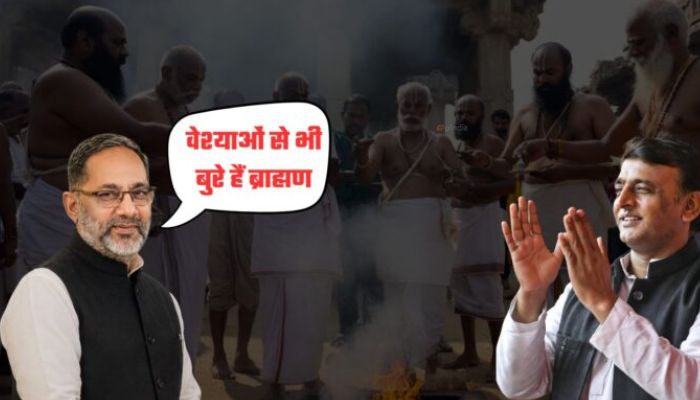
The story of Samajwadi Party leader Rajkumar Bhati begins on a stage in Delhi, wherein he peddled a hateful narrative against the Brahmin community under the guise of ‘socialism’ and ‘social justice’. Standing amidst a gathering of leftists and fundamentalists, Samajwadi Party leader Rajkumar Bhati compared Brahmins to prostitutes and described them as even worse.What followed was a vicious “giggle.” The laughter echoing from the stage and Bhati’s scornful smile testified that this wasn’t just a phrase, but a display of his deeply ingrained anti-Hindu mindset.
However, as Hindus were outraged and demanded police action, Rajkumar Bhati changed tone and began offering “unconditional apology” with folded hands. However, a video he himself shared exposes his forced apology, in which he is still smiling while reading the hateful lyrics, while his supporters, in the background, demand the installation of “posters” of this insult. Let’s understand this entire story, woven of hatred, cunning, and electoral fear, sequentially.
Book launch event became a platform for peddling anti-Brahmin hatred
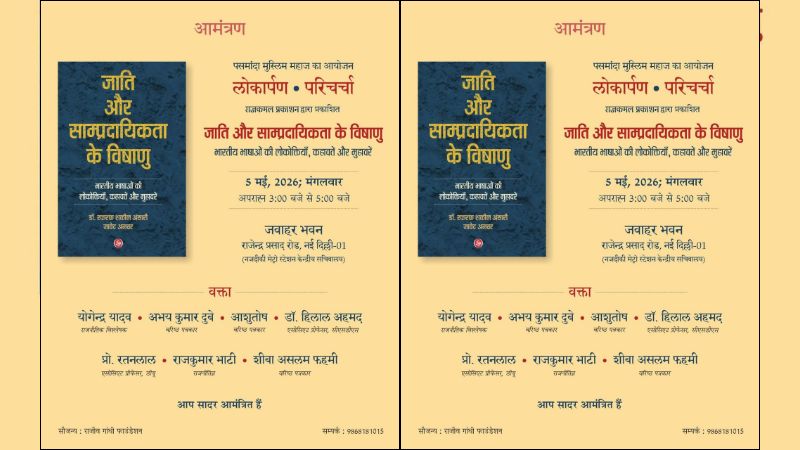
The story begins on 5th May 2026. A book launch event was underway at Jawahar Bhawan in Delhi, associated with the Sonia Gandhi family’s Rajiv Gandhi Foundation. The book was titled “The Virus of Caste and Communalism.” Ironically, the two Muslim authors, namely, Dr. Rafraf Shakeel Ansari and Javed Anwar, did not speak about social evils like halala or triple talaq within their religion, but rather spewed venom against the castes of Hindu society.
It was on this stage that Rajkumar Bhati began his speech. He recited an old couplet, “ब्राह्मण भला न वेश्या, इनमें भला न कोय!और कोई-कोई वेश्या तो भली, ब्राह्मण भला न कोय।” The direct meaning of this was that for him, Brahmins were worse than prostitutes.
The Left’s support and the vicious laughter
Bhati wasn’t alone on the stage. He was joined by Yogendra Yadav, Professor Ratan Lal, Ashutosh, and Sheeba Aslam Fahmi, all of whom have a history of making controversial statements about Hinduism. When Rajkumar Bhati was insulting the Brahmin community, a strange, hateful smile appeared on his face. He may never have laughed as much during his entire speech as he did while making these derogatory remarks about Brahmins.
Surprisingly, the “intellectual” community gathered there applauded this insult. Someone in the crowd even shouted, “Bhati ji, please put up a poster of this!” This proves that the people gathered there were not there for a discussion, but to humiliate a particular community.
The fake apology: When the elections and fear of jail haunt you
Soon after, Bhati’s video spewing vitriol against Brahmins went viral online, sparking outrage and an FIR was registered in Ghaziabad. The Samajwadi Party leader immediately backtracked. Bhati posted a 5-minute video, portraying himself as a helpless man, saying, “I’m being defamed by cutting a 7-second clip.” He even resorted to the phrase “Gurjar-Yadav” to defend himself, but the reality is that his entire target was Brahmins.
In the video, he is seen folding his hands, but his eyes show cunning, not remorse. The video, shared on Facebook, clearly shows Bhati having already written a book against Brahmins and then reading it from the paper and reciting proverbs to the crowd, bursting into laughter. In a way, Bhati Sahib had gone there not to release a book, but to entertain leftists.
Bhati also said that “some innocent people are misled by the BJP and start campaigning against them.” But the truth is that the 2027 assembly elections are nearing, and this “pretend apology” was staged to prevent the Brahmins’ anger from spoiling the vote count.
Rajkumar Bhati’s apology is as genuine as the Samajwadi Party’s ‘secularism’
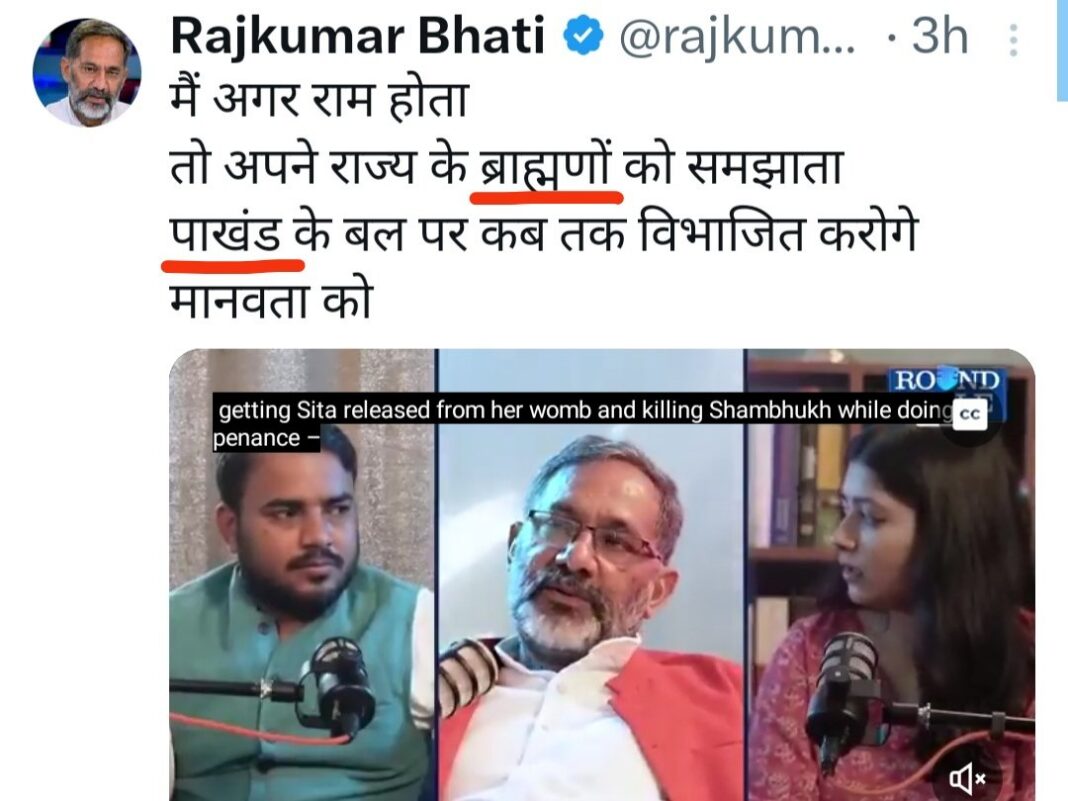
The anti-Brahmin commentary by SP leader Rajkumar Bhati at the Delhi event is not an isolated incident; rather, he has spewed venom against the Hindu religion and traditions many times before. He has not shied away from commenting on even Lord Ram. He once even said that if he were Ram, he would advise Brahmins to abandon their hypocrisy.
Rajkumar Bhati has also insulted Hindu scriptures in the past. He once called the Manusmriti “inferior” and considers the great work Ramcharitmanas a mere “ordinary poem” rather than a divine text.
Not only this, but his views on the existence of God are also quite strange. He says that he doesn’t feel the need to visit temples because he is currently conducting research on whether God exists. But surprisingly, while on the one hand he questions Hindu deities, on the other hand, he openly declares on TV that he considers no one greater than Muhammad.
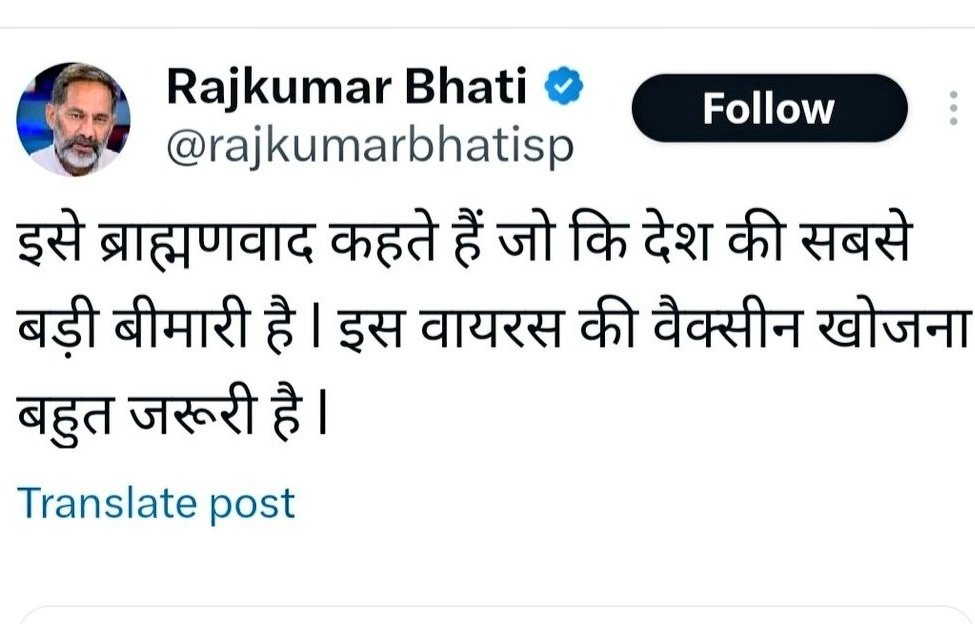
His comments clearly demonstrate his one-sided thinking and hatred towards Sanatan Dharma. Furthermore, in an earlier tweet, Rajkumar Bhati had referred to Brahminism as a “virus” and called for a vaccine.
The real Hindu-hating face versus the socialist ‘secular’ mask
Today, when SP leader Rajkumar Bhati apologises for his actions, it’s not from his heart, but rather from the fear of arrest. It is the fear of political loss that compels him to apologise. The body language in his Facebook video, the voices of his supporters behind him, and his laughter scream out loud the hatred he harbours for Hindus.
7th October 2023 marked the bloodiest day for Israel since its independence when Hamas-led terrorist outfits such as Palestinian Islamic Jihad, unleashed a gruesome onslaught on the country.
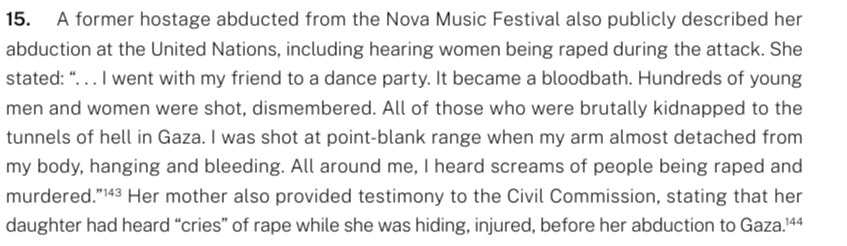
Over 1,200 people, mostly civilians comprising of women, elderly, disabled and children, were killed and about 251 were abducted into Gaza by the assailants who targeted homes, roads, shelters, communities, military bases, security installations and a music festival. The events were captured and transmitted to the world with the purpose of glorification.
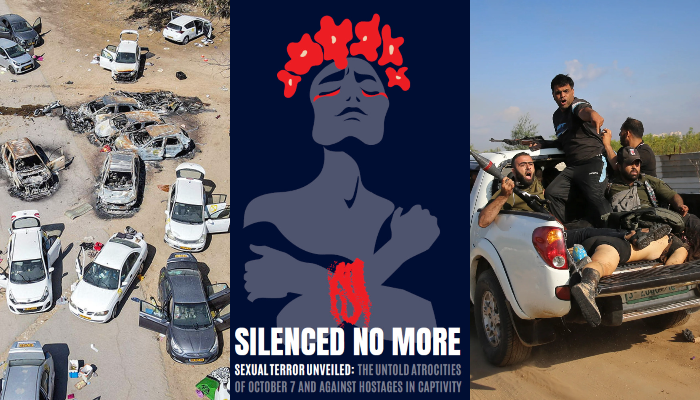
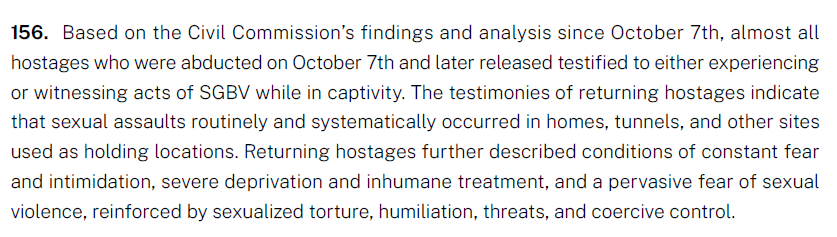
Israelis, irrespective of their age or gender, endured unprecedented sexual violence at the hands of the terrorists. The distressing testimonies have been regularly shared by the victims, witnesses and various accounts to the shock of the global community. Israeli non-profit organisation, “The Civil Commission” released a similar 300-page report, “Silenced No More,” featuring tagline “Sexual Terror Unveiled: The Untold Atrocities of October 7 and Against Hostages in Captivity” on 12th May (Tuesday).
The unending horrors of sexual violence, derogation and severe violations
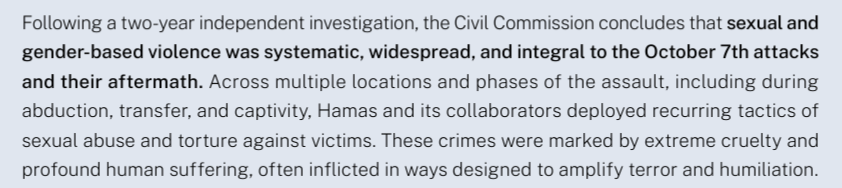
Sexual and gender-based violence was systemic, pervasive and crucial to the assault and its aftermath, based on the findings of a 2-year independent inquiry by the commission. Hamas and its allies repeatedly used sexual abuse and torture against victims in many locations and stages of the attack, including their kidnapping, transfer and incarceration. Excessive cruelty and severe human suffering were characteristics of these crimes, which were committed in ways intended to frighten and demean them.
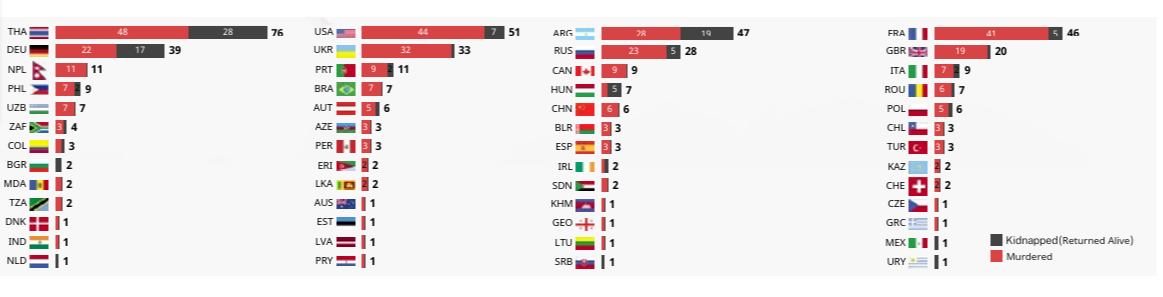
Original witness and survivor testimony, interviews, photos, videos, government papers and other primary materials from the attack sites had been employed for basis of the conclusion. “Data analysis conducted by the commission reveals that the victims represented 52 different nationalities, underscoring the international scope of the crimes and their impact,” the report read. Foreign or dual Israeli and foreign nationals were a substantial portion of the persons held in Gaza.
It highlighted, “Through systematic cross-referencing of this material and detailed analysis of the modus operandi of the perpetrators, the commission identified 13 recurring patterns of sexual and gender-based violence committed across multiple locations. The repetition of these patterns demonstrates that the crimes were not isolated acts of brutality but formed part of a broader operational method used during the attack and its aftermath.”
The probe also revealed that the terrorists used visibility and digital distribution, including sexualised content, as weapons in the attack. They misused social media and the personal online profiles of the victims to circulate footage of assault, humiliation and murder. Family members first found out about their loved one’s fate through pictures or videos that the attackers shared in multiple instances.
Terrorists sported GoPros and body-worn cameras or made sure that their acts were captured and publicised by others. “Across all sites, these videos documented armed groups and Palestinian civilians celebrating the attacks, appearing joyful and euphoric,” the report underscored. This intentional use of digital media converted violent crimes into psychological warfare instruments aimed not only at victims but also at families and society as a whole.
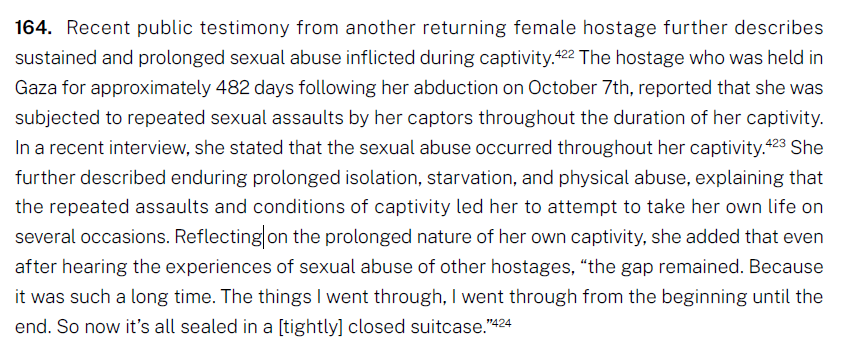
A calculated campaign of sexual terror aimed at punishing, degrading and dehumanising the victims persisted after they were dragged to the Gaza Strip. Women and men, including the very young and the senior citizens were exposed to perpetual sexual violence, threats of rape humiliation and psychological horror. Families were split up and basic medical treatment was withheld while the bodies and minds of these prisoners were manipulated into weapons for propaganda and coercion.
The report outlined that these acts were “central” to the attack. It conveyed, “Women and girls, and, in many cases, men and boys, were subjected to rape, sexualised torture, mutilation, forced nudity, and desecration of bodies. Parents were murdered in front of their children, siblings assaulted in front of one another, victims stripped, violated, filmed and displayed. These were not crimes of passion: they were coordinated and orchestrated to exacerbate the cruelty of crimes that are sexual in nature.”
Family members pushed into sexual acts, even the deceased not spared: A chronicle of continual dread faced by the victims
The report mentioned, “Hamas and its collaborators used sexual and gender-based violence (SGBV) deliberately and systematically as an inherent part of a wider strategy of the attack, primarily targeting women and hostages, while minors were also subjected to grave forms of such violence and abuse.” The people were put through these gut-wrenching ordeals at different places even in the presence of their families by the jihadis.
Their pain and suffering were maximised through sexual torture. “Victims endured brutal acts, including burning, mutilation, rape, restraining, forced insertion of objects into the genitalia, shootings to the faces and genital area, killings and abuses in front of family members and executions. Many victims were found handcuffed, bound or otherwise physically restrained. Extreme forms of SGBV continued against hostages in captivity for prolonged periods, inflicted on both women and men,” the investigation discovered.
Furthermore, individuals who witnessed these acts and those who survived sustained serious, long-lasting psychological and physical damage. The armed groups committed rape, gang rape, other sexual assaults, torture, including burning and mutilation, as well as purposeful shootings to the head, face and genital area. Executions and killings were either carried out in tandem with or after SGBV. There were postmortem sexual abuse, body degradation and humiliation.
“Forced nudity and exposure. Handcuffing, binding and restraint of victims. Public displaying and parading of women and children. Abduction of mothers and children. SGBV inflicted in the presence or near vicinity of family members. Filming and digital dissemination of SGBV, including use of social media to document, glorify and amplify the atrocities. Threats of forced marriage. Rape and other forms of sexual violence against boys and men,” the report stated.
SGBV was wilfully perpetuated against blood relations, including a particular case where family members were subjugated to indulge in sexual acts with one another. The report emphasised, “Other documented cases include, inter alia, family members being sexually assaulted or humiliated in each other’s presence. The weaponisation of familial bonds maximised the pain and suffering of victims and terrorised their families. This pattern was particularly evident during Hamas captivity.”
The extremists recorded themselves on camera and uploaded visuals of themselves beating, shaming, abducting, slaughtering women, children and entire families alongside desecrating bodies. They displayed women and their corpses as war booty. Some clips showed terrorists and Gazan people rejoicing over desecrated remains.
Additionally, footage portrayed dead bodies that were brutalised and burnt. “Hamas and its collaborators further circulated footage of injured women and girls, and elderly women being violently humiliated and abducted. Many of these victims were taken in their sleepwear due to the early-morning timing of the attack, further heightening their vulnerability,” the report conveyed.
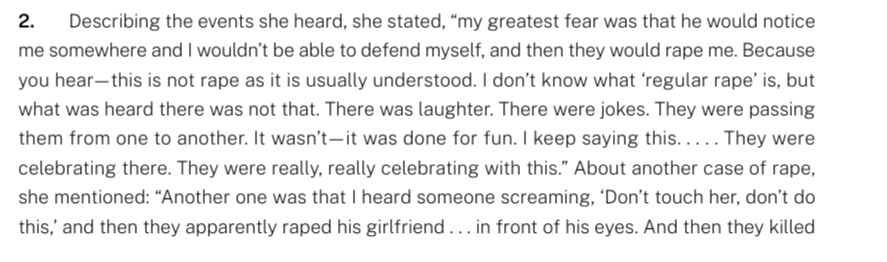
It added, “The digital abuse of hostages continued for many months after 7th October. Videos and images filmed by Hamas during captivity, show hostages being tormented, abused, taunted or humiliated on camera.” The report had a statement from a Nova music festival survivor who expressed, “The men pulled a woman from the vehicle, forcibly removed her clothing and raped her. They repeatedly stabbed her, killing her. They continued to rape her after her death,” illustrating the extent of the depravity and violence.
“I saw them raping her. While they were raping her, we heard her screaming. Then they murdered her and then they raped her again, even after she was no longer moving. I saw them raping her,” revealed Raz Cohen.
The savage strike that shook the Jewish state: A deed motivated by religious animosity
Two pregnant women, 28-year-old Nitzan Rahum and 23-year-old S. Abu-Rashed were among the initial targets. The latter managed to survive while her baby perished as did Rahum and her unborn child. Testimonies and witness descriptions of sexual assaults promptly surfaced following the assault.
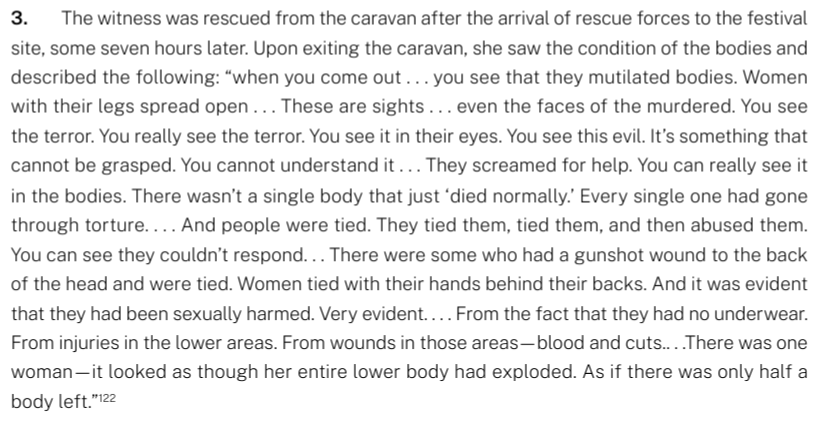
“From the earliest days, reports from survivors, first responders, medical experts, and morgue staff indicated that the attacks had a marked gendered dimension. For many victims, these crimes ended in death. In numerous cases, victims were killed during or after the assaults, and their bodies were recovered mutilated, burned and desecrated, in ways consistent with patterns of sexualised violence of exceptional cruelty,” the report pointed out.
It recounted the occurrence regrading “22-year-old Shani Louk lying face down, partially naked, visibly injured, and motionless in the back of a pickup truck, as she was paraded through the streets of Gaza, surrounded by armed perpetrators and civilians, who are seen cheering and spitting on her body.”
In the months that succeeded the attack, Hamas dropped countless videos exhibiting innocent detainees pleading for their life or showcasing corpses. They made direct contact with family members of the victims in certain situations, aggravating their anguish. These actions extended and amplified the effects of the terror hit, adding to the pain and trauma.
“Many times, these beautiful young women were shot in the eye, disfiguring their faces. They didn’t die from that because they were killed with a bullet to the heart.” voiced Sharon Laufer who prepared the bodies for the last rites.
The report cited assessments drawn by the United Nations, underlining the gravity of the crimes, including sexual abuse and violence executed by the terrorists. It disclosed that Hamas was added to the UN Secretary-General’s blacklist in August 2025, which identifies parties credibly suspected of committing or being responsible for systematic rape and other types of sexual violence during times of armed conflict.
The report noted, “Being placed on this list signifies that the UN has also verified substantial evidence of such violations perpetrated by Hamas during the 7th of October attacks and against hostages in captivity.”
The commission examined an assortment of tactical manuals, notebooks, checklists, maps, phrasebooks, and operational resources that guided abductors on how to control victims, penetrate civilian areas and issue directives in Hebrew. These materials include overt calls for violence and hatred that is structured by religion.
“These materials further include Arabic-to-Hebrew phrase lists with imperatives and humiliating commands (for example, commanding victims to take off your pants or take your clothes off, lie down, spread your legs) as well as kits containing zip ties and other materials to physically restrain victims,” the report highlighted.
“These ideological materials contained an underlying dehumanising narrative against the Jewish people and Israeli civilians, including women, children and the elderly, who were represented in some texts and statements as legitimate objects of violence,” it added in compliance with the charter of Hamas, which endorses violence against the Jewish community.
The massacre and vile acts were not only filmed but were also exalted with religious expressions and fervor. “Civilian property in the kibbutzim was also defaced with religious graffiti glorifying the attacks. For example, the Civil Commission documented several homes in Be’eri bearing inscriptions in Arabic (such as this is one of God’s days and God is great),” the report stated.
The victims and witnesses narrate the tale of Islamist terror
A witness who was at Nova music festival sought cover in the caravan together with 7 others during the attack. She reported hearing 3 acts of rapes emanating from 3 distinct places close to her hiding place. She was an eyewitness to the sight, including the mutilated condition and position of the bodies seen in the wake of the incident.
“I don’t know what regular rape is, but what was heard there was not that. There was laughter. There were jokes. They were passing them from one to another. It was done for fun. They were celebrating. They were really, really celebrating with this,” she expressed. They passed around the screaming victims and then shot them dead.
“Another one was that I heard someone screaming, ‘Don’t touch her, don’t do this,’ and then they apparently raped his girlfriend in front of his eyes,” she added after which the couple met the same fate.
“There wasn’t a single body that just died normally. Every single one had gone through torture. People were tied and abused. You can see they couldn’t respond. There were some who had a gunshot wound to the back of the head and were tied. Women tied with their hands behind their backs. And it was evident that they had been sexually harmed. Very evident. From the fact that they had no underwear. From injuries in the lower areas. From wounds in those areas, blood and cuts. There was one woman, it looked as though her entire lower body had exploded,” she reflected on the ghastly scene she encountered after her rescue. The same was confirmed by another witness who was inside the caravan with her.
A male shared a similar experience. Furthermore, he was also gang raped and tortured at the venue by at least 5 radicals. His testimony had been proven by a polygraph test. “We went through abuse of every kind. They spat in our faces, humiliated us, said things about Jews. At one point, I was alone with my head on the ground. At first, I resisted, until I was hit in the head so hard that I felt I lost myself, and the more I resisted, the harder they beat me. They injured my genitalia. I was beaten with a belt. They also laughed at me. One of them took out a knife and started laughing about different things. I told him I was sorry and begged him to leave me alone. I don’t know what they took before they did this, they were like animals,” he remembered.
The pressed a gun to his head and issued death threats along with warnings of genital amputation. The inhumanity continued until he lost consciousness and was unable to recollect what had happened to him. He also heard crying women being gang raped in the background.
An individual observed a gang rape at the site and stated, “Someone violated her and shot her in the head while still inside her.” The witness asserted to have seen another attacker carrying the nude body of a second female over his shoulder. A person similarly saw “a beautiful woman with the face of an angel and 8 or 10 fighters beating and raping her.” He highlighted that she pleaded, “Stop it, already, I am going to die anyway from what you are doing, just kill me,” but they just laugh and eventually shot her in the head.
The eyewitnesses reported that women were continuously begging and screaming for help as they were brutally raped, injured and subsequently murdered, including beheaded, by the terrorists. A survivor who was held captive revealed, “All of those who were brutally kidnapped to the tunnels of hell in Gaza. I was shot at point-blank range when my arm almost detached from my body, hanging and bleeding. All around me, I heard screams of people being raped and murdered.”
“I remember seeing the Jeep, and there was the body of a woman wearing a black dress. She had a bullet in her cheek and she was frozen in that position. Her dress was pulled up, and she wasn’t wearing underwear, not because it burned, because there was no trace. They removed her underwear. Her legs were spread. Her genitals were exposed. Her husband’s body was on the other side of the car, apparently it was her husband. I didn’t know that at the time. There was another body that was just ash. It didn’t even look like a human being anymore,” expressed another witness who was trying to save a friend.
“They dragged people out of cars. They abused the bodies at the most extreme levels. They cut people with construction hoes. Tools are in their bodies. We drive maybe another 50 meters. There are trees on both sides. Everything is burned. Bodies are thrown along the side of the road. A lot of equipment, so much equipment,” pointed out another man.
The report noted, “Witnesses who were part of the Nova Music Festival staff similarly publicly reported encountering female victims found naked or partially naked, in some cases without underwear, including victims positioned with their legs spread and showing injuries or mutilation to the groin area.” Corpses were located severed in half, viciously dismembered, including intimate parts and in specific settings, stacked together and charred.
“Burned bodies, charred bodies, bodies in conditions, some mutilated, some scattered across the area. Burned-out cars to a degree you can’t even comprehend,” mentioned a first responder. The report outlined, “One volunteer described encountering cases involving the recovery of naked civilian bodies, including a female victim whose body showed signs of extreme physical destruction and a male victim found naked with indications suggesting prolonged suffering and possible abuse prior to death.”
The witnesses shared how the terrorists ruthlessly persecuted, harmed and tortured their targets. A number of visuals were evaluated and examined by the commission and professionals, which depicted the brutality of that day, where weapons were likely inserted into the groin areas of the victims prior to executing them.
The report stressed that “the dynamics of sexual violence at the Nova site are evident throughout the testimonies and visual materials reviewed: women were targeted in ways that were both gender-specific and exceptionally brutal, including extreme sexual violence, mutilation and disfigurement, indicating that they were attacked because they were women and that SGBV was an integral component of the attacks. The documentation further indicates that male victims were also subjected to sexual violence and mutilation, including through acts of undressing and targeting of the genitalia that carried clear sexualized and emasculating dimensions, apparently to humiliate and punish victims.”
The extraordinary violence grips Israel
Multiple Palestinian civilians took part in the attack on Kibbutzims alongside armed terrorists, adding to the scale of carnage and devastation, according to testimonies, visual evidence and official data that the commission gathered and scrutinised.
A volunteer stated, “When we went inside, there was a hospital bed and a body. I understood that it was a woman. In the room were knives, scalpels, a hammer, an axe, screwdrivers, tools, tools from the household. All of those were embedded in the body. The body was completely mutilated,” after visiting Be’eri on 9th October.
“In this kibbutz, similarly to other locations, female victims were found fully or partially naked from the waist down with their hands tied behind their backs and shot. The mission team collected information from first responders who reported discovering bodies of women naked with their hands tied behind their backs and gunshot wounds to the head,” stated Special Representative’s report in relation to Kfar Aza.
It added, “While verification of sexual violence against these victims was not possible at this point, available circumstantial information, notably the recurring pattern of female victims found undressed, bound, and shot indicates that sexual violence, including potential sexualized torture, or cruel, inhuman and degrading treatment, may have occurred.” People were also either fatally shot or abducted in the presence of their defenceless families.
UN Special Representative on Sexual Violence in Conflict observed, “There are reasonable grounds to believe that sexual violence occurred in kibbutz Re’im, including rape. This included the rape of a woman outside of a bomb shelter at the entrance of kibbutz Re’im, which was corroborated by witness testimonies and digital material. The UN COI (Independent International Commission of Inquiry) also documented cases indicative of sexual violence perpetrated against women and men in several kibbutzim.”
Moreover, videos that Hamas released after its assault on Kibbutz Nahal Oz represented the abuse of a young male international student and his partially naked body.
Grim scenes continue to unfold
Israeli military installations were also targeted even although civilians and their communities were the main targets. “The invasion of military bases was marked by extreme forms of violence, including sexual torture, burning and desecration of bodies, mutilation, genital mutilation and decapitation,” the report mentioned. It was also confirmed through video recordings and other materials by the commission.
“As in other attack sites, most victims of SGBV at these locations were killed. However, evidence drawn from Hamas’s own documentation, as well as testimonies from survivors, released hostages, and other witnesses, indicates that incidents of SGBV occurred at these sites, against both men and women,” it conveyed.
According to testimonies, witnesses detected horrifying scenes, such as female victims with their faces deliberately distorted and maimed, bodies covered in blood and women shot in their genital areas. “Testimonies further described the condition of the bodies of female soldiers when they were received at morgues, specifically reiterating these observations and additionally noting that their clothing and pajamas were torn to shreds, and that the bodies bore injuries indicative of extreme forms of violence inflicted both prior to death and post-mortem,” the report noted.
An officer who was hiding outside the building reported to have heard someone being raped. She later spotted a woman soldier’s nude body and covered her after moving outside. She even asserted to have seen a man’s body with his penis mutilated.
“Another video reported by the UN Commission of Inquiry is described showing six perpetrators standing beside a wall. Four bodies are shown on the floor of the shelter. One female body is partially blurred and appears to have been covered with a piece of white sheet. Despite the blurring, the lower part of the body appears to be undressed. In another video, the perpetrators scream ‘God is great’ while standing over the same woman,” the report stated.
It noted that an essential official point of reference for comprehending the extent and character of the violence at the Nahal Oz military camp had been provided by the conclusions of the United Nations Special Representative of the Secretary-General on Sexual Violence in Conflict.
“Her forensic review underscores both the scale of the killings and the extreme brutality inflicted upon the victims, including destructive burn damage and injuries to intimate body parts while also highlighting limitations in identifying patterns of sexual mutilation due to the condition of many of the bodies,” the report added.
On the other hand, witnesses disclosed, “Female victims arrived dressed in blood-soaked, shredded clothing or were partially naked, wearing only underwear that was often heavily stained with blood,” and further conveyed that “female soldiers who were shot in the crotch, intimate parts, vagina or shot in a breast. This seemed to be systematic genital mutilation of a group of victims.”
A witness admitted having encountered bodies of women personnel with evidence of sexual violence, including many with groin cuts and “described seeing bodies showing indications of sexual abuse, including bone fractures, inserted items, as well as bodies with amputated genitals.”
It was mentioned that “first responders also reported bodies of women found undressed and isolated in separate rooms, showing signs of physical abuse and sexual violence.” UN Commission of Inquiry also documented similar accounts revealed by witnesses. A person unveiled, “The women were brutalised and it was clear what had happened. They were isolated, stripped, and in positions of surrender when we found them.”
Pathologists noted that accelerants could have been used to put the genitalia on fire as many bodies, majority females, had “precise burnings” to their private area.
The extreme sexual abuse experienced by hostages, including minors, after their abduction
According to the commission’s examination into the treatment of hostages detained in Gaza, SGBV was committed against them in a number of different locations. Testimonies, medical assessments and open-source research show that these violations occurred for the whole of the captivity, from the first days after the kidnappings until they were freed or killed.
Nearly all of the hostages who were kidnapped on 7th October and ultimately released attested to having either witnessed or experienced SGBV during their captivity. Statements from captives revealed that sexual assaults took place in homes, tunnels, and other facilities that were utilised as holding places on a regular and organised basis.
A widespread fear of sexual violence, reinforced by sexualised torture, humiliation, threats and coercive control, as well as extreme deprivation and cruel treatment were also mentioned by them.
A victim stated, “They brought me into a room. At the entrance to the room there were two men standing there with guns. One man simply starts cutting off all my clothes. One man takes off my shoes, another takes off my earrings, and another removes my jewellery from my body. Around 15 people who are touching me, like, all at once, until it gets to the point where they cut off all my clothes. And then I was lying there naked, completely naked. It felt like an out-of-body experience, like I was seeing everything from above.”
She was repeatedly sexually violated by her captors, told that she was presumed dead in Israel and would spend the rest of her life as a sex slave. Another victim who stayed 482 days in Gaza narrated similar traumatic experience. The report mentioned, “She further described enduring prolonged isolation, starvation, and physical abuse, explaining that the repeated assaults and conditions of captivity led her to attempt to take her own life on several occasions.”
“Male hostages were also subjected to sexual violence, sexual torture, and sexual humiliation in captivity,” the report mentioned. “Two returning hostages, minors, who were family members, reported that they were forced to perform sexual acts on one another. They were reportedly compelled by their captors to take off their clothes, and their captors then touched their private parts and whipped their genitalia,” it highlighted.
The report contained the chilling narratives of sexual violence and abuse perpetrated against the hostages by the terrorists. They were beaten to the extent of losing consciousness and these horrific acts were documented. It disclosed, “Several returning hostages explained that throughout their captivity, they and other captives were forbidden from crying or making sounds, and in some cases were instructed to smile and appear happy, even in the immediate aftermath of sexual abuse.”
Conclusion
The report is based on more than 10,000 photos and video clips of the attack along with greater than 430 official and informal interviews, testimonials, and meetings with survivors, witnesses, returned hostages, experts and family members. Both American tech executive and philanthropist Sheryl Sandberg, who has also raised awareness of sexual abuse by Hamas predators and former US secretary of state Hillary Clinton endorsed the findings.
Chair of the commission, Cochav Elkayam-Levy pointed to the motivation behind the report and conveyed, “They filmed the victims to make sure that the world knew what was happening. We felt deeply obligated to expose everything. This was sexual terror in the most exceptional cruelty, and I think one important aspect of it was the digital documentation, the fact that the crimes were glorified,” while talking to The Jerusalem Post.