Home Blog Page 26

Inside India’s massive railway overhaul to end the mixed-traffic nightmare

For decades, Indian Railways operated under an intractable economic paradox. Passenger trains were heavily subsidised, while freight tariffs were inflated to offset operational losses. Compounding this fiscal imbalance was the physical nightmare of mixed-traffic operations: goods rakes sharing standard double-track corridors with express trains were routinely shunted onto loop lines, dragging freight velocities down to a dismal 25 km/h and bloating national logistics costs to nearly 14% of GDP.

Today, that systemic bottleneck is being dismantled through an aggressive, freight-first infrastructure overhaul. At the heart of this paradigm shift lies the operationalisation of the 2,843-kilometre Dedicated Freight Corridor (DFC) network. Spanning the Eastern and Western corridors, this fully electrified broad-gauge system is engineered for 25-tonne axle loads and 1.5-kilometre-long rakes operating at 100 km/h. By connecting northern industrial belts directly to the Jawaharlal Nehru Port Trust (JNPT), the DFC has collapsed transit times from days to hours. This seamless movement is anchored inland by dry ports like the 110-hectare ICD Dadri, which handles up to one million TEUs annually and clears customs inland, completely bypassing coastal maritime bottlenecks.

To address saturation across the legacy network, Indian Railways is quadrupling tracks across 11,000 kilometres of its seven primary High-Density Networks (HDN)—arteries like Delhi–Howrah and Mumbai–Chennai that shoulder 41% of national traffic on just 16% of total route length. This multitracking permanently separates high-speed express trains from heavy freight, preventing cascading delays and unlocking massive path availability.

Simultaneously, India has rewritten heavy-haul logistics through vertical expansion. Leveraging its 1,676 mm broad gauge, the Western DFC raised overhead catenary wires to an unprecedented 7.45 metres, enabling high-reach pantographs to power double-stacked containers on green electricity. For standard overhead clearances on legacy routes, indigenous wider “dwarf containers” yield 67% higher volumetric capacity.

This logistical leap is propelled by a modernised motive fleet, featuring Alstom-partnered 12,000 HP WAG-12B twin-section giants and Chittaranjan Locomotive Works’ 9,000 HP single-frame WAG-9HH engines. As freight migrates onto dedicated rails, passenger services are flourishing via Vande Bharat and push-pull Amrit Bharat trains, all shielded by indigenous SIL-4 certified Kavach 4.0 automatic train protection and AI-based Gajraj Suraksha wildlife intrusion detection. By systematically decoupling goods from passengers, India is no longer merely upgrading tracks—it is engineering a high-velocity circulatory system vital for a five-trillion-dollar economy.

Read the full article on Chapter 1 Magazine.

As the Asian Games in Japan are hit by major controversies, here’s how racists would have a field day if it were India

Japan is hosting the 20th edition of the Asian Games. It is officially known as the “Aichi-Nagoya 2026 Asian Games.” The official opening ceremony is scheduled to take place on 19th September (Saturday). However, the international event has already been marred by massive controversies and severe backlash. The criticism has escalated to the point of calling it “the worst in history.”

Nagoya, designated as the venue for thousands of athletes and officials attending the distinguished competition, has faced substantial issues with lodging and transportation. South Korea, the reigning Asian Games men’s football champions, were late for a training session because the team’s scheduled bus did not show up at their hotel. As a result, they arrived at their recovery session with a 20-minute delay after officials hastily arranged a substitute bus for them.

This incident happened after another similar mishap, as the bus transporting the team to their opening match proceeded to a baseball facility rather than the Mizuho Rugby Stadium. They were at the correct location 30 minutes beyond the planned time of arrival.

“Minor issues ​regarding vehicle ​scheduling and ⁠operations have been continuously arising during every training session and official ​event throughout the tournament. This ⁠is a situation that all teams currently participating in the tournament are facing, not just us,” stated a Korea Football Association official, reported Reuters.

These occurrences have only contributed to a series of grievances that have been persistently raised amid the ongoing Asian Games. Furthermore, some events, including football, have taken place ahead of the formal inauguration of the pivotal multi-sport contest.

The customary flag-hoisting ceremony also underwent a postponement, then an interruption due to undisclosed operational difficulties on Friday, while numerous nations, including India, sought transparent communication from the event administrators.

Cramped rooms, water leaks and more: Budget cuts and poor planning behind the growing complaints

The Olympic committee for South Korea reported that there was “a serious shortage of accommodation” at the tournament, while Philippine authorities resorted to Airbnb. The problem persisted, and even the Japan team had to consider other arrangements because male and female athletes were assigned shared rooms.

“Tall players over 2 meters tall cannot even stretch their legs on the beds. This is beyond common sense,” expressed Jung Jae-yong, vice president of the Korean Basketball Association, who referred to the tournment as “the worst ever.” Moreover, the space was not only argued to be small, but even the management of the facility had been equally poor.

A member of the Korean men’s national basketball team wrote, “Please help me,” with a picture of water seeping from pipes in his room, turning the floor into a sea of water. Those allotted container dormitories had to be evacuated immediately during Nagoya City’s record-breaking heavy showers last week as multiple places experienced leaks.

According to Japanese reports, the extreme budget cuts by organisers and inadequate planning are the root of this situation. Instead of setting up apartment-style athlete villages, the organising committee built wooden container dorms designed to be used as emergency evacuation shelters.

On the other hand, they only anticipated 15,000 athletes and officials, but the number of participants greatly surpassed the original projection and touched 17,000, which is higher than at the Olympics, triggering the current limitations.

Afterwards, the organisers asserted to have “neither the manpower nor the budget” to handle the increased figure. “The budget is only for 15,000 people. It’s impossible to cover costs for excess participants, and there are no physical dormitories available. If they still come, they must solve it themselves,” Aichi Governor Omura Hideaki declared last month.

Hence, the teams are forced to stay in temporary wooden container-style dorms that house thousands of people. This has led to a wave of complaints from national delegations. The competitors also travel great distances for everyday training in the absence of a proper Athletes Village.

An Italian cruise ship with a capacity of 4,000–5,000 passengers that was docked at Nagoya Port to provide a memorable experience likewise turned into a source of embarrassment due to ridiculous hotel assignments, which unfolded in the presence of the Japanese delegation. Some competitors had to wait for hours there. Heavy rains also stopped many athletes from boarding the vessel.

The Japanese team also met with inconvenience after male and female athletes were paired together and coaches and athletes were given the same room. The matter was resolved after intervention, but some sports organisations had to book private hotels outside the cruise ship due to this episode. Meanwhile, athletes from the Thailand team slept on the floor in the cruise ship’s welcome area before they were able to check in.

The magnitude of the problem can be assessed through the feedback of the athletes who have grown weary of the recurring difficulties and are no longer able to tolerate the situation.

Transportation issues, food shortage, congested spaces greet Team India

The Indian squad landed in Japan in preparation for the games, where a distressing ordeal awaited them. They were stranded for 14 hours after entering Nagoya, akin to athletes from Vietnam, China, South Korea and Thailand who were also hit by the same problem.

The on-site system struggled to locate information for many athletes, preventing them from boarding the scheduled shuttle buses, which prompted long delays for teams from multiple countries and areas. Many delegations had to wait hours to reach their official accommodations. However, there was no formal explanation provided for the problem.

The Indian team also found that the three hotels that house the men and women, as well as the coaches, are situated more than four kilometres from the Tsukuba training centre. The following day, hotel personnel informed the men’s team that breakfast had not been set up for them. The athletes encountered another challenge that evening when the assigned bus did not transport them to the training session.

According to sources, the Indian team had to travel four kilometres for dinner and lunch as the Japanese hotel served soybeans and rice for breakfast. “There is no special diet, no fruit. At the Indian restaurant, they were served rice, roti and chicken,” the insiders unveiled to The Times of India.

The predicament aboard the Costa Serena ship also affected the Indian team, as rooms meant for individuals had to be occupied by three. A member of the contingent conveyed, “In some rooms which are meant for only two athletes, three players are staying. The rooms are already small, and one additional athlete makes it even more inconvenient. The athletes want to give their best in such a mega event, but they are facing this.”

Additionally, many Indian officials have been urged to manage things on their own. Two members of the rowing team support staff have to stay outside because the cruise ship is unable to accommodate them, while certain athletes were asked to wait for more than 12 hours before they were eventually handed over their accommodations on the ship.

Indian contingent’s Chef de Mission Sahdev Yadav mentioned, “There has been a bit of mismanagement from them (organisers), but we are sorting out the issue. We are working on that.”

Over 17,000 athletes and officials, including Olympic and world champions, will attend the 20th Asian Games. The competition will continue till 4th October and will mostly be held in the port city of Nagoya and in the larger Aichi prefecture.

How loudly would cries of racism have echoed across the media and online discourse if this preventable disaster had unfolded in India

Protests are being expressed over the preventable conditions unfolding in Japan at this critical time, when the focus should only be on the prominent competition, especially for the athletes. Years of training, sacrifice and preparation can come down to a few crucial days, and inadequate arrangements, poor meals, lack of transportation and similar lapses can easily affect their physical and mental state. This also has consequences for countries with limited resources that make significant efforts to invest in their teams for the global stage.

Yet, the outrage is nowhere close to the fury that would have been visible if the same complaints were reported in India, when even a relatively minor issue is often magnified into a sweeping narrative of incompetence and the country’s supposed inability to host global events.

The label of a “third-world” nation would have been readily invoked as the global Islamist-leftist ecosystem would seize the opportunity to target India. The racists would also have a field day pushing their propaganda through misleading and fabricated videos.

However, the reflexive outburst appears to be absent when the shortcomings transpired from Japan, a highly developed country with substantial resources and infrastructure and a very small population, in stark contrast to India. The East Asian country neither shoulders the responsibility of maintaining the world’s largest population nor experiences the same degree of resource constraints.

Thus, the question is not whether organisational failures should be criticised or not, but why are standards of accountability and the language used to describe such episodes so varied depending on where they occur?

Interestingly, Indians are equally intrigued by this pronounced discrepancy in reaction. “Had this happened in India, 100% this would be a bigger deal. The media would be running wild with it, and India as a country wouldn’t hear the end of it,” stated Mixed Martial Arts (MMA) fighter Varun Sanyal, who is also in Japan, while highlighting the array of distressing conditions encountered by athletes.

Indian social media was also flooded with posts calling out the glaring double standards. A user posted an image showing athletes sleeping on the floor, underscoring that India would have been subjected to severe hatred if the incident had surfaced in the country. He added, “The reason India gets so much bad PR is because Indian opposition trolls team up with anti-India content creators abroad just out of hatred and jealousy against Prime Minister Narendra Modi.”

An individual listed the hardships endured by the athlete, emphasising the same argument regarding how India would have been subjected to perpetual attacks had such scenes taken place in the country.

Another shared a similar sentiment, noting how the arrangements have been characterised as “worst ever” and “worse than military quarters.” The person further stated, “I wonder what would have happened if anything even remotely close was true for an event hosted in India,” pointing out, “Even outrage is hierarchical.”

“Imagine the global outrage if India faced issues on this scale at a major international sporting event,” a netizen commented, while drawing attention to the grave shortcomings documented at the Asian Games in Japan.

India repeatedly put in the dock regardless of the truth behind the allegations

While the condemnation directed at Japan is not even a fraction of what India receives over groundless allegations, another aspect of the contrast warrants consideration: how the global cabal has actively tried to defame India and repeatedly tried to discredit its achievements.

The Western media recently used poverty porn to reinforce a particular perception of India during the G20 Summit in New Delhi, where its focus was not on the scale and success of the event, but on images carefully framed to underline poverty and deprivation. People cycling, sleeping on benches or riding mopeds past G20 posters were turned into featured images, in hopes of creating a visual contrast between the two realities to undermine India’s stature.

The media narrative was only one part of the story. An online campaign was pushed alleging that several leaders who attended the summit had fallen sick, which became another vehicle for racism and anti-India propaganda. The misinformation was serious enough for the Ministry of External Affairs to step in and publicly debunk the claims.

This is also reminiscent of when The New York Times mocked India’s historic Mangalyaan mission through a deeply offensive cartoon, and it issued an apology after being called out for its racist antics.

The fundamental point is that two global events, despite differing in nature and scale, occurred in two distinct regions of the world. In one case, unverified claims were orchestrated and amplified to target a country, while in the other, a genuine situation has attracted muted attention because the objective is really not to scrutinise failures but to simply portray India in a negative light, even when it has to be manufactured.

What makes this more concerning is the role of the entire ecosystem of India’s opposition, which has completely blurred the line between political antagonism towards the Bharatiya Janata Party (BJP) and PM Modi and hostility towards the country itself. They seem to have joined the global anti-India network and lend their support to propaganda against their own country and people, which they otherwise claim to serve.

Of course, any critique levelled at Japan in relation to the Asian Games should be limited to the organisational shortcomings and not racism or advancing any agenda, but one cannot overlook the hypocrisy and dual standards applied to India.

Why are Indians queuing outside Apple Stores when the iPhones can be delivered in minutes? The psychology behind the iPhone 18 Pro frenzy

0

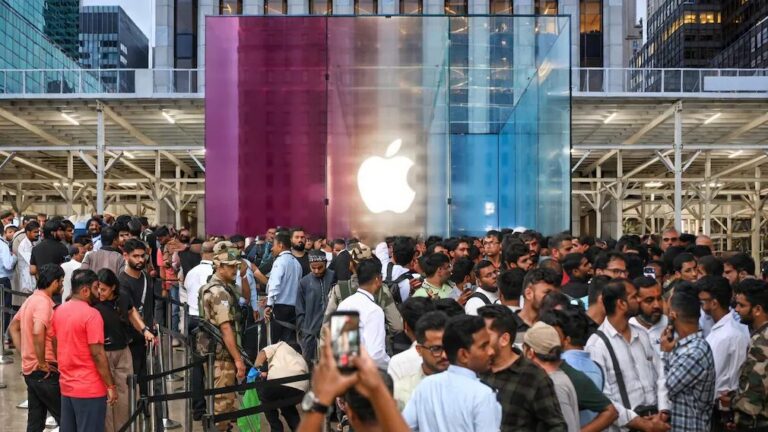
On September 18, 2026, social media was flooded with visuals of people standing in long queues outside Apple Stores in Delhi, Noida, Mumbai, Bengaluru and other Indian cities. Some had apparently been waiting since the previous night, all for one thing: to get their hands on the latest iPhone 18 Pro.

There is something particularly revealing about these visuals. It is not merely that people are willing to spend ₹1,64,900 or more on a smartphone. It is that some are willing to lose an entire night’s sleep and spend several hours standing in a queue to obtain a product that, in several major cities, can now be delivered to their doorstep within minutes.

Blinkit CEO Albinder Dhindsa announced on Friday that the company had partnered with Apple to offer the latest iPhones through quick commerce in cities including Mumbai, Bengaluru, Noida, Delhi, Ahmedabad and Hyderabad. In other words, for a consumer in one of these cities, the iPhone 18 Pro can potentially arrive at home while he is still sitting on his sofa.

Yet people are lining up outside Apple Stores.

That tells us that this is not really a story about convenience, technology or even the urgent need for a new smartphone. It is a story about status, identity, conspicuous consumption and the increasingly powerful psychological need to be seen owning the latest and most expensive gadget.

The iPhone is no longer merely a smartphone

There is nothing inherently extraordinary about wanting an iPhone. Apple’s devices are premium products with a strong ecosystem, capable cameras, powerful processors and long software support. Someone upgrading from an older smartphone can have legitimate reasons for buying the latest model.

But the psychology changes when somebody who already owns a recent flagship decides that he absolutely needs another ₹1.65 lakh smartphone barely a year later.

The iPhone, particularly the Pro models, has become a status object for a section of consumers. It communicates something about its owner before the owner says anything. It can signal wealth, professional success, technological sophistication or membership of a particular aspirational social class.

And unlike a washing machine or an expensive television, the smartphone is constantly visible. It travels with you to the office, restaurants, airports and social gatherings. It sits on the table during meetings and dinners. It appears in photographs. It is displayed on social media.

The phone is therefore not merely something you use.

It is something other people see you using.

That distinction goes a long way towards explaining the frenzy.

When a ₹1.65 lakh phone becomes a measure of social status

The iPhone 18 Pro starts at ₹1,64,900 in India, a ₹30,000 increase over the previous generation’s starting price. In the United States, the corresponding increase was $100.

That pricing disparity is striking, particularly when viewed against India’s broader income levels. India’s per-capita income is nowhere near the price of Apple’s latest Pro iPhone.

Of course, per-capita income should not be mechanically compared with the salary of an individual consumer. India has millions of affluent consumers for whom ₹1.65 lakh is a manageable discretionary purchase. A wealthy individual spending one lakh rupees on a phone is not remotely equivalent to a middle-income worker spending several months’ savings to buy the same device.

But that caveat should not obscure the broader phenomenon.

There are consumers who spend a disproportionately large share of their earnings on premium smartphones primarily because the device allows them to project an image of affluence. That is where consumption stops being about utility and becomes conspicuous consumption.

And there is something worth questioning about that.

A smartphone costing ₹1.65 lakh is not ten times more useful than a ₹25,000 or ₹35,000 smartphone. In many everyday tasks, it isn’t even twice as useful as a good mid-range device. The enormous premium is partly payment for Apple’s ecosystem and engineering, but also for the brand and the social meaning attached to it.

If someone can comfortably afford that premium, that is their choice.

But if somebody earning a modest salary is willing to sacrifice savings, financial security or other priorities merely to ensure that nobody mistakes him for someone who cannot afford the latest iPhone, the purchase deserves more scrutiny than admiration.

There is nothing impressive about appearing wealthy at the expense of actually becoming financially secure. The availability of iPhones on EMI also sought to brighten the illusion of appearing and becoming rich by the dint of owning an iPhone.

So why queue outside the Apple Store?

This is perhaps the most fascinating part.

If the objective is simply to obtain an iPhone 18 Pro, the queue is almost irrational.

Why stand outside a store for six, eight or ten hours when you can order the same phone online and have it delivered to your home?

Because the queue itself has become part of the experience.

Consider the difference between saying, “I ordered my iPhone online, and it arrived in ten minutes,” and saying, “I was outside the Apple Store on launch day and waited for hours to get the new iPhone.”

The second is a story.

It is something to photograph. Something to upload to Instagram. Something to tell friends and colleagues. Something that establishes that you were among the first people to own the latest device.

The consumer is therefore purchasing more than the phone.

He is purchasing the experience of being an early adopter.

The queue becomes free advertising for Apple

There is another psychological phenomenon at work.

A huge queue outside an Apple Store is effectively a giant advertisement for Apple.

A person scrolling through social media sees hundreds of people outside a store. Then he sees another video from another city. Then celebrities post pictures with the new device. Then influencers upload unboxing videos.

The message doesn’t need to be spoken.

Everybody wants it. Therefore it must be desirable.

This is social proof.

Human beings routinely use the behaviour of others as a signal of what is desirable, particularly when they are uncertain about something themselves. When hundreds of people appear willing to spend hours waiting for a product, the spectacle can reinforce the perception that the product is exceptionally desirable.

This can then create a feedback loop.

People see the queues, the queues create excitement, excitement creates FOMO, and FOMO generates more purchases.

That does not prove that Apple deliberately manufactured these queues or artificially created demand. Such a claim would require evidence. But Apple, like every sophisticated consumer brand, undoubtedly understands the enormous marketing value of turning a product launch into an event.

The FOMO economy

Apple does not necessarily need to convince every existing iPhone owner that the iPhone 18 Pro is dramatically better than the iPhone 17 Pro.

It needs to convince enough people that everybody else is upgrading.

That is where FOMO enters.

For somebody using a five-year-old smartphone, upgrading can be a genuine technological improvement. But for somebody replacing a perfectly functional recent flagship, the psychological motivation can be very different.

The fear isn’t necessarily that the old phone won’t work.

It is that the owner will no longer have the newest one.

That is an important distinction.

The consumer is not necessarily asking, “Does this phone solve a problem I have?”

He is asking, consciously or otherwise, “Does owning this phone make me look more successful?”

That is precisely the kind of psychological trigger on which luxury and premium consumer brands thrive.

The celebrity factor

The celebrity amplification surrounding the launch adds another layer.

Social media users noticed celebrities including Riteish Deshmukh, Shilpa Shetty, Genelia D’Souza and Neha Dhupia showcasing the new iPhone around the launch. Triptii Dimri was at the Apple headquarters for the launch of the new iPhone. Vicky Kaushal was clicked at the Apple BKC store on Friday morning.

The timing naturally prompted speculation about coordinated promotional activity. But timing alone cannot establish that a particular post was paid advertising; that would require evidence of a commercial relationship or appropriate disclosure.

Nevertheless, celebrity marketing works because it doesn’t merely sell specifications.

It sells aspiration.

The celebrity isn’t necessarily telling the audience that the camera has improved or that the processor is faster. The celebrity is showing the audience what a certain lifestyle looks like, and placing the iPhone inside that lifestyle.

The implicit message becomes:

People who live this kind of life use this phone.

And some consumers respond by wanting the same symbol.

There is something slightly absurd about the launch-day ritual

Standing in a queue for hours to buy something that could have been delivered to your home in minutes is, from a purely practical perspective, difficult to justify.

But consumer behaviour is rarely purely practical.

People go to luxury stores even when the same products can be ordered online. They travel hundreds of kilometres to attend concerts when the music is available on streaming platforms. They queue for hours at restaurants when other restaurants serve perfectly good food without a waiting list.

The experience matters.

The problem arises when the experience becomes a justification for excessive spending.

There is a difference between a wealthy consumer treating himself to an expensive gadget and someone making a financially disproportionate purchase simply because he wants to project an image of success.

The latter is particularly ironic.

If you have to compromise your financial stability to look rich, the expensive smartphone isn’t proof that you have made it. It may be proof that you desperately want other people to think you have.

The queue also creates a psychological commitment

There is another curious element to this behaviour.

Imagine spending eight hours outside an Apple Store.

After sacrificing an entire night, standing in the heat or cold, travelling to the store and finally getting the phone, it becomes psychologically uncomfortable to conclude that the entire exercise was unnecessary.

This is where effort justification comes into play.

The greater the effort invested in acquiring something, the stronger the psychological tendency can be to convince oneself that the object was worth that effort.

The queue therefore becomes self-reinforcing.

After spending half a day waiting, the buyer has an emotional incentive to believe that he has acquired something genuinely extraordinary.

Otherwise, he has to confront an uncomfortable question:

Why did I waste eight hours to buy something that could have arrived at my doorstep while I was sleeping?

Apple has mastered the art of making a product launch feel like a cultural event.t

This is where Apple’s marketing genius lies.

The company isn’t merely launching hardware.

It is creating a moment.

The Store becomes the theatre. The queue becomes the spectacle. The early buyer becomes the protagonist. The unboxing becomes content. Celebrities amplify the message. Social media distributes it to millions of potential customers.

The actual technological upgrade becomes only one component of the product’s perceived value.

The rest comes from the brand.

And that is why Apple can command prices that would have seemed absurd for a smartphone not very long ago.

The uncomfortable question Indians should ask themselves

There is nothing wrong with buying an expensive smartphone.

There is nothing wrong with liking Apple.

There is nothing wrong with wanting the latest technology.

But perhaps consumers should occasionally ask themselves a brutally simple question before spending ₹1.65 lakh on a phone:

“Am I buying this because I need it, because I genuinely enjoy it, or because I want other people to know that I can afford it?”

There is a meaningful difference between those three motivations.

If the first two apply and the purchase is financially comfortable, there is little to debate.

But if the third is the primary motivation, the buyer is effectively paying Apple ₹1.65 lakh to rent a status symbol.

And that is where the spectacle of hundreds of people queuing outside Apple Stores becomes more than amusing.

It becomes a commentary on modern consumer culture.

In a country where financial security, savings and wealth creation should arguably matter far more than displaying an expensive gadget, there is something deeply ironic about people sacrificing hours of their time — and, in some cases, a disproportionate share of their earnings — merely to become the first person in their social circle to own the latest iPhone.

The most revealing part isn’t that these people want the iPhone 18 Pro.

It is that some appear to want everyone else to know that they have it.

And perhaps that is Apple’s greatest achievement. It has turned a smartphone into a badge of social status, a product launch into a cultural event,t and a queue outside a retail store into free advertising.

The phone may fit inside your pocket.

But for some consumers, the status attached to it has become much bigger than the device itself.

Mahua Moitra moves to the UN over alleged exclusion of Muslim officers in Bengal: How TMC MP turned routine deployment into a communal controversy

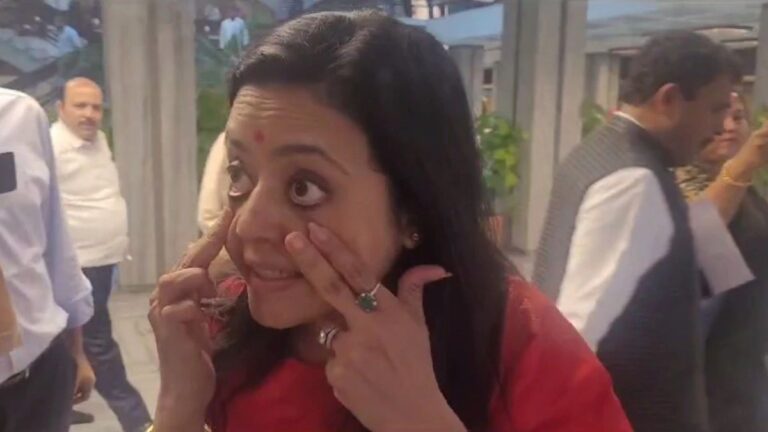
Mahua Moitra appears to have discovered a familiar political formula: if an allegation cannot be sufficiently established at home, take it abroad and give it the appearance of an international human-rights scandal.

The Trinamool Congress MP has now approached the UN Special Rapporteur on Minority Issues, alleging that three senior Muslim IAS and IPS officers in West Bengal were excluded from official engagements during Union Home Minister Amit Shah’s visits because of their religion. She has named Siliguri Police Commissioner Waquar Raza, West Bengal Police STF chief Jawed Shamim and IAS officer Khalil Ahmed.

The allegation is serious. The evidence, however, is conspicuously missing.

And that is precisely what makes Moitra’s decision to internationalise the matter so curious.

First, establish discrimination. Then call it discrimination

Moitra’s argument appears straightforward: these three officers are Muslims, they were allegedly excluded from particular events, and officers belonging to other communities were present.

Therefore, she concludes, they were excluded because they are Muslim.

But that is an inference, not proof.
If the allegation is religious discrimination, the obvious question is: where is the evidence establishing the religious motive?

Where is the written instruction?

Where is the communication telling officials not to allow a particular officer because he is Muslim?

Where is the contemporaneous record establishing that religion, rather than protocol, administrative responsibilities, security arrangements or the nature of the particular meeting, was the reason?

None of that evidence has been publicly produced.

In fact, PTI specifically reported that Moitra’s allegations could not be independently verified.

That should have been the point at which a responsible political debate asked for evidence.

Instead, Moitra has taken the allegation to the UN.

When evidence is missing, internationalise the allegation

This is where the entire exercise begins to look like political sensationalism.

Instead of first establishing the facts through the relevant Indian administrative and legal mechanisms, she has chosen to internationalise the allegation.

The political utility is obvious.

A dispute over who attended which official meeting suddenly becomes “religious discrimination in India”. A claim made by a politician becomes a matter supposedly requiring the attention of a UN human-rights mechanism.

The allegation gets international branding before it gets domestic verification.

And that is precisely where the exercise becomes questionable.

If Moitra possesses evidence that senior government officials were excluded specifically because they were Muslims, she should produce it.

If there is an official order, let the order be examined.

If there is CCTV footage, let it be released.

If there are witnesses, let their accounts be tested.

But simply pointing to the religion of three officers and their alleged absence from certain events does not establish discriminatory intent.

The UN is not a court over India

Moitra’s appeal to the UN also appears designed to give the allegation greater weight than it currently possesses.

The relevant UN Special Procedures mechanism can receive allegations and communicate with governments, but it is not a court. The Office of the UN High Commissioner for Human Rights states that the Special Procedures complaints process is not quasi-judicial, and that mandate-holders have no power to enforce their views or recommendations.

Therefore, if the Special Rapporteur seeks an explanation from New Delhi, that does not mean that the UN has found India guilty of religious discrimination.

It means precisely what it says: information has been sought regarding an allegation.

There is a world of difference between the two.

And then there is Mahua Moitra’s own record of attacking Amit Shah

The context becomes even more interesting when one considers Moitra’s long-running political confrontation with Amit Shah.

In August 2025, while attacking Shah over illegal immigration from Bangladesh, Moitra made the extraordinary remark that if people were entering India in large numbers, “Amit Shah’s head should be cut off and put on the table.” She subsequently defended the statement as an idiom about accountability, arguing that critics had misunderstood the expression.

That history does not prove anything about the present allegation, and it would be wrong to suggest otherwise.

But it does provide political context.

Moitra is hardly approaching Amit Shah from the position of a detached observer who has suddenly discovered an administrative irregularity. She has repeatedly made Shah a target of her political attacks.

Now, an allegation concerning three officers at Shah’s official programmes has been escalated into a complaint to a UN human-rights expert.

The pattern is difficult to miss: a domestic political confrontation is being given an international human-rights frame.

Is the absence of a Muslim officer automatically discrimination?

Moitra’s line of argument also risks creating a peculiar and deeply reductive standard: if Muslim officers are not present at a particular official engagement, should that automatically be treated as evidence of religious discrimination?

If that becomes the standard, the composition of every government meeting could become a communal headcount, with the absence of an officer from a particular religious community being presented as proof of institutional discrimination.

India is home to several minority communities: Christians, Jains, Buddhists, Sikhs, Jews and others. Yet Moitra’s intervention is specifically centred on the representation of Muslim officers.

That raises a legitimate question: why should the absence of Muslim officers automatically invite international scrutiny while the absence of officers belonging to other minority communities does not? Are Christians, Jains, Sikhs or Jews any less deserving of concern when it comes to equal treatment and representation?

The answer should be obvious: public institutions should not operate on the principle that one minority community deserves greater political attention than another.

More importantly, the Civil Services should not be reduced to a religious headcount.

IAS and IPS officers should be judged by merit, not religion

An IAS or IPS officer should be judged by competence, integrity, experience and performance, not by whether he or she belongs to a particular caste or religious community.

An officer who has demonstrated professional ability should be given responsibility because of that record. Conversely, an officer should not be elevated, included or excluded simply to satisfy a communal arithmetic.

This is not an argument against protecting minorities from genuine discrimination. If an officer is denied an opportunity solely because of religion, that should be investigated.

But there is an important difference between preventing discrimination and demanding that every official setting reflect religious representation.

The former protects equality. The latter risks turning public administration into identity politics.

And when accomplished civil servants are repeatedly introduced primarily as “Muslim IAS officers” or “Muslim IPS officers”, there is an unintended irony: those very officers are being reduced to their religion rather than recognised for their professional achievements.

The politics of communalising an administrative question

There is also an unavoidable political dimension to Moitra’s intervention.

West Bengal has a substantial Muslim population, and her Krishnanagar constituency is part of that political landscape. That does not, by itself, establish her motive for making this complaint, and attributing motives without evidence would simply repeat the very mistake being criticised.

But the political effect of her framing is clear enough.

An issue that could have been examined through official records is being presented as a Hindu-versus-Muslim confrontation involving the Union Home Minister.

That risks sowing a division that the evidence presently available does not establish.

And when politicians repeatedly tell citizens that routine administrative decisions should be interpreted through the prism of religious identity, they risk doing precisely the opposite of what they claim to be defending.

Secularism does not mean ensuring that every meeting contains a prescribed number of people from every religious community. It means that citizens and public servants are entitled to equal treatment irrespective of their religion.

If there is evidence that this principle was violated, produce it.

If there isn’t, manufacturing a communal interpretation only deepens the divide.

The easy politics of throwing dirt

When Moitra approached the UN, her move appears less about safeguarding the rights of the Muslim officers and more about manufacturing a political controversy by amplifying unverified yet sensational allegations of religious discrimination.

There is a straightforward way to establish her claim: produce the evidence.

Instead, the allegation has been escalated to an international forum, where the mere existence of a UN communication could itself generate headlines and lend an aura of credibility to a claim that remains unproven.

That is the easy route in political communication: make the most damaging allegation possible, attach a communal dimension to it and then seek an international audience.

The allegation travels faster than the evidence.

And once it reaches an international forum, the original question — what exactly happened and why? — risks disappearing beneath the political narrative.

If there is discrimination, prove it

Nobody should object to genuine discrimination being investigated. If any government official is excluded from an official function solely because of religion, that would be a serious matter.

But serious allegations demand serious evidence.

Moitra has not publicly established that the three officers were excluded because they are Muslim. The available reporting itself notes that the allegations have not been independently verified.

Perhaps the records she has asked the UN to seek will establish something more. Perhaps they will not.

Until then, however, the accusation remains an allegation.

Internationalisation cannot substitute for evidence

There is nothing wrong with investigating genuine discrimination. But there is something fundamentally wrong with manufacturing discrimination from circumstances that have not established it.

Moitra has taken an unverified allegation, attached the strongest possible interpretation to it, invoked international human-rights norms and then asked a UN rapporteur to investigate.

That is a remarkably convenient way of shifting the debate from “prove that discrimination happened” to “why isn’t the UN investigating discrimination?”

The second question sounds far more sensational than the first.

But the first remains the only question that actually matters.

If Mahua Moitra has evidence that Muslim IAS and IPS officers were deliberately excluded because of their religion, she should produce it. If she does not, internationalising the allegation does not make it any more credible. It merely gives a political accusation an international stage.

And no UN letter can turn an unproven allegation into a fact.

UPI MDR explained: What the new 0.4% merchant charge means and why the fearmongering around it is misleading

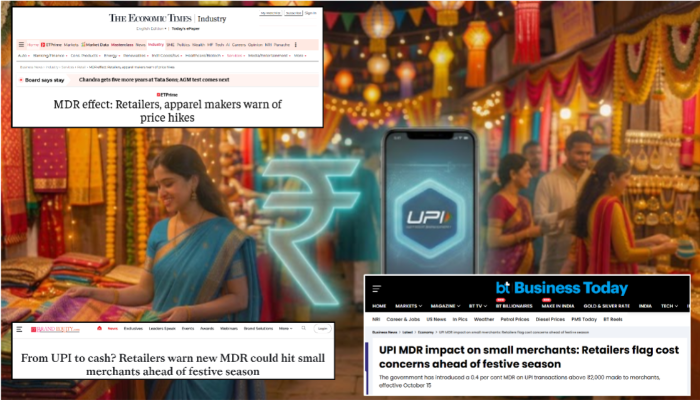
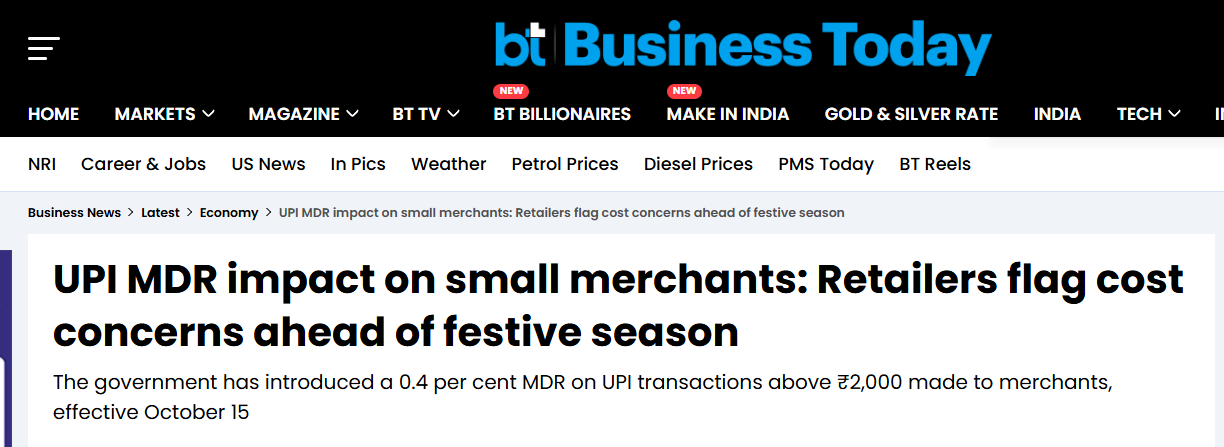
On 15th September (Tuesday), National Payments Corporation (NPCI) of India announced that transactions exceeding Rs 2,000 will be subject to a 0.4% Merchant Discount Rate (MDR). This is going to come into effect from 15th October but will not apply to person-to-person transactions, which will continue to remain free. Moreover, the MDR would be limited to Rs 300 for each transaction totalling Rs 75,000 or more.

MDR constitutes a fee that merchants must bear upon accepting payment transactions via credit or debit card instruments, which is computed as a percentage of the transaction value and is subtracted from the total payment by the bank before the remaining amount is received.

Since the development, an attempt appears to be underway to stoke panic, particularly among the business community and consumers, with the festival season approaching. Their concerns should certainly be heard and addressed, but turning the decision into a story of impending economic doom without weighing the facts only fuels unnecessary alarm and sensationalism.

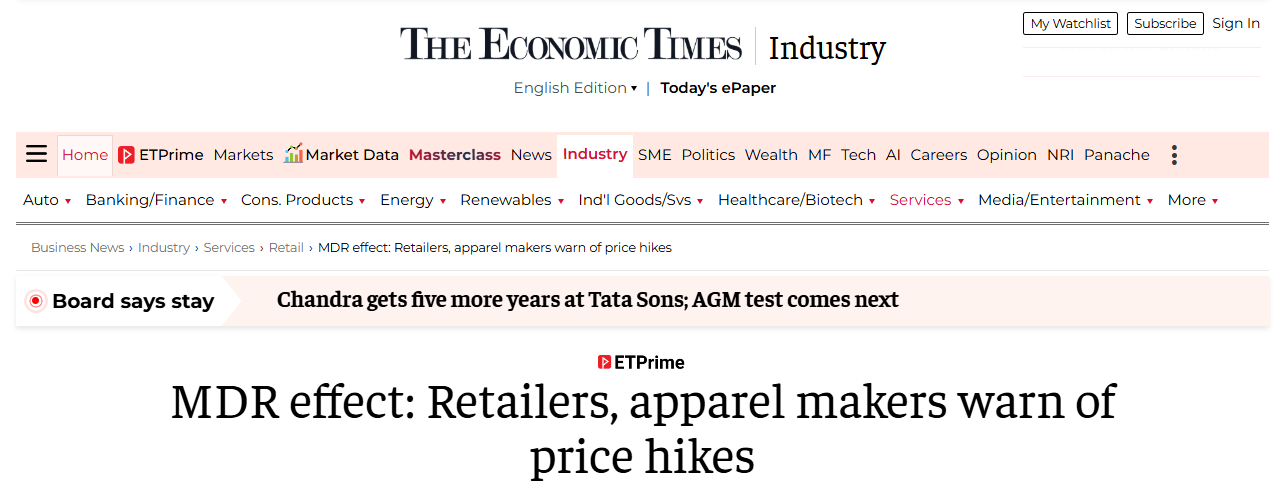
The Economic Times carried a report titled, “MDR effect: Retailers, apparel makers warn of price hikes,” which read, “There is a palpable consensus among retailers and clothing manufacturers that consumer prices are bound to increase with the 0.4% merchant discount rate (MDR) levy on high-value UPI deals ahead of festive season, despite the government’s notification that clearly prevents retailers from directly passing on the MDR charges to consumers.”

It featured statements regarding their current struggle with inflation and elevated logistics expenditures stemming from the geopolitical tensions present in West Asia. The article stated that the decision was reached during an exceptionally hard period for merchants, retailers and consumer-oriented enterprises, “many of whom are already working hard to revive demand and improve margins.”

It claimed that MDR could impose more strain on smaller retail operations functioning with limited profit margins, and potentially redirect transactions toward cash payments rather than digital channels.

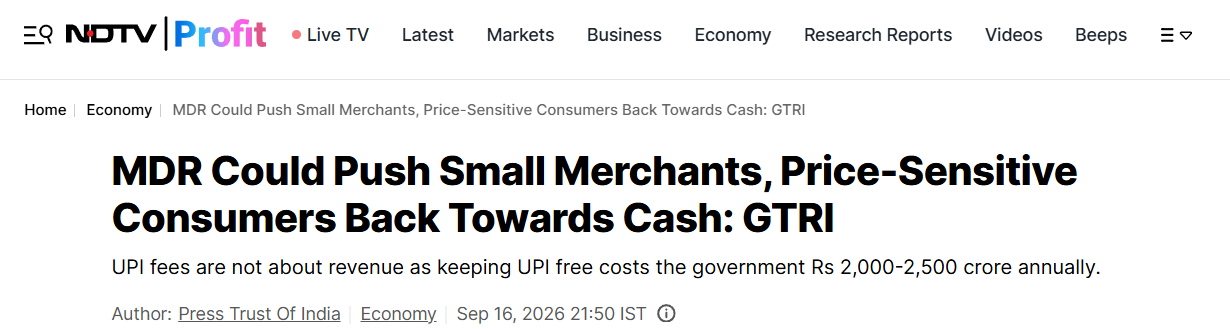
However, The Economic Times was far from alone. Other media outlets such as Business Today, Brand Equity and NDTV also published similar pieces, following the same narrative, arguing that the rules could hurt small merchants, particularly with the upcoming festivitives are expected to bring a surge in business.

It was also alleged that customers could shift back to cash, abandoning digital payments at a time when India’s digital payment ecosystem has become an integral part of everyday transactions. This would also reduce the digital trail tied to the sales.

NDTV Profit’s article included a comment from Global Trade Research Initiative (GTRI) founder Ajay Srivastava, who expressed, “MDR could push small merchants and price-sensitive consumers back towards cash.” He further implied that influence from the United States was instrumental in the decision, an unfounded accusation also raised by the opposition and firmly rejected by the centre.

“Brazil refused to weaken Pix, its UPI-like public payment system, despite US pressure and an additional 25% tariff. India should have shown similar resolve. The government can easily afford free UPI, weakening it would impose far greater economic and strategic costs on India. And the US may soon press for restrictions on the RuPay card and withdrawal of NPCI’s proposed 30% market-share cap,” stressed on social media.

He even drew a comparison between the “tiny” UPI subsidy and the portion dedicated to food, fertilisers, agricultural credit, petroleum and Liquefied Petroleum Gas (LPG), implying that the government could similarly spend more to support the digital payments sector.

Beyond the headlines: Taking a closer look at the claims

It is important to highlight that India is not the only nation to introduce these charges. In fact, merchant fees within Brazil’s PIX framework average 0.33% despite the misleading assertions, while those in China are approximately 0.40%. The NPCI highlighted, “Most global payment systems (including Digital Public Infrastructures) have economic models that support infrastructure and innovation. India’s approach continues to prioritise accessibility, scale and inclusion.”

It further clarified, “UPI is a home-grown payment system, and its charges are much lower than other payment instruments such as credit cards, debit cards, wallets, etc.” The official release added that the pricing structure has been deliberately maintained at modest levels to guarantee that UPI continues to serve as the most economical payment acceptance method available.

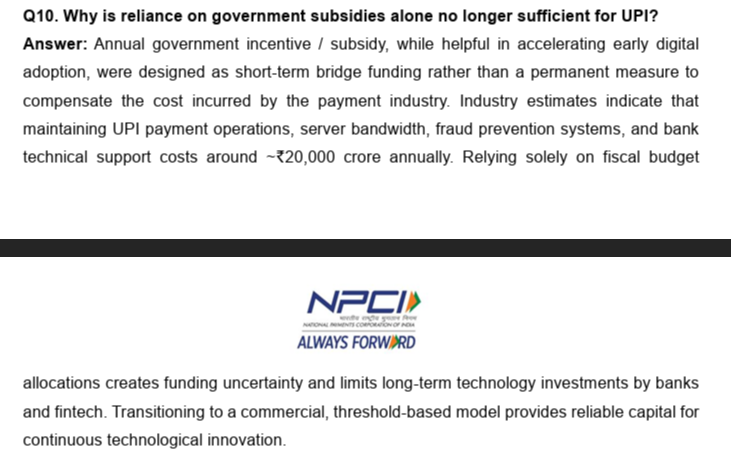
It was also emphasised that depending merely on government subsidies proves inadequate for UPI, and consequently the objective of this initiative has been to identify a viable solution to overcome this obstacle. NPCI outlined, “Annual government incentive/subsidy, while helpful in accelerating early digital adoption, was designed as short-term bridge funding rather than a permanent measure to compensate the cost incurred by the payment industry.”

It conveyed, “Industry estimates indicate that maintaining UPI payment operations, server bandwidth, fraud prevention systems, and bank technical support costs around ~ Rs 20,000 crore annually. Relying solely on fiscal budget allocations creates funding uncertainty and limits long-term technology investments by banks and fintech (financial technology). Transitioning to a commercial, threshold-based model provides reliable capital for continuous technological innovation.”

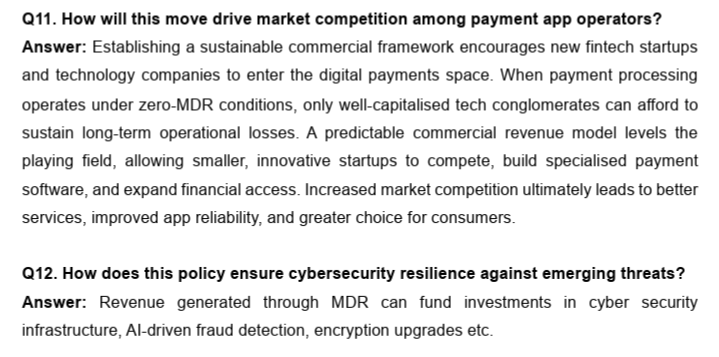
Contrary to the claims of a downfall of the digital economy, the NPCI noted that the move will encourage new fintech startups and tech firms to enter the digital payments market by creating a sustainable business structure.

Underscoring the fundamental reasoning behind this strategic action, the statement mentioned that only well-capitalised IT conglomerates can afford to sustain long-term operational losses when payment processing is conducted under zero-MDR conditions.

It stated, “A predictable commercial revenue model levels the playing field, allowing smaller, innovative startups to compete, build specialised payment software, and expand financial access. Increased market competition ultimately leads to better services, improved app reliability, and greater choice for consumers.”

“Revenue generated through MDR can fund investments in cyber security infrastructure, AI-driven fraud detection, encryption upgrades, etc.,” the statement highlighted.

The truth is that even with the implementation of a 0.4% MDR, UPI stands as the most economical payment channel, specifically in comparison with conventional credit and debit card options. The impact on small vendors and retailers would be negligible, as their transaction amounts generally remain within the prescribed boundaries.

The Reserve Bank of India, which founded the NPCI and oversees MDR rates, likewise stressed the significance of this decision in “strengthening the long-term sustainability of India’s digital payments ecosystem.”

“It will help UPI in continuing to scale, innovate and serve consumers and businesses across the country. A fair and appropriate distribution of MDR across ecosystem participants will support continued investment in technology, infrastructure and acceptance networks. This, in turn, can enable wider UPI acceptance, deepen the customer base and support sustained growth in transaction volumes,” the central bank wrote.

Conclusion

The fundamental reality is that MDR has maintained a zero per cent rate for UPI and RuPay debit card transactions since 2020, reflecting the government’s commitment to advancing digital payment adoption. Nevertheless, it is equally evident that supporting UPI independently through government funding has become impractical given its broad expansion, ambitious future objectives and the need to attract engagement from more companies.

More importantly, over 95% of all UPI P2M (person-to-merchant) transactions are of small value, up to Rs 2,000 for all merchants, which will not witness any change. The P2PM (person-to-person merchant) category supports small vendors to receive Rs 1 lakh monthly through UPI QR payments straight into their bank accounts, acting as an anchor between digital payments and the unorganised retail sector.

Furthermore, comparing the subsidy for UPI with spending on food, fertilisers or fuel misses the larger picture. As India expands its digital footprint, these sectors remain tied to basic necessities and the everyday lives of a far larger section of the population. It is therefore only natural that they command greater priority and are awarded a much larger share of government allocations.

However, the usual detractors are already searching for “signs” of external pressure and conspiracy theories to attack the move, as they often do with every government decision. Of course, genuine concerns and problems brought forth by those affected should certainly be heard and addressed, but using them as a pretext for fear-mongering while ignoring the facts only hurts their cause.

However, those solely invested in pushing an agenda are unlikely to concern themselves with inconvenient details like truth is quite evident in the current scenario as well.

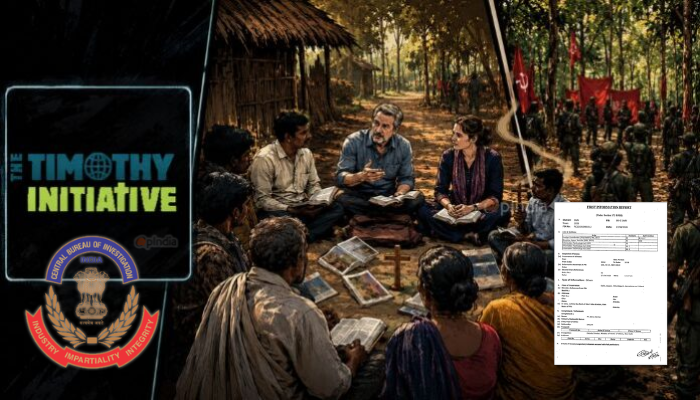
OpIndia Impact: CBI books US Christian missionary group The Timothy Initiative, its Indian functionaries over FCRA violations and LWE; read FIR details and what our investigation found

In a major success for the extensive reporting by OpIndia into the illegal activities of the US-based Christian missionary group The Timothy Initiative (TTI), the Central Bureau of Investigation (CBI) registered an FIR over alleged violations of the Foreign Contribution Regulation Act (FCRA). The Timothy Initiative received Rs 92.55 crore between November 2025 and April 2026, and used the funds for illegal Christian conversion activities.

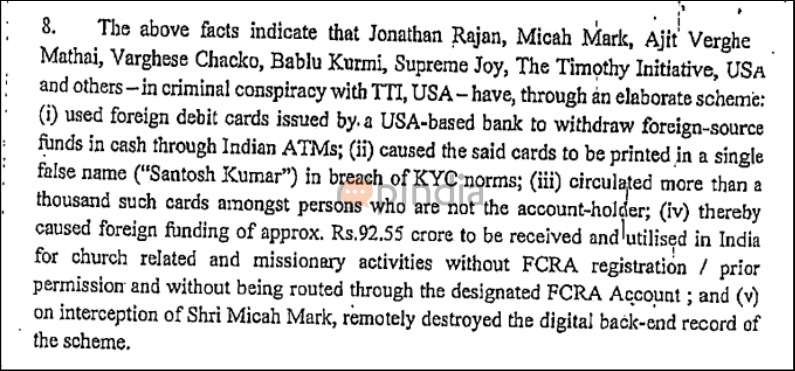
The CBI has booked TTI’s India operations head Jonathan Rajan, India financial head Ajit Varghese Mathai, Micah Mark, Varghese Chacko, and TTI.

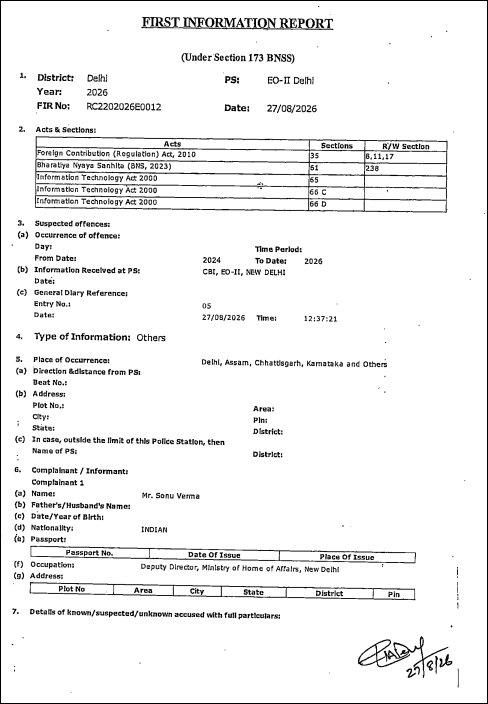
While news of CBI’s action against the Timothy Initiative and its operatives in India has surfaced in public now, the FIR was registered on 27th August 2026.

OpIndia has accessed the FIR copy, which makes startling revelations about the alleged flouting of the FCRA rules by The Timothy Initiative and its workers in India.

The Timothy Initiative and its officials in India conspired to use Rs 92.55 crore foreign funds for illegal activities in India

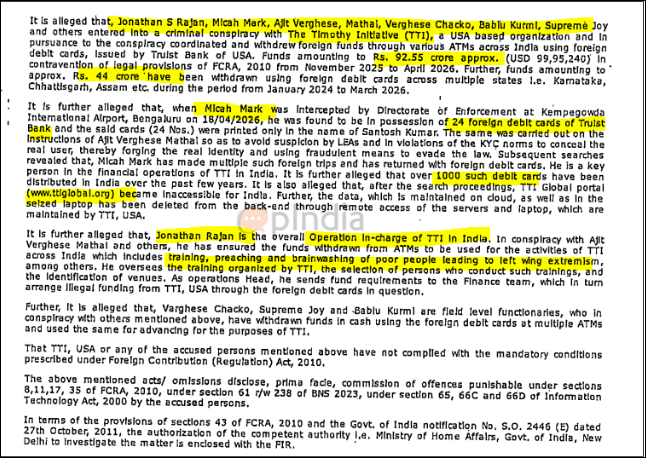
The FIR states that Jonathan S Rajan, Micah Mark, Ajit Verghese, Mathal, Verghese Chacko, Bablu Kurmi, Supreme Joy and others hatched a criminal conspiracy with The Timothy Initiative (TTI). The accused coordinated and withdrew foreign funds up to Rs 92.55 crore through various ATMs across India using foreign debit cards, issued by Truist Bank of the USA.

In addition to this, Rs 44 crore was withdrawn using foreign debit cards in Karnataka, Chhattisgarh, Assam and other states, between January 2024 and March 2026.

“Funds amounting to Rs. 92.55 crore approx. (USD 99,95,240) in contravention of legal provisions of FCRA, 2010 from November 2025 to April 2026. Further, funds amounting to approx. Rs. 44 crores have been withdrawn using foreign debit cards across multiple states i.e. Karnataka, Chhattisgarh, Assam etc., during the period from January 2024 to March 2026,” the FIR states.

1000s of Truist Bank of USA debit cards distributed across India since 2024

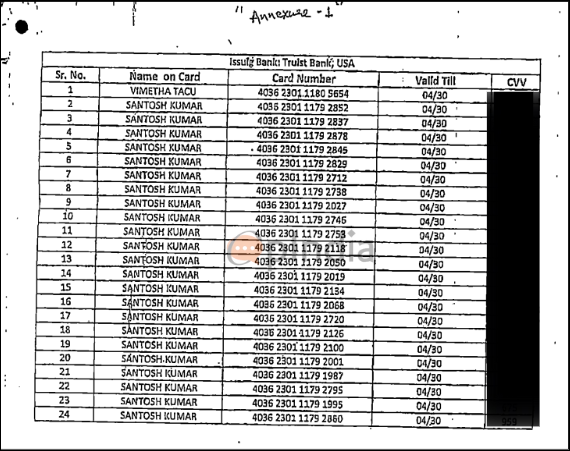
Further, the CBI FIR states that when Micah Mark was intercepted by the Enforcement Directorate (ED) officials at the Kempegowda International Airport in Bengaluru on 18th April 2026, they found 24 foreign debit cards of Truist Bank of USA in his possession. These cards were printed in the name of one Santosh Kumar, on the instructions of accused Ajit Varghese Mathai, to dodge suspicion by law enforcement agencies.

The CBI stated that this act was in violation of the Know Your Customer (KYC) norm to hide the real user and use fraudulent means to evade the law.

“It Is further alleged that, when Micah Mark was intercepted by Directorate of Enforcement at Kempegowda International Airport, Bengaluru on 18/04/2026, he was found to be in possession of 24 foreign debit cards of Truist Bank and the said cards (24 Nos.) were printed under a single false name, Santosh Kumar. The same was carried out on the instructions of Ajit Verghese Mathal so as to avoid suspicion by LEAs and In violations of the KYC norms to conceal the real user, thereby forging the real identity and using fraudulent means to evade the law,” the FIR reads.

Further investigation revealed that accused Micah Mark made multiple such foreign trips and has returned with foreign debit cards. The CBI described Micah Mark as a “key person in the financial operations of TTI In India.”

The authorities have also alleged that over 1000 such debit cards have been distributed in India over the past few years.

In addition, after an investigation was launched into the illegal activities of The Timothy Initiative, the TTI Global portal (www.ttlglobal.org) became inaccessible in India.

Moreover, all the data stored on the cloud servers and the laptops seized by the police was deleted from the back-end through remote access to the servers and laptops, which are maintained by TTI, USA.

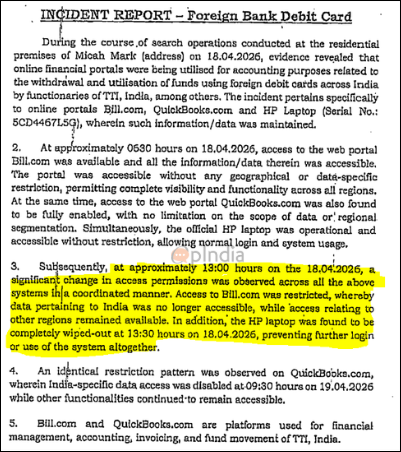
The incident report filed earlier gives details about how, when the authorities conducted search operations at the residence of Micah Mark on 18th June 2026, online financial portals Bill.com and QuickBooks.com and an HP laptop were being used for accounting purposes related to the withdrawal and utilisation of funds using foreign debit cards across India by functionaries of TTI, India, among others.

However, within hours, the investigators noted a significant change in access permissions across all the above systems in a “coordinated manner”.

“Access to Bill.com was restricted, whereby data pertaining to India was no longer accessible, while access relating to other regions remained available. In addition, the HP laptop was found to be completely wiped out at 13:30 hours on 18.04.2026, preventing further login or use of the system altogether,” the Incident Report stated.

TTI’s activities included pumping illegal funding into India for training, preaching and brainwashing of poor people to fuel Left Wing Extremism (LWE)

The probe agency also alleged that Jonathan Rajan was the overall “operation-in-charge” of TTI in India. Rajan colluded with Ajit Verghese Mathai and others to ensure that the funds withdrawn from ATMs are used for the activities of TTI across India, which include training, preaching and brainwashing of poor people leading to left-wing extremism, among others.

As the FIR, Jonathan Rajan oversees the training organised by The Timothy Initiative, the selection of persons who conduct such trainings, and the identification of venues. As operations head, Rajan sends fund requirements to the finance team, which in turn arrange illegal funding from TTI, USA through the foreign debit cards in question.

About the role of Varghese Chacko, Supreme Joy and Bablu Kurmi, the FIR states that they are field-level functionaries who withdrew funds in cash using the illegal foreign debit cards at multiple ATMs and thereafter, these funds were utilised for Christian proselytisation activities and for promoting Left Wing Extremism.

The Timothy Initiative, the CBI FIR states, did not comply with the mandatory conditions prescribed under the Foreign Contribution (Regulation) Act, 2010.

It has, thus, been alleged that the accused persons committed offences punishable under sections 8,11,17, 35 of FCRA, 2010, under section 61 r/w 238 of BNS 2023, under sections 65, 66C and 66D of the Information Technology Act, 2000.

“The above-mentioned acts/ omissions disclose, prima facie, commission of offences punishable under sections 8,11,17, 35 of FCRA, 2010, under section 61 r/w 238 of BNS 2023, under sections 65, 66C and 66D of the Information Technology Act, 2000 by the accused persons. In terms of the provisions of section 43 of FCRA, 2010 and the Govt, of India notification No, S.O. 2446 (E) dated 27th October, 2011, the authorization of the competent authority i.e. Ministry of Home Affairs, Govt, of India, New Delhi to investigate the matter is enclosed with the FIR,” the FIR reads.

OpIndia reported extensively about The Timothy Initiative and how it was blatantly violating Indian laws to pursue its Christian conversion agenda

In past few months, OpIndia has published an extensive series covering the history, agenda, activities, their footprint in India, and the alleged FCRA violations.

The criminal case against US-based Christian missionary group The Timothy Initiative and its members originated from an investigation initiated by the Enforcement Directorate under the Foreign Exchange Management Act (FEMA). According to the investigating agency, Micah Mark is the key person handling TTI’s financial operations in India.

As reported earlier, Mark was intercepted at Kempegowda International Airport in Bengaluru on 18th April 2026. Upon being searched, he was found carrying 24 foreign debit cards issued by Truist Bank in the United States. The ED informed the court that all 24 cards were printed in the name of “Santosh Kumar”, a common name in India. Earlier cards were reportedly issued using regional descriptions such as “NE-1”, “NE-2” and “Southern Region-1”.

The ED stated that the common name was deliberately used to conceal the identities of the actual users and was intended to bypass Know Your Customer requirements and prevent law enforcement agencies from tracing the cards to the individuals operating them.

The probe agency said more than 1,000 such debit cards had been distributed across India over several years. The cards were used by TTI functionaries to withdraw foreign funds from Indian ATMs in repeated transactions, usually amounting to Rs 10,000 each.

The ED’s preliminary examination had found that around Rs 92.55 crore, equivalent to approximately USD 9.99 million, was utilised in India between November 2025 and April 2026 through this mechanism. It further found that approximately Rs 44 crore was withdrawn using foreign debit cards across Karnataka, Chhattisgarh, Assam and other states between January 2024 and March 2026.

The ED particularly flagged withdrawals in the Left Wing Extremism (LWE)-affected Dhamtari and Bastar regions of Chhattisgarh. It said around Rs 6.34 crore was withdrawn in these regions over the past few years.

Of this, approximately Rs 3.2 crore was withdrawn through 3,200 transactions of Rs 10,000 each from a single AU Small Finance Bank ATM located at Vijay Plaza on Bastar Road in Dhamtari. The withdrawals were made using two foreign debit cards. The ED said such systematic cash withdrawals had taken place under the supervision of Varghese Chacko.

The Enforcement Directorate uncovered a parallel cash-based financial network in Naxal-affected areas, which posed “a serious threat to the security and financial integrity of India” and could facilitate the movement of illicit funds for unlawful activities.

In its complaint to the Karnataka Police, ED had said that shortly after its search operation, TTI’s global portal became inaccessible to users in India. The data maintained on cloud servers was also made inaccessible.

In June 2026, the Karnataka High Court dismissed petitions seeking the quashing of a criminal case registered under the Unlawful Activities (Prevention) Act (UAPA) against The Timothy Initiative and its six Indian operatives.

What OpIndia investigation found about The Timothy Initiative

During the OpIndia investigation, we uncovered how The Timothy Initiative built its India network, how foreign churches supported its activities and how funds from abroad were directed into India even as the US-based organisation did not have an FCRA approval, which was the core of the ED’s investigation.

The TTI began as “Project India” in 2009 and was later rebranded as TTI in 2009. Its founder, David Nelms, had first come to India in 1992, and the organisation later developed a structured church-planting model focused on India and other countries.

The TTI’s model was constructed around creating groups of local religious workers, describing them as Pauls, Timothys and Tituses. The model projected low-cost house churches, with each unit requiring only a few hundred dollars to plant.

The Timothy Initiative’s India-centric operations were not standalone; rather, the missionary group remains connected with a massive ecosystem of foreign churches, including Kensington Church, Mission Grove Church, Northwest Baptist Church, Wooddale Church, Rise City Church, Mission Hills Church, First Presbyterian Church of Hanford, Springbrook Community Church, the Baptist General Conference of Canada, Liberty Church Network, All Access International, Saltbox Church and Woodside Bible Church.

Most of these churches are situated in the US and Canada. These churches primarily focus on church planting, pastor training, field visits and funding targets. The TTI’s own training and operational material demonstrated how the organisation trained local workers to enter Hindu-dominated villages, approach Hindus, avoid suspicion, use local social structures and identify caste leaders for outreach, with the ultimate goal of converting more and more non-Christians to Christianity.

OpIndia repeatedly pressed that the case of The Timothy Initiative was a lot more than FCRA and FEMA violations, and pertains to national security. Now, the CBI has taken the fight against foreign entities operating with the agenda of altering India’s religious demographics and fueling left-wing terrorism, a step further.

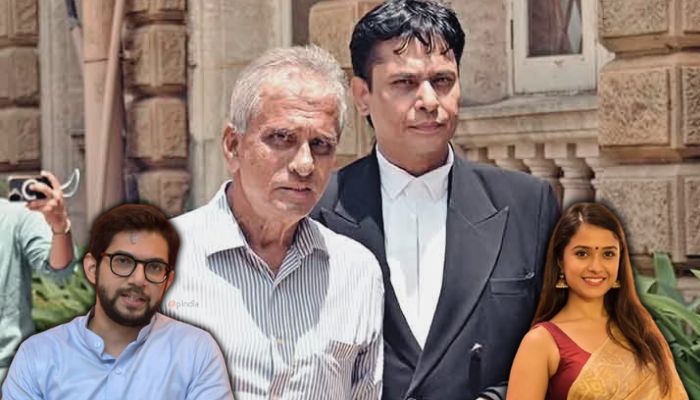
‘Disha Salian was gang-raped and murdered as part of a well-orchestrated criminal conspiracy to protect Aaditya Thackeray and others’: Read what the FIR says

0

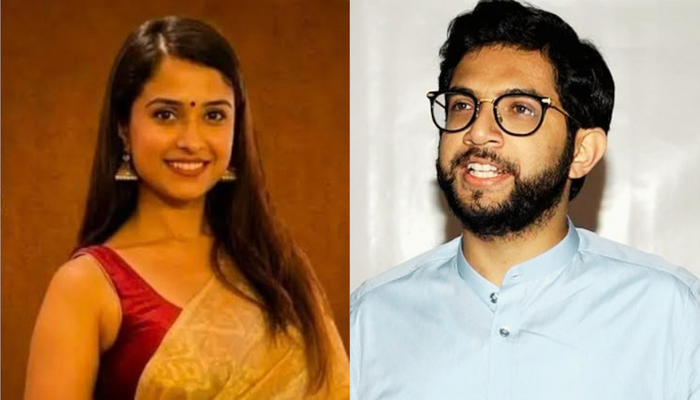
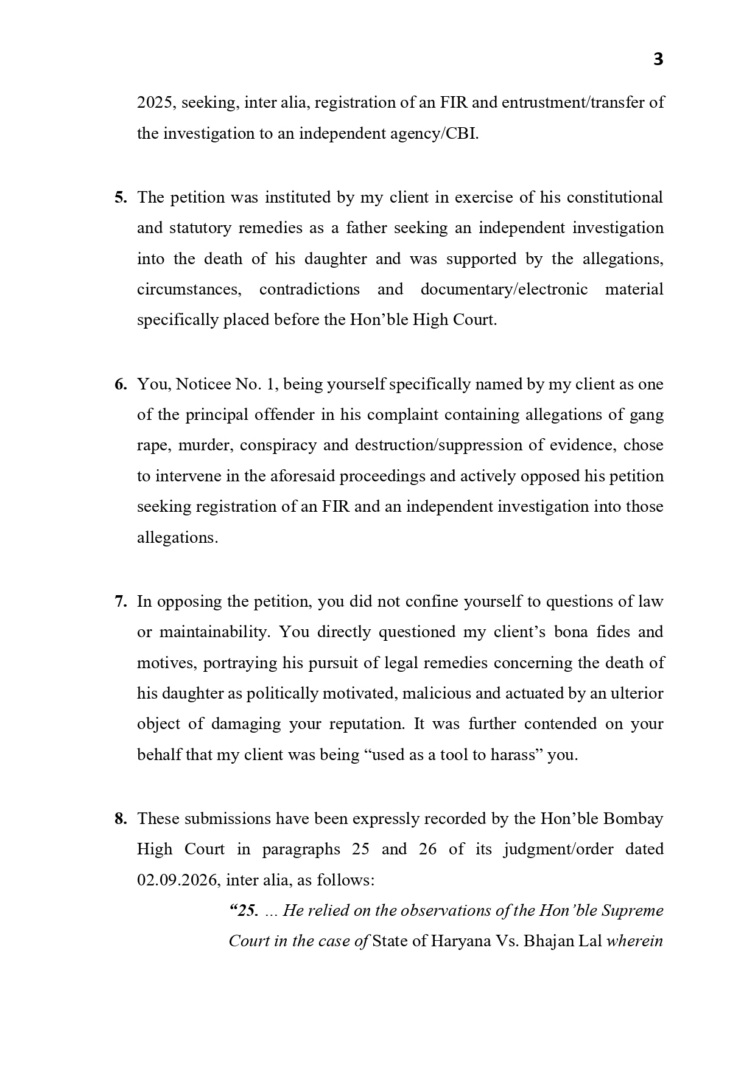
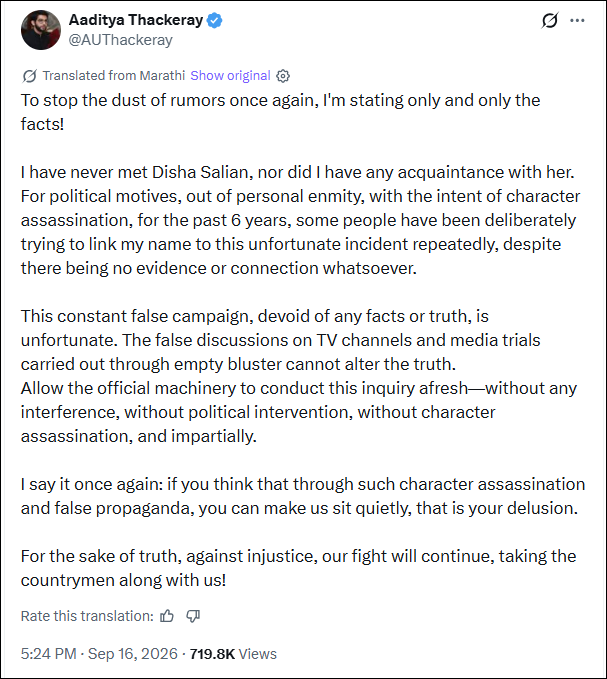
The FIR filed in connection with the mysterious death of celebrity manager Disha Salian attributes her death to a well-orchestrated criminal conspiracy hatched to protect Aaditya Thackeray, son of former Maharashtra CM and Shiv Sena (UBT) chief Uddhav Thackeray, and other accused.

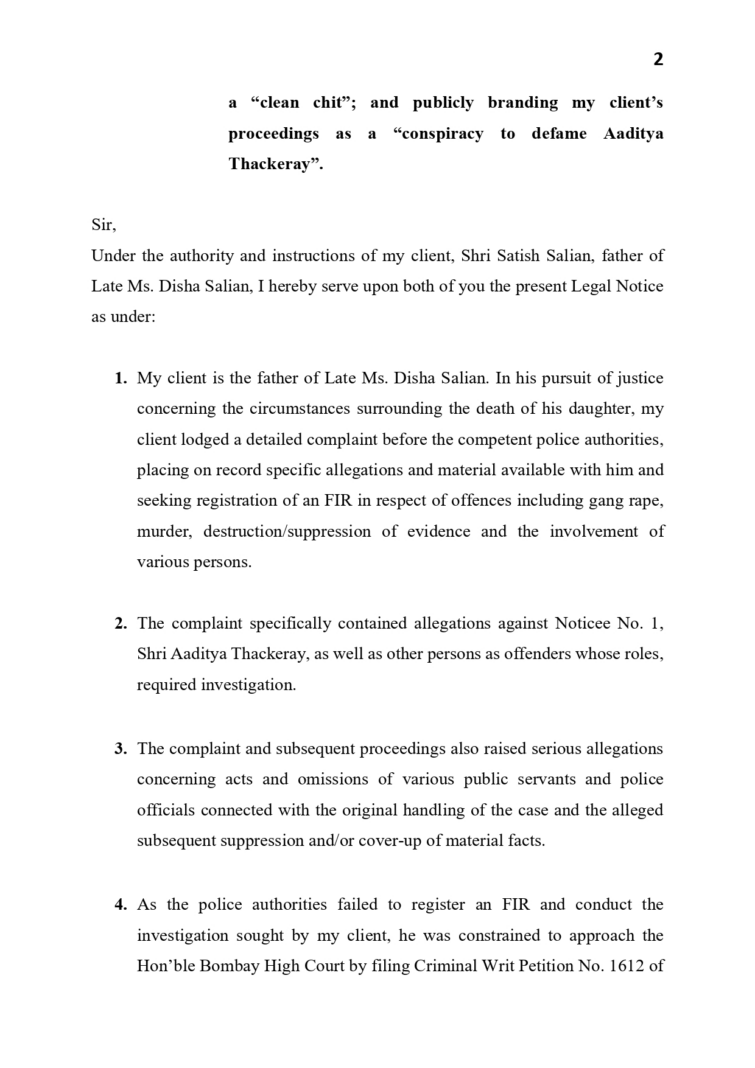
In the FIR, Disha’s father, Satish Ishwar Salian, pointed out inconsistencies in the police’s version of the circumstances surrounding Disha’s death and the contradictions in the evidence, the medical records, and the statements of the witnesses, which caused him to suspect the investigation into his daughter’s death. He said that he was not convinced by the ‘suicide theory’ given by the police in his daughter’s death. Disha’s father was not given a copy of her post-mortem report for five years after her death, and was handed over the report last year after his lawyer’s intervention.

A well-planned conspiracy to protect the high and the mighty

Satish Salian says that his daughter was gang-raped and killed as part of a well-planned conspiracy to protect Aaditya Thackeray and other accused, who were involved in criminal activities, including drug smuggling and child abuse, that she had come to know about.

Screenshot from the FIR

“The accused persons conspired together to silence victim DS (Disha Salian), and in furtherance of the said conspiracy, she was gang-raped and murdered, and a false story of suicide was created to cover up the crime,” Disha’s father stated in the FIR.

Disha and Sushant wanted to expose Aaditya Thackeray and others

As per the contents of the FIR, Disha Salian and her late friend and actor Sushant Singh Rajput possessed incriminating information concerning alleged drug trafficking, child abuse, and other unlawful activities involving Aaditya Thackeray and others. She and Rajput intended to disclose the information through a press conference, which is why they conspired to eliminate her.

“My daughter, victim DS, shared a close friendship with Sushant Singh Rajput, a film actor, and had also worked as his manager. In the course of her work, she came into possession of incriminating and objectionable information concerning alleged drug trafficking, child abuse, and other unlawful activities involving Aaditya Thackeray and others. She shared this information with Sushant Singh Rajput, and they intended to bring the same into the public domain through a press conference,” Disha’s father stated in the FIR. He said that Disha was gang-raped and murdered as part of the conspiracy, and a false suicide story was concocted as a cover-up.

According to Disha’s father, Sushant Singh Rajput shared his and Disha’s plan to expose the criminal activities of Thackeray and others with Rhea Chakraborty, who passed on the information to Thackeray and Dino Morya. As a result, Thackeray and his associates hatched a conspiracy to kill Disha Salian to prevent her from exposing the information against them.

The FIR states that after Disha’s death, Sushant feared that the accused would kill him. Therefore, to save himself, he instructed his staff to delete digital evidence, including data from mobile phones and other devices. “A cyber expert was also allegedly called to delete/erase CCTV footage and other digital material relating to the premises where the relevant meetings had taken place. This fact was subsequently disclosed by his family members and staff in their statements in connection with the CBI investigation of another case relating to Sushant Singh Rajput’s death,” the FIR mentioned.

Uddhav Thackeray and his son played a key role in the cover-up

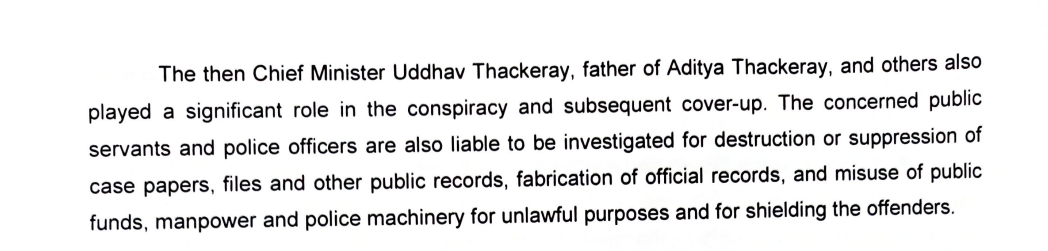
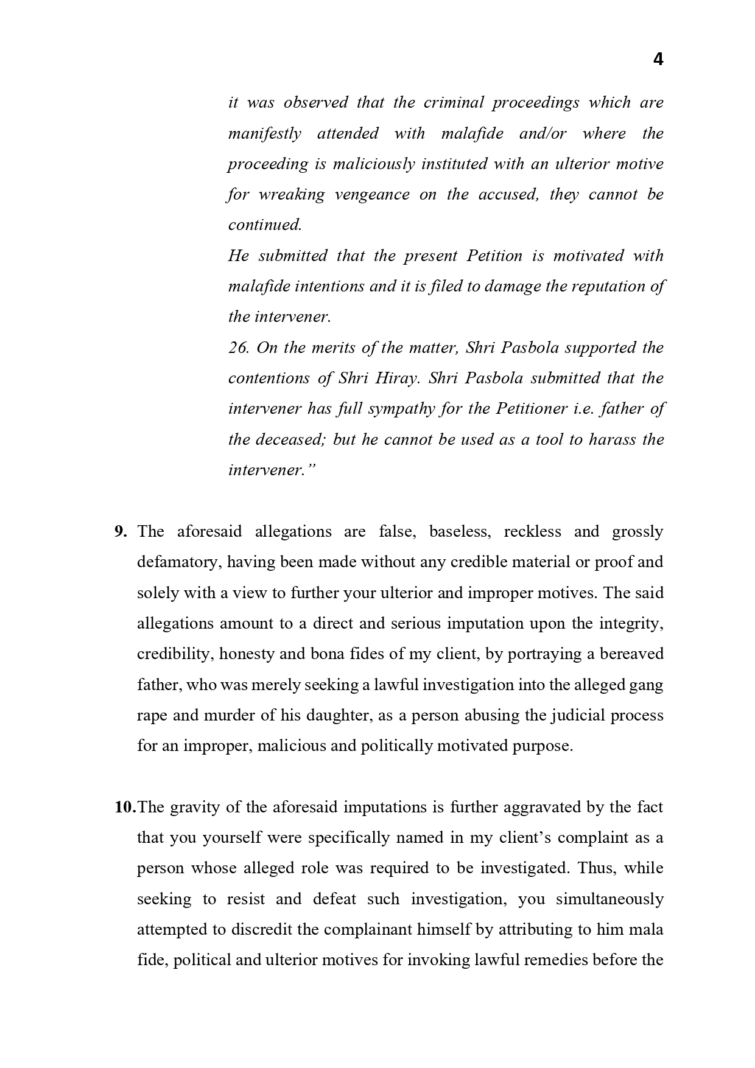
According to Disha’s father, several police officers and public servants played an active role in the implementation of the conspiracy that led to his daughter’s death. He adds that Aaditya Thackeray, who was a cabinet minister in the Maharashtra government at the time, and his father, Uddhav Thackeray, then the Maharashtra CM, played key roles in the conspiracy and the cover-up.

Screenshot from the FIR

The FIR alleges involvement of Aaditya Thackeray and several others, including Disha’s fiancé Rohan Roy, actors Dino Morea and Sooraj Pancholi, Aaditya Thackeray’s bodyguards, actress Rhea Chakraborty and her brother Showik Chakraborty, former police officer Sachin Vaze, former Mumbai Police commissioner Param Bir Singh, DCP Vishal Thakur, and former Maharashtra chief minister Uddhav Thackeray in Disha Salian’s death.

Disha’s father said crucial electronic evidence, such as mobile-tower/location records showing the presence of Aditya Thackeray, Dino Morea and Sooraj Pancholi near the crime scene around the time of her death, went mysteriously missing from the investigation records.

“The disappearance/non-production of such crucial electronic evidence requires investigation to ascertain who removed or suppressed these records, at what stage, on whose instructions, and for whose benefit,” the father said in the FIR. He also pointed to the disappearance of records and videography of crime scene reconstruction, which contradicted the distance of landing given by the police, from the investigation record.

Contradiction in witness statements and CCTV footage

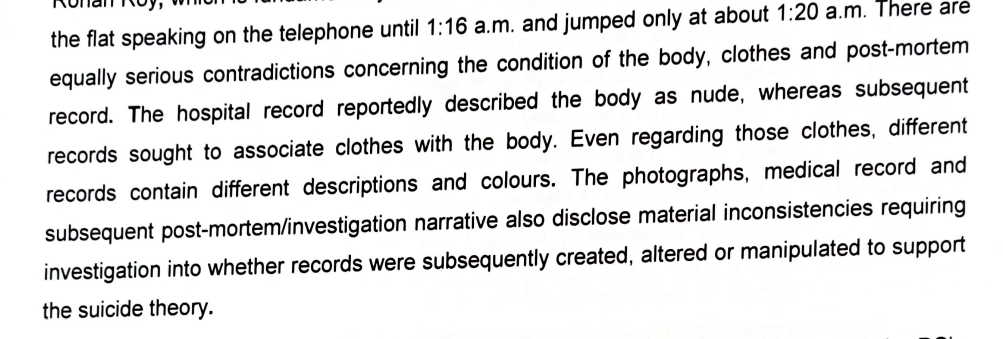
The FIR points out contradictions in the statements of witnesses, including Rohan Roy, regarding the circumstances surrounding Disha’s death. It states that Roy, the security guard of the building where Roy resided, and other persons told the police that Disha did not leave the building after she arrived there to stay with her fiancé on June 4, 2020. As per their version, Disha jumped from the building at around 1:20 a.m. on the intervening night of June 8 and 9, 2020, after speaking over a phone call with Ankita Satur.

According to the FIR, the version given by Roy and others that Disha never left the building since June 4, 2020, was contradicted by the CCTV footage, which showed her entering Flat No. 1101 at about 8:15 p.m. on 8 June 2020. The version that she jumped from the building around 1:20 a.m. is contradicted by the CCTV footage, which shows Rohan Roy and police personnel using the lift of the building around 12:55 a.m. and going to Flat No. 1202.

The FIR also highlighted material inconsistencies in the details relating to the condition of Disha’s body, clothes, and post-mortem.

Screenshot from the FIR

Discrepancies in medical and police records

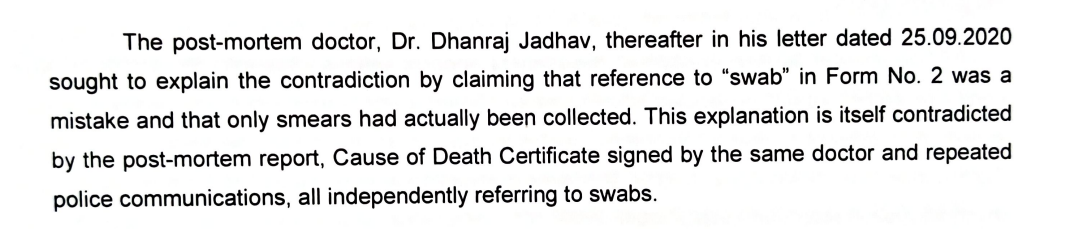
According to the FIR, the medical and police records established that Disha’s vaginal and anal swabs were collected and sent to the Forensic Laboratory for examination. But the record was subsequently changed and, instead of the forensic result of the vaginal and anal swabs, a report dated August 28, 2020, concerning ‘smear slides’ was produced.

Screenshot from the FIR

The FIR says that Dr Dhanraj Jadhav, who conducted the post-mortem, claimed that the mention of the word ‘swab’ in earlier medical records was a ‘mistake’ and that only smears had actually been collected. However, as per the FIR, Dr Jadhav’s claim was contradicted by the SIT record, which specifically stated that the vaginal and anal swabs had been collected and sent to the Forensic Laboratory for examination.

Disha Salian’s suspicious death

Celebrity manager Disha Salian died on June 8, 2020, after allegedly falling from a residential building in Mumbai’s Malad area. She had briefly worked as Sushant Singh Rajput’s manager before her death.

Strangely, just six days after Disha’s death, Sushant Singh Rajput was found dead at his residence in Bandra on June 14, 2020. The deaths of Disha and Sushant stirred widespread speculation about any possible connection. A CBI investigation was conducted into Sushant’s death, which ended with a closure report stating suicide as the cause of his death. The closure report remains to be considered by the court.

The FIR relating to Salian’s death was filed during a CBI inquiry into the case initiated on the order of the Bombay High Court passed earlier this month. The court had questioned the six-year-long investigation carried out by the Mumbai Police into Salian’s death and highlighted “glaring discrepancies” in it.

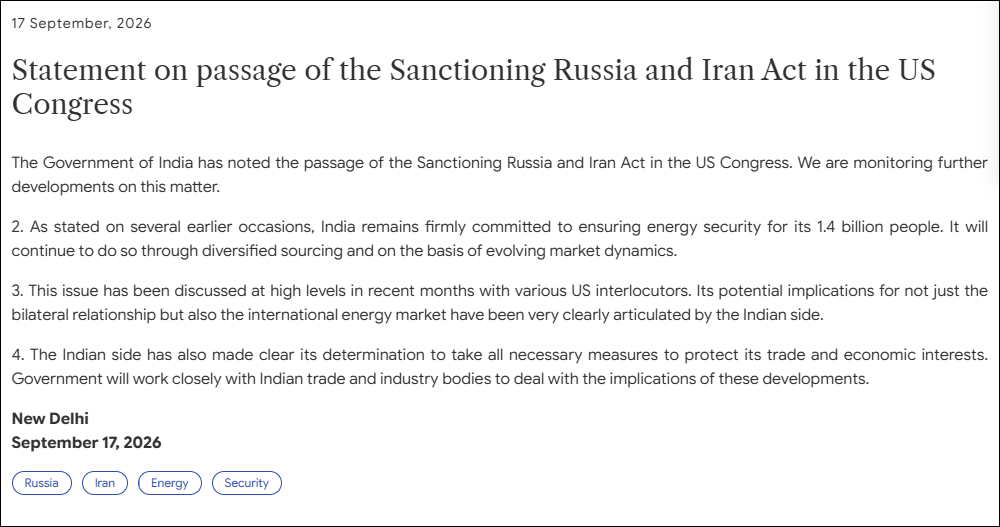
US Congress passes Sanctioning Russia and Iran Act: Here’s what the bill says, its impact, and India’s response

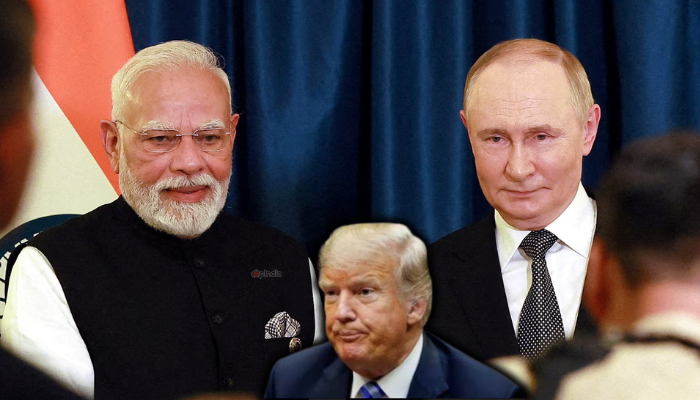
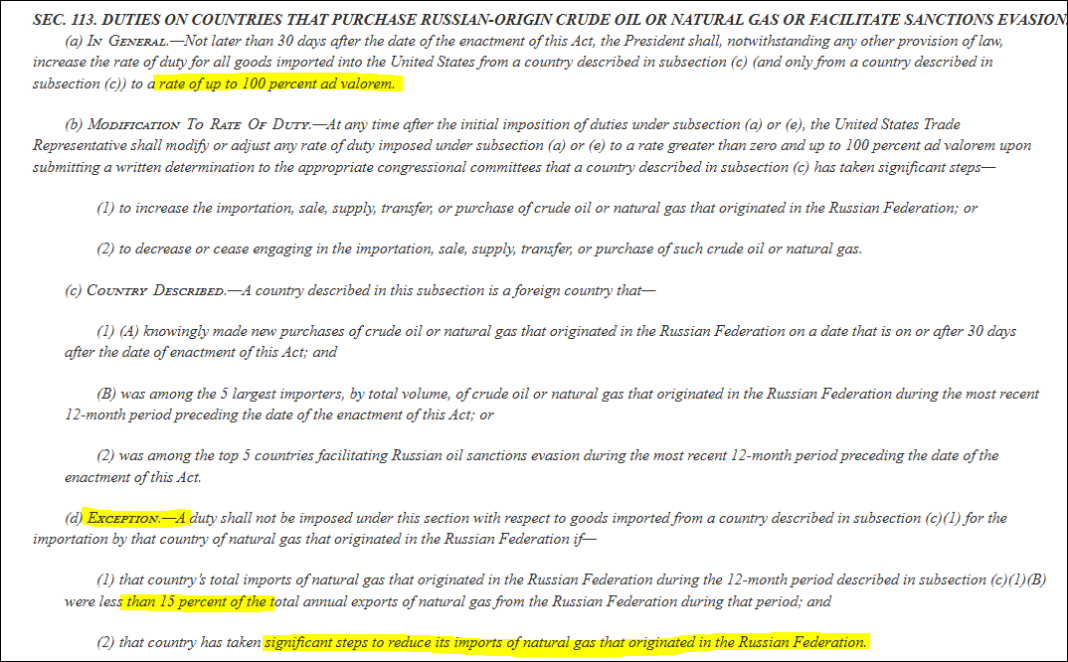
On 16th September, the US House of Representatives passed a bipartisan sanctions bill on Russia by a margin of 262-159.  Passed in the Senate, the Lindsey O. Graham Sanctioning Russia and Iran Act of 2026 grants the President authority to impose tariffs up to 100% on the top five purchasers of Russian oil: China, India, Slovakia, Hungary and Azerbaijan. Following the Senate passage, the bill will now head to US President Donald Trump’s desk to be signed into law.

In August this year, the Lindsey O. Graham Sanctioning Russia and Iran Act of 2026 was passed by an 86-11 margin in the US Senate. However, it faced challenges in the House of Representatives. 

While the bill’s fate was uncertain given it lacked the required majority support, the procedural hurdle was overcome after r two Democratic lawmakers voted with Republicans, and it was advanced with 214-211 votes.

Following the Sanctioning Russia and Iran Act, 2026, passage on 16th September, US senator from the Democratic Party, Richard Blumenthal issued an open threat to China and India, saying that it would be better if the two countries ‘improved their performance’.

“For China and India, it would be better if you improve your performance. Buy your oil and gas from somewhere else,” Blumenthal said.

From Russia Sanctioning Act, Lindsey Graham Russia Accountability Act to Lindsey O. Graham Sanctioning Russia and Iran Act

In July 2026, a group of US senators introduced an updated version of the earlier proposals, particularly the 2025 Sanctioning Russia Act. Senators Jeanne Shaheen, Richard Blumenthal, and Roger Wicker, among others, held a press conference in Washington to announce the proposal and expressed confidence that the bill has the required senatorial backing and will be passed by August 2026.

The revised version came to be referred to as the Lindsey Graham Russia Accountability Act, in honour of the late Republican Senator Lindsey Graham who championed the original Sanctioning Russia Act.

The Graham-introduced Sanctioning Russia Act of 2025 proposed that “the [US] President must increase the rate of duty on all goods and services imported into the United States from countries that knowingly engage in the exchange of Russian-origin uranium and petroleum products to at least 500% relative to the value of such goods and services.”

The bill proposed measures against the shadow fleet of Russian tankers used to evade existing sanctions. The bill included visa bans, asset freezes, and sanctions on Russian officials, banks, and energy firms. The bill also imposes sanctions on Russia’s shadow fleet of tankers that do not depend on Western maritime services, on Russian financial institutions, including the Central Bank of the ‌Russian Federation, ⁠and on Russia’s largest state-owned energy projects, including Yamal LNG and Arctic LNG 1, 2 and 3.

The bill’s most interesting provision, however, is the natural gas exception. The Lindsey Graham Russia Accountability Act largely exempted countries importing less than 15% of their total natural gas from Russia and actively reducing purchases, granting relief to most European allies of the US.

Key provisions of the Lindsey O. Graham Sanctioning Russia and Iran Act

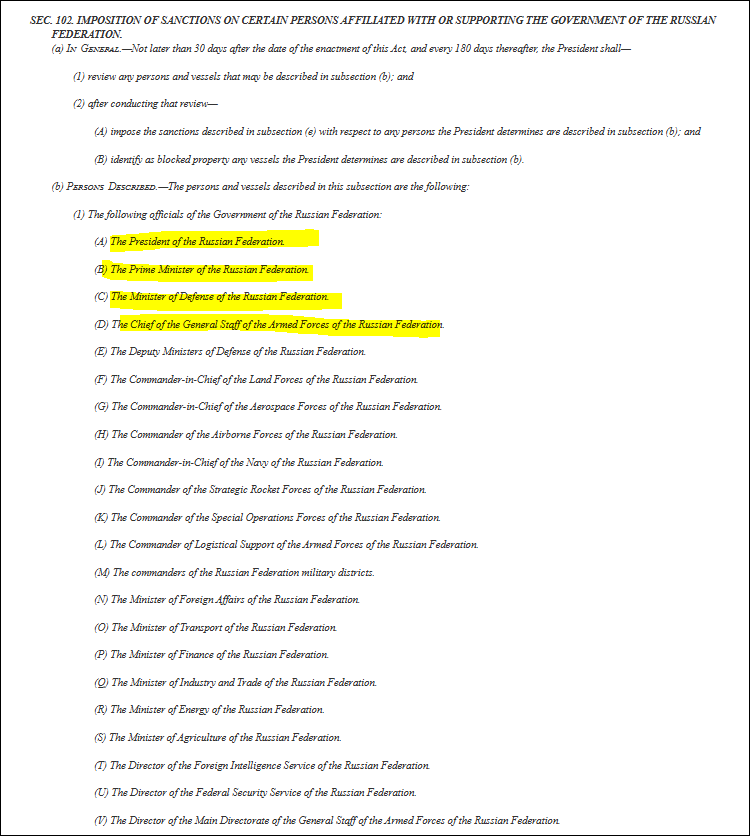
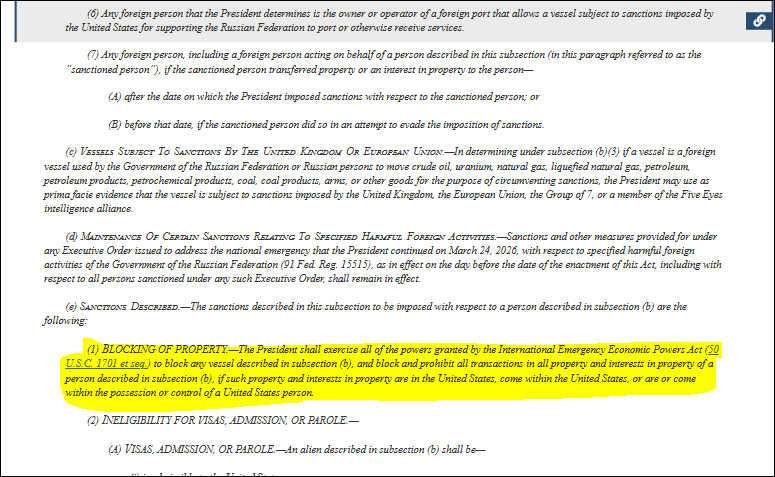
Section 102 of the passed bill provides for mandatory sanctions on Russian officials, military figures, oligarchs, and supporters. The targeted Russian officials include the President of the Russian Federation, Prime Minister, Defence Minister, and other key officials.

As per the bill, the US President must, within 30 days of enactment and every 180 days thereafter, impose blocking of property and visa ineligibility on specific persons, like the Russian president, certain military commanders, persons providing goods or services to Russia’s defence industrial base, persons ‘undermining’ Ukraine, as well as those involved in energy projects or sanctions evasion.

“The President shall exercise all of the powers granted by the International Emergency Economic Powers Act (50 U.S.C. 1701 et seq.) to block any vessel described in subsection (b), and block and prohibit all transactions in all property and interests in property of a person described in subsection (b), if such property and interests in property are in the United States, come within the United States, or are or come within the possession or control of a United States person,” the bill reads.

Regarding visa and admission restrictions, the bill provides, “An alien described in subsection (b) shall be—(i) inadmissible to the United States; (ii) ineligible to receive a visa or other documentation to enter the United States…”

Sanctions on Russian financial institutions

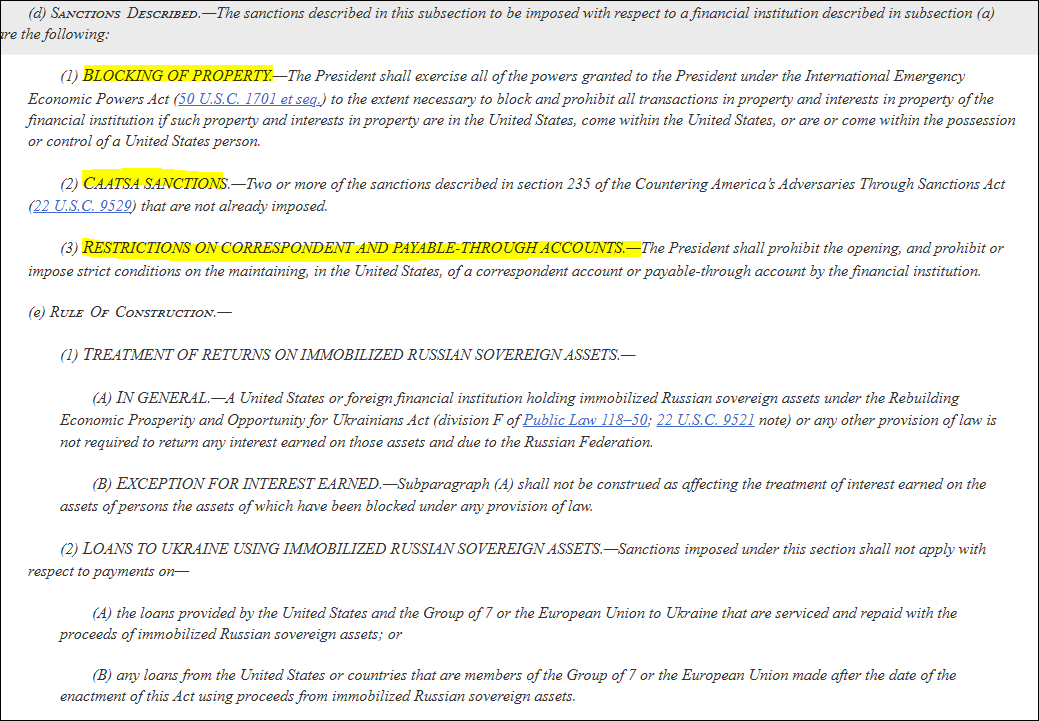
Section 103 of the passed legislation states that the US President must sanction the Central Bank of Russia, Sberbank, VTB Bank, Gazprombank, other state-owned or affiliated Russian financial institutions, and, with limited exceptions, foreign institutions that indulge in significant transactions with them. The measures primarily include property blocking additional CAATSA sanctions, as well as restrictions on correspondent/payable-through accounts.

Prohibitions on investment, energy, debt, and securities

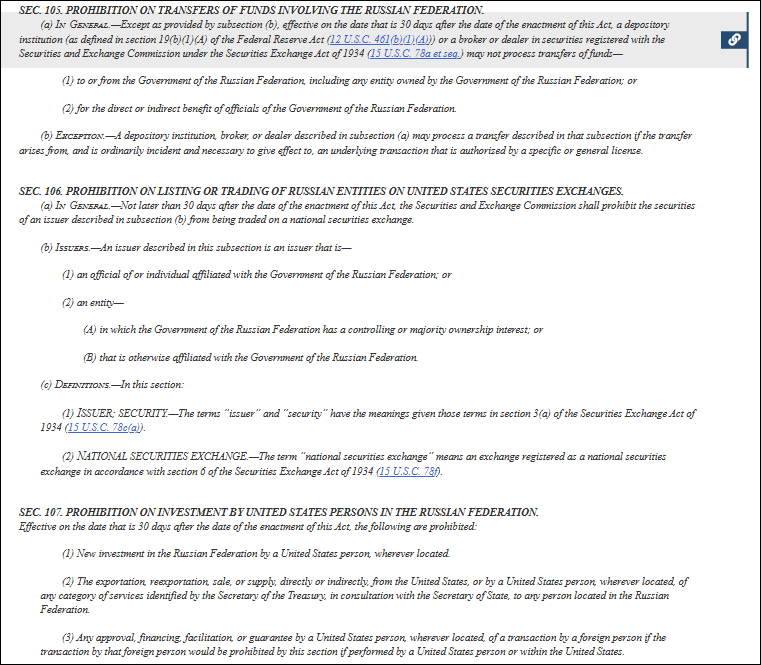
Sections 105 to 111 detail provisions for prohibiting US citizens or the government from making new investments in Russia or purchases of Russian sovereign debt.

In addition, the bill prohibits export, reexport, or in-country transfer of US-produced energy or energy products to Russia.

It further prohibits listing or trading of securities in Russian government-owned, controlled or affiliated entities on US exchanges.

Moreover, the bill restricts financial-messaging services to sanctioned Russian banks.

The bill also bolsters restrictions on Russian uranium imports and sanctions Rosatom leadership. Section 111’s “Sanctions” clause reads, “—Beginning on the date described in section 3112A(d)(2)(C) of the USEC Privatization Act (42 U.S.C. 2297h–10a(d)(2)(C)), and every 180 days thereafter, the President shall impose sanctions described in section 102(e) with respect to any leaders, officials, senior executive officers, or members of the board of directors of, or principal shareholders with a controlling or majority interest in, Rosatom State Atomic Energy Corporation or any subsidiary or successor entity.”

Surge in duties on Russian goods by 500%

Under Section 112, the bill provides for increasing duties on Russian goods, including oil, natural gas, liquefied natural gas, petroleum, petroleum products, petrochemical products, coal, and coal products, imported into the US from Russia up to a massive 500%.

“Not later than 30 days after the date of the enactment of this Act, the President shall, notwithstanding any other provision of law, increase the rate of duty for all goods, including oil, natural gas, liquefied natural gas, petroleum, petroleum products, petrochemical products, coal, and coal products, imported into the United States from the Russian Federation to a rate of up to 500 percent ad valorem,” the bill states.

Secondary tariffs on top purchasers of Russian energy and ‘sanctions-evasion’ facilitators: US bill targets India and China

Section 113 is the most discussed provision of the Lindsey Graham Sanctioning Russia and Iran Act of 2026. Under this, the US President must raise duties of up to 100% ad valorem on “all” goods imported from major purchasers of Russian energy, particularly China and India.

“Not later than 30 days after the date of the enactment of this Act, the President shall, notwithstanding any other provision of law, increase the rate of duty for all goods imported into the United States from a country described in subsection (c) (and only from a country described in subsection (c)) to a rate of up to 100 percent ad valorem,”  it states.

About the “country described”, the bill states:

  • (1) (A) knowingly made new purchases of crude oil or natural gas that originated in the Russian Federation on a date that is on or after 30 days after the date of enactment of this Act; and
  • (B) was among the 5 largest importers, by total volume, of crude oil or natural gas that originated in the Russian Federation during the most recent 12-month period preceding the date of the enactment of this Act; or
  • (2) was among the top 5 countries facilitating Russian oil sanctions evasion during the most recent 12-month period preceding the date of the enactment of this Act.

The Bill, however, ensures that America’s European allies do not bear the brunt of the US’s manoeuvers to undermine Russia and cripple its economy. For this, the bill adds an “exception” clause.

It states that a duty will not be imposed under this section with respect to goods imported from a country described in subsection (c)(1) for the importation by that country of natural gas that originated in Russia, if its total imports of natural gas from Russia were less than 15% during the specific 12-month period.

In addition, the countries that have undertaken significant steps to reduce their imports of natural gas from Russia shall also be exempt from duties.

Source: US Congress’s website

Iran sanctions extension

Under Section 201, the bill extends authority to sanction persons involved in Iran’s energy sector or weapons-related activities.

“Section 13(b) of the Iran Sanctions Act of 1996 (Public Law 104–172; 50 U.S.C. 1701 note) is amended by striking “2026” and inserting “2031”,” it states.

Will a 100% tariff get imposed automatically now that the sanctions bill is passed?

The passed bill authorises the US President to impose up to 100% tariffs on the five countries; it does not make them mandatory or come into effect automatically. This law grants the US President legal room to impose tariffs or grant waivers or exemptions.

Even if President Trump does not immediately impose a full 100% tariff, the bill has now created a permanent legal authority to threaten and influence negotiating terms while dealing with the targeted countries.

India and the US are engaged in extensive talks for a bilateral trade deal; imposition of a 100% tariff on Indian exports to the US would put pressure on India to demonstrate a meaningful reduction in Russian oil purchases to secure an exemption.

However, India has maintained that its energy imports are not governed by the whims of a foreign country but by their domestic needs and geopolitical interests.

Ever since the Russia-Ukraine war broke out in 2022, India has played the anchor role and kept the oil flowing globally. In fact, the US earlier lauded India for saying that Washington encouraged India to buy Russian oil, as stabilizing energy supplies and prices. However, as the Trump administration failed massively to secure even a ceasefire, let alone a complete end to the war, the US is vilifying India and China.

All this while, the US itself continued to import fertilisers, uranium, palladium, and base metals, among other products, from Russia, saying that these products are critical for American industries and hard to replace. OpIndia has reported earlier how the same US that accused India of profiteering from the Russia-Ukraine war is itself the biggest beneficiary of the prolonged war.

Committed to ensuring energy security for Indians: Ministry of External Affairs hits back

In response to media queries about the passage of the Sanctioning Russia and Iran Act in the US Congress, India’s Ministry of External Affairs said India remains committed to ensuring energy security for its people through diversified sources, in line with evolving market dynamics.

“The Government of India has noted the passage of the Sanctioning Russia and Iran Act in the US Congress. We are monitoring further developments on this matter. As stated on several earlier occasions, India remains firmly committed to ensuring energy security for its 1.4 billion people. It will continue to do so through diversified sourcing and on the basis of evolving market dynamics,” the MEA said.

It further informed the country that the issue of Russian oil purchases has been discussed with US interlocutors in recent months,

“Its potential implications for not just the bilateral relationship but also the international energy market have been very clearly articulated by the Indian side,” the MEA stated.

Furthermore, the MEA stated that it has made it clear that India will take all requisite measures to protect its trade and economic interests.

Source: MEA

“The Indian side has also made clear its determination to take all necessary measures to protect its trade and economic interests. The government will work closely with Indian trade and industry bodies to deal with the implications of these developments,” it added.

How India finds the missing children

When a child goes missing in India, the search involves far more than the local police station. Police databases, child-protection authorities, railway networks, helplines, shelters and increasingly facial recognition technology form an interconnected system designed to trace children and return them safely.

NCRB data show that 98,375 children were newly reported missing in 2024, including 75,603 girls and 22,768 boys. Another 48,800 children from previous years remained untraced at the beginning of the year, taking the total number under consideration to 147,175. During 2024, 98,826 children were traced or recovered, while 48,349 remained missing at year-end.

The process begins with an FIR. There is no requirement to wait 24 hours before reporting a missing child. Details and photographs can then move through police and child-protection networks. TrackChild and Khoya-Paya have been brought under the Mission Vatsalya Portal, which works alongside systems such as CCTNS. Child Helpline 1098, Child Welfare Committees and District Child Protection Units are also part of the tracing, protection and restoration process.

Railway stations have emerged as important intervention points. Under Operation Nanhe Farishte, the Railway Protection Force rescued 84,119 children between 2018 and May 2024, including missing, runaway, abandoned and other vulnerable children.

Technology is now adding another layer to this network. Facial recognition can compare photographs of missing children with images of children found elsewhere, potentially linking cases separated by years and hundreds of kilometres. Systems such as Telangana Police’s DARPAN and the nationwide UNIFY platform demonstrate how image matching can support investigators. CCTV networks at railway stations can similarly help identify children moving through crowded public spaces. AI-assisted age progression may also help when the available photograph is several years old.

But technology does not independently solve a missing-child case. Facial recognition produces probable matches that still require human verification. Its effectiveness depends on photographs being available, records being correctly entered and databases communicating with each other. Questions also remain over accuracy, privacy and the retention of children’s facial data.

India’s challenge, therefore, is not simply developing better technology. It is ensuring that police, databases, welfare systems and technology connect quickly enough to turn information into identification, protection and, wherever possible, a safe reunion with family.

Read the first article How India finds the missing children‘ on Chapter One Magazine.

Read the second article ‘How India is using advanced facial recognition and AI to find missing children‘ on Chapter One Magazine.

‘Baseless, reckless’: Father of Disha Salian issues Rs 500 crore defamation notice to Aaditya Thackeray over discrediting his complaint as ‘politically motivated’

Days after the Central Bureau of Investigation FIR named Shiv Sena (UBT) leader Aaditya Thackeray in the Disha Salian death case, her father Satish Salian has issued a Rs 500 crore defamation notice to Thackeray and NCP (SP) leader Anil Deshmukh. In the notice issued on 16th September, Satish Salian alleged that his pursuit of justice for Disha Salian, the former manager of late actor Sushant Singh Rajput, was portrayed as “politically motivated” by Aditya Thackeray and former Maharashtra Home Minister Anil Deshmukh.

“In his pursuit of justice concerning the circumstances surrounding the death of his daughter, my client lodged a detailed complaint before the competent police authorities, placing on record specific allegations and material available with him and seeking registration of an FIR in respect of offences including gang rape, murder, destruction/suppression of evidence and the involvement of various persons,” the notice reads.

The notice further highlights that the CBI FIR names Aditya Thackeray, details how material facts pertaining to the matter were allegedly suppressed or covered up.

“The complaint specifically contained allegations against Noticee No. 1, Shri Aaditya Thackeray, as well as other persons as offenders whose roles required investigation. The complaint and subsequent proceedings also raised serious allegations concerning acts and omissions of various public servants and police officials connected with the original handling of the case and the alleged subsequent suppression and/or cover-up of material facts,” the defamation notice adds.

Satish Salian’s counsel stated that the petition was instituted by Satish Salian in exercise of his constitutional and statutory remedies as a father seeking an independent investigation into the death of his daughter and was supported by the allegations, circumstances, contradictions and documentary/electronic material specifically placed before the Hon’ble High Court.

“You, Noticee No. 1, being yourself specifically named by my client as one of the principal offender in his complaint containing allegations of gang rape, murder, conspiracy and destruction/suppression of evidence, chose to intervene in the aforesaid proceedings and actively opposed his petition seeking registration of an FIR and an independent investigation into those allegations,” it adds.

Instead of questioning the maintainability of the case against him, Aaditya Thackeray attacked the credibility of Satish Salian

The defamation notice further stresses that Aaditya Thackeray did not confine himself to disputing the case’s maintainability; rather, he directly questioned Satish Salian’s motives and portrayed his pursuance of legal remedies as “motivated, malicious and actuated by an ulterior object of damaging your reputation.”

“In opposing the petition, you did not confine yourself to questions of law or maintainability. You directly questioned my client’s bona fides and motives, portraying his pursuit of legal remedies concerning the death of his daughter as politically motivated, malicious and actuated by an ulterior object of damaging your reputation. It was further contended on your behalf that my client was being “used as a tool to harass” you,” the notice reads.

The allegations levelled by Aaditya Thackeray against Satish Salian are “baseless, reckless and grossly defamatory”

Calling the claims made by Aaditya Thackeray that his implication in the Disha Salian death case is ‘politically motivated’ as “baseless”, Satish Salian’s defamation notice states that these claims are “false, baseless, reckless and grossly defamatory.”

“The aforesaid allegations are false, baseless, reckless and grossly defamatory, having been made without any credible material or proof and solely with a view to further your ulterior and improper motives. The said allegations amount to a direct and serious imputation upon the integrity, credibility, honesty and bona fides of my client, by portraying a bereaved father, who was merely seeking a lawful investigation into the alleged gang rape and murder of his daughter, as a person abusing the judicial process for an improper, malicious and politically motivated purpose,” the notice adds.

Himself accused in the Disha Salian death case, Aaditya Thackeray attempted to discredit the complainant

The notice further states that Satish Salian had named Aaditya Thackeray in the complaint, and that the Shiv Sena (UBT) leader’s alleged role in Disha Salian’s death was to be investigated; Thackeray resorted to discredit the complainant.

“The gravity of the aforesaid imputations is further aggravated by the fact that you yourself were specifically named in my client’s complaint as a person whose alleged role was required to be investigated. Thus, while seeking to resist and defeat such investigation, you simultaneously attempted to discredit the complainant himself by attributing to him mala fide, political and ulterior motives for invoking lawful remedies…” the notice adds.

Source: IANS

Aaditya Thackeray had claimed that he never met Disha Salian, him implication in her death case is ‘politically motivated’

On 16th September, Aaditya Thackeray stated X and claimed that he never met Disha Salian. He alleged that his name is being linked to Salian’s death due to political motives, out of personal enmity, and for character assassination.

“To stop the dust of rumours once again, I’m stating only and only the facts! I have never met Disha Salian, nor did I have any acquaintance with her. For political motives, out of personal enmity, with the intent of character assassination, for the past 6 years, some people have been deliberately trying to link my name to this unfortunate incident repeatedly, despite there being no evidence or connection whatsoever,” he wrote in Marathi.

Further, Thackeray criticised television news channels for allegedly running a false campaign against him and conducting media trials.

“This constant false campaign, devoid of any facts or truth, is unfortunate. The false discussions on TV channels and media trials carried out through empty bluster cannot alter the truth. Allow the official machinery to conduct this inquiry afresh—without any interference, without political intervention, without character assassination, and impartially. I say it once again: if you think that through such character assassination and false propaganda, you can make us sit quietly, that is your delusion. For the sake of truth, against injustice, our fight will continue, taking the countrymen along with us!” he wrote.

CBI FIR names Aaditya Thackeray and actor Rhea Chakraborty

Recently, the CBI registered an FIR into the death of Disha Salian, the former manager of actor Sushant Singh Rajput, nearly six years after her death and following a direction from the Bombay High Court.

The FIR names several individuals for investigation and sets out allegations ranging from criminal conspiracy and an alleged cover-up to the purported creation and propagation of what it describes as a “false suicide story”.

Among those named in the FIR are Shiv Sena (UBT) leader Aaditya Thackeray, Rohan Roy, actors Dino Morea and Sooraj Pancholi, Aaditya Thackeray’s bodyguards, Rhea Chakraborty, Showik Chakraborty, former police officer Sachin Vaze, former Mumbai Police commissioner Param Bir Singh, DCP Vishal Thakur and former Maharashtra chief minister Uddhav Thackeray.

Former Maharashtra home minister Anil Deshmukh, along with police personnel, forensic officials, doctors and several other individuals, also find mention in the FIR.

The FIR alleges that “the then chief minister Uddhav Thackeray, father of Aaditya Thackeray, and others also played a significant role in the conspiracy and subsequent cover-up.”

It must be recalled that Disha Salian died on 8th June 2020, after falling from a residential building in Mumbai’s Malad area. Mumbai Police registered an Accidental Death Report (ADR) rather than an FIR at the time. Salian had worked briefly as Sushant Singh Rajput’s manager.

Just six days after Disha Salian’s death, Sushant Singh Rajput was found dead at his residence in Bandra. While a CBI closure report concluded that Rajput’s death was a suicide, that report is yet to be heard by the competent court.