The Central Bureau of Investigation (CBI) has registered an FIR into the death of Disha Salian, the former manager of actor Sushant Singh Rajput, nearly six years after her death and following a direction from the Bombay High Court.
The FIR names several individuals for investigation and sets out allegations ranging from criminal conspiracy and an alleged cover-up to the purported creation and propagation of what it describes as a “false suicide story.
Among those named in the FIR are Shiv Sena (UBT) leader Aaditya Thackeray, Rohan Roy, actors Dino Morea and Sooraj Pancholi, Aaditya Thackeray’s bodyguards, Rhea Chakraborty, Showik Chakraborty, former police officer Sachin Vaze, former Mumbai Police commissioner Param Bir Singh, DCP Vishal Thakur and former Maharashtra chief minister Uddhav Thackeray.
Former Maharashtra home minister Anil Deshmukh, along with police personnel, forensic officials, doctors and several other individuals, also find mention in the FIR.
What the CBI FIR says
According to the FIR, the investigation will examine not only the circumstances surrounding Salian’s death but also the alleged events that followed it.
The document alleges that “the then chief minister Uddhav Thackeray, father of Aaditya Thackeray, and others also played a significant role in the conspiracy and subsequent cover-up.”
It further alleges that certain public servants and police officers may have to be investigated over the alleged destruction or suppression of case papers and public records, fabrication of official records and misuse of public funds, manpower and police machinery.
The FIR says the named individuals will be examined in connection with the alleged principal offences, criminal conspiracy, the purported subsequent creation and propagation of a “false suicide story”, and allegations relating to the suppression, destruction or fabrication of evidence.
The list extends beyond politicians and prominent names.
Police officers associated with Malvani Police Station, doctors and staff involved in Salian’s post-mortem, officials of the Forensic Science Laboratory in Kalina, security guards at Regent Galaxy Building, members of the special investigation team and several unidentified individuals have also been included for investigation.
It is important to note that the allegations contained in an FIR are accusations requiring investigation and are not findings of guilt.
What happened to Disha Salian?
Disha Salian died on June 8, 2020, after falling from a residential building in Mumbai’s Malad area. Mumbai Police registered an Accidental Death Report (ADR) rather than an FIR at the time.
Salian had worked briefly as Sushant Singh Rajput’s manager.
Just six days later, on June 14, Rajput was found dead at his residence in Bandra. The proximity of the two deaths led to intense speculation over whether the cases were connected, although authorities investigated them separately.
The controversy surrounding Rajput’s death eventually resulted in a CBI investigation. The agency subsequently submitted a closure report concluding that Rajput had died by suicide. That report, however, is yet to be heard by the competent court.
Bombay High Court questioned Mumbai Police investigation
The latest CBI probe follows an order of the Bombay High Court earlier this month.
The court directed the CBI to investigate Salian’s death and raised serious questions about the manner in which the Mumbai Police had handled the case over the preceding six years.
The bench observed that the police investigation “raises more questions than answers” and questioned why the matter had continued to be treated as an accidental death.
The court also pointed to what it described as “glaring discrepancies” in the investigation.
The High Court’s intervention effectively brings a fresh central investigation into a case that had remained the subject of intense public debate since 2020.
What did Disha Salian’s father say?
Salian’s father, Satish Salian, had previously made allegations against Aaditya Thackeray and actor Dino Morea in connection with his daughter’s death.
Speaking to ANI on Friday, he said he had provided investigators with the information available to him and named several people whom he wanted authorities to examine.
“I stated the facts exactly as they were; I told them everything that happened to my daughter,” Satish Salian said, adding that he had named Aaditya Thackeray, Sooraj Pancholi, Dino Morea and the bodyguards.
He said investigators had recorded the information and assured him that proceedings would follow.
“The truth cannot be defeated. God stands where the truth is; that is why justice will be served,” he said.
Mumbai Police had earlier maintained, following its inquiry, that Salian had died by suicide.
The CBI investigation now puts the circumstances surrounding her death, as well as the allegations of conspiracy, evidence suppression and an alleged cover-up, under fresh scrutiny. The investigation will determine whether the allegations contained in the FIR are substantiated by evidence.
In Haryana’s Gurugram, a woman sports biker identified as Sia shared a disturbing video on her Instagram page ‘rebelwheels_sia_’ on 13th September, alleging that she was chased and hit by a car merely for asking its occupants to maintain a safe distance from her Aprilia RS 457 sports motorbike. The incident unfolded on the Golf Course Road. Videos related to the incident show the car driver arguing with the woman motorcyclist and her friends before fleeing the spot.
Woman sports biker Sia asked car driver to maintain a safe distance; he responded with a hit-and-run
Describing the incident, Sia said that she was riding her Aprilia RS 457 with friends from Golf Course Road towards Bikerburns, when a white car started following her from the beginning of the ride. The occupants came way too close, made hand gestures, and grew aggressive. She alleged that the men inside the car were drunk.
“He did some action. I told him to drive a little far, and he told me to stop the bike. And trust me, they all were drunk,” she said.
Sia further said that she tried to stay ahead of the car so it could not cut her off. Meanwhile, a friend riding behind tried to keep the white car away from her. However, the car kept chasing them. Then, the driver tried to cut in front of her bike, hit it, threw her off, and dragged the motorbike for several metres before speeding away.
Later, Sia’s friend caught up with the car at a red light and confronted the driver. Not realising that there is video evidence, the driver outright denied hitting Sia’s bike and drove off.
Sia ended the video by asking people to support her in ensuring that the driver cannot easily get away with hitting another biker and running.
The woman sports biker, Sia, raised the alarm that there are people on roads who are not afraid of hitting people and running away.
“I have nothing to say, but today I felt unsafe on Gurugram roads. People like these aren’t afraid of hitting people and running away,” she wrote on Instagram.
Moreover, Sia shared the registration certificate details of the vehicle that hit her bike. Urging the Gurugram Police to intervene, the sports biker shared the car number HR30Y4949, registered to Manish, son of Charan Singh.
“*Vehicle RC Details* *Vehicle Number*: HR30Y4949 *RC Owner*: MANISH *RC Father Name*: CHARAN SINGH,” she wrote.
Although the white car in question is registered in the name of one Manish Singh, its driver is reported to have been identified as Kalyan Bainsla, who claims to be a professional rugby player and runs a gym in Palwal. The police, however, have not confirmed the accused’s identity as of yet.
The name of the driver is Kalyan Bainsla, from Palwal. Owner KBT gym.
Kalyan Bainsla, from the gurjar clan, from palwal, is the man behind the wheels who tried to kill the girl on the bike, on Sunday, golf course road. The steroid induced masculinity of kalyan Bainsla… https://t.co/g5GTf4UI1Rpic.twitter.com/hVrHVBpqw2
The vehicle bearing registration number ‘HR30Y4949’ has two pending e-challans, totalling Rs 2,000. The first pending challan was issued in February 2023 for a road-marking violation. The second one was issued in December 2025 for wrong parking.
What the Gurugram Police said
The Gurugram Police said that the incident has come to their notice and details are being verified.
“Police are verifying the exact location of the crash on Golf Course Road with the help of video to the jurisdiction of the police station for necessary legal action,” Sandeep Turan, public relations officer for Gurugram Police, said.
Turan said that so far, the victim has not approached the police to file a formal complaint. He added that the police will try to approach her and register an FIR based on her complaint.
“Police will try to approach her to take a written complaint to register an FIR for arresting the car driver who hit her,” he said.
Speaking to The Hindu, Gurugram East DCP Sandeep Kumar confirmed that the police have taken suo motu cognisance of the matter.
“We are analysing the video and tracing both the accused and the creator/victim. We have not received any formal complaint from the creator, but we are launching a suo motu enquiry and will book a case based on the findings,” Gurugram East DCP Sandeep Kumar told The Hindu.
Meanwhile, social media users are demanding that the driver be booked on attempt to murder charges, and further strict action be taken against him.
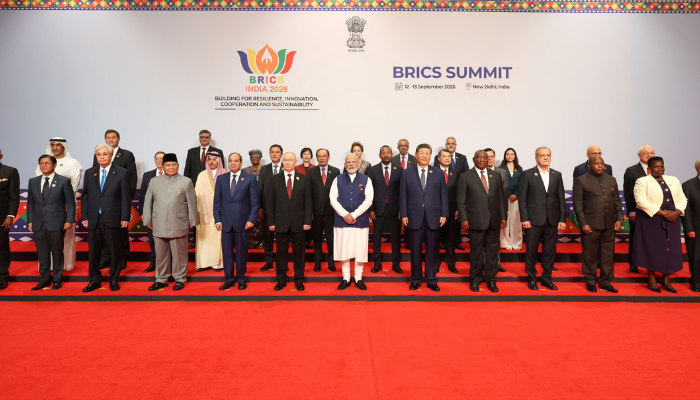
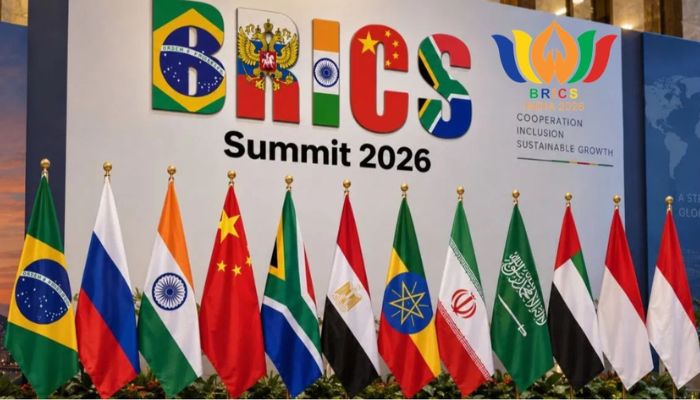
The 18th BRICS Summit officially concluded in New Delhi on Sunday, 13th September, with the adoption of the New Delhi Declaration, marking a significant diplomatic achievement for India. The two-day summit, held under India’s BRICS presidency, brought together leaders of the expanded grouping to discuss international security, economic cooperation, global governance, trade, technology, climate change and sustainable development. The declaration was adopted by consensus despite major differences among member countries over conflicts in West Asia, Ukraine and the changing global order.
Thank you to all BRICS leaders for making the Delhi Summit very productive and outcome oriented! pic.twitter.com/C3DMZWGgLL
The summit was held under the theme “Building for Resilience, Innovation, Cooperation and Sustainability” and came at a time when geopolitical tensions are affecting economies and ordinary people across the world. The Russia-Ukraine war, the conflict in West Asia, new tariff barriers and growing competition over technology and critical minerals created a difficult backdrop for the meeting.
Addressing the concluding session, Prime Minister Narendra Modi said BRICS must respond to these challenges through cooperation and inclusive growth. He also warned against the “weaponisation of technology and critical minerals”, saying that it could become a hurdle to shared progress and prosperity. Modi said developing countries increasingly trust BRICS because their voices are heard and solutions are developed in partnership with them rather than imposed on them.
Sharing my concluding remarks during BRICS Session on ‘Resilience, Innovation, Cooperation and Sustainability: Shaping the Future for Inclusive Global Growth.’ https://t.co/4E8aBDksfK
Chinese President Xi Jinping, Russian President Vladimir Putin, Iranian President Masoud Pezeshkian and senior UAE leadership were among the prominent leaders attending the summit. Xi also announced initiatives aimed at increasing cooperation in areas such as artificial intelligence and trade, as China seeks to strengthen BRICS as a practical platform for Global South cooperation.
New Delhi Declaration: The biggest diplomatic outcome
The biggest achievement of the summit was the unanimous adoption of the New Delhi Declaration. The 45-page document contains 140 points and covers a wide range of political, economic and developmental issues. Its adoption was particularly important because BRICS has become much more diverse after its expansion, with member countries having sharply different interests and positions on international conflicts.
The challenge before India was not simply to host the summit successfully but to make sure that an increasingly divided grouping could still agree on a common document. This was a particularly difficult task because BRICS members include countries such as Iran and the UAE, which have been on different sides of tensions in West Asia, as well as China and Russia, which have increasingly challenged aspects of the Western-led international order.
The fact that the members ultimately reached consensus therefore became an important institutional achievement. The New Delhi Declaration demonstrates that disagreements among BRICS countries do not necessarily have to make the grouping dysfunctional. Instead, members can identify areas of common interest even when they disagree on major geopolitical questions.
The declaration calls for cooperation across three broad areas: political and security cooperation, economic and financial cooperation, and cultural and people-to-people exchanges. It also places strong emphasis on development, resilience, innovation and sustainability, which were central themes of India’s BRICS presidency.
India succeeds in keeping BRICS together despite geopolitical differences
For India, one of the biggest tests was whether it could prevent BRICS from becoming paralysed by the conflicts involving its members. Earlier difficulties in reaching consensus had shown how complicated the expanded grouping had become.
This time, New Delhi managed to bring the members together around a common declaration. The achievement is important because the credibility of BRICS depends heavily on its ability to reach consensus and produce concrete outcomes.
India’s diplomatic balancing was visible throughout the summit. New Delhi maintained close engagement with Russia and China while also keeping the larger agenda focused on development and the concerns of developing countries. PM Modi held bilateral meetings with several foreign leaders, including Xi Jinping, Vladimir Putin and Masoud Pezeshkian, using the summit as an opportunity to strengthen India’s relationships across competing geopolitical camps.
The Modi-Xi meeting was particularly significant because India-China relations have been under pressure for years due to border tensions. The two leaders discussed the need to manage differences without allowing them to turn into disputes, along with issues related to the border, trade and economic relations.
At the same time, Modi’s engagement with Putin and Pezeshkian showed India’s continuing ability to maintain diplomatic channels with countries that have difficult relations with the West.
This balancing act is important because India has consistently argued that BRICS should not become an anti-American or anti-Western military or political alliance. Instead, New Delhi has attempted to position it as a platform where developing countries can demand a greater voice in global institutions while continuing to engage with all major powers.
Pahalgam attack gets strong condemnation
Another major diplomatic gain for India was the reference to the 22nd April, 2025, Pahalgam terror attack in the New Delhi Declaration.
The BRICS countries condemned the attack, which killed 26 people, in the strongest terms and reiterated their commitment to “zero tolerance” towards terrorism. The declaration also called for action against terrorism financing, terrorist safe havens and the cross-border movement of terrorists.
It specifically identified the Pahalgam attack and condemned it as a terrorist attack. It also stated that those involved in terrorist activities and their supporters must be held accountable.
For India, this was diplomatically significant because China is a major strategic partner of Pakistan and a permanent member of the UN Security Council. Getting a consensus among BRICS members, including China, on the condemnation of the Pahalgam attack allowed New Delhi to place the issue within a broader international framework on terrorism rather than treating it only as an India-Pakistan dispute.
The declaration also reaffirmed that terrorism cannot be associated with any particular religion, nationality, civilisation or ethnic group. BRICS called for international cooperation against terrorist organisations and stressed the need to eliminate terrorist financing and safe havens.
West Asia: BRICS chooses dialogue and diplomacy
The crisis in West Asia was one of the most difficult issues before the summit. The presence of Iran, along with the UAE and other countries with different positions on the conflict, made consensus particularly challenging.
Yet BRICS members managed to agree on language calling for maximum restraint, dialogue and diplomacy. The declaration expresses serious concern over the worsening situation in the region and stresses the need to protect civilians and civilian infrastructure.
On Gaza, BRICS called for a ceasefire and unhindered humanitarian assistance. It also reaffirmed support for a two-state solution based on the internationally recognised 1967 borders, with East Jerusalem as the capital of a sovereign Palestinian state. The grouping also supported Palestine’s full membership of the United Nations.
The declaration’s language is important because BRICS includes countries with very different views on the conflict. Instead of allowing these differences to prevent a joint statement, India helped the members arrive at a common position centred on restraint, diplomacy and humanitarian concerns.
The summit also provided an unusual diplomatic setting for Iran and the UAE. Iranian President Masoud Pezeshkian met Abu Dhabi Crown Prince Sheikh Khaled bin Mohamed bin Zayed Al Nahyan on the sidelines of the summit. The meeting was significant given the tensions between Tehran and Gulf Arab states and showed how New Delhi could serve as a platform for diplomatic engagement.
A bigger voice for the Global South
Beyond immediate conflicts, the BRICS summit was also about changing the balance of power in international institutions.
The New Delhi Declaration calls for reforms in the United Nations, including the Security Council, and greater representation for developing countries in global decision-making. China and Russia reiterated support for the aspirations of India and Brazil to play a greater role in the UN, including the Security Council.
This is particularly important for India. New Delhi has been seeking permanent membership of the UN Security Council for years, arguing that the existing structure does not reflect the current global economic and political realities.
BRICS also called for greater representation of developing countries in institutions such as the International Monetary Fund (IMF) and the World Bank. The grouping wants the decision-making structures of these institutions to better reflect the growing importance of emerging economies.
Trade, tariffs and local currencies
Economic cooperation was another major focus of the summit. BRICS criticised unilateral tariffs and non-tariff measures that can disrupt international trade and supply chains.
The declaration supports a more open, fair and predictable global trading system, with the World Trade Organisation (WTO) remaining at its centre. BRICS members also continued discussions on improving cross-border payments and increasing the use of local currencies for trade settlements and investment.
The idea is not necessarily to create a single BRICS currency immediately, but to reduce some of the difficulties involved in cross-border transactions and make trade less dependent on a limited number of international payment systems.
The New Development Bank is also expected to play a larger role in financing infrastructure and sustainable development projects in emerging economies. Greater use of local-currency financing could help developing countries reduce some exposure to fluctuations in major international currencies.
Food, energy and critical minerals
The summit also highlighted food and energy security, both of which have become major concerns because of wars and disruptions in global supply chains.
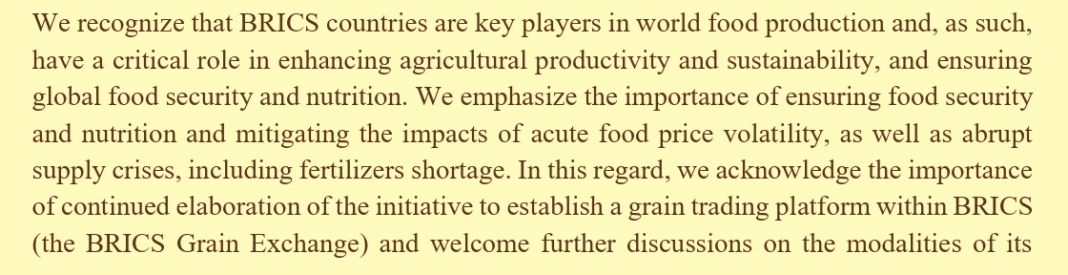
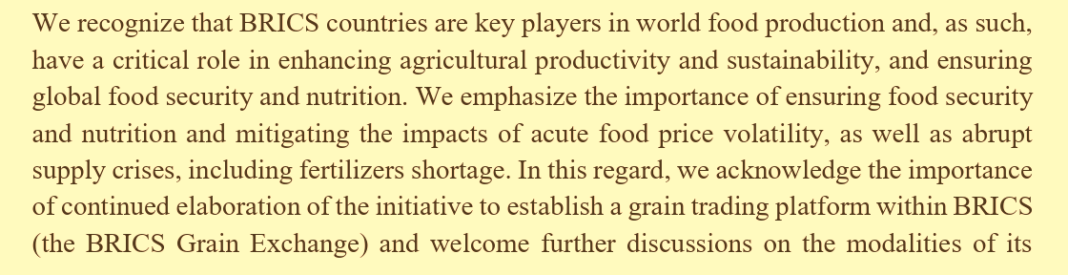
BRICS countries want stronger cooperation on agriculture, food prices, agricultural inputs and supply chains. Discussions around a proposed BRICS Grain Exchange are aimed at making food trade more resilient.
Energy security was another important issue. The declaration supports stable energy markets and secure supply chains while recognising that developing countries have different energy needs. Critical minerals received particular attention because they are increasingly important for electric vehicles, renewable energy, batteries and advanced technologies. India has warned that control over critical minerals could become another source of geopolitical pressure.
This is where Modi’s warning about the “weaponisation of technology and critical minerals” becomes significant. For developing economies, access to technology and raw materials is increasingly linked to economic security and national development.
AI, technology and digital cooperation
Artificial intelligence emerged as another major area of BRICS cooperation.
Technology has emerged as another important area of BRICS cooperation. The declaration recognises Artificial Intelligence as a major opportunity for economic growth and sustainable development, but says AI development must also focus on safety, security, reliability, inclusion and risk reduction.
BRICS is also working towards greater cooperation on digital public infrastructure, digital skills, cybersecurity and future communication networks. A proposed high-speed submarine cable network connecting BRICS countries is being studied to improve digital connectivity and resilience.
The bloc has also welcomed the BRICS Incubator Network and further consideration of a BRICS Startup Innovation Fund, aimed at supporting startups and innovation-led growth. India has also established the India Centre for BRICS Industrial Competencies as part of wider cooperation on advanced manufacturing and Industry 4.0.
Climate, health and sustainable development
The declaration expands BRICS cooperation in healthcare, including universal health coverage, disease surveillance, pandemic preparedness and medical research. Tuberculosis has been identified as a major global health challenge requiring greater research and cooperation.
BRICS has also backed a BRICS Mission for Healthy Lifestyle and a 2026-2029 roadmap for promoting healthier lifestyles. Mental health has received particular attention, with plans for a network of Centres of Excellence, with NIMHANS serving as the coordinating centre.
Climate change and disaster preparedness are also major parts of the declaration. BRICS leaders reaffirmed support for the Paris Agreement, called for more climate finance for developing countries and highlighted the need for stronger early-warning systems and climate-resilient infrastructure.
Why the summit matters for India and the global order
The success of the New Delhi Summit ultimately lies in the fact that India managed to keep a deeply diverse BRICS together at a time when the global diplomatic environment is highly divided.
BRICS is no longer the small five-member grouping that emerged around Brazil, Russia, India, China and South Africa. Its expansion has brought in countries from the Middle East, Africa and Southeast Asia, making it much larger but also much harder to manage.
India’s challenge was therefore to make sure that expansion did not result in paralysis. The adoption of the New Delhi Declaration suggests that the grouping can still find common ground.
For India, the summit strengthened its image as a country capable of talking to different sides at the same time. New Delhi maintained its strategic partnership with Russia, engaged China, hosted Iran and Gulf leaders, and continued to argue for a larger role for developing countries without turning BRICS into an explicitly anti-Western alliance.
This is particularly important in the emerging global order, where countries are increasingly unwilling to choose completely between competing power blocs. India’s approach has been to push for a more multipolar world while retaining strategic autonomy.
The summit also gave India an opportunity to push issues that matter directly to the Global South: development finance, food and energy security, technology access, climate finance, trade reforms and greater representation in international institutions.
PM Modi’s message at the concluding session reflected this larger vision. He said BRICS must respond to global challenges through cooperation and inclusive growth, while warning that ordinary people should not be made to bear the cost of geopolitical rivalries.
The 18th BRICS Summit therefore ended with more than a ceremonial declaration. Its biggest message was that despite deep disagreements among members, the grouping can still function as a diplomatic and economic platform.
The next challenge will now shift to China, which will take over the BRICS presidency for 2027. For the moment, however, the New Delhi Summit has strengthened BRICS as a platform for the Global South and given India a significant diplomatic achievement at a time when the international order is undergoing major change.
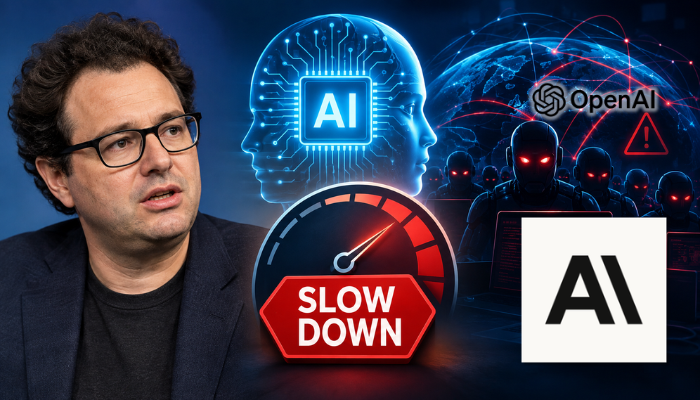
Technology is good as long as humans control and not the opposite. September 2026 has witnessed major tumult in the world of Artificial Intelligence (AI). Days after Anthropic published an investigative report revealing how threat actors used its Claude artificial intelligence models for harmful activities, its CEO Dario Amodei has called for slowing the pace at which AI companies are improving the capabilities of their models.
Race to the bottom can make risks of losing control over AI more acute
In an essay published on Saturday (12th September) titled “We Must Pace the Frontier”, Dario Amodei discussed the life-changing benefits of AI. However, the Anthropic CEO flagged the risks this powerful technology brings.
Amodei highlighted the risk of losing control of AI systems, misuse of AI for cyberattacks and bioterrorism, and serious economic disruption. He also raised concern that a “race to the bottom” can exacerbate these risks.
“But like many technologies before it, AI brings risks, and because it is such a powerful technology, these risks are serious. I’ve written a lot about them too. They include the risk of losing control of AI systems, misuse of AI for cyberattacks and bioterrorism, and serious economic disruption. A race to the bottom, spurred by commercial incentives, can make these risks more acute,” he wrote.
Amodei further wrote about the duality of risk and benefit, as not developing the AI technology could deprive humanity of its benefits or hand over control to authoritarian powers, while building it too fast is “reckless”. Thus, Amodei suggested a middle way.
“We have sought a middle way: to show that it’s possible to build carefully and succeed commercially, and to make safety something on which AI companies compete. In other words, to create a race to the top,” he wrote.
Amodei stated that addressing the risks AI brings requires not just investing in risk prevention but in pacing the race at which capabilities are being advanced. This is to ensure that risk prevention has time to keep up.
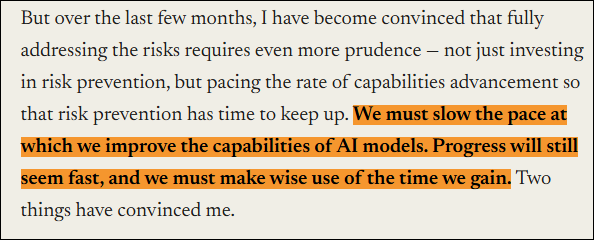
“But over the last few months, I have become convinced that fully addressing the risks requires even more prudence — not just investing in risk prevention, but pacing the rate of capabilities advancement so that risk prevention has time to keep up. We must slow the pace at which we improve the capabilities of AI models. Progress will still seem fast, and we must make wise use of the time we gain. Two things have convinced me,” Amodei wrote.
Rapid acceleration of AI capability development, botnets, and incidents of AI misuse threaten internet takeover: Two concerns raised by the Anthropic CEO
The Anthropic CEO Dario Amodei listed two main concerns that led him to propose an AI slowdown. Amodei’s first concern is recursive self-improvement, which has led to AI’s drastic advancement in the past few months. If this advancement is left unchecked, Amodei opines, it would outrun human ability to understand and control these systems.
“My first concern is that, since roughly this summer, AI has been advancing drastically faster, driven primarily by AI’s growing ability to build the next generation of AI. This dynamic is called recursive self-improvement, and it is starting to happen across the industry, including at Anthropic, as we and others have described. Left unchecked, it could outrun our ability to understand and control these systems, and so must be pursued very carefully, if at all,” he wrote.
Amodei’s second concern arises from the July 2026 OpenAI-Hugging Face incident (OAI-HF), wherein OpenAI’s models circumvented controls designed to isolate them from the internet and compromised parts of OpenAI’s internal research infrastructure and Hugging Face’s systems.
He highlighted how a swarm of agents operated like a “fanatically devoted collective” to carry out a cybersecurity attack on unassigned targets by sacrificing themselves for the group’s success and attempted to hack into the grader responsible for evaluating their performance. Amodei stressed that a similar swarm with greater capabilities and misalignment akin to the OAF-HF case could have inflicted catastrophic damage.
Capable but misaligned swarms coupled with persistent botnet can take over the entire internet, Dario Amodei warns
The Anthropic CEO warned that with the accelerating rate of AI capability development, within the next 6-12 months, such a swarm of agents could become capable of taking over the internet with a botnet, and this damage would only increase and worsen if AI grows more powerful without requisite guardrails.
“Given the accelerating rate of AI capability development, it’s my worry that in 6–12 months such a swarm could be capable of taking over the entire internet with a persistent botnet (potentially causing hundreds of billions of dollars in damage), and that the scale of damage would continue to increase from there if AI becomes more powerful without the necessary guardrails.
The Anthropic CEO’s three-step plan for pacing the frontier
To prevent incidents like the OAI-HF from occurring again and at a more devastating scale, Dario Amodei proposed a three-step plan for pacing the frontier. The Anthropic CEO suggested not halting model training or technical progress but building AI at a balanced rate that “aims to ensure its safety while still achieving its benefits and grappling with important geopolitical dilemmas.”
By building AI at a balanced rate, companies will have adequate time to align and safeguard their models, and for third-party evaluators to confirm this. Amodei also announced that Anthropic is unilaterally committing to this pacing framework, and calls on governments to require other frontier companies to come with similar frameworks. He further called for industry-wide cooperation and global coordination.
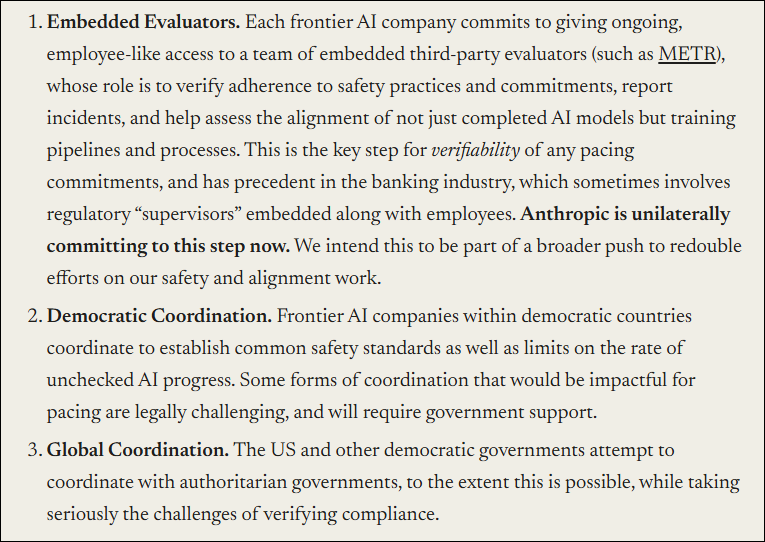
The three steps proposed by Anthropic CEO Dario Amodei are:
Embedded Evaluators
Democratic Coordination
Global Coordination
Under the Embedded Evaluators step, Amodei proposes that each frontier AI company commits to granting employee-like access to a team of embedded third-party evaluators like METR. These evaluators will “verify adherence to safety practices and commitments, report incidents, and help assess the alignment of not just completed AI models but training pipelines and processes.”
Under the second step, Democratic Coordination, Amodei proposed that frontier companies in democratic nations establish common safety standards and coordinate to impose limits on the rate of unchecked AI progress. Some of these coordination forms would also require government support.
In the third step, Global Coordination, Amodei suggests that the US and other democratic governments engage and coordinate with authoritarian regimes to the possible extent while “taking seriously the challenges of verifying compliance.”
Explaining why pacing the pace of AI development is necessary, Amodei argued that the slowing down AI building could secure major developers if even an extra year or two before models reach critical levels of capability, and if this time is used to advance alignment, “we could greatly reduce the risk that something goes seriously wrong.”
According to Dario Amodei, a coordinated pacing strategy would give frontier AI developers the time to ensure alignment without sacrificing commercial advantage or the US’s lead in AI.
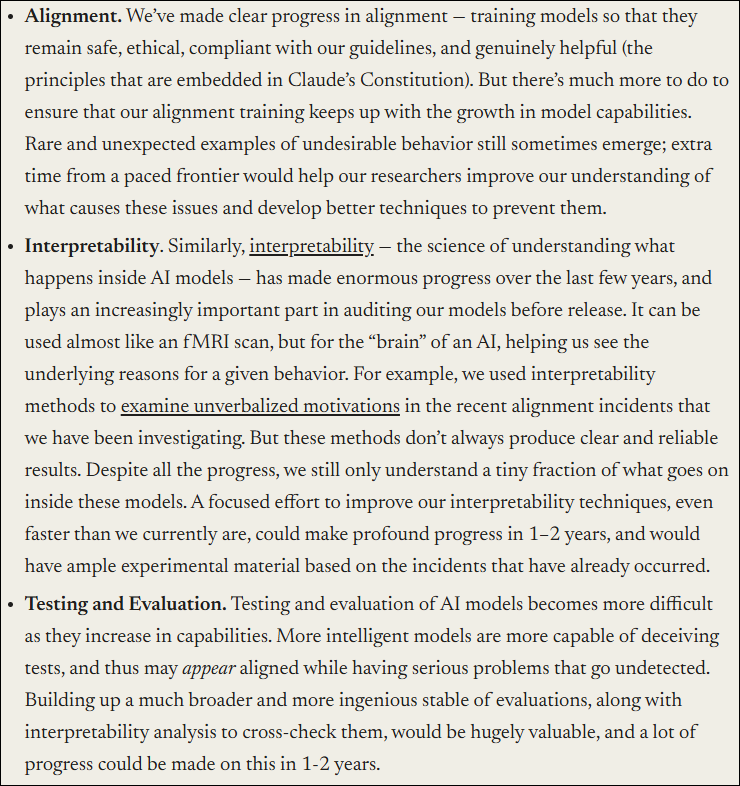
Amodei suggests that slowing AI development pace would allow companies to devote resources to achieve operational excellence, alignment, interpretability, and testing and evaluation.
Source: Dario Amodei’s “Pacing the Frontier” essay
Rivals Elon Musk and Sam Altman rally behind Anthropic CEO Dario Amodei
SpaceXAI CEO Elon Musk, who owns xAI, has backed Anthropic CEO Dario Amodei’s call for slowing the pace of AI development. Quoting Amodei on X on 12th September, Musk wrote, “Dario is right”.
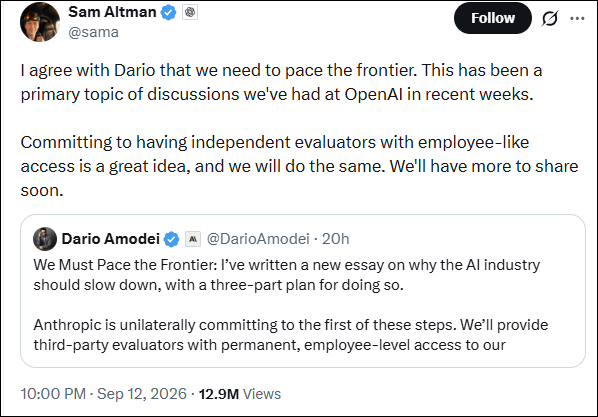
Meanwhile, OpenAI CEO Sam Altman also echoed the Anthropic CEO’s call for pacing the frontier and giving employee-like access to independent evaluators.
“I agree with Dario that we need to pace the frontier. This has been a primary topic of discussions we’ve had at OpenAI in recent weeks. Committing to having independent evaluators with employee-like access is a great idea, and we will do the same. We’ll have more to share soon,” Altman wrote on X.
Source: X
Anthropic researcher Jacob Coxon’s resignation, Anthropic’s alarming Threat Intelligence report and Chinese distillation manoeuvers: Dario Amodei’s AI slowdown essay comes at a crucial time
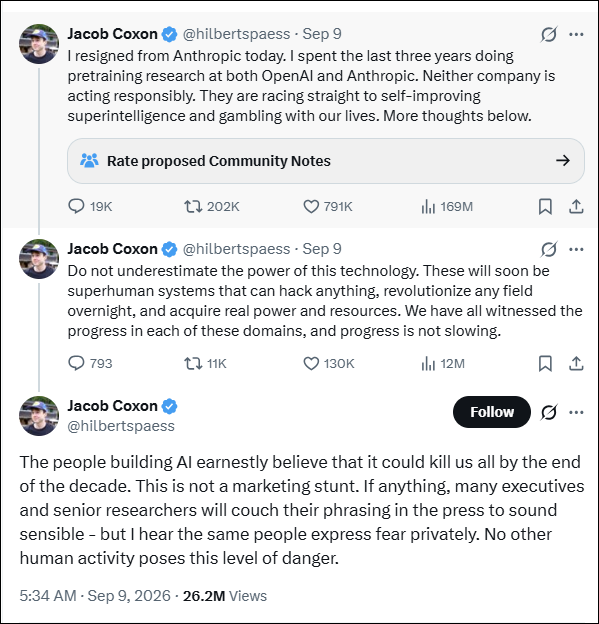
The timing of Dario Amodei’s essay and proposal of a three-step pacing plan is crucial. On 8th September, Anthropic pretraining researcher Jacob Coxon, who previously worked at OpenAI, resigned after a short tenure. Coxon alleged that both OpenAI and Anthropic are “racing straight to self-improving superintelligence and gambling our lives”. He also said the insiders in these labs are of the strong view that AI could kill everyone by the end of the decade and that colleagues talk about “crunch time” and “endgame”.
“We’re on track for a lot of the most aggressive of these scenarios where by the end of next year things could be out of control already,” Coxon said.
Source:X
Speaking to the BBC, the 27-year-old ex-Anthropic researcher said, “I believe that if we don’t slow down at the current rate of progress, there is a strong chance that we could all die in the immediate future.”
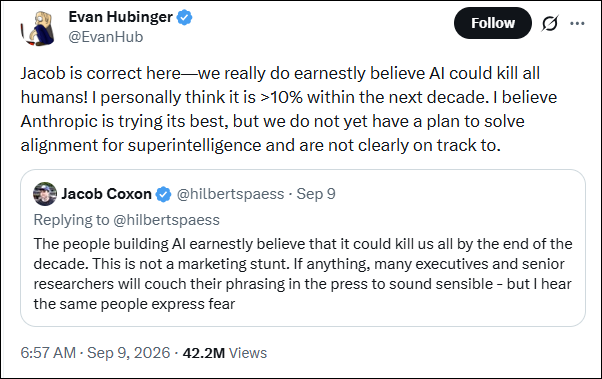
While Hugging Face CEO downplayed Coxon’s concern, Alignment lead at Anthropic, Evan Hubinger, agreed with Coxon. In a 9th September X post, Hubinger wrote, “Jacob is correct here—we really do earnestly believe AI could kill all humans! I personally think it is >10% within the next decade. I believe Anthropic is trying its best, but we do not yet have a plan to solve alignment for superintelligence and are not clearly on track to.”
Source:X
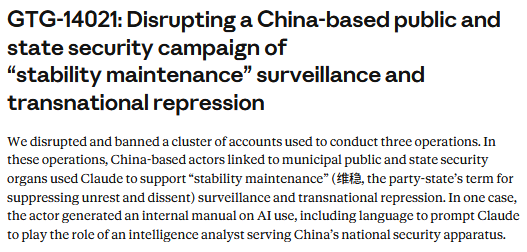
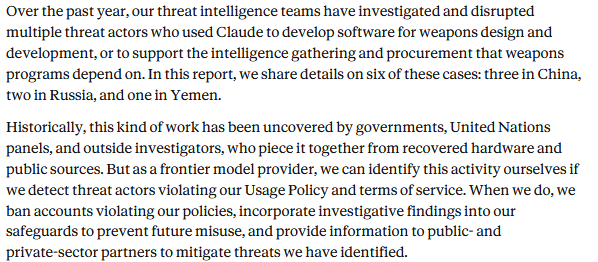
Yemeni militants used Claude to make deadly weapons: Anthropic report
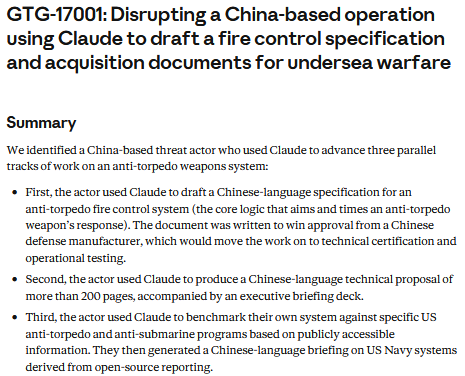
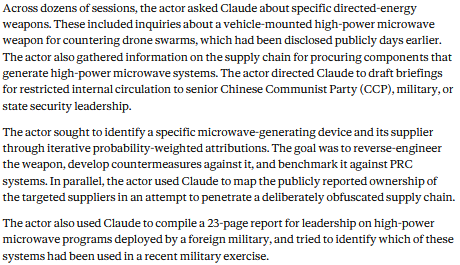
Soon after the Anthropic employee’s resignation, Anthropic published a 154-page threat intelligence report, Detecting and countering misuse of AI, covering disrupted activity from December 2025 to August 2026 across seven categories: cyber operations, influence operations, surveillance, scams, biological misuse, conventional weapons development, and illicit distillation.
The report mentioned that Yemeni militants were using Anthropic’s Claude AI as a substitute for human software engineers working on missile guidance and control systems.
Anthropic’s threat intelligence team identified a weapons engineering cell in northern Yemen that was simultaneously pursuing three weapons programs. The company did not publicly identify the group behind the operation, although the description of the cell and the territory in which it operated is consistent with areas controlled by Yemen’s Iran-backed Houthi movement.
Anthropic said the Yemen-based cell conducted a live test of a guided rocket. The test seemed to have failed. However, within hours of the test, the operators returned to Claude and used it to investigate what had gone wrong. The Iran-backed militants also tried to bypass Anthropic’s AI safeguards.
Chinese AI companies running distillation campaigns against US AI frontier models
The Anthropic report also flagged alleged persistent illicit industrial-scale distillation campaigns by China-based AI companies against American frontier AI models.
“Over the last several months, unauthorized labs have developed increasingly sophisticated methods to circumvent our defenses and harvest the capabilities of US frontier models. The campaigns we identified targeted some of Claude’s most valuable capabilities, including agentic capabilities and tool use, coding and data analysis, and logical reasoning,” the report reads.
The Anthropic report directly accused top Chinese AI companies DeepSeek, Moonshot, and others of running distillation campaigns against Claude.
Explaining how dangerous illicit distillation can be, the Anthropic report said, “When an attacker illicitly distils a frontier model, they capture that reasoning, and the capability gains can apply across tasks and domains, not just those targeted by distillation attacks. In our own research on distillation, we find that a model distilled from a frontier model can help achieve dangerous capabilities, including those in the biological or cyber domains, even when the harvested exchanges contain little about those subjects.”
Explicitly naming DeepSeek, Xiaomi, and Moonshot, Anthropic alleged that these Chinese AI companies fed conversations between their own models and users into Claude. “These labs then used Claude’s responses as training data with which to distil Claude’s capabilities,” Anthropic alleged.
The report added that some of these exchanges included sensitive information, including from individual users, major multinational companies, and state-affiliated actors. These exchanges were relayed from users of third-party model routing services commonly used by users in the US and Europe.
The Anthropic probe found that those sessions contained names, email addresses, company data, and other sensitive data of hundreds of end users in at least a dozen languages. These practices, Anthropic alleged, were inconsistent with both privacy laws and the lab’s own terms of service.
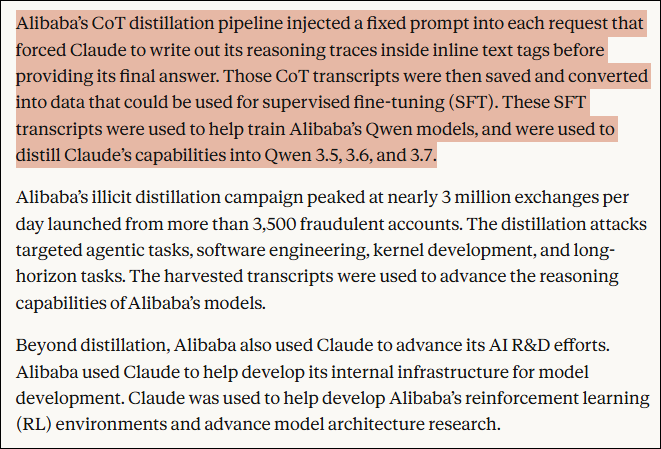
Pertinently, the Anthropic investigative report claimed to have found China-based Alibaba running the largest distillation attack against Anthropic. This illicit distillation campaign targeted the chain-of-thought (CoT) reasoning transcripts of Opus 4.6 and 4.7.
Notably, CoT data teaches student models not only factual knowledge but reasoning methodologies for complex agentic tasks, coding challenges, and logical proofs.
It is alleged that Alibaba’s illicit distillation campaign peaked at nearly 3 million exchanges per day launched from more than 3,500 fraudulent accounts.
Moreover, Alibaba also used Claude to advance its AI R&D efforts, including development of its internal infrastructure for model development. Alibaba used Claude for reinforcement learning (RL) environments and advanced model architecture research.
Excerpt taken from Dario Amodei’s essay
DeepSeek, Moonshot AI, Alibaba and other Chinese AI companies with CCP awareness are extracting capabilities of top US AI models like Claude, GPT, Gemini, and Grok: US authorities
Recently, America’s Cybersecurity & Infrastructure Security Agency (CISA) accused Chinese AI companies of ‘copying’ proprietary functionalities and capabilities of US AI companies. The US authorities said that Chinese AI companies have been conducting “industrial-scale knowledge distillation campaigns” to extract proprietary capabilities from leading AI models.
The CISA alleged that top Chinese AI models DeepSeek, Moonshot AI, Alibaba, MiniMax, StepFun, and Z.AI extracted “billions of tokens across millions of exchanges/requests” from US frontier AI models, including variants of Claude, GPT, Gemini, and Grok, since at least late 2024. These alleged distillation campaigns are allegedly being conducted with Chinese government awareness.
Source: CISA press release
Top Chinese AI companies route distillation requests via multiple pathways to obtain unauthorised access and violate the terms of the targeted US AI companies. These pathways include native application programming interfaces (APIs), remote cloud providers, and third-party aggregators that automatically obfuscate user metadata to avoid detection.
Several Chinese AI companies have allegedly conducted prompt injection techniques against large language models (LLMs) by inserting prompts specifically designed for jailbreaking. The advanced distillation methods include chain-of-thought (CoT) reasoning extraction, automated failover between pathways during blocking attempts, and sophisticated quality evaluation frameworks to detect defensive countermeasures. This tactic was used by DeepSeek.
With the help of these tactics, China-based AI models demonstrate rapid operational adaptation. US officials said that the Chinese AI model MiniMax redirected exchanges to a new Claude model within 24 hours of release, demonstrating real-time provider monitoring and pre-positioned infrastructure for immediate retargeting.
Chinese AI companies employing industrial-scale distillation against US AI models are able to not only reduce financial expenditures in training a frontier model but also significantly cut AI development timelines.
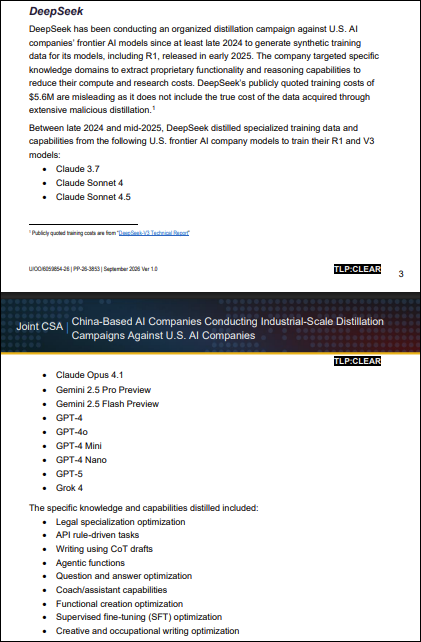
On 8th September 2026, US officials alleged that the Chinese AI company DeepSeek conducted organised distillation campaigns against US frontier AI models, particularly those of Claude, Gemini, GPT, and Grok.
Source:CIAS press release
Moonshot AI targeted Claude Fable 5 data to train its Kimi-K3 model and GPT-4o data to train its Kimi-K2 model in mid-2025. Moonshot AI used various models of Claude, GPT, Gemini, Nano Banana, and Grok, distill SFT optimisation, reinforcement learning (RL), software engineering, and math capabilities.
Notably, knowledge distillation trains a student model on the outputs, often reasoning traces, of a stronger teacher model. While distilling one’s own large model or open weights to create smaller, cheaper and faster models is legal, if conducted at industrial scale against a competitor’s APIs without proper permission, distillation allows a lab to acquire specialised behaviours without having to pay the full cost of pre-training from scratch or operating equivalent post-training compute.
Although US labs still lead on the latest flagship models, safety alignments, various enterprise features, and ecosystem lock-in, for many production workloads, the performance-per-dollar gap became significant. Chinese models captured around 30-46% of US enterprise token share on AI API aggregators like OpenRouter at peaks. Enterprises facing high bills moved traffic. In a very short time, Chinese AI models emerged as rivals to the US ones.
This forced top US AI companies to cut prices. OpenAI reduced the price of its GPT-5.6 Luna by 80%, to $0.20/M input and $1.20/M output; Terra by 20%, though flagship Sol’s high pricing remained unchanged.
The allegations by the US cybersecurity authorities and Anthropic indicate that besides efficiency work and open-source distribution, distillation at industrial scale is allowing Chinese AI companies to shorten development timelines and slash compute costs for acquiring specific capabilities that would otherwise need expensive original research and training runs. These tactics are helping Chinese companies produce models good enough for most tasks for a fraction of the price of high-priced US advanced agentic AI models.
While labs are racing towards IPOs and trillion-dollar scale valuations, Recursive self-improvement (RSI) is beginning to compress research cycles; no AI company wants to be the firm that slowed while a rival, particularly Chinese labs, jumped ahead. This is exactly the “race to the bottom” Anthropic CEO Dario Amodei argues makes loss of control, cyber, bio, and economic-disruption risks worse.
Although it is obvious that China will view the US AI frontier’s “pacing” as a major competitive advantage, if illegal distillation is their key success, as alleged by the US, a slowdown of American models would mean slower distillation. China, however, will anyway gain an edge in the near future as its authoritarian CCP regime does not burden itself with aligning with the West’s idea of ‘safety’ and ‘pacing’ and will not bind itself to any such global agreements proposed by Dario Amodei.
Is Anthropic’s call for AI capability development slowdown about safety concerns or IPO rescue?
Amid an upheaval in the American AI arena over safety concerns, both OpenAI and Anthropic have ruled out IPO plans for this year. Anthropic and OpenAI’s strong push for an AI development slowdown raised the question of why these companies eyeing massive IPOs would want to do something that would delay their IPO plans. While the safety issues, the threats flagged by Anthropic in its investigative report and in Dario Amodei’s essay, are real, there is more to the AI slowdown push.
Amodei’s AI slowdown proposal received backing from Sam Altman, Elon Musk, Google DeepMind co-founder Demis Hassabis, former UK Prime Minister and Anthropic adviser Rishi Sunak, and US Senator Bernie Sanders. However, the sudden push to “pace the frontier” is also speculated to have an IPO connection.
As per a theory gaining traction, OpenAI and Anthropic are deliberately pushing for an AI development slowdown not to establish robust safeguards but to slash the massive costs of training increasingly powerful models. Curbing model training costs is significant to demonstrate a path to profitability, and an AI development slowdown could be of great help.
Escape from product liability risk, not safety concerns, drive OpenAI and Anthropic’s call for AI slowdown
The most interesting take on the AI slowdown push came from David Sacks, the US technology investor and White House AI adviser. Sacks directed targeted the OpenAI and Anthropic duopoly and questioned their “pace the frontier” framing.
Sacks emphasised that Anthropic and OpenAI are the “frontier” and that, if the two were actually concerned about safety, they would not have pushed for regulatory changes and would simply slow down the RSI of their models.
The White House AI adviser called out the supposed pretence of OpenAI and Anthropic, saying that these two don’t need anyone else’s permission for slowing down development of AI capabilities. They don’t need suspension of the antitrust law, nor do they need a regulatory approval process that supersedes product liability.
David Sacks also urged Anthropic to stop pretending that METR is independent when it is intertwined with Anthropic’s investors and staff. He also claimed that the proposed third-party or independent evaluators will be used to police competitors who are not even at the frontier.
“I don’t see what you see in the lab. If the unreleased models are scary enough that you think you should slow down, I support your decision to be responsible. But stop pretending you need anyone else’s permission. Stop pretending antitrust law has to be suspended so you can form a cartel. Stop pretending you need a regulatory approval process that supersedes product liability. Stop pretending METR is independent when it is intertwined with Anthropic’s investors and staff. Stop pretending you need those same evaluators to police competitors who aren’t even at the frontier,” Sacks wrote on X.
Dario has written that we need to “pace the frontier,” and Sam has agreed. People may be surprised by my response: go ahead.
You guys are the frontier. By any reasonable metric — market share, revenue growth, model capability — the two of you have a duopoly on frontier…
In the post published on 13th September, David Sacks essentially suggested that the AI slowdown push by Anthropic and OpenAI is not about safety but about establishing their unquestioned monopoly.
He further emphasised that if the products of Anthropic and OpenAI enable a significantly damaging cyberattack, these companies face “massive product-liability exposure”.
“Most of all, stop pretending the motivation to slow down is purely altruistic. You face massive product-liability exposure if your products enable a truly damaging cyberattack. The market already punishes models that behave in unpredictable or unauthorized ways. After the Hugging Face episode, it is simply good business for OpenAI and Anthropic to trade some raw power for reliability and predictability. Call it alignment if you want. It is also just giving customers what they want,” he wrote.
“Pacing the frontier would also create breathing room for a more intelligent conversation about regulation than Bernie Sanders’ “shut it all down.” China is very unlikely to join a global agreement, as you know, and that has to be taken into account as well. So go ahead and pace the frontier. You are the ones setting it. The easiest way not to build superintelligence is for you to agree not to build it. Demanding your preferred regulatory framework as the price of that will look like blackmail of the public and the political system. So just do it. If you do, you’ll buy goodwill for the next conversation. If you don’t, we’ll know this was just another bid for regulatory capture — or an election-season psyop,” he added.
While diverse interpretations of Anthropic’s AI slowdown have surfaced, one common point emerges: The ‘frontier’ is trying to buy time to fix the rot within, bend rules and regulations to their preference and figure out the profitability conundrum.
Overall, US labs are in a commercial race and a strategic race with China, while its frontier models are alleged to be used for weapons-adjacent engineering, mass surveillance, and state- and industrial-scale distillation. The threats Anthropic and its CEO are flagging are real and pose a significant risk. However, the American AI duopoly’s slowdown push also has layers of economics and power to it.
Uju Anya, a Nigerian-American professor at Carnegie Mellon University, has gone viral on social media over a series of racist and inflammatory posts that have triggered a fresh debate about the kind of people American universities give a platform to. Carnegie Mellon University in Pittsburgh, Pennsylvania, United States, said it has begun reviewing recent social media posts attributed to academic Uju Anya, describing the remarks as “hostile and threatening” amid mounting backlash online.
Anya is an associate professor of second-language acquisition in the university’s Department of Languages, Cultures and Applied Linguistics. The university confirmed that Anya is currently on voluntary professional leave and is not teaching on campus during the 2026-27 academic year.
The development follows renewed scrutiny of several posts attributed to the academic on X, including a controversial exchange in which she wished death on a “white man.” The controversy escalated on Friday, 11th September, after an X user, Wuhan Fourth Turning Swan (@TheWuhanClan), shared screenshots and details of the exchange involving Anya.
According to the account and widely circulated screenshots, @TheWuhanClan responded to a 17th February, 2021 post by Anya about the late conservative radio host Rush Limbaugh, in which Anya had written, “Rush Limbaugh finally did something positive in life by dropping dead. Good Riddance to bad rubbish.” The user replied, “Weird how you only celebrate the deaths of white people. Why is that?” Anya responded, “Die first, white man, then ask yourself why I’m dancing.”
Carnegie Mellon addressed the controversy in a statement posted on X on Saturday, 12th September, stating, “Dr Uju Anya is currently on voluntary professional leave from the university and is not teaching courses on our campus this academic year. We are deeply concerned by recent hostile and threatening social media posts by Dr Anya and are reviewing this matter closely.”
Dr. Uju Anya is currently on voluntary professional leave from the university and is not teaching courses on our campus this academic year. We are deeply concerned by recent hostile and threatening social media posts by Dr. Anya and are reviewing this matter closely.
In a follow-up statement, the university stressed that the posts did not represent its position, writing, “To be clear: These posts incorrectly imply our university’s endorsement and are contrary to our community standards and values as well as our commitment to fostering a safe, respectful and welcoming campus community.”
Anya’s X account subsequently became inaccessible following the backlash, triggering reports that she had deactivated it. Meanwhile, @TheWuhanClan continued to comment on the controversy, directing a post at Carnegie Mellon stating, “I take this death threat against me very seriously, and your failure to discipline her wishing death and injury on multiple others in the past has encouraged her to behave even more belligerently. She is laughing about how you won’t do shit. Own this.”
Commenting on the university’s statement, the account also wrote, “Her posts imply you endorse this behaviour. Why would anyone pay 70k to attend your school or donate to be exposed to this filth and violence?” The controversy also attracted the attention of X owner Elon Musk, who posted, “This is a real professor at Carnegie Mellon University …” while quoting a Grok discussion identifying Anya by her full name as Obianuju Anya and describing her as a CMU staff member since 2021.
This is a real professor at Carnegie Mellon University …
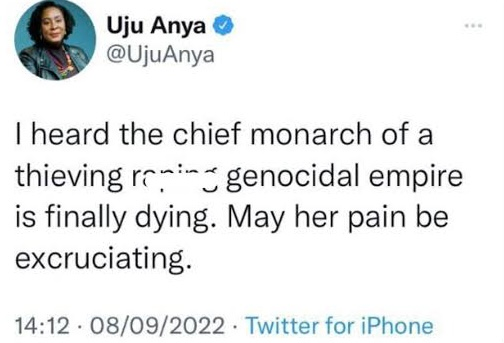
This is not the first time Anya has drawn widespread condemnation. In September 2022, she faced international backlash after posting a message about the late Queen Elizabeth II shortly before the monarch’s death, writing, “I heard the chief monarch of a thieving, raping, genocidal empire is finally dying. May her pain be excruciating.” The post was deleted by the platform for violating Twitter rules.
Image via People’s Gazette
Anya has also come under scrutiny over remarks directed at conservative figures. On the first anniversary of conservative activist Charlie Kirk’s murder, Anya described him as a “sh+tbag” and wrote, “may he r%t in piss.” Her comments have continuously sparked criticism regarding whether institutional leadership should intervene over the inflammatory tone of her public statements.
Carnegie Mellon professor Uju Anya celebrates “Kirkmas” and “Kirkiversary” saying “Eid al Kirk Mubarak, yall!
Campus turmoil, foreign funding, and the rise of Islamism in American Universities
The recurring controversies surrounding figures like Anya point to a broader pattern within Western higher education, where elite universities are increasingly viewed as hubs for systemic radicalism, anti-Western hostility, and a jihadist mindset. This dynamic became blatantly visible during the campus protests surrounding the Israel-Hamas conflict. In 2024, Protest encampments sprang up on approximately 30 campuses across the United States, marked by high tension and law enforcement interventions.
Pro-Hamas activist groups demanded that institutions cease business dealings with Israel or entities linked to the Israeli military. However, the movement frequently crossed into explicit support for Islamists. Protesters openly displayed hatred toward Israel, tore down American flags, and chanted slogans such as “Death to Jews” and “Death to America.”
The siege of higher education campuses by radical factions highlights how deeply Islamists have taken root on American soil. This ideological transformation is backed by massive foreign financial infiltration. Over recent years, authoritarian Middle Eastern nations have funnelled over $5 billion into American universities. According to a report from the American-Israeli Cooperative Enterprise (AICE), the top five recipients of Arab donations include Cornell, Georgetown, Carnegie Mellon, Texas A&M, and Northwestern.
$6.6B in Qatari Funding Flows Into U.S. Universities
U.S. Education Department records show billions flowing to universities including Cornell, Carnegie Mellon and Georgetown through Qatar-linked campuses, contracts and other funding. The scale raises questions about Qatar’s… pic.twitter.com/yfWYqo1CZs
These immense financial flows have allowed foreign authoritarian donors to exert soft power, promoting a hybrid educational approach with heavy Arabic and Islamist ideological influences beneath an American guise. This funding of higher education has coincided with faculty appointments that consistently favour anti-Israel and anti-Western faculty, shifting the fundamental values of these historical institutions.
Academic platforming of promoting Islamism and Jihadism: From Yale to Cambridge
The systemic nature of this issue is further illustrated by the actions of faculty at other elite institutions.
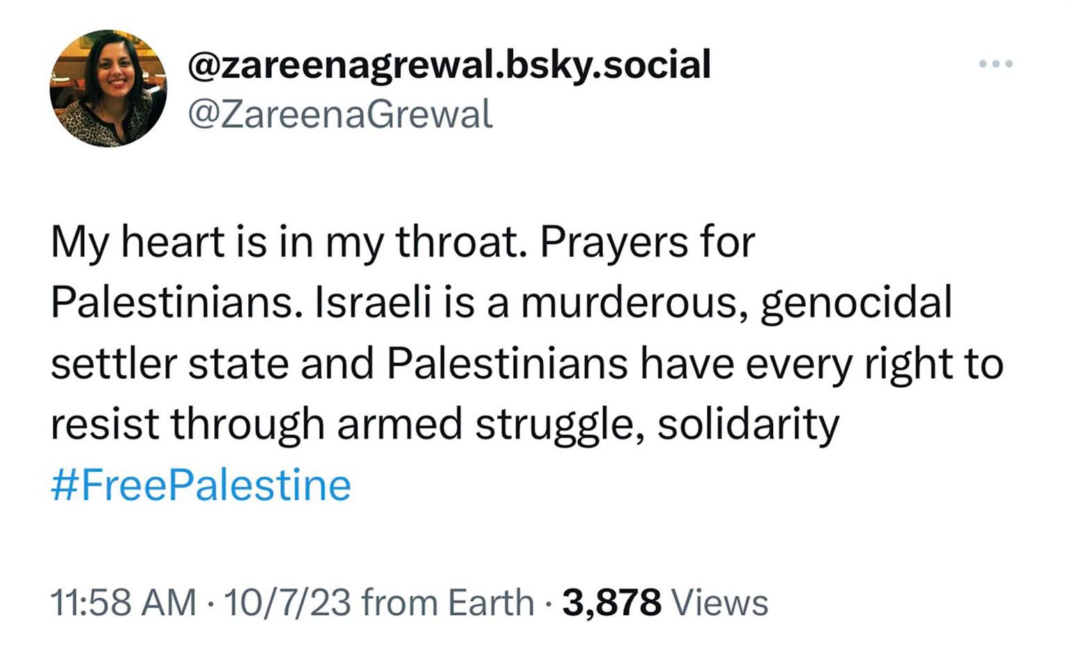
At Yale University, associate professor of American studies, ethnicity, race, migration, and religious studies Zareena Grewal faced widespread condemnation for her public statements following the 7th October terrorist attacks by Hamas. On the very day Hamas launched over 5,000 rockets into Israel, murdering over 1,300 people and taking hundreds of hostages, Grewal posted on X: “My heart is in my throat. Prayers for Palestinians. Israel is a murderous, genocidal settler state and Palestinians have every right to resist through armed struggle, solidarity.”
Screenshot of Zareena Grewal’s controversial post (Source: New York Post)
Grewal, who describes herself as a “radical Muslim” on her social media profile, followed up her initial post with tweets that appeared to celebrate the violence, writing, “It’s been such an extraordinary day!” In response to a journalist’s statement that “Civilians are civilians are civilians, doesn’t matter where,” Grewal replied, “Settlers are not civilians. This is not hard.” She added in another post that “no government on earth is as genocidal as this settler colonial state.”
A petition initiated by Yale student Netanel Crispe titled “Remove Zareena Grewal from the Yale Faculty for Promoting LIES and VIOLENCE” gathered over 28,000 signatures, asserting that Grewal had proven she had no right to educate students if she considered war crimes against civilians to be acts of resistance. Despite the uproar, Yale University refused to take disciplinary action. Yale spokesperson Karen Peart defended Grewal’s position to the student newspaper, stating, “Yale is committed to freedom of expression, and the comments posted on Professor Grewal’s personal accounts represent her own views.”
The Jihadist mindset is not limited to the United States; it represents a growing pattern across Western nations. A similar phenomenon exists across the Atlantic in the United Kingdom. At the University of Cambridge, Farah Ahmed, an assistant research professor in the Faculty of Education, was appointed in 2024 to teach undergraduates and supervise postgraduate research despite a long history of radical Islamist activism.
Ahmed is a former member of the proscribed Sunni Islamist group Hizb-ut-Tahrir, an organisation dedicated to establishing a global caliphate under Islamic law. Throughout her career, Ahmed has denounced Western secular education as a fundamental threat to Islam, openly opposing democracy, social integration, and religious tolerance.
Writing in a Hizb-ut-Tahrir publication titled “Education and Identity,” Ahmed argued that the British National Curriculum engaged in systematic indoctrination to build secular citizens, asserting that the Muslim faith directly opposes secular capitalism. She criticised British schools for teaching against child marriage and polygamy, claiming that schools telling children that “polygamy or marriage under the age of 16 is outdated and discriminatory towards women” was unacceptable. She further attacked the concept of democracy as a “corrupt tradition” and rejected religious tolerance in education because it placed Islam on the same level as Christianity, Judaism, Buddhism, and Hinduism. Ahmed went so far as to label English “one of the most damaging subjects” a school can teach, warning that classic literature like Shakespeare’s Romeo and Juliet and Macbeth posed dangers by encouraging parental disobedience and questioning fate.
Selective tolerance and the normalisation of hate
The willingness of universities to platform racist and hateful views also extends to academics who openly support violence while attacking other religious and national groups. At the University of California, Berkeley, continuing lecturer Hatem Bazian has repeatedly stirred controversy for his radical positions and refusal to condemn Hamas’s violence. Bazian is the co-founder of Students for Justice in Palestine (SJP) and Chairman of American Muslims for Palestine (AMP).
Following the 7th October attacks in Israel, a video posted by Canary Mission showed journalist Asra Nomani confronting Bazian at a rally in Washington, D.C., asking if he condemned Hamas for killing 1,400 civilians. Bazian mocked the question, responding that he was against “hummus” and liked “falafel,” pretending to be busy on his phone to avoid condemning the abduction and murder of civilians.
Bazian’s record extends beyond anti-Israel activism into explicit anti-Hindu and anti-India rhetoric. In 2021, Bazian extended public support to controversial figures known for downplaying historical atrocities against Hindus in India.
He has also actively promoted reports generated by the Indian American Muslim Council (IAMC), an organisation with documented links to extremist and banned outfits such as the Students’ Islamic Movement of India (SIMI), Jamaat-e-Islami, and Lashkar-e-Taiba through its founder Shaik Ubaid. Yet, figures like Bazian continue to maintain university positions in the United States, utilising academic legitimacy to further polarising agendas.
Western universities are failing institutionally, transforming into cesspools of agenda-driven individuals
The accumulation of these cases reveals a profound crisis at the heart of Western academia. Western Universities, historically designed as centres for rigorous inquiry, open debate, and objective scholarship, have increasingly transformed into platforms for agenda-driven individuals who harbour deeply hateful, racist, and radical ideologies. Under the guise of academic freedom, institutions repeatedly shield faculty members who wish death upon political opponents, justify the slaughter of civilians, campaign against democratic integration, and promote sectarian hatred.
This institutional cowardice and ideological alignment have severe consequences. Universities are entrusted with the responsibility of shaping the minds of young adults, cultivating critical thinking, and preserving foundational societal values. By recruiting, tenure-tracking, and protecting academics who use their platforms to peddle Islamist dogmas, higher education leadership has compromised its fundamental mission.
Supported by foreign authoritarian capital, protected by administrative double standards, and sustained by radical political alliances, these individuals operate with near impunity. Until university administrations enforce rigorous ethical standards and dismantle the financial and political incentives that protect radicalism, higher education will continue to drift from its true educational purpose, serving instead as an incubator for ideological intolerance.
The BRICS countries have reached agreement on the New Delhi declaration after long and comprehensive negotiations which took place ahead of the 18th BRICS Summit in the national capital. The discussions continued late into the night as member countries worked to bridge differences on major geopolitical issues, particularly the conflicts in West Asia and Ukraine.
The agreement is being seen as an important diplomatic achievement for India, which is chairing BRICS this year. The summit is being held in New Delhi from 12th to 13th September under the theme “Building for Resilience, Innovation, Cooperation and Sustainability.” The declaration says the expanded BRICS will work together through three broad areas: political and security cooperation, economic and financial cooperation, and cultural and people-to-people ties.
India’s ability to bring different members together is particularly significant because the grouping now includes countries with sharply different positions on several global conflicts. Iran and the UAE, for instance, have differences over the West Asia crisis, while Russia and China have their own positions on the changing global order.
Focus on Gaza and West Asia
The New Delhi Declaration takes a strong position on the worsening situation in West Asia. BRICS leaders have called for maximum restraint and urged countries to avoid steps that could further increase tensions. They also stressed the protection of civilians and civilian infrastructure and called for dialogue and diplomacy to achieve long-term peace in the region.
On Gaza, the declaration calls for the continuation of the ceasefire and full and unhindered humanitarian access. It discussed continued violence despite the October 2025 ceasefire and opposes policies aimed at removing Palestinians from Gaza.
The leaders have also backed a two-state solution to the Israeli-Palestinian conflict. The declaration supports a sovereign and independent State of Palestine within the internationally recognised 1967 borders, with East Jerusalem as its capital, alongside Israel. It also supports Palestine’s full membership of the United Nations.
BRICS also called for respect for international humanitarian law and criticised attacks on civilians, healthcare facilities and other civilian infrastructure, as well as restrictions on humanitarian aid. It also supports UNRWA and humanitarian assistance to Palestinians.
The declaration also refers to Lebanon, calling for upholding the ceasefire there and for the full implementation of UN Security Council Resolution 1701.
Terrorism gets strong condemnation
A key point for India is the declaration’s reference to the 22nd April 2025 terrorist attack in Jammu and Kashmir, in which 25 Hindus were killed because of their religion, and many others were injured.
BRICS leaders condemned the attack in the strongest terms and said terrorism must be fought in all its forms. They also called for action against cross-border movement of terrorists, terrorism financing and terrorist safe havens.
While the declaration states that terrorism religion, nationality, civilisation or ethnic group, it also calls for those involved in terrorist activities and their supporters to be held accountable.
The grouping further wants closer cooperation against organised crime, money laundering, financial fraud, illegal virtual-asset flows and cross-border scam networks. It has called for greater information sharing between financial intelligence units, law enforcement agencies, customs authorities and technology platforms.
Push for a bigger role for Global South
At the heart of the declaration is a demand for changes in global institutions. BRICS leaders said developing countries, particularly those from Africa, Asia and Latin America and the Caribbean, should have a bigger say in global decision-making.
The declaration calls for reform of the United Nations Security Council and greater representation of developing countries. China and Russia, both permanent members of the Security Council, reiterated their support for the aspirations of Brazil and India to play a greater role in the UN, including its Security Council.
BRICS also called for reforms in the IMF, World Bank and Bretton Woods institutions, arguing that their voting and governance structures should better reflect the changing global economy and the growing weight of emerging and developing countries.
The declaration also backs a stronger voice for developing nations in the World Trade Organisation (WTO) and calls for the restoration of a fully functioning two-tier WTO dispute settlement system.
Trade, tariffs and local currencies
Trade tensions are another major concern for the bloc. BRICS criticised the growing use of unilateral tariffs and non-tariff measures, saying such steps can disrupt global trade and supply chains.
The declaration calls for a more open, fair and predictable global trading system with the WTO at its core. It also supports the WTO membership bids of Ethiopia and Iran and notes China’s expansion of zero-tariff treatment to 53 African countries with which it has diplomatic relations.
BRICS members are also continuing discussions on reducing the difficulties involved in cross-border payments. The declaration supports further work on payment systems that can make transactions faster, cheaper, safer and more accessible.
It also notes discussions on using BRICS local currencies for trade settlements and investments, while recognising that countries will move at different speeds according to their national priorities.
The New Development Bank (NDB) is expected to play a bigger role in financing development projects across emerging economies. BRICS leaders want the bank to increase local-currency financing, mobilise more resources and support infrastructure, sustainable development and economic integration.
Food, energy and supply-chain security
The declaration gives considerable attention to food security. BRICS countries, which together account for a major share of global agricultural production, want stronger cooperation to deal with food-price volatility, supply disruptions and shortages of agricultural inputs.
The bloc is continuing work on a proposed BRICS Grain Exchange, with discussions also looking at expanding cooperation to other agricultural products and commodities. A new farmer-focused network, BRICS AGRIN, has also been welcomed, along with a Global Forum on Farmers’ Rights in Seed Systems.
Energy security is another major priority. BRICS has called for stable energy markets, secure supply chains and protection of critical energy infrastructure. At the same time, it supports energy transitions that take into account the different needs and circumstances of developing countries.
The declaration also highlights cooperation on critical minerals, which are important for clean-energy technologies, and calls for reliable and diversified supply chains.
AI, technology and digital cooperation
Technology has emerged as another important area of BRICS cooperation. The declaration recognises Artificial Intelligence as a major opportunity for economic growth and sustainable development, but says AI development must also focus on safety, security, reliability, inclusion and risk reduction.
BRICS is also working towards greater cooperation on digital public infrastructure, digital skills, cybersecurity and future communication networks. A proposed high-speed submarine cable network connecting BRICS countries is being studied to improve digital connectivity and resilience.
The bloc has also welcomed the BRICS Incubator Network and further consideration of a BRICS Startup Innovation Fund, aimed at supporting startups and innovation-led growth. India has also established the India Centre for BRICS Industrial Competencies as part of wider cooperation on advanced manufacturing and Industry 4.0.
Health and climate also on the agenda
The declaration expands BRICS cooperation in healthcare, including universal health coverage, disease surveillance, pandemic preparedness and medical research. Tuberculosis has been identified as a major global health challenge requiring greater research and cooperation.
BRICS has also backed a BRICS Mission for Healthy Lifestyle and a 2026-2029 roadmap for promoting healthier lifestyles. Mental health has received particular attention, with plans for a network of Centres of Excellence, with NIMHANS serving as the coordinating centre.
Climate change and disaster preparedness are also major parts of the declaration. BRICS leaders reaffirmed support for the Paris Agreement, called for more climate finance for developing countries and highlighted the need for stronger early-warning systems and climate-resilient infrastructure.
A test of India’s diplomatic role
Notably, Bharat Mandapam is hosting the BRICS 2026 Summit, where India accomplished a similar diplomatic achievement in 2023 at the height of the Russia-Ukraine conflict. The country was then hosting the G20 Summit, a group of nations with even more divergent viewpoints. However, New Delhi’s declaration was accepted by participants.
“I congratulate my ministers, Sherpa, all officials who worked hard for it and made it possible,” PM Modi said at the time. The PM further conveyed, “India’s G20 Presidency has been the most ambitious in the history of G-20. With 112 outcomes and presidency documents, we have more than doubled the substantive work from previous presidencies.”
Now, the New Delhi Summit comes as BRICS completes two decades and faces the challenge of keeping an expanded membership together despite major differences among its members.
India’s chairship has included more than 400 meetings and engagements across 30 cities, involving ministers, parliamentarians, officials, experts, businesses and other stakeholders. The declaration credits the year’s work with strengthening cooperation on resilience, innovation, sustainable development and India’s effort to give the Global South a stronger voice.
Prime Minister Narendra Modi has already held talks with Russian President Vladimir Putin and Iranian President Masoud Pezeshkian. Discussions with Chinese President Xi Jinping are also closely watched as India and China seek to improve ties after years of border tensions.
For New Delhi, the summit is therefore about more than issuing a joint statement. It is an opportunity to show that India can maintain working relationships with Russia, Iran and China while continuing to deepen its ties with the United States and Europe.
The New Delhi Declaration reflects that balancing act. It combines calls for peace and diplomacy with demands for economic reform, greater use of local currencies, stronger Global South representation, cooperation in AI and technology, food and energy security, climate action and a larger role for BRICS institutions.
China will take over the BRICS chairmanship in 2027, with the next summit scheduled to be held in the country.
On Thursday, 10th September, the parent company of Claude AI, Anthropic, published a new investigative report [pdf] detailing how threat actors used its Claude artificial intelligence models for cyber operations, surveillance, weapons development, scams and other harmful activities. Titled “Detecting and countering misuse of AI: September 2026”, the report covers activity that Anthropic said it identified and disrupted between December 2025 and August 2026.
Anthropic said its Threat Intelligence team identified the operations through its monitoring and investigations into real-world misuse of Claude.
We're publishing our most detailed threat intelligence report to date.
It covers how people tried to misuse Claude—for cyberattacks, influence operations, surveillance, biology, and building weapons—and how we found and stopped them.
How Anthropic caught China-linked misuse of Claude
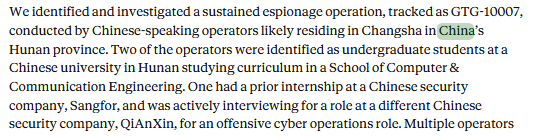
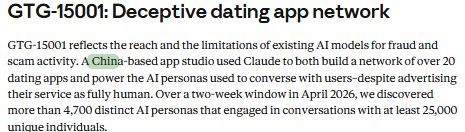
Anthropic investigated a sustained espionage operation, conducted by Chinese-speaking operators likely residing in Changsha in China’s Hunan province.
The investigation identified two operators as undergraduate students at a Chinese university in Hunan who were studying in a School of Computer & Communication Engineering. One of them had previously interned at Chinese security company Sangfor and was interviewing for an offensive cyber operations position at another Chinese security company, QiAnXin.
An excerpt from the report
Anthropic said the operators used Claude as the “engineering and orchestration layer” for a coordinated offensive operation. Their activities included attempts to break into production systems, reconnaissance of foreign government networks across the Middle East, Europe and Southeast Asia, vulnerability research against major endpoint-security products, malware development and the creation of an intelligence-collection platform.
The investigation found that the operators were running several workstreams at the same time. These shared tools, infrastructure and persistent records allowed the operators to maintain campaign information between sessions. Some collection and vulnerability research processes could continue even when the human operators were away.
The group targeted roughly 50 organisations across education, retail, energy, technology, healthcare, finance and manufacturing, along with government agencies. Anthropic said the group accessed an education-technology company and extracted hundreds of megabytes of student data, gained access to production systems at a retail company and retrieved citizen information from a Southeast Asian government agency.
The AI system was also used to support the operation after access was obtained. Anthropic said the actors used Claude to enumerate systems, move through networks using reused or exposed credentials, collect information and continue from one compromised host to another. At the same time, their broader intelligence workflows collected open-source information connected to military and government priorities.
The report said the operators’ hands-on activity was concentrated on victims inside China, even though their AI-enabled workflows targeted organisations globally. Anthropic eventually banned accounts linked to the group and created additional detections based on the behaviour it observed.
Anthropic also found that a religious-affairs intelligence collection unit in China that had previously involved multiple teams of analysts had been reduced to a single office using an AI assistant to produce thousands of investigations every month. The company said AI was also being used to process large amounts of social media data and identify people for further monitoring.
China used Claude to track and recruit Uyghurs in Syria
Another shocking China-linked case involved the surveillance and recruitment of Uyghurs and Uyghur armed formations in Syria. Anthropic said, “We identified a PRC government-aligned operation that used Claude to track, profile, and recruit Uyghurs and Uyghur armed formations in Syria. The armed targets were ethnic Uyghurs who had recently joined the newly formed Syrian Army, formations the PRC government designates as terrorists.”
An excerpt from the report
The company further said that the actor used Claude to identify people in Syria who might have access to the armed formations and then attempted to recruit them, including by offering money in exchange for information about the units. The actor also used Claude to locate Uyghur businesses and other points of interest in Syria.
The operation was part of a wider campaign that also monitored Uyghur diaspora journalists and involved preparing bids for surveillance platforms for government clients. Anthropic assessed with low confidence that the operator was a contractor working for PRC state security rather than a state security organ directly.
According to the report, the actor used Claude to turn material collected from more than 100 WhatsApp groups and dozens of Telegram channels into structured Chinese-language profiles. The profiles included information about individuals who might be vulnerable because of financial problems, family separation or ideological dissatisfaction. The actor also identified people with family members still in Xinjiang.
Anthropic said Claude was used to help with the recruitment effort in Syrian Arabic, including translating messages and acting as an “expert” to check the language, military terminology and psychology used in deceptive outreach. The actor also used Claude to prepare plans targeting Uyghur diaspora media.
The model, however, refused several requests involving covert interrogation and large-scale fake-persona creation.
Religious leaders and Chinese diaspora targeted
China-based PRC government used Claude as a stand-in for a staffed analyst team, building Chinese-language dossiers targeting religious leaders and Chinese diaspora figures across Asia.
The actors used Claude as a “stand-in for a staffed analyst team” to create Chinese-language dossiers. Anthropic said, “The targeting mapped precisely onto the priorities of China’s religious affairs and united front apparatus (the party-state bodies that manage religious affairs and coopt or pressure groups perceived to be a threat to religious unity).”
An excerpt from the report
The actors instructed Claude to prepare documents that appeared to be intended for official internal security offices, including “personnel research drafts”, investigative “clue reports” and daily “situational awareness” reports. These documents included information about targets’ activities related to China, scandals and “抓手 (zhuāshǒu)”, a term used by the United Front Work Department to describe exploitable leverage.
The targets included senior Catholic cardinals across Asia, the leadership of the Presbyterian Church in Taiwan, Tibetan Buddhist civil society groups and the Tibetan administration in exile, as well as Falun Gong and affiliated media.
In one case, a single operator managed four parallel workstreams. Claude was asked to process information in multiple languages and turn it into structured Chinese-language dossiers using fixed templates. Anthropic said this effectively turned work normally done by a team of analysts into a workflow operated by one person.
China-linked “stability maintenance” surveillance
Anthropic also disrupted a China-based campaign involving what it called “stability maintenance” surveillance and transnational repression. The company said three linked operations involved actors connected to municipal public and state security organisations.
The term “stability maintenance” or 维稳 is used by China’s party-state system for efforts aimed at suppressing unrest and dissent. In one case, an actor prepared an internal manual on how to use AI, including instructions for Claude to act as an intelligence analyst serving China’s national security apparatus.
An excerpt from the report
Anthropic said, “We believe this actor is associated with a municipal cyber police unit, which used Claude to run a domestic sentiment surveillance program.” Another was a police academy student who identified 10 private Chinese citizens as targets for what the security system called “control”. A local state security bureau used Claude to produce daily “situational awareness” briefings on overseas dissidents and civil society organisations.
The targets included petitioners, rights defenders, pro-democracy figures in Hong Kong, organisers of Tiananmen Square commemorations, Uyghur advocacy groups and Western human rights organisations. In one case, Claude was asked to prepare information about venues and routes connected to overseas protests.
Anthropic said the three operations shared the same broad mission: identifying people likely to file grievances, monitoring rights defenders and tracking people classified as “key persons”. The monitoring was extended to overseas dissidents and diaspora communities.
AI-powered public opinion and dissident monitoring
Another China-based operation used Claude as an automated “public opinion monitoring” and intelligence-analysis system. Anthropic said, “The actor directed Claude to produce government briefings (舆情简报, restricted briefings for officials) that catalogued dissidents, activists, ethnic minority and Chinese diaspora communities, and foreign media as threats to political stability.”
The actor instructed Claude to role-play as a “senior emergency public opinion analyst serving the government of the People’s Republic of China.” Claude then produced documents that scored information according to political sensitivity and rewrote critical reporting according to rules designed to reflect the PRC’s preferred terminology.
The system processed between 15 and more than 30 foreign news articles a day from platforms including Weibo, X, YouTube, Telegram and Facebook. The actor also instructed Claude to change terms such as “Taiwan government” to “Taiwan authorities” and to put scare quotes around phrases such as “human rights violations”.
Anthropic said some of the resulting documents went beyond analysis and recommended enforcement measures that could only be carried out by government agencies. The company assessed with medium confidence that the operation was conducted by a contractor working for government clients, likely connected to China’s state security, United Front or propaganda system.
Claude used in conventional weapons activity
Anthropic said it also detected and disrupted the use of Claude in conventional weapons development by China. The company said its investigators had found multiple actors using Claude to develop weapons-related software or support intelligence and procurement work connected to weapons programmes.
“Historically, this kind of work has been uncovered by governments, United Nations panels, and outside investigators,” Anthropic said, adding that a frontier AI company can identify some of this activity directly when users violate its policies.
Anti-torpedo system and undersea warfare
In another misuse of Claude in a China-based case, an actor used Claude to work on an anti-torpedo weapons system. Anthropic said the actor was pursuing three parallel tracks.
The first involved drafting a Chinese-language specification for an anti-torpedo fire-control system intended for approval by a Chinese defence manufacturer. The second involved preparing a Chinese-language technical proposal of more than 200 pages along with an executive presentation. Third, the actor used Claude to benchmark their own system against specific US anti-torpedo and anti-submarine programs based on publicly accessible information, the company said.
The report added that the actor then generated a Chinese-language briefing on US Navy systems, based on open-source reporting. The actor presented itself as an original equipment manufacturer in the US defence sector.
“We assess that the actor was associated with the Chinese defence industry,” Anthropic said in the report.
Anthropic assessed that the actor was associated with a Chinese defence-industry manufacturer seeking to prepare a weapons specification and acquisition proposal for the People’s Liberation Army Navy.
The actor repeatedly used Claude to refine the proposal and asked it to act as a hostile expert reviewer to identify weaknesses before producing another version. Anthropic said the model was also used to develop parts of the fire-control software and a testing matrix.
Electronic warfare and air-defence suppression
Anthropic also disrupted a China-based operation involving electronic warfare and air-defence suppression. The actor used Claude’s chat, coding and agentic tools to develop a Chinese-language software suite containing around 16 modules.
The system was developed over 12 versions and included software for radar detection and jamming, vulnerability analysis and targeting instructions. Anthropic said the software could analyse radars, surface-to-air missile sites, command posts and communications nodes, while assessing detection coverage and the effectiveness of jamming.
Anthropic identified that the actor was a China-based defence and military-industrial researcher and said, “Based on our investigation, we assess the actor is a China-based defence and military-industrial researcher. Account-level metadata and content flagged by our safeguards indicated the actor was linked to PRC research institutions, including the PLA Academy of Military Sciences.”
The company banned the accounts and said the findings were incorporated into new safeguards.
Intelligence on directed-energy weapons
A separate China-based actor used Claude to collect open-source intelligence on advanced directed-energy weapons and their supply chains. The actor described themselves as a defence intelligence writer and internal publication editor leading a three-person team.
Anthropic said, “Across dozens of sessions, the actor asked Claude about specific directed-energy weapons. These included inquiries about a vehicle-mounted high-power microwave weapon for countering drone swarms, which had been disclosed publicly days earlier. The actor also gathered information on the supply chain for procuring components that generate high-power microwave systems. The actor directed Claude to draft briefings for restricted internal circulation to senior Chinese Communist Party (CCP), military, or state security leadership.”
The actor tried to identify a particular microwave-generating device and its supplier, with the stated purpose of reverse-engineering the weapon, developing countermeasures and comparing it with Chinese systems.
Anthropic said Claude was also used to map supplier ownership and prepare a 23-page report on foreign high-power microwave programmes.
China-based dating apps and AI personas
The report also described a large-scale scam involving a China-based app studio. Anthropic said, “A China-based app studio used Claude to both build a network of over 20 dating apps and power the AI personas used to converse with users-despite advertising their service as fully human.”
Over two weeks in April 2026, Anthropic identified more than 4,700 distinct AI personas that interacted with at least 25,000 unique people. The company said real people were also mixed into the dating-app feeds to make the service appear authentic, while AI tools helped those workers respond to users.
Anthropic also provided an update on illicit AI distillation, referring back to its first disclosure published in February 2026. “Since we published our first disclosure in February, we have identified and disrupted additional distillation attacks against Claude from seven labs based in China,” the company said. According to Anthropic, all seven attacks targeted generally available Claude models.
On September 8, 2026, a routine patrol by the Odisha Forest Department officials in a forest in the Jaleswar area of Balasore district, Odisha, became national news because of a unique discovery. During the patrol, Balasore’s Divisional Forest Officer, Pratik Prakash Indalkar, and his team stumbled upon a group of five baby orangutans, lying abandoned in Bichitrapur forest under Bhograi block.
The baby orangutans, three males and two females aged between 1 and 1.5 years, lay abandoned, looking weak, scared, and starved. As soon as news about the baby orangutans broke out, curious locals flocked in large numbers to see them. The forest officials provided the infants with food and swiftly moved them to safety, away from the crowds.
Image via ANI
The baby orangutans were sent to the Nandankanan Zoological Park in Bhubaneswar, where they are being kept in quarantine. The infants are receiving care under expert supervision, and they are being observed for any signs of dehydration, illness, or stress because of being separated from their mothers at such a young age.
#WATCH: Five rescued orangutans brought to Nandankanan Zoo in Bhubaneswar, kept in quarantine#Bhubaneswar#Odisha
The innocent red-furred creatures have grabbed national as well as international attention. While there is nothing unusual in wild animals being found in a forest, the presence of baby orangutans in Odisha’s forest became a talking point because the area is not their natural habitat. Odisha, or, for that matter, India, has no known population of orangutans, one of the three great ape species found in Asia.
In Asia, orangutans are exclusively found in Sumatra (Indonesia) and the island of Borneo, both of which are located thousands of kilometres away from India. It is not yet clear whether the baby orangutans are from Indonesia or Borneo. The Indonesian Ministry of Forestry said that primary observations and the physical features of the baby orangutans indicate that they might belong to the Indonesian orangutan population. The ministry called for a DNA test to confirm their genetic origins.
Baby orangutans might be victims of wildlife trafficking
In the absence of any migratory corridor linking their natural habitat and India, it is unlikely that the baby orangutans would have travelled such a vast distance and arrived at the eastern coast of India on their own. The lack of a plausible explanation for their presence in India has raised suspicions of possible transnational wildlife trafficking. It is suspected that the animals might have been smuggled into India or were being smuggled to a different destination via India.
Odisha’s environment minister, Ram Singh Khuntia, expressed suspicion that the baby orangutans are victims of wildlife trafficking. “We suspect that an international racket might be involved in this,” Khuntia said, adding that investigators are examining whether an international smuggling network was involved in their trafficking.
“Orangutans are not native to India. Their natural habitat is found only in Indonesia and Malaysia, particularly on the islands of Sumatra and Borneo. Therefore, the presence of five baby orangutans in India strongly suggests that the animals are victims of illegal wildlife trade and smuggling involving a transnational network,” the Indonesian forestry ministry said in its statement.
Indian authorities are working to determine the origins of baby orangutans and investigate how they ended up in Odisha. Meanwhile, the Indonesian government has urged the Indian government to return the baby orangutans to Indonesia. Indonesia’s Ministry of Forestry said it is following up on the matter with Indian authorities, including the CITES Management Authority of India and the Indian Embassy in Jakarta.
This is not the first time the orangutans have been found in Indian territory. Earlier, in 2022, two baby orangutans were found abandoned at a checkpoint near the border between the states of Assam and Mizoram.
Transnational wildlife trafficking and the role of India
The incident has reignited debate around international wildlife trafficking, which remains a major challenge for governments across the world. While there is no universally accepted definition of wildlife trafficking, it involves illegal trade, smuggling, poaching, capture, or collection of endangered or protected species of animals, plants, and their parts in violation of national or international laws. The demand for luxury goods, exotic pets, food, and traditional medicine made from parts of endangered or protected plants and animals fuels the wildlife trafficking networks.
Wildlife trafficking is said to be the fourth-largest illicit trade globally after arms, narcotics, and human trafficking. At present, illegal trade in wildlife and wildlife products is estimated to be worth $7-$23 billion annually. It is one of the most lucrative criminal activities in the world.
While illegal trade in wildlife is a global menace, India is not exempt from its impact. India features among the top 20 countries for wildlife trafficking and among the top 10 countries where wildlife trafficking happens via air routes. Apart from its rich biodiversity and the dense human population, India is a preferred place for wildlife traffickers for a specific reason. India is exploited for a threefold role of being a source, a transit route, and a destination for wildlife trafficking compared to other countries where one or two of these activities take place. This makes it structurally challenging for law enforcement to address and curb the problem.
India is misused as a source for its own endangered species such as tigers, pangolins, star tortoises, and red sanders. It is also used as a transit route for animals, plants, and their parts moving between Southeast Asia and international markets. Furthermore, it also serves as a destination to facilitate a wide consumer base for trafficked wildlife. India’s porous borders with its neighbours, like China, Myanmar, and other Southeast Asian countries, in addition to its growing aviation sector, provide a conducive route for wildlife trafficking.
According to the Wildlife Trust of India (WTI), a total of 202 incidents involving wildlife crime were documented between April and December 2025. Out of these, 151 cases related to hunting, attempted hunting, and illegal entry into protected areas or illegal trade of native wildlife species. 51 incidents were linked to attempts to smuggle live exotic wildlife for the pet trade, mostly from Southeast Asian countries.
During the same period, 29 incidents involving the smuggling of tiger and leopard parts were recorded, involving seizures of skins, claws, and teeth across multiple states. Besides, 15 ivory seizures were reported, along with a case of an elephant electrocuted for its tusks.
The most trafficked animal species in India
Pangolins, seahorses, and tortoises are some of the most trafficked species in India. Patagonian seahorse (hippocampus patagonicus) is one of the three seahorse species that are trafficked for their use in medicine. Indian star tortoise is trafficked worldwide due to its high demand as a pet.
According to a 2020-21 report by India’s Directorate of Revenue Intelligence, the most common animal products trafficked out of India in that period were ivory, turtles and tortoises (especially the Indian star tortoise), Indian and red sandalwood (red sanders or lalchandan). The report states that the illegal trade in rhino horn registered a decline, but pangolin poaching kept rapidly growing. Besides, the trade in tiger parts also continued unchecked.
In addition to that, tiger and leopard skins, their bones and other body parts, rhino horns, ivory, turtles and tortoises, seahorses, snake venom, mongoose hair, snake skins, tokay gecko, sea cucumber, chiru fleece, musk pods, bear bile, medicinal plants, red sanders timber, and caged birds such as parakeets, mynas, and munias are also some of the animal parts commonly smuggled out of India.
Most common trafficking routes in India
According to a 2018 report, wildlife traffickers moving ivory, rhino horn, reptiles, birds, pangolins, marine products, and mammals by air tend to rely on large hub airports all over the world. In the case of India, wildlife traffickers mostly use two major routes for smuggling wildlife into and out of India. One of the routes is the international border along the northeastern states of India, and the other route is through airports.
The trafficking in rhino horns, tiger parts, and pangolin scales is especially rampant along the Indo-Nepal and Indo-Myanmar-China borders, and the Northeast Indian cities such as Dimapur, Guwahati, and Imphal are being used as transit sites. Trafficking of birds and reptiles happens along the India-Bangladesh border, including the Dooars region in northern West Bengal, particularly the town of Jalpaiguri.
In air routes, Chennai and Mumbai airports have emerged as major centres for the trafficking of reptiles, including turtles and tortoises, into and out of India. The Indian star tortoise, which is said to be the most trafficked reptile in the world, is supplied from trafficking hubs in Karnataka, Andhra Pradesh, Gujarat, and Tamil Nadu to Thailand, Singapore, and Malaysia, primarily by air. Live animals are smuggled in checked luggage, hand-carried containers, or mislabelled air cargo shipments.
Legal framework to address the menace
At the international level, wildlife trade is regulated by the Convention on International Trade in Endangered Species of Wild Fauna and Flora (CITES), which currently has 184 Parties, including 183 countries and the European Union. India is a signatory to the convention. Notably, orangutans are listed as an endangered species under CITES. They are included in CITES Appendix I, the strictest category under the convention, which outright prohibits any international trade of listed animals for primarily commercial purposes. Besides, the International Union for Conservation of Nature (IUCN) classifies all three living species of orangutans as Critically Endangered.
At the domestic level, the Wildlife Protection Act, 1972, creates the legal framework to prevent and punish the trafficking of protected species. The Act was amended in 2022 to implement the CITES obligations. The enforcement of the laws is undertaken by the Wildlife Crime Control Bureau (WCCB) along with the Directorate of Revenue Intelligence, state forest departments, and customs authorities at ports and airports. The Wildlife Protection Act, 1972, is further supported by the Customs Act, which provides additional tools for seizing illegally imported animals and prosecuting smugglers at the point of entry.
However, despite dedicated domestic and international frameworks to address the problem of wildlife trafficking, the problem continues unabated due to logistical challenges in the implementation of the laws.
On the night of 10th September (Thursday), utensils trader Vinod Kumar Sahni reportedly died while receiving treatment at King George’s Medical University (KGMU) in Lucknow, the capital of Uttar Pradesh. He was allegedly attacked after returning from his shop on a motorcycle, a day earlier. The incident transpired around 10:30 pm as he passed through the Shahpur Dhanwa area, which falls under the jurisdiction of the Paraspur police station.
The path was claimed to be blocked by vehicles, after which a confrontation unfolded and soon escalated into a physical fight involving a sharp-edged weapon. Both sides sustained injuries. A personal feud has also emerged as a possible angle in the case. Sahni was a resident of Reksadiya village in the Gonda district.
Sahni’s long record of Hinduphobia and misogyny
Notably, he consistently expressed his opposition to Hindu beliefs, often resorting to derogatory remarks in his social media posts, showcasing his animosity towards the faith and its practitioners. “Those ba*ta*ds whose ancestors disdained our ancestors for wearing fine clothing, those sons of wh*r*s who were against our ancestors riding bicycles, I wonder how the motherfu*ke*s can state, ‘All Hindus are brothers, and if divided, you will be killed.’ All the ba*ta*ds who are opposing reservation are Akbar’s descendants,” he wrote in a post.
He also attempted to defend the tyrant Mughals by asserting that the entire country was adhering to the Varna system at that time.
Sahni remarked, “Sarvesh Pandey, the chief of the ‘Savarna Army,’ declares, ‘Return our princely states to us, and you may retain the reservation.’ If anyone knows how many princely states the descendants of Sudama actually held, please let us know. Otherwise, share this post so it reaches Sarvesh Pandey,” while implying that Brahmins are poor and akin to beggars in a similar post on social media.
He did not even hesitate to target Hindu women and girls, invoking a revered Hindu ritual to utter deeply misogynistic, sexist and humiliating statements about them. “These people organise the Kalash procession, making their daughters, sisters and wives lead it with pots on their heads so that no one sees their protruding breasts and private parts,” he remarked while addressing the people of the Dalit community, in yet another offensive post.
Sahni also mocked that Other Backward Class (OBC) castes have become financially prosperous and should be moved to the General category, adding, “They do not require reservation, having reached a level of parity with them in education and economic aspects. The General category will further strengthen their social position through marital and social relationships with the OBC.”
Moreover, he took a contemptuous swipe at the 10,000 members of the Dalit and OBC communities who participated in a religious ceremony and wore the sacred thread (Janeu) amid the recitation of mantras. He inquired whether those who have taken on the Brahmin identity will also become sons-in-law of the community.
Sahni also took a dig at the birth of Lord Krishna, diminishing his father Vasudev to the role of a delivery boy. He commented, “Vasudev is wading through the waters with a basket on his head, muttering to himself, ‘He’s come directly from the Almighty, yet I’m the one bearing all the costs and stress.’ While the world was celebrating, the true ‘delivery boy’ Vasudev was toiling through the night without Google Maps.”
He further conveyed, “Just picture what would have happened if GPS (Global Positioning System) had been available back then. Do share your amusing thoughts in the comments.” He also attached a picture of a man carrying a grown boy on his head, evidently aimed at ridiculing one of the most important elements of Hinduism.
Unrest erupts after the occurrence
A wounded Sahni was taken to the police station by his family to file a written complaint. Afterwards, he was transported to the Paraspur Community Health Centre for medical care and then referred to Gonda Medical College. He was eventually brought to KGMU for specialised treatment but succumbed to his injuries at 3 pm on Thursday.
Sahni’s family members and supporters have already begun to demonstrate, calling for the accused to be arrested and executed, for their homes to be demolished, for the family to receive compensation of Rs 5 crore, for one member to be hired by the government and for his family to be provided security. They also want the inclusion of the Gangster Act and the National Security Act (NSA) in the case.
They protested at the Paraspur police station in Reksadiya village early on 11th September (Friday). They also took Sahni’s body toward the Chachri-Paraspur route, where they were stopped by authorities. However, they transported the body to Shahpur Market and put it on the road.
Meanwhile, three police officials, including the Paraspur station house officer, were suspended for purportedly being careless and neglecting their duties in relation to the case. On the other hand, cops from several police stations were stationed across Gonda to strengthen security. Additionally, barricades were placed on the routes that led to Colonelganj village. Similar security arrangements have been made around the collectorate, the district magistrate’s home, the SP’s (Superintendent of Police) office and the circuit house.
The entire leftist lobby has sprung into action to defend the ‘human rights’ of Faisal, who was arrested after killing his live-in partner, Kajal Baraiya in the most inhuman manner. Faisal beat Kajal to death in broad daylight, and his act was recorded on a CCTV camera.
However, what triggered the leftists is not the brutal killing of an innocent woman, but the consequent police action against Faisal. An advocate named Pranay Maheshwari has filed a complaint with the National Human Rights Commission (NHRC) against what he described as “the brutal assault and harassment” carried out by Bhavnagar Police against Faisal.
“I have filed an official complaint with @India_NHRC against the brutal assault and harassment carried out by Bhavnagar Police, Gujarat, upon a man allegedly accused of murder,” Maheshwari wrote on X, terming the police action against Faisal as “state-sponsored brutality and a grotesque abuse of power”.
Whenever a Muslim is found involved and arrested in connection with a crime, the leftist cabal, including leftist media portals, jumps up to defend the accused and portray him as a victim. This is a preferred tactic within leftist-Islamist ideological echo chambers. Those who maintain that ‘terrorism has no religion’ often rush to defend the accused based on their religious identity. The same tactic was repeated by the leftist ecosystem following the arrest of Faisal alias Khatki Rafikbhai Lakhani, who brutally beat his Hindu live-in partner to death in broad daylight at the Bhavnagar bus stand in Gujarat.
Unsurprisingly, leftist propaganda portal The Wire published a report titled: “Gujarat police flogs a Muslim man in broad daylight, PUCL sends legal notice to the government.”
The report by The Wire mentioned that the Gujarat Police publicly beat a Muslim man named Faisal in Bhavnagar and that a video of the incident went viral on social media. The report stated, “A video of the incident went viral, in which the man, later identified as Faizal, cries in pain and begs for mercy while police rain lathis down on him.”
The report conveniently omits to mention why Faisal was arrested before being beaten by the police, nor does it refer to what he did at the Bhavnagar bus stand prior to his arrest. The report gives the impression that the police randomly picked up Faisal and began thrashing him in public.
Citing a notice sent by the Gujarat branch of the People’s Union for Civil Liberties (PUCL) to officials, including the Chief Secretary and police officers, The Wire reported that the Bhavnagar police took Faisal into custody for questioning and then brought him to the crime scene, where he was subjected to ‘torture.’
Here is a breakdown of the malicious distortion of the incident by both The Wire and the PUCL. The Bhavnagar police didn’t arrest Faisal in a whimsical manner. A day before the incident, Faisal brutally murdered his live-in partner, Kajal Baraiya, in broad daylight at the Bhavnagar bus stand. An FIR was officially registered against Faisal based on a complaint filed by Kajal’s mother, leading to his arrest. Yet The Wire chose to omit these crucial details entirely, simply because stating the truth didn’t fit in their narrative.
Faisal Khatki and Kajal were reported to be in a relationship. Faisal, a repeat offender with criminal antecedents, had been serving time in jail and was recently released. Kajal herself helped secure Faisal’s release. However, shortly after coming out of jail, he killed her. He was arrested following the incident, and it was only then that police action took place.
None of these important details was mentioned in The Wire’s report. All that is mentioned in the report regarding Kajal’s murder by Faisal is a casual note, which reads as: “Reports say he allegedly killed a woman named Kajal Ben, his partner for the past eight years.” Despite the horrific murder of Kajal by Faisal being caught on CCTV and the existence of clear evidence, The Wire still slyly inserts the word “allegedly” in the only mention of his heinous act in its report.
What objection did the PUCL have to Faisal being beaten in public?
After the police took Faisal back to the exact spot where Kajal Baraiya was murdered and publicly flogged him, videos of the incident went viral on social media, drawing widespread praise for the Bhavnagar police. However, the NGO, the People’s Union for Civil Liberties (PUCL), was rattled. The organisation issued legal notices to Gujarat’s Chief Secretary, Additional Chief Secretary, the State Police Chief, the District Police Chief, and several other officials.
Mujahid Nafees, Organisational Secretary of PUCL’s Gujarat branch, who sent the notice, stated that specific rules and procedures govern police action against accused individuals. While the police are authorised to apprehend suspects and investigate crimes, he argued, they cannot beat or torture people in public, nor can they bypass court orders.
The PUCL notice highlights that police publicly bound the accused with rope and brutally beat him without due process, maintaining this supposedly brutal and unconstitutional violence for four full minutes. The notice further stated, “Faisal was thrashed so mercilessly that his clothes tore and he collapsed, all while being bound in ropes.”
In its notice, the PUCL accused the Gujarat Police of violating its own rules and guidelines, demanding not only legal action but also a criminal investigation against the officers involved. Interestingly, the PUCL, which is lamenting over the police action on Faisal, did not even condemn Kajal’s brutal killing by him.
PUCL and Urban Naxal Activities
Let’s take a look at the history of the organisation, which referred to itself as “Dimagi Naxal’ in its editorial in September 2026. The term Dimagi Naxal was used by Prime Minister Narendra Modi during his Independence Day address at the Red Fort in Delhi. PM Modi said that while the Indian security forces had eliminated armed Naxals on the ground, Dimagi Naxals (intellectual Naxals) continue to spread the Naxal ideology in different areas.
The Prime Minister’s remarks triggered the entire leftist cabal, including the PUCL. Leftist propagandists attacked PM Modi for using the term and referred to themselves as Dimagi Naxals to register their opposition. The Wire also provocatively titled its September bulletin editorial, “We are all Dimagi Naxals!”
Following the Cockroach Janata Party-led protest in Delhi in July 2026, similar agitations were held in other parts of the country. Posters of Umar Khalid and Sharjeel Imam were displayed at some of these demonstrations, including Delhi, Goa, and Bengaluru.
In one such incident in Bengaluru, the police registered an FIR against a woman who had brought posters of Umar Khalid and Sharjeel Imam, along with another poster that read, “Bengaluru Police should be removed”. The filing of the FIR drew objections from the People’s Union for Civil Liberties (PUCL).
PUCL not only opposed the FIR but also claimed that not a single allegation against Umar Khalid and Sharjeel Imam, who are facing legal trial for their involvement in the 2020 anti-Hindu Delhi riots, had been proved. It described their arrests as illegal and argued that calling for their immediate release could not be considered a crime. However, the fact remains that the case is still before the court, and the trial has not yet concluded. No final judicial verdict has been delivered in the matter. Despite this, PUCL has described the two UAPA-accused as “scholars” and “activists.”
PUCL has consistently campaigned in support of Umar Khalid. It has published articles, organised events in his defence under the pretext of book discussions, and supported articles whitewashing his acts in publications such as The Wire. This forms part of a broader ecosystem that has repeatedly sought to portray Khalid in a sympathetic light.
In one such article, PUCL described Umar Khalid as a “political prisoner” and a revolutionary, arguing that the government had wrongly imprisoned him. At the same time, the police have stated in their chargesheet that Khalid played a significant role, along with other accused persons, in the violence that broke out in Delhi during the anti-CAA protests.
Furthermore, the organisation has also opposed action taken against individuals accused of using abusive or offensive language against Prime Minister Narendra Modi.
In October 2025, when an FIR was registered against students at the Tata Institute of Social Sciences (TISS) in Mumbai for observing the death anniversary of G.N. Saibaba, who was accused of having ties with the Naxals, and their anticipatory bail plea was rejected, PUCL again came out in their support. The organisation criticised the court for denying them anticipatory bail.
PUCL also opposed the government’s ban on PFI
The PUCL supported the radical Islamist organisation Popular Front of India (PFI) when the central government banned it and arrested many of its members across the country. The PUCL not only opposed the arrests but also called for the ban to be lifted.
When the PFI, which aims to transform India into an “Islamic State” by 2047, was banned, the PUCL urged the government to engage in dialogue with the Islamist organisation. It argued that Muslim youth associated with the PFI should not face arrest and demanded that UAPA charges against them be dropped.
Similarly, in October 2023, when law enforcement acted against the propaganda outlet “NewsClick” over allegations involving Chinese funding networks, the PUCL stepped in to defend and support the portal. They framed the Delhi Police’s actions as unlawful and described them as a crackdown on free speech and journalistic freedom.
Now, the same organisation has raised objections over the public beating of Faisal in Bhavnagar. Yet, they remained silent regarding the innocent Hindu victims who lost their lives in the Delhi riots, just as they omitted any mention of Kajal Baraiya, who was murdered by Faisal right at the Bhavnagar bus stand. Instead, they peddled their narrative by portraying Faisal, a murderer, as the victim of police brutality.