Home Blog Page 29

Houthi-Saudi Arabia crisis explained: Why Yemen’s Red Sea coast has become the latest flashpoint in the Middle East

The Yemen war has entered a potentially dangerous new phase.

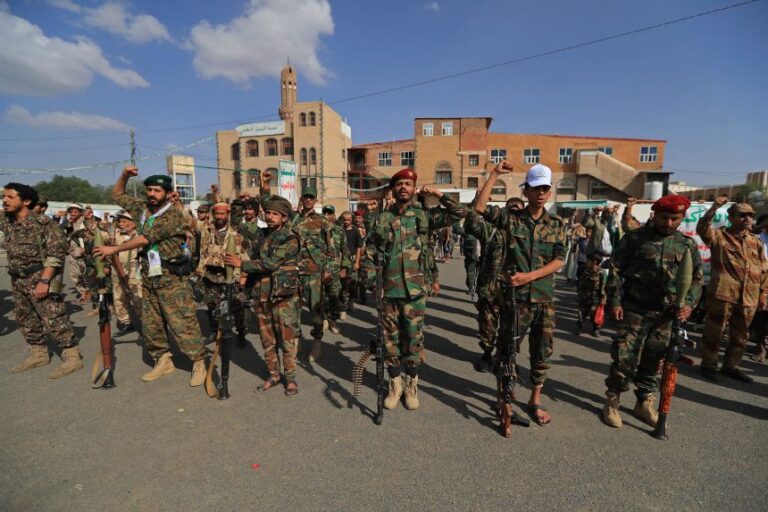
Iran-backed Houthi militants have rapidly advanced along Yemen’s Red Sea coastline, capturing the strategic port city of al-Makha (Mocha), moving into Dhubab and reaching Mayyun (Perim) Island in the Bab al-Mandeb Strait, according to Yemeni government sources cited by Reuters. The developments could give the Houthis a much stronger position over one of the world’s most important maritime chokepoints.

The immediate confrontation is between the Houthis and the Saudi-backed, internationally recognised Yemeni government. But the stakes are considerably larger.

At one level, this is another chapter in Yemen’s decade-long civil war. At another, it is becoming a new front in the wider confrontation between Iran, the United States and their regional allies.

And another development makes the Houthi threat particularly striking: an Anthropic investigation has revealed that a Yemen-based weapons cell used Claude AI to help develop software for guided weapons and ballistic missiles.

Anthropic did not identify the cell as the Houthis. However, it described a group operating in northern Yemen, much of which is controlled by the Houthis, and documented an advanced missile-development effort. The circumstances make the Houthi movement the obvious focus of scrutiny, but the attribution should not be presented as confirmed by Anthropic.

What has happened on Yemen’s Red Sea coast?

The Houthis have spent years consolidating their control over northern and western Yemen. Their latest offensive represents something different: a push southwards along the Red Sea coast towards the Bab al-Mandeb Strait.

The group captured Mocha and subsequently advanced towards Dhubab, which lies directly on the Bab al-Mandeb. Houthi fighters have also reached Mayyun Island, which sits strategically inside the strait. Saudi-backed government forces reportedly withdrew from the island.

The geographical significance cannot be overstated.

Bab al-Mandeb is the southern gateway to the Red Sea. Ships travelling between the Indian Ocean and the Suez Canal have to pass through the area. At its narrowest point, the strait is only about 29 km wide, with Mayyun Island dividing the shipping channels.

The Houthis already control Hodeidah further north. Adding Mocha, Dhubab and potentially Mayyun to their sphere of control would give them a far more formidable position from which to threaten maritime traffic.

The Houthis have not formally announced that they control the entire Bab al-Mandeb, and reports about the extent of their control should therefore be treated with appropriate caution. But their latest territorial gains have clearly altered the strategic equation.

Why is Saudi Arabia at the centre of this crisis?

Saudi Arabia’s problem is directly connected to the Strait of Hormuz.

The ongoing US-Iran conflict has severely disrupted traffic through Hormuz, the crucial waterway between the Persian Gulf and the Gulf of Oman. Before the current conflict, roughly one-fifth of global oil shipments passed through the strait.

Saudi Arabia has consequently relied more heavily on an alternative route.

The kingdom’s East-West oil pipeline carries crude from the oil-rich eastern part of the country towards the Red Sea. From there, Saudi oil can be loaded onto tankers and sent towards international markets without passing through Hormuz.

But those tankers still depend on the Red Sea and, ultimately, Bab al-Mandeb.

That leaves Riyadh facing an uncomfortable strategic reality:

Iran has leverage over Hormuz, while the Houthis, whose movement is closely aligned with Tehran, are gaining leverage over Bab al-Mandeb.

Reuters reported that Saudi crude supply fell by 2.3 million barrels per day in August to about 6 million bpd, its lowest level in more than three decades. The International Energy Agency attributed part of the disruption to attacks on vessels transiting Bab al-Mandeb by groups linked to the Houthis.

Why does Iran matter?

The Houthi movement is part of Iran’s broader regional network of allies and aligned armed groups.

Tehran officially rejects the description of the Houthis as a conventional Iranian proxy and says the group makes its own decisions. However, Reuters reported that Iranian Revolutionary Guard personnel provided guidance during the latest Houthi offensive and that Iran had encouraged the Houthis to intensify pressure on Saudi Arabia. Iranian support has reportedly included weapons, funding and senior personnel.

For Tehran, the strategic benefit is obvious.

Iran does not necessarily need to directly close every shipping lane itself. If the Houthis can threaten traffic through Bab al-Mandeb while Iran keeps pressure on Hormuz, the combined effect could squeeze energy supplies from two sides of the Arabian Peninsula.

That is precisely why the latest Houthi advance is being watched far beyond Yemen.

The surprising AI angle: Houthis and Claude

The latest Anthropic threat report adds another dimension to the Houthi story.

Anthropic said it identified a threat-actor cell in northern Yemen running three weapons-development programmes.

One involved a guided rocket using a commodity, phone-class flight computer and terminal-phase guidance. Another involved a multi-stage ballistic missile with a stated range goal exceeding 2,000 km. The third was a multi-variant missile programme referred to as the “R2000” set, which included a proposed hypersonic-glide-vehicle variant.

The operators used Claude Code in place of human software engineers to develop guidance, navigation and control software.

Anthropic says Claude was used to help integrate an open-source autopilot with a phone-class flight computer, develop control and position-estimation software, tune controls, run firmware builds and conduct flight simulations. The operators reportedly ran multiple Claude instances simultaneously, effectively assigning different AI instances to coding, research and code review.

This is important because the AI was not simply being used to write a report about missiles.

It was being used to help develop the software responsible for steering and stabilising a flying weapon.

A guided rocket was actually test-fired

The operation also moved beyond simulations.

Anthropic said the Yemen-based actors conducted a live test of a guided rocket. The test appears to have failed, after which the operators returned to Claude to investigate the failure.

Anthropic stressed that it had no evidence that the actors successfully fielded an operational weapon. Nevertheless, the episode demonstrates how frontier AI can become part of an actual weapons-development workflow.

The company also found evidence that the actors had developed an offline simulation toolkit that could continue functioning without Claude.

That point is particularly significant. Banning an account does not necessarily eliminate the capability that has already been acquired.

How did they get around Claude’s safeguards?

Anthropic said its safeguards blocked many requests, but the operators found ways around them.

They concealed their ultimate objectives, disguised what the software would be used for and divided the work among multiple sessions so that no individual conversation necessarily exposed the complete weapons programme.

The company subsequently banned the associated accounts and shared threat intelligence with public- and private-sector partners. It has also introduced additional safeguards intended to detect weapons-development activity.

The episode illustrates a growing problem for AI companies: a request that appears innocuous in isolation can become dangerous when dozens or hundreds of apparently separate technical tasks are assembled into a weapons-development programme.

Why Bab al-Mandeb matters so much for global trade

Bab al-Mandeb is effectively a gateway between the Indian Ocean and the Suez Canal.

Disruption there can force ships travelling between Asia and Europe to take the much longer route around the Cape of Good Hope.

That means more fuel, longer journeys, higher insurance costs and increased freight rates.

The Houthis demonstrated this during their earlier Red Sea campaign, when major shipping companies rerouted vessels away from the area. Reuters notes that companies including Maersk, MSC, Hapag-Lloyd and BP previously diverted traffic because of Houthi attacks.

The latest territorial advance raises the possibility that the group could have an even greater ability to threaten the route.

And this time, the consequences could be amplified by the simultaneous disruption of Hormuz.

Saudi Arabia faces a difficult choice

Riyadh has already carried out strikes against Houthi targets, but it faces a dilemma.

A major Saudi military intervention could push the Houthis into intensifying attacks against Saudi oil infrastructure and shipping.

Doing too little, however, could allow the Houthis to consolidate their position along the Red Sea and around Bab al-Mandeb.

According to a Reuters report citing Axios, Saudi Crown Prince Mohammed bin Salman called US President Donald Trump twice and urged Washington to strike the Houthis. Trump reportedly rejected the request, with US officials saying Washington did not currently intend to launch direct military action against the Houthis.

The US is already heavily focused on Iran and the Strait of Hormuz. Opening another major front in Yemen could stretch American military resources and create another avenue for regional escalation.

For Riyadh, however, the stakes are existentially important.

Saudi Arabia is the world’s largest oil exporter, and its ability to move crude through alternative routes has become increasingly important because of the disruption around Hormuz.

Oil is where the Yemen crisis becomes everyone’s problem

The market has already reacted.

Brent crude was on track to end the week above $100 a barrel, while US diesel prices crossed $6 per gallon. The IEA has warned that global oil supply losses in 2026 could be considerably larger than previously expected as Middle Eastern conflicts continue disrupting energy flows.

The danger is not limited to crude.

Higher shipping costs and fuel prices feed into transportation, manufacturing, aviation, food prices and inflation.

In other words, a battle for a small strip of coastline in Yemen can eventually affect consumers thousands of kilometres away.

Is this becoming another Iran-Saudi confrontation?

In many ways, yes, but with an important distinction.

Saudi Arabia and Iran have historically competed for influence across the Middle East. Yemen became one of the most important theatres of that rivalry after the Houthis seized Sana’a and Saudi Arabia intervened militarily in 2015.

The current crisis is more dangerous because it is occurring against the backdrop of a much wider US-Iran confrontation.

The Houthi advance potentially gives Tehran another strategic pressure point without requiring Iran itself to directly fight Saudi Arabia.

Hormuz is Iran’s leverage. Bab al-Mandeb could become the Houthis’ leverage. Saudi Arabia sits between the consequences.

And the AI revelations add a troubling technological dimension to the equation. A militant organisation operating in one of the world’s most unstable regions is not merely acquiring conventional weapons; according to Anthropic, a Yemen-based cell was using a frontier AI system to accelerate the development of guidance software and missile simulations.

Anthropic has not confirmed that the cell was the Houthi movement. But the timing and geography make the revelation particularly significant as the Houthis expand their military footprint along Yemen’s Red Sea coast.

The immediate battle may be over Mocha, Dhubab and Mayyun.

The larger battle is over who controls the maritime arteries through which the world’s energy and trade move.

If the Houthis consolidate their hold over Bab al-Mandeb while Iran continues to restrict Hormuz, the Middle East will have entered a new and considerably more dangerous phase, one in which two critical global shipping chokepoints can potentially be used simultaneously as instruments of geopolitical pressure.

Hindu monk Chinmoy Krishna Das not allowed to meet dying mother: How he was targeted and the timeline of his forced prosecution in Bangladesh

Hindu monk and spokesperson of “Bangladesh Sammilito Sanatani Jagaran Jote,” Chinmoy Krishna Das Brahmachari, who has been imprisoned for almost two years for speaking out against the persecution of Hindus in the country, once again made headlines after being granted five hours to attend his mother’s funeral.

However, the 71-year-old woman passed away without fulfilling her last wish of meeting her son, as the authorities had turned down the family’s request for parole to allow him to visit her in her last moments.

Das was arrested in November 2024

Das, a former member of the International Society for Krishna Consciousness (ISKCON), was apprehended when the jihadis, encouraged by the tacit support of the Muhammad Yunus government, attacked Hindus and their sacred sites, resulting in killings, rapes, looting, vandalism and terrorising the minority community, particularly after the forced ouster of Prime Minister Sheikh Hasina.

He persistently voiced his concerns and presided over peaceful demonstrations against the violence, insecurity and discrimination experienced by Hindus following the political upheaval in August 2024. However, his activism seemed to have displeased both the government and the radicals. Hence, he was arrested a few months later, on 25th November, under the pretext of sedition charges.

He was accused of disrespecting Bangladesh’s national flag during a massive rally to demand minority rights and security, which was organised at Chittagong’s historic Laldighi Maidan on 25th October. The speakers pushed for the implementation of an eight-point agenda, which included the creation of a minority affairs ministry, the passing of a law protecting minorities and the prompt trial of cases involving minority persecution.

They also denounced the government’s failure to bring charges against the perpetrators of attacks on Hindu homes and places of worship. However, a complaint was lodged by Firoz Khan, former general secretary of Mohora ward unit of the Bangladesh Nationalist Party (BNP), against Das and 18 others on 31st October. He asserted that a saffron flag had been hoisted above the national flag of Bangladesh at the “Independence Monument” by them.

Interestingly, Das had delivered a speech at a sizable agitation in Rangpur, criticising the rise in attacks on Hindus nationwide on 22nd November. As a result, the opportunity was provided to the authorities on a platter, and they took Das into custody at Hazrat Shahjalal International Airport in Dhaka. He was handed over to Chattogram Metropolitan Police by Dhaka Metropolitan Detective Police because the case was lodged in Chattogram.

Bail denied as court premises descend into chaos and violence

On 26th November, the Chattogram Sixth Metropolitan Magistrate Court’s Judge Shariful Islam denied his bail petition and sentenced him to prison in connection with the treason charge after more than an hour-long hearing, but his lawyer Dilip Kumar Nath informed, “The court has rejected the bail petition. We will file a miss case tomorrow.”

However, circumstances took a turn for the worse when unrest erupted in the court building area. According to reports, 32-year-old Saiful Islam Alif, who was the public prosecutor against Das, was taken from his chambers and assaulted, resulting in his death. At least 10 people were also injured as clashes unfolded, and police, along with members of Border Guard Bangladesh (BGB), fired sound grenades and utilised batons against the people. The authorities also employed truncheons to disperse the crowd.

Das also addressed his followers and expressed, “We are not against the state and the government. We, the Sanatanis, are a part of the state. We will not do anything to destabilise the state and destroy peaceful coexistence. We will hold a peaceful protest by controlling our emotions and turning them into strength.” 

Subsequently, Das, the former head of Pundarik Dham in Chattogram, faced multiple charges, including murder, attempted murder and vandalism, totalling six criminal cases aimed at keeping him behind bars because he consistently protested against the oppression of his community.

It is noteworthy that a bail hearing scheduled for December had to be postponed by a month since no defence counsel could represent him due to extreme physical intimidation, threats and protests after Saiful Islam’s demise.

ISKCON offered clarification

Meanwhile, Islamists began to demand a ban on ISKCON, which defended itself and stated, “Several months ago, Leelaraj Gour Das, Gaurang Das and Chinmoy Krishna Das were removed from their positions and all organisational activities within ISKCON due to violations of discipline.” The action was reportedly taken in July 2024.

However, it emphasised, “ISKCON has not, and does not, distance itself from supporting his rights and freedom to peacefully call for protecting Hindus and their places of worship. We also support, along with all other Sanatani groups, protection and safety of Hindus, and re-establishing an atmosphere of peaceful coexistence with minorities in Bangladesh. Many of our press statements and interviews have made this fully clear.”

“It was clearly stated that their actions are not representative of ISKCON. There are ongoing attempts to wrongly associate ISKCON Bangladesh with the death of lawyer Saiful Islam Alif in Chittagong. We want to make it clear that ISKCON Bangladesh has no involvement in this tragic event or the ongoing protests,” the group further conveyed.

Indian government’s sharp reaction

The government of India raised a strong objection regarding the arrest and the denial of bail to Das. The Ministry of External Affairs (MEA) highlighted, “We have noted with deep concern the arrest and denial of bail to Shri Chinmoy Krishna Das, who is also the spokesperson of the Bangladesh Sammilit Sanatan Jagran Jote. This incident follows the multiple attacks on Hindus and other minorities by extremist elements in Bangladesh.”

It outlined that there were several documented instances of theft, vandalism and destruction of temples and deities, as well as fire and looting of residences and commercial buildings belonging to the marginalised community.

The statement further read, “It is unfortunate that while the perpetrators of these incidents remain at large, charges should be pressed against a religious leader presenting legitimate demands through peaceful gatherings. We also note with concern the attacks on minorities protesting peacefully against the arrest of Das. We urge Bangladesh authorities to ensure the safety and security of Hindus and all minorities, including their right to freedom of peaceful assembly and expression.”

Another bail plea rejected after just 30 minutes of arguments

Judge Saiful Islam again heard the submissions from the prosecution and defence on 2nd January 2025. However, he decided to deny bail to Das after around half an hour of arguments, reported The Daily Star. The proceedings occurred under strict security measures, which involved military personnel, as an outraged Islamist mob gathered at the court premises.

“During the hearing, we told the court that the allegations against him are not true. There are no such elements in the case that can prove him guilty. We also told the court that permission from the Home Ministry was not taken before filing the FIR (first information report) with the police,” outlined Apurba Kumar Bhattacharjee, who represented Das. According to Bhattacharjee, they intended to file an appeal for his client’s bail with the High Court.

On the other hand, Metropolitan Public Prosecutor Mofizul Haque Bhuiyan contended, “Sedition is a non-bailable offence, and it carries a punishment of life imprisonment. We told the court that the case is being investigated and no report has been submitted yet. We opposed the bail petition, presenting our points, and the court denied bail to Chinmoy after hearing our arguments.”

Apurba led a group of 11 Supreme Court attorneys who defended Das, but they had to depart the court grounds in two microbuses escorted by police due to intimidation by the radicals who carried out a procession to celebrate the verdict.

Supreme Court stayed High Court decision to grant bail to Das

On 30th April of that year, the Bangladesh Supreme Court’s Appellate Division stayed the high court ruling to grant bail to Das in the sedition case. Additional Attorney General Barrister Aneek R Haque had challenged the judgement shortly after it was pronounced by the bench of Justices Ali Reza and Atoar Rahman.

The court suspended the bail until the certified copy of the order was released and a regular leave-to-appeal petition was put forth. However, the declaration was made in the absence of Das’s attorney. 

Charges framed against Das in Saiful Islam death case

On 19th January 2026, 39 people, including Das, were charged by a Chattogram court in the death case of Saiful Islam. Judge Zahidul Haque of the Chattogram Speedy Trial Tribunal allegedly looked into the case summary, charge sheet, CCTV footage and the confessional testimonies prior to his decision. The court scheduled the recording of witness testimonies for 2nd February.

Sections 302 and 109 of the Penal Code were invoked against Das, while the others were booked under sections 147, 448, 449, 302 and 34. Das personally gave a 25-minute statement in front of the court during the proceedings. Afterwards, tensions broke out as Das was targeted while being removed from the courtroom under strict police protection.

The court premises was subjected to high-level security measures before the hearing. Members of the army, Border Guard Bangladesh (BGB) and Rapid Action Battalion (RAB) were deployed with about 1,000 police officers. Vehicle traffic was prohibited from the Kotwali intersection to the court’s main entrance and up to the Cinema Palace intersection.

Only solicitors and relevant officials were permitted entry into the courtroom following identity verification. The steps were taken considering the presence of the aggressive mobs, which include lawyers and regularly assemble on court grounds during these hearings.

High Court refused bail petition of Das

On 10th May, the bail petition submitted by Das in the death case of Saiful Islam was refused by the High Court, which also postponed its decision on four additional bail requests. His counsel pressed for bail on health grounds, but state prosecutors objected, stressing that the allegations were grave and the trial continues to be underway.

Das’s attorney stated that bail requests had been submitted in five different cases concerning the death of Saiful Islam, attack on police, damaging vehicles and other similar accusations. He approached the High Court last year after failing to obtain bail in lower courts.

Das stayed incarcerated despite eventually securing bail in two cases

On 2nd August, Das secured bail in two separate cases by the High Court, but his immediate release was stalled because he had been implicated in four other cases. “The (two-judge) High Court bench granted his bail petition in two cases involving charges of murder attempts, vandalism and obstructing officials in performing their duties,” shared his lawyer Apurba Kumar Bhattacharya.

Das produced two separate petitions for bail, which were heard before the decision was delivered. The cases were lodged in Chattogram’s Kotwali Police Station.

Chattogram court denied bail to Das

On 20th August, Judge Fazle Khoda Mohammad Nazir of the Chattogram Divisional Speedy Trial Tribunal denied Das’s plea for bail. The latter virtually participated in the hearing, while the others were brought before the court under high security. Two distinct petitions were submitted for him, including one which asked for more time to cross-examine the third prosecution witness, while the other sought his bail. The tribunal refused to accept the petitions after hearing arguments from both parties.

Das awarded bail, but release remained blocked

On 6th September, Das was granted bail in two other matters by the High Court, but he continues to be in jail in two other cases and thus cannot be released. Justice KM Zahid Sarwar and Justice Sheikh Abu Taher announced the verdict after hearings on two distinct petitions submitted by him.

The charges related to vandalism and obstructing the police from carrying out their responsibilities were submitted to the Kotwali Police Station in Chattogram. The High Court and the lower courts have granted him bail in five cases thus far, one of which has been put on hold by the Supreme Court’s Appellate Division.

Conclusion

Das’s situation has been exacerbated by repeated court deferrals, threats against his counsel and various intimidation tactics. The magnitude of the prevailing climate of fear can be gauged by the necessity of transforming the courts into fortified bastions to avert any unfortunate incidents caused by the violent mobs who hold him accountable for the death of Saiful Islam, a claim that has not been validated in any court of law in Bangladesh.

His religious identity apparently has made him a target, much like other minorities in the country. His efforts to speak up for the rights of his community have only made him more vulnerable to such attacks. The nation appears to adhere to the twisted principle of “jail is the rule, bail is the exception” for persons from the Hindu community.

Additionally, the fact that he was not permitted to visit his dying mother, despite her repeated pleas, adds an especially heartbreaking chapter to his ordeal and underscores the harsh reality endured by Hindus in the country. More importantly, this man has been singled out while Islamist mobs have been on a rampage against the community, slaughtering them and even demanding jizya, as well as creating a hellish existence for them in Bangladesh.

However, Das touching the feet of the Radha-Krishna idol at Pundarik Dham temple with tears in his eyes before returning to jail is a powerful reminder that his faith and resilience remain unshaken. He is steadfast in his convictions despite the intensely adversarial environment, akin to many other Hindus in the country.

25 years after 9/11, the world still has not won the war against Islamic terrorism

0

Twenty-five years ago, on September 11, 2001, the world watched in horror as four commercial aircraft were turned into weapons of mass murder.

Two planes crashed into the World Trade Centre in New York. Another slammed into the Pentagon. Passengers aboard the fourth fought back against the hijackers before the aircraft crashed in Pennsylvania. Nearly 3,000 people were murdered that morning.

But 9/11 was not merely an attack on the United States. It attacked the post-Cold War assumption that globalisation, prosperity, and technological advancement had made large-scale ideological violence a relic of the past.

The men who hijacked those aircraft demonstrated something far more frightening: a determined extremist organisation could exploit the openness of modern societies to wage war against them.

Twenty-five years later, that lesson remains painfully relevant.

The banners have changed. The organisations have mutated. The geography has shifted. The methods have evolved. But the ideology that inspired 9/11 has not disappeared.

If anything, the post-9/11 history of terrorism demonstrates that Islamist terrorism has proved extraordinarily resilient.

That statement needs an important qualification. Islam and Muslims are not synonymous with Islamist terrorism. Hundreds of millions of Muslims across the world reject terrorism and have themselves been among its victims. Islamist terrorism is an extremist political ideology that invokes an absolutist interpretation of Islam to justify violence. Conflating an ideology with an entire religious community does nothing to defeat that ideology.

But refusing to name the ideology does not defeat it either.

And that is perhaps one of the great failures of the last 25 years.

The death of Al-Qaeda was repeatedly predicted. It never happened.

Osama bin Laden is dead. His organisation was hunted across continents. Its leadership was degraded. Afghanistan was invaded. Airport security was revolutionised. Intelligence agencies were transformed. Counter-terrorism cooperation became a permanent feature of international diplomacy.

Yet Al-Qaeda survived.

The Islamic State subsequently emerged from the wreckage of Iraq and Syria, captured enormous territories, proclaimed a so-called caliphate and attracted recruits from countries thousands of kilometres away.

When its territorial caliphate was dismantled, the problem did not disappear.

The organisation simply reverted to what terrorist networks have historically done when they lose territory: decentralise, adapt and metastasise.

Twenty-five years after 9/11, Al-Qaeda remains a significant, though diminished, force within global jihadism, while its affiliates continue to operate across Africa, the Middle East and South Asia. The ideology has survived the death of its most famous leader and the destruction of its most visible strongholds.

From skyscrapers to smartphones

Perhaps the most significant transformation has been technological.

The 9/11 terrorists required months of planning, international travel, flight training and a sophisticated logistical operation.

Today’s extremist does not necessarily require a terrorist training camp.

He can be radicalised online.

He can consume propaganda from a bedroom. He can communicate through encrypted platforms. He can be encouraged to conduct an attack without ever meeting a senior terrorist commander.

This is the terrifying evolution of the post-9/11 threat.

The terrorist organisation no longer necessarily needs to send the terrorist.

It can inspire him.

Islamic State has demonstrated precisely this ability to operate as an ideological franchise. Its territorial ambitions may have been crushed, but its affiliates continue to exploit instability, weak governance and social fractures across multiple theatres.

The battlefield has changed.

The war has not ended.

India has lived with the threat for decades

For India, the story of Islamist terrorism did not begin on September 11, 2001, and it certainly did not end with the death of Osama bin Laden. The country has endured repeated terrorist attacks, bomb blasts, targeted killings and cross-border jihadist violence for decades.

The Parliament attack, the Mumbai attacks and numerous bomb blasts across Indian cities demonstrated that India was already confronting the same broader phenomenon that the rest of the world would come to know with even greater urgency after 9/11.

The 2025 Red Fort blast was another chilling reminder that the threat is not merely historical. The investigation into the November 10 explosion near Delhi’s Red Fort uncovered what authorities described as a sophisticated terror module involving medical professionals, explosives, financial transfers and alleged links to Jaish-e-Mohammed. Investigators traced a substantial financial trail, recovered large quantities of explosive material and uncovered evidence suggesting that members of the network had been receiving bomb-making material and instructions from handlers abroad. The investigation also revealed an attempt to recruit a suicide bomber and a wider network spread across multiple locations.

What makes the case particularly disturbing is the apparent transformation of educated professionals into participants in a terrorist conspiracy. According to the investigation material, the network included doctors allegedly connected to Jaish-e-Mohammed and an extremist ecosystem involving encrypted communication, ideological indoctrination, financial inducements and bomb-making expertise. Investigators also recovered evidence relating to what was described as “Operation Hamdard”, reportedly involving the recruitment and training of young women for terrorist activity.

India’s experience also fits into a much larger global pattern.

In January 2015, Islamist terrorists stormed the Paris offices of the French satirical newspaper Charlie Hebdo, killing journalists, cartoonists and others in an attack carried out in the name of avenging what the perpetrators described as an insult to the Prophet Muhammad.

The attack became one of the defining terrorist atrocities in Europe after 9/11 because it demonstrated how extremists could interpret criticism, satire or perceived blasphemy as a justification for murdering civilians.

A decade later, the pattern remained tragically familiar.

On April 22, 2025, terrorists attacked tourists at Pahalgam in Jammu and Kashmir, killing 26 people. The attack by Pakistan-based terrorists was horrifying because the victims were reportedly asked their religion before being shot. The terrorists checked victims for circumcision, turning religious identity into a potential death sentence. India subsequently launched Operation Sindoor against terrorist infrastructure in Pakistan and Pakistan-occupied Jammu and Kashmir.

The message was unmistakable: Islamist terrorism remains capable of targeting civilians not merely because they are in the wrong place, but because of who they are.

Terrorism survives when states provide sanctuary

There is another dimension of the post-9/11 story that cannot be ignored: terrorists do not always operate in a vacuum.

They require financing, training, weapons, communications infrastructure, safe houses and, most importantly, sanctuary.

And sometimes that sanctuary comes from states.

Pakistan’s relationship with jihadist organisations is perhaps the most consequential example.

It is worth remembering the extraordinary circumstances surrounding the death of Osama bin Laden. The architect of the 9/11 attacks was killed by US forces in 2011 in Abbottabad, Pakistan, where he had been living in a compound not far from the Pakistan Military Academy. The discovery of the world’s most wanted terrorist living for years in a major Pakistani military town raised obvious questions about how such a high-value fugitive could remain there undetected.

The episode remains one of the most powerful symbols of the problem of terrorist sanctuary.

The issue is not simply that Pakistan failed to find bin Laden.

It is that organisations such as Lashkar-e-Taiba and Jaish-e-Mohammed have for decades operated from Pakistani territory, with extensive evidence of their networks, fundraising structures and leadership infrastructure there. The Lashkar-e-Taiba, in particular, has historically been nurtured and used by Pakistan’s intelligence establishment as a proxy against India.

The problem became impossible to ignore after Operation Sindoor.

Following the Pahalgam massacre, India launched strikes on May 7, 2025, against nine terrorist infrastructure sites in Pakistan and Pakistan-occupied Jammu and Kashmir. India’s Ministry of Defence said the targets were terrorist infrastructure from which attacks against India had been planned and directed. Later, the government said more than 100 terrorists, trainers, handlers and associates were killed in the strikes.

The significance of Operation Sindoor went beyond the destruction of terrorist camps.

Images and videos that emerged after the strikes showed Pakistani military personnel and senior officials attending the funerals of terrorists killed in the attacks. Pakistani Army officers and Punjab police officials among those were present at funerals linked to slain Lashkar-e-Taiba and Jaish-e-Mohammed figures. In one case, a funeral for a senior Lashkar figure was conducted with military honours, with wreaths laid on behalf of the Army Chief and Punjab’s Chief Minister.

Later, a Jaish-e-Mohammed commander claimed that Pakistan Army leadership had instructed officers to attend the funerals, revealing a deep nexus between terrorism and the state’s armed forces.

The imagery was extraordinary.

India had just struck the infrastructure of terrorist organisations responsible for years of bloodshed, and the men who had been killed were subsequently accorded a degree of recognition involving serving Pakistani military personnel.

Such scenes reinforce a conclusion that India has reached repeatedly over decades: cross-border terrorism cannot be understood solely as the work of non-state actors when those actors have operated from territory where state institutions possess considerable reach and authority.

This is the fundamental challenge posed by state-sponsored terrorism.

A terrorist organisation can be defeated militarily. But if another state provides it sanctuary, training, financing, diplomatic protection or strategic utility, the organisation can regenerate.

You can kill the terrorist.

You cannot permanently eliminate the threat while the ecosystem that produces him remains intact.

The uncomfortable truth about ideology

The world became very good at identifying terrorists.

It became less comfortable discussing the ideology that motivates them.

There is nothing courageous about pretending that ideology does not matter.

Terrorism does not emerge from nowhere. Organisations recruit. Propagandists indoctrinate. Political grievances are weaponised. Young people are persuaded that murder can become an act of Islamic piety.

Defeating terrorism therefore requires more than killing terrorists.

It requires defeating the intellectual and ideological infrastructure, i.e Islamism, that produces them.

That means confronting Islamist extremist propaganda. It means dismantling terrorist financing networks. It means preventing radicalisation in prisons, online communities and vulnerable populations. It means holding states driven by Islamic doctrine accountable when they provide sanctuary, infrastructure or diplomatic cover to terrorist organisations.

And it means refusing to sanitise Islamic terrorism through euphemisms.

A terrorist who murders civilians does not become less of a terrorist because his political objective is inconvenient to acknowledge.

The same standard must apply everywhere.

The West learned the wrong lesson from victory

There is another danger in the 25th anniversary of 9/11: complacency.

Counter-terrorism works.

Intelligence cooperation works. Financial sanctions work. Military pressure works. Border controls work. International cooperation works.

But success against terrorism is not the same thing as victory over terrorism.

The destruction of the Islamic State’s territorial caliphate was a major achievement. The killing of bin Laden was a major achievement. The dismantling of terrorist cells and disruption of financing networks have saved countless lives.

But terrorist movements are patient, especially the Islamic terror networks, who routinely invoke Islam and religious scriptures to derive validity and support among the gullible population willing to be radicalised for carrying out ‘Jihad against infidels’.

They wait for wars, political instability, weak governments, porous borders and social fractures.

They exploit chaos.

And when governments become complacent, they return.

Twenty-five years later, the question remains.

The defining lesson of 9/11 is not simply that terrorists can destroy buildings. It is that extremist ideology can turn ordinary human beings into instruments of mass murder.

It is also that terrorism becomes dramatically more difficult to defeat when terrorist organisations receive sanctuary from states.

Twenty-five years after 9/11, the world is no longer fighting the same enemy in the same places with the same weapons.

Al-Qaeda survives. Islamic State survives. Their affiliates survive. New generations are being exposed to extremist propaganda. Terrorist groups are exploiting failed states, civil wars, social media and emerging technologies.

And state support or sanctuary continues to complicate the fight.

India’s experience makes the warning even sharper. From repeated bomb blasts over the past quarter-century to attacks targeting civilians, security forces and tourists, India has had little opportunity to indulge in the illusion that Islamist terrorism belongs to a bygone era.

The Red Fort investigation is a particularly stark reminder that the contemporary terrorist threat can involve educated professionals, sophisticated financing, foreign handlers, encrypted communication and readily available materials being repurposed for mass-casualty attacks.

Pahalgam demonstrated that terrorists can still select victims according to religious identity. Charlie Hebdo demonstrated that Islamic terrorists can turn an alleged insult into a justification for murder. Abbottabad demonstrated the extraordinary challenge posed by terrorist sanctuary. And Operation Sindoor demonstrated that destroying terrorist infrastructure may require striking beyond the immediate battlefield when terrorist organisations are operating from across an international border.

Twenty-five years after 9/11, therefore, the central question is not whether Islamic terrorism has been defeated.

It plainly has not.

The question is whether the world is prepared to sustain the political, intelligence, military and ideological effort required to defeat it.

Because terrorist organisations can lose territory and regain influence, they can lose leaders and recruit replacements. They can lose training camps and move online. They can lose one generation of terrorists and radicalise another.

And when they have the protection, tolerance or strategic patronage of states, their ability to survive becomes even greater.

The battlefield may change.

The propaganda may change.

The methods may change.

But the ideology remains.

Twenty-five years after 9/11, the world therefore needs more than remembrance. It needs clarity.

The nearly 3,000 people murdered on September 11 deserve to be remembered. So do the victims of Mumbai, Paris, Pahalgam and countless other terrorist attacks whose names never became global headlines.

But remembering them also means remembering what killed them.

It means recognising Islamist terrorism as an enduring transnational threat, confronting the ideology that legitimises it, dismantling the organisations that operationalise it and holding accountable the states that provide terrorists with sanctuary or support.

Because the war against Islamic terrorism was never won simply by killing Osama bin Laden.

His death was a victory.

It was not the end of the war.

And twenty-five years after the planes struck New York and Washington, that war remains unfinished.

Ford Foundation asked to vacate Lodhi Estate office after expiration of lease: How the American NGO has been targeting India for years, funding entities with malicious agendas

0

The notorious Ford Foundation was told to vacate its New Delhi office by the central government. Two international initiatives led by India were given the space which had been used by the foundation since the 1960s, reported The Indian Express. Its contract for the property at 55, Lodhi Estate expired, after which the eviction process was started by the Land and Development Office of the Union Ministry of Housing and Urban Affairs (MoHUA) last March. Officials informed that there was no “forceful eviction” because the foundation left the premises.

According to information obtained by the media house, the foundation moved out in February of this year, and its website now lists Level 8, DLF Centre, Sansad Marg as the new address. On 7th September (Monday), the International Big Cat Alliance (IBCA) and Global Biofuels Alliance were provided with accommodation on the ground floor and first floor of the foundation’s former location by the Directorate of Estates, under the MoHUA.

In 2023, Prime Minister Narendra Modi formed the IBCA, a collaboration of several nations and agencies. Its website states that it currently operates out of a home in the Shanti Niketan neighbourhood of the national capital. During the 2023 G20 Summit in New Delhi, PM Modi introduced the Global Biofuels Alliance in front of world leaders. Its present office is located in South Delhi at Sanrakshan Bhawan, Bhikaji Cama Place.

American architect Joseph Stein, who also created famous post-independence structures in Delhi such as the India International Centre and India Habitat Centre, designed the Ford Foundation Headquarters in Lodhi Estate. The United Nations and its agencies have also used its grounds, and they continue to inhabit portions of it to this day.

Notably, the Gujarat government highlighted that the Ford Foundation was supporting the anti-India operations of Sabrang Trust and Citizens for Justice and Peace, the NGOs (non-governmental organisations) of Teesta Setalvad. As a result, the Union Ministry of Home Affairs (MHA) put it on a watchlist in 2015. The foundation was placed on the “prior approval category,” which meant that any money it transferred to Indian organisations would first need to be approved by the government. It was taken off the list by the MHA in March 2016.

The glaring anti-India agenda of the Ford Foundation

The Ford Foundation is infamous for its involvement with multiple entities focused on intervening in India’s domestic issues, targeting the incumbent Modi government and damaging the country’s international reputation. It funds the Association for Democratic Reforms (ADR), an alleged election-reform NGO with strong ideological and financial ties to globalist networks, including the Open Society Foundations (OSF) of George Soros.

The NGO submitted a lawsuit in the Supreme Court last year, using same arguments propagated by Rahul Gandhi in his campaign rallies in Bihar to claim “mass disenfranchisement” of voters. Of course, the unfounded charges made by the Islamo-leftist group and the opposition are strikingly similar to the foundation that is determined to malign India’s image.

ADR even contested the Chief Election Commissioner and other Election Commissioners (Appointment Conditions of Service and Term of Office) Act 2023 in the apex court. Former Aam Aadmi Party (AAP) leader and career propagandist Prashant Bhushan, whose name has been associated with the anti-Hindu Delhi riots and who has openly supported accused Umar Khalid and Sharjeel Imam, took to social media to announce this development.

The Reporters Collective, run by the National Foundation for India, which published an inaccurate report declaring that the Modi government manipulated a “Homemade Poverty Index” to portray a significant reduction in poverty in the nation, also received financial support from the foundation.

Predictably, there were a number of conceptual and methodological errors in the evaluation of India’s National MPI (Multidimensional Poverty Index). The assertions of manipulation and cherry-picking did not explain the logic for the government’s approach, and the rejection of additional parameters indicated a dearth of understanding of poverty’s complex nature.

It is, however, not surprising, as the goal was never to attain a factual conclusion but to use the government to attack the nation and cast aspersions on its progress and development.

Ravish Kumar, another propagandist disguised as a journalist, was awarded the “Independence Prize” by Reporters Without Borders (RSF), a group backed by the Ford Foundation. RSF also expressed support for “fact-checker” Mohammed Zubair, co-founder of Alt News, after he was charged by the authorities in Uttar Pradesh for jeopardising the sovereignty and unity of India. RSF has a track record of targeting India, including in relation to press freedom, where it ranked Pakistan higher in its 2023 report.

Moreover, it was disclosed in 2023 that the Organised Crime and Corruption Reporting Project (OCCRP), which gets aid from OSF and the Ford Foundation, among others, was intending to disrupt India’s financial markets, emulating the actions of the United States-based short seller “Hindenburg Research.” The objective was to target Indian businesses and induce a ripple effect in the country’s economy.

OCCRP, similar to “Hindenburg Research,” carried out a hit job on the Adani Group. Afterwards, the report was utilised by international left-wing media outlets, such as the Financial Times and the Guardian, to accuse Adanis of secretly investing in their company shares, referring to them as “family linked to PM Modi.” However, the malicious effort could not succeed.

Hence, OCCRP chose to attack one of India’s major mining corporations, the Vedanta Group, insisting that it “covertly” persuaded the government to remove crucial environmental rules during the COVID-19 crisis.

The Ford Foundation is also associated with the “Access Now” NGO, which is linked to Soros. Its name gained attention after many Members of Parliament (MPs), politicians and other notable individuals reported receiving an alert from Apple indicating that “state-sponsored threat actors” might have attempted to access their phones. This issue escalated into a political controversy. However, it was subsequently unveiled that the messages originated from Access Now, and recipients were advised to reach out to its 24/7 helpline.

Ford Foundation: A cabal of left-wing extremists

According to whistleblower emails cited by Christopher Brunet on his Substack KarlStack in 2021, the Ford Foundation, which presents itself as a group working to advance human welfare, is a cesspool of intolerant and bigoted left-wing extremists. They mentioned that these left-wing ideologues and extremists go to considerable lengths to propagate their communist views while advocating cancel culture and harassing those who dare to voice opposing views and dissenting opinions.

The unofficial listserv for Ford Foundation Fellows, a private forum available to both current and former members, has been described as being heavily influenced by radicals who utilise the platform to foster a continuous groupthink aligned with extreme leftist ideology. A whistleblower, who has been a part of the group for more than 20 years and has firsthand knowledge of the conversations taking place on the listserv, made the statement in an email.

“The group consists of academics whose membership in the Fellowship Programs claims to ‘seek to increase the diversity of the nation’s college and university faculties by increasing their ethnic and racial diversity, maximise the educational benefits of diversity, and increase the number of professors who can and will use diversity as a resource for enriching the education of all students.’ This couldn’t be further from the truth,” the person highlighted.

Those who do not comply with the left-leaning worldview and dare to express competing viewpoints are ruthlessly attacked, discredited, criticised, accused of “provocation” or “racism,” and sometimes even doxxed, just because their opinions varied from those of the left-wing bullies.

Conclusion

The American NGO has been unwavering in its support for anti-India elements and has collaborated with the likes of George Soros, who has openly pushed for regime change in India. This private foundation has a long history of indulging in actions that are hostile to India, all under the pretence of “assistance,” which, in truth, aims to promote their detrimental agenda that opposes Indian interests.

Why is Apple charging Indians so much more for the new iPhone 18 Pros and Duo?

Apple’s latest iPhone launch has exposed an uncomfortable reality about the company’s pricing strategy in India: the steep increase cannot be explained simply by rising component costs, memory shortages or taxes.

Apple unveiled the iPhone 18 Pro and iPhone 18 Pro Max on September 9, with the US starting price of the Pro rising by $100 to $1,199. In India, however, the 256GB iPhone 18 Pro now starts at ₹1,64,900, a ₹30,000 increase over the previous generation. The Pro Max starts at ₹1,79,900.

That raises an obvious question: if Apple’s global explanation for the price increase is higher memory and storage costs, why has the Indian increase been substantially larger than the American one?

The answer may have less to do with the cost of making an iPhone and considerably more to do with how Apple believes Indian consumers perceive the iPhone.

A $100 increase becomes a ₹30,000 increase in India

Apple has pointed to rising memory and storage costs as a reason for increasing iPhone prices globally. The explanation has some basis. The explosive growth of AI data centres has created enormous demand for memory and storage components, putting pressure on supplies and prices. Reuters has reported that Apple cited these rising component costs while noting that India nevertheless received one of the steepest price increases among its major markets.

But the mathematics becomes difficult to ignore.

The iPhone 18 Pro has risen by $100 in the United States. At roughly ₹95 per dollar, that translates to approximately ₹9,500. Even after allowing for currency fluctuations and higher input costs, a ₹30,000 increase in India is difficult to attribute entirely to the additional $100 that American consumers are paying.

The Indian 256GB iPhone 18 Pro now costs ₹1,64,900. Apple itself lists that price on its Indian website.

And the discrepancy becomes even more striking higher up the storage ladder. The 1TB Pro costs ₹2,39,900 in India, while the 2TB version reaches ₹3,14,900. The price gap compared with the previous generation grows dramatically as storage increases.

But what about taxes?

This is where Apple has an entirely legitimate argument.

Indian consumers pay taxes that American consumers do not see included in the advertised US sticker price. US prices are generally displayed before state and local sales taxes, while Apple’s Indian prices include applicable taxes. India also imposes duties on imported components and finished products, although Apple’s increasing local manufacturing changes the equation for models assembled domestically. Reuters notes that India’s 18% GST and import duties remain important factors in the price difference.

But taxes cannot automatically explain every rupee of the difference.

This is particularly relevant because India has transformed from being merely an iPhone consumption market into an important manufacturing and export hub for Apple. A substantial portion of Apple’s iPhone production is now carried out in India, and the country is increasingly important to Apple’s global supply chain.

That makes the question more pertinent: if the product is increasingly being assembled in India, why should Indian consumers automatically pay substantially more for it?

Local assembly obviously does not mean the entire device is manufactured domestically. Components, intellectual property, logistics, distribution, warranty costs and other expenses remain part of the final price. But neither does it mean that a US-India price gap can simply be dismissed as an unavoidable consequence of manufacturing economics.

Then comes the iPhone Duo

The most extraordinary example is Apple’s first foldable iPhone.

The iPhone Duo starts at $1,999 for 256GB in the United States. In India, Apple has priced the same storage configuration at ₹2,99,900. Apple’s own Indian store confirms the ₹2,99,900 starting price.

At an exchange rate around ₹95 per dollar, $1,999 is approximately ₹1.90 lakh before US sales tax.

Even allowing for taxes and the fact that American prices are advertised before those taxes, the Indian price is extraordinarily higher.

In other words, the Indian consumer is being asked to pay roughly ₹1 lakh more than the simple currency conversion of the American sticker price.

That is not a marginal difference.

It is a pricing decision.

Is Apple charging for what Indians are willing to pay?

This is perhaps the more interesting explanation.

Economics is not simply about the cost of producing something. It is also about willingness to pay.

Apple knows that the iPhone occupies a very different cultural position in India from that of an ordinary smartphone. For a significant section of Indian consumers, particularly affluent urban consumers, the iPhone is not merely a communications device. It is a luxury purchase, a status symbol and an aspirational product.

Apple may therefore be calculating that a certain segment of Indian buyers will tolerate a substantial premium rather than walk away from the brand.

That is classic price discrimination: charging different prices in different markets based not merely on production costs, but on market conditions, purchasing power, competition and consumers’ willingness to pay.

And Apple has considerable pricing power.

There is no shortage of ₹20,000–₹50,000 smartphones in India. There are also excellent premium Android alternatives. But for consumers specifically seeking an iPhone, the alternatives are less interchangeable.

That gives Apple room to push the price upward.

India may be one of Apple’s biggest opportunities, and that is precisely why pricing matters

The irony is that India is becoming increasingly important to Apple.

The company is expanding manufacturing in the country, India has become a major export base and Apple’s premium smartphone business has been growing rapidly. Yet the latest pricing suggests that Apple does not necessarily intend to pass the benefits of India’s growing importance directly to Indian consumers.

Instead, it appears to be treating India as a market where the brand can command a premium.

That is why the argument that “Apple charges more because India has higher taxes” is incomplete.

Taxes explain part of the difference.

Component costs explain part of the global increase.

Currency movements explain another part.

But once those factors are accounted for, there remains a much more uncomfortable possibility: Apple simply believes Indian consumers will pay more.

The bigger problem is transparency

There is nothing inherently wrong with a company charging different prices in different markets. Apple is a private company and is entitled to maximise its profits.

The problem arises when consumers are encouraged to believe that dramatically different prices are primarily the unavoidable consequence of taxes, duties or manufacturing costs, when pricing strategy and willingness to pay may be equally important factors.

The iPhone 18 Pro’s ₹30,000 increase, compared with a $100 increase in the US, illustrates the point.

The iPhone Duo makes it even harder to ignore.

Apple’s first foldable is positioned as an ultra-premium product everywhere. But its Indian price pushes it into an entirely different territory. At ₹2,99,900, the 256GB Duo costs almost ₹3 lakh, a price that effectively transforms the device from an expensive smartphone into a luxury purchase. Apple’s Indian store lists the 512GB model at ₹3,24,900, the 1TB model at ₹3,74,900 and the 2TB model at ₹4,49,900.

This is ultimately what makes Apple’s latest India pricing so striking.

The question is no longer simply how much it costs Apple to make an iPhone. It is how much Apple thinks an Indian consumer can be persuaded to pay for one.

And if that calculation is indeed behind the enormous India premium, then the latest launch offers a revealing lesson in the economics of aspiration: Apple may not be subsidising American consumers in a literal accounting sense, but its global pricing structure certainly makes Indian consumers appear to be carrying a disproportionately large share of the premium.

Indian consumers should therefore raise their objections instead of simply accepting Apple’s pricing as inevitable. They should not fall for the hyped-up launch videos, “first impressions” and promotional content flooding social media, much of which can end up amplifying Apple’s marketing rather than questioning it. Consumers have every right to ask Apple India a straightforward question: why is an iPhone being priced so much higher in India than in other markets, particularly when India is itself becoming an increasingly important manufacturing base for the company?

Apple has every right to maximise its profits. Indian consumers have an equal right to question a pricing strategy that appears to treat them differently from customers elsewhere. The answer should not be another marketing campaign; it should be a clear explanation of why Indian consumers are being asked to pay such a steep premium.

Anti-Hindu Delhi riots: Delhi court convicts Arif, Mohd. Khalid, Abdul Sattar, Tanveer Ali, and Hunain in connection with Bhajanpura petrol pump violence, read what the court said

A Delhi Court on Wednesday (9th September) convicted five accused, namely Arif, Mohd. Khalid, Abdul Sattar, Tanveer Ali, and Hunain in connection with violence at the Bhajanpura petrol pump that happened on February 24, 2020, during the anti-Hindu Delhi riots.

Additional Sessions Judge-03, North-East District, Karkardooma Courts, Delhi, Parveen Singh, pronounced the judgment convicting the five accused of rioting, assaulting/obstructing a public servant when suppressing a riot, voluntarily obstructing a public servant in discharge of public functions, and assault or criminal force to deter a public servant from discharge of duty. The hearing on the accused’s sentencing will take place on September 16, 2026.

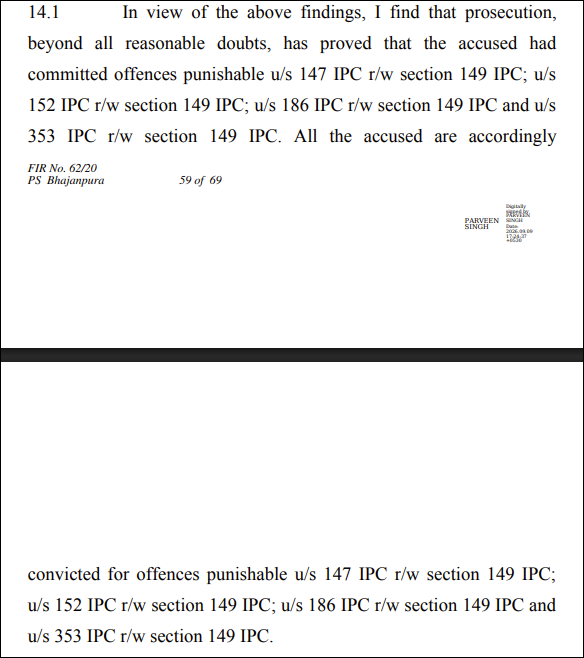
“In view of the above findings, I find that prosecution, beyond all reasonable doubts, has proved that the accused had committed offences punishable u/s 147 IPC r/w section 149 IPC; u/s 152 IPC r/w section 149 IPC; u/s 186 IPC r/w section 149 IPC and u/s 353 IPC r/w section 149 IPC,” the court held, noting that the prosecution proved the said charges against the accused beyond a reasonable doubt.

After examining all the material on record, including witness testimonies, the court concluded that a mob of at least 100-150 people gathered at Bhajanpura Petrol Pump with a common object of committing riot, arson, criminal mischief, and vandalism.

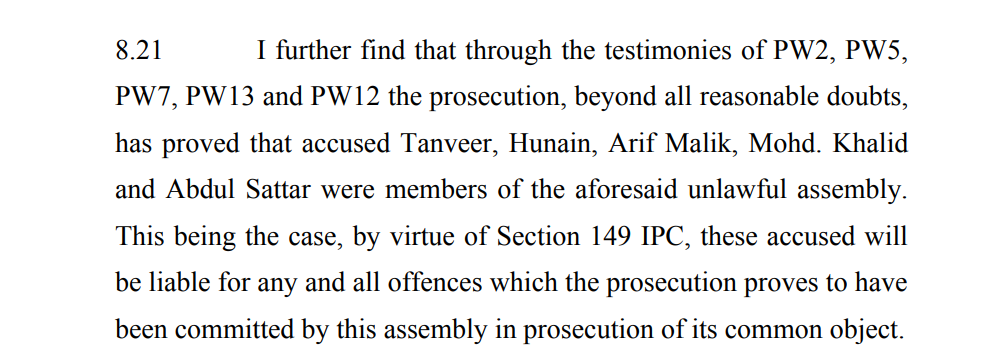
The court held that the five accused, Tanveer, Hunain, Arif Malik, Mohd. Khalid and Abdul Sattar were part of the mob, which was an unlawful assembly under Section 141 of the IPC.

The FIR in the case was filed by ASI Arvind Kumar on February 25, 2026. According to the prosecution, the police received information around 2:00 pm on February 24, 2020, about a large gathering near the Bhajanpura petrol pump. On getting the information, ASI Arvind Kumar and some other police personnel reached the petrol pump at around 2:10 pm.

On reaching the petrol pump, they saw a mob of 100-150 people protesting and raising slogans against the CAA/NRC. In no time, the mob turned violent and pelted stones at the police, broke the road divider, vandalised the petrol pump, vehicles, and nearby shops, and set vehicles on fire.

Court observations

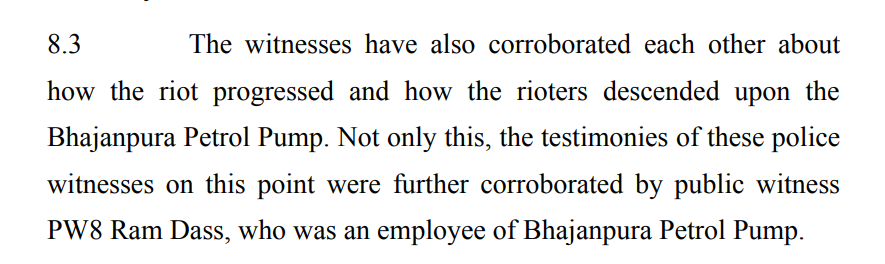
The prosecution presented 26 witnesses before the court, of which the Court relied on the testimonies of eight prosecution witnesses, including five police witnesses, to hold the accused guilty. The five police witnesses, ASI Arvind Kumar, Retd. SI/ASI Ved Pal, Retd. HC Arvind, HC Jagroop and Constable Nemi Chand were present at the spot when the mob, including the five accused, unleashed violence at the petrol pump. They identified the five accused and described their acts of violence at the petrol pump to the court.

The court rejected the defence’s claim that the police witnesses were not present at the spot when the violence at the petrol pump happened. The court said the defence failed to prove the police witnesses were not present at Bhajanpura Petrol Pump at the time of the incident. It further noted that the testimonies of the police witnesses sound credible and corroborate one another.

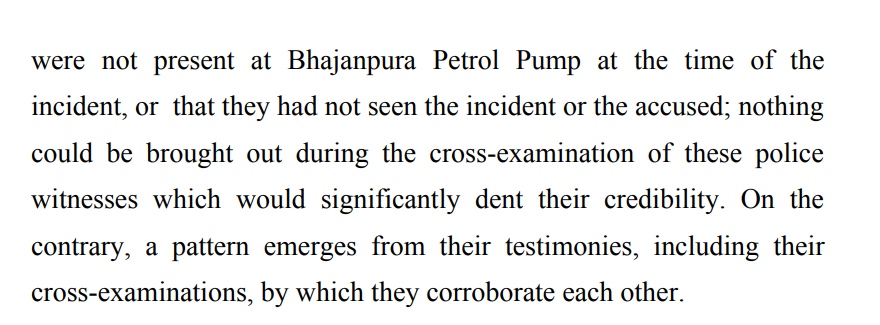
“Apart from the general and bald suggestions, put to only some of them, that they were not present at Bhajanpura Petrol Pump at the time of the incident, or that they had not seen the incident or the accused, nothing could be brought out during the cross-examination of these police witnesses that would significantly dent their credibility. On the contrary, a pattern emerges from their testimonies, including their cross-examinations, by which they corroborate each other,” the Court noted.

The court noted that the police witnesses’ descriptions of the events relating to the incident matched one another and were further corroborated by the testimonies of other witnesses.

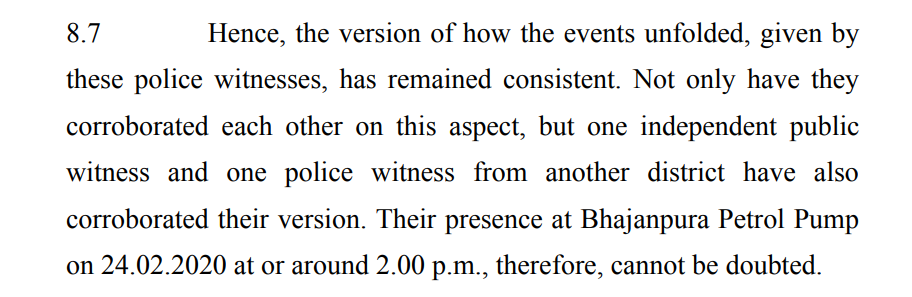
The court said that the witnesses’ version of events could not be doubted. “…the version of how the events unfolded, given by these police witnesses, has remained consistent. Not only have they corroborated each other on this aspect, but one independent public witness and one police witness from another district have also corroborated their version. Their presence at Bhajanpura Petrol Pump on 24.02.2020 at or around 2.00 p.m., therefore, cannot be doubted,” the court said.

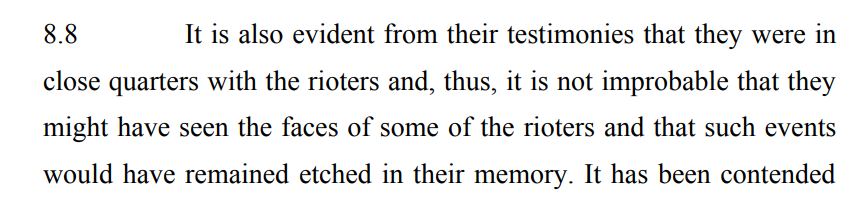
The court observed that these policemen were present on the ground and came face to face with the rioters. Therefore, their identification of the accused leaves little room for suspicion.

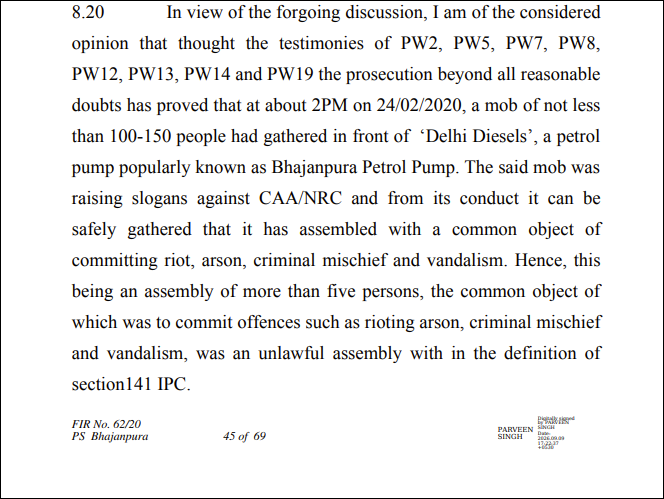
“In view of the foregoing discussion, I am of the considered opinion that through the testimonies of PW2, PW5, PW7, PW8, PW12, PW13, PW14 and PW19 the prosecution beyond all reasonable doubts has proved that at about 2 PM on 24/02/2020, a mob of not less
than 100-150 people had gathered in front of ‘Delhi Diesels’, a petrol pump popularly known as Bhajanpura Petrol Pump. The said mob was
raising slogans against CAA/NRC, and from its conduct it can be safely gathered that it has assembled with a common object of committing riot, arson, criminal mischief and vandalism. Hence, this being an assembly of more than five persons, the common object of which was to commit offences such as rioting, arson, criminal mischief and vandalism, was an unlawful assembly within the definition of section141 IPC,” the court said.

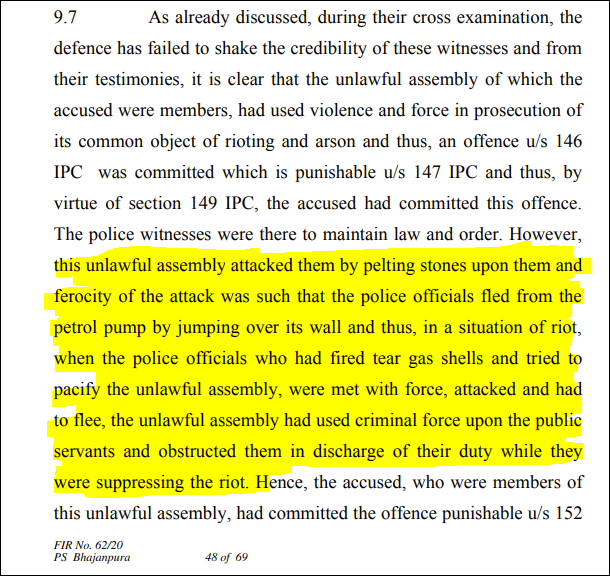
The court further stated that during their cross-examination, the defence has failed to shake the credibility of the witnesses and from their testimonies, it is clear that the unlawful assembly of which the accused were members had used violence and force in prosecution of its common object of rioting and arson and thus, an offence u/s 146 IPC was committed, which is punishable u/s 147 IPC and thus, by
virtue of section 149 IPC, the accused had committed this offence.

The court also noted that while the police [witnesses] were deployed to maintain law and order, the Muslim rioters attacked them by pelting stones upon them, and “ferocity of the attack was such that the police officials fled from the petrol pump by jumping over its wall and thus, in a situation of riot, when the police officials who had fired tear gas shells and tried to pacify the unlawful assembly, were met with force, attacked and had to flee, the unlawful assembly had used criminal force upon the public servants and obstructed them in discharge of their duty while they were suppressing the riot.”

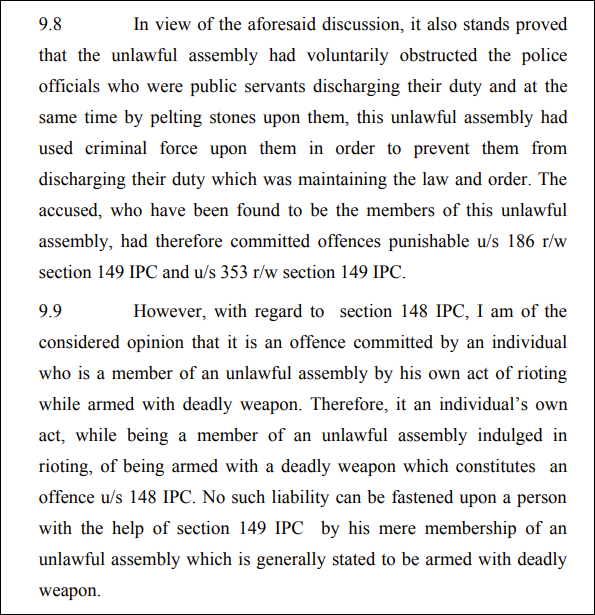
“In view of the aforesaid discussion, it also stands proved that the unlawful assembly had voluntarily obstructed the police officials who were public servants discharging their duty and at the same time by pelting stones upon them, this unlawful assembly had used criminal force upon them in order to prevent them from discharging their duty which was maintaining the law and order,” the court added.

The court held the accused guilty of being part of an unlawful assembly and committing violence, arson, criminal mischief, and vandalism at the Bhajanpura petrol pump.

However, the court did not accept the prosecution’s allegation that the petrol pump was set on fire by the mob, noting that there were inconsistencies and gaps in the evidence concerning this particular allegation.

The anti-Hindu Delhi riots

The violence at the Bhajanpura petrol pump was part of the large-scale anti-Hindu riots and violence that happened in the national capital on February 24 and 25 in 2020. Several parts of Delhi, including Shahdara, Maujpur, Bhajanpura, and Brahmapur, witnessed brutal violence and chaos unleashed by Islamist mobs, which went on a rampage, attacking the police as well as common people. The anti-Hindu riots were a culmination of the anger and hostility manufactured by Islamists during the anti-CAA protests in Shaheen Bagh and other areas.

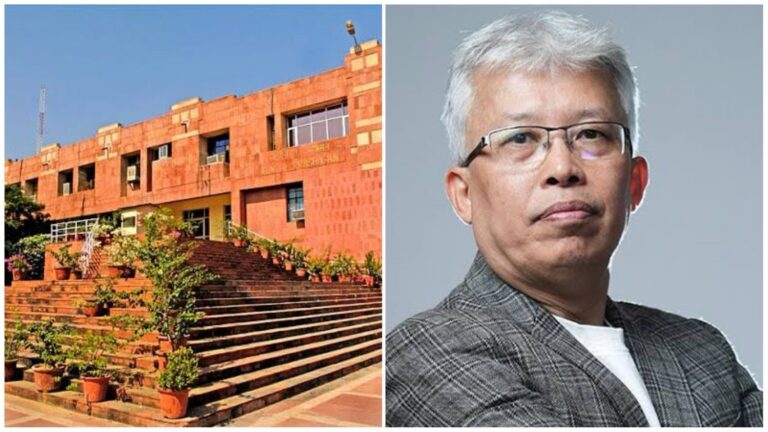
11 women, four months, one Congress MP-Professor: Why JNU must answer over ‘marks for sexual favours’ allegations against Bimol Akoijam

Jawaharlal Nehru University (JNU) has long been a campus where protests over politics, ideology and academic freedom can erupt within hours. But when 11 women students approach the university’s Internal Complaints Committee with allegations of sexual harassment against a professor who also happens to be a sitting Congress MP, the question is no longer merely political; it is about whether the institution’s own mechanisms work when the accused is politically influential.

The Akhil Bharatiya Vidyarthi Parishad (ABVP) took to the streets outside JNU’s School of Social Sciences on September 9, demanding action against Congress Lok Sabha MP and JNU professor Angomcha Bimol Akoijam. The organisation also questioned why the complaints, reportedly filed in May, have still not reached a conclusion. 

That four-month delay is now at the heart of the controversy.

11 students came forward, but the questions remain unanswered

According to reports, the allegations stem from viva examinations conducted in the first week of May. One student’s account was subsequently shared in a students-only WhatsApp group, following which several other women students reportedly came forward with similar allegations. The complaints were then submitted to JNU’s Internal Complaints Committee in May. 

The allegations reportedly include inappropriate, sexually suggestive remarks and claims that students were offered higher marks in exchange for sexual favours.

These are allegations, not facts, and the outcome of the Internal Committee’s proceedings will determine what actually happened. But precisely because the allegations are serious, the inquiry cannot be allowed to disappear into bureaucratic limbo.

ABVP’s contention is straightforward: if an ordinary professor were facing allegations from 11 students, would the university permit the matter to remain unresolved for months?

And if the answer is no, why should the identity or political standing of the accused change the urgency with which the complaint is handled?

The uncomfortable political question

Akoijam is not merely a JNU professor.

He is a Congress MP representing Inner Manipur in the Lok Sabha, and his political profile has grown considerably since he entered electoral politics in 2024. He won the Inner Manipur seat in his first Lok Sabha election and became one of Congress’ prominent voices on the Manipur crisis. 

That makes the ABVP’s question about political influence particularly significant.

The organisation has accused JNU’s administration and Internal Committee of failing to ensure a transparent and time-bound process. It has also questioned the silence of Congress, NSUI and Left student organisations that routinely position themselves as champions of women’s rights and student welfare. 

This is where the controversy acquires a distinctly political dimension.

Women’s safety cannot become a principle that applies only when the accused belongs to the political camp one dislikes.

If the allegations are false, Akoijam deserves a fair and credible process that clears his name. If they are substantiated, appropriate action must follow. What cannot serve anyone, not the complainants, not the accused, and certainly not JNU, is an inquiry that drags on without clarity.

90-day rule raises serious questions over delay

The delay in the inquiry becomes particularly significant when viewed against JNU’s own rules governing sexual harassment complaints. The university’s Internal Complaints Committee guidelines state that an inquiry “has to be completed within a period of ninety days from the receipt of the complaint.” The inquiry report is then required to be submitted within 10 days of completion.

If the first complaint was received in May, the prescribed 90-day period had already become a critical benchmark by August. This raises an obvious question: why has the inquiry still not been concluded?

The issue is not about declaring anyone guilty before the inquiry is complete. It is about whether the institutional process is functioning within its own prescribed timeline. When 11 women students have reportedly approached the mechanism with allegations against a professor who is also a sitting Congress MP, JNU must explain the delay rather than allow questions about institutional independence to grow.

The more uncomfortable question is whether the complainants have been adequately protected from possible political or institutional influence. If JNU’s Internal Committee is genuinely independent, the university should have little difficulty demonstrating that the proceedings are being conducted impartially, without favour or pressure.

The central questions now are: Is the inquiry into the JNU sexual-harassment allegations already facing an institutional credibility crisis? Why was the 90-day deadline apparently not met? And, most importantly, what safeguards has JNU put in place to ensure that the complainants are not subjected to influence or intimidation while the accused is a politically influential public figure?

Who is Bimol Akoijam?

Akoijam is an academic-turned-politician whose career before electoral politics was rooted in JNU.

JNU’s official profile identifies him as a professor at the Centre for the Study of Social Systems, School of Social Sciences. His academic interests include social and political psychology, identity politics, conflict, nation-state and minorities, intergroup and gender relations, popular culture and politics of knowledge. The university lists an M.A./Ph.D. qualification and 16 years of experience. 

His academic work has extensively dealt with Manipur, conflict and identity politics. He has written on subjects including the Armed Forces (Special Powers) Act and the political history of Manipur. JNU’s profile also records the Young Psychologist Award conferred on him by the National Academy of Psychology.

His transition into electoral politics came against the backdrop of the 2023 Manipur violence. Congress fielded him from Inner Manipur in the 2024 Lok Sabha elections, where he defeated the BJP’s Thounaojam Basanta Kumar Singh by more than one lakh votes. 

He is currently serving his first term as an MP. PRS records his parliamentary attendance at 81%, with 15 debates and 60 questions listed on his profile. 

A professor, a parliamentarian and now the centre of a campus controversy

The Internal Committee exists precisely to provide an institutional mechanism for such complaints. Its credibility depends on being seen as independent, impartial and capable of reaching conclusions within the applicable framework. But the fact that the first complaint was filed in May raises serious questions on whether the committee was compromised from the start itself.

ABVP has now put JNU in an uncomfortable position: if the university believes the complaints are being handled properly, it should explain the timeline and process. If there has been a delay, it should explain why.

The same principle should apply to political parties and student organisations.

Congress, NSUI and Left student groups cannot credibly demand accountability in cases involving political opponents while treating allegations involving someone within their own political ecosystem as an inconvenient subject best avoided.

The test of a commitment to women’s rights is not whether the accused is politically convenient to condemn. It is whether the same standard is applied when the accused is politically inconvenient.

For now, the allegations remain unproven. But the questions surrounding how the complaints were handled are very real. JNU owes the 11 complainants, and Akoijam himself, a process that is swift, independent, transparent and capable of producing an answer.

Anything less will only deepen the suspicion that, at JNU, political influence can sometimes make an institution move more slowly than it otherwise would.

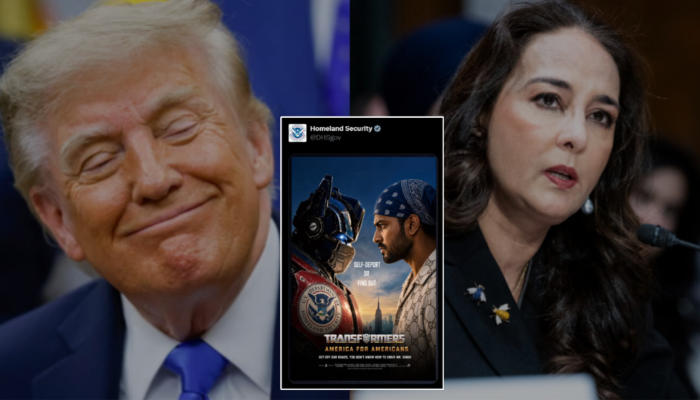
Get off our roads, Mr Singh: As US Homeland Security Department racist post faces flak, pro-Khalistani voice and Trump administration member Harmeet Dhillon maintains silence

The United States is witnessing a disturbing rise in anti-India rhetoric and hostility, particularly across online spaces. Indians, and especially Hindus, have increasingly found themselves in the crosshairs of white supremacist and neo-Nazi sections of the MAGA movement, who have gone beyond attacking the community to mocking its faith, traditions and culture.

However, what makes the situation even more unsettling is that the racism is no longer confined to some corners of the internet and appears to have found an echo within the highest levels of the Trump administration itself. Now, key government departments are openly fostering an environment where such sentiments can flourish instead of being firmly confronted.

A similar incident occurred on 9th September (Wednesday) when the US Department of Homeland Security shared an AI-generated picture designed to resemble a movie poster for the popular “Transformers” movie series. It was named “Transformers: America for Americans” and displayed an imposing Transformer with Homeland Security’s seal against a brown and bearded Indian man wearing a head covering. The poster warned, “Self deport or find out,” and further read, “Get off our roads, you don’t know how to drive, Mr Singh.”

The poster was accompanied by a popular scene from the franchise featuring its villain and had been altered to include the names of some accused of Indian descent. The move, unsurprisingly, triggered a wave of outrage within the Indian community, with many calling out the federal department for acting as a mouthpiece for racists. However, a similarly revealing occurrence took place simultaneously in the aftermath.

The post did not merely take aim at Indians. It specifically singled out Sikhs, reducing an entire community to the crude stereotype of bad drivers. Yet, as the controversy unfolded, those who are otherwise quick to speak out for Khalistan and claim persecution to denounce India on global platforms maintained a conspicuous silence.

Even the loudest Khalistani voices within the Trump administration, particularly Harmeet Kaur Dhillon, who routinely invoke victimhood to target India, chose to look the other way when their own community was subjected to such a blatant racial attack. Notably, these separatists have sought asylum in Western countries, including the United States, by asserting persecution at the hands of the Indian government and presenting these nations as havens from the alleged atrocities they endured back home.

However, the irony is hard to miss. Those who have repeatedly portrayed the West as their refuge have suddenly decided to remain silent when they experienced xenophobic aggression from the upper echelons of government, which they intended to leverage to undermine India’s international standing.

Indian community pushes back against the racist post

The upload understandably sparked outrage within the Indian American community, many of whom reacted strongly to the deeply offensive and disgraceful move by Homeland Security. Hindu American Foundation wrote, “Singhs are Hindu, they are Sikhs, they are American, and they drive. Racist, un-American, anti-Indian profiling/trolling by the DHS should shock our nation’s collective conscience.”

It inquired whether the filmmakers were comfortable with their cinematic work being utilised for such purposes and even tagged Harmeet Dhillon along with other accounts to seek accountability regarding the reprehensible action.

Kushal Mehra blamed Khalistanis for the growing racism in the United States.

Another user responded that the Trump administration has shifted from enforcing immigration laws to openly propagating against Indian people. He remarked, “This is the language and imagery being attached to the power of the US Department of Homeland Security. A federal government humiliating an ethnic group with racial stereotypes is not America First.” He referred to it as “state sponsored bigotry.”

CoHNA (Coalition of Hindus of North America) told the department to impose the law rather than indulge in a “caricature” of individuals. It highlighted, “Dangerous drivers come from all backgrounds, ethnicities, faiths and last names. Singling out some last names does nothing for safe streets, but it does endanger the safety of hundreds of thousands of Americans with names like Singh and Kumar.”

According to the advocacy group, an act by the official US Government portraying a brown person as “foreign” and “un-American” effectively opens the door for the targeting of Hindus and Indian Americans, even those who are legal residents and citizens. “Especially ironic to see the transformers used to stereotype and put a target on the backs of vulnerable communities and individuals. Stop stigmatising millions of law-abiding Hindu, Sikh and Indian Americans,” it appealed.

Fox 7 Austin anchor Alec Nolan mentioned that his family surname is Singh and his father arrived in America from India several decades ago in pursuit of a better life. “He became a raisin farmer in California. My grandpa eventually took over the family business and also worked as a truck driver,” the journalist stated, adding that the “post is racist and demeaning to anyone with the last name Singh.”

Transformers are extraterrestrial metal lifeforms who have arrived from another planet, but in a twist of irony, they are being employed by the Trump administration to promote racist rhetoric against Indians in the US. Some jokes, as cruel as they might be, truly write themselves.

Harmeet Dhillon turns a blind eye to the racial attack

While the Indian community and others rightly questioned the Department of Homeland Security, Harmeet Dhillon, a close confidante of President Donald Trump and the Assistant Attorney General for the Civil Rights Division at the US Department of Justice, decided to completely ignore the repulsive exhibit of racism.

Interestingly, she also encountered similar attacks after performing a Sikh prayer to conclude the Republican National Convention in 2024. However, she chose to enjoy the attention instead of opposing the bigotry associated with Trump’s preferred support group. Therefore, her silence following the recent incident is rather predictable.

On the other hand, Dhillon’s approach has often appeared markedly different when the subject is India, where she has been often accused of endorsing Punjab’s secession. She has inflated every trivial or non-significant matter into a major propaganda opportunity or conjured controversies out of thin air to peddle her anti-India narrative while sympathising with and assisting Khalistanis living in the US.

Her position on the killing of terrorist Hardeep Singh Nijjar and the ensuing barrage of unfounded charges made by then-Canadian Prime Minister Justin Trudeau is the clearest evidence of her pro-Khalistan inclination. “Canada’s conservative leader joins other Canadian officials in condemning the extrajudicial murder of Sikh leader Hardeep Singh Nijjar. It’s good to see them unite against this shocking act,” she wrote after the country’s opposition leader Pierre Poilievre sided with Trudeau.

Dhillon also cited an article from the controversial British media house “The Economist” about how Indian migrants were promoting Prime Minister Narendra Modi’s domestic campaign and international lobbying efforts. She reiterated unproven accusations that New Delhi is killing critics in the diaspora, referencing the report. She charged that the Modi government was operating “death squads” in both the US and Canada.

Dhillon regularly points to unreliable reports to argue that human rights violations are taking place in India, specially in Punjab, to reinforce the Khalistani narrative.

Furthermore, she demonstrated her Hinduphobia by using caste rhetoric against the Democratic leader Kamala Harris. Dhillon reacted to the pronunciation of her name and insisted that she emphasises the second syllable, making it Kamala instead of Camala as it is known in India. “She comes from a high-caste Brahmin family. Her mother is a Brahmin,” she stated while talking to another white supremacist Tucker Carlson.

Of course, Dhillon even keeps the company of like-minded individuals who possess a mutual disdain for India and Hindus. John-Paul S. Deol, her former law firm partner, was caught dog-whistling against Siddhartha Patel, the Special Agent in Charge of the Federal Bureau of Investigation (FBI) Sacramento Field Office last year.

He made highly disparaging remarks against Lord Shiva over a tweet condemning terrorist Jarnail Singh Bhindranwale in relation to a “The Wire” article in 2023. “There is no civilization sadder and backward than pagan Lindu,” he wrote in another post on social media in that year. Deol demonised the Vedas and associated them with caste. He has also been one the ardent supporters of the anti-caste bill in the US that targets Hindus.

Conclusion

It has become increasingly apparent that Khalistani figures such as Dhillon are opportunists of the highest order. Their sole focus is on their agenda against India, and they are prepared to betray the sensitive concerns of their community members which they assert to champion. The recent event has not only revealed the ugly truths about the US government but have also exposed the claims of this Khalistani faction.

The post has further deepened the unease already felt among Indians, particularly Hindus, in the US. However, Khalistanis who have spent years denigrating India on American soil have found themselves subjected to the same kind of racial stereotyping and othering. In many ways, the chickens appear to have come home to roost for this anti-India faction.

Meanwhile, those who have endorsed the separatist cause, including Dhillon, seem noticeably unwilling to stand up for the very people they profess to represent.

Data centres to space economy: Jefferies highlights six sectors and the Modi government’s policy measures that will drive ‘India’s new Industrial Revolution’

In its report titled India’s New Industrial Revolution, global investment bank Jefferies said that space, semiconductors, data centres, electronics, solar manufacturing and aerospace sectors could drive the next phase of India’s industrial growth in the coming years. This “revolution” is expected to be led by a combination of an established manufacturing base, a massive domestic market and a rising global demand for an alternative supply chain that will create opportunities in India across emerging industries.

The Jefferies report published on 8th September stated that this opportunity is being backed by the Modi government’s incentives and policy measures, particularly the schemes for semiconductors, solar manufacturing, electronics, and the opening up of the Space sector for private companies.

“Large domestic opportunity is driving private participation in emergent industries in India across Space, Semi & Electronics, Datacenters and Solar. Support from the govt. is also visible here with action such as opening up space to pvt. sector, long tax holiday for DCs, large incentive schemes for Semi, Electronics & Solar, localisation requirements, GPU purchases etc,” the report reads.

Opening the space sector to private players is a game-changer

The Jefferies report highlighted the Modi government’s decision to open up India’s Space sector for private companies in 2020. It highlighted that since the space sector was opened for private participation, “Startups are advancing from early innovation to commercial execution with companies such as Skyroot (orbital launch in July), Pixxel (high-res observation satellites), Agnikul (3D-printed rocket engine) & Digantara (surveillance satellites).”

Notably, the Modi government’s push to bring private companies into the space sector began explicitly in 2020 as part of the broader economic reforms announced during the Covid-19 pandemic.

In May 2020, the fourth tranche of the Atmanirbhar Bharat package was announced by Finance Minister Nirmala Sitharaman. The minister said that the government wanted private companies to become partners in India’s space journey.

The Central government had announced that private companies would be allowed to use ISRO facilities and other relevant assets to improve their capabilities. The government’s intent was never to fully privatise ISRO but to make better use of India’s existing space infrastructure and allow startups and private companies to develop their own capabilities under ISRO’s guidance.

For private participation, IN-SPACe was created as a regulatory and facilitation mechanism, while NewSpace India Limited (NSIL) has a commercial role in taking ISRO-developed technologies and systems to industry.

Later in 2023, the Indian Space Policy allowed private companies a wider role across the space value chain, including the development and operation of space systems.

India’s semiconductor ambitions are moving from policy intent to execution

The Jefferies report highlighted India’s pivot in recent years, from policy to execution in the semiconductor sector. It noted India’s creating an ecosystem and has pumped around $20 billion in investment, has a chip fab under construction and has multiple OSAT projects starting production. A further ~$13 billion incentive plan is also set to boost the ecosystem. Jefferies opines that India is building the foundations of a “credible” semiconductor ecosystem.

“Creating an ecosystem. India’s semiconductor aspirations are moving from policy intent to execution with ~$20bn of investments, including a chip fab under construction and several OSAT projects starting production. A new ~$13bn incentive plan should further expand the ecosystem and boost value addition, including chip design. While supply chain depth, talent, and global competition remain challenges, we believe India is building the foundations of a credible semiconductor ecosystem,” the report reads.

In recent years, the Modi government has, through its policy interventions, attempted to make India self-reliant in the semiconductor sector. India is rapidly expanding and bolstering its semiconductor chip design ecosystem. The Modi government launched the India Semiconductor Mission

In 2021, with Rs 76,000 crore in incentives. The Mission approved at least 10 projects worth Rs 1.6 lakh crore across six states. The initiative is aimed at attracting global manufacturers, building fabs, packaging units and a local supply chain to reduce reliance on imports. 

In May 2025, the Union Cabinet approved India’s sixth semiconductor manufacturing unit in Jewar in western Uttar Pradesh, for establishment through a joint venture between the HCL Group and Taiwanese electronics giant Foxconn. 

To support indigenous startups, the Modi government launched the Design Linked Incentive (DLI) Scheme in 2022 to ensure venture capital investment in this sector by curbing upfront risk through financial support, access to advanced EDA tools, IP cores, etc. and greater ecosystem awareness of semiconductor chip design.

In November 2024, the Centre approved C2i Semiconductors for financial support and access to advanced chip design tools under the DLI Scheme.

In the Union Budget 2026-27, the Modi government announced the India Semiconductor Mission 2.0 with Rs 1,000 crore allocated to bolster domestic semiconductor capabilities. In its new phase, the Mission will focus on the production of semiconductor equipment and materials in India. Designing full-stack Indian semiconductor intellectual property and fortifying both domestic and global supply chains will remain in focus.

“5x capacity in 5 years”: India’s data centre space is becoming a strategic digital infrastructure segment

The Jefferies report noted that the colocation capacity of India’s data centre has increased fivefold in five years. This growth is driven by cloud adoption, digitisation and data localisation requirements.

“We expect capacity to grow another 5x to ~10GW over the next five years, supported by favorable cost economics, policy support and rising hyperscaler demand. We calculate this expansion represents a US$9bn revenue opportunity for data center operators and a US$45bn investment opportunity across power, cooling, construction and network infrastructure,” the report states.

Pertinently, the Modi government is aggressively building data infrastructure to boost AI and cloud growth.  In the Union Budget 2026-27, the Centre announced a long-term tax holiday framework designed to attract foreign investment while preserving India’s domestic tax base.

In consequence of India’s policy shift, there has been a significant surge in foreign investment in this sector. In December 2025, Microsoft CEO Satya Nadella announced a US$17.5 billion investment to expand India’s AI infrastructure, develop advanced skills, and strengthen sovereign technological capabilities. In October 2025, Google announced its plans to develop India’s largest AI data centre campus in Andhra Pradesh with an investment of $15 billion over five years. Around $95 billion in investments were pledged between 2019 and 2025 alone.

From assembly to domestic value addition: India’s electronics ecosystem entering the next phase of growth

Jefferies described the electronics sector as a key driver of India’s next phase of growth. It noted that India is focusing on domestic value addition and component manufacturing. The global investment banking company highlighted that Central government initiatives like the Electronics Component Manufacturing Scheme (ECMS) and Mobile Phone Manufacturing Scheme (MPMS) aim to deepen backward integration and reduce import dependence.

The Jefferies report forecasted that the ECMS will cover 50% of mobile component value versus 20% now.

“From assembly to value addition. India’s electronics ecosystem is entering the next phase of growth with a greater focus on domestic value addition and component manufacturing. Electronics exports have grown sharply, while schemes such as ECMS (components scheme) and MPMS (Mobile 2.0) aim to deepen backward integration and reduce import dependence. We forecast ECMS to cover ~50% of Mobile component value (BOM) over the next 6-Y vs <20% now. PCB (both HDI + Multi-layer) is a focus area for Components, with $5bn TAM, 85-90% imports,” it stated.

The Electronics Component Manufacturing Scheme (ECMS) was launched by the Modi government in July 2026 to deepen the domestic supply chain ecosystem and develop a robust electronics component ecosystem in the country. The scheme is designed to attract investments across key components such as Printed Circuit Boards (PCBs), passive components, electro-mechanical components, sub-assemblies, camera modules, optical transceivers, and capital goods required for electronics manufacturing.

As per the Central government, the approved investment under ECMS has increased to ₹69,548 crore, up from the ₹59,350 crore investment originally envisaged under the scheme.

Meanwhile, the Mobile Phone Manufacturing Scheme (MPMS), with a budgetary outlay of Rs 62,500 crore, aims to scale up production, deepen domestic value addition, strengthen supply chain resilience, and enhance global competitiveness.

90% of the solar manufacturing value chain to be localised by 2030

The Jefferies report stated that India is now the world’s second-largest solar PV manufacturer, having 35 GW of cell capacity operational and another 100 GW under construction. Jefferies expects 90% of the value chain to be localised by 2030.

“India is the 2nd largest solar PV manufacturer. India has emerged as the world’s second-largest solar PV manufacturer, with ~35GW of solar cell capacity already operational and another ~100GW under construction. Policy measures such as ALMM (Approved list of Models and Manufacturers, a regulatory quality register), domestic content requirements and PLI (Production-linked incentives) are accelerating backward integration across cells, wafers and ingots. We expect ~90% of the solar manufacturing value chain to be localised by 2030,” it stated.

Notably, by the end of March 2026, India had crossed 150 GW of solar capacity. OpIndia reported earlier that in just 11–12 years, India’s solar capacity has grown nearly 50 times. Nearly 10% of India’s total electricity now comes from solar energy sources.

The remarkable growth was achieved by the Modi government in three phases. During the first phase, from 2014 to 2018, the Central government set aggressive targets, pushed the National Solar Mission and introduced larger solar parks.

In the second phase (2018 to 2022), solar became cheap, with tariffs coming down from around 7-8 rupees per unit to under 2 rupees. Result? Solar energy became not only clean but cheap energy, attracting private sector investment and driving the rise of massive solar parks in Rajasthan, Gujarat, and Karnataka. 

In the third phase, from 2022 to 2026, manufacturing push, Rooftop solar expansion, and better grid readiness were brought together. Solar moved beyond big projects—now homes, farmers, and industries are all part of the system. With this, India added a record 44+ GW of renewable energy in just one year (FY26), the highest ever.

Source: Jefferies

Aerospace: Made in India, Flying Global

The Jefferies report described India as a “beneficiary” of the global demand-supply imbalance in aerospace. It said that India has an opportunity to leverage its cost-competitive manufacturing and engineering talent.

“Indian exports are on the rise with Boeing and Airbus already sourcing $1.4-1.6bn annually from the country. Indian companies such as Aequs, Azad, BHFC, DYTC, RW, MOTHERSO & SANSERA have become suppliers to global OEMs and tier-1s, and are expanding in the segment,” the report states.

Overall, the Jefferies analysis suggests that India is not just adding more factories, but building new industrial ecosystems in sectors that cater not only to the domestic economy but also to global markets.

No, Hindu festivals are not a Sarkari scheme that everyone has a right to: Why VHP’s call to ban Muslims from Garba is neither against the Constitution nor against inclusivity

The Islamo-leftist cabal that relentlessly vilifies Hindu festivals as regressive, dogmatic, misogynistic and whatnot, also wants to appropriate and secularise Hindu festivals to enforce unasked ‘inclusivity’. As the Hindu festival of Navratri is approaching and preparations are on for Garba events across the country, the Islamo-leftist coterie has turned on its activism mode for ensuring unrestricted participation of Muslims, primarily Muslim men, in Garba programs.

In the wake of increasing incidents of Muslim crimes during Garba events, the organisers have started restricting the entry of non-Hindus to the Garba Pandals. This year, the Vishwa Hindu Parishad gave a call to ban Muslims from attending garba and dandiya events during Navratri across Maharashtra.

The VHP has issued guidelines for Garba organisers, calling for Aadhaar card checking of participants, applying Tilak on the forehead of entrants, among other measures.

The Hindu rights group stated that their decision was not directed against any religious community but was only a precautionary measure to protect and preserve the Dharmic character of Garba.

However, the VHP’s call triggered an outrage. Shiv Sena (UBT) leader Sanjay Raut, who claims to be a champion of Hindutva, gave an absurd statement opposing restrictions on the entry of Muslims in Garba events.

Raut suggested that somehow because Muslims also ‘contributed’ to India’s freedom struggle and cultural struggle, they should not be prevented from participating in Navratri events.

“Muslims also made a significant contribution to this country’s freedom struggle and cultural struggle. Mohan Bhagwat goes abroad and delivers speeches stating that ‘there should be no differences between Muslims and Hindus in our country… yet here, his people engage in this kind of behaviour? Mohan Bhagwat ought to issue a statement on this,” Raut said during a media interaction on 6th September.

Not only anti-BJP political leaders but some of those aligned with the BJP have also invoked ‘inclusivity’ and ‘Constitution’ to oppose a ban on Muslims in Garba events.

In this vein, Union Minister Ramdas Athawale said that the VHP’s call goes against the Constitution and its guarantee of equal rights for people of all religions.

“I feel this stand is not right because India runs on the Constitution. The Constitution given by Dr Babasaheb Ambedkar ensures justice to all religions. Hindus, Muslims, Sikhs, Christians, Jains, Buddhists, Lingayats, Parsis and people of several other faiths live in India, and the Constitution seeks to protect all religions,” he said.

“It is not good to say that Muslims should not attend garba. Hindu and Muslim communities need to come together and work for the country,” the minister added.

Similarly, Maharashtra Chief Minister Devendra Fadnavis’s wife Amruta Fadnavis has also opposed the VHP’s call to Garba organisers to restrict entry of Muslims in the events.

“Our festival is inclusive; if any Muslim wants to enjoy Garba, it should not be a problem,” Amruta Fadnavis said.

Meanwhile, Samajwadi Party MLA Rais Shaikh argued that banning Muslims from Garba events goes against the Constitution.

“This is cultural policing by VHP and Bajrang Dal. VHP’s ‘fatwa’ banning Muslims is against the Constitution and the state government should take note of this directive because such extremist positions can potentially give rise to a law-and-order situation,” he said.

Does banning Muslims from participating in Hindu religious celebrations like Garba go against the Constitution? Does the ‘inclusivity’ argument even make any sense?

Invoking the Constitutional guarantee of equal rights for all religions is utterly nonsensical in the present context. Muslims are not guaranteed any Constitutional right to force themselves to participate in the celebration of Hindu festivals. They do not have any right to participate in Hindu festivals against the wishes of the Hindu community. They have as much the right to practice their own religion as Hindus or any other religious community have in India.

However, this does not mean Muslims can, regardless of their intentions and motives, be allowed unrestricted access to Garba or Durga Pandals. Our Constitution allows Hindus to celebrate their festivals without having to mandatorily ensure participation of non-Hindus.

Besides, this whole ‘inclusivity’ argument is also not appropriate. Yes, Hindu festivals, including Durga Puja and Garba, are inclusive; they bring people, specifically devotees of Maa Durga, together. However, this inclusivity is not by default extended to Muslims or Christians or any community or individuals who are not adherents of Hinduism or devotees of Maa Durga.

Remember the mayhem Islamists unleashed in 2022 when then BJP spokesperson Nupur Sharma merely quoted a fact stated in the Islamic texts? Sharma had made no insulting remarks or said anything on her own but simply quoted the Islamic text, yet Muslims rioted across the country, raised Sar Tan Se Juda slogans, and burned her effigy because her ‘tone’ was perceived as disrespectful.

Why is it that those who cannot even stand a Hindu, the Kafir of the highest order, even uttering the facts mentioned in Islamic texts, want to participate in festivals of Hindus?

Why would those who kill a Hindu youth over a drop of colour splashing on them during Holi want to participate in a dance performed in honour of Maa Durga?

Why do those who don’t want to say Bharat Mata ki Jai and sing Vande Mataram because it glorifies Maa Durga want to dance in honour of Maa Durga during Navratri?

Why is it that only Muslim men want to participate in Garba celebrations and not Muslim women? Does Islam restrict only Muslim women from partaking in festivities of non-Muslims? Muslim women should stay in Burqa or hijab, but Muslim men can dance in honour of Maa Durga?

What makes anyone think that those who do not want to entertain the idea of Muslim women offering namaz in mosques just as men do believe in inclusivity?

Why are Hindu festivals burdened with the idea of accommodating and promoting ‘inclusivity’?

Garba is sadhana of Maa Durga, not a government scheme Muslims have a right over

The performance of Garba is essentially a religious affair. It is not a party. It is not a cultural event that anybody, regardless of their faith, can attend, shake a leg, enjoy and move on.

Garba is strictly a Dharmic dance performed by the devotees of Maa Durga during Navratri in her honour for liberating the world from the terror of demons and in celebration of the victory of Dharma over Adharma. It is a celebration of the feminine form of the divine. Garba is not a government scheme that every ‘minority’ citizen has a right to. 

In fact, even to avail the benefits of government schemes, there are certain criteria to be met. If any non-Hindu, particularly Muslims whose faith clearly directs them not to associate partners with their God, Allah, or partake in the celebration of the festivals of polytheists like Hindus, want to join Garba celebrations, they should revert to Sanatan Dharma, invoke devotion for Maa Durga and maybe then they can be allowed to participate in Garba events.

Barring Muslims or anyone from entering Durga Puja pandals who does not have genuine devotion for Maa Durga is not discriminatory but simply the preservation of the sanctity of Garba.

If Muslims have really become so secular that they do not see a violation of their Sharia and concept of Tawheed, why don’t they organise Durga Puja in mosques?

For years, Hindus have been conditioned into believing that because they form India’s religious majority, and their polytheistic faith is inherently tolerant and accommodative, it is their unquestionable responsibility to bear the burden of upholding the mythical syncretic culture, ‘Ganga-Jamuni Tehzeeb’, inclusivity, idea of India and whatnot, while other communities are exempt from shouldering this burden.

In the left-liberal understanding of secularism and inclusivity, the Hindu majority must accommodate Islamist intransigence and secularise their festivals, while the Muslim ‘minority’ gets a free pass to be as exclusionary as their religion demands and still not get accused of intolerance.

In recent years, there have been consistent attempts at secularising, rather, de-Hinduising, Hindu festivals to make them absolutely inclusive and reduce them to non-Dharmic celebrations but cultural events.

Onam, the Hindu festival rooted in the Hindu scriptural legend of the greatness of King Mahabali (also known as Raja Bali) and how Lord Vishnu, in his Vamana avatar, gave him a boon that he could come back to meet his subjects once a year, has been reduced to a mere harvest festival.

In Tamil Nadu, Hindu-hating Dravidianists have been executing a similar playbook to secularise Pongal or Makar Sankranti and dissociate it from its Hindu religious roots. Just as Onam is being labelled a ‘cultural’ festival in Kerala, Pongal is being promoted as a ‘Tamil’ festival of agrarian gratitude in Tamil Nadu.

This de-hyphenation of religion from Hindu festivals has also been noticed in movies and commercial ad films over the years, with Diwali becoming ‘festival of lights’, Holi becoming ‘festival of colors’ and Garba being reduced to a folk dance.

The same Islamo-leftists who argue that Hindu processions should not stop outside mosques, pass from ‘Muslim areas’ or play loud religious music there to preserve ‘communal harmony’, want Hindus to lay a red carpet for Muslims to enter Garba events even though their religion prohibits them from partaking in the festivities of non-Muslims, and perhaps molest Hindu women or unleash violence.

For Hindus, Garba is worship of Maa Durga; for Islamists, the sacred celebration is a perfect opportunity for rape jihad

Over the years, Islamists have attacked Hindus on their festivals by using trivial excuses to express their hatred and intolerance towards the Hindu community. Every year, OpIndia reports numerous incidents of Muslim mob violence on Holi, Diwali, Ganesh Chaturthi, Ram Navami, Hanuman Jayanti, Navratri, and other Hindu festivals. While Garba events have also faced desecration and violence, this sacred celebration has been targeted for love and rape jihad by Islamists.

In September 2025, during Navratri, Muslim boys were caught filming female participants of a Garba celebration at a college in Mumbai’s Virar West. On checking one of the boys’ phones, the organisers reportedly found multiple videos of girls, alongside obscene chats and conversations that outlined plans to lure Hindu girls into relationships and “ruin” them.

Some of the leaked messages contained disturbing instructions, with one explicitly urging that not a single Hindu girl be “left untouched” after entering the Garba grounds. In the same college, obscene comments were also made by putting videos of students on the Discord App during the Dandiya program.

In a garba programme in Benisar Bari area in 2025, Muslim youths forcibly entered the pandal and molested the women. The Muslim men forcibly danced with women. When other participants resisted, stone pelting began. At least 5 people were injured, and police vehicles were damaged. Police later arrested 12 people in connection with the incident.

Last year, two Muslim youths, Suhail Siddiqui and Saif, were caught infiltrating during the Navaratri event in Kanpur. They made obscene comments about the Hindu girls. After a complaint from a female police officer present at the venue, both were arrested.

A Durg idol was damaged on 21st September 2025 in Mumbai’s Mankhurd area. The incident happened near a mosque where Muslims objected to the sound of drums being played during the welcome procession of the idol.

Last year, one Mohsin Khan threw eggs from the 16th floor of the building during a garba event at the JP North Gardgarn City Society on Mira Road East in Mumbai. 

In October 2024, it was reported that in Madhya Pradesh’s Alirajpur, Muslim youths molested a woman returning from the Garba event.

In another incident during 2024 Navratri, a Muslim youth named Feroz attended a garba event using a fake Hindu identity in Ujjain. Feroz posed as Rahul and entered the Garba Pandal with condoms. Yes, you read it right: he was carrying condoms at the Hindu religious event and was caught by the activists of Hindu Jagran Manch.

In the Guna district, it was reported that five Muslim boys entered the Garba Pandal under suspicious circumstances, as told by the police and were detained in 2024.

In October 2023, it was reported that one Fareed Shah attempted to enter the Garba Pandal in Hyderabad’s Begumpet Hockey Stadium by posing as a Hindu person named Ashish to lure a Hindu girl. He was stopped by Bajrang Dal activists.  

In October 2022, it was reported that 8 Muslim men were detained by the police in Indore for trying to enter garba venues by concealing their identities. In another incident from the same year, it was reported that a Muslim person was arrested for passing lewd remarks about Hindu women at a Garba Pandal in Palsikar colony.

On 1st October 2022, a Hindu youth named Madhusudan Modi was attacked with a knife by three Islamists named Shahrukh, Zubair, and Samir at a dandiya event held in Bikaner in Rajasthan. These Muslim youths were molesting girls who had come to play Garba.

On 1st October 2022, six Hindu students were attacked by four accused, identified as Rathod Amin Gulab Nabi, Nizami Moin Nurmahammad, Ganchi Amanbhai Firozbhai, and Chauhan Mahamadnuman Mahamadhanif, for objecting to Islamic songs being played during a Garba event at BK Patel Arts & Commerce College of Savli in Vadodara. The four accused attacked the Hindu students with iron belts and stones.

On September 30 2022, some Muslim youths forcefully entered the Garba venue in Jaipur, Rajasthan. The Muslim youths, however, fled as soon as the Vishwa Hindu Parishad (VHP) and Bajrang Dal activists arrived.

In the same year, seven Muslim youths were arrested by the police from the Garba pandal of Pandharinath in Indore. They were reportedly making videos of Hindu girls.

In 2023, OpIndia reported that in Gujarat’s Bharuch, Muslims of the Ikhar village had threatened the Hindu tribal community not to organise Navratri and said they would pelt stones if the event is held, declaring that it was a ‘Muslim area’.

While all Muslims may or may not have malice for Hindus and their festivals, Hindus cannot and should not get guilt-trapped and allow Islamist predators to enter Garba pandals, molest Hindu women and desecrate the sacred celebration, just because suicidally delusional Hindus have to satiate their fetish for unwarranted ‘inclusivity’, ‘secularism’, and ‘composite culture’.