The demand to release “Bandi Singhs” has become one of Punjab’s most persistent political issues, drawing the SGPC, Shiromani Akali Dal, AAP, Congress, BJP, hardline Panthic organisations and, more recently, supporters of jailed MP Amritpal Singh into competing campaigns. But “Bandi Singh” is not a legal category. The term brings together prisoners in very different situations, including death-row and life convicts, people already on parole and undertrials facing ongoing terror-related prosecutions.
The SGPC’s core campaign focuses on nine prisoners, including Balwant Singh Rajoana, Jagtar Singh Hawara, Jagtar Singh Tara, Devinder Pal Singh Bhullar and Gurdeep Singh Khera. Seven are connected with the 1995 assassination of Punjab Chief Minister Beant Singh, in which he and 16 others were killed. Bhullar was convicted in the 1993 Delhi bombing targeting MS Bitta that killed nine people, while Khera received life sentences in bombing cases.
Over time, however, the definition has expanded. Lists have included dozens of prisoners and newer terror accused such as Jagtar Singh Johal, Hardeep Singh Shera and Ramandeep Singh Bagga. Amritpal Singh, who is an undertrial rather than a decades-old life convict, has also been brought into the release campaign by Akali Dal Waris Punjab De. This expansion has transformed separate legal cases into a broader political cause.
A central argument of campaigners is that many prisoners have “completed their sentences”. Legally, that description can be misleading. Life imprisonment ordinarily lasts for the convict’s natural life unless remission or commutation is granted. Fourteen years can make a prisoner eligible for consideration in certain cases, but does not automatically end a life sentence. Different governments may also have jurisdiction depending on where the conviction occurred.
The movement has grown through hunger strikes, the SGPC’s signature campaign and the Qaumi Insaaf Morcha’s permanent mobilisation near Chandigarh. It has also witnessed violent confrontations in which police personnel were injured and public property damaged. Meanwhile, Punjab’s political parties continue balancing Sikh sentiment, electoral considerations, humanitarian arguments and national-security concerns.
Individual cases can legitimately be reviewed for remission, parole or clemency based on age, health, conduct and law. But the article argues that blanket release through political or religious mobilisation risks turning men convicted of terrorism and murder into political heroes while pushing their victims out of the debate.
In early August 2026, the National Highways Authority of India (NHAI) found itself at the heart of a controversy after visuals showing dangerous and substandard ‘rumble strips’ on National Highway-25 (NH-25) near Rajasthan’s Prathvipura village went viral online. After an initial rebuttal of social media posts flagging the safety hazard the strips posed, NHAI ended up getting fact-checked by social media users and suspending a concerned project director.
The viral video showed raised asphalt ridges at a median opening causing vehicles to bounce sharply. Highway users quickly flagged the so-called rumble strips, which actually were poorly constructed speed humps or breakers, on NH-25 as hazardous on a high-speed national highway corridor.
As the videos of the rumble strips across NH-25 near Prathvipura village surfaced online, several netizens raised questions over the design of the strips, the necessity of such rumble strips on a national highway, and whether they met road safety norms.
People raised concerns that such unusually high and inconsistent ‘rumble strips’ can cause vehicles to experience sudden jolts and lead to loss of control, abrupt braking, or collisions, especially during night or in poor visibility.
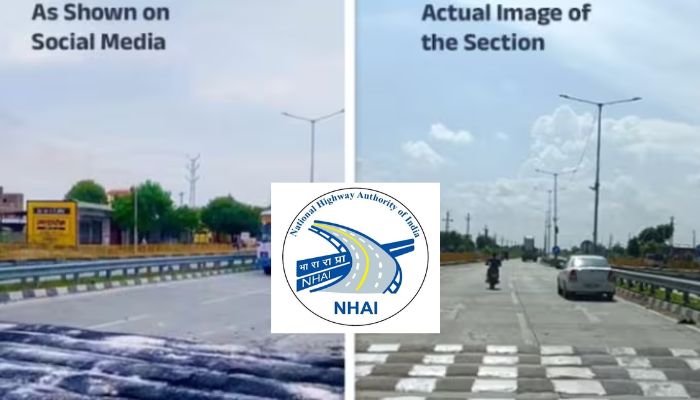
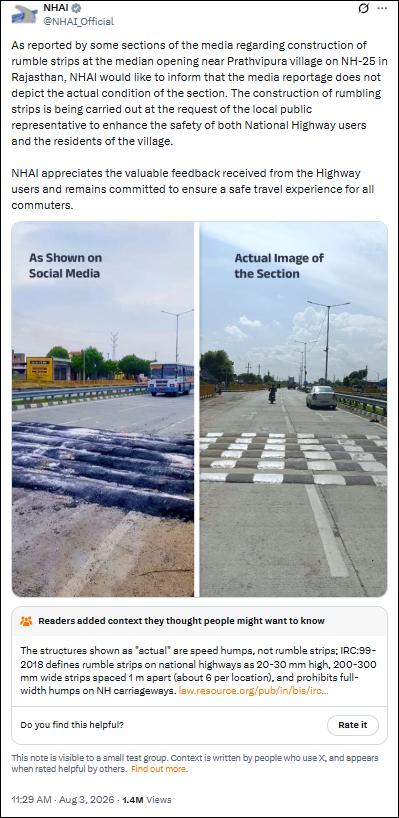
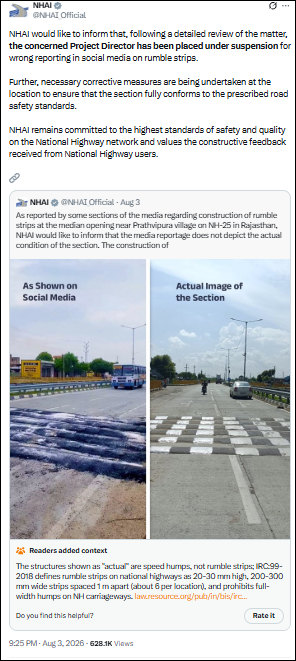
In response to the social media outrage, the NHAI published an X post on 3rd August 2026 and claimed that the viral visuals of the rumble strips on NH-25 in Rajasthan do not depict the actual condition. It shared a comparison picture, captioned: “As shown on social media vs actual image of the section”.
The NHAI also said that the rumble strips were constructed at the request of a local public representative for the safety of local villagers and highway users.
“As reported by some sections of the media regarding construction of rumble strips at the median opening near Prathvipura village on NH-25 in Rajasthan, NHAI would like to inform that the media reportage does not depict the actual condition of the section. The construction of rumbling strips is being carried out at the request of the local public representative to enhance the safety of both National Highway users and the residents of the village. NHAI appreciates the valuable feedback received from the Highway users and remains committed to ensure a safe travel experience for all commuters,” it said.
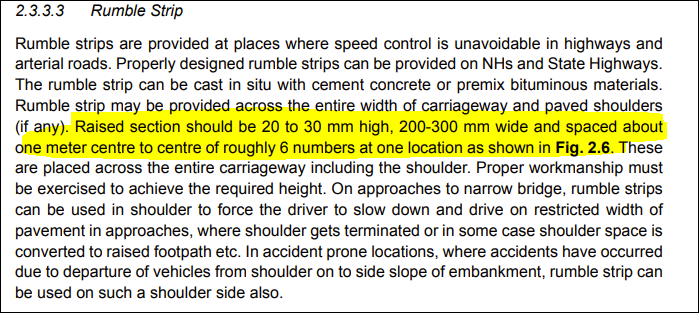
A closer look at both the images, however, makes it clear that even the supposed ‘actual image’ does not really show standard rumble strips, but speed humps. As per the rules, rumble strips on national highways should be 20-30 mm high, 200-300 mm wide strips spaced 1 m apart (about 6 per location). In addition, there is a prohibition on full-width humps on NH carriageways.
Source: Indian Roads Congress 2018 document.
The NHAI’s ‘rebuttal’ intensified the backlash further, as people called out the authorities for passing off hazardous flat-topped speed breakers or humps as rumble strips.
One X user wrote, “That’s certainly not rumble strips. You are sadly mistaken if you think you can pass off flat-topped speed breakers as rumble strips. These are speed breakers and are undoubtedly a safety hazard for highway drivers.”
That's certainly not rumble strips. You are sadly mistaken if you think you can pass off flat-topped speed breakers as rumble strips. These are speed breakers and are undoubtedly a safety hazard for highway drivers.
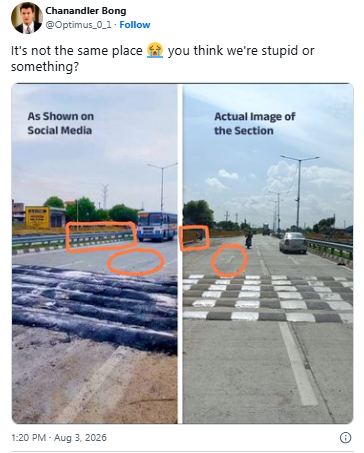
Pertinently, several social media users shared longer videos of the same location and drew comparisons between the “actual image” shared by the NHAI with elements from the additional on-site videos.
It emerged that the “actual image” the NHAI shared was actually either of a different location or the opposite carriageway.
Social media calls out mismatched ‘factcheck’ imagery, NHAI backtracks
By the evening, the NHAI backtracked from its own rebuttal of the viral claims about the substandard and hazardous rumble strips, rather, speed breakers.
At 9:25 pm on Monday, the NHAI published an X post informing that it has conducted a detailed review of the matter. The NHAI said that following a review, it has suspended the concerned Project Director for “wrong reporting in social media on rumble strips.”
The NHAI further stated that it is undertaking corrective measures at the location to ensure conformity with prescribed road safety standards.
“NHAI would like to inform that, following a detailed review of the matter, the concerned Project Director has been placed under suspension for wrong reporting in social media on rumble strips. Further, necessary corrective measures are being undertaken at the location to ensure that the section fully conforms to the prescribed road safety standards. NHAI remains committed to the highest standards of safety and quality on the National Highway network and values the constructive feedback received from National Highway users,” the NHAI said.
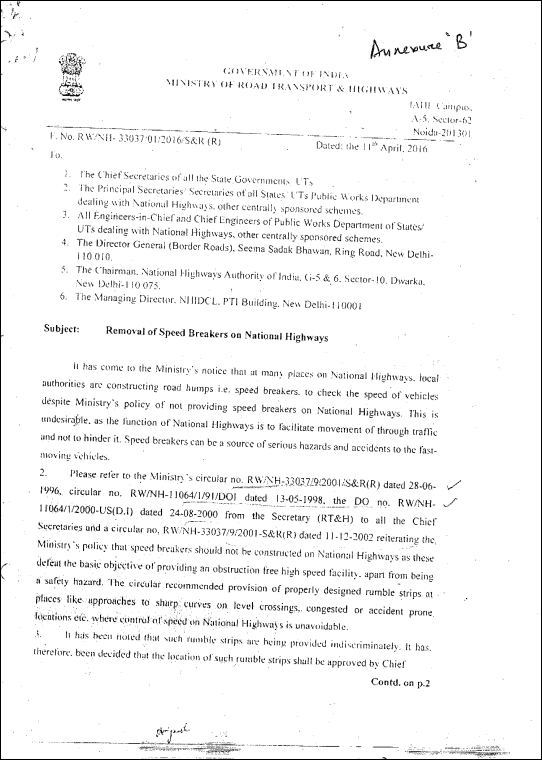
The NHAI’s initial clarification remains problematic for another reason. The Ministry of Road Transport and Highways has reiterated on multiple occasions, including in a 2016 circular, that constructing speed breakers or humps on National Highways by local authorities or by NHAI at their behest/request is against the rules. Constructing speed humps on National Highways is prohibited because it essentially is a safety hazard and also defeats the basic objective of providing an obstruction-free high-speed facility.
Instead of speed humps, the authorities recommend properly designed rumble strips at places like approaches to sharp curves on level crossings, congested or accident-prone locations, etc., where control of speed on National Highways is unavoidable.
However, in the present case, the NHAI first said that the ‘rumble strips’ were constructed at the request of a local political representative and later admitted “wrong reporting” and undertaking of corrective measures. It is being highlighted that not only did the actual installations exceed the IRC specifications, but also that the NHAI justified non-standard construction work solely on political request, subordinating engineering principles to local political pressure.
The NHAI’s handling of the whole matter has revealed a mixed picture. On one hand, the NHAI quickly committed to physical corrections, demonstrating seriousness about accountability. On the other hand, however, the NHAI initially denied ground reality by sharing mismatched imagery.
Not only this, the NHAI passed off a series of small speed bumps as ‘rumble strips’. It must be recalled that back in September 2023, the NHAI itself, in response to an RTI query, said that the construction of rumble strips and speed breakers has been banned on National Highways.
“There are no guidelines to erecting rumblers on NHs. In this regard, specific instructions have been issued to all Project Directors for removal of speed breakers from all NH stretches and ensuring patchless roads for road users (including ambulances),” the NHAI responded in its official reply to the query filed by one Nikhil Desai.
The NHAI could have first conducted a thorough review, ascertained complete facts, and then issued a clarification instead of rushing to discredit the viral claims.
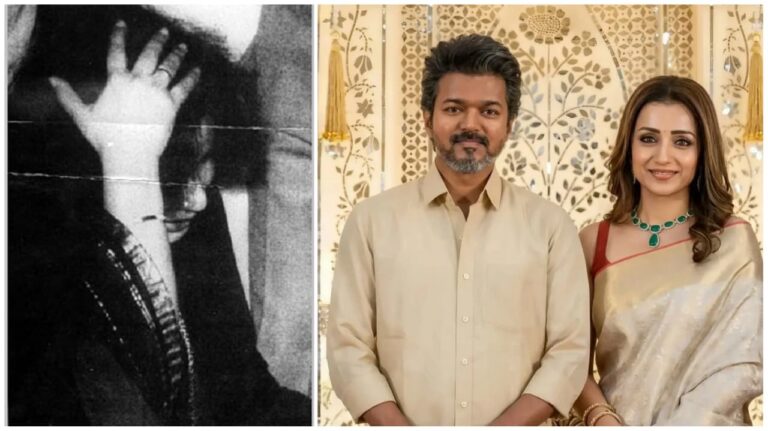
Politics in Tamil Nadu has often been marked by fierce rivalries, but some episodes have transcended ordinary political confrontation to become defining moments in the state’s history. One such moment unfolded on 25 March 1989, when then Leader of the Opposition J. Jayalalithaa walked out of the Tamil Nadu Assembly with a torn saree, dishevelled hair and visible injuries after proceedings descended into chaos.
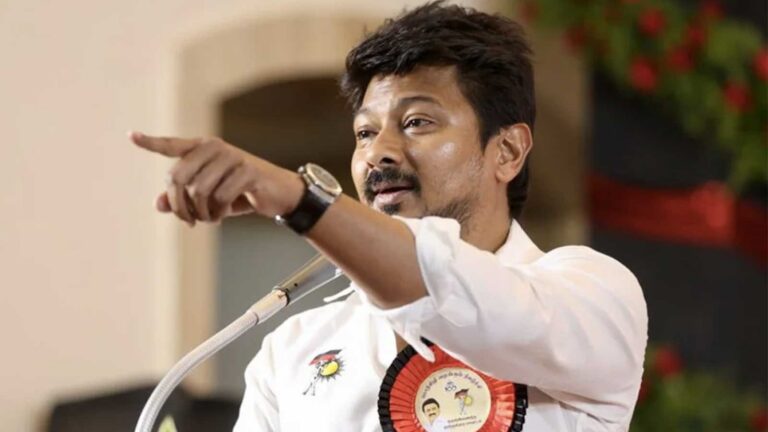
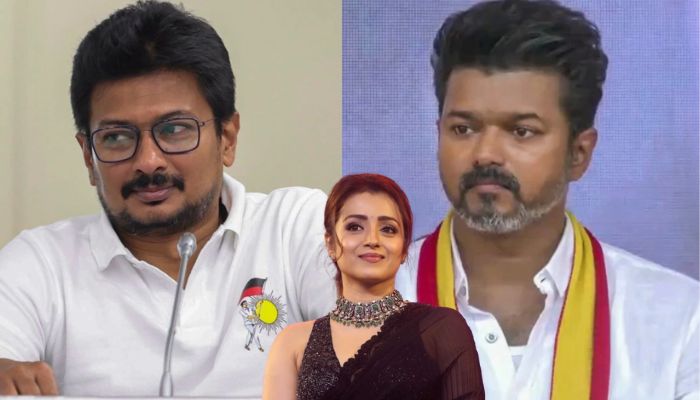
Nearly four decades later, another controversy involving a woman has once again placed the Dravida Munnetra Kazhagam (DMK) under scrutiny. Udhayanidhi Stalin, the former Deputy Chief Minister and a senior DMK leader, was arrested after drawing widespread criticism over an alleged double-meaning remark widely interpreted as targeting actress Trisha Krishnan during a political speech against Tamil Nadu Chief Minister C. Joseph Vijay.
While the two incidents are vastly different in nature, one involving alleged physical assault inside the Assembly and the other a controversy over public remarks, they have together revived a larger political debate about the treatment of women in Tamil Nadu’s political discourse.
The day that changed Jayalalithaa’s political career
The Assembly session of 25 March 1989 remains among the most controversial in Tamil Nadu’s legislative history.
Jayalalithaa, then 41 and serving as the Leader of the Opposition, accused the Karunanidhi-led government of corruption during the Budget session. The proceedings soon deteriorated into unprecedented disorder as AIADMK and DMK legislators clashed on the Assembly floor.
Jayalalithaa later alleged that she was physically attacked amid the chaos. According to her contemporaneous account, legislators directed blows towards her, hurled objects across the House and, while AIADMK MLAs were escorting her out, a DMK minister allegedly pulled her saree, causing it to tear and resulting in injuries.
She emerged from the Assembly with a torn saree, dishevelled hair and tears in her eyes, a scene that was widely reported and became one of the defining images of Tamil Nadu politics.
Jayalalithaa declared that she would return to the Assembly only as the Chief Minister of Tamil Nadu.
Two years later, in 1991, she fulfilled that pledge by leading the AIADMK to a sweeping electoral victory.
Competing versions of the 1989 events
The events of that day have always remained politically contested.
Jayalalithaa consistently maintained that she had been assaulted and humiliated inside the Assembly.
Karunanidhi, however, rejected those allegations. In statements issued later, he maintained that DMK legislators had remained calm despite provocation and instead accused AIADMK MLA K. A. Sengottaiyan of attacking him and breaking his spectacles after Jayalalithaa called him a criminal.
The contrasting accounts have remained part of Tamil Nadu’s political history, with both parties continuing to narrate the incident through sharply different lenses.
Regardless of those competing claims, the events of 25 March 1989 are widely remembered as one of the darkest days in the history of the Tamil Nadu Assembly and marked a turning point in Jayalalithaa’s rise as a mass political leader.
The Trisha Krishnan controversy
The latest controversy erupted during a DMK protest meeting over the Cauvery water-sharing issue.
While attacking the ruling Tamilaga Vettri Kazhagam (TVK) government, Udhayanidhi Stalin remarked that sections of the crowd repeatedly chanted actress Trisha Krishnan’s name. His comments were widely interpreted by political opponents and many social media users as a double entendre referring to media speculation linking Trisha Krishnan with Chief Minister Joseph Vijay.
Although Udhayanidhi immediately added, “I meant the Cauvery,” the clarification did little to contain the backlash.
The remarks triggered criticism from across the political spectrum.
The ruling TVK described the comments as degrading and accused the DMK leader of normalising the objectification of women in political discourse. The party approached the National Commission for Women seeking action. The Tamil Nadu BJP also condemned the remarks, calling them vulgar and demanding legal action.
Earlier controversies involving women
The Trisha controversy is not the first time Udhayanidhi Stalin has faced criticism over comments involving women connected to political rivals.
Earlier this year, while criticising Chief Minister Joseph Vijay, he referred to Vijay’s wife, Sangeetha Sornalingam, mentioning reports about their personal differences during a political speech. Those remarks also drew criticism for dragging family members into political attacks.
During the 2021 Assembly election campaign, Udhayanidhi also mocked then Chief Minister Edappadi K. Palaniswami over his political relationship with V. K. Sasikala, invoking her while attacking his political credibility.
Each of these episodes has attracted criticism from opponents, who argue that women associated with political rivals are unnecessarily drawn into partisan political battles.
Echoes of the past
The circumstances surrounding Jayalalithaa’s 1989 Assembly experience and the Trisha controversy are fundamentally different.
One concerns allegations of physical assault during legislative proceedings. The other concerns remarks delivered at a political rally.
Yet both incidents have generated debate over how women become part of political confrontation in Tamil Nadu.
For Jayalalithaa, the events of March 1989 transformed her political image from an opposition leader into a symbol of resilience. The images of her leaving the Assembly remain among the most enduring in the state’s political history.
The current controversy has similarly reopened conversations about political language, public conduct and the standards expected from elected representatives.
Whether the Trisha row ultimately proves to be a fleeting controversy or another defining moment in Tamil Nadu politics remains to be seen. What is undeniable, however, is that nearly four decades after the events of 1989, women continue to be dragged into Tamil Nadu politics.
During the month of Sawan, Kanwariyas seem to bother left-wingers the most. Consequently, continuous efforts are made during this period to tarnish their image in every possible way. A recent attempt was made regarding an incident in Meerut, where a video went viral on social media, spreading rumours that Kanwariyas had assaulted police personnel. However, when the police issued an official statement on the matter, the truth turned out to be completely different.
What Was in the Video?
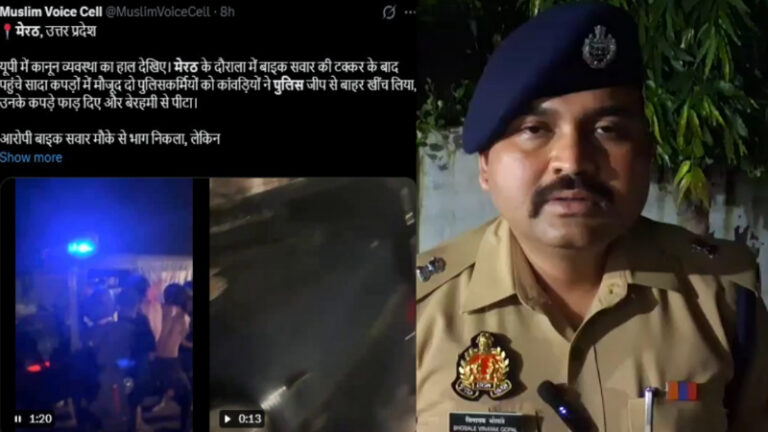
In the viral video on social media, a few Kanwariyas can be seen standing outside a jeep, repeatedly shouting phrases like “Pull him out, get him out!” They had surrounded the police jeep, continuously trying to drag someone out of the vehicle. Several left-leaning individuals and extremists shared this video from their social media handles to build a specific narrative.
Accusations Against Kanwariyas for Beating Police Officers
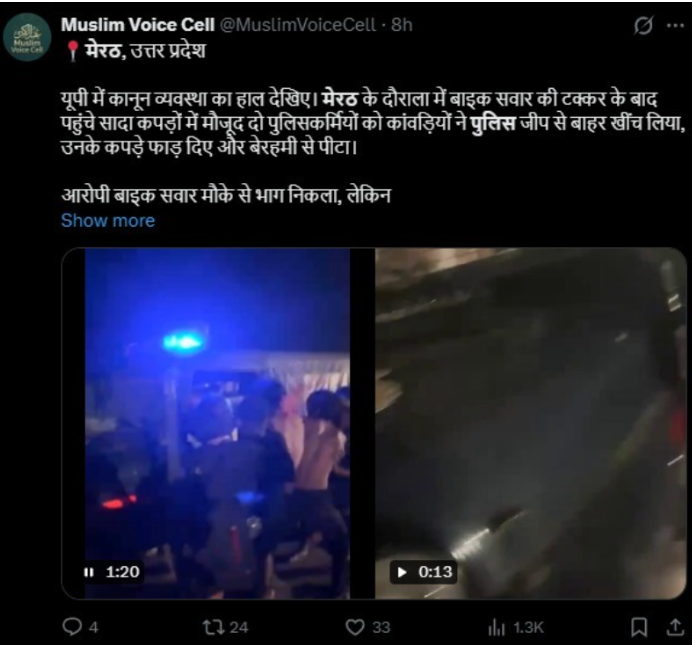
Consider the tweet by ‘Muslim Voice Cell’. Targeting the Kanwariyas, the tweet read: “Look at the state of law and order in UP. In Meerut’s Daurala, after a collision with a motorcyclist, plainclothes police officers who reached the spot were dragged out of the jeep and beaten up by Kanwariyas.”
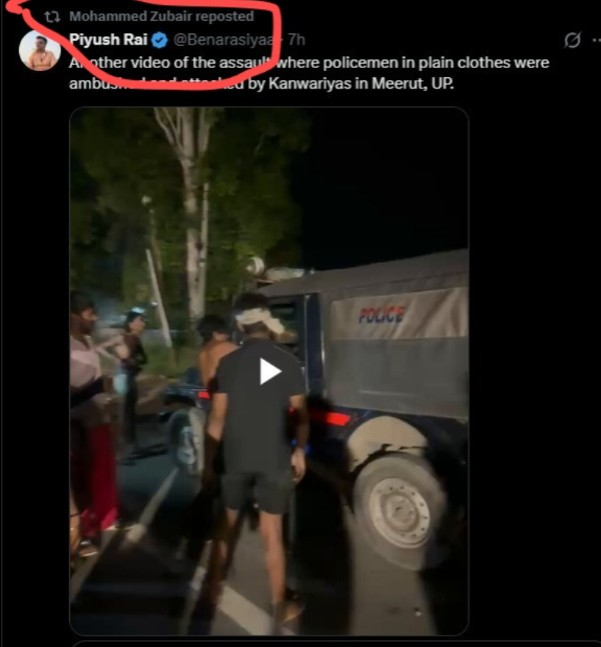
Journalist Piyush Rai also shared the video with a similar claim, which was subsequently reposted by fact-checker Mohammed Zubair.
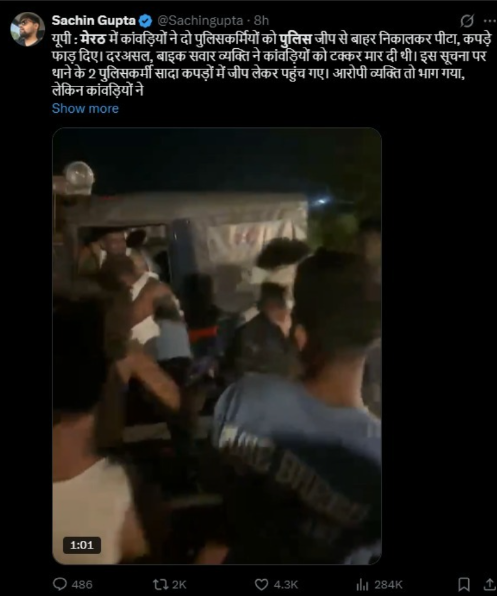
Sachin Gupta similarly claimed in his tweet that after a motorcyclist hit the Kanwariyas, the police arrived at the scene. However, the Kanwariyas started beating up the police officers while the motorcyclist who caused the accident fled.
Zakir Tyagi similarly spread the news, claiming that the Kanwariyas beat the police so mercilessly that the officers had to run to save their lives.
Police Statement
Meerut Police has now issued an official statement regarding this incident. They stated that the video circulating on social media with claims that Kanwariyas assaulted police officers and tore their uniforms is completely false.
According to the police, the investigation revealed that on the night of August 3, two groups of Kanwariyas came face-to-face. A person named Sonu, along with his companion Guddu, was heading to Haridwar in a vehicle when they got into a collision and a subsequent brawl with another group of Kanwariyas coming from the opposite direction.
In response, the Daurala police station team arrived at the spot and tactfully tried to intervene and stop both parties. During this process, Sonu and Guddu were seated inside the police vehicle. It was at this moment that the opposing group became aggressive and attempted to pull these two individuals out of the vehicle. A senior police officer clarified that following the incident, both parties were taken for medical examinations, and further legal action is currently underway.
Misleading Media Coverage
It is worth noting that this entire incident was misrepresented not just on social media, but in mainstream media as well. Without verifying the facts with the police first, it was initially reported that Kanwariyas had beaten up police officers. Although news outlets later updated their reports after the police issued a statement, channels like TV9 Bharatvarsh initially broadcast the news with headlines explicitly stating that “2 police personnel were beaten up.”
The arrest of DMK leader Udhayanidhi Stalin over his alleged vulgar remarks targeting actor Trisha Krishnan has once again put the Tamil Nadu minister’s political style under the spotlight. While the DMK has predictably dismissed the action as “political vendetta,” the controversy is part of a much longer pattern.
For years, Udhayanidhi Stalin has built a reputation for making inflammatory remarks, seemingly secure in the belief that outrage would only strengthen his political brand.
His latest controversy stems from a public rally in Thanjavur, where he responded to chants of actor Trisha’s name with an offensive double entendre. The remarks prompted complaints from the Tamilaga Vettri Kazhagam (TVK), BJP leaders, and appeals to the National Commission for Women, who argued that such comments normalise the objectification of women in public life.
Yet, if there is one episode that best encapsulates Udhayanidhi Stalin’s penchant for reckless rhetoric, it is his infamous September 2023 speech calling for the “eradication” of Sanatana Dharma.
Comparing Hinduism to diseases
On 2 September 2023, Udhayanidhi Stalin attended the so-called “Eradicate Sanatan Conference” organised by the Tamil Nadu Progressive Writers and Artists Association in Chennai. Rather than distancing himself from the event’s provocative title, he openly endorsed it.
“The title of this conference has been excellently coined. You’ve named it ‘Eradicate Sanatan Conference’ and not ‘Oppose Sanatan Conference’,” he declared, congratulating the organisers.
He then proceeded to compare Sanatana Dharma to diseases and pests.
“Mosquitoes, dengue, flu, malaria, corona, we should not oppose these things. They have to be eradicated. The same is the case with Sanatanam.”
The analogy sparked nationwide outrage because it went far beyond criticism of religious practices or social customs. By equating Sanatana Dharma, a faith followed by hundreds of millions of Hindus, with diseases that must be eliminated, Stalin crossed into rhetoric that many viewed as openly hateful towards an entire religious tradition.
He did not stop there.
Attempting to justify his position, Udhayanidhi claimed that Sanatana Dharma represented inequality, caste discrimination, and opposition to social justice. He asserted that it was something “eternal” that could not be questioned and therefore deserved abolition rather than debate.
Following the event, he reiterated his position on social media, stating that they would continue their efforts to eliminate Sanatan.
A government minister at an anti-Hindu platform
The controversy was amplified because Udhayanidhi was not merely a party functionary but a serving minister in the Tamil Nadu government. The conference was also attended by HR&CE Minister P.K. Sekarbabu and several prominent leaders from the DMK and its ideological allies, including Dravidar Kazhagam chief K. Veeramani, VCK leader Thol. Thirumavalavan, Congress leader Peter Alphonse, CPI(M) representatives, and others.
The participation of ministers at an event explicitly advocating the “eradication” of Sanatana Dharma strengthened criticism that the DMK government was lending legitimacy to rhetoric directed against Hindu beliefs while simultaneously controlling thousands of Hindu temples through the state’s HR&CE Department.
A pattern of provocation
The Trisha controversy therefore appears less like an isolated lapse and more like another chapter in a recurring pattern.
Whether it was comparing Hinduism to dengue and malaria, celebrating an event dedicated to the “eradication” of Sanatana Dharma, or now allegedly making vulgar insinuations about a woman actor during a political rally, Udhayanidhi Stalin has repeatedly chosen provocation over restraint.
Political disagreement is a legitimate feature of democracy. Criticising religious practices, governments, or opponents is protected political speech. However, rhetoric that likens an entire faith to infectious diseases or uses objectionable remarks against women inevitably attracts scrutiny and backlash.
Speech has consequences
Udhayanidhi Stalin reportedly described his arrest as a “joke” and said he would challenge it legally. Whether the case ultimately results in conviction or dismissal will be decided by the courts.
What is beyond dispute, however, is that public figures occupy positions of influence. Their words shape political discourse, social attitudes, and public behaviour. The repeated use of inflammatory language may generate headlines and energise partisan supporters, but it also deepens divisions and lowers the standards of democratic debate.
The latest controversy is therefore not simply about one allegedly vulgar remark aimed at an actor. It is a reminder of a political career that has repeatedly courted outrage, from calling for the “eradication” of Sanatana Dharma to making comments that opponents now say demean women in public life. Regardless of where one stands politically, it illustrates a broader truth: leaders who repeatedly push the limits of acceptable public discourse should not be surprised when their words eventually invite legal and political consequences.
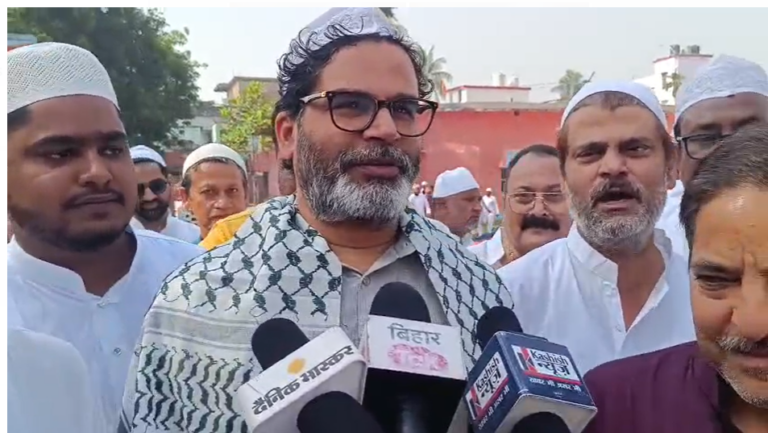
The Bankipura Assembly by-election has highlighted a clear shift in voting behaviour, with many Muslim voters choosing Jan Suraaj Party (JSP) founder Prashant Kishor over the Rashtriya Janata Dal (RJD). Conversations with voters suggest that the decision was driven less by traditional political loyalties and more by the belief that Kishor was the strongest candidate to defeat the Bharatiya Janata Party (BJP). This thinking also found support among sections of Yadavs, upper castes, Scheduled Castes (SCs) and Kayasths.
Muslims shift from RJD to Prashant Kishor
In Sabzibagh, where Muslim voters have a strong presence, many residents said the community backed Prashant Kishor because they did not see the RJD candidate as capable of defeating the BJP. Mohammad Rizwan, a resident, said community members met at a nearby mosque and encouraged people to vote for the candidate who had the best chance of winning against the BJP. He said Kishor’s campaign created the impression that he was giving the BJP its toughest contest.
RJD’s weak campaign helped Kishor
The same mood was visible in Yaarpur and Jakkanpur, where many Yadav voters shifted towards the JSP. Mangesh Yadav said Tejashwi Yadav joined the campaign only in its final two days after returning from a foreign trip. He added that senior RJD leaders, including Sudhakar Singh, Misa Bharti, Sanjay Yadav and Manoj Jha, were largely absent, while the BJP had deployed around 40 star campaigners. According to him, many voters felt Kishor was fighting the election almost single-handedly and decided to support him.
BJP stronghold slips despite development work
The result was significant because Bankipura had remained a BJP bastion for nearly three decades. In the 2025 Assembly election, BJP national president Nitin Nabin retained the seat for a fifth consecutive term by defeating RJD’s Rekha Kumari by more than 51,000 votes. His father, Navin Kishore Prasad Sinha, had represented the constituency since 1995. In May 2026, Chief Minister Samrat Choudhary and Nitin Nabin inaugurated the ₹115-crore Mandiri Nala project, with the road named after Nabin’s father. Even so, voters rejected BJP candidate Neeraj Kumar Sinha.
Support came from different communities
Deepak Sharma, a Bhumihar from Mandiri, said Kishor appealed to voters because he focused on public issues and gave the message of voting for the future of children rather than making big promises. Brahmin voter Akhilesh Mishra said the BJP had become overconfident after winning the seat repeatedly and fielded a candidate who failed to connect with voters.
In SC-dominated areas such as Peermuhani and Daldali Road, residents said Kishor personally visited them and sought support for change. Bittu Kumar said Kishor even told people they could accept money from BJP workers if offered but should vote for the JSP.
The BJP also lost support in Kayasth-dominated localities such as Boring Canal Road, Kadamkuan, Exhibition Road, and Rajendra Nagar. One Kayasth voter, who had campaigned for the BJP, said he ultimately voted for Kishor and even asked his wife to press serial number 9 instead of the BJP’s serial number 2. Many residents also expressed anger over police action against students during the 25th July Bihar Bandh over NEET-UG irregularities.
A vote for change
Political observer Sanjay Kumar said Bankipura has never voted for a single ideology consistently and has elected candidates from the Congress, CPI, Left parties, the Janata Party, and even independents in the past. According to him, this election reflected the voters’ desire for change, with many communities putting aside old political preferences and rallying behind Prashant Kishor because they believed he was the most credible challenger to the BJP.
Tamil Nadu politics has a long track record of objectifying women from the camp of political opponents. In continuation of this opprobrious record, DMK leader and former Deputy Chief Minister Udhayanidhi Stalin made a double-meaning remark against actress Trisha Krishnan while criticising CM C. Joseph Vijay on 3rd August 2026. The DMK leader is reported to have been arrested from his residence in connection with his defamatory remarks allegedly targeting Trisha Krishnan on 4th August.
WATCH | 'Trisha' Comment Row: Udhayanidhi Stalin Arrested by Tamil Nadu Police pic.twitter.com/CuZFvHm5nV
Addressing a protest rally in Thanjavur over the Cauvery water -haring issue with Karnataka on 3rd August 2026, Udhayanidhi Stalin claimed that CM Vijay-led Tamilaga Vettri Kazhagam (TVK) government has remained silent over the lack of Cauvery water releases instead focusing on filing alleged ‘false’ cases against the DMK.
Immediately, the crowd largely comprising DMK workers began chanting “Trisha, Trisha”. To this, Udhayanidhi Stalin paused, smirked, and responded with a remark that is being widely interpreted as a crude double entendre.
Without naming Trisha Krishnan, Udhayanidhi Stalin said, “Even if water doesn’t come to our place, water must reach there. That’s all he cares about,” or “Water comes or not, the water should come.”
This followed a sarcastic ‘clarification’ as Stalin said, “I meant the Cauvery.”
At what was projected as a farmers protest, Udhayanidhi Stalin made an unnecessary, vulgar and double meaning comment about actress Trisha in front of thousands of men. pic.twitter.com/EvqkGrHKie
The video has gone viral on social media, with people from across party and ideological lines criticising Stalin’s alleged double entendre directed at actress Trisha Krishnan, who has been making headlines for her supposed personal association with actor-turned-politician CM Joseph Vijay.
Meanwhile, Udhayanidhi Stalin’s remarks have also stirred a political storm in Tamil Nadu. TVK MLA Rhevanth Charan called Stalin’s remarks “disgusting and unacceptable”. “This is precisely why the people of Tamil Nadu rejected you and confined you to the position you are in today. Even by Arivalayam’s already abysmal standards, this is a new low,” he said.
The Tamil Nadu BJP also condemned the Leader of Opposition over his alleged double entendre, describing the DMK scion’s remarks as “disgusting, obscene, vulgar and shameful.”
The state BJP spokesperson Narayanan Thirupathy questioned former CM MK Stalin’s silence over his son’s lewd comments against a woman, and also demanded Udhayanidhi’s arrest.
Meanwhile, the ruling TVK has written to the National Commission for Women (NCW) seeking action against Udhayanidhi Stalin. The TVK said that Stalin’s language “normalises the objectification and verbal harassment of women in public spaces…severely degrades the decorum expected of public figures. The TVK further stated that such conduct sets a “dangerous precedent” for the treatment of women in public life.
The TVK has asked the NCW to seek an explanation from the DMK leader and direct him to issue an unconditional apology. The party has also said that Udhayanidhi Stalin should be booked for public obscenity and outraging the modesty of women.
Udhayanidhi Stalin hurling sexual innuendos at women over political rivalries: The recurring pattern
While Udhayanidhi Stalin is receiving a massive backlash for his remarks allegedly directed against actress Trisha and dragging her into a political attack through innuendos, the DMK leader has made sexist remarks targeting women linked to political rivals earlier as well.
In the lead-up to the 2021 Tamil Nadu Assembly elections, Udhayanidhi Stalin, while campaigning, said that then Chief Minister Edappadi Palaniswami had “crawled like a dead body” to touch the feet of former AIADMK general secretary, VK Sasikala.
“Whenever I mention Edappadi government in my election speech, people ask me to say Edupudi (someone following orders) and not Edappadi. I ask who is Edupudi and people say, Modi’s Edupudi. Someone in the crowd at one of my recent rallies said he is not Edupudi but a dead body as he has fallen at the feet of Sasikala,” Udhayanidhi said.
Earlier this year, when TVK formed government, Udhayanidhi Stalin dragged Joseph Vijay’s wife Sangeetha Sornalingam into his political attacks against the TVK supremo. “His (Vijay’s) rambling about telling a ‘kutty story’ is completely against the dignity of the Assembly. The story of a wife searching for her husband in the Chengalpattu court is known to the whole of Tamil Nadu,” he said.
Stalin was heavily criticised for bringing the personal dispute between CM Vijay and his wife into his political mudslinging.
And now again, Udhayanidhi Stalin has dragged the alleged personal relations between Trisha Krishnan and CM C Joseph Vijay for petty political gains.
The DMK leader has been in controversies for various reasons over the years. Back in 2023, Udhayanidhi Stalin sparked national outrage over equating Sanatan Dharma to “dengue, malaria” and calling for its eradication. Widespread protests were held against him at that time, and even the Supreme Court rebuked the DMK leader.
In 1025 CE, Rajendra Chola led an ocean-going fleet from Nagapattinam across more than 2,000 km to strike the Srivijaya kingdom, to protect the economic and strategic interests of the Chola Empire. The ships were stitched teak hulls sealed with resin and lime. The fleet navigated by sun, wind, birds and stars. They carried troops, elephants and months of supplies, entered via the unexpected Sunda Strait, and broke Srivijaya’s grip on East Asian trade.
That campaign was possible only because India then possessed the industrial skill to build large, seaworthy vessels. That competence faded into the downfall and decay of history. After the Cholas, political power in India turned inland. European control of ports and shipyards pushed indigenous ocean-going construction to the margins.
After Independence, defence yards succeeded in building warships, but commercial shipbuilding never achieved design depth, productivity or scale. China and South Korea pulled far ahead. The result is a paradox: the country after which an ocean is named, with more than 11,000 km of coastline, still produces only a tiny share of global commercial tonnage.
Shipbuilding is not a single trade but an interlocking ecosystem: naval architecture, steel, engines, electronics, coatings, finance, skills and ports. Without it, maritime power and strategic autonomy remain incomplete. The Union Budget 2025–26 package of ₹69,725 crore is the first serious attempt to close that gap.
Three greenfield clusters in Andhra Pradesh, Gujarat and Tamil Nadu have in-principle approval, and a pipeline of more than 400 vessels is being aggregated. The stated goals sit inside Maritime India Vision 2030 and Maritime Amrit Kaal Vision 2047: more Indian-flagged ships and a competitive place in global shipbuilding. Success, the article concludes depend on execution over many years, infrastructure, skills, technology and consistent policy. The Chola precedent showed that Indian yards once served both commerce and strategic reach. The present effort is an attempt to turn that memory into industrial strength again.
The article tells the story of the lost dominance of a thousand years to the current push. The full article can be read on Chapter One Mag.
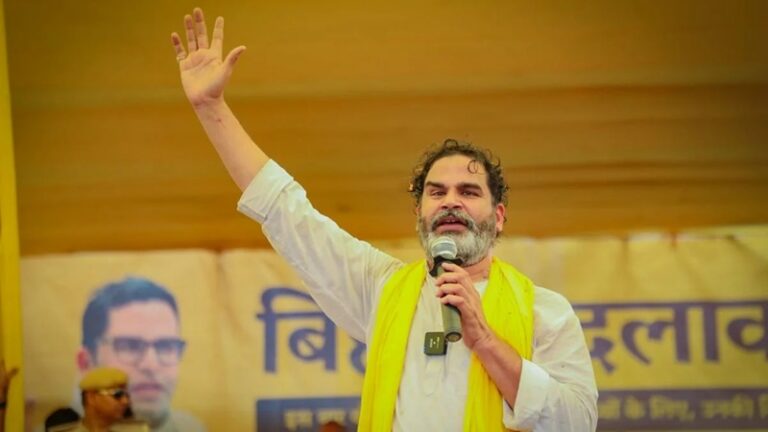
Jan Suraaj founder Prashant Kishor has secured the biggest electoral victory of his political career after defeating the Bharatiya Janata Party (BJP) in the Bankipur Assembly by-election. Kishor defeated BJP candidate Neeraj Sinha by 19,246 votes, securing 63,946 votes against Sinha’s 44,700. The Rashtriya Janata Dal (RJD) candidate finished a distant third with 14,241 votes.
The result is significant not merely because it came in what has long been considered a BJP bastion, but because it appears to reflect a marked shift in Kishor’s own political strategy. Just months ago, after Jan Suraaj’s humiliating debut in the Bihar Assembly elections, Kishor had questioned the integrity of the electoral process. In Bankipur, however, he chose a very different path, focusing on grassroots organisation, local issues and voter outreach instead of questioning institutions.
A humiliating debut for Jan Suraaj
The Bankipur victory comes against the backdrop of Jan Suraaj’s disastrous performance in the 2025 Bihar Assembly elections.
Founded by election strategist-turned-politician Prashant Kishor, the Jan Suraaj Party contested 238 of Bihar’s 243 Assembly constituencies, projecting itself as a serious alternative to both the NDA and the Mahagathbandhan.
The outcome, however, was devastating.
The party failed to win even a single seat. Most of its candidates forfeited their deposits, while the party’s vote share remained insignificant despite months of campaigning through the Jan Suraaj Yatra.
For many observers, the verdict demonstrated that political visibility alone could not substitute organisational depth or booth-level strength.
Questioning the verdict instead of the campaign
Kishor’s immediate reaction to the defeat attracted almost as much attention as the election result itself.
Speaking to India Today TV after the Assembly elections, Kishor claimed that the polls appeared to have been “rigged”, although he admitted that he had no evidence to support the allegation.
“There were some invisible powers at play,” he said, arguing that the election results did not match the feedback collected by his team during months of campaigning.
While he stopped short of alleging EVM manipulation, Kishor maintained that “something went wrong”. He also accused the NDA of influencing women voters through cash transfers during the campaign. At the same time, he acknowledged another political reality, that many voters eventually backed the NDA because they feared that voting for Jan Suraaj could pave the way for the return of what he described as “Lalu’s jungle raj.”
Kishor’s reaction to the Assembly election defeat also echoed a familiar pattern in Indian opposition politics. In recent years, Congress leader Rahul Gandhi and Aam Aadmi Party chief Arvind Kejriwal have repeatedly questioned Electronic Voting Machines (EVMs), the Election Commission or the fairness of the electoral process after suffering electoral setbacks. Although Kishor stopped short of directly alleging EVM manipulation and explicitly admitted that he had no evidence to substantiate his claims, his remarks about “invisible powers” and the polls appearing “rigged” placed him in a similar category of leaders who sought explanations beyond campaign shortcomings.
A different strategy in Bankipur
The Bankipur bypoll, however, appears to have marked a significant departure from that approach.
Instead of revisiting allegations about the electoral process or suggesting that unseen forces had influenced the outcome, Kishor concentrated on strengthening Jan Suraaj’s grassroots organisation, improving booth-level mobilisation and building a campaign around constituency-specific issues.
Rather than blaming institutions, the former election strategist returned to the fundamentals of electoral politics, meeting voters, understanding local grievances and offering himself as an alternative based on governance rather than rhetoric.
The change in emphasis is difficult to ignore. After explaining away defeat through suspicions that could not be substantiated, Kishor appears to have accepted that electoral success depends primarily on political organisation and public trust.
Local issues worked in Kishor’s favour
The political environment in Bankipur was also markedly different from the statewide Assembly election.
The BJP entered the bypoll facing visible local discontent on several fronts. Among the most significant issues was anger among sections of students and youth over the NEET paper leak controversy, which had triggered widespread criticism across Bihar. Education, unemployment, civic infrastructure, administrative transparency and governance-related concerns also featured prominently in local discussions.
Kishor ensured that his campaign remained centred on these constituency-specific issues rather than abstract ideological debates.
Instead of relying on emotional rhetoric or broad political narratives, Jan Suraaj projected itself as a party willing to address everyday governance concerns. The campaign also included extensive door-to-door outreach, ward-level meetings and direct interaction with voters.
Political observers believe that these organisational efforts, combined with local anti-incumbency against the BJP, enabled Kishor to expand his support base beyond Jan Suraaj’s traditional voters.
A lesson from the assembly elections
The contrast between the Assembly elections and the Bankipur bypoll is perhaps the most striking aspect of Kishor’s political journey.
In the Assembly elections, Jan Suraaj relied heavily on statewide messaging and Kishor’s personal credibility built over years as a political strategist. When that strategy failed, Kishor questioned the electoral outcome and suggested that unseen factors may have influenced the verdict.
In Bankipur, however, the emphasis shifted entirely.
The campaign revolved around local issues, voter contact and organisational discipline instead of post-election allegations. While one bypoll cannot conclusively establish a long-term political transformation, the result suggests that Kishor may have recalibrated his strategy after learning from Jan Suraaj’s disappointing debut.
More Than Just a BJP Defeat
It would be simplistic to interpret the Bankipur verdict solely as a rejection of the BJP.
The outcome appears to have been shaped by multiple factors, including local dissatisfaction with the ruling party, the fallout of the NEET controversy, constituency-specific grievances and an energetic campaign by Jan Suraaj.
Equally, it would be difficult to ignore Kishor’s own strategic shift.
Instead of spending the campaign questioning institutions or reviving allegations about the electoral process, he invested in organisational work and constituency-level engagement. That approach stands in contrast to the post-defeat narratives often witnessed in Indian politics, where electoral setbacks are followed by allegations against EVMs or the Election Commission.
The Road Ahead
Whether Bankipur proves to be an isolated victory or the beginning of Jan Suraaj’s political rise will only become clear in future elections. A bypoll is very different from a full-fledged Assembly election, and replicating this success across Bihar will require a far stronger organisational network.
Nevertheless, the bypoll has delivered an important political lesson; not just for Jan Suraaj but for opposition parties in general.
For Prashant Kishor, the biggest takeaway may not simply be that he defeated the BJP in one constituency. It is that after publicly claiming the Assembly elections appeared “rigged” despite admitting he had no evidence, he returned to the electorate with a campaign rooted in issues, organisation and voter engagement. Bankipur suggests that when politics is fought on the ground instead of in post-election explanations, electoral fortunes can change.
Whether this strategic recalibration becomes the defining feature of Kishor’s politics remains to be seen. But if Bankipur is any indication, Jan Suraaj’s first major electoral success came not by questioning the system, but by competing within it more effectively.
On 18 July 2026, Skyroot Aerospace’s Vikram-1 lifted off from the First Launch Pad at the Satish Dhawan Space Centre, Sriharikota. Mission Aagaman made Skyroot the first private Indian company to place satellites into orbit. India thereby joined the United States and China as only the third country whose private industry had independently achieved orbital launch capability. Co-founder Pawan Kumar Chandana said the rocket was designed, manufactured and built entirely in India.
While it was a success of a private sector company, the government played a crucial role through policies and supports. It followed a deliberate opening of the space sector by the government. In May 2020, as part of the Aatmanirbhar Bharat package, Finance Minister Nirmala Sitharaman announced that the entire space value chain would be opened to non-governmental entities. On 24 June 2020 the Union Cabinet created IN-SPACe as a single-window agency under the Department of Space to authorise private missions, ensure a level playing field and give companies access to national facilities.
NewSpace India Limited, incorporated in 2019, was given a demand-driven commercial mandate. The Indian Space Policy 2023 authorised non-government entities to design and operate launch vehicles subject to IN-SPACe clearance. FDI rules were liberalised and a ₹1,000-crore Venture Capital Fund and a ₹500-crore Technology Adoption Fund were created. The ecosystem grew from a handful of firms to more than four hundred active start-ups.
Skyroot signed a framework MoU with the Department of Space in September 2021. That agreement opened ISRO’s solid-motor casting and static-test facilities at Sriharikota, engine-test stands at the Liquid Propulsion Systems Centre, trajectory and range-safety support, and tracking through ISTRAC. Mission-readiness reviews involved specialists from ISRO and IN-SPACe. The launch-authorisation board was headed by ISRO veteran Dr B.N. Suresh.
The same framework has assisted Agnikul Cosmos, Pixxel, Digantara, Dhruva Space and GalaxEye through authorisations, technology transfers and access to testing facilities. NSIL has signed more than seventy technology-transfer agreements. Skyroot now plans its own launch pad to schedule flights more freely and raise cadence. India’s space economy, valued at about $8.4 billion, is projected to reach $40–45 billion by 2030.