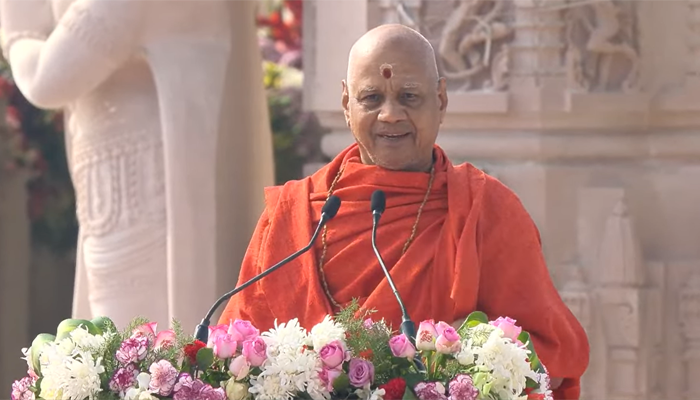
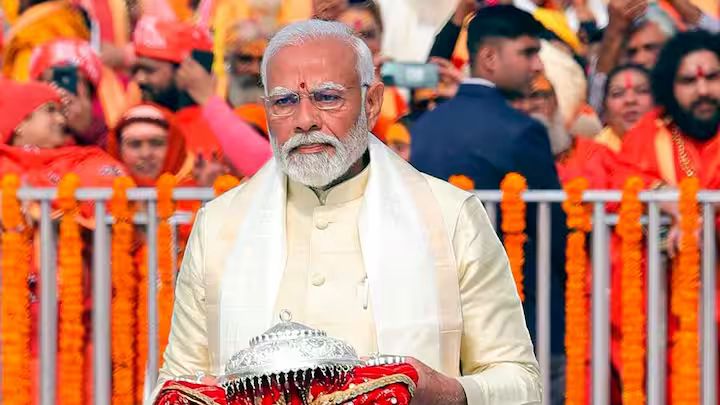
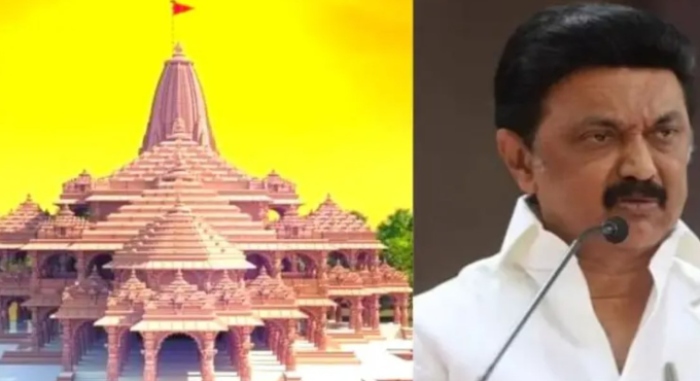
On 22nd January, Shri Ram Janmbhoomi Teerth Kshetra Trust’s treasurer, Swami Govind Dev Giri Ji Maharaj, lauded Prime Minister Narendra Modi for his deep spiritual commitment and strict observances in preparations for the Ram Mandir Pran Pratishtha ceremony. He highlighted how PM Modi practised rigorous fasting and meditation, which far exceeded the expectations set by the religious leaders.
Swami Ji revealed that 20 days before the ceremony, a request from the Prime Minister came for a list of observances he should follow as PM Modi was scheduled to be Yajmana at the Pran Pratishtha ceremony. After consulting with the religious leaders, an advisory was prepared for PM Modi that included different observances, including fasting, sleeping on the floor and more.
While the advisory mentioned only a three-day fast, PM Modi undertook an 11-day complete fast, relinquishing even the consumption of grains. According to Swami Ji, this act of devotion is a profound spiritual undertaking similar to the practices of the most dedicated spiritual figures in Hindu religious texts. He said, “Fasting is the supreme form of penance,” emphasising the spiritual significance of PM Modi’s actions. Furthermore, he highlighted how PM Modi slept on the floor for 11 days as part of the observances.
Swami Ji also shed light on PM Modi’s pilgrimage to sacred sites across India during this period. He said the visits could be interpreted as an invitation to divine entities to grace the temple city of Ayodhya. These visits, he said, were not just a personal spiritual journey but also symbolised a national leader’s dedication to seeking blessings for the prosperity and well-being of the people of India.
In his speech, Swami ji drew parallels between PM Modi’s dedication and the legendary devotion of Chhatrapati Shivaji Maharaj. He recounted how Shivaji Maharaj, after visiting the shrines of Mallikarjuna, expressed a desire to renounce his kingdom for spiritual pursuit, which was a testament to his deep spiritual commitment to the deity. He remarked, “It’s rare to find such spiritual depth and dedication in a national leader.”
His words resonated as a reminder of the deep spiritual roots and the venerable traditions that continue to guide the Prime Minister of the country and the people of India.
22 January 2024 is etched in the annals of Bharatvarsh’s glorious history after Ram Lalla’s Pran Pratishtha concluded in the Ram Mandir in Ayodhya. PM Modi performed the consecration ceremony, reinstalling Ram Lalla to his rightful abode after 496 long agonising years.
Celebrations swept across the country as millions of devotees took to the streets and visited temples, small and big, to mark the completion of Pran Pratishtha of Ram Lalla and pay their tributes to God on his homecoming to Ayodhya.
Chants of ‘Jai Shri Ram’ thundered across the length and breadth of the country, infusing energies and feelings of triumph seldom witnessed in such vast multitudes of people simultaneously and organically. The prophecy “Ram Lalla Aayenge, Mandir Wahin Banayenge” has finally been fulfilled.
Even as the country is drowned in the celebrations of Lord Ram’s homecoming, it is a sobering moment to reflect upon the centuries of struggles that have brought the Ram Mandir to fruition. In his speech after the Pran Pratishtha ceremony, one that would be remembered for decades if not centuries to come, PM Modi emphasised the sacrifices made to materialise the dream of building a Ram Mandir in Ayodhya.
“After centuries of unprecedented patience, countless sacrifices, renunciations and penances, our Prabhu Ram has come…” PM Modi said in his speech following the Pran Pratishtha ceremony. He spoke about the resilience of Hindus, their unwavering devotion to Lord Ram, and their indomitable spirit in reclaiming what had always been theirs.
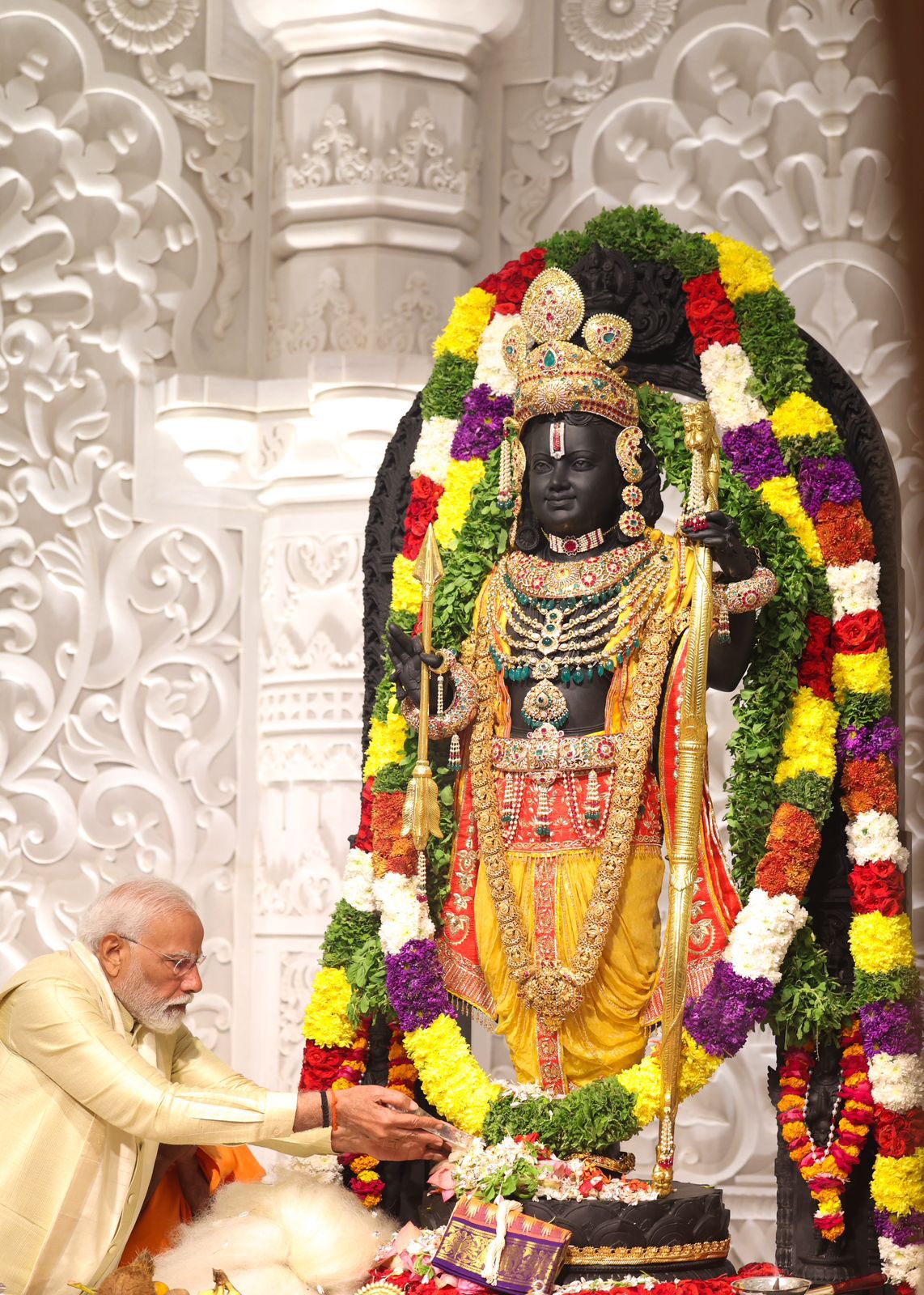
PM Modi offering flowers at the feet of Ram Lalla
Indeed, it has been an incredible moment to witness. It is a triumph of Dharma over Adharma, a victory of pluralism over Islamic iconoclasm, for Lord Ram embodies the abiding symbol of India’s civilisation that has always stood for freedom, pluralism, tolerance, and diversity. Lord Ram’s homecoming was, therefore, symbolic of the country’s ushering into Ram Rajya, a vision of perfect social harmony, economic justice and political freedom.
For many, the Pran Pratishtha ceremony is the culmination of the centuries-old struggle to reclaim Lord Ram’s birthplace and reinstall God again to his rightful abode, but it is much more profound than that. The return of Lord Ram to Ram Janmabhoomi is a tribute to the thousands of devotees who sacrificed their everything to continue fighting for a site that was forcibly usurped by Islamic zealots who humiliated the natives by building a mosque atop a preexisting temple.
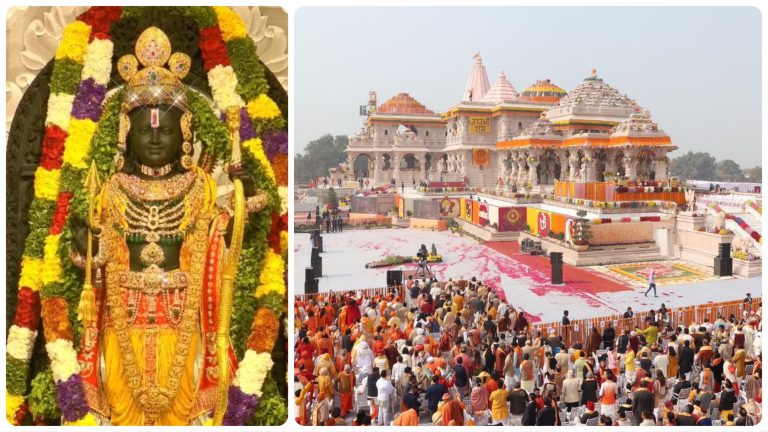
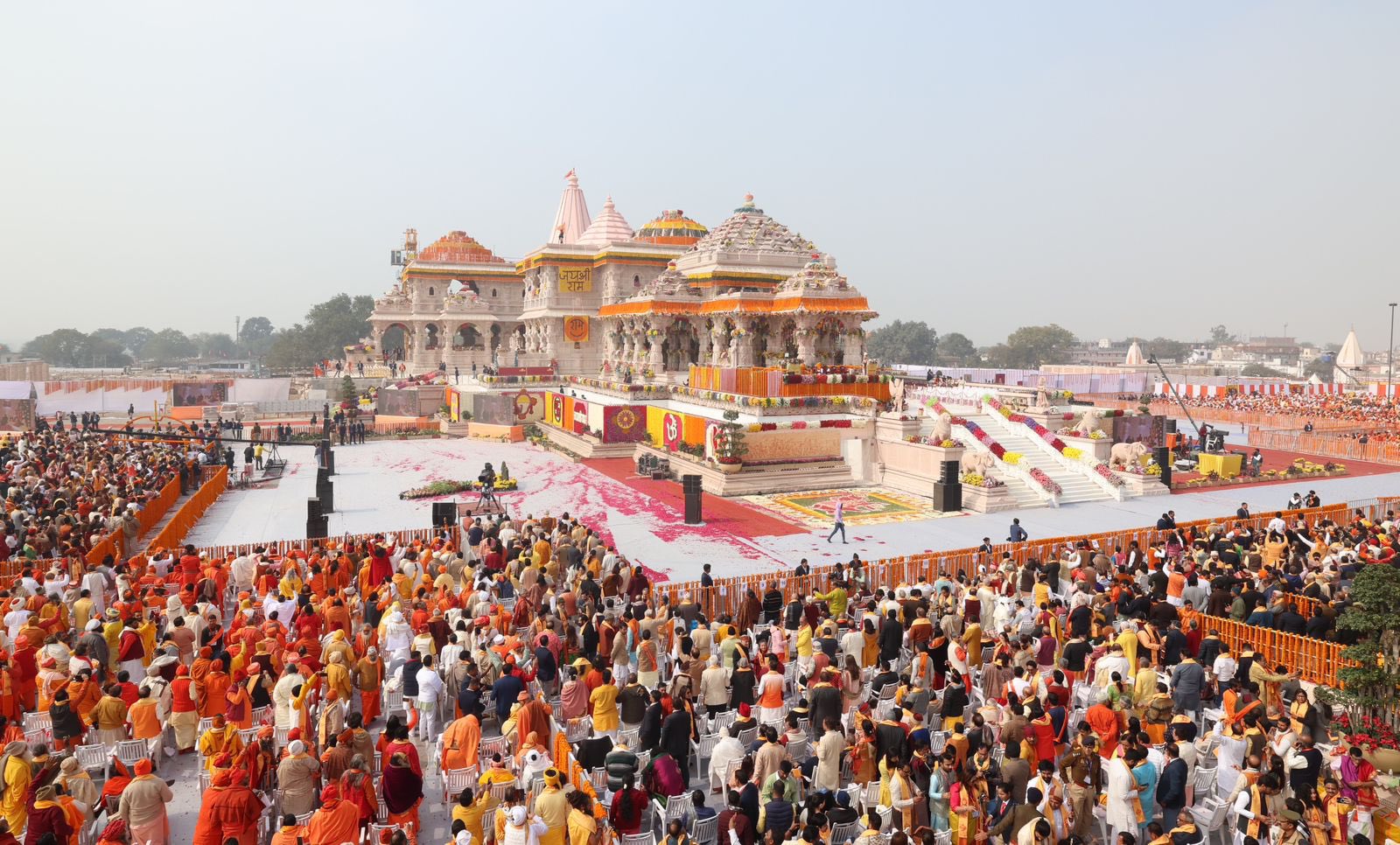
Scores of people, including celebrities from different walks of life, attend the Pran Pratishtha ceremony in Ayodhya
Ram Lalla Virajman at the holy site is, therefore, an expression of the unprecedented grit, dauntless determination, and extraordinary courage of the millions who ensured the fight for the Janmabhoomi is not lost in the vicissitudes of the time, and who instilled a sense of obligation to Dharma among their progenies to persist with the struggle until their goal of liberating the birth-site of their God was achieved.
But as India’s bloody history poignantly reveals, the Ram Janmabhoomi site is but one example of how Islamic iconoclasm and extremism had subjugated non-Muslims in India. There are countless sites, most notably the Krishna birthplace in Mathura and Gyanvapi mosque in Varanasi, where this iconoclasm becomes incongruously jarring. India’s history, even through the Marxist-Leftist lens, illustrates in great detail how the Muslim invaders from the Middle East, whose original goal was to spread the flag of Islam, pillaged and plundered, raped and massacred the idol-worshipping Hindus in India.
After the religious persecution faced by the Muslim rulers, the Indic civilisation came under assault from the wily Britishers, who economically deprived the country to the extent that it was reduced to contributing less than 1 per cent to the global GDP when they left the country in 1947 from once being at a high of 27 per cent during the 17th century.
One would have imagined India’s independence from the Britishers would provide a much-needed breather to the Indic civilisation that endured a relentless wave of assault, first by the Muslim invaders and then by the cruel British rule. It was natural to assume that after the Britishers left the country, the Hindus and other natives would finally be granted the independence to reinvigorate their civilisation and allowed to reclaim their battered cultural heritage. Instead, the assault continued unabated, with Hindus being guilt-tripped for something as fundamental as wearing their identity on their sleeves, greeting each other with ‘Jai Shri Ram’ slogans, and reclaiming their destroyed temples and usurped lands.
The renovation of Somnath Temple was disapproved of, for it unnerved the socialist politicians who thought it would revive Hindu resurgence among the masses. The Ram Janmabhoomi dispute was also relegated to oblivion, with politicians wary that its resolution could lead to widespread riots and violence in the country. Lies and rhetorics aimed at depriving Hindus of reclaiming their places of worship took centre stage as the thought leaders, civil society, and media—all of them thoroughly entrenched in the prevailing governmental system—took it upon themselves to gaslight and manipulate Hindus to dissuade them from standing up for their religio-cultural imperatives.
Seen in this context, the Pran Pratishtha ceremony in Ayodhya has been a remarkable victory for Hindus and adherents of all Vedic faiths that have grown restive with the policy of some political parties to indulge in minority appeasement, even at the expense of justice and morality. It has kickstarted a process of healing for a civilisation that remained resilient and irrepressible to centuries of subjugation.
Of course, there are other battles to be won, be it the Gyanvapi complex or the Shahi Idgah building, but one thing is for sure. The Ram Mandir Pran Pratishtha has instilled a sense of belief among Hindus that they could not only overturn centuries of wrongs, first wrought by the tyrannical Mughals, followed by the exploitative Britishers, and then by the Marxist-leftist politicians who governed independent India for decades, but also reclaim their honour and the places of worship that form the spiritual epicentre of Hindu civilisation.
Maybe in the distant future, the significance of January 22 will extend beyond the celebration of Ram Lalla’s Pran Pratishtha at the revered Ram Janmbhoomi. It might also be remembered as a day that realised the essence of devotion (bhakti) and inspired Ram devotees to engage in more extensive karseva, contributing significantly to the ongoing restoration of civilisation. This epoch-making triumph could pave the way for even greater accomplishments in the times to come. A wounded civilisation has finally found a focal point to revolve around and set itself on the path to greater glory.
Rashtriya Swayamsevak Sangh (RSS) chief Mohan Bhagwat said on Monday that the history of Lord Ram Lalla’s homecoming to Ayodhya is such that whoever listens to those stories, their sorrows and pains get erased.
The RSS chief was addressing the gathering at Shri Ram Janmabhoomi temple premises after Ram Lalla’s ‘Pran Pratishtha’. “Today, after 500 years, Ram Lalla has returned here and due to his efforts, we are seeing this golden day today. We pay our utmost respect to him. The history of this era has so much power that whoever listens to the stories of Ram Lalla, all their sorrows and pains will be erased,” he said.
#WATCH | RSS chief Mohan Bhagwat says "Today after 500 years, Ram Lalla has returned here and due to his efforts we are seeing this golden day today, we pay our utmost respect to him. The history of this era has so much power that whoever listens to the stories of Ram Lalla, all… pic.twitter.com/YkxcpvYkOo
Bhagwat said that all countrymen should fulfill the duties of citizens of Ram Rajya just like Lord Ram. “He (Lord Ram) has practised penance for us. Now we should do the same…We should fulfill the duty of citizens of Ram Rajya. We should get rid of our fights, even for the most insignificant differences among us,” Bhagwat said. The RSS chief further said that countrymen should refrain from greed and follow a life of discipline.
“The citizens of Ayodhya were hardworking, not arrogant and they were righteous. We should treat others as equals. We should offer our service wherever we see difficulties, earn our livelihood and give back whatever excess we have. Do not fall prey to greed,” Bhagwat said. Bhagwat said that we should practice penance to make our country ‘Vishwa Guru’. “We should practice penance together to make our country Vishwa Guru. If we practice this, along with the ongoing construction of the temple Vishwa Guru Bharat will also be established,” he said.
He said that the feelings of devotees of Lord Ram cannot be expressed in words. “No one can express what you are feeling now. The same feeling is resonating throughout the world, even in small temples where the Pran Pratishtha ceremony is being live telecast,” Bhagwat said. The RSS Chief also lauded Prime Minister Narendra Modi for his 11-day special ritual for Ram Lalla’s ‘Pran Pratishtha’, and said that Lord Ram has come back to Ayodhya after a span of 500 years.
“There was a state of war at Ayodhya 14 years ago, and Lord Ram went into exile and after bringing an end to all fights throughout the world, he came back. Today he has come back after a long span of 500 years,” he said.
Earlier in the day, the idol of Ram Lalla was unveiled and the Ram Mandir was consecrated by the hands of Prime Minister Narendra Modi. Prime Minister Narendra Modi performed the ‘aarti’ of the Ram Lalla idol at the temple. PM Modi led the rituals at the Pran Pratishtha ceremony. He performed ‘parikrama’ of the deity and did ‘dandvat pranam’. He also took blessings from ‘sadhus’.
Indian Air Force (IAF) choppers showered flower petals over Shri Ram Janmabhoomi Temple premises in Ayodhya as the idol of Ram Lalla was unveiled. The historic Pran Pratishtha ceremony was attended by representatives of all major spiritual and religious sects of the country. Over 8,000 guests were invited to the ceremony at the grand temple.
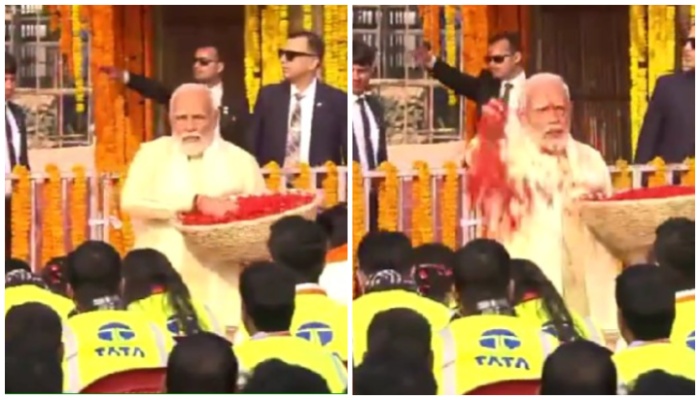
In a heartwarming gesture, PM Narendra Modi showered flower petals on the shramiks (workers) who were involved in the construction of Ayodhya’s Bhavya Ram Mandir.
After presiding over the Pran Pratishtha puja of the idol of Ram Lalla inside the sanctorum of the newly constructed Ram Temple in Ayodhya, the Prime Minister was observed walking between the seated engineers, architects and skilled artisans with a basket filled with flower petals. He showered them with petals as an expression of appreciation for their hard work.
Modi’s gesture of gratitude shows that the workers’ determination and dedication towards constructing the holy Mandir were acknowledged.
#WATCH | Prime Minister Narendra Modi showers flower petals on the workers who were a part of the construction crew at Ram Temple in Ayodhya, Uttar Pradesh. pic.twitter.com/gJp4KSnNp6
It may be noted that Larsen & Toubro (L&T), the leading Indian engineering and infrastructure company, had pledged its services free of charge and offered its vast experience and technical prowess to oversee the entire project, ranging from design to execution.
Other companies that were involved in the construction of the Ram Mandir in Ayodhya are- Tata Consulting Engineers Limited (TCEL), Central Building Research Institute, National Geophysical Research Institute, IITs from Guwahati and Madras.
Meanwhile, Prime Minister Narendra Modi addressed the nearly 7,000 guests including seers and saints of Sanatana Dharma after the Ram Mandir Pran Pratishtha ceremony in Ayodhya. In a passionate and emotional address, PM Modi sought forgiveness from Shri Ram saying, “Today, I also apologise to Lord Shri Ram. There must be something lacking in our effort, sacrifice and penance that we could not do this work for so many centuries. Today the work has been completed. I believe that Lord Shri Ram will definitely forgive us today…”
Recalling the moments inside the Garbh Griha (sanctum sanctorum), he said, “This moment is divine, this time is pure, this atmosphere, this energy is Shri Ram’s blessing to us.”
Recalling Shri Ram’s exile in Treta Yuga, PM said that His exile back then was for 14 years but in Kali Yuga, his exile was for 500 years.
PM Modi also lauded the Supreme Court for its verdict on Ram Janmabhoomi in 2019. “I congratulate the Supreme Court that it upheld the dignity of justice.”
PM Modi expressed pride over the fact that the Ram Mandir was built as per due judicial and legal procedure.
PM Modi said that the entire country is celebrating Deepavali today as today evening, Ram Jyoti will be lit in every house.
Prime Minister Narendra Modi on Monday (22nd January 2024) addressed the nearly 7,000 guests including seers and saints of Sanatana Dharma at the Ram Mandir Pran Pratishtha ceremony in Ayodhya.
“Humare Ram aa gaye hain (Our Ram has arrived),” he said as he began his address. The PM added that he has a lot to say but is falling short of words.
PM Modi said, “Our Ram Lalla will not live in the tent anymore.” And with this, the crowd broke into loud chants of Jai Shri Ram and applauds.
“Our Ram Lalla will live in the Bhavya Mandir now,” he said.
In a passionate and emotional address, PM Modi sought forgiveness from Shri Ram saying, “Today, I also apologise to Lord Shri Ram. There must be something lacking in our effort, sacrifice and penance that we could not do this work for so many centuries. Today the work has been completed. I believe that Lord Shri Ram will definitely forgive us today…”
“I believe that Shri Ram today will forgive us,” he said.
Recalling the moments inside the Garbh Griha (sanctum sanctorum), he said, “This moment is divine, this time is pure, this atmosphere, this energy is Shri Ram’s blessing to us.”
PM added, “The sun of 22 January 2024 has brought with it a new light. This is not just a date on a calendar, but rather a new wheel of time has been set into motion.”
He said that by breaking the barrier of slavery, the nation has stood up and has derived courage from its history.
“This moment, this date will be discussed even 1000 years from now. It is such a big blessing of Shri Ram that we are all living this moment,” PM said.
“Today all directions, day and night are all complete. Wherever work is done in Ram’s name, Hanuman Ji is definitely present there,” the PM said paying obeisance to Hanuman and Hanuman Garhi temple.
“I pay my pranams to Hanuman, Hanuman Garhi, Janaki, Lakshman, Bharat, Shatrughna and Mother Saryu,” he said.
PM Modi said, “I am witnessing the Divine presence whose blessings have made this work possible. Those powers are all present around us at this very moment. I bow down to them.”
Recalling Shri Ram’s exile in Treta Yuga, PM said that His exile back then was for 14 years but in Kali Yuga, his exile was for 500 years.
PM Modi also lauded the Supreme Court for its verdict on Ram Janmabhoomi in 2019. “I congratulate the Supreme Court that it upheld the dignity of justice.”
PM Modi expressed pride over the fact that the Ram Mandir was built as per due judicial and legal procedure.
PM Modi said that the entire country is celebrating Deepavali today as today evening, Ram Jyoti will be lit in every house. He also recalled his visit to Dhanushkodi in Tamil Nadu.
PM Modi also paid tribute on behalf of the nation to the kar sevaks, seers and Ram Bhakts “whose work and sacrifice brought us to this fortunate day”.
“They achieved the epitome of sacrifice and penance. We are indebted to the uncountable Ram Bhakts, kar sevaks and seers,” he said.
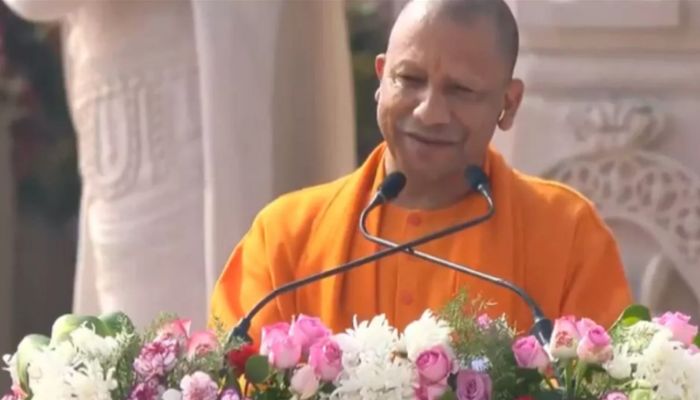
Addressing the esteemed gathering of Ram Bhakts and VVIPs on the occasion of Ram Mandir Pran Pratishtha, Uttar Pradesh CM Yogi Adityanath said that the Ram Mandir has been finally built at the very same place where every Ram Bhakt had resolved to build it.
Elated UP CM Yogi said, “The temple has been built where we had resolved to build it…”
CM Yogi began his address by chanting Jai Shri Ram. Overwhelmed with emotion, CM Yogi asserted that every road in India is coming towards Ramjanmabhoomi.
Congratulating everyone, CM Yogi said, “Many congratulations to all of you for being seated in the grand and divine presence of Lord Ram Lalla… I am emotional… Surely you all must be feeling the same. ..Today, on this historic occasion, every city, and every village of India has become ‘Rammay’… The name of Ram is in every mind. Every eye is wet with tears of joy and satisfaction. Every tongue is chanting the name of Ram. Ram is present in our rom rom (every cell of the body and soul)… It seems that we have arrived in Tretayuga.”
Yogi Adityanath said that Ram Lalla is seated after 500 years, adding that the majority Hindu community struggled for the Ram Mandir on every front.
He said, “Shri Ram Janmabhoomi may have been the first such unique case in the world, in which the majority community of a nation had fought for so many years and at so many levels for the construction of a temple at the birthplace of their idol in their own country.”
श्रीराम जन्मभूमि, संभवतः विश्व में पहला ऐसा अनूठा प्रकरण रहा होगा, जिसमें किसी राष्ट्र के बहुसंख्यक समाज ने अपने ही देश में अपने आराध्य की जन्मस्थली पर मंदिर निर्माण के लिए इतने वर्षों तक और इतने स्तरों पर लड़ाई लड़ी हो: मुख्यमंत्री श्री @myogiadityanath जी महाराज…
The UP CM remembered the contributions of countless Ram Bhakts who gave their life for the dream that several generations had seen. He mentioned Sadhus, Sanyasis, Nagas, and Political leaders among others who contributed enormously to the reclamation of Ram Janmabhoomi.
He added, “Now the streets of Ayodhya won’t echo with gunshots. There will be no curfew. Now there will be Deepotsav and Ramotsav here….”
Meanwhile, following the Pran Pratishtha ceremony, the treasurer of Ramjanmabhoomi Trust, Govinddev Giri Ji broke PM Modi’s fast and gave him Ramji’s Charanamrit.
In a blistering attack against Ram Mandir detractors, PM Modi said Lord Ram is not an object of conflict as peddled by naysayers, instead, he is a source of solution. The remarks came during his speech following the completion of the Pran Pratishtha ceremony of Ram Lalla in Ayodhya.
“Some people thought talking about building a Ram Mandir in Ayodhya would lead to fire (arson and riots). But let me tell you. Lord Ram is not fire, he is a source of energy. Lord Ram is not a conflict (vivaad), he embodies solutions, Lord Ram is not our present, but he is for eternity,” PM Modi said to a rousing cheer in Ayodhya outside the Ram Temple.
मैं आज उन लोगों से आह्वान करूंगा, आइए आप महसूस कीजिये अपनी सोच पर पुनर्विचार कीजिए।
It is noteworthy to mention that PM Modi’s jibe was at the opposition parties that have stoutly objected to the construction of a Ram Temple in Janmabhoomi site, citing the December 1992 felling of Babri mosque, which was built upon the ruins of an erstwhile temple dedicated to Lord Ram.
The opposition parties had long claimed that the construction of a Ram Mandir would touch off violent riots and violence across the country, hinting at the disputed nature of the site despite the Supreme Court ruling that ended the long-drawn conflict and handed over the land to Hindus for constructing a majestic temple to Lord Ram.
In his speech, PM Modi congratulated people on the Pran Prathistha ceremony in Ayodhya temple and said that Ram Lalla will no longer stay in a tent now.
The Prime Minister said the temple has been constructed after centuries of sacrifices. “After centuries of unprecedented patience, countless sacrifices, renunciations and penances, our Prabhu Ram has come…” he said.
“Ram Lalla will not stay in a tent now. He will stay in the grand temple…” the Prime Minister added.
Earlier today, Pran Pratishtha of Bhavya Ram Mandir in Ayodhya was done at the hands of PM Narendra Modi.
Celebrations swept across the country as millions of devotees took to the streets and visited temples, small and big, to mark the completion of Pran Pratishtha of Ram Lalla and pay their tributes to God on his homecoming to Ayodhya.
On Monday (22nd January), left-liberal ‘journalists’, ‘activists’, and propagandists took to social media to whine about the Pran Prathistha of the Ram Mandir.
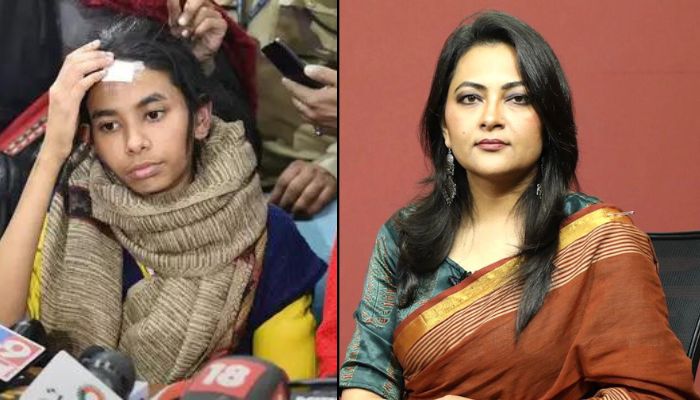
Communist leader and former JNU student President, Aishe Ghosh, wrote, “22nd January. Fall of a secular nation. Will be remembered.”
Senior Editor of the leftist propaganda outlet The Wire, Arfa Khanum Sherwani, tweeted, “The way we imagined India, knew India for many centuries, is dead now.”
The way we imagined India, knew India for many centuries, is dead now.
Columnist at Congress mouthpiece ‘National Herald’, Mitali Saran, claimed, “A temple-government, embodied in a self-appointed king-priest who’s trying to convince people that he was chosen by god—the hard launch of a thoroughly unequal country. It’s a crime scene in more ways than one.”
A temple-government, embodied in a self-appointed king-priest who’s trying to convince people that he was chosen by god—the hard launch of a thoroughly unequal country. It’s a crime scene in more ways than one.
Malayalam director Kamaluddin Mohammed Majeed posted a picture of the 1976 preamble of the Constitution of India, amended by the Indira Gandhi government in 1976 during the Emergency.
He tried to insinuate that construction of Ram Mandir is somehow against the ethos of the Indian constitution.
The Pran Pratishtha of Bhavya Ram Mandir in Ayodhya has been conducted by the hands of PM Narendra Modi. The grand idol of Shri Ram’s Baal Swarup (childhood form) is now the revered God of over a billion Hindus across the world.
22nd January 2024 marks the day of the awakening of the Hindu civilisation and the undoing of 496 years of cultural subversion. As such, it was expected that left-liberals would suffer a prolonged meltdown on social media.
On Monday, January 22, the Supreme Court issued a notice to Tamil Nadu, saying that permission for the live telecast of the Ram Mandir Pran Pratishtha ceremony cannot be rejected. The apex court reprimanded the Tamil Nadu government saying that permission cannot be denied just because other communities live in a neighbourhood.
Terming the reason provided by the DMK government as “atrocious”, the apex court said during Monday’s hearing, “This is a homogenous society, do not prevent only on this ground (that there are other communities).” It sought a response on the matter from the state government and the DGP of the state.
“If the order on page 21 (of the petition) is to be made applicable across Tamil Nadu, wherever there are minorities, they will never be able to hold a prayer meeting… See the reason. Here the Hindus are in the minority, if they are permitted to hold this prior meeting that will cause problems in the society. Is this a reason?” asked Justice Dipankar Datta, who was part of a two-judge bench.
“You regulate it, you have the power. You have the power to pass orders regulating all these processions. But this reason is atrocious,” Justice Datta added.
The bench presided by Justice Sanjiv Khanna was hearing a pea which alleged that on January 20, Tamil Nadu Chief Minister M K Stalin had “issued oral orders/Directions to the Police Department not to permit any kind of Poojas, Archanas, Annadhanam, Live Telecast of Pran Prathishta, Bhajans and processions in the name of Lord Ram on the auspicious occasion of “Pran Prathista” of Lord Ram at Ayodhya, in all the Temples in the State of Tamil Nadu irrespective of whether it is a Private Temple controlled by the TN HRCE Department”.
Solicitor General Tushar Mehta told the bench that he received information that certain police stations had issued written directives. He also said that the highest constitutional court needed to send a message stating that what is happening is unacceptable.
The court was particularly offended by the response of the deputy superintendent of police of Dindigul Rural Sub Division to an application from the administrators of Sri Bhagavatiyamman Temple, asking for permission to perform special almsgiving (Annadanam) in reverence of the Ram Mandir Pran Pratishtha.
Among other things, the police note said, “The area of A Vellodu village, where you have requested permission to conduct the event, is predominantly inhabited by Christians. Additionally, there are areas with Christian temples. Due to the lower number of Hindu residents in this village, there is a possibility of encountering cultural sensitivities or legal complications related to public peace and morality when organizing events that are perceived as deviating from the prevailing religious practices”.
“Also, public peace is likely to be affected by the programme proposed to be conducted and law and order problems are likely to arise. Religious problems also are likely to arise, public property is likely to be damaged and the public is likely to be put to discomfort. Therefore, due to the above reasons, permission is denied for the program you want to conduct”.
Judge Khanna disapproved of this and added that law and order can be a reason to regulate, but what is stated in the order alone can’t be the reason. “We have made it very clear. We want to know the reason. If this is the reason going to be given, you will be in trouble,” Justice Khanna cautioned the Tamil Nadu counsel.
Notably, the Madras HC on Monday also ruled that no permission is needed from the state police or the state government for a live screening of Pran Pratishtha at private temples and halls. The High Court also said that it is open to the organisers to make arrangements for LIVE streaming of the inauguration ceremony.
On 22nd January, Finance Minister Nirmala Sitharaman slammed the Tamil Nadu government for not allowing live telecast of Ram Mandir Pran Pratishtha in temples. FM Sitharaman was scheduled to witness the ceremony live at a private temple in a small village in Tamil Nadu. However, the police personnel came in plain clothes and removed the LEDs.
The repression saga in TN continues: a small village (not more than 200 houses) where people wanted to celebrate #AyodhyaRamMandir and watch PM @narendramodi participate have been told that unless the District Collector gives permission they shall not install the hired LED…
FM Sitharaman voiced her concerns about the repression of religious festivities and the infringement of Hindus’ rights by the DMK-led state government.
Earlier, on 21st January, the Bharatiya Janata Party (BJP) criticised the DMK-led Tamil Nadu government for prohibiting special poojas and food offerings in temples during the Ram Mandir Pran Prathistha.
On 22nd January (Monday), Sony Group officially informed Zee Entertainment Enterprises Ltd. of its decision to call off the merger with its India unit, as reported by Bloomberg.
As per the report, the Japanese entertainment giant sent a termination letter to Zee early on Monday. It is expected that it will disclose the same to the exchange later. Sony Group has claimed that the closing conditions for the deal have not been met and citing this reason, it called off the merger deal worth $ 10 billion.
In a statement, Sony said, “The merger did not close by the end date as, among other things, the closing conditions to the merger were not satisfied by then. Sony Pictures Networks India Private (SPNI) has been engaged in discussions in good faith to extend the End Date but the Discussion Period has expired without an agreement upon an extension of the End Date. As a result, on January 22, 2024, SPNI issued a notice to ZEEL terminating the definitive agreements.”
While the definitive agreements allowed both parties to extend the closing deal in good faith, it also provided that if the parties were unable to agree on an extension by the end of the discussion period, any party could terminate the definitive agreements by providing written notice.
Meanwhile, Sony refrained from commenting, and Zee did not respond immediately to Reuters’ request for a statement.
Earlier on Friday (19th January), Zee had stated that it was committed to the merger and was working to close the deal through “good faith negotiations”. In line with that, it sought to discuss an extension to a 20 January deadline to close the merger deal.
The agreement was seen as essential for the companies’ survival in an intensely competitive market, particularly in light of the upcoming merger between Disney’s Indian operations and the media assets of billionaire Mukesh Ambani’s Reliance Industries.
Notably, Sony’s India unit and Zee Entertainment had announced a merger deal over two years ago. However, the merger deal faced challenges over the leadership dispute about who would lead the combined entity. The challenges were further aggravated when the financial regulator Securities and Exchange Board of India (SEBI) launched a probe into Zee chief executive officer Punit Goenka.
The impasse over leadership had effectively derailed the deal which had aimed to establish a $10 billion media powerhouse that would have been capable of competing with global giants like Netflix Inc. and Amazon.com Inc.
Sony issued the termination letter after the lapse of a 30-day grace period over the weekend. Throughout this duration, the two parties were unable to agree on a deadline set in late December. In June, the Mumbai-based media house was accused by SEBI of falsifying loan recovery to hide private financing deals orchestrated by its founder, Subhash Chandra. SEBI’s interim order alleged that Chandra and his son, Goenka, had “abused their position” and misappropriated funds.
Despite Goenka securing relief from an appellate authority against the SEBI order, preventing him from holding an executive or director position in a listed company, Sony continued to view the ongoing investigation as a persistent corporate governance issue.