Home Blog Page 167

Nepal: Hindu-Muslim clash erupts in Janakpurdham after Muslims pelted stones on Ganesh idol immersion procession, police fire tear gas to control situation

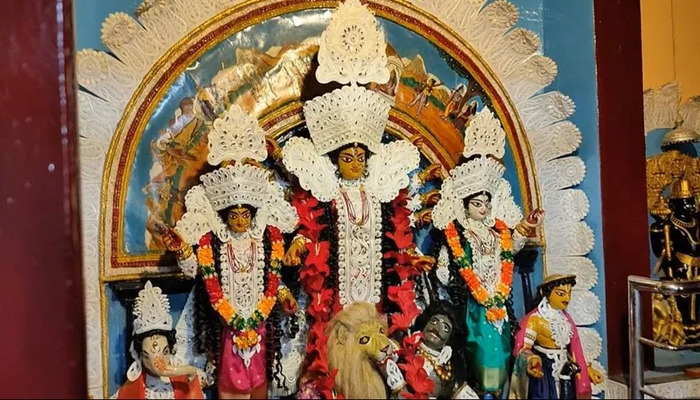
A clash broke out between Hindus and Muslims at Janakpurdham, the capital of Nepal‘s Madhesh Province, on Saturday, 30th August, while an idol of Ganesh was being immersed. The incident happened at Janakpurdham Sub-Metropolitan City-20’s Jhanda Chowk and quickly turned violent.

It was reported by the local media that the idol of Ganesh was being carried along a Muslim area to be immersed in the pond at Kashibhui. It was at this time that an argument began as certain members of the Muslim group attempted to halt the procession and close the road. Things escalated when stones were pelted towards lord Ganesh’s idol, triggering a violent confrontation between both communities. According to some reports, some people from the Hindu side removed two green flag tied to a lightpost, escalating the tension.

Situation was calmed after police arrived at the spot. Police fired tear gas shells to control the situation. Dhanusha Police Deputy Superintendent Bahadur Singh confirmed that two individuals were injured in the communal clash that occurred after stone-pelting.

Around 200 Nepal Police and Armed Police have been mobilised to prevent any untoward incident. DSP Singh said that Nepal Police and Armed Police have been mobilised on both sides of the road leading from Janakpurdham to Devpura-Rupaitha and from Jatahi to Janakpurdham.

According to locals, the controversy and clashes that used to take place during the immerision of the idol of Goddess Durga in the past were wrong, and this time it happened during the immerision of the idol of Lord Ganesha. According to them, one should be vigilant as harmful elements of society try to create social unrest and disrupt harmony every year in the name of religion.

It is said that clashes between the two communities that have been taking place here every year will continue to occur every year if they are not resolved in the long term.

Justice Vikram Nath says stray dogs case gave him global recognition

0

On 30th August, Supreme Court Justice Vikram Nath remarked that while he had been known in the legal fraternity for his judicial work, it was the stray dog matter that gave him recognition worldwide. Justice Nath was speaking at a regional conference on human-wildlife conflict in Thiruvananthapuram, Kerala, which was organised by NALSA and KeLSA. He expressed gratitude to the Chief Justice of India for assigning him the matter.

He said, “So far, I have been known in the legal fraternity for the little work I do, but I am thankful to the stray dogs case for making me known to the entire civil society, not only in this country but world over. And I am thankful to my CJI for allotting me that matter.”

Acknowledges dog lovers’ support

Justice Nath pointed out that presidents of various lawyers’ associations, both in India and abroad, now ask him about the ‘stray dogs’ matter. Interestingly, he added that along with human blessings, he was also receiving good wishes from dogs themselves. He said, “Apart from dog lovers, dogs are also giving me blessings and good wishes,” which somewhat shows his biased leaning.

The remark comes in the backdrop of mobilisation of self-styled dog lovers and activists who had protested after a bench of Justice JB Pardiwala and Justice R Mahadevan ordered to round up and keep all the dogs in shelters in Delhi-NCR. Following the protests and repeated mentions in front of the Chief Justice of India, the matter was curiously reassigned to a three-judge bench within days. The new bench, led by Justice Nath, modified the order on 22nd August and said that the dogs must be released back after deworming, vaccination and sterilisation. Only the aggressive and rabid dogs will be kept in shelters.

While the Court categorically banned public feeding, self-styled dog lovers and some NGOs are claiming that till Municipal Corporations designate feeding spots, public feeding can continue, which is a false interpretation of the court order.

Bench reshuffle and bias concerns

The case was transferred to Justice Nath’s bench after the CJI’s intervention. However, with the presiding judge himself acknowledging the appreciation he has been receiving from “dog lovers”, questions are being raised over whether such visible support may end up casting a shadow on how unbiased the hearing of this contentious public safety issue will be.

Madhya Pradesh: Christian evangelists preach about Jesus at Navodaya school, lure students and parents to convert, police arrest accused

A case of evangelical activities taking place in a school has come to light in Jangipura locality of Dabra town in the Gwalior district of Madhya Pradesh.

The matter grabbed the attention of the authorities after a parent, whose son was enrolled in the Nava Kanti School (a Navodaya School located in Ward No. 18), flagged the Christian missionary activities taking place in the school.

An FIR was registered by the police under Section 5 of the Madhya Pradesh Freedom of Religion Act, 2021, on 29th August this year in the Itarsi Police Station, based on the information provided by the complainant. Three persons, namely, Shyamnayaran, Revika Nanda, and Denzil have been booked in the FIR.

According to the FIR, which was accessed by OpIndia, for the past year, some teachers have been preaching Christianity in the school and luring students and their parents to convert to Christianity by offering them jobs and other opportunities.

The complainant came to know about the Christian activities when his son told him that the school teachers talked about Jesus and Christianity. His son also said that the school principal was aware of these activities.

The complainant added that the teachers gave religious sermons to the students, in violation of government rules, and praised Jesus and the Christian religion. He said that he has been noticing such activities in the school for a long time.

Two people found distributing Christian literature in the school

The FIR states that on August 25, 2025, the complainant went to the school accompanied by a friend. After reaching the school, he saw two mysterious men present in the school, and the students were given literature relating to Christianity.

According to the complainant, the two men approached him and handed him a Bible. They praised Jesus and Christianity and asked him to convert to Christianity in return for a job and money.

In the meantime, an education department official, Deepak Chaukotia, and some members of Hindu organisations, Vishwa Hindu Parishad and Bajrang Dal, also reached there.

The members of the Hindu organisations confronted the education department official for not conducting regular inspection of the schools, because of which such activities. A video of the members’s confrontation with the education department official has been doing the rounds on social media.

They seized the literarure related to Christianity found in the school and handed it over to the education department official, who sealed it in an almirah.

SDM formed a committee to investigate the matter

After receiving a complaint regarding the Christian activities in the school, the SDM formed a three-member committee to look into the matter. The committee reportedly found several irregularities in the school during the investigation. The names of the principal and the director of the school are Anil Nigam and Abrahim Kranti, respectively. Since 2012, the school has been managed by the Nava Kanti Committee. It is affiliated with the Madhya Pradesh Board of Secondary Education. In 2025, the affiliation of the school was renewed. Currently, around 70 students are enrolled in the school in different classes. An NGO had been running a vocational training centre in the school, but there were no trained staff or teachers. Two people were found living in the residential quarters inside the school.

Mann Ki Baat: PM Modi highlights ‘Pratibha Setu’ as a second chance for UPSC aspirants

0

On 31st August, during Mann Ki Baat Episode 125, Prime Minister Narendra Modi spoke about ‘Pratibha Setu’, a digital platform designed to give new opportunities to UPSC aspirants who narrowly missed making it to the final merit list. PM Modi said, “All of us have heard many inspiring stories from the toppers of the Civil Services… but friends, there is another truth about the UPSC exam. There are thousands of such candidates who are very capable; their hard work is no less than anyone else’s, but they are unable to reach the final list by a small margin.”

Explaining the motivation behind the initiative, he added, “That is why, now a digital platform has been created for such sincere students and its name is ‘Pratibha Setu’. Through this portal, private companies can obtain information on these promising students and employ them. Friends, the results of this effort have also started coming in. Hundreds of candidates have got jobs immediately with the help of this portal and those youth who had got stuck by a small margin are now moving ahead with new confidence.”

What is Pratibha Setu

UPSC ‘Pratibha Setu’ is short for ‘Professional Resource and Talent Integration – Bridge for Hiring Aspirants’. It is a databank of over 10,000 candidates who cleared all stages of various UPSC examinations but were not recommended in the final merit list.

The platform was launched in July 2025. It was previously known as the Public Disclosure Scheme (PDS) and has been in operation since 2018. The new portal comes with login IDs for organisations to voluntarily select or recruit candidates from the non-recommended list. Private organisations can also register through the Commission’s portal.

The portal allows verified employers, including ministries, PSUs, autonomous bodies, and private companies to access details of the willing candidates for recruitment. It features dashboards for shortlisting, documentation, and candidate profiles with educational qualifications and contact details. Examinations covered under this scheme include the Civil Services, Indian Forest Service, CAPF, Engineering Services, CDS, CMS, and others.

A forward-thinking approach

In July, following the launch of the new portal, Union Minister Dr Jitendra Singh had hailed the scheme as a “forward-thinking approach” to talent utilisation. He said that the portal is emerging as a meaningful gateway for aspirants who clear the written and interview stages of the Civil Services exam but narrowly miss the final selection.

Notably, institutions such as IIM Udaipur have already been recognising the calibre of UPSC aspirants who clear the Civil Services (Main) examination by exempting them from submitting CAT, GMAT or GRE scores when applying to its PhD programme in Organisational Behaviour and Human Resource Management. This exemption acknowledges their intellectual rigour and aligns with IIMU’s focus on socially relevant, research-driven work. Now, with the launch of ‘Pratibha Setu’, Prime Minister Modi has urged private companies too to tap into this exceptional talent pool.

Growing interest from employers

UPSC officials confirmed that interest from employers has been steadily rising. Over a hundred organisations have already registered on the platform, with several more approaching the Commission to access the pool of candidates. What sets Pratibha Setu apart is that it transforms a passive disclosure model into an interactive recruitment bridge. Unlike the earlier system where data was only published online, recruiters can now log in, shortlist and directly contact candidates for recruitment.

Punjab floods: Over 1,000 villages submerged and 61,000 hectares of farmland ruined, opposition slams AAP govt, calls it ‘Manmade Disaster’

0

Punjab is suffering from one of the worst floods in the last 37 years. Non-stop rain in the last week has converted huge tracts of the state into a sea of water. However, the threat is far from over, as the Indian Meteorological Department (IMD) has predicted more rainfall on Sunday and Monday in isolated areas of Punjab.

According to reports from district headquarters, 1018 villages are affected, the majority in Gurdaspur district. While over 61,000 hectares of agricultural land have been severely impacted. Rescue and relief efforts are being conducted at full capacity by the NDRF, Army, BSF, and local authorities, but the destruction is yet to cease.

According to the media reports, over 11,000 individuals have been rescued and relocated to safer areas. Currently, 77 relief camps are operating in flood-affected districts, accommodating nearly 5,000 individuals. 

These camps are rendering essential facilities such as food, water, and medical facilities, with the administration reporting that they are doing everything in their power to take care of the displaced.

110 individuals are residing in four camps in Kapurthala, 3,450 individuals in eight camps in Ferozepur, which has the largest number. Hoshiarpur, Gurdaspur, Pathankot, Barnala, Fazilka, Moga, and Amritsar have a few active camps too. 

The majority of these places are under the influence of floodwaters due to Sutlej, Beas, and Ravi rivers overflows, which had swelled perilously after rains lashed their catchments in Himachal Pradesh and Jammu and Kashmir.

Army-NDRF operations continue in villages near border

Over 1,000 villages have been hit in several districts, 323 in Gurdaspur, 101 in Ferozepur, 107 in Kapurthala, 85 in Hoshiarpur, 81 in Pathankot, 52 in Fazilka, and several others in Tarn Taran, Sri Muktsar Sahib, Sangrur, and Moga.

The devastation of agricultural land is immense. Fazilka has lost almost 16,600 hectares of agricultural land, Ferozepur more than 10,800 hectares, Kapurthala 11,620 hectares, and Tarn Taran almost 10,000 hectares. Crops in Pathankot, Hoshiarpur, and other districts have also met with enormous losses as fields of ripe paddy stood inundated in muddy water.

In Fazilka’s border villages, the Army and NDRF, aided by civil authorities, have been operating day and night to evacuate people trapped in water-logged homes. Villagers are being rescued from waist-deep water using boats. 

35 people were rescued during one operation from Nihala Lavera, Dheera Ghara, and Talligram villages. Medical and veterinary personnel are also on the job, providing both people and cattle with immediate treatment.

Relief camps are being operated with the help of social organisations and gurdwaras. 260 people are being given food, water, and other necessities at one of the biggest relief camps, Bare Ke. Gurdwaras have come forward with langar services, while school officials are imparting education to children in camps so that they do not lose out entirely.

Opposition targets AAP govt for “failure

Even while the rescue operations are on, political blame games have escalated. Opposition parties on Saturday, 30th August, slammed the Aam Aadmi Party (AAP) government in Punjab for its flood management situation, which has worsened the plight of several of the affected people.

Highlighting the situation in Kharar, Kurali, Nayagaon, and villages in Majri block, Mohali, senior BJP leader and Punjab state media head Vineet Joshi said on Saturday that “floods in Punjab may partly be nature’s wrath, but Kharar’s misery is entirely due to the incompetence, negligence, and corruption of the AAP government”.

He said local MLA Anmol Gagan Mann failed her constituency. “No water in summer, flooded streets in monsoon… people suffer, MLA missing,” Joshi remarked, adding that residents face power cuts, water shortages, and sewage mixing with drinking water.

Joshi demanded the Punjab government “immediately provide relief and restore basic amenities like electricity, water, and roads.” 

“AAP government’s negligence has turned Kharar into hell,” Joshi declared.

Punjab Congress leader and Ludhiana MP Amrinder Singh Raja Warring described the floods as a “manmade disaster” and accused the government of “doubly failing” the people. “By not taking preventive and precautionary measures first, and then by not providing effective relief and rehabilitation,” he added during his visit to flood-affected Ferozepur.

According to the media reports, after visiting the flood-affected areas in Ferozepur district, Warring said the Punjab government “miserably failed” in helping the flood victims. The Congress leader was accompanied by MP Sher Singh Ghubaya. 

He further added that Congress MPs and MLAs have promised to give one month’s salary and pension for relief operations, emphasising that Punjab now requires a long-term and permanent solution to floods.

The Shiromani Akali Dal (SAD) also hit out at the Punjab, accusing it of abandoning flood victims at a time of devastation.

“Floods have wreaked havoc, but the government has turned its back on its responsibilities,” SAD spokesperson Shamsher Purkhalvi said.

The floods of 1988: A haunted reminder 

As Punjab is struggling today, memories from the floods of 1988 returned to haunt people. Hundreds died that year, and the devastation left behind was so bad that it has been used as a point of reference each time rivers have burst over their banks.

The 37-year-old nightmare describes bodies pouring over the border into Pakistan, extensive destruction of crops, devastated villages, and even political instability. Indian Punjab alone saw 600 to 1,500 dead, depending on the reports. Crops worth hundreds of crores were lost, and over 9,000 villages got inundated.

The Pong and Bhakra dams, brimming with rainwater, were strained to capacity. Catchment area rainfall was more than five times above predictions, causing a disastrous outburst of water.

Reports from the time say the dam management had expected the catchment area to receive up to 120 mm of rain that September, since the monsoon is usually over in the North by that time. But, between 22nd to 26th September, 1988, there was more than five times the forecasted rain.

As per a report by IndiaToday, flash floods damaged around 75 to 80 per cent of what promised to be a record kharif crop in the districts that are deluged this time too. 

Around 9,000 of the 12,000-odd villages were hit in Punjab, plus there was devastation in large parts of Himachal and J&K upstream, and Haryana, Rajasthan, and Delhi further down the Indo-Gangetic plains.

Prominent Punjabi newspapers also reported that bodies flowed into the Punjab across the border, in Pakistan, which was also ravaged. Images of one such news report, which speaks of 1,300 bodies flowing across the border, have gone viral on social media. 

Department of Posts completely suspends booking of all mail to the USA over uncertainties after tariff exemptions were withdrawn

The Department of Posts on Sunday announced a complete suspension of all mails to the USA over president Donald Trump’s tariff policy. Earlier on 22 August, the department had announced a temporary suspension of parcels to the USA valued over $100, but now shipment of all parcels has been suspended.

A statement issued by the Ministry of Communications said, “In view of the ongoing inability of carriers to transport U.S.-bound mail and in the absence of defined regulatory mechanisms, it has been decided to completely suspend the booking of all categories of mail, including letters, documents, and gift items valued up to USD 100, destined for the USA.”

It further added, “The Department is closely monitoring the situation and making every effort to restore services at the earliest. Customers who have already booked items that could not be dispatched may claim a refund of postage.”

Global parcel deliveries to the United States of America have been impacted after president Trump revoked the “de minimis” tariff exemption, which allowed shipments of items valued under $800 to be imported to the USA without any import duty. President Donald Trump signed an executive order on 30th July shutting down this exemption.

As per new rules, such shipments will attract import duty according to the tariff fixed for the originating country. However, letters/documents and gift items valued up to $100 remain exempt from these new duties, according to the executive order.

The introduction of tariff on small value items have caused huge delays at US ports. As a result, major carriers have stopped shipping such packages to the USA. Several countries in the world have suspended parcel deliveries to the USA for this reason. India Post’s latest decision indicates that shipping issues have not been sorted yet, and they had to suspend shipment of even tariff exempted items.

The fall of ‘secular’ Bangladesh: How Muhammad Yunus is plunging the nation into the jaws of terrorism, tyranny and Islamism

Bangladesh, a nation of over 170 million people, is quietly spiraling toward an ominous black hole, with every passing day bringing it closer to becoming one of the gravest security threats in South Asia – and potentially the wider world.

Since the ouster of Prime Minister Sheikh Hasina, the interim government led by Muhammad Yunus has plunged the country into chaos, economic disintegration, and rising Islamist militancy.

When Yunus assumed power, he promised democratic reforms, protection of human rights, freedom of the press, and the restoration of the rule of law.

Instead, what followed has been a stunning reversal. The country’s economy is now in crisis, radical Islamist groups are resurging, and a dangerously high number of young people are being lured toward extremism and jihadist ideologies.

Initially hailed as a reformist, Yunus was viewed by many as a potential savior of Bangladesh’s fragile democracy. However, that illusion quickly shattered.

Indian strategist Professor Brahma Chellaney, noting disturbing parallels, described Bangladesh as following the same trajectory as Pakistan.

Meanwhile, Yunus’s Nobel Peace Prize – long viewed as controversial – has come under renewed scrutiny.

Although the Norwegian Nobel Committee chairman Professor Ole Danbolt Mjøs once portrayed him as a symbolic bridge between Islam and the West, it is now widely believed that the award was secured through years of lobbying by former US President Bill Clinton.

Indeed, the links between Muhammad Yunus and the Clinton family are both extensive and troubling. During a reception organised by the Clinton Global Initiative on September 26, 2024, Yunus publicly introduced key figures behind the so-called “mass uprising” in Bangladesh – an event now widely recognised as a jihadist coup.

At that same event, Bill Clinton praised Mahfuz Alam, a known leader of Hizb ut-Tahrir, a globally banned terrorist organisation. A 2024 article in the Gatestone Institute stated:

“Yunus is one of the major donors to the Clinton Foundation. According to a cable leaked by WikiLeaks in 2007, Hillary Clinton made frantic efforts and exerted pressure on the Bangladesh Army to appoint her friend Yunus as head of the then military-backed interim government”.

The fall of Hasina’s government opened the floodgates for Islamist and jihadist groups, who are now operating with newfound boldness.

According to the Atlantic Council, “Religious extremists demolished sculptures and artworks across the country. Soon after, As-Sahab, Al Qaeda’s official media wing, released a twelve-page statement hailing the events as a victory for Muslims, portraying Bangladesh as a new beacon of Islamic conquest in South Asia”.

The article further stated, in March, Hizb Ut Tahrir staged a “March for Khilafah” in Dhaka, which was widely publicized and occurred without meaningful government interference.

These events mark not just a collapse of law and order, but an ideological shift toward a jihadist state.

From her exile in India, former Prime Minister Sheikh Hasina issued a statement denouncing Yunus as a “militant leader” who was “selling Bangladesh to the United States”. Her party’s student wing went further, declaring the country had become a “graveyard of democracy”.

A year after the Islamist uprising, India Today Digital published a revealing article stating:

“Anti-Hasina forces had cultivated loyalists within the administration for years. As the student-led protests peaked, these insiders paralyzed state institutions, causing a total collapse of governance. Bangladesh now mirrors what Pakistan became in the 1980s – an ideological state held hostage by jihadist impulses. Hindus, Buddhists, and Christians, the real sons and daughters of the soil, are being driven out or buried beneath the rubble of destroyed temples”.

The Indian Express added in a scathing editorial:

“Despite the promises of Muhammad Yunus, Chief Advisor to the Interim Regime, the past year has witnessed a surge in religious extremism and a collapse of rule of law. Awami League leaders have been jailed en masse, while individuals linked to terrorism have been released or allowed to escape. The ancestral home of Bangladesh’s founding father, Sheikh Mujibur Rahman, has been destroyed. The pluralistic identity of Bangladesh is under siege”.

The US Commission on International Religious Freedom corroborated these concerns in its latest report, warning that “systematic pressure on religious minorities continued to generally worsen”. In May, thousands of supporters of Hefazat-e-Islam protested efforts to ensure equal rights for Muslim women. Simultaneously, violent crime is on the rise, and the economy is faltering under the weight of public debt and poor governance.

Firstpost captured the chaos succinctly:

“Bangladesh is now in a state of lawlessness. The Awami League’s unofficial control over extortion has been replaced by an anarchic competition between political factions, radical student groups, and organized crime syndicates”.

Sheikh Hasina, calling the transition of power a “dark moment”, has repeatedly criticized Yunus’s regime as unconstitutional and tyrannical.

Although on August 5, 2025 Yunus announced plans in August to hold elections by February, his actions suggest otherwise. In a bizarre and symbolic move, he has begun converting the official Prime Minister’s residence into a so-called “Museum of Tyranny”.

This act – unaccompanied by preparations for a new government complex – implies no intention of restoring democratic rule. Worse still, Yunus is cultivating deeper ties with Islamist regimes in Turkey, Iran, Pakistan, and “Palestine“, while simultaneously demonizing Israel through repeated propaganda.

Domestically, Islamist militancy is reaching new heights. Bangladesh’s madrassa-educated militants, many of whom trained in Afghanistan during the 1970s and 1980s, later founded notorious groups like HuJI-B and JMB. Today, these groups are joined by others like Ansar Al Islam (Al Qaeda’s Bangladesh affiliate), Hizb Ut Tahrir, Hefazat-e-Islam, Khelafat Majlish, and Islami Andolan Bangladesh.

Islamic fundamentalists, mostly comprising madrassa-students, who had traveled from Bangladesh to Afghanistan in the 1970s and 80s to fight alongside the Afghans against the then Soviet Union later returned home and formed militant groups including Harkat-ul Jihad al-Islami Bangladesh (HuJI-B) and Jama’atul Mujahideen Bangladesh (JMB).

Today, the list of such elements has significantly expanded, with the emergence of Ansar Al Islam, which is affiliated with Al Qaeda, Hizb Ut Tahrir, Hefazat-e-Islam, Islami Andolan Bangladesh, Khelafat Majlish and others.

Recently, during a meeting with US Chargé d’Affaires Tracey Ann Jacobson, Yunus claimed:

“Combating terrorism is our top priority. We have zero tolerance for terrorism in Bangladesh”.

Yunus further told the US envoy, “combating terrorism is our top priority. We have zero tolerance for terrorism in Bangladesh. We will exert every effort to eliminate terrorists from our soil”.

But these words ring hollow. In January, his regime attempted to pardon a terrorist linked to Al Qaeda and implicated in the 2015 murder of an American citizen.

This same individual has a US$5 million reward on his head offered by the US State Department. Yunus’s willingness to protect such a high-value fugitive exposes the deceit behind his public declarations.

The world cannot afford to remain a silent spectator as Bangladesh descends into extremist chaos.

The international community – particularly the United States, India, the European Union, and regional allies – must recognize that what is unfolding under Muhammad Yunus’s regime is not a domestic political affair, but a ticking time bomb with global ramifications.

Bangladesh is rapidly transforming into a hub for jihadism, transnational narco-trade, arms trafficking, and radical indoctrination.

If left unchecked, it will soon become the launchpad for thousands of jihadists, flooding across borders with the sole purpose of destroying Western civilization and targeting Christians, Jews, Hindus, and secularists alike.

The time for polite diplomacy is over. The international community must act decisively – through sanctions, visa restrictions, financial scrutiny, and targeted counter-terrorism measures – to hold the Yunus regime accountable.

The longer the world waits, the darker the shadow grows. Bangladesh’s fall will not remain confined within its borders. The consequences will be global, devastating, and irreversible.

Xi Jinping says it is right choice for dragon and elephant to come together during bilateral meeting with PM Modi in Tianjin, both leaders commit to improving ties

Chinese President Xi Jinping and Indian Prime Minister Narendra Modi reaffirmed their commitment to warmer ties during a significant bilateral meeting on the sidelines of the Shanghai Cooperation Organisation (SCO) summit.  Xi Jinping emphasised the importance of India-China friendship during the meeting on Sunday.

He stated that it is the “right choice” for both nations to be friends, highlighting both country’s shared historical and cultural ties. Xi further mentioned that the partnership between the “dragon and elephant” enables each other’s success.

Welcoming PM Modi, Xi Jinping remarked: “It is a great pleasure to meet you again, Mr Prime Minister. I welcome you to China for the SCO summit. Last year, we had a successful meeting in Kazan.” He went on to highlight the shared heritage and global mission of the two countries by saying, “China and India are two ancient civilisations in the East. We are the world’s two most populous countries and also important members of the Global South. We both share the historical responsibility of improving the well-being of our two peoples, promoting solidarity and rejuvenation in developing countries, and advancing the progress of human society.”

Underscored the importance of friendship and collaboration between India and China, the Chinese president said, “It is the right choice for both countries to be friends who have good neighbourly and amicable ties, partners who enable each other’s success, and to have the dragon and the elephant come together.”

Echoing the sentiment, Prime Minister Modi stressed his country’s dedication to advancing relations on a foundation of mutual respect and stability. He committed to taking the India-China ties forward, based on mutual trust, respect and sensitivity. PM Modi further appreciated the progress made on several fronts of ties and peace on the border post disengagements.

Modi added that several significant developments have taken shape: an agreement on border management has been reached, the Kailash Mansarovar Yatra has resumed, and direct flights between the two countries are being restored.

PM Modi said, “We are committed to progressing our relations based on mutual respect, trust, and sensitivities.” He further added, “Last year in Kazan, we had very fruitful discussions, which gave a positive direction to our relations. After the disengagement on the border, an atmosphere of peace and stability has been created.”

Summing up the broader significance, he said: “The interests of 2.8 billion people of both countries are linked to our cooperation. This will also pave the way for the welfare of the entire humanity.”

This high-profile meeting marks Modi’s first visit to China in seven years and arrives amid recent indications that both nations are striving to mend ties after the 2020 border clashes.

Pakistani handles extend support to Sonam Wangchuk after Ladakh administration takes back allotted land: Know the truth behind the social media claims of ‘witch hunt’

Days after the Ladakh administration cancelled the land allotment to the Himalayan Institute of Alternative Learning (HIAL), Pakistani handles on social media have extended support to ‘activist’ Sonam Wangchuk.

Wangchuk, who had travelled to Pakistan earlier in February 2025 to attend a ‘climate conference’, had dubbed the decision of the local administration as ‘an attack on Ladakh.’

In the meantime, Pakistani accounts are amplifying the fake narrative that Sonam Wangchuk is somehow being victimised by the Indian government.

Screengrab of the tweets in support of Sonam Wangchuk by Pakistani handles

They are deliberately misleading about the internal matter of India and characterising the decision by the Ladakh administration as a ‘political move to silence voices demanding statehood.’

The Background of the Controversy

The year was 2018. The local administration had allotted around 135 acres of land in Phywang village of Leh to ‘activist’ Sonam Wangchuk and his Himalayan Institute of Alternative Learning (HIAL).

The parcel of land was leased for a period of 40 years. On 21st August this year, the Deputy Commissioner of Leh cancelled the land allotment in its entirety.

The administration was forced to take the drastic decision since the allotted land was not being used for the purpose agreed upon by both parties.

‘Activist’ Sonam Wangchuk had failed to establish an accredited university to date on the 135 acres of land. At the same time, he has neither executed the lease agreement nor formally handed over the land to the Tehsildar.

In his order, the Deputy Commissioner of Leh, Romil Singh Donk, stated, “The allotment order has lapsed on 5-5-2019 and is deemed to have been cancelled as per condition No IV of the allotment order.”

He further added the land ‘stands escheated to the State’ and directed the Tehsildar to ‘remove all the encumbrances’ from the allotted land and update the revenue records.

Fake claims about ‘witchhunt’

Since the order of the Ladakh administration, ‘activist’ Sonam Wangchuk has left no stone unturned to portray himself as the victim of government-enabled hegemony.

“The decision to cancel the land allotment to HIAL has been taken when people of Ladakh are demanding their rights, safeguards and democracy. It seems to be a witch-hunting process,” he had alleged.

Similar claims of a supposed ‘witchhunt’ have been made by political groups such as Leh Apex Body (LAB) and Kargil Democratic Alliance (KDA). However, the reality is starkly different.

The truth that Sonam Wangchuk doesn’t want you to know

‘Activist’ Sonam Wangchuk has not paid rent for several years for 135 acres of land, whose present market value is between ₹27 and ₹30 crores. This was despite the issuance of notices by the Deputy Commissioner under Clause 4(b).

At the same time, no university was set up within one-year period of the lease agreement. Interestingly, HIAL applied for ‘university status’ only in 2022, i.e. 4 years after land allotment.

This gives us a sneak peek into the non-compliance with the lease agreement by Sonam Wangchuk. But this has not stopped the ‘activist’ from making frivolous claims of regulatory hurdles.

Coincidentally, HIAL did not approach the Ladakh Autonomous Hill Development Council (LAHDC) for 3 years. It attempted to bypass the council by directly reaching out to the Deputy Commissioner of Leh.

Moreover, Sonam Wangchuk has claimed that the Himalayan Institute of Alternative Learning (HIAL) was granted a waiver of ₹14 crore premium.

However, the request was never accepted by LAHDC. As such, no exemption of any kind exists in official records.

As a matter of fact, complaints were filed against HIAL for violation of land use. A letter to this effect was fired off to LAHDC by the Sarparnch and Nambardar of Phyang village in Leh in February 2020.

Given the circumstances and multiple violations of the lease agreement, the Ladkah administration was forced to cancel the land allotment to HIAL.

‘Activist’ Sonam Wangchuk did not bother to comply with the lease agreement or resolve grievances raised by LAHDC. Despite defaulting on payment for all these years, he is now pretending to be the victim of a political vendetta.

The violations by HIAL and Sonam Wangchuk are now documented through administrative records, notices and the Executive Councillor within the Ladakh Autonomous Hill Development Council.

While it is obvious for the ‘activist’ to be rattled, it is important to note that Sonam Wangchuk is receiving overwhelming support from across the border.

It is a matter of grave concern given that Pakistan is eyeing to create discord in the Indian territory through half-truths and conspiracy theories.

‘Activist’ Sonam Wangchuk is actively aiding them to disseminate anti-India propaganda by not being truthful about his misuse of public resources.

Bihar SIR: Opposition’s ‘vote chori’ propaganda falls flat as Election Commission data reveals a total of only 128 objections file by opposition parties, Congress filed none

On 30th August, the ECI disclosed the number of applications of claims and objections filed by various political parties between 1st and 30th August, in relation to the draft roll prepared by the commission after revising electoral data during the SIR. The draft roll was published by the commission on 1st August, as the SIR has entered its concluding phase. The period for raising claims and objections ends on 1st September. The latest figures published by the Election Commission of India (ECI) regarding the Specific Intensive Revision (SIR) in Bihar have laid bare the opposition’s false ‘Vote Chori’ propaganda.

Interestingly, the numbers do not match the zeal displayed by the opposition in running a propaganda of ‘vote chori’ against the Election Commission (EC) and accusing it of rigging the electoral roll in the poll-bound state of Bihar. The entire opposition, led by Congress leader Rahul Gandhi, has been calling the SIR in Bihar a conspiracy of the BJP and the ECI to disenfranchise ‘lakhs’ of voters. However, the total applications raising objections regarding the draft roll published by the ECI after revising the electoral data are only 128. Notably, out of these 128 applications, 118 are filed by the CPI(ML)(L), including only 15 applications for the inclusion of eligible voters and the remaining 103 for the exclusion of ineligible voters. The rest of the applications, that is, 10, are filed by the Rashtriya Janata Dal (RJD) for the inclusion of eligible voters.

Rahul Gandhi’s party did not raise a single objection regarding the draft roll

The Congress Party did not file even a single application raising any objections regarding the draft roll prepared during the SIR. Notably, Congress has been spearheading the mud-slinging campaign against the Election Commission. The draft roll was shared by the ECI with all 12 political parties recognised in Bihar. And yet, only two parties filed applications raising objections regarding the draft roll.

Besides, a total of 2,27,636 claims and objections received by the commission directly through voters, only 29,872 were regarding the addition of eligible voters; the remaining 1,97,764 were for the exclusion of ineligible voters. A total of 7.24 crore voters are included in the draft rolls by the election body after undertaking a humongous task of revising the voter list in Bihar under the SIR, which commenced on 24th June 2025.

Opposition ran a baseless and malicious campaign against the EC

Ever since the beginning of the SIR, which is a routine exercise undertaken by the Election Commission to update the voter list, the INDI Alliance parties have been running a malicious campaign against the commission, which is merely fulfilling its constitutional mandate. The malicious campaign was kick-started by Congress scion Rahul Gandhi, who levelled baseless accusations of vote theft and voter list rigging in a press conference held earlier this month. He even threatened the election officials with ‘consequences’ once his party comes to power.

Gandhi’s allegations were refuted by the Election Commission of India in a point-by-point manner. The commission urged Gandhi to submit his allegations enclosed in a written declaration, as required by the rules, and tender an apology for levelling false accusations against the commission. Interestingly, Gandhi did neither.

The opposition also has to face embarrassment in the Supreme Court after their request to stay the SIR in Bihar was declined by the court. The Apex Court acknowledged that the ECI was constitutionally empowered to conduct the SIR and that it was a routine exercise needed to update the electoral roll for fair and transparent elections.