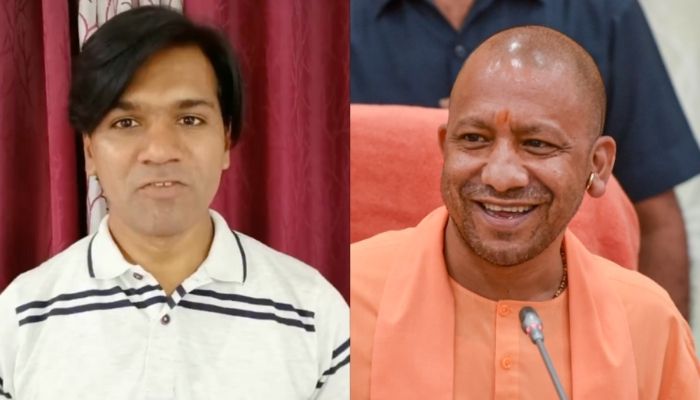
On Monday (July 4), the Delhi police brought Alt News co-founder Mohammed Zubair to Sitapur in connection with a case registered against him in Uttar Pradesh. The case pertains to the derogatory comments made by Zubair against three Hindu saints in May this year.
In a video shared by news agency ANI, Zubair was seen following the lead of the Delhi Police in Sitapur, where a case was registered against him for inflaming religious sentiments with his comments on the Hindu saints.
#WATCH | UP: Delhi Police bring Alt News co-founder Mohammed Zubair to Sitapur in connection with a case registered against him here for allegedly inflaming religious sentiments through his tweet on Mahant Bajrang Muni, Yati Narsinghanand Saraswati and Swami Anand Swaroop. pic.twitter.com/UyVfrcpsHD
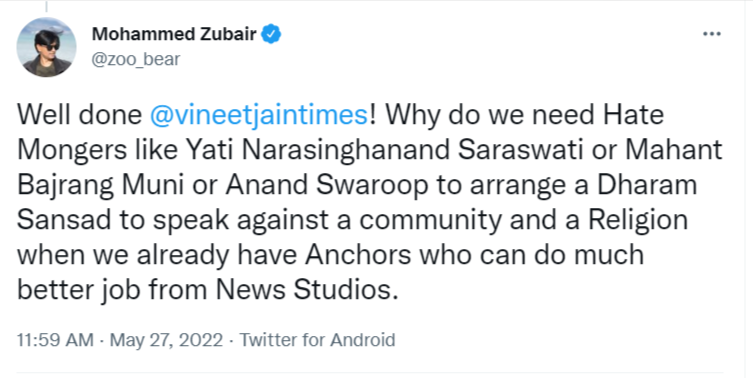
In a tweet on May 27, Mohammed Zubair took a swipe at Times Now anchor Navika Kumar and labelled Yati Narasinghanand Saraswati, Mahant Bajrang Muni and Anand Swaroop as hate mongers.
His tweet read, “Why do we need Hate Mongers like Yati Narasinghanand Saraswati or Mahant Bajrang Muni or Anand Swaroop to arrange a Dharam Sansad to speak against a community and a Religion when we already have Anchors who can do a much better job from News Studios.”
Five days later, the Khairabad Police in the Sitapur district of Uttar Pradesh filed a First Investigation Report (FIR) against Zubair for using derogatory language against the trio.
Screengrab of the contentious tweet by Mohammed Zubair
The FIR was registered based on the complaint of Bhagwan Sharan, district head of Rashtriya Hindu Sher Sena, under sections 295(A) of the Indian Penal Code (IPC) and Section 67 of the Information Technology Act, 2000.
In his complaint, Sharan said, “On May 27, Mohammed Zubair used derogatory remarks against Mahant Bajrang Muni Udasin Ji by using the term ‘Hate Mongers’ for him from his Twitter handle. He also abused Yati Narsinghanand and Swami Anand Swaroop.”
He further clarified there was no enmity of Mahant Bajrang Muni Udasin with Mohammed Zubair. “He (Zubair) did it to intentionally spread hatred in the society and hurt religious sentiments of Hindus under a well thought out conspiracy,” Sharan emphasised.
Mohammed Zubair is currently under judicial custody in Delhi facing charges related to hurting religious sentiments with his tweet, he is also under investigation for tampering with the evidence and FCRA violations.
Following the assassination of chemist Umesh Kolhe by Islamists in Amravati, Maharashtra, various media reports have emerged suggesting that Islamists targeted many other Hindus because they posted WhatsApp statuses in favour of ex-BJP spokesperson Nupur Sharma.
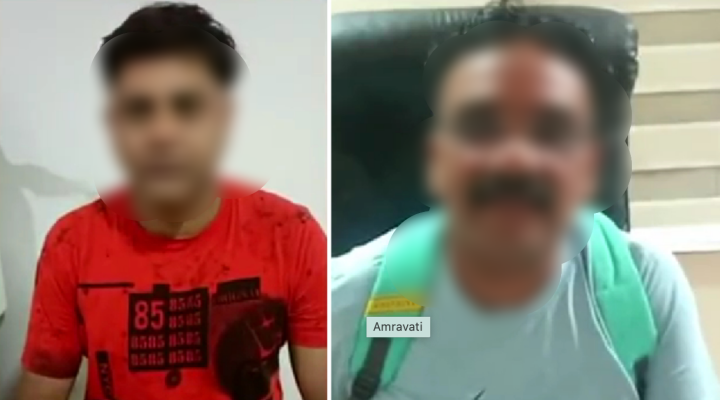
As per a report by India Today, two other people were threatened by Islamists and asked to apologise by recording a video of their apology. The call recordings of the two reveal how they were intimidated by the Islamists and forced to apologise.
One such call was made to Dr Gopal Rathi from Amravati. Dr Rathi was called by someone from Rahebar Helpline, the NGO run by the killers of Umesh Kolhe, as per the India Today report. During the call, the caller said that he was offended by the WhatsApp status put by Dr Rathi and that it will be detrimental for him as he knows him very well. To which, Dr Rathi responded that he will remove the status if it is offending anyone. Dr Rathi was asked to apologise by making a video.
Accepting the demands of the callers, Dr Rathi shot a video in which he said, “I had put a status regarding Nupur Sharma. I had no intention to hurt the sentiments of any religion or caste or person. But, still, if someone is hurt, then I apologize to them from my heart. Also, I promise that there will be no such mistake in future.”
Another Amravati resident named Vijay received a similar threat call for sharing a WhatsApp status in favour of Nupur Sharma. Vijay received a phone call from someone threatening to ‘see’ him at his shop. The caller warned him of dire consequences if he did not make a video and apologise. Vijay, fearing for his life, also recorded a video apologising for posting the aforementioned WhatsApp status. The police have finally taken the matter into consideration and launched a formal investigation in this case.
It is notable that these threat calls were made prior to the murder of Umesh Kolhe who was killed by Islamists in Amravati of Maharashtra for allegedly sharing a social media post supporting Nupur Sharma.
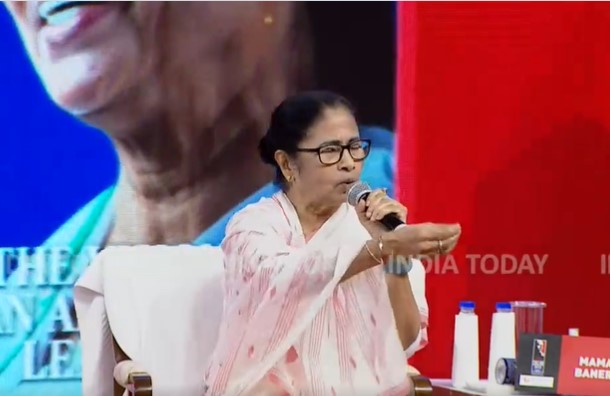
After receiving harsh criticism, Mamata Banerjee, the chief minister of West Bengal, defended her recent ‘Jihad against BJP’ comment at India Today Conclave East 2022, calling it the state’s local language. The TMC supremo was speaking at the 2022 India Today Conclave when she went on to defend her contentious remark.
Addressing a public gathering in Asansol earlier this week, Banerjee called upon her party cadres and supporters to launch a ‘jihad’ against the BJP from July 21, a day her party observes as ‘shahid diwas’ (martyr’s day).
When Rajdeep Sardesai, a ‘journalist’ for India Today, questioned the TMC leader about her explicit call for ‘jihad’ against the saffron party, which the BJP claimed was a clear threat to kill all of its workers and supporters in Bengal, the TMC chief gave a bizarre explanation to justify her call for violence. She said, “there are some local languages. Sometimes, Hindi and Urdu become one language. Marathi and Gujarati are similar, likewise, Bangali and Assamese languages have a lot of similarities. I understand Marathi, Gujarati, Punjabi… on our side, in our local language, we said that in protest against the BJP. ‘Jihad’ in our local language means strong protest,” explained the WB CM.
Moving on, the WB CM also claimed that the heinous post-election violence that broke out in her state of West Bengal after her party regained power in May 2021 was a BJP-created drama. Throughout her conversation with India Today ‘journalist’ Rajdeep Sardesai, the WB CM admonished the BJP of conniving and lying against her and her party.
It may be recalled after Mamata Banerjee openly threatened the BJP party with ‘jihad’, the latter had complained to state Governor Jagdeep Dhankar. The Governor wrote to Banerjee Wednesday (June 29) asking her to withdraw the “unconstitutional declaration” which he also termed “authoritarian and undemocratic”.
Suvendu Adhikari, the leader of the opposition, hit out at Mamata Banerjee saying her hate speech indicated her “jihadi” mindset. The BJP had also demanded Banerjee’s dismissal for her call for violence against the opposition party.
Adhikari asserted Mamata Banerjee issued the appeal for ‘jihad’ against BJP keeping in mind her Muslim vote bank. “This is part of her vote bank politics. She has encouraged Islamist and terror outfits to set up their bases in Bengal and has now given the call for jihad against the BJP,” he said.
Mamata Banerjee’s ‘Khela Hobe’ and the weaponisation of political violence
It may be recalled how the TMC supremo had coined Khela Hobe’, the genocidal election slogan during the state elections last year. Mamata Banerjee had also launched her “Khela Hobe Diwas’ on exactly the same day when Pakistan’s founder Mohammad Ali Jinnah of the Muslim League had launched the horrific “Direct Action Day” against Hindus in 1946.
Initially, the slogan appeared as a harmless jibe against the opposition but soon started to showcase its true colours. TMC members made a wall painting in Bengal wherein Mamata Banerjee was seen hitting PM Modi’s head instead of a football. During her election rallies, the West Bengal Chief Minister continued to provoke her party workers to retaliate against the central armed forces and BJP workers. Several instances of violence were reported during the various stages of polling. Following the declaration of the 2021 assembly poll results, Bengal was in the throes of horrifying violence as TMC goons murdered, plundered and raped BJP supporters across the state.
The exchange between a Judge and an Advocate during the adversarial process of judicial adjudication is often said to enrich the quality of dialogue between the two. Different judges interact differently owing to varying personal approaches. Every advocate dreads a situation which has a lack of exchange, generally considered to be a signal of a lost cause. The senior counsels, having proved their salt at the Bar, are adept at dealing with these exchanges in order to present the best possible case for the litigant. A healthy exchange, without a doubt, elevates the level of the debate and ensures that the advocate gets ample opportunity to dispel any doubts that a Judge may have with regard to his case.
Over the course of the years, with the opening of the judicial process, this dialogue between a counsel and a Judge has been attracting increased public attention. The submissions of the advocate and the observations of the Judge, especially in matters of public importance or curiosity, are contemporaneously reported, published and/or tweeted verbatim. This live reporting has become a window for the general public to understand the machinations of the judicial process. This live reporting of the judicial process has its own consequences which have its own positives and negatives.
The Supreme Court itself has consistently from the landmark ruling of Naresh Shridhar Mirajkar v. the State of Maharashtra, AIR 1967 SC 1 in the 60’s to the recent judgment of Swapnil Tripathi v Supreme Court of India (2018) 10 SCC 639, held that a reporting of judicial proceedings increases access to justice and effectuates the right to open justice and public trial, enhancing the “right to know” for the public at large. It is clear that the Court, therefore, constitutionally permits and to an extent promotes this live access to the Court, with certain narrow exceptions with higher countervailing interests. Despite the obvious positives highlighted by the Court, there are some growing apprehensions with regard to such live access.
The primary apprehension on live access revolves around the fear of deterioration of quality of the dialogue between the Bar and the Bench during the hearing of a matter. It is apprehended that once the fact of any exchange being live reported is implanted in the subconscious mind of a Judge and the advocate, the quality of the dialogue between the two would be coloured by the same thereby altering its genuineness. It is apprehended that the participants would consciously or sub-consciously restrain themselves from free expression, perhaps fearing that what may be appropriate inside a Courtroom for experienced practitioners, may not be perceived in the same manner outside it. It may also be the case that the participants sub-consciously apprehend that with a lack of context attached to any observation or statement made during the dialogue, the same may be prone to misinterpretation by the public at large who may not necessarily understand or appreciate the subtleties or the niceties of the law or the legal process.
While the above aspects highlight the apprehensions with regard to the restraining or hindering of dialogue in the adversarial process, there is a flip side to the same. It is feared that the participants in this dialogue, especially the advocates representing partisan interests, may seek to utilize this live access and reporting in order to unnecessarily sensationalize the issue or for personal publicity. It is further apprehended this may alter the nature of the dialogue and may result in inculcating a culture which is not of a serious legal enquiry but rather is publicity or image-oriented. This twitter-isation of discourse, therefore, reposes increased responsibility on the shoulders of the participants of the adversarial process. The fact that any and all remarks can and will be relayed across the world with the ability to remain accessible for eternity, commands that the platform of the Court does not become a mere theatre.
The legal position on oral observations
The Supreme Court has in fact taken judicial notice of ‘off the cuff’ remarks in a petition filed by the Election Commission against some oral observations made by a Judge of the Madras High Court in Election Commission of India v. M.R. Vijayabhaskar, (2021) 9 SCC 770. The Court clarified that oral remarks are not a part of the official record and do not express any formal opinion and hence, cannot be expunged. The Court has highlighted that mostly such oral observations are elicitation-oriented.
However, the Court relayed some apprehension about an increasing trend of Judges making caustic observations against litigants during hearings. The Supreme Court highlighted that “We must emphasize the need for Judges to exercise caution in off-the-cuff remarks in open court, which may be susceptible to misrepresentation”. The case of the Election Commission was that in the context of the Covid-19 pandemic, the oral observations of the Judge of the Madras High Court of a “murder charge” was incorrect. The Supreme Court observed, in this context, that the remarks of the High Court were “harsh” and that the metaphor was “inappropriate”.
It is in this light that the ex parte oral observations made by the Supreme Court in the case of Nupur Sharma must be examined. The following are the remarks that require scrutiny and have attracted reactions in the public domain. Let’s examine the comments one by one. The entire court exchange was documented by a journalist present in the courtroom and has been reproduced here. Every effort has been made to maintain the correctness and continuity of the comments made by Judges.
Oral Observations
Comment
Bench: Why has she filed with a deceptive name? She wants to hide her identity that people might be watching?
The question is surprising and insensitive. There seems to be nothing deceptive with the title of the petition
Advocate: Seems to have a serious security threat
The response correctly seeks to highlight the security threat which is something in the public domain.
Bench: She has a security threat or she has become a threat to the security of the nation?
The said observation is unfortunate that seeks to unfairly and without any inquiry passes the comment against the Petitioner.
Bench: The way she has ignited the whole country and she has the cheek and courage to come to the court to ask for discretionary relief?
This is an open-ended allegation bordering on being derogatory and defamatory with no factual or logical basis whatsoever.
Bench: This lady is singlehandedly responsible for the burnings in the country.
The said comment again seeks to hold the speaker responsible for the irrationality or the fanaticism of others and further passes an unfair comment on the Petitioner for merely filing a petition seeking enforcement of her rights.
Bench: The anchor very mischievously incited each one of them including another gentleman who was a religious leader.
This observation condemns a third person without any factual basis or inquiry.
Bench: This lady [has a] completely loose tongue that she keeps on making all irresponsible statements and she claims that she is a lawyer with 10 years standing? This is shameful
This observation is highly objectionable and makes a personal comment against a woman without any basis.It seeks to make a character assessment and nonchalantly pass a moral judgment without factual enquiry.
Advocate: The statement is withdrawn, kindly see.
Bench: What do you want from us?
Advocate : The FIRs should be clubbed at one place. That’s all.
Bench: This is not the way to withdraw. She should have gone on air and apologised to the whole country.
The manner of withdrawal of the statement is completely immaterial to the issue at hand.
Advocate: My lords have laid down that in case of registration of FIRs in multiple jurisdictions, only the first FIR stands. The first FIR is registered in Delhi.
Bench: And what the Delhi Police has done? Please don’t compel us to open our mouths. When she makes a complaint, the person is arrested. And when there is an FIR against her, she is not even touched.
Without any enquiry, the passing of such comments against the investigating agency is uncalled for.
Advocate: The content of the transcript, does not make a case [points to relevant part]. A particular insinuation is made towards the Shivling as a phavvara [fountain]
Bench: What is her business or what is the business of this TV channel to discuss a matter which is sub-judice before the Supreme Court? Except that they are promoting a particular agenda.
Apart from the fact that sub-judice matters which attract public interest and curiosity are debated day in and day out in various public forums, the Court has itself said that discussing sub-judice matters on TV channels cannot be barred and is in fact a part of freedom of speech and expression.
Bench: [Refers to relevant part] It is so disturbing. This is the outcome of what happened unfortunately at Udaipur.
This is perhaps the most unfortunate observation which provides a justification for an act of terror. Even ardent terror apologists would find this reference simply, appalling.
Advocate: These are matters of debate within society.
Advocate: My lords have laid down the law that multiple FIRs on same incident cannot stand.
Bench: Even if we have laid down that law, this is a fit case that we refuse to apply that law.
The application of the law has to be the same for every citizen and cannot be denied as per personal opinions.
Advocate: [Showing withdrawal of statement] She has withdrawn the statement
Bench: We have seen the withdrawal. It was too late in the day to withdraw. Even the withdrawal is conditional.. where our “so and so” was being insulted continuously.
This observation effectively ridicules the faith of the litigant.
Advocate: If the incident is one, and there is registration of multiple FIRs with regard to every citizen, my lords have laid down the law.
Bench: These are the people who are not religious at all. They have no respect for any religion. A religious person will have respect for other religions also. It is all to gain cheap popularity and just to achieve some political or nefarious agenda that all these statements are made.
Another personal comment is passed against a litigant without any enquiry or basis in fact and/or law.
Advocate: [Points to the allegedly problematic speech of Petitioner and reads] The speech does not make out any offence.
Bench: Go file Section 482 petitions [inherent power of High Court for quashing of FIRs] before High Courts.
Advocate: My lords have granted indulgence previously in cases of multiple proceedings
Bench: This petition also shows her obstinate character and her arrogance that she thinks that the Courts of the Magistrate are too small for her.
Another personal comment which is unbecoming of the forum.
Advocate: Kindly see the antecedents of the Petitioner. She is a practising advocate and she was a spokesperson for a political party. She has been appearing before screens and there has never been any such allegation made before this incident.
Bench: If you are a spokesperson, it is not a license. Sometimes powers goes to your head, people think that yes I have a backup therefore I can make any kind of statement and go scot-free.
Another personal attack outside the issue at hand without ascribing reasons.
Advocate: The statement was not made at the beginning. Mischievous provocation took place.
Bench: If there was a mischievous provocation, the first thing she should have done is file a case against the anchor. That you won’t do. Because you need them every day.
This observation ignores that provocation was not by the Anchor rather was by the other panellists.
Advocate: The provocation is not by the anchor. It is by the other panellists. [Shows relevant part] A particular insignia of a particular religion is described as a Phavara. [reads relevant portions]
Advocate: My lords even within the same religion, there are serious debates on these issues. Citizens have been granted rights.
Bench: [sarcastically] Yes everyone has a right to speak, in a democracy, the grass has the right to grow and a donkey has the right to eat.
This observation, apart from ridiculing the concept of democracy itself, represents a sorry state of affairs.
Advocate – Seeks to rely on judgments in T.T. Antony v. theState of Kerala (2001) 6 SCC 181; Arnab Ranjan Goswami vs. Union of India & Ors. (2020) 14 SCC SC 12; Amish Devgan v. Union of India, (2021) 1 SCC 1 cases where anticipatory bail was granted and/or multiple FIRs were consolidated. Showing interim order in case of Arnab Goswami case [reads legal principles enshrined in that order]
Bench: There is nothing like a principle of law laid down the interim order [Arnab Goswami case]
The interim order in Arnab’s case in fact clearly discussed the principles of law which the Court balanced before passing a favourable interim order in favour of the litigant.
Advocate: My lords may kindly take up the final judgment in this case [Arnab Goswami’s case] which lays down the principles. [Reads the judgment of Arnab Goswami on the issues of multiple FIRs being vexatious and protection against the same being a part of the right to fair trial]
Bench: Therefore, you have a remedy, you can approach the High Court.
Advocate: [Reads part of the Arnab judgment which holds that making a litigant who has FIRs on the same transaction in multiple jurisdictions approach various High Courts for the same relief would result in a multiplicity of proceedings and unnecessary harassment to the Petitioner]. The fact remains that this is for one statement in one particular episode. The law laid down by this Court is always for every citizen.
Bench: It is not every citizen. Here also some special treatment is given to a journalist.
Another unfortunate observation. This time not just against the litigant but also against the order passed by the Supreme Court itself in the case of Arnab Goswami.
Advocate: What am I asking? I am asking that let investigation be done at one particular place. That is the very least that my Lords may consider. I am not saying that I should not be investigated
Bench: The case of a journalist is at a different pedestal as compared to a citizen or spokesperson who goes on the channel and starts lambasting others making irresponsible statements without even an inkling of the ramifications and serious consequences that how seriously it will disturb the fabric of the society.
The case of a Journalist cannot be different from the case of a citizen. In fact, the citizen being in a weaker position as compared to a Journalist, deserves more indulgence from the Court. The Constitution requires that the application of law should be the same for all and does not allow arbitrary exercise of discretion.
Advocate: Let me assume that proposition is correct, citizens have fundamental rights and fact remains that there is one incident. And all I am asking is the clubbing of that FIR. TT Antony says that there cannot be a second FIR on the same incident.
Bench: We are asking you repeatedly, what has been done in that FIR?
Advocate: I have joined the investigation.
Bench: Naturally, and there must be red carpeting for you. There must be a red carpet for you. This is how you have joined.
Another uncharitable and unfair statement against the investigating agency without any factual enquiry.
Advocate: If your Lordships have laid down that every citizen, not just journalists can approach your Lordship for clubbing in one place. The laid down is for all citizens and there cannot be different standards. Kindly see the judgment in Satinder Singh Bhasin case [case of a business concerning multiple FIRs]He is not a journalist. He is a businessman. My submission is that every citizen is entitled to such an indulgence. Being put to multiple FIRs on one incident is contrary to basic tents of law, contrary to Cr.P.C. and contrary to Article 20(3) [protection against double jeopardy]. Even if a person is not a journalist, your Lordships have applied the same yardstick.
Bench: Even taking your case, assuming what you are arguing is taken to a logical conclusion, the Delhi FIR is dated 8th June 2022.
Advocate: That is the second FIR is general hate cases. My FIR is on 28thMay, 2022.
Bench : What is the date of your first FIR?
Advocate: 28th May. [Refers to relevant] I am not saying don’t investigate. I am relying on the judgments of this Court for every citizen.
Bench: Yes we have seen that.
Advocate: I should not be treated unequally. Your Lordships have laid down a yardstick specifically for multiple FIRs of the same incident. Even if my conduct is condemnable if Your Lordship feels, but then treatment of law should be equal.
Bench: When you get the FIR registered against XYZ [referring to one Mr Zubair] he is arrested immediately
The comment refers to a separate sub-judice proceeding with an incorrect factual allegation.
Advocate: My Lords he is not arrested in my FIR.
Bench: Nobody has dared to touch you. It shows your clout.
Another personal remark against the litigant and also against the investigating agency.
Advocate: No My Lords. That arrest is not in my FIR.
Bench: When the conscience of the Court is not satisfied. We must mould the law accordingly. Starts dictating order – “No case to …”
The law is implemented on facts and not necessarily on personal conscience of people.
Advocate: Then my Lords may permit me to withdraw the case.
Dissecting the courtroom exchange and the comments by the Judges
Apart from the fact that the above observations, almost in their entirety are untrue and grossly inappropriate bordering on being defamatory and derogatory, in the world of digital media and live access, these observations have rendered the litigant guilty in the minds of millions. Further, considering that observations have a digital footprint which is indelible, such observations prejudice the litigant’s case to no end and effectively make any other remedy before a lower forum, an exercise in futility. Such observations are not technically binding on lower courts or the High Courts, however, considering that these were observations of the Apex Court of the country’s deeply entrenched judicial hierarchy would make it practically impossible to have a fair hearing.
At present, from the tenor of the arguments of the Advocate, it was clear that the Petitioner was merely seeking protection against vexatious criminal prosecutions arising out of the same event because, in these prosecutions, FIRs have been filed in various States, it is not possible to approach one particular High Court seeking clubbing of all such cases. The Supreme Court has time and again even in cases of bitcoin scamsters, Ponzi Scheme Operators or Real Estate Builders, and has exercised the power under Article 32 in order to club multiple FIRs on the same transaction/incident as it is the only judicial forum having territorial jurisdiction over multiple States and the entirety of the country. The said proposition is so well settled that the judgment in Arnab Ranjan Goswami vs. Union of India & Ors. (2020) 14 SCC SC 12, refers to precedents on this subject as a “parading of the familiar”. Considering that the same is well settled and also forms a part of the right to life and liberty and the protection against double jeopardy, it is the duty of the Supreme Court to implement the same for one and all. Classifications cannot and ought not to be made merely on the basis of the profession practised by individuals.
Another issue which would have arisen in this case had the Court granted the initial indulgence, would be examining the question of whether mere repetition of the facts which are available in the public domain can ever be a criminal offence? It has been widely reported in various forums of media that the observations made in the T.V. telecast are actually mere repetitions of what various public speakers, religious scholars and religious scriptures themselves state with particular clarity. It has also come to light that such issues are often openly discussed and debated in various Islamic nations and by the world at large and are seemingly considered innocuous. In such an event, an interesting legal question would have arisen considering the presence of such facts and discussions in the public domain – whether the mere reference to them by a person can ever be considered to be a malicious insult or an attempt to incite violence attracting the rigours of Section 153A and 295A of the IPC. It would have also represented an opportunity to discuss the previous cases and incidents on such issues from Rangeela Rasool in the early 1920sto Kishan Bharwad more recently. Therefore, even if a discretionary test was to be applied, considering the factual position emerging, the present case brought up an important question of law which ought to have been entertained.
While it is difficult to understand the legal, factual or moral basis of the observations made during the hearing of a case, it is clear that the observations were off the cuff, broad-based and often unfairly personal. As stated above, the Supreme Court has itself cautioned the High Courts while making any oral observations, it is unfathomable to ascribe reasons to the observations. To some, they may represent self-perceived moral grandstanding and to some others, it may represent a misplaced moralistic barrage. Without adverting to either of the two, it can be easily stated that there was scant legal or judicial basis behind the said oral observations which represents an unfortunate position.
As far as the factual issues are concerned, the observations are particularly startling to some as has been discussed on public forums that the statement of the litigant is largely borrowed from resources in the public domain [religious scriptures, articles by scholars or videos by TV personalities]. It was arguable that from religious scholars to clerics to saints and written down religious scriptures, the statement of the litigant before the Court was prima facie justifiable. Some have referred to the observations as “pseudo-secular” or Shariaesque in nature. This critique may be unfair as it is safe to assume that any genuine Sharia Court would have, at the very least, conducted a factual and religious analysis of the religious scripture itself before passing any comment – something which was dearly missing in the present oral comments. In some ways, it is interesting to guess if the Petitioner would have been better placed to get relief before a Sharia Court.
In the daily news cycle of tweets and reactions, it is incumbent upon the Court to function as an institution in a fearless and fair manner. While the Court does function in a discretionary manner on the writ side, it cannot function in a whimsical manner. The criminal justice system can appropriately deal with the loose tongues of the common people, politicians or media personalities. However, some other loose tongues remain immune.
Amidst allegations of flouting the Foreign Contribution (Regulation) Act, Alt News founder Pratik Sinha has effectively conceded that the lawyer for Mohammed Zubair had lied before the Patiala High Court.
On Monday (July 4), the ‘fact checking’ website issued a clarification, distancing itself from allegations of receiving foreign contributions. “The allegations claim that we have received funds from foreign sources from whom we cannot receive donations. These allegations are categorically false,” it claimed.
“Our payment platform through which we receive donations does not allow receipt of funds from foreign sources and we have received donations from Indian bank accounts only. All the donations collected through these means go to the organisation’s bank account,” Alt News further claimed.
The ‘fact-checking’ site claimed that none of its employees ever received funds in their personal accounts, except for their monthly compensation.
“All of this is an attempt to shut down the very critical work that we do, and we will fight this attempt to shut us down and come out on top,” Alt News cried foul.
Interestingly, the statement by the company’s founder Pratik Sinha comes days after advocate Vrinda Grover, representing Mohammed Zubair, accepted that foreign contributions were received by Alt News.
When Vrinda Grover threw Alt News under the bus
On July 2, Senior Public Prosecutor (SPP) Atul Srivastava informed the Patiala High Court that Zubair violated the Foreign Contribution (Regulation) Act by receiving donations from people in foreign nations.
He stated, “We have already found that donations have come from Pakistan, Syria etc. He is the Director of Pravda Media (parent company of AltNews).
Grover: Sec. 153A and 295A ki kahani khatam ho gayi, ye unhe bhi pata Hain Hume bhi.
In a bid to save Zubair, advocate Vrinda Grover was quick to throw the company (AltNews) under the bus. She put out a categorical statement that foreign funds did not go to the bank account of Zubair but to that of AltNews.
Grover emphasised, “Your honour was misled when told that the accused has received it (foreign contributions). AltNews runs under a company under Section 8. They are saying I am a journalist, I cannot receive FCRA. This is to the company, not to me.”
However, advocate Vrinda Grover had accepted before the Patiala court on Saturday (July 2) that foreign contributions from Pakistan and Syria, as alleged by the senior public prosecutor, were received by AltNews and not Zubair.
Lies of Pratik Sinha exposed
In doing so, she has exposed the lies peddled by Pratik Sinha since 2019 about not accepting foreign remittances. It must be pointed out that only organisations with FCRA licences can accept foreign contributions.
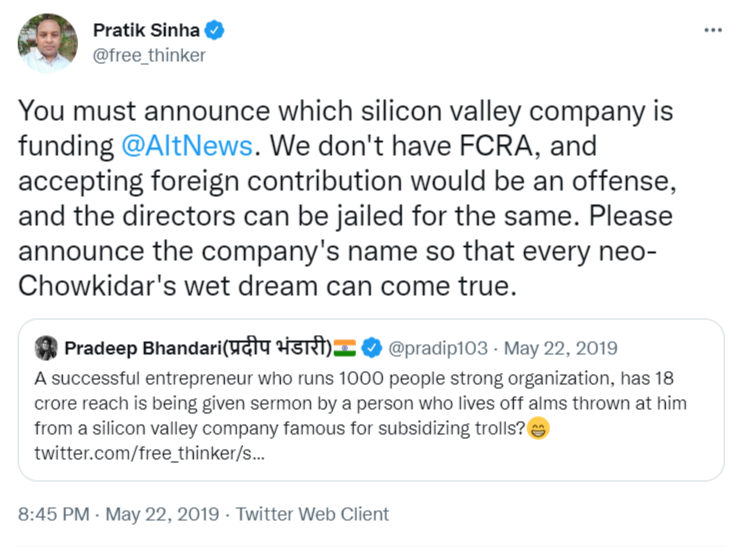
According to AltNews’ founder Pratik Sinha, the alleged fact-checking company does not have an FCRA licence. During a war-of-words with psephologist Pradeep Bhandari in May 2019, Sinha conceded that his organisation could not accept foreign contributions.
He had tweeted, “We don’t have FCRA, and accepting foreign contribution would be an offence, and the directors can be jailed for the same. The archived version of the tweet can be accessed here.
It appears now as if both Pratik Sinha and advocate Vrinda Grover are deliberately trying to create confusion by making contradictory claims. Whether it is a part of the agenda to thwart the investigation process is not yet known.
Even before the brutal Amravati murder or Udaipur beheading, there was a Nagpur family fleeing the city fearing for their lives. The family spent over 2 weeks away from their home in Nagpur, and having recently returned, is still living in fear with their movements heavily restricted. The young boy whose social media posts angered the Islamists has still not returned and is living in hiding.
As per reports, the 22-year-old son of the family had forwarded some social media messages after which they started getting threats. Following that, the family registered a complaint at the Nandanvan police station and even posted an apology on Instagram for the posts. However, that didn’t help as the next day, 100-200 people came to their house to threaten them.
The photograph of the 22-year-old boy was posted on social media with a cross on the photo and abusive language directed at him. Then the family then decided to leave their home for their own protection and left the city. Even though the police have provided security to the family, they are still too scared to bring the boy back to Nagpur, and are themselves living in fear.
Their sense of fear has been heightened following the brutal murders in Udaipur and Amravati over posts supporting Nupur Sharma. Now the family restricts its movement and doesn’t venture out unless something really important is required.
Udaipur beheading over a social media post
Two Muslim men in Rajasthan’s Udaipur murdered a Hindu man, Kanhaiyya Lal, last week over his post in support of ex-BJP spokesperson Nupur Sharma. In the videos that were recorded by the killers themselves, one could see the two men enter the tailor’s shop as customers and attack him with a knife.
In the latter part of the video, the victim could be heard crying and screaming while he was beheaded with a raw knife by the men. The tailor’s body covered in plastic was seen lying outside his shop with blood overflowing on the streets.
Amravati murder of a pharmacist for sharing message of support for Nupur Sharma
On June 22, Umesh Kolhe, a chemist living in Maharashtra’s Amravati, was murdered by four Muslim assailants while he was returning from his pharmacy that night. After initial media reports shared that the murder was with the intention of robbery, police later revealed that the murder was linked to a social media post from Kolhe in support of Nupur Sharma. The case is now being investigated by the NIA.
India has witnessed a recent spike in Islamist attacks against the Hindu community. Armed with fallible excuses, they have left no stone unturned to strike fear and terror in the hearts of common Hindus.
With the inherent ability of Islamists to quickly mobilise in the name of religion, the Hindus are left fending for themselves. And such incidents are not uncommon in the Communist-ruled State of Kerala, where even the minority Christian population is unsafe from the wrath of Islamists.
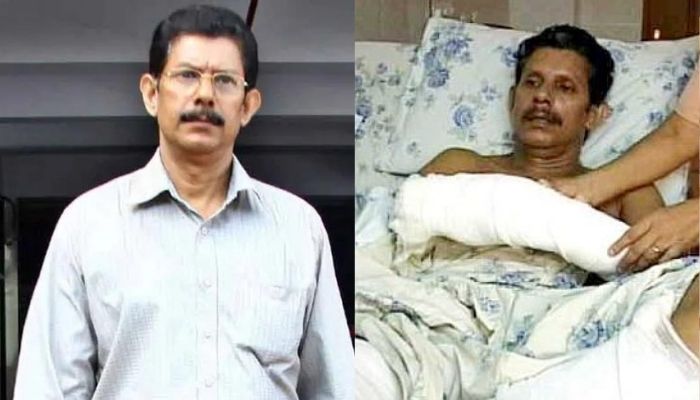
This becomes evident from the ordeal of TJ Joseph, a Professor of Malayalam at Newman College in Thodipuzha. On July 4, 2010, his hand was chopped off by Islamists associated with the radical Popular Front of India (PFI) over allegations of blasphemy.
The background of the case
In March of that year, Joseph had prepared a set of questions for the Malayalam language paper for 2nd-year BCom students. Reportedly, one of the questions asked students to punctuate a conversation between God and a character.
The conversation was extracted from the book ‘Thirakathayude Reethisasthram‘, written by Malayalam Director Kunju Muhammed. The character in the passage was that of a man suffering from schizophrenia and having a constant dialogue with God.
Without thinking much about the consequences, he named the man ‘Muhammed’ after the name of the Malayalam director. Islamists were quick to cry ‘blasphemy’ and interpret the question as a conversation between Prophet Muhammad and God.
The matter received widespread traction after the Jamaat-e-Islami-run newspaper, Madhyamam, reported about it.
Soon, radical Islamic outfits such as the Popular Front of India (PFI), Campus Front of India (CFI), Indian Union Muslim League (IUML) and even the Congress party-led large-scale protests against him.
A First Information Report (FIR) was lodged against him by the Kerala Police for stirring communal hatred under Section 295 of the Indian Penal Code (IPC). TJ Joseph tried to evade law enforcement authorities but it was in vain. He was arrested but was soon released on bail.
However, to make things worse, the Malayalam Professor was fired by Newman College, which is a Christian minority institute affiliated with Mahatma Gandhi University.
The fateful day and aftermath
The day was July 4, 2010. Joseph, who was 53 years old at that time, was returning home from church in his car at about 8 o’clock in the morning. He was accompanied by his sister and mother.
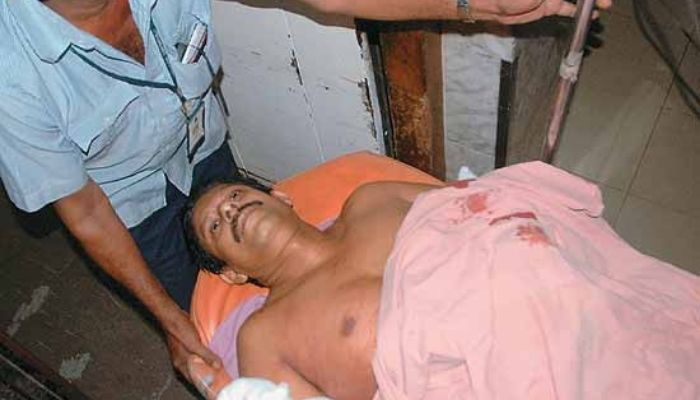
A gang of 6 Islamists laid siege on his car. Armed with an axe, they chopped off his hand below the wrist and ditched the severed part in a nearby land. The assailants also stabbed the Professor in the leg and arm.
Joseph’s wife tried to intervene but was chased away. The Islamists burst crackers and bombs to create an atmosphere of panic. They soon fled the crime scene, leaving an injured Joseph to fend for himself.
Joseph with a severed limb in hospital, image via Outlook India
The victim’s neighbours rushed him to Specialists Hospital in Kochi, which was located 50 kilometres away from his home. His financial situation was exacerbated after he was fired by his college.
Distraught by the aftermath of the incident that turned the life of TJ Joseph upside down, his wife Salomi committed suicide on March 19, 2014.
“During the trial, the court examined 306 prosecution witnesses, four defence witnesses, 963 prosecution documents, 29 defence documents, and 227 material objects. There were 54 accused in the case, of which 37 had been charge-sheeted and 32 persons had undergone trial,” reportedThe Hindu.
In 2015, the court found 13 accused guilty in the hand-chopping case. The accused included Jamal, Mohammed Shobin, Shamsuddin, Shanavas, Pareeth K.A, Younus Aliyar, K.K. Ali, Jaffar, Shejeer, and Kasim.
In May this year, the NIA Court in Kochi granted bail to accused Shafeeq after all witnesses turned hostile during the course of the investigation. Many of the conspirators remain absconding to this day.
‘Church and our own people didn’t support us’: TJ Joseph
In an interview with The Times of India in September last year, Joseph refused to accept that punishing the accused will bring justice. He emphasised that religious fundamentalism was at the heart of the problem.
Joseph said that initially, people were sympathetic towards him, but many still believe that the punishment he had gotten was for a crime he had allegedly committed.
He said, “I wanted to present the truth, and an autobiography was the ideal medium for it. Moreover, I wanted to reveal how insecure we are due to religious extremism. No one is safe in this country when such a situation arises.”
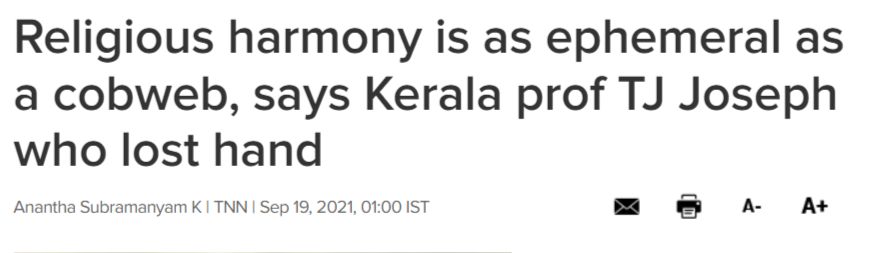
He pointed out that when a situation like his happens, everyone finds themselves “as ephemeral and vulnerable as cobwebs.” Joseph conceded that the physical pain was nothing in front of what the college management and church did to him.
Screengrab of the news report by The Times of India
He recounted how the principal and management of Thodupuzha Newman College and his church supported him when the controversy first erupted, but in later stages, everyone left him alone. He was dismissed from the service over alleged blasphemy.
The church excommunicated his family, and pastoral letters were read in 120 churches in the Kothamangalam diocese against him, justifying the church’s action to disown him. Friends and family members stopped visiting his house out of church’s fear.
He said, “My attackers were blinded by fundamentalism, and they gave me only physical pain but what my own people did to me was even worse as it affected my family and me in all ways.”
Joseph’s memoir of the pain and suffering he endured over the false allegations of blasphemy was released in Malayalam 2020. Its English translation by Nandkumar has been recently released under the title, “A Thousand Cuts: An Innocent Question and Deadly Answers”.
On Monday, July 4, Prime Minister Narendra Modi reached Andhara Pradesh to pay his tributes to freedom fighter Alluri Sitarama Raju on the occasion of his 125th birth anniversary. As part of the Azadi Ka Amrit Mahotsav celebrations, the PM unveiled a 30-feet tall bronze statue of one of the greatest freedom fighters of his time, who laid his life fighting against the tyrannical British Rajfor the rights of the tribal communities.
Sharing a video of his public address in Bhimavaram, Andhra Pradesh on the occasion, PM Narendra Modi Tweeted, “Tributes to the great freedom fighter Alluri Sitarama Raju. His indomitable courage inspires every Indian.”
Tributes to the great freedom fighter Alluri Sitarama Raju. His indomitable courage inspires every Indian. https://t.co/LtgrhYHKin
Several initiatives have reportedly been planned by the Modi administration as part of the year-long commemoration honouring the fearless revolutionary hero and freedom fighter Alluri Sitarama Raju. As per reports, the birthplace of Alluri at Pandrangi in Vizianagaram district and Chintapalli Police Station will be restored to mark 100 years of Rampa Rebellion. The attack on this police station marked the beginning of Rampa Rebellion a century ago. The government has also approved the construction of Alluri Dhyana Mandir at Mogallu with a statue of Alluri Sitarama Raju in Dhyana Mudra, depicting the life story of the freedom fighter through mural paintings and an AI-enabled interactive system.
This has been the first such gesture by any Government to honour the awe-inspiring freedom fighter that made the British spend sleepless nights a century ago.
Born on July 4, 1897, Alluri Sitarama Raju is known for his brief but emphatic 1922 Rampa Rebellion in the Eastern Ghats of Andhra Pradesh against the Britishers. Alluri, who is also referred to as Manyam Veerudu (Jungle Warrior), rallied thousands of poor tribals and kindled the spirit of freedom among them.
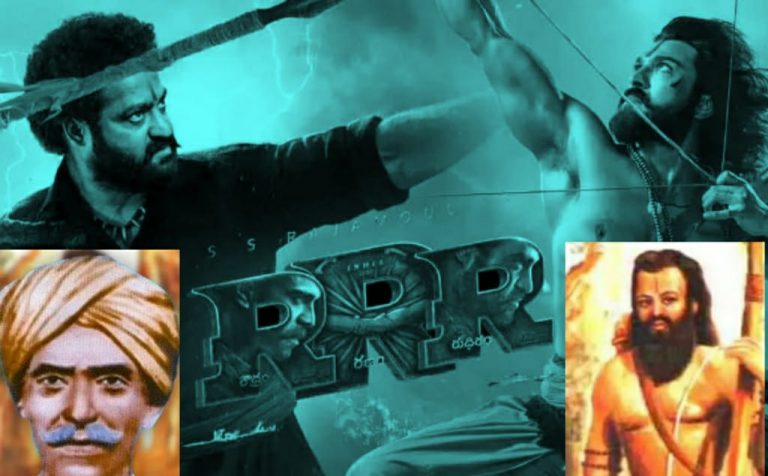
Alluri Sitarama Raju was one of the main characters portrayed in film RRR
In fact, Alluri Sitarama Raju is one of the main characters portrayed by actor Ram Charan in the SS Rajamouli-directed epic action drama film RRR (Rise, Roar, Revolt). The other character played by Jr. NTR was another freedom fighter, Komaram Bheem. The multi-lingual movie was a fictional tale of the friendship between two freedom warriors – Komaram Bheem and Alluri Sita Ramaraju – belonging to present-day Telangana and Andhra Pradesh states. The movie was an adaption of the life story of two legendary revolutionaries and their journey away from home before they started fighting for the country in the 1920s.
The movie RRR, which hit the theatres in October 2020, became one of the biggest ever hits in the history of Indian cinema. However, it couldn’t escape criticism from the Indian left who blamed the film for promoting “Hindutva”. The Hindu symbols and imagery used in the film offended Indian liberals, as did the names Ram and Sita, that were used for the lead pair. Even though the names were picked from the history where Rama Raju had fallen in love with a girl named Sita, eventually adding her name to his name after her untimely death.
Sitarama Raju led the Rampa Rebellion (1922-24) against the Madras Forest Act, which prevented the free movement of tribals in the forests and impacted their livelihoods. Under his leadership, the tribes fought a gruesome guerilla war by attacking British armouries and police stations. Komaram Bheem led a rebellion against the feudal Nizams of Hyderabad and the British Raj in the eastern part of the princely state during the 1930s which culminated in the Telangana Rebellion of 1946.
The story of the unsung revolutionary freedom fighter Sitarama Raju or ‘Manyam Veerudu’
Sitarama Raju, fondly known as ‘Manyam Veerudu’ (hero of the forest) was born on July 4, 1897. He was born in the Mogallu village of West Godavari district to Venkata Rama Raju and Surya Narayanamma. Since childhood Sitarama Raju was eager to fight British oppression. History has it that at the age of 13, when Sitaram Raju was offered a handful of badges with King George’s picture on it, he threw all but one, pinned it on his shirt, and said, “To wear them is to flaunt our servitude. But I pinned it on my shirt near my heart to remind all of you that a foreign ruler is crushing our lives.”
Sitaram Raju is believed to have traveled extensively while he was still a teenager. He was extremely moved by the dismal socio-economic conditions that existed during the British administration, particularly in tribal areas. He started working with tribals and organising them against the atrocities committed by British police, forest, and tax authorities after returning to the primarily tribal “Manyam” areas near Visakhapatnam and Godavari.
The Rampa administrative area was home to many tribes who followed the ‘podu’ method of shifting cultivation. The Madras Forest Act, 1882 forbade them from engaging in podu farming and limited their freedom of movement so that the forests might be cleared and exploited for wood. Under the Rampa rebellion, which went on from August 1922 to May 1924, many tribal residents led by Sitaram Raju, attacked the British army.
He won a few battles, using traditional weapons such as bows and arrows. Later, Sitarama Raju led attacks on police stations to steal their firearms to support their uprising. The British government offered a prize of Rs 10,000 for Sitarama Raju’s capture, and a large number of personnel and resources were mobilised to quell the uprising.
Despite announcing a cash reward, when the British failed to crush the uprising, it sent TG Rutherford in April 1924, who resorted to unprecedented violence in tribal villages to find his coordinates.
Finally, in 1924, Raju was taken into police custody. chained to a tree and executed in front of the entire community, effectively putting an end to the armed uprising. For his bravery, he received the title of ‘manyam veerudu’ or ‘forest hero.’
It’s unfortunate that, like many other unsung heroes, Alluri Sitarama Raju’s contribution to the history of this country has been ignored by so-called historians and the intelligentsia. The bravery, valour, and stories of Alluri Sitarama Raju have never been featured in any NCERT texts.
BJP leader from Padra, Vadodara was threatened on Facebook with ‘Kanhaiya Lal-like fate’ over his comments condemning the killing of Udaipur’s Kanhaiya Lal by Islamists who was killed for supporting ex-BJP spokesperson Nupur Sharma on her remarks on Prophet Muhammad. A police complaint in this regard has been registered. Vice President, BJP Padra Taluka Committee, Nileshsinh Jadav, on 29th June 2022 commented under someone else’s post on the Udaipur killing.
Jadav had commented in disbelief that such a brutal killing happened in a country like India. An acquaintance of Jadav had posted on Facebook condemning the murder. “This is an incident that can happen in Taliban Afghanistan or Pakistan. This is scary. It shames humanity. On this first incident itself the perpetrators should be given strict punishment so that no one can repeat it. The law will take its course. Please maintain peace,” he had posted.
Responding to the same, Jadav had said that the killer knew he would go to jail for the crime he was committing. “They may be imprisoned for life. However, for carrying out this murder, the family (of killers) may be well-compensated financially from donation that might have come from countries like Qatar, Kuwait, Saudi Arabia. Hence, people associated with these killers, parents, siblings, maulvis, they all should be arrested so that if such money is received it cannot be utilised. These people do such things in search for the hoors,” he posted.
Comments by Nileshsinh Jadav and threat by Abdul
Subsequent to his tweet, one Abdul Subur Choudhary threatened him with similar fate for Nilesh and ‘people like him’.
Speaking to OpIndia, Jadav said that he was commenting on a social media post of someone from Rajasthan and demanded the culprits get strict punishment and the property be attached. One Abdul Subur Choudhary threatened me that I will also meet same fate as that of Kanhaiya Lal. “I have filed a police complaint and protection is given to me,” he said.
Police has since registered complaint under section 507 (criminal intimidation) and 294 (B) (using obscene language) of the IPC against the person behind Abdul Subur id. The account has since been deleted but police has undertaken investigation.
On June 3, a wave of appreciation tweets for Congress leader Rahul Gandhi flooded social media after it was claimed that he is the ‘most updated politician in the fields of technology and policy in entire South Asia’. An American Think-Tank RAND Corporation was dragged in to give this ‘news’ more authenticity.
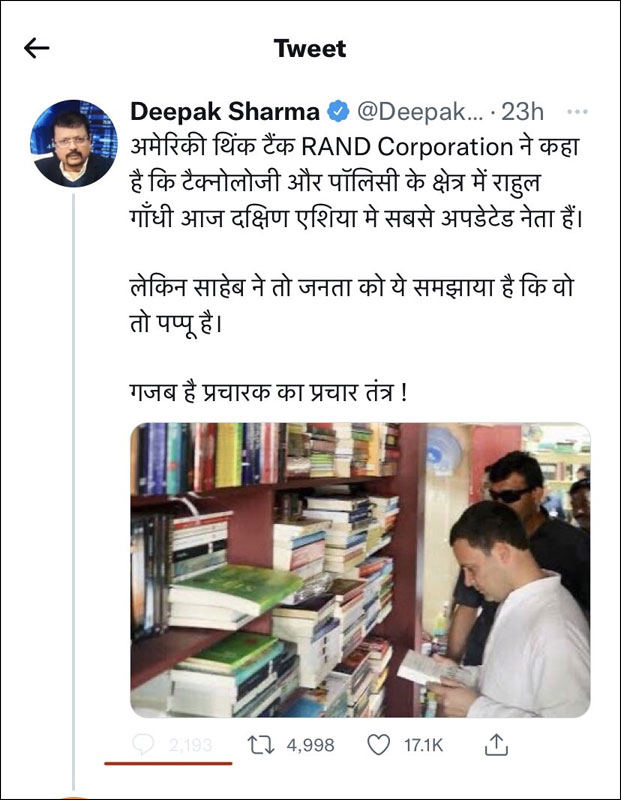
It all started with a tweet by Investigative journalist and Founder Editor of Desh 24×7 Deepak Sharma. In his now-deleted tweet, Sharma claimed, “American Think Tank RAND Corporation has said that Rahul Gandhi is the most updated politician in the fields of Technology and Policy. But ‘saheb’ has taught the public that he is ‘Pappu’. The propaganda machine is amazing.” ‘Saheb’ is often used for PM Modi by the ‘liberals’, and ‘Pappu’ is the often-used moniker for Rahul Gandhi.
Now deleted post by deepak Sharma. Source: Twitter/BefittingFacts
Many Twitter users like BefittingFacts, commented on his tweet and sought the source for the information that Sharma had shared.
What’s your source of information? I didnt find anything in their site. Please provide link. Thanks in advance.
Instead of sharing any information about the source, Sharma decided to restrict comments on his Tweet. Later, he deleted the tweet.
Instead of deleting fake news @DeepakSEditor has restricted his comment. Whatsapp forward ko news bana diya ab payment leke baitha hai ? pic.twitter.com/5rEa2xSsJd
However, by then, the alleged ‘moment of happiness’ had spread throughout the Congress ecosystem, and not only Rahul Gandhi’s supporters but Congress leaders and official handles too jumped in to gloat about it.
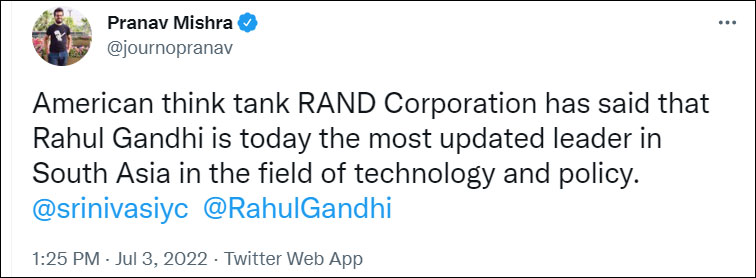
Indian Express Journalist Pranav Mishra wrote, “American think tank RAND Corporation has said that Rahul Gandhi is today the most updated leader in South Asia in the field of technology and policy.” He tagged Rahul Gandhi and Congress leader Srinivas in his tweet.
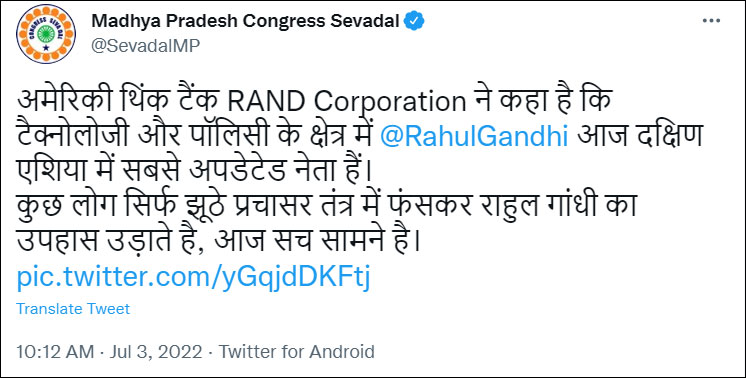
Madhya Pradesh Congress Sevadal said, “American Think Tank RAND Corporation has said Rahul Gandhi is the most updated politician in the fields of Technology and Policy. Some people get stuck in propaganda machinery and laugh at Rahul Gandhi. Today, the truth is in front of everyone.”
Tweet by MP Congress Sevadal. Source: Twitter
Tweet by Jansatta journalist Pranav Mishra. Source: Twitter
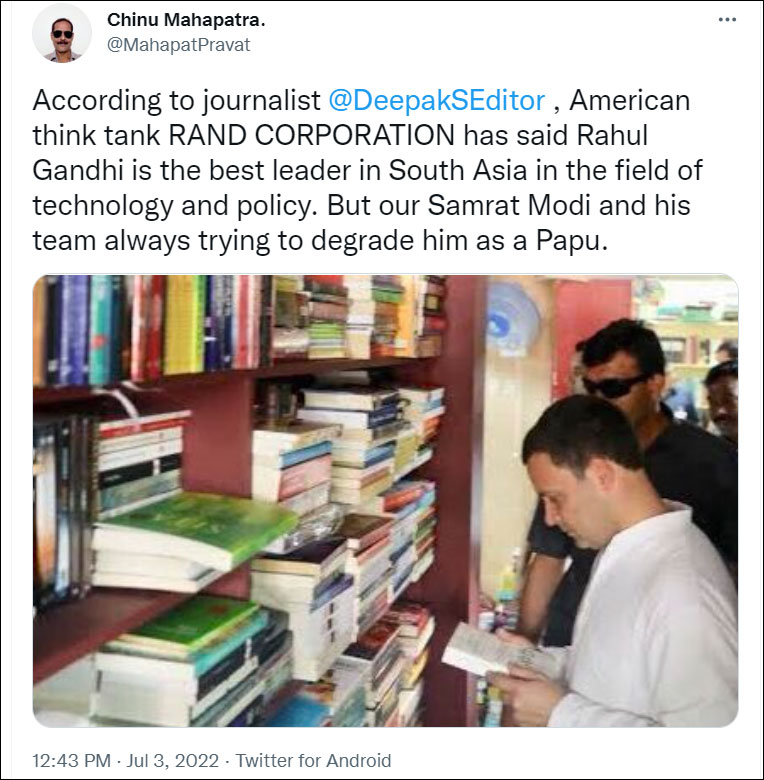
Social ‘activist’ Chinu Mahapatra joined in as well and said, “According to journalist Deepak Sharma, American think tank RAND CORPORATION has said Rahul Gandhi is the best leader in South Asia in the field of technology and policy. But our Samrat Modi and his team are always trying to degrade him as a Papu.”
Tweet by netizen Chinu Mahapatra. Source: Twitter
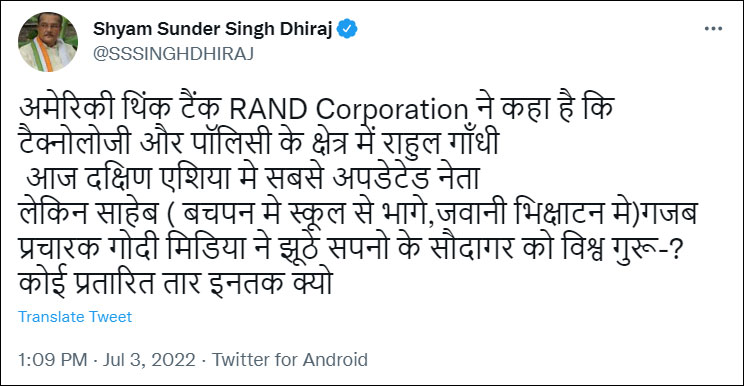
Working President of Bihar Pradesh Congress Committee, Shyam Sunder Singh Dhiraj said, “American Think Tank RAND Corporation has said Rahul Gandhi is the most updated politician in the fields of Technology and Policy. But Saheb’s’ (ran away from school, and begged during his youth) Godi Media have made the broker of false dreams a Vishwaguru.”
Tweet by Congress leader Shyam Sunder Singh Dhiraj. Source: Twitter
What OpIndia found during its investigation?
During the investigation, we checked the website and social media handles of RAND Organisation to see if they released any ranking for the politicians in recent times. We could not find any. Interestingly, many Twitter users have tagged the organisation for explanation over the claims made by Congress workers and leaders along with journalists, but there was no official statement by them.