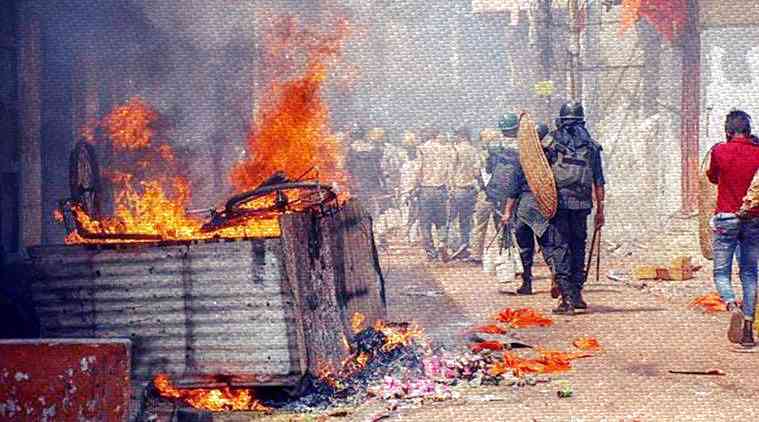
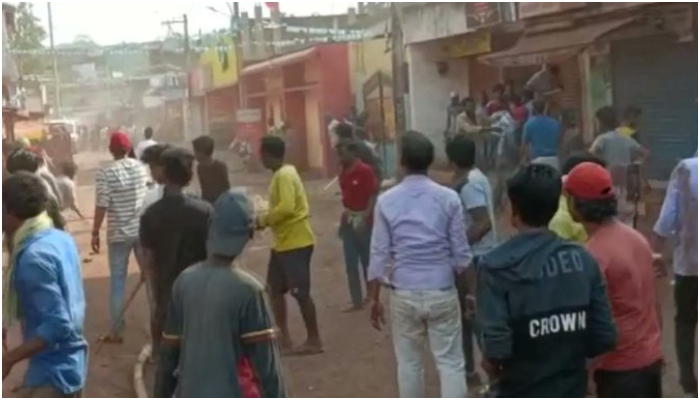
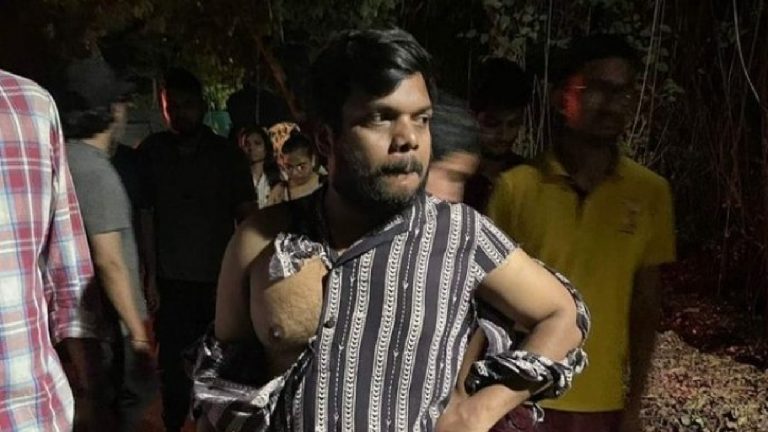
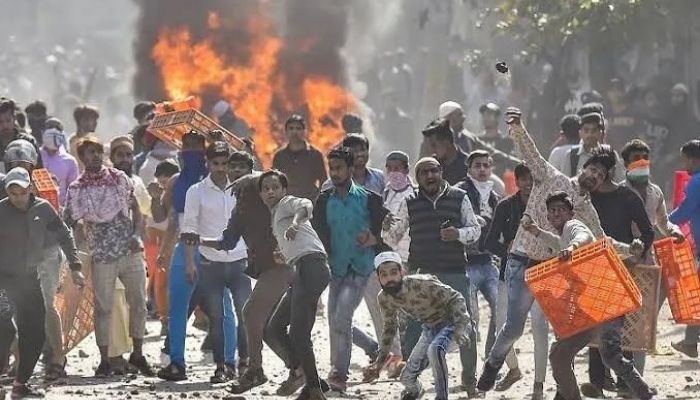
This Ram Navami saw a wave of violence all across India, as processions celebrating the festival were stoned in state after state. Whether it was BJP ruled Gujarat and Karnataka, or opposition ruled West Bengal or Chhatisgarh or Odisha, devotees of Lord Ram were subjected to stone-pelting and petrol bombs to stop them from celebrating their festival.
While the normal reaction of any human is to condemn the violence, that was not the case here. Indian “liberals” went out of the way to justify this violence by claiming that Muslims were provoked into stone-pelting by these Sri Ram processions because they dared to pass through ‘Muslim areas’.
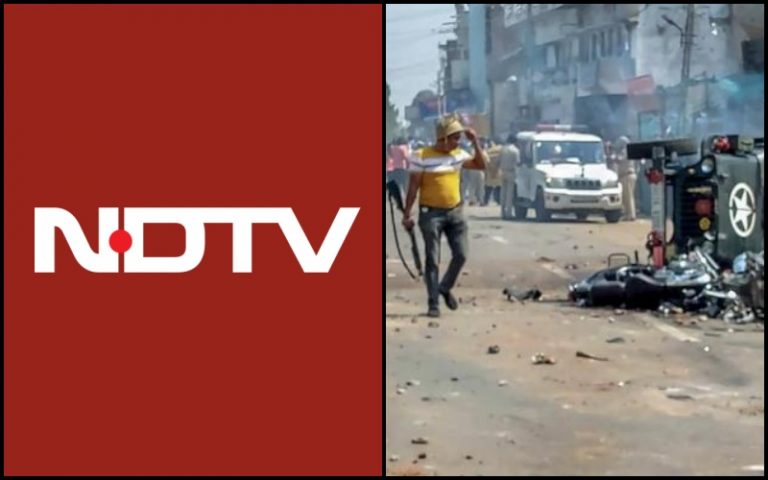
Leading the charge was an alleged news channel NDTV, with their anchors repeatedly saying that Hindus provoked Muslims into stone-pelting by passing through ‘Muslim areas’.
Multiple reports + videos indicate that one persistent trigger for this latest wave of violence was Ram Navami processions playing provocative music/raising slogans while passing through Muslim areas. And yet, ‘clashes’. pic.twitter.com/NXUNfVXeBK
Apparently, Muslims saw Ram Navami processions, got provoked, immediately assembled thousands of stones out of nowhere through magic, and started pelting stones at the processions. Radical Islamist outfit PFI had even warned the local authorities that Hindus taking out a procession in ‘Muslim dominated areas’ may lead to violence, but let’s blame the Hindu entry in “Muslim Areas” to avoid addressing the elephant in the room.
Chhota mota blast fameJain also went on to blame the music played during the processions to justify the violent stone-pelting.
From today’s @IndianExpress, on the violence in MP: ‘According to sources, the clash broke out near Talab Chowk mosque when some people opposed the provocative songs being played during the procession’. https://t.co/tEUwshKbUy
He was not the only NDTV anchor who came out in full force to justify the violence against Ram Navami processions, Gargi Rawat, also chipped in by saying that the violence happened because Ram Navami processions were taken out through Muslim areas.
In most of the places where there’s been violence, the procession is taken through Muslim areas, past mosques with very aggressive sloganeering, and jeering. Invariably reports of stone pelting and then clashes. One person dead in Gujarat. #RamNavamipic.twitter.com/Ytu0mHS8IR
Of course, when it comes to justifying violence against Hindus, how can Congress be far behind NDTV, youth Congress leaders came out in support of the violence by blaming “provocative songs” in these Muslim areas.
DJs blaring provocative songs outside mosques, jobless youth dancing with flags and raising slogans, social media replete with reports of alleged stone pelting on processions to justify attacks on Muslims and their property.. all in sync and tandem, across the country..
This is not the first time that Indian journalists have tried to make “Muslim areas” exclusive zones where Hindus must not enter. Sample this tweet from another journalist from 2017, where Amit Shah and Yogi Adityanath entering ‘Muslim lanes’ was apparently problematic.
Watch how Amit Shah-Adityanath roadshow passes through Muslim lanes of Gorakhpur yesterday shouting Jai Sri Ram. https://t.co/ITGLvoREWt
Compare this to the public Namaz controversy in Gurugram, when people asked Muslims to avoid blocking public spaces for Namaz. At that time, none of these wise people asked Muslims to pray in their mosques, or even in these so-called Muslim areas. They defended the right to block public spaces every Friday but once in a year, the Ram Navami procession is fair game for violence if it crosses Muslim areas.
As per these people, Hindus should keep their celebrations away from these so-called Muslim areas, and should also avoid playing any song that may offend them. After that, all sorts of violence is justified against Hindus. Even though they will never ask how come there is a whole arsenal of stones and petrol bombs on the roofs of their houses even before they know what songs will be played during the procession.
If a Hindu even decides not to rent out their own personal property to a Muslim, for whatever reason, it is a national crisis. However, Muslims have exclusivity over the entire area where they reside the majority, and Hindus should avoid entering that area if they want to avoid being hit by stones.
This demarcation of Hindu-Muslim areas is exactly what led to the partition in 1947. News reports from 100 years ago talk about the same stone-pelting on Hindu processions for passing through these allegedly Muslim areas, and now Indian liberals want to see that again. Baba Saheb Ambedkar talked about this same violence against Hindu religious processions in the 1920s.
Ambedkar commented on the hate Ms have for Hindu religious processions way back in 1920’s. pic.twitter.com/pMYd7EgMDE
Separating geographical areas as Hindu areas or Muslim areas is just a step short of another partition, and that is what these people want to see. As if the bloodshed at the time of the 1947 partition wasn’t enough that they are trying to provoke another similar incident.
When the year 2022 started, India was just about limping back to normalcy after the sinister violence unleashed upon Hindus in February 2020 and a debilitating pandemic that screeched the nation to a halt. The memory of Ankit Sharma’s body being pulled out of the gutter and the charred, dismembered body of Dilbar Negi was fresh in the Hindu conscience even as the Delhi anti-Hindu riot cases trudged along in the Judiciary. On the 6th of January 2022, ISIS released its new edition in which it asked Muslims to take back the Babri Masjid (the illegal structure that once stood on Ram Janmabhoomi) from the dirty “cow urine drinkers” (Hindus, of course).
While the January edition of the ISIS magazine called for Muslims to wage Jihad against Hindus and the Indian state, one is transported back to the riots of 2020, in the midst of which, the magazine was started by ISIS. It was on the 27th of February 2020, a day after the Delhi violence had subsided, did the news emerge that ISIS had launched an India centric magazine. On its cover page was Muslim lawyer Mahmood Paracha. In a press conference in 2019, Shia cleric Maulana Kalbe Jawad and Mahmood Paracha had announced that they would be setting up a camp in Lucknow to teach Muslims and Dalits about the ‘right to self-defence and how to apply for a firearm licence.
It is generally a result of collective myopia or paralysing hope, that we fail to see patterns that oft repeat themselves, leading to devastating consequences. While the patterns of Islamic aggression have repeated themselves since time immemorial, there are specific threads that run in common between what happened in 2019, leading up to the Delhi anti-Hindu riots in 2020, and what we see unfold in 2022.
The saga of violence in 2019 started with the Hauz Qazi temple desecration that took place in the month of June 2019. A temple in the narrow bylanes of Chandi Chowk was desecrated by an Islamist mob. According to locals, they urinated on the idols and broke the glass and the murtis in the temple. The incident that led to communal tension in the area was downplayed by the media. Most of the media looked away and the rest tried to downplay the communal tension, the actions of the Muslim mob and the case of the missing boy (who was later recovered). To top it all, the media also weaved stories of how the local Muslim community (the very community that vandalised the temple) was “helping” the Hindu community come together, a yarn that was summarily rejected by the local Hindus.
What happened after Hauz Qazi was a string of low-level violence all through 2019, right up to the JNU violence of December 2019, which effectively marks the start of the Delhi violence that culminated in riots on the 23rd of February 2020.
Come October, there was a spate of attacks against Durga Puja and Dussehra processions. In Balrampur, a Durga Puja procession was attacked amidst chants of Pakistan Zindabad and speaking to OpIndia, Suraj, a Balrampur resident part of the procession, said he was convinced that the Muslim residents of the locality had meticulously pre-planned this entire siege and the attack had nothing to do with the music not being stopped near the Mosque. In Gorakhpur, meat pieces were thrown strategically on the route of the Durga Puja procession, simply to humiliate Hindus. In Badaun, temple idols were vandalised and desecrated. In Arunachal Pradesh and Assam too, murtis were desecrated, in fact, in Assam, the Islamist had put tilak on his forehead. In Gaya and Jehanabad, Durga Puja processions came under siege with stones being pelted at Hindus. And these were only some of the incidents OpIndia managed to document. There is no telling how many processions actually came under attack in that period.
It was around the same time, while Durga Puja, Dussehra and Diwali celebrations were being attacked by Islamists, Kamlesh Tiwari was brutally murdered after being stabbed 15 times. Ashfaq and Moinuddin from Suraj tried to slit his throat twice while stabbing him. It was on the 18th of October that Tiwari was murdered for his alleged comments, where he had claimed that Prophet Muhammad was a homosexual. After the 2015 comments, riots had broken out in several places including rallies taken out by Islamists amidst chants of “Gustakh-e-Rasool ki saza, sar tan se juda”.
In the video, Owaisi could be heard saying whoever dares to speak anything against Rasalullah is haram as per Quran. “Woh zaalim, woh kutta jo Uttar Pradesh mein baith kar Allah ki shaan mein gustakhi kiya, yaad rakh. Tu aaj jail main hai magar duniya tere liye chuhe ki bil ki tarah ban jayegi. (That dog who is sitting in Uttar Pradesh and speaking such things against the Allah, remember. You are safe in jail but the world will become a rat’s hole for you),” Owaisi says. He further threatens that by speaking against the Rasalullah, you (Kamlesh Tiwari) have invited your own doom.
By December, political speeches incited violence and misrepresented the entire Citizenship Amendment Act. Not only did they do that, in their speeches, they held the Assam protests against it as a prototype, to be replicated in the entire nation. They, of course, glossed over the fact that the Assam protests were not against the CAA at all, but in support of Clause 6 and in fact, the protest essentially meant that Assam wanted NRC, to ensure all illegals were dispelled from the state. Sonia Gandhi on 14th December said that the Congress and the people should be ready to make any sacrifice to “protect” India and that this is an ‘aar paar ki ladai’ (the final battle) and people should be willing for any ‘Qurbani’ (sacrifice). The provocative speech was later held responsible for the Delhi riots by some victims themselves. At the same time, Mamata Banerjee announced that her party would hold protests in December against CAA and NRC.
The violence had already begun on the 11th of December. It is to be kept in mind that before the violence erupted in Jamia, we now know that several posters were distributed by the riots’ accused – Sharjeel Imam – at the behest of Umar Khalid. The posters and pamphlets were distributed at mosques in Delhi and called for Jihad. Most of them also spoke about the Babri Masjid and how Muslims need to reclaim and avenge.
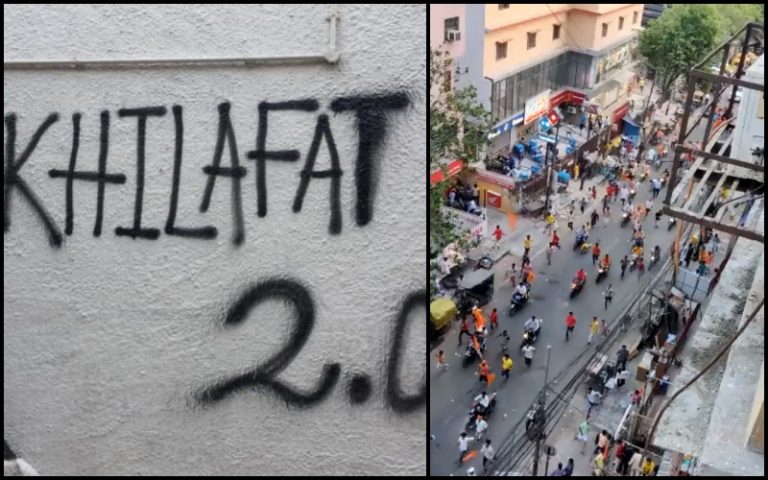
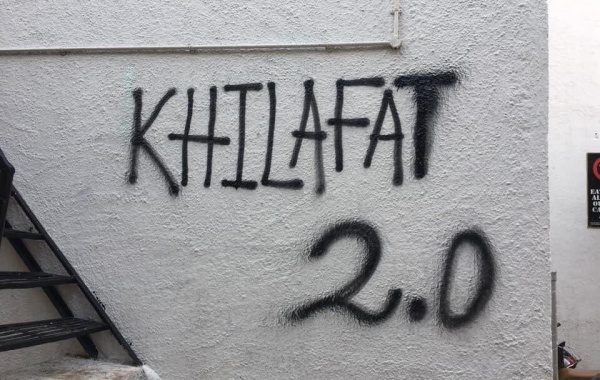
During the violence and the protests that preceded the violence, slogans like Hinduon se Azadi, Hindutva ki kabar and posters of Khilafat 2.0 emerged.
Khilafat 2.0 on AMU wall
While violence raged on in several parts of the country, including Bengal, Uttar Pradesh, Delhi, Gujarat etc, there was an innocuous controversy that escalated in JNU, leading to violence and the Left playing victim. While there were several images that showed the Left leading mobs to attack ABVP students, the narrative in the media was completely different. They alleged that it was the ABVP students who entered hostels and attacked Left students while the fee hike saga was ongoing. This, after Jamia and AMU had already erupted in violence in December itself (violence that police called well-planned).
The pattern repeats? The eerie similarities between 2019 and 2022
While the chronology of what happened in 2019 that led to the Delhi riots is a subject worthy of a book, there are several similar threads we see play out in 2022.
In 2022, just in the first 4 months, we saw sporadic cases of blasphemy killings, much like the murder of Kamlesh Tiwari. It was on 27th January when the murder of Kishan Boliya shocked Gujarat. In Ahmedabad district’s Dhandhuka taluka, when Kishan was on his way home, two bikers came and shot at him. He died on the spot. It was alleged that Kishan had shared a post on social media platforms that Muslims found offensive. The video shared by Kishan on social media had an image of Prophet Muhammad. Even those who demanded justice in the Kishan murder were brutally beaten up by Muslims. Another Hindu activist Harsha was also murdered and it emerged that Islamists had threatened him over a “Blasphemous” post in 2015.
Another case that emerged around the same time was one in which a group of people attacked a young man named Prakash Lonare just because he posted “smiley” emoticons in a post having a reference to Tipu Sultan.
Not a lot of time had passed since these brutal killings, and the Hijab controversy took centre stage. It started with one school where students insisted on entering wearing Hijab and were disallowed by the school. Soon enough, the media spun a yarn claiming that India was banning Hijab and protests erupted across the nation. These protests, several of them, ended up in violence with dangerously provocative and genocidal statements being made.
In West Bengal, the Karnataka controversy ended in violence when one school in Murshidabad disallowed students in hijab from entering the school. Locals hurled stones and bombs at the school in “protest“. In Karnataka, a Hijab clad woman was seen “taking a stand” against Hindu students who were peacefully protesting against the imposition of hijab where students were defying the uniform rule. That woman, Muskan, who raised Allahu Akbar slogans, was hailed by Al Qaeda, no less.
As the Hijab row progressed, Islamists indulged in provoking young Muslims by invoking events such as the Babri Masjid demolition, the same modus operandi that was used during the anti-CAA riots in 2019, that actually culminated in the Anti-Hindu Delhi riots leading to the death of 53 people.
As the Hijab row subsided, with the court declaring that the uniform rule had to be respected, another spate of violence erupted. Across 5 states, there were several attacks against Ram Navami processions.
When one notices the events, it is evident that there are eerie similarities between what happened in 2019 and 2022. Just like then, there were blasphemy murders and attacks against Hindu processions. Just like then, when the Babri demolition was invoked to incite Muslims, during the Hijab row, Islamists involved the Babri Masjid demolition to ensure more violence erupts.
But the eeriest similarity is perhaps how in 2019, an innocuous development in JNU was turned into a violent episode by the Left. In 2019, fee-hike was the rallying point for the Left to turn JNU into a violent den and in 2022, it was Navratri and the fact that ABVP did not want non-vegetarian food to be served in the mess while Hindus were celebrating their festival. Violence erupted and according to students, it was the Left that started unleashing violence on the Ram Navami puja, however, as usual, the narrative was vastly different.
On April 10, the members of Left student organizations at Jawahar Lal University allegedly attacked the residents of Kaveri Hostel who were celebrating Ram Navami. According to Left organizations, the members of Akhil Bharatiya Vidyarthi Parishad (ABVP), the student wing of the Rashtriya Swayamsevak Sangh, had a scuffle with the mess manager as non-vegetarian food was being served on the day of Ram Navami.
On the contrary, ABVP accused Left student organizations and the National Students Union of India (NSUI) of stopping them from doing Hawan and Puja on Ram Navami. Speaking to OpIndia, ABVP JNU President Rohit Kumar said there was no agitation from their side. Everything was going on peacefully, and Hindu students were doing Hawan in the designated place, and Muslim students had Iftar inside the mess. According to ABVP, the Left students started pelting stones on the Ram Navami pujan and concocted the story of ABVP protesting against non-vegetarian food to manage the narrative.
In 2019, a similarly innocuous incident was turned violence when the Left students had started protesting against the fee hike. In the middle of the protest, the Leftists students had claimed that ABVP students had entered the hostel and beat up the Left students even though there were images of Left students leading the mob that created the violence.
As 2022 sees a repeat of 2019, what lies ahead
One can perhaps never really be sure, however, the pattern that emerges is rather evident. Most of these incidents of violence appear not only innocuous but grossly low intensity to consider it a genuine built up to a situation like the Delhi anti-Hindu riots. However, if history stands testament, these low-intensity incidents of violence are anything but innocuous.
While the anti-CAA violence itself started from the beginning of December and lasted till the end of the riots, there were several other violent strings that emerged much before CAA even became an issue. As detailed above, the violence that started right from Hauz Qazi continued till October-November with Hindu festivals coming under attack and Kamlesh Tiwari being murdered. Thereafter, since the beginning of December, the anti-CAA violence erupted, with the campaign of violence starting right from the 5th of December 2019.
In 2022, those threads seem to be emerging yet again.
It remains to be seen whether the Islamists and Left find another excuse, like the CAA, to go on another full-fledged rampage as they did in 2019, however, the makings of India erupting in industrial-scale violence seem to be there and only growing in its cacophony.
Low-Intensity violence by Islamists is often dismissed, even by serious commentators. India, as a nation-state, has normalised violence by Islamists and come to accept its street veto as an evil that they must survive. From the 1900s, when we saw the rise of the Khilafat movement that eventually birthed Pakistan, Hindus have been told that the maintenance of peace is their sole responsibility that the aim can only achieve if they accept the intolerance of the minority with a smile on their face.
During the Khilafat movement in 1919, the Muslims of the time protested against the sanctions against the Caliph and the Ottoman Empire, At that time, as is now, it was evident that the Muslim allegiance lay towards the Ummah, which says that all Muslims across the globe form one nation. It is their allegiance to the Ummah that led them to fight for the Turkish Caliph. At that time, Mohandas Karamchand Gandhi had, serendipitously for the Muslims, supported the Khilafat movement in the hope that the Muslims would join hands with the Hindus eventually and fight against the British, leading to everlasting brotherhood and peace between the Muslims and Hindus. What transpired was vastly different from what Gandhi has imagined. The Malabar genocide of Hindus followed, where Hindus were brutally massacred by the Moplah Muslims.
With the Khilafat 2.0 posters in AMU and elsewhere in 2019, it become evident that these repeated transgressions by the Islamists, where only an excuse is needed to spark the fire, is nothing but a build-up to a situation that existed pre-partition, where the minority community asserts that their mere existence means that they have a right to their own nation, untarnished by Kafirs and “dirty cow urine drinkers”. Whether this time the security establishment would be able to thwart such attempts and the populace at large would see the nefarious designs more clearly, remains to be seen.
Those who forget the history are condemned to repeat it.
When someone talks about communal riots in Gujarat, they always talk about 2002 riots that took place after a train compartment carrying Hindu pilgrims from Ayodhya was set on fire in Godhra killing 60 people. But for those of us who have lived in this great state for generations, communal violence was so frequent that the post 2002 peace now appears like a silence before the storm.
Recently, on the occasion of Ram Navami, at least two incidents of violence were reported from Gujarat where stones were pelted on the procession of Shri Ram. The stones were pelted largely from mosques after the shobha yatra passed through ‘Muslim Area’ as noted by the ‘liberal journalists’ in India. Remember, India is secular but some pockets in the are ‘Muslim Areas’ where perhaps just existence of a Hindu could be ‘provocative’.
For those who live outside Gujarat, they would draw a parallel between these incidences in Himmatnagar and Khambhat and other such incidences that happened across India on the same evening. But for average Gujaratis, especially those who live in the metros of Gujarat like Ahmedabad, Vadodara and Surat this was a déjà vu moment for us.
The so-called liberals of India have created this image that Gujarat was a land of peace before 2002. That it was an utopian dream where communal harmony was rooted firmly. Gather around, as I take you down the memory lane and the bloodied history of Gujarat right from the time of partition to 2002.
Prior to 2002 riots, communal violence would erupt like snap of a finger. On Uttarayan, the annual kite-flying festival, communal clashes would erupt over cutting of kites in old cities where people of both communities ‘live in communal harmony’. On Rath Yatra of Lord Jagannath, when the procession would pass through certain areas, the chariots would get attacked, stones would be pelted. So much that this communal violence was one of the prime reason Gujaratis have not voted back Congress to power again since 1998.
Being a kid in 1985 and then a youngster in 1992, I believe the 2002 riots were nothing against those two black chapters in Gujarat’s history of law and order. As I said, ever since independence, riots in Gujarat have happened on communal lines, well mostly, but Gujarat has seen its streets getting burnt on a small issue of kite flying as well. Smallest dispute between a Hindu and a Muslim kid on who got better of a particular kite-war has started the worst riots in the cities like Ahmedabad in past. This is our lived history.
But, because the well-oiled ecosystem works with the utmost professionalism, the mainstream media of India have created a false picture that Gujarat has been the victim of riots only in 2002. As a matter of fact, Gujarat is more than 90% peaceful ever since the 2002 riots. That burning alive of 60 Hindus did not trigger the worst communal riots in the state quite speaks volumes of how much better law and order situation was that Modi as CM did not let the situation get out of control.
The thing is that Gujarat has seen most of its riots during the rule of Congress or non-BJP governments. According to the reports between 1961 and 1971, the first decade of Gujarat after it was created as separate state, 16 out of 19 districts at that time experienced riots. In the single year of 1969, there were not less than 578 incidences of communal riots registered in Gujarat.
During this decade there were three Congress Chief Ministers who were in the power, namely Jivraj Mehta, Balwantrai Mehta, and Hitendra Desai. Notably, after Hitendra Desai, the Gujarat assembly was dissolved and the president’s rule continued for 309 days in the state! Such was the mess Congress created between Hindus and Muslims during the first decade itself after Gujarat was born. Whether the Congress chief ministers failed to control the riots or they allowed riots to happen to appease their political lines is a big question mark even today.
In a perfect world, a political party that has a thumping majority in an assembly would try its best that not a single riot would happen in the state. But the Congress party is a different entity altogether. In the 1980 assembly elections Congress secured a record 141 seats out of 182 seats in the house, 66 more than the previous time. This is a record even the most popular CM of Gujarat to date Narendra Modi was unable to eclipse.
These many seats would allow the ruling party to further its development agenda without a single hurdle. Instead, the Congress party under Madhavsinh Solanki implemented the KHAM theory and started reservation politics that eventually turned into upper caste hate. Patels (or Patidaars as they are now popularly known as) were targeted primarily by the then ruling party and riots between upper and lower castes of Gujarat unfolded. Eventually, after the violent Anamat Andolan of 1985 that lasted for more than five months, Madhavsinh Solanki had to resign despite winning 141 seats just four and a bit years ago.
The twist in the tale came when these caste-based riots turned into or were allowed to turn into communal riots just to divide the attention of the public anger. Muslim goondas like Abdul Latif were given a free hand and Hindus were killed, mainly in the old city of Ahmedabad. The same place where, as I said before, riots would spark even on kite-wars. The biggest newspaper at that time was Gujarat Samachar. Its Prajabandhu Press was burnt down during these riots. Shockingly during the peak of these riots, even Gujarat police observed a strike for one day. Law and order has been a state subject. Imagine the lawlessness in Gujarat during those twenty hours under Congress rule.
In the 1990 elections, Chimanbhai Patel came to power on the anti-Congress wave as Janata Dal candidate and formed the government with the BJP as a partner. Just before demolition of disputed structure at Ayodhya often referred to as ‘Babri Masjid’, Gujarat BJP had parted away from Chimanbhai’s Janata Dal Gujarat. In return, Chimanbhai merged his party with Congress against which he had fought the elections just two years prior. Post demolition of disputed structure, many parts of India including Gujarat were engulfed in communal riots.
The following year the iconic Ahmedabad Rath Yatra of Bhagwan Jagannath was marred with violence too. In the walled area of Shahpur and Dariapur, which are ‘communally sensitive areas’ stones were pelted on three Raths of Bhagwan Jagannath, Balbhadra, and Subhadra. There was even an attempt to hijack them. For four days Ahmedabad was lawless and goondas were at large, and the police were just a mute spectator. Finally, all three raths were taken inside the Jagannath Temple in the Jamalpur area of the city under police+army protection.
After the Ayodhya structure was demolished worst riots were organized in Gujarat. Again Ahmedabad, Vadodara, and Surat became the epicenter of those riots. After a bit of a lull, there were ‘revenge riots’ that took place a few months later. This time the incidences of stabbing and petrol bombs became normal in the walled cities. Just like in past this time also many of Gujarat’s metros were handed over to the army. A week-long curfew and a regular army flag marches became a new normal for Gujaratis during those times.
Remember the scene in Shah Rukh Khan starrer film Raees where the Bollywood actor plays role inspired from Don Abdul Latif throws petrol bomb on procession?
Gujarat lived this fiction as reality. Of course, the filmmakers watered down and glorified a bootlegger, a criminal and a terrorist but petrol bombs on processions were accurately depicted.
Then came the 2002 riots, which are similar in nature to what Gujaratis witnessed in 1985 and in 1992, but were better dealt with by the then-Gujarat government within a few days’ time, despite getting no police help from the neighboring Congress-ruled states. Yes, many people did get killed in 2002, and properties were burnt and looted like in the previous riots, but numbers of the culprits of those incidents are behind bars now.
The major difference between all the riots that happened in Gujarat from 1960 till 2002, was that after the 2002 riots even the Chief Minister and the Home Minister of the state were trialed and after the due procedure observed by the law enforcement agencies, both were cleared or acquitted. But after the 1969 riots, the recommendations by the judicial commission of the Jagmohan Reddy and Nusserwanji Commission were ignored by the successive government in Gujarat.
The Dave Commission that was appointed to find the root causes of the 1985 riots in Gujarat by the Congress government later did not accept its recommendations. The Chauhan Commission that was looking for findings in the Surat violence of 1992 was not given the required 15 days extension by the Congress government which was supported by Shankersinh Vaghela and eventually the commission had to be dispersed.
In the contrast, the Nanavati-Mehta Commission which was appointed by Narendra Modi led BJP government after the 2002 burning of Sabarmati Express and the aftermath of the riots, not only completed its tenor but also submitted its findings in two parts, first in 2008 and then in 2014.
After 2002, Gujarat is at peace largely, just there was some violence during the Patidar Anamat Andolan of 2016, but they were nowhere near to what Gujarat has witnessed in past. Looking at the history of riots in Gujarat one would definitely make a conclusion that despite being in a full majority for years in Gujarat, the Congress either couldn’t control the riots as it should, but in fact, it allowed them to spread. Not only that it didn’t even implement the recommendations of the various judicial commissions appointed by its government to give justice to those who were affected by some horrendous riots of its times, no matter the affected people were Hindus or Muslims.
Except, now the hood of communal violence is being raised in Gujarat again after 20 years of peace. First it was Kishan Bharwad murder case where he was killed by Islamists over allegations of blasphemy and now the violence on Ram Navami. Have we all become complacent after experiencing 20 years of peace? Or have we forgotten the history and are condemned to repeat it.
On Monday, a British court convicted Conservative Member of Parliament (MP) Imran Ahmad Khan guilty of sexually abusing a 15-year-old boy at a party in 2008 after forcing him to drink gin. Khan is an MP from the Wakefield constituency.
Imran Khan was found guilty of assaulting the youngster at a party in Staffordshire in January 2008, 11 years before he became an MP, by a jury at Southwark Crown Court in London. Mr Justice Baker, the judge, stated that he will sentence Khan at a later date.
According to United Kingdom law, if he obtains a term of more than 12 months, he will be immediately barred from serving as an MP. Khan did not say anything as he walked out of court, but a member of his legal team indicated he will appeal.
When he reported the complaint to the Conservative Party press office in December 2019, the victim said he was not “taken very seriously.” In court, he stated that when Khan did “slow caressing” to his legs, he felt “scared, vulnerable, and numb.” Khan, on the other hand, claimed that he only stroked the adolescent’s elbow when he became irritated during a discussion about his “confused sexuality.”
According to the court, Khan fed the child with gin and tonic before taking him upstairs to see pornography and assaulting him on a bunk bed. The incident was reported to the police by the child. The 15-year-old did not want to take the complaint further, therefore it was dismissed at the time. However, the complainant returned to the police after learning Imran Khan was standing for MP in the 2019 general election.
Khan attempted and failed to prohibit press coverage of the case, claiming that if the case against him became public, his life would be jeopardised. He said that as an Ahmadi Muslim, using alcohol and homosexuality are severely forbidden within his faith and that reporting on those topics would subject him to “a risk to his safety both here and abroad.”
Khan was expelled from the Conservative Party in June 2021 after being charged with sexual assault, and he has since sat as an independent.
The jury also heard testimony from a man who said Khan sexually assaulted him in his sleep during a party in Pakistan where they consumed marijuana and drank alcohol. The man, who was in his early twenties at the time, told the jury Khan gave him sleeping drugs as they shared a room in a Peshawar hotel. The victim said that when he woke up, Khan was performing a sex act on him after taking down his boxer shorts.
He told the court that he reported the event to the British High Commission and the Foreign Office, but said he did not want to go to the Pakistani police because of Khan’s strong links in the military and politics. After knowing Khan had been charged with sexual assault, he stepped forward as a witness.
On Monday, the situation in Joda town of Keonjhar district in Odisha became tense after an Akhada procession on the occasion of Ram Navami by Hindu devotees came under attack by some local Muslims. The district administration has imposed section 144 in the area following the violence.
According to the reports, the Hindu devotees had wanted to conduct an Akhada procession on Sunday on the occasion of Ram Navmi. The devotees had sought administrative permission to carry the religious flag to every Hindu temple in line with the Ram Navmi rituals followed every year. However, the Police denied the permission on Sunday and allowed only five members of the community to complete the procession on Monday.
On April 11, as the devotees with religious flags reached the temple of Lord Shiva in ward number 4, the protesters from the Muslim community blocked the road and began arguing with the devotees. They didn’t allow the devotees to enter the temple area and began pelting stones and glass bottles at them, triggering violent clashes that resulted in several persons getting injured.
The police officials who reached the spot to pacify the situation were also thrashed with stones and glass bottles. The tensions heightened further as the protesters began destroying the nearby shops in the temple area. They also torched a couple of bikes and damaged a few more two-wheelers. The Police then open fire in the air to disperse the violent crowd.
Reportedly, the clashes between the two communities continued for more than 4 hours. Police officers including SP Mitrabhanu Mohapatra, Champua Deputy Collector Pratap Pritimay, Badbil SDPO Himanshu Bhushan Behera, Badbil Tehsildar Alok Patel, Joda BDO Jagannath Hanuman were present at the spot to control the situation. The Police officers later imposed prohibitory orders under Section 144 of the Criminal Procedure Code in the town till Tuesday 10 am.
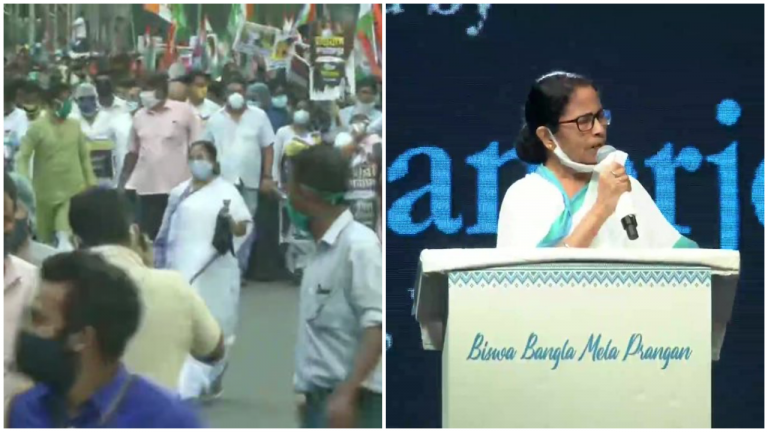
West Bengal CM Mamata Banerjee had yesterday announced to a packed auditorium that the 14-year-old minor girl who was allegedly raped and killed by a TMC leader’s son in Nadia’s Hanskhali, ‘had a love affair and nobody knows if she was pregnant.’
Speaking at the inauguration of the revamped Milan Mela, a permanent fair-ground opposite the Science City at the Eastern Metropolitan Bypass in Kolkata on the afternoon of April 11, Monday, the CM indulged in victim shaming, by indirectly slandering the character of a 14-year-old girl who is no more.
In order to downplay the allegations of rape, the Bengal CM stated, “As a layman, I am saying where would someone get the evidence whether she was actually raped or was she pregnant or was there any other reason, like someone beat her up or she died of some illness. There was a love affair for sure, her family knew about it, and their neighbours also knew about it. Now if a girl and a boy love each other, I cannot punish them”, said the WB Chief Minister Mamata Banerjee. “This is not Uttar Pradesh that I can do that in the name of Love Jihad”, said the West Bengal Chief Minister.
* Class 9 girl dies in Nadia, #Bengal. * Mother alleges gangrape by TMC leader’s son and his friends. * Cops cremate girl in a hurry. * CM Mamata Banerjee asks: “She had love affair with accused, so was it rape? Was she pregnant? Did she die of a slap?”pic.twitter.com/uDmL4HbcXh
Mentioning the ‘love affair’ multiple times, she even turned around once to ask one of her aides,” Is it not a fact? Everyone is saying that she had a love affair with that boy.”
Even though the investigation is underway and at present, the allegation of rape made by the victim’s family is yet to be proven, it is shocking that the CM of the state, instead of sympathising with the minor victim, makes such remarks about the alleged love affair, almost to the point of slandering the minor girl’s character and downplaying the incident. Also, a sexual relationship with a minor is statutory rape as per Indian law and is punishable under harsh provisions of the POCSO Act.
Mamata Banerjee had taken a protest march for Hathras victim
Ironically, the Bengal CM had taken the Hathras incident, where a young girl was found strangulated and rape was alleged by the family in their later statement, very seriously. She had given multiple statements over the condition of law and order in UP and had even taken out a protest march in Kolkata demanding justice for the Hathras victim.
West Bengal: Chief Minister Mamata Banerjee participates in the protest march being held from Birla Planetarium to Gandhi Murti in Kolkata over Hathras incident. pic.twitter.com/OWkjwtNbSM
Speaking at the rally, Mamata Banerjee had also stated that she felt like going to Hathras and meeting the victim’s family. She had also slammed PM Modi over the Hathras case in 2021, saying, “PM Modi knows very well that there is no rule of law in UP. How many commissions has he sent there? So many incidents, from Hathras to Unnao, have taken place. Even journalists are not spared. They give a bad name to Bengal. Maximum violence was pre-poll.”
It is a sad irony that a 14-year-old victim girl who died gets only shaming and apathy from her own state’s CM, while the same CM reserves her outrage and political power for victims in Uttar Pradesh.
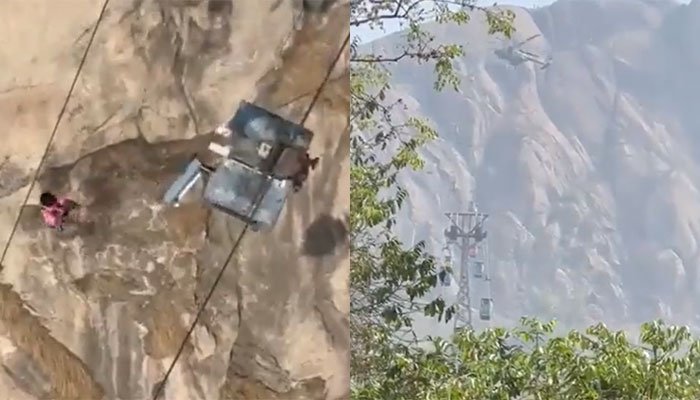
The rescue operation after the Tirkut Ropeway accident in the Deoghar district of Jharkhand is underway, and so far, over 40 people have been rescued by the agencies. Indian Air Force (IAF) is leading the rescue operation with support from Army, Indo-Tibetan Border Police (ITBP), Garuda commandoes and district administration. Two people, including a woman, have lost their lives.
Operations are underway by #IAF to rescue stranded tourists and passengers on #Jharkhand ropeway at Trikut hill near Deoghar.
The accident took place at the tourist location 20 KM from Deoghar. In an early-morning Twitter post, Deputy Commissioner (DC) Manjunath Bhajantri said that a total of ten out of 15 people had been rescued since morning. These 15 people could not be rescued on Monday due to extreme weather conditions and low visibility.
A woman who was among the rescued people was shifted to hospital on Sunday, where she succumbed to injuries that were sustained at the time of the accident. A man fell to death on Monday evening during the rescue operation.
Speaking to OpIndia, RK Mallick, Additional Director General of Jharkhand Police, said, “Proper inquiry has to be done by the agency that was carrying out the operation. They will be able to find out the reason for what happened. Only they can throw any light on that. It will not be proper for me to say anything. We have to wait for the assessment of the Air Force that was conducting the rescue operation.” ADG Mallick, who rushed from Ranchi to Deoghar after the ropeway accident, is overseeing the rescue operation.
There are a lot of speculations floating in the media about the reason behind the tragic accident during the rescue operation, but the clear reason can only be revealed by the Indian Air Force. OpIndia tried to reach out to the PRO of IAF but could not connect.
Hindustan Times quoted a rescued person saying that the accident took place at around 3:00 – 3:30 PM on Sunday. A total of 48 people were stranded in 12 of the 25 ropeway cars when the system halted following the rope down the line dislocated from the pulley. The rescue operation could be launched on Sunday evening but could not continue for long due to topography. The person said, “We had lost hope when we saw helicopters returning after doing two sorties. We could not sleep at night. We were provided food and water in the morning. I thank the rescue team for saving us.”
ITBP spokesperson Vivek Pandey said the rescue operation was difficult due to altitude and ropes. He said, “The first to be rescued were in the cabins that were only around 60 feet high from the ground. But risk increased as the height of the cabins progressively increased to over 500 feet, thus increasing the risk factor. The ITBP has previously conducted a similar rescue at a ropeway in Mussourie. We could not have risked trying to run the ropeway again as it is risk-prone to restart the system without a complete mechanical checking. So ultimately, the only option was to either provide anchors to the stranded and take them down or else airlift and land them at a safe place.”
BJP accused the Jharkhand govt of mismanagement
Jharkhand BJP president Deepak Prakash said in a statement that the tourism department failed to do routine maintenance for the past two years. He added that Hafizul Ansari, tourism minister of Jharkhand, failed to reach the accident site on Sunday though he was in Deoghar.
देवघर रोप वे हादसे के 24 घंटे बीतने के बाद भी झारखंड के मुख्यमंत्री,मंत्री और उनके अफसर मुँह छुपाते रहे.
Speaking to OpIndia, Prakash said, “It was a complete failure of the state government. Thanks to Prime Minister Narendra Modi and Home Minister Amit Shah, who took cognizance of the matter and sent IAF, NDRF and Army for the rescue operation.”
Trikut Ropeway
As per the Jharkhand Tourism department, Trikut Ropeway is the highest vertical ropeway in India, with a maximum lens angle of 44 degrees. Located around 20 KM away from Baba Baidyanath Temple, Deoghar, its length is 766 meters. A total of 25 cabins are available with the capacity of four passengers per cabin.
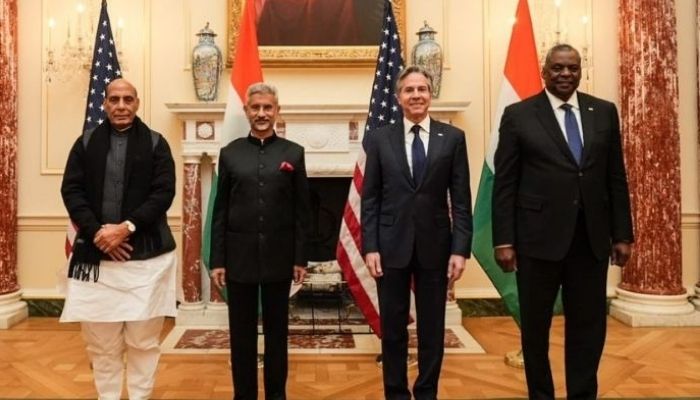
On Monday (April 11), External Affairs Minister S Jaishankar gave a befitting reply to a reporter, who had tried to raise the issue of Indian oil purchases from Russia during the 4th edition of the India-US 2+2 dialogue.
“I noticed you referred to oil purchases. If you are looking at energy purchases from Russia, I would suggest that your attention should be focused on Europe,” he emphasised.
Dr S Jaishankar pointed out, “We do buy some energy, which is necessary for our energy security. But I suspect looking at the figures. Our total purchases for the month will be less than what Europe does in an afternoon. So, you might want to think about it.”
External Affairs Minister S. Jaishankar in Washington, responding to a reporter’s question on India’s energy purchases from Russia, points out Europe buys more in an afternoon than India does in a month pic.twitter.com/4LJituULic
While defending the decision to purchase Russian crude oil at discounted prices, the EAM emphasised that it was important for India to obtain good deals on energy supplies, at a time when global markets were volatile.
“It is interesting because we have seen for some time what looks almost like a campaign (against us) on this issue. When the oil prices go up, I think it is natural for the countries to go out into the market and look for what are good deals for their people,” he had remarked.
During a conversation with British Foreign Secretary of State Liz Truss, S Jaishankar emphasised that India purchased its majority of energy supplies from the Middle East. He pointed out that around 8% of the total oil imports were from the United States while less than 1% of crude oil purchases were from Russia.
He had added, “I am pretty sure if we wait two or three months and actually look at who are the big buyers of Russian oil and gas, I suspect the list would not be too different from what it used to be and I suspect we won’t be in the top 10 on that list.
The latest incident of violence in Jawaharlal Nehru University (JNU) for serving meat is abhorrent, as such commotion has no place in an educational institution, let alone a university. Nothing gives a favourable impression to a university or institution when police vans and ambulances stop by every now and then. However, it appears that a certain segment of JNU has made it a badge of honour to continue drawing the attention of the authorities and the international community.
On the other hand, such violence on a Hindu holiday on the campus of an educated institution like JNU is not a mere coincidence. We are fully aware of JNU’s history and its milieu, which is infused with anti-Hindu air and partially secular water. With blood-splattered hands of ABVP activists to badly battered young learners, yesterday’s episode emphasises the campus-dominant left-liberal cabal’s conviction to dislodge the whole non-left existence off-campus.
Also, Why didn’t we hear something like this from Delhi University or Banaras Hindu University? Why is it exclusively JNU? This is because JNU has been specifically chosen by the anti-India and anti-Hindu forces looking at the stronghold of the left on the campus. Leaving aside the possibility of happenstance, no one knows how JNU appears in every single controversy, even if it didn’t originate there. This suggests that there is something fundamental that gets JNU embroiled in controversies from time to time.
Surprisingly, the recent violence in JNU coincided with a wave of violence that erupted across the country on the eve of Ram Navami. Several reports have revealed stone-pelting and arson during Ram Navami festivities, particularly in Muslim-dominated localities. Looking at the sequence of events and the chronology, one may simply decipher what it implies.
The violence in JNU, according to the leftist student (so-called) unions, erupted over some concerns about serving meat in the canteens. While the consumption of meat is a question for another day, we are all very well aware of how meat has been politicised and used deliberately to harm the religious emotions of Hindus and Jains in recent times. This charge made by a certain element of the JNU adds another hand to the very same attempt.
Various ‘meat festivals,’ including ‘beef festivals,’ have been organised in the past by some sections of society in order to offend Hindus and Jains’ religious sentiments. Students Federation of India (SFI) and Democratic Youth Federation of India (DYFI), the students’ and youth wing of the Communist Party of India (Marxist), organised the ‘Beef Festival‘ in Kerala back in 2018.
Similarly, the motive for the violence at JNU was the Ram Navami festival, and the pretext of meat was used to continue demeaning Hindus. The major motive was to disturb the Hindu festival celebrations and then incite violence since there is always the chance to play the victim card in the end. And this has been a tried and tested formula. Be it the controversy surrounding the Hanuman stickers on the mirrors of the car or the deliberate vilification of the ‘Jai Shri Ram’ slogans, the left intelligentsia and their footsoldiers in places like JNU and other leftist bastions spare no time in inventing causes to guilt-trip Hindus and paper over the murderous tendencies of the Islamists.
Earlier yesterday, Ram Navami celebrations came under attack in 5 different Indian States, namely, Gujarat, West Bengal, Jharkhand, Madhya Pradesh and Karnataka. They were allegedly orchestrated by frenzied mobs, who were armed with stones and sticks, and determined to stop the Hindu processions from advancing through their ‘Muslim areas’. But the focus of the attention was not the stone-pelting that was witnessed during the processions but on an allegedly contrived controversy of some scuffle over the consumption of meat in JNU. A day later, the leftists are desperately trying to play the victim card, blaming the processions for being “provocative” while going through ‘Muslim areas’—a characterisation which is nothing but a contemporary manifestation of the divisive Two-nation theory.
Everyone is aware of JNU’s track record, and we all recall anti-India slogans on the campus a few years ago. JNU is being exploited to purposely promote the anti-India and anti-Hindu narrative. The recent incidence of violence at JNU was a similar attempt to humiliate Hindus on Ram Navami and inculcate fear that such incidents will become foreseeable if Hindus do not stick to their way of professing religion and allow them unjustified freedom across institutions and spaces to do whatever they want.
Stone pelting was once an everyday phenomenon in the Kashmir Valley. Young children and grown men alike, dawned skull caps, unfurled ISIS flags and took to stoning the security forces in unison. However, with the abrogation of Article 370 in 2019, the cases of stone-pelting gradually began to drop. Today, it is close to nil.
However, it remained a central part of protests against the Indian Armed forces stationed in Kashmir. While sometimes stone-pelting was used by Islamists to agitate security forces, knowing fully well that the security personnel won’t use guns against them, at other times it was used as a tool to help besieged terrorists escape from being caught by the forces. Though it cannot be denied that several of the stone pelters were backed by the Pakistani deep state, the religious motivation behind it could not be understated.
Much like stone-pelting was used as an instrument of defiance against security forces in Kashmir, it was and has been routinely used to target Hindu processions when they pass through neighbourhoods that are now being referred to by the liberal intelligentsia as ‘Muslim areas’, which is nothing but a contemporary manifestation of the divisive Two-nation theory. Processions, carrying deities, often come under a volley of stones, followed by arson attacks, vandalism and violence, under the garb that they played devotional songs and hymns that ‘provoked’ the other side.
This was witnessed during the recent Hindu New Year celebrations in the Karauli district of Rajasthan where a Hindu procession, which was carried out after more than 7 years, witnessed stone-pelting and a wanton bout of violence and vandalism. Earlier yesterday, Ram Navami celebrations came under attack in 5 different Indian States, namely, Gujarat, West Bengal, Jharkhand, Madhya Pradesh and Karnataka. They were allegedly orchestrated by frenzied mobs, who were armed with stones and sticks, and determined to stop the Hindu processions from advancing through their ‘Muslim areas’.
As stone-pelting seems to be the default choice of action by the Islamists who get ‘provoked’ on something as fundamental as a procession being carried out from their ‘areas’ by non-Muslims, it is important to understand what the religious scriptures and commandments say about stone-pelting.
Stoning of the Satan in Islam
During the Islamic pilgrimage (Hajj) to Mecca, Muslims participate in a ritual called the Rami al-Jamarat. They hurl stones at 3 pillars (jamarat), believing it to be the abode of Satan. It must be mentioned that the Jamarat is located in Mina city, which is located east of Mecca.
The Islamic ritual mandates that Muslims collect 70 stones and throw them at the three pillars on the day of Hajj. The ritual is repeated for the following 3 days before the completion of the circumambulation of Kaaba.
“Narrated Ibn `Abbas: The Prophet made Al-Fadl ride behind him, and Al-Fadl informed that he (the Prophet ) kept on reciting Talbiya till he did the Rami of the Jamra (stoning of the Satan),” says Sahih al-Bukhari 1685.
Furthermore, the Sahih al-Bukhari 1748 notes, “Narrated Abdur-Rahman bin Yazid: When Abdullah, reached the big Jamra (i.e. Jamrat-ul-Aqaba) he kept the Ka`ba on the left side and Mina on his right side and threw seven pebbles (at the Jamra) and said, “The one on whom Surat-al- Baqara was revealed (i.e. the Prophet) had done the Rami similarly.”
A video of the ritual was shared by Qatar funded news outlet, Al Jazeera on Youtube. According to Islamic Finder, the stoning of Satan represents submission to the commandment of Allah.
“Throwing pebbles at the Satan is not as if Satan is present at the place, rather it is an exercise of faith: this act is a testament that the believers are able to resist the thoughts and desires that Satan puts in the believer’s mind,” it noted.
Islamic Finder further emphasised, “Even though a pilgrim is throwing a pebble at one of the pillars of Jamarat, but in fact, he or she is throwing them in the face of Satan as nothing annoys Satan more than a man following the command of Allah.”
Stoning to death for ‘adultery’
The Islamic practice of stoning is not just limited to pillars, assumed to be the embodiment of Satan. Adult men and women in Islamic countries are often flogged and stoned to death for committing the supposed sin of ‘adultery.’
“As for female and male fornicators, give each of them one hundred lashes, and do not let pity for them make you lenient in ˹enforcing˺ the law of Allah, if you ˹truly˺ believe in Allah and the Last Day. And let a number of believers witness their punishment.“
Although there is no explicit mention of killing over adultery in the ‘Holy Book’, the authentic Hadith of Sahih Muslim (which contains the sayings of Prophet Muhammad) claims otherwise.
For instance, the Sahih Muslim Book 17, Hadith Number 4191 states –
“Ubada b. as-Samit reported: Allah’s Messenger (may peace be upon him) as saying: Receive (teaching) from me, receive (teaching) from me. Allah has ordained a way for those (women). When an unmarried male commits adultery with an unmarried female (they should receive) one hundred lashes and banishment for one year. And in case of married male committing adultery with a married female, they shall receive one hundred lashes and be stoned to death.“
A clarification for the disparity in punishment between Quran and Hadiths for adultery is explained in the Sahih Muslim Book 17, Hadith Number 4194. It states–
“…I am afraid that with the lapse of time, the people (may forget it) and may say: We do not find the punishment of stoning in the Book of Allah, and thus go astray by abandoning this duty prescribed by Allah. Stoning is a duty laid down in Allah’s Book for married men and women who commit adultery when the proof is established, or it there is pregnancy or a confession.”
Conclusion
Given that Islamists are purists who adhere to the Quranic and Hadith sanctions in all its entirety, it cannot be ruled out that an idol-worshipping Hindu might appear as an embodiment of the ‘Devil’ to them. Also, several scholarly accounts claim that Islamic texts preach extermination of non-believers and apostates, and regard idolatry as one of the biggest ‘sins’.
It must be recalled that former Shia Waqf Board Chief Waseem Rizvi (converted to Jitendra Narayan Singh Tyagi) had last year appealed to the Supreme Court to remove 26 verses of the Quran, which called for the annihilation of infidels and disbelievers.
It is, most likely, for these reasons, that stone-pelting has become such a popular practice among Islamists. Whether it is their opposition to security forces, and by extension, to India’s sovereignty of Kashmir, or their antagonism towards processions carried out on Hindu festivals, they don’t flinch from resorting to stone-pelting, which has been widely cited in various Islamic texts.
Considering that the targeting of the Hindu festivals is a routine occurrence, can the indoctrination of bigotry, coupled with sanctions of the religious scriptures, be ruled out?