Home Blog Page 3491

The more you panic and more noise you make, you will sink faster: The Modi juggernaut and the quicksand that opposition is in

In the last few years with BJP forming the government twice over at the centre and also ruling many states the opposition is dealing with a slippery phenomenon on a slippery slope. Why a slippery phenomenon? Because they have not been able to decode or decipher this phenomenon and that is why don’t know from which side to get hold of it- for them, it is as mysterious and powerful as the Cyberdyne systems Model 101 or the T-800 popularly known as ‘The terminator’ played by Hercules like Arnold Schwarzenegger also known as a cyborg- who is impossible to beat. Another streak of this phenomenon is like that of the ‘predator’ being played again by Schwarzenegger who is visibly invisible and surprises you with omnipresence and is formidable as an opponent. This is a Ghost who walks- yes you guessed it right- Phantom. They call it Modi juggernaut.

Led by Prime Minister Narendra Modi and flanked by Amit Shah and razor-sharp erudite mind in Subrahmanyam Jaishankar and Ajit Doval giving covering fire as National security advisor the entire casting is occupying the entire cinemascope screen and it seems to be too formidable for anyone to take on easily. 

In one TV interview Prashant Kishore, who needs no introduction said something about PM Modi which seems very obvious but most of us including me could not put in correct panoramic perspective or missed it outright. He said that PM Modi is first amongst equals-and is always a couple of steps ahead of others- because his last 45 years in public life have been stellar and extremely educative to take him on a learning curve that may be no one else has ever got.

He explained that the first fifteen years as a Pracharak took him at the grass-root level to understand what our diverse problems are and also the pain points of such a large diverse country. The next fifteen years as a Karyakarta (party worker) and event organizer of the largest political party. Then next 15 years in the governance of a state taught him rajneeti and administration. In addition to the gift of the gab, nothing could be better for Narendra Modi. Of course, he is a good listener and a fast learner.

The losing game people are playing

Never interrupt your enemy when he is making a mistake, said Napoleon Bonaparte.

These ten words of Napoleon are golden words of wisdom that must be used as a stratagem. It is better not to react to whatever your adversary or opponent is doing or saying. And that is what is being done by the government. Bonaparte’s ten words in two are – Just watch.

In fact more the noise the opponents create the better it is for PM Modi. Mostly they make noise for nothing and that is their weakness and a problem. You must find a genuine fault and then build a substantial narrative and then a perception around it. Otherwise, you lose credibility – It is a cry wolf syndrome. They thought they could come up with some slogans which would damage his image – but totally false allegations will not stick. So most of them backfired. You are saying ‘Chowkidar Chor hai’ shouting from a sprawling bungalow which your sister was not even authorized! And had to be unceremoniously made to vacate. Congress made noise about that too as a fiefdom-ish statement which again didn’t work. 

The PM has not helped any of his relatives in any way, donates around Rs 100 crore plus from the auctioned gifts and personal savings. His 90 year plus an aged mother who could well stay in his official accommodation stays with his brother in Gujrat. A man who has led a frugal life and has no one to favour besides his own nation cannot be called a thief for God’s sake. He is spotlessly clean as a whistle. You must learn from history but must understand it before using it. The opposition took Joseph Goebbels the propaganda Chief of Adolf Hitler too seriously when he said ‘Repeat a lie often enough and it becomes the truth’. There was no social media, satellite TV or even serious courts those days bro- it was 1933. Germany a small nation could be fooled but not today- you need to learn newer tricks of the day.

Social media has become a great leveller today. With all the fake news, ill effects of misuse by some and doctored stuff and spin-doctoring galore somehow there is a balancing act carried out by nature which plays a decisive role on social media too. ‘Hawa ka rukh dikhta hai- saaf dikhta hai’ you can make out which way the wind is blowing.

This windsock effect is so evident when you watch Television debates- if anchors are smart the public over a period of time has become smarter. It’s a four corner debate on all channels. Here is a group for ‘for’ and another for ‘against’ and then there is an anchor who adds to the chaos rather than being a moderator (none of our anchors can handle rowdy debaters as Tim Sabastian of hard talk fame. With his reading glasses on the tip of his nose he could stop anyone going out of line- I miss him). The fourth one is the most important who is a muted mute spectator- actually this entire thing is stage-managed for the spectator only! And he is the smartest.

One can make out how embarrassed and albeit silly the guys look when defending the un-defendable. Some are fired/spent cartridges some are rubber bullets and most dud shells. Mostly the last string of players from a political party in opposition is offered at the altar. They are recycled and predictable. Some are proud to put a tag ‘expelled Neta’ which is as good as putting on your CV ‘Tenth class fail’. One has to give credit to their Oscar-winning straight-faced performance even when most uncomfortable questions are thrown at them. Shameless. They can’t even duck for cover in the studio but for that one-hour losing battle put up a brave face. When someone is rattled either he/she starts shouting and becoming personal, heckling or starts smiling to avoid further embarrassment. They distort everything. Most recently CM of UP Yogi said, elections will be on 80:20 and 80% will vote for BJP in UP on basis of positive work done and people who want progress, good law and order and 20% will vote against BJP who are with negative forces like goonda raj, mafia and negative energy. How conveniently the opposition turned it in to a lie that he means 80% Hindus and 20% Muslims! What gross white lies?

Imagine respectable people like Actor Amir Khan saying he is not safe a few years back but he is still hale and hearty. On the other fronts, it is more annoying and embarrassing. You have Mani Shankar Iyer caught on camera in Pakistan pleading with them to topple the government and remove Mr Modi. One would have never witnessed anything like this in our 75 years of History.

Then you have award wapsi brigade who was totally nondescript and in total oblivion till they came to return their awards and no one bothered as no one knew who they were. Students were incited and JNU and others made a lot of noise for nothing and nothing much came out of it except such fine institutions got a bad name on the rebound. Mr Sidhu hugging the Pakistani Army chief was quite a tamasha- even a class 5 boy would not approve of it. Hasn’t gone well for him at all. People can do little but they are watching.

Latest in the list of fiascos is Mr Hamid Ansari former Vice president of India attending a virtual conference being a Panelist at a conference organised by the Indian American Muslim Council on January 26 2022. Some US senators and failed actors join the fray as if to add some featherweight to the event.

Today, Geopolitics is in a churn, the world is in transition and the balance of power is shifting fast and moving like molten lava. Unfortunately, America is no more seen as the land of the resurrection where opinions are tom-tommed matter. To be fair to the US, the entire West. Look they could do nothing in Afghanistan and little is being done by NATO, US and EU to come to the rescue of Ukraine which is standing up almost alone to Russia and there is only lip service given to tiny Lithuania and Taiwan who are looking straight in the eye of mighty China. 

India is, too big, too powerful and too important today and a jab by a few like Hamid Sahab will be no more than a mosquito bite to cause may be a small bump on the skin that disappears in a short time without any external intervention or medication. Yes, the loss will be entirely of the mosquito who was given the second-highest constitutional office and who lived up to the reputation of the mosquito breed that lives off the blood of others.

Still living like a Maharaja in the country and as someone remarked in a TV discussion just yesterday –‘ Jiss Thaali main Khatey ho ussi main ChChed karte ho’ was not too much off the mark. He stands to gain nothing- nothing at all. Yes for others who may have been sponsored this may be a good free ride and a bit of bad publicity which they clamour for – They love getting trolled not for professional competence which they lack but for such activities.

Americans are themselves scared after 9/11 and they talk of intolerance in India. First, put your own house in order and then initiate such actions.

The opponents in India are in quicksand. In such a mess if you move or flutter too much you sink further down. Shouting helps no one as no one is listening. The worst is if you put your foot in the mouth when you are sinking in a scary black hole! Professionals have some tips to get out of Quicksand. You need to do the following four things for sure. If you want to survive.

  1. Take deep breaths.
  2. Don’t panic.
  3. Move slowly and deliberately. 
  4. Use Your Resources wisely, assess your surroundings, and utilize any trees with reachable branches. Only grab them after you have achieved a safe position.

The more you panic and more noise you make you will sink down faster. 

Uttar Pradesh: Ink thrown at Kanhaiya Kumar inside Congress party office in Lucknow, party leaders claim it was ‘acid’

A man has reportedly thrown ink at Congress leader Kanhaiya Kumar at the Congress party office in Lucknow on Tuesday. The youth identified as Devansh Vajpayee was caught by NSUI activities after attempting to throw Ink at the CPI-turned-Congress leader.

According to the reports, Congress leaders had congregated at the Lucknow office to participate in the nomination of candidate Sadaf Zafar from Lucknow Central constituency. During this gathering, ink was allegedly hurled at Kanhaiya Kumar.

In the videos of the incident that are doing the rounds on the internet, just when Kanhaiyya was being welcomed at the gathering surrounded by party workers, a youth popped up to throw ink at him and screamed slogans ‘Kanhaiya Kumar Murdabad, Murdabad!”. Following the incident, a scuffle reportedly broke out between two groups inside the Congress office. While Kanhaiyya was saved from the attack by party workers, the attacker was held by police later.

However, after the incident, some congress party workers alleged that it was not ink but acid that was thrown at the former JNU student. “The accused tried to throw acid at Kanhaiya Kumar but failed to do so. However, some drops fell on 3-4 youth standing nearby,” Congress leaders said.

Kanhaiya Kumar, who was earlier with CPI, is one of the star campaigners for the Congress party for the upcoming Uttar Pradesh assembly elections. He was in Lucknow to promote party candidate Sadaf Zafar, who is going to fight the polls from the Lucknow Central constituency. It is worth noting that Sadaf Zafar was arrested by UP Police for participating in the anti-CAA protests in 2019. She is currently out on bail on charges of rioting.

Rashtranayak Netaji: Dharmic moorings of Subhash Chandra Bose and the death-blow to the British Raj in India

Netaji Subhas Chandra Bose must be conferred the title of Rashtranayak (national hero) lickety-split. Unfortunately, Article 18 (1) of the Indian Constitution does not permit any titles to individuals, except when in an academic or military context. That is why MK Gandhi has never been officially the ‘Father of the Nation’ and lamentably, Netaji cannot be conferred the title of Rashtranayak. If there was ever an Indian hero in modern times, it has to unequivocally be Netaji. After facing sustained opposition from the pro-Gandhi factions of the Congress within the party and severe restrictions from the British Raj that culminated in his house arrest in Kolkata, Netaji took a flight of imagination and vision and escaped in a most idiosyncratic manner to mobilise Indians abroad towards an armed struggle against the Britishers, to unshackle India from their hold.

On 21 October 1943, he established the Azad Hind Government with Japanese support in Singapore, with its jurisdiction being primarily over the Andaman and Nicobar Islands, even as it later struggled to make inroads into the North-East of India. The provisional government commanded a sizeable army comprising of Indian POWs (Prisoners of War) captured by the Japanese during the Malayan campaign in Singapore and had diplomatic relations with various countries, including Germany, Italy, Croatia, Thailand, Japan, Burma, Second Philippine Republic and Manchukuo. If significant expanse and populace under jurisdiction coupled with international recognition were to be the barometer for the legitimacy of a government, Netaji was indeed the first Prime Minister of free (and, might I add, undivided) India. Technically, however, it took another couple of years for the official Indian Independence Act [1947 c. 30 (10 & 11. Geo. 6.)] to be signed and for India to have its much-cited ‘tryst with destiny’.

One often wonders how the country may have evolved, particularly in its infancy, had Netaji been at the helm of matters. Some say that he would have established a socialist authoritarian state, as he said he sought to do for about two decades to even out India’s social and political problems before democracy could be installed, while others feel that Partition would never have taken place with Netaji as the national leader. Given that it was interestingly Bose who had placed Nehru as the chairman of the National Planning Committee (NPC) after Nobel Laureate Rabindranath Tagore had intervened to convince a reluctant Nehru with the words

“there were only two modernists in the High Command—you and Subhas Babu”

Ref: Letter from Anil Kumar Chanda to Jawaharlal Nehru (1938).

it seems likely that his would have been the planned economy that Nehru established post-independence. Whether India would have lost the War of 1962 with China is anyone’s guess. I, for one, do believe that Netaji would have prioritised realpolitik and pragmatism over the utopian positivism that the Panchsheel framework seems to present to a belligerent China, which had just annexed Tibet. 

What people, however, seldom know and realise is that MK Gandhi was hardly the only prominent leader of the later stages of the Independence movement to have a strong Dharmic mooring and alignment.

While Netaji was fairly against the activities of Veer Savarkar and the Hindu Mahasabha, given the famous criticism by the All India Forward Bloc of Veer Savarkar’s speech in December 1939 against the A. K. Fazlul Haq government of Bengal (back in the day, rather pretentiously, the British Raj had instituted the office of `Prime Minister of Bengal’, an office that Haq first occupied on 1 April 1937), he was a devout Hindu and believed in Dharmic ideas and principles. Not many know that Netaji always carried a copy of the Srimad Bhagavad Gita with him. From a young age, Netaji was quite influenced by the teachings and lives of Sri Ramakrishna Paramhansa and Swami Vivekananda. This is evident in his words

How shall I express in words my indebtedness to Sri Ramakrishna and Swami Vivekananda? It is under their sacred influence that my life got first awakened. Like Nivedita, I also regard Ramakrishna and Vivekananda as two aspects of one indivisible personality. If Swamiji had been alive today, he would have been my, My guru, that is to say, I would have accepted him as my Master.

Ref: A Patriot Monk Swami Vivekananda by Santa Kumara

Netaji was spiritual and ever-committed to Dharmic ideals throughout his life. He found in Sri Ramakrishna Paramhansa’s teaching on the oneness and unity of all religions an inspiration for the diversity he later encouraged in his Azad Hind Fauj. Just like Sri Ramakrishna Paramhansa, Netaji was an ardent follower of Ma Kali and kept a pictorial representation of the deity in his pocket. He believed that Swami Vivekananda preached the purest form of Hinduism, in which caste and creed had no relevance and bearing at all. Netaji highlighted the role Swamiji played in inspiring nationalism and encapsulating the very spirit of India in his writings, saying:

The foundation of the present freedom movement owes its origin to Swamiji’s message. If India is to be free, it cannot be a land especially of Hinduism or of Islam—it must be one united land of different religious communities inspired by the ideal of nationalism. (And for that) Indians must accept whole-heartedly the gospel of harmony of religions, which is the gospel of Ramakrishna-Vivekananda

While Netaji was a student in Presidency College in 1913, he even considered joining the Ramakrishna Mission as a sanyasi. To that end, he met Swami Brahmananda, a direct disciple of Sri Ramakrishna Paramhansa and the then-president of the Order. It is said that the apparently prescient Swamiji told Netaji that he was not meant to be a sanyasi. If the theories of Netaji having survived the plane crash in 1945 and returning to India as a seer named Gumnami Baba are to be taken seriously, his childhood ambition may have had an avenue of expression.

This close association with the Ramakrishna Mission continued for years after. As per the reminiscences of Swami Shankarananda of the Ramakrishna Math, Swami Abhedananda, a direct disciple of Sri Ramakrishna, wanted to meet Netaji Subhas Chandra Bose in 1939. Upon meeting the dynamic leader, Swamiji embraced Netaji with great affection and blessed him, saying, “Be thou victorious.” During his time in Singapore, Netaji had a special relationship with the Ramakrishna Mission there, often meditating in the shrine late into the night and sharing a good rapport with Swami Bhaswarananda with whom he had many spiritual discussions.

Swami Bhaswarananda was impressed with Netaji, saying that he had the grace of God and could move people with the force of his personality as well as the strength of his character. Netaji also donated to an orphanage run by the Ramakrishna Mission there and contributed towards the Tithi Puja celebrations of Ma Sarada Devi. Back in the day, Netaji would accompany his father Janiki Nath Bose to Hindu mutts in Cuttack in present-day Odisha, particularly one set up by Jagatguru Srimad Bhaktisiddhānta Sarasvatī Goswami, the famous Gaudiya Vaishnava Hindu guru whose student Sri Abhay Charanaravinda Bhaktivedanta Swami (Srila Prabhupada) established the world-famous ISKCON, in Cuttack. His respect and recognition of Dharma being the cement that held the nation together is seen in the words

“Though geographically, ethnologically and historically India represents an endless diversity to any observer-there is nonetheless a fundamental unity underlying this diversity […] The most important cementing factor has been the Hindu religion. North or South, East or West, wherever you may travel, you will find the same religious ideas, the same culture and the same tradition. All Hindus look upon India as the Holy Land.” 

The Indian Struggle by Netaji Subhas Chandra Bose

Netaji speaks of the spiritual dimension and the essence of his spirituality, evidently influenced by Vedanta and its conception of reality at its most fundamental, in the following words in his unfinished autobiography, ‘An Indian Pilgrim’.

“Reality, therefore, is Spirit, the essence of which is Love, gradually unfolding itself in an eternal play of conflicting forces and their solution” 

An Indian Pilgrim by Netaji Subhas Chandra Bose

When Rabindranath Tagore welcome him to Santiniketan in January 1939, Netaji responded to him in a memorable extempore response, wherein he expressed his gratitude to the litterateur and luminary for speaking on the inner poverty of individuals, which must be addressed and resolved for true emancipation of Indians. Speaking on this, Netaji emphasised how it was indispensable that we must spiritually actualise to be able to accomplish our goals as individuals, saying:

“We are today no doubt working tirelessly to attain national freedom, but our ideal is greater. We want complete fulfilment in personal and national life. We desire that every man and woman of the country and the entire nation may in every respect realize Truth. In this quest, in this Sadhana, political freedom is only a means.”

One of the greatest attainments of Netaji on the spiritual and philosophical plane was his aversion to accepting anything without reasoning and evidence, which is the quintessential experiential and truth-oriented approach of Vedanta and the Dharmic way of life. At the practical level, just like Sri Aurobindo, Netaji believed that political freedom is not possible until one has social and economic freedom.

This comprehensive emancipation was something that made him realise that simply unshackling the colonial yoke would truly bring India to the point of realising its potential and promise. While Netaji was broadly spiritual in a Vedantic mould, he did not shy away from acknowledging and referring to a Saguna God, as is seen in his speech to establish the Azad Hind government:

“In the name of God, I take this sacred oath to liberate India and the thirty-eight crores of my countrymen. I, Subhas Chandra Bose, will continue the sacred war of freedom till the last breath of my life.” 

For Netaji, the battle was as sacred and spiritual as it was political, and the emphasis always was to create a fundamental premise and foundation that comprised of key spiritual, social, philosophical, political and economic dimensions. In doing this, Netaji placed emphasis on the Upanishadic concept of Tyaga (त्याग) – sacrifice, and imbibed the ideal of renunciation for self-realisation and actualisation. At a very young age, he became determined to leave all else to work for his country, as seen in his words, that he spoke in his youth.

“I had a new ideal before me now which had influenced my soul to effect my own salvation and to serve humanity by abandoning all worldly desires and breaking away from all undue restraints.”

And when the time came for mass mobilisation, his call for sacrifice by all patriotic Indians was resonant with the ancient call of Dharmic seers and luminaries to use the power of sacrifice for the betterment of mankind. What was even more commendable and reflective of Dharma at its most fundamental was the focus on pluralism and cosmopolitanism. Netaji always saw economic issues as cutting across communal divisions and barriers, and the movement towards political emancipation as being for all the children of the land of Bharatvarsh, cutting across schools of thought and theism. That had always been the Indic way. Netaji also extended the Dharmic idea of emancipation cutting across constructs of identities and ideologies. One of the main areas where he was vocal on this front was that of breaking asunder one societal encumbrance that had arisen from the corruption of previously spiritual categorisation – casteism.

Caste had divided Indian society in ways that had institutionalised discrimination and exploitation, and that the colonial powers had used for their selfish interests at the expense of the Indian cause. He also spoke for gender equality and parity, and this was best seen in the much-celebrated Rani Jhansi regiment, one of the first all-female regiments in a modern army, in the Azad Hind Fauj. After all, the fundamental spiritual way of looking at freedom and emancipation summarily is at variance with any form of physicalist or societal segregation and discrimination. The elephant in the room, when it comes to delineating how Dharmic Netaji’s vision was, is his association with the Nazis in Germany and the Axis powers, more generally.

For starters, Netaji and Hitler were on opposite ends of the ideological spectrum. Netaji was a socialist through and through, while Hitler made a name for himself by culling the socialists in Germany. People often wonder how Hitler, with his much-highlighted `National Socialism’, was not a socialist! The term `National Socialism’ was a misnomer arising out of an attempt to redefine socialism, and not going by the Marxist socialist ideas. Nazis rejected the idea that class conflict was an important aspect of society to be addressed.

They opposed any semblance of international cosmopolitanism or cosmopolitan internationalism. The only `common good’ that they stood for was that of the nation, in their nationalistic fervour, in a rather collectivist or communitarian way, rather than a truly socialist one! Bose, on the other hand, was the one who brought the concept of a planned economy to the Indian masses in a definite way. Hitler was very derogatory about Indians throughout, while Netaji lived, breathed and worked for India and Indians. Netaji’s contempt for the Nazi cause was evident in his letter to Dr Thierfelder, President of the Deutsche Akademie, a German cultural institution that had sponsored a scheme for giving scholarships to Indian students studying in Germany on Indo-German ties, way back in March 1936:

“When I first visited Germany in 1933, I had hopes that the new German nation which had risen to a consciousness of its national strength and self-respect would instinctively feel deep sympathy for other nations struggling in the same direction. Today, I regret that I have to return to India with the conviction that the new nationalism of Germany is not only narrow and selfish but arrogant.[…] Herr Hitler has talked of the destiny of the white races to rule over the rest of the world. But the historical fact is, that up till now the Asiatics have dominated Europe more than have the Europeans dominated Asia … We who are struggling for our own freedom desire that all nations should be free and that Europe and Asia should be at peace with one another. It, therefore, pains us that the new nationalism in Germany is inspired by selfishness and racial arrogance.”

Bose was not sparing in his criticism of the racial policy of the Nazis. For instance, when Hitler referred to white superiority in a speech in 1936, Bose denounced him in a press conference in Geneva and advocated a trade boycott of Germany. In a similar manner, Bose strongly rebutted Hermann Göring’s disparaging remarks on Mahatma Gandhi. By the end of the 1930s, Netaji was quite disillusioned with the Nazis. He once told a journalist.

“Fascism had not started on its imperialist expedition, and it appeared to me merely an aggressive form of nationalism”

Some may ask why then did he hobnob with Nazi Germany subsequently. In his dalliance with Berlin, his sole purpose was the liberation of his motherland from British rule. He may have been naive in his political operations, but Netaji was never a Nazi supporter per se. Bose was deeply disturbed by the treatment of Jews by the Nazis. Yet he was seeking to look away and maintain a relationship with Hitler and Germany only for anti-British realpolitik and to assist Indian independence. Insight is obtained from his communication with a Jewish friend Mrs Kurti, as mentioned in her book `Subhas Chandra Bose as I knew him’:

“It is dreadful, but it must be done. It is our only way out. India must gain her independence, cost what it may. Have you any idea, Mr and Mrs Kurti, of the despair, the misery, the humiliation of India? Can you imagine her suffering and indignation? British imperialism there can be just as intolerable as your Nazism here.”

Netaji used to say that an enslaved nation cannot have the convenience and comfort of ideological filtering and political correctness and sought the freedom and emancipation of a people who had had to face the worst ordeals and persecution one could imagine, from the Jallianwala Bagh massacre to the man-made Bengal famine. The magnitude of how effective Netaji was can be fathomed from a conversation between former British Prime Minister Clement Attlee and the acting Governor of West Bengal Justice P. B. Chakroborty, who was also the Chief Justice of the Calcutta High Court, in 1956. Justice Chakroborty famously said:

“When I was acting governor, Lord Attlee, who had given us independence by withdrawing British rule from India, spent two days in the governor’s palace at Calcutta during his tour of India. At that time I had a prolonged discussion with him regarding the real factors that had led the British to quit India. My direct question to Attlee was that since Gandhi’s Quit India Movement had tapered off quite some time ago and in 1947 no such new compelling situation had arisen that would necessitate a hasty British departure, why did they have to leave? In his reply, Attlee cited several reasons, the main among them being the erosion of loyalty to the British crown among the Indian Army and Navy personnel as a result of the military activities of Netaji. Toward the end of our discussion, I asked Attlee what was the extent of Gandhi’s influence upon the British decision to leave India. Hearing this question, Attlee’s lips became twisted in a sarcastic smile as he slowly chewed out the word, ‘m-i-n-i-m-a-l’”

This conversation was first published by Ranjan Borra and the Institute of Historical Review in 1982. When the Second World War had ended, the officers of the INA troops who were captured by the British Raj had to go through the infamous Red Fort trials. The Britishers had downplayed the role of the INA during the War, saying they were a bunch of Japanese-inspire forces.

The trials, however, brought to the fore the magnitude of the efforts by Netaji and his troops. This had an electrifying effect across the country. After all, to the millions and millions of Indians, here was a leader and here was an army that was poorly supplied and ill-equipped but who had not flinched even once to lay down their lives for India’s independence. On 20 November 1945, a secret note from the head of the Intelligence Bureau (IB), Sir Norman Smith, stated that:

“There has seldom been a matter which has attracted so much Indian public interest and, it is safe to say, sympathy.”

There were massive demonstrations and a Hartal (strike) in Lahore, Rawalpindi and Lyallpur in the first two days of the trial, while  `INA days’ were held in Vellore, Salem, Karachi, Madras and various other cities and towns in India. Posters had started to appear in Calcutta and Delhi that threatened to kill 20 Britishers for the execution of every INA hero. The governor of the Central Provinces even voiced doubts about how willing the Indian troops would be to reign in the mobs, comparing the situation to 1857, when the Sepoy mutiny took place.

Ironically, even the Muslim League under Jinnah, with whom Bose had shared a rivalry and significant hostility, sided with the INA heroes. Netaji’s Dharmic cosmopolitanism in embracing Muslims, even at the very top of his army and government, had made it impossible for the League to stay aloof. Even Nehru, who had retired from the bar a quarter of a century earlier, joined the legal defence team of the INA officers. This also was ironic since Nehru had publicly condemned the INA when they were waging pitched battles in the North-East of India, while Netaji was gracious in naming an entire brigade of the INA after Nehru.

Immense public pressure, due to demonstrations and riots, forced the General of the British Indian army, Claude Auchinleck, to release all three defendants of the trials. Within 3 months, 11,000 soldiers of the INA were released after being cashiered and with their pay and allowances being forfeited. So paranoid were the Britishers that as per a recommendation of Lord Mountbatten and with Nehru agreeing, no soldier of the INA was to be allowed to join the armed forces of independent India, as a condition for independence! Upon the officers’ commutation of sentences, there was a massive celebratory rally of around 1,00,000 people in Delhi. Similar numbers were seen coming out in support of the heroes in Punjab.

The magnitude of how loved and respected these officers were comes from communication by Sir Bertrand Glancy on 17 November 1945, when he said executing these war heroes would result in a situation worse than in 1919 (preceding the Jallianwala Bagh massacre) or in 1942, and would make a peaceful, constitutional settlement very difficult. Given that Punjab was an important centre of recruitment for the British Indian army, the ripple effect that the trials and subsequent electrifying effect that the release of the officers had could seriously jeopardize the possibility of the army being able to stand its ground, imminently. By December of 1945, Auchinleck reported to the British government in London that native forces could not be relied upon to suppress any insurrection, saying:

“To regain control of the situation, nothing short of an organised campaign for the reconquest of India is likely to suffice.”

His request for three additional British battalions was denied by the British cabinet, saying that there was a large-scale demobilisation of forces and the soldiers did not seek to return to battle duties after the prolonged Second World War. Moreover, Indian officers hinted that their men or they themselves may not remain loyal if an insurrection happened. Historian Peter Fay once said:

“In the autumn of 1945, India was swept by a storm of excitement and indignation, a storm that Bose and his renegades ignited. It was a storm the Indian officer, and the jawan too, could not ignore. They did not ignore it. In 1942, at the time of Quit India, there had been no question of their reliability. Now their own commander doubted it. Three years of campaigning, three years climaxed by battlefield victories in Europe and the Irrawaddy, do not explain the change. Only that autumn storm can. It was the Indian National Army that forced Britain’s hand.”

The British Raj in India was premised on the strength of the British Indian army, for theirs had been the mercantile and subsequently the militaristic approach to acquiring clout and power. While Netaji may not have succeeded in driving through to his ultimate goal with the Azad Hind Fauj, his efforts ultimately incited a nationalistic fervour that threatened to bring the Raj down in India. Indian soldiers had started speaking of their loyalty to the Congress and the Indian forces and not their British overseers. The Royal Indian Air Force (RIAF) saw a crippling strike by 5,200 pilots and officers in January 1946.

The HMIS Talwar, a signal training ship in Bombay, saw a full-scale mutiny, with the mutineers demanding that all INA prisoners be released, the pay of British and Indian soldiers be equalised and that the Indian soldiers fighting in Indonesia against the nationalist army of Sukarno be withdrawn. Since the HMIS Talwar was a signalling ship, the mutineers quickly communicated with other ships, resulting in 78 of the 88 ships of the Royal Indian Navy joining the mutiny! This spread to all the important ports along the east and west coast of India. Just a day after, Clement Attlee, the then-Prime Minister of the UK, announced that a Cabinet Mission will be sent to India to begin negotiations for India’s independence. While in mid-January 1946, the British cabinet still believed in self-righteous, presumptuous and, might I add, delusional humbug such as:

“If no solution is reached (for problems faced by Indians on various fronts)… we should continue governing India even if it involved rebellion which would have to be suppressed by British troops.”

With the various mutinies, soldiers in the army being hair-length away from revolting as well (although there was a mutiny by the Jabbalpore regiment, and various engineering units of the Madras Regiment had also joined in), and clear expression of no-confidence by Auchinleck on his Indian staff, the Cabinet changed their mind by the end of February 1946! Almost like a prophecy, Netaji’s words from back in 1943 rang true:

“When the British government is thus attacked… from inside India and from outside — it will collapse, and the Indian people will then regain their freedom”

The repeated failure of Mahatma Gandhi, be it in 1920, 1939 or 1942, and the derision of Attlee regarding the pacifist approach, it can be safely said that the Azad Hind Fauj gave the proverbial death-blow to the British Raj, albeit not exactly in the way they may have wanted to. In conclusion, I would like to highlight and celebrate a seldom-seen aspect of Netaji: his Dharmic moorings and spirituality, which defined and guided his actions in service for the nation, all the while highlighting what an important role he and his Azad Hind Fauj played in securing India’s independence.

His was the truly Dharmic way of inherent cosmopolitanism, universal brotherhood, emancipation and dignity of the individual, as well as the importance of sacrifice. Even though it is unfortunate that he had to ally with certain problematic elements, his mission and personal bearings always reflected his Dharmic roots. If there was a Mahatma who synthesised a novel conception of politics and society from ancient Indic and Dharmic ideas coupled with modern frameworks in a seamless way, it has to be the brave son of Bengal who is undoubtedly our Rashtranayak: Netaji Subhas Chandra Bose.

Prime Minister Narendra Modi’s YouTube channel subscribers cross 1 crore mark

Indian Prime Minister Narendra Modi’s YouTube channel has now more than 10 million (1 crore) subscribers. As an active global leader who often uses social media platforms to express himself, this comes as yet another record-breaking achievement considering his massive following on other platforms like Facebook and Twitter as well. With this feat, Modi has become the most popular global leader to be subscribed on YouTube.

Narendra Modi’s Youtube Channel has crossed the 10 million mark on Tuesday

The Prime Minister often takes to social media to make announcements, express his thoughts, wish people and citizens and also connect with other world leaders. His social media success is also a testament to his evocative speech addresses, dapper style statements and a fitting persona that he carries to every function he graces. Apart from YouTube, PM Modi also holds the record of being the most followed Indian on Twitter with over 75.3 million followers. On Facebook, his account has 46.8 million followers while having followers on Instagram.

PM Modi now has the largest subscriber base among politicians across the world with Brazilian President Jair Bolsonaro (36 Lakh subscribers), Mexican President Andrés Manuel López Obrador (30.7 lakh), White House Official account (19 lakh) and US President Joe Biden on the fifth position with 7 lakh followers. Among the Indian leaders, Narendra Modi’s Youtube following stands very tall against Rahul Gandhi with 5.24 lakh subscribers, Shashi Tharoor (4.39 lakh) and Asaduddin Owaisi (3.7 Lakh).

Budget 2022: Govt plans to reimagine our cities as ‘centres of sustainable living’, pushes for urban planning

Finance Minister Nirmala Sitharaman while presenting the annual budget for the year 2022-23, has put emphasis on financial inclusion in urban planning with a view to chart urban development in the country in unconventional ways. The government plans to make a major overhaul in the urban sector by facilitating a paradigm shift in policy research, promoting transition-oriented development, sustainable living and methods concerning urban governance.

By the time India would complete hundred years of Independence, “nearly half of our population is likely to be living in urban areas” said Sitharaman in her budget speech. To prepare for this, the government thinks carrying out orderly urban development processes is of critical importance. With a view to realising its economic potential through livelihood opportunities especially concerning the country’s young population, the government has planned schemes to facilitate urban planning and design, so as to nurture our cities as ‘centres of sustainable living’

Urban planning cannot continue with ‘as-usual’ approach

While calling on the need to change the way we look at cities, FM Nirmala Sitharaman said, “On one hand, we need to nurture megacities and their hinterlands to become current centres of economic growth. On the other, we need to facilitate tier – 2 and tier – 3 cities to take upon the mantle in the future.”

Sitharaman emphasized that this would require the nation to ‘reimagine our cities as centres of sustainable living with opportunities for all’ including women and the youth. She said, “For this to happen, Urban planning cannot continue with the business-as-usual approach. We plan to steer a paradigm change.” The government has decided to set up a high-level committee of reputed urban planners, urban economists and institutions which will be formed to have recommendations on urban sector policies, capacity building, planning and governance.

Support to the states

For Urban capacity building, the government assures support to be provided to the states in the budget. This includes modernization of existing building bye-laws, town planning schemes, and implementation of transit-oriented development schemes. Sitharaman said that this move will facilitate reforms for people to live and sustain closer to the mass transit systems. “The central government’s financial support for mass transit projects and the AMRUT scheme will be leveraged for the formulation of action plans and their facilitation for providing the TOD and TPS by the states,” she added.

Establishing centres of excellence

For developing contextual and India-specific knowledge for Urban planning and design, the finance minister has announced the designation of up to five existing academic institutions as ‘centres of excellence.’ The institution will be built to deliver certified training in the areas concerning urban planning and design, policy and governance. These centres will be provided with an endowment fund of Rs. 250 crore each. Apart from this, the AICTE will be improving syllabi and enhancing the quality and access of Urban planning courses in other institutions.

Focus on transit-oriented development

“We will promote a shift to the use of public transport in urban areas,” said the Finance Minister in her budget speech. She added, “This will be implemented by green tech and governance solutions for special mobility zones with zero fossil fuel policy and EVs.” The government has also laid out a Battery Swapping policy considering the constraint of space in urban areas for setting up charging stations in scale. The policy will be brought out to facilitate swift battery charging in vehicles while interoperability standards will be also formulated. The private sector will be encouraged to develop sustainable and innovative business models for battery or ‘energy’ as a service. Nirmala Sitharaman believes this will improve the efficiency of the Electric Vehicle (EV) ecosystem.

One nation- one registration policy

“Efficient use of land use is a strong imperative. States will be encouraged to adopt unique land parcel identification numbers to facilitate IT-based management of records.” FM Sitharaman added. A facility for transliteration of land records will be rolled out by the government in the scheduled eight languages. Local registration of land property with linkage with the National Generic Document Registration System (NGDRS) with a ‘one nation-one registration’ software will be provided as an option for uniform processes of registration of property.

The Government plans to make a paradigm shift in the urban Planning sector through research, change in the implementation of policies and thinking of new ways of governance. Earlier during Modi Government 1.0, the government had announced the Atal Mission for Rejuvenation and Urban Transformation (AMRUT) to facilitate Urban Transformation along with the Smart Cities Programme in 2015.

Union Budget 2022-23: Finance Minister Nirmala Sitharaman announces National Mental Health Programme

Finance Minister Nirmala Sitharaman announced a National Mental Health Programme in her budget speech on Tuesday.

The Finance Minister said that the government intends to set up a National Tele-Mental Health Programme in India. She said that 23 tele-mental health centres would be launched with the National Institute of Mental Health and Neuro Sciences (NIMHANS) as the nodal centre.

The Covid-19 pandemic has accentuated mental health problems in people of all ages, Finance Minister Nirmala Sitharaman said today while presenting the Union Budget 2022-23.

“To better the access to quality mental health counselling and care services, a National Tele Mental Health program will be launched,” she said.

The Finance Minister added that the Indian Institutes of Technology (IIT) Bangalore will provide technological support for the mental health programme.

In her budget speech today, FM expressed her empathy for those who had to bear adverse health and economic effects of the pandemic.

In the budget speech, the minister also stated that government would roll out an open platform for the National Digital Health Ecosystem. “It will consist of digital registries of health providers and health facilities, unique health identity and universal access to health facilities,” the minister added.

The Finance Minister said the country is expected to grow at 9.2 per cent in the current financial year.

Tamil Nadu RSS worker threatened with bogus charges under SC/ST Act for complaining against religious conversions by Christian evangelists

In the early hours of Saturday (January 29), Tamil Nadu police arrested Ganesh Babu, an RSS volunteer from the Pudukottai district who had filed a complaint alleging religious conversion in his neighbourhood. The incident occurred on January 21 and Ganesh was arrested on Saturday and produced before a magistrate on Sunday. He has been lodged in the Aranthangi sub-jail. A case has been registered under sections 147 (punishment for rioting), 341 (punishment for wrongful restraint), 294(b) (obscenity), 387 (extortion) of the IPC and the Tamil Nadu Prohibition of Harassment of Women Act.

According to reports, the purported action was taken against the RSS activist for stopping two nuns, namely Rani and Devasanthi, from trying to convince his family members to convert to Christianity.

Ganesh Babu wrote a letter to the Pudukottai Superintendent of Police in which he mentioned how on January 21, 2022, at around 6 30 PM, two unidentified women had come to his home saying that they were from the church and had come to spread the ‘gospel of Jesus’.

Nuns used derogatory language against Hindu deities leading to an altercation

He further stated that the two evangelists allegedly informed him that if he converted to Christianity, his family would be “taken care of by Jesus” and had given him some Christian books. Ganesh Babu and his family opposed this. He informed the ladies that they were Hindus and that their clan deity (kuladeivam) was the Malayadikaruppar, and he requested that they leave his house right now. When the two missionary ladies referred to Hindu gods as “stones,” “satans,” and “ghosts,” a furious altercation occurred between them, informed Ganesh Babu.

When Ganesh Babu said he would call the police, the missionary ladies allegedly told him that ‘he can’t even pluck a hair’ because they have been doing it for a long time, especially in the nearby villages of Irundhirapatti, Mettupatti, Kattakutti, Irappoosal, Iluppur, Melappatti, Navampatti, and others, and no one from those villages could stop them. They allegedly threatened to kill him as well.

The two missionary women were trying to lure Hindu children by offering them chocolates and gifts: RSS volunteer arrested by Tamil Nadu police reveals

The RSS worker further added that after the two women left his house he heard some commotion in the village. When he went to check, he saw that the duo had been going door-to-door and engaging in conversion activities after they left his house.

According to Ganesh Babu’s complaint letter to the SP, the two ladies were held by a few local residents after they allegedly gave chocolates and gifts to neighbourhood children and spoke disparagingly about Hinduism.

Ganesh Babu along with a few other locals informed the Iluppur police and the two women were handed over to Inspector Ushanandhini and Sub-Inspector Rex Stalin.

When Ganesh Babu and members of the village went to the police station on January 27 to inquire about the progress of the complaint, the officers informed them that they had received a complaint against them as well and requested them to submit a written complaint, which they did on January 28.

When Ganesh and his relative Kumar went to receive the copy of the CSR, they were told to pick it up the next morning.

RSS worker allegedly threatened with slapping of false case under SC/ST Act against him

On January 28, about 1 am, the Deputy Superintendent, Sub-Inspector, and Inspector, as well as four constables, arrived and took Ganesh Babu away in a jeep.

Officials from the police department allegedly asked him to retract the complaint and threatened to pursue bogus charges under several statutes, including the Prevention of Atrocities against SC/ST Act.

Ganesh Babu had stated that he would not withdraw the complaint and that he was prepared to take legal action in response to the allegations levelled against him. He was released, but he was instructed to return the next day at 11 am to withdraw his complaint. Ganesh Babu was apprehended in the wee hours of January 29.

Protests erupt after police’s unjustified action against RSS worker

The locals of the village, together with Hindu organisations, took to the streets to protest Ganesh Babu’s arrest after the Tamil Nadu police took arbitrary action against the RSS volunteer. People gathered outside the police station to stage a protest against Ganesh Babu’s arrest.

Members of the BJP and various Hindu organisations, as well as Ganesh’s family, blocked Illupur-Viralimalai Road in protest of Ganesh Babu’s detention. When the police arrived, they seized over 100 people and took them to a private wedding venue. Later, BJP state president K Annamalai announced a protest against his arrest.

Meanwhile, justifying its arbitrary action against the RSS volunteer, the Pudukkottai Superintendent of Police (SP) Nisha Parthiban told TNIE: “The two nuns were on their way to visit an acquaintance in the village. It is said that they often visited people’s houses and were not new to the place.”

At that time, a group of more than 20 people, including Ganesh Babu (38), waylaid their two-wheeler and seized their mobile phones, claiming the nuns were trying to convert Hindus in the area to Christianity, said the police adding that following the incident, the two nuns had reached the church in Illupur on foot, and later lodged a complaint with the police. On Saturday evening, the police registered a case of unlawful restraint against the accused and arrested Ganesh Babu. 

Union Budget 2022: GOI to establish AVGC promotion task force, aims at employing youth in visuals, animation, gaming and comics sector

On February 1, during budget 2022-23 speech, Finance Minister Nirmala Sitharaman announced that the government would set up a task force to promote AVGC (animation, visual effects, gaming, and comics) section.

FM said, “Animation, Visual Effects, Gaming and Comics (AVGC) sector offers immense potential to employ youth. An AVGC promotion task force with all stakeholders will be set up to recommend ways to realise this and build domestic capacity for serving our markets and the global demand.”

Considering the growing demand in the AVGC sector, the government of India as well as state governments took several steps in the past as well. In 2019, FM Sitharaman had opened FDI in the sector. Recently. Karnataka government had launched the AVGC Centre of Excellence in Bengaluru. Karnataka was the first state to announce the AVGC policy in India in 2012.

India calls for de-escalation of Russia-Ukraine tensions at UNSC; abstains from procedural vote

0

India on Monday reiterated its call for immediate de-escalation of tensions between Russia and Ukraine, taking into account the legitimate security interests of all countries. India’s Ambassador to United Nations, T S Tirumurti focused on quiet and constructive diplomacy and said that ‘any steps that increase tension may best be avoided by all sides in the larger interest of securing international peace and security’.

“India has been following the developments between Russia and Ukraine closely and has also considered the ongoing diplomatic talks with the US. India’s interest is in finding a solution to the problem and maintaining security and peace within the region”, Tirumurti said while addressing the UN.

This is after India along with Kenya and Gabon abstained from a procedural vote in the UN Security Council on whether or not discussions were required on the threat of the Russian invasion of Ukraine. But US ensured that the meet was conducted as it was able to get nine votes in all from France, the UK, Brazil, Albania, Ghana, Norway, Mexico, UAE and Ireland.

During the meeting, Amb T S Tirumurti also highlighted that more than 20,000 Indian students and nationals live and study in different parts of Ukraine, including in its border areas. While the Indian mission in Kyiv has started to collect data on the number of Indians in Ukraine, the well-being of Indian nationals is of priority to us, he added.

The call for de-escalation of tensions along the Ukraine border came three days after India advocated a “peaceful resolution” of the situation through “sustained diplomatic efforts” for “long-term peace and stability” in the region and beyond.

It is important to note that the United States has been pressuring India to speak up to call out Moscow’s alleged aggression since the first week of January as three Indo-Russia conversations have taken place in the same month. Earlier, MEA official spokesperson Arindam Bagchi had cleared that Indian Embassy in Kyiv is monitoring the local developments. “We call for a peaceful resolution of the situation through sustained diplomatic efforts for long term peace and stability in the region and beyond”, he had said.

What’s the Russia-Ukraine crisis?

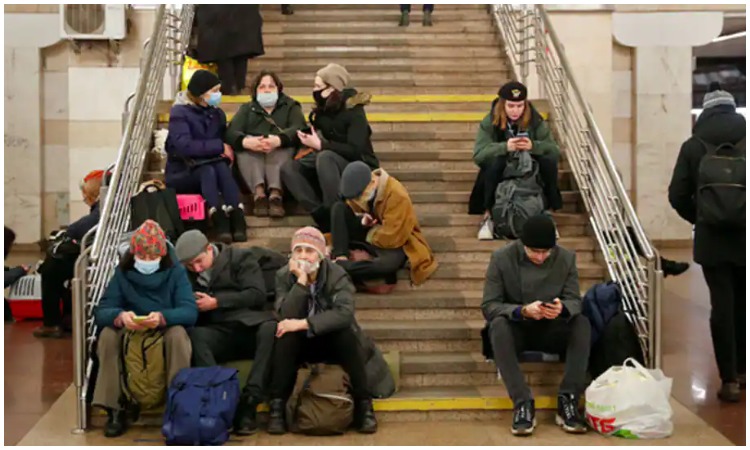
It’s been one and a half months since the possibility of war between Russia and Ukraine is looming large. While Russia has amassed lakhs of its military with missiles and weapons at the Ukraine borders, the United States has stepped up in support of Ukraine.

Amid the diplomatic talks between the US, Russia and Ukraine, Russia has demanded in writing from the West to cease expansion of NATO. It has demanded that Ukraine should never be allowed to join NATO. As the US and the West have ruled this out, the two sides are negotiating in Paris, in the presence of interlocutors from France, Germany, the US and Russia.

Does Russia bid to resolve the issue?

Russia and Ukraine have a history that dates back to when Kyiv first became the capital of the ancient state of Russia. According to the reports, the two countries were united under the rule of Tsar in Russia and later became the core of the Soviet Union. It is during the revolution led by Vladimir Lenin that the Ukranians happened to create a state of their own and declared independence in January 1918.

Vladimir Lenin had then said that ‘losing Ukraine would be losing Russia’s head’. Putin, in his more than two-decade of Russian rule, has made several attempts to restore Russia’s influence in the countries that were part of the Soviet Union, that includes Ukraine. He also had called break up of the Soviet Union ‘the greatest geopolitical catastrophe of the last century’.

While there are negotiations going on between the two countries, French President Emmanuel Macron, US President Joe Biden has spoken to Russian President Vladimir Putin in a bid to resolve the crisis. According to Putin, NATO, if allows Ukraine as a member, may use it as a launchpad for missiles targeted at Russia. Russia reportedly views NATO’s eastward expansion to 14 new countries, including some that were part of the Soviet Union as a potential threat.

In 2014, NATO unanimously decided to suspend all practical co-operation with the Russian Federation, in response to the Ukraine crisis, but the NATO-Russia Council still remains intact.

‘It was a conspiracy to make this jihadi activity appear like a local clash’: How cow-lover Kishan Bharwad was killed by Islamists

Dhandhuka Taluka in Ahmedabad district is little over 100 kms from Ahmedabad city. You take an exit from Sarkhej, most known for the mosque and tomb Sarkhej Roza, pass through industrial area of Changodar and other parts to reach Dhandhuka. It takes little over two hours to reach there from the city. Once out of the industrial area, one can see the beautiful countryside with golden farms on both the sides of the highway.

Except, the destination to this picturesque route was home of 27-year-old Kishan Boliya, also called Kishan Bharwad, where his parents are mourning his untimely death. He was shot dead by radicalised men inspired by maulanas (Islamic religious leaders) who instigated them to carry out the jihadi activity of killing a man who had ‘blasphemed’.

Kishan had shared a video which showed an image of Prophet Muhammad. Muslims firmly believe that visual depiction of Muhammad are forbidden. Islamists believe that such a visual depiction is blasphemy and an ‘insult’ to Muhammad, and beheading of the one who blasphemed is appropriate punishment.

Unfortunately, many are still unaware about such terrifying laws of blasphemy in Islam.

Kishan Bharwad’s house in the village in Dhandhuka

Right off the main road near Chachana bus stop is where Kishan’s family home is. There was heavy media presence in the house where political leaders were expected to arrive through the day. There are cows and buffaloes tied outside the house.

“Kishan loved cows. His Instagram profile was also Kishan Shepherd. Cows, dogs, he was an animal lover. He would spend hours with them. If he saw anyone in pain, he would go out of his way to help them,” his father said with his hands folded, fighting back tears.

Kishan would help his father in farming and also ran a small photocopy shop near the court in Dhandhuka.

Kishan’s photocopy shop

Kishan was a simple boy with simple life.

Earlier in January, he shared a video on his social media profile. His father and other relatives repeatedly tell me he had only shared and not created that post. The video showed Jesus as ‘Son of God’, Prophet Muhammad (with a visual depiction of what he would look like) as ‘Prophet of God’ and Shree Krishna as ‘The God’. “All religions are equal and all humans are equal. My son only said that Shree Krishna is bigger God and within 30 minutes of his posting the video he started getting threats,” he said. The villagers were not aware that visual depiction of Prophet Muhammad was the bigger bone of contention in all possibilities.

Kishan started getting threats, including death threats almost immediately.

“A mob of 500-1000 Muslim people reached police station and demanded action against Kishan. They filed police complaint and Kishan and I went to the police station. The mob then beat up Kishan. Some policemen also joined in in beating him up. They demanded Kishan apologises. So he apologised. We gave written apology as well as video apology,” his father said.

Except, three days later, he got a call from police station again. The mob was back and not satisfied with the various forms of apology over ‘blasphemy’. So they wanted him jailed and another FIR was filed. “They (Police) said they will have to arrest him so I said okay. Next day we got him a bail and then I asked him to stay away from the village for a few days till things calm down,” his father said. Kishan then stayed at his uncle’s place for a few days.

Just day after he was put in jail, his wife had to undergo a caesarian section and gave birth to a baby girl.

Kishan never got to see his daughter’s face.

“He was going from my brother’s house to other home, hoping to see the child. His cousin was driving the bike and he sat pillion. He came back at 4 PM and at 5:30 PM they killed him,” his father said.

“It was a conspiracy to make the murder appear like a localised crime and not a jihadi activity that it was. They carried out rallies and reached out to police and filed complaints to show their anger. But in reality it was a part of bigger conspiracy. Involvement of so many maulanas from across India shows that only,” said one of his relatives.

“I am willing to bet that if you carry out raids at these dargahs, masjids and madarsas, you will find AK47 in most of these. These are breeding ground for jihadi training and activities. Even the piston and bike used in the murder were found near the dargah,” the relative said.

Sar Mubarak Bukhari Dada Dargah where the gun and bike were abandoned

A source while speaking to OpIndia said that there is rampant increase in dargahs and masjid in the area, where a lot of radicalisation activities take place. Most of these have come up in past 35-40 years since the Tablighi Jamaat started preaching in the area, he said.

Masjids, Dargahs

In about 2 km radius of Dhandhuka Mamlatdar office, there are over half a dozen masjids, dargahs and even kabristans. A local resident said that a few years back Islamists had broken down part of Mamlatdar office because it covered about 3 feet into the Kabristan area.

“This is the Kashmir modus operandi to drive away Hindus away silently. We will not let Gujarat turn into Kashmir. There is no reason to not believe this is a nationwide conspiracy. Following the action taken by Saudi Arabia government even Indian government should crackdown on Tablighi Jamaat in India,” said Ranchhod Bharwad of Antarrashtriya Hindu Parishad while speaking to OpIndia. He said that the police should investigate the organisations the maulanas accused in Kishan Bharwad murder case and take action against these organisations as well.

Shambhunath Tundiya, former MP and MLA and currently President of state unit of BJP SC Morcha, speaking to OpIndia said that it is important that everyone is made aware of Indian Constitution and Indian Penal Code. “The killers were inspired from Sharia, but in India it is the constitution that is above all. Along with religious books, these two should also be taught to children so that everyone knows their duties along with their rights,” he said emphasising that only way out would be education.

“They ruined not only Kishan’s family but their own families. One of the accused is so poor his father borrows bidis to smoke. He didn’t even think of his own family. You know he works as a car cleaner?” said a source close to the family.

‘Navrang Service Station’ where one of the accused worked

“They have no remorse. Instead, let me tell you, they have collected money to build mazaar in their names. If they get death sentence or for whenever they die, these two will be celebrated for having done jihad for the faith,” said a source. A mazaar is a shrine/tomb of saints or notable religious leaders.

It should be noted that in Pakistan, Mumtaz Qadri, who assassinated politician Salman Taseer who was against the blasphemy laws, has a shrine in his name. Qadri had gunned down Taseer in 2011 and now his followers believe he has earned a place for himself next to Prophet Muhammad. But even before that, before the partition of India, Mahashay Rajpal, publisher of Rangeela Rasool, was assassinated for publishing a satirical take on Prophet Muhammad. Unsurprisingly, his assassin, Ilm Ud Deen is also celebrated and his shrine/mazar in Lahore is revered by his followers.

Following Kishan Bharwad’s assassination, a number of Islamists posted their support for the murderers on social media.

Social media posts hailing the murderers

In one post, one ‘bigde nawab’ gave 100 salute to the murderers and hailed them as lions. In other post, one ‘Mr Nawab’ showed how proud he was of the two and warned others of thinking a hundred times before ‘opening mouth’.

I asked Kishan’s father if anyone from the Muslim community has expressed regret to him or reached out to him and join him in mourning on death of his son. He said no. No one from the Muslim community has shown solidarity with him.