

Home Blog Page 3913

‘You may be strip searched’: Pakistani cricketer shares boarding pass for USA flight with ‘SSSS’ stamped on it. Read what it means

Pakistani cricketer Umar Akmal recently took to Twitter to share pictures of himself and his boarding pass of his flight to the United States. Akmal said he is travelling to the United States for some personal meetings and urged his supporters to pray for his success.

“I am travelling to the US for some personal meetings if all goes well I might have to stay there for some time! I need my supporters to pray for me as they have always prayed!” Akmal tweeted along with the pictures.

However, soon after he posted the picture of the boarding pass on Twitter, a social media user noticed Akmal’s boarding pass had “SSSS” printed on them. “You have been marked for extra screening on arrival and you gotta be there for a couple of hours at least—hope that went well,” the user tweeted.

Social Media users react to “SSSS” symbol stamped on Umar Akmal’s boarding pass

After it was found that Umar Akmal is going to be subjected to additional security checks in the United States, a raft of social media users reacted to his tweet, asserting that it might be par for course for Pakistanis to go through a thorough security check while visiting the US.

Another social media user said perhaps Pakistan PM Imran Khan did not travel to the United States to attend the UNGA assembly in person because he too dreaded being subjected to the secondary security checks at the New York airport.

Yet another Twitter user said Akmal will be strip-searched in the United States.

A Twitter user advised Umar Akmal to wear his undergarments stating that the history of the New York airport is not good.

What does “SSSS” on boarding pass means and what causes it?

“SSSS” stands for Secondary Security Screening Selection or Secondary Security Screening Selectee, an airport security measure adopted in the United States which entails subjecting select passengers for additional inspection. Passengers who have been selected for secondary screening will have the letters “SSSS” printed on their boarding passes as a signal for the need for a thorough check-up at security checkpoints at the airport. While the list of those included on SSSS keeps on fluctuating, it is widely regarded that people from certain countries are included in the list by default.

There’s a variety of reasons that could land passengers on the SSSS list. According to an article, one of the reasons why passengers could be selected for additional security checks is because of their unusual or peculiar itinerary, which could include flights booked last minute, international one-way tickets, travel originating in “high-risk” countries, etc. With Pakistan having close ties with most of the Islamic terror outfits, it is entirely possible that they are listed among “high-risk” countries by the United States. Other reasons also include booking one-way tickets, tickets bought in cash, having a criminal record from the past, being charged with security-related offence at an airport, or have carried prohibited materials or weapons in the past.

The article further states there could also be some sort of list based on flying patterns, specific names or other reasons for which some people find their boarding pass stamped with “SSSS”. Sometimes, it is completely random. However, neither the Transportation Security Administration(TSA) nor the airlines publish the criteria that are used when boarding passes are issued to identify passengers who will be given extra screening or be denied boarding.

What happens at the airport if one is marked for the U.S. secondary screening?

Once the Transportation Security Administration (TSA) official finds “SSSS” marked on a boarding pass, he would ask the passenger to get out of the line and escort him for secondary screening. It usually takes 10 to 30 minutes for additional screening based on the compliance and readiness of the passenger to undergo it.

Passengers with an “SSSS” stamp are normally asked to walk through the metal detector, and then back again. They will be asked to remove their shoes and belts. They will also be asked to go through the full-body scanner. After that, they are subjected to a full-body pat-down, which the passengers can choose to have in private. This is where suspicious passengers are strip-searched by the authorities.

Besides, the luggage carried by such passengers is also checked thoroughly. They are scanned a couple of times in the scanner and based on the discretion of the officer-in-charge of the search, passengers may also have to open their bags and show things as needed.

Those who are carrying electronic devices with them such as phones, laptops, watches are usually asked to power up all of them after which the TSA agents check for any incriminating evidence in them.

Then, there is an explosives and narcotics contact scan as well, which includes rubbing a cotton/fabric/paper swab on the passengers’ clothes, luggage, belt, shoes and other belongings and scanning it under an ION scanner to detect contact with narcotics or explosive materials.

At last, a sticker would be pasted on the boarding pass by the TSA officer or security official, indicating that the additional security check of the passenger has been completed. Once the security authorities are satisfied with their inspection and find nothing wrong, passengers are allowed to leave the security area.
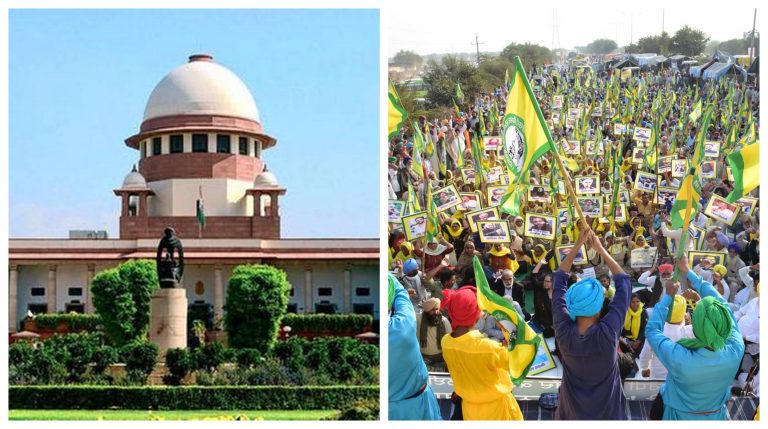
‘You have strangulated Delhi, obstructing security and defence personnel, it is all in the media’: Supreme Court slams farmer leaders

The Supreme Court on Friday, October 1, slammed the political farmers of Kisan Mahapanchayat for “strangulating” the entire Delhi. The farmer protestors had approached the apex court asking it to give directions to Delhi police to allow them to pervade Jantar Mantar to stage ‘Satyagraha’.

A Supreme Court bench led by Justice AM Khanwilkar said: “You have strangulated the entire city, now you want to come inside the city! Are the residents around happy with the protest? This business should stop.”

‘Are you protesting against the judicial system?’ SC slams the protesting ‘farmers’ for wanting to hold ‘Satyagraha’ at Jantar Mantar

“What is the point of doing satyagraha. You have approached the court. Have trust in court. Once you have approached the court, what is the point of protest? Are you protesting against the judicial system? Have faith in the system”, the bench observed.

Justice Khanwilkar stated that the farmer groups have already approached the court against the three farm laws and as such, there is no point in protests. “You are obstructing the security and defence personnel. This was in the media. All this should stop. There is no point in protests once you come to the court challenging the laws,” he added.

To this, the counsel for the Kisan Mahapanchayat submitted that the Kisan Mahapanchayat is not a part of farmer groups that are squatting on highways. He also submitted that it is the police that has blockaded the roads and not farmers.

‘Farmers’ asks permission for protests

The Supreme Court was responding to a writ petition filed by the Kisan Mahapanchayat on Thursday, September 30 urging it to give directions to authorities under the Central Government, Lieutenant Governor and Commissioner Delhi Police, the respondents in the case, to grant permission to them to hold ‘Satyagraha’ at Delhi’s Jantar Mantar.

These ‘farmers’ who had threatened to establish a ‘parallel government’ in Delhi’s Jantar Mantar after being granted permission to pervade the area by the AAP government in the month of July, told the Supreme Court that the respondents should not stop them from proceeding towards Jantar Mantar and provide space for at least 200 ‘farmers’ to carry out ‘peaceful’ or ‘non-violent’ protests in the area.

In the writ petition filed through Advocate on Record Ajay Choudhary, the Kisan Mahapanchayat argued in the apex court that the Delhi police are being “patently discriminatory, arbitrary and unreasonable” for denying permission to hold the rally.

Calling themselves ‘Satyagrahis’, these so-called farmers contended that the right of citizens to protest and gather peacefully without arms is a basic democratic right under the Constitution of India, which they are being deprived of.

“Action of the respondents in permitting the similar protest at the same site is unfair and violative of Right to Equality under Article 14, 19 and 21”, the petition stated.

While these political protestors have said fanciful things like ‘being stripped of their basic fundamental rights’ and holding ‘Satyagrahas’, the scars of the violence they unleashed in the country’s capital on the occasion of 72nd Republic Day are still fresh in the minds of the people.

Republic Day Riots

On January 26, so-called protesting farmers entered Delhi on the pretext of Tractor Rally using unauthorized routes. They caused property damage worth crores and injured innumerable police personnel. A group of protestors had reached Red Fort and hoisted two flags with the Sikh Holy symbol. Notably, terrorist organization Sikhs For Justice had announced a cash reward for anyone who hoists such flags on Red Fort. There have been several reports suggesting Khalistan separatists and Naxal sympathizers have infiltrated the farmer protests.

There were visuals of one of the protestors throwing away Tricolour while trying to hoist the alien flag. The protestors at several places tried to mow down the police personnel with tractors. Police personnel were attacked with lathis, stones, swords and other sharp weapons by the protestors. RTI replies reveal that around 299 police personnel were injured, which is lesser than the actual number as some data was not revealed due to ongoing investigation.

The Republic Day insurrection was not the only instance where these political farmers had resorted to violence. Several reports have emerged where these ‘farmers’ have resorted to stone-pelting, turned violent towards police, threatened to hold MPs and MLAs hostages.

Massive ongoing protests by farmer groups have been blockading highways routes around Delhi for months now. The farmer protestors have vandalised Jio mobile towers in Punjab, blockaded an Adani logistics facility and stopped trains for months, causing damages worth hundreds of crores to the public and private companies.

Odisha: Villagers foil Priest’s attempt to convert Hindus to Christianity, make evangelist sign a bond promising to never return

On Sunday (September 26), a Christian priest was detained by a group of villagers over charges of forced conversion, reported Organiser. The incident took place in Tangardihi village in the Sundargarh district of Odisha.

The priest, identified as Mahendra Sahu, was a regular visitor to the Tangardihi village. According to the villagers, he would come to the village in a bid to convert Hindus to Christianity. Despite their refusal, Sahu went unabated about his proselytism. He continued to visit the village and attempt to lure others to his religion. On Sunday, the villagers caught him and made him write an affidavit, stating that he would never return to Tangardihi.

A villager recounted, “His only intention was to convert our people into Christianity. All the villagers objected to his visit to our village. So we advised him not to come to our village. But he did not listen to us. On September 26, our villagers lost patience and called a meeting. Villagers asked Mahendra Sahu to give a written bond that he will never come to our village and block in the future”. The Organiser reported that Sundargarh has been the prime target of Christian evangelists.

Anti-conversion law not being implemented in Odisha, alleges VHP

This is despite the fact that the State of Odisha has an anti-conversion law named Odishan Freedom of Religion Act, 1967. While speaking about the matter, VHP Secretary (Sundargarh) Rama Chandra Naik said, “The Orissa Freedom of Religion Act, 1967, provides that no person shall convert or attempt to convert, either directly or otherwise, any person from one religious faith to another by the use of force or by inducement or by any fraudulent means. But unfortunately, the act is not being implemented properly by the state Govt.”

Protests, election rallies are virus free, but Hindu festivals are Covid carriers: How Govts are harassing Hindus in the name of the pandemic

The festive season is upon us, and with that, the season of intensified illogical Covid-19 restrictions have begun. Multiple states have issued a series of orders that clearly have nothing to do with the pandemic itself but only serve to inflate the ego of the Leviathan that is the Secular State of India.

The West Bengal Government has announced that like last year, no one will be permitted to enter pandals this year as well. It is the same state where politicians across all parties had gathered huge rallies for the assembly elections during the peak of second wave of the pandemic.

Not merely that, by-polls for the Bhawanipore constituency were held on the 30th of September which saw the gathering of huge crowds during the campaign. There were no Covid-19 restrictions observed for that. But during Durga Puja, the state will suffer the restrictions.

The Brihanmumbai Municipal Corporation (BMC) has gone several steps ahead with their restrictions for Navratri. They have decreed that Murthis cannot be taller than 2 feet for homes and 4 feet for public mandals.

Deciding the height of Murthis was not enough. BMC has also ordered that flowers and sweets have been banned for devotees at mandals and only five people are allowed to be present there.

Rajasthan has banned the sale and bursting of firecrackers between the 1st of October to the 31st of January, 2022.

Odisha has banned firecrackers for Diwali as well. Odisha had earlier in August imposed restrictions that could only be called crazy, along the lines of the restrictions BMC has imposed now. The state government had ordered that no Murthi could be taller than 4 feet, apart from other bizarre guidelines.

Meanwhile, Chhat Pooja has been banned in public places by the Delhi Disaster Management Authority, the Chairman of which is the Lieutenant Governor of the Union Territory.

The Delhi Government has also banned effigy burning during Dussehra, which is part of its larger ban on firecrackers. Earlier in September, Chief Minister Arvind Kejriwal had announced a complete ban on the sale and bursting of firecrackers.

Haryana, a BJP ruled state, has banned firecrackers in 14 districts of the state. While the restrictions have been imposed citing Covid-19 as an excuse, the measures clearly indicate that they have very little to do with controlling the pandemic itself. No state has taken any measure to control or restrict the gathering due to ‘farmer protests’.

Meanwhile, states have continued to witness huge crowds due to political rallies or protests of one sort or the other. Unless political parties have some incontrovertible evidence that only Hindu festivals spread Covid-19, such restrictions have no valid justification whatsoever.

The Covid-19 restrictions and dire warnings last year

It is pertinent to recall that dire warnings had been issued last year as well, claiming that the festive season could spark a new wave of the Coronavirus pandemic. Multiple states had issued such sermons and authorities had proclaimed that the expected gatherings at festivals posed a serious threat to public health.

But despite such warnings, Covid-19 cases saw a decline during the festive season and it was only in 2021, in April and May, that the second wave of the pandemic reached its peak. Even so, without issuing an apology for getting it wrong the previous year, authorities singled out the Kumbh Mela for blaming the second wave on, despite significant evidence that the ‘farmer protests’ all political parties had either tolerated or encouraged had played a much greater role.

This year, again without any significant evidence, political parties across the spectrum have decided to implement restrictions that are unscientific by all metrics. The announcement comes days after the Union Health Ministry urged states to enforce ‘Prompt and Effective Measures’ until the 31st October.

Rules for thee but not for Tikait Gang

Quite clearly, the restrictions are not about Covid-19. If political parties really cared about curbing the pandemic, they would have put an end to the ‘farmer protests’ first. This is about the tyrannical nature of the Secular State of India that seeks to enslave a community that it perceives as meek.

The manner in which the menace of stubble burning has been dealt with by numerous state governments provides some insight. After criminalising the practice because it causes air pollution, governments were very quick to fold and roll back their orders against it in the aftermath of the ‘farmer protests’.

Thus, quite clearly, all state governments have bent over backwards to placate the unruly mobs that have become the hallmark of the protests against the farm laws. There was no risk of Covid-19 then. But cometh the festive season, cometh the tyrannical inclinations of the Indian State and the oppressive restrictions that come along with it.

Indian government denies media reports about Tata Sons winning the final bid on Air India

Hours after Bloomberg Quint reported that the acquisition of national carrier Air India went to Tata Sons, the Indian government has rubbished all such media reports.

The Secretary to the Department of Investment and Public Asset Management (DIPAM) stated in a tweet, “Media reports indicating approval of financial bids by Government of India in the AI disinvestment case are incorrect. Media will be informed of the Government’s decision as and when it is taken.”

Screengrab of the tweet by Secretary (DIPAM)

Bloomberg had earlier reported, “Tata Sons is set to take over Air India. A panel of ministers accepted a proposal from bureaucrats, who recommended the conglomerate’s bid ahead of an offer from entrepreneur Ajay Singh. An official announcement is expected in the coming days.”

The Economic Times (ET) had also reported that the Indian government had chosen the winning bid, after judging the offers made by Spicejet founder Ajay Singh and Tata Sons against a ‘minimum reserve price’. The sale involved 100% ownership of the airline, besides a 50% stake in Air India SATS Airport Services Pvt Ltd/Citing sources, ET stated that the government had put the minimum reserve price between ₹15000- ₹20000 crores.

The airline was founded by JRD Tata in 1932 as ‘Tata airline’ and was renamed ‘Air India’ in July 1946. It was in July 1953 that the then-Nehru government took over a majority stake in the airline from Tata Sons. At the time, JRD Tata was extremely anguished by the manner Nehru had nationalised Air India without any dialogue or notice.

‘Can’t be in Congress, did not discuss alliance with BJP or prospect of new party’: Amarinder Singh dispels rumours

Captain Amarinder Singh, who has dominated the news since stepping down as Punjab Chief Minister, has spoken to the media portal The New Indian, and addressed some of the rumours that have been circulating. The former Punjab CM has said that he had met NSA Ajit Doval to discuss the security situation in Punjab.

“Raised some security concerns about Punjab with NSA Ajit Doval. Informed NSA how we eliminated drone attacks in Punjab in the last few years”, the media platform quoted Captain Amarinder as saying.

Singh had added that he does not trust Navjot Singh Sidhu’s control in Punjab.

After his meeting with NSA Ajit Doval yesterday, September 30, ANI had also quoted him as saying: We discussed security-related issues, can’t share them here”.

Amrinder Singh’s meeting with Ajit Doval is significant given the fact that just a few days ago, he had termed Navjot Singh Sidhu a national security threat. After resigning from the post of CM, Singh had said that he will fight any move to make Sidhu the Punjab CM, terming him as anti-national, dangerous, unstable, incompetent and a security threat to the state and the country.

‘Can’t be in Congress, did not discuss alliance or prospect of new party with HM’: Amarinder Singh

Speaking on his meeting with Home Minister Amit Shah and on speculations of him joining the BJP, Singh told the media platform that he met the HM to discuss the farm bills. “I didn’t hold any talks with any BJP leader or HM who I met in Delhi on prospects of any new party in Punjab or alliance for 2022 polls yet. But I can’t be in Congress, that I have already decided. Thank you to them”, Captain Amarinder Singh was further quoted by The New Indian as saying.

Earlier, we reported how media had been speculating that with only months left for the Punjab assembly elections, Singh may float his new party in the next 15 days. However, with this statement, the former CM of Punjab has, at least for now, put this speculation to rest as well.

Prior to this, Singh had also dispelled rumours of joining the BJP.

Captain resigns as Punjab CM

Amarinder Singh had resigned from the post of chief minister on September 18 saying that he can’t continue with the humiliation he was facing in the party. He had taken the decision after the party had called for a meeting of the Congress legislative party in Punjab without informing the CM, who is also the leader of the legislative party.

Trouble brewing for Congress in Rajasthan as SC issues notices to six former BSP MLAs who had joined Congress

The central leadership of the Congress, which is busy dousing fire in Punjab as well as tackling emerging problems in Chhattisgarh and Uttarakhand, is likely to face problems in Rajasthan also.

Six former BSP MLAs who had joined the Congress in September 2019 may land in legal trouble as the Supreme Court has issued them notice. The Supreme Court has asked them to file their counter affidavit within four weeks reminding them that it was the last opportunity for them. The court has asked them to reply whether or not their merger was in accordance with the Anti-Defection Law.

This development has come at a time when Sachin Pilot camp is learnt to have started a fresh move against Rajasthan chief minister Ashok Gehlot. Four out of six turncoat MLAs have rushed to Delhi.

In September 2019 all six MLAs of the Bahujan Samaj Party (BSP) in Rajasthan assembly namely Rajendra Singh Gudha ((Udaipurwati), Jogendra Singh Awana (Nadbai), Wajib Ali (Nagar), Lakhan Singh (Karauli), Sandeep Yadav (Tijara) and Deepchand (Kishangarh Bas) had joined the ruling Congress. The BSP MLAs had merged their legislative party with the Congress party. They were apparently promised ministerial berths in Congress government led by chief minister Ashok Gehlot.

The BSP had challenged their merger in Congress. However, the Rajasthan High Court on August 24, 2020 had dismissed a petition of BSP challenging the merger order passed by Rajasthan Assembly Speaker CP Joshi. The BSP had then moved Supreme Court against Rajasthan High Court judgment.

Four out of six MLAs namely Rajendra Singh Gudha, Wajib Ali, Sandeep Yadav and Lakhan Singh are camping in Delhi. However, they said that they are in Delhi to file their response to the Supreme Court notice. But they are clearly unhappy that they were not rewarded in terms of ministerial berths and political appointments. They are miffed that chief minister Ashok Gehlot ignored the support they had extended when deputy chief minister Sachin Pilot had rebelled against him. 

According to reports, they want to meet the Congress high command to convey that may reconsider their support to the Congress government in Rajasthan if the cabinet expansion doesn’t take place with assured ministerial berth for them.

But at this moment they are desperate to save their membership. Sandeep Yadav told the media they want to save their membership as MLA at any cost. And, they are ready to meet Rahul Gandhi, Priyanka Gandhi Vadra and even union home minister Amit Shah. He said that they will support whoever save their membership.

Currently, the Gehlot cabinet has 21 ministers and another 9 ministers can be accommodated. Out of 9 vacant berths, the Pilot camp wants 4 berths and some of the Independent supporting the government also have demanded ministerial berth. The party may be able to accommodate a few former BSM MLAs in a future cabinet expansion.

In the house of 200-member where the support of 101 MLAs is required, the Congress party currently has 106 members. This includes these six former BSP MLAs. Other than this, there are 13 Independents, 1 RLD MLA and two from CPM MLAs who support the government.


UCLA professor sues Uni for suspending him after he refused to be ‘more lenient’ towards black students compared to others

A professor at the University of California, Los Angeles (UCLA) sued the dean of the school for damages after he was suspended for refusing to be biased in judging the work of his black and non-black pupils.

In the summer of 2020, in the wake of trauma caused by the George Floyd incident, Gordon Klein, a lecturer in accounting at the Anderson School of Management at UCLA, who has been at UCLA for 40 years, was suspended by the University.

On Monday this week, he filed a case against the school dean and laid bare his side of the story on Bari Weiss’s Substack on Thursday. Mr Klein said he was wrongly punished by the University for refusing to discriminate against his students based on their skin colour.

In his blog, Klein said he was seeking unspecified damages “not only to correct the tortures he had endured but also to protect academic freedom.”

“He was suffering from severe mental distress, trauma, and physical illness treated by his primary care physician, gastrointestinal physician, and psychiatrist,” he said in a court document arguing that his job as a consultant had dropped dramatically due to UCLA’s disagreement and sought financial relief.

In June 2020, Mr Klein was handed over a three-week suspension by the UCLA Anderson School of Business on account of his refusal to treat his black students on different criteria.

UCLA suspended Klein after he refused to treat his black students as lesser than their non-black peers

Klein says his problems started after he responded to an email from a non-black student in his class who asked him to evaluate the work of his black classmates with greater “leniency” than others because of the emotional distress they had faced in the aftermath of the George Floyd incident.

“The unjust murders of Ahmaud Arbery, Breonna Taylor and George Floyd, the life-threatening actions of Amy Cooper and the violent conduct of the [University of California Police Department] have led to fear and anxiety which is further compounded by the disproportionate effect of COVID-19 on the Black community. As we approach finals week, we recognize that these conditions place Black students at an unfair academic disadvantage due to traumatic circumstances out of their control,” the email sent by a student to Klein reportedly read.

In order to make his case, the student also drew on UCLA’s pledge to “Equality, Diversity and Inclusion” agenda, which prescribes professors to grant “equity” to students belonging to “underrepresented groups”.

Klein welcomed the principles cited by the student but he held that academia had corrupted them to such an extent that they were nothing more than “hollowed out corpses devoid of their original meaning.” He claimed in his Substack blog that the meaning of “diversity” has distorted into ideological homogeneity and “inclusion” meant the exclusion of some to favour others regarded as more deserving.

Klein was shocked by the student’s email and felt the request “deeply patronised and offended the black students he claimed to care so much about.” He emailed back: “Are there any students that may be of mixed parentages, such as half black half-Asian? What do you suggest I do with respect to them? A full concession or just half?”

“Also, do you know if there are students from Minneapolis? I think they’re probably particularly devastated. The white students from there are racist, even if they’re not particularly racist. Some people think it’s a person, so I think this could be even more devastating,” he said in his email to the student concluding that he will not mark students’ work differently based on the student’s skin tone.

Defending his stance, Klein wrote he holds a degree and is pretty sure the university’s EDI agenda violates Proposition 209, the California Constitution’s prohibition against race-based preferences in public education.

Klein thought he had provided a satisfactory explanation to dissuade the student from demanding preferential treatment for the black students. But, the professor was in for a rude awakening. By the evening, students were baying for his job. They ran a petition asking the university to fire him. Within a day or two, Klein reminisces, about 20,000 students had signed the petition for his insistence to persist with non-colour-blind grading.

Klein believes he was made a scapegoat by UCLA to cover up its appalling reputation as an unwelcoming place for persons of colour

He was attacked for being a white man and called “woefully racist”. Three days after he sent the email, on June 5, the university handed him a three-week suspension amidst a growing online campaign directed at him. He even started receiving death threats on emails and voicemails that forced him to seek police protection.

Amidst his ordeal, Klein explains, Anderson administrators were rattled. But not because of the death threats received by him but because the school’s reputation was taking a beating. The university hadn’t accorded an African-American professor tenure in decades. It, however, had a handful of tenured Latino professors.

“Black students made up about two per cent of the student body. And men outnumbered women roughly two-to-one, leading many students to call Anderson the MANderson School of MANagement,” he wrote.

As racial reckoning swept the United States, Antonio Bernardo, the dean of UCLA Anderson, took a decision what Klein described as a “well-timed publicity stunt” to deflect attention away from the school’s appalling reputation as a forbidding place for persons of colour and suspended Klein that triggered mixed feeling on campus, with a section of students petitioning for his firing while the other asking him to be reinstated.

Klein said he was ‘confused and hurt’ at the University’s stance, despite being reinstated after less than three weeks.

Anderson tweeted on June 3, a day after Klein responded to the student’s email asking for differential grading for his black peers. “Respect and equality for all are the basic principles of UCLA Anderson. I am very anxious to know this email that we are investigating. We apologize to the students who received it and to all those who were upset and offended by it as well as ourselves,” the tweet said.

Promoting leniency among students would lower the standards of US universisties: Gordon Klein

Klein said he was left ‘confused and hurt’ – despite being reinstated after less than three weeks. He said he is filing the suit not only to seek damages but also to prove a point. “No employee should ever cower in fear of his employer’s power to silence legitimate points of view, and no society should tolerate government-sponsored autocrats violating constitutional mandates,” he said.

He further added it is not just about the principle but also about the United States’ ability to compete and for elite business schools across the country to train the next generation of innovators and leaders.

“The people who will muster the imagination and fortitude to create life-changing technologies and lead groundbreaking multinationals. If we don’t maintain our standards — if we’re not allowed to push all of our students to do their very best — we will be disarming unilaterally. I refuse to do that, and I’m convinced, this recent episode notwithstanding, that most of my students and colleagues feel the same way,” Klein concluded.

Canadian military used Covid-19 pandemic to test propaganda techniques on citizens, reveals a report by Canadian Forces

The Canadian military had seen the Covid-19 pandemic to test new propaganda techniques without taking approval from the govt, a recently released report by Canadian Forces says. Reportedly, the military saw the pandemic situation as an ideal situation to test propaganda techniques on the public, similar to propaganda used in Afghanistan. The military plan was exposed in a report by retired Major General Daniel Gosselin, who was brought in to investigate the scheme.

The propaganda plan was developed and used in April 2020 in Canada, even though Canadian Forces had already acknowledged that “information operations and targeting policies and doctrines are aimed at adversaries and have a limited application in a domestic concept.”

The plan was made public after the report of retired Major General Daniel Gosselin and other related documents were obtained under the Access to Information law. The plan was devised by the Canadian Joint Operations Command or the CJOC, which called for “shaping” and “exploiting” information. CJOC said that an information operations scheme was needed to combat disobedience by Canadians during the coronavirus pandemic, and also to bolster government messages about the pandemic.

Another unrelated initiative run by Canadian Forces intelligence officers picked information from public social media accounts in Ontario. Data on peaceful gatherings of Black Lives Matter and their leaders were also compiled under this initiative. Military officers claimed that such information was needed to ensure the success of Operation Laser, a mission by Canadian Forces to help care homes hit by the pandemic, and to help in distribution of vaccines in northern regions.

This initiative was undertaken by the military on its own, the federal govt had not asked them to do it, and the cabinet didn’t approve the scheme. According to the report by Gosselin, military officials believed that they didn’t need to get approvals to implement their propaganda campaign.

Gosselin’s probe found that the scheme was not just an idea of few military propaganda specialists, but it was supported across the board in military, showing a similar mindset at different levels in military. The officers thought that the pandemic was a unique opportunity to test out the propaganda techniques on Canadians.

The military saw the plan “as an opportunity to monitor and collect public information in order to enhance awareness for better command decision making,” the report by Gosselin stated. As a result, order for the propaganda plan was issued by the military on April 8, 2020.

However, it was withdrawn on May 2 after the then chief of the defence Staff Gen. Jon Vance ordered to shut it down after several advisers had questioned the legality and ethics behind the plan. After pulling the initiative down, Jon Vance had appointed retired Major General Daniel Gosselin to investigate the matter.

According to Gosselin, the military leadership saw its pandemic response “as an opportunity to monitor and collect public information in order to enhance awareness for better command decision making.” The report also says that CJOC officers had dismissed concerns raised by other military officers regarding the plan.

In the report, Gosselin has recommended a comprehensive review of Canadian Forces information operations policies and directives, especially those operations that may impact any activities for domestic missions.

Air India returns to the Tatas after 68 years, SpiceJet loses out

On Friday (October 1), a government-led panel held Tata Sons as the winner for the bid on national carrier Air India. In a tweet, Bloomberg reported, “Tata Sons is set to take over Air India. A panel of ministers accepted a proposal from bureaucrats, who recommended the conglomerate’s bid ahead of an offer from entrepreneur Ajay Singh. An official announcement is expected in the coming days.”

Screengrab of the tweet by Bloomberg Quint

Earlier, the Economic Times (ET) reported that the Indian government had chosen the winning bid, after judging the offers made by Spicejet founder Ajay Singh and Tata Sons against a ‘minimum reserve price’. The sale involved 100% ownership of Air India and Air India Express, besides 50% stake in Air India SATS Airport Services Pvt Ltd will now be held by Tata Sons. Citing sources, ET stated that the government had put the minimum reserve price between ₹15000- ₹20000 crores.

While Tata Sons bid ₹3000 crores higher than the said price, Ajay Singh had bid about ₹5000 quoted by Tata Sons. ET stated that the Tata Group had included an indemnity clause in its offer to protect itself from any pre-acquisition claims, with a sovereign guarantee from the Indian government. Reportedly, more than 200 Tata officials were part of the bidding process. The airline was founded by JRD Tata in 1932 as ‘Tata airline’ and was renamed ‘Air India’ in July 1946. It was in July 1953 that the then-Nehru government took over a majority stake in the airline from Tata Sons. At the time, JRD Tata was extremely anguished by the manner Nehru had nationalised Air India without any dialogue or notice.
