Home Blog Page 3931

Bengal Bypolls: Congress candidate from Samserganj reluctant to contest to avoid a clash with his twin brother, who is local TMC MP

0

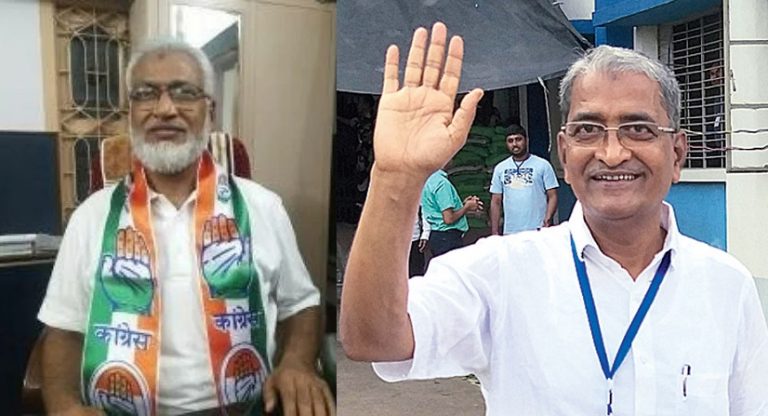
Ahead of the much anticipated West Bengal assembly by-polls, where the highlight would be the Bhabanipur seat from where chief minister Mamata Banerjee would be fighting the elections, a strange situation has emerged from the Samserganj constituency. The Congress candidate who has been picked to fight from Samserganj is not inclined to continue his campaign for the risk of drawing the ire of his twin brother, who is a TMC MP, a report publish in News 18 said. 

Congress candidate Jaidur Rahaman is in a quandary after he got the party ticket following the death of party nominee Rezaul Haque during the assembly elections this year. Samserganj falls under Jangipur area, which is under the charge of Trinamool MP Khalilur Rahaman, Jaidur’s twin brother. The Congress leader said he is not interested in contesting the by-polls as it would create troubles at home. 

As a consequence, there has been no campaign schedule, no strategy meetings or other paraphernalia associated with the hustle and bustle of elections. While he has submitted his nomination, the lack of campaign activity by him suggests he is uninterested in fighting the polls. 

Initially, Rezaul’s wife was approached by the Congress party to fight on his seat. After she declined, the party wanted a popular figure to spearhead their campaign in Samaerganj. They found Jaidur, a local businessman who was quite popular in the area. He agreed to contest on the party ticket but as the elections have approached, he has appeared to develop cold feet over the prospect of a potential fallout with his elder brother. 

“At the time, people suggested me to accept the ticket and contest the polls. So I was interested. My twin brother, Khalilur Rahaman, is the Trinamool Congress MP from Jangipur and he is now in charge of this entire area. He is two minutes older than me. If I contest, there will be a problem at home and I don’t want that,” Jaidur was quoted as saying by News 18. 

Jaidur’s reluctance to fight the elections has landed the Congress party between a rock and a hard place. It is unable to convince Jaidur to put up a fight. Nor can it change its candidate now. 

Speaking about Congress’ predicament, block president Saidul Islam said, “He is unsure. We are asking him to contest. The decision will come in a day or two. Meanwhile, we are telling our workers to paint the Congress symbol on walls in the area and do the usual things. The Congress has support there. What will the Congress voters do?”

It will be an interesting battle, analysts predict, given that Malda Congress candidate Abu Hasem Khan Choudhury had got the lead in Samserganj in the 2019 General elections. 

Trinamool has fielded Amirul Islam for the seat. Besides, CPI(M) candidate is also fighting for the seat. In the 2016 assembly polls, Amirul bagged the seat with 48,381 (30.41%) votes. The CPI(M)’s Touab Ali closely followed him with 46,601 (29.31%) votes. The Congress party’s Rezaul Haque got 42,389 (26.66%) votes.

The by-polls will be held for Bhabanipur, Samserganj and Jangipur on September 30 and the results will be announced on October 3.

Congress to mark PM Modi’s birthday as ‘Bad Omen Day,’ netizens say ‘no lesson learnt’

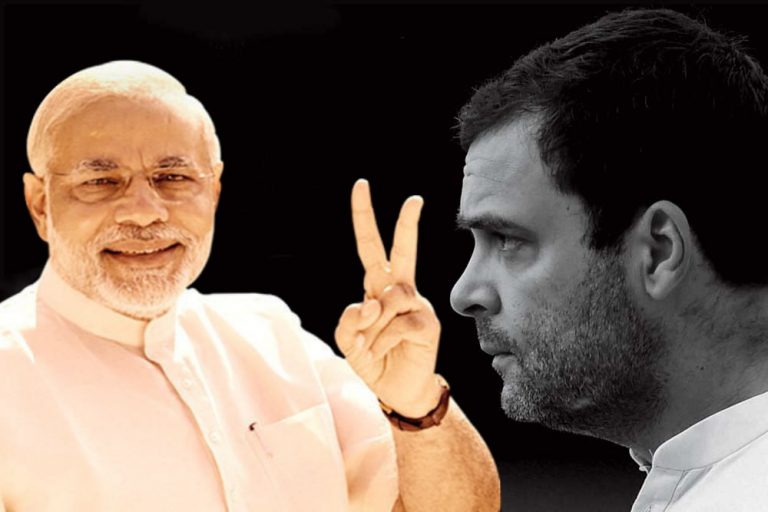
In another political plunge, the Congress party has reportedly declared to mark Prime Minister Narendra Modi’s birthday (September 17) as ‘Bad Omen Day.’ 

However, the netizens have reacted sharply to Congress’ derogatory, negative and juvenile political gimmick saying they have learnt no lessons. 

One user Tweeted, “No lessons learnt. Congress is stuck in the tornado of negative politics with the Gandhi Parivar at its epicentre. There is no way out unless they get rid of the epicentre of negativity.”

Several users suggested that such ideas only add to PM Modi’s popularity while severely damaging Congress’ image as a national political party.

Whereas, some thanked Congress for ensuring Bhartiya Janta Party’s win in the 2024 Loshabha elections with such imprudent stunts. People asked who is forming the startegy for Congress, because clearly they are being prepped for a more humiliating loss.

Several netizens making fun of the Gandhi family owned party said that it is indeed a ‘bad day’ or ‘bad omen’ for Congress and not the nation.

Another social media user rightly pointed out that Congress is devoid of any practical criticism and is hence coming forced to use such gigs. “Wow!! This means Congress Party is bereft of ideas, programs, policies and has no criticism to offer on policies of Modi and his govt,” Tweeted the user.

PM Modi is India’s most popular leader

What definitely is a sob story for Congress, is that PM Modi is the kind of grassroots politician who emerged as the answer for India’s leadership vaccume at the centre. At present, there is no one to challenge him in popularity, mass appeal and reach.

Starting with putting Gujarat on the country’s map as a favorable business destination to putting India on the global map as a conducive investment destination, PM Modi’s governance and policies have definitely made a visible impact.

While the Congress ecosystem kept hurling derogatory remarks like ‘neech’ ‘maut ka saudagar’ and chaiwala against PM Modi, the love and respect for him from the people of India just kept growing. Even after 7 years in office, PM Modi remains India’s most favourite leader, and constantly maintains top approval ratings among world leaders.

This month, PM Modi has completed 20 uninterrupted years in public office. 13 years as Gujarat CM and 7 years as India’s Prime Minister. He has never lost an election. He entered the Gujarat assembly for the first time as the CM and in 2014, after winning an overwhelming majority, entered the Lok Sabha for the first time as the Prime Minister of the country.

PM Modi was born on September 17, 1950 at Vadnagar, Mehsana, Gujarat. He comes from a poor family. He had become a RSS pracharak at an early age and is a celibate, teetotaller and vegetarian.

Want ticket? Tag money with your CV, Uttar Pradesh Congress asks

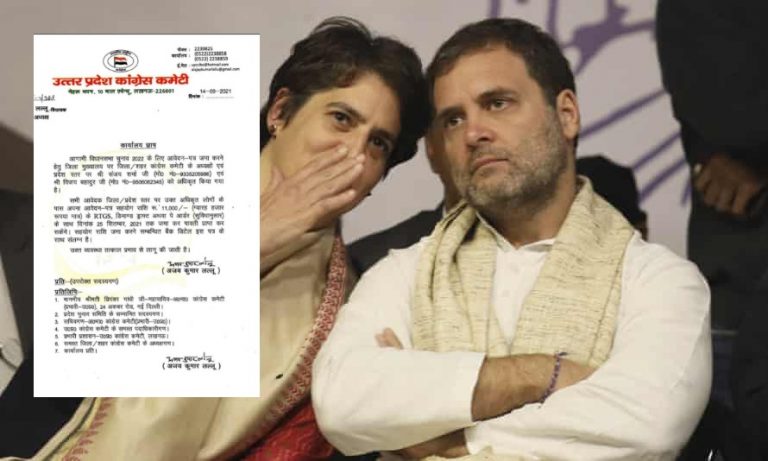
For 2022 assembly election in Uttar Pradesh, the state unit of the Congress Party has issued a circular for ticket seekers of the party to deposit Rs 11,000 as ‘donation’ along with along their application.

The circular was issued under the signature of Uttar Pradesh Congress president Ajay Kumar Lallu on September 14 where stated that the amount can be deposited through demand draft, RTGS and money order till September 25. District units have also been sent pro-forma of how to submit the donation.

This is not clear that whether the amount which party terms as Sahyoga Rashi (support money) can be refunded in case the ticket is not allotted to an applicant.

It will be interesting to see that how many ticket seeker come forward to attach cash to their CV but the move has triggered a controversy whether it is justified to charge money from ticket aspirants. Ajay Kumar Lallu justified the decision stating that it is contribution amount which is needed to support any institution or organisation to function. “Congress is doing work transparently. We have issued a circular for the same,” he said.

The revival of the Congress in Uttar Pradesh looks a tough undertaking for the Congress general secretary Priyanka Gandhi Vadra who is supervising the organizational activities of the party. However, Ajay Kumar Lallu a few days back had claimed that the Congress is returning in Uttar Pradesh and the party will not join hands with any big party like the Samajwadi Party (SP) and Bahujan Samaj Party (BSP).

In the 2017 Uttar Pradesh assembly election, the BJP had won 312 seats out of the 403-member house. The BSP ended with 19 seats. Rahul Gandhi and Akhilesh Yadav had joined hands together referring to themselves as ‘UP ke Ladke’ (UP boys). But the SP-Congress combine ended miserably with 54 seats.

UP: Bajrang Dal launches signature campaign against SP MLA Irfan Solanki’s demand of a namaz room in the state assembly

0

Bajrang Dal in Uttar Pradesh’s Sisamau constituency has launched a signature campaign against Samajwadi Party MLA Irfan Solanki opposing his demand of a namaz room in the state’s assembly building. 

In early this month, Solanki had demanded a separate room for namaz at the Uttar Pradesh assembly building soon after the Jharkhand assembly had officially notified a dedicated prayer room for Muslims. Citing examples of Jharkhand, Bihar and Maharashtra, the MLA had written to Uttar Pradesh assembly Speaker Hridya Narayan Dixit making a similar demand. 

Irfan Solanki said that he is an MLA for the past 15 years and he had a problem in offering namaz during the session of the assembly.  He claimed that in Bihar a separate room was provided for prayer, and added that a similar demand is being made in Maharashtra also. 

Bajrang Dal launches signature campaign

In a video, several Bajrang Dal activists can be seen going door-to-door taking signatures of people willing to join the campaign protesting Solanki’s demand. The campaign is said to run for one month after which all the signatures (documents) will be submitted to the governor. 

Bajrang Dal’s signature campaign

In another video, Bajrang Dal leader Ramji Tiwari can be heard saying, “We are not against any individual but against the ideology. Multiple nations invested thousands of crores to build Afghanistan only to see it taken over by Islamic State governed by Sharia law.”

“As an MLA it is Solanki’s duty to stand by the people of his constituency, fulfill his responsibilities and work towards getting them employment. But instead, he indulged in communal politics making unconstitutional demands,” he added further. 

VHP submits memorandum to Jharkhand governor

On the other hand, the Vishwa Hindu Parishad in Jharkhand has submitted a memorandum to Jharkhand’s governor opposing the allotment of a namaz room in the state assembly building. 

They further said that the assembly building is for making laws for the betterment of the public at large and not for a select group. Several VHP activists were present while handing over the memorandum.

Income Tax dept surveys Sonu Sood’s office

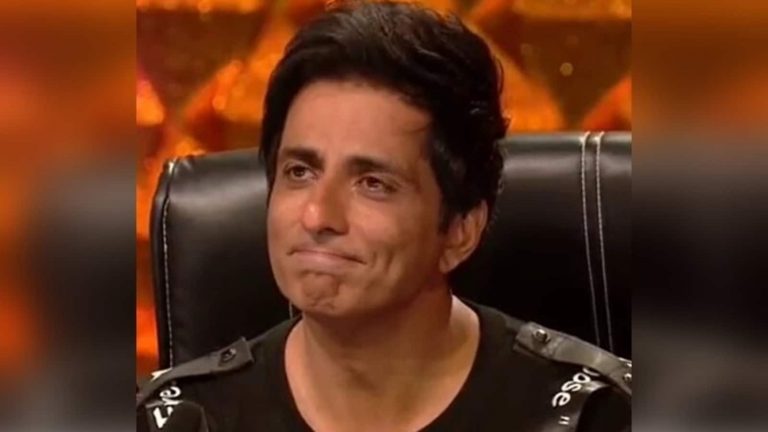
Income Tax department on Wednesday carried out survey at Bollywood actor Sonu Sood’s office over allegations of tampering of books of accounts related to him. As per reports, six locations associated with Sood and his companies were surveyed.

Earlier, the actor was in trouble with the Brihanmumbai Municipal Corporation over allegation of carrying out illegal construction in a residential building which he had converted into a hotel without permission. In an affidavit submitted in Bombay High Court, the BMC had called him a habitual offender.

In the affidavit, BMC had said, “Sonu Sood wants to enjoy the commercial proceeds of their unauthorized work and therefore once again started reconstructing the demolished portion in order to make the hotel operational albeit illegally and without permission from the License Department.”

Union cabinet approves structural reforms in telecom sector: AGR definition rationalised by excluding non-telecom revenues, 4-year moratorium on dues

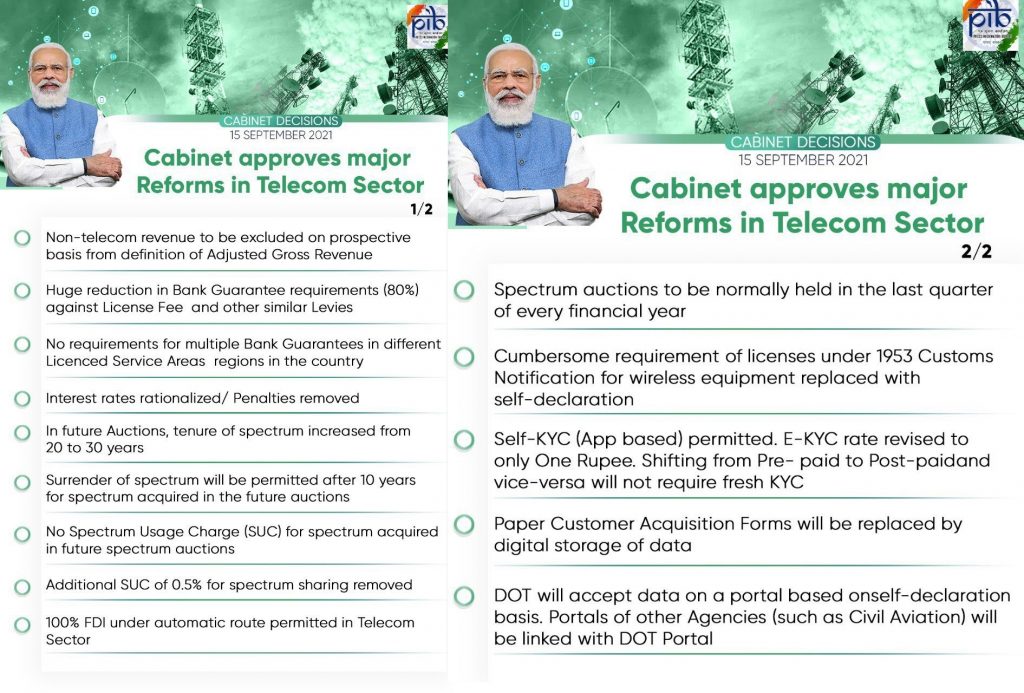
Giving a huge relief to the telecom sector in the country, the union cabinet today redefined the Adjusted Gross Revenue, which will effectively bring down the liabilities of the telecom companies to the govt. The union cabinet today decided to exclude non-telecom revenues of the telecom companies while calculating the Adjusted Gross Revenue (AGR). As per the revenue sharing regime in the sector, the telecom companies pay a portion of this AGR to the govt as tax liability.

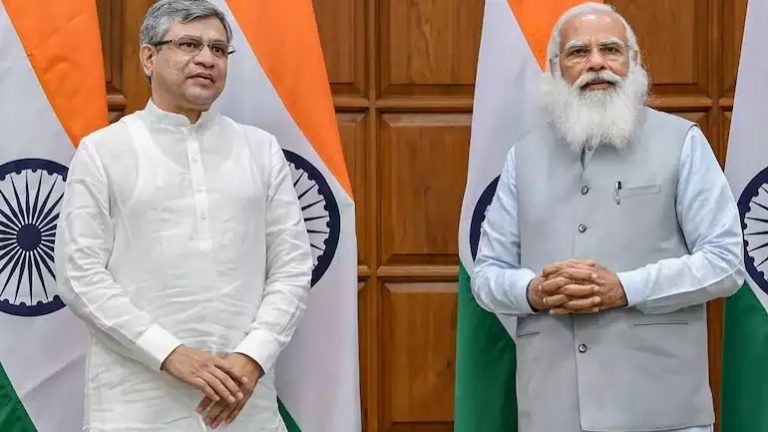
While announcing the decision to rationalise the definition of AGR, telecom minister Ashwini Vaishnaw said that PM Modi has taken a bold decision by removing the non-telecom revenue from AGR calculation. He said a very old and contentious litigated issue has been resolved today with this change.

However, this decision will be applied prospectively only, and the companies will be required to pay the existing AGR dues according to the old calculation. However, the government today announced a 4-year moratorium on payment of this due, giving some relief to the companies which are facing huge burdens of AGR dues. The companies will have pay interest on the due amount during the moratorium period.

Apart from the telecom companies, which will not have to pay revenue share as license fee on non-telecom companies from now on, today’s rationalisation of AGR will also benefit several PSUs which run captive telecom networks for their internal uses. As entities like GAIL, Oil India, Power Grid, Railways etc have their own captive networks, for which they had taken telecom licences, the earlier AGR definition meant that they were asked to pay telecom licence fee on their entire revenue from their main operations.

This had resulted in absurd demands raised by the DoT on such AGR calculations, where GAIL was asked to pay ₹1.72 lakh crore, four times its net worth. Similarly, Power Grid was asked to pay ₹ 1.72 lakh crore, Oil India ₹40,108 crore as pending AGR dues.

The debates on AGR had started after the telecom sector was moved from fixed licence fee to revenue share model in 1999. To calculate the revenue share the telecom companies were to pay the government, the Adjusted Gross Revenue (AGR) of the companies were to be calculated, and a portion of this will be paid to the govt.

But dispute started when the Department of Telecom (DoT) started including non-telecom revenues of the telecom companies in the AGR. This means, the companies were asked to pay telecom licence fee on revenue from various sources like rent, dividend, interest, profit on the sale of fixed assets etc. The companies opposed it in the court in 2005, saying that only telecom related revenues should be included in the AGR.

In 2015, the TDSAT had agreed with the telecom companies, saying non-telecom revenues should not be part of AGR. But the Supreme Court disagreed, and upheld the DoT definition in 2019, asking the companies to pay the dues as per DoT calculation. Since the matter was under litigation for so many years, the companies had not paid their revenue share dues anticipating a favourable verdict, which had meant that now they had to may huge amounts towards AGR dues, as they were given only 3 months to clear the dues totalling around ₹1.56 lakh crore by all the companies.

However, in September last year, the Supreme Court had allowed the companies to pay the dues over a period of 10 years. Vodafone Idea has the highest AGR due of around ₹58,254 crore, followed by Airtel with ₹43,980 crore, Tata Teleservices with ₹16,798 crore and Reliance Jio with ₹70.53 crore. The Supreme Court had agreed to deferred payment after its verdict could have resulted in the collapse of the industry, and the country’s banking sector would also be adversely impacted.

Apart from the rationalisation of AGR definition and moratorium on payment of dues, the cabinet today announced several other reforms for the sector. The govt has decided to decrease the interest on delayed payment of licence fee, which will now be compounded annually instead of compounding monthly as per the current practice. Moreover, the penalty for delayed payment has been eliminated altogether.

Spectrum will be allocated for 30 years in future auctions, against 20 years as of now. The govt has also decided to allow spectrum licence holders to surrender spectrum after 10 years by paying a surrender charge. The govt has removed all the restrictions on spectrum sharing among companies, and the process has been simplified.

In another major reform, the telecom consumers will not have to fill paper forms to take new connections. All customer acquisition and KYC will be done through digital forms. Along with that, the existing forms for all the telecom connections issued in India so far will be digitised. This will help in reduction in cost for telecom companies as they have to keep the forms in large warehouses.

Moreover, there will be no requirement of KYC for switching from postpaid to prepaid or prepaid to postpaid.

There will be a calendar of spectrum auction, so that companies will know about it well in advance. Similarly, the process of setting of mobile towers have also been simplified and all bureaucratic hurdles have been removed.

Ashwini Vaishnaw also announced that the core network technology for 4G and 5G telecom will be developed in India, and the country will use locally developed technology in future.

The changing CMs of BJP: What it means and what to expect

One of the worst moments for India as a nation was May 13, 2004. It was a day that put the brakes on India, possibly for a generation or more. It is not just that Vajpayee was voted out and UPA was voted in. The chilling effect of May 13, 2004 lasts even today. Without that day, India would already have been a $5 trillion economy.

So what are the things that Modi did in his first term that was different from what Vajpayee did? Fundamentally, there were two things. The first was making the rhetoric around “gareebi” the centrepiece of his communication. The more the Congress cried “suit boot ki sarkar,” the more ridiculous they looked. After 7 years in government and all the incumbency it has gathered, it is the one jibe from the opposition that cuts no ice anywhere. Who is anti-poor? Modi? You must be joking.

The second thing that Modi did was nurture the BJP’s state units. During the Vajpayee years, the NDA had become an expert at losing state elections. Often, they didn’t even seem to mind. The BJP deployed all their power at the Center. The party shrivelled in state after state. I think at one point during Vajpayee’s rule, Congress was ruling 15 states.

The BJP of today is far away from that historic low in states. As of now, the BJP has 10 Chief Ministers and the Congress only 3. But this could change easily. Next year, the BJP could well be down at least 3 CMs, in Goa, in Uttarakhand and in Himachal and these posts could go straight to the Congress. The following year, things don’t look too good in Karnataka.

The next big chance for BJP to actually snatch a state from Congress is all the way in December 2023, when there are elections in Rajasthan, Madhya Pradesh and Chhattisgarh.

Some of this is because of the incumbency cycle in several states. During UPA 1, the BJP did reasonably well in state elections and the Congress went through a bad patch. During UPA 2, all the way until Dec 2013, Congress did quite well in states. All this was when the anger against the central govt was palpable.

The changing CMs of BJP

But some of this is not. The BJP has changed 4 CMs in the last few months, 5 if you count Uttarakhand twice. The only state where the change made the party look good was Assam. But elsewhere, it is a sorry sight. The latest is Gujarat.

To their credit, the BJP made all these transitions very smooth. In Uttarakhand, both times, neither the sitting CM nor the party workers said a word against the party in public. In Karnataka as well, the handover was super smooth. And the current equation between Basavaraj Bommai & BS Yediyurappa seems genuinely cordial.

This is from just yesterday.

Of course, the BJP took care of caste equations. In Karnataka, they have a Lingayat CM, making sure that the BJP’s core voters don’t feel slighted. In Gujarat, they now have a Patidar Patel as CM, neutralizing any appeal that Hardik might have left.

Even so, changing all these CMs so quickly is not a good look for the BJP. It shows that the party perceives real anti-incumbency and need for change. In a weird way, you could say it is an extension of the Modi formula in Gujarat. One of the key components then was to drop a number of sitting MLAs to destroy local anti-incumbency. Now that Modi is PM, perhaps the idea is to drop a number of Chief Ministers?

The Congress is bickering in the open. Take Rajasthan or Punjab or Chhattisgarh. But there is no doubt that the BJP is bickering too, although internally. You tell me which is better or worse.

I must make 3 key observations here.

First, I have broken one of my own rules by doing a headcount of BJP CMs and Congress CMs. Because the headcount doesn’t matter. What matters is the strength of the party in any particular state. Because that is what will count in the long run. Sometimes, you might lose a CM post but gain in strength. The two best examples would be Maharashtra in 2019 and Karnataka in 2018.

A JDS redux?

Right now, Fadnavis is not CM, but one day he will be. And that day, BJP will have its own majority in Maharashtra, something no party has managed since 1991. By coming together, MVA has created the political space for single-party rule by BJP in the state. Similarly, in Karnataka, the JDS made a huge mistake by taking the CM post in 2018. Their party is now finished, and BJP has entered all their old strongholds in the Old Mysore region.

During Modi’s first term, I remember when BJP supporters used to show the map of India with saffron spreading across state after state. I always refused to take that seriously. See how quickly that map has changed. What matters is which states are Congress Mukt.

Second, it does appear now that Yogi Adityanath enjoys the clear confidence of Modi. They haven’t changed him. They have openly announced that he will be the CM face in the upcoming elections and they expect him to win. Considering that BJP cannot afford to take any chances in Uttar Pradesh, if there was trouble, they would have replaced him for sure.

Third point. I believe the next BJP CM who will be changed is Biplab Deb in Tripura. Let’s see if this comes true.

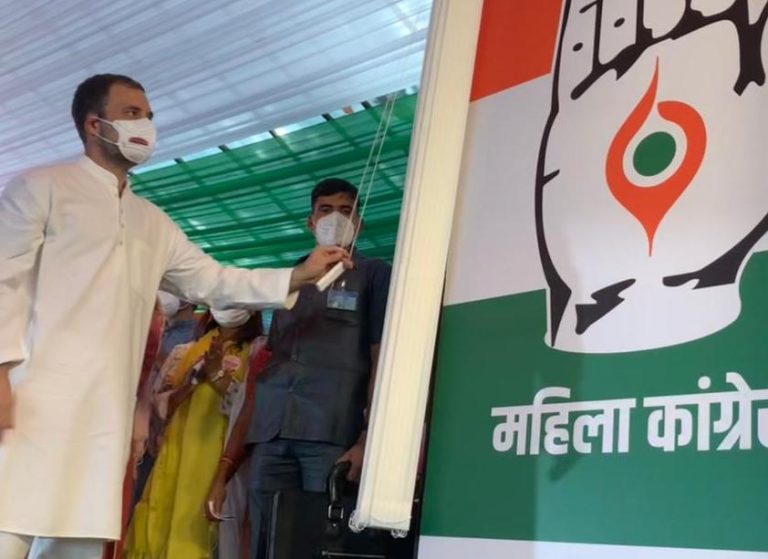
Watch: Rahul Gandhi goofs up while inaugurating new Mahila Congress logo on its foundation day

Senior Congress leader and Wayanad MP Rahul Gandhi on Wednesday goofed up yet again.

While addressing Congress workers on the launch of the new logo for Mahila Congress on its foundation day, Rahul Gandhi forgot for how many years Mahila Congress, the women’s wing for the grand old party has been around.

“I welcome all of you here and congratulate all the Mahila Congress workers, sisters for their foundation day. I’d like to also thank you for all the work that you have been doing over last 25 years?” he questions and turns around to confirm for how many years Mahila Congress has been functional. Someone in the background then prompted him that Mahila Congress has been operational since 38 years.

Rahul Gandhi’s struggle with Bharat Ratna M Visvesvaraya’s name

Incidentally, Rahul Gandhi’s goof-up on Mahila Congress coincided with the birth anniversary of Bharat Ratna M Visvesvaraya, the legendary engineer in whose honour September 15 every year is celebrated as ‘Engineers Day’.

During runup to 2018 Karnataka State Assembly elections, Rahul Gandhi struggled with pronouncing M Visvesvaraya’s name. M Visvesvaraya played a pivotal role in building many engineering marvels like the intricate system of irrigation in the Deccan Plateau near Pune. He was also instrumental in developing a system to protect the Vishakhapatnam port from sea erosion.

The fall of Afghanistan: How the Taliban is the sword arm of Pakistan

Afghanistan is in turmoil after the swift and lightning offensive carried out by the Taliban last month to capture Kabul and effectively seize control of the country. Thousands fled the country fearing a return to repressive regime of the 1990s and those who couldn’t are living under a palpable fear of persecution at the hands of their Talibani masters. 

Even though the situation in Afghanistan is grim and dreary, it is nevertheless a favourable outcome for its neighbour Pakistan, which has revelled in chaos and disorder in its neighbourhood and had long sought to use the Taliban and other assorted terror groups to advance its geopolitical ambitions. 

With the ignominious withdrawal of the United States and the return of the Taliban to power in Afghanistan, Pakistan has won a strategic victory, establishing a friendly and pliant government for the first time in nearly 2 decades. 

Throughout the long war that the USA engaged the Taliban in, Pakistan has been playing both sides, pretending to be a US ally while providing shelter and support to Taliban leadership.

Since the inception of the Taliban back in the late 1980s and the 1990s, Pakistan has been its principal benefactor. It had not only trained armed mujahideen to fight the invading Soviet forces in Afghanistan but also helped facilitate the transition of a ragtag militia group into the Taliban, which later went on to lay control of the country from 1996 to 2001. 

Pakistan was then one of the only three countries to recognise the Taliban government in Afghanistan and the last one to break formal ties with them after the US-led NATO invasion in the wake of the twin tower attacks. 

During the time, the Taliban was in power in Afghanistan, it remained as a Pakistani marionette, whose strings were pulled from Islamabad. It collaborated with the Taliban to forge ties with central Asian terror outfits such as Al Qaeda and enlist them to realise their nefarious designs. In return, the Taliban received cash incentives, arms and ammunition, and an unfettered passage through the porous borders between the two countries. 

When the US-led forces invaded Afghanistan, the Talibani leaders, as well as the top Al Qaeda commanders, bolted for their safe hideouts in Pakistan. For over two decades, Pakistan provided safe havens to Taliban leaders to cool their heels and organise their resistance. Wanted Talibani leaders and commanders moved around Pakistan without any restrictions. 

Pakistan also threw open Military hospitals to treat the Taliban terrorists who got wounded in their guerrilla war in Afghanistan or while crossing the border. Al Qaeda terrorist Osama Bin Laden’s refuge in the Pakistani backwater town of Abbottabad was a testimony to Islamabad’s resolute support to terrorism and its willingness to provide sanctuary to UN-designated terrorists and terror groups. 

Even as the western forces were busy routing the Taliban from Afghanistan, Islamabad, on the other hand, was occupied in the rehabilitation of the group. They provided assistance to sustain the Taliban, even as the terror outfit lost thousands of foot soldiers against the NATO forces. 

Several US intelligence agencies and defence experts have been cautioning the USA against Pakistan, warning them that Islamabad’s interests were at conflict with the United States and that it was playing a dangerous double-game, falsely claiming to help the United States’ in its war on terror while clandestinely extending moral, emotional and tactical support to the Taliban. 

Investigations reveal Pakistani support in helping the Taliban

Recently, US defence analyst Sarah Chayes in an interview with CNN explained how Pakistan’s ISI ran a sophisticated campaign for reinstalling the Taliban in power. When asked if the Taliban had cleverly utilised the 20 years time to build its capability and stake its claim to power, Chayes said it wasn’t the terror group but Pakistan’s intelligence agency ISI that used its resources cleverly to help topple the US-backed Ashraf Ghani government in Afghanistan.

documentary released in 2012, almost a decade before the fall of Kabul to resurgent Taliban, shed light on the double-dealing of the entities that identified themselves as the allies of the United States but were covertly working to undermine its mission in Afghanistan. Titled as ‘The Secret War’, the documentary was a culmination of the six-month long investigation carried out by Smith and Stephen Grey and which provided a window into interminably long-drawn-out war the United States had waged against Islamic terror outfits such as Al Qaeda and the Taliban

During the investigation, Smith and Grey found that the American soldiers stationed along the Afghanistan-Pakistan border were unhappy with the latter, for their covert support to the insurgency and terrorism targeted against the United States. One of the US troops, who wished to remain anonymous, confided to the reporters that the ground soldiers manning the border reportedly complained to the seniors about the Pakistani complicity in helping the Talibani and Al Qaeda terrorists cross the border and infiltrate into Afghanistan.

Pakistani Army and Air Force allegedly collaborate with the Taliban to suppress the Afghan resistance

Years later, as the Taliban wrest control of Afghanistan, Pakistan was at the forefront to grant legitimacy to the organisation and allegedly extend military help to bring the Panjshir Valley, the last remaining holdout of the Afghan resistance, under the Talibani control. Several reports that surfaced in the news hinted at Pakistani involvement in helping the Taliban in its offensive in Panjshir. 

The reports claimed that the Taliban’s campaign against the Afghan resistance in Panjshir was aided by the Pakistani Air Force and Army. They reportedly bombed the Panjshir Valley and fought against the rebels who were opposed to the Taliban takeover of Afghanistan, yet another illustration of how Pakistan has been furthering the interest of the Taliban. 

ISI chief Faiz Hameed had landed in Kabul days before the Taliban mounted a massive air and ground offensive against the Northern Resistance in Panjshir valley.

Pakistani complicity in the resurgence of the Taliban in Afghanistan

For years, Pakistan has pulled the wool over the West’s eyes by making deceptive claims of support to its war against the Taliban and Al Qaeda. Far from promoting western interests, it was assiduously working to safeguard, nurture and fortify the Taliban. When the west finally decided to call it quits of its disastrous campaign in Afghanistan, the Pakistan-backed Taliban displayed remarkable dexterity in seizing control of Afghanistan. 

The lightning offensive of the Taliban, the simultaneous fall of Afghan provinces, the surrender of the Afghan forces, all hint towards a mega plan hatched to lay control of Afghanistan. In the current context and given their historical association with the Taliban, it won’t be a wild exaggeration to surmise Pakistani involvement in the comprehensive takeover of Afghanistan. 

The Pakistani complicity in fostering the Taliban was acknowledged by the US Secretary of State Antony Blinken during his first testimony before Congress since the terror group took control of Kabul. Blinken stated that Pakistan is responsible for harbouring the Taliban and the terrorists from the proscribed Haqqani Network. 

It is also worth noting that earlier this month, former Afghan vice president Amrullah Saleh too accused Pakistan of being in cahoots with the Taliban. He alleged that the Taliban are being micromanaged by Pakistan’s notorious intelligence agency–the ISI, adding that Islamabad is in charge of the war-ravaged country effectively as a colonial power.

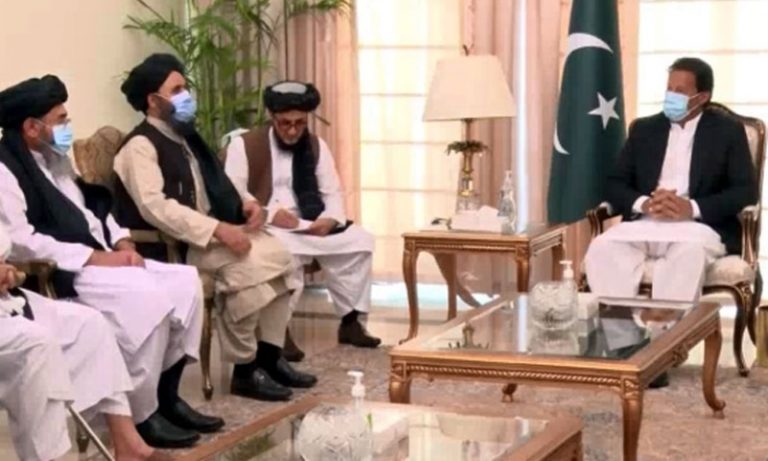
Pakistani Prime Minister Imran Khan has also been all praise for the Taliban after it stormed the capital and exerted its control over Afghanistan. Days after the Taliban takeover of Afghanistan, Khan heaped praises on the terror group, congratulating them on their victory and asserting that “Afghanistan had broken the shackles of slavery”.

Well, this is not the first time that Khan has sympathised with the Taliban. Time and again, Khan has hailed the Taliban and spoken in support of the terror outfit. It is his persistent praise and admiration for the Taliban which has earned him the moniker of ‘Taliban Khan’. With the country’s Prime Minister commiserating with the Taliban, it is anybody’s guess how enthusiastic the establishment would be to champion the cause of the Taliban.

Taliban—an offshoot of the Pakistani establishment

As the world grapples with the new reality of a restive Afghanistan under the Taliban, it would be advisable to account for the complicity of Pakistan in its current predicament. There is little doubt that Afghanistan would soon devolve into a Pakistani outpost, where an eclectic group of terrorists would once again find shelter and a conducive environment to wage Islamic jihad against the non-believers.

It is therefore of great consequence to account that not only is Pakistan harbouring and nurturing the Taliban, but it is also the original fountainhead of the terror group, the source from which the Taliban draws its power and perhaps works to fulfil its objectives. The world would be in for another rude shock if it continues to turn a blind eye to Pakistani shenanigans and refuses to treat it for what it is: a rogue terror state.


Mohammed Ameen became Raja Pandit to trap mother of three, tried to forcefully convert to Islam and harassed for dowry

0

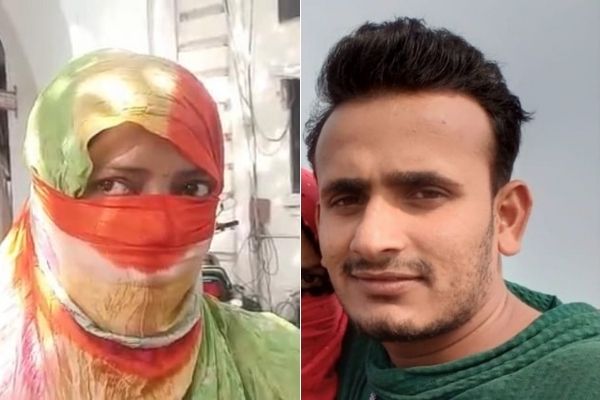
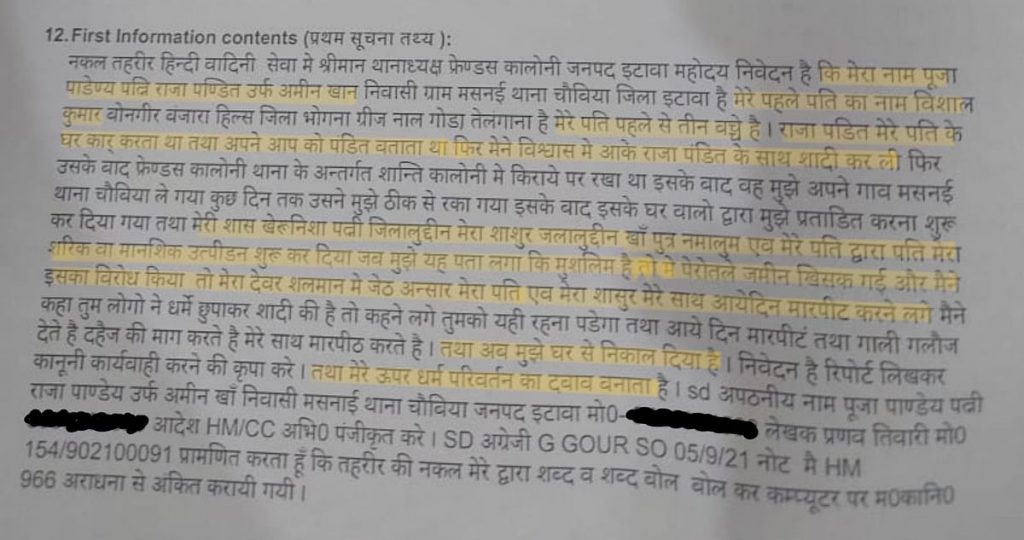
Uttar Pradesh police filed a case on September 05 against one Mohammed Ameen for faking his identity to trap a mother of three and later harassing her for dowry and forceful conversion to Islam.

Puja Pandey was living with her husband Vishal Kumar and three children in Telangana. Reportedly, the woman came close to a person who worked for her husband last year and eloped with him to Uttar Pradesh.

The victim has now filed a case against him alleging harassment and assault.

Mohammed Ameen posed as Raja Pandit

The woman in her complaint said that Mohammed Ameen who worked under her husband introduced himself as Raja Pandit. He then eloped with her and got her to the Etawah district in Uttar Pradesh. 

Initially, Raja aka Ameen kept her at Shanti Colony and later took her to his village, Masnai. As per Puja’s statement, it is after reaching Ameen’s village did she get to know of his real identity. 

The woman further revealed that Ameen’s parents and family soon began to harass her for dowry. They also pressured her to convert to Islam. She also accused Ameen of establishing a sexual relationship with her and recording the act. 

Victim’s statement to the police. Image Source: Swarajya

When resisted, Ameen began to blackmail her and threatened of making the videos viral on social media. She was eventually forced to elope with him. The victim in her statement also accused Ameen of abusing her physically and verbally.

In some media interviews, Puja also informed that Ameen made her sign some documents that she could not read. It is only later that she got to know that the papers declared her to be a Muslim. 

She was then forced to wear a burqa but being a Hindu she refused. On refusal, Ameen’s family said that the villagers would come to know that their son had brought a Hindu woman home if she does not wear a burqa.

Puja also alleged that Ameen’s family was forcing her to change her name to Nasreena. 

UP Police books Ameen’s family

On the basis of the woman’s complaint, the police has booked Ameen, Jalaluddin Khan (father), Kherunishan (mother) and Salman and Ansar (brothers) for harassment. 

The case has been filed under IPC section 498A (dowry), 323 (voluntarily causing hurt), 504 (provocation through insult), 419 (cheating by impersonation) and other relevant sections of the Dowry Prohibition Act and UP’s Prohibition of Unlawful Religious Conversion Ordinance, 2020. 

As per a statement given by the station house officer (SHO) of Friends Colony police station to Swarajya, all the accused have been arrested and are being interrogated. The officer also informed that Ameen refuted all the allegations levelled against him when presented before the court. 

Hindu activist assisted the victim to file a case

The report suggests that Puja was found crying outside a local court by Anuj Purohit, a worker of the Narayani Sena. He along with his organization then assisted the woman to Friends Colony police station after listening to her story. 

Purohit also assured that the victim has been provided with a rented accommodation near Friends Colony and that her elder son will soon come to pick her up to take her back to Telangana. 

“Till her family comes, we will look after her,” informed the Narayani Sena activist.