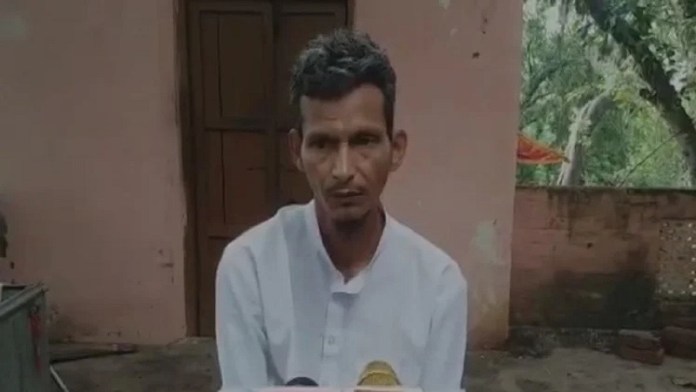
Nitin Pant, a resident of Uttarakhand was lured on the pretext of money and a job, taken to Rajasthan and forcefully converted to Islam to become Ali Hassan. In yet another case of forceful religious conversion, Pant who landed in Rajasthan’s Bhiwadi in 2010 in search of a job was taken to Mewat by some local Muslims. There he was forced to give up his religion and accept Islam by promising a job and marriage.
When resisted, Pant was beaten up and was threatened with dire consequences. He was also trained to trap Hindu girls and convert them to Islam. Pant was also taken to Muzaffarnagar, from there he was taken to Meerut where Pant was made to sign an affidavit. Eventually, he was made to lodge in a madrasa in Saharanpur’s Umahi village.
pant is still mortified by the incident, according to Bajrang Dal leader Nipun Bharadwaj.
उत्तराखंड के हिन्दू युवक का कांग्रेस शासित राजस्थान के मेवात में पिस्तौल के दम पर हुआ धर्मांतरण। मीडिया में भी चुप्पी है, एक तो जिहादी दामाद और सरकार कांग्रेस की… pic.twitter.com/XbHuNEzpjJ
As per reports, Pant successfully managed to escape from their clutches and approached members of the Hindu organization. He was immediately rehabilitated by the members and brought back to the Hindu-fold by organizing a ghar vapsi program.
Pant who is currently lodged at Saharanpur’s Balaji Ghat narrating his ordeal informed that the accused used to threaten him at gunpoint, beat him up and even give electric shocks when he tried to resist or revolt against conversion.
A case has been registered against the miscreants and the members of the Hindu organization have demanded strict action.
SP Rajesh Kumar informed, “We have received the information. As the case is related to Rajasthan, we will send an intimation to the Rajasthan Police once we receive the complaint. The local police will also take action when the allegations will be found to be true.”
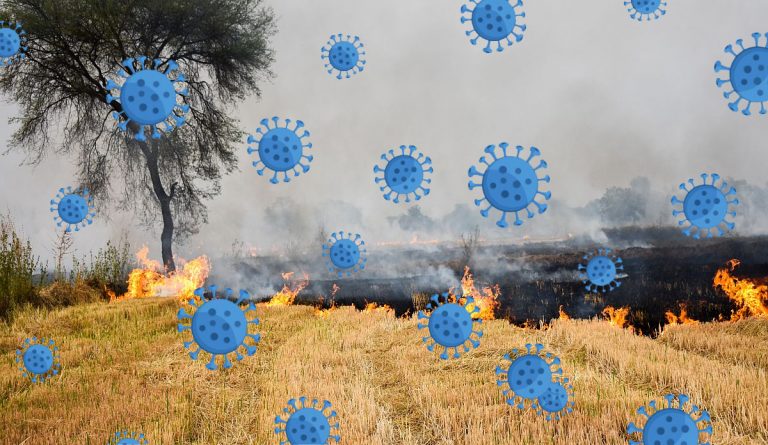
The surge in the Covid-19 cases in Delhi towards the end of last year could have been caused by the pollution caused by stubble burning, a research paper has suggested. According to a research paper published by researchers at the Indian Institute of Tropical Meteorology (IITM) in Pune, it has been concluded that the pollutants present in the air caused by the stubble burning increase the spread and infection rate of Covid-19 in multiple ways, and the surge in October and November in 2020 has been attributed to the same.
Indian Institute of Tropical Meteorology is an autonomous institution under the Ministry of Earth Sciences of the Government of India. It is tasked with research in monsoon, weather systems and climate-related processes in the tropical region.
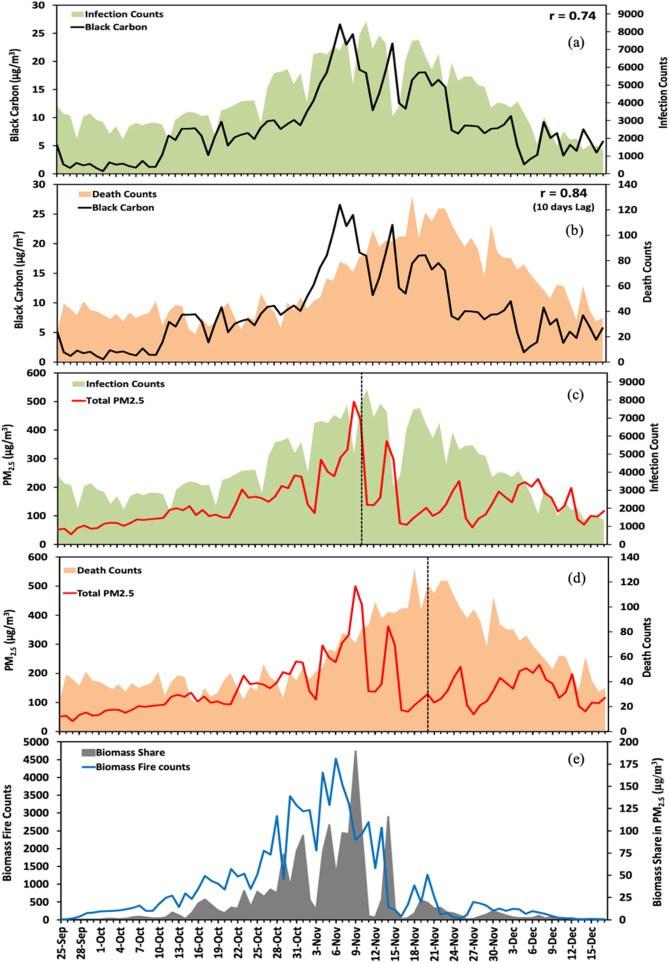
The peer-reviewed paper authored by Aditi Rathod and Gufran Beig says that the Covid-19 numbers in Delhi were declining in the second half of last year, but it suddenly started to rise in October, which coincided with the burning of stubble by the farmers mostly in neighbouring Punjab and Haryana. The researchers wanted to find out if there is any direct correlation between the level of particulate pollutants, mainly Black Carbon (BC), in the air with the spread of microbes that cause various diseases including Covid-19. Most of the Black Carbon in the air comes from the burning of biomass like crop stubble, and it is the main component of soot.
The study was conducted using pollution data for Delhi from September to December, 2020, and analysing the same with the daily Covid-19 numbers for the city in that period.
The researchers have arrived at shocking conclusions after the study, which shows that the stubble burning contributed heavily to the rising cases of Covid-19, which happened in multiple ways. The stubble burning produces black carbon, which gets ‘aged’ as it travels towards Delhi. During its ageing process, it gets combined with other pollutants, which increases its size. The aerosolised virus gets attached to these particles, piggybacks on them to remain suspended in air and also to spread to wider areas. As the number and size of such BC particles increase in the air, the number of viruses on them also increases. Such viruses attached to black carbon particles have been called carbonised virus.
The pollution also increases the level of nitrates and sulphates in the atmosphere, and they help the SARS-CoV-2 virus to reproduce at a faster rate. Thus, the polluted air provides the Covid-19 virus an ideal scenario to multiply and spread at a faster rate.
When people inhale these Black Carbon particles, the virus particle also goes deep down into the respiratory system, thereby increasing the total dose delivered and total duration for which the virus stays there.
The soot caused by stubble burning also causes inflammation of the lungs, which can cause asthma and other respiratory diseases. This causes serious damage to the functions of the lungs. When such an already compromised lung is infected with the Covid-19 virus carried by the Black Carbon particles, it becomes a double whammy for the lungs and increases the complications of the Covid-19 infection.
The research found that BC concentration directly corresponds to the speed of the spread of the Novel Coronavirus at the onset of winter and stubble burning period. Moreover, the infections came down gradually after December in Delhi, when the stubble burning in the farms had declined. The study also found direct correlation of total PM2.5 level in the air with Covid-19 numbers and the deaths caused by Covid-19.
Intestinally, the PM2.5 level in the air remained high even after stubble burning had ended, but this didn’t cause an increase in Covid-19 infections. This shows that the black carbon particles that originated from stubble burning are specifically responsible for the spread of the virus, and the same particles coming from other sources may not be that responsible.
Based on this analysis of data, the study concluded that SARS-CoV-2 has the potential to be transmitted aggressively through an aged Black carbon-rich environment with fire’s microbial content rather than any particulate pollution.
Although the researchers have not tested the infectivity of the carbonised virus clinically, they have proposed that SARS-CoV-2 may have the potential to be more lethal when piggybacking on aged black carbon as the black carbon particles themselves cause serious damaging effects to lungs. As a result, the study points out that atmospheric and public health sciences need to expand their perspectives to include the potential impact of smoke’s black carbon and microbial cargo on human populations.
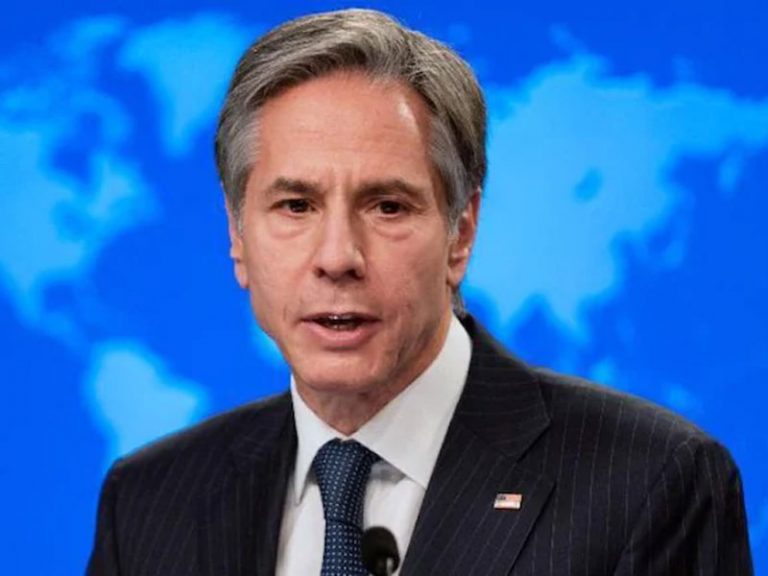
On July 28, Antony John Blinken, Secretary of State, United States, hailed India-US ties and said that India’s democracy is a force of good in a free and open world. He said the democracy in India is powered by free-thinking citizens, and the US applaud that. “We view Indian democracy as a force for good in defence of a free and open Indo-Pacific and a free open world,” he added.
Our shared values strengthen the US and India relationship. Like our own, India’s democracy is powered by its free thinking citizens. We applaud that. We view Indian democracy as a force for good in defence of a free and open Indo-Pacific & an free & open world: US Secy of State pic.twitter.com/30rDPtttHx
Blinken further added that every democracy, including that of America, is a work in progress. While discussing the issues, it should be done from starting point of humility. He said, “We recognize that every democracy, starting with our own, is a work in progress. When we discussed these issues, I certainly do it from starting point of humility. We’ve seen challenges our own democracy faced & faces today. This is in a sense to all democracies.”
We recognize that every democracy, starting with our own, is a work in progress. When we discussed these issues, I certainly do it from starting point of humility. We’ve seen challenges our own democracy faced & faces today. This is in a sense to all democracies: US Secy of State pic.twitter.com/XdDrT7eTUB
He said, “We talk about in our founding document, search for a more perfect union that means that we are not perfect. Our quest is to get closer to the ideals we set for ourselves. At times, the challenge is painful & ugly, but as democracies, we do it openly.”
As friends (India and the US), we talk about these issues, we talk about challenges we face in renewing & strengthening our democracies. Humbly we can learn from each other. No democracy regardless of how old or large has it all figured out: US Secretary of State Antony Blinken
While talking about India and the US relationships, he said that both the countries talk about the issues and challenges faced while renewing and strengthening the democracies. He said, “As friends (India and the US), we talk about these issues, we talk about challenges we face in renewing & strengthening our democracies. Humbly we can learn from each other. No democracy, regardless of how old or large has it all figured out.”
Blinken met MEA S Jaishankar and NSA Ajit Doval
State Sec Blinken met Minister of External Affairs Dr S Jaishankar. During the meeting, they discussed India and US cooperation against the Covid pandemic. They discussed the peace and prosperity in the region and to work for democratic stability in Afghanistan. In a tweet, the EAM said, “A wide-ranging and productive discussion today with Sec Blinken. Useful in mapping out the next steps in our bilateral partnership. Strong convergence of views on many regional concerns. Agreed to work closely on multilateral and global issues.”
A wide ranging and productive discussion today with @SecBlinken. Useful in mapping out the next steps in our bilateral partnership. Strong convergence of views on many regional concerns. Agreed to work closely on multilateral and global issues. pic.twitter.com/UiYjPdQZMi
The meeting between Blinken and NSA Doval lasted for around an hour. Reportedly, the main focus was on global and regional security and long term measures to take Indo-US relationships to the next level.
Today, #USA Secretary of State Antony Blinken met National Security Advisor Ajit Doval ji. Discussed strategic issues of importance in security, defence, economic & tech-related sectors and also on long term measures to take the Indo-US relationship to the next level. pic.twitter.com/U0A18YkPzu
It is notable here that Blinken’s visit is considered strategically important because the USA has been increasingly concerned about China’s attempts to dominate the Indo-Pacific region. The 4-nation Quad containing India, Japan, the USA and Australia had its first formal meeting earlier this year.
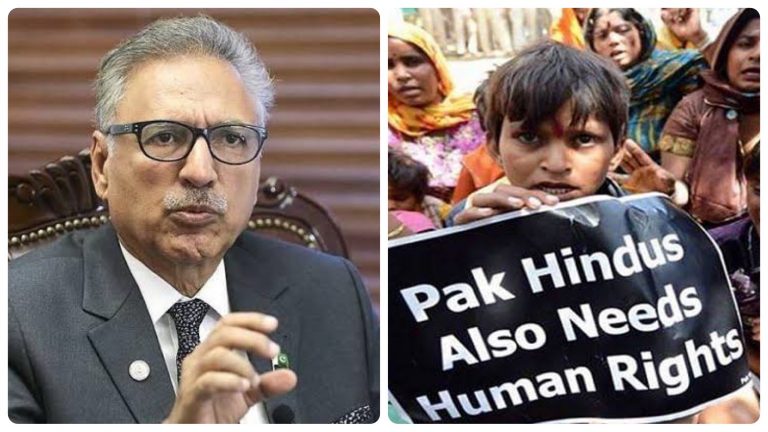
After the egregious video of a Pakistani Muslim man coercing and threatening a Hindu boy into chanting Allahu Akbar and abusing Hindu Gods and Goddesses went viral on the internet, triggering widespread outrage and concerns over the plight of minorities in Pakistan, the President of the country took cognisance of the incident and took to Twitter to comment about it.
In a tweet, the official Twitter account of the President of Pakistan informed that President Dr Arif Alvi took serious note of the incident of the harassment of a Hindu boy in Tharparkar, Sindh and on his directions, the accused, Abdul Salam Abu Daud was arrested by the Sindh Police.
President Dr. Arif Alvi took serious notice of the incident of harassing a Hindu boy in Tharparkar, Sindh
On directions of the President, the accused, Abdul Salam Abu Daud, has been arrested by Sindh Police. pic.twitter.com/0atqb3dp6f
— The President of Pakistan (@PresOfPakistan) July 27, 2021
However, this was not before social media users and activists expressed their outrage over the incident, raising larger questions about the predicament of minorities, especially Hindus, in Pakistan. As the video of the Hindu boy being intimidated and threatened into chanting Allahu Akbar and abusing Hindu Gods and Goddesses went viral, concerns regarding the fragile safety of minorities in Pakistan began to be raised, prompting the President of Pakistan to condemn the incident.
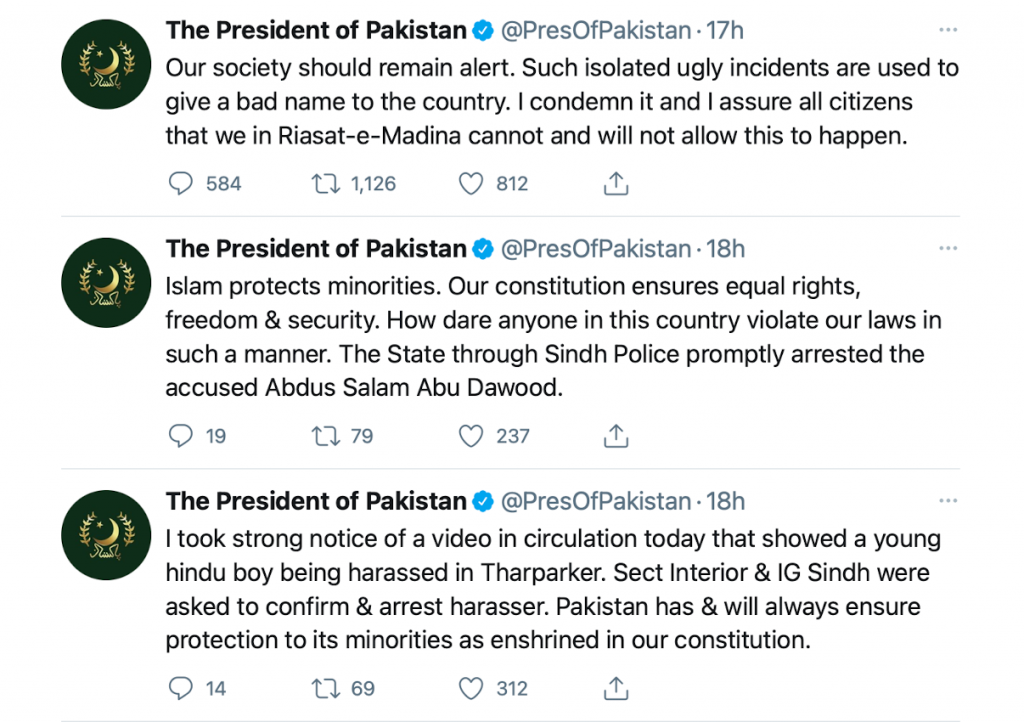
In a bid to allay the mounting criticism about Pakistan’s inability to safeguard the rights of its minorities, the President of Pakistan posted a string of tweets denouncing the harassment of the Hindu boy.
However, the President of Pakistan’s condemnation came with a caveat. Instead of issuing an unconditional denouncement of the incident, the President termed it as an “isolated” occurrence that he claimed was used to vilify the country.
“Our society should remain alert. Such isolated ugly incidents are used to give a bad name to the country. I condemn it and I assure all citizens that we in Riasat-e-Madina cannot and will not allow this to happen,” the President’s official Twitter account posted.
The President was more concerned about the bad name that the incident brought to the country instead of the harassment meted out to the Hindu boy by the member of the majority. In the subsequent tweet, the Pakistani President tried to water down the religious bigotry of the aggressor, holding forth on the cliches about Islam protecting minorities and the constitution ensuring equal rights, freedom and security.
“Pakistan has and will always ensure protection to its minorities as enshrined in our constitution,” he said in another tweet.
While the Pakistani President called it an “isolated” incident, a look at the perpetrator’s social media handle tells that the man is a habitual offender. His social media comments are full of blatant Hinduphobia and hatred against Hindus. There was another video where he was interacting with a Hindu child, claiming to the camera that he could have assaulted the Hindu child, but he was not doing so because he is a ‘virtuous’ man.
The systematic persecution of religious and ethnic minorities in Pakistan
While the President of Pakistan would have his followers believe that the harassment of a Hindu boy in Tharparker was just a stray incident and that the state of Pakistan works scrupulously to uphold the rights of the minorities and ensure their protection, the incidents of persecution since its inception in 1947 do not jibe with his recent assertions.
From 14 August 1947 Hindus in the country have been systematically persecuted, a trend that reached a crescendo during the Bangladesh liberation war in 1971 when millions of Hindus in Bangladesh were maimed, raped, brutalised, and killed. The trend continued well into the 1980s, the decade when Pakistan was Islamised under the rule of Islamic fanatic Zia-ul-Haq.
Later in the 1990s, the Islamic radicals and terrorists gained prominence as the United States egged them on to wage a jihad against the Soviet forces that had invaded neighbouring Afghanistan. The radicalisation of the population and the romanticism with the idea of jihad inevitably gave rise to Islamic terrorism and a growing number of radical fanatics started gaining currency. As a consequence, the country became a breeding ground for terrorists and radicals who believed in the puritanic version of Islam.
Subjugation of Ahmadiyya sect of Muslims within Pakistan
Since then, the persecution of minorities in Pakistan has only escalated. In fact, not just other religious minorities but Ahmadiyya, a minority group within Muslims, have also been subjected to violence, subjugation and brutality. Sectarian conflicts between Muslim groups have marred Pakistan as different radical groups vie to dominate the country’s larger Islamic doctrine.
The Ahmadiyya community in Pakistan is prohibited from referring to themselves as such, and from practising aspects of their faith under Pakistan’s strict blasphemy laws. A recently published report in Al-Jazeera said there has been a spike in the persecution of Ahmadiyya in Pakistan in the last two years.
Last year, at least five Ahmadis were killed in targeted attacks by terrorists across Pakistan, while at least seven others were wounded in unsuccessful attacks, the community data says. Since 2017, at least 13 Ahmadis have been killed, and more than 40 wounded, as per the data.
Religious minorities, especially Hindus, in Pakistan living under the persistent shadow of fear and persecution
The threats faced by members of other religious minority communities in Pakistan are even more dangerous. Sikhs, Hindus and Christians in Pakistan lead a particularly vulnerable life in Pakistan, with the strict blasphemy laws being used by the members of the majority community as a tool to persecute them and settle personal scores.
Hindus, in particular, live under a constant threat of persecution. Attacks on Hindus, kidnapping of Hindu daughters and their forcible conversions have become par for the course in Pakistan. Among Hindus, girls are especially targeted by the Islamic fanatics that run amok in Pakistan. The kidnappings, forced conversions and marriage of Hindu girls have become frequent in Pakistan, especially in the Sindh province. The Islamic fanatics routinely abduct Hindu girls, forcefully convert them into Islam before marrying them against their wish.
Recently, a case of a Muslim neighbour kidnapping, converting and marrying his Hindu neighbour was reported in Pakistan’s Kadio Ghanour. Reena Meghwar, a Hindu girl was forcibly converted and married after being abducted by a Muslim neighbourhood man she used to tie Rakhi to.
In March this year, a 13-year-old Hindu girl named Kavita Oad from the Kandhkot area of Sindh was reportedly abducted and then forcibly converted to Islam. A couple of days later, her house was set on fire by unidentified miscreants.
In the same month, a journalist in Pakistan was shot dead by unknown assailants for exposing the role of politicians and clerics in facilitating the forceful conversions of Hindu girls. A report published by Associated Press in December 2020 estimated that more than 1,000 girls, mostly Hindus, are abducted, raped and converted to Islam every year in Pakistan.
Families of the victims have accused the administration and the police of not acting against the culprits. Even the courts fail to do justice for Hindus in Pakistan. In fact, in some cases, the courts have actively participated in the injustice meted out to the Hindu and Christian minorities. In June 2020, a district magistrate allowed a Muslim man to keep his Hindu wife even after the parents of the girl alleged that their daughter was kidnapped and forcibly married off to the man.
So while the President of Pakistan might make light of the recent case of harassment of the Hindu boy by terming it as an “isolated” incident, the facts don’t add up with his assertions. On the contrary, they point towards a sinister pattern of unceasing persecution of minorities, carried out by Islamists and abetted by the judiciary, government authorities and members of civil society.
The Pakistani President might have resorted to using platitudes and laid claims to the lofty ideals of democracy but is it is an established fact that Pakistan is a dysfunctional country, much less a democracy. Therefore, his claim that the bullying of a Hindu boy into chanting Allahu Akbar is nothing but a shoddy attempt to whitewash the unspeakable atrocities meted out Hindus while shielding the perpetrators behind it.
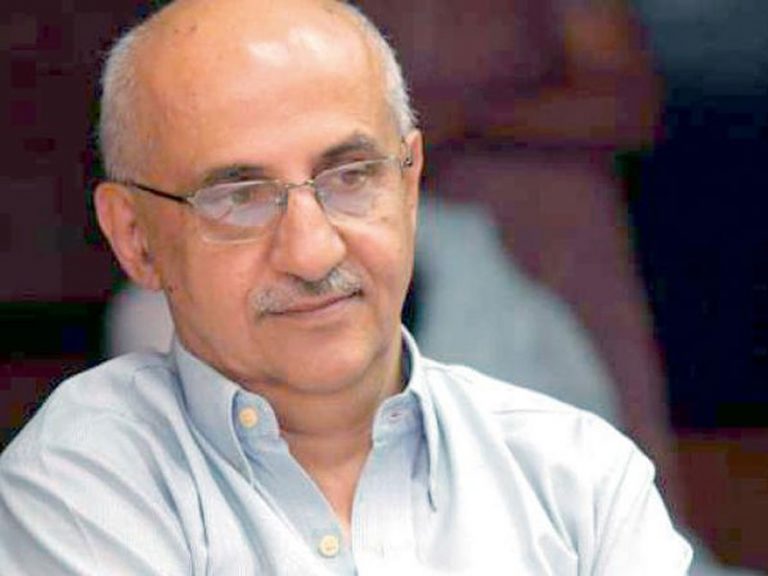
On July 27, the National Commission for Protection of Child Rights told the Delhi High Court that they had recommended action against two children’s homes linked to Harsh Mander only after they found various discrepancies and violations. The two homes under investigation are Ummeed Aman Ghar for Boys and Khushi Rainbow Home for Girls. An FIR was registered against Mander in February 2021.
According to the NCPCR, children informed that elder boys were sent to sit in protests against CAA and that one child even said that PM Modi only listens to Hindus and fights with Pakistan. The commission said that one of the girls informed the commission that she, along with 4-5 girls, went to Jantar Mantar during the CAA protest. They also found that elder boys were also sent to protest sites. Sending children for protests is a violation of Section 83(2) of the Juvenile Justice Act, 2015.
NCPCR said that the children were taken to the protest sites, including Jantar Mantar, which is a violation of the regulations. The reply by the commission was submitted as a response to the plea filed by the Centre for Equity Studies’ (CES) which runs the children’s homes. Mander is a director at CES. In the plea, they have requested the court to quash the inspection reports submitted by NCPCR.
In its reply, NCPCR said that prima facie, they found several violations of the Juvenile Justice Act, 2015 and its Model Rules, 2016, along with other irregularities. They said, “During the inspection, prima facie many violations of Juvenile Justice (Care and Protection of Children) Act, 2015 and its Model Rules, 2016 and various other irregularities came to the notice of NCPCR, including financial irregularities as the institution was reluctant in disclosing their sources of funding and other relevant documents to the inspection team.”
The action was taken based on a complaint filed by one Kalinga Rights Forum that alleged violations of the Juvenile Justice Act at the two homes run by Mander. In the complaint, it was alleged that children from a particular religion were being catered to in the homes. It also alleged that CES received hefty funding that was being used for illegal activities like religious conversions.
NCPCR, in its reply, mentioned several alleged violations, including expiration of the registration of one of the houses, inadequate staff and infrastructure, no age segregation among children and allowing foreign nationals on employment and tourist visas to give voluntary services at the homes, among others.
‘Inaction against complaints of child sexual abuse’
NCPCR told the court that in the boys’ home, an employee informed the commission about child sexual abuse cases reported. However, the management did not take any action in such a complaint. They said, “The Commission observed this to be a gross violation of the provisions of the POCSO Act, 2012 and had immediately reported this to Delhi Police for further investigation as well.”
CES failed to disclose details of funds
The commission alleged that the homes received funds from multiple sources. CES did not disclose that the funds were received from Rainbow Foundation India and Association for Rural and Urban Needy (ARUN) under the Rainbow Homes Program.
NCPCR raided homes in October last year
In October 2020, the NCPCR acting on a complaint had raided the children’s homes run by CES, where Mander is a director. Mander alleged that the questions asked by the commission included if children participated in protests such as anti-CAA protests, foreign funding received by the homes and if Rohingya children are lodged in the two homes.
In January 2021, NCPCR said in a statement that they found many violations of the Juvenile Justice Act and other regulations at the two homes. The allegations, including the incidents of child sexual abuse at the home for boys, were denied by CES. They said that the allegations were raised in order to tarnish the reputation of Mander, who is a director at CES.
DCPCR defended Mander-linked homes
Delhi Commission for Protection Child Rights (DCPCR) that comes under the Aam Aadmi Party-led Delhi government had defended the two homes. They said in their statement that most of the regulations were being followed at the homes. NCPCR, in response to the DCPCR inspection, said that the latter’s inspection took place after the former’s inspection.
In a reply, the Delhi Commission for Protection Child Rights (DCPCR) defended the two homes and said they were adhering to most norms. DCPCR said, “All citizens including children are well within their right to know, discuss, debate on any issue facing India and form their own conclusions. The fear expressed by the NCPCR is rooted in the belief that children are stupid, have no agency and cannot think at all. DCPCR vehemently opposes such a belief and expects greater dignity to be accorded to children.”
The NCPCR responded that the DCPCR inspection had taken place after its own inspection.
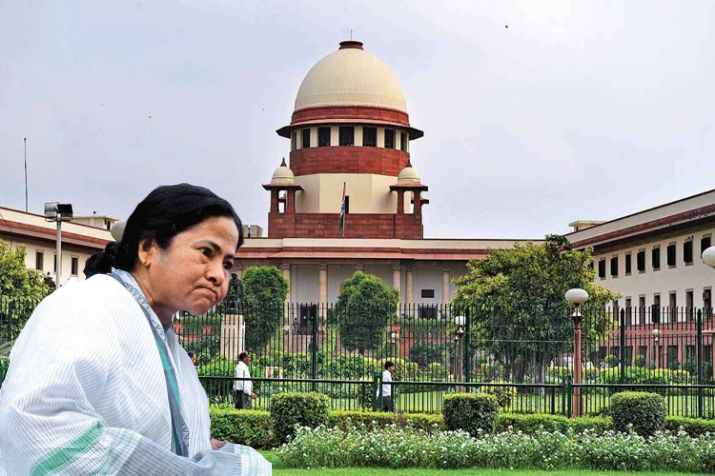
The Supreme Court on Wednesday tore into the West Bengal government for providing “unrealistic” and “unreliable” figures of children being orphaned and abandoned in the State owing to the Covid-19 pandemic. The bench comprising Justices L Nageswara Rao and Aniruddha Bose rebuked the TMC supremo Mamata Banerjee led government for not uploading correct information of children who were orphaned during the Covid-19 pandemic since March 2020.
It is pertinent to note here that the Mamata Banerjee government had submitted in the apex court that only 27 children were orphaned in the state during pandemic against all India reported figure of 6855. Calling it non-credible and unrealistic, the two-judge bench directed the Secretary of the Department of Women and Child Welfare, West Bengal to submit the correct particulars in the court.
The number was revealed in an affidavit filed by the National Commission for Protection of Child Rights (NCPCR) in a suo moto petition before the Supreme Court for the identification and rehabilitation of children who lost one or both parents during the Covid-19 pandemic and needed care and protection.
The NCPCR stated that from April 1, 2020, to July 23, 2021, its special portal, Balswaraj, collected information on 6,855 orphans, 68,218 children who lost one parent, and 247 children who were abandoned as a result of the pandemic.
To this, the West Bengal government reported that only 27 children were orphaned during the pandemic while 1020 children lost one parent and only three were abandoned.
The obligation is yours and not ours: SC lambasted the West Bengal Govt for furnishing wrong particulars in court
The bench of Justices L Nageswara Rao and Aniruddha Bose said: “The information that is filtering to us does not appear to be credible and reliable. We are not prepared to believe this figure that in a big state like West Bengal, only 27 children were orphaned.”
Do not politicise the issue and shift blames: SC tears into West Bengal Govt
The top court went on to slam the Mamata Banerjee led government for politicising the issue and shifting the blame on the NCPCR. Justice Rao reprimanded the counsel for the State of West Bengal by saying: “Don’t you understand the gravity of this situation? Don’t take such a stand on what basis NCPCR is making such allegations. It’s not a political matter. The obligation is yours and not ours. You are under a constitutional obligation to provide relief to the children”.
When advocate Sayandeep Pahari appearing for the state government of WB said it was an ongoing exercise and there was no reason for NCPCR to doubt the state’s figures. The bench said, “If you are steadfast in saying 27 children became orphans in such a big state, we can order an enquiry from an outside agency.”
“We will record your statement that this is the truth and then order a separate investigation?”, lambasted the court at the counsel representing the WB government.
Following the upbraiding by the apex court, advocate Suhaan Mukherjee, also appearing for the state, urged to be provided with an opportunity to come back with updated figures.
Mamata Banerjee’s mismanagement and cover-ups during the Covid-19 pandemic
It is pertinent to note here that the Mamata Banerjee government has received harsh criticisms for the mismanagement of the Covid pandemic in the state. Be it for fudging coronavirus positive cases and death numbers or hiding data or secretly disposing of deceased coronavirus patients in special incinerators or under-testing. Be it siphoning off ration provided by the central govt during Covid related lockdown or the misuse of the funds provided by the central government against the COVID-19, Mamata Banerjee has been under the scanner since the start of the pandemic.
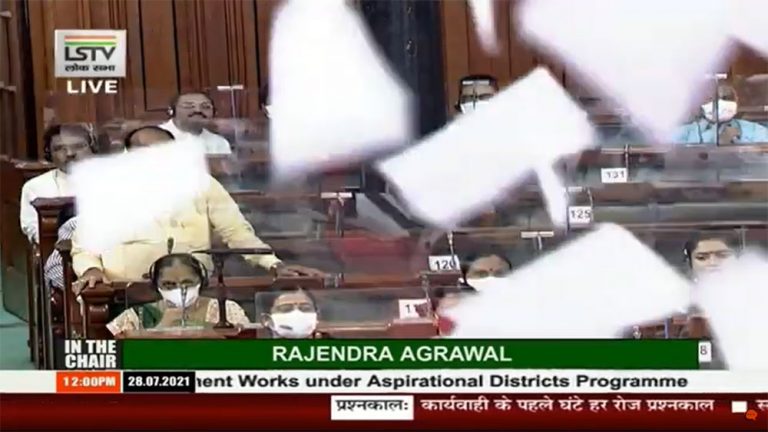
On July 28, Congress MPs tore and threw papers at the Chair and the treasury benches in Lok Sabha while protesting over Pegasus and farmers’ issues. The opposition leaders also raised ‘Khela Hobe’ slogans and demanded a discussion on the ‘Pegasus Project’ report. After the uproar, the Chair adjourned the proceedings till 12:30 PM.
Credit: Lok Sabha TV
The situation in Rajya Sabha was no different. The Opposition leaders restored to hooting and howling while Union Minister Hardeep Singh Puri made a statement in the house. Reportedly, the Opposition parties’ leader had a meeting at the Parliament earlier on Wednesday to plan the future course of action over several issues, including Farmer Protests, Pegasus report and others.
The meeting took place in the chamber of the Leader of Opposition in the Rajya Sabha, Mallikarjun Kharge. Leaders from both Lok Sabha and Rajya Sabha from 14 parties that are Congress, DMK, NCP, Shiv Sena, RJD, SP, CPIM, CPI, NC, AAP, IUML, RSP, KCM and VCK attended the meeting.
Some prominent names included Rahul Gandhi, Adhir Ranjan Chowdhury, Jairam Ramesh, TR Baalu, Tiruchi Siva, Kanimozhi, Supriya Sule, Praful Patel, Sanjay Raut, Hasnain Masoodi, Bhagwant Mann, Manoj Jha and others.
Sitting with the entire opposition is extremely humbling. Amazing experience, wisdom and insight in everyone present.#Unitedpic.twitter.com/w74YRuC3Ju
Speaking to the reports after the meeting, Congress leader Rahul Gandhi said that the Opposition would continue to raise the issues of ‘public interest’ and not compromise on matters including farmer protests, inflation and Pegasus Project. The Opposition has been creating a ruckus in the Parliament since the Monsoon Session commenced on July 19.
PM Modi asked BJP leaders to expose Opposition
On Tuesday, Prime Minister Narendra Modi has reportedly directed the BJP leaders to expose Opposition leaders for creating a disturbance in both houses.
जब प्रधानमंत्री श्री @narendramodi जी सदन के अंदर हर चर्चा के लिए तैयार हैं तो विपक्ष चर्चा से क्यों भाग रहा है ?
स्पीकर महोदय पर कागज फेंकना,तख्ती लेकर आगे आना ,मंत्री को जवाब ना पढ़ने देना ,पत्रकार गैलरी तक कागज फेंकना शर्मनाक है।
After today’s incident, Union Minister Anurag Takhur said in a tweet, “Prime Minister Narendra Modi is ready to discuss every issue in the house then why the Opposition is running away? Throwing paper at the speaker, coming with placards and not allowing the minister to read the answers is shameful. Does it suit the MPs of the Opposition?”
Advocates appearing for West Bengal post-poll violence petitioners today took strong objections to Calcutta High Court’s order giving time to the state government to file its reply. The Calcutta High Court on Wednesday granted time to the West Bengal government till July 31 to submit its supplementary affidavit in response to the report of the Committee of the National Human Rights Commission (NHRC) on the violence in the state.
While the Court made it clear during the hearing that no further extension will be given, the advocates representing the petitioners objected to the extra week given to the West Bengal government.
Advocate Priyanka Tibrewal appearing for one of the petitioners vehemently opposed the Court’s sluggish approach in the West Bengal post-poll case. Tibrewal’s arguments came after the Court could not understand the need for urgency in the case.
Bench asks : What seems to be the urgency? Why not wait for a week?
After one week, they will be forced to withdraw complaints, that is the urgency: Tibrewal
Tibrewal contested that the victims were being heckled into taking back their complaints due to delay in legal action. “State is using many tactics to delay the proceedings without paying heed to (the) plight of victims,” she argued.
Tibrewal vehemently argues that the State is using many tactics to delay the proceedings without paying heed to plight of victims.#westbengalviolence
Elaborating further, Tibrewal said, “The victims will end up withdrawing their complaints if the matter is further delayed. There is also a continuance of violence in West Bengal.”
One of the rape victims has been pressurised to take back complaint. She has been pressurised to take it back: Tibrewal
Court: is there an FIR? How can we take note of your oral remarks?#WestbengalViolence
“On last occassion, they (State of WB) were curious to find identities of Victims! They continue to harass rape and sexual assault victims & they have been pressurised to take back their complaints, hold flags of TMC. How long can they hold their courage?” questioned Tibrewal.
To this, the Bench asked if there was an FIR filed in this matter to which Tibrewal answered in negative.
One of the rape victims has been pressurised to take back complaint. She has been pressurised to take it back: Tibrewal
Court: is there an FIR? How can we take note of your oral remarks?#WestbengalViolence
Taking Tibrewal’s objection forward, senior counsel Mahesh Jethmalani appearing for another petitioner contended, “Your Lordships know that extension of time leads to the disappearance of evidence. The police is complicit in this matter”.
Police complicit in many cases of West Bengal Post Poll Violence: @JethmalaniM tells Cal HC
He also argued that the state was given enough time to file a comprehensive response to the NHRC report and if the state requires more time, a reasonable cause must be shown.
The NHRC Committee wanted to apprise the Bench of subsequent developments and new cases, however, the same was dismissed stating ‘it was not on the arguments today’.
NHRC Committee’s counsel again tells Court that he needs to tell Court about some subsequent developments.
Closing the argument, the Bench ordered, “More time sought to file further reply to NHRC’s report, even though we had granted time to the state as a last and final opportunity, however, we grant another indulgence to the State to do so on or before July 31.”
ORDER: More time sought to file further reply to NHRC’s report, even though we had granted time to the state as a last and final opportunity, however we grant another indulgence to the State to do so on or before July 31.#westbengalViolence
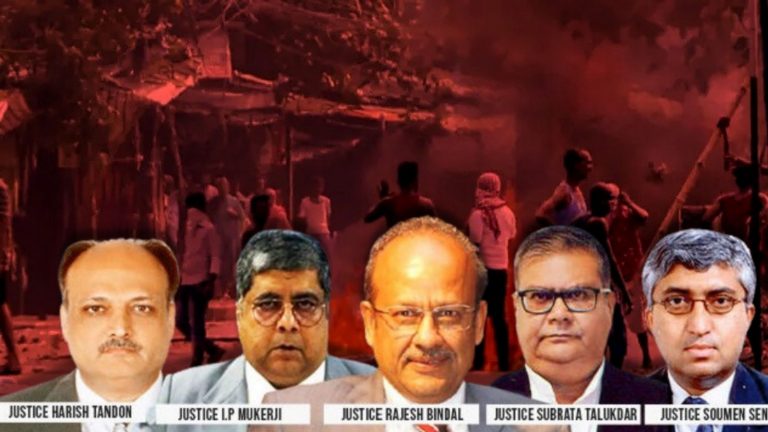
The five-judge Bench comprising Acting Chief Justice Rajesh Bindal, Justices I.P Mukerji, Harish Tandon, Soumen Sen and Subrata Talukdar took the required documents and reports of the deceased BJP worker Abjijit Sarkar. They also took on record the affidavit filed in response to the NHRC report by the State and a pen-drive containing the utterances of some members of the NHRC committee in public.
The matter has been adjourned till August 02 for further arguments on behalf of the NHRC.
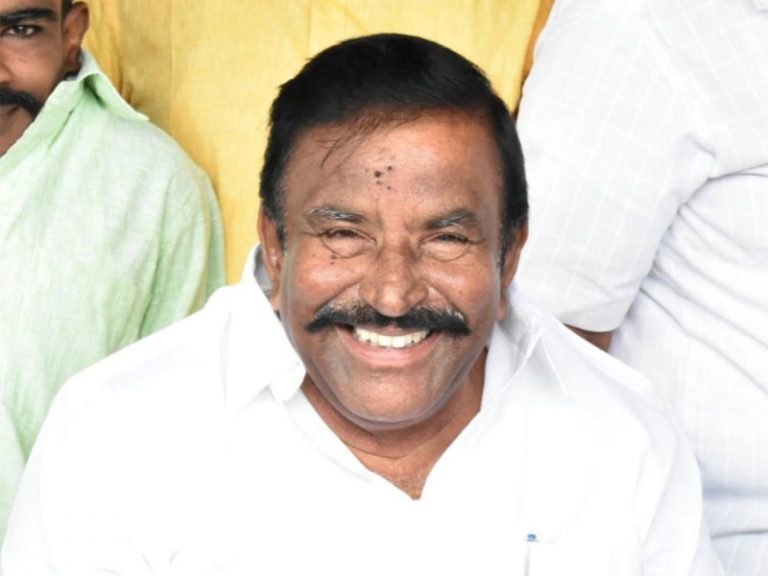
On July 25, KN Nehru, the Municipal Administration Minister in Tamil Nadu made a derogatory and racist statement against the people of Bihar. As per a report in Outlook, while attacking Lalu Prasad Yadav for his tenure as railway minister, he said, “Lalu Prasad Yadav as Railway Minister had packed the Railways with Biharis, especially at lower-level jobs, even though Biharis were less brainy than Tamils.” The Minister was speaking at an employment camp at the DMK office in Tiruchy.
He further added, “Over 4,000 people from Bihar are currently working at the Golden Rock Workshop of Southern Railway located in Tituchy. The majority of the gatekeepers at railways crossings are Biharis. This is all due to the handiwork of Lalu Prasad Yadav. When he was railway minister, he had all his fellow Biharis pass the railways exams by copying and then got them appointed in railway jobs. These people know neither Tamil nor Hindi and lack the brains that we Tamils have. Yet they are working in Tamil Nadu.”
He blamed Tamils as well for not showing any inclination or take the initiative to apply for the jobs in the Central Government or its undertakings. He said, “Even though ten per cent of jobs in Railways and PSU banks are reserved for candidates from outside the respective states, very few of our students took advantage of this. Compared to the southern states, the youth of Tamil Nadu are on par with those from Kerala in terms of intelligence. Therefore, people from Tamil Nadu should try harder for central government jobs,” Nehru said, as per reports.
Recalling former Chief Minister Karunanidhi’s request to become MP and move to Delhi, he said that he declined the offer as he did not know English or Hindi. “I regret that now,” the Minister said. His remarks have caused a stir in the political arena. Interestingly, Prashant Kishore, DMK’s strategist for the last Assembly elections, is also from Bihar.
In the centre, DMK, as an opposition party, has accused the BJP government of appointing people from North India in the railway and bank jobs. However, all the appointments were made after the candidates passed the written exams and joined their respective posts via a 10% non-state quota. The same DMK is now blaming former Railway Minister Lalu Prasad Yadav for preferring Biharis and Tamils for not applying for government jobs in the state.
Other bizarre statements by Nehru
This is not the first time DMK Minister KN Nehru has given a bizarre statement. During a political rally in March 2021, he justified allowing Tamil Nadu students to cheat in NEET exams claiming students from Bihar and Madhya Pradesh also cheat. He had added that if his party come back to power, he would extend the ‘privilege’ to the medical students of Tamil Nadu.
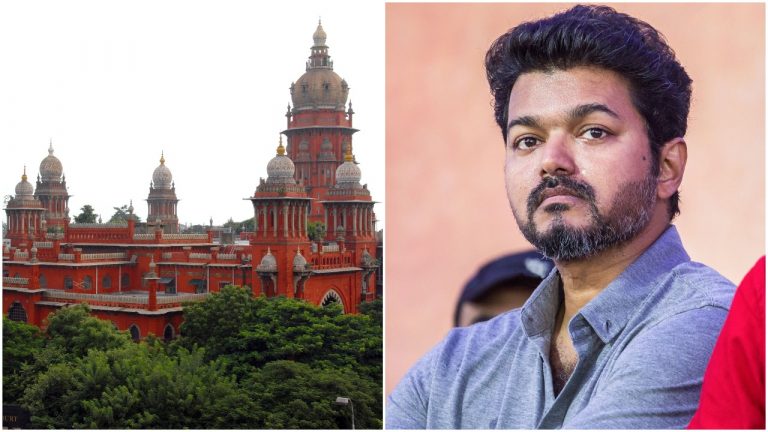
In a big relief to controversial Tamil actor Joseph Vijay, the Madras High Court stayed a scathing order passed by a single judge recently against the actor, asking him to pay a fine of Rs 1 lakh for committing an alleged tax irregularity.
According to the reports, a Division Bench of the Madras High Court stayed an order passed by a single-judge bench of Justice SM Subramaniam asking him to pay Rs.1 lakh as a fine for failing to pay an entry tax on his Rolls Royce Ghost car he had imported from England. In a critical order, the court had asked him to be a ‘real hero’ and pay the due taxes after the actor had sought an exemption from payment of entry tax on his luxury car.
Imposing a fine, the court had also criticised Vijay for flouting the rules and had opined that tax evasion ought to be “construed as an anti-national habit, attitude, and mindset, and unconstitutional”.
In response to the court ruling, Vijay had challenged the fine and sought remarks against him to be expunged.
The actor’s counsel had stated before the court that he is not challenging the tax levy and is willing to pay the tax as early as possible. However, the actor’s counsel argued that the judge’s adverse comments against the actors has created aspersions in the mind of the public against the actor.
Hearing the plea, the Madras High Court bench comprising Justices M Duraiswamy and R Hemalatha granted the interim stay after the actor said he was ready to pay the entire tax amount but wanted the “uncharitable” remarks made by the single judge against him to be expunged.
The Division Bench also directed the Commercial Tax department to raise a challan demanding 80% of the tax amount since Vijay had already paid the 20% fine after another court had directed him to pay in 2012.
In 2012 actor Joseph Vijay had purchased a Rolls Royce car worth Rs.1.2 crore and had paid Rs.1.88 crore, or 150 per cent of the cost, as customs. However, he had challenged the Rs.40 lakh entry tax demanded by transport authorities. In 2012, he moved the Madras HC seeking exemption for the Entry Tax imposed on his imported Rolls Royce car.