Home Blog Page 4449

People who fed us daadi nana stories by Priyanka now have issues believing history that RSS supported creation of Bangladesh

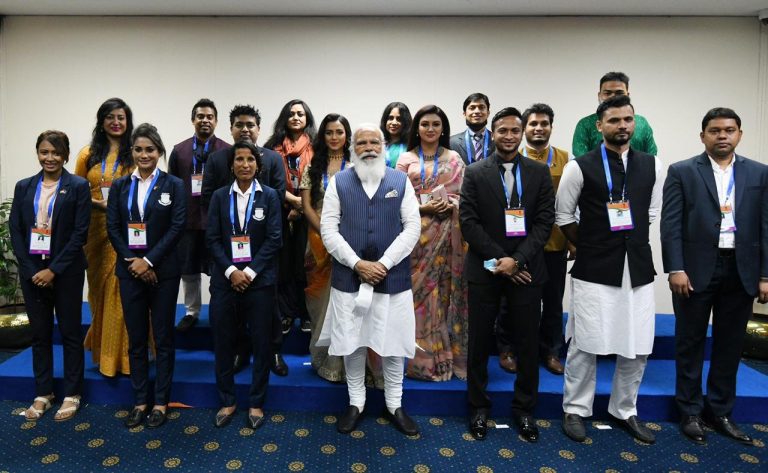
Prime Minister Narendra Modi is on an official visit to Bangladesh. He delivered a speech in Dhaka, Bangladesh where he recalled the Satyagraha he participated in with his friends, for which he was arrested. It was Narendra Modi’s first visit to a foreign country since the pandemic began.

The Prime Minister appeared to refer to the Gana Satyagrah organised by the Jana Sangh, the ideological predecessor of the BJP, in August 1971. However, ’eminent intellectuals’ have taken offense at Narendra Modi recalling the same in his speech.

Maya Mirchandani, Assistant Professor of Broadcast Journalism and Media Studies at Ashoka University, said that there is a consensus in India that Indira Gandhi played an instrumental role in the liberation of Bangladesh. She said, “It was hard strategy that led to Bangladesh’s independence 50 years ago, not satyagraha.”

Quite clearly, Narendra Modi never said that it was Satyagraha that won Bangladesh its freedom. But Mirchandani, nonetheless, deliberately twisted his comments in order to cast aspersions on his motives. As it turns out, an award to former Indian Prime Minister Atal Bihari Vajpayee by the Government of Bangladesh in 2015 mentioned the said rally by Jana Sangh.

The citation of the award said, “To press the demand for India Government’s expedited support to Bangladesh’s Liberation War, Jana Sangh held a Gana Satyagraha during 1-11 August and their volunteers organised a huge rally in front of the Indian Parliament House on 12 August 1971.”
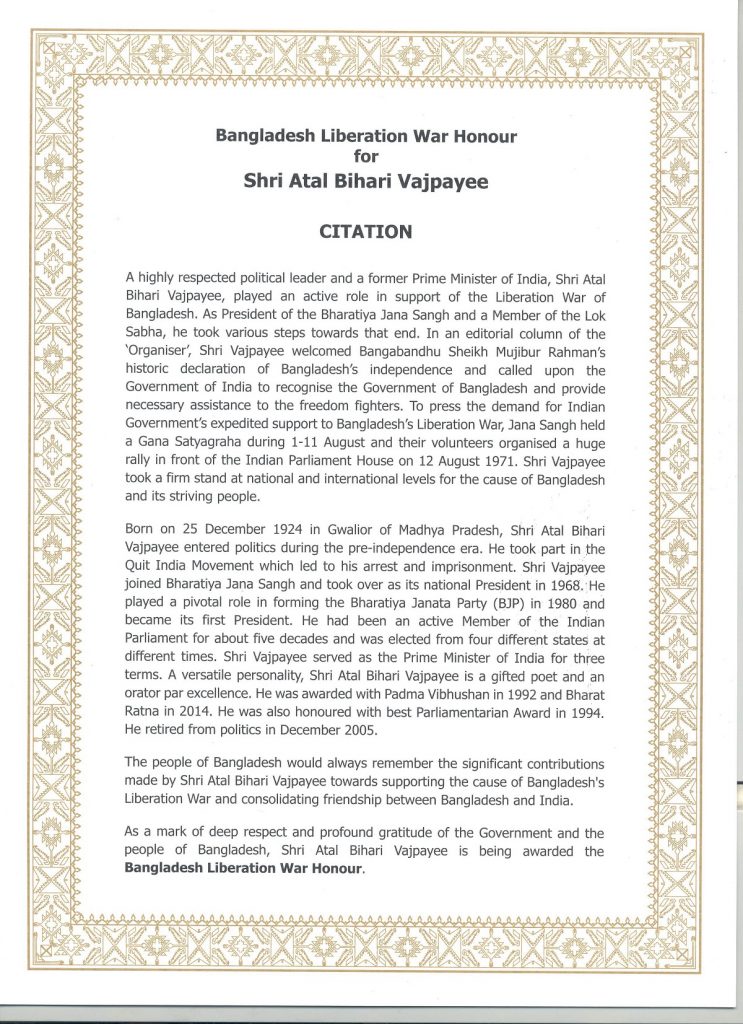
The citation for the award

Vajpayee was also lauded for his “firm stand at national and international levels for the cause of Bangladesh and its striving people.” “The people of Bangladesh would always remember the significant contributions made by Shri Atal Bihari Vajpayee towards supporting the cause of Bangladesh’s Liberation War and consolidating friendship between Bangladesh and India,” it said.

Despite Bangladesh’s own acknowledgment of the role played by the Jana Sangh, liberals in India appear deeply offended by the Prime Minister’s remarks. They have resorted to passing snide jibes and mocking Narendra Modi for his comments.

It is apparent that liberals have quite a hard time believing authentic history. It seems that they are unable to come to terms with the fact that leaders from a wide ranging section of the Indian political spectrum campaigned for the liberation of Bangladesh. It is remarkably similar to the narrative that is peddled regarding the Indian Independence Movement itself where all credit is placed at the feet of Jawaharlal Nehru and Mahatma Gandhi and the contributions of all others are sidelined.

Liberals appear to believe that just because they are themselves not aware of a certain event or a certain contribution, it means that it did not happen. But history does not work that way and truth has a way of coming out despite monumental efforts to suppress it.

These are the same ‘intellectuals’ who fall over themselves to hail Rahul Gandhi as a youth leader at the age of 50. These are the same people who believe Priyanka Gandhi has the credentials to lead India just because her face bears a resemblance with Indira Gandhi’s, which is perfectly ordinary given that she is her grand daughter.

The intellectuals fawn over incredulous stories involving Priyanka Gandhi and Rahul Gandhi regarding their parents or grandparents and yet, when it comes to a relevant aspect of India history, they feign ignorance to cast aspersions of factual statements.

None of them bothered to point fingers at Priyanka Gandhi when she came up with unbelievable stories about how Jawaharlal Nehru found his bodyguard sleeping on his bed one night or her tale about Indira Gandhi telling her stories about Joan of Arc.

These stories do not ring true at all and appeared tailor made to humanize themselves in the eyes of the public and yet, it only made them more worthy in the eyes of the ‘intellectuals’. The same intellectuals now have a problem when Prime Minister Modi recalled his participation in a Satyagraha for the liberation of Bangladesh.

All of this, of course, is par for the course for an ‘intellectual’ elite that is unwilling to come to terms with the fact that there is more to the history of post-independent India than the Nehru-Gandhi family. But despite their staunch efforts to the contrary, the history they have tried to bury for so long will resurface.
Karnataka sex CD case: FIR lodged against BJP leader Ramesh Jarkiholi for sexual harassment after woman files complaint

An FIR has been filed against BJP leader Ramesh Jarkiholi at the Cubbon Park police station in Bengaluru after a handwritten complaint was filed by the woman involved in the sex CD scandal. She filed a two-page complaint at the commissioner’s office through her advocate KM Jagadish alleging that she feared for her safety.

The FIR is reportedly filed under IPC sections 376c – Sexual intercourse by a person in authority, 354a – Sexual harassment, 504 – Intentional insult with intent to provoke breach of the peace, 506 – Criminal intimidation, 417 – Cheating, and IT Act 67a – Publishing or transmitting of material containing sexually explicit content.

Woman demands protection, alleging threat to her life from Ramesh Jarkiholi

In her letter, the woman explained how she met Jarkiholi and the events that came to pass in the wake of the meeting. The complaint said that she contacted Jarkiholi as she wanted to shoot a short video and therefore exchanged numbers.

After they started speaking, the woman alleged, Jarkiholi vowed to get her a job and informed her that she would have to compromise. She mentioned in her complaint that she got a video call from the leader when he was in Delhi and staying at the Karnataka Bhavan. Jarkiholi had allegedly asked her to strip in front of the camera, snippets of which were leaked to the media in the CD that was released earlier in February.

The woman had alleged that she did not come out earlier as she was afraid of the fact that Jarkiholi was an influential man and well-connected. She accused the MLA of offering her money to settle the matter and ignored her when she asked for a job. The complainant also mentioned that she and her family have been receiving threats from Jarkiholi and that attempts were also made by him to kill them.

Earlier on March 13, the woman had released another video from an undisclosed location, asking to be provided with security. Jarkiholi had then filed an FIR against unknown people, alleging that the video was fake and that he was being politically targeted.

In February this year, a complaint was filed against Jarkiholi by a social activist named Dinesh Kalahalli after the videos were leaked. However, within a few days, the complaint was withdrawn. The Karnataka government has now instituted a Special Investigating Team(SIT) to probe the matter.

Ramesh Jarkiholi, the MLA from Gokak constituency, had defected to the BJP from Congress

Ramesh Jarkiholi is a BJP MLA representing Gokak in the Karnataka state assembly. He had served as Water Resources Minister in the Government of Karnataka from 7 February 2020 to 3 March 2021. He was previously associated with the Congress party. In 2019, Jarkiholi jumped the ship and started campaigning for the BJP. He was a cabinet minister in Siddaramaiah’s government from June 2016 to May 2018 and was later made the Minister of Municipal Administration under HD Kumaraswamy government in Karnataka.

Maharashtra Chief Secretary’s fact-finding report on phone-tapping a sham, full of fallacies: Former CM Devendra Fadnavis

0

BJP leader Devendra Fadnavis on Friday rubbished the fact-finding report submitted to the Maharashtra government by the state chief secretary Sitaram Kunte over the phone-tapping allegations. Fadnavis said that the report submitted by Kunte was a sham and replete with fallacies.

“The Indian Telegraph Act mentioned in the report is cited to the public in a manner convenient to the government. The report in itself is full of fallacies. Although there are sufficient provisions to tap the phone calls, the government is not ready to accept it,” Fadnavis said.

Fadnavis said The Act empowers the official to intercept calls to avoid any possible offense that could happen, adding that the Anti-Corruption Bureau (ACB) of the Maharashtra police has all the rights to carry out phone-tapping.

The BJP leader also asked why the state government did not follow DGP Subodh Jaiswal’s recommendation of having the CID probe the matter.

“The then DGP Subodh Jaiswal had recommended a CID probe (into the alleged transfer scam) based on the conversations among police officials and other persons involved in it. Then why no action was taken on his recommendations?” he asked.

State Minister Nawab Malik responsible for leaking the detailed report about the transfer racket: Devendra Fadnavis

The former chief minister of Maharashtra also alleged that it was Maha Vikas Aghadi minister Nawab Malik who had leaked the detailed report by IPS officer Rashmi Shukla about the alleged transfer racket in the state police force.

Revealing that Nawab Malik had released the detailed report on the alleged transfer racket, Fadnavis said, “I had only shared a two-page cover letter (related to Rashmi Shukla’s letter), whereas it was state minister Nawab Malik who leaked some of its pages. I was even contacted by some journalists after they received the report from Nawab Malik.”

If any action is to be taken in this case, it should be against Mr Malik, he added.

Fadnavis further mentioned that he has it on good authority that the report was prepared by Nawab Malik or Jitendra Awhad and signed by chief secretary Sitaram Kunte. The BJP leader said if any legal action is taken against him, he will produce proof of the same in the court of law.

Fadnavis also claimed that of all the names mentioned by Nawab Malik from the list, 12 officials had received the postings as per their request.

Maharashtra chief secretary comes to state government’s rescue, recommends strict action against IPS officer Rashmi Shukla

After Fadnavis made an explosive revelation that Uddhav Thackeray had ignored a report on transfer posting racket in the state police, the Chief Secretary of Maharashtra came to the state government’s rescue, submitting in a report that there had been no wrongdoing observed in the postings of the police officials in the state. Kunte alleged that IPS officer Rashmi Shukla had illegally tapped the phones of politicians and recommended strict action against her.

In his report that was released on Thursday, Chief Secretary Sitaram Kunte claimed that the former Additional Director General of Police (Intelligence) Rashmi Shukla may have leaked her confidential letter on the alleged corruption in transfers in the police department to Leader of the Opposition Devendra Fadnavis (BJP).

Furthermore, the report which was submitted to Chief Minister Uddhav Thackeray stated that there was no wrongdoing in the police transfers and all transfers of police officers made between September 2-October 28, 2020. It added that the transfers were based on the recommendations of the Police Establishment Board.

NCPCR writes to I and B Ministry, asks for removal of objectionable scenes from Netflix’s ‘Bombay Begums’

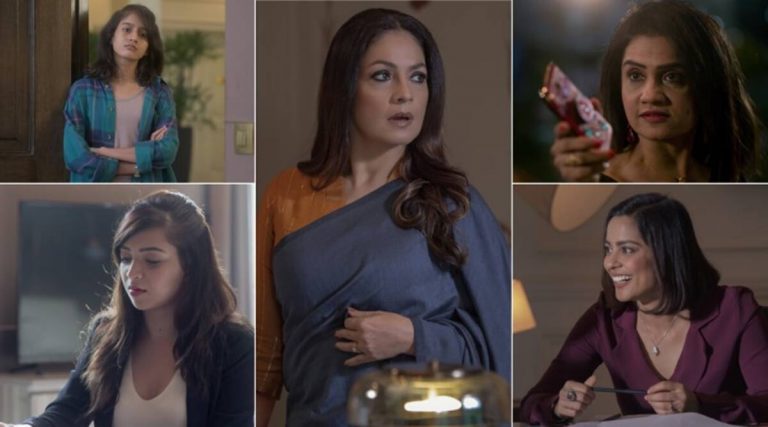
On Friday (March 26), the National Commission for Protection of Child Rights (NCPCR) wrote a letter [pdf] to the Information and Broadcasting (I&B) Ministry seeking issuance of directions to Netflix for the removal of inappropriate scenes from the ‘Bombay Begums’ web series. The contentious show has come under social media criticism over its obscene portrayal of minor children.

The letter addressed to I & B Ministry Chief Secretary Vikram Sahay pointed out that NCPCR received complaints from 2 Twitter handles against the ‘Bombay Begum’ series for showcasing minor children snorting drugs and taking indecent selfies in classrooms. The Commission reiterated that glorifying such acts through media platforms and OTTs goes against the laws meant for the protection and welfare of children.

NCPCR argued that such vicious content has the potential to create a ‘negative impression’ in the tender minds of young children and lead to an increase in child abuse and exploitation. “Any act of aforesaid nature cannot be permissible and hence the step should be taken to stop such publication at the earliest,” it said. As such, NCPCR took cognisance of the matter under the Commission for Protection of Child Rights Act (CPCR), 2005.

NCPCR points out objectionable scenes in the Bombay Begums series

“It is pertinent to mention that in one of the scenes, a minor girl was smoking cigarette which is violation of Section 77 of JJ Act, 2015,” the Commission pointed out. It said that in its earlier letter dated March 16, NCPCR has requested inquiry and lawful action from the Ministry of Information and Broadcasting against such a depiction. However, it did not receive any reply from the Ministry.

“Any such depiction or presentation, which could be a threat for any child’s interest cannot be permissible in the garb of creativity,” the letter emphasised. It pointed out that the series is meant for viewers above the age of 18 aka adults but children were being used to depict storylines and participating in prohibited acts such as consumption of drugs.

NCPR noted, “In the opinion of the Commission, the ingredient to inhale by the child artist is relevant upto the extent of determining law applicable on that child but acting to do any prohibited act, which can be viewed as the prohibited act affects all of that child artist’s age and the consent of the parent of that child artist cannot save makers/ publishers of that act from the offence against children.”

NCPCR calls for verification of the age of girls in web series, highlights the issue of bullying

The Commission pointed out another scene from the web series wherein a girl was seen taking pictures of breasts and sending them to one fellow male classmate. “…The Commission is of the view that the age of all the girls acting in the scene needs to be ascertained, as it seems that minor children are used in that scene, in violation of POCSO Act, 2012 and with the same logic as aforesaid, presence of the parents/mothers of those child artists cannot help makers/publishers to escape from their liability to present the product which is against the law,” it added.

NCPCR also took cognisance of another scene wherein a minor girl was seen commenting on the breast size of another minor girl. It said that the scene was a violation of the POCSO Act, 2012 and highlighted the issue of bullying. “It is pertinent to highlight that bullying is an act, which has lead to a lot of child-related issues as it spoils the complete personality of the child. Bullying in any form cannot be encouraged and that too through a natural biological human cycle,” the Commission said in its letter.

Commission says Web Series violates I & B Ministry guidelines, POCSO Act

NCPCR further noted that the objectionable scenes, cutting across 5 episodes, are against the ‘Guidelines to Regulate Child Participation in TV Serials, Reality Shows and Advertisements’ published by the I&B Ministry. The guidelines stated under Section 15 points out that no child should be cast in roles that cause distress or embarrassment (clause 1). Furthermore, clause 2 of Section 15 prevents the depiction of children indulging in smoking and anti-social behaviour.

The third clause prevents putting a child in distressing situations to obtain a “realistic depiction of an emotional reaction.” The letter by NCPCR Chairperson, Priyank Kanoongo, also pointed that the inappropriate depiction of minors in the series violated Section 67B (publishing or transmitting of material depicting children in a sexually explicit act in electronic form) of the Information Technology Act, 2000. NCPCR also added that the series violated Section 292 (Sale, etc., of obscene books,) of the Indian Penal Code (IPC) and Sections 13 and 14 of the POCSO Act, which defines and lays down punishment for child pornography.

Netflix tries to ‘justify’ inappropriate scenes involving minors

The Commission had earlier directed the online streaming platform to stop the broadcast of the series and remove the contentious scenes. In regard to the controversy surrounding the ‘Bombay Begums’ series, Netflix and NCPCR held a meeting on March 16 to discuss the portrayal of children in the said web series. At its request, NCPCR provided Netflix with an extended time frame to discuss the matter with their legal team.

NCPCR noted, “The Commission received the reply of Netflix dated 18.03.2021, which is an effort made by the Netflix to justify all objectionable scenes highlighted by the NCPCR. However, after a thorough perusal of the reply, the NCPCR is of the opinion that the effort to justify those scenes is a futile exercise and the bad impact of those scenes on children as well as the negative impression about adolescent young children due to those scenes cannot be denied.

The Commission concluded, “It is a fact that children tend to get influenced by what they see or watch on television and thus, it is our moral and legal duty to protect them. It is also important to highlight that films have less reach if compared with the extent of publication through OTT and other platforms in the present era.” It added, “It is further important to highlight that the series is streaming at the time when it has got more viewers than normally any series could have considering the pandemic has shifted classrooms and offices on virtual medium.”

NCPCR recommends I & B Ministry to issue directions to Netflix

“It is clear that the Netflix Series “Bombay Begums” has not only violated the prevailing law of land and guidelines, its continuing the same and affecting children’s interest to a very large extent,” NCPCR reiterated. The Commission has therefore recommended the Ministry of Information and Broadcasting to issue directions to Netflix to remove the contentious scenes and take action as per laws of the land to protect the children. “You are further requested to furnish an ATR in this regard within 7 days of issue of this letter, failing which the Commission will be constrained to initiate proceedings under Section 14 of CPCR Act, 2005,” it added.

Loyalty to Israel and fellows Jews paramount: Read what convicted Israeli spy Jonathan Pollard said in interview

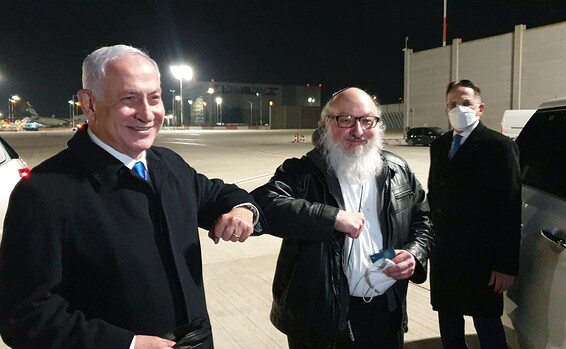
Convicted Israeli spy Jonathan Pollard has made controversial remarks in his first extensive remarks since he was released from prison in 2015, The Jerusalem Post reported. He said that Jews will always have dual loyalty.

“The bottom line on this charge of dual loyalty is, I’m sorry, we’re Jews, and if we’re Jews, we will always have dual loyalty,” Jonathan Pollard has told Israel Hayom in an interview published on Friday.

He told Israel Hayom, “If you don’t like the accusation of double loyalty, then go the f*** home. It’s as simple as that. If you live in a country where you are constantly under that charge, then you don’t belong there. You go home. You come home. If you’re outside Israel, then you live in a society in which you are basically considered unreliable. The bottom line on this charge of dual loyalty is, I’m sorry, we’re Jews, and if we’re Jews, we will always have dual loyalty.”

“American Jewry has one major problem – they consider themselves more American than they do Jews,” he added. Asked what he would tell a Jewish Naval Intelligence officer who had been approached by Mossad to work for Israel, Pollard replied that his advise would be that not doing anything is unacceptable.

“I’d tell him, not doing anything is unacceptable. So simply going home is not acceptable. Making aliyah is not acceptable. You have to make a decision whether your concern for Israel and loyalty to Israel and loyalty to your fellow Jews is more important than your life,” Pollard said.

He added, “Because you know what would probably happen to you if you get caught. It will be hell. But you have to look at yourself every morning in the mirror, and you have to live with yourself. If you do nothing, and you turn your back, or simply make aliyah, and go on with your life, you’ll be no better than those Jews who before and after the destruction of the Temple said, ‘It’s not my responsibility.'”

Jonathan Pollard was arrested in 1985 while he was a civil analyst for the US Navy. He was subsequently convicted on charges of spying on behalf of Israel. His conduct complicated matters for the American Jewish community ties for decades.

‘Pishi continues her khela’: BJP Tweets after another worker found hanging in Medinipur, claims 4 workers killed in last 72 hours

The spate of political violence in poll-bound West Bengal has been on the rise. On Friday, the body of a 30-year-old BJP worker named Lal Mohan Soren was found in a forest near his home in Bagmari in the Salboni police station area. The body of the booth secretary of the Medinipur assembly was found hanging from a Jamun tree near his house.

Informing about the brutal incident on Twitter, BJP claimed that Soren’s murder was the fourth such political murder in the state in the last 72 hours.

“Pishi (Mamata Banerjee) continues her ‘khela’ with human lives. Lalmohan Soren, aged 30 and Booth secretary of Medinipur assembly was found hanging this morning. 4 murders in the last 72 hours”, wrote BJP. It alleged that TMC goons have been behind these gruesome acts, the occurrence of which has become extremely common under Mamata Banerjee’s regime.

The BJP alleged that in the last 72 hours, 4 of their party workers have fallen prey to TMC’s political violence in the state.

In a Tweet shared yesterday, BJP informed how two-party karyakartas named Pratap Barman and Dipankar Biswas were brutally murdered in Santipur, Nadia Dakshin by TMC Goons because of their political affiliations.

This twin murder had prompted BJP in West Bengal to call for a 12 hours bandh in the areas falling under the Santipur Assembly constituency on Friday. The bandh was called to protest the murder of Pratap Barman and Dipankar Biswas by the Trinamool Congress party goons.

Similarly, on Wednesday, BJP Mandal President Amit Sarkar was found hanging in Dinhata, Cooch Behar district in West Bengal. The local BJP leaders had alleged that Sarkar was picked up from his residence by TMC cadres, and later, he was found dead mysteriously.

Following the murder of Amit Sarkar, local BJP leaders took to the streets. The enraged BJP Karyakartas reportedly pelted stones at the police and blocked roads in the area. According to reports, they also attacked the office of the Trinamool Congress that was accused of being behind the death. Police retaliated by using brute force. Teargas shells were also fired to disperse the crowd.

Maulana Jarjis lauded Mamata Banerjee for standing up against ‘Jai Shri Ram’ slogans, urged Muslims in Bengal to vote for her: Read details

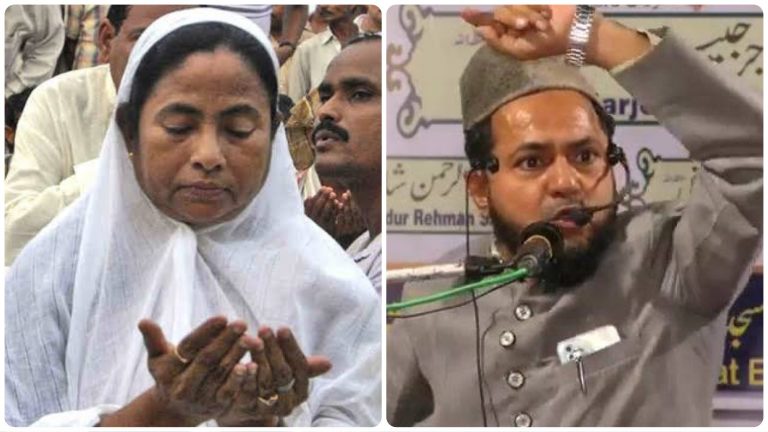
Radical Islamist preacher Maulana Jarjis, who was recently seen in a viral video reviling the kin of women as ‘bh*dwas’ for allowing them to roam around without a veil (purdah), had heaped praises on West Bengal CM Mamata Banerjee for standing up against ‘Jai Shri Ram’ slogans. 

In a video dated 10 February 2021, Maulana Jarjis was seen not only extolling the TMC chief because she objected to ‘Jai Shri Ram’ slogan, but also tacitly urged the people of Bengal to support her in the upcoming assembly elections. The hate speech peddler hailed Banerjee as the only politician who has the courage of taking on PM Modi.

Source: YouTube

“People of Bengal, it is the moment of reckoning as the entire world has set its eyes upon you about your decision on the upcoming assembly elections. During an event in West Bengal, when Mamata came on the stage to address the gathering, she was greeted with Jai Shri Ram slogans. How courageously that lady responded to it,” Jarjis said.

This is not the first time that Maulana Jarjis has rallied behind Mamata Banerjee. Maulana Jarjis has been voicing support for Bengal CM Mamata Banerjee for sometime now. Reports say that he has been campaigning for TMC in Bengal.

A Zee Hindustan report had highlighted that Jarjis has been instigating Muslims in Bengal against BJP and PM Modi, indirectly pushing them to vote for TMC by spreading fear and hatred. Jarjis’ campaign has been highlighted in media multiple times for instigating hate, and violence.

Maulana Jarjis incites Muslims to take up arms against the government of India

In an earlier video, Jarjis was seen inciting Muslims to take up arms against the government of India. In December 2019, a video of the Maulana was uploaded in which he was seen making vulgar and derogatory remarks against PM Modi and Union Home Minister Amit Shah as he rejected the Citizenship Amendment Act (CAA) and National Register of Citizens (NRC) bill and falsely claimed them of being anti-Muslim. 

The Maulana in his hate speech audaciously said that if Modi or Shah try to throw them (referring to the Muslim community) out of the country he would take ‘jihad’ to the last corner of India. He said, “inke baap ke baap ke baap ki bhi takat nahi hain ki humme bahar nikaal de (their forefathers also do not have the gall to throw us out of the nation), humme nikaal ke toh dikha Modi, hum bhi jihad karne se peeche nahi hatengein (try throwing us out Modi, we will also not hesitate in waging jihad).”

Mamata Banerjee takes offence for being greeted with ‘Jai Shri Ram’ slogans, walks out of Netaji’s birth anniversary celebrations

West Bengal Chief Minister Mamata Banerjee was seen walking out of the stage refusing to address the public gathered at Kolkata’s Victoria Memorial for Netaji birth anniversary celebrations. WB CM Mamata Banerjee, who was sharing the stage with Prime Minister Narendra Modi, lamented of “being disrespected” because she could not stand the slogans of Jai Shree Ram, Bharat Mata ki Jai, etc when she was invited to address the event.

Lashing out after hearing ‘Jai Shri Ram’ slogans, Mamata Banerjee lamented before walking off the stage: “Inviting people and then disrespecting them does not behove the government. This is a government programme, not a political party’s programme”.

When she was invited on to the stage to speak a few words, some people were chanting slogans of “Jai Shree Ram”, “Bharat Mata ki Ja”i and “Joy Bangla”. Getting offended by the slogans of Jai Shree Ram, Mamata Banerjee said that as a mark of protest against this ‘disrespect’, she would not say anything. Sulking, she walked off the stage even though several other dignitaries, including the Prime Minister, were on the stage.

Shamima Begum, who had joined ISIS, comes up with a far more innovative excuse for Jihad than Barkha Dutt: Read details

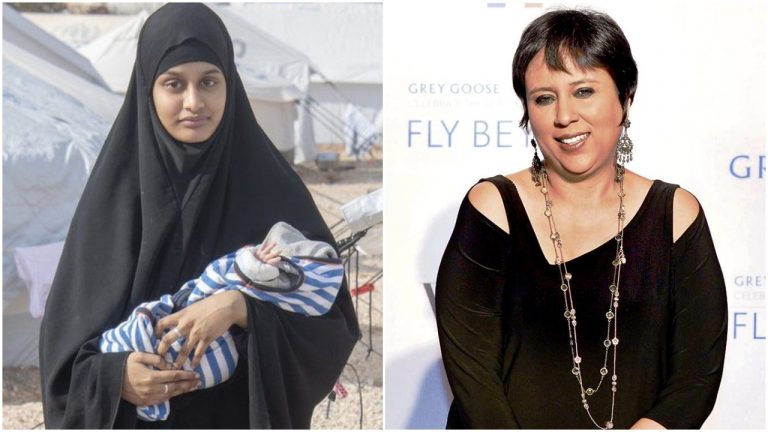
ISIS Bride Shamima Begum, who had once fled her homeland in the UK to join ISIS, has now come up with a reason to defend why she had joined the terror group six years ago. Shamima Begum, currently fighting a legal battle to enter her erstwhile country, the United Kingdom, said the difficult relationship with her mother “who did not make her feel loved” pushed her to join the Islamic terror group, reports Daily Mail.

In the documentary ‘The Return: Life After ISIS’ which premiered in the US, Shamima Begum described herself as the ‘black sheep of the family’ growing up and claimed that the difficult relationship with her mother, who did not make her feel loved, was one of the reasons for her to join the ISIS. Essentially, Begum held her mother and her ‘lack of love’ responsible for her decision to join the terror group ISIS.

Narrating her story, Begum said that she started watching videos of Syrians being bombed, which made her feel ‘guilty’ and want to defend Muslims. Shamima Begum, infamously referred to as ISIS Bride, revealed, “It just made me sick to my stomach that this was going on in the world and no one is doing anything about it.” Interestingly, while she talks about how she wanted to “defend Muslims”, she seems to momentarily forget that she had earlier said that she joined ISIS because she felt unloved and gives us a window into her radicalisation.

She said that she always wanted to be part of a Muslim community because when she was young, however, she always felt like an outsider in her community.

“So I just wanted to be a part of something my friends started practising (Islam), and they helped me come into the religion as well, and it just started with like learning my religion,” she said.

“And then it turned into wanting to come into Syria, wanting to help the Syrians,” Shamima said in the  90-minute documentary that premiered this week.

Six years back, Shamima Begum ran away from her east London home and went to Syria to join ISIS. Within days of arriving in Syria, Begum was married to Dutch-born jihadist Yago Riedijk, a convert to Islam.

In Syria, she gave birth to three children, all of whom died eventually, and later was locked up in two Kurdish-run detention camps in north-east Syria, following the defeat of ISIS.

Her citizenship was revoked by the UK government on national security grounds after she was found in a Syrian refugee camp in February 2019. Last month, the Supreme Court blocked her return to the UK to appeal against the loss of her citizenship.

Shamima Begum does a better job than Barkha Dutt in whitewashing terror crimes

Interestingly, Begum’s justification for fleeing her homeland and joining Jihadi-terror group ISIS seems to far more innovative than what some ideologies in India seem to peddle.

Amusingly, in India, the ‘secular liberal’ champions and far-left media outlets have unsuccessfully tried to push similar, but far less imaginative theories by eulogising and humanising terrorists to whitewash the crimes they commit. Perhaps, the most brazen attempt to whitewash the crimes committed by a terrorist was done by none other than ‘illustrious journalist’ Barkha Dutt.

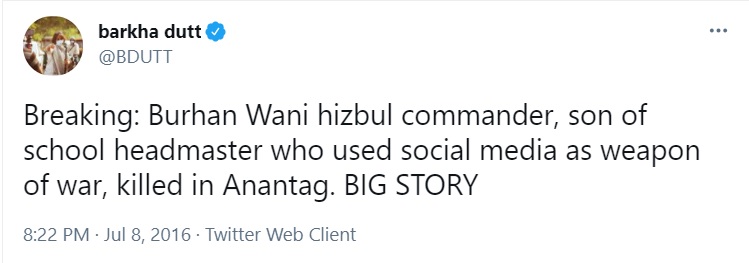
Soon after terrorist Burhan Wani, then Hizbul Commander in Kashmir was neutralised by the Armed Forces in an encounter in 2016, Dutt lost no time in putting out a tweet describing Wani as a “headmaster’s son” instead of referring to him as a Jihadi terrorist. The murderous Islamist tendencies exhibited by Wani had no significance, however, by plugging his father’s profession as a headmaster of a school, Barkha Dutt had tried to show the “human” face of the terrorist to portray that he was like any commoner after all.

Tweet by Barkha Dutt

Not just this, there have been several attempts by the left-wing media outlets to humanise terrorists and white-wash their crimes so that it is convenient for them to blame the Indian Armed Forces and depict them as some “cold-blooded murderers”. It is also worth mentioning that Barkha Dutt had gone a step ahead to blame the Kashmiri Pandits, who are themselves the victims of Jihadi terrorism, for their genocide and the subsequent exodus of the remaining population from their homeland in Kashmir.

Barkha Dutt had also once tried very hard to peddle the “secessionist” narrative even when the Kashmiris themselves proclaimed that they were doing it for “Islam”. Instead of confronting him, Barkha Dutt steered him to say that he was doing it for Kashmir.

ISIS bride Begum has certainly trumped homegrown ideologues like Barkha Dutt in at least coming up with a far more imaginative excuse for becoming a Jihadi. At least Shamima Begum seems to have made an attempt, even if it is laughable and unbelievable to come up with a sob story that is not already done and dusted. Barkha Dutt on the other hand simply took a page of the Nazi playbook and peddled the ‘economic disparity’ theory while whitewashing the crimes of Kashmiri Jihadis.

One recalls how in a 2004 video, Barkha Dutt proceeded to contextualise the heinous genocide of Hindus. She asserted that one of the reasons for the genocide of Hindus by religious fanatics was because of the economic disparity.

As we had demonstrated in this article, a similar rationale was given by the Nazis of Germany to justify their anti-Semitism and genocide of Jews. Clearly, while Barkha Dutt resorts to plagiarising from the Nazis, Shamima Begum has managed to be original, as far as whitewashing Jihad is concerned. At least on that front, the ISIS bride wins.

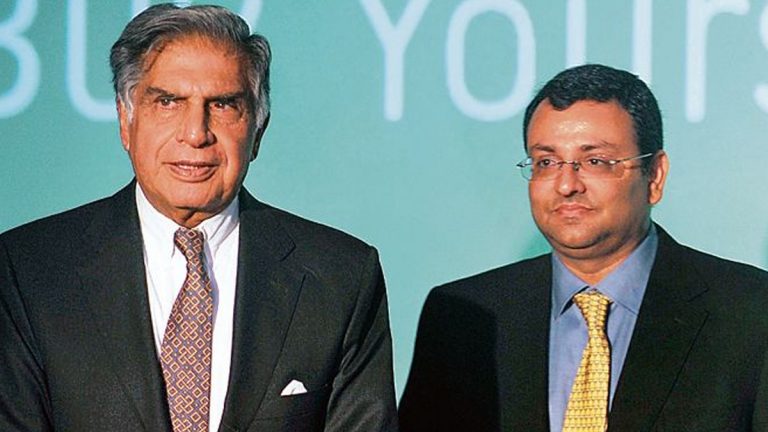
Tata Sons, Cyrus Mistry and the Supreme Court verdict: All you need to know about the case

On Friday, the Supreme Court of India set aside the order passed by the National Company Law Appellate Tribunal (NCLAT), which reinstated businessman Cyrus Mistry as the Chairman of Tata Sons Limited. The Court order effectively upheld the decision of the Tata Group to remove Mistry from the post in 2016.

The matter appeared before a 3-Judge Bench of the apex court, comprising of Chief Justice of India (CJI) SA Bobde, Justices AS Bopanna and V Ramasubramanian. “Company petition no 82/2016 filed by two companies belonging to Shapoorji Pallonji Group shall stand dismissed. Civil Appeal 1802 filed by Cyrus Investments Limited and Sterling Investment Corporation is dismissed. There will be no order as to costs,” the Court ordered.

It further said, “We find all the questions of law are liable to be answered in favour of the appellants, Tata Group and the appeals filed by the Tata Group are liable to be allowed and Shapoorji Pallonji group is liable to be dismissed.” Ratan Tata, who served as the Chairman of Tata Sons Limited between 1991 and 2012, took to Twitter to appreciate the verdict.

Ratan Tata wrote, “I appreciate and am grateful for the judgement passed by the honourable Supreme Court today. It is not an issue of winning or losing. After relentless attacks on my integrity and the ethical conduct of the group, the judgement upholding all the appeals of Tata Sons is a validation of the values and ethics that have always been the guiding principles of the group. It reinforces the fairness and justice displayed by our judiciary.”

The Background of the Case

After Ratan Tata stepped down as the Chairman of Tata Sons, a Selection Committee was formed to appoint the new successor of the Group. Cyrus Mistry’s father Pallonji Mistry owned an 18.4% stake in the conglomerate. Mistry, a Board member and also a part of the Selection Committee was appointed the Chairman of Tata Sons.

In a historic feat, Mistry became the only second Chairman in the 153-year-history of the Group to not have the ‘Tata’ surname. However, his term was short-lived. On October 24, 2016, the majority of the Board of Directors removed him from the position of Chairman. Six months later on February 6, 2017, Cyrus Mistry was removed from the Board of Directors as well.

Following this, two Shapoorji Pallonji firms owned by Mistry’s father moved the National Company Law Tribunal (NCLT) claiming Cyrus Mistry’s removal as ‘mismanagement’ and ‘oppression of minority stakeholders. The petition was dismissed by NCLT in July 2018. They then filed an appeal before the National Company Law Appellate Tribunal (NCLAT).

In an unprecedented decision on December 18, 2019, NCLAT not only overturned the NCLT order but also reinstated Cyrus Mistry as the Chairman of Tata Sons. It also declared the appointment of the new Chairman Natarajan Chandrasekaran as ‘illegal’. NCLAT directed Ratan Tata to not take any decision in advance without the majority of the Board of Directors. Both Tata Group and Mistry moved the apex Court, seeking resolution of the long-standing conflict.

Arguments in favour of Tata Sons in the Supreme Court

On January 10, 2020, the apex court put a stay on the order of the National Company Law Appellate Tribunal (NCLAT) reinstating Cyrus Mistry as the Chairman of Tata Sons. On Friday, the Supreme Court formulated a total of 5 questions, pertaining to the case. All the questions were answered in favour of the Tata conglomerate.

Senior Advocate Harish Salve, appearing for Tata Sons, contended that the NCLAT order gave minority shareholders (Shapoorji Pallonji firms) the control of Tata companies. He pointed out that in a ‘normal corporate democracy’, stakeholders with 18% will not have even a single director in the Board of Directors, let alone the position of Executive Chairman. He added that NCLAT’s order to reinstate Cyrus Mistry superseded the wish of the majority of the Board.

Harish Salve stated that bad business decisions, even if it causes loss to the company, cannot be classified under Section 241 of the Companies Act as ‘mismanagement.’ He pointed, “Section 241 refers to the filing of a complaint against ‘the company’ which in this case is Tata Sons. So, a complaint under 241 cannot be based on a litany of allegations against downstream companies like Tata Motors, Corus, Tata Steel etc.”

He further argued that NCLAT does not have absolute power to appoint a Director of a company, even under Section 242(2)(k) of the Companies Act, which makes for such provisions. “The power under Section 242(2)(k) is nuanced and for specific purposes,” Harish Salve pointed out. The Tribunal had cited “just and equitable” reasons in its order. The senior advocate emphasised, “The test is whether there is lack of probity in the running of company and standards for applying the principle (of just and equitable grounds) are very high.”

Arguments in favour of Cyrus Mistry and Shapoorji Pallonji firms

In its cross-appeals, Shapoorji Pallonji (SP) firms claimed that NCLAT did not give ‘crucial reliefs’ to Cyrus Mistry. They claimed that they should be given representation in all committees by the Board of Directors of Tata Sons. SP firms contended that their relationship with Tata Sons dated back 70 years ago and that it was based on ‘mutual relationship’ and trust.

SP firms counter-argued Harsh Salve by claiming that Tata Sons’ Board took decisions about the group companies, which in turn affected the downstream companies. “Decisions taken by Tata Sons if not made correctly affect the downstream companies and that, in turn, will affect Tata Sons shareholders because Tata Sons’ only income is the income from the downstream companies,” they said.

Furthemore, they argued, “In earlier Act, only ‘oppression’ of members was a ground and not ‘prejudice’. Under the 2013 Act, an action can be prejudicial without being oppressive. there have been acts which have been prejudicial to us though not necessarily oppressive.” They claimed that the decision to turn Tata Sons into a private limited company was to prejudice the minority stakeholders.

Given that Tata Sons owned listed companies with over 65 lac crores stake, SP firms pointed out, “f they wanted to keep a family affair, they should have remained so instead of making it public…That is why it needs it be “board run”. They cannot use the Articles to claim that they have absolute right over affairs of the company.”

Supreme Court sets aside NCLAT order, rules in favour of Tata Sons

After hearing both sides, the apex court set aside NCLAT order and ruled in favour of Tata Sons. It also dismissed the plea for ‘alternate relief’ sought by SP Groups. “The valuation of shares of SP Group depends on the value of stake of Tata Sons in listed equities, unlisted equities, immovable assets etc. and also perhaps the funds raised by SP Group on the security pledge of the shares,” the Court said.

It further emphasised, “Therefore, at this stage and in this court, we cannot adjudicate on the fair compensation. We will leave it to the parties to take the article 75 route or any other legally available route in this regard.”

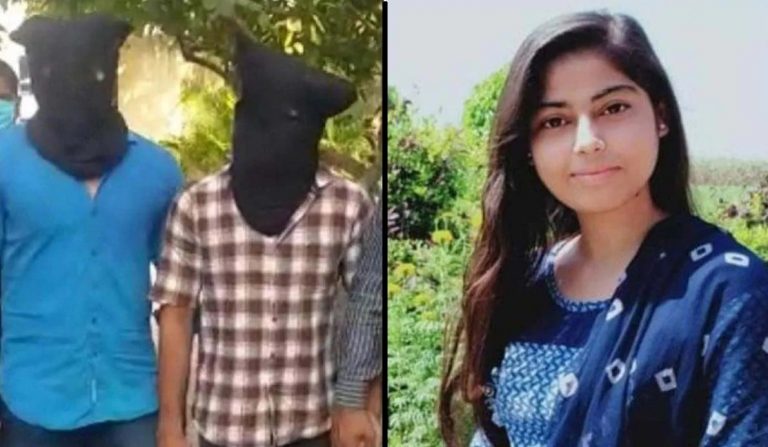
Nikita Tomar murder case: Faridabad fast track court sentences Tauseef and Rehan to life imprisonment

The district sessions court in Faridabad has ordered life imprisonment for the two convicts in the Nikita Tomar murder case. Tauseef and his friend Rehan were found guilty of killing Nikita Tomar in Ballabgarh, Faridabad, in Haryana by the court on Wednesday. While the court had convicted the two accused of the crime, the quantum of the punishment was not announced on that day. The trial court today ordered life imprisonment for Tauseef and Rehan in the case.

Both the convicts were found guilty under sections 302 (murder), 366 (kidnapping a woman to compel her into marriage), section 506 (criminal intimidation), 120-B (criminal conspiracy) and 34 (common intention) of the IPC. Both are already in jail since their arrest in October last year.

In October 2020, 21-year-old student Nikita Tomar was shot dead from point black range by Tauseef in full public view outside the Aggarwal college in Ballabgarh, Faridabad. The video of the gruesome act caught on camera had gone viral. The trial for this murder case began on December 1, 2020, in a fast-track court.

The victim’s family has claimed that this was a case of Love Jihad where the accused Tauseef pressurised the victim to embrace Islam and marry him.

It may be noted that the prime accused Tauseef comes from an influential family of Congress leaders. He is a cousin of Congress MLA Aftab Alam, and the grandson of Kabir Ahmed, a Congress leader who was elected as an MLA from Haryana’s Nuh constituency in 1975 and from the Tauru constituency in 1982. Moreover, Tauseef’s late uncle Khurshid Ahmad was a Congress MP of Haryana and was an ex-Cabinet minister of Haryana. Khurshid Ahmed’s son and Taufeeq’s cousin brother Aftab Ahmed was elected as MLA from Nuh, Mewat on the ticket of Congress Party and has been a Minister as well.