Home Blog Page 4820

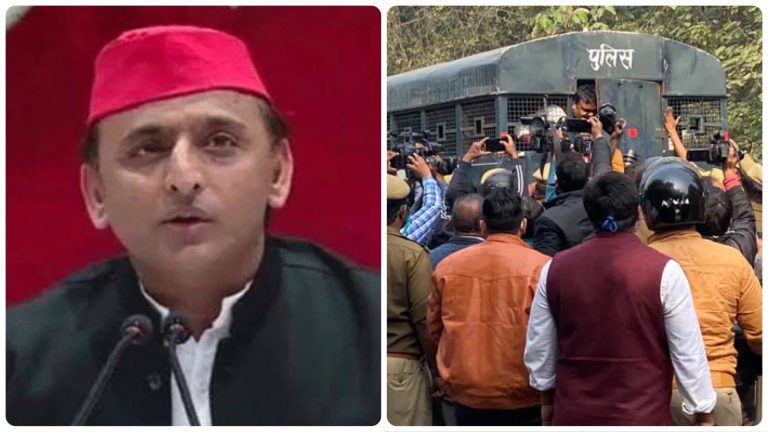
Uttar Pradesh: Akhilesh Yadav and other Samajwadi Party leaders put under ‘house arrest’ ahead of ‘Kisan Yatra’

The former Uttar Pradesh chief minister and the Samajwadi Party chief Akhilesh Yadav has been put under house arrest at his residence on Vikramaditya Marg in Lucknow. Akhilesh Yadav was scheduled to join Samajwadi party’s Kisan yatra from Kannauj at 11 am today to support the farmers’ protest and renew his dwindling political clout, but was detained by the police citing the renewed wave of coronavirus infection in the country.

Besides Yadav’s residence, the Samajwadi Party office on Vikramaditya Marg has also been sealed and police have placed barricades around it. The Lucknow police have been deployed in the neighbourhood and nobody is allowed to enter or leave the premises. Similarly, other Samajwadi Party leaders from different districts have also been placed under house arrest in the wake of the Kisan Yatra that was called by the Samajwadi Party in solidarity with the farmers’ protest.

Two MLCs—Udayveer Singh and Rajpal Kashyap—were stopped by the police from entering Akhilesh Yadav’s residence. MLC Rajpal Kashyap and Ashu Malik have been taken into custody after entering into a scuffle with the police personnel for meeting their party president Akhilesh Yadav.

The official Twitter account of Samajwadi Party claimed that the police officials in several districts are stopping their workers from joining the Kisan Yatra. It said that the arrests of their functionaries would not stop them from supporting the farmers and urged workers and leaders of the Samajwadi Party to continue their Kisan Yatra in their respective home districts.

Acknowledging his house arrest, Akhilesh Yadav posted a poem, questioning the government on how many more people will it be keeping under detention.

Samajwadi Party and Akhilesh Yadav seeking to regain political capital on the back of farmers’ protest

As the ongoing farmers’ protests, predominantly made up of farmers from Punjab, continue unabated, it has provided a lucrative opportunity to the opposition politicians and ‘activists’ to cash in on the agitation and enhance their dwindling political capital. To this end, many leaders who have been pushed on the verge of oblivion, are jumping on the bandwagon of the farmers’ protests and cutting themselves as empathetic leaders, waging a fight against the government on behalf of the agitating farmers.

Yogendra Yadav, who had no skin in the game, was one of the ‘activists’ who took the lead over the farmers’ protests, perhaps in a desperate bid to maintain his relevance in the national politics. Similarly, the Samajwadi Party is also trying to carve out a new role for itself after the Yogi Adityanath government in Uttar Pradesh has rendered it weak and inconsequential.

Realising that the farmers’ protests could be leverage to make a comeback, the Samajwadi Party has aligned itself with the protests, hoping that it would serve to strengthen its political capital needed to fight the Yogi Adityanath government. With this intention, the party mobilised its functionaries and workers for a ‘Kisan Yatra’ to mark their support for the demonstrators protesting against the three newly introduced agriculture laws. However, their plans got derailed as the UP government prevented the SP workers and functionaries from congregating and launching a movement, citing the threat from a looming second wave of the coronavirus infection.
Sex talk, propaganda and three incidents that made her an outcast: Cai Xia reveals why she got disillusioned with ‘political zombie’ CCP

0

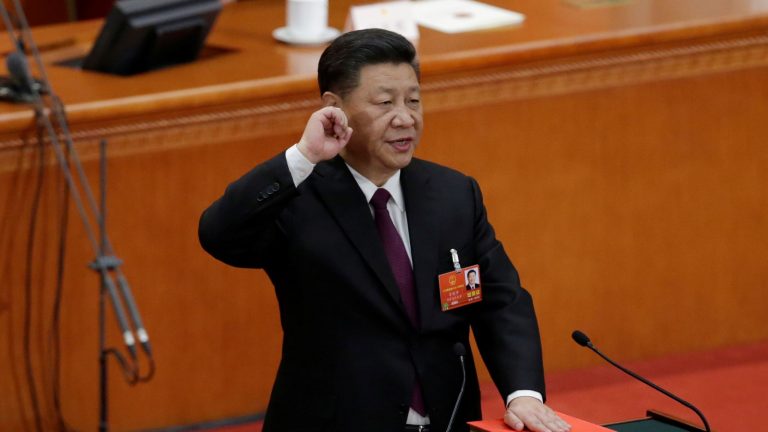
Cai Xia, a former professor at the Central Party School of the Chinese Communist Party between 1998 and 2012, has given her account of her break from the CCP and the disillusionment she has suffered with the party. She is a dissident who has had very harsh words to offer for Xi Jinping, the President of China. She is currently a political dissident.

Cai Xia is a long time member of the CCP and has been associated with the party her entire life. Her parents had served the party as well. However, her inclinations towards liberal reforms led her to get into the crosshairs of the party. She believes that there is a need for liberal reforms within China and a decrease in the party’s control of the economy.

The Three Represents

One of the issues that fundamentally altered her vision of the CCP was the manner in which it dealt with the theory of ‘The Three Represents’ as proposed by former Chinese president Jiang Zemin. Cai Xia detailed the manner in which the party went to great lengths to subvert the fundamental message of the vision laid out by Jiang.

Cai Xia said, “The party, Jiang said, had to represent three aspects of China: “the development requirements of advanced productive forces,” cultural progress, and the interests of the majority. As a professor at the Central Party School, I immediately understood that this theory presaged a significant shift in CCP ideology. In particular, the first of the Three Represents implied that Jiang was abandoning the core Marxist belief that capitalists were an exploitative social group. Instead, Jiang was opening the party to their ranks—a decision I welcomed.”

“What was the purpose of the Three Represents if it merely restated existing ideology? I was disgusted by the superficial methods of the party’s publicity apparatus. I grew determined to reveal the true meaning of the Three Represents, a theory that in fact marked a bold departure for China. This, it turned out, would bring me into conflict with the entrenched bureaucracy of the CCP,” she added.

What followed was a series of ventures, some of which she was involved in herself as a respected professor, where the party attempted to water down the radical aspects of the vision and realign it with what the party had always preached. “Your research and innovation can be presented at the Central Party School, but only the safest things can be shown on TV,” a vice-president of CCTV, Chinese state media, said after reviewing a documentary she helped prepare on Jiang’s theory.

“At that moment, I understood. The CCTV people weren’t interested in the real implications of ideology. They just wanted to make the party look good and flatter their superiors,” wrote Cai Xia. During her work for the Propaganda Department on the same topic, she revealed the toxic work culture that prevailed within the workspace.

“When the Propaganda Department convened a meeting, those who weren’t invited weren’t allowed to ask about it. We writers could eat and take walks together, but we were prohibited from discussing our work. I was the only woman in the group. At dinner, the men gossiped and cracked jokes,” she said before adding, “I found the off-color, alcohol-fueled conversation vulgar and would always slink out after a few bites of food. Finally, another participant took me aside. Talk of official business would only get us in trouble, he explained; it was safer and more enjoyable to confine the conversation to sex.”

Disillusionment with Xi Jinping

Cai Xia said that China entered a period of political stagnation under Hu Jinato, successor to Jiang Zemin. The professor believed that Hu ruled with the belief that “the economic, political, and ideological reforms the party had made so far should be maintained but not pushed forward” as he was “defending himself against accusations from both sides: from conservatives who thought that reform had gone too far and from liberals who thought it hadn’t gone far enough.”

Thus, Xia was optimistic about Xi Jinping when he assumed the reigns of the party. But there were others who were not so hopeful. One category of sceptics were the ‘princelings’, the descendants of the founders of the party, and the other was that of “establishment scholars”. She says that one scholar told her in private that Xi Jinping suffered from “inadequate knowledge”.

A former colleague of hers told her, “It’s not a question of whether Xi is going left or right but rather that he lacks basic judgment and speaks illogically.” Soon, she realised that Xi Jinping was not moving forward with further reform within the party as she hoped he would. Instead, from a period of stagnation, he was unleashing an era of regression.

The Straw the broke the Camel’s Back: Cai Xia becomes an outcast

There were three incidents that turned Cai Xia into an outcast. First, the persecution of tycoon Ren Zhiqiang following his dispute with Xi Jinping. Second, a cover up of police brutality. And third, the professor speaking out on WeChat. “After 20 years of hesitation, confusion, and misery, I made the decision to emerge from the darkness and make a complete break with the party. Xi’s great leap backward soon left me with no other choice. In 2018, Xi abolished presidential term limits, raising the prospect that I would have to live indefinitely under neo-Stalinist rule,” she said.

She said that while on a visit to the United States, she was informed that Chinese authorities would arrest her upon her return for “anti-China activities”. Then, the Wuhan Coronavirus pandemic ensued and she spoke out in favour of Lei Wenliang, the Chinese ophthalmologist who was persecuted for raising alarm bells over the emergence of a novel virus and eventually died of the same.

At that point, she was told to come home urgently by authorities at the Central Party School in China. Soon after, a private talk was released where she referred to the CCP as a “political zombie” and called for Xi Jinping to step down.

“I knew I was in trouble. Soon, I was expelled from the party. The school stripped me of my retirement benefits. My bank account was frozen. I asked the authorities at the Central Party School for a guarantee of my personal safety if I returned. Officials there avoided answering the question and instead made vague threats against my daughter in China and her young son. It was at this point that I accepted the truth: there was no going back,” said Cai Xia.

West Bengal BJP leader Kabir Bose’s car vandalised, under house arrest as 100s of TMC leaders, led by Kalyan Banerjee, surround his house

Political violence is on the rise in West Bengal, ever since Mamata Banerjee and the ruling TMC came to power. Bolstered by political patronage, the goons have turned into a nightmare for the political opponents in the State. 

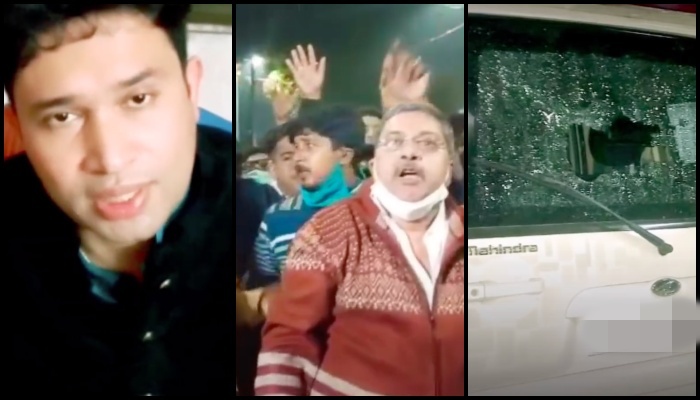
On Monday, Rajya Sabha MP Swapan Dasgupta informed on Twitter that BJP spokesperson Kabir Shankar Bose has been under house arrest and that TMC workers are preventing him from stepping outside. He tweeted, “West Bengal BJP spokesman & barrister Kabir Shankar Bose has been under siege in his flat in Serampore. The TMC, in collusion with the police, are preventing him from leaving or anyone from entering.” Dasgupta further stated that Kabir’s car has been vandalised and inquired whether the law and order situation has broken down in the State of West Bengal.

While speaking to Opindia, Kabir Shankar Bose narrated his ordeal. He stated that around 100 TMC workers are outside his house and that he has been under siege. “The police is right outside my house. They have restricted my movement. No one is allowed to step in or not. They are not allowing me to buy medicine and food. Anything can happen now. I don’t know what is happening. Kalyan Banerjee is scared of us”.

TMC goons vandalise Kabir’s car, assault his security personnel

DNN News reported that a scuffle broke out between the security personnel of the BJP leader and Trinamool workers after BJP leader Kabir Shankar Bose tried to take his car out of his house. In a video shared by the channel, two groups can be seen having a heated argument, followed by pushing and shoving. The BJP leader’s car was vandalised, as evident from the broken glass pane at the back of his car.

Kabir stated, “When I stepped out of my house, I saw several TMC workers and locals barricading my house. TMC councillor Pappu Singh, who was present there, also obstructed my path. My security personnel requested them to let me go but they refused to budge. When the TMC goons attacked my men, they had to act in self-defence. My car, security personnel and my house were attacked. Such acts of violence cannot deter the BJP.”

opVideo Courtesy: DNN News

Mamata Banerjee’s aide Kalyan Banerjee makes bizarre allegations against Governor

Local MP, Kalyan Banerjee, had also arrived at the spot with other TMC supporters. Banerjee, who is close to West Bengal Chief Minister Mamata Banerjee, was seen sloganeering against Kabir outside his house. While speaking to the media, he claimed that the BJP leader is a ‘goon’, who has been sent to unleash hooliganism in the area by West Bengal Governor Jagdeep Dhankhar. He claimed that CISF had no right to ‘beat’ his men and that he would not allow anyone to ‘create’ unrest in Serampore.

“I want to tell Jagdeep Dhankhar that he cannot disturb the peace in Serampore… All this was his plan. He has connections with all criminals,” Kalyan Banerjee alleged. While pointing towards a woman standing nearby, he claimed that Kabir Shankar Bose and his men had tried to molest her. “BJP is a party of hooligans and rioters. Even Amit Shah is a rioter”, Banerjee continued with his outlandish claims.

BJP rally attacked in Burdwan

On Saturday, a BJP rally was attacked allegedly by Trinamool Congress (TMC) goons in Barabani village in Asansol Sadar subdivision of West Burdwan district. As per reports, the BJP had taken out a procession under their flagship ‘Aar Noi Annay‘ campaign to protest against the oppression of people under the rule of Trinamool Congress supremo Mamata Banerjee.

However, the rally was disrupted with incidents of bombing. In a video that has now gone viral online, thick fumes of smoke can be seen rising in the air. The area was gripped by fear and chaos, with several people running with water-filled buckets to douse the smoke.

BJP National Secretary Kailash Vijayvargiya said that attack on BJP workers has become commonplace in Bengal and that such attacks are executed on the behest of Mamata Banerjee.

Major terror attack averted in Delhi as Police nabs five terrorists including two Khalistanis

Five terrorists including two Khalistanis were arrested by Delhi Police early on Monday, averting a major terror plot. As reported by Times of India journalist Raj Shekhar Jha, the three terrorists hail from Kashmir and are identified as Mohammed Ayub and Shabbir. The police have recovered weapons and other incriminating material from the terrorists.

As per news agency ANI, the Delhi police said that the group was backed by ISI for narco-terrorism. Following the arrest of the terrorists, the police have increased the checks on the borders.

Pramod Singh Kushwah, Deputy Commissioner of Police (Special Cell), said that they apprehended five persons after an exchange of fire. Weapons and other incriminating material have also been recovered from their possession.

According to Times of India journalist Raj Shekhar Jha, two Khalistanis arrested have been identified as Gurjeet Singh and Sukhdeep Singh.

They were responsible for the assassination of Shaurya Chakra awardee Balwinder Singh in Punjab in October. In October 2020, Balwinder Singh Bhikhiwind, who fought against the Khalistanis, was shot dead by two motorcycle borne assailants. He was awarded the Shaurya Chakra for his exemplary courage. He had trained his family including his wife and children to protect the village to take on Khalistani terrorists.

Reports have suggested that they were planning something similar in Delhi.

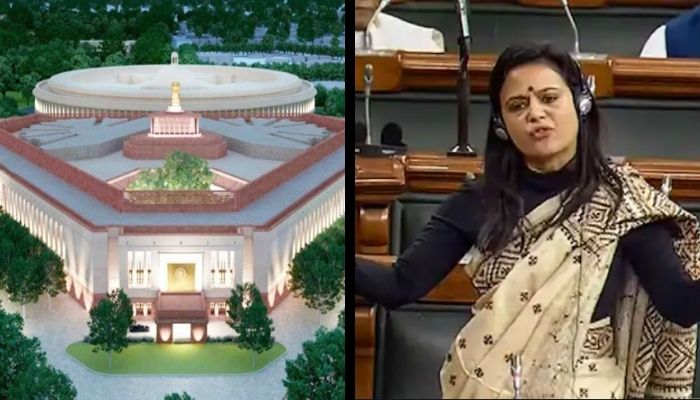
TMC opposes the Modi govt doing Bhumi Pujan ahead of construction of new Parliament building, dubs it ‘non-secular’

Two days after it was announced that the Bhumi Pujan of new Parliament building will be performed on December 10, the ‘secular’ forces in the Opposition have come forward to dub the move as ‘non-secular’.

Times Now reported, “TMC opposes the Bhoomi Pujan ceremony ahead of the construction of the new Parliament building; says the move is ‘not secular’. Leaders of other Opposition parties have also questioned the ‘priorities’ of the Govt.” Besides the Trinamool Congress, Congress leaders such as Rashid Alvi, Pl Punia and Communist Party of India (CPI) leader have also criticised the decision to perform Bhumi Pujan, citing secular principles espoused by the Indian Constitution.

Trinamool Congress leader, Mahua Moitra had also expressed her displeasure about the government’s decision on Sunday. In a tweet, she claimed that the Prime Minister of a country should lay the foundation stone and not perform Bhumi Pujan, in a ‘secular’ multi-faith democracy. Hailing herself as ‘pro-constitution’, Moitra emphasised that she was not being anti-Hindu for pointing this out.

Her tweet read, “In a secular multi-faith democracy a PM should lay the foundation stone of a new parliament building, NOT do a “Bhoomi Pooja. And no, I am not anti-Hindu to point this out, merely pro- constitution”

Bhumi Pujan of new parliament on December 10

On Saturday, Lok Sabha Speaker Om Birla had informed, “Hon’ble Prime Minister, Shri Narendra Modi will perform Bhumi pujan of the new Parliament building on 10 December. Construction work is likely to be completed by October 2022. On 75th anniversary of our Independence, Session will be held in the new Parliament.”

The Lok Sabha Speaker said that the there would be around 888 seats for the Lok Sabha members and over 326 seats for Rajya Sabha members in the new building. The new building will have the capacity to accommodate 1224 members simultaneously. Birla described that the new Parliament building as the temple of Atmanirbhar Bharat that will reflect the diversity of the nation.

The original constitution of India had pictures of Lord Ram

As often the case, the left-liberal cabal in India fails to fathom the cultural nuances and heritage of India while analysing every event from the perspective of Western secularism. The Constitution of India has a sketch of Lord Ram, Mata Sita and Lakshman returning to Ayodhya after killing Ravan in Lanka. The image appears at the beginning of the chapter related to the Fundamental Rights. Earlier, ahead of Bhumi Pujan of Ram Mandir, Law Minister RS Prasad had tweeted the image of the Constitution, bearing the images of Hindu deities to disseminate the outlook of our Constitutional drafters.

Pakistan Prime Minister Imran Khan’s ‘favourite place on earth’ is in India: Read details

Though Pakistani Prime Minister Imran Khan constantly and restlessly whines about India, deep down in his heart, he is enthralled by the beauty and the splendour of the landscapes offered in India. 

This fascination for India’s scenic magnificence was revealed by the Pakistani Prime Minister himself in a tweet posted by him. He shared mesmerising pictures of Gilgit Baltistan, claiming that it is one of his favourite places on earth. 

Sharing kaleidoscopic pictures of the landscapes in the region, Khan tweeted, “The colours of Gilgit Baltistan just before the onset of winter. One of my favourite places on this earth.”

Netizens remind Imran Khan that Gilgit Baltistan belongs to India

Soon after Khan hailed Gilgit Baltistan as one of his favourite places on earth, netizens were prompt in reminding him that Gilgit Baltistan legitimately belongs to India and that Pakistan has unlawfully and illegally occupied it.

Social Media users called out Khan for passing images from California as from Gilgit Baltistan

Before posting the above the tweet, the Pakistani PM had uploaded a tweet with four images and the same caption. However, several social media users pointed out that the images shared by Imran Khan were from the United States and not Gilgit Baltistan. Khan promptly deleted the tweet, posting a revised tweet later with pictures supposedly from Gilgit Baltistan.

Gilgit Baltistan—A part of erstwhile Jammu and Kashmir that was acceded to India

Gilgit Baltistan was a part of the erstwhile princely state of Jammu and Kashmir ruled by the then ruler Maharaja Hari Singh. Soon after independence, the Pakistani Army backed Pashtun tribal militias invaded the state of Jammu and Kashmir to plunder, rape and destroy. 

They marauding Pakistani tribesmen occupied Gilgit Baltistan as well as some part of Kashmir, including Muzaffarabad. Four days after their invasion, on October 26, 1947, Maharaja Hari Singh signed the Instrument of Accession, merging his state with India. Following the accession of the state to India, Indian troops were airlifted to Srinagar, the state capital to repel the tribal invasion. 

The Indian Army successfully drove back the advancing Pashtun tribals from Kashmir after which an armistice was reached. The Indian Army was successful in retaining Jammu, a major part of Kashmir, along with Leh-Ladakh. However, by then, Pakistani forces had illegally occupied the province of Gilgit Baltistan, The Shaksgam Valley and other regions of Kashmir. 

By the dint of the Instrument of Accession, India holds sovereign claims on Jammu and Kashmir, including the parts of Pakistan Occupied Kashmir such as Gilgit Baltistan, parts of Kashmir illegally controlled by Pakistan and it remains committed to retrieving its territories.

Earlier in November 2020, Pakistan’s Prime Minister Imran khan officially announced the ‘provincial status’ of Gilgit-Baltistan. He claimed that the decision was taken while “keeping in mind the UN Security Council’s resolution.”

Anurag Srivastava, Official Spokesperson, Ministry of External Affairs, had said, “The Government of India firmly rejects the attempt by Pakistan to bring material changes to a part of Indian Territory, under its illegal and forcible occupation. I reiterate that the Union Territories of Jammu and Kashmir and Ladakh, including the area of so-called “Gilgit-Baltistan”, are an integral part of India by virtue of the legal, complete and irrevocable accession of Jammu and Kashmir to the union of India in 1947.”

The statement further added that the Government of Pakistan has no right on territories illegally and forcibly occupied by it. “Such attempts by Pakistan, intended to camouflage its illegal occupation, cannot hide the grave human rights violation, exploitation and denial of freedom for over seven decades to the people residing in these Pakistan occupied territories. Instead of seeking to alter the status of these Indian territories, we call upon Pakistan to immediately vacate all areas under its illegal occupation.”

In September, reports suggested that the political dispensation of Pakistan, which is hands-in-gloves with the Army, has given the nod to alter the so-called ‘autonomy’ of the region. The decision will primarily benefit China and its China Pakistan Economic Corridor (CPEC) project.

NCP supremo Sharad Pawar’s u-turn over farm laws exposed as old letters and videos emerge on social media

Amidst the renewed protests over the historic farm laws, NCP supremo Sharad Pawar recently told the Union government to take the farmers’ protest seriously. He had warned the Centre that the agitation will not be limited to Delhi alone and will continue on a large scale in other States.

“But unfortunately this is not happening. I hope that the government will be wise and take cognizance of the issue to be resolved. If this impasse continues, the protest will not be limited to Delhi, but people from all over the country will stand with the protesting farmers,” Sharad Pawar said.

But it is interesting to note that Sharad Pawar has not always been a critic of the agriculture reforms, as espoused by the Modi government. While the opposition has been actively scaremongering the public about corporatisation and takeover of farming by private players, in light of the new farm laws, Pawar had once been a vocal supporter of introducing private competition in the agriculture sector.

Sharad Pawar on APMC Act and encouraging private players

In an old interview with NDTV, the NCP supremo, who was the then agriculture Minister, is seen explaining how he believed that encouraging private players in the Agricultural Produce Market Committee (APMC) can benefit farmers. “We have started with reforms within the APMC Act,” he had remarked. He said that the UPA government was encouraging private players to set up agricultural units, including cold storages.

On being asked whether he believed that the abolishment of the APMC Act would be a key step towards making the market farmer-friendly, he had asserted, “6 states had already adopted it. Another 8 states will be able to (go ahead) with it by January 2006. We are encouraging the State governments to set up modern markets.” He conceded that until private players are encouraged to work in the APMC sector, the government will not provide any financial support to the states.”

Sharad Pawar wrote letter to Delhi CM Sheila Dixit in 2010

In 2010, Sharad Pawar wrote to Delhi CM Sheila Dixit and emphasised about the need for ‘private sector participation’ for setting up ‘well-functioning markets.’ He had stated, As you are aware, the agriculture sector needs well-functioning markets to drive growth, employment and economic prosperity in rural areas of the country. This requires huge investments in marketing infrastructure including cold chain. And for this, private sector participation is essential, for which an appropriate regulatory and policy environment needs to be in place.”

He had highlighted the importance of amending the State APMC Act to encourage private players in creating ‘competitive marketing channels’ so as to benefit the farmers as well as the consumers. Sharad Pawar emphasised, “In this context, the need to amend the present State APMC Act on the lines of Model State Agricultural Produce Marketing (Development & Regulation) Act, 2003 to encourage the private sector in providing alternative competitive marketing channels in the overall interest of farmers/producers and
consumers cannot be overemphasized.”

Letter of Sharad Pawar to MP CM Shivraj Singh Chouhan in 2011

A year later, the NCP supremo had written another letter, highlighting about the need for marketing infrastructure, post-harvest investments and cold-chain logistics. “You will undoubtedly agree that the agriculture sector needs well-functioning markets to drive inclusive growth, employment and economic prosperity in the rural area of the country. This requires investments in post-harvest and marketing infrastructure including cold-chain logistics from the farm gate to the consumer, ” he wrote.

Sharad Pawar stated, “The private sector needs to play an important role in this regard. An appropriate regulatory and policy environment, therefore, needs to be in place for the purpose.” Reiterating the need to amend the APMC Act on the lines of Model APMC Act 2003, he stated, ‘”I am sure that this will mean reduced intermediation costs and post-harvest losses as well as the enhanced supply of the produce and greater farmer share in consumers’ price.”

While urging Shivraj Singh Chouhan to implement the proposed amendments, he had added: “In this context, there is a need to amend the present APMC Act on the lines of Model APMC Act 2003 in order to encourage private sector investment in marketing infrastructure and providing alternate competing marketing channels in the overall interest of the farmers, consumers and agricultural trade.”

After Sharad Pawar’s previous stand goes viral, NCP offers clarification

Clarifying Sharad Pawar’s stand on the issue, the NCP has stated, “Model APMC Act 2003 was introduced by Vajpayee govt. However, many state governments were reluctant to implement it at that point of time.” The party has further added, “As agriculture minister, Pawar tried to form a broader consensus among State Agriculture Marketing Boards by inviting suggestions for implementation of the Act. The benefit of farmers as per the model APMC Act was explained to various state governments &many governments came forward to implement it.”

NCP has further written, “The new farm bill has raised several doubts & insecurity in minds of farmers regarding MSP & other issues which the govt has failed to address. Modi Govt couldn’t form broader consensus & has failed to satisfy legitimate apprehensions of the farmers & entire opposition.”

It is, however, not clear why, when now the Modi government has given the freedom to farmers from the restrictions of local APMCs and introduced provisions for them to be paid adequately when selling their produce to private players, the opposition is hell-bent on opposing the reforms. The current government has also made it abundantly clear that they are neither abolishing Mandis nor taking back MSPs.

In fact, the government has made its stand abundantly clear. It has been addressed and readdressed several times. NCP’s ‘clarification’ rather sounds like they are trying to say that the government should have waited for the ‘opposition’ to agree with them before passing laws in a parliament where they rule with an absolute majority.

The new farm laws

In September 2020, the Central Government announced three new agriculture sector reform laws named Farmers Produce Trade and Commerce (Promotion and Facilitation) Act, 2020, The Farmers (Empowerment and Protection) Agreement on Price Assurance, and Farm Service Act, 2020, and The Essential Commodities (Amendment) Act, 2020. The main aim of these reforms is to provide a better platform for the farmers to sell their produce.

Simultaneously, several clauses protect farmers’ rights on how they want to sell the crop, timely payments, and more. Despite several clarifications by the Central government that the MSP provisions will remain as is, opposition parties have repeatedly indulged in spreading misinformation and accused the government of trying to end MSP provision. PM Modi had come down heavily on the parties opposing the farm laws on September 18 and said those who had kept farmers tied to restrictions for decades are now lying about agricultural reforms.

In 2008, Punjab and Haryana farmers led by Bharatiya Kisan Union protested against UPA govt for forcing them to sell at MSP

In 2008, the Punjab and Haryana farmers were upset that they were being forced to sell their wheat produce at the Minimum Selling Price (MSP). As per the report in The Tribune’s Chandigarh edition from 3rd April 2008, the Punjab and Haryana farmers led by Bharatiya Kisan Union (BKU) protested against the central government’s move to ban corporates from procuring wheat from farmers.

Led by then MP Sharad Joshi, who was also the founder of Kisan Coordination Committee (KCC), and Bhupinder Mann of BKU, farmers expressed displeasure that while the price of wheat was approximately Rs 1,600 per quintal in international market, they were selling their produce at Rs 1,000 per quintal as per MSP.

“Why should the farmers suffer losses by selling their produce at lower rates to the government agencies. The market forces, and not politics, should be allowed to rule,” Joshi had then said.

Twelve years later, the same farmers from same states led by same farmer organisation is opposing the very law which allows them to do exactly what they demanded.

Hypocrisy, thy name BKU

The BKU has been opposing the new farm laws introduced by the central government by alleging that the new laws were not meant for the benefit of farmers. The new farm laws, inter alia, liberate the farmers from the clutches of middlemen (Arhityas) and allow them to sell the produce to the buyer of their choice outside the APMC (Agricultural Produce Market Committees Act) markets at fair prices.

Amusingly, in 2019, the BKU had supported the then Union Minister for Consumer Affairs, Food and Public Distribution, late Ram Vilas Paswan after he demanded Punjab Chief Minister Captain Amarinder Singh to do away with Arhitya system and ensure direct payment to farmers as is provided under the new farm laws. 

The farmers’ union had welcomed the demand for eliminating commission agents who burdened farmers with huge debts and the decision to introduce direct online transactions. A year later, they want the middlemen system restored.

The Kisan manifesto prepared by KCC in 2019 asked for abolishment of APMC and Essential Commodities Act. However, when the current farm laws made provisions ending the monopoly of APMCs, offering farmers the freedom to sell their produce anywhere, the BKU has done a backflip.

Punjab farmers protest

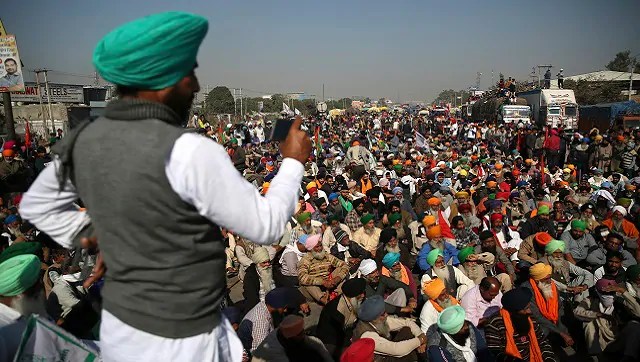
Punjab farmers are protesting against the new farm laws which lets them sell their produce to whoever they wish. They have been demanding that the government should not get rid of the MSP. However, the government has time and again assured that the MSP and mandi system will stay as is.

The three bills carrying Prime Minister Modi’s vision of ‘One India One Agriculture Market’ aim to empower farmer by providing a farmer-friendly mechanism. The ongoing protests being held in the name of farmers are being used by anti-national elements like pro-Khalistani voices and separatist groups to create mayhem.

‘Central govt stole my sandals to stop me from protesting’: Watch woman farmer leader’s viral video

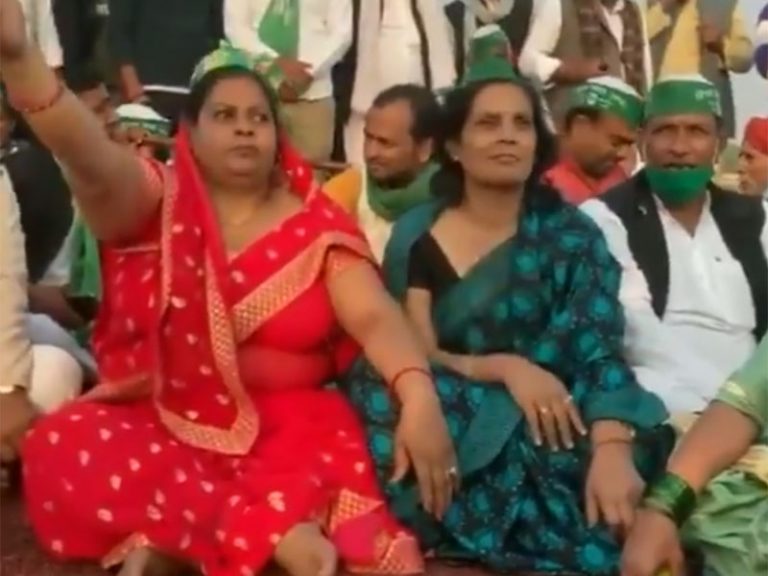
During the ongoing farmers’ protests in Delhi, a strange incident has come to light. A woman farmer leader’s sandals were stolen from the protest site. A video of the woman is making rounds in which she is alleging that the central government is behind the theft. She has urged the Modi government to return her sandals immediately.

She said, “I am Thakur Geeta Bharti, National Head of Kisan Ekta Sangh Women Wing. The police and administration have conspired to steal my sandals so that I cannot fight for the farmers. But I will fight barefoot. I will file FIR against them. The government must return my sandals.”

Some people sitting around here supported her and raised slogans in her favour, while others were trying to hide their amusement over the outrageous claims.

The video is now going viral on social media where many users are realising the gravity of the situation and demanding that the woman must get her sandals back immediately. Footwear theft is usually very common in gatherings. However, the woman’s conviction and passion to get her sandals back is winning the internet.

Farmers’ protests

Several Farmers’ unions are lodged in Delhi to protest against the recently passed Agriculture laws. While the government is trying to talk to the farmers, the unions are demanding that the laws must be repealed. The unions have called for Bharat Bandh on November 8. Yogendra Yadav, who is known for appearing on protest sites to gain some media coverage, is leading the unions for the November 8 Bandh.

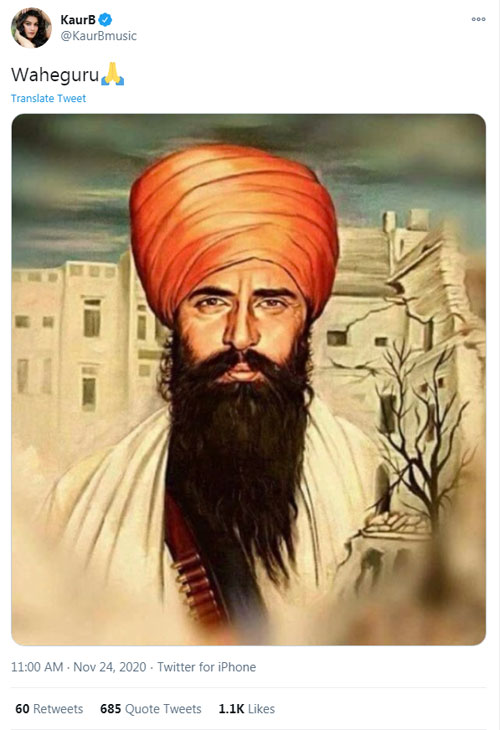
After hailing terrorist Bhinderwale, Punjabi Singer Kaur B shares a distorted map of India, complaint filed

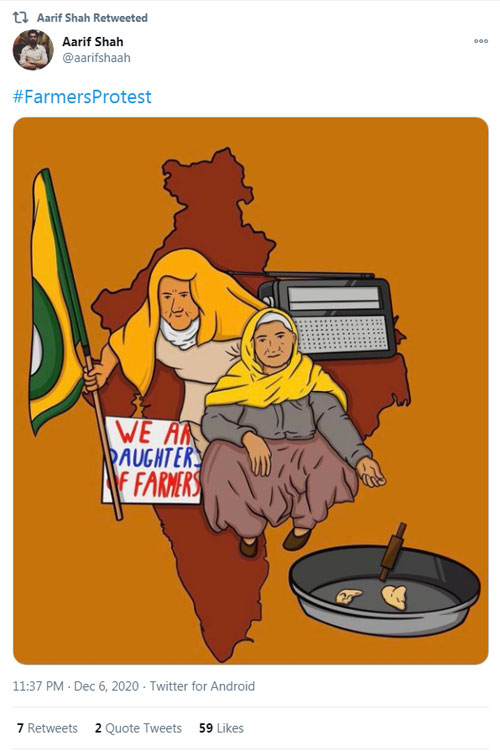
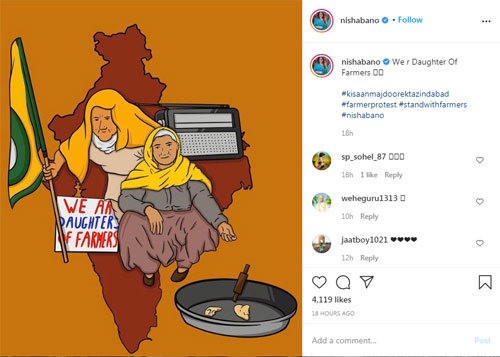
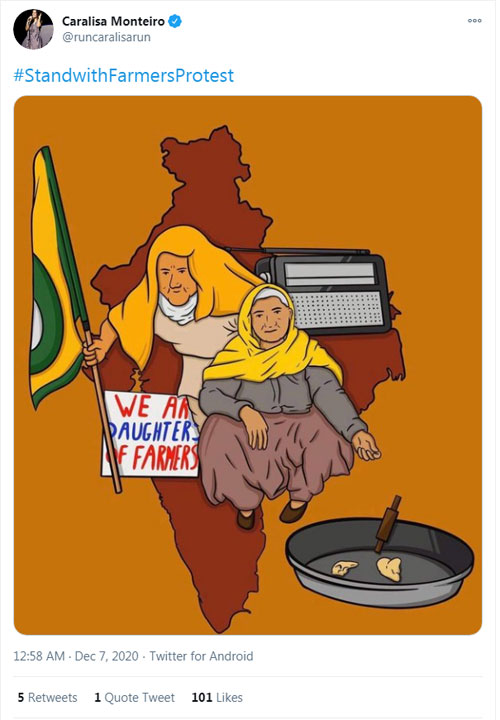
A complaint has been filed against Punjab Singer Baljinder Kaur alias Kaur B for posting a distorted image of the Indian map. Advocate Ashutosh J Dubey from Maharashtra, in his complaint to DGP and Commissioner of Police, Punjab, said that KaurB had posted the image knowingly, and it shows her malafide intentions.

Dubey shared a copy of the complaint wherein he has written that sharing or propagating a distorted map of India with the wrong topographic information, national territories or international boundaries is an offence and Kaur B has done it intentionally.

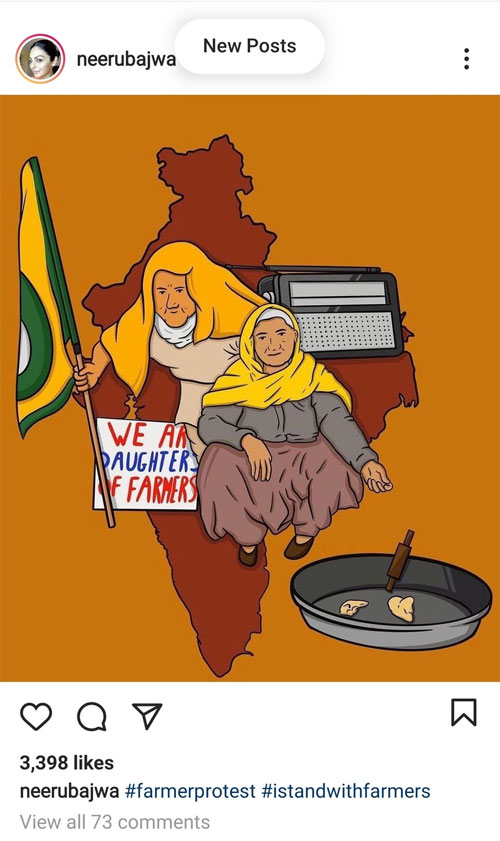
Pointing to her previous tweets, Dubey said that her account has several posts that might impose a threat to law and order in the current disastrous circumstances. The same image was used by several other Punjabi celebrities, including Neeru Bajwa, on different social media platforms. Dubey, in his tweet, mentioned that he is going to file a complaint against every celebrity who has used the distorted image. After his tweet, many of them, including KaurB and Neeru Bajwa, have deleted the post. 

Now-deleted Instagram post by Neeru Bajwa. The screenshot was shared on Twitter by user @Sahil53871351

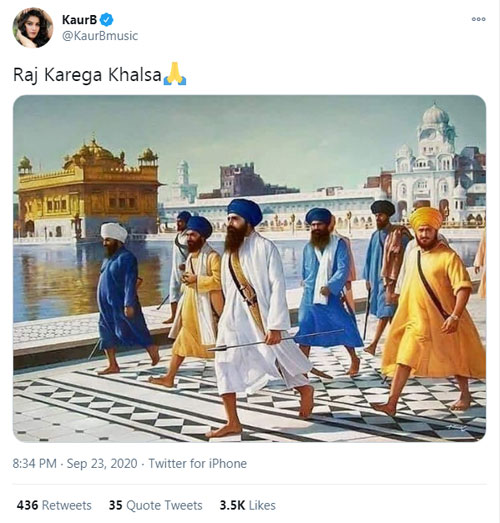
This is not the first time Kaur B has posted a provocative tweet on her social media account. She also has a few tweets in support of Khalistani terrorist Jarnail Singh Bhindranwale.

Tweet by Kaur B glorifying Bhindranwale

Other accounts sharing the same distorted map of India

Several other celebrities, journalists, and netizens pretending that they are supporting the so-called ‘farmer protests’ have shared the same image with a distorted map of India. Singer Nisha Bano, Singer Caralisa Monteiro, and journalist Aarif Shah from Kashmir are among them.

Tweet posted by journalist Aarif Shah
Instagram post by Nisha Bano.
Tweet posted by Caralisa Monterio

Farmers’ protests

A large group of farmers from Punjab and other states are currently in Delhi protesting against the three Agriculture laws that have been recently passed. The next round of talks between the central government and farmers’ unions is expected to be held on December 9. The unions have called for Bharat Bandh on December 8. Leftist Yogendra Yadav has declared that he will lead a ‘chakka jam’ for Punjab farmers. He has announced that they will block the delivery of essential commodities too.