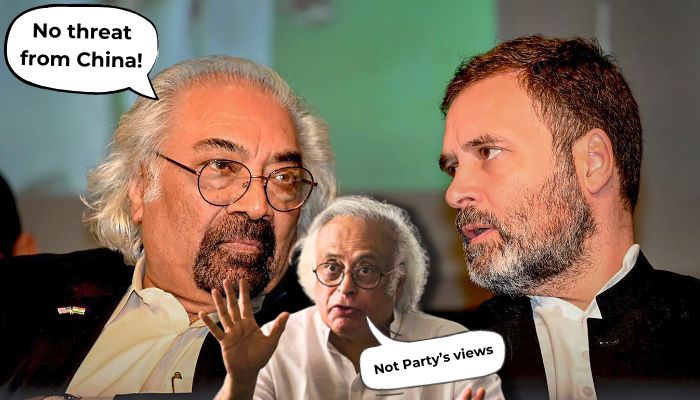
On 17th February, the Congress Party distanced itself from the remarks made by Overseas Congress chief Sam Pitroda regarding China. The grand old party clarified that Pitroda’s statements do not reflect the party’s position on China. Congress general secretary Jairam Ramesh said in a post on X, “The views allegedly expressed by Sam Pitroda on China are not those of the Indian National Congress.”
श्री सैम पित्रोदा द्वारा चीन पर व्यक्त किए गए कथित विचार निश्चित रूप से भारतीय राष्ट्रीय कांग्रेस के विचार नहीं हैं।
चीन हमारी विदेश नीति, बाह्य सुरक्षा, और आर्थिक क्षेत्र की सबसे बड़ी चुनौती बना हुआ है। कांग्रेस पार्टी ने चीन के प्रति मोदी सरकार के दृष्टिकोण पर बार-बार सवाल… pic.twitter.com/fKd6YNqm5D
The clarification from the Congress Party came after Pitroda questioned the notion of a ‘threat from China’. He stated that it was hard for him to fully understand and claimed the issue is often exaggerated. He further remarked, “There is a tendency in the US to define an enemy, and I believe this is often blown out of proportion.”
Responding to his remarks, Ramesh said, “The alleged views expressed by Mr Sam Pitroda on China are certainly not those of the Indian National Congress. China remains the biggest challenge in our foreign policy, external security, and economic domain. The Congress Party has repeatedly questioned the Modi government’s approach towards China, including the public ‘clean chit’ given by the Prime Minister on 19 June 2020. Our most recent statement on China was issued on 28 January 2025. It is also highly unfortunate that Parliament is not being given the opportunity to discuss this situation and collectively express a resolution to effectively address these challenges.”
What did Sam Pitroda say?
On 17th February, while speaking to IANS, Pitroda claimed, “I don’t know what is the threat from China. I think there is always this thing blown out of (at times) proportion.” He blamed the US for creating a hostile perception of China. He went on to blame India for harbouring an attitude of confrontation towards the Communist regime. Pitroda added, “Our attitude is that of confrontation from day one and that attitude creates enemy and that creates certain support in the country. I think we need to change that pattern. To assume that China is the enemy from day one is just not fair, not just to China but to anybody.”
He continued to heap praises on China. Sam Pitroda concluded, “I think it is time for us to learn to increase communication, collaborate, cooperate and co-create and not have this command and control mindset. China is around, China is growing.”
Congress distanced from Sam Pitroda’s remarks several times
This is not the first time Congress has distanced itself from controversial remarks by Sam Pitroda. In April 2024, while the Lok Sabha Elections were ongoing, Congress General Secretary in-charge Communications, Jairam Ramesh contradicted the statements of the Chairman of Indian Overseas Congress and Rahul Gandhi’s advisor Sam Pitroda after the latter suggested that a US-like inheritance tax should be brought in India. Ramesh posted his statement on X and said that Sam Pitroda’s comments are his personal view and should not be considered as INC’s views.
“Pitroda expresses his opinions freely on issues he feels strongly about. Surely, in a democracy, an individual is at liberty to discuss, express, and debate his personal views. This does not mean that Pitroda’s views always reflect the position of the Indian National Congress. Many times they do not,” Ramesh said in an X post.
Earlier, in December 2023, Ramesh distanced Congress from Pitroda saying his statement is not an official statement of the Congress Party after Pitroda, while speaking to ANI, targeted the Central government asking if Ram Mandir is the real issue or unemployment is.
On 16th February, All India Majlis-e-Ittehadul Muslimeen (AIMIM) supremo Asaduddin Owaisi claimed that Muslims residing in the communally sensitive Sambhal district of Uttar Pradesh are being forced to migrate. While questioning the supposed silence of the Uttar Pradesh government on the alleged forced displacement of Sambhal Muslims, Owaisi downplayed past incidents wherein Hindus were forced to leave their homes due to Muslim harassment.
Taking to X, Asaduddin Owaisi quoted a post that had a newspaper cutting attached claiming that thousands of houses are locked in Sambhal and people are forced to flee. He said, “Sambhal is now engulfed in such an atmosphere of fear and oppression that people are being forced to leave their homes. The government must stop targeting Muslims in Sambhal and giving them collective punishment; steps for confidence-building should be taken as soon as possible. Modi and the BJP repeatedly spread false rumours that there was an ‘exodus’ of Hindu society in some areas, and every time it was proven to be false. Here, even the police and administration admit that Muslims are being forcibly displaced, so why is the government silent?”
संभल में इतना डर और ज़ुल्म का माहौल बना दिया गया है कि लोग अपने घर छोड़ने पर मजबूर हो रहे हैं। सरकार को संभल के मुसलमानों को निशाना बनाना और उन्हें इज्तिमाई सज़ा देना बंद करना होगा, जल्द से जल्द एतिमाद-साज़ी के क़दम उठाए जाने चाहिए। मोदी और भाजपा ने बार-बार झूठी अफ़वाह फैलाई थी… https://t.co/Iz7lRMTQx2
However, contrary to the claims made by the AIMIM chief, the locals and administration refuted Owaisi’s claim. Muslims living around the disputed Jama Masjid said that there has been no migration in the area and none of the houses are locked.
Notably, after the Islamists ran riots on 24th November 2024 and attacked the team that came to survey the disputed structure on court order, several houses were locked for a few days as people temporarily left their houses, however, after the situation returned to normalcy, they returned.
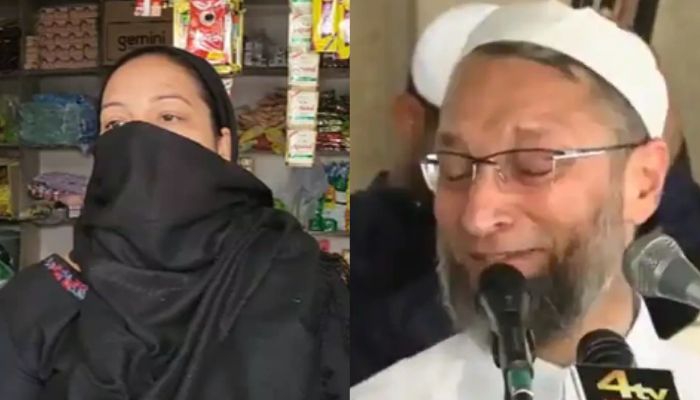
Speaking to AajTak, a local Muslim woman named Salma said that no one has left the area out of any fear or coercion. The grocery shop owner further stated that if any house is locked it is due to personal reasons.
Similarly, one Ali Abdul said that some people had temporarily left the area after the 24th November violence, however, they all have returned as the situation became normal in Sambhal. Several others also asserted that a few houses seen locked are either empty or their residents have gone out for personal reasons.
Meanwhile, Sambhal SP Krishna Kumar Bishnoi said that that 2500-3000 people were involved in the violence in Sambhal on 24th November and they pelted stones and committed arson. 79 people involved in the violence were arrested and jailed, in addition, posters of those absconding have also been put up. The officer stated that those missing from Sambhal were most likely the accused rioters. He further refuted the claims of forced displacement of Muslims and said that it is “100 per cent wrong”, adding that life in Sambhal has returned to normal.
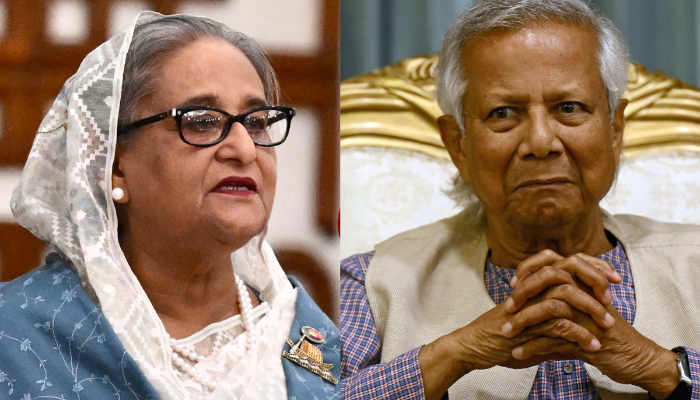
The Mohammad Yunus government, which came to power in Bangladesh following a coup last year has been engaged in a never-ending cycle of oppression regarding its political opponents. Yunus government has vowed to finish off former Prime Minister Sheikh Hasina’s party Awami League. Special operations are being carried out to arrest the party workers and leaders. The police personnel who tried to stop the violence during the coup are also being thrown behind bars.
Additionally, members of Sheikh Hasina’s party are being harassed by the current administration. The “Operation Devil Hunt” has been initiated by the authorities to apprehend them and so far 4790 people have been taken into custody. The majority of individuals are members of the Awami League and related groups. The government does not want Awami League workers to expose its misdeeds. Army, police and paramilitary troops have been mobilised throughout the nation to arrest them.
The government has claimed that this campaign has been launched to catch criminals and improve law and order. Former MPs and ministers are also targeted, in addition to the Awami League members. The administration has so far arrested and imprisoned over 100 Awami League MPs and former ministers under multiple offenses including prominent woman leader Dipu Moni. Apart from Sheikh Hasina, about 200 leaders have fled to different countries including India to escape persecution from the government which is arresting the alleged criminals in the country.
However, it has not been able to nab even a single goon who attacked Sheikh Hasina’s house in broad daylight. Now, the government is targeting 1059 police officers who tried to quell the violence that occurred in Bangladesh in July and August. Cases have been filed against them on charges of shootings and killings during quota unrest and 41 have already been arrested. Inspector General of Police (IGP) Abdullah Al Mamun, who was the head of police in Bangladesh during Sheikh Hasina’s government has also been nabbed.
They are being hounded in the name of crimes against humanity. The government has also detained Asaduzzaman Mia, the former Dhaka police commissioner. He has been charged with the same offenses. The action is not only restricted to high-ranking police officials but the majority of officials who served as police commissioners of Bangladesh’s main cities under Sheikh Hasina’s tenure have also been imprisoned. The administration is accused of retaliating against them for their actions against Islamic fundamentalists.
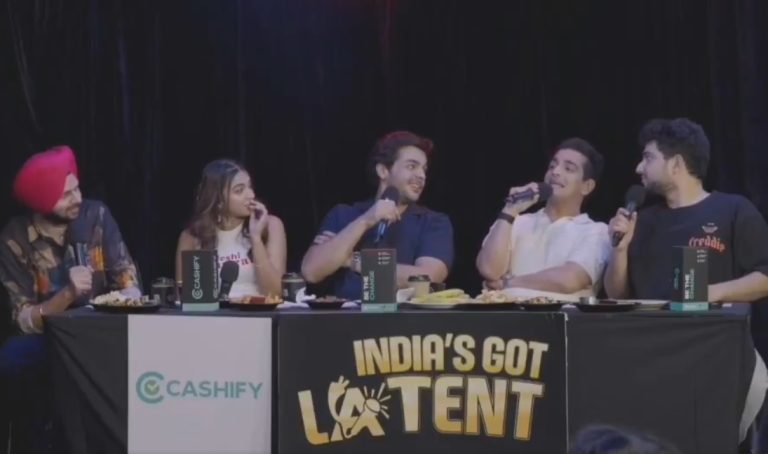
An FIR has been registered against all individuals associated with India’s Got Latent Case following multiple complaints nationwide regarding comments made by YouTuber Ranveer Allahbadia on the show.
A total of 42 individuals, including artists, producers, and influencers, have been summoned for questioning. Among those accused so far are Samay Raina, Apoorva Mukhija, and Ranveer Allahbadia. Statements have already been recorded from key figures, including Devesh Dixit and Raghu Ram.
India’s Got Latent Case | FIR has been registered against all members who played roles in all episodes of the show. Authorities had ordered the removal of all videos under investigation and mandated the deactivation of the show’s account until the inquiry concludes. Cyber…
Authorities have since ordered the removal of all related videos and mandated the deactivation of the show’s official YouTube account until the investigation is complete.
The controversy began when cyber officials flagged an allegedly inappropriate video, leading to its removal. Subsequently, comedian Samay Raina was directed to take down all content linked to the case.
The controversy erupted after Ranveer Allahbadia aka BeerBicepsGuy’s video making crass a joke about parents went viral on the internet, drawing condemnation from several quarters, following which the podcaster issued an apology. However, the matter escalated after FIRs were filed against him and other participants of the show were summoned for questioning. Earlier today, another FIR was filed against Allahbadia in Jaipur.
November 2004: Stampede at New Delhi Railway Station, 5 dead. Reason: Chhath Puja
May 2010: Stampede at New Delhi Railway Station, 2 dead. Reason: Summer Vacation
February 2025: Stampede at New Delhi Railway Station, 18 dead. Reason: Maha Kumbh
The stampede that happened at the New Delhi Railway Station on the night of February 15, Saturday, was neither the first stampede nor the first incident where the public was blamed for it.
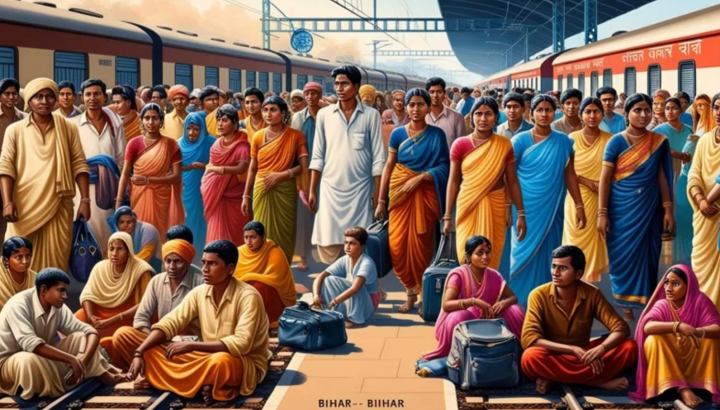
Amid the noise in social media, politicial mud-slinging, allegations and counter-allegations, nobody has noticed that the incidents of stampede have a crucial commonality; they all happened in an area where the people come to the platforms through the Ajmeri Gate area of New Delhi. Every time, the people that are the victims of the stampedes have come for trains that run to the areas of UP, Bihar and Jharkhand we commonly refer to as ‘Purvanchal’.
Nobody has talked about the fear with which a typical Purvanchali living in Delhi NCR carries with him or her, each time they board the above-mentioned trains from the same NDLS station to their hometowns in Bihar, UP and Jharkhand.
I come from that area called Purvanchal. Each time I travel with my family from the NDLS, boarding the same trains, that fear has travelled with me like an invisible burden.
Why did the stampede happen at NDLS?
If we believe the official statements by the Railways, there were no announcements for ‘change of platform’ for the special train going to Prayagraj. In the space between Platforms 14 and 15, on one side, there were people gathered to board the ‘Prayagraj Special’ and on another side people were gathered to board the Swatantrata Senani Express.
In the meanwhile, the station official announced on speakers that the ‘Prayagraj Special’ train would come on Platform 16. The ‘Bheed’ that had gathered for the train, started rushing towards the staircase to reach Platform 16. In the jam-packed platforms where the crowd started rushing all at once, some people slipped, some fell, the ‘Bheed’ kept moving, climbing over the fallen, kicking and crushing those who could not rise.
Stampedes, ‘Bheed’ and the social media keyboard warriors
Social media was quick to pronounce judgments. “Biharis do not have civic sense”, ‘Dehaati Indians don’t know queue discipline’, ‘uneducated labourers cannot obey civic rules’ and whatnot. Some experts even claimed that Indians have been travelling more because their purchasing power has increased. Indians are apparently travelling more with their families and elderly parents because they love it, because they can now afford to. Some asked why are the people even going anywhere when they know the places would be crowded. Some opined why are the people even taking trains where there is so much rush “Why do they even need to go to the Maha Kumbh?”
Some philosophers have spelled doom, that the crazy population levels in India mean such incidents will keep happening. ‘Nobody can control such a crowd.’ Another class of keyboard warriors feels there must be a conspiracy behind ‘causing’ the stampedes.
I am a part of that cursed ‘Bheed’
I am too a part of the same Bheed that lacks ‘civic sense’, that takes the overcrowded trains from the overcrowded platforms of the NDLS. I keep travelling on the same trains where people push each other, even kill each other to get on and even die in the process. You might feel that i may have been lucky that I wasn’t a among the victims that died or got injured in the Chhatth stampede, my wife and children weren’t among the unfortunate souls who were in the summer vacation stampede crowd, my parents were not among the crowd on the platform that wanted to go to Maha Kumbh.
But I am not. I am not lucky to have escaped getting crushed in those overcrowded platforms trying to board overcrowded trains. Because each time I travel to my hometown in Bihar, I see the same crowd, with the same desperate efforts to board a train, the platforms lacking even an inch of space, the people pushing each other, waves after waves of the same ‘Bheed’.
Every time I have travelled, I have faced the same crowd, every time I manage to board the train, I have to struggle to access the toilet from my berth. Every time the platforms are a sea of humans, without an inch of space to breath. Each time, the friend or relative who comes to drop me off, leaves from outside the station entrance, because, nobody knows when the station staff would stop selling platform tickets for those platforms where the Purvanchal trains come.
I am used to it, used to the overcrowded trains, the struggle, the dysfunction and the chaos. Because this is what the system has taught me. I wasn’t taught ‘civic sense’ by the system. The system taught me to live with the chaos, to struggle to carry myself, my family and our luggage through the crowd, to suffer the overcrowded train inside the so-called ‘reserved’ coaches too, because that is what the system allows, enables.
I did follow the queue
We are talking about the New Delhi Railway Station here, not about some other stations that you see in movies, where sprawling lawns and open spaces welcome travellers and where there is ample space to enter and exit. Passengers coming to this NDLS are bound to follow the queue discipline because there is no other way. Nobody can waltz into the station platforms without following queue. Nobody can bring any random stuff inside here. The baggage is scanned through a scanner where policemen are present. Anything ‘problematic’ is confiscated immediately. The passengers follow all these to reach the platform where their train is scheduled to arrive. Nowhere during this process, the ticket of the passengers, or the platform tickets of the non-passengers are checked. When one reaches the platform, there are always more people than expected. There is always pushing and shoving involved to get inside the train. The situation is worst for the general coaches, a little less than worst for sleeper coaches, a further less for AC 3 tier and usually absent for AC 2 tier coaches.
So the passengers do come with civic sense, they do enter the platform with civic sense, but the ‘system’ on the platform and the station in general somehow lack this civic sense.
It is the system that turns humans into ‘crowd’, this is how
Existing railway rules say that you can purchase a reserved train ticket at least 60 days before your journey. Due to demand, all trains going towards Purvanchal sell off all available tickets as soon as the 60-day window opens. The waiting lists run long. People pay for the waiting list tickets with the hope that it might get confirmed.
One can come to the platform absolutely ticketless. The system has ensured that. Ticketless passengers can and do get inside NDLS. ‘System’ ensures that there are TCs on the platform who can be approached by these ticketless travellers. They ask for a fine, and give a ticket that is pricier than normal tickets. This way, ticketless passengers throng inside the platforms, because they know there is a system in place to assure them a ticket, albeit with a heavier price.
After you get a ticket from the TC at the platform, you can board the train. The railways knows that the train has been booked beyond capacity. They know that the waiting lists are full too. They still issue these ‘tickets’, with a superficial warning that these new passengers are expected to board only unreserved coaches. But there is usually no system in place to ensure that the unreserved passengers do not board the reserved coaches. The result? The unreserved passenger who just paid more for a ticket, now considers it his right to board a reserved coach and find a place anywhere.
The security personnel in the station allow unreserved passengers to board in exchange for money. Pantry car space, generator compartment space, coach attendant space, every inch of space inside the train is sold for a price. The crowd is allowed to board the train with the full knowledge of the railway staff that the train has been booked beyond capacity. The crowd at this point is no longer human, it is just crowd, faceless, nameless, dignity-less. The system that is paid to ensure rules, instead ensures chaos and mayhem.
You can say that the average Bihari or average Purvanchali has no civic sense. But where has the civic sense of the system gone? What is this senseless system that does not even allow me to travel peacefully after paying the full fare for my reserved seat?
Is there any way to prevent humans from turning into the faceless crowd?
The migrants from Purvanchal come to Delhi-NCR seeking livelihoods, to earn and take care of their families. They come seeking the schools, colleges and hospitals of Delhi because they do not have them in their hometowns. Quality healthcare and quality education in these areas will ensure that there is no ‘bad quality’ crowd in the capital city.
Indian Railways needs an urgent and massive infrastructure overhaul. There is no space outside the NDLS station from the Ajmeri Gate area. There is a need for more trains, and more trains that run on time. The Railways need to address the overcrowding issue and realise that they are the ones causing overcrowding, by issuing these extra tickets with fines, knowing the trains are already fully booked. The Railways need to lose this sheer greed of emergency general ticket revenue. They need to ensure quality services to passengers with tickets.
The Railways need to ensure and train its staff in a way that overcrowding of passengers is not allowed in any train. The trains, even the unreserved, general coaches have a capacity limit. The Railways keeps issuing general tickets without any cap. There must be a cap to the number of general tickets issued per train.
An average Indian does not become anti-Modi or anti-India just for expecting a better system
Seeking accountability from the government and expecting the government machinery to ensure quality service for citizens is NOT anti-government behaviour. The average Indian knows that the Prime Minister, who comes from a humble background and not some ivory palace, knows the struggles of ordinary citizens. That is the reason he worries about basic amenities like toilets and roads. It is for that reason the average Indian seeks a better accountability and better services from the Modi government. The common voter knows that these problems have been existing for decades, they know that the Modi government has been trying to develop Railway infra for years and that these efforts need time.
But attempting to whitewash or cover up the incidents is not the solution. ‘Bhakts’ need to understand that by making desperate attempts to save the image of their favourite political party, they are causing irreparable damage, creating rifts between voters and the government that will leave a lasting impact of distrust and negativity.
Hard times await us as a country, as a populace. And hard situations demand hard questions. Hard questions need to be asked and accountability needs to be ensured at all levels. PM Modi holds the weight of a billion expectations, because a billion Indians hope that the man who achieved impossible things, can address their problems and solve them.
Yes. I agree that we, the Biharis or Purvanchalis, do not have civic sense. But please tell honestly, does the system in this country have any civic sense?
This article was translated from Hindi. The Hindi version can be read here.
Remember Dr Ramanan Laxminarayanan? He was one of the foremost “experts” quoted by the Indian and international media to fearmonger about India staring at, potentially, “millions of deaths” during the COVID-19 pandemic. The insinuation at the time was simple – based on the comments of Dr Ramanan Laxminarayanan, the media repeatedly speculated that the Indian government was hiding substantial information about COVID-19 deaths in India and vaccine penetration. Turns out, the campaign to tarnish the country and her seminal effort to contain the pandemic, largely driven by Dr Ramanan Laxminarayanan, may have a USAID, NED, CDC, Dr Fauci and the vaccine lobby angle to it, hitherto unexplored.
After Elon Musk-led DOGE bit USAID, skeletons have been tumbling out of the US Deep State closet, from election interference to regime change operations, forced colour revolutions, colluding with terrorist organisations to destabilize sovereign countries, and collaborating with nefarious NGOs in several nations including India, furthering the LGBTQIA+ plus agenda of body mutilation, funding the religious conversion of indigenous people – Hindus in India, for example, and much more. It almost seems like there is a USAID-created monster lurking under every rock that one bothers to lift.
So how does it all link to Dr Ramanan Laxminarayanan and the COVID-19 pandemic in India?
Who is Dr Ramanan Laxminarayanan and how was he creating panic in India during the COVID-19 pandemic
The COVID-19 pandemic was the worst health crisis that the world had experienced in decades and India was no exception. Governments across the world struggled to respond to the spread of the virus. The government of India, however, despite a less than adequate health infrastructure to deal with a global pandemic and a population of over 1.2 billion people, successfully curbed the spread. In fact, India not only managed to do a decent job for its own people but helped several other nations by supplying vaccines – this, at a time when the world was hoarding vaccines and medicines, leaving several smaller nations to fend for themselves.
While the Indian government put up a herculean fight against the COVID-19 pandemic, certain elements were fear-mongering and predicting millions of deaths in India – insinuating that the Indian government was hiding material evidence and facts about the deaths in India.
One of the foremost “experts” who peddled such theories was Dr Ramanan Laxminarayanan. Ramanan Lakshminarayanan came up with fanciful numbers to state that India would be facing close to 300 million COVID-19 infections and 2.5 million deaths due to the coronavirus outbreak – and he was used by the Left media to spread panic in India.
By the 20th and 21st of March 2020, Laxminarayanan had spoken to several mainstream media channels. On India Today and Barkha Dutt’s YouTube channel, Lakshminarayan claimed that nearly 10-15 million people would be affected seriously and would need critical care ‘in the coming days’.
Many are saying these projected numbers by Ramanan Laxminarayan will cause panic. I disagree. I think him telling us that India could get 300 to 500 million #Corona cases by July is a call to action. It brings home gravity of what could happen if we don't isolate diligently https://t.co/Xumlwkwk6o
According to Ramanan Laxminarayanan, if mathematical models from the United States and the United Kingdom were applied to India, the country could be looking at 300 million COVID-19 infections.
“Most of the infections will be mild, however, 10 million severe infections will happen within the next two weeks and India does not have such intensive care facilities to handle such scale,” claimed Ramanan Lakshminarayanan in March 2020.
In a classic case of speculation, Ramanan Laxminarayanan said that India could be facing close to 2.5 million deaths. The so-called disease expert, however, failed to authenticate his numbers and did not reveal the source of data before inventing such fanciful numbers.
The Wire was not left behind, of course.
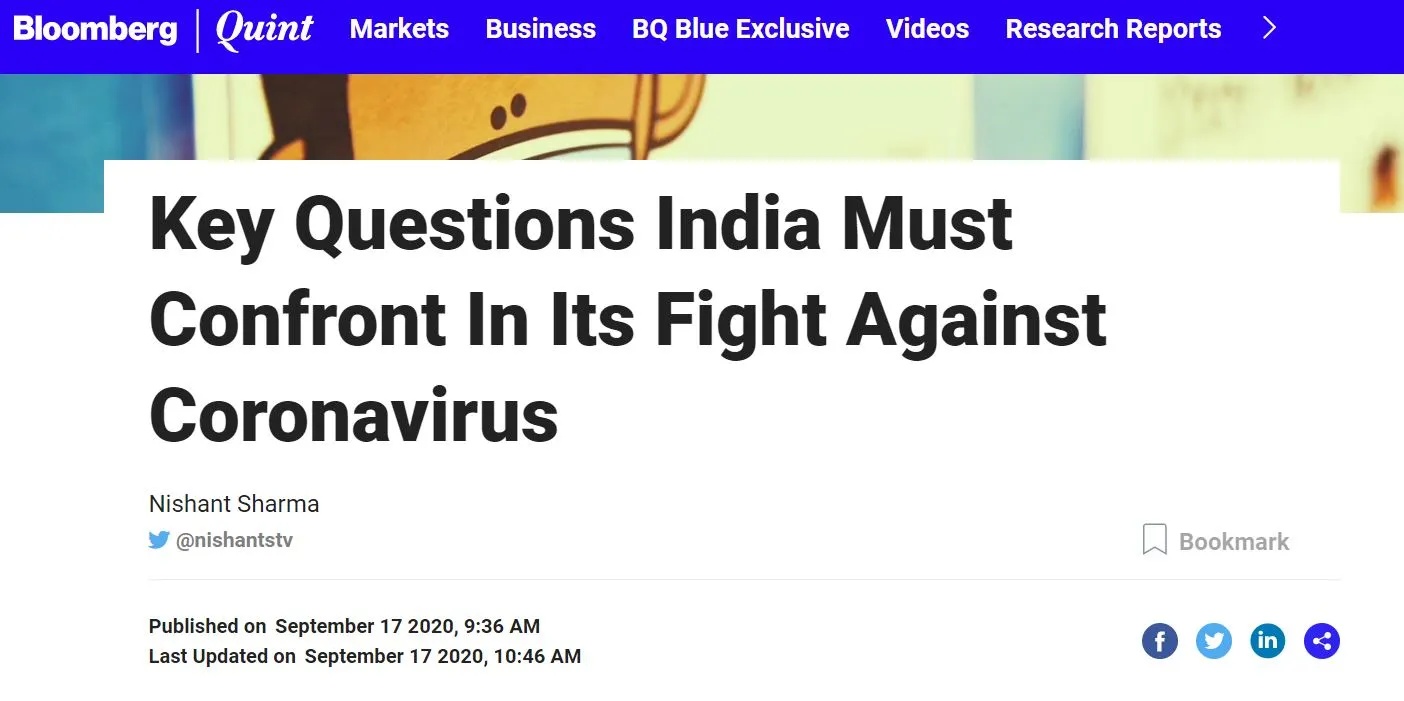
By September 2020, Ramanan Laxminarayanan was peddling fake news and fear-mongering yet again – this time – through Quint.
The article in The Quint claimed that the COVI-19 scourge in India was spreading like in no other country around the world and that India would “soon eclipse the outbreak in the U.S.” Secondly, it attempted to belittle the central government led by Narendra Modi by peddling the theory that a low mortality rate or a high recovery rate is a ‘useless statistic’. And to prove this, one of the “experts” it quoted was Ramanan Laxminarayanan.
NDTV and National Herald in March cited a study on COVID-19 done by The Center for Disease Dynamics, Economics & Policy (CDDEP) in collaboration with John Hopkins University, US. The report claimed that the study has found that the ongoing 21-day national lockdown will not be able to contain the spread of COVID-19. There were only two problems with this report. Only 4 days before this report was released, CDDEP’s founder and director – Ramanan Laxminarayanan – was stressing the need for a national lockdown in an interview with Barkha Dutt. The second problem was that while Laxminarayanan claimed that the report was in collaboration with Johns Hopkins University (evidenced by the logo on the research paper), JU came out and denied association with it.
To clarify: Faculty with appointments at @JohnsHopkinsSPH co-authored this report with @CDDEP and Princeton researchers. The report has been updated to clarify its authors affiliations and does not reflect the views of CDDEP, Johns Hopkins, or Princeton.https://t.co/QrFhRDq1Fs
— Johns Hopkins University (@JohnsHopkins) March 28, 2020
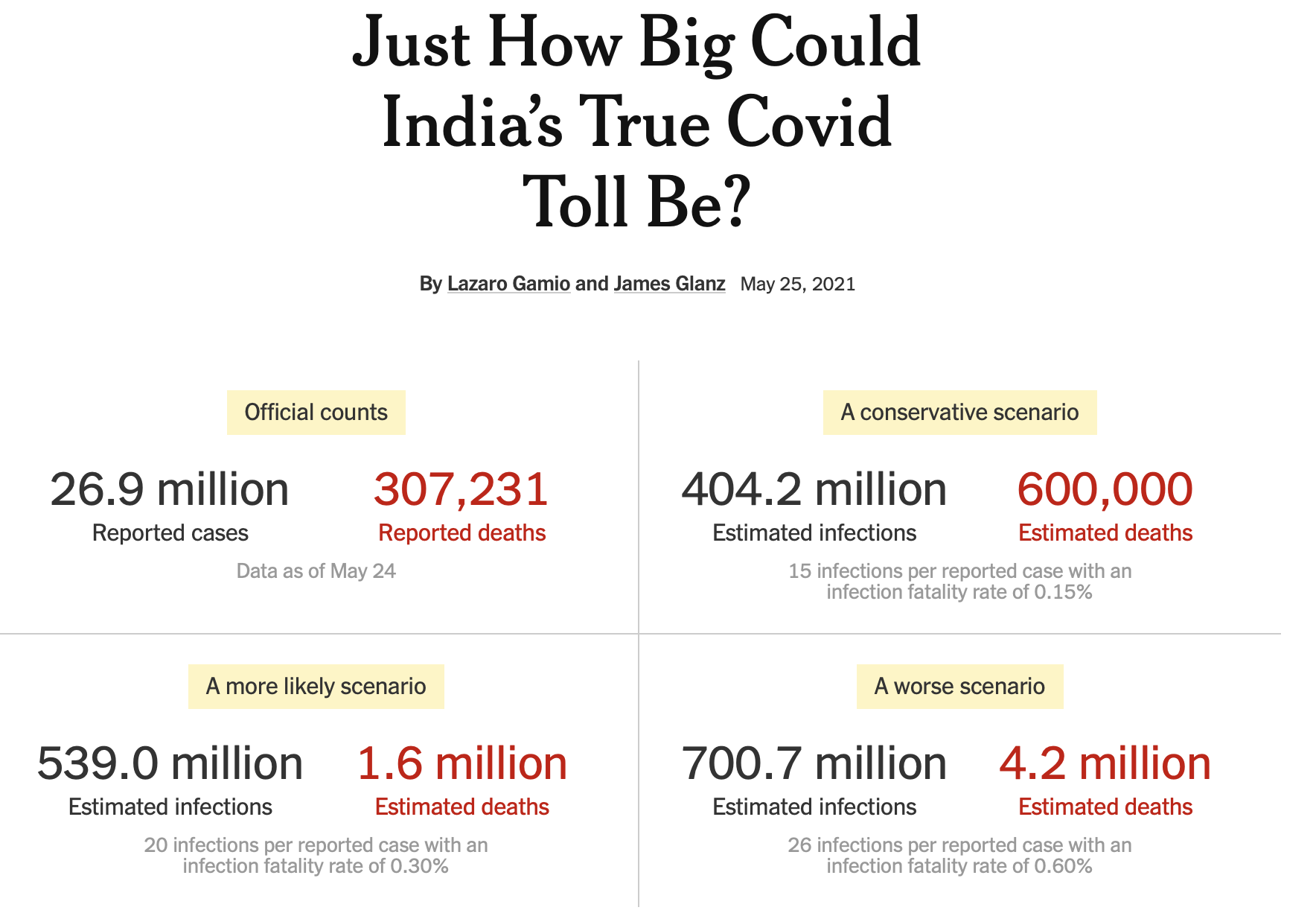
In 2021, after the worst phase of the COVID-19 pandemic was over, the New York Times published a table estimating millions of deaths and clearly claiming that the Modi government was lying about the casualties.
In the article, Ramanan Laxminarayanan confirms the outlandish accusation by the NYT, insinuating that the Modi government was indeed underreporting the deaths. This narrative was then used by several Congress leaders to target the Modi government.
While the Indian media gave Laxminarayanan unprecedented access to spread misinformation and fearmonger about the COVID pandemic in India, OpIndia realised that he was no doctor. He had done a PhD in Economics and had a Masters in Public Health (MPH). The MPH, for example, would make him suitable to weigh in on how India should build the capacity to store vaccines under suitable conditions, but certainly not predict deaths based on medical evidence.
Ramanan Laxminarayanan actually claims to be an economist and has worked for a not-for-profit organisation named the Public Health Foundation of India.
Ramanan Laxminarayan is also the founder and director of the Center for Disease Dynamics, Economics and Policy (CDDEP) in Washington DC, and also a senior research scholar and lecturer at the Princeton Environmental Institute at Princeton University. His claims of being an economist are also disputable.
The Centre for Disease Dynamics, Economics and Policy (CDDEP), renamed to OneHealth Plus, and the USAID, CDC, and NED connection
In 2022, Ramanan Laxminarayanan announced that CDDEP was being renamed to OneHealth Plus. The announcement said:
“The One Health Trust (OHT) uses research and stakeholder engagement to improve the health and well-being of our planet and its inhabitants. OHT continues and builds on the work of the Center for Disease Dynamics, Economics & Policy (CDDEP), which for more than a decade has conducted vitally important research on major global health challenges, including COVID-19, antimicrobial resistance, hospital infections, tuberculosis, malaria, pandemic preparedness and response, vaccines, medical oxygen shortages, and non-communicable diseases. OHT’s work now expands to take on issues related to climate change, biodiversity protection, and the effect of changing human diets on the planet”.
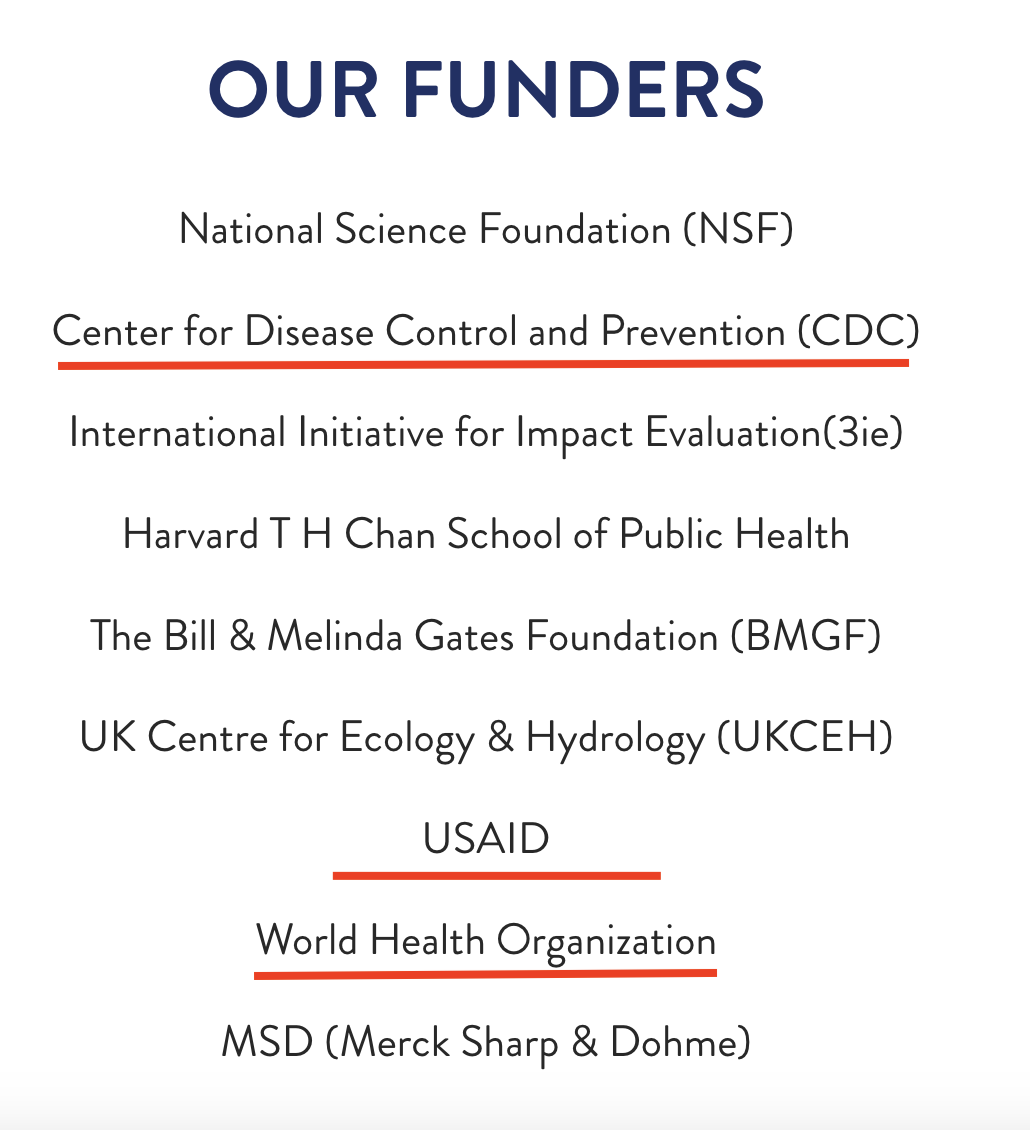
When one looks deeper, one realises that OneHealth Plus is funded by the Centre for Disease Control (CDC), World Health Organisation (WHO) and, of course, USAID.
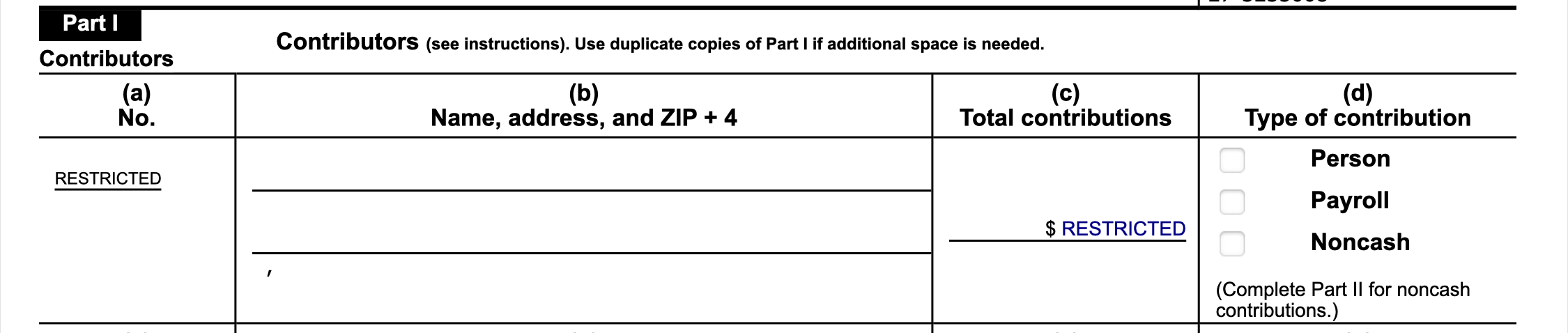
Interestingly, in all their Form 990 returns with the IRS, they have marked their source of funds as “restricted”. OpIndia perused Form 990 of CCDEP till 2020 – and in all the returns – the source of funds was marked to be ‘restricted’.
However, they specify that they are an organisation that gets a substantial chunk of their funding from the government (In this case, it would be the US government – this could include the CDC and USAID funding).
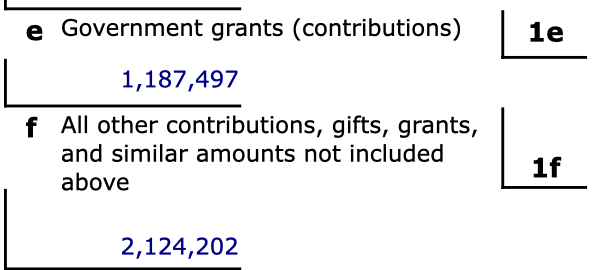
In the year 2023, CCDEP, according to their Form 990 got $1.2 million are Government grants (contributions). The compensation drawn by Ramanan Laxminarayanan was $321,003.
In the year 2020, when he was spreading lies and misinformation in the name of COVID-19, he was drawing a salary of $286,150 and CCDEP got $771,534 in government grants (contributions).
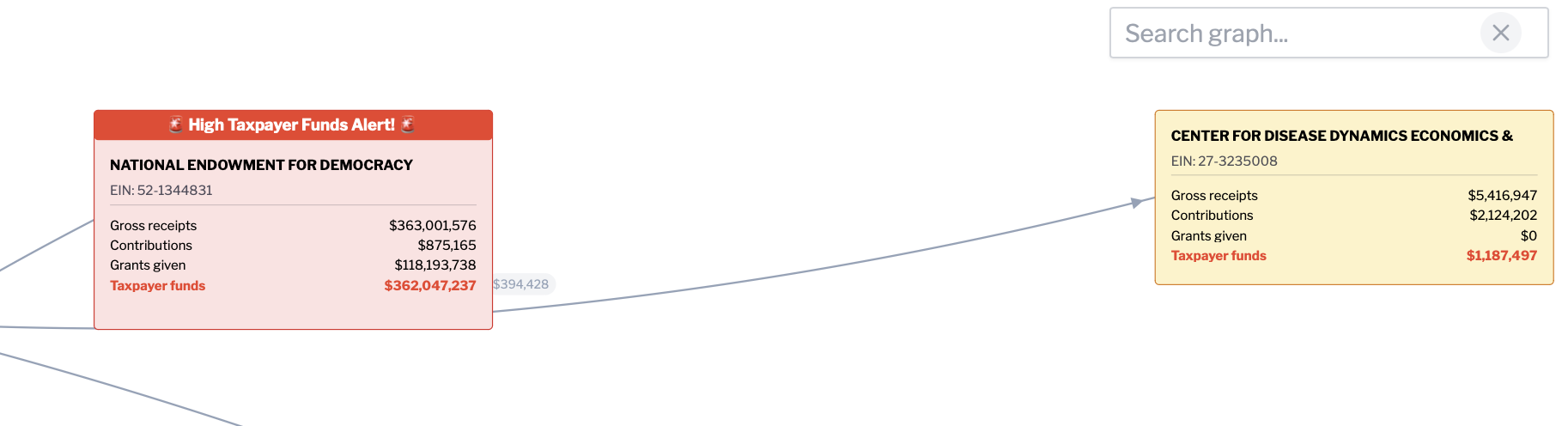
Further, according to DataRepublican, CCDEP also got money from the National Endowment For Democracy (NED).
National Endowment for Democracy (NED) is a private nonprofit grantmaking organization that supports the development of democratic institutions around the world. Though formally private, the NED is almost entirely funded by the U.S. Congress. Annually, the NED distributes more than 2,000 grants with an average value of $50,000 in more than 100 countries. NED is largely assumed to be an extended arm of the US Deep State which essentially works to fulfil USA’s foreign policy goals – much like the USAID and to bring about regime change operations. In fact, The left-wing Monthly Review Online has characterized the NED as “a CIA offshoot”, according to Influence Watch.
Mike Benz, a former intelligence officer who now exposes the functioning of the US deep state has long spoken about NED and its nefarious regime change operations. Recently, he spoke about how NED was instrumental in the regime change operation in Bangladesh.
USAID’s constant partner and operational companion star, NED, funded this Bangladesh rap song and music video, which it wrote to the US State Department “was designed… to build up disappointment and even dissent to government.” pic.twitter.com/XEnSntCfe0
Senator Chris Murphy (D-CT) has been leading the charge to defend USAID. Here he is listed as the main “Hill Outreach” point of contact for a USAID-funded NED program to “destabilize Bangladesh’s politics” by funding transgender dance festivals and Bangladeshi rap groups. pic.twitter.com/yElFZUrstX
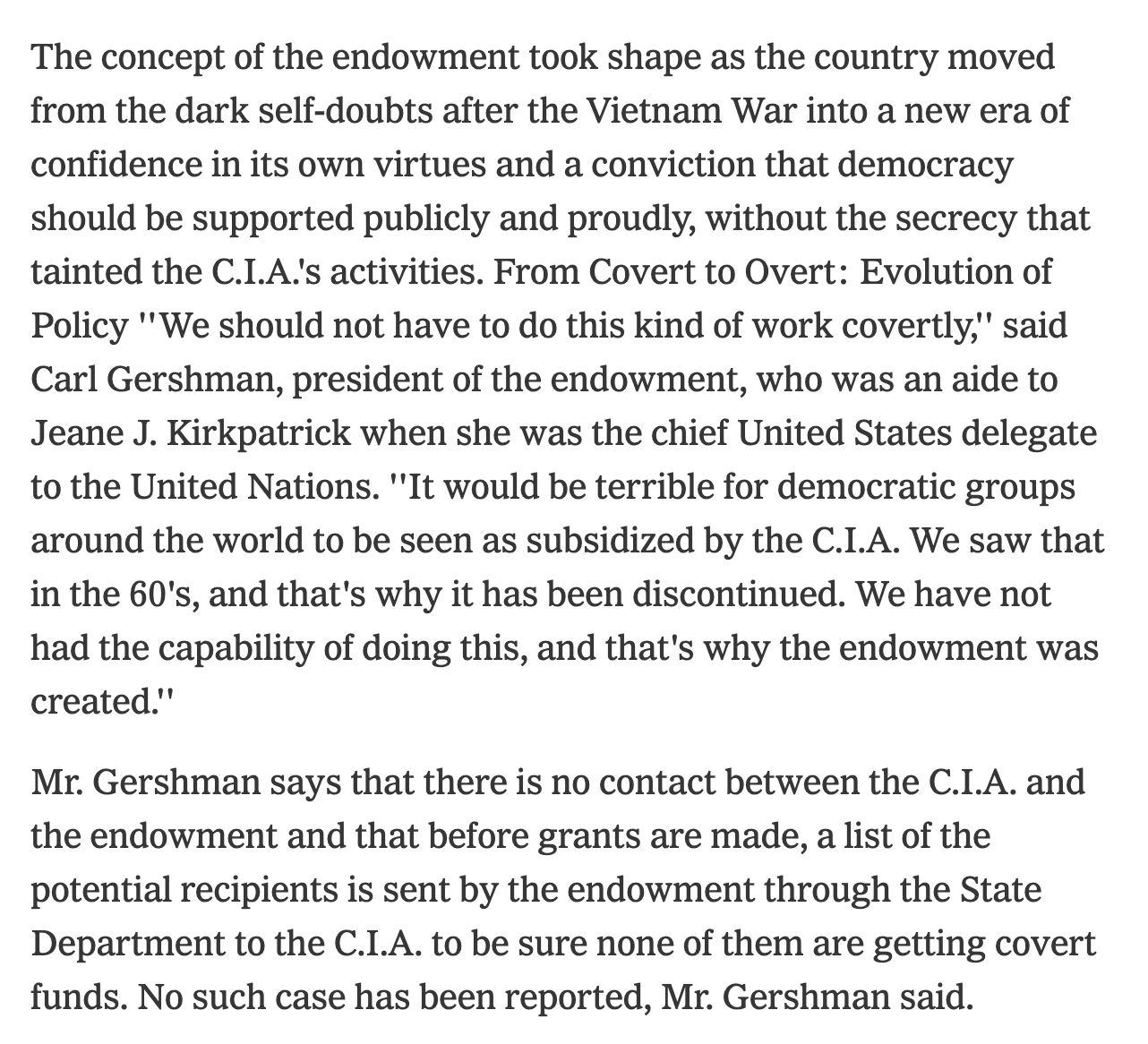
In a 1986 article in the New York Times, Carl Gershman, the founder of the National Endowment For Democracy, made some startling revelations. He was the founding president of NED from 1984 to 2021.
He essentially said that the NED was formed because the US did not want to be seen as subsidizing programs around the world through the CIA – essentially – that the NED was a CIA proxy front. Further, he reveals that a list of potential recipients of NED grants is approved by the CIA before the grants are made.
Mike Benz has also claimed that USAID and NED sponsored several programs for election interference in India – to ensure the defeat of PM Modi. He said that NED worked to promote the narrative that PM Modi’s success was largely due to misinformation. Interestingly, Ramanan Laxminarayanan had also attempted to create the narrative that India’s COVID-19 success was a mere myth, that the recovery rate does not matter and that millions were dying in India – insinuating that the Modi govt was hiding the real numbers.
The PHFI-USAID connection
As mentioned earlier, Ramanan Laxminarayanan was working for an NGO called PHFI before he ventured on his own.
According to BJP leader Vijay Chauthaiwale, Laxminarayanan while working with PHFI in India, had launched two private companies without taking appropriate PHFI permission. Later, PHFI did not renew his contract in 2016 and also sued him for stealing the NGO’s intellectual property. Ramanan Laxminarayanan had also the lost case and had to return back the Intellectual property rights to the PHFI. The court even awarded legal costs to PHFI.
PFHI collaborates with the government in various fields, however, interestingly, it also partners with USAID.
It is possible that it is in PHFI that Laxminarayanan made his USAID connections and then, after his alleged ouster, set up his own network of NGOs primarily with USAID, NED, WHO, CDC and Bill and Melinda Gates Foundation funding.
In addition to his role in the US-based NGO CDDEP, Laxminarayanan also ventured into commercial activities by starting a company called Health Cube, which according to him works in the area of diagnostics. Another venture set up by the so-called health expert is “Public Health Technologies Trust”.
The websites of both Health Cube and Public Health Technologies Trust suggest that Ramanan Laxminarayanan is in the business of health solutions. PHFT in its website claims to use state-of-the-art IT and systems design tools and technologies to empower the Indian population to obtain better health through the optimal use of technologies.
Connections with Dr Anthony Fauci
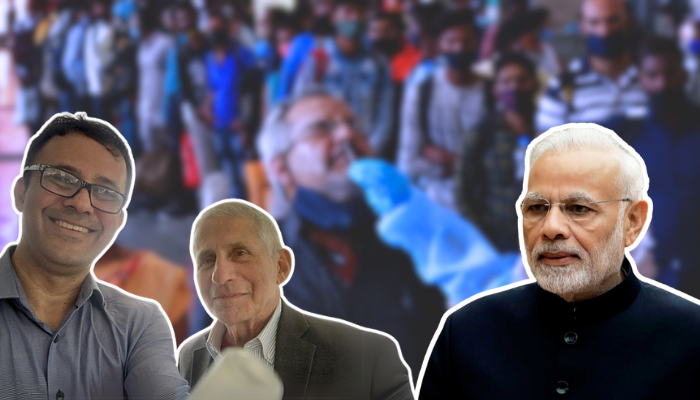
The earliest trace that OpIndia can find for now between Ramanan Laxminarayanan and Dr Anthony Fauci is from 2016. In 2016, Ramaman was invited by Dr Fauci for a John LaMontagne Memorial Lecture. The lecture is sponsored by NIAID and Dr. Fauci served as NIAID Director from 1984 to 2022.
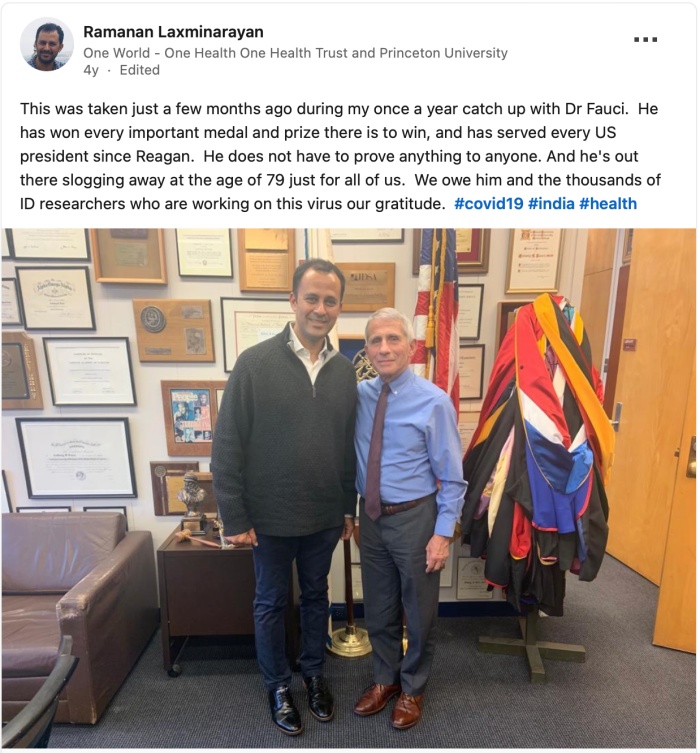
In the midst of the COVID-19 pandemic, while he was fearmongering in India, spreading misinformation and panic, Ramanan posted a picture about his meeting with Dr Fauci and posted on LinkedIn about it, claiming that the meeting was one of the annual meetings he has with Fauci. In this post, he was clearly defending Dr Fauci against the allegations that were being mounted against him.
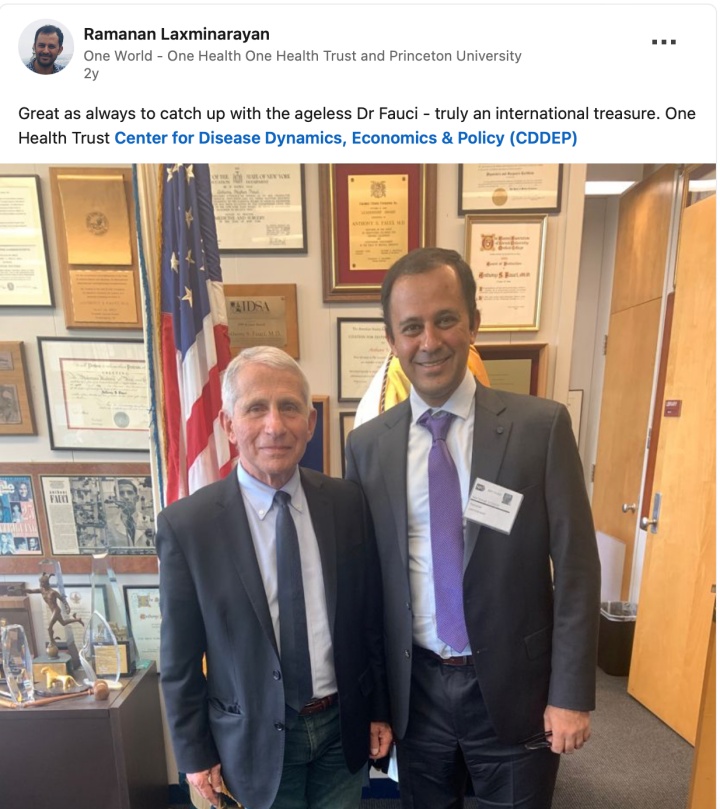
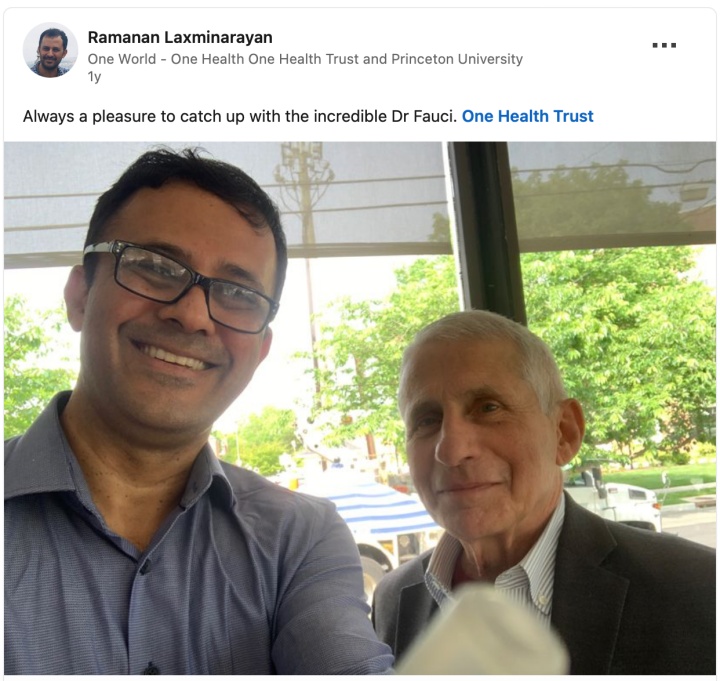
He has, since, posted pictures with Dr Fauci regularly.
The links to his LinkedIn posts can be accessed here, here and here.
After President Donald Trump took office, he withdrew the security of Anthony Fauci and DOGE, led by Elon Musk cancelled the grant for an Anthony Fauci museum exhibit.
Dr Fauci has been the subject of much investigation after the COVID-19 pandemic. Dr Fauci, during a senate hearing on May 11, 2021, had said under oath that the NIH never carried out gain-of-function research in Wuhan. However, he had, evidently, committed perjury.
An investigation by Project Veritas has made a shocking discovery regarding the origin of Covid-19, and the gain of function research to enhance the virus. Project Veritas has claimed to access ‘never before seen’ Department of Defence (USA) documents that show that the USA’s elite military research organisation DARPA (Defence Advanced Research and Projects Agency) had rejected a proposal by EcoHealth Alliance. The proposal that DARPA rejected was about studying bat-born Coronaviruses in Wuhan. However, the proposal that was rejected by DARPA saying it is ‘too dangerous’, was later approved by the USA’s NIAID, which is headed by Dr Anthony Fauci. The proposal was named ‘Project Defuse’. As per the Project Veritas report, DARPA had rejected the proposal saying that it would violate the ‘gain of function’ moratorium.
It is notable here that several reporters have revealed in the past that EcoHealth Alliance, headed by Peter Daszak was involved in conducting gain-of-function research into coronaviruses in WIV, China. Daszak was one of the first and foremost scientists to vocally dismiss the ‘lab leak’ theories. He had also published a very widely publicised letter in The Lancet at the beginning of the pandemic to dismiss all claims of ‘lab leak’.
Reports and documents had also revealed that Fauci’s NIAID had funded EcoHealth Alliance to carry out research in Wuhan.
Interestingly, Daszak was also a part of the WHO investigative team that had visited the WIV to study the origins of the Covid. Later, when Daszak’s old statements and videos emerged showing him admitting that his EcoHealth Alliance is indeed involved in the gain of function research at Wuhan, Daszak was dropped from the Lancet commission investigating Covid origins.
Somehow, the obvious conflict of interest has not been addressed by WHO or the respective governments of the USA and China so far.
A number of documents, letters and reports have so far emerged, showing the damning involvement of US scientists and bureaucrats in suppressing the truth about Covid origins.
Anthony Fauci, the head of NIAID and NIH, had stated in the past that the gain of function experiments into the virus was ‘worth the risk of a pandemic’.
Before President Biden left office, he had signed a pardon for Dr Anthony Fauci. While Fauci maintained that he had committed no crime, it was speculated that Biden had pardoned Fauci because once Trump took over, he could potentially have been indicted for perjury.
A leaked email conversation between Dr Anthony Fauci and James LeDuc also showed that the US National Institutes of Health-funded an institute that trained researchers at the Wuhan lab’s biosafety level four facility. In 2025, the CIA confirmed that the source of COVID-19 was most likely a lab leak – something Dr Fauci had denied, perhaps owing to his funding the research on the virus.
Raman Laxminarayanan, who has been pictured with Fauci and was invited by him for a lecture back in 2016, claims on his website that he is leading the largest COVID-19 epidemiology study in the world based on extensive contact tracing in India. The flagship paper from this study was published in Science in 2020.
Ramanan Laxminarayanan – lobbying for Pfizer in India?
On the 19th of December 2021, The New York Times published an article titled “Most of the World’s Vaccines Likely Won’t Prevent Infection From Omicron”. It was an article basically pushing for vaccines like Pfizer while discreting other vaccines. In the article, Ramanan Laxminarayan was quoted lobbying for Pfizer.
A growing body of preliminary research suggests the Covid vaccines used in most of the world offer almost no defense against becoming infected by the highly contagious Omicron variant. All vaccines still seem to provide a significant degree of protection against serious illness from Omicron, which is the most crucial goal. But only the Pfizer and Moderna shots, when reinforced by a booster, appear to have initial success at stopping infections, and these vaccines are unavailable in most of the world. The other shots — including those from AstraZeneca, Johnson & Johnson and vaccines manufactured in China and Russia — do little to nothing to stop the spread of Omicron, early research shows. And because most countries have built their inoculation programs around these vaccines, the gap could have a profound impact on the course of the pandemic…
…The Pfizer and Moderna shots use the new mRNA technology, which has consistently offered the best protection against infection with every variant. All of the other vaccines are based on older methods of triggering an immune response. The Chinese vaccines Sinopharm and Sinovac — which make up almost half of all shots delivered globally — offer almost zero protection from Omicron infection…
…A preliminary effectiveness study in Britain found that the Oxford-AstraZeneca vaccine showed no ability to stop Omicron infection six months after vaccination. Ninety percent of vaccinated people in India received this shot, under the brand name Covishield; it has also been widely used across much of sub-Saharan Africa, where Covax, the global Covid vaccine program, has distributed 67 million doses of it to 44 countries…
…But some public health experts say they believe that countries that have already been through brutal waves of Covid, such as Brazil and India, may have a buffer against Omicron, and vaccination after infection produces high antibody levels. “The combination of vaccination and exposure to the virus seems to be stronger than only having the vaccine,” said Ramanan Laxminarayan, an epidemiologist. India, he noted, has an adult vaccination rate of only about 40 percent but 90 percent exposure to the virus in some areas. “Without a doubt Omicron is going to flood through India,” he said. “But hopefully India is protected to some extent because of vaccination and exposure”…
…Dr. Laxminarayan said the Indian government, to which he is an occasional adviser, was considering booster shots, but the Delta variant still poses a significant threat in India, and two vaccine doses offer protection against Delta. That presents the government with a difficult choice between focusing on getting people who remain unvaccinated, or only partly vaccinated, to two doses, or trying to get boosters to older people and those with high-risk medical conditions as protection against Omicron.
Throughout the article, it was evident that the NTY and Ramanan were lobbying for Pfizer.
The first and foremost reason that India did not approve the Pfizer vaccine for use in India was the indemnity clause. It had sought waiver against liabilities that may occur out of the adverse effects of the vaccine. It had also refused to transfer technology for local production. It was also reported that Pfizer had asked several Latin American nations to pledge their sovereign and military assets, including federal reserves and embassies in foreign countries, as indemnity against any future liability that may arise due to side effects of the vaccine or any negligence of the company. The Pharmaceutical giant had also asked the countries to deposit bank guarantees in foreign countries as part of such indemnity.
Further, in November 2023, Texas Attorney General Ken Paxton filed a lawsuit against Pfizer, accusing the company of unlawfully misrepresenting the effectiveness of its COVID-19 vaccine and attempting to censor public discourse about the product. The lawsuit alleges that Pfizer engaged in false, deceptive, and misleading practices by making unsupported claims regarding the vaccine’s efficacy, in violation of the Texas Deceptive Trade Practices Act.
Similarly, in June 2024, Kansas Attorney General Kris Kobach sued Pfizer, alleging that the company misled the public about its COVID-19 vaccine by hiding risks while making false claims about its effectiveness. The lawsuit claims that Pfizer’s actions violated the Kansas Consumer Protection Act.
It is interesting to note here it was reported that Pfizer was paying several celebrities to promote their vaccine and also, Pfizer donated $1 million in 2021 to Joe Biden’s inaugural committee.
Given the narrative furthered by Ramanan Laxminarayanan, his proximity to Dr Anthony Fauci, his funding from the US Deep State including USAID and NED, one has to wonder why Ramanan was promoting Pfizer and discrediting the vaccines which were being used by India.
Conclusion
Dr Ramanan Laxminarayanan, as our research found, is funded by USAID, CDC and NED – the USAID ‘operational partner’ which gets its grants vetted by the CIA. The USAID and NED have participated in destabilising countries and regime change operations throughout the world. During the COVID pandemic, an entire narrative was created against India and the Modi-led government with Dr Ramanan Laxminarayan playing a massive role in it. He repeatedly insinuated that the death toll, as being reported by the Modi government was not accurate and that the deaths were most likely in the millions. This narrative was further latched on to by the Congress party and several others – including the global media – which harbours a visceral hate for not just PM Modi but also India as a nation. The negative narrative, ridden with misinformation and conjecture was aimed at a potential exercise of narrative building against the Modi government, in the hopes that the COVID-19 negativity could affect a change in government. Further, Dr Ramanan also seems to have lobbied in the global press in favour of Pfizer, discrediting the vaccine being used by India.
One of the reasons Donald Trump couldn’t get re-elected was bad press about how he handled the COVID-19 crisis with publications like NYT printing just the names of all Americans who died on the front page. It would not be far-fetched to wonder if a similar outcome was expected in India – based on misinformation, false narratives and conjectures.
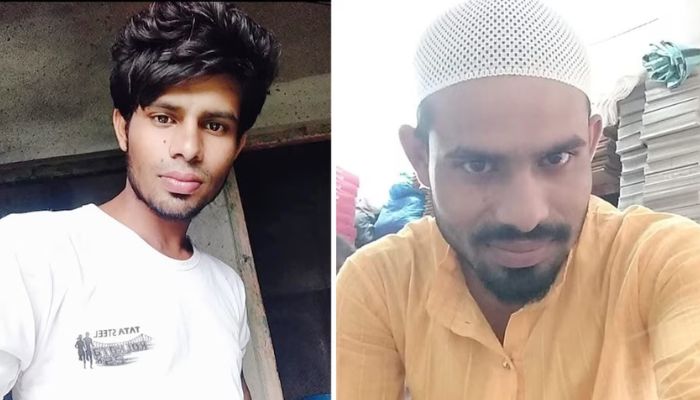
In an absurd turn of events in Uttar Pradesh’s Banda district, a youth named Rahul converted to Islam and changed his name to Murshad for his Muslim girlfriend, however, he killed her after finding out that she married someone else. Consequently, the Muslim girl’s family thrashed Rahul/Murshad so brutally that he succumbed to his injuries during treatment.
The matter pertains to the Palani police station precinct wherein Rahul/Murshad had been dating a Muslim girl from his area for the last two years. He reportedly converted to Islam and also offered namaz regularly, although his religious identity on documents remains Hindu.
Reports say that the girl got married to someone else in December 2024, and after learning about this, Murshad was infuriated. On 16th February, Murshad went to meet his Muslim girlfriend. However, the two had an argument which took a fatal turn as the accused stabbed his girlfriend with a knife and killed her.
Soon after, the girl’s family caught hold of Murshad and brutally thrashed him. The police arrived at the spot and took the badly injured boy to a hospital, however, Murshad died during treatment. Subsequently, the dead bodies of the girl and the boy were sent to the mortuary for post-mortem.
Meanwhile, SP Ankur Agarwal said that a case has been registered and further legal action is underway. As tensions prevail in the Palani police station area, police force from multiple police stations as well as DIG and SP are monitoring the area.
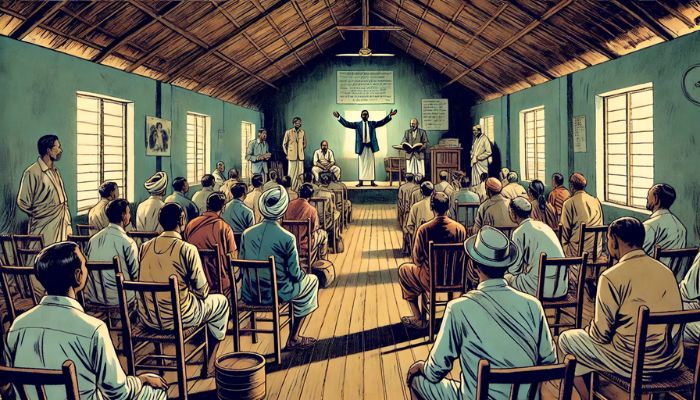
On 16th February, a major row erupted in the Amleshwar police station area of Durg district in Chhattisgarh over alleged religious conversions happening at a house in the region. Hindu organisations protested outside the house where conversions were allegedly taking place under the guise of a Christian prayer meeting. Following the protest, 97 people who were hiding in the house were detained by the police. Later, after questioning, three individuals were booked on charges of religious conversion.
The police took action based on a complaint by Meenakshi Sharma, a resident of Ayodhya Nagar. In her complaint, she accused Dr Vinay Sahu, Krishnakant Kurre, and Dhal Singh Sahu of converting people to Christianity. All three are residents of Amleshwar, and Dr Vinay Sahu was the organiser of the conversion event under the guise of a prayer meeting at his home. The so-called prayer meeting took place at around 1 PM on 16th February.
Meenakshi stated in her complaint that apart from Dr Sahu, two other individuals were present at the prayer meeting and spoke against Hindu deities while glorifying Jesus Christ. She further alleged that the trio pressured the attendees to convert by offering inducements.
When news of the alleged conversion event spread in the area, activists from Hindu organisations gathered in large numbers and surrounded the house to stage a protest. They raised slogans and accused the organisers of conducting conversions under the guise of a prayer meeting.
The activists of Bajrang Dal also recited the Hanuman Chalisa as part of the protest outside the house. Those who had come to attend the meeting remained locked inside until the police arrived and detained them.
When the police arrived, the protesters informed them that innocent and poor individuals were being manipulated into converting to Christianity.
Durg Superintendent of Police (SP) Jitendra Shukla was informed about the situation, prompting him to deploy additional police forces in the area to maintain law and order. Despite repeated requests from the police, the protesters refused to leave. Senior police officials had to step in to urge the Hindu groups to disperse. The Hindu groups warned of intensifying the protests if strict action was not taken against the accused.
Based on Meenakshi’s complaint, the police detained 97 individuals from the prayer gathering for questioning. The police found that Dr Sahu and his associates, Krishnakant Kurre and Dhal Singh Sahu, were allegedly coercing people into converting to Christianity. Subsequently, an FIR was registered under Sections 299 and 3(5) of the Bharatiya Nyaya Sanhita (BNS) and other relevant acts, and the trio were placed in judicial custody.
Speaking to the media on 17th February, Additional Superintendent of Police (ASP) Abhishek Jha said that a complaint was received about a religious conversion event taking place under the guise of a prayer meeting. The police reached the house where the event was being held and brought the situation under control. Several people, including the pastor, were arrested by the police. Further investigation into the matter is underway.
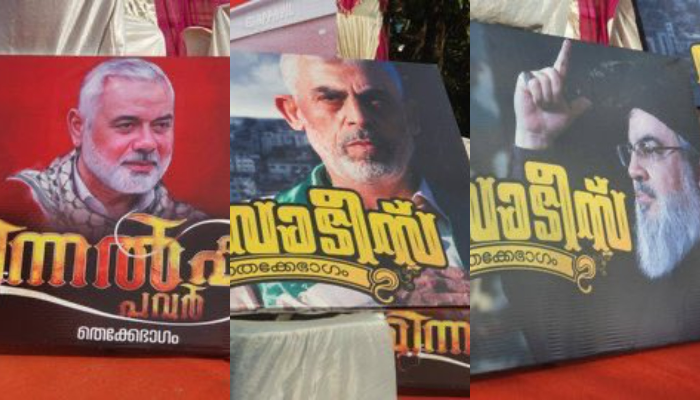
A mosque’s annual festival procession in the Palakkad region of Kerala featured prominently displayed images of Hamas and Hezbollah leaders. Banners with the titles “Tharavadis, Thekkebhagam (Ancestrals, Southside) had pictures of terrorist commanders Yahya Sinwar, Ismail Haniyeh and Hassan Nasrallah. Notably, all three were neutralised by Israel. A group of young participants paraded the banners on top of elephants. The development which transpired on the evening of 16th February in the presence of Communist and Congress leaders led to major controversy.
Terrorists glorified on the streets of Kerala. As per local media reports, during a recent Uroos procession at a local mosque in Thrithala, the mosque authorities displayed posters of Hamas Islamist terrorists Ismail Haniyeh, Yahya Sinwar, and Hassan Nasrallah. Why no action yet? pic.twitter.com/nfgPIkpu2M
Although the event organizers have not yet responded, the participation of Congress leader VT Balram and Minister MB Rajesh also drew major criticism. The procession, which was part of the yearly “Uroos” of a mosque in Thrithala, attracted around 3,000 people but the installation of the controversial flags resulted in severe backlash. “Trithala Uroos” is celebrated by the Muslims in the area. The crowd applauded the youngsters as they carried the posters of the three terrorists during the parade. The event soon became a contentious issue, with many condemning the organizers for permitting such antics.
The incident is the latest in a series of incidents involving pro-Palestine demonstrations in the state. Intifada, the name of Kerala University’s annual youth festival, triggered a massive row in 2024 because the word was linked to the Palestine-Israel conflict and its utilization by Hamas. The university’s vice-chancellor, Mohanan Kunnummal, ordered that the term be taken off of all festival promotional materials, including posters and social media posts. The event was dubbed the “Kerala University Youth Festival” afterward.
Khaled Mashal, the former leader of Hamas, spoke at a rally in Malappuram in October 2023 for at least 7 minutes. It was hosted by the “Solidarity Youth Movement,” the youth arm of radical “Jamaat-e-Islami.” The group had started a campaign titled “Uproot Apartheid Zionism and Hindutva.” Meanwhile, slogans like “buldoze Hindutva” and “unroot Zionism” were raised during the event.
The involvement of Hamas leaders in these events had been sharply denounced by the Bharatiya Janata Party. The participation was referred to as “extremist” by party’s state president K Surendran, who also sought for an investigation into the event and added, “Things have reached such a state in secular Kerala. Hamas extremists are participating in programs in Kerala.” Additionally, he noted that Mashal’s address was virtual only due to his visa denial. Interestingly, it has been discovered that banned Students Islamic Movement of India (SIMI) was being funded by Hamas.
In Bihar’s Jamui, Hindus returning from a Hanuman Chalisa recitation were attacked. A mob surrounded their convoy, pelting stones and bricks, and vandalising several vehicles. Hindu activists claimed that the attackers were Muslims. Women were also injured in the violence. Following the incident, police officials arrived, and internet services in Jamui were suspended. Authorities have arrested several individuals in connection with the attack.
According to media reports, on Sunday, February 16, 2025, activists from the Hindu Swabhiman organization gathered in Baliadih village, Jamui, for a Hanuman Chalisa recitation. As they were returning, a mob near a mosque attacked their vehicles.
The attack occurred as the convoy passed through a Muslim-majority area. The mob shattered vehicle windows and threw stones. Several activists, including Hindu Swabhiman district president Nitish Kumar and activist Khushbu Pandey, sustained serious injuries.
As per News18 Bihar, women and children were also present during the attack. One injured activist stated, “We were returning after reciting Hanuman Chalisa when suddenly 300-400 people attacked us.” Another activist mentioned that they were pelted with stones and their vehicles were damaged without provocation while passing through the Muslim area.
Khushbu Pandey, injured in the attack, said, “The Hanuman Chalisa event was held at Bhaleshwar Nath Temple in Baliadih village. After receiving Prasad, as we were heading back, stone-pelting started suddenly near a mosque. Vehicles were vandalized, and chants of ‘Allahu Akbar’ were heard.”
She further claimed that there was a plan to target specific individuals, and discussions about attacking the police were also taking place. Many Hindu activists were reportedly stranded in the area for hours. Videos of the incident, showing stone-pelting, have gone viral on social media.
Reports indicate that local police officers initially mishandled the situation. However, additional police forces later arrived to restore order. To prevent the spread of rumours, internet services were suspended in Jamui. SP Madan Kumar Anand confirmed these actions, stating, “After slogans were raised against those returning from the Hanuman Chalisa event, the police did not inform senior officials. Instead, they attempted to handle the situation themselves and even suggested changing the route. We have sought clarification from them and suspended them.”
A case has been registered regarding the incident. Eight individuals have been named in the FIR, while 50 others remain unidentified. As part of the crackdown, nine suspects have been arrested. A significant police presence has been deployed in the village to maintain law and order.