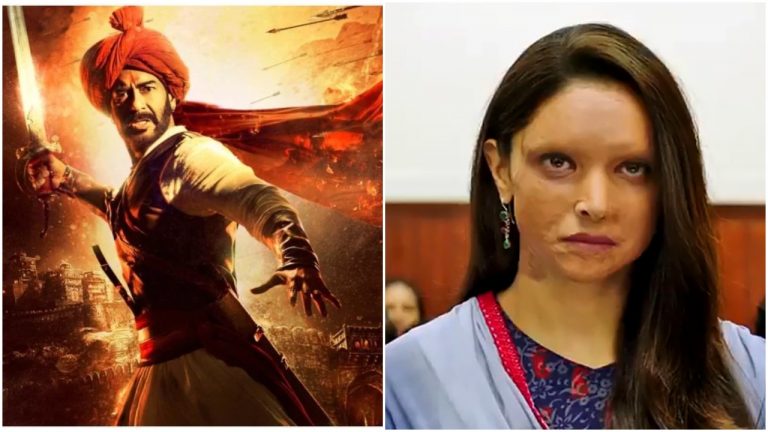
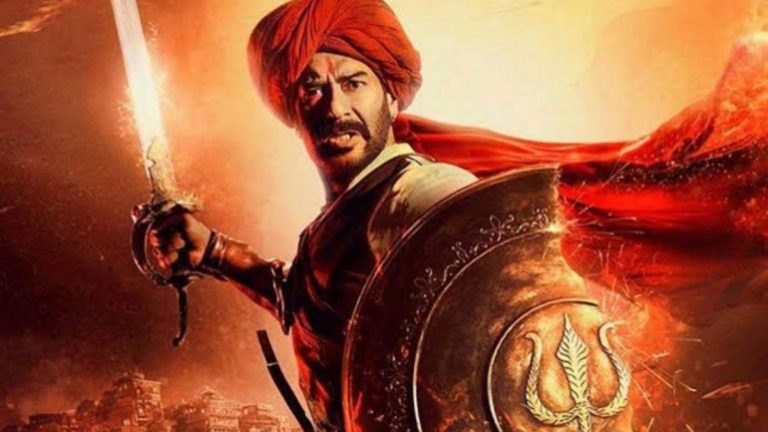
Bollywood entertainer Deepika Padukone’s Chhapaak and Ajay Devgn’s historical thriller Tanhaji: The Unsung Warrior went head-to-head at the box office on Friday. As per a Boxofficeindia report, Tanhaji has scored big on the first day of its release while Chhapaak despite the PR stunt faltered at the box office.
Reportedly, Tanhaji – The Unsung Warrior starring legendary actor Ajay Devgn has done well on day one at the box office as it has collected in the Rs 16 crore on an opening day.
However, Chhapaak – the film starring Deepika Padukone, has faltered on day one itself as compared to Tanhaji. Chhapaak managed to rope in merely Rs 4.75 crore on day one.
Interestingly, despite all the PR stunt by Deepika Padukone and her associates on Wednesday and an active backing by Congress-ruled states with making the movie tax free, the movie has failed to impress the audience. In fact, Congress workers had distributed free tickers in Bhopal, Madhya Pradesh in support of the movie.
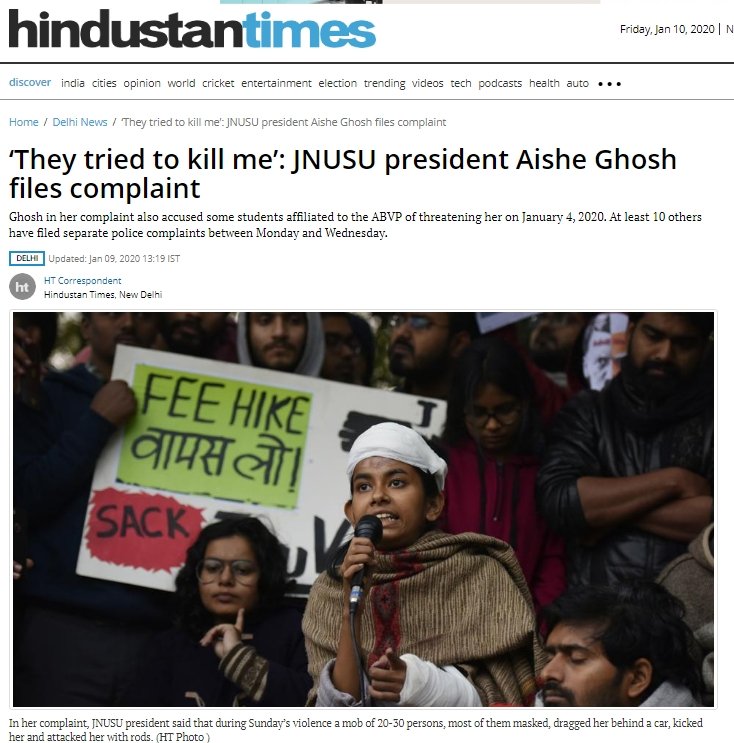
The Deepika Padukone starrer Bollywood movie “Chhapaak” has found itself surrounded in controversy after Bollywood entertainer Deepika Padukone did a PR stunt on Wednesday by visiting JNU campus to promote her new movie.
Deepika Padukone had stood in support of left-wing students who had unleashed violence on students who were registering for the winter semester and took over the server room and made it dysfunctional.
Padukone, to show her solidarity with the students, had chosen to meet accused Aishe Ghosh and her friends while ignoring the real victims who were beaten up by the leftist goons during the registration process.
India Today channel on the 10th of January 2020 aired a sting operation that they called a stupendous work of investigative journalism. The sting operation by India Today was to do with the JNU violence that had erupted in the campus on the intervening days and nights of 3rd, 4th and 5th of January. In the sting operation, India Today claimed to unmask 2 ABVP activists who had supposedly indulged in retaliatory violence on the 5th in the Sabarmati hostel after they said that the Leftists had attacked the Periyar hostel. It now appears that India Today tried to pass off a JNUSU activist as an ABVP member simply to further a narrative.
The sting operation was aired by India Today right after the Delhi police had held a press conference and implicated several Left students, including the JNUSU president Aishe Ghosh as suspects in the JNU violence.
During the airing of the sting operation, ABVP had come out to issue a statement saying that Akshat Awasthi, the man being identified as an ABVP activist is not associated with ABVP in any manner. To this, Rahul Kanwal had claimed that he has proof of Akshat attending an ABVP rally. Though this was a flimsy reason to associate someone with a political outfit since thousands of unrelated and unconnected people might turn up for a political event, Kanwal stuck to his guns.
After the sting operation was aired, Rahul Kanwal took to Twitter to publish the “proof” of Akshat Awasthi attending an “ABVP rally”.
Akshat Awasthi now says he’s ‘not in any way associated with the ABVP.’ Here he is on the front page of national newspapers at an ABVP rally. Go on. Zoom in. He’s the one holding the tricolour. #JNUTapes Weak defences won’t fly. pic.twitter.com/dQESc9fkzP
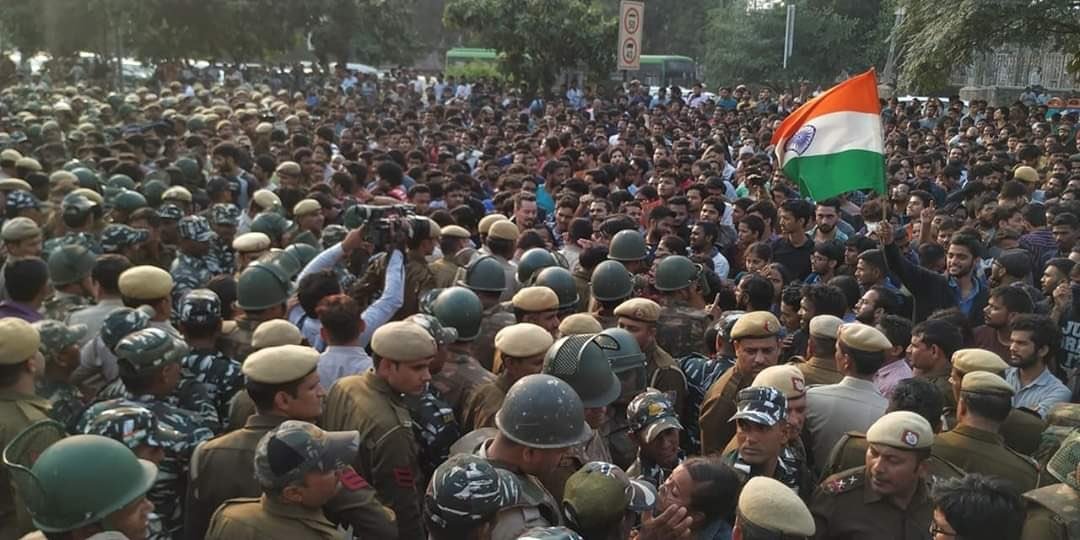
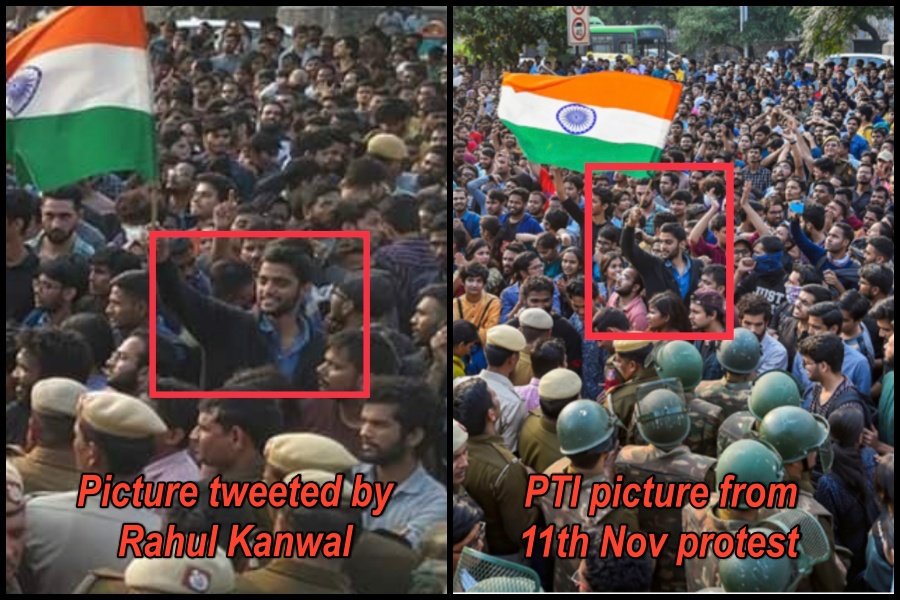
Rahul Kanwal claimed that though Akshat Awasthi has now changed his stance and said that he is in no way associated with the ABVP, there is a photo of him at an ABVP rally holding the Indian flag. The picture he offered as proof is as follows.
Picture shared by Rahul Kanwal as proof of Akshat Awasthi attending an “ABVP rally”
According to Rahul Kanwal, the man in the picture holding the Indian flag is Akshat Awasthi and this is an ABVP rally.
First, to ensure that we have the right information, we tried to search other publications that had used with the very picture and the picture credits thereof. This was done to ascertain whether this was an ABVP rally and what the rally was about.
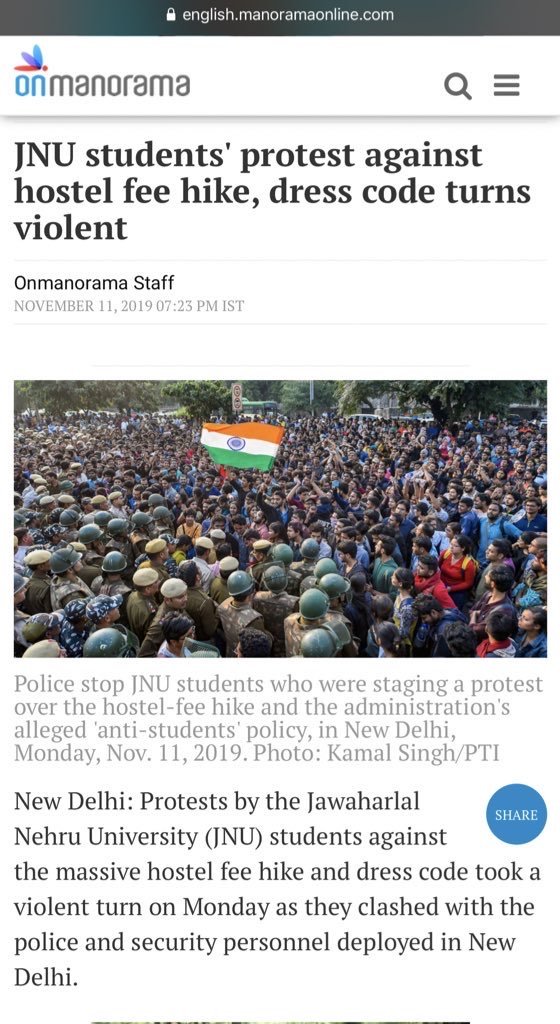
The picture used by Manorama says that the picture is from the 11th of November 2019 when the police stopped JNU students who were staging a protest over the hostel fee-hike issue. The picture was taken by Kamal Singh of PTI.
To confirm it is indeed the same picture, we tried to spot Akshat in both.
The picture tweeted by Rahul Kanwal, PTI picture of 11th November protests
We had now established that the rally Rahul Kanwal was calling an ‘ABVP rally’ was held on 11th November 2019 in protest against the JNU hostel fee-hike issue.
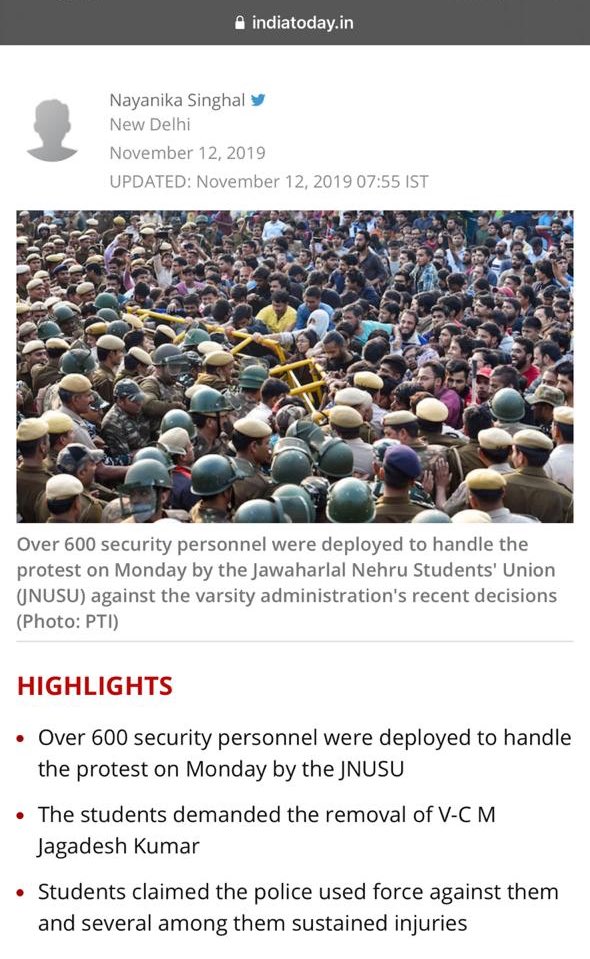
We found a corresponding article on India Today itself about the 11th November protest which Rahul Kanwal and India Today have now claimed was an ABVP rally.
India Today article from 12th November
The India Today article, in its first paragraph, said, “Shouting slogans and raising banners, thousands of Jawaharlal Nehru University (JNU) students clashed with police on Monday as their protest over steep fee hike escalated. The students of the varsity, which has seen several such agitations in the recent years, were protesting outside the All India Council of Technical Education (AICTE) premises, the venue for the varsity’s third convocation, which was addressed by Vice President M Venkaiah Naidu”.
We had now established that the protest on 11th November was one outside the AICTE, the venue for JNU’s third convocation, which was addressed by Vice President Venkataiah Naidu. In fact, during this protest, HRD Minister Ramesh Pokhriyal ‘Nishank’ was also stranded for over six hours at the venue of the varsity’s convocation.
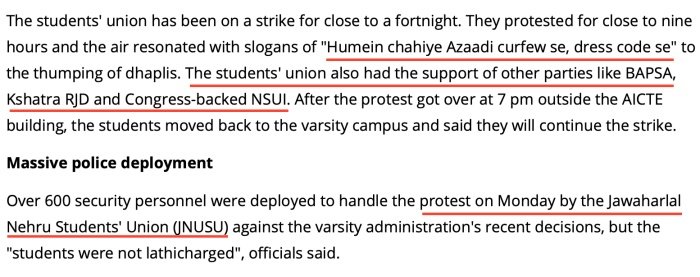
The India Today article in the question itself spoke about who organised the protest and the other parties that were supporting the protest.
India Today article
The India Today article mentions that the 11th November protests were organised by JNUSU. The current President of JNUSU is Aishe Ghosh, who has been named by the Dehli police as a suspect in the JNU violence and is from Leftist organisation SFI.
This protest was in turn supported by parties like BAPSA (Birsa Ambedkar Phule Students’ Association), Kshatra RJD (the student wing of RJD, Lalu’s party) and Congress’ NSUI.
The chants in the protest were ‘Humein Chahiye Azadi”.
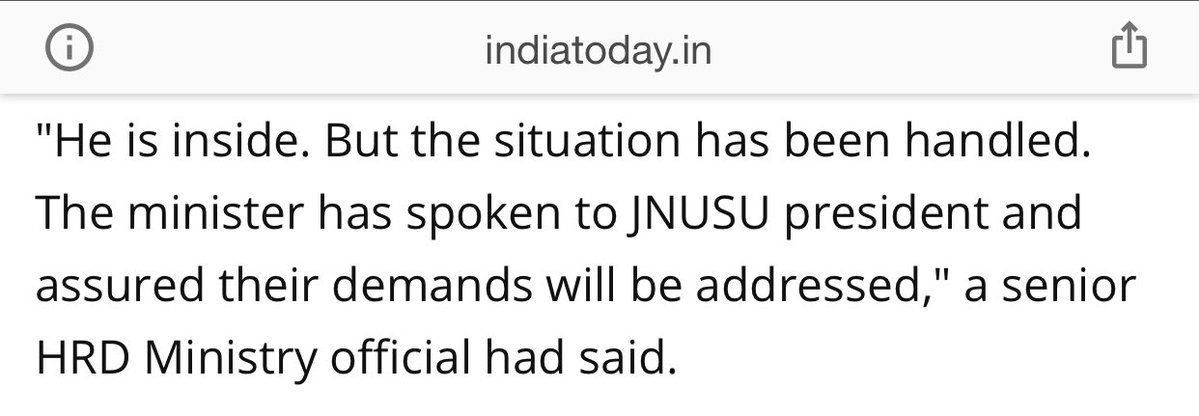
Further, the India Today article says, that the situation, of the minister being stuck in the AICTE premises, was only brought under control after the HRD minister spoke to the JNUSU president (Aishe Ghosh).
India Today article
The India Today article itself does not mention ABVP even once.
Here is a video report by the India Today about the JNUSU protest outside AICTE on 11th November 2019.
Here’s video of your channel from the day of protest. Channel shows Aishe Ghosh speaking, SFI’s Soori at the protest.
Do you have any shame @rahulkanwal before calling it ABVP rally?
Interestingly, there is no mention of ABVP even in the video report.
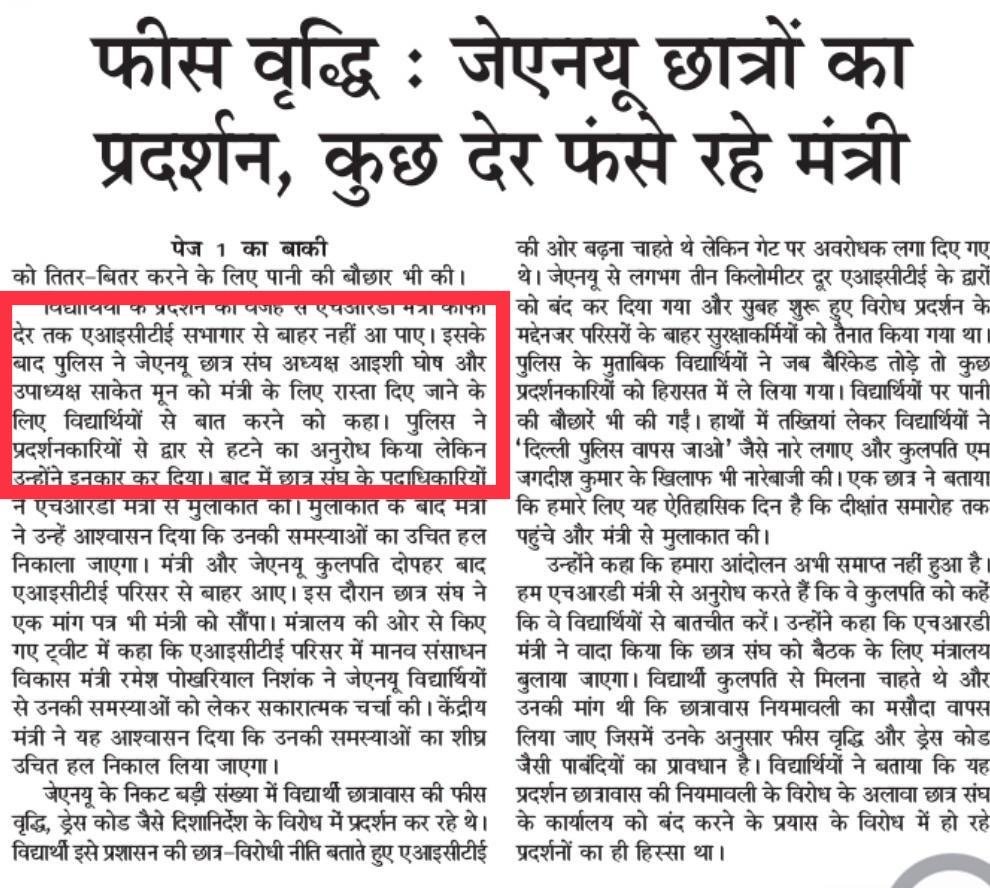
The fact that this was not a protest by ABVP or an “ABVP rally” as claimed by Rahul Kanwal is further proved by the fact that even the second page of the Jansatta article shared by Rahul Kanwal mentions Aishe Ghosh and JNUSU, but not ABVP.
Jansatta article
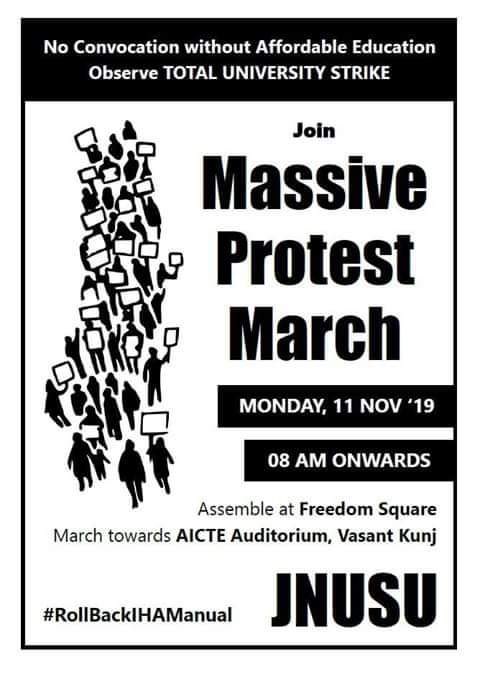
OpIndia also acquired the JNUSU pamphlet of the 11th November protest.
Pamphlet of JNUSU protest on 11th November 2019
Thus, by every account, the “proof” shared by Rahul Kanwal does not hold. The protest march, which is being claimed as an “ABVP rally” by Rahul Kanwal of India Today was clearly a protest by JNUSU, dominated by the Left and supported by other Left organisations including the Congress’ student wing NSUI. Thus, it is only reasonable to assume that Akshat Awasthi was a JNUSU activist at the very least and not an ABVP member.
This begs several important questions that Rahul Kanwal and India Today must answer:
1. If India Today’s had only this to prove that Akshat Awasthi was an ABVP member, how was this sting operation allowed to air?
2. Even after the Delhi police had categorically named the initial suspects, India Today aired this clearly erroneous sting operation and went on to question the credibility of the Delhi police. Will India Today now apologise?
3. What was the motive behind India Today deliberately trying to pass off what looks like a Left student activist as an ABVP member who was involved in the JNU violence?
4. Who is this first-year student who seems to have clearly lied on camera when he said that he had organised the violence in Sabarmati hostel and called several ABVP activists?
5. Is there an ulterior motive of muddying the water as far as the JNU violence investigation is concerned in order to shield Left parties?
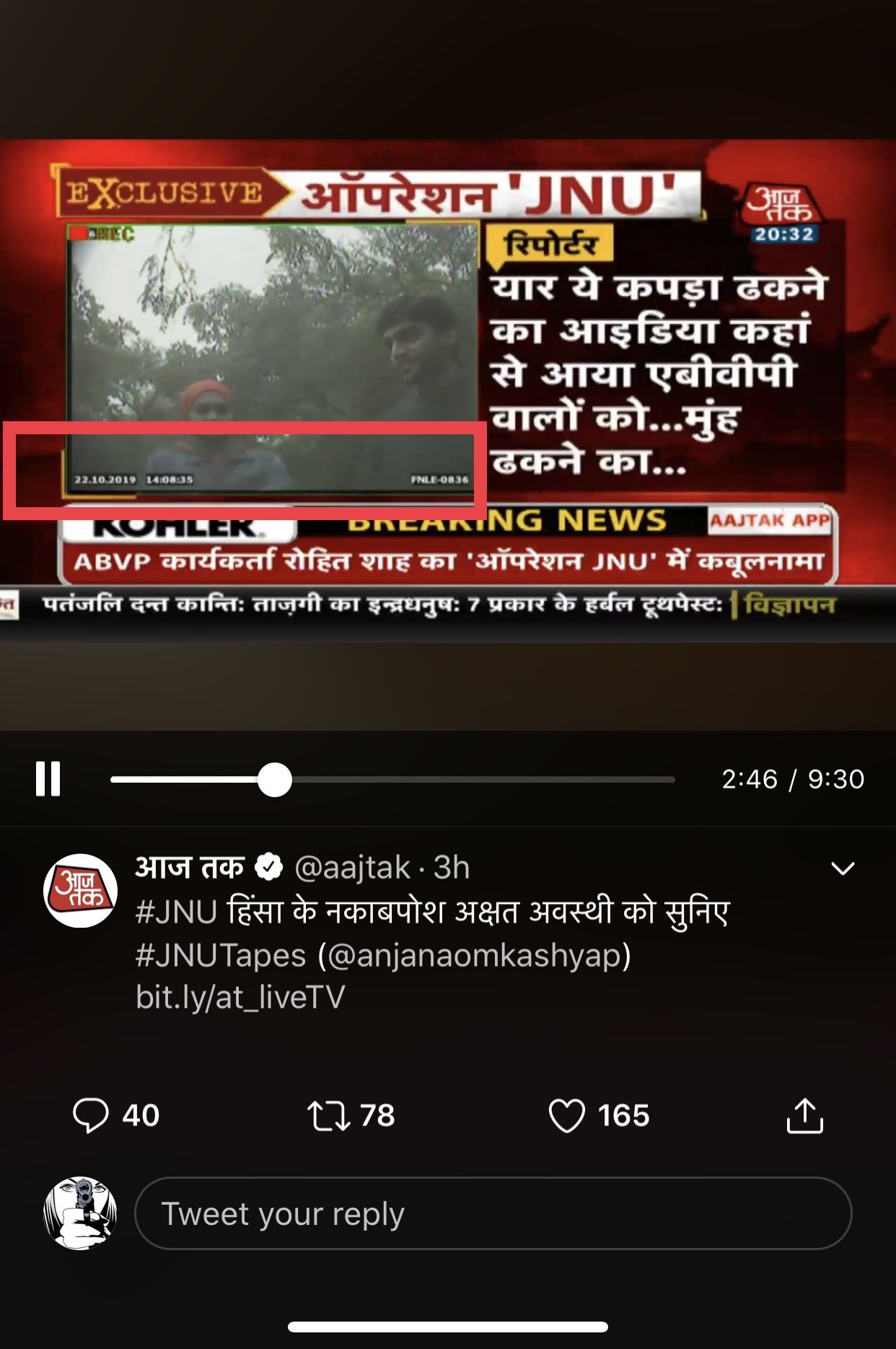
The questions only grow stronger after this one shocking aspect that came to light. While the excess of graphics in India Today hid the timestamp, on Aaj Tak, in the second segment of Akshat Awasthi speaking, a strange timestamp is revealed.
Screengrab from the video uploaded by Aaj Tak
The timestamp that is on the second segment of the video showing Akshat Awasthi shockingly has the date stamped as 22nd October 2019. The violence in JNU happened on 5th January 2020.
In this segment, Akshat Awasthi was making generic statements about how ABVP activists got the idea of masking their face, Interestingly, there were no details specific to the 5th January violence were revealed by Akshat Awasthi in this segment.
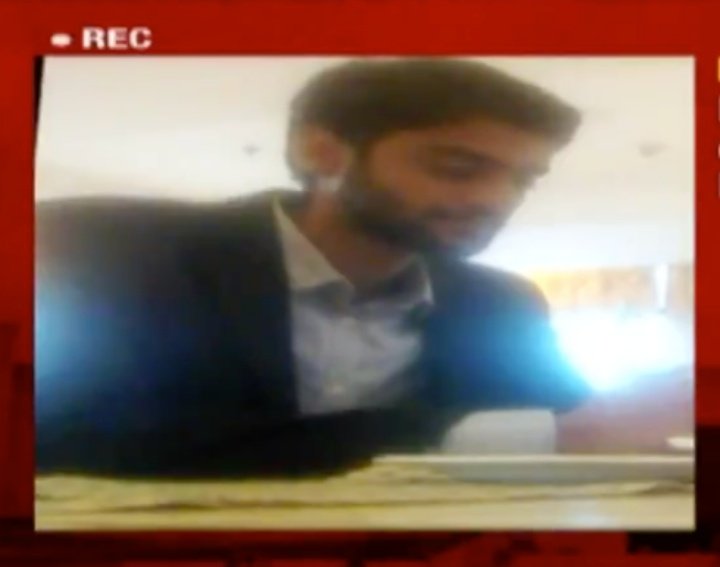
The specific details of the attack on Sabarmati hostel and Periyar hostel were only revealed in the first segment of the India Today sting on JNU violence where Akshat is wearing a blue blazer and sitting supposedly in the canteen.
While this could possibly be a technical glitch, with the credibility of India Today being extremely low with respect to this sting operation, there are certain questions that the channel and Rahul Kanwal must answer:
1. Was this segment indeed recorded in October?
2. If this segment was recorded in October, was there some sort of conspiracy by the investigators of India Today to implicate ABVP falsely and that plan was postponed till yesterday?
3. If this was a technical glitch, why was a disclaimer not added either in India Today or Aaj Tak?
There are several questions that India Today must answer about its JNU sting operation and explain why they tried to pass off what looks like a Left student as an ABVP student even after Delhi police made those revelations implicating the Left for JNU violence.
We did our job as journalists. @DelhiPolice Commissioner Mr Amulya Patnaik you should, at least now, do yours. Without fear or favour. Show some spine. Goodnight. See you all tomorrow. Jai Hind.
Tweets of grandstanding where Rahul Kanwal alleges that his channel did their job without “fear or favour” does not hold water as far as the India Today sting on JNU violence is concerned and to tarnish the image of Delhi police based on a shoddy investigation ridden with lies does not bode well for the channel or Rahul Kanwal either.
Update: OpIndia reached out to India Today journalist Rahul Kanwal to get a comment on this fact-check. Rahul Kanwal said, “We do not speak to other publications so I won’t be able to comment”.
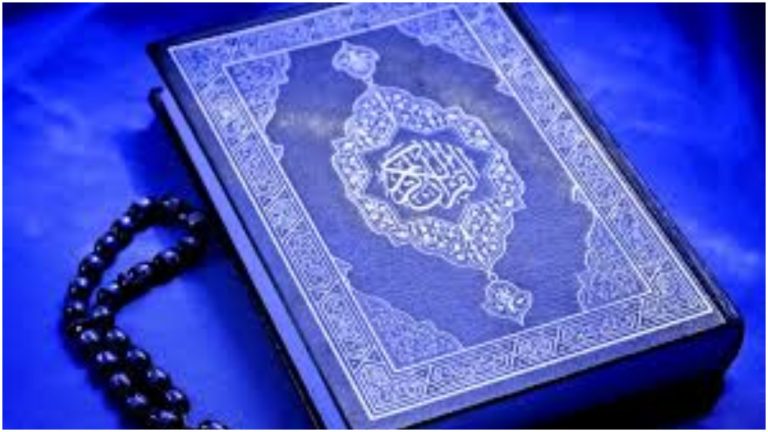
Twenty-five tonnes of Quran will be auctioned at International Trans-shipment Container Terminal at Vallarpadom in Kerala’s Kochi after the importer said they are unable to pay the import duty to clear the consignment. The consignment described as “unclaimed and uncleared” imported goods are being auctioned on January 21.
According to the reports, the consignment containing thousands of Qurans had landed at the Vallarpadam International Container Transhipment Terminal (ICTT) six months ago. The holy books believed to be printed in state-of-the-art presses abroad had been lying unclaimed in the Trans-shipment Container Terminal for the last six months.
The books were imported by an Arabic College in Malappuram, and they have expressed their inability to clear the consignment saying that the import duty be paid for the books is too high.
Abdul Salam IP, principal of Darul Uloom Arabic College, Vazhakkad in Malappuram, said that the college had imported the books from Saudi Arabia for free distribution to economically weak believers. He said that the import duty asked for the consignment is too high and that’s they are not accepting it.
“When we went to accept the consignment, we were asked to pay around Rs 8 lakh as Customs duty for releasing the consignment. We didn’t have that much money and we decided not to accept it. Later the Customs agent informed the unclaimed consignment would be auctioned,” he said.
Salam also informed that he had requested the consignment to be sent back to Saudi Arabia, but he was informed that for that the return freight charges will have to be paid. After that, he gave a letter to the terminal authorities to auction the books saying that the college is unable to pay the duty of Rs 8 lakh. He said that the books were sent free of cost from Saudi Arabia after he informed a contact in the Gulf country that a lot of books in his college neighbourhood were lost in the 2018 Kerala floods.
As the College has refused to take the Qurans, MIV Logistics Pvt Ltd has issued a notice to auction the consignment. The logistics company said that they decided to auction the books after getting a go-ahead from the customs department. The company has been holding the consignment in their warehouse for the last several months after it landed in India.
Officials of MIV Logistics said that the consignment doesn’t come under any relaxation category and the importer needs to pay the duty as it has to come with a bill of entry. He added that all imported goods have to go through computerised Indian Customs EDI system which automatically fixes the duty as per the tariff entry of the good.
A committee of evaluators under the Customs has fixed Rs 1 lakh as the base price for auction of the consignment. The company has received a few enquires about the auction and the e-auction will take place on January 21.
Tanhaji star Ajay Devgn, who has until now refrained from rushing to make a statement on the JNU violence saga, has said that one should wait for proper facts to emerge before commenting on the issue.
I have always maintained that we should wait for proper facts to emerge.
I appeal to everyone- let us further the spirit of peace and brotherhood, not derail it either consciously or carelessly #JNUViolence
Issuing an appeal for maintaining peace, Devgn said, “Let us further the spirit of peace and brotherhood, not derail it either consciously or carelessly.”
Today, the Delhi Police’s investigation vindicated Devgn’s stand who had earlier claimed that he couldn’t comment on the issue as contradictory accounts of the incident were being reported. The Delhi Police on Friday addressed a press conference and accused left-wing students of instigating violence in the Jawaharlal University (JNU). Nine suspects have been identified as attackers in the JNU attack case, 7 of whom belong to four Left organisations SFI, AISA, AISF and DFI.
Earlier, the Bollywood actor, known for his measured demeanour, had said that he is not in the position to comment on the JNU violence incident as news reports were giving conflicting accounts of the incident. “It is very conflicting. Till now we are not sure who are the perpetrators. So I don’t know how to comment until this is clear. All that is happening in JNU is very sad,” Devgn said.
Devgn had condemned the violence that took place in the university on Sunday evening when masked goons barged into the university premises and attacked the students who were filling the who were registering for the winter semester and took over the server room and made it dysfunctional.
“Why it is happening or who is doing it? What is the agenda behind it? Till we don’t know we have to keep quiet. If people think that it is complicit, then it is stupid. We cannot add fuel to fire,” Devgn said.
However, Devgn’s restrained response over the incident did not sit well with the left-leaning intellectuals who directed their ire against him for remaining guarded in his response against the JNU violence and not toeing their agenda against the Central Government.
Another Bollywood actor Deepika Padukone, who had made her political affiliations clear back in 2011, was hailed by the liberal coterie for visiting the JNU campus. However, Padukone visited the JNU as a part of a PR stunt for her upcoming film-Chhapaak. She displayed her solidarity with the students, chose to meet Aishe Ghosh and her friends while the ones who were the victim of the violence during the registration process were ignored.
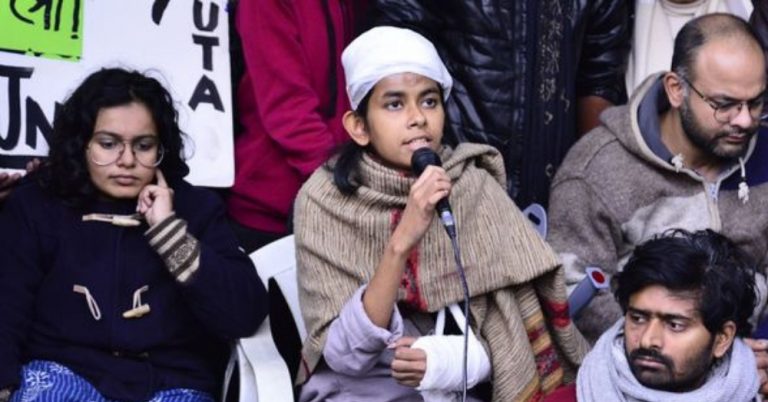
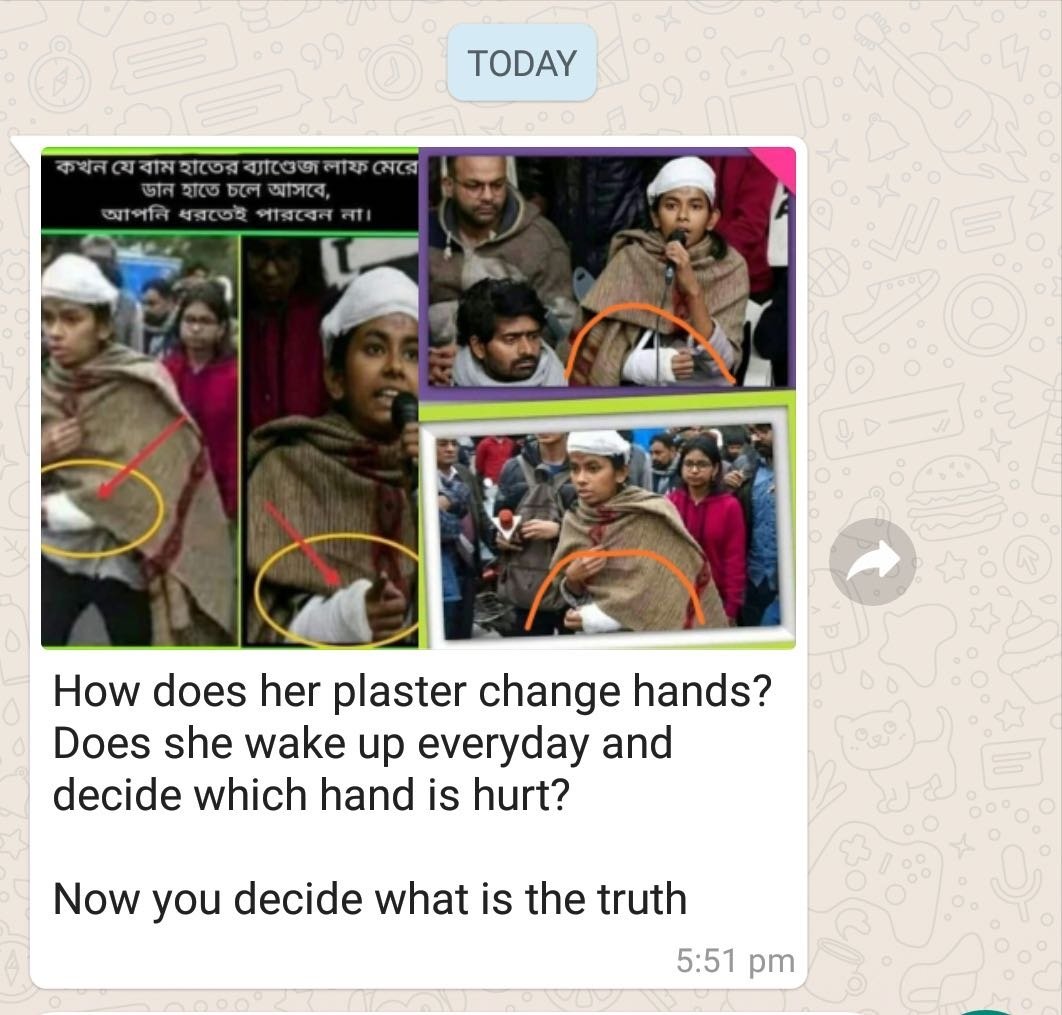
On a day when Delhi police named JNU Students’ Union president Aishe Ghosh as part of the mob that had attacked students and vandalised property in the university campus, messages have been circulating in social media that the injury on her hand is fake as it is seen switching hands in different images.
The following message has gone viral on WhatsApp, claiming with photos that seems to show that the plaster on her hand swithces hands. In some pictures the plaster is seen on her left hand, while in the others it is on her right hand. The message wonders if Aishe Ghosh wake up every morning and decide which hand is hurt.
The message ends with “no you decide what is the truth”, implying that Aishe Ghosh is faking her injury. These images are also being circulated on Twitter, accusing that her injured hand is not consistent.
Is it true that the left-wing student’s union leader is wearing her plaster on different hands on different occasions? We looked at various photographs of various events she had attended after the January 5 incident when she was injured, and it seems mirror images of actual photographs are being used to spread misinformation against her. All photographs published by media show that Aishe’s left hand has plaster, which means that the photographs showing the plaster on her right hand are flipped.
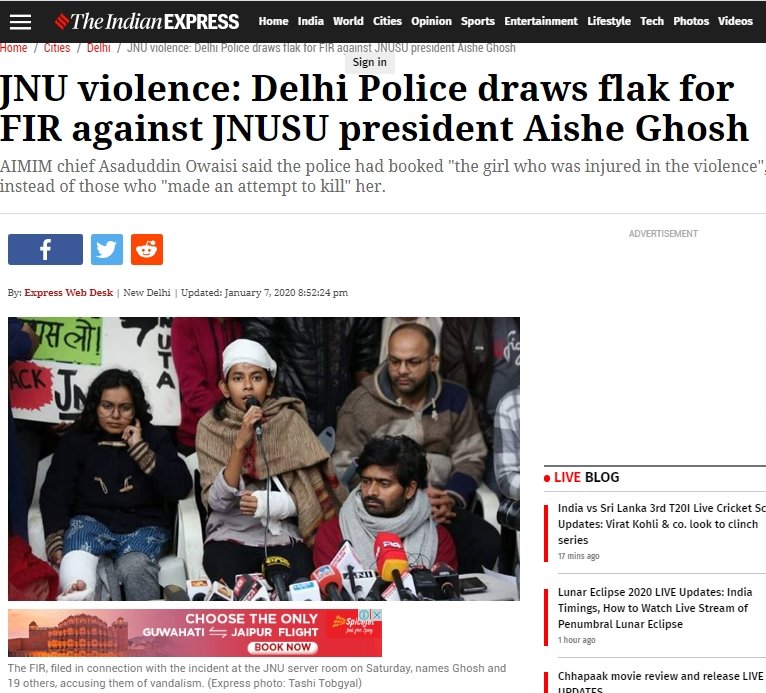
The following photograph was taken by Indian Express and published in a report on January 7. We can see that this image has been flipped vertically to create the top left image in the WhatsApp message to claim that the plaster is on her right hand. The image has also been cropped to remove the text in posters and media microphones, so that it can’t be caught that it is actually a mirror image.
Screenshot of Indian Express report
Similarly, the second image from left is also a mirror image, as it is from the same event where the above Indian Express photo was taken. This image was created by vertically flipping the following photograph taken by Hindustan Times, which was also cropped to remove the poster behind Aishe.
Screenshot of Hindustan Times report
Moreover, there are multiple videos of Aishe Ghosh talking to media, along with the press conference from where the above pictures were taken, and all such videos show that her left hand is injured and the plaster is on that hand only.
Therefore, it can be the concluded the viral messages claiming that Aishe Ghosh wears her plaster on a different hand on different days is wrong and it is based on fake images created by flipping the actual photographs.
Aishe Ghosh was injured on 5 January when unknown masked goons had launched an attack on several hostels in attack. The attacks were preceded by large scale violence by left-wing students attempting to boycott classes in protest against fee hike in the university. JNU administration and police have alleged that left-wing groups, where Aishe Ghosh was also involved, had physically attacked students and prevented them from registering for the winter semester to enforce the boycott.
They had also vandalised the university server room and disabled Wi-Fi in the campus, preventing students from registering online. Aishe was one of the named in FIR filed for vandalising the server room. Several students and ABVP leaders were injured in the attack by left-wing groups. Later in the day, some left-wing leader also attacked in an apparent retaliation by some masked goons, and Aishe was injured in that attack.
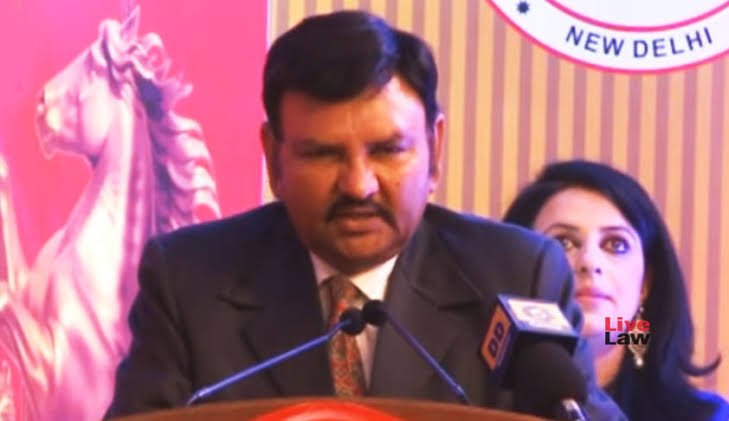
Arrested in judicial corruption case in September 2017, the former Odisha High Court judge IM Quddusi and his associates used code words such as Ped(plant), Gamla(pot), Saaman(goods) and Prasad(offering) while talking about the bribes that were allegedly paid to a certain “captain” in lieu of a favourable order from the Supreme Court, the Central Bureau of Investigation (CBI) has said in its charge sheet in the case.
As per a report by Hindustan Times, the charge-sheet which was filed by the agency in July last year named Quddusi along with several others alleged to be involved in the case. The charge-sheet mentioned Biswanath Agarwala, an Odisha businessman who allegedly claimed to have high contacts in the judiciary; and five others, Bhawna Pandey, Sudhir Giri, Ram Dev Saraswat, and owners and top functionaries of Prasad Educational Trust, BP Yadav and Palash Yadav.
According to the agency, the Yadavs Were seeking relief from the judiciary after being proscribed by the Medical Council of India from providing admission to the students in their Lucknow-based college, Prasad Institute of Medical Sciences, in the academic years 2017-18 and 2018-19 after allegations of wrongdoings surfaced against it.
In the charge-sheet accessed by Hindustan Times, the CBI has reportedly provided 80 telephone intercepts of Quddusi and his associates which, as per the agency, completely unravels the conspiracy. It claims that Giri, BP Yadav and Agarwala had a meeting with Quddusi at the latter’s residence on August 23, 2017, and just two days later, the Allahabad HC division bench that included Shri Narayan Shukla gave an interim order putting a stay on the college’s delisting until next hearing.
However, undeterred by the Allahabad HC verdict, the Medical Council of India approached the Supreme Court against the order. Meanwhile, Quddusi and Pandey assured BP Yadav that they will get his work done in the apex court, the charge-sheet mentions.
The CBI then filed a fresh case against Justice Shukla for allegedly accepting a bribe to pass an order in favour of the Prasad Medical College. In 2018, taking cognisance of the case, the Chief Justice of India, Dipak Mishra, had asked Justice Shukla to either resign or seek voluntary retirement. However, Shukla passed up CJI’s advice, following which the CJI asked the Chief Justice of Allahabad High Court not to assign him any judicial work.
The charge-sheet further mentions that the ex-judge Quddusi chewed over the bribe amount with Agarwala which was finalised at 3 crores, with approximately 2.5 crores going to the “captain”.Agarwala says to Quddusi: “….Abhi jo hamara captain hai na, Unka all over India hai, jo bhi kaam ho karne k elite tayyar hai (Our Captain hold’s sway across the entire country now. We can get work done anywhere).”
At one point, the charge sheet mentions that Agarwala stated to BP Yadav, “The government of the Chaiwala (tea-seller, referring to PM Modi), is keeping an eye over everyone, so the ‘captain’ will not meet anyone directly, but the work will be done if you pay the money.
As per charge sheet, Quddusi was working at the behest of the Yadavs and it was Agarwala’s remit to get a favourable order from the Supreme Court.
As per reports, the accused used te code word ‘Mandir’ for the SC or HC. At one point, they discuss a hawala transaction where Agarwala was asked to collect money from a Hawala operator at Chandni Chowk by mentioning the code word ‘ten rupees note’.
The violence in JNU that peaked on Sunday, the 5th of January had been in process since October 2019. The Delhi police today held a press conference and exposed how mostly the Left students were involved in the violence in JNU. The Delhi police revealed names of 9 suspects and 4 Left organisations. The 9 suspect list included Leftist JNUSU President Aishe Ghosh and 2 alleged ABVP students. However, India Today, after the Delhi Police press conference started airing their own ‘investigation’ of the JNU violence, the first two parts of which implicated 2 ABVP students.
The IndiaToday sting claimed that the person identified as an ABVP activist had orchestrated the violence in Sabarmati hostel of JNU. He had also claimed that the violence in Sabarmati hostel was in retaliation to the Left unleashed violence in Periyar hostel. Interestingly, both the alleged ABVP activists identified by India Today were first year students.
Now, the ABVP has issued a statement saying that the person identified as an ABVP member by IndiaToday is not an ABVP member at all.
Akshat Awasthi is neither an office bearer, nor a karyakarta of ABVP, as claimed by @IndiaToday. This is a smear campaign run by India Today to deviate everyone from the facts put forth by @DelhiPolice proving #LeftBehindJNUVoilence.
Nidhi Tripathi, the National General Secretary of ABVP said, “Akshat Awasthi is neither an office bearer, nor a karyakarta of ABVP, as claimed by IndiaToday. This is a smear campaign run by India Today to deviate everyone from the facts put forth by Delhi Police”.
After 5 days of violence, the Delhi Police on Friday addressed a press conference and accused left-wing students of instigating violence in the Jawaharlal University (JNU). Nine suspects have been identified as attackers in the JNU attack case, 7 of whom belong to four Left organisations SFI, AISA, AISF and DFI.
Addressing a press conference, the Delhi Police has identified some masked men who had vandalised property and beaten up students on the JNU campus on January 5. The Delhi police said that on January 3, Students’ Federation of India, All India Students’ Federation (AISF), All India Students’ Association (AISA) and Democratic Students’ Federation (DFI) destroyed the server and due to this registrations were halted.
The 93rd edition of the Akhil Bharatiya Marathi Sahitya Sammelan is being held in Maharashtra’s Osmanabad from 10th to 12th of January this year.
There have been some concerning developments in the ongoing event. Initially, the media outlet Mumbai Tarun Bharat (MTB) had published reports critical of the president of the current Sammelan, a Catholic priest named Father Francis D’Britto.
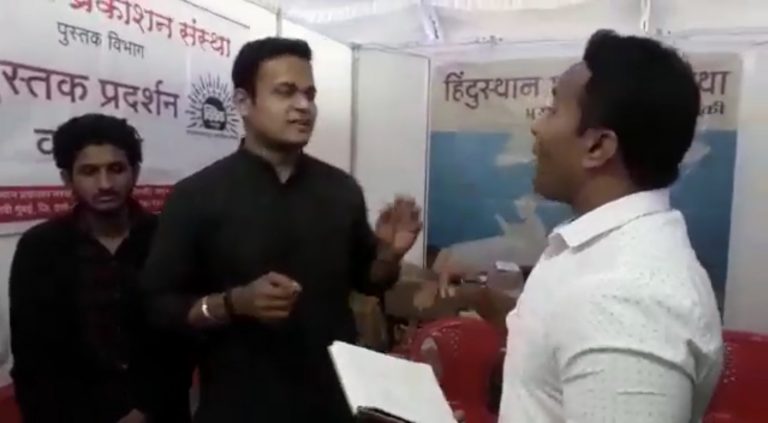
In the latest incident, Somesh Kolge, a journalist with the Marathi vernacular daily-Tarun Bharat has claimed that the Osmanabad police officials tried to arrest him from the Marathi Sahitya Sammelan event held in the town.
According to Kolge, who was at the stall ‘Mumbai Tarun Bharat’ representing his organisation Tarun Bharat, PSI Mane tried to take him away from the stall on the pretext of seeking information about him. However, Kolge resisted Mane’s attempts and asked him to search whatever he wants to at the bookstall.
Interestingly, Mumbai Tarun Bharat had earlier asked questions to Fr D’Britto about his stand on forced conversions and various other issues. They had also published an ‘open letter’ to the priest asking him to clarify some issues.
A video has now emerged wherein Kolge can be seen asking PSI Mane why he was being asked to accompany him for questioning and not questioned at the stall itself. Conscious of the video being shot, Mane appeared placatory in claiming that he was simply seeking information about everyone who has participated in the Sammelan and had no other objective to approach Kolge.
“You asked me to come along with you. You told me I’m PSI Mane and you will have to come with me. I’m a journalist,” Kolge can be seen in the video saying this to PSI Mane. Even the bystanders in the video corroborated Kolge’s assertions that PSI Mane was trying to forcibly take him away.
However, Mane refuted the allegations in the video claiming that he was simply trying to obtain information about people who have participated in the event and asserted that he plans to do the same for other stalls at the Sammelan as well.
In the meantime, the Deputy Superintendent of Police, Motichand Rathod, visited the stall. He was accompanied by PSI Mane and other police personnel. Rathod sought information on the books being sold at the stall and then bought some of them.
Earlier, a man was beaten up and his head shaved up for making critical remarks against the chief minister Uddhav Thackeray. Shiv Sena supporters first reportedly beat him up and then forced him to get his head shaved. Reportedly, the post criticised Thackeray for comparing the action against Jamia Nagar rioters with that of Jallianwala Bagh massacre of 1919.
After 5 days of violence, the Delhi Police on Friday addressed a press conference and accused left-wing students of instigating violence in the Jawaharlal University (JNU). Nine suspects have been identified as attackers in the JNU attack case, 7 of whom belong to four Left organisations SFI, AISA, AISF and DFI.
Addressing a press conference, the Delhi Police has identified some masked men who had vandalised property and beaten up students on the JNU campus on January 5. The Delhi police said that on January 3, Students’ Federation of India, All India Students’ Federation (AISF), All India Students’ Association (AISA) and Democratic Students’ Federation (DFI) destroyed the server and due to this registrations were halted.
“Between 1st to 5th, JNU decided to do registration online for the winter semester. AISA, AISF, SFI, DSF members were against registration. They have been protesting since October 28,” said Delhi police. It is being reported that out of the 9 suspects, 2 belong to ABVP.
Image Source: Twitter
A large majority of students wanted to register but some members of these students’ organisations did not want these students to co-operate with the process, said Joy Tirkey, SIT head while addressing the media.
The Delhi police presented several pieces of evidence to show that how some masked miscreants allegedly belonging to left-wing groups, who had broken glass door and damaged server room.
The police also said specific rooms in JNU’s Periyar hostel were targeted. Interestingly, most of the injured students of the Periyar hostel were from ABVP.
Three cases have been registered till now, and they are being investigated by the Delhi police. However, none of the nine accused has been detained. The Delhi police have now decided to issue a notice to all the accused.
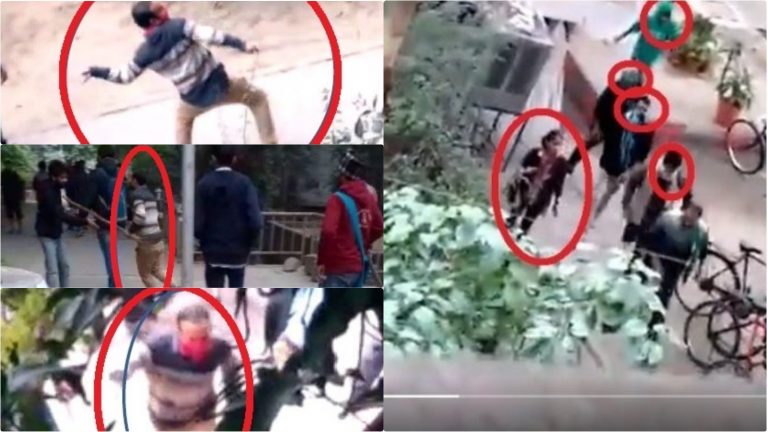
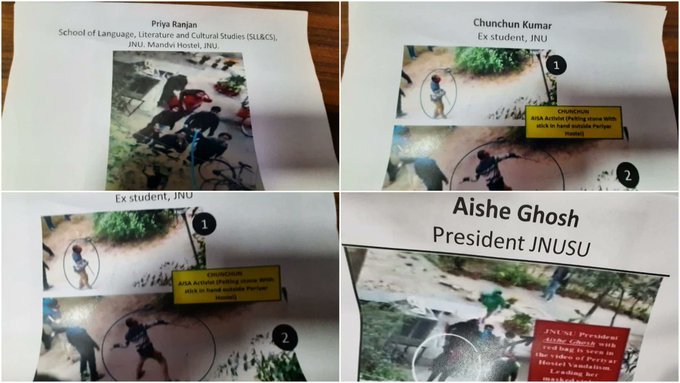
The Delhi Police also released the pictures in JNU violence and identified JNUSU President Aishe Ghosh and some former students as the accused behind the JNU violence.
Former JNU student Chunchun Kumar, Pankaj Mishra, Sucheta Talukdar, Priya Ranjan, Bikash Patel, Dolan Sawan, Yogendra Bhardwaj have been identified as the eight others accused in the JNU violence.
Yogendra Bhardwaj has also been identified as the admin of ‘Unity against left’ Whatsapp group, which allegedly incited violence before the violence in the JNU campus.
Delhi Police PRO MS Randhawa said the investigation is still on and assured that there will be many in the future to provide further details.
Yoga guru Baba Ramdev has welcomed the decision of union government restricting the import of refined palm oil. He congratulated prime minister Narendra Modi and Commerce & Industries minister Piyush Goyal for taking such an important decision. In a video message issued on Social Media, the Patanjali group promoter said that the decision will work as a revitaliser for the domestic refined oil industry.
He said that it will be beneficial for farmers, as the imported palm oil was a big concern for domestic palm plantations. Ramdev added that this will have a big impact on edible oil production in the country, which will boost self-reliance in the sector. He said that thousands of people employed in the refined oil industry had lost their jobs, and they will now get fresh opportunities for employment. Ramdev further added that this will help in boosting the GDP, and contribute towards achieving the goal of a $ 5 trillion economy.
Baba Ramdev added that he expects that the govt will take such big and tough decisins regularly.
On January 8, the Directorate General of Foreign Trade had issued a notification moving refined palm oil from free category to restricted category for imports. This change means now importers will have to obtain a licence to import refined palm oil and palmolein into the country.
India is the largest importer of palm oil, with major sources of import being Malaysia, Indonesia and Nepal. Malaysia ships the bulk of palm oil imported by India, which means this country will be most affected by the decision to restrict import of the oil. Moreover, while India imports refined palm oil from Malaysia, from Indonesia largely crude oil is imported. Therefore, although Malaysia’s export will be hit, Indonesia will benefit from the decision as there is no restriction on import of crude oil, and Indian refiners are expected to import increased amount of crude palm oil after the decision.
Due to this reason, it was widely speculated that Indian government had taken the decision in response to Malaysian Prime Minister Mahathir Mohammed criticising the Modi government over the recently enacted Citizenship Amendment Act. On 20 December, Mahathir had reportedly said, “I am sorry to see that India, which claims to be a secular state, is now taking action to deprive some Muslims of their citizenship.” He had added that CAA will lead to chaos and instability and everyone will suffer. Before that, he had commented that India had invaded and occupied Kashmir.
But the Indian government has denied the allegations saying the decision was not country-specific and said that decision to restrict refined palm oil import was a commercial decision. Foreign ministry spokesman Raveesh Kumar said, “When you are looking at issues related to the import of any product from any country there are basically two factors — one is the commercial decision and the other is defined by the trade policy.” Clarifying that import of refined palm oil has only been restricted and not banned, Kumar said, “in this case it is defined by the trade policy. There are basically three categories under which you can import items – open, restricted and prohibited. This is not under prohibited category. So why do you presume that this means imports will be stopped?”
But significantly he added that bilateral relationships between do come into play in taking business decisions. “The state of relationship is one of the factors that businesses look at before doing business,” he had said, further adding, If I am an importer and I have to import a certain product from a country, I would certainly keep that at the back of my mind, as to how the status of the two countries are.”
Commenting on relations with Malaysia, the foreign ministry spokesman said that India and Malaysia have age old ties that the Malaysian government should keep in mind while making statements. He said that India had expressed its concerns on different occasions but the Malaysian government had continued to make remarks in the same vein. India was hopeful that there would be a rethink on the matter at some stage, he added.