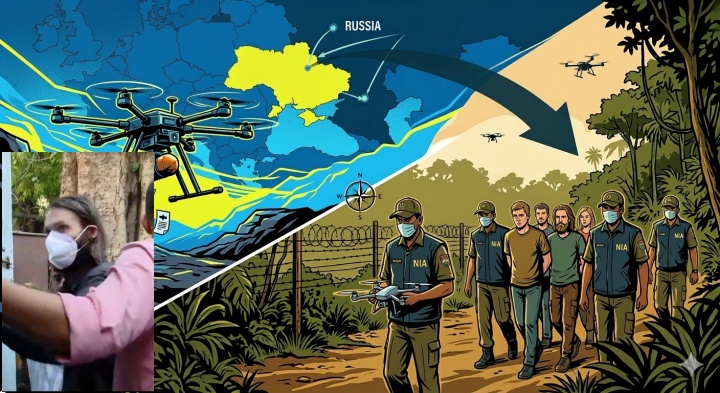
On March 13, 2026, India’s National Investigation Agency (NIA) arrested seven foreign people, six Ukrainians and one US citizen, in a major counter-terrorism operation. On March 16, a court in Delhi remanded them to NIA custody for 11 days. The group apparently entered India illegally through Mizoram’s protected border areas, then travelled to Myanmar to train with ethnic armed organisations linked to Indian insurgents in the northeast. They are also accused of carrying a huge consignment of drones from Europe, raising concerns about proxy conflict networks.
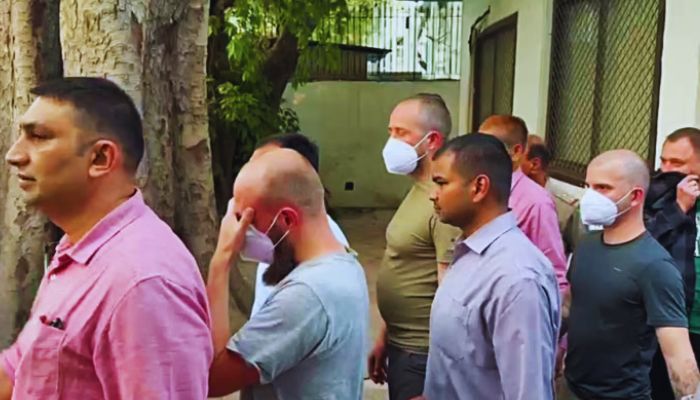
This crackdown, which coincided with ongoing NIA investigations into terror financing and insurgency affiliations, sparked speculation on social media that the American individual was Matthew VanDyke, a name that has been associated with many conflicts and insurgent groups over the years. News videos that had the visuals of NIA officials loading the arrested foreigners into a jail van had one thin, long haired individual wearing a mask. Soon, the name Matthew VanDyke was all over social media.
Is he Matthew VanDyke! A private mercenary, the one who joined Libiya rebels during Gaddafi regime in 2011??
The left pic (masked) one is a foreigner arrested by NIA for providing training to Myammar terrorist. pic.twitter.com/OiW6C8KDDQ
Not just Libya. US mercenary Van Dyke was also involved in covert operations against Venezuela, allegedly funded by Colombian drug trafficking and USAID.
How this bunch of foreigners slipped through Inner Line Permit checks in Mizoram and crossed over to Myanmar baffles me. https://t.co/OP9T6hadAA
VanDyke, the founder of Sons of Liberty International (SOLI) and an American documentary filmmaker who transformed into a self-proclaimed revolutionary fighter, personifying the blurred lines of warfare in this era. Today’s battles encompass non-state actors, private contractors, and ideological mercenaries in uncertain zones, going beyond state forces and defined borders. He has, as per his own posts, worked in the deadliest hotspots in the globe for more than ten years, including Syria and Libya, highlighting these interrelated proxy dynamics.
Soon after the news of the arrest and remand, however, the speculations were confirmed. The US national arrested was reportedly Matthew VanDyke. Media reports named the Ukrainians as Hurba Petro, Slyviak Taras, Ivan Sukmanovskyi, Stefanik Marian, Honcharuk Maksim, and Kaminskyi Viktor.
❗️RT INDIA EXCLUSIVE – NAMED: American & Ukrainian Nationals Arrested For Alleged 'Terror Training' In Myanmar
The American named, Matthew VanDyke, has appeared in at least two films – one about his activities in Libya, and another about his 'security' firm, Sons of Liberty… https://t.co/68tmeaRBtIpic.twitter.com/pf5v8mfK4z
To understand the present rumours about VanDyke, one must first examine his unusual past. VanDyke, who was born in Baltimore, Maryland, in 1981, earned a master’s degree in Security Studies from Georgetown University’s Edmund A. Walsh School of Foreign Service. He set off on a multi-year motorcycle tour across the Middle East and North Africa with the initial goal of understanding the Arab world via the lens of a camera. But the 2011 Arab Spring drastically changed his course. When the Libyan Civil War broke out, VanDyke joined the rebellion against Muammar Gaddafi in addition to filming it. After fighting alongside rebel troops, he was taken prisoner by Gaddafi’s government and held in solitary confinement for almost six months before making his way back to the front lines.
The ideological foundation for his subsequent pursuits was established by this significant shift from observer to active participant. VanDyke formed Sons of Liberty International in 2014 after his friends, American journalists James Foley and Steven Sotloff, were executed by ISIS. Operating as a licensed 501(c)(3) non-profit, SOLI is essentially a private security contracting company with a humanitarian twist o itself.
It claims to offer supplies, military training, and consulting services at no cost to “vulnerable populations” facing terrorist groups and authoritarian regimes. The Nineveh Plain Protection Units (NPU), an Assyrian Christian group battling ISIS, were trained by SOLI during its first deployments in Iraq.
However, Eastern Europe has been the focus of SOLI’s largest and most significant mission to date. VanDyke and his group made a significant shift in favour of Kyiv after Russia invaded Ukraine in 2022, and SOLI started actively training, advising, and supplying the Armed Forces of Ukraine. Their efforts quickly grew to encompass the creation of battlefield innovations, a thorough demining program to remove unexploded Russian munitions, and specialised frontline tactical instruction. According to reports, VanDyke personally joined the Ukrainian military to serve as a combat professional. From a small outfit training localised militias to a highly coordinated apparatus supporting a conventional European army against a global superpower, his organisation’s deep involvement in Ukraine showed a major evolution.
It also shows another important aspect. SOLI is doing what the Western-NATO establishment, particularly the US military interests want to be done.
VanDyke’s interactions with the US military date back years. During his early travels, he embedded with US Army units in Afghanistan, including at Forward Operating Base (FOB) Baylough, and remained in contact with soldiers he encountered there.
Digital footprints of Matthew VanDyke
The distinction between a popular figure and a covert agent is virtually nonexistent in the context of contemporary proxy warfare. Matthew VanDyke’s online presence, concentrated on his Twitter/X account (@Matt_VanDyke), functions as a digital diary of what security researchers refer to as ‘ transparency-based militancy.’ Unlike typical private military contractors, who operate in complete secrecy, VanDyke uses his platform to broadcast his missions, frequently in real time. VanDyke’s digital past is riddled with what one can consider confessional tweets where he defends violating international conventions or domestic laws in favour of what he thinks as a greater moral goal, but is often aligned with the current interests of NATO powers, especially the US military industrial complex.
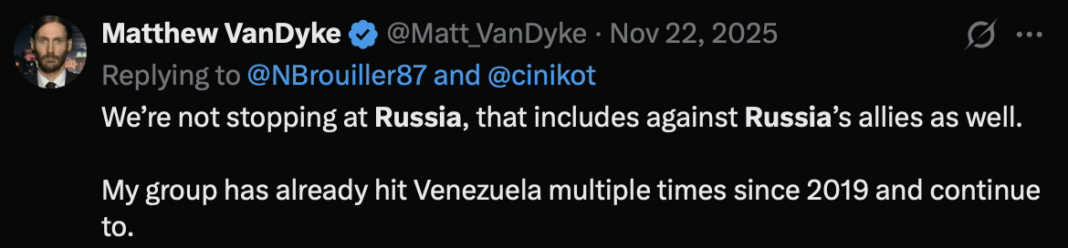
VanDyke has famously tweeted variations on his idea that as long as his squad is shooting in the right direction (against alleged dictatorships such as Russia or ISIS), the US government will look the other way. This particular style of bravado leads to assume he would attempt an unauthorised crossing into the Myanmar-India border zone. Since 2022, his feed has been filled with constant updates from Ukraine. However, by late 2025, observers noticed a shift in his rhetoric toward broadening the front against Russia’s allies.
These close ties to Ukraine are what led to the recent, very contentious event on the Indian subcontinent. On March 13, seven foreign nationals, six Ukrainians and one American, were detained by India’s top counterterrorism agency, the NIA, on suspicion of entering India illegally in order to go through neighbouring Myanmar. Authorities claim that these people were using the Indian state of Mizoram’s porous borders to smuggle European drone technology and give advanced military and terrorist training to ethnic rebel groups in Myanmar, which are currently fighting the ruling military junta in a bloody civil war.
The identity of the detainees have been kept under stringent operational secrecy by official authorities. However, profound speculation on social media has quickly filled the gap in official information. Rumours that the unidentified American is Matthew VanDyke, working with a group of Ukrainian veterans connected to his group, are rife on platforms like X (previously Twitter) and other open source intelligence (OSINT) forums. Online investigators cite VanDyke’s close logistical ties to the Ukrainian military, SOLI’s documented history of crossing borders to train anti-authoritarian rebels, and his recent public admissions of conducting covert operations in other international locations, including Venezuela.
Strategic geopolitics
It is very important to remember that this connection is still entirely speculative at this point. The names of the accused have not been made public by the NIA, and Opindia is unable to independently confirm the American’s identity. Nonetheless, the simple plausibility of the rumour, the fact that the OSINT world regards VanDyke’s involvement in Myanmar as totally in character, calls for a more in-depth investigation into why Ukrainian fighters would be operating in Southeast Asia at all. Why would Ukraine, a country engaged in a fierce battle against Russia for its own survival, want to train rebels in Myanmar?
It is notable here that the presence of Ukrainian and Ukraine war elements on the Myanmar-India border, especially for training insurgent groups in Myanmar, was raised as a concern by Mizoram CM Lalduhoma in March 2025 itself.
The answer is found in a complicated web of global alliances and asymmetric proxy warfare strategies. The Myanmar military junta, commanded by Min Aung Hlaing, is one of Putin’s most steadfast and uncritical allies. Naypyidaw fully supported Russia’s invasion of Ukraine in 2022 after the military takeover in Myanmar in 2021 cut off the junta from the West. In exchange, Moscow has been the junta’s main source of support, providing the Myanmar Air Force with Mi-38 helicopters, Su-30 flanker fighter jets, and surveillance drones, all of which have been incredibly successful against insurgent rebel groups.
For Ukraine, the conflict is no longer limited to the Donbass or Crimea, it is a global endeavour to drain Russian resources and undermine Russian allies wherever they are present. Reports have already surfaced of Ukrainian special forces fighting Russian backed Wagner mercenaries in Sudan and Syria. A move into Myanmar is an ideal fit for this global plan. Ukrainian operatives, or sympathetic American contractors deeply entwined with the Ukrainian cause, could severely interfere with a key Russian client state by providing tactical training and drone warfare expertise to Myanmar’s ethnic armed organizations (EAOs), forcing Moscow to invest more diplomatic and military capital far from the Donetsk battlefield.
For foreign operatives, India’s vast geography and neutral status may have appeared to be an excellent transit route into Myanmar’s troubled frontiers. However, the NIA’s prompt arrest of the foreign nationals sends a clear and unambiguous message, India will not allow its sovereign territory to be used as a staging ground for foreign proxy conflicts, regardless of geopolitical motives. While New Delhi may remain neutral on the global arena, it is fiercely defensive of its own security apparatus.
Conclusion
The episode of an American mercenary figure associated with Ukrainian combat forces highlights a significant shift in modern conflict. We are witnessing the globalisation of the battlefield, with American privateers and Ukrainian veterans purportedly emerging in the jungles of Myanmar to fight a proxy war against Russian interests, only to be intercepted by Indian counter-terrorism forces. VanDyke’s career, which took him from the deserts of Libya to the plains of Nineveh and finally to the trenches of Ukraine, serves as the ultimate model of mercenary fighters for this new century.
Update: The earlier version of this article has been modified slightly after the name of Matthew VanDyke was confirmed by media sources.
A recent ruling by the Bombay High Court has brought renewed attention to a contentious question: can stringent social justice laws be weaponised through repeated litigation?
In quashing a 16-year-old case against advocate and law professor Virendranath B. Tiwari, Justice Ashwin D. Bhobe did more than just dispose of a stale prosecution; he exposed a pattern that raises serious concerns about potential misuse of the SC/ST Act.
Three cases, one accused, similar allegations
At the heart of the matter lies a striking fact: this was not the first complaint Chitra Shalunkhe had filed against Tiwari. It was the third.
All three cases invoked provisions of the SC/ST Act, each stemming from broadly similar allegations. In the earlier two instances, Tiwari had already been acquitted or discharged. Yet, an FIR was registered once again, this time over a 2007 incident where Shalunkhe alleged that Tiwari questioned her qualifications for a reserved post and assaulted her.
Tiwari’s defence was direct: the complaints were retaliatory, triggered by his objections to her eligibility and academic credentials. The High Court appears to have found merit in this claim.
When law meets threshold: Court finds no offence
The Court’s reasoning was unambiguous. It held that even if the allegations were taken at face value, they failed to meet the essential ingredients required under the SC/ST Act.
There was no evidence of caste-based insult in public view. No use of casteist slur. No intimidation linked to caste identity.
This is not a procedural technicality; it goes to the very foundation of the law. The SC/ST Act is designed to address targeted, identity-based atrocities. Without that nexus, its invocation becomes legally untenable.
Even the complainant’s counsel conceded that key provisions, such as Section 3(1) (s), were not attracted due to the absence of caste-based humiliation.
Judicial recognition of “vengeance”
Perhaps the most consequential part of the judgment lies in its characterisation of the litigation pattern.
Justice Bhobe noted that initiating proceedings “for the third time” on similar grounds appeared to be “an act of vengeance aimed at causing harassment and humiliation” to the accused, a 74-year-old senior citizen.
This observation shifts the case from a mere acquittal to something more systemic: a judicial acknowledgement that legal processes themselves can be misused as instruments of pressure.
IPC charges also falter
The attempt to sustain parallel charges under the IPC, including allegations of assault and outraging modesty, also collapsed under scrutiny. The Court found that the alleged umbrella incident did not satisfy the statutory thresholds required to constitute these offences.
Additionally, the Court clarified that the amended provisions of the SC/ST Act introduced in 2016 could not be retrospectively applied to a 2007 incident, closing another avenue that had been invoked to keep the case alive.
A case study in legal overreach?
This ruling does not dilute the importance of the SC/ST Act. The law remains a critical safeguard against caste-based violence and discrimination. However, cases like this underline a parallel reality: when invoked repeatedly without meeting legal thresholds, even well-intentioned laws risk being drawn into cycles of personal vendetta.
Three cases. Same complainant. Same accused. All are failing on foundational legal requirements.
The High Court’s intervention, therefore, is not just about one man’s legal relief; it is a reminder that the credibility of protective legislation depends as much on preventing misuse as it does on punishing genuine offences.
In drawing a firm line after years of litigation, the judiciary has signalled that while the law must remain strong, its application must remain precise.
The United States and Israel began military action against Iran’s Islamic regime on 28 February 2026. As a response, Iran started attacking Israel, the United States and moderate Arab countries in the region. Iran has tried to target the global economy by closing the Strait of Hormuz. I understand that the Gulf countries are extremely important for India. We are also concerned about the safety of nearly 10 million Indians living in these countries, about Indian farmers who depend on fertilisers coming from the Gulf, about the markets in that region, and about India’s energy security. Since India is a very close friend of Israel, if India is affected by this war, Israel cannot remain untouched by its consequences.
To understand why “Operation Roaring Lion” was necessary and why it was launched now, one must look at the past and present behaviour of Iran’s ruling regime. It is also important to consider what might happen in the future if it is not contained.
Forty-seven years ago, in 1979, an Islamic revolution in Iran brought fundamentalists to power. From the very beginning, this theocratic regime oppressed its citizens and denied them basic human rights. Internationally as well, it has used terrorism as a tool to pursue its objectives. After taking American diplomats hostage in 1979 and orchestrating suicide attacks through Hezbollah against hundreds of American, French, and Israeli citizens in Lebanon during the 1980s, Iran became the world’s largest state sponsor of terrorism.
This destructive terrorist network operates not only in the Middle East but across the globe. Iran has provided money, weapons, training, and strategic guidance to its proxy terrorist groups—Hezbollah, Hamas, militias in Iraq and Syria, and the Houthis in Yemen. In addition, its terrorist networks have spread to South America, Asia, and Africa.
The clerics who rule Iran follow an ideology so extreme that it is difficult to comprehend. This extremism is evident even in their treatment of their own citizens. The regime has imprisoned countless women for not wearing the hijab “properly.” People who protested peacefully against the regime have been shot dead or executed. In Iran, burning the flags of the United States and Israel and chanting slogans calling for their destruction is a routine occurrence at public events.
In recent years, Iran’s economic situation has deteriorated severely. Ordinary citizens struggle to meet their basic needs. Even in the capital, Tehran, water and electricity supply are limited. Yet the country’s leadership has spent billions of dollars supporting terrorist organisations and wasting resources. These actions have only resulted in tougher international sanctions against Iran.
Instead of stabilising the economy, Iran’s rulers accelerated their nuclear weapons program and increased the production of long-range ballistic missiles. These two reasons are why “Operation Roaring Lion” was launched at this time. Last June, Israel and the United States carried out airstrikes on Iran’s nuclear development facilities in an attempt to reduce the threat. We believed that this action would cause Iran to halt its efforts. Instead, Iran’s leadership pretended to negotiate with the United States while simultaneously beginning to construct its military nuclear facilities and ballistic missile production sites deep underground so that they would become impossible to neutralise. Therefore, it became necessary to eliminate these urgent threats to Israel’s very existence before their plans could be completed.
Although Iran’s Islamic regime openly seeks the destruction of Israel, its threat is not limited to Israel alone. Iran has also created dangers for other countries in the Gulf. Evidence of this can be seen in its missile attacks on its Arab neighbours. At the same time, Iran has demonstrated the capability to strike targets in Europe with long-range missiles and continues to develop technologies that could reach the United States.
Allowing such destructive weapons to fall into the hands of a regime that has worked for 47 years toward our destruction would be like inviting disaster.
An unchecked theocracy that encourages terrorist organisations, fuels conflicts in neighbouring countries, and exports its Islamic revolution will only increase instability in West Asia and beyond. Such a regime could threaten any country that comes within the expanding range of its ballistic missiles. Moreover, Iran’s hardline rulers could establish permanent control over crucial global maritime routes used for transporting oil and gas, something that would be devastating for the global economy in the long run.
Today, Iran’s attempt to punish the entire world by trying to close the Strait of Hormuz has shown that our concerns were justified. If Iran’s rulers succeed in their ambitions of nuclear weapons and ballistic missiles, it would become a nightmare for the world. Israel and the United States are determined not to allow this nightmare to become reality. That is why our leaders have taken this difficult decision.
For both India and Israel, the IMEC (India–Middle East–Europe Corridor) and the I2U2 group (India, Israel, the UAE, and the United States) are extremely important. The biggest threat to these projects comes from Iran and the terrorist networks it has created in the Gulf region. Attacking countries that are not involved in the war, stopping the transport of crude oil, natural gas, and fertilisers from the Gulf to hold the global economy hostage, and then blaming the United States and Israel for it, this is like a thief crying foul. I am confident that the United States, India, Israel, and the Gulf countries will work together to overcome this crisis and transform the Gulf into a global centre of peace, stability, prosperity, and progress.
On 16th March 2026, a Special NIA Court at Patiala House Court remanded seven foreigners into 11 days’ custody of the National Investigation Agency. The arrested accused include six Ukrainians and a US citizen. The authorities arrested Ukrainians from Delhi, three from Lucknow and one US citizen from Kolkata.
The investigators revealed that the arrested foreigners arrived in India on a visa and then entered Mizoram, which is a protected area. Subsequently, they entered Myanmar and contacted ethnic war groups.
The NIA further stated that the arrested Ukrainian and American nationals were trained in Myanmar and were training ethnic war groups, adding that these outfits are linked with insurgent groups in India.
According to the NIA, the arrested foreigners brought a huge consignment of drones from Europe through India. The investigation revealed that all the accused had entered India on valid visas but reached Mizoram without the mandatory Restricted Area Permit (RAP).
The Patiala House Court has extended the accused’s custody until March 27 to unravel the depth of the conspiracy and funding routes. The probe agency is now scanning their cell phone data and social media accounts to uncover their other suspected accomplices and foreign handlers hiding in India.
“The aspects of collection of evidence, unearthing criminal conspiracy, identification of co-accused persons and analysis of mobile data of accused persons are such that police custody of accused persons is justified,” Additional Sessions Judge Prashant Sharma said.
The accused persons have been booked under Section 18 of the Unlawful Activities (Prevention) Act (UAPA) for criminal conspiracy to commit illegal or terrorist acts.
Foreigners are entering Myanmar via Mizoram: Chief Minister Lalduhoma raised an alarm over foreign elements attempting to destabilise the Myanmar-Mizoram area in 2025
For quite some time, Myanmar has turned into a battleground for control between China and the US. While the arrest of foreigners allegedly involved in terrorist activities has sent shockwaves across the country, Mizoram Chief Minister Lalduhoma had raised the alarm in March last year. The Chief Minister had publicly stated that foreigners, particularly from the US and UK, are crossing into Myanmar through Mizoram via the porous borders. These foreigners are entering Myanmar to train insurgents.
Addressing the Mizoram assembly, CM Lalduhoma revealed that between June and December 2024, over 2,000 foreigners visited Aizawl. However, they were never seen on the streets, fuelling the suspicion that they entered Mizoram only to cross into Myanmar and interfere in the neighbouring country’s internal affairs.
#WATCH | Special NIA Court at Patiala House Court remanded 6 foreigners in 11 days of National Investigation Agency (NIA) custody. They were produced before the NIA court.
It is alleged that they came to India on a visa and then entered Mizoram, which is a protected area.… pic.twitter.com/s7bXItPLTx
The Mizoram CM mentioned the case of one UK national, Daniel Newey, who was arrested with one live ammunition in June 2024. Newey was nabbed at Lengpui airport and was booked under the Arms Act, 1959.
CM Lalduhoma had also said that among those who entered Myanmar via Mizoram had previously partaken in the Russia-Ukraine war.
Back then, CM Lalduhoma had also expressed surprise at the then US Ambassador, Eric Garcetti’s visit to Mizoram, hinting at the US government’s direct interest in the developments in India’s northeast and Myanmar.
The Indian government re-imposed the protected area regime (PAR) in Nagaland, Manipur, and Mizoram to monitor the entry of foreign nationals.
In March 1993, India went through one of the most frightening periods in its modern history. The country was still trying to understand the massive serial bomb blasts in Mumbai when another deadly explosion shook Kolkata just days later. While the Mumbai attacks are widely remembered, the blast that took place in Kolkata’s Bowbazar area around the same time remains far less talked about.
The terror attack occurred in the early hours of 16th March, 1993, when a deadly explosion destroyed two residential buildings in the crowded Bowbazar area of Kolkata.
The Mumbai blasts that shook the nation
On 12th March, 1993, a series of coordinated bomb explosions ripped through Mumbai, then called Bombay. Multiple blasts targeted busy commercial and public locations across the city. The attacks killed more than 250 people and injured over 1,300 others, leaving the country shocked.
From the investigations carried out, it was concluded that the operation involved a large number of Islamists and was carefully planned. Police believed that as many as 50 terrorists may have taken part in the bombings. Explosives were planted at several sites, including busy markets and office complexes.
Authorities later traced possible links between the attacks and members of Mumbai’s powerful underworld networks. Investigators also found the role of gangster Dawood Ibrahim, who was believed to be operating from Dubai at the time.
The police also discovered unexploded devices during their search operations. Two motor scooters filled with plastic explosives were found and safely defused in a crowded diamond merchants’ market, preventing further casualties.
The scale and coordination of the attacks created panic across the country, and intelligence agencies warned that more attacks could take place.
Sharad Pawar, who was the Maharashtra Chief Minister at that time, infamously invented a 13th bomb blast to protect ‘secularism’ (falsely claimed that an explosion took place in a ‘Muslim area’ to divert focus from the Islamists involved in the terror attack).
A deadly terror attack in Kolkata
Just a few days after the Mumbai blasts, there was yet another explosion in India, and this time it was in Kolkata.
On 16th March, 1993, a powerful explosion took place in the Bowbazar area in the centre of the city. The explosion was so powerful that it destroyed two buildings in the region, causing fires in several buildings in the area.
People were sleeping in their homes when the blast took place. Within seconds, buildings collapsed, and people were trapped under the debris. Soon, fires broke out in the buildings.
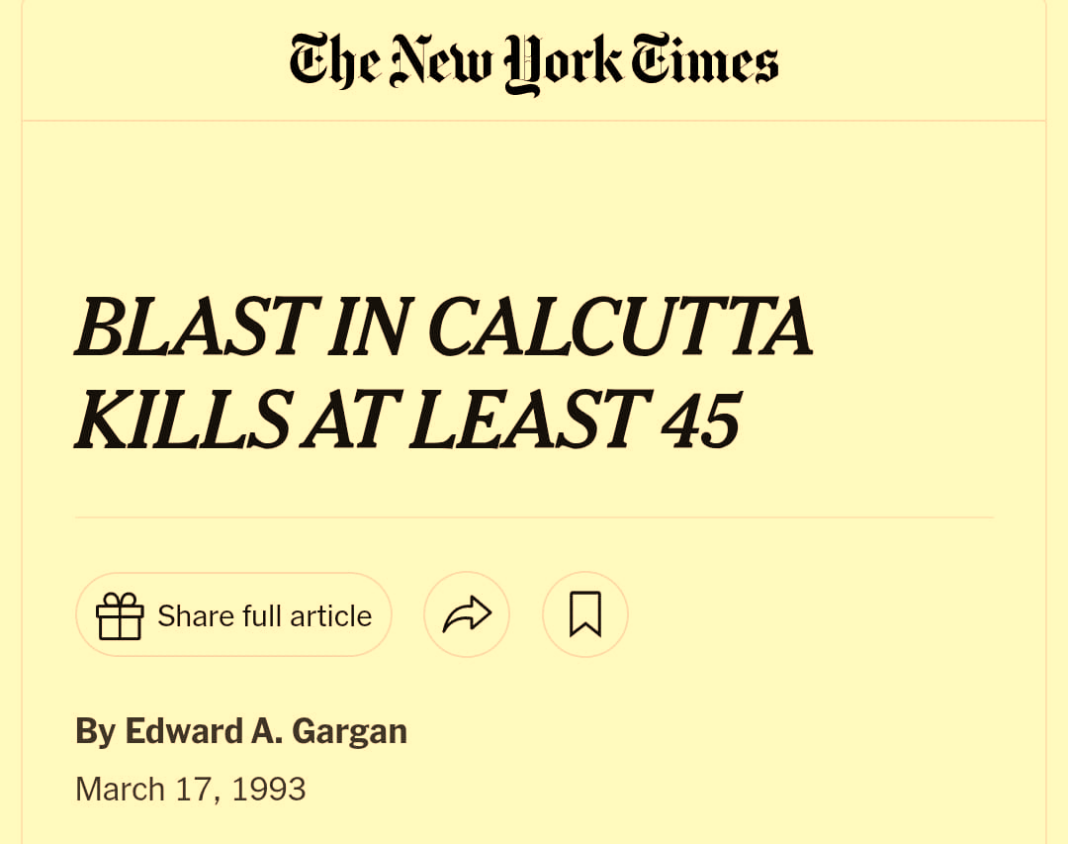
Screengrab of the news report by The New York Times
Police said at least 45 people were killed in the initial hours after the explosion. The death toll later rose to 69 as rescue teams recovered more bodies from the rubble. The blast was strong enough to be heard nearly three miles away.
Fires and desperate rescue operations
Bowbazar is one of the most crowded areas of Kolkata. It is both a residential and commercial area surrounded by the city’s major gold and furniture markets. Hundreds of families live in tightly packed buildings there.
At the time of the explosion, about 125 people were believed to be living in the two apartment blocks that collapsed.
After the blast, both buildings caught fire, making rescue work extremely difficult. At least ten fire engines were rushed to the area, and firefighters spent more than two hours battling the flames.
Many buildings were also affected, and some caught fire as well. People were trapped inside several structures. Residents described scenes of panic and confusion. One neighbour recalled being woken up by a loud explosion just after midnight.
When he ran outside, he said the area was filled with smoke and screams. Many injured people were lying on the streets, while others were trapped under the rubble.
Before ambulances could reach the area, residents and volunteers began helping the injured. Trucks and private vehicles were used to carry victims to nearby hospitals. People in the neighbourhood also appealed for blood donations as hospitals struggled to treat the large number of injured victims.
Questions over what caused the blast
Initially, police believed that a bomb had caused the explosion. However, investigators also considered another possibility. One officer suggested that a large quantity of explosives might have been stored inside one of the buildings and could have exploded due to careless handling.
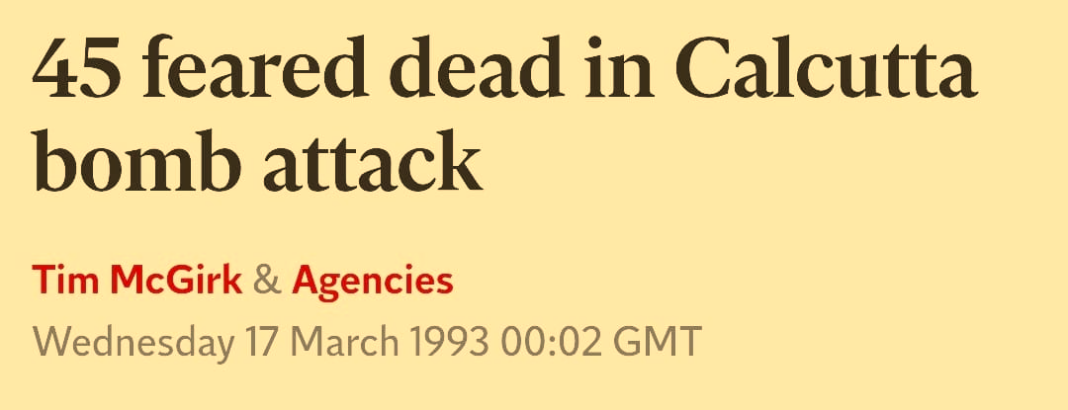
Because of this possibility, authorities said the blast might not have been planned in the same way as the coordinated attacks in Mumbai. At that time, it was also unclear whether the Kolkata explosion had any connection with the bombings in Mumbai that had occurred just four days earlier.
Screengrab of a news report by The Independent
The area where the explosion took place is located close to several important government buildings, including the state government headquarters at Writers’ Building and the city’s police headquarters.
The incident, therefore, raised serious concerns about security across major Indian cities.
International warnings and ongoing investigations
The tense situation following the Mumbai blasts had already led to international alerts.
The United States had warned Indian authorities that more attacks could take place. The US State Department informed New Delhi that intelligence suggested there might be a heightened threat of further terrorist activity in the Indian capital.
Washington even advised American citizens to postpone travel to India temporarily. US bomb experts also offered to assist Indian investigators in examining the explosives used in the Mumbai blasts. Authorities hoped the analysis might help determine whether there was any link with other incidents.
The police continued their investigation into the network behind the Mumbai bombings. Two suspects believed to have been involved in the attacks were surrounded by police during a raid but managed to escape after a gunfight.
Criminal networks and economic motives
Investigators believed that the Mumbai blasts involved members of the city’s organised crime groups.
At the time, Mumbai’s underworld had long been involved in smuggling gold, electronics and foreign currency into India from Gulf countries. But economic reforms introduced in the early 1990s reduced import duties and weakened the smuggling trade.
With their earlier sources of income shrinking, criminal gangs increasingly turned toward drugs, extortion and other illegal activities. Authorities suspected that such networks may have played a role in helping carry out the bombings. However, questions remained about why criminal groups would cooperate in such large-scale attacks on Indian cities.
The Bowbazar terror attack and the 2015 debate
The investigation into the Bowbazar explosion eventually led to the arrest of several individuals.
One of the main accused in the case was Rashid Khan, known locally as a satta operator. According to investigators, explosives had been stored in a building linked to him.The explosion that destroyed the buildings in Bowbazar was believed to have been caused by the stored explosives.
In 2001, Khan was convicted under the Terrorist and Disruptive Activities (Prevention) Act, or TADA, and sentenced to life imprisonment. More than a decade later, in 2015, the West Bengal government considered releasing him from prison.
By that time, Khan was over 60 years old and had spent many years in jail. Officials said he had maintained good conduct during his imprisonment and had even begun learning painting while in custody. Sources said the State Sentence Review Board examined the possibility of his release under provisions that allow remission of sentences.
However, the proposal created debate among officials because he had been convicted under TADA, a central anti-terror law.
Authorities also noted that the Calcutta High Court had earlier confirmed his life sentence, and the judicial department planned to seek the court’s views before any final decision.
2025 court ruling on another convict
More than three decades after the blast, the case returned to court again in 2025. A division bench of the Calcutta High Court cancelled the early release of another life convict in the Bowbazar blast case, Md Khalid.
Khalid had earlier been granted remission by a single judge of the High Court. However, the State Review Board later expressed doubts about releasing him.
The division bench, consisting of Justices Debangsu Basak and Md Shabbar Rashidi, examined the matter and ruled that the earlier order directing his release could not stand.
The judges said that courts reviewing such matters should mainly check whether authorities followed the proper process while deciding on remission. They should not replace the decision taken by the review board if it is reasonable.
The bench noted that the board had given clear reasons for refusing Khalid’s release and that its decision could not be described as arbitrary.
Kolkata Police had also raised concerns during the review process, warning that Khalid might return to criminal activity if released. Police told the court that Khalid had worked closely with Rashid Khan and had carried out various criminal activities under his instructions to create fear in the area.
Khalid, who is now around 60 years old, has spent over 30 years in prison after being arrested in 1993. His lawyers told the court that he suffers from diabetes and requires medical care.
However, the court observed that remission cannot be claimed as a right. While a convict may request consideration for early release, the final decision must depend on legal rules and the assessment of authorities.
The bench ultimately directed the review board to reconsider Khalid’s request in accordance with the law.
A forgotten chapter of 1993
While today, the Mumbai blasts of 1993 have become a very popular memory, the terror attack that took place just a few days after the blasts in the Bowbazar area of Kolkata does not receive much attention.
While for some, the terror attack is still a memory, for others, it is a reminder of the damage it caused, including the destruction of homes and the loss of many lives.
More than three decades later, court cases related to the incident continue to surface from time to time, reminding the country that the terror attack was not limited to Mumbai alone.
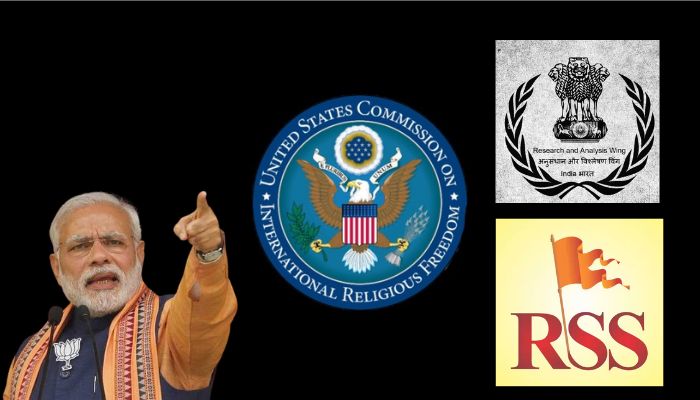
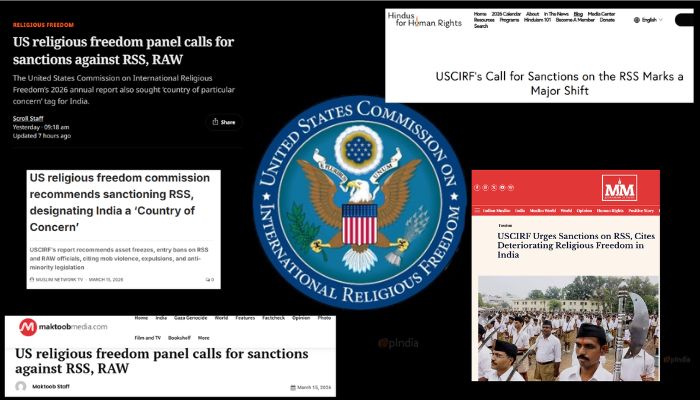
It has become ritualistic for the United States to sermonise, concoct sinister narratives, and meddle in the internal affairs of partners and adversaries alike. This practice has continued regardless of which political party holds power in the US. In its latest instalment of anti-India propaganda, the United States Commission on International Religious Freedom (USCIRF) has published its annual report for the year 2026, wherein it recommended that the US government impose sanctions on the Rashtriya Swayamsevak Sangh (RSS) and the Research and Analysis Wing (RA&W).
In the report, the USCIRF continues to advocate for designating India as a “Country of Particular Concern”, over what it calls “engaging in and tolerating systematic, ongoing, and egregious religious freedom violations.”
The USCIRF report peddles the same old ‘Hindu nationalists targeting Muslim and Christian minorities’ bogey to argue that somehow religious freedom conditions in India worsened in 2025. To back its claims, the report cherry-picked incidents of violence, arrests, and demolition drives that allegedly affected Muslims and Christians.
Furthermore, the USCIRF cried hoarse over what it claims the Modi government’s usage of the Unlawful Activities Prevention Act (UAPA), Foreign Contribution Regulation Act (FCRA), Citizenship Amendment Act (CAA), and National Register of Citizens (NRC) to “target minorities”.
‘Islamophobia’ after Pahalgam Islamic terror attack is a bigger concern for USCIRF than killing of Hindus for being Hindus
Making its anti-Hindu mindset clear at the very onset of the report, the USCIRF not only villainised Hindus by cherrypicking incidents of violence, while completely neglecting Muslim mob violence, but also insinuated that Hindus being shot dead by Muslims for being Hindus, is not as big a problem as subsequent ‘Islamophobia’.
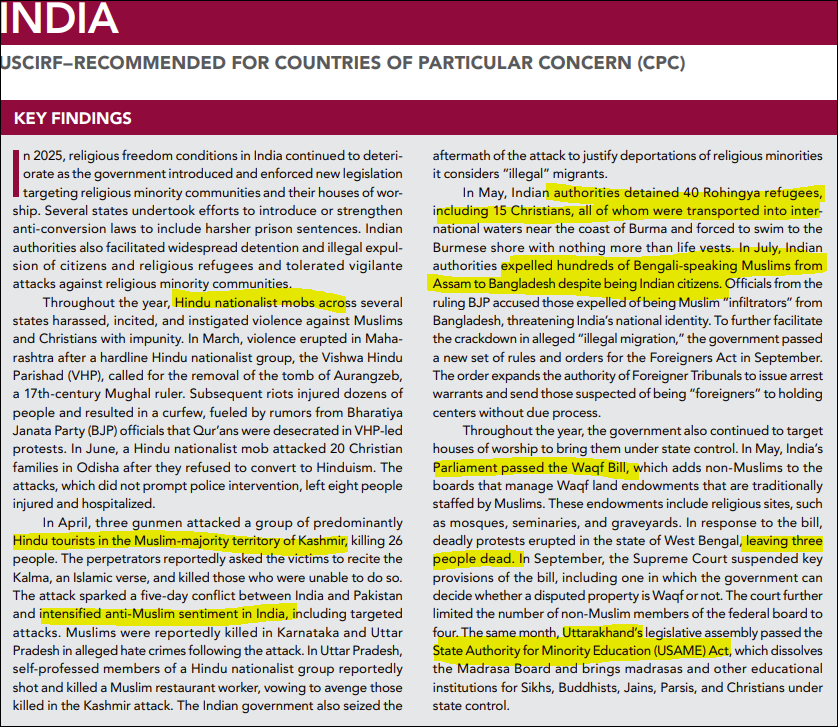
“In April, three gunmen attacked a group of predominantly Hindu tourists in the Muslim-majority territory of Kashmir, killing 26 people. The perpetrators reportedly asked the victims to recite the Kalma, an Islamic verse, and killed those who were unable to do so. The attack sparked a five-day conflict between India and Pakistan and intensified anti-Muslim sentiment in India, including targeted attacks,” the USCIRF report reads.
In April 2025, 26 people, mostly Hindu men, were singled out by Pakistani Islamic terrorists linked to LeT offshoot The Resistance Front (TRF), checked for circumcision and asked to recite Kalma, to confirm their religious identity before shooting them dead. Hindus were targeted and killed for not being Muslims, and yet, the USCIRF is more concerned about a natural reactionary disdain for Islamists, indicating that the Commission is an Islamic terror apologist that shields Jihadis and their unarmed sympathisers.
The USCIRF also expressed dismay over the Modi government’s crackdown on Bangladeshi and Rohingya infiltrators and went on to suggest that those expelled in ‘inhumane’ fashion were often Bengali-speaking Indian citizens. The report, of course, provided no credible source to back its claim. No wonder the report made no mention of how these illegal infiltrators use illegal means to enter India, obtain fake documents, indulge in criminal activities, and systematically alter the religious demography of strategically picked locations, particularly, tribal areas.
USCIRF claims the Centre’s Waqf Bill was a tool to “target” Muslim houses of worship to “bring them under state control”
In May 2025, the Modi government passed the Waqf Amendment Bill, which aimed to overhaul the management of Waqf properties across India. The USCIRF dubbed the legislation democratically passed by an elected government as an attempt to “target houses of worship to bring them under state control.” The USCIRF mentioned the death of three people during the anti-Waqf ‘protests’ in West Bengal last year.
While framing the incident as ‘targeting of Muslims’, the report did not mention that among the three killed were 70-year-old Hargobind Das and his son Chandan Das (40), who were hacked to death at Dhulian in Shamsherganj by a Muslim mob. In December 2025, 13 Muslim men were convicted for the brutal killing of the Hindu father-son duo. Withholding the names of the Hindu victims of the Muslim mob protesting against the Waqf Bill only shows that the USCIRF has no qualms in using Hindus killed by Muslim mobs as numbers to push an idea of false Muslim victimhood and vilify Hindus.
The USCIRF tried to paint Muslims and Waqf Boards as victims of a Hindu nationalist government, while making no mention of the fact that Waqf Boards in India are the third-largest landowners, despite allegedly perpetually oppressed, suppressed, repressed and whatnot. The Waqf Boards have also been involved in corruption, scams, and illegal land grabbing.
In addition to corruption within Waqf Boards, the unchecked powers handed to them by the Congress government in 1995 have also emboldened Waqf Boards to arbitrarily claim ownership of lands, houses, villages, colleges and nearly anything under the sun. The Waqf Bill intended to end this menace. The bill also discontinued the draconian Section 40 of the Waqf Act 1995, which allowed the Waqf Board to claim properties overnight, including Hindu villages, temples, etc. Yet the USCIRF framed the inclusion of non-Muslims on Waqf Boards as unfair, even as Waqf Boards and properties are not religious institutions.
It is pertinent to recall the case of the Hindu-majority Thiruchenthurai village near Trichy, Tamil Nadu, which has been designated as a waqf property by the Tamil Nadu Waqf Board. The Tamil Nadu Waqf Board also claimedownership of 7 such Hindu villages in the state. The villagers alleged that the Waqf Board had also claimed that the 1500-year-old Sundareswarar Temple belongs to them.
From Gurudwara in Haryana, Surat Municipal Corporation headquarters in Gujarat, Taj Mahal and Kashi Vishwanath Mandir in Uttar Pradesh, two islands in Gujarat’s Bet Dwarka to Andhra Pradesh Waqf Board’s claim on 1,654.32 acres of Manikonda village, the list is endless and so is the menace of Waqf Board’s land-grabbing game, which neither the Indian ‘religious freedom’ advocates nor the USCIRF dares to talk about, since doing so does not align with their anti-Hindu agenda.
While the USCIRF lamented Arunachal Pradesh’s push for the implementation of the “decades-dormant” anti-conversion law, it did not care to delve into what necessitated the revival of this “dormant” law.
The USCIRF also dubbed the Uttarakhand State Authority for Minority Education (USAME) Act as somehow a step towards curbing the religious freedom of ‘minorities, even as the report itself states that the Act “dissolves the Madrasa Board and brings madrasas and other educational institutions for Sikhs, Buddhists, Jains, Parsis, and Christians under state control.” The question of targeting any particular community would have arisen if only madarsas or Christian educational institutions were targeted.
Anti-conversion laws: USCIRF continues to term laws protecting people from coercive and fraudulent religious conversion as prohibition of voluntary change in faith
The USCIRF report dedicated a portion to condemning the enforcement of religious freedom-related laws in various Bharatiya Janata Party (BJP) ruled states.
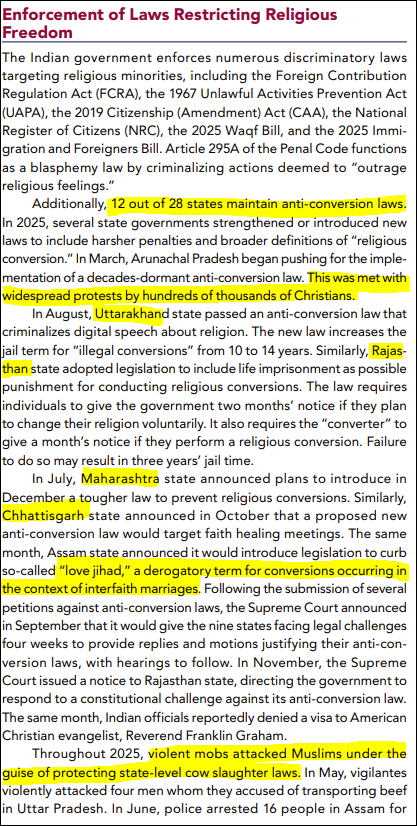
“Additionally, 12 out of 28 states maintain anti-conversion laws. In 2025, several state governments strengthened or introduced new laws to include harsher penalties and broader definitions of “religious conversion.” In March, Arunachal Pradesh began pushing for the implementation of a decades-dormant anti-conversion law. This was met with widespread protests by hundreds of thousands of Christians,” the report reads.
Arunachal Pradesh is home to various indigenous tribes and religions like Donyi Polo, Hinduism, Mahayana and Theravada Buddhism. In October 2025, thousands of people from 27 districts, 26 major tribes, and 100 sub-tribes took to the streets to demand a strict implementation of a 46-year-old anti-conversion law, Arunachal Pradesh Freedom of Religion Act (APFRA), 1978.
The demand stemmed from rapidly shifting religious demographics in the state and the erosion of native faiths and cultures. OpIndia reported earlier how there has been a significant increase in the Christian population and conversion activities in the state over the years. The Christian population in Arunachal Pradesh went up from 0.79% in the 1971 Census to 30.26% in the 2011 Census. The share of the Hindu population in 1971 was 22%, and in 2011 it was 29.04%. The Buddhist population in the 1971 census comprised around 13%, but in 2011, the share dwindled to 11.77%. Meanwhile, Muslims have gone from 0.18% in 1971 to 1.95% in the 2011 census.
It is obvious that those with the agenda of altering the religious demographics of Arunachal Pradesh would rise in opposition to the implementation of a law that would essentially curb, if not put a stop to, their conversion activities. This does not mean the state government is attacking the religious freedom of Christians, but only attempting to bar the unlawful exploitation of the freedom accorded to them.
In Uttarakhand as well, the need to impose strict anti-conversion laws arose from the deliberate attempts at changing the religious demography of the state through forceful or fraudulent conversion of poor and vulnerable Hindus to Islam or Christianity. In 2024, the Uttarakhand Uniform Civil Code panel report made alarming revelations about how the population of Muslims and Christians in the state have expanded by more than twice as much as that of Hindus and Sikhs. These dynamics pertaining to religious demography are not always organic and illegal conversion activities are significant contributors to it.
Local Hindu organisations have consistently raised alarms that the population of Muslims has witnessed a sudden increase in some hill districts like Dehradun, Haridwar, Nainital, Pauri Garhwal and Tehri Garhwal. In recent years, there were communal tensions in some hilly areas like Purola town of Uttarkashi, Dharchula and the Nandanagar area of Chamoli.
Moving ahead, the USCIRF further mentioned announcements by the BJP governments in Assam, Rajasthan, Madhya Pradesh, Chhattisgarh, and Maharashtra to strengthen anti-conversion laws and impose stricter jail terms and fiscal penalties on those involved in forced and/or fraudulent religious conversions.
“In July, Maharashtra state announced plans to introduce in December a tougher law to prevent religious conversions. Similarly, Chhattisgarh state announced in October that a proposed new anti-conversion law would target faith healing meetings,” the report claims.
The USCIRF report does not shed light on what happens in the “faith healing meetings” it wants the American government to believe are simple prayer meetings meant for Christians. These Changai Sabhas often feature missionaries and Pentecostal pastors who claim to possess miraculous healing powers so much so that they boast of curing critical illnesses like cancer, paralysis, and even raising the dead.
While the USCIRF may not want to see the obvious, the issue of Christian pastors using ridiculous tactics that create a façade of magical healing in the minds of gullible people who ultimately fall victim to these theatrics and convert to Christianity is a serious threat to India’s demography and religious balance. Many Christian missionaries and fraudulent pastors rely on a blend of spectacle, emotional manipulation, and exploitation of the desperation and vulnerabilities of common people.
The purpose of these ‘Changai Sabhas’ has been to target vulnerable people poor, sick, desperate and disillusioned people promising them instant relief where medicine or resources fail. The idea is to subtly push conversion to Christianity as the path to ‘salvation’ and relief from all worldly problems. All this is done to harvest souls for Christianity, just as ‘Mother’ Teresa used to do. These pastors and missionaries are often foreign-funded, involved in unlawful activities, and involved in disparaging Hindu religious beliefs.
From the Ghaziabad conversion racket, the Meerut Changai Sabha racket of 2022, the 2024 Bharatpur Christian conversion racket, to countless cases of love jihad and Islamic conversion rackets like those operated by Chhangur Baba, Hindus and other non-Christian and non-Muslim communities are facing two-sided attacks on their religious freedom, but the USCIRF does not consider the Hindu community significant enough have document their plight.
It is not a hidden secret that Christian missionaries and Islamists have, over the years, turned tribal areas in Assam, Chhattisgarh, and the non-BJP-ruled Jharkhand into battlegrounds of religious conversions and demographic dominance. While Christian missionaries use financial inducements, miraculous healings, brainwashing, promises of jobs, education and medical treatments, and other such tactics to lure tribals and Hindus into the fold of Christianity, Islamists, both local and Bangladeshi infiltrators, employ Love Jihad and land-grabbing tactics to expand dominance.
Islamists often lure tribal women for marriage in tribal areas to exploit local land-related laws like the Chota Nagpur Tenancy Act (CNT Act and the Santhal Parganas Tenancy (SPT) Act in Jharkhand.
Interestingly, this pattern of using a foothold to seize control and execute nefarious agendas is not confined to Islamists alone. Many Christian missionaries, out with the mission of luring non-Christians to Christianity using myriad tactics, also do the same. In February 2025, it was reported in Gomti Nagar Extension area of Uttar Pradesh’s Lucknow, that local Hindus staged a protest against Christian prayer meetings in a residential house in Chhota Bharwara, after it was found to be operated as an unregistered church. This illegal house-turned-church was hosting up to 200 people weekly, and conversion activities were taking place there. The Christian missionaries were found to be purchasing properties in the area at inflated rates to establish influence and create a Christian-dominated locality. It was reported that if the Hindus refused to convert, the Christian missionaries put pressure on the locals to sell their houses.
The local Hindus were being instigated to convert to Christianity. The house in question was a church-like structure with no explicit religious symbols.
In many tribal areas. Christian missionaries have earlier been reported to have encroached on Hindu temple lands in Gujarat and Tamil Nadu. Be it Muslim immigrants or Christian missionaries, outsiders infiltrate tribal areas, establish residence, and engage in conversion activities to alter local demography, often beginning with innocuous prayer meetings or gatherings or benign private worship, but eventually resulting in land grabs, encroachments, and even religious conversion attempts.
The USCIRF also mentioned the Modi government’s denial of visa to American evangelist Franklin Graham, inadvertently explaining the reason behind apparent disdain for Hindus and limerence for Christian missionaries and Islamists.
In November 2025, Franklin Graham from the United States, who was scheduled to visit Kohima in Nagaland on 30th November for a Christian event, was denied a visa. As reported earlier, Graham’s organisation, Samaritan’s Purse, has been involved in conversion-oriented activities in the country, using aid, food distribution, and other material assistance as a tool for evangelism. In 2010, during an interview with USA Today, Franklin Graham had mocked Hinduism for its many manifestations of God and said “No elephant with 100 arms can do anything for me. None of their 9,000 gods is going to lead me to salvation. Graham even used the Covid pandemic as a tool for his sinister agenda of Christian conversion in India.
USCIRF calls love jihad a ‘derogatory’ term for religious conversions in interfaith marriages, and links denial of visa to American Christian evangelist, Franklin Graham to restriction of religious freedom
Dishonest to its own stated objective of documenting the status of religious freedom in various countries, the USCIRF does not care to document the deliberate attempts at eradicating the religious freedom of Hindus in India.
This dishonesty is reflected in the tone and deliberate downplaying of real issues as conspiracy theories. Take love jihad for example. Regardless of the Islamo-leftist propaganda that love jihad is a BJP-peddled hoax or conspiracy theory, it is established through countless cases reported every year wherein Muslim men feign love to trap Hindu, Sikh, and in several cases, Christian girls to sexually exploit them, and eventually force them into conversion to Islam and Nikah.
Yet, the USCIRF report calls love jihad a “derogatory term for conversions occurring in the context of interfaith marriages.” The USCIRF expressed no overt discomfort over interfaith marriages requiring religious conversion, almost always of the Hindu partner, let alone differentiating between legal interfaith marriages and fraudulent, predatory, and unlawful abuse and conversions via love jihad.
Unsurprisingly, the USCIRF also dubs the strict enforcement of anti-cow slaughter rules as the BJP’s restriction on religious freedom of ‘minorities’, even if it comes at the expense of the religious sentiments of the Hindu majority.
The USCIRF’s criticism of cow protection laws reflects a deliberate unwillingness to acknowledge religious-cultural context. The cow holds both civilisational and constitutional significance in India, with the Constitution’s Directive Principles calling for its protection. Akin to how Western societies regulate or forbid the consumption of culturally sensitive animals, whether horses, dogs, or whales, India’s cow protection laws are a reflection of long-standing societal ethos. However, the USCIRF’s ideological lens does not permit such nuance. The USCIRF, driven by its own anti-Hindu agenda, mechanically classifies the cow protection laws as expressions of Hindu majoritarian oppression, revealing more about its cultural incomprehension than about India.
USCIRF passes off arrest of Christian missionaries, Islamist rioters and anti-India elements as ‘imprisonment of religious minorities’
In the “Imprisonment of Religious Minorities” section, the USCIRF cited the October 2025 arrest of James Watson (58), an American citizen currently staying in Thane’s Hiranandani Estate; and Manoj Govind Kolha (35), who lives in Bhuishet, Chimbipada, for converting people to Christianity, to argue that religious minorities are imprisoned in India for practising their religion.
Despite mentioning that the accused persons were charged with “hurting religious sentiment” and for violating the state’s anti-black magic law, luring individuals to convert by promising “miracle cures” and prosperity, the USCIRF dubbed it a case of religious persecution as if these people were arrested for simply being Christians and not for the illegal activities they indulged in. Apparently, using fraudulent tactics to lure Hindus into Christianity is not even problematic for the USCIRF, let alone being unlawful.
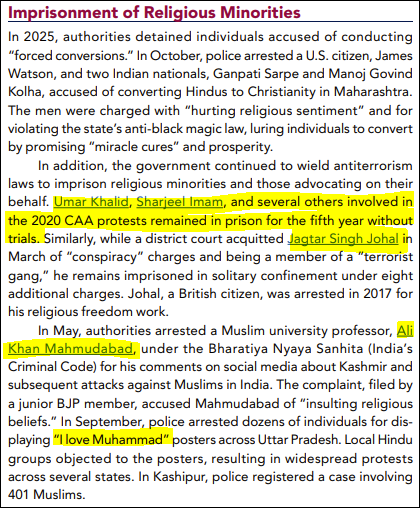
Predictably, the USCIRF continues to cry for Umar Khalid, Sharjeel Imam and other Islamists involved in the 2020 anti-CAA protests and the anti-Hindu Delhi riots.
Contrary to the false narrative amplified by the USCIRF, Umar Khalid, OpIndia has reported earlier that out of the 14 adjournments in 2023 and 2024, 7 delays and adjournments were sought by Umar Khalid himself. It therefore becomes evident that the withdrawal was certainly not because of the famed “delay” in hearing. While the Islamo-leftist ecosystem continues to cry ‘injustice’, it is the alleged failed forum shopping attempts of the accused’s lawyer that have Khalid rotting in jail for so long.
Former Chief Justice of India, DY Chandrachud, had also said earlier this year that the real problem lies in the mindset of some lawyers and political groups who want their cases heard only by certain judges. Highlighting what OpIndia has reported multiple times, the former CJI said that court records showed that Khalid’s legal team, led by Sibal, had sought at least seven adjournments before finally withdrawing the bail plea in February 2024, citing “a change in circumstances.”
The USCIRF also extended support to Ali Khan Mahmudabad, a professor at Haryana’s Ashoka University, and said, “In May, authorities arrested a Muslim university professor, Ali Khan Mahmudabad, under the Bharatiya Nyaya Sanhita (India’s Criminal Code) for his comments on social media about Kashmir and subsequent attacks against Muslims in India.”
Contrary to what the USCIRF claimed, Mahmudabad was arrested for making derogatory remarks against women officers in the armed forces and for promoting communal disharmony. Later, the Supreme Court granted him bail but did not halt the investigation. It ordered a Special Investigation Team (SIT) to continue the probe.
Furthermore, the USCIRF framed the arrest of murder accused Jagtar Singh Johal, alias Jaggi, as the Modi government’s imprisonment of religious minorities. Jagtar Singh Johal, alias Jaggi, is a British resident from Glasgow, Scotland. In 2017, he was visiting India to attend a wedding. During his stay, the Punjab Police arrested him as a suspect in several cases. He was arrested based on the statement of one Taljit Singh Jimmy. He had confessed to his involvement in several crimes during interrogation. However, his supporters claim that the investigation agencies ‘forced’ a confession out of him using third-degree torture during interrogation. Johal was behind the outfit ‘Never Forget 84’.
Jaggi is reported to be a staunch Khalistani supporter. He is facing several murder and attempted murder cases. According to National Investigation Agency’s charge sheets, he has been named in the murder cases of Hindu Takht leader Amit Sharma, RSS leader Brig. (Retd.) Jagdish Kumar Gagneja, RSS leader Ravinder Gosain, Shiv Sena leader Durga Dass Gupta, Pastor Sultan Masih, and Dera Sacha Sauda followers Satpal Sharma and his son Ramesh Sharma. Jaggi was also accused of paying Rs. 27 lakh to the Khalistan Liberation Force (KLF) chief Harminder Singh Mintoo (deceased) in France in 2013 to assassinate RSS leader Ravinder Gosain. His name also appeared in the attempt to murder Shiv Sena activist Amit Arora and firing at RSS Shakha in Kidwai Nagar in Ludhiana in 2016.
However, merely because the court acquitted Johal in one out of the nine criminal cases he faces, the USCIRF deemed it a case of oppression of religious minorities by the ‘Hindu nationalist’ Modi government.
Sanction RSS, allow in-country assessments, link bilateral ties with religious freedom in India, and pass Transnational Repression Act: USCIRF recommendations to the US government is seeped in entitlement and delusion rooted in outright lies and propaganda
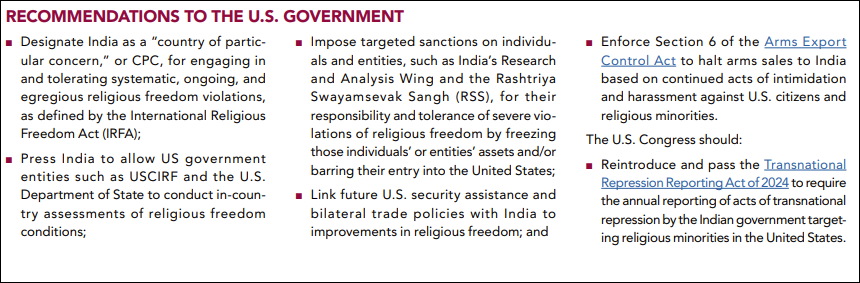
The recommendations part of the USCIRF report on religious freedom in India is not particularly very refreshing. Rather, it is the same old agenda offered with a slightly blunter rhetoric. The Commission urged the US government to “designate India as a ‘country of particular concern,” or CPC, for engaging in and tolerating systematic, ongoing, and egregious religious freedom violations, as defined by the International Religious Freedom Act (IRFA).” The Commission had made similar recommendations in its report last year.
Lost in its own sense of entitlement, the USCIRF asked the US government to “press India to allow government entities such as USCIRF and the U.S. Department of State to conduct in-country assessments of religious freedom conditions.”
The Commission, however, failed to explain what locus standi it has to even think they can conduct any assessment of religious freedom in a foreign country, that too, the world’s largest democracy, India. The US needs to come out of the mindset of assumed superiority and self-imposed imperative to sermonise and teach foreign governments how to run their countries and ensure religious freedom. If the US thinks it wants to export its suicidal empathy for Islamists who kill Jews on American soil for sport, to India in the name of religious freedom, India would simply say, No, thanks!
Further exposing its retardation, the USCIRF recommended the American government impose sanctions on individuals and entities linked to the Research and Analysis Wing, and the Rashtriya Swayamsevak Sangh (RSS). The RSS, which is often called the ideological parent body of the ruling BJP, has been involved in humanitarian and social service activities for decades. Despite its ideological core being the establishment of a Hindu Rashtra, the organisation has never advocated for killings or the ouster of non-Hindu Indian citizens.
Ironically, even the traditional supporters of the RSS are miffed with the organisation for its newly-conceived ideological softness and flexibility. Yet, the organisation continues to attract foreign attacks and propaganda campaigns like those from the USCIRF.
“Impose targeted sanctions on individuals and entities, such as India’s Research and Analysis Wing and the Rashtriya Swayamsevak Sangh (RSS), for their responsibility and tolerance of severe violations of religious freedom by freezing those individuals’ or entities’ assets and/or barring their entry into the United States,” the USCIRF stated.
RA&W is India’s premier external intelligence agency, though not explicitly a regime toppler like CIA, it is the CIA-equivalent of India, to even think that the US government should sanction RA&W or related entities and individuals, that too over “violations of religious freedoms” is absurd. Imagine the absurdity if an Indian government entity recommends sanctions on the CIA for its regime change and other covert operations involving human rights violations. Clearly, the USCIRF’s recommendation to sanction RA&W is a quixotic gesture from an anti-India panel which has been pushing an Islamo-leftist ideological agenda as its top priority instead of unbiased assessment and diplomatic pragmatism.
USCIRF’s call to sanction RA&W alongside the RSS, conflating religious freedom with national security, stretches the Commission’s mandate to absurd lengths. The continued rejection of its recommendations by the US administrations suggests that this time as well, the USCIRF-produced garbage will be relegated to the veritable dustbin.
The Commission further suggested to the US government to “link future U.S. security assistance and bilateral trade policies with India to improvements in religious freedom; and “enforce Section 6 of the Arms Export Control Act to halt arms sales to India based on continued acts of intimidation and harassment against U.S. citizens and religious minorities.”
For the US Congress, the USCIRF recommended reintroduction of the Transnational Repression Reporting Act of 2024 “to require the annual reporting of acts of transnational repression by the Indian government targeting religious minorities in the United States.”
If India also starts linking trade and defence ties with the US to improvements in religious freedom, the straining of relations between the two countries would not need a narcissistic, loudmouth and intransigent Trump, given the frequent attacks, both violent and ideological, on Hindus and their temples, and the wider Indian diaspora in the US in recent years.
Congress and the extended anti-BJP cabal rejoice over USCIRF recommending sanctions on RSS
Predictably, the anti-BJP/RSS ideological system has turned its celebratory mode on as once again, a foreign government entity churned out propaganda report to meddle in India’s internal affairs and attack the Modi government. As it has always been, the Congress party and the extended Islamo-leftist cabal is amplifying the USCIRF propaganda as universal truth to score political points against the BJP-RSS.
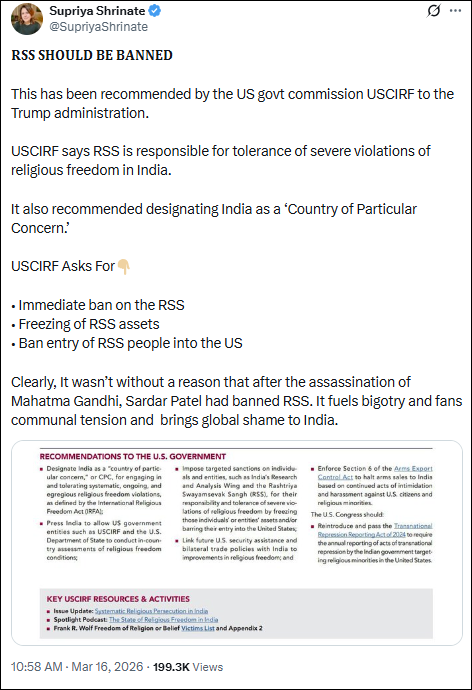
In this vein, Congress leader Supriya Srinate, shared the USCIRF report’s recommendations on X and wrote, “R𝐒𝐒 𝐒𝐇𝐎𝐔𝐋𝐃 𝐁𝐄 𝐁𝐀𝐍𝐍𝐄𝐃 This has been recommended by the US govt commission USCIRF to the Trump administration. USCIRF says RSS is responsible for tolerance of severe violations of religious freedom in India. It also recommended designating India as a ‘Country of Particular Concern.’ USCIRF Asks For • Immediate ban on the RSS • Freezing of RSS assets • Ban entry of RSS people into the US Clearly, It wasn’t without a reason that after the assassination of Mahatma Gandhi, Sardar Patel had banned RSS. It fuels bigotry and fans communal tension and brings global shame to India.”
The Congress leader had no qualms about amplifying a report by a foreign government entity which not only calls for sanctioning the RSS but also India’s intelligence agency RA&W.
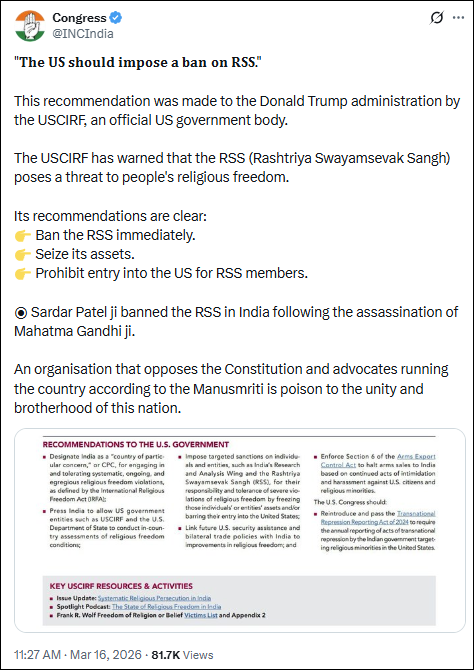
The Congress party’s official X handle went a step ahead and dragged Hindu scripture, Manusmriti into the matter, and wrote, “”𝐓𝐡𝐞 𝐔𝐒 𝐬𝐡𝐨𝐮𝐥𝐝 𝐢𝐦𝐩𝐨𝐬𝐞 𝐚 𝐛𝐚𝐧 𝐨𝐧 𝐑𝐒𝐒.” This recommendation was made to the Donald Trump administration by the USCIRF, an official US government body. The USCIRF has warned that the RSS (Rashtriya Swayamsevak Sangh) poses a threat to people’s religious freedom. Its recommendations are clear: Ban the RSS immediately. Seize its assets. Prohibit entry into the US for RSS members. ⦿ Sardar Patel ji banned the RSS in India following the assassination of Mahatma Gandhi ji. An organisation that opposes the Constitution and advocates running the country according to the Manusmriti is poison to the unity and brotherhood of this nation.”
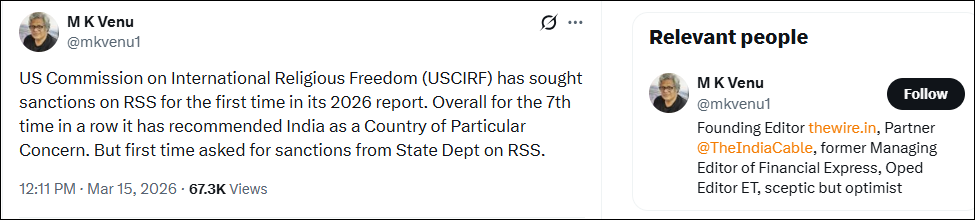
Meanwhile, M K Venu, the Founding Editor of Islamo-leftist rag, The Wire, wrote, “US Commission on International Religious Freedom (USCIRF) has sought sanctions on RSS for the first time in its 2026 report. Overall for the 7th time in a row, it has recommended India as a Country of Particular Concern. But first time asked for sanctions from State Dept on RSS.”
Meanwhile, several Islamo-leftist propaganda outlets, Maktoob, Muslim Mirror, Muslim Network, Scroll, and the George Soros-funded Hindus for Human Rights (HfhR) have amplified the USCIRF propaganda as an indisputable truth, with many even backing the Commission’s recommendations to sanction RSS and RA&W.
Pakistani Islamist leads the USCIRF that wants to sanction RSS and RA&W
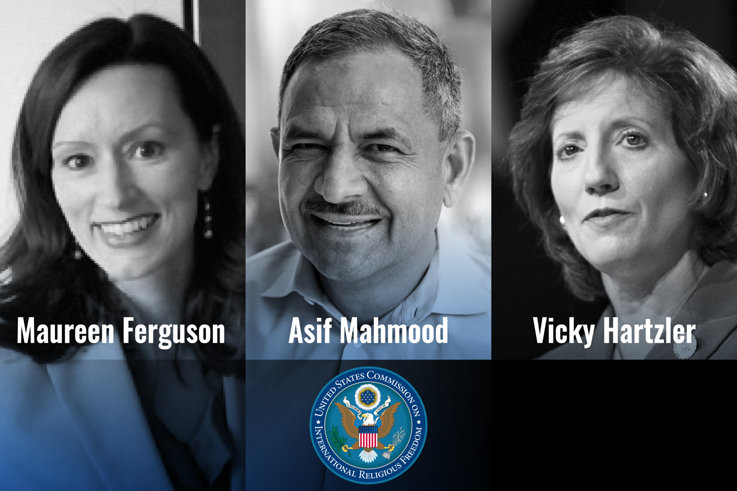
Interestingly, be it Reuters ‘source-based’ articles or the USCIRF annual report on religious freedom, most of the foreign-based anti-Hindu and anti-India propaganda has had a Pakistani connection in recent years. The USCIRF, which wants to have the US government impose sanctions on RA&W and RSS based on a Muslim victimhood bogey, has a Pakistani-American ‘activist’ named Asif Mahmood as its current Vice Chair and Commissioner.
Mahmood has consistently been peddling anti-India hatred and lies. In April 2025, Mahmood was found peddling the conspiracy theory about India’s supposed involvement in the killing of Khalistani extremists in the United States, Canada and Pakistan. Asif Mahmood did not provide any evidence to substantiate his outrageous claims. Interestingly, a similar attempt was made by leftist news outlets such as The Guardian and Australian Broadcasting Corporation (ABC) News to falsely implicate India in extra-territorial killings. Asif Mahmood claimed that the Uttar Pradesh government banned 25000 Islamic schools, aka madrassas, in the State for electoral gain. “Religious freedom is a basic human right”, without mentioning the fact that the action was taken, the Allahabad High Court declared the Uttar Pradesh Board of Madarsa Education Act of 2004 as “unconstitutional.”
Earlier, Asif Mahmood also misled Indian Muslims about the Citizenship Amendment Act (CAA), a humanitarian law which aimed to fast-track the citizenship of religious minorities who took refuge in India following persecution in the neighbouring Islamic countries of Bangladesh, Pakistan and Afghanistan.
“Citizenship Amendment Act #CAA2019 being implemented in #India intentionally coincided with the #Ramadan2024 to send a clear message to the #Muslims of India that you are no longer equal citizens. Religious Freedom at its lowest and Religious Discrimination at its highest expose India and #Modi of its shallow Secular Claims,” the Pakistani-origin ‘activist’ had alleged.
Asif Mahmood had also framed PM Modi’s presence at the consecration ceremony of the Ayodhya Ram Mandir in 2024, as the “end of secular India”, while in his home country, Pakistan, policymakers and public alike, are yet to fully comprehend the meaning of secularism. ” “Is the #RamTemple inauguration by Prime Minister #Modi and circumstances around it the beginning of the end of Secular #India? ReligousFreedom is at its the lowest point in India today and civilized world needs to pay attention,” he whined.
Unsurprisingly, Mahmood also has a history of pushing Pakistani narratives on Jammu and Kashmir, “Another sad and dark day for #Democracy #Justice and #SelfDeterminationRight for #Kashmiris in a long struggle for them and their children future. #US and rest of the Democratic world should pay attention on encroachment of #India in #Kashmir,” Asif Mahmood posted on X in 2023.
One of the USCIRF Commissioners, Mohamed Elsanousi also has a controversial history. Appointed to the Commission by the Biden administration, Elsanousi was the Islamic Society of North America’s Director of Government Relations and Interfaith Relations. The official website of the Network for Religious and Traditional Peacemakers mentioned that Elsanousi graduated from the International Islamic University in Islamabad, Pakistan, with a bachelor’s degree in Sharia Law. Anyone who strictly believes in Sharia law and advocates the same should be the last person to lecture democratic countries like India on religious freedom.
The next in line is Maureen Ferguson, who has ties to missionary organisations and such groups have a history of dehumanising native cultures and religions under the guise of enlightening them with the name of Jesus Christ and converting to Christianity. These outfits have a very sordid past in India and continue to operate in the country to lure gullible people into the Christian fold.
Source: USCIRF’s website
USCIRF chair Vicky Hartzler has a similar past that of Ferguson. Hartzler has been associated with several Christian missionary groups and propaganda organisations that operate under the guise of minority rights, human rights and other usual shields these frauds often use.
“She has long been an advocate for those persecuted for their faith. Prior to her public service, she volunteered with the Voice of the Martyrs organization providing tangible help to Christians persecuted for their faith,” stated USCIRF’s official website.
Vicky Hartzler has also been awarded for her services to these Christian organisations. No wonder the USCIRF cries hoarse over the Modi government acting against Christian missionaries luring Hindus into Christianity through illegal means.
Another key office bearer at the USCIRF is Commissioner Meir Soloveichik. As per the USCIRF’s official website, “Meir Y. Soloveichik is Rabbi of Congregation Shearith Israel- the oldest Jewish congregation in the United States, the Director of the Straus Center for Torah and Western Thought at Yeshiva University, and a Senior Scholar at the Tikvah Fund. He graduated summa cum laude from Yeshiva University and received his PhD in religion from Princeton University.”
Among the professional staff listed in the USCIRF 2026 report is Sema Hasan, who has been a part of the team that wrote similar anti-India reports by the USCIRF in recent years. She has long been pushing the Muslim victimhood narrative against India, while in her home country, Pakistan, Hindus are killed, raped, and discriminated against on a daily basis.
The United States Commission on International Religious Freedom, which was created in 1998 by the Clinton administration, has been reporting on ‘religious freedom in India’ for the past two decades but not without mixing its ideological biases. OpIndia has consistently reported on how the USCIRF has been peddling hysteria around CAA, NRC, Muslim rights, and by extension, religious freedom in India using lies and propaganda.
I occasionally follow ‘The 50’, which is a reality show where a group of influencers and celebrities perform tasks to earn money, not for themselves but for their fans. It is not exactly the sort of programme one watches for intellectual stimulation. Most of the time it is simply mindless entertainment, which one seeks after a day-long work routine. It is the kind of show you put on when you want to switch your brain off for a while. However, sometimes even the most ordinary entertainment ends up revealing something far more unsettling than intended.
That moment arrived during a conversation involving Faisal Shaikh, better known to millions of followers as Mr Faisu. During a discussion with other contestants about his popularity and journey as an influencer, he recalled the early days of his career and told them how things evolved after short video platforms exploded in popularity.
During that conversation, he made a remark that stayed with me. He explained that the company they had signed with had invested heavily in grooming them. According to him, they attended classes where they were taught how to eat properly, how to sit, how to behave in public and how to present themselves as gentlemen.
At first glance, it sounded like nothing more than professional training for social media personalities. Even celebrities take such lessons, and some rich kids too. These people often operate in a competitive environment where presentation matters almost as much as content. Grooming, in that sense, is a simple part of the process of building oneself as a brand.
However, the more I thought about that remark, the more uncomfortable the idea became. Because grooming is not just about table manners. It is about crafting a persona.
The grooming of influencers and the making of an ideal public image
One small detail in Faisu’s remark is worth paying attention to. When he described the grooming classes, he did not speak in the singular. He repeatedly said “we”. The training was not something that happened to him alone. It was something that happened to an entire group and that group was the well-known social media collective “Team 07”. It is a set of influencers who rose to prominence together through TikTok, Instagram and other platforms.
If his group was “groomed”, there must be more investors who are grooming other influencers or groups of influencers. We have noticed that over time, these influencers become completely different from what they used to be a few years ago. In other words, the grooming classes that taught them how to sit, how to eat and how to behave like gentlemen were part of a structured effort to shape an entire influencer ecosystem.
If we think just about being an influencer, there is nothing inherently wrong with learning how to conduct oneself well. In fact, in an era where many online personalities thrive on shock value and vulgarity, the cultivation of discipline and politeness can even appear refreshing.
However, grooming also produces something else, that is, a carefully crafted public image. A well-groomed influencer who appears polite, respectful and disciplined naturally commands admiration. Add physical fitness, charisma and massive social media reach to that, and the effect becomes even stronger. Such personalities become aspirational figures. People admire them, emulate them and often trust them.
Watching ‘The 50’, one can see exactly how that persona plays out. Other contestants praise Faisu for his behaviour and discipline. He performs tasks well. He carries himself confidently. His personality appears measured and controlled. It is easy to understand why he enjoys an enormous fan following, especially among younger audiences.
Yet the idea of systematic grooming raises an interesting question. When personalities are deliberately shaped to appear admirable and trustworthy, what kind of influence do they ultimately hold over those who follow them? And if the grooming applied to the entire group, as Faisu’s use of “we” suggests, then that influence extends far beyond one individual.
The story of Adnaan Shaikh and Riddhi Jadhav
Another figure connected to “Team 07” and ‘The 50’ show is Adnaan Shaikh. Just like Faisu, he also rose to prominence through social media. In fact, they actually rose to popularity together. He also has a substantial following on social media. Though he did not discuss about his marriage on the show, but his bond with Faisu made me do a little bit search about him.
Interestingly, the story surrounding Adnaan extends beyond social media fame. His wife was previously known as Riddhi Jadhav, a Hindu woman and influencer, who later converted to Islam before marrying him. After the conversion, she adopted the name Ayesha Shaikh.
The couple recently appeared in public while shopping ahead of Eid. Photographs and videos circulated online showed Riddhi, now Ayesha, covered in a full burqa. The image once again revived discussions surrounding the circumstances of her conversion and marriage. Adnaan and conversion of his wife to Islam is being talked about on social media.
Reel celeb Adnan Shaikh does Eid shopping for his son, he's accompanied by his Hindu wife Riddhi Jadhav who once wanted to go to temple in shorts.
Well he's allowing her to breathe that itself might mean great freedom to her! pic.twitter.com/iOAIyHiRNh
Reports had earlier suggested that Riddhi’s family opposed the decision and did not attend the wedding ceremony. The issue had already generated controversy in 2024 when allegations from Adnaan’s sister triggered public debate on social media.
In interviews, Adnaan has addressed the controversy by emphasising that the conversion was Ayesha’s personal decision. He has pointed out that India guarantees freedom of religion and argued that no one can be forced to convert.
At face value, the explanation appears straightforward. But the story contains another detail that Adnaan himself once mentioned. In an earlier interview, he recalled how he first noticed Riddhi years earlier when she was studying at Khalsa College. According to him, she did not initially pay attention to him. He said that during those days he would perform stunts on his bike around her in an attempt to attract her attention.
How easily these scums change the whole identity of Hindu women they trap in love jehad? Ayesha who?
This OTT celeb Adnan Shaikh aka Chapri, has been chasing Riddhi Jadhav since 12 years. So when she challenged temple rules to wear shorts, he was very well laughing at Hindus… pic.twitter.com/m16dIySnrR
Years later, the two married. Before the marriage, Riddhi converted to Islam and adopted a new religious identity. Another statement of Adnaan’s also stands out. He has openly said that religion comes first in his life.
"Adnan Sheikh roasted his wife." 🤡
He says he is Muslim and his wife was Hindu, but she converted before marriage because religion is very important to him. Wow!
When we place all the circumstances and facts together, these details paint a more complex picture than the simplified narrative of personal choice often presented by him in public discussions. Funny thing is, after the controversy, Adnaan told Telly Reporter that her face is not revealed on social media because of his religious beliefs. He claimed it is a personal choice guided by his faith and cultural values.
When admiration becomes influence
The modern influencer economy thrives on emotional connections. Followers feel as though they know the personalities they watch online. They admire their lifestyle, their personality and the way they carry themselves.
Over time, admiration often evolves into trust. And once trust is established, influence becomes inevitable. This is where the discussion begins to intersect with a broader cultural debate that has appeared repeatedly in recent years. Narratives around religious conversions through emotional relationships have surfaced in various contexts, including popular culture.
Films such as The Kerala Storyattempted to portray a pattern in which young women were drawn into relationships that gradually evolved into ideological influence and eventually religious conversion. Whether one agrees with the film’s depiction or not, the central idea it explored was simple. Emotional bonds can sometimes become channels of persuasion.
In the film, the Hindu women were coerced into converting and marrying Islamic terrorists by repeatedly pushing narratives against Hinduism. The brainwashing, which used to be subtle, has become overwhelmingly open nowadays and with social media platforms it has become much easier as well.
Friendships and romantic relationships have the ability to shape beliefs and identities in ways that individuals may not fully recognise in the moment. In the age of social media influencers, where personalities are deliberately groomed to appear charismatic, disciplined and admirable, the scale of such influence becomes even greater.
Admiration leads to emotional connection. Emotional connection leads to trust. Trust often leads to deeper influence and that influence can push a person, in most cases a Hindu, to convert to Islam and it is a bitter truth that is undeniable.
The uncomfortable gap within Hindu society
Perhaps the most uncomfortable aspect of this discussion lies not in the actions of individuals but in the condition of the society observing them. Many modern Hindu families have gradually moved away from discussing religion in any meaningful way. Faith is often reduced to festivals, rituals and occasional temple visits.
Children grow up celebrating traditions but rarely receive a clear understanding of the philosophical or cultural foundations behind them. Religion becomes something symbolic rather than something deeply understood.
At the same time, young people are exposed to a world where other communities often possess far clearer and more assertive expressions of religious identity. This difference can create a subtle imbalance. A young person who grows up without a strong understanding of their own belief system may find it easier to adopt another one when emotional relationships come into play.
In such an environment, charismatic personalities and influential figures can wield enormous cultural power. Admiration can easily turn into ideological influence when the individual on the receiving end lacks clarity about their own identity. The issue therefore is not simply about interfaith relationships. India has always been a civilisation where multiple faiths have interacted and coexisted.
The issue is whether individuals enter those relationships with a clear sense of who they are.
The uncomfortable lesson from a reality show
All these thoughts returned to me as I continued watching that seemingly harmless episode of ‘The 50’. It popped up during a discussion with the team at the office and I believe sometimes small details matter.
A casual conversation about influencer grooming suddenly began to feel like a glimpse into a much larger ecosystem. Faisu’s remarks about grooming revealed how carefully influencers’ personalities can be shaped. The emphasis on etiquette, discipline and presentation creates individuals who appear admirable and trustworthy to millions of viewers.
Adnaan’s story, meanwhile, illustrates how a good personality mixed with personal relationships can intersect with identity, belief and religious commitment in ways that spark intense debate.
These are just two influencers. One revealed how he became what he is today and the other revealed how his wife became Ayesha from Riddhi. Interestingly, Riddhi was once accused of wanting to go to a temple in shorts, something that is against Hindu traditions.
Perhaps the real question is not about Faisu or Adnaan as individuals. Perhaps the real question is about the society watching them. Sometimes, a “harmless” show can reveal the uncomfortable truth of things happening around you. Sometimes, it reveals why your modern Hindu friend converted to Islam and now wears a burqa covering her from head to toe.
Just days before Eid, a video shared by Hyderabad-based hate preacher Syed Ayub sparked controversy after he openly called on Muslims to offer Namaz on roads. Ayub, who describes himself as the organiser of the NGO Hyderabad Youth Courage (HYC) and has around two million followers on Instagram, posted the video on Sunday night, 15 March.
In the video, Ayub can be heard urging Muslims to pray on the roads, not just in Sambhal but across the country. In his speech, he said: “Not just in Sambhal, but across the entire country, Namaz will be offered on the roads, Inshallah. If Eid gatherings are large, Muslims will come out and offer Namaz on the roads.”
He also challenged authorities who had warned against offering prayers on public roads. In the same video, he said, “If someone thinks they can stop Muslims from praying on the road, let them try. Muslims are not afraid of threats of cases or jail.”
Ayub also used a derogatory word for UP CM Yogi Adityanath and criticised the Yogi government, accusing it of creating unnecessary restrictions on Muslims. His remarks quickly spread across social media and triggered debate about the ongoing dispute over offering Namaz on public roads in several parts of the state.
What is the issue in Sambhal?
The controversy is taking place at a time when the administration in Sambhal has already issued strict warnings about maintaining law and order during Eid and Friday prayers.
Recently, on Thursday, 12th March, Kuldeep Kumar, who is a police officer in Sambhal, convened a meeting of the Peace Committee in which it was made clear that Namaz would not be allowed on public roads. The video of his remarks from the meeting was shared on social media.
He said in his remarks at the meeting that authorities were fully alert ahead of Eid and that maintaining peace and law and order was their top priority. He said that strict legal action would be taken against those who were found offering Namaz on public roads outside mosques.
UP DSP Kuldeep Kumar to Muslim residents in Sambhal: Some people, for the sake of Insta reel, sympathize with Iran and raise questions over assassination of Khamenei. https://t.co/MNAwh7e9Cypic.twitter.com/NCmUVWB9OA
He further said, “If anyone is found offering Namaz on public roads, strict action will be taken. If necessary, people can also be sent to jail.”
He also made a broad remark about maintaining peace in the region. He said that if people were emotionally attached to issues happening in different parts of the world, they were free to go to those places, but creating unrest in India would not be allowed.
According to the local administration, allowing religious gatherings on roads often disrupts traffic and public movement, which is why such restrictions are imposed.
Ayub’s Ramadan project for Gaza
Apart from his political and social commentary, Syed Ayub has also been involved in another campaign, which is associated with the war in Gaza. He has been using his NGO, Hyderabad Youth Courage, to promote a Ramadan aid initiative that claims to deliver Iftar meals and drinking water for the people of Gaza.
Ayub has been sharing updates about the campaign on his social media accounts and urging followers to donate to his initiative.
Recently, he was spotted in Uttam Nagar, Delhi, where he went to meet the woman and the Muslim family linked to the death of Hindu youth Tarun Kumar, who was killed by a Muslim mob. The incident had drawn attention after allegations of mob violence surfaced.
Arrest in 2024 over fundraising fraud
Syed Ayub has also faced legal trouble in the past. In 2024, police in Hyderabad registered a case against him after a complaint accused him of cheating and illegal fundraising on social media.
The complaint was filed by lawyer P. Sai Kishore at the Saidabad Police Station of Hyderabad. According to the FIR registered under Section 420 of the IPC, Ayub collected donations online by claiming that he would personally deliver aid to Gaza.
The complaint stated that he shared personal bank account details on social media and posted pictures from Hyderabad Airport and later from Egypt, suggesting that he was travelling to Gaza with aid supplies.
However, the complainant argued that such claims were misleading because, given the geopolitical situation, sending aid to Gaza by road was practically impossible. Ayub was also accused of misleading donors and collecting funds under false promises.
The complaint also demanded action against his NGO and requested that the Hyderabad Youth Courage social media pages be blocked.
Earlier arrest of Syed Ayub in 2020 over crowdfunding misuse
This was not the first time Ayub had been arrested. Back in 2020, the Hyderabad Task Force police arrested him along with Salman Khan, the president of the same NGO.
Police said the two had misused money collected through crowdfunding campaigns meant for people suffering from serious illnesses.
According to the investigation, the NGO used its Facebook page to post videos of financially struggling patients and asked the public to donate money for their treatment.
In one such case, donations were collected for a woman suffering from a chronic illness. Within a few days, large sums of money were transferred into bank accounts linked to the accused.
Police said that ₹15 lakh was transferred to Salman Khan’s bank account and another ₹15 lakh to an account belonging to a relative of Syed Ayub, while additional funds remained in another account.
After receiving complaints from donors, the police registered a cheating case. The Taskforce later arrested Ayub and Salman Khan from Hyderabad and seized their mobile phones during the operation.
The larger debate over offering Namaz on roads
The issue of offering Namaz on public roads is not limited to Sambhal. In many parts of the country, particularly in Uttar Pradesh, restrictions have been imposed on performing Namaz on roads as it may cause traffic jams and public inconvenience.
If a large number of people assemble on roads to perform Namaz, it may cause traffic jams and inconveniences to the residents. Therefore, the police in many districts have been advising people to perform their prayers in mosques, Eidgahs, or other designated areas instead of roads.
The authorities clarified that the restrictions are not imposed to curb religious activities but to ensure that public places are accessible to all.
Similar restrictions in Meerut
A similar case was witnessed in Meerut recently, where the police issued a warning on Sunday, 15th March, before Eid.
Senior Superintendent of Police Avinash Pandey warned that strict action would be taken against those who perform Namaz on public roads.
He warned that violators might face a police inquiry that could even affect official documents like passports if serious law-and-order violations were found. Later, he clarified that there is no direct legal rule linking road prayers to passport cancellation, but if an investigation reveals criminal involvement or repeated violations, authorities could take further action under existing laws.
On 15th March (Sunday), Natasha Chart, a self-described “Western civilisation appreciator,” author and supporter of the (Make America Great Again) movement, referenced a fraudulent “caste discrimination” case initiated by the California Civil Rights Department (CRD) involving two engineers of Indian descent from Cisco Systems Inc. in the Superior Court.
Chart claimed that a Dalit engineer at the company was denied promotions, excluded from important projects and ultimately removed. She then added, “Why? He wasn’t from the right caste. Internal messages showed hiring managers actively discussing caste identity and choosing only from their own,” while reacting to another biased social media post, fear-mongering that Indians are taking over significant firms created by Americans.
"At Cisco, a Dalit engineer was blocked from promotion, kept off key projects, and eventually pushed out. Why? He wasn’t from the right caste. Internal messages showed hiring managers actively discussing caste identity, and choosing only from their own." https://t.co/Q2R78pECPT
Notably, the lawsuit brought against Sundar Iyer and Ramana Kompella in June 2020, alleging discrimination against a “self-identifying Dalit,” disclosed as Chetan Narsude by OpIndia, was voluntarily dismissed by the CRD, a California state government agency, on 10th April 2023. It made incorrect assertions about Hinduism and portrayed persons of Indian heritage as “xenophobic.”
The development transpired even though Iyer offered the “victim,” referred to as “John Doe,” an impressive package that included millions in stock grants. He gave up his equity to recruit him and other workers. Moreover, he also employed at least one additional “self-identifying Dalit” in a leadership role at the corporation.
CDR, the largest state civil rights agency in the United States, was fully cognisant of the enterprise’s diversity and of the specific division in which Sundar Iyer served. It was discovered that the scheduled caste person had been recruited for 8 years at the time of the allegation.
Meanwhile, CDR was unable to locate any evidence of harassment against the two Cisco Systems engineers. The Hindu American Foundation (HAF) outlined that the agency relied on deceptive “reports” published by the infamous Equality Labs, disregarded Iyer’s official status as “agnostic” for more than 20 years and wrongly labelled him as a “Hindu.”
It was also revealed that the Dalit man had known him for almost 20 years, dating back to their time at the Indian Institutes of Technology (IIT) Bombay. Predictably, “activists” utilised the case to pass resolutions adding “caste” to nondiscrimination laws in several locations. “The nightmare endured is beyond imaginable and a cautionary tale for what awaits in California over caste,” HAF Director Suhag A Shukla expressed at the time.
The lie, although debunked, has persisted as the racist cabal, who refuse to allow the truth to deter their propaganda, use it to attack the hard-working Indian community.
How CRD intended to trap Sundar Iyer in a fabricated case
Iyer recounted his troubling ordeal with CDR at an event in August of that year. According to him, he was accused of denying the post of head of engineering to the plaintiff at his startup, Candid Systems, because of his caste. On the other hand, the court documents submitted by Cisco highlighted that the latter never asked for or even desired the role.
Iyer stated that, in addition to hiring him despite knowing his caste, he offered all three of the top leadership posts, including the head of engineering, to another person who belonged to the same community. He mentioned that the applicant was the most qualified candidate for the job. He was offered two roles prior to the lawsuit being brought against him.
However, CRD sued Iyer and his colleague in the name of Dalit discrimination. He had awarded the Dalit individual multiple million dollars in compensation without taking any stake in the startup, but rather than taking into account his position, it also held him responsible for salary discrimination only due to his failure to award him a few more thousand dollars during a single cycle of increment in wages in October 2016.
Iyer pointed out that he presented public information during the trial, which substantiated that he was not a devout religious practitioner. However, the agency maintained that he followed Hindu religious customs and purposefully infringed on his religious freedom instead of protecting his civil rights, which is its duty.
Iyer contended that he was dragged to court, although the agency was aware that he didn’t wear the sacred thread or observe caste. He had even written many short stories criticising the same over the years, but was designated as a Hindu Brahmin. According to him, the civil rights organisations strategically placed him in a caste based only on his last name.
Iyer conveyed that CRD announced his caste to the world after insisting that it was a private subject. The agency also argued that caste causes violence and conspired with the “activists” who created several aggressive stereotypes of Brahmins. Its primary activist partner, Equality Labs, stated on record that Nazis in Europe and Germany are upper-caste Indians.
CDR and Equality Labs orchestrated a vicious campaign against Indian American Hindus
Iyer pointed out that the first incident of state-sponsored casteism occurred on 30th June 2020, when the case was launched against him. Despite strong evidence to the contrary, the CRD spent years looking into the matter and took action against him merely after a 15-minute interview, which breached his right to due process.
It then lodged a case against Iyer for harassment, a major offence that is based on personal behaviour rather than professional conduct. However, the agency did not find any adverse comments made by him concerning the Dalit man during his term of employment. Likewise, Ramana was also charged with harassment based on caste. His most heinous transgression was asking him to submit weekly status reports on the instructions of a White American manager. They were named and humiliated just for carrying out their tasks.
CRD targeted more than 50 Cisco coworkers, along with Iyer and Ramana. Men and women from different racial and ethnic backgrounds from all over the world made up the multicultural and diverse staff, which was portrayed as “entirely upper caste Indians.” It blamed them for propagating the caste system from India in the United States. However, the agency did not adhere to a proper legal procedure.
It robbed them of their humanity and declared that the environment was anti-Dalit, but chose not to speak with the group’s senior member, a Dalit person. CRD and Equality Labs unleashed a torrent of hate on all Hindu Americans. The duo brutally stereotyped and racially profiled them regularly. They were accused of raping and abusing 25% of all Dalits in America without any proof.
However, the irrational singling out was rejected by the judge, who also disregarded each statement made in the unscientific Equality Labs report, which was illustrated as anecdotal rather than factual.
CDR’s effort to demonise PM Modi and Hindus
CRD made outrageous comments such as, “Working under Indian managers is a living hell,” charged upper-caste Indians with bragging about their biological superiority founded solely on informal details, and accused Indian Americans of spitting on Dalits after knowing about their caste.
It even suggested that the election of Prime Minister Narendra Modi was the cause of the rise in casteism in America. However, they downplayed his Other Backwards Class (OBC) origin.
The HAF filed a case against the CRD in January 2021 for repeatedly breaching the country’s Constitution. The deferral equal employment opportunity commission charged it with various ethical violations in September 2021. The chief prosecutor for CRD, who also helmed the Cisco case, was dismissed by Governor Gavin Newsom in April 2022.
A volunteer-run outfit called Castegate.org unveiled extremely unsettling and recurring unethical behaviour in relation to the issue in October 2022. Iyer and others filed a motion to sanction the CRD prosecutors in January 2023 for launching a case without any supporting evidence. The agency dropped the lawsuit against the pair but continued to sue Cisco.
An alarming white paper accusing the CRD of a pattern of dishonest activity against multiple Californian companies, including Tesla and Ride Games, was published in April 2023 by the California Policy Centre, a think tank in Southern California. A volunteer-run engineering organisation called California for Justice criticised the agency for discriminating against Indian Americans in July 2023 and urged Newsom to take immediate action.
Israeli Prime Minister Benjamin Netanyahu on Sunday released a light-hearted video from a Tel Aviv coffee shop, directly mocking viral social media rumours that he had been killed in an Iranian missile strike and that his previous public address was an AI-generated deepfake. Notably, several Iranian and Pakistani social media users had spread the rumours of the Israeli PM’s death. Moreover, many of them had falsely claimed that Iran hit Netanyahu with a missile after Indian journalist Aditya Raj Kaul, who is in Israel at present, ‘revealed’ the location of the Israeli PM in a live broadcast.
In the one-minute clip posted on X, Netanyahu stands casually at a counter holding a cup of coffee, smiling and chatting with staff. He opens with asking the person making the video, “What did you ask me?”, and the person says, “They are claiming on the Internet that you are dead?”
— Benjamin Netanyahu – בנימין נתניהו (@netanyahu) March 15, 2026
The Prime Minister responds by saying, “I’m dying for coffee, you know what I mean? I’m dying for my people and how they behave — fantastic!” He then shows both his hands to the camera, saying, “Want to count my fingers?” explicitly addressing claims that an earlier video showed him with six fingers — a supposed tell-tale sign of AI generation. It was being claimed that the ‘AI-generated’ video was used for his address after he died in the Iranian strike.
After being asked what message he wants to give to people who want to go out and get some fresh air, the Prime Minister says, “To those going out, go out, but stay near a protected area. Your support gives strength to me, the government, the IDF, the Mossad, and our institutions. We’re doing things I can’t share right now, but are taking action, hitting Iran very hard, even today, and Lebanon too.”
Netanyahu added, “You ask me to keep going, and say to all of you, keep going as well. Keep following the instructions of home front command and city administrations. Always stay near protected area. We will make it as easy as possible.”
He thanked the shop for the excellent coffee, joking that its calorie content seems to be dangerous to him.
How the death and AI rumours began
The rumours gained traction two days ago after Netanyahu posted a video of a press briefing on the ongoing US-Israel-Iran conflict. At the 0:35 mark, when he raised his hands, a shadow and slight angle created an optical illusion of an extra finger next to his little finger, which some users immediately labelled a “classic AI finger glitch.”
Prime Minister Benjamin Netanyahu, this evening, at a Press Conference:
"Citizens of Israel, my brothers and sisters, We are in historic days, days that will be recorded in the annals of Israel. In Operation Roaring Lion, our roar is growing stronger. pic.twitter.com/wtxqrHoPzM
Social media erupted with claims that the video was artificially generated and that Netanyahu must therefore be dead. However, the footage was authentic; the full unedited video shows him with the normal five fingers on each hand, and the apparent sixth finger was merely a lighting artefact.
The speculation intensified further with claims that Indian journalist Aditya Raj Kaul live-tracked and broadcast Netanyahu’s location during a recent Iranian missile barrage. Using Kaul’s coverage of Netanyahu’s visit to a site hit by Iranian missile, social media users claimed that it was a live broadcast and an Iranian missile had struck the exact spot using the coordinates obtained from the video.
> Aditya Raj kaul wanted a media byte from Netanyahu.
> He started tracking his movements and started following him everywhere.
> he got so desperate that he showed his footage & exact location on live TV.
> IRGC saw it and fired a missile on the same location.
This triggered a fresh wave of “Netanyahu missing/dead” posts and even jokes about Kaul “getting Netanyahu killed,” and claims of him being a double agent. Some asked whether Iran should reward Indian ships for the alleged tip-off, while others falsely claimed Kaul had been arrested by Israeli police.
Notably, Kaul covered Netanyahu’s visit to a site damaged by Iranian strike in Bet Shemesh on 2nd March, and the Israeli PM had made several public appearances after that. But the social media users falsely claimed that the broadcast was recent, and Netanyahu was not seen after that.
Reportage from Bet Shemesh, Israel for @NDTV on March 2 4:30pm where Israeli PM @netanyahu was visiting to review damage a day after Iranian Missile attack. 9 people including children were killed, 40 injured in the attack. Some baseless disinformation being spread on this video. pic.twitter.com/FZygdxymJZ
Israel’s Prime Minister’s Office dismissed the entire narrative as “fake news,” stating Netanyahu was “fine.”
Sunday’s coffee-shop video was designed to end the speculation once and for all, proving he is alive and well, and directly rebutting both the “six-finger AI” claim and the missile-strike conspiracy. However, some people claimed that even this video is AI-generated, saying that the video does not look normal.
However, the Sataf Cafe in Jerusalem, where the video was taken, posted several photos on Instagram showing Netanyahu visiting he cafe and having coffee.
They wrote, “We were very happy to host the Prime Minister and his Staff today”. The cafe added, “And the main thing is that beautiful and quiet days will come! We send from here a big hug to the men and women of the reserves (and their families), the IDF and the Security and Rescue Forces.”