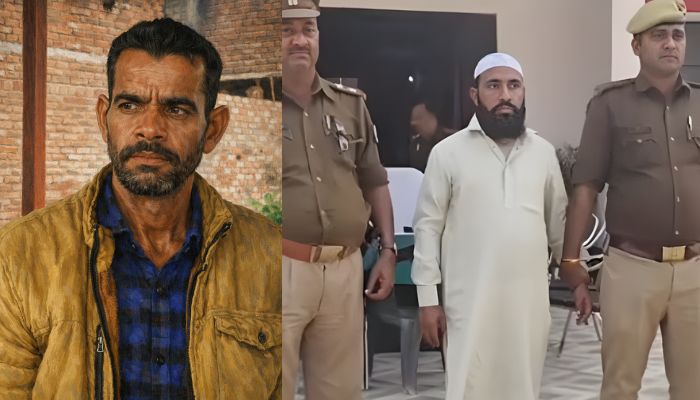
In a chilling revelation, a sex and conversion racket being run by two Muslim sisters has been busted by police in Bhopal, Madhya Pradesh. Two sisters named Amreen and Afreen had been running the racket, luring vulnerable Hindu women with lucrative job offers.
On Monday (23rd February), the police arrested Amreen, Afreena and their associate Chandan Yadav. The police are looking for three other accused, Bilal, Chanu, and Yasir. The two sisters, who were earlier slum-dwellers in Abbas Nagar, recently moved to a posh housing society called Sagar Royal Villas near Ashima Mall in Hoshangabad, Bhopal. An FIR has been lodged by the police against six persons under Sections 64, 123, and 351 of the BNS and relevant provisions of the MP Freedom of Religion Act.
How the racket was uncovered
The case came to light after two victims approached the Bagh Sewania police station on Sunday night (22nd February). The victims approached the police separately, but the police noticed a striking similarity in their cases.
According to police, the two sisters lured women from low-income backgrounds with promises of domestic jobs paying around ₹10,000 a month, along with free housing and meals. One of the victims, aged 21 and 32 years, is from the Mungeli district in Chhattisgarh, and the other is from Bhopal. Both the victims said they were drugged and raped by many people in Bhopal, Mumbai and Ahmedabad.
Victims drugged, raped and forced to convert to Islam
The victim from Bhopal worked as a maid at Amreen’s house. She told the police that Amreen left her alone at the house of Chandan Yadav’s sister in Narayan Nagar, where he raped her. She said Chandan Yadav blackmailed her and threatened to kill her if she disclosed the incident to anyone. She also accused Bilal, Yasir and Chanu of drugging and raping her multiple times.
The victim from Mungeli, who is a beautician, told the police that she was taken to Ahmedabad in December 2025 in the guise of work. However, on reaching there, she was raped by Amreen’s relative, Yasir. She said that Bilal laced her tea with a sedative and raped her after she fell unconscious. She accused Chandan Yadav of raping her on multiple occasions between August 2025 and January 2026. She managed to escape in January and stayed with her relatives in Chhattisgarh. She returned to Bhopal in January before filing the complaint.
The activities of the racket were not limited to the sexual exploitation of young Hindu women but involved forcefully converting them to Islam. According to the FIR, Chandan Yadav told one of the victims that he had converted to Islam. He asked her to convert to Islam and offered to get her married into a good family. The victim was forcefully converted to Islam and was forced to wear a burqa and offer prayers.
Both the victims were also forced to wear skimpy clothes and socialise with rich men at parties, pubs and lounges. They were intoxicated and drugged against their will. They alleged that they were sexually exploited by the men in some cases. The victims said that whenever they spoke of leaving the job, they were given threats. The accused had captured their obscene photographs and were using them to blackmail them.
Photographs of victims found on the phones of the two sisters
After arresting the Amreen, Afreen, and Chandan on Monday, the police seized their mobile phones for examination. On Amreen’s phone, the police found suspicious WhatsApp chats and photographs of multiple young women. Since the victims were taken to different cities in different states to meet strangers, the police suspect that the accused might be linked to a wider network operating across states.
Confirming the incident, Additional DCP Gautam Solanki said that a case has been filed at Bagh Sewania police station. “The female complainant has filed a rape report. A crime has been registered, and further investigation is underway. The victim worked as a maid at the accused woman’s house. The accused persons are being questioned,” Solanki said.
Police are looking into the financial transactions of the accused, their travel records and digital communications to ascertain if they were part of a bigger network or operated on their own.
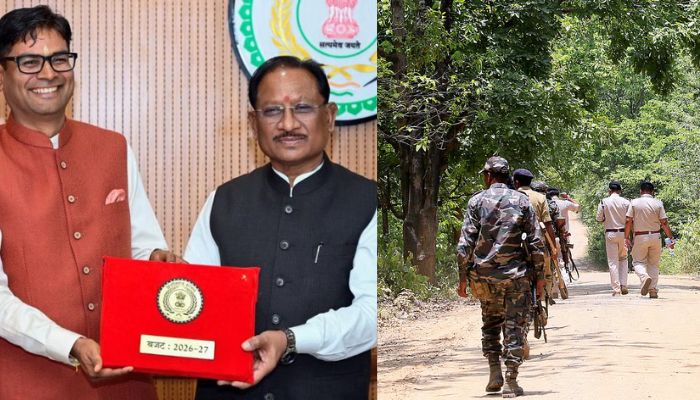
In a major push to transform the once red terror-hit regions, the Chhattisgarh government has announced that Abujhmad and Jagargunda in the Bastar region will be developed into “modern education cities.” An allocation of ₹100 crore was announced on Tuesday, 24th February, for this purpose in the 2026–27 state Budget.
Chhattisgarh budget: Rs 100 crore allocated for construction of 'Education Cities' in Abujhmad and Jagargunda in Bastar region. pic.twitter.com/HdHFQVFyum
Chief Minister Vishnu Deo Sai later explained that the education cities are part of a broader push under the “Five Chief Minister Missions,” each receiving ₹100 crore annually for the next five years. These include the CM’s AI Mission, Sports Excellence Mission, Tourism Development Mission, Infrastructure Mission, and Startup & NIPUN Mission aimed at preparing youth for new-age industries.
The proposed education cities in Abujhmad and Jagargunda will have an integrated system from primary to higher secondary schools, along with sports facilities, roads, and hostels for students from remote villages. Officials said the aim is to create a safe and supportive environment for tribal children and those from weaker sections. The campuses will also offer IT and skill development training so that local youth can access employment-oriented education and explore self-employment opportunities.
‘Dark chapter’ over, Chhattisgarh budget sets Naxal hotbed Bastar on path to ‘education cities’ & tourism
The Budget has a strong focus on Bastar’s overall development. In the irrigation sector, the state has proposed the construction of Matnar and Deurgaon barrages on the Indravati River for ₹2,024 crore, which is expected to irrigate an additional 32,000 hectares of land. The government has also created 1,500 new posts for Bastar Fighters, a special police unit. Other allocations include ₹720 crore for Particularly Vulnerable Tribal Groups (PVTGs), ₹10,000 crore under the Krishak Unnati Yojana, ₹4,000 crore for rural employment, ₹250 crore for industrial parks, and ₹100 crore for EV subsidies.
The announcement was part of the ₹1.72 lakh crore Budget presented by Finance Minister O.P. Choudhary in the Vidhan Sabha. Last year’s Budget stood at ₹1.65 lakh crore. Capital expenditure this year has been increased slightly to ₹26,500 crore from ₹26,341 crore last year. The state’s Gross State Domestic Product (GSDP) has also seen a healthy rise of 12.4%, increasing from ₹6,31,920 crore to ₹7,09,553 crore. Officials said the fiscal deficit stands at 2.87% of GSDP, lower than last year’s 2.91% and within the permissible 3% limit.
समग्र विकास का SANKALP… "विज़न विकसित छत्तीसगढ़ 2047" की दिशा में ऐतिहासिक कदम।
ज्ञान से गति और अब समग्र विकास की ओर बढ़ता छत्तीसगढ़ – किसानों, युवाओं, मातृशक्ति, जनजातीय समाज और हर नागरिक के सशक्त भविष्य का भरोसा बनकर उभरा है।
The Budget announcement comes at a time when Abujhmad, which was known as the strongest Maoist stronghold in the country, has witnessed a sudden transformation. In November, last year, Narayanpur Superintendent of Police Robinsons Guria said that almost 80% of the Naxals operating in the Abujhmad area have surrendered. He also said that security forces now have dominance over almost two-thirds of the area.
#WATCH | Narayanpur, Chhattisgarh | On the surrender and rehabilitation of Naxals in the district, SP Narayanpur, Robinson Guriya says, "Currently in the Abujhmarh area, 80% of the Naxals have surrendered, across levels. Many partners and all members have surrendered. We feel… pic.twitter.com/BAlrOyw5sI
Abujhmad was isolated from the mainstream of development for several decades. There was no proper revenue survey, no land rights for the villagers, and hardly any roads, hospitals, or communication infrastructure. The Maoists had made it their stronghold in the 1990s and 2000s, and they had destroyed all the infrastructure, burned down schools, and established a parallel administration called “Jantana Sarkar.” The people lived in fear, and any development work was either stalled or destroyed.
The security scenario has been changing in the past few years because of the continuous efforts of central and state security forces. The turning point came with the killing of top Maoist leader Nambala Keshav Rao, alias Basavaraju, in May 2025 in the forests of Narayanpur. Basavaraju, the general secretary of CPI-Maoist and one of India’s most wanted insurgents, had a bounty of ₹1.5 crore on his head. His killing was described as a landmark achievement in the fight against Left-Wing Extremism.
Due to Naxalism, this area had little to no civil administration. With a population of around 40 to 45 thousand, mostly Abhujhmadhia tribe people, Abujhmadh included the Orcha block and some regions of the Narayanpur district. Abujhmadhia are among the Particularly Vulnerable Tribal Groups (PVTGs) of Chhattisgarh and are entitled to special benefits and rights from the government meant for endangered groups like them.
There have been no roads, hospitals, and other basic facilities in Abujhmadh since the Naxalites would not allow any development work or any step towards mainstreaming of this region and its people take place. As per locals, Naxalites used to set buses ablaze if they entered villages in Abujhmadh. Maoists made sure that no land deeds were earmarked in Abujhmadh, no motorable roads were constructed, and no development ever reached the villages on this hill. To ensure this, the Maoist terrorists would either resort to violence or propaganda, mostly both.
Before that, Operation Black Forest, conducted along the Chhattisgarh-Telangana border, neutralised several Naxals and destroyed hideouts and explosive stockpiles. Many cadres surrendered, and senior officers described the last two years as decisive in breaking the backbone of Maoist networks in Bastar.
Former Maoist commanders who surrendered have publicly said that Abujhmad is no longer the “Red citadel” it once was. According to police, only a handful of senior leaders remain active, and their ability to operate has been severely restricted.
Despite the challenges, the security forces and the government relentlessly continued their efforts to end the Naxal menace not only in Abujhmadh but the entire Dandakaranya region.
In February 2025, a former Maoist, Giridhar, told TOI that Abujhmadh, the red citadel of Maoists, has “fallen”. The former commander of PLGA, who surrendered and quit Naxalism in 2024, said, “Abujmarh is no longer an impregnable Red citadel. The liberated zones have been smashed, commandos are conquering every inch of Dandakaranya jungles. Maoist cadre base has been practically wiped out.”
Highlighting the change in mindset of the youth in Naxal-infested areas and the administration’s friendly approach towards them, Giridhar, who masterminded the 2009 ambush that killed Rajanandgaon SP Vinod Chaubey, said, “Our cadre base was fast depleting. Police seemed friendlier, with their civic actions, freebies, jobs, and promise of a better life. With education and the lure of urban dazzle, nobody wanted to join us. The youth did not want to die with a police bullet in their head.”
Development push: Giving Bastar a fresh start
With the security situation improving, the government is now focusing on ensuring that people in these areas finally get access to basic facilities and opportunities. For decades, villagers in Abujhmad and surrounding regions lived in fear of violence. Development projects rarely reached them, and many families remained outside the formal education and healthcare systems.
The new education cities are being seen as a symbol of this transition. The idea is simple: once an area is cleared of violence, it must be stabilised quickly with roads, schools, hospitals, communication networks and livelihood opportunities. The state has already taken steps such as installing mobile towers, opening operation theatres, expanding road connectivity and increasing recruitment in local police units.
Efforts are also being made to bring more people into the electoral and administrative mainstream. Revenue surveys, welfare schemes and employment programmes are gradually reaching once inaccessible villages.
Officials say that development is the long-term answer to extremism. When children can attend school safely, when farmers have irrigation facilities, and when youth have skill training and job opportunities, the chances of insurgent groups regaining ground reduce significantly.
Operation Kagar and the Modi govt’s push for a Naxal-Free India
At the national level, the Modi government has amped up operations in Naxal strongholds to entirely uproot the Maoist cadres. The government has adopted a two-pronged strategy of eliminating the Maoist cadres through military operations clubbed with development-oriented works such as expansion of roads, transport facilities, water, electricity and other welfare schemes of the government reaching the villagers.
As part of this strategy, the central government launched Operation Kagar in January 2024 to wipe out Naxalism in Chhattisgarh, Maharashtra (Gadchiroli), Odisha, Jharkhand, Madhya Pradesh, and Telangana. As part of the operation, about 1 lakh para-military forces, including the Central Reserve Police Force (CRPF), its elite forces CoBRA (Commando Units of CRPF), District Reserve Guards (DRG), and state police forces, armed with modern technology, have been deployed in the areas affected by left-wing terrorism to completely root out the naxal terrorism from its last remaining strongholds.
The success of the centre’s anti-Naxal operation can be judged by the fact that, from 2015 to 2025, the number of Naxal-affected districts reduced from 106 to 18. Of these districts, 12 were considered the worst-affected by Naxalism. However, this number was further reduced to only 6 worst Naxal-affected districts, including Bijapur, Kanker, Narayanpur, and Sukma in Chhattisgarh, West Singhbhum in Jharkhand, and Gadhchiroli in Maharashtra.
On 19th February, Bihar authorities announced that the state is now “Naxal-free” after the surrender of prominent Maoist Suresh Koda, also known as Mustakim, who had a reward of Rs 3 lakh. He surrendered himself to the Special Task Force (STF) of the Munger district police a day ago. It is pertinent to note that the number of districts affected by left-wing extremists (LWE) has also decreased to seven, as per a recent analysis of the affected region.
BREAKING NEWS 🚨 📢
Officials declare Bihar 'Naxal-free' after Naxalite Suresh Koda with bounty of ₹3 lakh surrenders in Munger. pic.twitter.com/fkb3fRld8N
Last month, the Centre released a detailed 10-point plan to ensure that areas cleared of Left-Wing Extremism remain peaceful. The plan is meant for the post-Left-Wing Extremism phase and focuses on stabilising districts that have lived through years of violence. It aligns with the development-oriented part of the Cen.
Union Home Minister Amit Shah has reiterated that the government is determined to wipe out Naxalism before 31st March, 2026. The current operations and the collapse of the Maoist strongholds like Abujhmad are being seen as significant milestones in this direction.
As Bastar is all set to welcome the modern education cities in the regions that were earlier known for violence, the region is at a crossroads. For thousands of families who had lived for decades in the shadow of fear, the hope is that development and opportunities will finally come in place of the decades of violence.
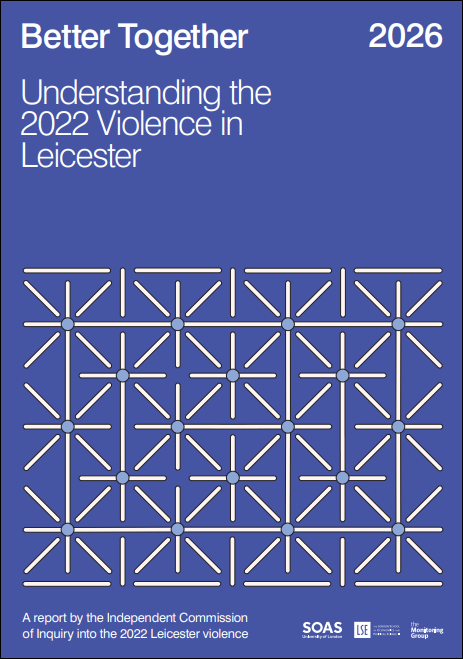
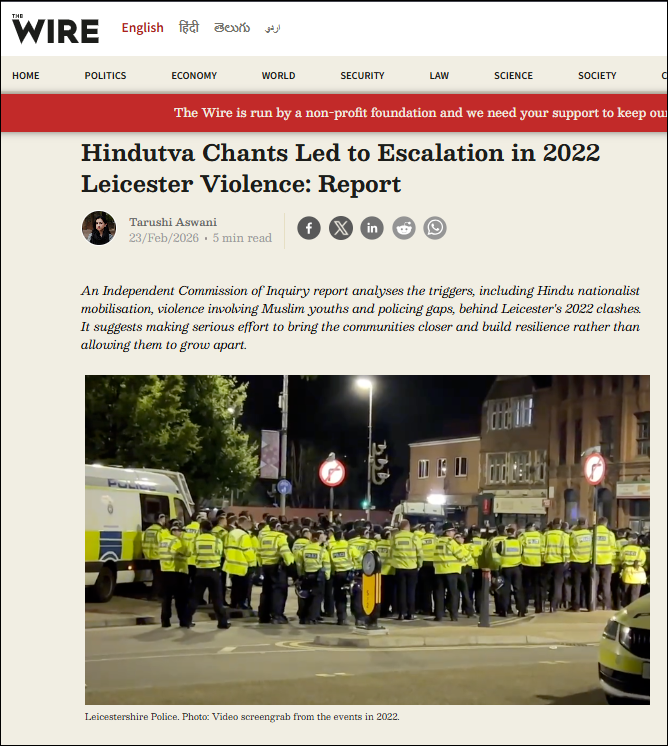
Churning out propaganda material to whitewash Islamist crimes and blame the non-Muslim victims has been a tried and tested tactic of the Islamo-leftist cabal globally. The same Soros-funded coterie comes up with reports, analysis, documentaries and whatnot, laden with pro-Muslim bias, while packaging their content as unbiased ‘inquiry’. In continuation of this ‘intellectual fraud’, the London-based SOAS University, on 23rd February, published a report on the 2022 anti-Hindu Leicester violence.
The School of Oriental and African Studies (SOAS) report titled ‘Better Together: Understanding the 2022 Violence in Leicester’, claims that its findings show that “no single community or group is ‘to blame’ for the violence, distrust, and tensions that erupted in 2022.” However, the report conveniently picked Hindus, Hindutva, and the BJP government in India to blame for violence and communal polarisation in Leicester in 2022.
While the 218-page report does mention incidents of Muslim mobs attacking local Hindus, a Muslim man pulling off the Shivalaya Mandir’s saffron flag, and the stabbing of a Hindu man, the report framed Hindutva as the biggest driver of the violence in Leicester in 2022, even as it was Islamic intolerance of Hindus that triggered violence against Hindus.
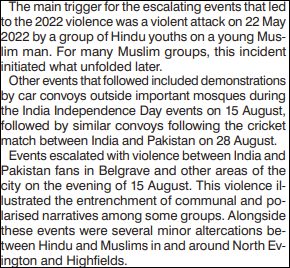
The SOAS report attempted to present an alleged May 2022 attack on a Muslim youth by Hindu men as the “main trigger” that led to the eventual large-scale violence in August-September 2022. “For many Muslim groups, this incident initiated what unfolded later,” the report claims.
It further claimed that it was the ‘provocative’ behaviour of the Hindu youths, including congregations outside mosques and car convoys inthe Green Road Muslim-majority area, especially on India’s Independence Day (15th August), that offended and instigated Muslims. The Hindu youths were mainly from the Daman and Diu regional community.
The tone and the framing of the events of the 2022 Leicester violence in the SOAS report essentially insinuates that it was Hindus who provoked, started, and escalated communal violence by victimising and terrorising ‘peaceful’ Muslims. The report’s ‘findings’, or rather, a dishonest blend of 40 per cent facts and 60 per cent anti-Hindu narrative, come across as suggesting that whatever violent and offensive actions Muslims indulged in against Hindus were reactionary.
The report does intermittently drop balancing statements like ‘Both Hindu nationalist and political Islamist actors actively sought to inflame division for political ends.’ However, it portrays ‘Hindutva’, Hindu ‘nationalism’, and by extension Hindus as the bigger problem, the trigger, the promoter, and the perpetrators of the Leicester violence in 2022.
“Hindu nationalism (Hindutva) was a clear factor in the 17 September march, in narratives about the events from late August, and in the reaction to the events of that Summer. Hindutva narratives about the events took on international dimensions after the late August cricket match events; these intensified following the 5-6 September violence. Hindu nationalist ideology influenced the march, even if not all marchers subscribed to it,” the report reads.
While initially, the SOAS report claimed there was no specific religious community, neither Hindus nor Muslims were to blame for the violence, the researchers soon exposed their hypocrisy and put the larger blame on Hindutva narratives. They insinuated that while the Islamist narrative was confined to local actors, the Hindutva narrative around the events related to Leicester violence was more international, and often coordinated in their approach, reflecting the fact that Hindutva is a state-backed international project.”
After claiming ‘No communities to blame for Leicester violence’, the SOAS University of London report villainises Hindus hailing from Daman a.nd Diu
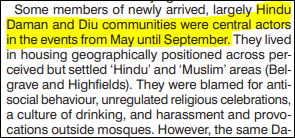
Even as it was Muslim leaders and Islamists like Majid Freeman who were found guilty of instigating violence against Hindus, the SOAS report claimed that Hindus from India’s Daman and Diu “were central actors in the events from May until September.”
Further villainising the Hindus, the SOAS report says, “They (Hindu Daman and Diu communities) were blamed for antisocial behaviour, unregulated religious celebrations, a culture of drinking, and harassment and provocations outside mosques.”
Moving forward, the report highlights how social media was used to amplify misinformation and disinformation to further incite tensions and violence. Despite mentioning that several Leicester Muslims made false stabbing and mob attack claims on social media to instigate violence against Hindus, the SOAS report did not mention specific names like those of Majid Freeman, Mohammed Hijab, and others, despite there being ample evidence.
It must be recalled that in September 2024, Majid Freeman, the Muslim ‘activist’ who had spread lies and misinformation about the role of Hindus in the 2022 anti-Hindu Leicester violence, was jailed for 22 weeks for attempts to spark violence during the same unrest. Freeman was charged with inciting terrorism and lending support to the proscribed terrorist organisation, Hamas. OpIndia had reported back then on how Freeman published disinformation on social media against Hindus, including false claims of Quran desecration.
It seemed that the SOAS report tactfully used balancing language to apparently maintain the façade of unbiasedness. However, the manner in which the so-called ‘Hindu mobs’ raise the Jai Shri Ram slogan is highlighted, while no noticeable mention of violent Muslim mobs screaming ‘Allahu Akbar’, the SOAS researchers, despite advocating “Better together”, are bitter towards Hindus.
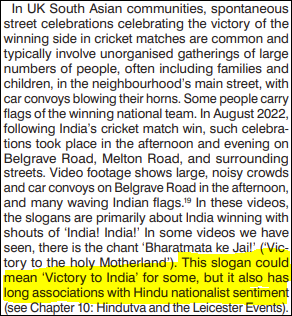
‘Bharat Mata ki Jai’ slogan carries ‘Hindu nationalist’ sentiment: As per SOAS, raising the victory to the motherland slogan by Hindus is problematic
After India won a crucial cricket match against Pakistan in August 2022, the Indian diaspora in Leicester burst into celebrations. Indian national flags were raised, and celebratory car convoys dominated Belgrave Road, Melton Road, and nearby areas. The Indian people were celebrating in Belgrave, a largely Hindu-dominated area, and raising slogans like India! India! And Bharat Mata ki Jai. Despite Bharat Mata ki Jai being the most common slogan raised by not only Indian cricket fans but by all patriotic Indians, the SOAS report shrewdly linked it to ‘Hindu nationalist’ sentiment.
While Islamists in Leicester raised the ‘Allahu Akbar’ slogan, a literal Islamic war cry that even ISIS used before beheading Kafirs was not deemed problematic or inflammatory, the SOAS report insinuated that even a harmless Bharat Mata ki Jai slogan can be deemed inexcusable and offend Muslims.
The report further delved into the religious demographics of Leicester to point out that among just South Asian people, there are approximately equal numbers of Hindus (64,391) and Muslims (63,871).
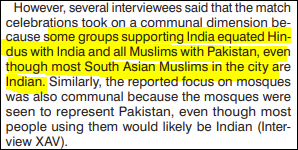
The study, however, comes back to its central motive of blaming the Hindu Indian communities for the 2022 Islamist mob violence. Throwing its weight behind ‘interviewees’, the SOAS report claims that they said “the match celebrations took on a communal dimension because some groups supporting India equated Hindus with India and all Muslims with Pakistan, even though most South Asian Muslims in the city are Indian.”
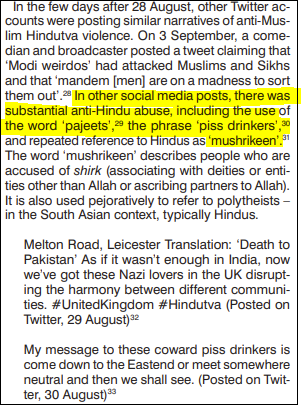
The report further relied on unnamed ‘locals’ and ‘interviewees’ to peddle a one-sided Muslim victimhood bogey by claiming that Hindu mobs vandalised Muslim-owned shops. There is a pattern in the entire report: long, less-facts-more-victimhood paragraphs on Muslims, followed by small but noticeable mentions of anti-Hindu abuse.
Despite the 2022 Leicester violence being a case of Islamist intolerance of unapologetic Hindus and India, the SOAS University of London report found Hindutva to blame. In fact, they even suggested that the clashes were a result of prevailing tensions between two primarily Gujarati communities: East African Asian Muslim and Indian Daman and Diu.
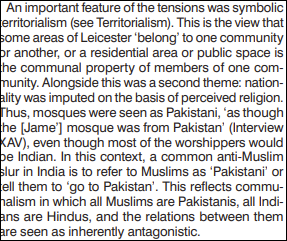
In conclusion, the SOAS University of London report again subtly blames and villainises Hindus by suggesting that Hindus celebrating a match victory saw mosques as ‘Pakistani’ even though most worshippers there would be Indian Muslims.
In essence, the researchers blamed ‘Hindu communalism’ which “reflects communalism in which all Muslims are Pakistanis, all Indians are Hindus, and the relations between them are seen as inherently antagonistic.”
Between 4th and 7th September, Hindus were attacked by Muslims. A local Ganesh Chaturthi celebration was disrupted by Muslim mobs, who threw eggs at Hindu sacred symbols. A Hindu man was attacked. In another incident, after Majid Freeman falsely claimed that Hindu men had attempted to abduct a Muslim girl, a Hindu man was doxed. The police later revealed that the whole story was fabricated.
The SOAS University of London propaganda report, although it mentioned the attack on the Ganesh Chaturthi celebration, somehow inserted the Muslim victimhood narrative here as well.
Regarding the events of 17th and 18th September 2022, the report explicitly blamed a Hindu march by around 300 young men for the subsequent Muslim mob violence. While the likes of Mohammed Hijab openly deployed ‘Muslim patrol’ gangs to intimidate and attack Hindus, the SOAS report suggested that the orientation of the 17th September protest march by Hindus was “determined, purposeful and intended to cause fear and intimidation.”
Hindu temple attacked by Islamists in Leicester, yet the SOAS University report says the incident ‘energised’ the political “Hindus under attack” narrative
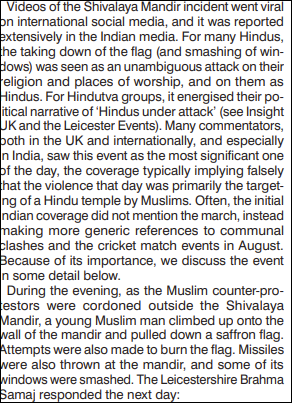
Highlighting the Shivalaya Mandir attack by a Muslim mob wherein a Hindu religious flag was pulled down and burnt, in addition to smashing of windows and throwing of missiles, on 17th September 2022, the SOAS University report said that videos of the incident went viral on social media, and the Indian media also gave it widespread coverage.
Distinguishing Hindus from Hindutva groups, the report said that while the local Hindus saw the Shivalaya Mandir incident as an attack on their religion, temples, and on them as Hindus, for ‘Hindutva’ groups, it energised their political narrative of ‘Hindus under attack’ (see Insight UK and the Leicester Events).
Amusingly, the report also features the ‘Muslims form human chain to protect temple’ bogey. This carefully concocted narrative of Muslims protecting Hindu temples during Islamist violence gained attention during an Islamist mob attack in Bangladesh in 2024 after PM Sheikh Hasina’s forced ouster.
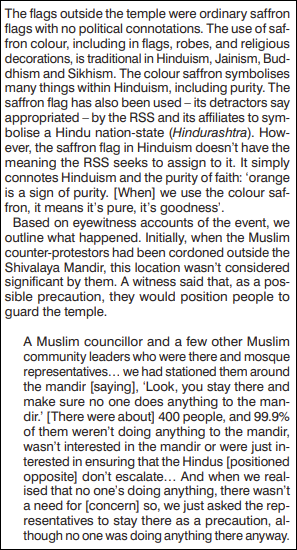
Citing ‘eyewitness’, the SOAS University report says that Muslim counter-protestors had gathered outside the Shivalaya Mandir to guard it and ensure that the Mandir remains unharmed. The report, however, did not comment on why Muslim protestors who gathered to oppose a Hindu protest march would deploy Muslim youths to ‘guard’ a Hindu temple from Hindus.
Exposing its anti-Hindu bias again, the SOAS University report concluded that the march by Hindus on 17th September 2022 was “an unprecedented communal event whose novelty related to the expression of street-level Hindu nationalist ideas during violent actions.” It further asserted that the Hindu march was essentially taken out to “intimidate, threaten and attack” Muslims.
The report dedicated a segment to establishing that Hindu nationalism alone is to blame for the violence in Leicester. From casting aspersions on the denial by the UK Overseas Friends of the BJP, and other ‘Hindutva’ groups of involvement in mobilising Hindu youths in Leicester, to claiming an unnamed old Hindutva figure inciting Hindu youths to take out a protest march in Belgrave, the SOAS University report resorted to weaving a warp and weft of conspiracy theory-level lies to villainise Hindus.
Unsurprisingly, the researchers of this propaganda report expressed disappointment over UK politicians like Bob Blackman, local Hindu organisations, and the RSS in India, condemning the anti-Hindu violence in Leicester.
“Much of the political response to the 17 September violence followed the same paths of communal and religious division that led to the violence in the first place. It is disappointing that many political figures in the UK and abroad sought to amplify narratives of one innocent religious community being the victim of another hate-driven aggressor,” the report states.
Interestingly, the Islamo-leftists become uncomfortable and even disappointed with Indian Hindus and Hindu rights groups expressing support and solidarity for their coreligionists abroad, and frame it as ‘ Hindu polarisation’, but there is no such framing when Muslims across the world cry and are outraged for the distressed people in Gaza solely because of their religious identity. Muslims supporting Muslims is humanity, solidarity, and unity, but Hindus supporting Hindus is ‘polarisation’, Hindutva nationalism, ‘growing intolerance’ and whatnot.
Notably, while the report does make mention of the inflammatory speeches and activities of Islamic fanatics like Mohammed Hijab and Ali Dawah, the “political Islamist disinformation” portion is way too short and downplays the Islamic Jihadist mindset of these instigators when compared to the report’s focus on Hindutva and villainization of Hindus.
George Soros-funded SOAS University report dedicates entire chapter to Hindutva after initially claiming ‘no community is to blame’
In a sharp contrast to all previous reports and investigations into the 2022 anti-Hindu Leicester violence, the SOAS University report outrightly blames Hindutva, Hindus and the BJP government in India for the riots in Leicester.
Even though the SOAS inquiry, chaired by human rights expert Prof Juan Méndez, claimed that there was no religious community to blame for the incidents of violence in Leicester, the inquiry devoted an entire chapter to Hindutva, in a stark contrast to the Henry Jackson Society report.
It must be recalled that in November 2022, the Henry Jackson Society (HJS) released a 39-page report titled “Hindu-Muslim civil unrest in Leicester: ‘Hindutva’ and the creation of a false narrative.” The findings were clear: No evidence of Hindu extremism was found in Leicester. The riots were instigated by Islamist misinformation and mobilisation, not “Hindutva terrorism.” Social media influencers linked to Dawood Ibrahim, Hizb ut-Tahrir, and even Taliban sympathisers exploited the chaos.
The report warned that media outlets, including BBC, The Guardian, and Reuters, amplified the false Islamist narrative by giving platforms to the very agitators spreading hate, thereby deepening mistrust and endangering Hindus.
The SOAS inquiry delved into the origins and evolution of the Hindutva ideology, the role of the RSS, and its relevance in Modi’s India.
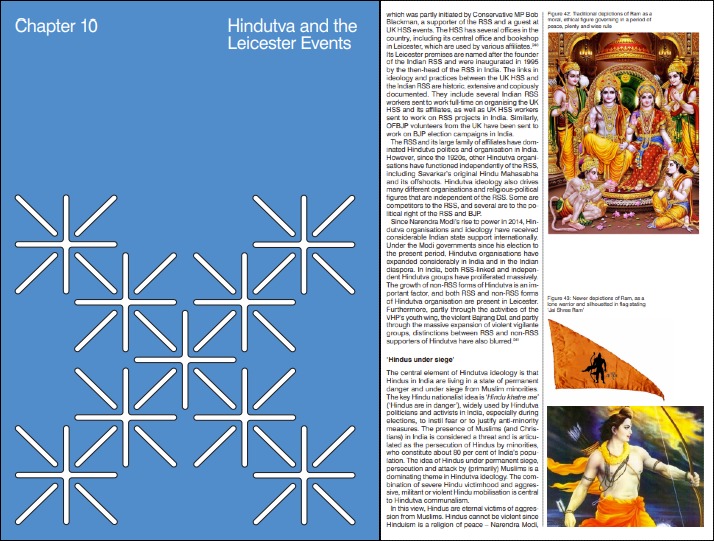
Expectedly, the report villainised the RSS, Hindu rights groups like the Vishwa Hindu Parishad and Bajrang Dal, trivialising the real existential threat Hindus face by suggesting that the Hindutva ideology instils ‘Hindu khatre mein hai’ fear in the Hindu community to justify persecution of Muslim and Christian minorities.
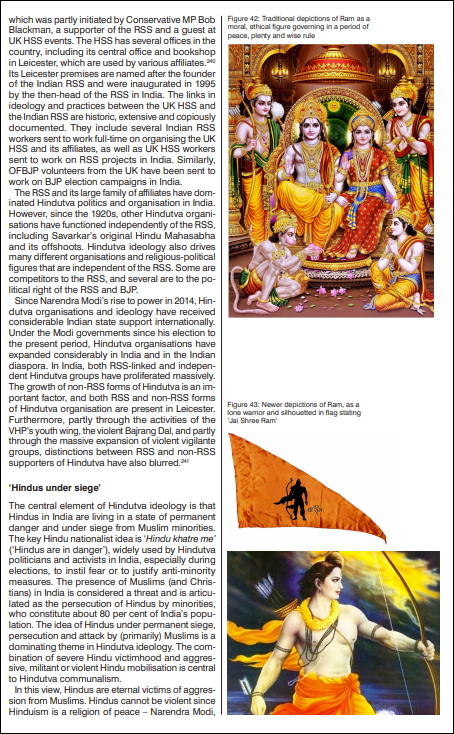
“The presence of Muslims (and Christians) in India is considered a threat and is articulated as the persecution of Hindus by minorities, who constitute about 80 per cent of India’s population. The idea of Hindus under permanent siege, persecution and attack by (primarily) Muslims is a dominating theme in Hindutva ideology,” the report claims.
While dismissing the idea that Hindus are under threat despite the Kashmiri Pandit exodus, frequent attacks on Hindu festival celebrations, and rapidly shifting religious demographics, SOAS University highlighted the 80 per cent Hindu population; however, while pushing the Muslim victimhood bogey, it used the term ‘minority’ even as they are the second largest religious community in India.
The inquiry also portrayed sacred slogans like Jai Shree Ram, Har Har Mahadev, patriotic slogans like Bharat Mata ki Jai, as somehow aggressive, inflammatory, and the idea of Akhand Bharat problematic.
The SOAS inquiry into Leicester violence argued that Hindutva influenced Hindu communities in Leicester. It went to label Bageshwar Dham’s head priest, Pandit Dhirendra Krishna Shastri, a vocal advocate of Hindu rights, a “radical and militant preacher”. The report lamented that despite Shastri advocating for a Hindu Rashtra, a theological Hindu nation where all other non-Hindu communities would also be allowed to reside and have rights, the Leicestershire Police awarded Shastri an ‘NPA [Neighbourhood Policing Area] Commanders Award for Recognition of Service’ on 27 July 2023.
SOAS University researchers irked with OpIndia for reporting the Islamist anti-Hindu Leicester violence exactly as what it was
Analysing the impact of social media on the incidents in Leicester back in 2022 and vice versa, the SOAS University report, although brief, did cover Muslim social media disinformation; its central focus remained on the Hindutva narrative.
The report claimed that Hindutva organisations and their UK-based supporters amplified a Hindu ‘victimhood’ narrative on social media under the hashtag #HindusUnderAttackinUK.
The SOAS University report describes the broader “Hindus Under Attack” phrase as a social media tag created by the RSS and its supporters in India, exclusively referring to “Muslims attacking Hindus and is part of the RSS’s ideology of Hindus living in a state of permanent siege from Muslims. Hindutva organisations often use the phrase to refer to the situation of Hindu minorities in Bangladesh, Pakistan and Kashmir.”
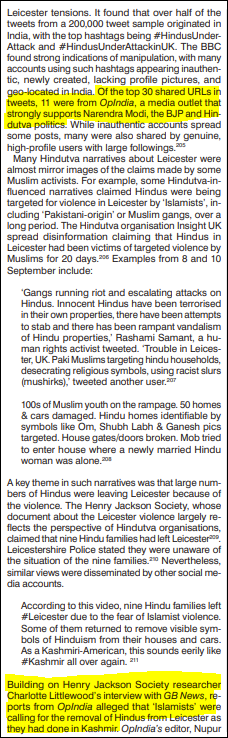
The propaganda report further cites a BBC report to claim that social media narrative manipulation was at play during the Leicester violence in 2022, with OpIndia being a significant contributor.
“Of the top 30 shared URLs in tweets, 11 were from OpIndia, a media outlet that strongly supports Narendra Modi, the BJP and Hindutva politics,” the report claimed.
“Henry Jackson Society researcher Charlotte Littlewood’s interview with GB News, reports from OpIndia alleged that ‘Islamists’ were calling for the removal of Hindus from Leicester as they had done in Kashmir,” it adds.
SOAS inquiry does not blame any community for Leicester violence but recommends confronting Hindutva ‘extremism’ and makes no such case for countering Islamic extremism
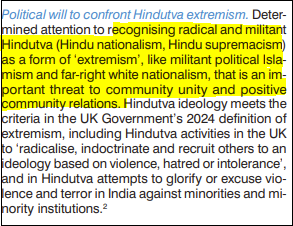
The Open Society Foundations (OSF)- funded inquiry also made several recommendations based on its findings regarding the 2022 anti-Hindu violence in Leicester. A specific recommendation that exposes the fundamental bias and dishonesty of the inquiry nobody asked for is the “Political will to confront Hindutva extremism”. The report recommended the UK National government to determinately recognise radical and militant Hindutva as a form of extremism as just like militant political Islamism.
“Determined attention to recognising radical and militant Hindutva (Hindu nationalism, Hindu supremacism) as a form of ‘extremism’, like militant political Islamism and far-right white nationalism, that is an important threat to community unity and positive community relations,” the report reads.
It is criminal to put Hindutva on par with “political Islamism” for UK extremism policy. British Hindus have never carried out terror attacks in the country; Islamists, on the contrary, do it for a hobby. In fact, the term ‘political Islamism’ itself is fundamentally dishonest. There is Islam and only Islam, no political Islam, biological Islam, regional Islam, musical Islam or stuff like that. The only thing that separates terrorist and non-terrorist Muslims is the degree of strictness in adherence to Islam. Hindutva, on the contrary, despite advocating for a Hindu Rashtra, does not call for a genocide or removal of legitimate non-Hindu Indian citizens.
India-hater George Soros funded SOAS University garbage on Leicester violence
It has become almost a rarity that a link between any piece of anti-Hindu and anti-India propaganda and Hungarian-American philanthropist and known Modi detractor, George Soros, does not emerge. The SOAS University’s Leicester violence inquiry-cum-propaganda report is funded by Soros-linked Open Society Foundations (OSF).
The OSF is accused of engineering regime change operations around the world through civil society groups and activists. The OSF describes itself as the world’s largest private funding agency of groups supporting human rights, justice and accountable government. In reality, however, it is dedicated to toppling non-left governments and stirring unrest in target countries.
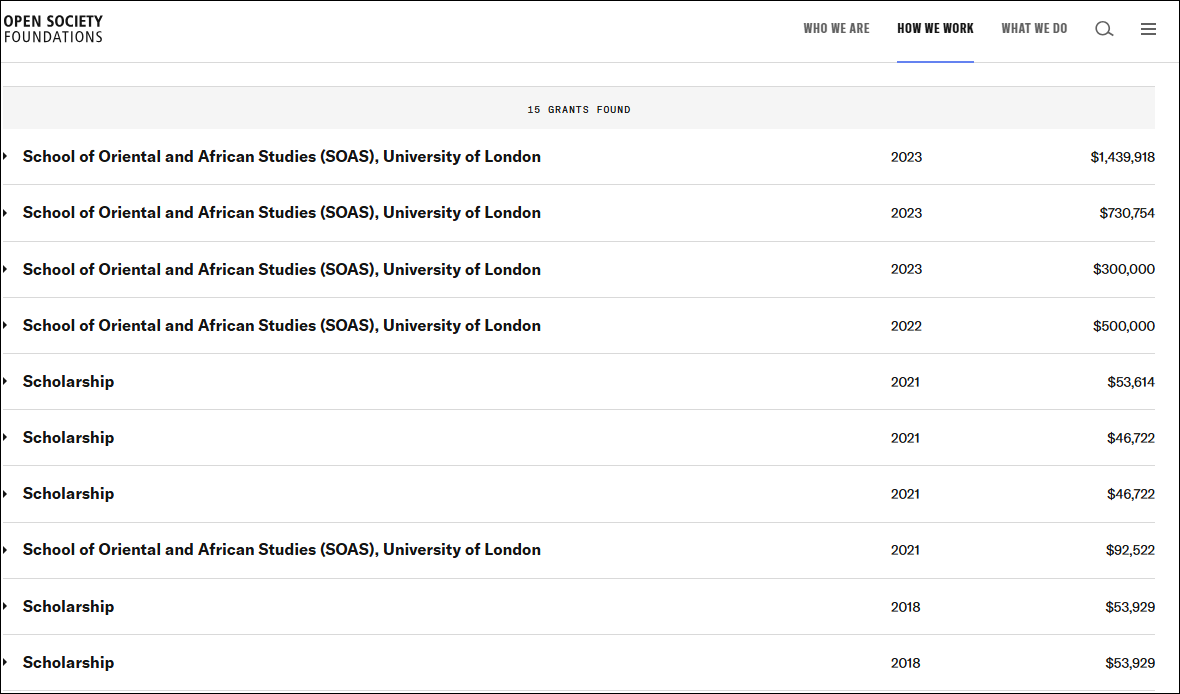
The Open Society Foundation has, in the last decade, made several grants to the SOAS University. As per the records available on OSF’s website, the Foundation gave a grant of $730,754 in 2023 to the SOAS University for a 21-month term, to “support the creation and work of a commission of inquiry into intercommunal violence in the UK in 2022.”
In a separate grant to the varsity in 2022, the OSF gave $1,439,918 to “support fellows working to improve democracy and human rights in the South Asian diaspora.”
Source: Open Society Foundations
Who are the authors of the Soros-funded SOAS University inquiry that paints Hindus and Hindutva as the aggressors of the violence unleashed by Muslim in Leicester
The ‘Better Together: Understanding the 2022 Violence in Leicester’ inquiry’s panel included five members, namely, Juan E. Méndez, Former UN Special Rapporteur on Torture, Schona Jolly KC, HR Lawyer, Subir Sinha, Reader in Development Studies, SOAS, Chetan Bhatt, Professor of Sociology, LSE, and Suresh Grover from The Monitoring Group.
All five members of the SOAS inquiry panel have a track record of peddling Hinduphobia and coddling Islamists in the UK.
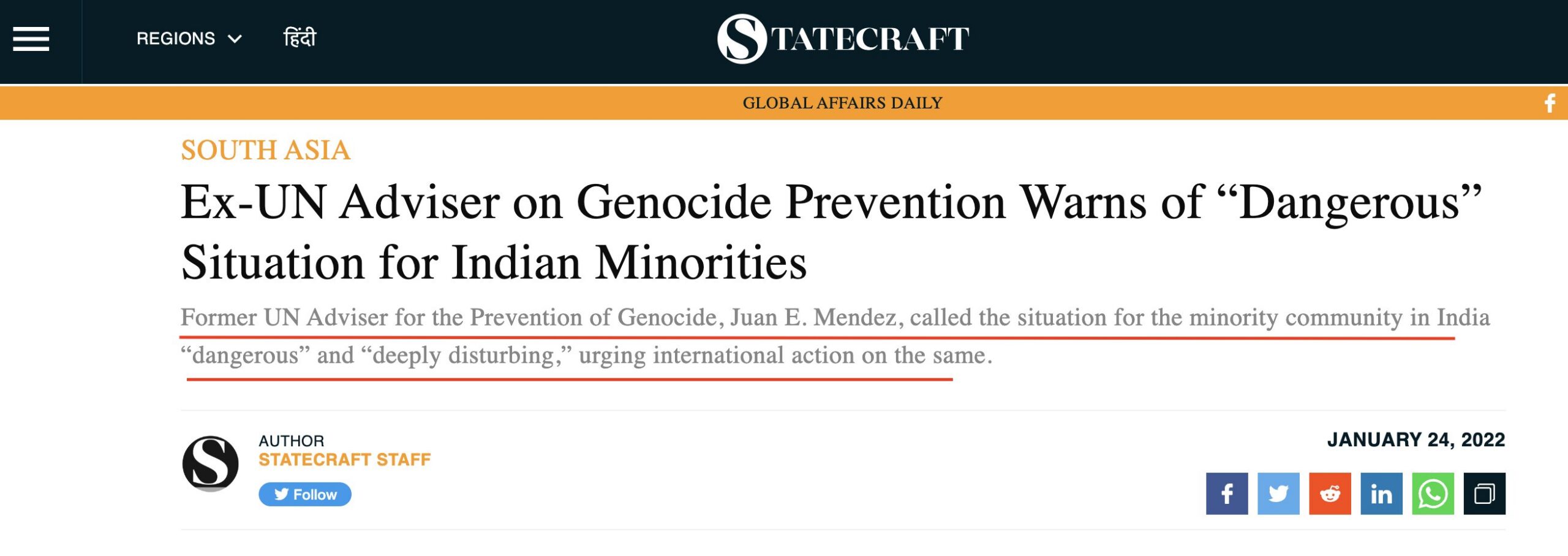
The panel head, Juan E. Méndez, has a record of peddlingthe Muslim victimhood narrative. Previously, Méndez had given an interview to Qatari-state-funded Al Jazeera wherein he called for UN and international intervention in India to “protect Indian minorities”.
Méndez, however, never made similar appeals for Hindus in Pakistan and Bangladesh despite them being religious minorities subjected to unending persecution and discrimination by the Muslim majority.
Meanwhile, another panellist, Schona Jolly, an HR lawyer, earlier appeared in a webinar alongside Professor Mukullika Banerjee, who was involved in an incident targeting Indian student Karan Kataria from the London School of Economics (LSE). Jolly is also reported to be a supporter of Kashmiri separatism, making her a direct enemy of India’s territorial integrity. Banerjee is reported to close to Congress leader Rahul Gandhi.
The next is Subir Sinha, a Reader in Development Studies at SOAS, who has previously equated Hindutva with the genocidal Nazis.
3. Subir Sinha, Reader in Development Studies, SOAS. Sinha has many times equated Hinduism with Nazis. 4/7 pic.twitter.com/aJ82G3VUxj
— Stop Hindu Hate Advocacy Network (SHHAN) (@HinduHate) June 9, 2023
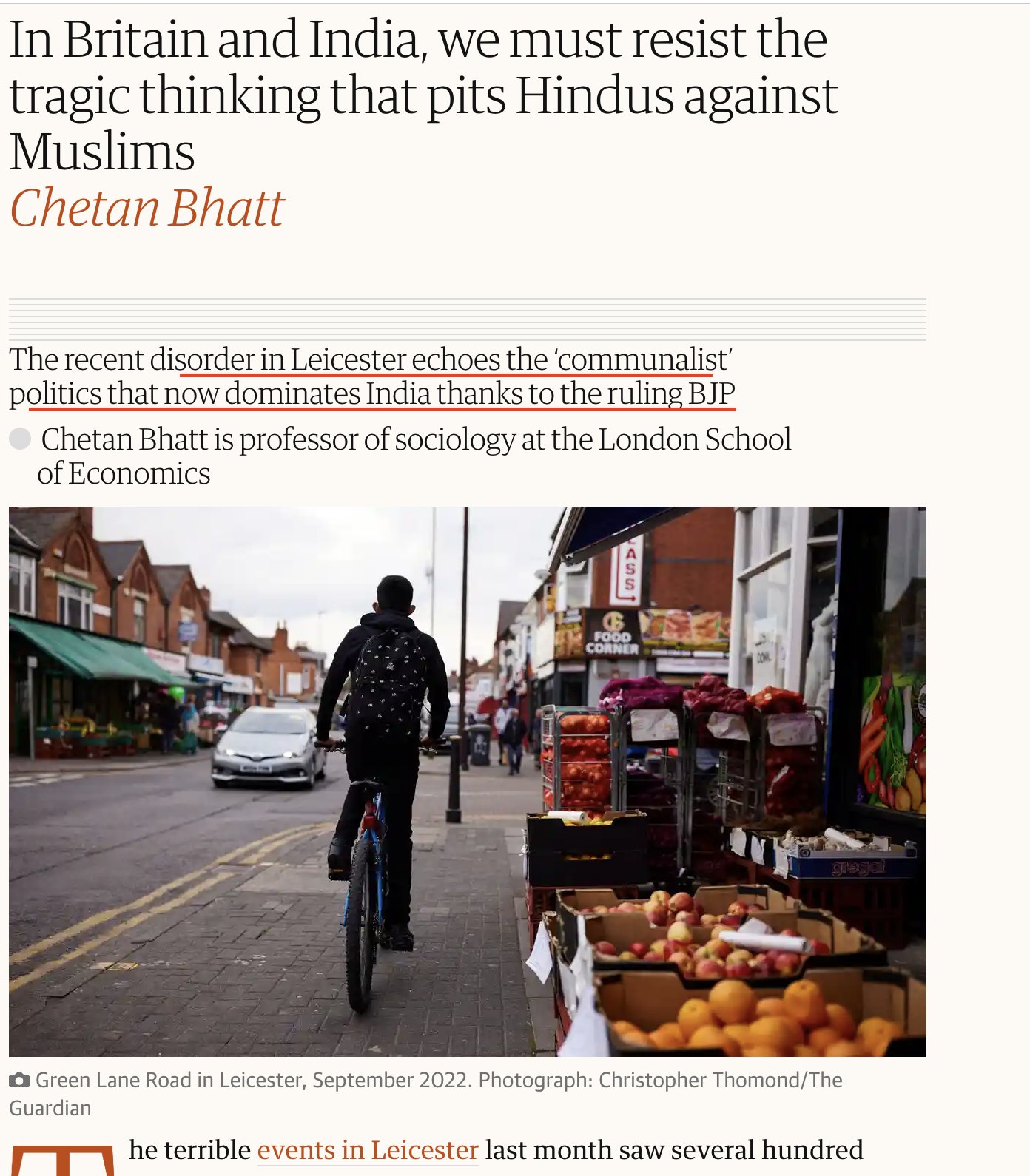
Another researcher, Chetan Bhatt, Professor of Sociology, LSE, had previously written a propaganda article in The Guardian, blaming Hindus for Leicester violence. He equated the RSS with Islamic terrorist entities like Pakistan’s Jamat-e-Islami and Egypt’s Muslim Brotherhood.
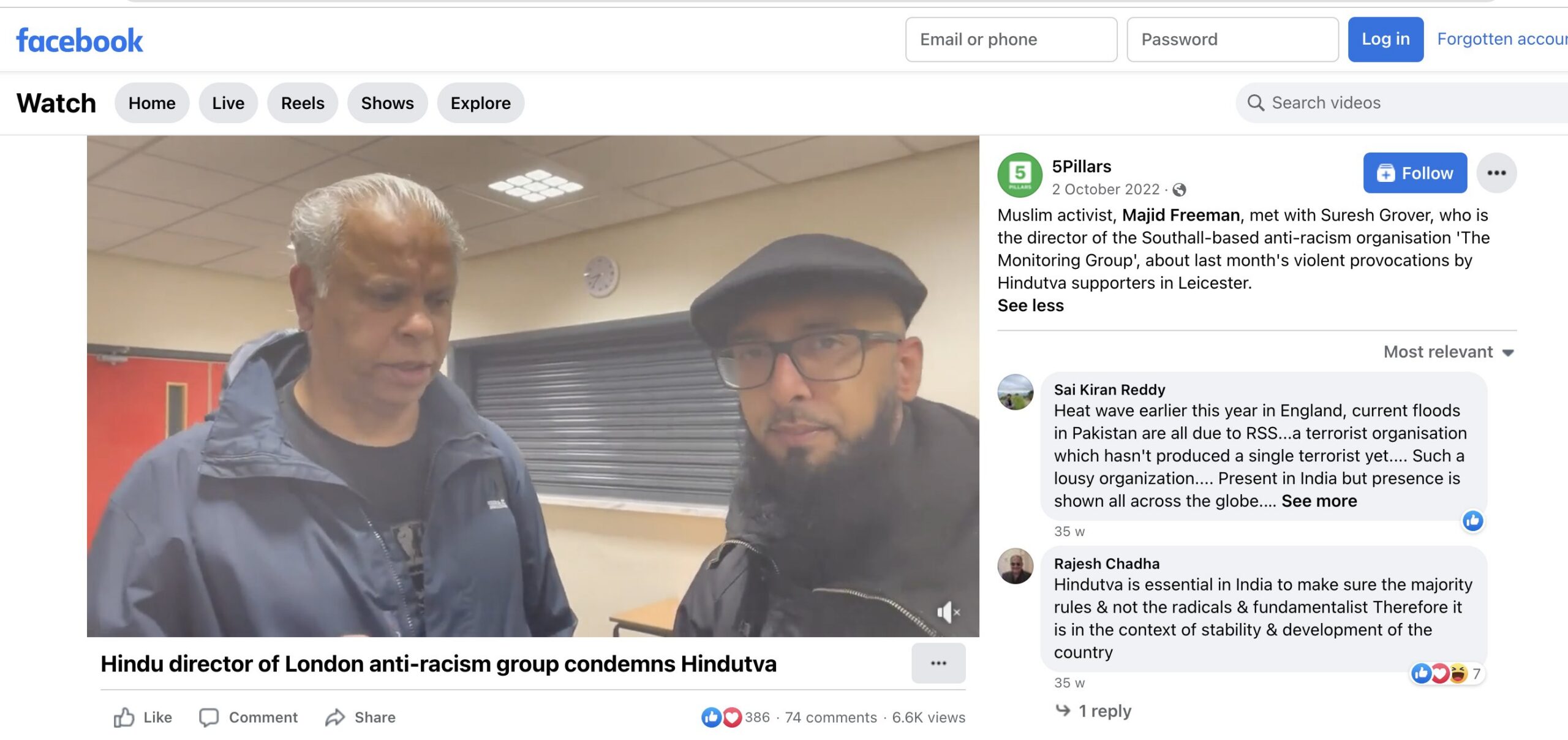
Suresh Grover, from The Monitoring Group (TMG), in an interview with convicted Leicester violence instigator and Islamic fanatic Majid Freeman, blamed Hindus and the RSS for the violence.
No wonder the SOAS inquiry into the 2022 Leicester violence is riddled with propaganda villainising Hindus and blaming them as the perpetrators of the Islamist violence.
While the spinning of propaganda and false narratives by Islamo-leftists against Hindus and Hindutva, in connection with Leicester, will remain an unending story, the truth remains that the High Court of Justice in England has already debunked fake news about the involvement of ‘Hindutva’ inthe 2022 Leicester violence.
In August 2025, during the hearing of a defamation case filed by an Islamist and Leicester violence instigator, Mohammed Hijab against the weekly British political and cultural news magazine, The Spectator, the court said, “The claimant’s (Mohammed Hijab) account as to his basis for attributing responsibility to the Hindutva does not withstand scrutiny. He had not been in Leicester in the days and weeks leading up to his speech. He had no first-hand knowledge of the events and was not in a position to make a direct first-hand informed assessment.”
Debunking the ‘Hindutva involvement’ claim by Hijab based on a video clip of masked men chanting ‘Jai Shree Ram’ and marching past a Muslim neighbourhood, which also is found in the SOAS University inquiry report, the court noted, “he claimant relied on the chants of “Jai Shree Ram” but he did not have any convincing reason for asserting that this was necessarily an indicator of the Hindutva as opposed to Hindus who do not subscribe to the Hindutva ideology. The claimant, in his oral evidence, said he had seen Hindutva flags when he was in Leicester. This was not in his witness statement. In any event, he did not profess any detailed knowledge of Hindu vexillology, and he was in no position reliably to attach particular significance to individual flags.“
Evidently, the SOAS University’s report is neither an inquiry nor credible research; rather, it is recycled propaganda by a Hindu-hating Soros-funded institution. It brazenly aims to resurrect lies that courts have already debunked and evidence has conclusively disproven, all to smear Hindus, Hindutva, and the BJP-RSS. Unsurprisingly, Islamo-leftist propaganda portal The Wire has amplified the anti-Hindu trash produced by the SOAS University as some universal truth.
Hindu community and groups unequivocally reject the so-called “Independent” SOAS inquiry report
The so-called “independent” SOAS inquiry into the 2022 Leicester violence has now concluded, and its report has been published. From the moment it was announced in 2023, the inquiry… pic.twitter.com/HNZzH1Ka5A
Meanwhile, the British Hindu community and various Hindu rights groups have condemned the not-so-independent inquiry by the Soros-funded SOAS University into Leicester violence.
The Indian Navy’s Anti-Submarine Warfare (ASW) capabilities are soon going to receive a significant push after the commissioning of “Anjadip,” the third member of the Arnala-class eight-vessel ASW Shallow Water Craft (SWC) series.
Admiral Dinesh K. Tripathi, Chief of the Naval Staff, is scheduled to preside over the event on 27th February(Friday) when the warship will officially join the Eastern Naval Command at Chennai Port. The Navy has planned to put the second next-generation destroyer into service with the goal of finding enemy submarines in shallow waters.
The state-of-the-art marvel was created especially to handle the difficulties of the littoral warfare environment, which includes the shallow and coastal waters that are critical to the security of the country. The ship is intended to operate as a “Dolphin Hunter,” whose primary mission is to locate, track and destroy enemy submarines in coastal regions.
INDIAN NAVY TO COMMISSION ANJADIP
The Indian Navy is set to enhance its Anti-Submarine Warfare (ASW) capabilities with the commissioning of Anjadip, the third vessel of the eight-ship Anti-Submarine Warfare Shallow Water Craft (ASW-SWC) project. The warship will be formally… pic.twitter.com/XskjKT60I2
“The ship is a reincarnation of the erstwhile INS (Indian Naval Ship) Anjadip, a Petya class Corvette decommissioned in 2003. The ship derives its name from Anjadip Island located off the coast of Karwar, Karnataka, underscoring India’s commitment to safeguarding its expansive maritime domain,” the Navy outlined.
It further highlighted, “The Shankh symbolises divine energy, purity and the sound of creation. Anjadip’s operational prowess – encompassing its Anti-Submarine Capabilities is powerfully encapsulated by its motto – Seek the enemy, and be ever victorious.”
The ship, which was delivered to the Indian Navy on 22nd December in Chennai, has been designed and built locally by Garden Reach Shipbuilders and Engineers (GRSE), Kolkata.
Unveiling the crest of Anjadip, the third ship of the eight ASW-SWC built by @OfficialGRSE. The Shankh symbolises divine energy, purity, and the sound of creation. Anjadip’s operational prowess – encompassing its Anti-Submarine Capabilities is… pic.twitter.com/FuATfzsQRI
“The ASW SWC ships have been designed and constructed as per the Classification Rules of Indian Register of Shipping (IRS) under a Public-Private-Partnership (PPP) of GRSE with M/s L&T (Larsen & Toubro) Shipyard, Kattupalli, thus demonstrating the success of collaborative defence manufacturing,” the Navy informed.
The ship’s prominent features and capacities
These vessels, which are about 77 metres long and powered by waterjets, are the biggest Indian Naval Warships. They are outfitted with cutting-edge lightweight torpedoes, indigenous anti-submarine rockets and shallow water sonar, which enable the efficient identification and confrontation of underwater threats. The ship would boost the Navy’s minelaying, coastal surveillance and anti-submarine capabilities.
It features ASW weaponry and sensor packages, including the Hull-Mounted Sonar Abhay. The agile and exceptionally manoeuvrable battleship is capable of performing search and rescue missions and Low-Intensity Maritime Operations (LIMO) in addition to its core ASW task. With its high-speed Water-Jet Propulsion system, it can reach a maximum speed of 25 knots for swift response and uninterrupted operation. It can be employed for both military and humanitarian purposes due to these attributes.
The official statement declared, “Anjadip’s delivery is yet another milestone in the Indian Navy’s quest for indigenous shipbuilding, ng upholding the government’s vision of Aatmanirbhar Bharat with over 80% indigenous content. The ship stands as a testament to a growing domestic defence manufacturing ecosystem and reducing dependency on imports.”
The Defence Acquisition Council (DAC) approved the purchase of 16 ASW ships in December 2013 at a cost of more than Rs 13,000 crore. Furthermore, contracts for the production of 16 ASW SWC were signed. Cochin Shipyard Limited is to construct 8 of these Mahe-class ships, while the remaining Arnala-class would be made by GRSE.
The recently commissioned Mahe, Malvan, Mangrol, Malpe, Mulki, Magdala and Machilipatnam are parts ofthe formero,rmer while Arnala, Androth, Anjadip, Amini, Abhay, Agray, Ajay, and Akshay constitute the latter. The success of indigenous warship design and building is best demonstrated by this substantial project.
A golden feather in the “Made-in-India” cap
Notably, coastal surveillance is crucial for Anti-Submarine Warfare (ASW) operations in India because of its vast 7,516-kilometre coastline, 12 major ports, 184 smaller ports and 1,197 island territories. Therefore, ASW SWC inductions are helping the Navy fill a prolonged operational gap by offering the vital strength for spotting and deterring stealthy diesel-electric submarines moving along the shore, an area that is inaccessible to bigger surface warships.
They are key to protecting harbour approaches, sea lanes connecting to main ports, offshore energy assets and operational bases, which are vulnerable and economically important marine assets because of their low draught, excellent sonars and great mobility.
The Indian Navy’s ability to protect the nation’s extensive marine interests and coastal approaches, such as the Tamil Nadu and Puducherry region, has been presently reinforced by Anjadip’s deployment. This accomplishment is yet another important step in making the Navy a powerful “Builder’s Navy.”
Similarly, India’s continuous efforts to become self-sufficient in shipbuilding and defence technology are reflected in the launch of Anjadip. The ASW SWC program also shows the nation’s dedication to generating innovative military platforms in the country through homegrown design, manufacture and advanced systems integration.
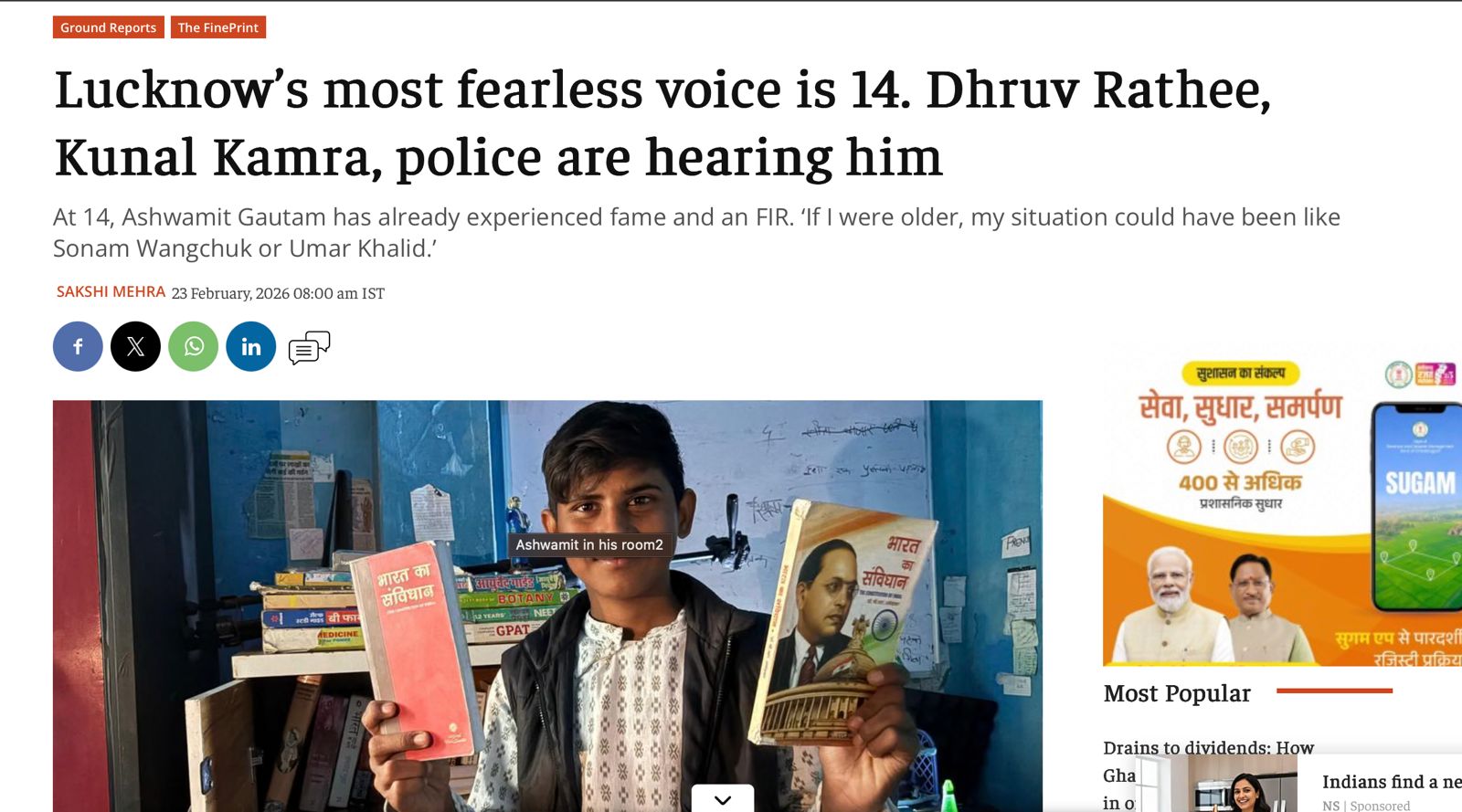
There is something deeply unsettling about a society that mistakes virality for virtue and outrage for intellect. The recent glorification of 14-year-old Ashwamit Gautam by sections of the media and the usual ecosystem of left-wing influencers is a textbook example of how India’s attention economy preys on minors and rewards provocation over education.
At an age when children are supposed to be in classrooms, grappling with textbooks, building foundations in mathematics, science, and language, Ashwamit Gautam is being paraded as a “fearless political voice”, armed with a smartphone, a clip-on mic, and a script carefully tailored for maximum algorithmic impact.
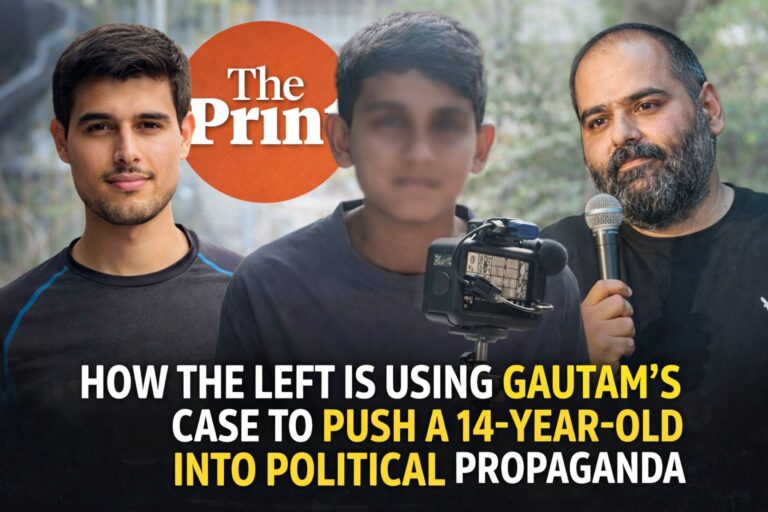
Media houses like The Print have gone out of their way to publish hagiographic profiles, portraying him as a child-prophet of dissent, while conveniently ignoring the most basic and uncomfortable question: why is a 14-year-old being turned into a full-time political content creator in the first place?
Source: The Print
Is it the desperation to replace PM Modi that every and all measures are being undertaken to paint the BJP in a bad light and gaslight the public into looking for an alternative regime at the centre? Well, the helplessness of the Left, especially in more than 10 years of Modi at the helm, has acquainted us with the ecosystem willing to grasp at straws even if there is a remote possibility of a measure accomplishing their political objectives.
Nevertheless, let us strip away the sentimental packaging. What we are seeing is not “courage”. It is the industrialisation of rage. Social media platforms reward the loudest, angriest, most polarising content with views, followers, and donations. A teenager, like any other human being, responds to incentives. When the incentive structure tells him that attacking the Centre, exaggerating claims, and producing rage-bait will fetch him popularity, gadgets, and celebrity treatment, that is exactly what he will do. This is not political awakening. This is behavioural conditioning by algorithms.
The Left-liberal ecosystem, of course, is thrilled. A minor is the perfect political mascot: emotionally evocative, morally armoured, and largely immune to criticism. Any attempt to question the wisdom of pushing a child into the toxic arena of daily political combat is instantly reframed as “silencing dissent” or “attacking a Dalit voice”. This is intellectual dishonesty of the highest order. Caste or background cannot be used as a shield to justify pulling a child away from structured education, throwing him into the meat grinder of social media politics, and then rationalising his views as repressed public anger.
In fact, if questioned about why a minor is weaned away from education, the Left can spin the narrative against the Centre, blaming it for ‘forcing’ the marginalised child to abandon education for social media activism. But make no mistake, by his own admission, he left regular schooling because he was asked to stop making political videos. In other words, this is not a case of the system denying him education; it is a case of choosing virality over studies. That distinction matters. A lot.
But for the usual suspects, Kunal Kamra, Dhruv Rathee and the broader propaganda industry, this is a feature, not a bug. They have found a new symbol to weaponise: a teenager who can be showcased as “brave” while parroting the same tired, predictable talking points about the Modi government, the RSS, and “shrinking dissent”. He is invited, amplified, gifted equipment, and showered with praise. Not because this is good for him as a child, but because he is useful to them as a narrative device.
There is a deeper rot here. We live in a time when a child holding a mobile phone and chasing trends is celebrated more than a child holding a book and building a future. We are told this is “democratisation of voice”. In reality, it is the commodification of childhood. The metrics of success are no longer grades, skills, or knowledge, but views, likes, and follower counts.
None of this is to deny that teenagers can have opinions. They can. They should. But there is a world of difference between having opinions and being turned into a full-time political influencer before you are even legally allowed to vote. Politics is not a game. It is a brutal, cynical, high-stakes arena that even adults struggle to navigate without being consumed by it. Pushing a 14-year-old into this space and then applauding ourselves for “encouraging free speech” is not progressive. It is reckless.
The real indictment here is not of the child. It is of the adults, media houses, influencers, and activists, who see a minor not as someone to protect and guide, but as content, as a tool, as a symbol to be monetised and milked for ideological mileage.
A society that rewards children more for outrage than for education should not pretend it is building a better future. It is merely building a louder, angrier, and far more hollow one.
Before proceeding, for the uninitiated, let me summarize who belongs to which generation:
Gen X – someone born between 1965-1980 Gen Y (Millennials) – born between 1981-96 Gen Z (Zoomers) – born between 1997-2012
Those born in 2013 or afterwards are known as Gen Alpha, while those not falling in any of these would be Baby Boomers or older generations, if alive.
For someone born in 1980, technically there is now a third generation after me (not in my family; but generally, how a generation is defined i.e. a period of 15 years) and I already feel outdated like any AI product from 2024.
But this realization also means that I try to listen more and understand various points of views, especially of the younger generation. One of the things that I’ve been interested in is their attitude towards caste identity, especially among the general caste, or let’s say the ‘upper-caste’ youth. I was surprised to see that many had more ‘conservative’ and less apologetic views on it as compared to mine.
And no, my attempts to explore this didn’t begin after the outrage around the UGC regulations.
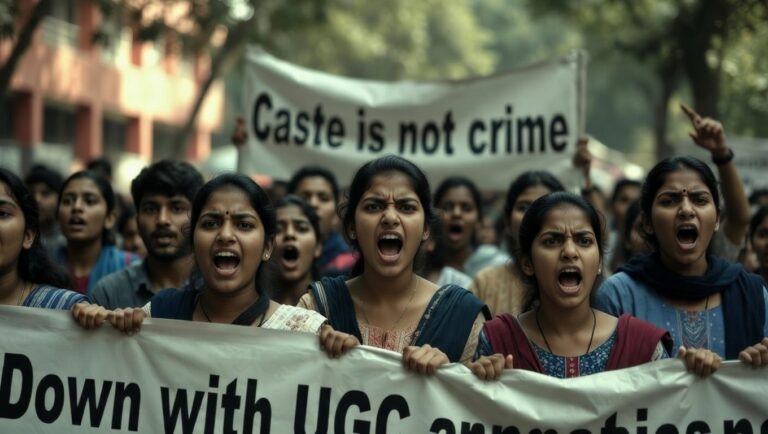
While no doubt many older generation folks are also jumping into this outrage around UGC regulations and some have even become the face of the outrage/movement, the resistance primarily came from the Gen Z folks who could be convinced (and they were right) that their supposed best years as college-going youth can be spoiled by these regulations just because of their caste identity.
It is ironic that Congress spent literally crores of rupees in trying to create unrest through Gen Z, but none of those gimmicks worked. Heck, they even spent money to paint Rahul Gandhi as someone whom Gen Z considers as a ‘sex symbol’ who could sway them into doing whatever he wanted, but Congress couldn’t get the Gen Z into the streets. What finally brought them out was something that was not triggered by a Congressi ppt, but a sarkari pdf.
As an aside, someone in Congress must be taking credit for having orchestrated this ‘Gen Z unrest’ and asking Rahul Gandhi to increase the budget of their team. However, this outrage has indeed been driven mostly through organic reach rather than paid attempts (which could be there as well in some cases, given the nature of social media).
Coming back to the approach towards caste identity among the younger upper-caste folks, one of the first attempts I had made was before the 2024 general elections when some Rajput groups were outraged over two things; first the controversy around Raja Mihir Bhoj, who was celebrated as Gurjar king rather than a Rajput king (this was grouse of Rajput groups) and then the statement of BJP leader Parshottam Rupala who had ended up angering Rajputs while trying to argue that Dalits were ‘more loyal’ to their national and Hindu identity than Rajput kings (Rupala had apologized later).
I thought both these were not such a big issue. My reasoning being, if the Dalits or OBC communities are given reasons to associate themselves with Hindu iconography and heritage with pride (and even with some aggression), upper castes should ‘accommodate’ because this is better than Ambedkarite narrative of completely divorcing the history of such groups from anything Hindu.
But young Rajput folks whom I tried to engage simply didn’t buy this argument, or rather optimism. They maintained that this was not some attempt at social harmony, but it was theft, rather dacoity. “They are going to claim our ancestry and valor today, tomorrow they would claim our ancestral property and dignity” was what of the guys argued, before adding that “we will not go down without a fight”.
Slippery slope arguments are always tricky, but I didn’t further argue as my intention was never to argue but to understand. I was amused that caste consciousness was rather high in this young guy while I thought it will dissipate or weaken in subsequent generations.
Well, that guy today can come back and tell me that “See, I was right. First, they asked us to do away with our history and heritage, and now there is an attack on dignity by painting every upper-caste person as an oppressor”. He hasn’t, though I can see him outraging on UGC on X.
This article isn’t on UGC regulations per se, much has been spoken on that, and the court has stayed them too, but a little attempt on why the upper-caste urban Gen Z appears more caste conscious than the earlier generations. I’m obviously guilty of generalization, as not everyone in Gen Z would be like that, but anecdotal ‘evidence’ and the outrage around UGC show that I might not be way off the mark.
Primary reason I feel is ‘lived experience’ (incidentally a term favorite with the leftists). I’d again be guilty of generalization, but I think the lived experiences of different generations of the urban ‘upper castes’ can be summarized as below:
From Boomers to Gen Z: How caste consciousness has varied
Baby Boomers did not only see that there indeed was upper-caste hegemony in some sectors, but they might even be harboring some supremacist beliefs in some form at some point in time in their lives. Therefore, a good number from this generation could have a ‘guilty conscience’, for they have witnessed some of the ‘atrocities’ first hand, and consequently, the elites among them, additionally influenced by colonial narrative, proactively supported affirmative actions to correct these historical wrongs. Let’s remember that the constituent assembly of post-partition India was dominated by upper-caste Hindus.
While there indeed exists made-up ‘atrocity literature’ and even more made-up diagnoses of reasons why those atrocities happened, one would be very dishonest to claim that no discrimination ever existed, especially in the 20th century. In general, the Boomers, and more so the earlier generation, agreed upon some sections being historically disadvantaged and discriminated against, and thus the constitution allowed for reservations and other policies that tantamount to ‘positive discrimination’.
Gen X and the Mandal Commission
While Gen X witnessed less of the discriminations first hand, they were more or less influenced by the Boomer narrative. I think a good part of that guilty conscience was passed on to them, because they definitely witnessed the supremacist or feudal mindset if not ‘atrocities’ themselves. If not guilty conscience, one can argue that they had a bit sympathetic approach towards affirmative action, because the claims of discrimination or inequality didn’t appear entirely fictional to them, especially when it came to the SC/ST community.
Incidentally, Gen X was the generation that protested in the streets against the Mandal Commission recommendations that advocated for OBC reservations. It was a bitter experience. Possibly a defeatist attitude additionally crept into their psyche after realizing how their protests, which included self-immolation, came to achieve nothing. They were essentially made to feel that their life was not more important than “social justice”. In all probability, this generation decided to just ‘accept the fate’ and try to salvage whatever is left. Some just decided to leave the country and settle abroad.
Millennialsand caste identity
Then came the Millennials. Many of them actually witnessed or heard about ‘reverse discrimination’ more than the original claims of caste discrimination. Not to say that India was free of any discrimination against ‘lower castes’ by this time, but this is the generation that started using internet. As a result, it wasn’t entirely captive to the accepted mainstream narratives from the Boomers or Gen X era anymore. However, I’d argue that many still retained a bit of empathy, if not sympathy or guilty conscience, towards the issue of affirmative actions or reservations. Primarily because there was nothing like Mandal Commission that hit their generation that could have ignited their caste consciousness.
The decision of UPA government in the year 2006 to extend OBC reservations to premier educational institutes like IITs, IIMs, and AIIMs was a little blip, but it couldn’t have the same kind of effect as original Mandal Commission. There were two reasons for it; one, the affected territory was limited, and two, the courts ensured that the seats available to the upper castes didn’t go down due to reservations. Institutes were asked to expand capacity to keep the number of unreserved seats unaffected. This wasn’t as bitter an experience like that of Gen X where no one cared even when they self-immolated – at least a resolution was offered this time.
I’d argue that upper-caste urban millennials were possibly the least conscious about their caste identity, because they thought that the worst was over and the post-broadband-and-smartphones world was a different place. That’s why when PM Modi asked to give up subsidies voluntarily (like the LPG cylinder subsidy), I don’t recall seeing any quip like “why should upper-castes give up anything when the money thus collected will be used for welfare of soshit-vanchit only?” which I’m sure will be thrown today by many I follow on X if a similar call is given by the government.
That thought just didn’t cross anyone’s mind at all, and they were sending SMS, including myself, to opt out of the subsidy. Constant glorification of Ambedkar didn’t raise any red flags either, because I believe that millennials didn’t just think that the worst was over, they retained a bit of empathy towards the issue of caste discrimination and inequality. And obviously, the ‘Hindu nationalist’ narrative overpowered everything else where fellow Hindus were to be helped.
And now we have the Gen Z.
Why Gen Z are more likely to be caste-conscious
Nope, they are not the monsters without empathy, but they are the generation that has not witnessed the ‘atrocities’ first-hand and possibly hasn’t even seen that mentality present among their parents (being the children born to Gen X). The urban bunch among them has more reasons to believe that ‘reverse discrimination’ exists than otherwise.
They have also seen how some news reports about discrimination against lower-castes end up being spiced up (many times the perpetrators being OBC than ‘upper castes’) and have grown hearing about misuse of SC/ST act. They have also been exposed to extreme Ambedkarite narratives in crude form thanks to the internet and social media (they had much more free and uncensored access than millennials).
You can’t expect this generation to have a guilty conscience because their lived experience is very different. Any empathy that this generation could have developed has been evaporated by the neo-Ambedkarites making cringe and crude reels targeting their caste identity. Celebrities and media platforms too have endorsed many such abusive ‘content creators’ in the name of dissent and ‘anti-caste’ activism. Such experiences have led to the development of caste consciousness among this generation, which I was a bit amused to discover a couple of years ago.
The only way this generation can develop a guilty conscience is if the education system is entirely taken over by the Cultural Marxists, who teach this oppressor-oppressed framework around ethnic identities as some sort of axiomatic fact. Ah, now you see why those rabid professors exist in humanities departments (though not just in humanities) in various universities? You’ve to give it to the leftists that they know the challenges and work towards the solutions. Perhaps they thought that Gen Z was already ‘taken care of’ through their meticulous brainwashing, but clearly, they haven’t been successful.
A section of the UGC regulations, especially how the caste-based discrimination was defined, was entirely subservient to this oppressor-oppressed framework. The fact that Gen Z decided to resist it rather than surrender to the “social justice” narrative shows that the battle is not entirely lost.
‘Affirmative action’ vs Gen Z’s own lived experience
This is not to say that India now needs no affirmative action, but the government and policy makers have to factor in the upper-caste urban Gen Z, whose lived experiences are very different from their own respective generations. A casual extreme thought could cross the mind that why not give Gen Z the ‘same treatment’ that Gen X was given during the Mandal Commission? But that would be counter-productive, because Gen Z is not Gen X, and the respective worlds in which they operated are very different.
On the other hand, the forces fighting against Cultural Marxism or Ambedkarite narrative also need to realize that while the Gen Z has increased caste consciousness, it doesn’t mean they are ready to jump on to your side and become flag-bearers of whatever is your pet project – resurgence of traditional Hinduism, cultural nationalism, “right wing” or whatever, though a window of opportunity is surely there to reach out to this bunch. Gen Z are not ready to take the knee, but that doesn’t mean they are ready to take up swords.
UGC is just a symptom, the issue is that of caste consciousness that has made a comeback due to various reasons, some of which I tried to summarize, at the risk of broad-brushing the entire issue.
And while I write all this, Generation Alpha is playing in their schools. Wait for them to discover their caste and ask AI about what it means.
On 23rd February, Pratapgarh police in Uttar Pradesh arrested Badrul Jama for keeping Santosh Shukla captive for 10 years and converting him to Islam. 40-year-old Shukla hails from Madhya Pradesh. He told police in his complaint that he was held captive for nearly a decade, forced to change his religion and identity, and beaten whenever he attempted to escape. OpIndia accessed the FIR in the matter.
According to media reports, the victim is a resident of Patharia Haat village in Sagar district of Madhya Pradesh. He had been working at a dhaba in Chhattisgarh around 2014 when he came into contact with four men from Pratapgarh.
Lured with promises of work and marriage
The accused befriended Shukla and promised him a stable job, marriage and a better life if he relocated to their village in Pratapgarh district. He was reportedly brought to Kuttiliya Sadei village under Jethwara police station limits.
What was projected as an opportunity for a better life turned into prolonged confinement. Shukla told police that he was forced to work at the house of one of the accused and was not allowed to return home. Reports further state that whenever he expressed a desire to leave or tried to flee, he was beaten and threatened with death.
Allegations of forced conversion and identity change
Shukla told police that he was taken to a mosque in Dawood Nagar and converted without his consent. His name was changed from Santosh Shukla to Sher Ali Khan, and a new Aadhaar card was prepared in the altered name using forged documents.
He further stated that he was made to recite religious verses and forced to consume meat against his will. The matter came to light after Shukla managed to escape and approach the police outpost in Derwa to narrate his ordeal.
What the FIR says
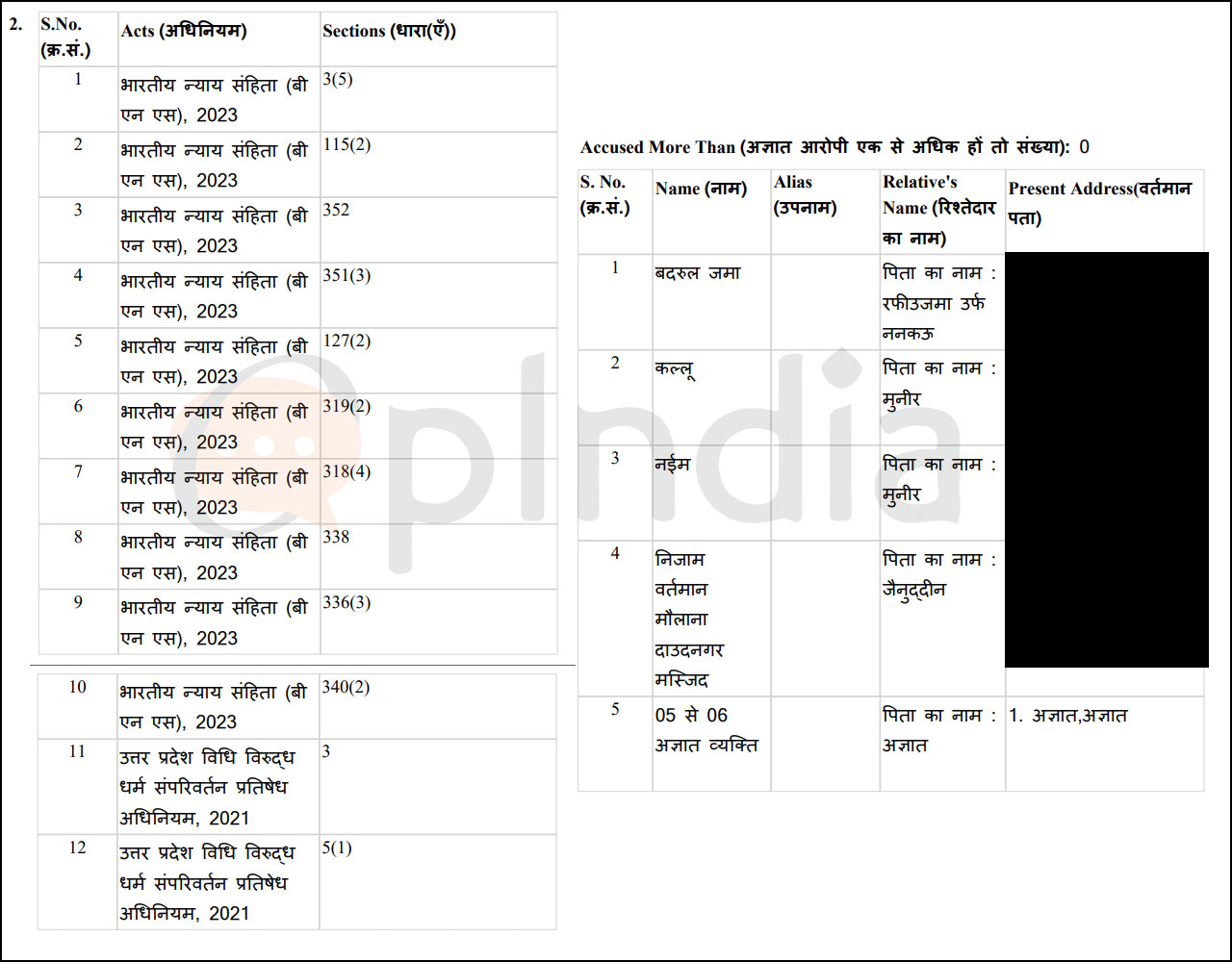
The FIR has been registered on the complaint of Santosh Shukla under Sections 3(5), 115(2), 127(2), 318(4), 319(2), 336(3), 338, 340(2), 351(3) and 352 of the Bharatiya Nyaya Sanhita (BNS) and Sections 3 and 5(1) of the Uttar Pradesh Prohibition of Unlawful Conversion of Religion Act against Badrul Jama, Kallu, Naeem, Nizam and 5-6 unknown persons.
Source: UP police
In his complaint, Shukla said that he was kept as a bonded labourer, forced to perform household work, abused, beaten and threatened with death if he tried to escape. He further stated that he was forcibly converted at Dawood Nagar mosque without his consent and made to adopt the name Sher Ali Khan. A fake Aadhaar card was created in this name using forged documents.
He added that the accused misused the fake Aadhaar card as well. He further stated that they fed him meat to hurt his religious sentiments and, when he opposed, he was force-fed meat.
On 20th February, when he attempted to flee, Badrul and his associates caught him, brought him back, assaulted him and threatened to kill him and dispose of his body. He later managed to escape again and reached the police to lodge his complaint.
Police action so far
Additional Superintendent of Police Brijanandan Rai stated that a case has been registered on the basis of the complaint. One accused, Badrul Jama, has been arrested, while police teams have been formed to apprehend the remaining accused.
थाना जेठवारा पर सूचना प्राप्त हुई थी कि थाना क्षेत्रान्तर्गत 01 व्यक्ति का धर्म परिवर्तन कर उसका नाम परिवर्तित कर दिया गया है, थाना स्थानीय पुलिस द्वारा की जा रही कार्यवाही के संबंध में-
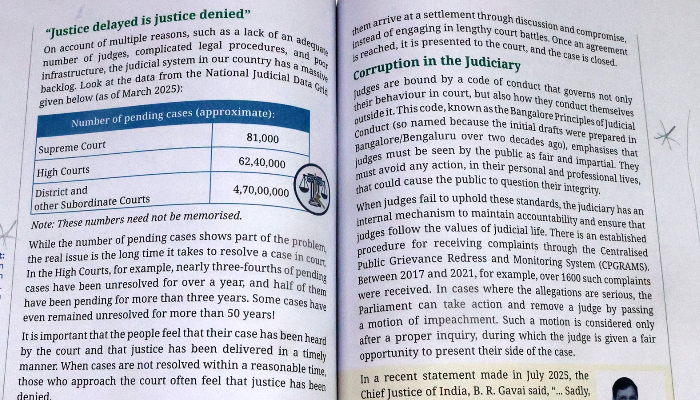
The National Council for Education Research and Training (NCERT) released the new textbook for Class 8 on Social Sciences on Monday. The book, titled ‘Exploring Society: India and Beyond Part-2’, includes a chapter on “The Role of Judiciary in Our Society”. The chapter includes a section on the major challenges before the Indian judiciary at present, corruption in the judiciary and the massive amount of case backlog are listed in that.
The section starts with the subheading “Justice delayed is justice denied”, and lists the massive amount of case backlog that the Indian judiciary faces. Without laying unfair blame with political motivation, the paragraph lists real reasons behind the backlog, like the lack of an adequate number of judges, complicated judicial procedure and the poor judicial infrastructure.
The problems facing the judiciary are covered in the revised chapter.(Source: The Indian Express)
The subheading ‘corruption in the judiciary’ describes the importance of proper judicial conduct, the Bangalore Principles of Judicial Conduct and why it is important that judges are seen by the public as fair and impartial. The section also informs students that there is an established procedure to maintain accountability, the Centralised Public Grievance and Monitoring System (CPGRAMS).
None of the above details are fictional, the issues mentioned, the backlogs, and the necessity of proper judicial accountability in a country are all facts. However, social media is as usual divided into two different major opinions.
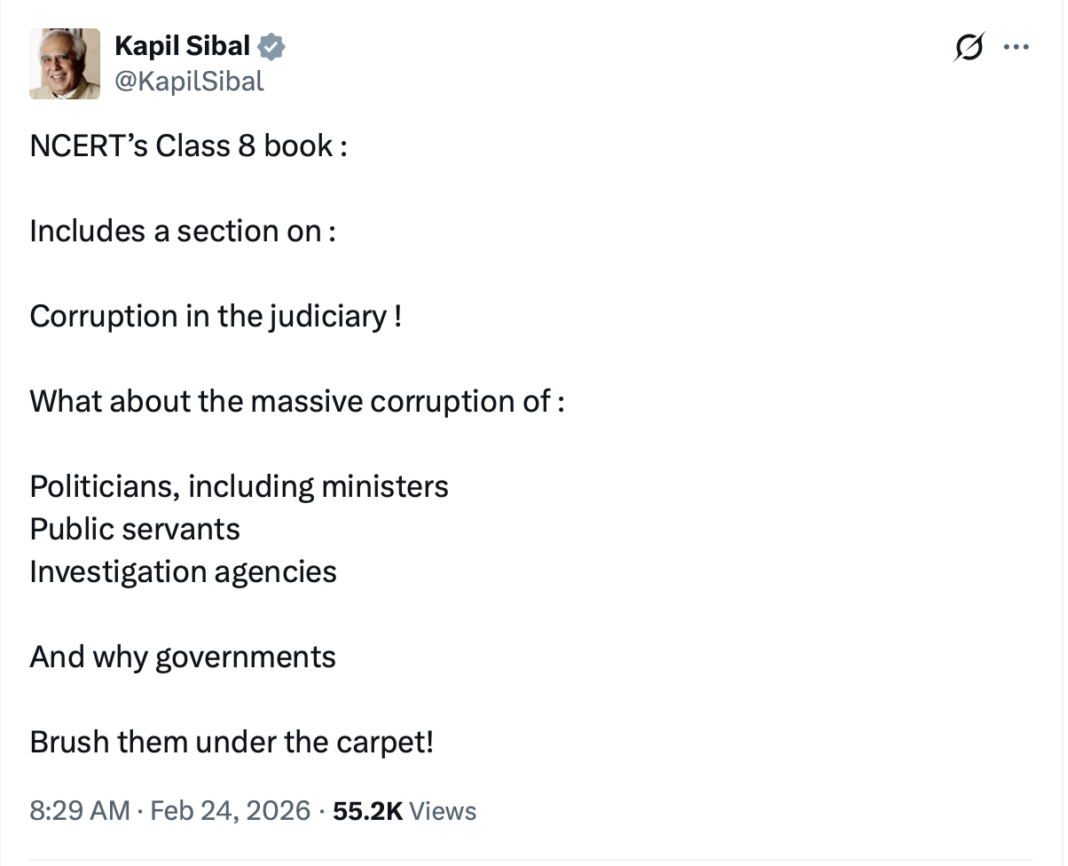
One group, like Kapil Sibal, suggests it’s unfair to highlight corruption in the judiciary without addressing similar issues in other government branches. The other group sees the inclusion of the section in the NCERT textbook as some sort of goal-scoring by the government against the judiciary.
In reality, both claims miss the mark. The textbook simply presents verifiable facts with a balanced perspective on ongoing reforms, and including such content is a positive step toward fostering informed citizenship among students.
Important perspective, not propaganda
The book doesn’t paint a one-sided picture. It emphasizes accountability mechanisms, such as judges being bound by a code of conduct, internal complaint systems like the Centralised Public Grievance Redress and Monitoring System (CPGRAMS), which handled over 1,600 complaints between 2017 and 2021, and informs about parliamentary impeachment for serious allegations.
It quotes former Chief Justice of India B.R. Gavai from July 2025, acknowledging instances of corruption and misconduct but stressing swift, decisive and transparent action to rebuild trust.
The chapter also highlights positive efforts at state and union levels, including technology use, to enhance transparency.
By no means this is a sensationalism or goal scoring of any kind. In fact, this aligns with broader NCERT revisions under NEP 2020, which aim to incorporate contemporary issues into curricula.
Kapil Sibal’s argument overlooks the chapter’s scope: it’s dedicated to the judiciary. There are other chapters in the book, like chapters on Parliament and lawmaking, and so on. There is a chapter on social justice and its necessity, emphasising how government sometimes fails to benefit the marginalised communities. The textbook isn’t a comparative analysis of government branches; it’s an introduction to how the judicial system functions and its real-world challenges. Corruption isn’t unique to the judiciary. If a textbook informs students that corruption and backlogs are among the major challenges faced by the Indian judiciary today, it is telling facts and providing a crucial contemporary perspective, not disseminating propaganda.
Kapil Sibal’s post
Similarly wrong and misleading are the hyperventilating claims suggesting some sort of goal-scoring against the judiciary by the government. The content is evidence-based. Backlog statistics come from official sources, showing over 81,000 pending cases in SC, 62,40,000 pending cases in HCs, and a staggering 4,70,00,000 pending cases in lower courts, a figure that has doubled in a decade and could take centuries to clear at current rates.
The corruption references draw from judicial leaders themselves, like CJI Gavai’s remarks, not partisan sources.
NCERT operates as an autonomous body, and these updates stem from NEP 2020’s emphasis on critical thinking and real-world relevance, not political vendettas. The subtle pattern of change in how subjects are explained to students have been changing over the years, diverting from the cold mention of facts in old books to added perspectives and updated points of view in latest books.
New-age students need new-age learning
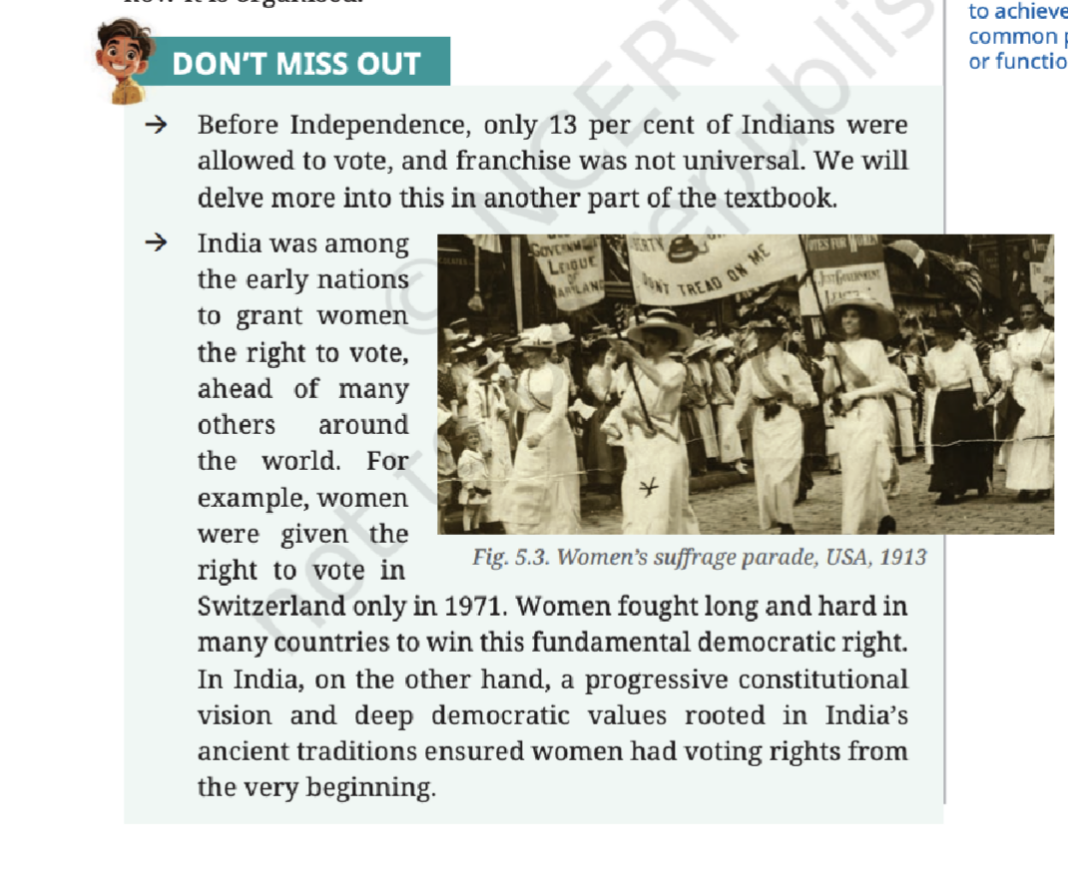
For example, take this mention of universal franchise in India. It is from the chapter ‘Universal Franchise and India’s Electoral System’ in Part 1 of the Social Sciences NCERT textbook. Going beyond just laying cold details that students find dry and unrelatable, the chapter makes a point to remind students why the universal franchise was important for a newly independent India. And how, the early leaders, displaying a more progressive and forward-thinking attitude than many European nations at that time, decided that women of India will also vote, granting them equal rights as citizens of this nation.
Books of the past told us about forest terrains, mountain terrains and deserts. But current books provide added context on how people live there, what kinds of difficulties they face, and how they earn a living. Past instances of blind glorification of certain rulers, like Babar and Aurangzeb, have also ‘evolved’, educating students about the other sides of their rule, like temple destructions, forced conversions and cruelty.
Times are changing. Students do not just need cold details and texts detached from real-world scenarios. They need perspectives and thinking points that explain the real-world implications and realities of our times.
Far from being problematic, including these perspectives is a smart evolution for NCERT. Traditional textbooks often stuck to “cold details”, structures, hierarchies, and ideals, leaving students disconnected from reality. By discussing challenges like corruption and backlogs, the book aligns with NEP’s goal of promoting analytical skills and civic awareness among children. It encourages discussions on reforms, such as technology-driven transparency or increasing judicial staffing, preparing young minds to engage with democracy’s imperfections.
In a country where judicial delays affect millions, with a real possibility that the families of some of the students who will read this book might be among them, this isn’t indoctrination or propaganda. This is empowerment. Students learn that institutions aren’t infallible but can improve through accountability. They learn that questioning the existing system is their democratic right and accountability, and corrections are as important as the institutions themselves.
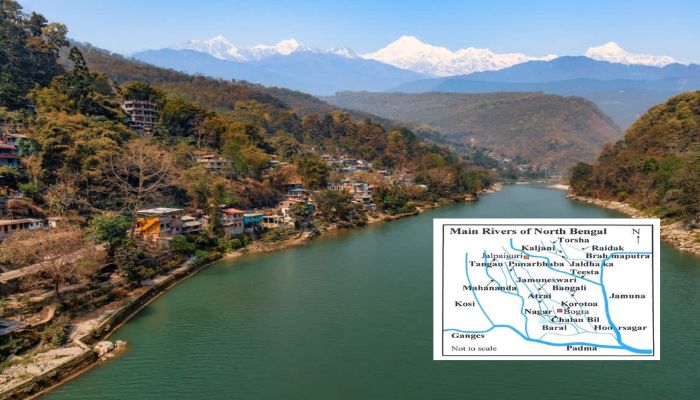
On 22nd February, China said that it is willing to move forward with the Teesta River Comprehensive Management and Restoration Project which has been pending for a long time. Notably, China made the announcement within a week of Tarique Rahman becoming the Prime Minister of Bangladesh. The development is likely to cause strategic unease for India.
Foreign Minister of Bangladesh, Dr Khalilur Rahman, met with Chinese Ambassador Yao Wen on Sunday. Following the meeting, Wen spoke to the media and said that China and Bangladesh had engaged in discussions over the Teesta River project for several years. He claimed that the work on the project would begin soon.
Wen added that China is ready to execute the project and stated that its implementation would depend on the priorities set by the newly elected government in Bangladesh. China’s remarks, which came via Wen, are being seen as its intent to operationalise a major infrastructure commitment following regime change in Bangladesh.
Interestingly, Wen described the recent General Elections in Bangladesh as “smooth and orderly” and called them a “victory of democracy”. He added that China is ready to work with the new leadership in Bangladesh and strengthen bilateral relations across sectors. Furthermore, high level discussions between the two nations would continue in the coming months.
Beijing signals deeper Belt and Road push under new Bangladeshi leadership
The recent statements made by Chinese leaders make it clear that Beijing wants to expand its approach towards Bangladesh beyond diplomatic engagement. On 17th February, Chinese Premier Li Qiang sent a congratulatory message to Rahman following his swearing in. The message reaffirmed China’s willingness to work with the new administration to advance “high quality Belt and Road cooperation”.
In his message, Li called China and Bangladesh long standing Comprehensive Strategic Cooperative Partners. He emphasised that China is willing to provide support for the priorities of Rahman’s government. He added that China is ready to elevate bilateral cooperation across multiple sectors, including infrastructure and river management. The wording of the message indicated that the Teesta project may now be formally embedded within the broader Belt and Road Initiative framework.
China emphasised expanding strategic cooperation at the very outset of the new government’s tenure, which indicates that it wants to increase its influence in Bangladesh’s infrastructure planning ecosystem, specifically in sectors that carry long term operational and geographical significance.
The proposed Teesta management project includes large scale dredging, embankment strengthening, flood control infrastructure, irrigation canals, land reclamation, and reservoir construction along a transboundary river system. Notably, Teesta flows close to India’s eastern frontier. In case a third party gets involved in the project’s execution, especially if that “third party” is China, it is likely to be closely watched by the Government of India.
What the Teesta project entails, and why it is more than a river plan
The Teesta River Comprehensive Management and Restoration Project is officially being presented as a development-oriented river management programme. However, its scope goes far beyond routine flood control or irrigation modernisation.
When executed as intended, it would involve dredging of riverbeds, strengthening of embankments, construction of reservoirs for dry season storage, development of irrigation canal networks, erosion control infrastructure, land reclamation, transport linkages, and long-term hydrological monitoring systems.
When these projects are considered together, it effectively amounts to the creation of a permanent river basin management ecosystem. Such projects require the sustained presence of foreign contractors, engineers, survey teams, project management units, equipment corridors, and monitoring stations across multiple sites along Bangladesh’s Teesta basin.
If Bangladesh undertakes such projects, it does not concern India per se. However, Chinese involvement in the project in a geographically sensitive zone along a transboundary river that originates in India’s eastern Himalayan region and flows into northern Bangladesh before joining the Brahmaputra does raise serious concerns for Delhi.
The Teesta originates in Sikkim and travels through North Bengal before entering Bangladesh. It is a critical upstream resource for India and a key downstream dependency for Dhaka. Any basin wide management intervention downstream inevitably has implications for upstream flow dynamics, seasonal storage patterns, and long-term water release expectations.
Dispute history, why the Teesta issue has remained unresolved for decades
The Teesta water sharing dispute between India and Bangladesh is not a recent development. It is a long-standing bilateral issue. Despite efforts made by governments on both sides for decades, the matter has remained unresolved.
The two nations have been engaging in discussions over equitable distribution of Teesta waters since the early 1970s. In 1972, the Joint Rivers Commission was established to facilitate discussions on transboundary river management.
In 1983, India and Bangladesh reached an ad hoc arrangement that allocated 39% of dry season flows to India and 36% to Bangladesh. The remaining portion was left unallocated pending further agreement. However, the formula was never materialised into a permanent treaty framework.
A notable development came in 2011 when an interim agreement was proposed that would have allocated 42.5% of Teesta waters to India and 37.5% to Bangladesh during the lean season. However, the proposal was shelved at the last moment due to objections raised by the then West Bengal government over concerns that increased water sharing could adversely impact irrigation needs of farmers in North Bengal.
Since then, several rounds of dialogue have taken place between India and Bangladesh, but nothing concrete has been materialised into an acceptable settlement. This has left Teesta as the most significant unresolved water sharing dispute between the two neighbours.
The absence of a formal treaty means that Bangladesh depends on upstream releases from India during the dry months between December and April. In the case of India, specifically the agrarian districts of North Bengal, any commitment to increase the downstream release of water raises concerns over irrigation security and hydropower generation in the region. Notably, North Bengal already faces seasonal water stress.
Bangladesh’s move to seek help from China for comprehensive basin management is thus being seen as an attempt to bypass the limitations imposed due to the stalled bilateral framework with India.
Why Chinese involvement near the Siliguri corridor raises security concerns for India
The renewed push for a China backed Teesta River management project raises concern for India when viewed through the lens of geography rather than development rhetoric. The lower Teesta basin in Bangladesh lies in close proximity to India’s strategically vital Siliguri corridor which is often referred to as the Chicken’s Neck. It is a narrow stretch of land measuring roughly 20 kilometres in width that connects the northeastern states to the rest of mainland India.
This corridor is not just a logistical route but a critical strategic lifeline for troop movement, civilian connectivity, supply chains, and infrastructure access to India’s northeastern frontier. Any long-term infrastructure activity involving external actors, especially China, in its immediate neighbourhood is a concern for national security.
A comprehensive river basin project of the scale that is being discussed between Bangladesh and China will require construction activity across multiple locations that include embankments, water storage systems, monitoring stations, and dredging sites along Bangladesh’s northern districts adjoining the Indian border.
From India’s standpoint, the prospect of Chinese companies, engineers, technical personnel, and project management units operating for extended periods in areas geographically contiguous to the Siliguri corridor presents a new layer of complexity.
Furthermore, while the river management projects are being shown as civilian in nature on paper, such projects often involve detailed terrain mapping, soil analysis, floodplain modelling, and satellite assisted hydrological monitoring. In a sensitive frontier region, such activities could potentially generate granular topographical and environmental datasets that hold value beyond developmental planning.
There are concerns regarding the revival of the Lalmonirhat airbase in northern Bangladesh which is not too far from India. While Bangladeshi authorities have maintained that the facility is being developed for civilian aviation and aerospace education purposes, the infrastructure initiatives in the same geographical belt have drawn attention in Indian strategic circles.
In effect, what is being presented as a river restoration effort could also enable the creation of a sustained third-party footprint in a zone that directly abuts India’s most vulnerable land corridor linking its northeast.
India’s dilemma, water security versus geopolitical leverage
For India, the current situation presents a layered dilemma that is not limited to just water sharing. On the one hand, India has legitimate hydrological concerns regarding the availability of Teesta waters during the lean season. The river provides crucial water resources to several districts in North Bengal. The water from Teesta is used for irrigation and drinking purposes.
The Teesta Barrage project in West Bengal was developed to irrigate over nine lakh hectares of farmland and generate hydropower for the region. An increase in downstream release commitments could adversely affect water availability for Indian farmers, especially during the stressful dry months.
On the other hand, prolonged inability to conclude a bilateral agreement with Bangladesh risks creating space for external intervention, allowing Dhaka to frame Chinese involvement as a necessary developmental alternative in the face of stalled negotiations with India.
This places India in a difficult negotiating position. Accelerating talks may invite domestic political resistance in West Bengal, where water sharing remains a sensitive electoral issue. Delaying engagement, however, could enable China to entrench itself deeper within Bangladesh’s infrastructure planning ecosystem under the rubric of development cooperation.
The result is a strategic balancing act between safeguarding India’s own water security interests and preventing the emergence of an external operational footprint in its immediate eastern neighbourhood.
What changes under Tarique Rahman, and what India should watch next
China’s open signalling on Teesta immediately after Tarique Rahman’s government took office suggests that Beijing sees the political transition in Dhaka as an opportunity to push through projects that had remained in limbo, either due to Bangladesh’s internal politics or because of the unresolved India Bangladesh water sharing framework.
For India, the key shift is not merely that Bangladesh is exploring a river management project with China, that conversation has existed for years. The shift is the timing and tone, China is publicly projecting readiness to execute, praising the election outcome, endorsing the new government’s policy positioning, and creating a narrative of forward movement at the start of Tarique Rahman’s tenure.
What India should watch first is whether Dhaka formally lists Teesta as an early priority item in its new government programme and whether the project moves from broad political signalling to specific operational decisions. That would include fresh MoUs, feasibility studies, revised financial commitments, tendering processes, and mobilisation of technical teams.
Second, India should watch the diplomatic choreography. The Chinese envoy has already hinted at the tradition of high-level exchanges and expressed hope that Tarique Rahman would visit Beijing soon. A Beijing visit early in the tenure would likely be used to announce headline projects, including Teesta, under the language of Comprehensive Strategic Cooperative Partnership and Belt and Road cooperation.
Third, there is the domestic pressure layer inside Bangladesh. Over recent months, political and civil mobilisations around Teesta in Bangladesh have increasingly framed the issue as “water injustice” linked to India’s upstream control during the lean season. If that narrative is amplified under the new government, Teesta could be used as a political weapon to harden public opinion against India while simultaneously justifying deeper Chinese involvement as a sovereign development choice.
Finally, India will also have to factor the broader calendar of transboundary water diplomacy with Bangladesh. The Ganga Water Sharing Treaty signed in 1996 is due for renewal by December 2026. Even though Teesta and Ganga are separate issues, Dhaka’s domestic politics may increasingly link both under a single headline, India must deliver water fairness. That linkage, combined with China offering an alternate framework through river basin infrastructure assistance, could sharpen bargaining pressure on New Delhi in the coming months.
For India, the Teesta question is no longer only about hydrology and state level politics in West Bengal. With China attempting to convert an unresolved bilateral dispute into an entry point for strategic infrastructure presence, Teesta is fast turning into a security and neighbourhood policy test case, one playing out uncomfortably close to the Siliguri corridor.
For the past few days, a video of a baby macaque named Punch at Ichikawa City Zoo in Japan has been going viral online. In the video, a baby monkey is being dragged and scolded by an adult monkey inside its enclosure. Footage captured Punch being dragged across the ground and later retreating in fear, quickly spreading across social media platforms. Many social media viewers were deeply moved by the scene, especially after seeing the Punch run to the corner and cling to his stuffed toy for comfort. The emotional nature of the video led to widespread sympathy, with many people expressing sadness and concern for the orphaned baby monkey. Some even questioned whether Punch was being bullied or mistreated by other monkeys.
I am not crying, you are.
For those who aren’t familiar with Punch, he is a baby monkey from Japan who was separated from his mother shortly after birth. Since then, zookeepers have been raising him and hand-feeding him to help him survive.
Punch was born on July 26, 2025, at Ichikawa City Zoo, but his mother abandoned him immediately after the birth. Without maternal care, he was reared by zookeepers who supplied him with food, shelter, and emotional support. Because of a lack of mother’s connection and comfort, the Zoo offered him a plush orangutan toy to help him cope with loneliness and stress. Punch grew emotionally attached to the toy over time, frequently keeping it close and using it for comfort. His naive behaviour and obvious reliance on the toy made people fall in love with him. He became a famous and beloved animal online.
What happened in the video
In the viral reel, Punch was trying to approach and interact with another baby monkey. However, the interaction was quickly turned into violence. An adult monkey, believed to be the baby’s mother, reacted aggressively. As a protective or disciplinary response, the adult monkey dragged Punch across the ground and scolded him. Punch, who was obviously scared and upset, was able to escape and dash to a corner of the cage, where he promptly snatched up his stuffed animal and clung to it for safety and comfort. Due to the heartbreaking visuals, combined with Punch’s vulnerable background as an orphan, many viewers interpreted the incident as bullying, sparking strong feelings and heated discussions on social media.
In response to the viral reaction, the Ichikawa City Zoo issued an official statement to address public concern and provide clarification. According to the Zoo, Punch tried to engage with another baby monkey, but the adult monkey, who was probably the baby’s mother, retaliated by scolding Punch and dragging him as a form of protection and punishment. The zoo stressed that this kind of behaviour is typical of the macaque social structure, in which older monkeys set limits and instruct younger ones on appropriate social behaviour. That statement said that “While Punch is scolded, he shows resilience and mental strength. When you observe these disciplinary behaviours from other troop members toward Punch, when he tries to communicate with them, we would like you to support Punch’s efforts, rather than feel sorry for him.”
Source: X
The zoo went on to claim that Punch is still learning how to behave in a monkey colony after being abandoned and raised by humans. Even though they may appear harsh to human observers, these interactions are critical to his social development. These encounters provide Punch with the communication, structure, and social limits he requires to fit in with the group.
Importantly, the zoo emphasised Punch’s perseverance, noting that despite being scolded, he continues to approach and socialise with other monkeys. This demonstrates that he is gradually adapting and learning the social skills required to live as part of the group. The zoo asked visitors not to see Punch as a victim, but as a young monkey learning and growing via natural social interactions.
Scientific explanation: What research says about orphaned monkeys
According to psychologist Harry Harlow’s scientific research, social interaction is crucial for infant monkeys. In research, young monkeys who were denied social interaction and maternal care later in life experienced extreme emotional anguish, social anxiety, and trouble connecting with other monkeys. His studies demonstrated the importance of social experience, physical comfort, and emotional bonding for healthy behavioural development.
Monkeys, like Punch, are left behind or reared without their mums; they must interact with other group members to acquire social norms. Although it may seem harsh, these encounters can occasionally involve rejection, violence, or discipline, all of which are normal components of their social learning process. In order to set limits and impart appropriate behaviour within the group hierarchy, adult monkeys frequently reprimand or chastise younger monkeys.
Such social correction helps orphaned monkeys gradually understand communication, social limits, and group structure. Over time, these experiences allow them to integrate into the troop, form social bonds, and function normally within their society. Without these interactions, orphaned monkeys risk remaining socially isolated and psychologically distressed.
Conclusion
Although Punch’s widely shared video may seem tragic, professional analysis and scientific knowledge indicate that he is not being mistreated. Rather, he is learning to survive in monkey society through a normal, essential process. His growth and long-term welfare depend on these social interactions, which include adult monkey discipline.
Punch’s journey demonstrates adaptability and resiliency as he progressively gains the ability to negotiate social situations and locate his position within the troop. His experience illustrates the difficulties faced by orphaned animals and their capacity to overcome them through organic social integration rather than being a tale of cruelty.