

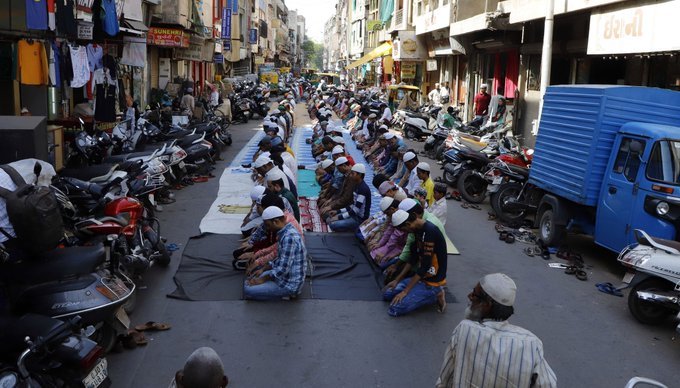
After the successful implementation of a limited ban on offering Namaz on roads in some parts of the state like Meerut and Aligarh, Uttar Pradesh has decided to impose a complete ban on offering namaz on roads across the state.
Confirming the ban, Director-General of Police (DGP), OP Singh, on Tuesday said direction had been issued to all districts police chiefs and other authorities to ensure that no namaz was offered by blocking roads. “On special occasions, when a large crowd gathers for offering prayers on festivals, it could be allowed by the district administration, but this practice will not be allowed as a routine during every Friday prayer,” he said.
The DGP furthered that after attaining success in cities like Meerut and Aligarh, the district officials have been asked to hold meetings with clerics and mosque administrations of various districts to sensitize them on how namaz on roads interrupted smooth traffic flow and caused other problems.
He confirmed that the Aligarh district administration had apart from holding such meetings with clerics and mosque administrations, had also issued a detailed circular for not allowing namaz on roads and it was imposed successfully.
Singh furthered that other communities would also not be allowed to hold similar religious gatherings on roads if it interrupted the traffic flow or caused inconvenience to others.
The Uttar Pradesh administration for all this while has been quite stringent, forbidding all religious events including namaz, on roads in various parts of the state. On June 8, the UP police had foiled attempts of namazis who assembled outside Chowki Chouraha Masjid in Bareilly, Uttar Pradesh, to offer Friday namaz on the road. However, they were unsuccessful as the UP police determined to follow decree and stopped the mob from offering namaz on the road.
Last year the Madras High Court had ruled that public places cannot be encroached upon for the purpose of offering prayers. A bench of Justice N Kirubakaran and Justice Krishnan Ramasamy had on July 18, 2018, observed that everyone is entitled by law to pray in a place of worship or their residence, but they cannot do so in a public space which will cause a nuisance to the general public.
Moreover, after this ruling, the Noida police had also in December 2018 issued an advisory notice to companies in sector 58, asking their administrations to dissuade their employees from visiting nearby parks for offering namaz.
The order issued by the Noida police to the companies cited the district magistrate’s order that ‘No religious activities’ including namaz can be offered in the authority parks. The police also added that namaz should be offered in Mosques and Idgahs.


