

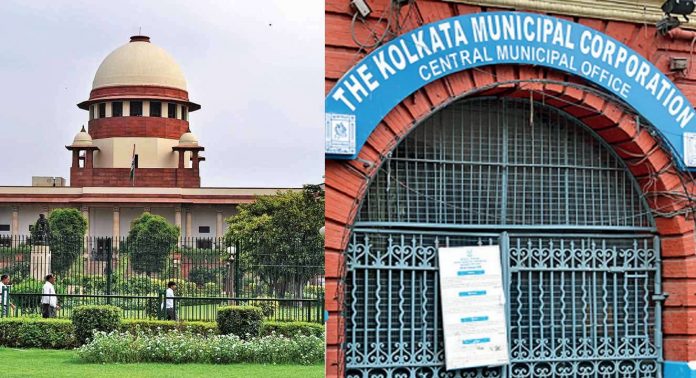
Despite the large-scale violence witnessed in West Bengal during the assembly polls, the Supreme Court of India today refused to entertain a petition filed by BJP to deploy central forces for the upcoming Kolkata municipal elections. The court asked the petitioner Sukanta Majumdar, Lok Sabha MP and BJP’s state president, to approach the Kolkata High Court instead.
The petition had said that after BJP nominated and finalised the list of candidates for the Kolkata Municipal Corporation elections, the candidates have been receiving threats from the ruling Trinamool Congress party members, asking them to withdraw from the contest. The petition had also said that despite the threats, no FIRs are being registered by the police.
The bench comprising Justices L Nagesara Rao and BR Gavai told Senior Advocate Maninder Singh, who was representing BJP in the court, that it will not be entertaining the petition. The bench said, “We cannot take decisions with respect to the requirement of Central force. High Court will be in a better position to know the situation”.
The apex court said that if this petition is allowed, there will be no end, and advised the petitioner to approach the high court instead. Advocate Singh accordingly withdrew the plea with the liberty to approach the High Court.
It is interesting to note that while the Supreme Court is refusing to order the deployment of central forces for municipal elections in West Bengal, saying it will open the floodgates for similar petitions, the same court had given completely opposite order just a few weeks ago. Last month, the apex court had ordered the govt to deploy more central forces in Tripura for the municipal elections, agreeing to a plea by the Trinamool Congress.
#SupremeCourt refuses to entertain #BJP‘s plea for deploying central forces in #WestBengal for upcoming municipal polls. #BJP asked to go to #Calcutta HC.
— Utkarsh Anand (@utkarsh_aanand) December 13, 2021
Recently,SC ordered deployment of central forces in #Tripura when #TMC approached it. This, when HC there already was hearing
The court had ordered the union home ministry to ensure that enough central forces are deployed in the state so that every polling booth is maned by central forces. It is notable that the Supreme Court had ordered this despite the fact that the High Court was already hearing the issue.
West Bengal has been seen widespread political violence by TMC in the last several years. Hundreds of BJP workers and leaders have been killed and many more attacked by TMC workers. The violence peaked after TMC won the assembly elections, and hundreds of people were forced to flee to neighbouring states due to the violence by TMC. A National Human Rights Commission committee report has documented these incidents and also notes how police had refused to file cases of violence by TMC workers.


