


India is witnessing a troubling surge in stray dog attacks. It has raised urgent questions about public safety. According to official data shared by the Government of India, dog bite incidents have skyrocketed across the country. In multiple replies to questions raised by MPs in the Lok Sabha, the Government of India has noted that there were 37,17,336 (over 37 lakh) dog bite cases in the country in 2024 alone. The numbers have spiked from over 30 lakh cases in 2023 and over 21 lakh cases in 2022. According to available data, in 2024 alone, over 5.2 lakh dog bite cases involved children under 15.
The carnage is not merely statistical. The increasing number of deaths and serious injuries reported daily overpowers the notion that, because the number of dog-mediated rabies cases is declining, the Animal Birth Control (ABC) Rules are working. In one of the recent cases, a 6-year-old girl died in Delhi after contracting rabies 20 days following a dog attack. In another case, a 3-year-old boy was attacked by a dog outside his house in Bareilly, UP, leaving serious injuries on his face.
Similar tragedies have unfolded across the country. Recently, the Supreme Court of India took suo motu cognisance of the stray dog menace in the national capital based on a report in the Times of India. While the government, judiciary and experts have finally started to wake up to the menace, the road to dog-free streets safe for children, the elderly, the disabled and other vulnerable individuals is far from reality.
Amid this growing menace, India’s primary policy response has been the Animal Birth Control (ABC) programme governed by the Animal Birth Control (Dogs) Rules, 2001, and now the updated ABC Rules, 2023. These rules, rooted in an ethos of animal welfare, mandate that stray dogs be captured, sterilised, vaccinated, and then released back to the same location, rather than removed or culled. Even if a dog has a history of attacking humans, these rules will be followed, leading to consistent conflict between humans and stray dogs.
The ABC Rules were supposed to be a humane solution to control the stray dog population and rabies. However, after over two decades, cases of dog bites and rabies continue to plague communities across the country. In this article, we will critically examine the ABC Rules and argue that they have failed to curb the stray dog menace. Furthermore, these rules have created legal hurdles that jeopardise public safety.
Genesis of ABC Rules – A questionable origin
Before going ahead, it has to be put on record that the Government of India, in a recent statement in Lok Sabha, categorically said, “The Government has not conducted a formal assessment of the Animal Birth Control (ABC) Program’s effectiveness in controlling the stray dog population”. However, the programme remains “the primary mechanism for managing the issue”.
The concept of controlling stray dogs through sterilisation gained official backing in 2001 when the Central Government, surprisingly via the Ministry of Culture, notified the Animal Birth Control (Dogs) Rules under the Prevention of Cruelty to Animals Act, 1960. This bureaucratic parentage was unusual. Matters of animal control and public health typically fall under the ministries of health or urban development.
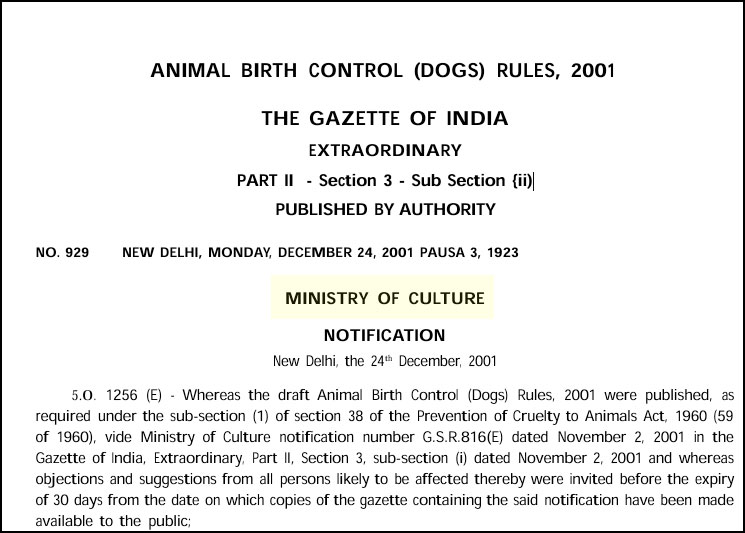
However, the ABC (Dogs) Rules, 2001, emerged from a cultural and animal welfare mandate, heavily influenced by animal-rights advocacy at that time. The 2001 Rules directed municipal authorities to stop the old practice of indiscriminate culling of strays and to implement a capture-sterilise-release programme across India. Notably, they were enabled by Section 38 of the PCA Act, which allowed the central government to make rules. However, these rules did not originate in public health law. In effect, an animal welfare framework became the governing law for what is also a public sanitation and safety issue.
The origin under the Ministry of Culture signalled the primacy of animal welfare over public health in the ABC approach. Indeed, the rules came at the behest of influential animal activists in government, and they tasked Animal Welfare Organisations (AWOs) and municipalities with the duty to sterilise and immunise stray dogs on the streets. According to the gazette notification dated 24th December 2001, when the Rules came to power, objections were called from the public and were apparantly incorporated in the Rules. However, if we look at the Rules, they were pro-animal welfare while keeping human welfare on the back seat.
This questionable genesis would later feed into legal challenges. In a way, the central government, for some reason, overstepped its limit by effectively dictating municipal stray dog policy through rules framed for “prevention of cruelty” rather than for disease control or public safety.
ABC Rules 2023 – A flawed revision
After years of patchy implementation of the 2001 Rules, which only fuelled an uncontrolled rise in the dog population on the streets across the country, the Central Government introduced a revised set of rules in 2023. The ABC Rules, 2023, notified by the Ministry of Fisheries, Animal Husbandry & Dairying, were seemingly aimed at strengthening the ABC programme and addressing directives of the Supreme Court. In practice, however, the ABC 2023 Rules have been widely criticised as a flawed revision that doubles down on the old approach and grants extensive power to the Animal Welfare Board and organisations with insufficient accountability.
One significant change in 2023 was procedural centralisation. According to the new rules, any entity conducting dog sterilisation must be recognised by the Animal Welfare Board of India (AWBI). This means local authorities can no longer simply hire private veterinarians or use in-house staff for mass sterilisation drives unless they get approval for all the “projects” from the AWBI.
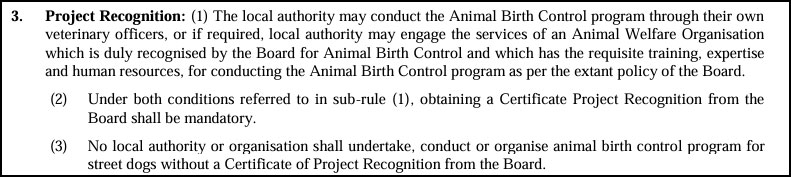
In short, the ABC Rules 2023 have made it impossible for the local authorities to run sterilisation drives without the approval of the AWBI. The bureaucratic pace of approvals in the country is known to everyone. Interestingly, if a local body wants to run different projects in different regions, it has to take approval from the AWBI for every such project, making it difficult to control the population of stray dogs in time.
Furthermore, there are so many rules to follow to run a sterilisation programme including putting up banners ahead of the sterilisation drive, telling locals of the community about ABC programme and what not. All these rules only make it difficult for local authorities to run sterilisation drives effectively.
Furthermore, the 2023 Rules reinforce that no healthy stray dog can be relocated or removed from its home territory. It does not matter if that dog is aggressive and poses a threat to the public. It does not matter if there are public complaints about the dogs in the area. Even the Supreme Court has ruled against relocation, making it impossible for people to live peacefully without fear of tens of hundreds of street dogs roaming literally everywhere.
Another change in the 2023 Rules is that the government introduced the term “community animals” in place of “stray dogs”, signalling that stray dogs are to be seen as legitimate members of the community, giving them the right to live in public spaces.

The Rules also require Resident Welfare Associations (RWAs) and local bodies to designate feeding spots for these “community dogs” and even facilitate feeding by volunteers.

Though Rule 20 of the 2023 Rules mandates that feeding be done in specific areas away from children’s play zones, and that any dispute be decided by a committee involving a veterinarian, municipal and police representatives, and animal welfare groups, it has come to light that so-called animal lovers who pose as dog feeders completely disregard the notion of designated places to feed dogs. They openly challenge, fight with residents, and cause nuisance when stopped from feeding dogs at places frequented by children and the elderly. In essence, the selective use of the 2023 Rules by the animal lovers and dog feeders has added to the problems faced by the general public because of the presence of stray dogs.
One of the most disturbing aspects of the 2023 Rules is that they provide no effective mechanism to permanently remove or segregate dogs that are aggressive. At best, an aggressive or “ferocious” dog may be temporarily captured for sterilisation or observation and kept in a shelter until it is deemed fit for release in the same locality. That means an aggressive and potentially deadly dog will return to the place where it had bitten children and chased the elderly. There is no accountability for incidents of dog bites caused by such dogs. It is like capturing a murderer, keeping him in jail for a few days, and then releasing him into the community without ensuring he would not kill anyone again.
The ABC framework thus continues to prioritise the dog’s presumed territorial rights over the community’s sense of security. This flawed approach of the 2023 revision, expanding bureaucratic requirements (project recognition, monitoring committees, feeding mandates) without correcting the fundamental imbalance, has drawn widespread criticism from civic bodies and public interest groups. Far from fixing the problems of 2001, the ABC 2023 Rules have entrenched them, empowering AWOs in theory but leaving them and local authorities with no clear responsibility for results.
Legal overreach of the ABC regime
A central contention about the ABC Rules is that they amount to legal overreach, potentially clashing with both the parent Act (PCA, 1960) and various state laws. The Prevention of Cruelty to Animals Act, 1960 was enacted to prevent infliction of unnecessary pain and suffering on animals. It was never designed as a public health or municipal animal control law.
However, the ABC Rules, which are subordinate legislation under the PCA Act, have been used to effectively override provisions in state municipal laws relating to stray dogs. The result? A flurry of judicial challenges and contradictory judgments across High Courts.
According to the Constitution of India, public health and safety are matters of States’ jurisdiction. Article 246(3), read with the State List, assigns to states the preservation of livestock and control of animal diseases, and Article 243W (Twelfth Schedule) entrusts urban local bodies with responsibilities like animal control and public sanitation. However, via the ABC Rules, the central government has ventured into this state domain without clear legislative sanction.
In 2008, the Bombay High Court explicitly held that the ABC Rules do not override state municipal laws and upheld the municipality’s discretionary power to remove or even destroy stray dogs causing danger or nuisance under the Mumbai Municipal Corporation Act. In other words, a High Court recognised that local commissioners retain authority (under older laws) to act against dangerous strays despite the central ABC Rules. The judgment was challenged by AWBI in the Supreme Court of India.
The court said, “We clarify that all issues raised… are kept open to be adjudicated in an appropriate proceedings, before the appropriate forum, in accordance with law. Whether be it may the mechanism in terms of the new Rules deficient/insufficient or repugnant to the Constitution or the parent statute(s); in our considered view, which can be best considered by the Constitutional Courts or other Forums accounting for all factors and circumstances, local in nature, being germane for adjudication for them and to decide it independently.”
The Kerala High Court, however, in 2015, took a pro-ABC stance, directing that municipal actions must conform to the ABC Rules and that there cannot be “unbridled” power to kill stray dogs. This conflict reached the Supreme Court in a batch of cases, including AWBI vs. People for Elimination of Stray Troubles. On the contrary, the High Courts of Bombay, Karnataka, and Himachal Pradesh took a different stance and ruled that local authorities possess discretionary powers to handle the issue of stray dogs and not bound by the ABC Rules.
No blanket primacy to ABC Rules, says Supreme Court
After years of interim orders and debates, the Supreme Court in May 2024 declined to give the ABC Rules blanket primacy. In disposing of AWBI’s special leave petition, the Court refused to elevate the ABC Rules above state laws, instead holding that all issues, including whether the new 2023 Rules are ultra vires (beyond the authority of) the Constitution or parent statutes, should be adjudicated by appropriate forums in context.
The Court effectively sent the matter back to States and High Courts to decide, acknowledging that local factors matter in such decisions. This was a significant development as it signalled judicial recognition that the ABC Rules may be deficient or in conflict with higher laws, and it lifted the cloud of supremacy that animal welfare rules had cast over municipal powers.
In fact, a range of laws buttress the primacy of public safety over the ABC regime. Article 21 of the Constitution guarantees citizens the fundamental right to life and personal liberty, which the state has a duty to protect. Where an uncontrolled stray dog threat endangers life, the state’s inaction can be seen as a violation of Article 21. The PCA Act itself, far from mandating perpetual care of strays on streets, contains provisions against abandoning animals to suffer and implicitly permits humane euthanasia of incurably ill or mortally dangerous animals. Moreover, state municipal Acts and Police Acts uniformly obligate local authorities to keep public spaces safe and disease-free for citizens. For example, many municipal laws empower officials to seize or dispose of strays if they become a public hazard, powers that were never formally repealed but have been dormant due to the perceived dominance of the ABC Rules.
On paper, the ABC Rules are subordinate legislation. They should not be able to contravene the PCA Act or extinguish state laws as per the legal procedures. There is nothing in the PCA Act that explicitly authorises rules that forbid removal of all stray dogs or mandate their feeding in public spaces.
However, these facets are available in the ABC Rules, unnecessarily stretching the PCA Act’s purpose into an unrelated domain, which is actively managing and maintaining the street dog population. It makes the rules vulnerable to being struck down as exceeding the Act’s authority. There is no provision in the law, centre or state, that mandates citizens to feed or tolerate stray dogs in their locality. The notion that dogs have inviolable “territories” in public areas is completely absent from any Act passed by the legislature. It is a creation of the ABC guidelines.
Consequently, multiple layers of law refute the idea that the ABC Rules are the last word. The Prevention of Infectious Diseases in Animals Act, 2009 mandates that animals with certain diseases, including rabies, must be euthanised and not left on the streets. Furthermore, the new Bharatiya Nyaya Sanhita, 2023 (Section 270) penalises any action causing common danger or nuisance to the public. In theory, Section 270 of BNS should apply to rogue dog feeders who refuse to stop feeding dogs in areas where it causes danger, nuisance, or annoyance to the public, including near someone’s home. However, nothing like this have ever been heard of. Why? Because ABC Rules provide protection to the dog feeders as well, again overpowering laws enacted for public safety.
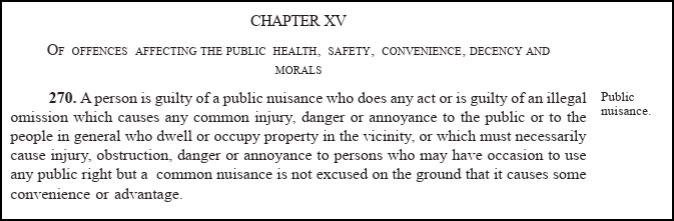
There is an established legal framework that empowers authorities to prioritise human safety. The ABC Rules, by purporting to prohibit or limit those actions, sit on shaky legal ground. Still, the authorities fail to act against the ABC Rules, thanks to the unprecedented pressure of “animal lovers” with a strong lobby inside the Parliament.
Human rights versus animal rights
Then comes the question, to what extent do animal rights trump human rights, especially in the context of street dogs? Dog lovers often cite the Supreme Court’s landmark observations that animals too have a right to life under Article 21.
In the 2014 A Nagaraja case (relating to Jallikattu bulls), the Supreme Court indeed expanded Article 21’s scope, holding that every species has an inherent right to live a life with dignity. However, that judgment was overturned by the Supreme Court itself while allowing Jallikattu.
Additionally, Article 51A(g) of the Constitution imposes a fundamental duty on every citizen to show compassion to living creatures. These principles have been used to argue that stray dogs have a right not to be killed or displaced, and that caring citizens have a right (even a duty) to feed and look after them. Such arguments underpin the ABC Rules and were recognised in court rulings like one by the Bombay High Court in 2023, which affirmed that housing societies cannot ban residents from feeding community dogs and that the ABC Rules “have the force of law”.
However, framing the issue purely as animal rights can overshadow the equally (if not more) pressing human rights concerns. The right to life and personal security of humans is a fundamental right enforceable against the state. This encompasses the right to a safe environment and protection from known dangers. When attacks by stray dogs threaten life and restrict freedom of movement, for example, children unable to walk to school safely, or the elderly prisoners in their homes due to fear, it engages the core of Article 21 for people. Courts and authorities are increasingly acknowledging this reality. The Allahabad High Court, while hearing a case of a person feeding dogs in a colony, pointedly noted that protecting street dogs under ABC Rules does not mean the “concern of the common man” can be ignored, and that authorities must ensure people can move on the streets without fear of dog attacks.
In July 2025, during a Supreme Court hearing on stray dogs, Justice Vikram Nath remarked that those who wish to feed strays “should do so in their own homes” rather than public spaces, emphasising that there is “all space for these animals, no space for humans” if feeders turn common areas into feeding grounds. Such blunt comments from the Bench underscore the judiciary’s struggle to balance compassion with public order.
In practice, the current ABC framework elevates animal rights over human rights. In doing so, it violates the Constitution’s guarantee of human life with dignity. Article 21 is a shield for citizens first and foremost, not dogs roaming and killing children on the streets. The National Human Rights Commission (NHRC) recently took cognisance of the stray dog menace from a human rights perspective, after a complaint highlighted that the failure to control strays is causing distress and deaths, amounting to a breach of citizens’ rights.
There is also the Rights of Persons with Disabilities Act, 2016, which mandates the removal of environmental barriers that impede the mobility and safety of disabled persons. Aggressive stray dogs are a literal barrier. Blind or visually impaired persons, for instance, are at severe risk as they cannot see approaching dogs and may inadvertently provoke them with canes. For such citizens, the state’s duty of care (under Article 21 and the Disabilities Act) is fundamentally incompatible with a policy that allows potentially dangerous dogs to roam free in public spaces. In short, animal rights are not absolute. Even the Article 21 right to life, as extended to animals, is subject to “law and procedure”. The PCA Act itself provides procedure for euthanising suffering animals, and other laws provide procedure for removing threats. The paramountcy of human life in a conflict situation was eloquently summed up by the Kerala High Court that said, “when there is a conflict between the right to life of a human and the right to life of a dog, the former has to prevail.”
The curious case of contradictory clauses on euthanasia in ABC Rules 2023
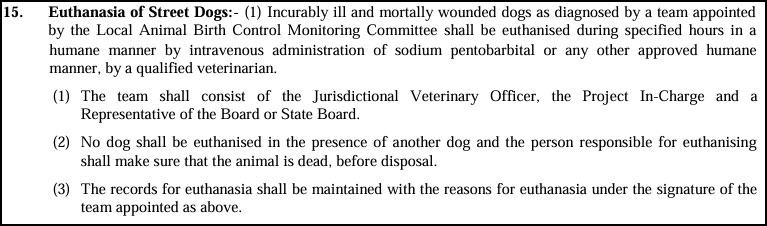
There is a glaring contradiction buried within the ABC Rules 2023 themselves, particularly in how they treat euthanasia in the case of rabid or aggressive stray dogs. While Rule 15 allows euthanasia for “incurably ill and mortally wounded” dogs upon certification by a designated team, Rule 16 creates an administrative and ethical deadlock when it comes to dogs suspected of rabies or those involved in bite incidents.
Under Rule 16(5), a stray dog found to have a “high probability of having rabies” is not to be euthanised immediately. Instead, the animal is to be “isolated till it dies a natural death”. In simple words, ABC Rules, that are supposed to be promoting humane handling of stray dogs is pushing for dogs to suffer slow and painful death due to rabies virus.
This clause makes no exception for public health concerns, trauma to bite victims, or the risk posed to shelter workers and the surrounding community. The rule mandates passive observation until the disease takes its fatal course, an approach that contradicts humane euthanasia principles.
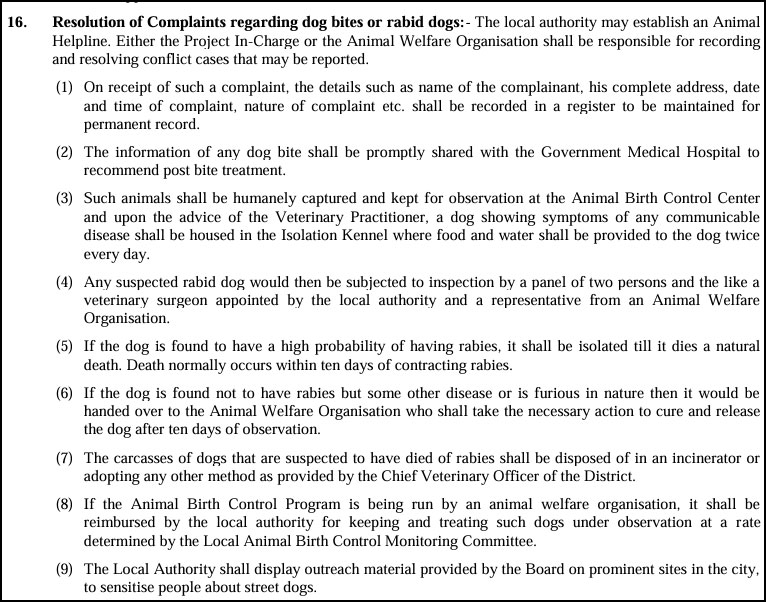
To make matters worse, Rule 15’s conditions for euthanasia do not explicitly include zoonotic threats like rabies or behavioural aggression. The text restricts euthanasia to cases of mortal physical injury, leaving no room for preventive public health intervention. Even Clause 16(6), which addresses aggressive or “furious” dogs, mandates their release after attempted treatment rather than any meaningful containment or disposal.
The end result is a dangerous paradox. A rabid dog, while being a confirmed fatal threat to human life, cannot be euthanised unless it also happens to be physically mortally wounded, a technicality that flies in the face of both logic and medical science.
This contradiction undermines the very notion of effective rabies control, traps local authorities in bureaucratic indecision, and empowers vested activist interests over hard public health realities. When legal clauses protect even a terminally diseased animal over the safety of children and citizens, it is not compassion, it is policy failure.
The economics of failure
The ABC programme has proven inefficient and riddled with mismanagement. Despite spending crores over two decades on sterilisation and vaccination, India’s stray dog population remains over 2 crore as per 2019 census which, according to some estimates, exceeds 7 crores and according to a report, 12 crores. The cases of dog bites have risen exponentially as well. Over 37 lakh dog bite cases in 2024 alone reflect the ongoing health burden.
Deep-rooted corruption is also a reason for the inability of local authorities to reduce the dog population. In Pimpri-Chinchwad, ₹73 lakh was paid during the COVID-19 pandemic for the sterilisations of 7,500 dogs. However, RTI replies exposed ghost operations. Similar allegations have surfaced in multiple locations in Mumbai and other cities.
The decentralised nature of the programme, lack of infrastructure, and poor monitoring compound the failure. Few cities reach the 70% sterilisation threshold needed to stabilise populations.
Meanwhile, the cost of anti-rabies treatments and the human toll mixed with missed school, lost wages, mental distress, and lifetime trauma continues to rise. The ABC programme has offered poor returns and remains an underfunded mandate plagued with inefficiency and corruption. It has failed to deliver on public health goals which no government agency is ready to accept.
Public nuisance and social trauma
The stray dog crisis imposes immense social costs. It is often overlooked in legal and policy debates. Aggressive packs of dogs chasing vehicles, attacking pedestrians, howling at night, and defecating in public spaces create fear and conflict, especially among children, the elderly, and disabled persons.
By legal definition, this qualifies as public nuisance. Feeding and sheltering strays in residential areas without community consent only worsens the threat, and the Bharatiya Nyaya Sanhita, 2023, criminalises actions endangering public safety.
The trauma is not limited to bite victims. Children are kept indoors, elders abandon walks, and people live in anxiety in areas where dog bite incidents happen frequently. Ironically, even sticks and canes for protection provoke aggression and create a cruel bind for the visually impaired. The National Commission for Protection of Child Rights has flagged stray dog attacks as a serious threat to child safety.
Court rulings increasingly recognise citizens’ rights. The Supreme Court recently questioned why feeders do not house strays themselves. High Courts have ordered dog removals from campuses, stressing human safety. Resident Welfare Associations face frequent clashes with dog feeders, sometimes leading to FIRs and court cases.
Noise pollution, litter, and faeces further degrade urban life. It is time public safety, hygiene, and dignity are prioritised over unchecked stray dog presence in shared human spaces.
The case for repeal and a new framework
The Animal Birth Control Rules, 2023 (and their 2001 predecessor) have failed to control the stray dog population and have created a legal environment that undermines public safety. It is time these Rules are repealed and replaced with a pragmatic, public-health-centric law.
Repealing the ABC Rules would free local authorities from legal hurdles, allowing them to act under state laws without fear of violating central rules. The Supreme Court in 2024 indicated that if ABC Rules conflict with state laws or the Constitution, constitutional courts must resolve the matter. Repeal would clear the way for a new start.
A revised framework must prioritise public health and safety while ensuring humane treatment of animals. Municipal bodies and panchayats should be empowered to remove aggressive strays, supported by district shelters and state oversight to prevent misuse. Humane euthanasia must be permitted for incurably ill or dangerous dogs, under veterinary panel supervision, with due process.
ABC should continue but under the Health Ministry, with sterilisation tied to public health goals, not vague welfare metrics. Independent audits, mandatory reporting of dog bites, and a centralised dashboard for both rabies and dog bite cases are essential for accountability.
Implementing agencies must face penalties for embezzlement, shoddy surgeries, or negligence. Municipal officials ignoring attacks should also be held accountable. This will reduce the current impunity plaguing ABC execution.
Feeding must be regulated. Feeding should be allowed only in designated areas under local authority supervision. Volunteers should register, assist in sterilisation, and share responsibility for dogs they feed. Feeding near schools, markets, or apartments must attract penalties to ensure safety. In case residents of the community are not in favour of creating feeding zones and want to get rid of stray dogs, Rules or laws must not come in the way.
Adoption and relocation must be encouraged. NGOs and shelters can remove docile strays for adoption or placement in rural sanctuaries. This removes them from urban areas while ensuring welfare. Incentives can support Indian dog adoption and reduce street populations gradually. Furthermore, in many developed countries, if a dog is not adopted within a specific period, it is euthanised. There should be a similar provision to reduce the burden on shelters.
Public education is vital. Campaigns on rabies, dog behaviour, and responsible ownership should be prioritised. Pet abandonment and lack of sterilisation fuel the crisis. Strict pet licensing, anti-abandonment enforcement, and school-level awareness on avoiding dog bites will help. Citizen groups should be involved in reporting problem dogs and supporting vaccination drives. Local authorities must be empowered with regulations allowing them to remove aggressive dogs and put them in shelters for life. There should be no aggressive dog(s) on the streets putting human lives in danger.
Repeal does not mean inhumane culling. OpIndia is against mass culling of dogs or any species per se. The goal is a balanced, evidence-based law grounded in reality. India cannot afford another decade of legal paralysis as dog bites and deaths, especially of children, continue unchecked. Human lives matter. Citizens have the right to safe streets. The state must act to remove threats.
A new law must recognise this and empower authorities with firm but humane tools to control stray dog populations. The ABC Rules have been built on misplaced idealism. These Rules must give way to a law that protects both people and animals, enabling safe coexistence through enforceable public health principles.


