

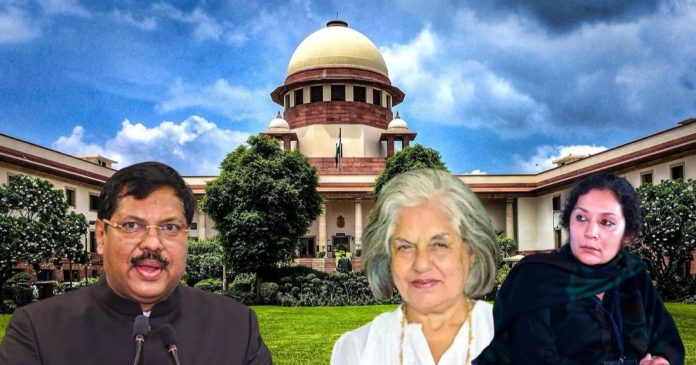
When a 71-year-old lawyer flung his shoe towards Chief Justice of India B.R. Gavai in open court, shouting “Sanatan ka apmaan nahi sahenge!”, it was an act of raw outrage. Rash, highly condemnable, but unmistakably rooted in faith. Within minutes, however, India’s liberal echo chamber decided to read something entirely different: caste.
The shoe, they said, wasn’t hurled in defence of Sanatan Dharma; it was an attack on a “Dalit Chief Justice.”
This is the perverse alchemy of India’s left-liberal intelligentsia, where every almost everything must be twisted into a social fault line, every protest of faith turned into a caste war. One of the seniormost Opposition leaders, Rahul Gandhi, has long championed himself as a caste crusader, positioning himself as the self-appointed messiah of Dalits, OBCs, and tribals, all while reducing their identity to mere electoral arithmetic. From his choreographed temple visits to his recent calls for a nationwide caste census, Rahul’s politics has been less about empowerment and more about engineering divisions. Similarly, other regional parties too, have leveraged caste to sow divisions and further their politics.
But the facts in this case are clear. The lawyer didn’t invoke caste. He didn’t utter a slur. His only words were, “We will not tolerate the insult of Sanatan Dharma.” The outrage stemmed from what many perceived as CJI Gavai’s sarcastic remark during a plea about the restoration of a mutilated Lord Vishnu idol at Khajuraho: “Go and ask the deity itself to do something now. You say you’re a staunch devotee, so go and pray.”
To a devout Hindu, such words, even if unintended, sound dismissive of faith, especially when they come from the head of the judiciary. The lawyer’s reaction, while disproportionate and unacceptable, was emotional, not casteist.
Yet, within hours, the caste machinery was activated. “Casteist attack on Dalit CJI,” screamed social media activists and ‘secular’ journalists who seem allergic to any expression of Hindu faith that doesn’t fit their pre-approved templates.
The politics behind the caste spin
The reason for this spin is simple: faith unites Hindus; caste divides them.
Since 2014, when Narendra Modi’s rise disrupted decades of vote-bank arithmetic, the Opposition and its ecosystem have been trying to fracture Hindu unity by resurrecting caste divisions. Every election cycle brings the same playbook: fake narratives about reservation rollback, “Brahminical Hindutva,” and now, the “Dalit CJI under attack” trope.
Remember the doctored video of Amit Shah circulated before the 2024 elections, falsely suggesting the BJP wanted to end caste-based reservation? The same ecosystem is now at work again, exploiting an act of protest to gaslight Dalit voters and drive a wedge within Hindu society.
Because for them, a united Hindu identity rooted in Sanatan Dharma is politically fatal.
When Islamists take to the streets chanting “Sar Tan Se Juda” over perceived “blasphemy,” neither the Left ecosystem nor the Supreme Court dares to hold Islamic theology accountable. The blame, somehow, always lands on Hindus who merely choose to speak up.
During the Nupur Sharma controversy, the hypocrisy was laid bare. Even as mobs threatened beheadings, burned effigies, and called for her death, the Supreme Court’s own oral observation outrageously declared that “Nupur Sharma was single-handedly responsible for what’s happening in the country.”
So while Islamist radicals bayed for blood, the national conversation shifted to blaming a woman who quoted directly from their own scriptures. And the same Left-liberal chorus that now weeps for “free speech” over every anti-Hindu film went completely silent when “Sar Tan Se Juda” mobs took over the streets.
Back then, not one among the so-called conscience-keepers of secular India found the courage to condemn the rioters. Instead, they found it convenient, even fashionable, to hold Nupur Sharma responsible for “setting the country on fire.” But today they want an emotional outburst, although reprehensible, be treated as a casteist attack on the CJI.
The usual suspects: Indira Jaising to Saba Naqvi, and countless online trolls
True to form, activist-lawyer Indira Jaising was quick to declare the shoe incident “a casteist attack.”
Attorney General should take action for contempt of court for an ideological castest attack on a secular court https://t.co/Fk4XrWTGOX
— Indira Jaising (@IJaising) October 6, 2025
On what basis? None. Not a word uttered, not a slur spoken, not a reference made. But why let facts ruin a good narrative?
Saba Naqvi, the same ‘journalist’ who once mocked the Shivling found in the Gyanvapi mosque with a meme comparing it to an atomic model, added her signature secular wisdom, claiming the incident had “clear social dimensions.”
There are clear social dimensions to an attack on Dalit CJI when a lawyer attempted to throw a shoe at him. It is an assault on his dignity.
— Saba Naqvi (@_sabanaqvi) October 6, 2025
In the liberal lexicon, “social dimensions” means: we don’t have evidence, but we’ll invent context.
Several social media trolls aligned with furthering Congress and opposition parties’ talking points joined the bandwagon to allege it was a “casteist attack” against a Dalit CJI.
संघ के एजेंट की तरह काम ना करने पर CJI गवई पर एक संघी मानसिकता के वकील ने जूता फेंका।
— Rofl Gandhi 2.0 ? Commentary (@RoflGandhi_) October 6, 2025
सड़कों की बात छोड़ों, देश का मुख्य न्यायाधीश बनने के बाद भी दलित व्यक्ति सुरक्षित नहीं है नरेंद्र युग में। pic.twitter.com/eZJxAhE7Ls
In the last two days,
— Amock_ (@Amockx2022) October 6, 2025
A dalit man was beaten to déath by a mob while he was begging for his life ?
CJI who comes from dalit background was attacked with shoes in Supreme court ?
When will Godi media raise voices fpr SCs and STs like they bat for BJP leaders? https://t.co/37KiShJjss pic.twitter.com/gqkK9Awt2m
The dangerous consequences of identity politics
What’s tragic here is how the genuine question of how those in constitutional offices speak more sensitively about faith has been buried under the identity-politics avalanche.
Instead of debating whether CJI Gavai’s earlier comment reflected a growing insensitivity toward Hindu sentiments in elite institutions, the conversation was derailed into another “Dalit victimhood” narrative.
This is not just intellectually dishonest; it’s corrosive. It sends a message that even legitimate religious hurt expressed by a Hindu must be vilified, unless, of course, it fits the Left’s caste calculus.
Faith is not a caste privilege
It’s worth reminding the self-styled moral custodians that Sanatan Dharma is not the monopoly of one caste. The faith that the lawyer invoked belongs equally to Dalits, Brahmins, OBCs, and tribals. Temples across India, from Ayodhya to Tirupati, are frequented by Dalits. Many Dalit saints, from Ravidas to Chokhamela, have been central figures in Hindu spirituality.
When someone says, “Sanatan ka apmaan nahi sahenge,” he speaks for a civilizational identity, not a caste identity. To reduce that to casteism is not just lazy analysis; it is an insult to the very spirit of Sanatan Dharma, which transcends caste and creed.
The Left’s double standards on shoe protests and judicial independence
Ironically, the same Left ecosystem now howling over a shoe hurled at CJI Gavai had, for years, celebrated similar acts as “legitimate forms of dissent.” When shoes were thrown at politicians, journalists, and public figures from the Right, they were hailed as symbols of resistance. Memes were made, tweets were cheered, and shoe-throwers were glorified as brave protestors standing up to “fascism.”
In 2009, journalist Jarnail Singh made headlines when he hurled a shoe at then Home Minister P. Chidambaram during a press briefing. His act was a protest against the CBI’s decision to absolve two Congress leaders accused in the 1984 anti-Sikh riots. Singh was hailed in many liberal circles as a symbol of defiance against political injustice for his act of flinging shoe at the then Home Minister. Similarly, when Iraqi journalist Muntadhar al-Zaidi hurled his shoes at former US president George Bush in 2008, it was celebrated by the Left as an act of resistance against America’s occupation of Iraq.
But the moment the target happened to be a Dalit Chief Justice and the protester a man defending Sanatan Dharma, the moral compass of the Left spun wildly out of control. Suddenly, the very act once hailed as dissent became an assault on “Dalit dignity.” Their selective outrage only exposes how ideology, not principle, dictates what qualifies as acceptable protest.
It is also worth noting that the Left has never shown reverence for the judiciary when it refused to echo their worldview. Former CJI D.Y. Chandrachud, once celebrated as a “progressive icon,” was viciously attacked by the same intellectual class after his interview with Sreenivasan Jain, where he made the now-famous remark that “the very erection of the Babri mosque was the fundamental act of desecration.”
That one line was enough to turn the darling of liberal drawing rooms into a target of relentless criticism. Countless opinion pieces in left-leaning portals questioned his “secular credentials,” some even calling his remarks “dangerous” and “regressive.”
So when the same cabal suddenly sheds tears over an attempted shoe attack on CJI Gavai, it’s not out of concern for judicial dignity or institutional respect. It’s simply political opportunism, a convenient moment to inject caste into public discourse and reinforce the tired “Dalit victimhood” narrative.
The Left doesn’t care about the Chief Justice being attacked; it cares only about how the incident can be spun to divide Hindus and keep the caste pot boiling.
Was it really casteist attack or the Left’s desperation to undermine Hindu unity?
Yes, the lawyer’s act was highly inappropriate and may even deserves punishment, as per the law of the land. But the reaction it triggered tells us something more unsettling about India’s intellectual class: that their first instinct is not to understand, but to divide.
Not a single left-wing intellectual even attempted to examine the issue with nuance or seek a balanced perspective. None thought it worthwhile to ask the most basic questions: Why did the lawyer do what he did? What provoked him? What was his state of mind? A simple inquiry into his motivation would have cleared the air.
But introspection has never been the Left’s strength. Instead of probing facts, they rushed headlong into manufacturing outrage, branding the incident as a “casteist attack” on the CJI. The motive didn’t matter, the context didn’t matter; only the narrative did.
To them, faith expressed by a Hindu is fundamentalism, but hurt expressed by a Muslim is righteous anger.
A 71-year-old lawyer may have overreacted in court, but the far greater crime is the intellectual dishonesty of those who weaponised his act to fracture Hindu society yet again.


