

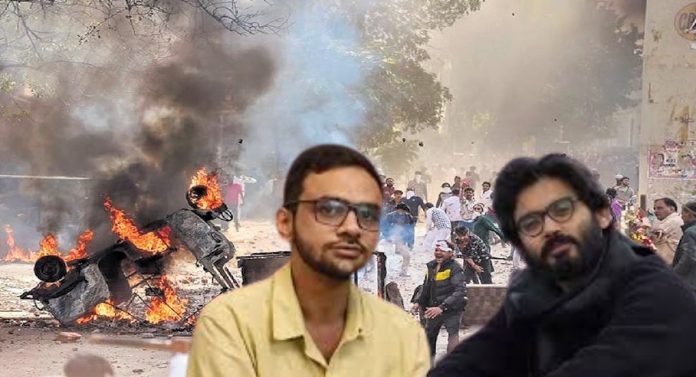
The “larger conspiracy” case stemming from the February 2020 Delhi anti-Hindu riots, lodged as FIR 59/2020 and prosecuted under the Unlawful Activities (Prevention) Act (UAPA), has been the focus of several bail petitions that have been brought before the Supreme Court. Umar Khalid, Sharjeel Imam, Gulfisha Fatima, Meeran Haider, Shifa-ur-Rehman, Shadab Ahmad, and Mohd Saleem Khan are all accused of conspiring, planning, organizing, and funding a systematic campaign to incite Delhi anti-Hindu violence to bring about a ‘regime change’ in India, under the garb of anti-CAA protests. A bench of Justices Aravind Kumar and N.V. Anjaria are currently considering their pleas.
These bail requests are not first ones. Every petitioner has already encountered a negative ruling on several occasions. Umar Khalid was denied bail by the trial court in March 2022 following a comprehensive ruling that, based on a preliminary review of the chargesheet, the material revealed a deliberate conspiracy behind the disturbances in which he was purportedly one of the main conspirators. A Division Bench of the Delhi High Court declined to intervene in October 2022, ruling that the accusations, which included alleged terrorist activity and criminal conspiracy under the UAPA, exceeded the high threshold of “reasonable grounds for believing” that the accusations were prima facie true as contemplated by Section 43D(5) UAPA. Most recently, on September 2, 2025, another Division Bench of the High Court dismissed Khalid, Imam, and seven others’ bail appeals in the same larger-conspiracy case, emphasizing the prosecution’s case that the violence was the result of a coordinated plan rather than a random clash.
The fundamental difference is evident even before the Supreme Court. The appellant has repeatedly emphasized that there is “no proof of violence” directly attributable to these petitioners, that some of them were not even physically present in North-East Delhi during the worst of the riots, and that the case primarily rests on memberships in WhatsApp groups, belated “protected” witness statements, and speeches that, according to counsel, fall within the acceptable bounds of dissent and political critique of the NRC and Citizenship (Amendment) Act (CAA). However, the Delhi Police has consistently maintained in its affidavits and now in its oral arguments that what is at stake is not isolated sloganeering or disorderly protest, but rather a “deep-rooted, premeditated and orchestrated conspiracy” to weaponize anti-CAA protests as a cover for a planned attack on the nation’s sovereignty and the authority of the State, timed with the visit of then-US President Donald Trump.
Hearing recap: Prosecution presents two videos, comprehensive arguments on how Delhi anti-Hindu Riots was a regime change operation by Sharjeel Imam, Umar Khalid and other accused
The prosecution has in the Supreme Court so far methodically argued that the violence in February 2020 was the result of a well-thought-out conspiracy rather than an out-of-control protest.
Appearing on behalf of the State, Additional Solicitor General S.V. Raju has done two things at once. First, he has disproved the popular narrative that the accused are innocent “activists” or “intellectuals” who have been wronged because of their political beliefs and second, he used speeches, WhatsApp conversations, and timelines to show that there is evidence of a larger plan to paralyze the capital, internationalize the unrest during the Trump visit, and, in their words, even attempting a “regime change operation.”
Sharjeel Imam’s speeches and the conspiracy’s larger ideological framing were the main topics of discussion during the hearing on 20th November (Thursday). Before the Bench of Justices Aravind Kumar and N.V. Anjaria, ASG Raju played a number of clips in which the Imam is heard discussing a national “chakka jam” intended to choke Delhi and target the vital Siliguri corridor, also known as the “chicken neck,” which connects the North-East to the Indian mainland.
The video which was played in the Supreme Court by the prosecution was released exclusively by OpIndia.
EXCLUSIVE! Delhi Riot bail hearing
— OpIndia.com (@OpIndia_com) November 20, 2025
ASG Raju plays a video of Sharjeel Imam speeches. Imam referred to CAA, NRC and Kashmir. He spoke about Chakka Jam, incited violence, urging Muslims to take to streets. He spoke about cutting off Chicken’s Neck and NE
Video played in SC pic.twitter.com/FFsl1hDzin
The prosecution argued accuraptely and exposed how the rhetoric extends far beyond the scope of civil disobedience. Imam, who is trained as an engineer, is heard urging supporters to block important routes so that “Delhi should not get milk” and that the North-East could be cut off by seizing control of a 16 kilometer stretch. He also incorporates the repeal of Article 370, the Ayodhya ruling, and the Triple Talaq law to make the case that Muslims had not mobilized sufficiently in the past and should now take advantage of the CAA’s opportunity to launch a decisive confrontation.
The Delhi Police is utilizing this information to emphasise two things. One was that the ultimate goal was to bring the State to its knees through economic strangulation, territorial disturbance, and persistent communal strife, but the CAA and NRC were being used as a pretext, a handy banner around which to gather sympathy. Second, people like Imam are more dangerous because of their purportedly “intellectual” nature. According to ASG, there is a new and concerning trend in which educated professionals, such as doctors and engineers, “are not doing their professions but engaging in anti-national activities.” These individuals, who received their education at public expense, are more dangerous than “ground-level” actors who merely toss stones or take part in localized violence when they use their training and prestige to plan, justify, or direct illegal acts. The main argument of his submission was that the romanticized story of “persecuted scholars” is false, the State claims that the record shows intentional instigation to obstruct, interfere with necessary supplies, and weaponize protest locations as nodes in a much larger disruptive network.
The WhatsApp evidence also plays a role in this. The ASG guided the Bench through communications and group structures, including the Delhi Protest Support Group, the Muslim Students of JNU (MSJ), the Jamia Coordination Committee (JCC), and other relevant discussions. According to the State, they were coordination centers rather than informal student forums where conversations about fundraising, repairing protest locations, coordinating chakka jams, and influencing media narratives took place. According to ASG Raju, the chats, when read in conjunction with speeches and on-the-ground events, demonstrate that the petitioners and their associates were organizers and architects rather than passive participants. They used closed-door, encrypted channels to plan a nationwide escalation that would coincide with the visit of then US President Donald Trump to Delhi.
From their point of view, the term “regime change operation” that appears in the Delhi Police’s affidavit accurately describes what the communications reveal as the ultimate goal, which is to undermine the elected government by rendering the capital unmanageable and portraying India as a burning nation abroad.
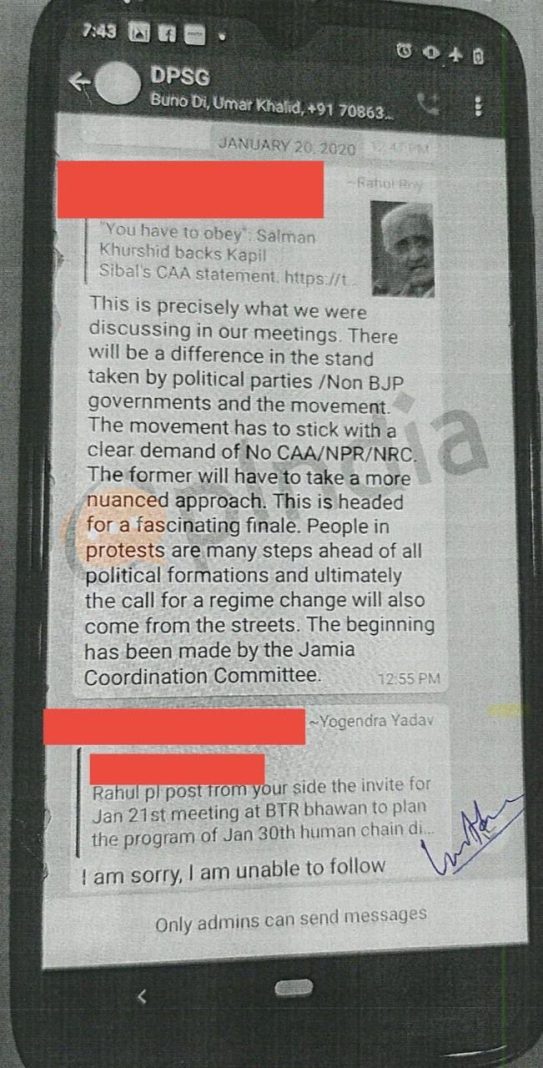
OpIndia also revealed a specific message from the DPSG chat group, where all co-conspirators of the Delhi anti-Hindu riot were present, where the protests being a precursor to a ‘regime change operation’ was mentioned.
The message in question was sent by Rahul Roy on the 20th of January 2020 – a full month before the Delhi anti-Hindu riot. In the message, Rahul Roy mentions that the protest was a precursor to a regime change operation, spearheaded by the Jamia Coordination Committee.
In one significant interaction with the Bench, ASG SV Raju was asked whether the Court should be delving into such comprehensive material at all during the bail hearing. His response was measured, the defence, he said, sought to limit the debate to “delay” and build a picture of innocent dissenters languishing in jail while the prosecution, on the other hand, was required to demonstrate that there is substantial prima facie evidence of a significant conspiracy. The statutory restriction on bail applies under Section 43D(5) of the UAPA once there are reasonable grounds to believe the accusations are true. The court just considers whether there is sufficient evidence to meet the threshold, rather than evaluating the final reliability of each piece of evidence as it would at trial. He insisted that in that narrow sense, it was essential to play the films and point to conversations in order to refute the idea that the case is based solely on “political” or flimsy evidence.
To bolster his point, ASG Raju also showed a video which demonstrated how the protestors had mobilised, leading to the lynching of constable Ratan Lal. Through CCTV footage, he demonstrated how the rioters first, as per a planned conspiracy, covered the cameras, disconnected or damanged the CCTV cameras which were too high to cover, and then, once that was done, unleashed violence.
OpIndia reconstructed the video from the details of the chargesheet. The video can be seen below:
Important Delhi Riots EXCLUSIVE update ?
— OpIndia.com (@OpIndia_com) November 21, 2025
The video feed of the bail hearing in SC was disrupted. But our reporter has informed us of a video played by ASG SV Raju showing how cameras were disrupted, the mobilisation of the mob, and the diversion of CCTV right before the first… pic.twitter.com/H87eKX7v0R
ASG Raju responded to the claim that the petitioners’ nearly five year incarceration should alone tip the scales in favor of bail. He used trial court orders to demonstrate to the court that the accused’s numerous requests for adjournments and protracted debates, rather than the prosecution, were largely to blame for the delay in filing charges and advancing the trial. He noted that in several cases, the trial court documented the defence’s repeated requests for time as individual counsel debated the accusations for weeks on end. In light of this, he cited the Supreme Court’s ruling in Salim Khan to argue that even a five and a half year sentence does not automatically grant an accused person bail, particularly in cases involving serious crimes and substantial evidence of involvement.
Additional Solicitor General (ASG) S.V. Raju, representing the Delhi Police, resumed his arguments the next day before the Bench of Justices Aravind Kumar and N.V. Anjaria. In a well organized presentation, he blended factual narrative (what actually occurred on the ground) with doctrinal points under UAPA to contend that the bar on bail in Section 43D(5) is squarely attracted and leaves little room for judicial indulgence at this stage.
He started by emphasizing once more the scope and intensity of the violence that shook North-East Delhi in February 2020. Petrol bombs, acid-like chemicals, stones, and sticks were used against small groups of police officers and regular citizens, resulting in 53 fatalities and over 530 injuries. He emphasized that the pattern of violence, the use of bombs, the targeting of law officers, the destruction of CCTV cameras, and the selection of locations indicated pre-planning. This was not some wild street fight or unplanned clash between two local groups. Instead of treating these ground facts as background information, the ASG took care to link them directly to the UAPA’s statutory text from the very beginning of the hearing.
ASG Raju used Section 16(1)(a) of the UAPA, which defines a “terrorist act,” and Section 43D(5), which lays down the strict requirements for bail, to establish that legal connection with the Bench. He reminded the Court that a competent court has taken cognizance of the offence and that a chargesheet specifically citing Section 16 has already been filed. He emphasized that none of the petitioners had ever contested that order of cognizance. According to his definition, it is difficult for the same material to be treated at the bail stage as if it discloses nothing once a court has applied its judicial thought to the material and determined that a terrorist offense is made out. “If there is an application of judicial mind that an offence under the UAPA has been committed, there is no question of granting bail. The accusation is prima facie true because cognisance has been taken,” he submitted.
Focusing on the specifics of the conspiracy, Additional Solicitor General Raju argued that the accused’s acts satisfied the UAPA’s definition of a terrorist act by intending to endanger the security of the State, instill fear, and cause economic instability. He highlighted intentional disruptions of vital supplies like milk, water, and vegetables to the capital, citing evidence of bombs, petrol bombs, and firearms backed by post-mortem material. These disruptions were not the result of protests, but rather were calculated strategies to paralyze daily life and portray the State’s incapacity to maintain order. He made a significant reference to the Siliguri corridor, sometimes known as the “Chicken Neck,” and said that there was a plot to “choke Assam out of the country.” He connected this to Section 2(ea) of the UAPA, which deals with threats to India’s economic security. When the Bench queried where this appeared in the chargesheet, ASG Raju stated that the evidence was delivered via a pen drive, meaning that the petitioners’ failure to oppose this information weakens their contention that no prima facie case existed.
The ASG then focused on individual roles, demonstrating that the Delhi Police case involved more than just “someone” conspiring; rather, the petitioners in front of the court were crucial links in this network. In order to emphasize Umar Khalid’s participation, he read from the supplemental chargesheet, characterizing him as one of the “originators” of the notorious “Bharat tere tukde tukde honge” slogan and, more significantly, as the “founder of the idea of chakka jam” in this context. ASG Raju said that Khalid did more than just attend protests; he actively explained to co-accused Sharjeel Imam and Asif Iqbal Tanha the difference between a simple dharna and a chakka jam, instructing Imam to begin a chakka jam at Jamia while he would personally organize similar blockades in other areas where Muslims predominate. According to the State, chakka jam was a violent strategy intended to paralyze the city and stop vital services, not a form of civil disobedience.
ASG SV Raju read passages from protected witness statements recorded under Section 164 CrPC, including information about money, to support the story of organized roles rather than random appearance. He claimed that one such statement showed accused Meeran Haider had used ₹2.86 lakh to finance the riots. He further stated that although the Enforcement Directorate’s money-trail investigation had revealed “something more,” he was not even depending on that at this time, suggesting that the current record was sufficient to prove organized funding. The State was able to present its evidence as more than the typical police-station level testimonial material by emphasizing Section 164 statements, which are recorded before a magistrate.
Regarding the legal theory of conspiracy, the ASG cited Section 10 of the Indian Evidence Act to contend that each conspirator’s actions and words during the conspiracy’s duration may be used against the others on an agency-like basis once there are good reasons to suspect a conspiracy. In such a situation, an individual’s involvement in the planning, financing, or ideological direction of the operation becomes more important than their presence at each site of violence. “The principle of agency would apply to anything within the conspiracy period if there is a reasonable suspicion of conspiracy. There would be vicarious liability,” he told the Court, implicitly contradicting the petitioners’ earlier claim that there is no video footage of them personally engaging in violence at specific riot locations.
Linking his arguments to digital evidence, SV Raju cited WhatsApp chats that, in his interpretation, revealed a divide between those advocating peaceful protest and another faction advocating violence, with the petitioners falling into the latter group as the ones who consciously chose confrontation over nonviolence. He contended that the presence of moderating voices did not excuse those who ignored them and pursued a violent agenda. SV Raju summarized the State’s case as a conspiracy that included murder, terrorist activities, and an orchestrated attempt at “regime-change riots” similar to those in Bangladesh or Nepal, using weapons such as sticks, acid bottles, and firearms. On this premise, he argued that Section 43D(5) of the UAPA, which bars release in terrorism related cases, obviously applies, thereby dismissing the petitioners’ bail application.
He also briefly addressed two supporting but significant planks which were parity and delay. On parity, he reminded the Court that he had already explained why the petitioners could not benefit from earlier bail orders granted to other co-accused by the Delhi High Court, as the Supreme Court had expressly stated that those bail orders did not establish a binding precedent on UAPA interpretation. Regarding the delay, he maintained that much of the time spent in the trial court has been due to defence tactics, including frequent adjournments, lengthy discussions on charge, and a general reluctance to allow the matter proceed to trial. As he expressed it, he could finish the trial in two years “if they cooperate,” indicating that the State believes the system cannot be blamed for delays that are primarily defence engineered.
The Bench, for its part, sought clarifications while remaining true to the prosecution’s case. Justice Aravind Kumar inquired as to how many witnesses had recorded Section 164 statements, ASG SV Raju responded that 38 of the 47 witnesses had done so, giving the impression of a significant testimonial base in favor of the conspiracy story. When defence counsel requested that they be heard on Monday (24th November) , ASG Raju said that they “can’t argue on merits,” referring to their previous stance. The Bench, on the other hand, made it clear that he couldn’t stop them from doing so and that they would be fully heard even if he wasn’t present.
Further arguments are due to be heard on the 24th of November (Monday) when the defence would present their arguments.


