

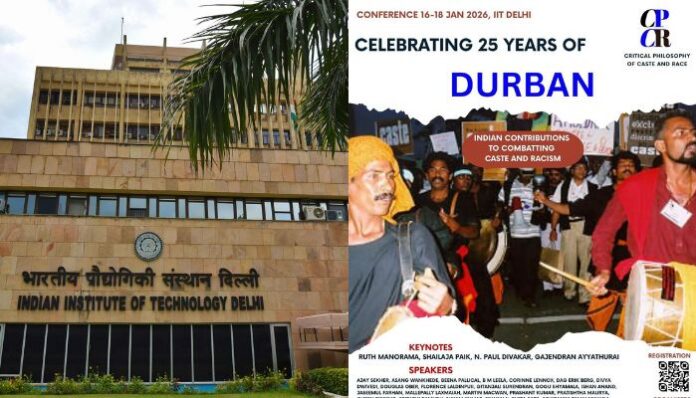
On 25th January, the Indian Institute of Technology Delhi acknowledged “serious concerns” raised over the “Critical Philosophy of Caste and Race” conference held on its campus between 16th and 18th January. In an official statement, IIT Delhi said it has sought an explanation from the concerned faculty members and constituted a fact-finding committee with independent members to examine objections related to the choice of speakers and the nature of the content presented.
"Critical Philosophy of Caste and Race" conference (Jan 16-18):
— IIT Delhi (@iitdelhi) January 25, 2026
Serious concerns have been raised over the choice of speakers and content of the conference.
The Institute has sought an explanation from the concerned faculty, and a fact-finding committee with independent…
The institute further stated that appropriate action would be taken in accordance with institutional protocols once the committee submits its findings. The institute reiterated its commitment to national goals, academic integrity, and established institutional guidelines.
What the conference was about
The three-day event, titled “Critical Philosophy of Caste and Race” or CPCR3, was organised at the Senate Hall of IIT Delhi’s main building. It was positioned as an academic conference marking 25 years of the 2001 World Conference Against Racism held in Durban, South Africa.
According to the organisers, the conference aimed to examine caste as a form of descent-based discrimination and to frame it alongside race within global human rights discourse. The programme brought together academics, activists, writers, and international speakers for keynote lectures, panel discussions, round tables, book launches, and film screenings centred on caste, race, gender, religion, and global advocacy.
While it all sounds good from the outside, the conference provided a biased platform to a one-sided narrative of caste politics. The whole structure was designed to show that there are high levels of discrimination everywhere against minorities and marginalised communities in India.
The conference was organised by Divya Dwivedi of IIT Delhi and Sowjanya Tamalapakula, with support from the Department of Humanities and Social Sciences. Divya Dwivedi is the same professor who once claimed that Hinduism was invented in the 20th century during a debate on a news channel. She also called Hinduism a “hoax” in an article she wrote for The Caravan.
Among the speakers, there were international “activists” and “scholars”, including Thenmozhi Soundararajan, founder of Equality Labs, whose work has been controversial for its framing of caste within race-based and international advocacy narratives. Equality Labs has been pushing a caste narrative in the United States, claiming that upper-caste Indians who have migrated to the US often indulge in caste-based discrimination against Indian-origin colleagues and employees from the SC/ST community.
Several sessions explicitly linked caste with race, global governance, religion, and contemporary political movements, including discussions comparing Dalit issues with other international conflicts. These sessions called for transnational alliances to address “caste-based discrimination”. The ideological orientation of these sessions and the speakers in the sessions, as well as the activist-driven framing of caste within an elite technical institution, have now come under scrutiny.
Who is Divya Dwivedi and what she represents
Divya Dwivedi is a professor in the Department of Humanities and Social Sciences at IIT Delhi who is behind the CPCR conferences. She teaches philosophy and literature. Over the past decade, she has emerged as an ideologue who consistently frames Hindu identity, caste, and Indian society through a confrontational political lens that is rooted in race discourse and global activist frameworks.
Her academic career includes publications with international publishers, fellowships in European institutions, and advisory roles linked to UNESCO affiliated platforms. This global positioning is central to her work, as it means she is not confined to classroom debate. She actively seeks to shape how India’s social structure is interpreted, critiqued, and judged in international intellectual and political spaces.
Her public record on Hinduism and the Hindu identity
The ideological positioning of Dwivedi is in itself highly problematic. During a television debate in 2019, she declared, “The Hindu religion was invented in the early twentieth century in order to hide the fact that the lower caste people are the real majority of India.” She went on to claim that Mahatma Gandhi “helped construct a false Hindu majority and a new Hindu identity”, adding that this political construct must be “discarded”.
These views were elaborated further in the essay she co-authored for the controversial magazine, The Caravan. The essay, titled “The Hindu Hoax”, presented Hindu identity as a deliberate political fiction created by upper caste elites. In the essay, she argued that there is “no innocent use of ‘Hindu’” and portrayed the term itself as inseparable from caste oppression and political domination.
Such claims are not framed as one strand of interpretation among many. They are presented as definitive conclusions, leaving little room for historical continuity, internal reform traditions, or the lived religious experience of millions of Hindus across caste. By presenting Hinduism as a “hoax”, she effectively denies the followers of Sanatan Dharma their legitimate place in India’s religious and civilisational space, reducing a living faith to a political construct and disregarding how millions of people understand and practise their own religion.
G20 intervention and internationalisation of the narrative
Dwivedi’s ideological posture became even more explicit during the G20 meeting in India in 2023. During that time, she used an interview with the French broadcaster France 24 to argue that India’s future must move beyond Hinduism itself.
🔴🇮🇳 Philosopher and author Divya Dwivedi says there are two Indias:
— FRANCE 24 English (@France24_en) September 8, 2023
➖ Past India of racialized caste order oppressing the majority population.
➖ The idea of a future egalitarian India without caste oppression and Hinduism.
Watch her analysis here on the @F24Debate 👇 pic.twitter.com/Q5J0CHL0uQ
She said, “There are two Indias. One is the India of racialised caste order and then there is the India of the future, an egalitarian India without caste oppression and Hinduism.”
When confronted with on-ground stories of social mobility and economic change, she dismissed them as “mediatised anecdotes” and reiterated that “10% of the upper caste occupy 90% of the lucrative and powerful positions”. She further described Hinduism as a “false to hoax representation” and went on to label the RSS as a “fascist organisation” representing “upper caste supremacist interests”.
This was not a casual remark. It reflected a consistent attempt to export a specific narrative about India to global audiences at a time when the country was hosting world leaders. She sought to reinforce the same ideological framework she advances in her academic work.
What she argued at the IIT Delhi conference
At CPCR3, Dwivedi presented a paper titled ‘Remnants of Durban: Towards a Critical Philosophy of Caste and Race’. While the full text of the paper or a video of her presentation is not publicly available yet, the abstract of the paper itself is revealing.
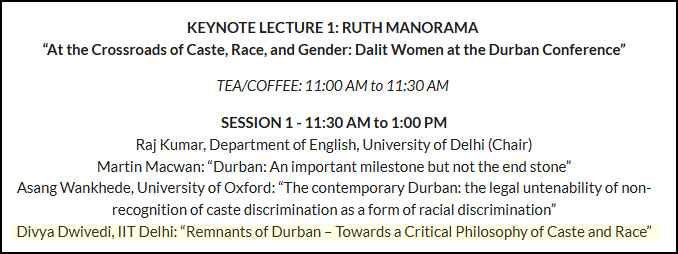
In the paper, which was published by Oxford Press in March 2025, Dwivedi reiterated the claim that “caste is race plus”, a slogan that originated from the 2001 Durban conference. She argued that caste and race share a deep structural homology rooted in what she described as the pre-colonial and colonial “Aryan doctrine”. According to her, this constitutes not merely discrimination but a form of “paleo racism”, predating modern racial categories.
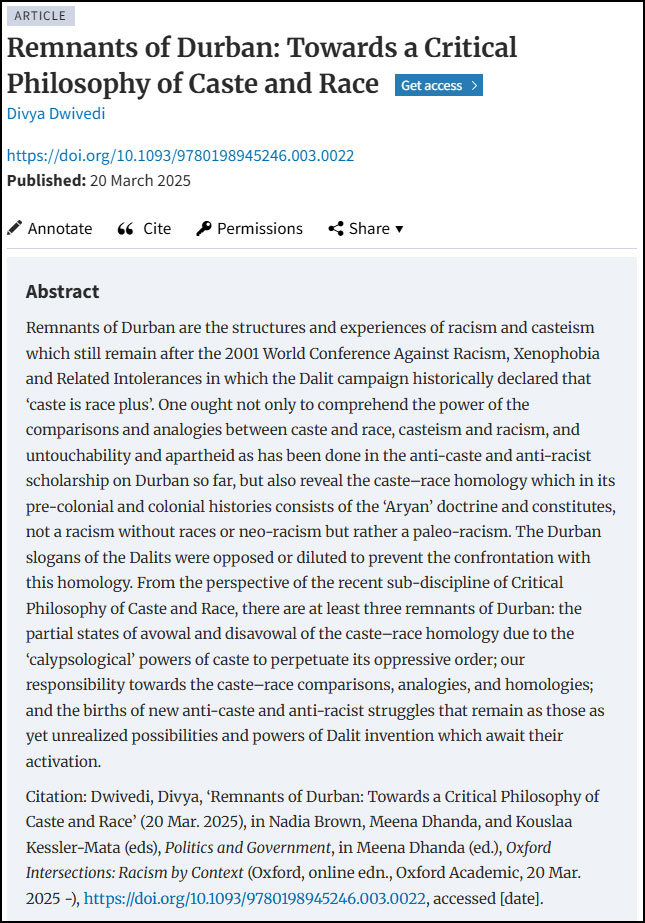
She further suggested that opposition to equating caste with race exists primarily to prevent confrontation with this so-called homology. The abstract framed caste as possessing “calypsological powers” which allow it to perpetuate oppression through concealment and denial. It concludes by calling for new global anti caste and anti-racist struggles, presented as unfinished political projects awaiting activation.
The aim of the argument is to prove that Hindu society is not viewed as reformable or internally plural. It shows society as an inherently racialised order whose very foundations must be challenged through global ideological mobilisation.
Why this framework is deeply problematic
Dwivedi’s approach collapses religion, history, social practice, and political power into a single accusatory framework. Hinduism is reduced to a tool of domination, caste is racialised in absolute terms, and dissenting interpretations are treated as moral evasions rather than scholarly disagreements.
This is one of the major problems with Left-liberal intellectuals. In their view, it is “my way or the highway”. Anyone presenting an alternative narrative or perspective to counter theirs becomes a right-winger, no matter how rational the argument is.
Her work invites external interventions into India’s internal social processes by framing caste as race and Hindu identity as a hoax. It delegitimises indigenous reform movements, philosophical traditions, and social mobility that do not align with her thesis. It replaces social complexity with ideological certainty.
Most critically, her repeated use of global platforms, whether academic conferences or international media during the G20, demonstrates how this narrative is not merely academic inquiry, but political advocacy presented as scholarship.
Why her role at IIT Delhi matters
When such an ideological framework is institutionalised within a publicly funded premier institution like IIT Delhi, it raises legitimate concerns. Jawaharlal Nehru University (JNU) has long been seen as a hub of Left-liberal, anti-Hindu, and anti-India narratives, largely because such ideologies have been allowed to flourish without meaningful administrative intervention.
Academic freedom does not mean ideological monopoly. Yet the conference curated by Dwivedi overwhelmingly reflected her worldview, with little evidence of balance or counter scholarship. The concern is not that she holds controversial views. It is that these views are advanced as academic consensus, amplified through elite institutions, and projected internationally as representative of Indian reality. That is precisely why scrutiny of her role, her conferences, and her intellectual networks has become unavoidable.
Who is Thenmozhi Soundararajan, founder of Equality Labs
Thenmozhi Soundararajan is the founder and executive director of Equality Labs. She describes herself as a transmedia artist, theorist, and futurist. She is a Dalit American commentator on religion, race, caste, gender, technology, and justice, with highly objectionable views on Hinduism, Hindu society, and culture. Her topic for the conference was “25 Years of Racial and Caste Equity Impact of Durban on Dalit Americans”.
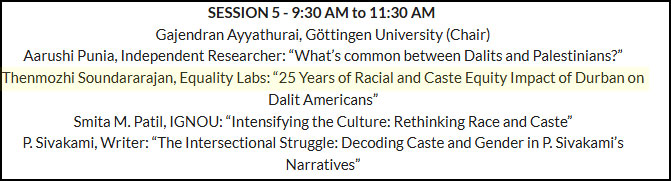
Her organisation, Equality Labs, has emerged as one of the most influential anti-Brahminism advocacy groups in the United States. She is also the author of The Trauma of Caste and has positioned herself as a key voice seeking to internationalise caste discourse by framing it within the language of race, systemic oppression, and genocide.
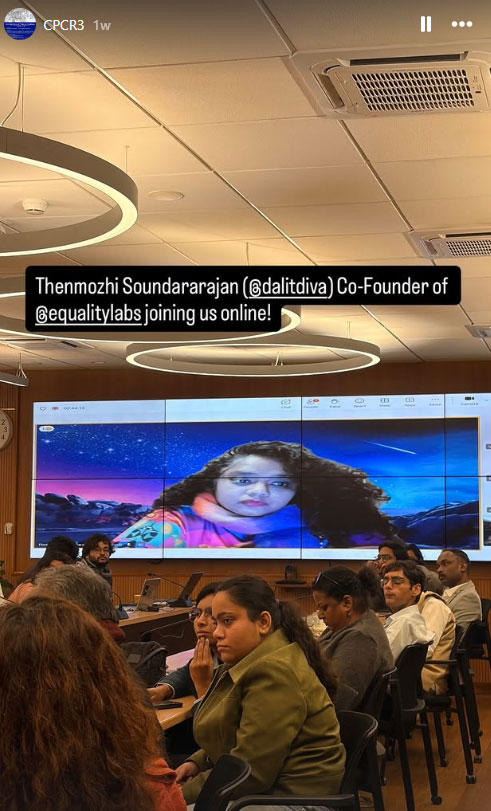
Under Thenmozhi Soundararajan‘s leadership, Equality Labs has actively pushed narratives portraying Hindu society, particularly Brahmin communities, as structurally oppressive, often using sweeping generalisations rather than case specific evidence.
Equality Labs and its activism record
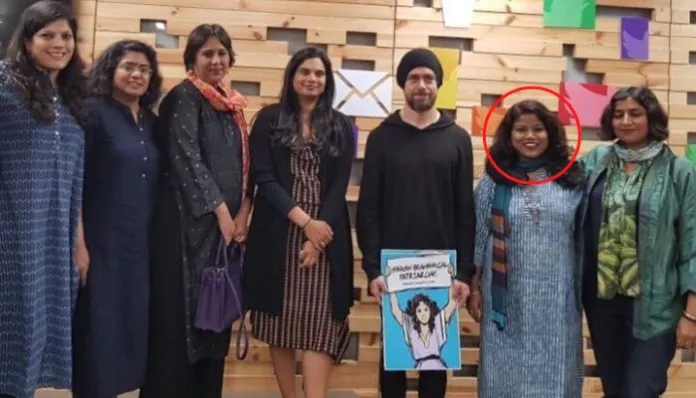
Equality Labs gained global attention when former Twitter CEO Jack Dorsey posed with a placard reading “Smash Brahminical Patriarchy”, a poster designed by Soundararajan herself. The image became emblematic of the organisation’s confrontational activism, which promotes social antagonism rather than reform.
The organisation has collaborated with the Organisation for Minorities in India (OFMI) on reports claiming widespread caste discrimination among South Asian Americans. OFMI was founded by Bhajan Singh Bhinder, a known ISI operative, and included Pieter Friedrich, who has repeatedly targeted Hindu political figures and organisations. Despite these associations, Equality Labs continued to be cited by activist lawmakers and media outlets as an authoritative voice on caste.
Political lobbying and ideological campaigning
Equality Labs holds significant influence within the Justice Democrats wing of the US Democratic Party. The organisation actively campaigned against India’s Citizenship Amendment Act in the United States, amplifying allegations of genocide and popularising slogans such as “Stop Hindu fascism”.
Controversial claims and workplace pushback
Soundararajan has made repeated controversial assertions, including claims that Sanskrit was exclusive to Brahmins in the Vedic period and that the Manusmriti ordered molten lead to be poured into the ears of Dalits, assertions that have been disputed by multiple scholars. She has also accused yoga traditions and instructors of promoting sexual control and predatory behaviour under the guise of ancient practices.
In April 2022, Google cancelled a scheduled talk by Soundararajan after internal concerns that her presentation could create division and rancour within the workplace. The tech giant clarified that while caste discrimination has no place at Google, it would not host sessions that risked polarising employees.
Links to Khalistani elements and SB403 controversy
Soundararajan has also drawn attention for appearing on the same stage as Khalistani terrorist Gurpatwant Singh Pannun of Sikhs For Justice, a fact highlighted by US Congressional candidate Ritesh Tandon. The event took place in Washington DC, and photographs of the gathering were later shared by Hindu advocacy groups.
I strongly condemn the reported acts of vandalism, attempted arson, and fire targeting the Indian Consulate in San Francisco @nagentv @SandhuTaranjitS. These criminal offenses are highly reprehensible. It is disappointing to witness the lack of action from California Governor… pic.twitter.com/mXxl9aHva2
— Ritesh Tandon US Congressional Candidate, CA 17 (@tandon4congress) July 4, 2023
Equality Labs was among the strongest backers of California’s SB403, a proposed anti caste discrimination bill that relied heavily on the now collapsed Cisco caste case. Despite the bill being returned by Governor Gavin Newsom, Soundararajan described the setback as “heartbreaking”, signalling the organisation’s continued push to legislate caste narratives into American law.
Aarushi Punia and the Dalit Palestinian comparison
During the conference, one of the speakers, Aarushi Punia, spoke on the topic “What’s common between Dalits and Palestinians?”. Aarushi is a scholar trained at IIT Delhi, where she completed her PhD comparing Dalit and Palestinian literature and narratives of suffering.
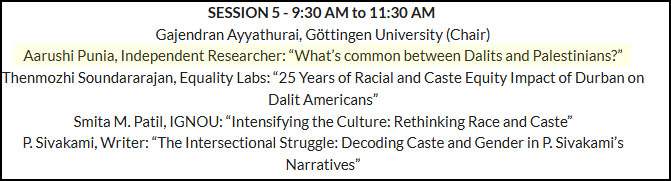
Her academic work focuses on caste, Palestine, gender, and what she describes as racialised structures of oppression. She has also been a visiting fellow at the University of Cambridge and has written for platforms such as the Indian Express, Middle East Eye, and other left leaning publications.
In an article published in the Indian Express in May 2024, she argued that Dalits and Palestinians share comparable experiences of oppression, humiliation, segregation, and erasure at the hands of ‘ethno-national states’. She equated the Indian social order with the Israel Palestine conflict by portraying both as “carceral” systems in which dominant groups allegedly exercise racial control over subordinated populations.
Her article repeatedly framed Hindu society and the Indian state as structurally analogous to Zionism, asserting that caste operates as a form of racial domination similar to Israel’s actions in Gaza and the West Bank.
This comparison is deeply problematic. Dalits are citizens of India with constitutional rights, political representation, affirmative action safeguards, and legal remedies. Palestinians, by contrast, are located within a geopolitical conflict involving borders, war, terrorist groups like Hamas, and competing national claims. Collapsing social discrimination within a civilisation into an active military conflict between states and non-state actors is not scholarship, but ideological flattening.
She drew moral equivalence between caste oppression and war driven territorial conflict without considering the fact that such arguments erase historical specificity, reduce complex realities into grievance narratives, and have the potential to push specific communities towards armed conflicts.
This framing does not advance reform or justice. Instead, it feeds into a broader academic tendency to recast Indian society as inherently oppressive and comparable to global conflict zones, a move that aligns more with political advocacy than rigorous analysis.
Not an isolated event, but a growing pattern
The controversy around the CPCR3 conference at IIT Delhi points to a larger issue within India’s academic spaces. What was presented as an academic discussion on caste and discrimination ended up promoting a narrow and one sided narrative that portrayed Hindu society as inherently oppressive and beyond reform.
The conference was organised by Divya Dwivedi, and the presence of Equality Labs founder Thenmozhi Soundararajan makes the nature of the conference clearer. Their past statements and activism show a consistent pattern of framing Hindu identity as a political conspiracy and caste as a racial system comparable to global conflict patterns. This approach is less about reform and more about confrontation, often aimed at international audiences.
Such conferences do not exist in isolation. Similar events are increasingly being organised across campuses, where activist narratives are presented as academic consensus, while alternative perspectives are ignored. When caste is repeatedly equated with race and India’s social realities are compared with war zones, it creates division rather than dialogue.
Academic freedom does not mean ideological monopoly. Institutions like IIT Delhi have a responsibility to ensure balance, intellectual rigour, and genuine debate. The institute’s decision to seek explanations and set up a fact finding committee is an important step, but the larger issue remains.
This episode is only the tip of the iceberg. Unless such narratives and conferences are examined more closely, academic spaces will continue to lean towards ideologically driven political advocacy rather than serving as centres of learning and inquiry.


