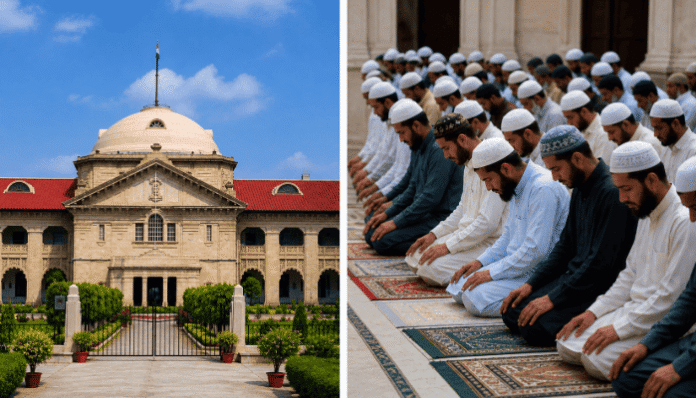
On 6th April (Monday), Allahabad High Court noted that no individual or organisation can be allowed to utilise public land exclusively for large-scale religious gatherings, including namaz. It pointed out that public order, morality and health are tied to the fundamental right to freedom of religion.
“It is not an unlimited right. It cannot be exercised in a way that affects others or disturbs the normal functioning of public life. As is often said, one person’s freedom ends where it begins to affect someone else,” pronounced a division bench of Justices Garima Prasad and Saral Srivastava.
The court made these statements while rejecting a request for authorisation to perform namaz on land in the Sambhal district of Uttar Pradesh’s Ikona village in Pargana Rajpura of Gunnaur Tehsil. It dismissed the plea, which was filed by a man named Aseen, claiming the spot was his own property and demanded protection from authorities to execute Islamic prayers there.
The court highlighted that public property is governed by law and is intended for everyone. Hence, no one is entitled to employ it for routine religious events. “Such use affects movement, access and safety, and in appropriate situations, communal equilibrium; it must therefore be regulated. It is the state’s obligation to ensure equal access, civic order and nondiscriminatory administration,” the court observed.
The bench cited earlier judgements and referenced the Supreme Court’s emphasis on upholding social harmony, civic peace and the rule of law. It urged that courts must consider the practical implications of their decisions. “Where a claim to hold religious congregation on public land has the potential to create social tension, the constitutional court must ensure that the conditions necessary for peaceful coexistence are maintained,” the court mentioned.
The state is duty-bound to act
According to the verdict, it must be acknowledged that established legal procedures, long-standing agreements, or concessions given for particular or restricted purposes might stand independently, but no new or unilateral assertion could be predicated only on personal preference or religion. “The state is constitutionally entitled, and in appropriate cases duty bound, to prevent the use of public land without lawful authority,” the court further emphasised.
‘Private properties can be used for strictly private events, when they become congregational, it will be subject to law and order’
The judges declared that the context with regard to private property is distinct and expressed, “Private prayer, family worship and such limited devotional activity as remains genuinely internal to the premises ordinarily fall within the protected domain of Articles 25 and 26.” However, this protection is limited to truly private, infrequent and non-disruptive activities. It excludes converting any private space into a de facto public place of worship.
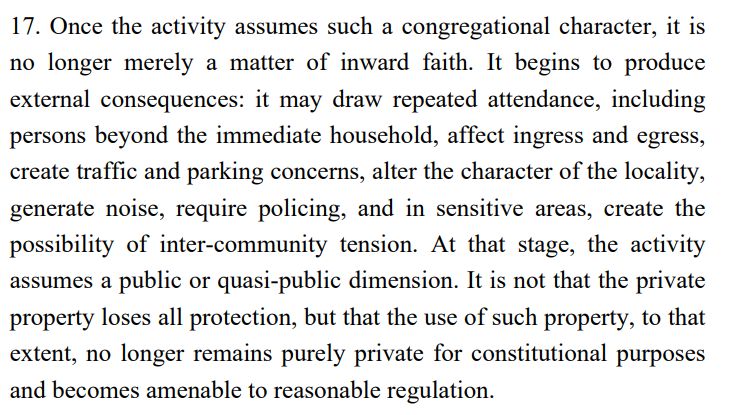
“Once the activity assumes such a congregational character, it is no longer merely a matter of inward faith. It begins to produce external consequences: it may draw repeated attendance, including persons beyond the immediate household, affect ingress and egress, create traffic and parking concerns, alter the character of the locality, generate noise, require policing, and in sensitive areas, create the possibility of inter-community tension,” the court stated.
It underscored that the activity then takes on a public or quasi-public aspect. Private property is not completely unprotected, rather, its use, to that extent, turns liable to reasonable control and is no longer solely private for constitutional considerations. “This position is consistent with the decisions relied upon by the petitioner,” the bench stressed.
‘No unequivocal right to repeatedly organise religious functions even on private property’
The court invoked previous rulings to convey that although bona fide religious practices on private grounds are protected and cannot be arbitrarily interfered with, it does not equate to “absolute carte blanche” for periodic or structured religious activities by a community.
It stated, “They recognise a limited protection, namely where prayer remains confined to a private, non-disruptive setting. Where the activity extends beyond that sphere and begins to affect the public domain, lawful regulation follows. These decisions do not confer a right to convert private premises into an unregulated congregational space.”
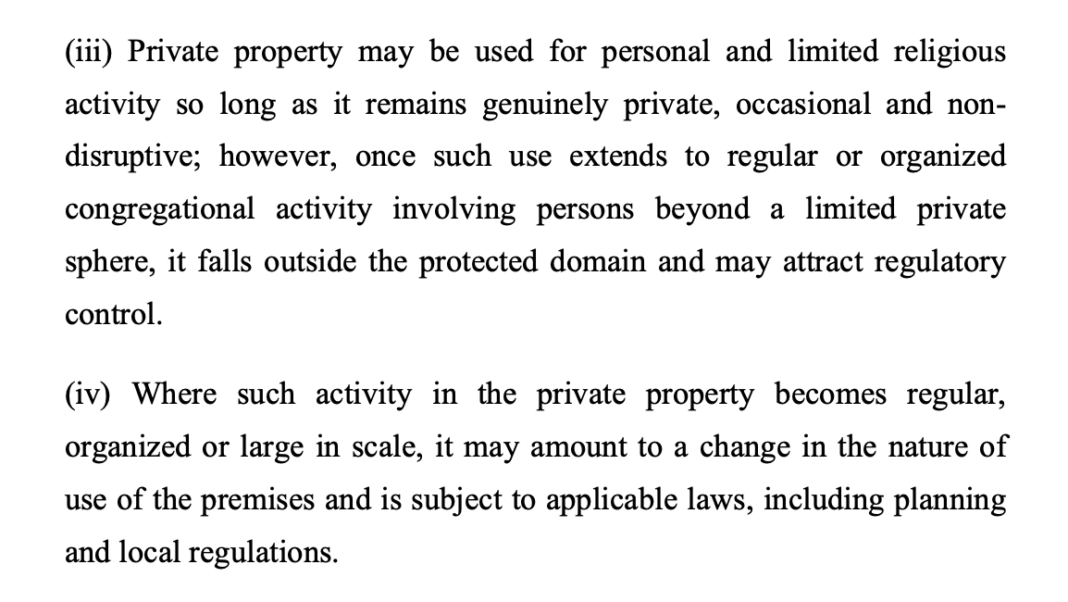
The order read that the authorities are not required by law to wait for an actual disruption to happen. The state has the right to take preventive steps when an activity has the potential to have an impact on public order. The examination is not the religious character, but its effects on society.
“This approach is consistent with the constitutional principle of secularism, which requires equal treatment of all religions and equal application of law. While the State must permit private worship, it is equally bound to regulate activities that affect public order, whether on public land or on private premises. Maintaining this balance is essential to the working of Articles 25 and 26 in a constitutional system,” the court highlighted.
The court calls out the flimsy submission
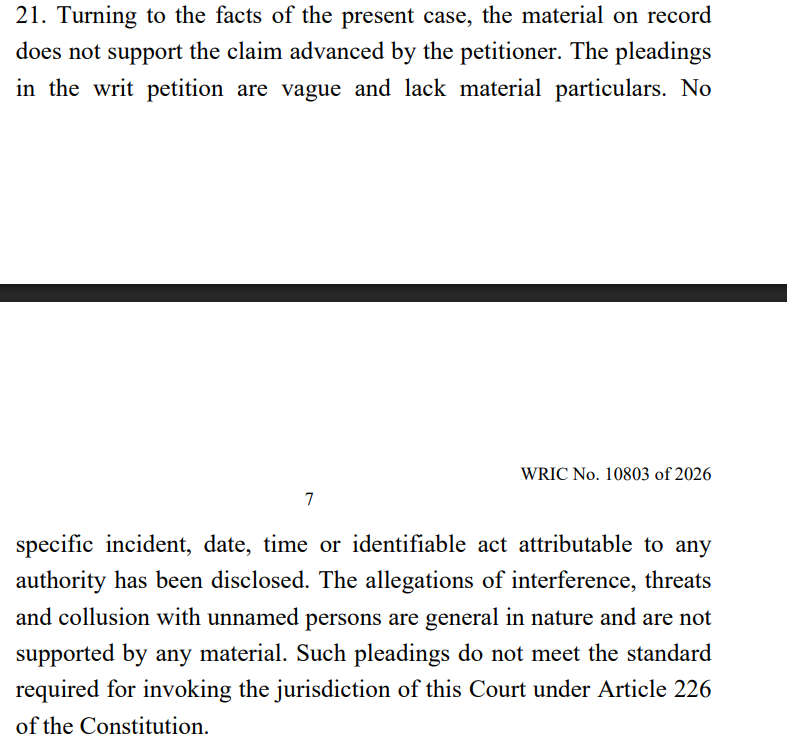
The court specified that the petitioner’s argument is not supported by the facts provided in the record. The writ petition’s contents are ambiguous and devoid of important details. It countered, “No specific incident, date, time or identifiable act attributable to any authority has been disclosed. The allegations of interference, threats and collusion with unnamed persons are general in nature and are not supported by any material.” According to Article 226 of the Constitution, such declarations do not satisfy the prerequisites necessary to seek the court’s jurisdiction.
This court determined that the land in dispute is marked as public land pursuant to the provided materials. The ownership claim relies entirely on an alleged gift deed that is centred exclusively on ambiguous border descriptions and lacks key land details like Gata or Khata numbers “Such a document does not establish any identifiable title and cannot displace the revenue record,” it added.
“Even otherwise, if the land is assumed to be private, the petitioner is not entitled to the relief sought. The record shows that he is not protecting an existing practice, but seeking to introduce regular congregational gatherings, including persons from within and outside the village,” the bench and remarked that it has been accepted that in the past, namaz was only performed on special occasions like Eid. This extension outside of a narrow private domain is not protected and is vulnerable to oversight.
“In these circumstances, no enforceable legal right is made out. This court cannot grant relief on such a basis, particularly where the matter has implications for public order and social harmony. Accordingly, the writ petition is dismissed. No order as to costs,” the judges concluded.
It is noteworthy that the Sambhal administration outright banned namaz on public highways and areas last year.