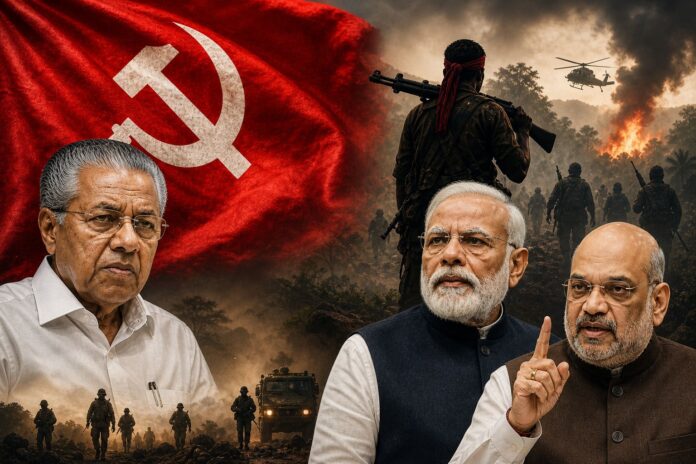
History, when it turns, rarely does so in fragments. It moves in arcs: political, ideological, and civilizational. And in 2026, India appears to be witnessing one of those rare moments where two parallel arcs have converged into a single, decisive conclusion: the collapse of Communist political power and the near-extinction of Maoist violence.
On the one hand, Kerala, the last functional bastion of parliamentary communism, is slipping decisively out of the hands of the CPI(M)-led Left Democratic Front. On the other hand, the Indian state is declaring the endgame of left-wing extremism, meeting a self-imposed deadline of March 31, 2026, to eradicate Naxalism.
One ballot. One bullet. Both are now spent.
The fall of Kerala: When arithmetic became an ideological verdict
The ongoing Kerala assembly results are not merely unfavourable for the Left; they are catastrophic. The Congress is leading in 63 out of 140 seats, the CPI(M) is reduced to around 25, and the Indian Union Muslim League is holding 23. The Congress-led United Democratic Front is comfortably heading toward a sweeping victory, while the BJP remains marginal with just two leads.
This is not a routine alternation of power that Kerala is known for. This is a breach of ideological territory.
For decades, Kerala was the exception that kept the Left politically relevant even as it collapsed elsewhere. The re-election of Pinarayi Vijayan in 2021 had been projected as proof that communism in India could still adapt, still govern, still win.
Five years later, that argument stands dismantled.
The campaign led by V. D. Satheesan has not just defeated the Left, it has outflanked it. By setting an ambitious 100-seat target and aggressively pushing into traditional LDF strongholds, the UDF has done what few thought possible: convert anti-incumbency into ideological displacement.
The Congress’s historical Muslim appeasement and its alliance with a party like IUML has further solidified its standing in Kerala elections, ensuring that the UDF emerges as a coalition with a comfortable majority to keep the Left at the bay.
Kerala, in short, has delivered a verdict that goes beyond governance. It has questioned relevance.
The long decline: From Jyoti Basu to political marginality
To grasp the magnitude of this moment, one must revisit the heights from which the Left has fallen.
In 1996, Jyoti Basu was poised to become Prime Minister, a moment that could have altered India’s political trajectory. The CPI(M)’s refusal, later termed a “historic blunder” by Basu himself, symbolised an enduring tension within the Left: ideological rigidity over political opportunity.
By 2008, the Left was powerful enough to destabilise the United Progressive Alliance government led by Manmohan Singh over the Indo-US nuclear deal. It held sway in West Bengal, Kerala, and Tripura simultaneously.
And then came the collapse.
West Bengal fell in 2011 to Mamata Banerjee, exposing the contradictions of a regime that had drifted from its grassroots origins. Tripura followed in 2018, with leaders like Manik Sarkar unable to withstand the BJP’s expansion.
Kerala remained the last redoubt until now.
Parallel arc: The rise and fall of Maoist violence
While the electoral Left was losing ground, another, more violent manifestation of the same ideological spectrum was also unravelling: the Maoist insurgency.
The story of Naxalism begins in 1967, in the village of Naxalbari in West Bengal, led by figures like Charu Majumdar. What started as a localised peasant uprising soon evolved into a decades-long insurgency that spread across central and eastern India, forming what came to be known as the “Red Corridor.”
At its peak, this corridor spanned over a dozen states and affected millions of people. Entire regions, like the dense forests of Dandakaranya, were effectively outside the writ of the Indian state. Maoists ran parallel administrations, enforced their own justice systems, and sustained themselves through extortion, violence, and ideological indoctrination.
The human cost was staggering. Since 2000 alone, over 12,000 lives have been lost. Civilians, security personnel, and even tribals were coerced into the insurgency.
And yet, for years, the response remained hesitant.
The policy shift: From appeasement to annihilation
The turning point came post-2014, when the Modi government reframed Naxalism not as a socio-political grievance but as a national security threat. This was not merely a rhetorical shift; it fundamentally altered the state’s operational doctrine.
Under the leadership of Amit Shah, a multi-pronged strategy was deployed: intelligence-driven operations, infrastructure expansion, financial crackdowns, and rehabilitation programs.
The results were cumulative and decisive.
Between 2015 and 2025, the number of Naxal-affected districts shrank dramatically from 106 to just 18, with only a handful remaining severely impacted. Leadership decapitation accelerated, with top commanders like Nambala Keshav Rao (Basavaraju) eliminated in 2025. Surrenders surged, crossing 2000 in a single year.
Operations like “Kagar” and “Black Forest” dismantled Maoist strongholds, destroyed bunkers, and recovered massive caches of explosives. Simultaneously, development initiatives like roads, telecom networks, and bridges began integrating previously inaccessible regions into the national mainstream.
Perhaps the most symbolic shift was psychological. Where once the Indian state sought ceasefires, Maoists were now reportedly seeking them, an inversion of power dynamics that underscored the insurgency’s collapse.
By March 31, 2026, the government declared that Naxalism, as an organised threat, had been effectively eliminated.
Abujhmadh: From no-man’s land to state presence
No region illustrates this transformation better than Abujhmadh in Chhattisgarh, a vast, unmapped forest that once served as the ideological and operational headquarters of Maoists.
For decades, there were no roads, no hospitals, no administrative presence. Maoists ensured isolation, destroying infrastructure and preventing development to maintain control. They ran their own “Janatana Sarkar,” enforced their own laws, and turned the region into a fortress of insurgency.
Today, that fortress is collapsing.
Security operations have penetrated deep into these areas. Roads are being constructed, mobile towers installed, and governance restored. The very geography that once shielded Maoists is now being reclaimed by the state.
The ideological link: Ballots and bullets
It would be analytically simplistic to equate parliamentary communism with Maoist insurgency. One operates within democratic frameworks; the other rejects them entirely.
And yet, both draw from a shared ideological lineage, a belief in class struggle, a scepticism of the Indian state, and an aspiration, however differently expressed, to fundamentally restructure society along Marxist lines.
What 2026 demonstrates is that this broader ideological ecosystem is in retreat.
The voter has rejected it at the ballot box. The state has dismantled it on the battlefield.
The collapse of the “Urban Ecosystem”
An often overlooked dimension of this story is the role of what has been termed the “urban Naxal” ecosystem, academics, activists, and commentators who provided ideological cover, legal aid, and narrative support to Maoist groups.
For years, this ecosystem framed Maoists as rebels with a cause, often downplaying or justifying their violence. But as the insurgency weakened and its excesses became harder to obscure, that narrative began to lose traction.
The state’s refusal to engage in ceasefire theatrics or narrative battles further marginalised these voices. The focus remained on outcomes, not optics.
Two Ends, One Message
The simultaneous decline of the CPI(M) in Kerala and the eradication of Maoist violence across India is not coincidental; it is convergent.
It reflects a deeper shift in Indian society: from grievance to aspiration, from ideology to delivery, from revolution to integration.
The Indian voter today is not interested in dismantling the system; he wants to succeed within it. The Indian state, for its part, has demonstrated that it will no longer tolerate armed challenges to its authority.
The year an idea lost its constituency
2026 may well be remembered as the year when an idea, once dominant, often disruptive, occasionally transformative, finally ran out of both voters and fighters.
The CPI(M), staring at a wipeout in Kerala, faces an existential question: what does it stand for in modern India?
Maoism, reduced from a sprawling insurgency to scattered remnants, faces a harsher reality: it no longer stands at all.
History will record this not as a sudden collapse, but as the end of a long decline, accelerated by political missteps, ideological stagnation, and a changing nation that simply moved on.
And as India steps into its next phase, the message from 2026 is unambiguous: The age of the Red, both electoral and insurgent, has come to an end.