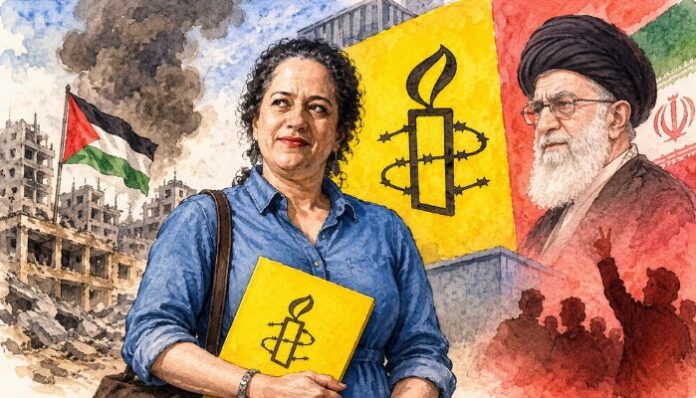
A woman who fled Iran fearing for her life, only to find refuge in the United Kingdom and a role within Amnesty International, has now quit the organisation. She said that it has become dangerously fixated on Gaza while sidelining the very human rights crises it claims to champion. Her resignation and the shocking revelations she has levelled against a fellow volunteer have lifted the lid on an organisation that has long been viewed with deep suspicion in India for its documented history of financial irregularities, FCRA violations, and anti-national activities.
Sara Saei Joeghan arrived in the UK as a refugee in 2015 after being arrested and interrogated by the Iranian regime for participating in anti-death penalty protests. She joined Amnesty International, believing it to be a beacon of impartiality. Instead, she says she found an organisation where a fellow volunteer praised Iran’s former Supreme Leader, Ayatollah Ali Khamenei, as a “warrior pope” and a “man of honour. Khamenei was responsible for mass killings, executions of minorities, and severe repression.” She says she was forced to work alongside this individual, Niloufar ‘Nilly’ Brook, and felt “unsafe” doing so. The revelations, first reported by the Daily Mail, paint a picture of an organisation that has lost its moral compass and prioritises ideological agendas over the very people it purports to protect.
Peter Benenson founded @amnesty to support victims of human rights abuses. But the NGO became a massive source of hate propaganda & lies. Whistleblower Sara Saei Joeghan confirms @NGOmonitor documentation of @amnesty @AgnesCallamard @Irenekhan etc antisemitism and betrayal. https://t.co/QxL21YR5Rt
— Prof Gerald M Steinberg (@GeraldNGOM) November 29, 2026
A Refugee’s betrayal: ‘I felt deeply let down’
Joeghan’s story is one of courage and, ultimately, disillusionment. She has endured interrogation by the Iranian regime. She dedicated herself to human rights advocacy. She became one of Amnesty UK’s more than 200,000 members. She was appointed Iran country co-ordinator in 2024. She believed this would allow her to organise events to help women, LGBT+ people, and other groups facing repression in Iran. “I joined Amnesty because I believed deeply in its principles of independence, impartiality and the protection of human rights,” she said. “Now I feel deeply let down and ultimately betrayed.”
Instead, she found an organisation gripped by monomania. According to Joeghan, Amnesty International had become so consumed by the Palestinian cause that every other human rights crisis was being subordinated to it, diluted by it, or ignored altogether. The problem was not merely a matter of emphasis. It was a matter of institutional culture. When Joeghan shared articles from Persian media exposing Tehran’s human rights abuses in internal WhatsApp groups, she was criticised. When she tried to organise events focused on Iran, the ground shifted beneath her feet.
Her betrayal stems from what she describes as Amnesty’s systematic dilution of Iranian human rights abuses in favour of an all-consuming focus on the Palestinian cause. She recounts how a panel event discussing US President Donald Trump’s impact on Palestinians and Iran included figures who had amplified members of the National Iranian American Council (NIAC), a lobby group often described as an influence network for the repressive Islamic Republic. Her complaints went unanswered. A planned screening of In the Eye of Freedom, a documentary about protesters shot during the Iranian regime’s brutal 2022 crackdown following the death of Mahsa Amini, was cancelled by Amnesty colleagues, ostensibly over the director’s pro-monarchist leanings.
The ‘Warrior Pope’ and the Ayatollah: Amnesty’s uncomfortable bedfellows
The most damning concerns Niloufar ‘Nilly’ Brook, Joeghan’s fellow country co-ordinator. Brook praised Ayatollah Khamenei following his death. He described him in a video as a “warrior pope” and a “man of honour,” claiming he had been “heavily demonised” by the West. She reportedly shared social media posts containing phrases such as “you are always in my heart” and “Dear leader, I miss you so much.” For an Iranian refugee who had fled the Ayatollah’s brutality, having to work alongside someone who revered him was not merely uncomfortable; it was a profound betrayal of everything Amnesty claims to stand for.
Amnesty’s response has been to distance itself from the characterisation of Brook as “staff,” issuing a correction to state that both women were volunteers. This semantic gymnastics does little to address the core issue: an organisation that positions itself as the world’s moral arbiter on human rights apparently harbours individuals who celebrate the architects of state repression. Amnesty UK has insisted that it has “been at the forefront of documenting human rights abuses in Iran for decades” and that its work in Iran “has never been greater.” Yet the testimony of a woman who lived through that repression suggests otherwise.
The India file: A legacy of FCRA Violations and ‘Anti-National’ activities
For Indian observers, none of this is surprising. Amnesty International’s Indian chapter was forced to shut down its operations after a series of investigations exposed systematic violations of the Foreign Contribution (Regulation) Act (FCRA). The Enforcement Directorate (ED) found that Amnesty International UK routed more than Rs 51 crore to its Indian arm in violation of FCRA. It did so to “fund anti-national activities in the guise of export of services”. The ED’s chargesheet specifically named two projects: “Kashmir: Access to Justice” and “Justice for 1984 Sikh Massacre” as receiving significant foreign funds. ED said Amnesty was fanning the 1984 Sikh massacre narrative during the 2017 elections.
The ED’s investigation revealed a sophisticated layering operation. When the government denied FCRA permission to Amnesty International India Foundation Trust (AIIFT), the UK-based parent organisation created Amnesty International India Pvt Ltd (AIIPL) and Indians Amnesty International Trust (IAIT) to circumvent regulations. Amnesty International UK sent Rs 51.72 crore to AIIPL in the guise of export of services and foreign direct investment, with no documented proof of the purported export. The ED attached assets worth Rs 1.54 crore, bringing the total attachment in the case to Rs 21.08 crore. The organisation ultimately had to close its India operations as a direct consequence of its refusal to comply with Indian law.
AI-Generated Lies: Amnesty’s credibility crisis
The organisation’s credibility was further shattered in 2023 when its Norway chapter published AI-generated images purporting to depict human rights abuses during the 2021 Colombian protests. The images were riddled with errors: the Colombian flag’s colours were arranged incorrectly, police uniforms were obsolete, and faces were visibly warped. Photojournalist Juancho Torres from Bogotá condemned the deception: “We are living in a highly polarised era full of fake news, which makes people question the media’s credibility. And as we know, artificial intelligence lies. What sort of credibility do you have when you start publishing images created by artificial intelligence?” Amnesty was forced to delete the posts and issue an apology, admitting the AI images were “disrespectful to the photojournalists who covered the protests”. The episode exposed an organisation willing to fabricate evidence to advance a narrative a pattern that Joeghan’s testimony now confirms extends to its treatment of Iran.
Conclusion: An organisation that has lost its way
Sara Saei Joeghan’s resignation is not an isolated incident. It is the latest data point in a long and troubling pattern. Amnesty International has demonstrated, time and again, that its commitment to human rights is selective, contingent on ideological convenience and geopolitical utility. It celebrates the oppressors of Iran while ignoring the victims. It fabricates evidence when reality does not suit its agenda. It violates the laws of sovereign nations while claiming moral superiority. And now, a woman who risked everything to escape the Ayatollah’s regime has confirmed what many have long suspected: Amnesty International is not a human rights organisation. It is a political project masquerading as one, and its fixation on Gaza is merely the latest symptom of a deeper rot.