

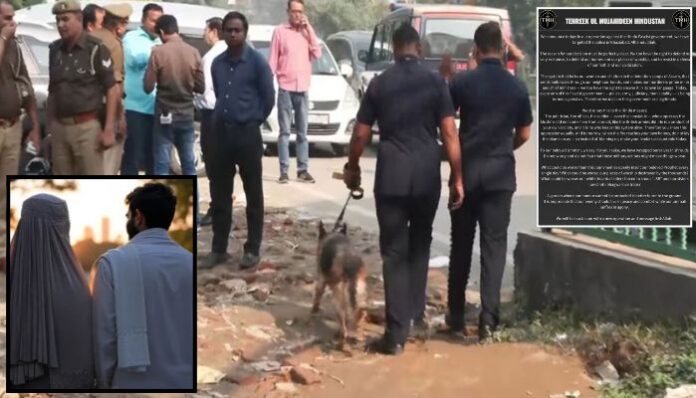
The propaganda surrounding the so-called ‘Bhagwa Love Trap’ has once again come under the spotlight following a blast at the Vasundhara Police Outpost in Ghaziabad, Uttar Pradesh, on Friday night, 6th November. Soon after the explosion, an X account operating under the name ‘Ghazi 2’ claimed responsibility for the incident on behalf of an organisation calling itself Tehreek-ul-Mujahideen Hindustan. The account described the blast as an operation against what it called the ‘Hindu Fascist government’ and threatened similar attacks in the future.
A massive blast rocked a police outpost in Vasundhara, Ghaziabad, triggering an investigation by UP Police and multiple agencies. Meanwhile, a group calling itself Tehreek ul Mujahideen Hindustan has claimed responsibility in a video circulating on social media. The video cites revenge over Assam detention camps and bulldozer action, and threatens the Bhagwa government, PM Modi and CM Yogi. The claim remains unverified as investigations continue.
— OpIndia.com (@OpIndia_com) November 7, 2026
The statement released by Tehreek-ul-Mujahideen Hindustan framed the explosion as a direct “operation” against what it termed the allegedly “Hindu Fascist government.” The post went on to claim, “We too have the right to defend our very existence, to defend our homes and our places of worship, and to resist in defence of our faith and our civilisation.”
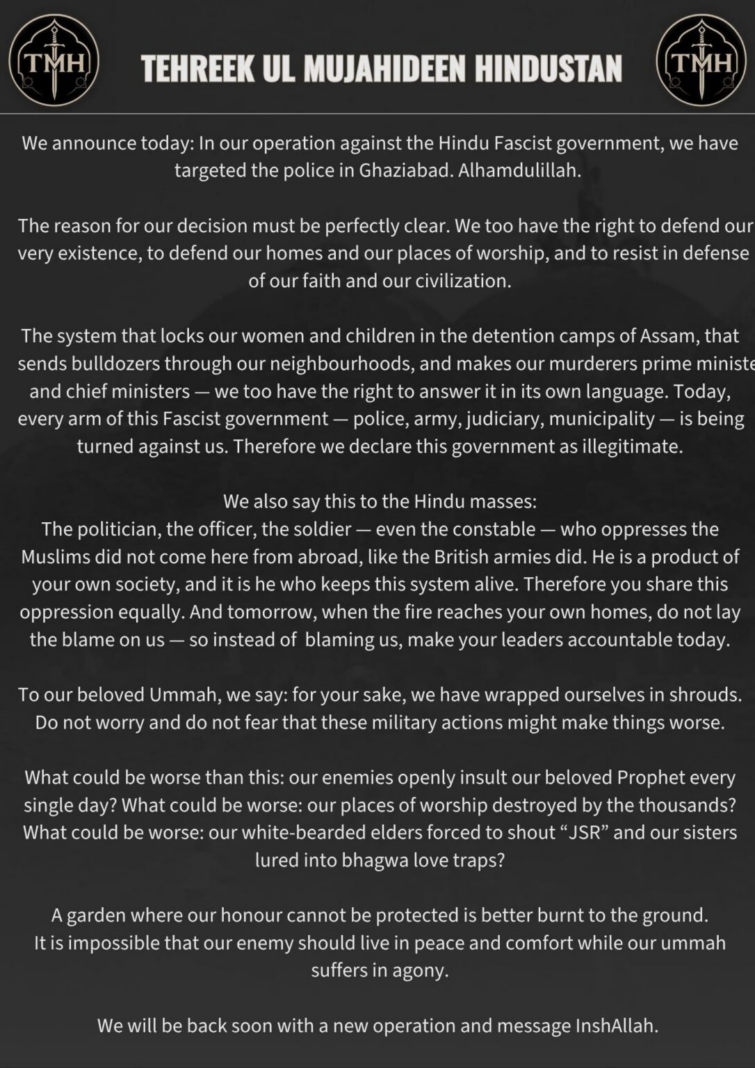
Moving deeper into its radical narrative, the post aggressively peddled the already exposed propaganda surrounding “Jai Shree Ram” slogans and alleged “bhagwa love traps,” threatening society with the words, “What could be worse: our white-bearded elders forced to shout ‘JSR,’ and our sisters lured into bhagwa love traps?”
A growing pattern of terror motives citing the Bhagwa Love Trap
This chilling incident highlights how fringe digital narratives are rapidly morphing into active, violent terrorist threats targeting law enforcement and public infrastructure.
The recent horrific explosion in Ghaziabad is not an isolated event or a random outburst of criminal violence. Across the country, security agencies have steadily uncovered multiple terror plots, radicalised modules, and extremist networks where the malicious “bhagwa love trap” conspiracy theory has been directly cited as a core motivation for planning violence, targeted killings, and terror operations. What began as an online smear campaign has systematically evolved into a dangerous ideological justification used by terror groups to recruit youth, amass weaponry, and incite widespread communal bloodshed.
Bhagwa Love Trap cited in Andhra Pradesh terror conspiracy
One of the earlier cases in which the ‘Bhagwa Love Trap’ narrative featured in a terror conspiracy emerged from Vizianagaram, Andhra Pradesh, in May 2025. Police arrested two men, identified as Siraj and Syed Sameer, for conspiring to carry out terror activities using improvised explosive devices (IEDs). Investigators recovered their conversations from the Signal app, which revealed plans to establish a chemical laboratory, manufacture rocket launchers and target RSS members and entities they considered anti-Muslim.
According to the investigation, the two suspects had discussed attacking JCB machines allegedly used in demolitions of mosques and Muslim homes. Their conversations also revealed plans to establish a so-called special school and expand their network by recruiting like-minded people. Police suspected that Siraj had been radicalised through speeches by Islamic preachers, including Dr Israr Ahmed, Zakir Naik, Shaik Yakub Jamali and Shaik Javid Rabbani.
The investigation also revealed that Siraj wanted to establish an organisation named Al-Hind Ittehadul Muslameen (AHIM), claiming that it would protect Muslim women from what he described as the ‘Bhagwa Love Trap’. He travelled to Mumbai to meet people sharing his ideology and expand the proposed network.
ISIS-linked terror module planned to kill Hindu men married to Muslim women
Another disturbing case emerged in September 2025 when Delhi Police busted a pan-India terror module with links to ISIS and a Pakistan-based handler. Five suspects were arrested following coordinated raids across several states. The accused included Ashhar Danish, Aaftab Qureshi, Sufiyan Abubakar Khan, Mohammad Huzaifa Yaman and Kamran Qureshi.
The accused informed the Delhi Police that their group had planned to assassinate a well-known politician in Mumbai. Beyond high-profile political targets, the network was actively targeting Hindu youths across India who had married Muslim girls, plotting to hunt and kill them.
Additional Police Commissioner of the Delhi Police Special Cell, Pramod Singh Kushwaha, detailed how the accused terrorists were aggressively expanding their module’s capacity. Module members Aftab Nasir Qureshi and Sufiyan Abubakar were assigned the task of targeting the politician, for which they had smuggled weapons from Mewat (Nuh) in Haryana to Delhi.
A courier had delivered the weapons in Delhi, and the suspects were about to leave for Mumbai by train when a Special Cell team arrested them, recovering pistols and cartridges.
Investigators further revealed that another accused, Kamran from Madhya Pradesh, had been assigned the specific task of killing Hindu boys who had married Muslim girls. The gang’s leader, Danish, had sourced weapons from Telangana for these violent operations. Officials noted that the ISIS-backed group was deliberately trying to expand its base across India, having already misled over eighty young men, brainwashing them, and roping them into violent plans.
The targeting of Hindu men simply because they had married Muslim women brought the ‘Bhagwa Love Trap’ narrative into the discussion once again. The propaganda, which portrays consensual interfaith relationships as a conspiracy against Muslim women, was being used to justify hostility towards Hindu men and their personal choices.
Mohammed Hasan Abu Sarmad Akhtar was spreading radical propaganda and targeting interfaith couples
Another case that has drawn critical attention to the online ecosystem surrounding this propaganda emerged in October 2026, when the Maharashtra Anti-Terrorism Squad (ATS) arrested thirty-three-year-old Mohammad Hasan Abu Sarmad Akhtar from Mumbai’s Mahim area. Akhtar was actively promoting radicalisation under the guise of exposing “bhagwa love traps,” using this narrative to feed extremist ideologies.
Akhtar was arrested for circulating inflammatory radical material linked to the banned terrorist organisation Jaish-e-Mohammed (JeM), including speeches by its chief, Maulana Masood Azhar.
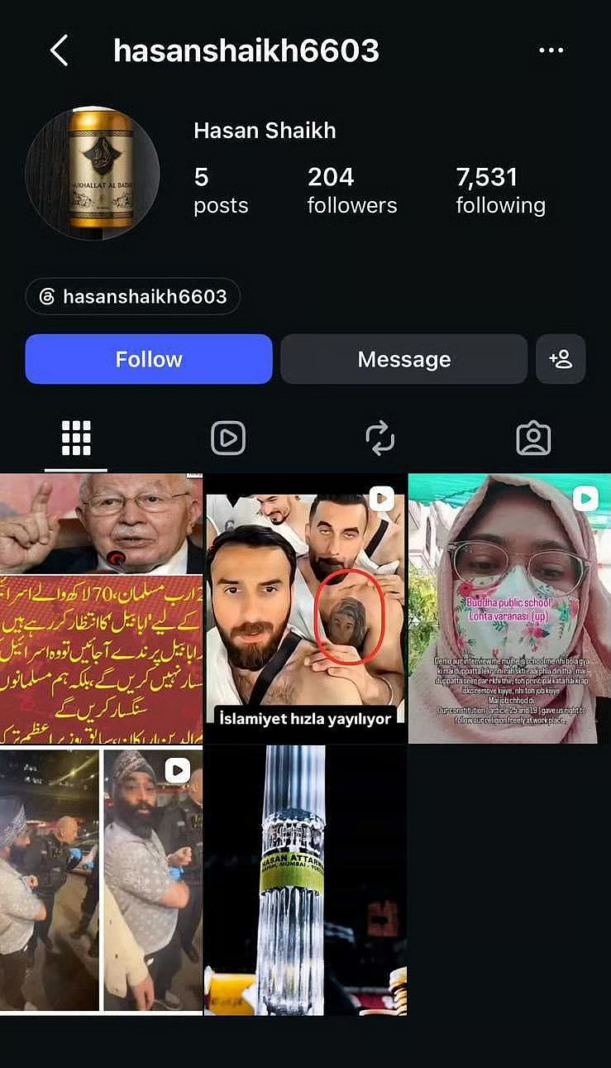
Akhtar, who worked as a Rapido driver and perfume seller, was in contact with Pakistani intelligence operatives (PIOs) via Telegram and Instagram. During interrogation, authorities found audio recordings of speeches by Masood Azhar shared in a Telegram group named “Indian Muslim” administered by Akhtar. Furthermore, his social media accounts featured posts supporting armed jihad and urging Muslims to take up arms.
Responding to news reports or security incidents, Akhtar had posted inflammatory remarks, including calling for an act against Prime Minister Narendra Modi similar to the assassination of former Prime Minister Indira Gandhi, writing, “kuch karana tha indira gandhi ki tarah modi ko bhi bhai log.”
Crucially, his digital trail also included recording and sharing videos on his Instagram account of Muslim girls being stalked alongside Hindu men, directly intertwining online harassment, vigilantism, and radical Islamist propaganda.
What is the “Bhagwa Love Trap” propaganda?
Underpinning many of these radical networks is a systematic propaganda campaign pushed by Islamist groups known as the “Bhagwa Love Trap.” This campaign falsely paints Hindu boys as predators of Muslim girls and seeks to actively discourage and criminalise interfaith friendships and relationships in society.
Activists and extremists behind this campaign have gone to extreme lengths, publishing the personal information and private details of Muslim girls who are in relationships or friendships with Hindu men. These details are frequently posted on major social media platforms like X, Facebook and Instagram, accompanied by severe abuse, threats, and doxing. Posters and banners have also been publicly displayed, urging local communities to “protect the faith” of their women.
In several cases, the women involved have been portrayed as victims who need to be rescued, even when they have willingly entered into relationships with Hindu men. Such posts have also been used to encourage people to track down couples and confront them in public places.
Numerous disturbing incidents have been documented where Muslim girls were harassed, threatened, or physically assaulted simply because they were seen in public with Hindu boys.
What makes the premise of this conspiracy theory particularly absurd and dangerous is that the claims made under the “Bhagwa Love Trap” banner routinely lack any factual or real evidence of deception. The Hindu boys targeted in these narratives did not hide their identities; they were easily identified through their open social media profiles, visible religious symbols like sacred threads (kalawa), and by openly using their real names.
This is very different from “love jihad” cases, where Muslim men have, in many cases, been found hiding their religion to deceive Hindu girls, trap them, establish sexual relations, blackmail and pressure them for conversion to Islam and Nikah.
Despite this, the conspiracy theory quickly transformed into viral social media hashtags used by extremists to secretly record and share videos of random hijab-wearing Muslim women and their male Hindu friends, acquaintances, or partners without their consent. These posts are paired with emotional appeals urging public help to identify and corner the couples.
Consequently, social media algorithms fueled an environment where roving Islamist mobs began ambushing random Hindu-Muslim couples on roads, inside restaurants, eateries, and hotels. These ambushes invariably led to heated verbal altercations, severe physical assaults on Hindu men, and the harassment or molestation of Muslim women.
The larger objective of such campaigns is to create suspicion around ordinary interfaith relationships and present Hindu men as a threat to Muslim women.
From online propaganda to radical terror
The trajectory of the “bhagwa love trap” narrative reveals a disturbing blueprint of modern radicalisation. What initially manifested as online intimidation and street-level mob violence directed by Islamists against Hindu men and Muslim women has now escalated into full-scale terrorist conspiracies, bomb plots, and planned assassinations.
Online propaganda campaigns by Islamists began as vicious digital campaigns and physical attacks on Hindu men and interfaith couples and have now directly transformed into promoting active terror activities, armed jihad, and violent attacks against the nation. The recent blasts, planned assassinations, and intercepted terror modules stand as a grim testament to what non-stop, unchecked propaganda against Hindus has ultimately created in the country.
Notably, based on local reports and social media videos, OpIndia has compiled several cases (here, here and here) where Hindu men and Muslim women were attacked by extremists under the pretext of the ‘Bhagwa love trap.’ OpIndia has also published an investigative report, highlighting how Islamists are using WhatsApp groups to target Hindu-Muslim couples.


