

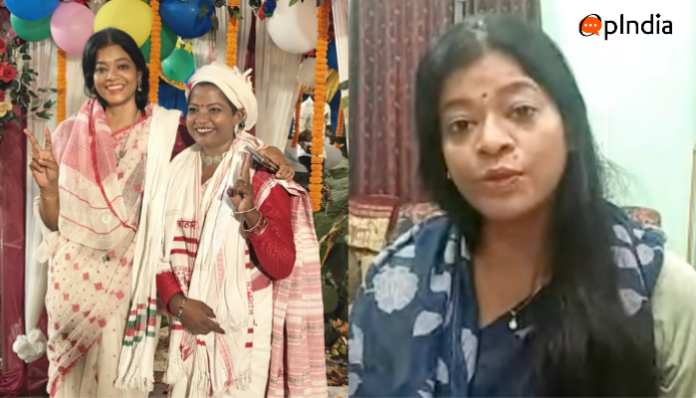
Nesha Oraon, an Indian Revenue Service (IRS) officer from Jharkhand, has stated that she is willing to become a government witness in the case of Nisha Bhagat, who committed suicide in Ranchi on 6th November, after a Facebook Live. Bhagat, who had been fighting against the land mafia and religious conversions of tribals, accused the Hemant Soren government and administration of harassment and targeting in the video.
Oraon expressed her anguish and wrote that she gave her life for the “Sarna Samaj,” an indigenous tribe that worships nature and wrote, “She raised her voice against societal issues. The mental torture inflicted to silence her voice is not hidden from anyone. This is not merely suicide; it is murder. Nisha Bhagat continuously raised her voice against religious conversion and the looting of tribal lands. The voice of the society will not be silenced like this. Justice must be served to the Sarna Samaj and Nisha Bhagat. An investigation and swift action must be taken.”
OpIndia recently interviewed her, during which she made explosive revelations about the tragedy, which she termed “murder” and noted the growing threat of missionary groups doing religious conversions, particularly among tribals.
निशा भगत सरना समाज के लिए शहीद हुई है… वह समाज के मुद्दों पर आवाज़ उठाती थी। उसकी आवाज़ दबाने के लिए दी गई मानसिक यातनाएँ किसी से छिपी नहीं हैं। यह महज़ आत्महत्या नहीं, हत्या है। निशा भगत धर्मांतरण और आदिवासी ज़मीन लूट पर लगातार आवाज़ उठाती थी । समाज की आवाज को यूँ खामोश नहीं होने दिया जाएगा । सरना समाज और निशा को न्याय मिले । जाँच और त्वरित करवाई हो 🙏🏼💐
— Nesha Oraon 🇮🇳 (@OraonNesha) November 6, 2026
Oraon, who is the daughter of a Congress leader and former state minister, informed that she has been on deputation to the Jharkhand government for the past few years, having previously served as Director of Panchayati Raj and Director of Agriculture. “During that three-year tenure and earlier, I saw certain ground-level incidents and problems that made it very difficult to ignore them. These issues related to violations of constitutional rights, our identity, cultural infiltration, and looting of tribal land.”
She mentioned that grassroots activists do not receive sufficient support, highlighting, “I got the opportunity to connect with them and realised that these problems can no longer be ignored. If we ignore them now, it will be too late. Let me tell you that the generation we are in, tribal society today, is the last generation that remembers its customs, songs, and traditions and is still connected to its roots. If we do not raise our voice or connect with these issues now, it will be too late. Future generations will face an identity crisis.”
Oraon expanded on her experience, elaborating that while serving as Director of Panchayati Raj, she observed that the special constitutional rights of tribal communities in Scheduled Areas were being completely violated. Over a period of 10–15 years, rights, territories, schemes, and benefits were gradually appropriated in a highly organised and conspiratorial manner.
She added, “For example, the PESA (Provisions of the Panchayats Extension to the Scheduled Areas) Act of 1996 has still not been fully implemented in Jharkhand even till 2026. These are the Fifth Schedule areas. Ten states in India have regions that fall under the Fifth Schedule, where tribal communities and their Gram Sabhas enjoy special rights. When I was in the department in 2023, nearly 20-23 years had passed since the state was formed, and the PESA rules had not been made and notified because a particular group was obstructing them through courts and legal issues. This would cause serious damage to tribal society. I consider this a conspiracy.”
She explained that the PESA Act grants the right to protect religious practices, culture and traditions under Sections 4(d) and 4(g), and Article 25 also guarantees the fundamental right to protect the same, affirming, “A judgment by the Chhattisgarh High Court, which was upheld by the Supreme Court, has clarified this as well.”
Violation and exploitation of tribal rights
Oraon emphasised that traditional rights, too, were being taken over. Fifth Schedule areas have both a democratic system, where the chief is appointed by election, and a traditional system, where members are nominated in accordance with custom. A tribal person who converts while holding a traditional position may retain social responsibilities but cannot discharge religious ones. The role is meant to protect ancient civilisation and traditional heritage. However, she disclosed that converted individuals occupied at least 40% of such positions in Jharkhand as they continued to be listed on paper as tribals.
She conveyed that influential people in the hamlets are approached first for conversion, with the aim of persuading others to follow. She further stated, “Under the CNT (Chota Nagpur Tenancy) Act, which protects tribal land, a village assigns land to the Pahan, the hereditary traditional priest or religious leader, so he can fulfil religious duties. He cultivates this classified service land and uses it for worship. It is not private property; when he ceases performing his duties, he is no longer entitled to it. The same arrangement applies to other authorities that receive land for religious duties.”
However, Oraon unveiled that converted tribals retain these positions without carrying out the associated duties and do not relinquish the land, charging, “This amounts to cultural hegemony, placing our identity and traditional heritage at risk. They also receive a substantial portion of reservation and government-scheme benefits, aided by a coordinated support network. Tribals at the grassroots witness this and want to resist, but fear threats of imprisonment and legal action. Strong opposition to conversion and the appropriation of land exists on the ground, but the converted tribals get greater coverage due to their ecosystem. As a result, the actual aspirations and condition of ordinary tribals remain underrepresented.”
She complained that the mainstream discourse on tribal communities is dominated by a Christian narrative due to their nexus, while the real accounts struggling to find a voice remain buried beneath it.
Not a suicide but murder
The IRS official noted that activists at various levels in the state have spoken out about religious conversion and the looting of tribal land. Bhagat was a particularly forceful voice who expressed her views firmly, which angered people. Oraon mentioned, “Those we challenge are highly influential in our state, well formalised, connected to powerful figures, and protected in many ways. Our sister faced threats in her personal life. I spoke with her on the day she was killed. I am not calling it suicide; I am calling it murder.”
She recounted, “That morning was my last conversation with her. It pains me deeply that I could not give her enough courage. She told me she felt unsafe even leaving her home. Anyone who follows social media, print media, or digital media will recall how an organised group can operate at Jantar Mantar (implying the Cockroach Janta Party). Jharkhand, too, has a powerful, well-resourced narrative group. Its members systematically shape narratives and repeatedly target people like her and us,” adding that vulnerabilities are exploited to push people like Bhagat to a breaking point.
Oraon demanded, “We need a thorough investigation. Her family and society are calling for an impartial inquiry.”
The menace of illegal conversion
Drawing attention to the gravity of the situation, Oraon revealed that illegal conversion was already around 11-14% in 2011, pointing out, “I estimate the figure is now at least 30%. Over the past six or seven years, conversions have occurred very rapidly, with frequent gatherings. They are funded by NGOs. An FCRA amendment Act was introduced, but it has yet to take effect. Christian organisations wielding considerable influence across several northern states opposed the proposed changes and pressured state governments. There are around 7,500 NGOs in Jharkhand; roughly 5,400 of them are missionary groups registered on the Darpan portal. The scale of funding and its purpose can be assessed.”
Oraon stressed the need for an inquiry, maintaining that she could not level accusations without evidence. However, she added that a visit to the villages would bring the activities of these NGOs to light. “They have a highly organised and influential network. Those who speak out against them are silenced in different manners: they are discredited, subjected to character assassination, implicated in cases, have their families harassed, or are threatened with the loss of their jobs.”
Oraon underscored that Bhagat’s social media page illustrated how strongly she was speaking out against land grabbing, explaining, “She asserted that she had evidence of tribal land being sold illegally in certain places and that the land brokers mostly belonged to a particular group and ideology. I do not want to name anyone publicly without substantiation, but the proof concerning the people she identified and opposed should still be on her mobile phone and computer.”
She also highlighted that Bhagat’s house was robbed in June or July and digital evidence was stolen, questioning, “If nobody had done anything wrong and people genuinely believed that the evidence was fake, why would anyone go to the extent of committing a robbery to steal it? All of this left her deeply disturbed. She had also been receiving threats, including death threats. When I spoke to her at around 9:30 that morning, she was in tears.”
Oraon quoted Bhagat, who told her, “Didi, I am very troubled. I don’t even feel safe stepping out of my house. I fear that if I go out, they will kill me. Look at the way they are attacking my character. I am a woman. How much more am I expected to endure?” The officer recalled that a day earlier, a person who has now been named as an accused in the FIR had given a video interview and made unfounded allegations against Bhagat, completely tarnished her character and also passed comments about people like me.
Oraon informed that they have been putting up boards in accordance with Supreme Court guidelines and decisions taken by Gram Sabhas, declaring conversion activities impermissible. “People are free to visit or meet others, but not for religious conversion. However, he threatened to bury people like me in the ground beneath those very boards. Can anyone openly issue such threats unless they enjoy strong protection and patronage,” she asked.
Oraon brought up Bhagta’s Facebook post, in which the latter blamed the Hemant Soren government, adding, “She may have been seeking help, or perhaps she found herself alone in her final moments. There could also be a larger conspiracy at play that has to be probed. I believe this is a very big gang.”
Threats and intimidation against activists
Oraon outlined that activists who protest against religious conversions and land encroachment endure threats and feel helpless. She revealed that Bhagat’s death had heightened concerns among women from the Sarna community, leaving them worried about their own lives and safety.
She shared, “The intention was to instil fear in us by making us believe that we would be left alone, nobody would come to our help, and those threatening us were so powerful that no one could stop them. They would subject us to such severe mental torture that we would be driven to suicide, while nobody would come to our rescue. I fear that many voices could be silenced. We are doing everything possible to ensure that this does not happen. If we wish to raise our voices while remaining within the bounds of the law, we must be allowed to do so. This is a free country, and we are its citizens. We have every right to protect our religion, culture and identity.”
Oraon stated that NGOs fail to comprehend the objections to religious conversions when education and healthcare facilities are being provided in remote areas. She responded, “I want to ask them: you have funds and financial power, but where does it come from? It comes from abroad. Your remote control is outside, and their national ideals are different from ours. Earlier, we were subjected to British colonisation and made slaves. I say that colonisation is continuing. We are mental slaves even today, with the remote control remaining outside the country. Its effects are visible everywhere, whether in the form of religious conversions or land occupation. Think about it: the Government of India is the country’s largest landowner, and the Church ranks second. That is the truth.”
The anti-Hindu agenda to create division
Oraon shed light on how Hindus have been consistently portrayed as the biggest enemy of tribals over the past 15 years, to poison their minds against the Hindu community. She rejected this propaganda, clarifying, “Our roots lie in nature worship, and that is what connects us as one family. We cannot be separated. Unity in diversity is the foundation of Indian and Sanatan Dharma. Customs, methods of worship and faith may differ from one place to another. You may call God by different names, such as Singbonga, Dharmesh or Mahadev, but our roots remain the same: nature worship. Tribals were the first to practise nature worship and have preserved this ancient tradition to this day. The Constitution and the PESA Act provide rights precisely to protect this ancient faith, because it is the soul of India. By creating such narratives, they are driving a wedge between us.”
She also referred to this agenda as a threat to the sovereignty, integrity and unity of the nation, remarking, “This is modern-day colonisation. It threatens not only the country’s unity and integrity but also our traditional heritage and identity. We are the roots of the Indian faith; nature worship originated with us. If we are under threat, the entire Indian faith is under threat.”
She reiterated that the threat extended to civilisation, culture, religion and society, which was why the demand for delisting had emerged in Jharkhand and pressed, “I want to bring the issue of delisting to the government’s attention. There is considerable support for delisting at the grassroots among tribals who have preserved their original faith for thousands of years, despite temptations. They have remained committed to their ancestral faith and deserve recognition and respect for that. They have neither abandoned it in the past nor are they doing so now. Delisting is the only way to safeguard their rights and identity and ensure that reservation benefits, intended for communities with a distinct culture, reach those they were meant for. Once tribals convert, their distinct culture changes, yet they continue to receive these benefits, leaving those who have retained their original faith deprived of them.”
When OpIndia pointed out that government benefits such as hand pumps, solar lights and paved roads were reaching converts in Chhattisgarh instead of those who had remained committed to their traditional faith, Oraon agreed that the same pattern was unfolding everywhere, including Jharkhand.
Nisha Bhagat’s death
Bhagat did a Facebook Live before taking her life and accused, “I am ending my life because this Hemant Soren government has crossed the limit in insulting and humiliating a woman (herself). I cannot tolerate this anymore. How much more will my parents have to suffer?”
She added, “They kept accusing me of being a BJP/RSS broker, but I am nobody’s broker. I have been fighting and struggling for the protection of my tribal society,” crying profusely, repeating that the administration failed her and stating that she was alone in her fight for her community.
The incident triggered widespread public anger against the Jharkhand Mukti Morcha-Congress government in the state, after which Chief Minister Hemant Soren recommended a CBI inquiry.
“We have booked Jyotsana Kerketta and Ajay Tirkey under Sections 108 and 61(2) of the Bharatiya Nyaya Sanhita (BNS), relating to abetment of suicide and criminal conspiracy. Besides, officer-in-charge Satish Kumar Pandey has been sent to the police lines,” Ranchi (Rural) SP Gaurav Goswami conveyed amid the backlash. He added that a Special Investigation Team (SIT) was also created to look into the matter.
Her father, Handu Bhagat, also named Kerketta and Tirkey, among others, in the complaint he filed after her death. He stated that she had been subjected to prolonged mental and social harassment. Her reputation was maligned on social media, and false accusations were levelled against her. The grieving man highlighted that she was afraid to even step out of her house due to constant harassment and character assassination.
Bhagat had long been advocating for protecting tribal rights. Her demands included a “Sarna Religious Code,” the protection of jal-jangal-zameen (water, forests, and land) and the implementation of the CNT-SPT Acts and the PESA Act. Bhagat also vehemently opposed religious conversion activities concerning tribal communities.


