Home Blog Page 1599

Who is Mohammed Hijab? The Islamic preacher who provoked Muslims during the 2022 anti-Hindu violence in Leicester

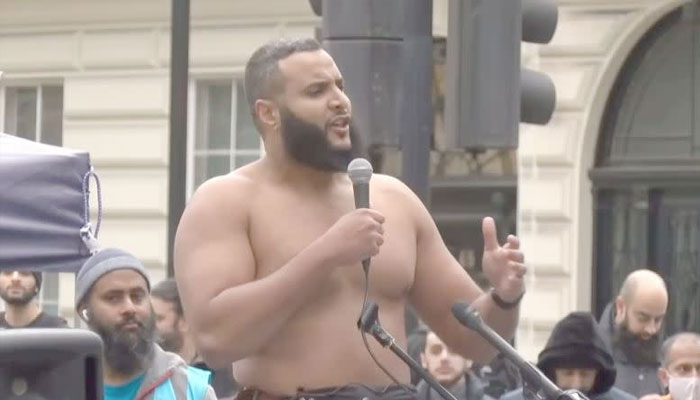
Since Hindus were attacked in Leicester in August 2022, one name has prominently appeared in reports. Mohammed Hijab, a prominent Islamist YouTuber and influencer, is one of the main instigators of violence against Hindus in Leicester. Hijab is a British-Egyptian “public speaker” who gained notoriety for his inflammatory speeches. His controversial views on various issues, including the ongoing Israel-Hamas war, have brought him to the forefront. In the mainstream media, he is a debater who discusses religion, politics and society. However, the videos of provocative speeches given in public tell a different story about him.

When the Hindu community was attacked following the Asia Cup T20 match between India and Pakistan in August 2022, Hijab was identified as a chief instigator. He led patrols and made disparaging remarks against Hindus during the violence. On his website, Hijab describes himself as a political philosopher and philosopher of religion. He co-founded Sapience Institute to spread Islamic education. Furthermore, he is an academic co-ordinator at Islam.Net and a lecturer at Mishkah University.

Hijab’s controversial stance is not limited to the local clashes but extends to international matters. In recent times, he has expressed pro-Palestine and pro-Hamas sentiments. He condoned the 7th October terrorist attack of Hamas against Israel. Interestingly, while saying his views on the Israel-Hamas war, he attempted to play the victim card and accused others of lacking morality and not condemning Israel’s actions.

Mainstream media gave space to Mohammed Hijab

Despite being controversial, he has been provided platforms by major publications, media channels and prominent hosts like Piers Morgan. On 17th October, Hijab was a guest on Piers Morgan Uncensored. On 21st October, he spoke on the topic “Reviving Roots’Roots’ at the University of Toronto, Mississauga, and on 23rd October, he was provided a platform to speak at the University of Saskatchewan, Saskatoon.

During his time with Piers Morgan on his show, Hijab kept questioning the authenticity of the reports about the atrocities of Hamas against the people of Israel on 7th October. When Morgan asked him about his views on the reports of the elderly being kidnapped and toddlers being killed by the Hamas terrorists, the only thing Hijab said was, “Where is the proof?”. Morgan informed him that several mainstream media reports, including from the United Kingdom, verified and published the reports of the atrocities, but the Hijab called them “second source”. He said that as a “scholar”, he needs “academic” proof of the atrocities. Morgan said there were reports citing experts in the media, but he categorically denied accepting.

Hijab also tried to justify the horrific actions of Hamas terrorists on 7th October by claiming that Israeli forces have been killing Palestinians for decades and that what Hamas did was “resistance”. He also objected to the comparison of Hamas to ISIS, again for the same reason that Hamas was only showing a form of “resistance”. He failed to provide a base for his theory that resistance would include the killing of civilians.

Hijab continued to lie about the Hospital bombing

On 17th October, a rocket fell on Al-Ahli al-Arabi Hospital in Gaza. Palestinian Authority claimed around 500 people died and accused Israel of the bombing. Israel countered with footage from Al Jazeera showing a missile originating from Gaza to attack Israel, falling short and hitting the hospital. Further reports showed the rocket fell in the parking lot, and there were apprehensions about the death toll claims.

Hijab vouched for enslaving non-Muslim women

Just two days after the terrorist attack on Israel, an old post of Hijab went viral on social media where he suggested that non-Muslim women somehow loved to be taken as ‘sex slaves’ by the Islamic captors. “I believe certain anti-Muslim women would wish they lived in the medieval period. It was a period where if the opposing side won a war, it was conventional that people could be taken as booty. Some historical accounts actually say some women would dress up for the captor,” his post read.

Leicester violence: Mohammed Hijab incited Muslims to attack Hindus

In September 2022, Mohammed Hijab was found inciting violence against Hindus in Leicester, UK. In his speeches, he mocked Hinduism and provoked Muslims to attack Hindus. Videos of his speeches were shared widely on social media. He claimed that Hindus were fearful of Muslims. He further suggested that the fear was due to Muslims holding the “truth”.

Furthermore, he made derogatory remarks against Hindus and warned them not to protest. He threatened that he and his supporters would attend the Hindus’ protest sites. He was also seen leading a group of masked Islamists in Leicester.

In a video, was seen mocking Hinduism and inciting Muslims to attack the Hindus. In a video that has now surfaced on social media, he was seen interacting with mask-clad Muslim men and encouraging them to teach the local Hindu population ‘a lesson’. “When I was on social media, I saw these people (Hindus) getting brave. How come today it is like pin-drop silence?” the British Egyptian ‘scholar’ was heard as saying. He claimed that no Hindus were in sight after realising that Muslim mobs were coming at them in hordes. “Cause they (Hindus) fear us when they are near us”, responded an Islamist from the crowd. Pumped by the support of the like-minded people in the crowd, Hijab said, “Deep down, they know we got the truth. If you want respect, then learn to respect.”

In an Instagram post, Hijab was seen leading a frenzied mob of Islamists, with their faces covered in masks. “Muslim patrol in Leicester,” he wrote in his post.

He led similar fringe mobs following the Israel-Hamas war. In the video, his followers were seen raising pro-Palestine slogans. During the anti-Jew protest, they attacked a Jewish boy walking his dog. When police saved the boy, Hijab warned the police official that bringing a dog to the protest site was “an act of aggression” and if they saw the dog again, they would kill it.

Mohammed Hijab also worked alongside hate preacher and fugitive Zakir Naik, during the fundraising for the construction of a grand mosque and Dawah (proselytism) centre in Oslo, Norway.
Shortly after the results of assembly elections will be announced in 5 states, Rahul Gandhi set to travel to 3 foreign countries

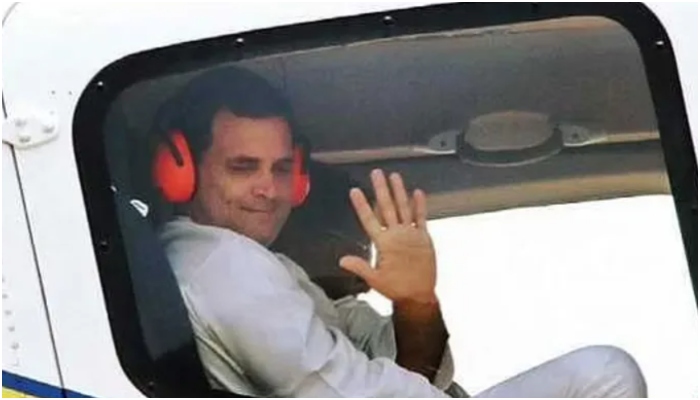
Rahul Gandhi, the former president of the Congress, is scheduled to visit three nations between 8th December and 15th December. Gandhi has been currently actively campaigning in five states for the assembly elections. 

According to the reports, Rahul Gandhi will visit Indonesia, Singapore, and Malaysia from 8th December to 15th December. He will meet with the Indian diaspora and also visit universities during his trip. 

Rahul Gandhi has visited many countries earlier this year, including Norway, the Netherlands, France, the United States, the United Kingdom, and Belgium, and held interaction programs with the Indian diaspora as well as interactive sessions with students at various universities.

Reports mention that the Indian Overseas Congress will coordinate all of the programs of the Congress MP from Kerala’s Wayanad. Rahul Gandhi has campaigned extensively for the ongoing assembly elections in 5 states, however, looks like he will leave India shortly after the results are announced for the same. In addition, he had visited the sacred shrine of Kedarnath earlier this month amid his campaign schedule across the five states.

It is notable here that Rahul Gandhi’s foreign visits are always shrouded in mystery. Besides political speculations, there is often little to no news about his foreign travels. The Congress scion has a history of going on vacations without informing the public during election season or at times when his party needs him the most.

Rahul Gandhi and his secret trips

In April 2022, after poll strategist Prashant Kishor had rejected Congress’ offer to join the party, and at that time, Rahul Gandhi had become untraceable. Reports mentioned that Gandhi went missing for over 10 days and had been unreachable, leaving the party to act alone in action during the crisis.

Earlier in December 2021, the Wayanad MP had gone for a personal trip to Italy ahead of the campaigns and rallies for the then-upcoming Assembly elections in five states scheduled for 2022. He had forced the party to postpone his already scheduled rally in Punjab and had flown to Italy for a ‘personal visit’.

Just before Diwali 2021, Rahul Gandhi vanished, reportedly to London. On November 5 of that year, it was reported that Gandhi was on a ‘long vacation’. He returned after almost a month, just before the winter session commenced in the Parliament. At that time, the BJP took a dig at Gandhi and questioned his trip to London.

In September 2021, while the Congress party in Punjab was facing a crisis with Amarinder Singh’s resignation, the Gandhi family was vacationing in Shimla. In December 2020, Rahul Gandhi left for Italy on the 136th foundation day of his party. His party leaders could not settle on one explanation and further made themselves a target of media questions. 

In October 2019, fifteen days before the assembly elections in Haryana and Maharashtra, Gandhi had left, reportedly for Bangkok. In June of that year, before the counting of votes of the parliamentary elections, Rahul Gandhi skipped an important meeting held by UPA chairperson Sonia Gandhi and flew to London for a holiday.

Notably, Gandhi has a history of spreading hate against the ruling government and India while on trips abroad. On his recent trip to the US, he could be seen targeting the current government and making anti-India statements.

Supreme Court dismisses plea demanding a total ban on Pakistani artists in India, says ‘one must not be so narrow-minded’

0

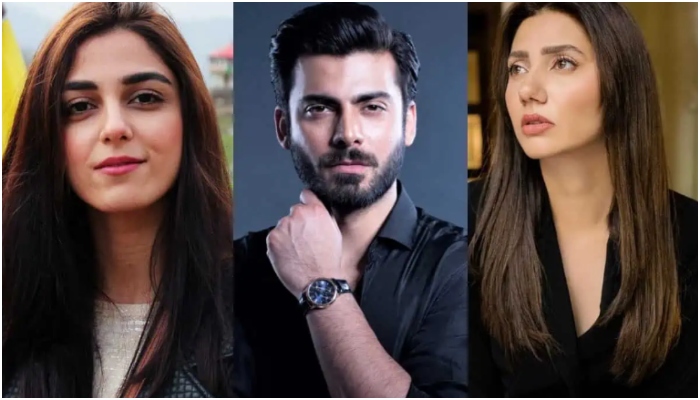
On Tuesday (28th November), the Supreme Court of India dismissed a petition asking for a total ban on the employment of Pakistani artists in India.

A Bombay High Court decision was upheld by a Supreme Court Bench of Justices Sanjiv Khanna and SVN Bhatti. The petition requested that Indian citizens be prohibited from hiring or soliciting work or performances from Pakistani artists.

Before dismissing the case, Justice Khanna remarked that the petitioner’s thinking should not be so narrow. The bench stated that in order to be a patriot, one must not be hostile to those from abroad, particularly those from a neighboring country.

“A true patriot is a person who is selfless, who is devoted to the cause of his country, which he cannot be unless he is a person who is good at heart,” the Court said. The Bombay High Court had previously dismissed a petition in October, prompting the appeal to the Supreme Court.

The Bombay High Court ruled that the petition lacked merit because it sought a backward step that was detrimental to cultural harmony, unity, and peace.

Notably, the High Court also mentioned Pakistan’s recent participation in the now-completed Cricket World Cup tournament in India. The High Court observed that this was possible due to appreciable positive steps taken by the Government of India in the interest of overall peace and harmony.

The petitioner’s sense of patriotism, according to the High Court, was misplaced. Furthermore, imposing such bans would violate Indian citizens’ fundamental right to conduct business and trade, according to the Bombay High Court.

Faaiz Anwar Qureshi, a film worker, had filed the petition. He was referring to a ban imposed by the All Indian Cine Workers Association (AICWA) on hiring Pakistani actors in the Indian film industry.

The AICWA resolution was allegedly published in several newspapers and on social media accounts. Qureshi claimed that denying him relief would lead to discrimination against Indian artists, who he claims are not treated well in Pakistan.

He also claimed that Pakistani artists would try to take advantage of commercial opportunities in India, which would prejudice Indian citizens by reducing or eliminating such opportunities.

UK: Hindu families living in perpetual fear of persecution by Islamists, netizens reveal chilling details of harassment and police inaction

Reports are doing rounds about attacks on a Hindu family in the UK’s West Midlands county by Islamists. The incident was first reported early in November. The family has been attacked several times by Islamists since July this year but the local police refused to take action demanded by the complainants.

The incident was again reported this time by GB News and shared by British journalist Martin Daubney on X, formerly Twitter. Daubney’s post was reshared by another X user prompting several UK citizens to share the horrifying experiences of several Hindu families they knew living in the UK.

One such user named Bo shared an experience of their Hindu friend. The user wrote that their Hindu friend stopped wearing bindi (a Hindu symbol worn by Hindu women on the forehead between the eyebrows) owing to the hatred that she had been subjected to.

“She’d had dog poo put through her letter box, she and her husband’s cars had been keyed, they’d been spat at, and a whole host of other things,” Bo wrote on X.

Bo added, “Thinking it was locals, I was just pushing up my proverbial sleeves to start having words with people before she told me who it was and begged me not to do anything as the police didn’t seem to care. In the end, they just moved away. Beautiful family, with great kids. I think this is more common than we realise.”

Replying to this post, another user named Boudicca and Viriato wrote that their son had a Hindu friend in school and they all got on well with each other. However, the school had a majority Pakistani students and the Hindu girl “experienced abuse from some of the mums”.

“It was stuff like telling her to ‘go home’ and this was ‘their’ school. They moved away also,” Boudicca and Viriato wrote.

A user named klownShowz wrote that their friends don’t wear bindi and have been advised by the police not to draw attention by putting rangoli or flowers on the doorway in Hindu festival style.

When a user replied to Bo’s post pointing at a possible lack of support from non-Muslims, Bo replied by saying that the aggrieved couple was a quiet couple and “it was only after they left and people asked where they went, and I said, that people were furious and wished they’d known.”

X user R Hilton said that moderate Muslims also get targeted in the UK including Ahmadi Muslims.

“Ahmadi Muslim information stalls often attacked in Kingston and occasionally in Merton, where I was a Councillor. They were accused by other Muslims of not being ‘real Muslims’. Their motto “Love for All – Hatred for None” incensed the radicals,” R Hilton wrote.

Bo replied to the user saying that they have Muslim friends in Cornwall who moved to get away from the other Muslims.

An X user by the name of Becks also mentioned that her Hindu colleagues working with her in a majority-Muslim hospital pharmacy were verbally abused and bullied on a daily basis while the hospital management did not care.

The West Midlands Hindu family harassment case

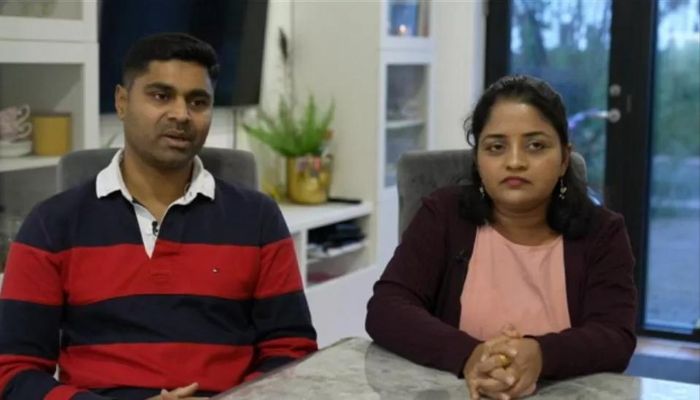
In the West Midlands county of England, a Hindu couple – identified as Ramana Nagumalli, his wife Radhika Kulkarni and their 8-year-old daughter – were harassed at least five times.

The Hindu family had reported 5 instances of harassment to the West Midlands police in July this year. In one incident, the couple and their minor daughter were surrounded by a mob outside a local leisure centre.

Recently, the same men came to their house and began kicking their front door. The victims were also called ‘Kafirs’, a dehumanising term used by radical Islamists to refer to non-Muslims.

The situation has become so grim that the Indian Hindu family is now afraid to leave their house and step outside. While speaking about their ordeal, Radhika Kulkarni stated, “I was shivering outside, I was just crying. I wasn’t able to sleep. We didn’t do anything to anyone. Why is this hate there?”

But their complaint to the West Midlands police failed to elicit any meaningful action. While responding to an email by the BBC, the cops said that there was no sufficient evidence to treat the crime as ‘racially aggravated offence.’

Although the police informed that the accused men confessed to harassing the couple and their 8-year-old daughter and a ‘detailed investigation’ was underway, the criminal offence was not regarded as a ‘hate crime.’

Hindu harassment is common in the United Kingdom. And it is compounded even more by inaction from the authorities including the police. In fact, in a recent case, the harassment itself was perpetrated by a British Muslim cop.

On 19th September, a British police officer identified as Adam Ahmed used excessive force on an elderly Hindu priest of Indian origin during the Ganesh Chaturthi celebrations in Leicester in the UK.

The videos of the incident went viral on social media, where Ahmed was seen behaving rudely with the priest and the Hindu devotees who tried to stop him.

A study revealed by a UK-based think tank in April exposed that Hindu students in the country are being subjected to bullying and racial discrimination in classrooms.

The study was carried out by a research fellow named Charlotte Littlewood, who interviewed 988 Hindu parents and surveyed more than 1000 schools in the United Kingdom.

As per a report by The Telegraph, Littlewood noted that Hindu students were being bullied by their Muslim classmates and repeatedly asked to convert to Islam and in one case a female pupil had beef thrown on her.

However unfortunate and dangerous these incidents may be, there is no point expecting action from the British authorities for their sheer unwillingness and incapability to defend their own daughters from the clutches of grooming gangs largely run by Pakistani Muslims.

Uttar Pradesh: Over 3,000 illegal loudspeakers removed from religious places during the statewide crackdown against noise pollution

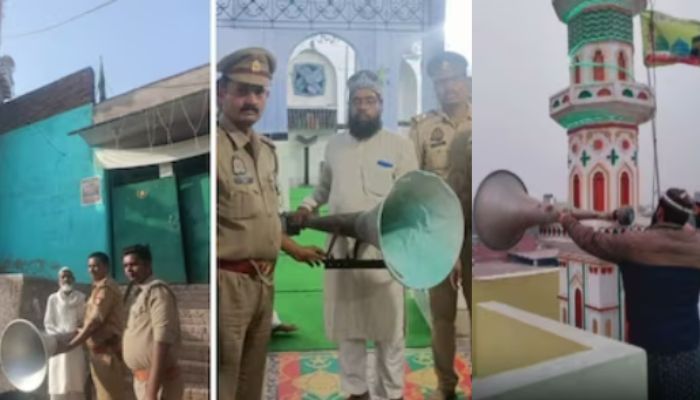
On 27th November (Monday), the Uttar Pradesh Police removed around 3,238 illegal loudspeakers as part of its month-long drive to ensure sustained compliance with an order of the Allahabad High Court regarding noise pollution. Additionally, the decibel levels of 7288 loudspeakers that were found to be higher than the permissible limits were lowered.

The UP Police started the drive on 27 November in all 75 districts of Uttar Pradesh against loudspeakers in public places, including religious centres. Through the drive, the authorities are probing whether the loudspeakers were put up legally or not. In case, the loudspeakers were installed illegally, the violators were served with notice and warned of stern action by the state authorities. 

Special Director General, Law and Order, Prashant Kumar, said cops had been directed to visit religious places from 5 pm to 7 pm till December 22.

In every district, Police teams have been constituted for this month-long drive, and they comprise senior officials. 

On the first day of the drive, around 61,399 loudspeakers installed at public/religious places were checked across the state, as per the details received from the state police headquarters.

In Agra, the police team removed 187 illegally installed loudspeakers from religious and other public places while it got the decibel levels of 79 loudspeakers reduced to permissible limits. 

The Police Commissioner of Agra, Dr Preetinder Singh, said, “In all, 405 loudspeakers at public and religious places in Agra Commissionerate were cross-checked on Sunday and Monday. The campaign continued during the night and ended on Monday morning.”

He added, “In the city area of Agra district, 288 loudspeakers were checked. The decibel levels of 57 loudspeakers were lowered while 147 loudspeakers were brought down from public and religious sites.”

In compliance with the state government’s directions, around 300 loudspeakers were removed from religious places in Kanpur alone as they were found to be violating prescribed norms. 

Apart from Agra and Kanpur, around 283 loudspeakers were removed in the Ambedkarnagar district while 195 illegal loudspeakers were removed in Bahraich.

Similar actions all across the state come after Uttar Pradesh Chief Minister Yogi Adityanath passed orders to remove loudspeakers or sound amplifiers operating against the norms or beyond the prescribed decibel limit.

Court rulings

Notably, the Allahabad High Court and its Lucknow bench had repeatedly instructed the state government to address the issue of illegally installed loudspeakers on numerous occasions.

On 4th May 2022, Allahabad High Court’s bench comprising justices Vivek Kumar Birla and Vikas Budhwar said, “The law has now been settled that the use of a loudspeaker at a mosque is not a fundamental right. Even otherwise, a cogent reason has been assigned in the impugned order.” 

The court issued the ruling while rejecting a petition filed by a resident of Budaun district. The petitioner had stated that the sub-divisional magistrate (SDM) of Bisauli tehsil refused their request to use a loudspeaker for the call to prayer (azaan). The petitioner contended that the SDM’s decision was illegal and violated his fundamental and legal rights to use a loudspeaker at the mosque.

US: American Sikh body urges New York Gurudwara to take action against those who heckled the Indian ambassador

0

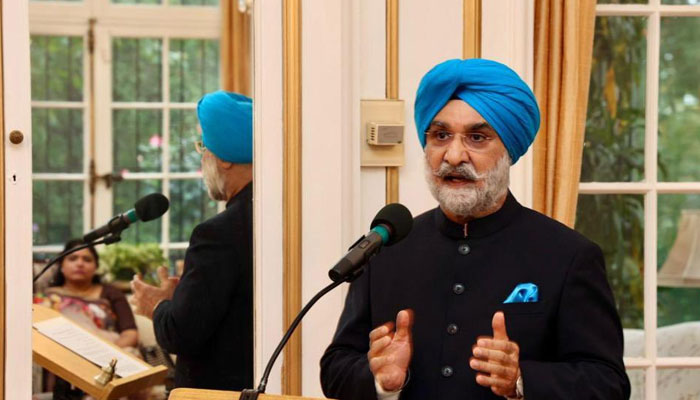
On 27th November (local time), an American-Sikh body, Sikhs of America, condemned the incident that place at Hicksville Gurudwara in Long Island, New York, where Indian Ambassador to the US Taranjit Singh Sandhu was heckled by pro-Khalistani elements. The Sikh body urged the Gurudwara management to take strict action against those involved.

In a statement, Sikhs of America said Gurudwaras are places of worship and they should not be used for personal political views. They said, “We urge the management of the Gurudwara to take strict action against these miscreants so that the peace-loving Sikh community in New York can come to Gurudwaras freely without any fear or pressure.”

Undersigned by Sikhs of America’s founder and chairman Jasdip Singh Jassee and president Kanwaljit Singh Soni, the statement further read, “Ambassador Sandhu went to the Gurudwara to pray, and the management honoured him. After that, a handful of miscreants tried to disrespect him and violated the peace and sanctity of the Gurudwara. Gurudwaras are places of worship and should be free from personal political views.”

“Sikhs of America, the leading Sikh organisation in the US, strongly condemns the disrespect of a Sikh devotee, Ambassador of India to US Taranjit Singh Sandhu, in a Gurudwara in Long Island, New York, yesterday,” it added.

The Indian Ambassador was heckled at Gurudwara in the US

On 26th November, Taranjit Singh Sandhu was heckled by a group of pro-Khalistani elements during his visit to the Hicksville Gurudwara in New York’s Long Island. Sandhu was visiting the Gurudwara on the occasion of Gurupurab to offer prayers. In a viral video, pro-Khalistani elements can be seen confronting the Ambassador with irrelevant and baseless questions about the murder of Khalistani terrorists Hardeep Singh Nijjar, and also about SFJ chief Gurpatwant Singh Pannun.

The incident took place after the Ambassador was honoured at the Gurudwara. While the pro-Khalistani elements kept heckling the Ambassador, he calmly walked towards his vehicle and left the premises. Later, Sandhu posted about his visit to the Gurudwara but did not mention any incident involving pro-Khalistani elements.

The murder of Hardeep Singh Nijjar and accusations against India

In June 2023, Khalistani terrorist Hardeep Singh Nijjar was killed in Canada by unknown assailants, probably as a result of a gang war. However, in September 2023, the Prime Minister of Canada, Justin Trudeau, accused India of being involved in the murder.

Following the accusations, Canada also expelled a senior Indian diplomat. India categorically denied any involvement in the murder and expelled a senior Canadian diplomat in retaliation.

Furthermore, 41 more Canadian diplomats were asked to leave India, and India warned to strip them of their diplomatic immunity. In October, the diplomats of Canada left India.

Canada tried to gather support from its Western allies but failed to do so. Even after two months of the diplomatic blunder that Canada made, India is yet to receive any credible evidence that Indian agents were involved in the murder of Hardeep Singh Nijjar.

India has also raised the issue that the Canadian government has been harbouring terrorists and giving them political and financial power on its soil. Since the accusations, Indian diplomats and Hindus living in Western countries are facing threats from the Khalistani elements.

“There was some divine power which..”: Former CJI Ranjan Gogoi’s autobiography talks about Ram Mandir judgment, and the hurdles he faced during it

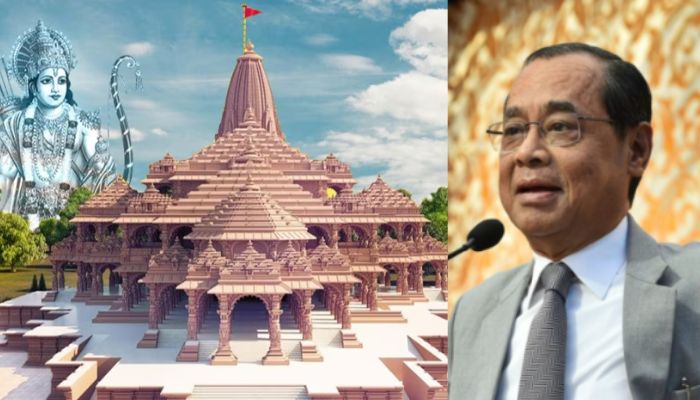
The inauguration of the Ram Temple in Ayodhya is set to take place in January 2024. After 40 days of hearings, the 5-judge Constitution Bench of the Supreme Court had delivered its verdict on 8th November 2019, ordering the transfer of 2.77 acres of land to the Hindu side. This landmark judgement marked the end of a 450-year-old dispute and brought a fruitful conclusion to the longstanding struggle of Hindus. At that time, Ranjan Gogoi served as the Chief Justice of India (CJI), and it was under his chairmanship that the bench delivered this landmark ruling.

What was going on in his mind at that time? What was happening inside the Supreme Court? Former CJI and now Rajya Sabha MP Ranjan Gogoi has provided a detailed account of the Ayodhya Judgment in the 12th chapter of his autobiography, ‘Justice for the Judge.’ 

Ex-CJI Ranjan Gogoi starts this chapter by stating that faith and religious beliefs are matters of conviction and not proof. Nevertheless, they bind humans and human communities together. Gogoi writes that, despite leaders’ claims, homogeneity and oneness remain elusive, and many nations have been entangled in centuries-old disputes revolving around religious faith and beliefs.

In the same sequence, Ranjan Gogoi addressed the Ayodhya dispute, noting that despite several transformations in civilisation, this dispute on the structure has survived through the centuries. In his autobiography, Gogoi emphasises that the impact of this dispute extends to millions of Hindus and Muslims, and governments have, at times, added layers of uncertainty to the dispute with their decisions. 

He also delves into the challenges surrounding this judgment and discusses how it can serve as inspiration for resolving disputes between different communities worldwide, making it a significant contribution to humanity.

Giving a brief overview of the claims of both litigants, Ranjan Gogoi notes that the Hindu side claimed that Lord Shri Ram was born in the sanctum sanctorum (‘garbh-grih’) of the temple, while the opposing side argued that Babar built the mosque there without demolishing any temple. The land below the central dome was 1500 square yards, which is less than 1 acre. He recalled that riots occurred in 1856-57, a statue was installed in December 1949, and in December 1992, the Karsevaks demolished the entire disputed structure.

The hearing was based on four suits filed between 1950 and 1989. In 1989, the Allahabad High Court transferred the case to a bench of 33 judges. On 30th December 2010, the High Court delivered its 4000-page judgment, consisting of three separate decisions. In the final judgment, the land was divided into three parts — Nirmohi Akhara, Ramlala Virajman, and the Muslim side. Justice Dharamveer Sharma ruled to hand over the entire land to Hindus, while Justice Sudhir Aggarwal delivered the verdict on the sharing of all parties except for the Central Dome.

On the other hand, Justice SU Khan decided to allocate the Central Dome to Hindus and distribute the remaining land among the three parties. In protest, 21 petitions were filed in the Supreme Court, collectively known as the Ayodhya case. The matter was brought before the then Chief Justice of India Deepak Misra on 5th December 2017. However, advocate, and then Congress leader, Kapil Sibal wanted the matter to be heard after the 2019 Lok Sabha elections. Rajeev Dhawan from the Muslim side argued that the case should be given to a larger constitutional bench.

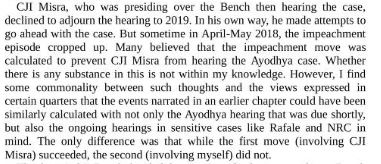
Further in his autobiography, Ranjan Gogoi writes that the then CJI Deepak Misra did not want to postpone this case till 2019. However, in April-May 2018, an impeachment motion was brought against him and an uproar broke out. 

“Many believed that the impeachment move was calculated to prevent CJI Misra from hearing the Ayodhya case. Whether there is any substance in this is not within my knowledge. However, I find some commonality between such thoughts and the views expressed in certain quarters that the events narrated in an earlier chapter could have been similarly calculated with not only the Ayodhya hearing that was due shortly but also the ongoing hearings in sensitive cases like Rafale and NRC in mind. The only difference was that while the first move (involving CJI Misra) succeeded, the second (involving myself) did not,” Former CJI Ranjan Gogoi writes while referring to the impeachment move against his predecessor Deepak Misra. 

(Excerpt from his autobiography – ‘Justice for the Judge’)

Notably, when the impeachment motion was brought against CJI Misra, a hearing on seminal matters like a case against the Rafale aircraft deal was going on in the apex court. 

Pertinent to note that 7 opposition parties, including Congress, SP, BSP, NCP, CPI, IUML/Muslim League, and JMM had submitted signatures of 71 MPs to the then Vice President and Rajya Sabha Chairman Venkaiah Naidu for initiating an impeachment motion against Justice Deepak Misra. Kapil Sibal was spearheading the charge. Arun Jaitley, who was then Union Minister, had pointed out how the impeachment motion was being used as a political weapon.

Nonetheless, Gogoi writes that the hearing of the Ayodhya case had already started during the tenure of his predecessor, he simply took it forward.

Former CJI Ranjan Gogoi then notes that the case was listed on 4th January 2019, without his permission at that time. As the then CJI, Ranjan Gogoi had decided to transfer the case to a bench of 5 judges, which, besides him, included Justices SA Bobde, NV Ramana, UU Lalit, and DY Chandrachud. However, the counsel of the Muslim side, Rajeev Dhawan objected to the inclusion of UU Lalit, stating that, as a lawyer, he was once associated with a case related to it. Additionally, NV Ramana also recused himself from the matter.

Consequently, Justices Abdul Nazeer and Ashok Bhushan were added to the bench hearing the Ayodhya case. The Uttar Pradesh government submitted 13,000 pages of translated oral evidence. To obtain no objection to this, both parties were given a 2-month period to review. Subsequently, a committee was formed for an agreement, but it proved unsuccessful. Therefore, on 6th August 2019, at 10:30 am, the Supreme Court commenced the hearing in this case.

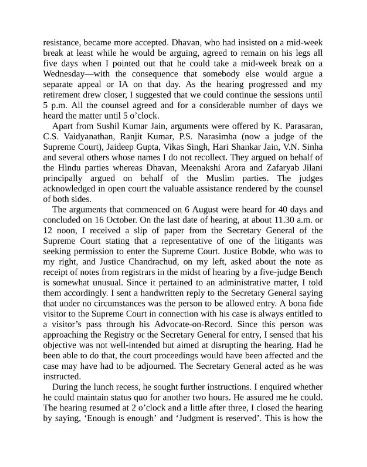
Justice Ranjan Gogoi writes in his autobiography that as the hearing progressed, the crowd in the court kept increasing, with many lawyers in attendance. Initially, Rajeev Dhawan asked for more time and even resorted to commenting on the judges themselves, mentioning that, apart from Chandrachud, no one had thoroughly studied all the documents. Such incidents kept occurring, and the judges responded on several occasions. It was decided to hold hearings 5 days a week. As Ranjan Gogoi’s retirement was approaching, the proceedings continued until 5 pm.

From then onwards, the hearing continued until 16th October. Ranjan Gogoi mentions a very interesting incident during that time. A person wished to enter the Supreme Court hearing, and he sent a message through the Secretary-General. However, Ranjan Gogoi found his intentions suspicious and instructed the Secretary-General not to allow the person’s entry at any cost. At 2 pm, the person requested permission again but was asked to wait for 2 hours. Ranjan Gogoi writes that if he had entered during the proceedings, an adjournment would have been necessary, leading to the scheduling of a new date.

(The incident pertaining to the last day of hearing in the Ayodhya case)

Ultimately, Gogoi declared, ‘enough is enough,’ and announced that the ‘judgment is reserved.’ The incident pertains to the last day of the hearing. Ranjan Gogoi mentions that his training as a judge was such that his stress did not reflect in his work, but he needed to conclude the case before his retirement on 17th November. Many times, he would return home with similar feelings. He shared his inner turmoil with his wife, who could sense his distress even when walking behind a seemingly calm posture in court.

One day, Gogoi even refused to go to court, but his wife Rupanjali encouraged him to attend the court. He lived at 5, Krishna Menon Marg at that time. On another day, he contemplated skipping court, but his wife insisted, and he went. On that particular day, he remained seated in his chamber, prompting Justice Bobde to adjourn the hearing, citing his illness. Ranjan Gogoi mentioned that in different cases, negative comments started coming from activists and lawyers so the hearing did not proceed quickly.

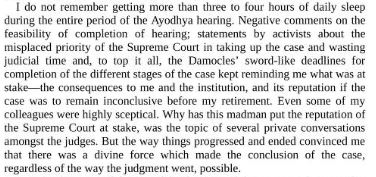
Retired judge and currently a Rajya Sabha MP Ranjan Gogoi writes that he was not able to sleep more than 3-4 hours on any day during the entire hearing. Justice Ranjan Gogoi reflects on how his fellow judges used to discuss among themselves why they were so determined to resolve this case. He faced accusations of putting the reputation of the Supreme Court at stake. However, he believes that there was some divine force that was prompting him to end the case.

(In his autobiography, Former CJI Gogoi writes, ‘There was a divine force which made the conclusion of the case possible’)

During that 3-month hearing period, none of the judges on the bench took even a single day’s leave. No judge experienced fever or a cold. One judge mentioned that, at that time, a relative was in the ICU and expressed the possibility of taking a few days off in case of a relative’s death. However, Ranjan Gogoi assured him that everything would be fine. Fortunately, the situation did not deteriorate, and perhaps the relative had already recovered by that time. After the hearing, the five judges would gather for tea in the Chief Justice’s chamber.

During that time, they used to discuss the details of the case, but in the final days, the conversation shifted towards the suggestion that the disputed land should be granted to the Hindu side and Muslims should get 5 acres of land separately for the mosque. In the Ayodhya case, only one judgment was written and who wrote it was not even made public; all five judges signed it. Justice Ranjan Gogoi believed that this case was one in which the judgment should not remain pending, even for a minute.

After the verdict was pronounced, a photo session was organised under the Ashok Chakra in the Judges Gallery in Court Number One. In the evening, Ranjan Gogoi invited his fellow judges to celebrate at the Taj Mansingh Hotel. There, they enjoyed Chinese food and wine. The next day, he left for Dibrugarh in Assam with his mother and wife for the release of a book published by the Supreme Court. Upon returning to Delhi, he resumed work and remained at the office until the last day of his retirement. He considered this case a challenge and even canceled his foreign tour for it.

Justice Ranjan Gogoi did not entertain petitions filed against Kashmir and the abrogation of Article 370 because he was determined to conclude the Ayodhya case. In his writings, Ranjan Gogoi mentions that he chose to confront the challenge and did not allow negative comments personally directed at him to impede the process. Today, as the Ram Mandir takes shape, we should also express gratitude to then CJI Ranjan Gogoi and the five-judge constitution bench for their courage and for resolving this legal dispute lingering for centuries. 

Congress exploits the plight of 41 workers stuck in Uttarakhand tunnel to attack PM Modi

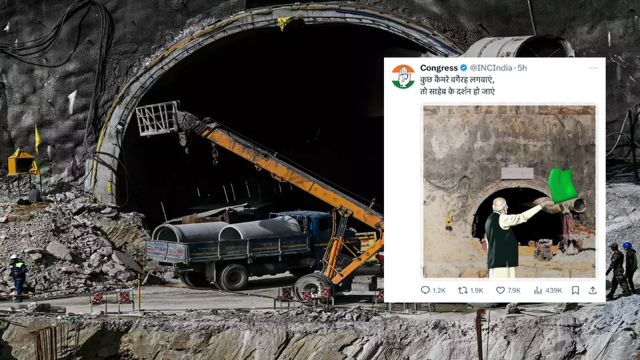
Even as the entire nation is feverishly praying for the safety of 41 workers stuck inside the Silkyara tunnel in Uttarakhand, the Congress party was busy using their predicament to attack their political opponent, PM Modi.

The official X account of Congress earlier this morning shared a cartoon showing PM Modi waving a green flag in front of the Silkyara Tunnel. The caption accompanying the cartoon said, “Kuch Camere wagairah lagwayein, toh saaheb ke darshan ho jaayein (Put some cameras, Saheb will visit the tunnel then).” 

The tweet exemplifies how Congress is given to exploiting tragedies and unfortunate incidents to further their political objectives and revive electral fortunes. Of late, the party has demonstrated shocking brazenness and eager zeal to politicise incidents and use them to mount an attack against their opponents, most notably PM Modi, who remains a force to reckon with in the Indian political landscape and the leader responsible for enfeebling Congress to its current state.

Earlier last week, the Congress party and its senior leader, Rahul Gandhi, attacked PM Modi over the loss of Indian cricket team in World Cup 2023 finals against Australia. Modi attended the final match, and the Congress party tried implying that India lost because PM Modi was in attendance—another illustration of how the political discourse in the country has descended as Congress desperately tries to combat its inexorable march to oblivion. In addition, this juvenile behaviour is itself an indicator of Congress’ incompetence in governing the country. It shows how Congress is incapable coming to terms with the reality that Australia outplayed India in every department on that day to clinch the finals and how individuals having no connection with sports teams could not be held responsible for the outcome.

Congress has stepped up its attack against PM Modi and the BJP ahead of the Karnataka assembly elections last year. The triumph in the polls seems to have deluded the party in believing that their brand of unapologetic and crass aggression had brought about their victory in the elections, nothwithstanding BJP’s dismal poll management and infighting with the Karnataka state unit. Since then, the party has often brushed aside well-intentioned criticism of its, at times, callous and insensitive take on incidents to attack the ruling dispensation.

The latest cartoon on the Silkyara Tunnel is emblematic of Congress party’s utter disregard for sensitivities and human emotions. Over 41 labourers were braving for their lives inside the Silkyara Tunnel, with hundreds and thousands of people and over a dozen teams deployed by the Centre and Uttarakhand state involved in rescue operations. The Congress party, however, demonstrated that it had no qualms mocking the struggles and travails faced by the labourers stuck for over 17 days inside the tunnel as long as they could attack PM Modi and the Centre.

Unfortunately for the Congress party, the electoral competition in India has long ceased to be a political battle fought with a vision for the betterment of her citizens. It has devolved into a propaganda campaign aimed at restoring the eminence of a single family, even if that means mocking labourers stuck inside a tunnel and fighting for their dear lives. As the efforts to rescue workers reached a crescendo, the Congress party shared the cartoon, not because they were moved by their predicament but because they were worried that a successful rescue operation would mean another feather in cap for the Modi government, which has executed some of the toughest evacuations of its citizens in India’s modern history.

Haryana: Woman scares away gun-wielding killers with a broomstick, video viral

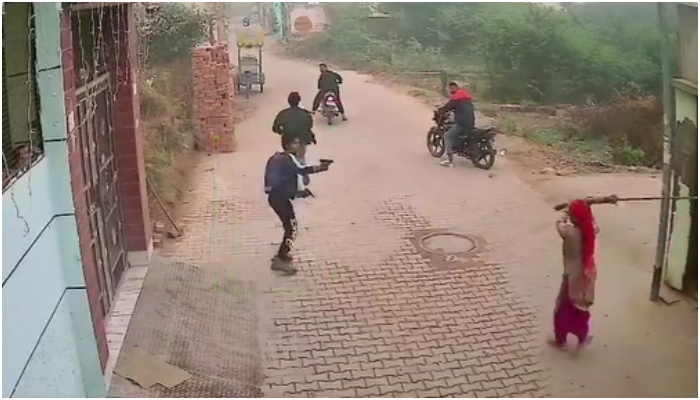
Few people would peep or come out if they heard gunshots outside their house. However, a woman in Haryana showed bravery by running with a stick to disperse the miscreants who opened fire at a man in the Bhiwani district of the state. The miscreants fired at an individual identified as Harikishan. However, they got scared and immediately fled from the spot as they saw a woman approaching with a stick and a broom in her hand.

The entire incident was recorded on a CCTV, the footage of which is going viral over social media. The woman is being praised for her courage and bravery. In the video, she can be seen running behind the miscreants with a broomstick in her hand.

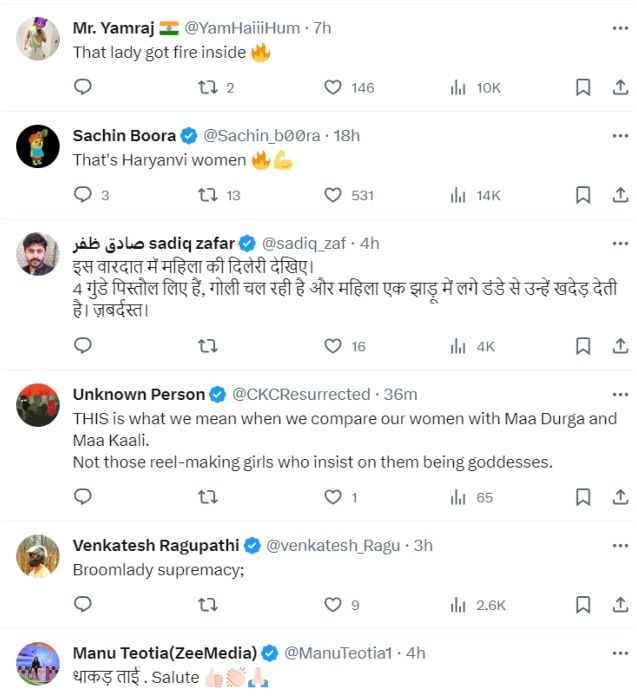
Netizens lauded the woman for her bravery. “Salute the bravery of the lady who could face them with a broomstick,” said one of the users. Meanwhile, another one said, “That lady has got fire inside. That’s Haryanvi women.”

Screenshot from Twitter

The saga began when the miscreants fired at Harikishan. The incident is reportedly a case of old enmity. Harikishan is accused in a murder case of a wrestler and gym trainer named Ravi from Bhiwani.

According to police, a gym trainer named Ravi from Bhiwani was murdered about a year ago. Harikishan alias Hariya is a murder suspect who is currently out on bail. Following the incident, several teams from the Bhiwani CIA and the city police station are searching for the accused. Harikishan alias Hariya was standing outside his house near Dabur Colony Charamandi Gate of Tosham Bypass on Monday (27th November) morning.

Meanwhile, four miscreants on two motorcycles arrived armed with weapons and opened fire on Hariya. Hariya jumped and entered the house. He has been hit by a bullet and is currently under treatment. Deepak Kumar, the charge of the Anaj Mandi police post, arrived with his team at the spot and confirmed the incident. Police have recovered bullet shells from outside the house.

Rajasthan: NEET aspirant from West Bengal kills himself in Kota, 28th case of suicide this year in ‘coaching factory’

0

On Monday (27th November), a 20-year-old NEET aspirant from West Bengal committed suicide in the apartment he rented in Rajasthan’s Kota. This is the 28th suicide by a coaching student in Rajasthan’s Kota this year.

Faureed Hussain, a resident of West Bengal’s Birbhum district, had been preparing for the NEET medical entrance exam at a Kota coaching institute for about a year. Since July of this year, he has been residing in Wauf Nagar. He was living in a rented flat with some other students in the same building.

Suspicion grew about Hussain’s absence when he didn’t leave his room until 8 p.m. He was last seen in the afternoon of Monday (27th November). The friends of Hussain then reached his apartment to check on him but he didn’t open the door. The friends then informed the house owner.

The house owner subsequently informed police about the incident, and police rushed to the scene, according to Circle Inspector Rajesh Pathak of Dadabari police station. When police broke open the door, they discovered the 20-year-old hanging and lifeless.

“No suicide note was found in the room and the reason behind the extreme step is yet to be ascertained. Post-mortem will be done after his parents arrive,” the Police confirmed.

Notably, more than 27 students have ended their lives in Kota this year. Earlier on 28th September, a NEET student from Uttar Pradesh’s Maharajganj district committed suicide by hanging himself in his room. A 17-year-old student from Mau, Uttar Pradesh killed herself on 18th September in Kota by ingesting pesticide. She came out of her coaching establishment vomiting and was rushed to hospital where she passed away during treatment.

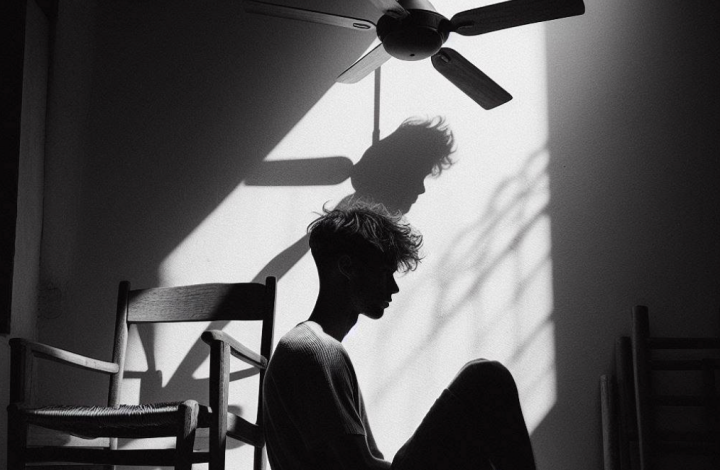
The alarming increase in suicide cases over the past few months has alarmed the local authorities and prompted them to take action. They have ordered coaching institutions to stop holding exams for a two-month period and mandated that anti-hanging mechanisms be installed in ceiling fans.

Furthermore, the Kota police are attempting to recruit hostel staff members including wardens, mess employees, and tiffin suppliers to look for any indications of stress or depression among the students residing in hostels and as paying guests.

Previously, Rajasthan authorities decided to make the premises ‘suicide-proof’ by installing spring-loaded fans in the rooms and “anti-suicide nets” on the balconies. Over 3 lakh students from across India are currently staying in Kota to prepare for various medical and engineering entrance exams.