Home Blog Page 187

Wanted terrorist Gurpatwant Pannun meets murder accused truck driver Harjinder Singh in Florida jail, claims he has ‘sorrow and suffering’ in eyes

On Tuesday (26th August), wanted Khalistani terrorist Gurpatwant Singh Pannun said that he met Harjinder Singh, the 28-year-old Indian-origin Sikh truck driver arrested in the US following a fatal crash in Florida which resulted in 3 deaths.

Pannun held a press conference and claimed that Harjinder Singh, currently in St. Lucie County Jail in Florida, is ‘grieving’ and going through a mental anguish over the deadly incident. “I saw sorrow and suffering in his eyes,” Pannun said. 

Defending the accused, Pannun claimed that Harjinder Singh exited the truck, went to the van, broke open the window, held the hand of someone and said help is on the way, please stay with me, right after his 18-wheeler trailer truck collided with the minivan as Harjinder took an illegal U-turn.

The incident transpired on 12th August. Singh, who entered the US illegally in 2018 and obtained a work permit in 2021, faces three counts of vehicular homicide and immigration violations, with a potential 45-year sentence.  

The anti-India Khalistani terrorist asserted that Harjinder Singh did not intentionally slam his truck into the minivan, rather, it was case of ‘tragic misjudgement’. “To portray him as a malicious killer, it would be very unfair,” Pannun said.

In addition to garnering sympathy for accused Harjinder Singh, Pannun also announced that his Khalistani terrorist outfit, Sikhs for Justice, will contribute $100,000 in humanitarian aid to the families of the victims. Gurpatwant Singh Pannun, who threatens terror attacks on India every now and then, urged Americans to show fairness for Singh and seek justice guided by truth and not hate.

As reported earlier, accused Harjinder Singh is an ‘asylum seeker’ in the US. 28-year-old trucker Harjinder Singh hails from Tarn Taran, Punjab in India. He was denied bail following the incident. Singh has been labelled an “unauthorised alien” and a “substantial flight risk”. He now faces three counts of vehicular homicide which will put him in prison for decades and eventual deportation. Harjinder Singh participated in anti-India and pro-Khalistan rallies and events organised by Pannun’s Sikhs for Justice.

Several countries including India stop parcel deliveries to USA after President Trump withdraws “de minimis” tariff exemption on small-value shipments

Japan, Australia, and Taiwan have now joined the list of countries that are stopping some parcel shipments to the United States. This comes after the Trump administration announced new rules that end tariff exemptions on small imports.

A long-running rule that allowed low-value goods to enter the country without customs duty, known as the “de minimis” exemption, is set to end on coming Friday. President Donald Trump signed an executive order on 30th July that shuts down this exemption, which for years allowed packages worth less than $800 to enter the U.S. duty-free. The order, which takes effect on 29th August, is part of his broader protectionist trade campaign.

For shoppers and companies alike, the regulation was a major deal. It facilitated cross-border online shopping as speedier, easier, and less costly. But with the exemption eliminated, millions of packages that used to move freely daily will now be subject to customs charges, forms, and delays. Delivery firms globally are already responding, and the impacts are set to hit American consumers.

The US government says this step is necessary to slow down the huge flow of cheap imports into the country and to protect domestic manufacturing. But this sudden move has caused disruptions in postal services and online shopping across the world.

However, letters/documents and gift items valued up to USD 100 will remain exempt from these new duties, according to the executive order.

Impact on global postal services

Several nations such as Thailand, South Korea, New Zealand, France and UK had previously suspended certain parcel services to the US. More and more countries in the Asia-Pacific region are now following suit, which is causing it to become increasingly difficult for small businesses and individuals to ship goods. 

In Germany, DHL and Deutsche Post announced last week that they were halting parcel services to the U.S., citing unanswered questions about how duties would be collected, what data would be required, and how information would flow to U.S. Customs and Border Protection (CBP).

Japan Post has announced that it will stop delivering small packages worth more than $100 to the US from Wednesday, 27th August. Similarly, Australia Post said it will “partially suspend” postal services to the US and Puerto Rico from Tuesday, 26th August, until further notice.

Australia Post also pointed out that many postal operators around the world are taking similar steps. The suspension has caused serious problems for e-commerce businesses in the country.

Taiwan has also joined in. Chunghwa Post announced that it will stop delivering small parcels to the US from Tuesday, 26th August. The postal service explained that the global postal system still doesn’t have a way for senders to prepay customs duties, and its partner carriers have also suspended merchandise deliveries.

According to a BBC report, at least 25 countries have suspended parcel deliveries to the USA due to the withdrawal of the tariff exemption.

Who will be affected most?

This change will hit online sellers and platforms the hardest. Small businesses selling via Amazon Haul, TikTok Shop, Etsy, and Shopify to American consumers will be impacted. These platforms typically link small foreign companies directly with American consumers, and most depend on cheap shipping to remain competitive.

Big courier service DHL has also said it will stop accepting shipments to the US from 25th August. Several European postal operators have already done the same.

Australian broadcaster ABC reported that retailers are struggling because of the uncertainty. Laz Smith, co-founder of maternity wear brand Apéro, told ABC that the unstable decisions and the lack of quick solutions are making things very difficult. “It puts us, and the entire Australian fashion industry, in a really tough position,” she said.

India Post also suspended services to US

India has also joined the list of countries halting U.S.-bound shipments. On Saturday, 23rd August, the Department of Posts announced a temporary suspension of most international postal services to the U.S., effective from 25th August.

The move comes directly in response to Trump’s July 30 executive order. In a statement, India Post said beginning 29th August, 2025, all goods sent to the US, regardless of their value, will be subject to customs duties under the International Emergency Economic Power Act (IEEPA) tariff framework. 

Air carriers that move U.S.-bound international mail have said they are not ready to meet the new requirements, including collecting duties and transmitting data to CBP. As a result, India Post has stopped booking most categories of items for the U.S., though it is working with American authorities to restore full service.

Although CBP released initial guidelines on 15th August, critical implementation details, such as the process for designating “qualified parties” and systems for collecting and remitting duties, have not yet been finalised.

Those customers who have already shipped goods that do not meet the qualification can claim a refund. “We apologise for the inconvenience,” the department stated, noting it plans to resume services in the near future.

What the data says 

According to US Customs and Border Protection, more than 1.36 billion de minimis shipments entered the US in the last fiscal year. On average, about 4 million of these shipments were processed every single day.

Under the new order, importers could face an $80 fee per item if the exporting country has a tariff rate of less than 16%. If the rate is between 16% and 25%, the fee could go up to $160 per item, and for tariff rates above 25%, it could be as high as $200.

This means that sending even small packages to the US will now become much more expensive. For global businesses that depend on American buyers, this is likely to be a major setback.

SC collegium recommends relative of CJI Gavai with 13 others for Bombay HC judge positions, but is a recusal enough? Read why judicial appointments need reform in India

The Supreme Court Collegium has suggested 14 lawyers to be appointed as judges of the Bombay High Court on Tuesday, 26th August. One of them is Raj Damodar Wakode, who is reportedly related to Chief Justice of India (CJI) Bhushan R. Gavai.

Wakode is the son of the CJI’s cousin and is often described as his nephew. However, according to media reports, Dr. Rajendra Gavai, the CJI’s brother, said that Wakode should be seen as a “distant relative.”

Even so, his inclusion in the list has triggered fresh debate about how judges are appointed in India, the role of family connections, and the lack of reforms in the Collegium system.

Background of Raj Damodar Wakode

Raj Wakode graduated under the Maharashtra Board, obtaining distinction at Class 12 in 1996. He initially did science, even securing a gold medal for MSc in 2001, before switching to law. In 2004, he obtained an LLB degree from Amravati University.

After his law degree, Wakode began his career in the chamber of Justice Nitin Sambre, who is now a judge at the Delhi High Court. Over the next two decades, he built a diverse practice, handling civil and criminal appellate cases, writ petitions before the Bombay High Court’s Nagpur bench, and cases before district courts and statutory tribunals such as the Maharashtra Administrative Tribunal and the Revenue Tribunal.

Wakode has represented several public institutions as standing counsel, including Maharashtra National Law University (Nagpur), the Maharashtra State Electricity Distribution Company, the Union of India, the Union Public Service Commission, and the municipal corporations of Amravati and Nagpur. He has also served as the legal advisor to the National Co-Operative Consumers Federation.

Wakode has reportedly declined to comment on his name being proposed by the Collegium.

CJI Gavai recuses himself

Naturally, questions have been raised on whether CJI Gavai had any role in the recommendation of his relative. Supreme Court sources have explained that the CJI recused himself from Collegium meetings where candidates related to him were being considered. Still, Wakode’s name, along with those of two other lawyers who had previous professional links with the CJI, figured in the final list.

It is not the first time that family members of judges have reached the upper judiciary. Examples include Justice YV Chandrachud and his son, Justice DY Chandrachud, both of whom became Chief Justices of India, Justice HR Khanna and his nephew, Justice Sanjiv Khanna, and Justice ES Venkataramiah and his daughter, Justice BV Nagarathna, who is set to become India’s first woman CJI in 2027.

The bigger issue: Nepotism in Judicial appointments

Even when candidates such as Wakode are qualified and experienced, the true outrage is elsewhere: judicial appointments seem to mostly originate from a restricted set of families and networks. This creates the perception that the judiciary operates like a closed club.

The critics are of the view that the system tends to keep at bay those lawyers who do not have family connections in the profession, particularly those with less powerful and small-town backgrounds. This has drawn allegations of the higher judiciary gradually becoming a dynasty much like in politics. The lack of transparency in the manner in which names are shortlisted and recommended only fuels further criticism.

How the collegium system came into being

The present system of appointing judges is referred to as the Collegium system. Surprisingly, it was never a part of the original Constitution. Rather, it developed through three significant Supreme Court judgments, the First Judges Case (1981), Second Judges Case (1993), and Third Judges Case (1998).

Here, judges of the Supreme Court are appointed by a committee of the five senior-most judges of the Court. For the high courts, the three seniormost judges of the Supreme Court along with the senior-most judges of the relevant high court make the suggestions.

In reality, this means into sitting judges having the dominant voice in which individual to promote to the higher courts. The government has no choice other than to raise an objection or refer back a name for reconsideration. If the Collegium reaffirms its decision, the government is obligated to agree with it.

NJAC: A reform effort that has been rejected by the judiciary

The Supreme Court upheld the collegium system for judicial appointments in the case of Supreme Court Advocates-on-Record Association v. Union of India (2015), also referred to as the Fourth Judges Case. The proposed National Judicial Appointments Commission (NJAC) would have been in charge of hiring, appointing and transferring judges, attorneys and other legal staff under the Indian government as well as all of its state governments.

The commission was created by amending the Indian Constitution by the 99th Constitutional Amendment Act 2014, also known as the Constitution (Ninety-Ninth Amendment) Act 2014, which was approved by the Rajya Sabha on 14th August 2014 and the Lok Sabha on 13th August 2014.

It would have established a new mechanism for the nomination of judges in place of the collegium system, which the Supreme Court had activated through judicial fiat. The Indian Parliament passed the act in addition to the Constitution Amendment Act to govern the National Judicial Appointments Commission’s functions.

The Constitutional Amendment Bill and the NJAC Bill were approved by 16 Indian state governments before being enacted into law by Indian President Pranab Mukherjee on 31st December 2014. On 13th April 2015, the Constitutional Amendment Act and the NJAC Act went into effect.

Why the NJAC was struck down

Shortly after its inception, the NJAC was assailed in court by the Supreme Court Advocates-on-Record Association. In what became the Fourth Judges Case, a five-judge bench invalidated the NJAC in October 2015 by a 4:1 margin.

The majority ruling contended that the NJAC subverted judicial autonomy, which forms part of the Constitution’s Basic Structure. It was a significant worry that two “eminent persons,” who weren’t even required to be legally qualified, could vet the choice of the Chief Justice and senior judges. The Court referred to this situation as “outrightly obnoxious.”

The other concern was the inclusion of the Law Minister because the Union government is party to most cases in front of the courts. Judges claimed this was a conflict of interest in the most direct sense. The Court also lamented the lack of specificity in the manner in which “eminent persons” would be selected, placing too much authority in the hands of politicians.

CJI rescual is not enough, judiciary is lacking transparency in India

While CJI Gavai’s rescual may have followed procedure, it doesn’t resolve the larger trust deficit surrounding judicial appointments. The judiciary demands transparency and accountability from all other institutions but has resisted reforms in its own selection process. 

Many people believe that the judiciary is the last stronghold of accountability, justice, and equity. However, this claim has always been disputed due to instances of corruption, self-preservation and a lack of transparency. 

When an inquiry is commenced, it is carried out by other judges based on a framework they have set up, resulting in lingering uncertainties and a severe lack of desired impartiality and transparency. This privilege is not extended to anyone else. The judiciary requires and enforces standards of transparency and integrity from everyone except itself.

Moreover, efforts to address the problem, such as the NJAC Act or the accountability bill, never proceed to a logical conclusion which only exacerbates the issue. Several attempts to alter the collegium have been met with resistance from the judiciary, which is frequently denounced as self-empowerment but is justified as defending independence.

Due to the collegium’s opaque operations, decisions are not made public and no formal criteria are revealed and hence the collegium system has been accused of nepotism and bias, with arguments that it shields a judicial elite that is exclusive.

Bareilly: Abdul Majeed and 3 others arrested while preparing to circumcise a blind Hindu boy, inter-state conversion racket busted by Police

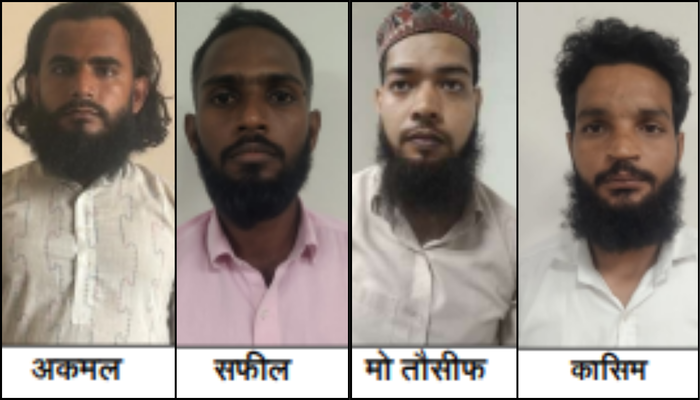
In a major crackdown on a vicious inter-state Islamic conversion racket in Bareilly, Uttar Pradesh, the police nabbed four individuals linked with the conversion racket on Monday (25th August). The arrested individuals have been identified as Abdul Majeed (35), Salman Raza (30), Mohammad Arif (29), and Mohammad Faheem(24). Another suspect named Mehmood Beg is said to be on the run.

According to the police, a tip-off was received at Bhuta police station from an Aligarh-based woman named Akhilesh Kumari, who said that some people have been luring her visually-impaired son Prabhat Upadhyay, with a marriage offer to convert him to Islam. She said that when she tried to stop the religious conversion of her son, she received death threats. On her indication, a team of police reached Faiznagar Madrassa and foiled the plan to convert the victim.

Inside the Madrassa, the police team found that the four accused were sitting around Prabhat Upadhyay, wearing skull caps, and were preparing to circumcise him to convert him to Islam. When the police team called the victim by his name, Prabhat, he said that his name was Hamid. On being questioned by the police, Prabhat Upadhyay revealed his real name. Police arrested all four accused and handed over Upadhyay to his family.

A case has been registered by the police under Sections 140(3)/351(3) of the BNS and Section 3/5(1) of the Uttar Pradesh Prohibition of Unlawful Conversion of Religion Act, 2021. The police seized several incriminating materials from the possession of the accused and the victim, including religious literature promoting conversion, CDs containing videos of fugitive Islamist preacher Zakir Naik, skull caps, garlands, and a first aid box containing blades, mobiles, laptops, and conversion certificates.

The gang converted an entire Hindu family to Islam

Addressing the media, SP Bareilly South, Anshika Verma, said that the conversion certificates found in possession of the accused revealed that an entire Hindu family was converted by the gang to Islam. The conversion certificates showed that a man named Brijpal Sahu was converted to Islam and renamed Abdullah. His mother, Usha Rani, was renamed Amina after conversion to Islam. His sister Rajkumari was converted to Islam, renamed Ayesha and married to a Muslim man. In addition to that, the police were led to a minor victim of religious conversion during the investigation of the case. However, the police were able to prevent the religious conversion of the minor victim by stopping his circumcision.

According to SP Verma, an examination of the bank accounts of the accused revealed that they had been running some scheme to collect funds. Abdul Majid, who is the prime accused in the case, ran a religious conversion scheme and travelled across India to collect funds. He is said to have travelled to Gujarat, Maharashtra, Madhya Pradesh, Karnataka and Tamil Nadu. All the arrested accused operated around 21 bank accounts.

Targeted vulnerable individuals and brainwashed them

The gang targeted vulnerable Hindus, particularly poor, unmarried youth, and those with disabilities, for religious conversion by luring them with marriage proposals and money. The gang’s operations are spread across 13 states and 30 districts. Their modus operandi included Salman, a tailor by profession, visiting Hindu families on the pretext of offering help or introducing them to Muslim girls. He was assisted by Faheem, a hairdresser, who identified potential targets out of people who visited his shop. Once they were able to influence a person, they would bring him to the madrassa and brainwash him with religious texts and CDs. The police suspect that the gang has converted a considerable number of people.

This is the sixth Islamic conversion racket busted by the authorities in Uttar Pradesh in this year. Earlier, the authorities, uncovered Islamic conversion rackets, Balrampur, Agra, Prayagraj, Kushinagar, and Aligarh.

Bihar govt conducting geo-mapping of all healthcare units across the state: Read what it means and how it will improve healthcare services

Value of human life, unity, and importance of robust modern healthcare infrastructure, Covid pandemic taught India a lot. Now, the Bihar government is mapping every healthcare service in the state to tackle a Covid-like healthcare emergency if it arises in the future. Geo-mapping of major private and public hospitals to local village pharmacies is being conducted across the state.

This unique geo-mapping initiative was launched in October 2024. So far, around 20,000 healthcare units have been mapped under this initiative. The mapped healthcare units include pharmacies, private labs, private solo practitioners, nursing homes, hospitals and medical colleges. The drive is on to cover all the hospitals, clinics, pathology labs and diagnostic centres and even local pharmacies in all of the state’s 38 districts. This information will then be collated in a dashboard.

Scheduled to conclude by the end of 2025, this geo-mapping exercise is being undertaken by the Bihar State Health Society in collaboration with Asian Development Research Institute (ADRI). The dashboard listing all healthcare units across the state would help policymakers detect and bridge gaps. It, however, is yet to be decided whether this dashboard will be accessible to the public.

Speaking about the rationale behind conducting the healthcare geo-mapping, Sanchita Mahapatra, senior health scientist at ADRI said that the initiative is meant to plug holes in the healthcare delivery system to avoid the chaos witnessed during the Covid pandemic.

This dashboard would function with and without internet connection and will store data locally and sync it with a remote server once a connection is available.

“We also drew up a comprehensive list of private healthcare units in each district using data from various sources, including the government. Using a real-time dashboard for accuracy, we geo-mapped from state headquarters to block towns,” Mahapatra said.

 Meanwhile, teams also visited block-level units to understand why private players are often the first point of contact for the public, especially in rural or underserved areas, Indian Express reported.

Explaining the importance of mapping healthcare units, According to ADRI’s member secretary and economist Asmita Gupta, said: “Besides a host of other benefits, this mapping could put in place a system of understanding the delivery of over-the-counter medicines and health outcome.

Notably, nearly 80% of state’s healthcare units have been mapped. Now, efforts are on to map private health services in “hard-to-reach regions and at villages”.

This exercise, however, is not without challenges, especially mapping flood-prone and border areas.  In addition, tracking and recording health vulnerabilities that vary seasonally is also a challenge since, it is difficult to establish a pattern of diseases, especially in Bihar’s migrant population. Despite the challenges, the officials say that geo-mapping is helping better the delivery of healthcare services.

Highlighting that around 70% of communicable diseases go to private hospitals and pathological labs, Ragini Mishra, the state epidemiologist with the Bihar State Health Society said: “The census of private health services has the potential of creating a network between healthcare seekers and providers.”

Mishra added that the biggest takeaway of the geo-mapping is “improving disease surveillance, seeking better response during pandemic outbreaks and getting a comprehensive picture of how people have been using private and public healthcare facilities.”

Kerala: Two teachers ask Muslim students not to attend ‘polytheistic’ festival of Onam, both suspended, case registered against teacher Khadija

A case was filed against a Muslim teacher in Kerala after she asked Muslim students not to take part in Onam celebrations, calling the festival ‘polytheistic’, as informed by the police on Wednesday (27th August). After complaints were filed, the teacher identified as Khadija has been suspended and a case has been registered against her.

The Muslim teacher Khadija teaches at Sirajul Uloom English High School in Kadavallur, Thrissur. As per reports, she circulated an audio message to parents of her Muslim students, urging them not to send their children to participate in Onam celebrations as it was a festival of ‘other religions’. “We Muslims should live by adhering to Islam. Onam celebrations are polytheistic and should not be encouraged. Neither we nor our children should encourage Onam celebrations in any way. Joining in with the customs of people of other religions may turn into shirk,” Khadija reportedly said in the audio message.

She said that Muslim children should be raised in an Islamic culture and must be prevented from participating in festivals of other religions. “Our children are very young, so they should be taught the seriousness of taking part in such celebrations. For this Onam, neither we nor our children are taking part,” she added.

The audio messages, which went viral, triggered outrage by parents and locals. A complaint was filed by the Democratic Youth Federation of India (DYFI), after which a case was registered by Kunnamkulam police under Section 192 of the BNS. The audio messages are said to have been sent out by two teachers, but the case has been lodged against Khadija only.

The school management suspended both the two teachers and clarified that the audio messages contained personal opinions of the teachers and not the school’s stance. “As like every year, the school management has decided to conduct the Onam celebration in a grand manner this year. We had sent messages regarding it to class groups and PTA groups. As part of the investigation, we have suspended the teachers involved in it,” read a statement by the school administration.

The DYFI and the CPM reportedly announced to stage protests in front of the school.

Death toll in Vaishno Devi landslide reaches 32, rescue operations underway as several people feared trapped under the debris

0

Incessant torrential rains in Jammu and Kashmir triggered a massive landslide at Ardhkuwari cave temple near the Vaishno Devi shrine on Tuesday (26th August), resulting in the death of at least 32 people and leaving around 20 injured. The landslide occurred at Indraprastha Bhojanalaya at the Ardhkuwari cave temple on the Vaishno Devi shrine route.

In view of the alarming weather conditions, the Shri Mata Vaishno Devi Shrine Board has halted the yatra and advised the pilgrims to replan their journey after the weather conditions improve.

Frightening visuals have been emerging from the site of the landslide as the rescue operations are underway. Many people are feared trapped under the debris. Teams of the local administration, Central Reserve Police Force (CRPF) and the National Disaster Response Force (NDRF) are engaged in the rescue operations.

Images via X/AIRNewsHindi

The landslide occurred near Ardhkuwari, approximately 12 km from Trikuta Hill, at around 3:00 pm on Tuesday. Huge boulders and debris fell from the hill on the track, destroying the tin sheds and metal railings.

The Shri Mata Vaishno Devi Shrine Board issued Helpline numbers for inquiring about the situation and missing people.

Prime Minister Narendra Modi expressed condolences over the tragic incident, calling it saddening. He said that the administration is assisting all those affected.

Ceaseless downpours have caused massive devastation across the mountainous state of J&K, causing flash floods and landslides. Critical infrastructure in the state has been severely hit, with roads being washed away, bridges collapsing, and communication and power supply being cut off. Around 35,00 residents were reportedly evacuated till Tuesday after consistent rains and cloudbursts.

As per the authorities, 20 to 30 low-lying areas, including those in Jammu and Samba, have been submerged by flash floods. Besides, Jammu city, RS Pura, Samba, Akhnoor, Nagrota, Kot Bhalwal, Bishnah, Vijaypur, Purmandal, and parts of Kathua and Udhampur have been the worst affected. Continuous but lighter rains have been falling in Reasi, Ramban, Doda, Billawar, Katra, Ramnagar, Hiranagar, Gool, Banihal, and nearby parts of Samba and Kathua districts.

TheWire and Newslaundry peddle misleading claims about SIR in Bihar, get factchecked by ECI

On 26th August, the Chief Electoral Officer of Bihar fact-checked misleading reports published by leftist propaganda outlets The Wire and Newslaundry regarding the Special Intensive Revision (SIR). The Bihar CEO not only gave a pointwise rebuttal, but also raised questions over the credibility of these propaganda outlets cherry-picking data to malign ECI’s reputation and lend credence to the opposition’s anti-ECI campaign.

In its ‘ground report’ published on 25th August, The Wire claimed that the ECI’s verification methods for SIR were questionable. The leftist propaganda outlet claimed had that in five constituencies, 1,50,000 voters are clustered around just 1200-1,300 households. Citing its interaction with locals, The Wire claimed that the supposed ‘unusually’ high voter registration indicates that in many cases, the majority of those listed at a given address were actually living elsewhere. The report claimed that there were 14 cases wherein “a few dozens to several hundred names registered at a single address.”

The Wire report says that in many cases, 200 to 389 voters are registered a single address. It alleged that voter clustering is taking place in East Champaran, Bishunpur, Katihar and other areas.

Alleging supposed ‘irregularities’, The Wire asserted the Election Commission did not conduct a house-to-house verification of voters. Moreover, The Wire claimed that in many in cases locals said that they could not recognise certain voters who were registered in their area. It used unfamiliar names and supposedly incorrect addresses argument to cast aspersions on the integrity of the Election Commission and transparency of the SIR exercise.

Chief Electoral Officer of Bihar factchecks The Wire’s propaganda

Refuting The Wire’s propaganda, the Bihar CEO first detailed the scope of SIR in an X post on 26th August, and said that verification of 7.89 crore voters was conducted house-to-house by booth level officers. The CEO added that documents of 99.11 percent of the 7.24 crore electors have already been received.

“1. Scope and Procedure of Special Intensive Revision (SIR): In Bihar, during the Special Intensive Revision period, verification of 7.89 crore voters was conducted house-to-house by booth level officers. As of the Draft list published on August 1, documents of 99.11 percent of the 7.24 crore electors have already been received, and verification is ongoing in the remaining cases. Therefore, the claim that “house-to-house verification was not done in the Special Intensive Revision” is beyond facts and fabricated,” the Bihar CEO said.

Addressing The Wire’s ‘voter clustering’ claims, the Bihar CEO said that the leftist propaganda outlet’s claims are false. The CEO said that in rural and semi-urban areas of Bihar multiple families live at the same address. The absence of land or house number in revenue records, the CEO said, is matter of local socio-geographical reality and not any ‘irregularity’.

“2. The Claim of Voter Clustering is Incorrect: In rural and semi-urban areas of Bihar, multiple families live at the same address under the same house number / same account (Khata Number) / tola / mohalla. Due to the absence of land or house number in revenue records, sometimes hundreds of voters appear registered at the “same address.” This is a local socio-geographical reality, not any kind of irregularity. Therefore, considering clustering as “irregularity” based solely on data is misleading and beyond facts,” the Bihar CEO said.

Regarding The Wire’s assertion that since some locals do not recognise certain voters registered in their area, or notice unfamiliar names, the Bihar CEO said that these are not essentially fraudulent voters as The Wire tried to insinuate, rather, these are students, migrants workers or tenants. Regarding incorrect addresses, the Election Commission official said that during claim objection period, the BLOs did necessary deletion and correction.

 3.“So-Called Incorrect Addresses and Unfamiliar Names: Often, names of students, migrant workers, or tenants are listed in the voter list, but current local residents may not have information about them. During the claim objection period, in such cases, BLOs have taken action to fill Form-7 (Deletion) or Form-8 for address correction. Therefore, saying that “local people do not have information about the electors’ names” is not in itself a certified error, and there is no rational basis for such claims,” the CEO said.

4. Only 14 cases from 5 constituencies out of 7.89 crore voters across 243 constituencies

Lastly, the Chief Electoral Officer pointed out that The Wire report cites only 14 cases in the assembly constituencies of Katihar, Purnia, Madhuban, and Harsiddhi while the SIR’s scope is extended to 7.89 crore voters across 243 constituencies. The CEO asserted that although even in the context of mere 14 cases, ECI has refuted The Wire’s misleading claims, “raising questions on the credibility of the entire process based on such a small partial selected cases (14 cases under investigation) is neither rational nor objective.”

Newslaundry published the same claims

Notably, leftist propaganda outlet Newslaundry also published the same article on its website. Although the contents of the article were same as The Wire’s, the Bihar CEO put up a separate X post refuting their falsehoods about the SIR exercise.  

The Bihar SIR exercise program has revealed a significant number of fraudulent voters in Bihar. It uncovered around 65 lakh non-existent voters who were then purged from the electoral rolls. The names that have been deleted are mostly those of people who have passed away or who were not found at their registered addresses. The opposition in the state has been mobilizing since the initiative was announced. A significant number of these counterfeit voters are their supporters. No wonder the opposition was even against the carrying out of SIR exercise.

It is essential to mention that ever since the SIR exercise began in Bihar, the opposition parties, particularly, Congress, Rashtriya Janata Dal (RJD) have been making one misleading claim after the other to establish a false narrative that the Election Commission is compromised and is acting in favour of the BJP.  Beyond the pursuit of immediate electoral gains in poll-bound Bihar, the broader motive is to convince the public that the anti-BJP parties did not lose any election in the last decade but were ‘made to lose’ by ECI to ensure its co-conspirator BJP’s victory.

What initially seemed like Congress’s coping mechanism has turned out to be a full-fledged electoral strategy. On 11th August, the I.N.D.I. Alliance marched to the Election Commission of India’s (ECI) New Delhi headquarters, protesting against the Special Intensive Revision (SIR) of the Bihar electoral registers and at the same time claiming ‘vote chori’ and voter list discrepancies. They claimed that the drive would result in disenfranchisement and charged that was an attempt by the Bharatiya Janata Party (BJP) led-government to steal votes. 

Earlier, Congress alleged ‘vote chori’ in Maharashtra assembly elections since it suffered a surprising defeat at the hands of the BJP-led alliance even as the ECI refuted their baseless claims. Recently, Rahul Gandhi claimed that a ‘vote theft’ happened in Karnataka during Lok Sabha elections last year. Just as The Wire claimed in Bihar, Rahul Gandhi also alleged voter clustering in Karnataka’s Mahadevpura constituency.  Gandhi claimed that 80 fake voters were registered at one house in Mahadevpura, but it turned out that they were not fraudulent but migrant voters.

 As OpIndia reported earlier, New York Times, Al Jazeera, and others have amplified Rahul Gandhi’s bogus ‘vote chori’ claim, apparently, to discredit India’s democratic institutions. While the foreign leftist media is amplifying opposition’s vote theft bogey, the Indian leftist media is concocting its own web of lies to aid the anti-BJP parties and allege a ‘democratic collapse’.

Milords, why do you want to be above criticism and questioning, you are not God, this is not how a democracy works

On 26th August, a group of retired judges, bristling at the earlier defence of former Justice B Sudershan Reddy by a group of judges and activists, said plainly that judicial independence was not under threat from Amit Shah’s remarks. Justice Reddy is the Vice President candidate of the Opposition parties. In the latest letter, the former judges reminded their colleagues that once a judge enters the electoral arena, he is fair game for criticism. This counter, to the earlier letter, lays bare the larger question that is, why do milords want to be above criticism in a democracy?

What Amit Shah said and why

On 22nd August, the Union Home Minister was speaking at a conclave organised by Malayalam news outlet Manorama in Kochi where he went straight for the jugular. He accused the Congress party of succumbing to Leftist pressure by fielding Justice Reddy as its Vice President candidate. HM Shah tied this decision to Reddy’s past as the judge who, along with Justice SS Nijjar, disbanded Salwa Judum, the anti-Maoist civilian force that had been deployed in Chhattisgarh.

In HM Shah’s words, “The opposition (Congress) vice presidential candidate Sudarshan Reddy is the same person who gave the Salwa Judum judgment in support of leftist extremism and Naxalism. If this had not been done, extremism would have been eradicated by 2020.” He reminded the people of Kerala that the state itself had borne the sting of Naxalism and extremism. He argued that Congress had revealed its true ideological tilt by elevating such a figure under pressure from its Leftist allies.

HM Shah’s attack was not an abstract rant against the judiciary. It was a pointed political critique of a rival candidate’s track record which is entirely natural in an electoral democracy.

The judgment in question

To understand why a group of judges and activists were stung so badly by the criticism, it is essential to revisit the Salwa Judum verdict of 2011. The Supreme Court bench of Justices Reddy and Nijjar struck down the Chhattisgarh government’s policy of arming tribal youth as Special Police Officers (SPOs) to fight Maoists. Nandini Sundar and other Leftists had filed a petition against the decision of the state government. The Court acted on the petition and ordered the government to disband the force, recall all firearms, and protect the young men from Maoist reprisals.

The judgment also ordered the state to investigate all allegations of human rights violations and criminal acts committed by Salwa Judum members or those known as Koya Commandos. The bench made it clear that no group could be allowed to take the law into its own hands or act outside the Constitution.

“The effectiveness of the force cannot be the sole criterion to judge whether it is constitutionally permissible,” the bench observed. It added that even if SPOs were somewhat effective in fighting Maoists, the “dubious gains” came at the cost of massive constitutional violations and damage to social order.

The judgment came as a severe blow to the state government and the Centre as Salwa Judum, despite whatever flaws were claimed, had been one of the few ways of countering Maoists in their stronghold. The apex court’s intervention tied the hands and left security forces exposed. Amit Shah’s argument is straightforward. If the judiciary had not stepped in, the war against Naxalism might have been concluded by 2020.

The first reaction – ‘eminent’ judges rise to defend

Barely two days after Amit Shah’s statement, on 24th August, a group of retired judges and activists issued a letter attacking Shah. They accused him of “publicly misinterpreting” the judgment and insisted that the verdict never endorsed Naxalism. They lectured that campaigns for high office should be conducted with dignity and without questioning ideology.

Source: LegallySpeakingTarun/X

The signatories included former Supreme Court judges like Madan Lokur, J Chelameswar, Kurian Joseph, Abhay Oka, and AK Patnaik, along with former high court judges and activists like Sanjay Hegde and Mohan Gopal. Their tone was pompous: how dare a political functionary interpret a judgment? They warned that Shah’s words could have a “chilling effect” on the independence of the judiciary. In other words, milords demanded immunity from critique, even when one of their own has entered the rough and tumble of electoral politics.

The counter reaction – judges who see through the act

However, the pushback came quickly. Another group of retired judges, clearly unimpressed by this theatrical self-righteousness, issued their own statement. They called out the pattern of certain retired judges cloaking partisanship under the garb of judicial independence. They reminded everyone that once Justice Reddy chose to contest the Vice-President’s election, he stepped into politics and must defend his record like any other candidate.

Source: Amit Malviya/X

This counter-statement is crucial as it demolished the idea that HM Shah’s criticism amounted to an assault on judicial independence. They argued that independence of the judiciary is not threatened by critique. What damages the judiciary is when retired judges repeatedly issue partisan political statements, giving the impression that the institution itself is aligned with one side of the political spectrum.

In one sharp line, they noted that the larger body of judges ends up painted as a partisan coterie because of the fault of a few. They warned that it is neither healthy for the judiciary nor for democracy.

Criticism of judges is not contempt of democracy

This is where the real issue lies. Retired or sitting judges are not gods. They are not prophets. They are human beings who delivered judgments that affected millions of lives. Those judgments, especially when they reshape national security policy, will inevitably invite criticism. That is the essence of democracy.

However, in India, milords seem to nurse a belief that they are somehow untouchable. They, for some reason, believe that criticism of their rulings is tantamount to an attack on the Constitution itself. Nothing could be more anti-democratic. If politicians, bureaucrats, generals, and media are subjected to public scrutiny, why should judges, especially those entering politics, expect exemption?

Free speech does not end at the courtroom doors. In fact, democracy demands that judgments that impact the security of citizens must be openly criticised. HM Shah’s statement may have been politically charged, however, it was legitimate commentary on how a past judicial decision shaped the trajectory of the Maoist insurgency.

To brand this as “misinterpretation” or “chilling” is to demand a monopoly over interpretation, as if only the judiciary has the right to explain its own words. The hypocrisy becomes glaring when retired judges themselves issue political manifestos under the guise of defending judicial independence. It is not right to sign letters that align perfectly with one political bloc on one hand but complain that a politician’s criticism is partisan on the other. That is having it both ways, and the public can see through it.

Democracy means accountability for all

This controversy is not just about HM Amit Shah versus Justice Reddy. It is about the role of the judiciary in a democracy. Once judges step into politics, they must accept that their record will be examined. Their judgments, especially those that changed the course of national security policies, will be scrutinised and their ideological leanings will be exposed in public. This is not an attack on the independence of the judiciary but the price of accountability.

The judiciary deserves respect but only if it stays above politics. When its retired members behave like political actors, they cannot demand immunity from criticism. If democracy means anything, it means that no institution or individual is beyond question.

So, to the milords who cry foul at every critique, here is a simple reminder. You are not gods, you are not above questioning, and this is not how a democracy works.

People in Bihar say dead, duplicate and illegals should not be in voter list, OpIndia Ground Report finds massive public support for SIR amid 5 questions asked by ECI

Amidst the drama of INDI Alliance on Special Intensive Review (SIR) of voter list in Bihar, Election Commission has asked 5 questions to every citizen. These are the same questions which OpIndia heard people asking during its ground reporting in Bihar.

People of Bihar have rejected the ‘vote chori’ campaign of Rahul Gandhi and Tejashwi Yadav, and said that the dead, duplicates, and people from Bangladesh should be removed from the voter list. OpIndia’s correspondent spoke to people in the same areas of Bhagalpur, Purnia, Katihar, and Araria from where Rahul Gandhi’s ‘Voter Adhikar Yatra’ has passed.

The questions asked by the Election Commission while seeking cooperation for voter list authentication are:

1- Should there be a thorough checking of the voter list or not?

2- Should the names of deceased people be removed or not?

3- If someone’s name is in two or more places in the voter list, should it be kept in only one place or not?

4- Should the names of those people be removed who have moved to another place?

5- Should the names of foreigners be removed or not?

The public dismissed claims of ‘vote chori’ and blamed Congress

When the people of Bihar were asked whether their names have been added to the voter list, everyone said that their names have been added. The people said that Election Commission is adding votes online and the BLOs themselves are coming to people’s homes to add names to the voter list. In Bhagalpur district, Congress is massively pushing the issue of ‘vote chori’, though people’s main concern is only development. In the district of Katihar, people openly expressed their anger towards Rahul Gandhi and Tejashwi Yadav when OpIndia spoke to them.

OpIndia spoke to several voters across various districts of Bihar to gauge the mood of the public over the SIR.

Vipin from Purnia said, “I added my son and daughter’s name in the voter list online.” On the cancellation of votes, he said, “Names of dead people will be cancelled. If the name remains, anyone can vote by using their Aadhar card.”

Rakesh Ranjan, who has a tea stall in Bhagalpur, said, “You (Congress) won Karnataka, Telangana, then the Election Commission was not bad, then the Commission was working fine. Now what has happened in Bihar that vote chori has happened. Where you win, the votes are correct and where you lose, the votes are stolen. The people of Bihar are not blind. The Nitish-Modi government is good.”

Midhuranjan, a resident of Zero Mile in Bhagalpur, said, “Earlier as well, it (Congress) was the one who used to do ‘vote chori’. Ballot box after ballot box were thrown into the river. In one panchayat, a voter used to vote 10 times. Now after the Modi government, vote chori through EVM has stopped. Now a lot has changed. SIR is a good process, it should be done everywhere.”

He further saaid, “BLOs are going from house to house. Anganwadi workers work the whole day. There is no ‘vote chori’ anywhere. Tejashwi Yadav cannot understand the pain of the poor people. We have seen Bihar changing under the Nitish government.”

Bhim Kumar Shah, a resident of Kumdi block of Katihar district, said, “The tea stall was demolished because of Rahul Gandhi’s Vote Adhikar Yatra. I have shown black flag to Rahul Gandhi. Rahul Gandhi has harmed the poor. Tejashwi Yadav will never become the Chief Minister in his life. How can a person whose father is involved in fodder scam become the Chief Minister?”

Shah further said, “Modi is giving 5 kg ration. He is doing good work for Hindu nation. Earlier, even dead people used to vote. I am a former ward member, this used to happen during my time too. I had written a letter to Amit Shah to complain about this.”

Party workers who joined the ‘Voter Adhikar Yatra’ could not explain the grievance

Even the workers who came to join Rahul Gandhi and Tejashwi Yadav’s ‘Voter Adhikar Yatra’ said that their names are there in the voter list. but not of the others. Nobody knows who are the others here. Some people said that 5 kg ration is being provided by the government but Modi-Nitish are harassing the poor.

Islamuddin, holding RJD’s flag in his hand, said, “My name is included but names of thousands of people have been deleted.” When he was asked how many people’s names were deleted and who they were, he had no answer. Shahzad Alam, standing next to him, did not even know anything about ‘vote chori’. Shahzad said, “I have come on the Yatra for change and development. I do not know anything about vote tchori.”

Another participant, Victor Yadav, who could not even take Rahul Gandhi’s name correctly, alleged that BLO is doing fraud. However, he also confirmed that his name has been added to the list. A person standing nearby said that he has brought a flag in the name of Lalu Yadav. They were all hoping that Tejashwi Yadav government will come to power in Bihar.

Some people reached the rally who did not even know on what issue the rally was being held. One such person, Vipin Saini, said, “We were asked us to go, so we went. We do not know what vote chori is.”

The surprise came when a person who joined the ‘Voter Adhikar Yatra’ said that he is a ‘Modi supporter’. Raising questions on the rally itself, he said, “Vote chori does not happen anywhere. Give an account of where it has happened. When the Election Commission is telling the truth, then what is the meaning of allegations of vote chori.”

Women appeared happy with the double engine government of Bihar

When women were asked about ‘vote chori’, they said, “Only those who are thieves will talk about theft.” Women were generally happy with the double engine government of Bihar. They said that PM Modi and CM Nitish Kumar are messiahs of the poor.

Nitya Devi of Katihar said, “Our names have been added (in the voter list), there is no problem. Modi-Nitish give us everything. Increased pension from 400 to 1100. Modi-Nitish have worked for women.”

Mala Devi said, “Only those who are thieves will talk about theft. Rahul Gandhi wants to turn the vote against us. Modi-Nitish government works for development. Provides ration and water. Provides gas and electricity for free.”

Jhugia Devi, a resident of Haldarpur said, “BLO came to our house and added our name in the voter list. Modi-Nitish are working well. We will vote for them in the coming elections.”

A woman from Araria said, “Ration, electricity, gas cylinders are available under the Modi-Nitish government. There was no problem in adding names to the voter list. Modi-Nitish are not vote thieves.”

Bangladeshi intruders snatched rights

In Bihar’s districts like Bhagalpur and Purnia, the major problem of people is Bangladeshi infiltration. Infiltrators are constantly coming and settling in the border districts of Bihar. People say that due to this unchecked infiltration, the rights of locals are being snatched away.

Midhurajan of Bhagalpur said, “Our problem is Bangladeshi infiltrators, we are being misled with the issue of vote chori. Infiltrators come to Bhagalpur via Katihar-Purnia and then they move to Delhi. Their (Tejashwi Yadav and Rahul Gandhi) focus should be on how to stop the infiltrators.”

A person living in Katihar said, “Those who have come from outside and settled here are snatching the rights of the people here. They will be removed by SIR. Bangladeshis have come from Bengal and settled here. There has been improvement since Modi-Nitish have come to power, security system has improved. Duplicate voters should be removed. Bangladeshis have built houses by paying double the money. They have snatched our daily wages.”

Bhim Kumar Shah said, “People coming from outside are consuming all the ration. These people are getting our share of rights. They are earning by settling on our land. The number of Bangladeshis has increased.”

The people of Bihar have made one thing clear, that Tejashwi Yadav and Rahul Gandhi can not understand that the people are not fools. Development and other issues cannot be suppressed by raising the issue of ‘vote chori’. The people have not forgotten the ‘Jungle Raj’ that was going on 20 years ago, which has ended under the double engine government of Modi-Nitish. The opposition should now stop misleading the people of Bihar in the name of SIR.

The original Ground Report in Hindi can be read here.