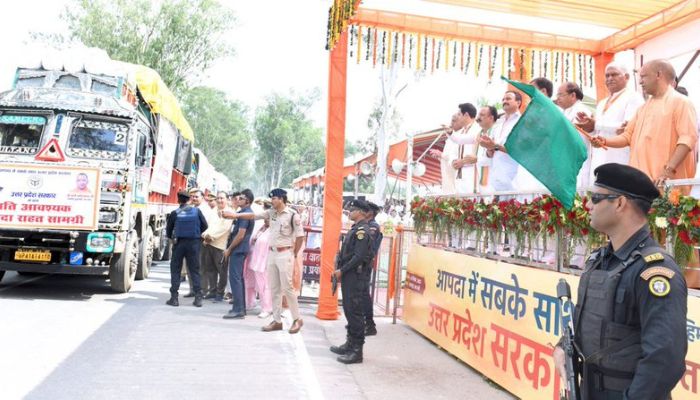
Uttar Pradesh Chief Minister Yogi Adityanath flagged off 48 trucks full of relief material for those who are affected due to heavy floods in Uttarakhand, Himachal Pradesh and Punjab on Monday, 8th September. The flag-off ceremony was held on Ambala Road in Saharanpur district of Uttar Pradesh. Senior BJP leaders, ministers, MLAs and local officials were present at the ceremony.
Addressing the event, CM Yogi mentioned that relief material was not only supplies but a symbol of compassion and care. “In this hour of crisis, the 25 crore residents of Uttar Pradesh extend their support to their sisters and brothers in the affected states,” he said.
CM Yogi Adityanath announced an additional ₹5 crore each in aid to the relief funds of Uttarakhand and Himachal Pradesh. He highlighted that the relief materials are being dispatched as a gesture of national unity and in line with Prime Minister Narendra Modi’s vision of Ek Bharat, Shreshtha Bharat.
#UPCM@myogiadityanath ने बारिश और बाढ़जनित आपदाओं से प्रभावित हिमाचल प्रदेश और उत्तराखंड के लिए ₹5-5 करोड़ की सहायता उपलब्ध कराई
?? बाढ़ पीड़ितों के लिए राहत सामग्री से लदे कुल 48 ट्रकों को झंडी दिखाकर रवाना किया
Each relief package sent through the 48 trucks contains: 10 kg flour, 10 kg rice, 2 kg tur dal, 2 kg roasted gram, 2 kg gram, 2.5 kg additional flour, 10 kg potatoes, 1 kg sugar, 1 kg mustard oil, 1 kg salt, two bathing soaps, candles and matchboxes, 10 packets of biscuits, sanitary pads, towels, mugs, Dettol, tarpaulins, buckets, cotton cloth, and disposable bags.
CM Yogi explained that the effort shows how UP is ready to share resources and stand by other states during disasters.
CM praised the disaster management groups
The chief minister praised the role of disaster management teams and local organisations in helping victims. He mentioned the work of the NDRF, Apda Mitra volunteers, police, and other agencies. He said that their work becomes stronger when society and voluntary organisations join hands with the government.
He also promised citizens that in the event of floods or rain-related fatalities and damage to property in Uttar Pradesh, the state government shall provide relief and compensation immediately.
A sum of ₹4 lakh is paid to families that lose their members to animal or snake bites, he further stated. He also emphasised that the government assists the reconstruction of houses, grants leases over land to families hit by erosion, and organises provisions of food, fodder, and safe transportation in relief camps.
To ensure the supplies reach the right people, the UP government has assigned senior representatives to travel with the trucks. Minister Kunwar Brijesh Singh will visit Uttarakhand, Jaswant Singh Saini will go to Himachal Pradesh, and Saharanpur MLA Rajiv Gumbar will take the relief material to Punjab.
According to the media reports, CM Yogi informed that disasters like cloudbursts, lightning, and heavy rain have vitally impacted life in Himachal Pradesh and Uttarakhand. He explained that hilly areas face special challenges, and life gets severely disrupted when disasters strike. “In such times, it becomes the responsibility of other states to extend both financial and material support,” he said.
He added that Uttar Pradesh has been able to manage floods better in recent years through strong disaster management systems. With the combined support of NDRF, SDRF, PAC flood units, police, voluntary groups, and social organisations, relief is being provided at all levels.
“Inspired by Prime Minister Narendra Modi’s vision, the Uttar Pradesh government has implemented successful flood management programs in the state. With the support of NDRF, SDRF, PAC flood units, local police, voluntary organisations, and business and social groups, relief is being provided to all affected citizens.” CM Yogi stated that the relief material distributed to flood victims in Uttar Pradesh is being packaged similarly and sent on Monday, via 48 trucks, to Uttarakhand, Himachal Pradesh, and Punjab for large-scale distribution.
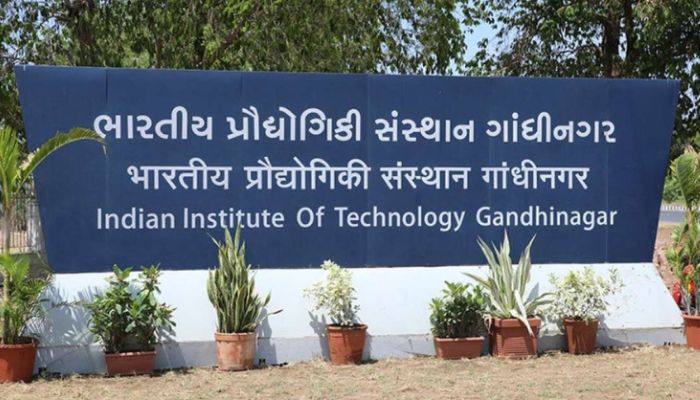
IIT Gandhinagar is yet again mired in controversies. The educational institution is now faced with allegations of ‘conflict of interest’ and favouritism in the appointment of faculty.
On Monday (8th September), columnist Harshil Mehta posed several questions to the IIT Gandhinagar and its hiring process on X (formerly Twitter).
According to him, the wife of a Professor has been roped in as ‘visiting faculty’ at the educational institution.
A Korean/American citizen was just another English and Korean "tutor" in the USA.
But she is then made an "Assistant Teaching Professor" at Humanities Dept, IIT Gandhinagar.
Her husband? He was working–still works–in a top position at IIT Gandhinagar.
The woman worked as a ‘tutor’ of the English and Korean languages in the United States but was appointed as ‘Assistant Teaching Professor’ in the Humanities Department of IIT Gandhinagar.
“Her husband? He was working–still works–in a top position at IIT Gandhinagar,” Harshil Mehta pointed out. The columnist posed 3 questions to the educational institution for transparency.
Which processes did IITGn follow to avoid conflict of interest and provide an equal opportunity to Indian citizens? Does India not have any English teacher that a foreign national was hired?
Does IIT Gandhinagar have any spouse hiring policy? If yes, where is it? If no, where is the conflict of interest policy?
How national security is maintained when IITGn host a semiconductor lab and work in tribal areas but it has employees with different nationalities?
Harshil Mehta pointed out that there are 14 cases of such favouritism and conflict of interest. While speaking to OpIndia, he said, “The question is whether IIT Gandhinagar runs any family reunion program? If so, then it should be declared as an official policy.”
IIT Gandhinagar has so many appointments with conflict of interest and favouritism.
If husband is working as a professor, then on what basis his Korean wife is appointed as a visiting faculty?
I have identified 14 couples (husband-wife, father-daughter) from the same family…
He pointed out, “Professor Prachi Thareja is on the internal complaint committee of the institute. Does the institute know that her husband also works there? If there is a complaint against her husband, how will Prachi decide the case since it is a clear case of conflict of interest?”
Mehta stated that large organisations have internal policies to prevent such situations from arising. “What is the policy of IIT Gandhinagar? It should tell what steps were taken to prevent such activities.”
He also posed questions to the former Director of IIT Gandhinagar, Sudhir Jain, under whom most of these contentious appointmenets were made.
Harshil Mehta sought urgent intervention of the Central government and the Union Ministry of Education.
PM Modi announced a financial assistance of Rs. 1500 crore for Himachal Pradesh. There will be advance release of the second instalment of SDRF and PM Kisan Samman Nidhi, as per government sources.
PM has also asked for a Multi-dimensional view to be taken to get the entire region and people back on its feet. These would be done through multiple ways, like rebuilding homes through PM Awas Yojana, restoration of national highways, rebuilding schools, provision of relief under PMNRF, along with the release of Mini Kits for livestock.
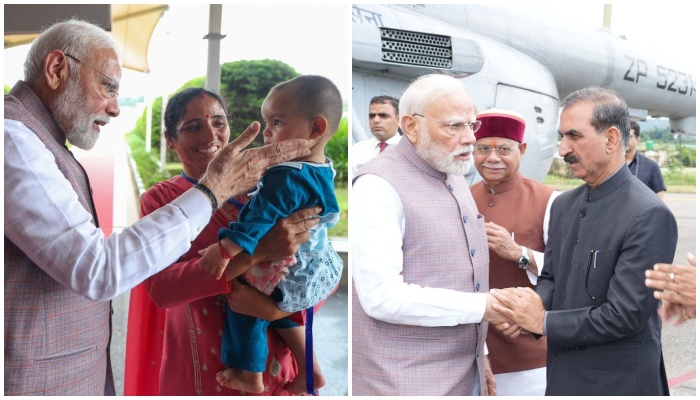
Arriving in Kangra today, PM Modi spoke to NDRF and SDRF personnel and many families who have been affected by the floods.
Recognizing the critical need to support the agricultural community, additional assistance will be provided specifically targeted at farmers who currently lack power connections.
Under the PM Awas Yojana, geotagging of damaged houses will be done. This will help in accurate damage assessment and faster delivery of aid to those affected.
To ensure uninterrupted education, schools will be able to report and geotag damages, enabling timely assistance under the Samagra Shiksha Abhiyan, sources said.
Construction of recharge structures for water harvesting to help collect and store rainwater will be done. These efforts will improve groundwater levels and support better water management.
The Union Government has already sent Inter-Ministerial Central teams to visit Himachal Pradesh to assess the extent of damage, and based on their detailed report further assistance will be considered.
As per a press release by PIB, the Prime Minister first conducted an aerial survey of flood-affected areas of Himachal Pradesh. PM Modi also announced an ex gratia of Rs 2 lakh to the next of kin of the deceased and Rs 50,000 to the seriously injured in the floods and natural calamities.
The Prime Minister also stated that all assistance under disaster management rules are being made, including advance disbursements to the States. He appreciated the efforts of the personnel of NDRF, SDRF, Army, State administration and other service-oriented organisations for making efforts in immediate relief and response. The Central government will further review the assessment based on the memorandum of the State as well as the report of the Central teams.
The United Kingdom has a penchant for sympathising with Islamic criminals. Be it the Pakistani Muslim grooming/rape gangs or Jihadi terrorists, the British authorities are often found protecting Islamist perpetrators.
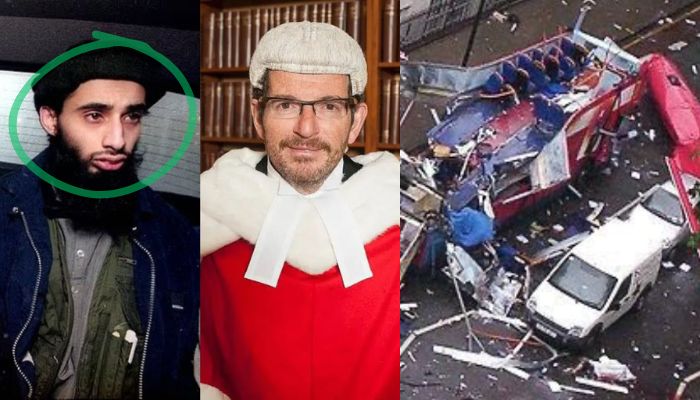
In a latest case of misplaced sympathies, convicted Al Qaeda terrorist Haroon Rashid Aswat (50), who trained for Islamic terrorism in Kashmir and masterminded the 7/7 London bombings, is set to be released by the UK authorities despite “grave security risk”.
The High Court judge, Robert Maurice Jay, not only granted release to Islamic terrorist Haroon Rashid Aswat, but also wished him “all the best”.
“I know it can’t have been pleasant to be in custody in the United States all that time. I wish you all the best. The way forward is to continue with the medication, listen to the advice you receive, and stay away from the activities that previously led you to prison. Because you saw where it ended up and you do not want to go back to that, I am sure.” Jay told Aswat.
Haroon Rashid Aswat and his involvement in Islamic terrorism
Originally from Batley, West Yorkshire, Haroon Rashid Aswat was given a 20-year prison sentence in the United States in 2015 for planning to establish a terrorist training camp in Oregon with Islamic hate preacher Abu Hamza in the 1990s.
He was repatriated to the UK in 2022 after completing his term, where he was held in mental custody after receiving a schizophrenia disorder diagnosis, until his release was approved recently.
Haroon Aswat, right, in a car with hate preacher Abu Hamza al-Masri in January 1999 (Image via Metro)
Notably, Haroon Rashid Aswat had earlier admitted that he masterminded the July 7, 2005 attacks, in which four suicide bombers targeted London’s transport network. In this Islamic jihadist attack, 52 innocent people died and over 700 were injured. Aswat also publicly described himself as a terrorist.
Aswat along with fellow Jihadi terrorist, Ouassama Kassir, received jihad training in Pakistan. Aswat also admitted during his trial in US that he supported Osama Bin Laden and Al Qaeda. Aswat and Kassir travelled to Seattle also, where they resided inside a mosque for two months.
These two provided men from the mosque with additional terrorist training lessons – including instructions on different types of weapons, how to construct a homemade silencer for a firearm, how to assemble and disassemble an AK-47 and how an AK-47 could be altered to be fully automatic and to launch a grenade.
The investigation by the US authorities found that a ledger recovered in September 2002 from an al Qaeda safe house in Karachi, Pakistan, listed a number of individuals associated with al Qaeda, including Haroon Rashid Aswat. This safe house was used by Al Qaeda terrorist and alleged planner of the terrorist attacks of Sept. 11, 2001.
Reports say that Aswat was linked to the London killing after police traced 20 calls made by the suicide bombers to a phone linked to him. Weeks later, Aswat was arrested in Zambia. He was carrying a terror manual and bomb-making materials.
Aswat pleaded guilty to one count of conspiracy to provide material support to a foreign terrorist organization and one count of providing material support to a foreign terrorist organization, each of which carries a maximum term of 10 years in prison.
However, he did not complete his 20 years jail term due to “periods of detention in this country awaiting extradition” being taken into account.
UK judge’s unwarranted sympathy for Haroon Rashid Aswat and legal loopholes
Aswat’s medical reports indicate that despite his medical treatment at the Broadmoor Hospital, even in his “relatively stable” condition, Aswat continues to express violent jihadist ideology.
In April this year, judge Jay who oversaw an application by the Metropolitan Police for a notification order for Aswat’s release, to monitor him when back with his family in West Yorkshire, was informed that Aswat continues to pose a risk to the public, and mental illness exacerbates his Islamic extremism.
Judge Robert Jay noted that Aswat still poses a risk of “violent extremism-motivated targeted terrorist offending behaviour given his threats to kill Jews, Christians and certain groups of Muslims”, and he could also “influence other vulnerable individuals, as when he is in an abnormal mental state his religious extremist rhetoric is amplified by mental illness”.
Despite taking note of Aswat’s terror history and persistent tendency of indulging in Islamic terrorism in future, the judge sympathised with Haroon Rashid Aswat and said to him: “you probably want to put all of this behind you now”, adding that it “could not have been too pleasant being in American custody all that time”.
Due to his alleged mental condition, Aswat was help in a hospital despite being a terrorist instead of a prison. This prevented his formal terrorist risk assessment. Aswat is due for release from psychiatric care without ankle tag monitoring due to a loophole for such mental patients. This loophole forbids checks on psychiatric patients.
Meanwhile, Detective Chief Superintendent Gareth Rees, a top Metropolitan Police terror investigator said, “He has spoken positively of his time with al-Qaeda in Afghanistan and expressed aspirations to reconnect with them. Based on my experience, this is conduct which gives me grave concerns about the risk which the defendant poses to the UK’s national security and to the public.”
Judge Robert Jay’s sympathetic approach towards Aswat has sparked outrage in the UK. Nigel Farag, a right-wing leader of the Reform UK Party, demanded Jay’s dismissal and said, “People are demanding much tougher justice. Aswat should be in a maximum security prison for the rest of his days, and Judge Jay should be dismissed.”
Robert Jenrick, shadow Justice Secretary, also criticised Jay’s show of sympathy towards Aswat and said, “It’s an insult to the victims of July 7. No one should wish luck or show sympathy to a convicted terrorist, least of all a High Court judge. Jay should be ashamed of acting as if he were a friend of an extremist.”
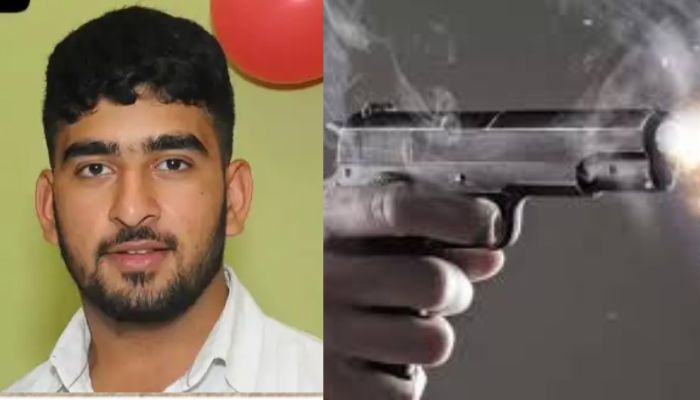
A 26-year-old man from Jind district in Haryana was shot dead in California, US, after a fight with a local resident. The deceased, Kapil, was working as a security guard. He was the resident of Barah Kalan village of Jind district of Haryana, and had travelled to America in 2022, almost two-and-a-half years ago through the illegal “Dunki route.”
The incident happened on the night of Saturday, 6th September, 2025. According to the media reports Kapil had stopped a man from public urination. The argument following this prompted the American man to take out a pistol and shoot him. Locals took Kapil to a nearby hospital, but the doctors confirmed him dead on arrival.
Kapil was the only son of his family.According to father Ishwar Singh, he spent Rs 45 lakh to send his son to the US. Kapil had crossed the dense forests of Panama, climbing the wall of Mexico and reached America. He was later arrested in the USA and a case was registered against him. Kapil’s father is a farmer and he used to stay at the house of his uncle Ramesh Singh and study in Jind. According to the uncle, he had sent him to America from Donkey Route in 2022 with great difficulty.
What is the Dunki route?
Dunki is a term in Punjabi which means to jump from one place to another. Over time, it has come to describe the illegal route taken by people who want to enter another country without proper documents. Nowadays, the phrase “Dunki route” is widely used to describe the dangerous path to America.
Many agents lure Indians to send them abroad through the Dunki route. Those who choose the path of Dunki, their passport and visa are first made. The agents who work the often illegal routes take money and get a visa for a European nation or a country in Latin America.
On most occasions it is a tourist visa. With this, the people of Dunki route are evacuated from India. They are made to travel in Nepal, Dubai and any other country for a few days and a complete story of their journey.
After this, the agents take the person to the designated Latin American nation for which the visa has been secured. Indian Dunki agents are helpful in these countries, who show the way to the Dunki route takers and help them illegally. Many times, they are associated with criminal gangs. They travel to the US border. The journey passes through the forest, the river and the mountains. It also has to walk for 40-50 km. The border has to be crossed to enter the United States.
The dangerous journey through Latin America
Most people taking this route first reach countries like Brazil, Venezuela, Peru, Colombia, or Nicaragua. They are then led by country agents and, at times, even criminal groups to Panama. The trek across Panama is precarious, as migrants must cross thick jungles, rivers, and rugged mountains.
Then they pass through Nicaragua and Guatemala to Mexico. From there, the US border is just a few kilometres. It is, however, highly secured with high iron fences. Migrants often use ropes to climb over them. Those who manage to cross describe it as a major achievement.
The path is filled with dangers. Migrants cover 40-50 kilometres straight, sometimes 17-18 hills at a time. If one slips or is injured, then they are usually left behind. Many have spoken about seeing dead bodies along the way. At times, they also travel 10-15 hours on overcrowded boats.
People who come from Dunki route want to become refugees
Indians who have been deported from America say that those who manage to enter through the Dunki route try to get refugee status. If a refugee is caught by American security agencies while crossing the border, he claims that he is being harassed in India and he needs even food and water. In the past years, the Indian government has flagged the illegal trafficking multiple times, urging citizens to emigrate only through legitimate and legal routes. Pro-Khalistani elements using to Dunki route to entrap and exploit young Indians and engaging them in criminal activities abroad has also been flagged by the government.
On 12th August, three people lost their lives in Florida, when an 18-wheeler trailer truck driven by Harjinder Singh, an ‘asylum seeker in the US, made an illegal U-turn on the Florida Turnpike. Harjinder Singh, the 28-year-old truck driver from Tarn Taran, Punjab, had arrived in the USA through a similar Dunki route via Mexico and sought asylum in the country.
US President Donald Trump is facing one embarrassment after the other. While the backlash over Trump’s mindless tariff tirade against India has yet to subside, the US President’s alleged sexually suggestive letter to convicted sex offender Jeffrey Epstein written in 2003 has been released by the House Oversight Committee.
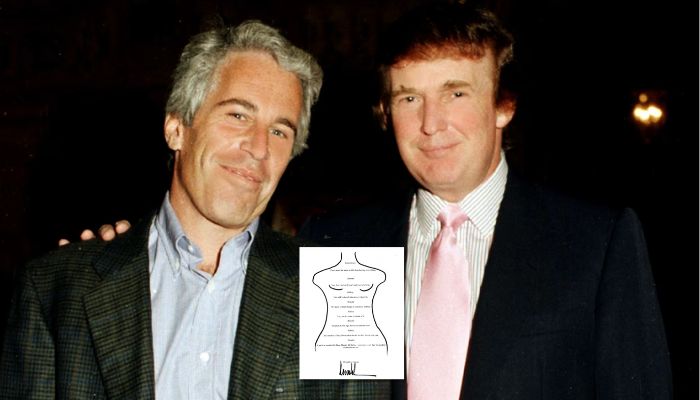
On Monday (9th September), the House Oversight Committee members confirmed that they received a copy of a birthday book which contains the letter bearing Donald Trump’s signature. It also included a letter that references Trump with a crude joke about a woman from another Epstein associate.
Taking to X, the Democrats shared the alleged letter Trump wrote to Epstein, and said: “We got Trump’s birthday note to Jeffrey Epstein that the President said doesn’t exist. Trump talks about a “wonderful secret” the two of them shared. What is he hiding? Release the files!”
??HERE IT IS: We got Trump’s birthday note to Jeffrey Epstein that the President said doesn’t exist.
Trump talks about a “wonderful secret” the two of them shared. What is he hiding? Release the files! pic.twitter.com/k2Mq8Hu3LY
In July this year, the Wall Street Journal had reported about the birthday book and the letter in question, which contained typewritten text framed by the outline of a naked woman. The letter concluded: “Happy Birthday, and may every day be another wonderful secret.” The signature was a squiggly “Donald” below the waist, mimicking pubic hair.
Donald Trump denied writing the letter or drawing the curvaceous woman that surrounds the letter. Not only this, he also filed a libel lawsuit against the publisher of the Wall Street Journal and reporters who wrote a story about a collection of letters gifted to Jeffrey Epstein for his 50th birthday in 2003, including the Trump’s alleged letter. The lawsuit sought at least USD 20 billion. Donald Trump denied writing the said letter and called it a “fake thing”.
In a Truth Social post, Trump informed about filing a ‘Powerhouse’ lawsuit against WSJ. “BREAKING NEWS: We have just filed a POWERHOUSE Lawsuit against everyone involved in publishing the false, malicious, defamatory, FAKE NEWS ‘article’ in the useless ‘rag’ that is, The Wall Street Journal. This historic legal action is being brought against the so-called authors of this defamation, the now fully disgraced WSJ, as well as its corporate owners and affiliates, with Rupert Murdoch and Robert Thomson (whatever his role is!) at the top of the list…”
Meanwhile, White House press secretary Karoline Leavitt has on Monday said that the birthday card story is “false”, adding that this “fake news” is intended to perpetuate “the Democrat Epstein Hoax!”
The latest piece published by the Wall Street Journal PROVES this entire “Birthday Card” story is false.
As I have said all along, it’s very clear President Trump did not draw this picture, and he did not sign it.
President Trump’s legal team will continue to aggressively…
“The latest piece published by the Wall Street Journal PROVES this entire “Birthday Card” story is false. As I have said all along, it’s very clear President Trump did not draw this picture, and he did not sign it. President Trump’s legal team will continue to aggressively pursue litigation. Furthermore, the “reporter”
@joe_palazzolo who wrote this hatchet job reached out for comment at the EXACT same minute he published his story giving us no time to respond. This is FAKE NEWS to perpetuate the Democrat Epstein Hoax!” Leavitt posted on X.
Notably, the Epstein files, which are sealed investigative records relating to the investigation into Epstein’s criminal activities, have sparked the curiosity of the American people, including Trump’s support base. After Trump swore in as the US President in January this year, Attorney General Bondi indicated that all the Epstein documents, including what many thought was a “client list” of influential individuals who were part of Epstein’s sex trafficking ring, would be made public. However, Donald Trump has made a U-turn after assuming office in January this year and now calls the Epstein files and investigation into these cases a Democrats peddled hoax.
Who was Jeffrey Epstein?
Jeffrey Epstein was an American financier who was convicted by a Florida state court for procuring a child for prostitution and soliciting a prostitute. He served 13 months in jail and was arrested again in July 2019 after being charged with sex trafficking of minors in Florida and New York. He died a month later in August while undergoing trial.
Epstein files are investigative documents containing files, records, videos, and contacts compiled by federal agencies during the investigation into Epstein’s criminal activities. The files are said to contain flight logs from Epstein’s private aircraft, contact lists, accounting records, and even video evidence of abuse.
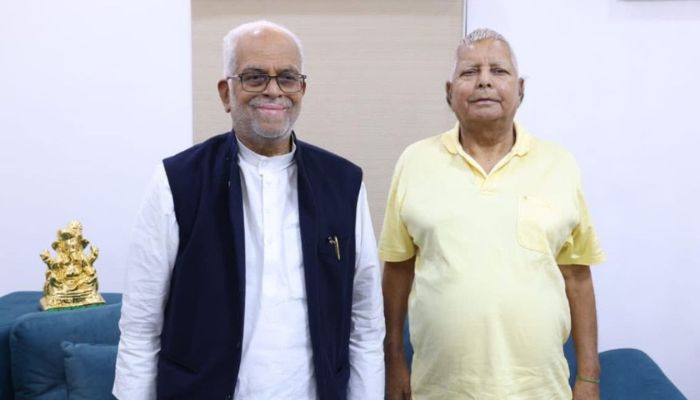
A group of eight former judges has written an open letter criticising the Opposition’s Vice Presidential candidate, Justice B. Sudarshan Reddy. The letter is regarding the meeting with Rashtriya Janata Dal (RJD) chief Lalu Prasad Yadav, who has been convicted in multiple fodder scam cases.
The letter issued on Monday, 8th September, raises serious questions over Reddy’s meeting with the convicted criminal in the fodder scam and his suitability for the high constitutional post he is contesting for.
The judges expressed their strong disapproval of the private meeting between Reddy and Lalu Prasad, calling it “dismaying” and “dubious in nature.” They pointed out that Yadav, convicted in cases involving the embezzlement of nearly ₹940 crore from Bihar’s animal husbandry department, neither holds the position of a Member of Parliament nor is eligible to vote in the Vice-Presidential election. The letter said the meeting, therefore, could not be justified on electoral grounds and served no legitimate political purpose.
Concerns over judgment and propriety
The retired judges stated that a person of Reddy’s standing, a former Supreme Court judge now seeking to hold one of the most important constitutional posts in the nation, must not have had dealings with a convicted politician. The retired judges issued a warning that this kind of behavior doubts public confidence and questions his intentions and loyalties.
“It is particularly worrying that, despite his distinguished judicial background, Mr. Reddy has independently associated with an individual whose criminal actions have been confirmed by Indian courts,” the letter stated.
The judges also criticised the silence of political groups who, in their view, selectively raise their voices on questions of morality. They said this incident exposed the partisan approach of those who often present themselves as guardians of constitutional values. The letter went on to argue that Reddy’s actions amount to a fundamental lapse in judgment, one that the public must evaluate carefully before deciding whether he is fit for such a prestigious post.
Amit Shah’s attack on Reddy’s past judgment
The controversy around Reddy’s candidature is not new. On 22nd August, Union Home Minister Amit Shah had strongly criticised him during a conclave organised by Malayalam news outlet Manorama in Kochi.
Shah accused Reddy of supporting left-wing extremism during his time as a judge by striking down Salwa Judum, the state-backed militia formed to counter Naxalites in Chhattisgarh.
“The opposition (Congress) vice presidential candidate, Sudarshan Reddy, is the same person who gave the Salwa Judum judgment in support of leftist extremism and Naxalism. If this had not been done, extremism would have been eradicated by 2020,” Shah said. He further said that Congress had fielded Reddy under pressure from its Left allies and warned that people of Kerala, who have suffered from Naxal violence, would see through this choice.
According to Shah, choosing Reddy for such an important constitutional post reveals the Opposition’s political priorities and its willingness to accommodate groups sympathetic to extremist ideologies.
Lalu Prasad Yadav’s fodder scam convictions
Lalu Prasad Yadav, with whom Reddy held the controversial meeting, has been convicted in several cases related to the infamous fodder scam. The scam involved the embezzlement of about INR 940 Crores of public funds from the State of Bihar.
The scam happened in the 1990s undivided Bihar(the state was bifurcated in 2000 with the formation of Jharkhand) by generating fake bills for the animal husbandry department.
Lalu was first convicted on 30th September, 2013, and sentenced to five years in prison for fraudulent withdrawal of ₹37.7 crore from the treasury of Chaibasa. Conviction disqualified Yadav from elections for 11 years.
In 2017, Lalu was convicted of fraudulent withdrawal of more than ₹89 lakh from the Deoghar treasury and sentenced to three and a half years’ imprisonment. He was released on bail in July 2021 after serving half the sentence.
In 2018, Lalu was convicted of the irregular withdrawal of ₹33.13 crore from the treasury of Chaibasa and sentenced to five years of imprisonment. In the same year, he was convicted in his fourth fodder scam case of fraudulent withdrawal of ₹3.76 crore from the treasury of Dumka. He was sentenced to 14 years of imprisonment, to which the special court (CBI) also added a fine of ₹60 lakh. He was released on bail in both cases.
In 2022, a CBI special court imposed a five-year prison term and ₹60 lakh fine for illicit withdrawals to the tune of ₹139.5 crore from the Doranda treasury. The sixth case, involving ₹46.98 lakh withdrawn from the Bhagalpur treasury, is at present under trial.
Lalu is at present on bail on health grounds, but the several convictions against him continue to serve as a grim reminder of one of India’s biggest corruption scandals.
Name of the judges who signed the letter
Former judges Justice S M Khandeparkar, Justice Ambadas Joshi, Justice R K Marthiya, Justice Devender Kumar Ahuja, Justice S N Dhingra, Justice Karam Chand Puri, Justice P N Ravindran and Justice R S Rathore signed the letter.
The combined action of these judges has put more pressure on the ballooning Reddy candidacy debate. Their objections, along with Amit Shah’s biting critique and the ongoing specter of Lalu Prasad Yadav’s criminal past, put the Opposition’s Vice Presidential candidate in the forefront of public and political examination.
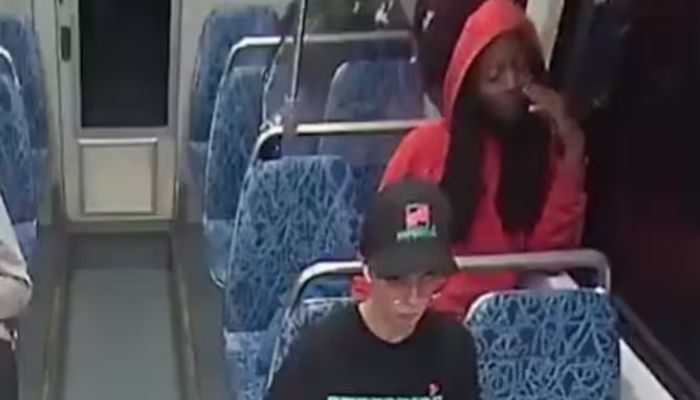
A 23-year-old Ukrainian girl named Iryna Zarutska fled her war-torn country to the US hoping for a safe and peaceful life. However, the young girl from Ukraine was stabbed to death by accused identified as a 34-year-old black man named Decarlos Brown Jr., at a train station in the US’s North Carolina on 22nd August 2025.
The disturbing incident sent shockwaves on social media. However, the US mainstream media remained silent over the brutal murder as if nothing had happened, or perhaps, it was too ‘normal’ a crime to warrant coverage.
Iryna Zarutksa was stabbed multiple times with a knife by Decarlos Brown Jr. and was pronounced dead the East/West Boulevard light rail station in South End, the Charlotte-Mecklenburg Police Department said.
Serial criminal Decarlos Brown has been arrested fourteen times in the past
The accused has been arrested and charged with first-degree murder. Decarlos Brown is a serial offender and has been arrested around fourteen times since 2011 for felony larceny, robbery with a dangerous weapon, and communicating threats. He even served five years in prison for the robbery with a deadly weapon charge.
The murderer of Iryna Zarutska had been arrested FOURTEEN TIMES before.
It’s beyond ridiculous that this monster had not yet been permanently locked up.
In addition, he also faces charges for misusing the 911 system. He once dialled the police and asked them to investigate a “man-made material” inside him. The police, however, said that he has a medical issue and they could not help him. Several past charges against him have been dropped by courts.
Mainstream media’s selective silence questioned by people
The video of the incident went viral online and in no time, social media dug up the accused person’s criminal antecedents. The Ukrainian girl’s killing, the dropping of previous charges against Brown and the American legacy media’s silence has sparked severe backlash on social media.
“The media silence on Iryna Zarutska’s murder is one of the most disgusting acts of lying by omission I’ve ever seen. From the people who gave you the Daniel Penny wall-to-wall negative coverage and the BLM moral panic. It’s true what they say: you don’t hate the media enough,” an X user wrote.
The media silence on Iryna Zarutska's murder is one of the most disgusting acts of lying by omission I've ever seen.
From the people who gave you the Daniel Penny wall-to-wall negative coverage and the BLM moral panic.
It's true what they say: you don't hate the media enough.
One X user ‘End Wokeness’ named major legacy media outlets of America and highlighted how none of the covered the brutal killing of the Ukrainian girl. “0 AP stories on this deadly attack 0 PBS stories on this deadly attack 0 NYT stories on this deadly attack 0 NPR stories on this deadly attack 0 WSJ stories on this deadly attack 0 BBC stories on this deadly attack 0 CNN stories on this deadly attack 0 WAPO stories on this deadly attack 0 Reuters stories on this deadly attack 0 MSNBC stories on this deadIy attack,” the X user wrote.
0 AP stories on this deadly attack 0 PBS stories on this deadly attack 0 NYT stories on this deadly attack 0 NPR stories on this deadly attack 0 WSJ stories on this deadly attack 0 BBC stories on this deadly attack 0 CNN stories on this deadly attack 0 WAPO stories on this… pic.twitter.com/962qmFOBNm
Meanwhile, X owner and billionaire, Elon Musk, also criticised the judges who dropped charges against accused Decarlos in previous cases. “Let’s change the law. Between now and then, name and shame the DAs and judges who enable murder, rape and robbery. But especially shame those who funded the campaigns of the DAs and judges. That will make the biggest difference,” Musk wrote.
Let’s change the law.
Between now and then, name and shame the DAs and judges who enable murder, rape and robbery.
But especially shame those who funded the campaigns of the DAs and judges. That will make the biggest difference. https://t.co/SirIuQcs2S
In another post, Musk called out the American legacy media over a lack of coverage of the Iryna Zarutska’s killing. He reshared a post counting how many articles the outlets had written about the stabbing, and commented, “Zero.”
Notably, it remains unclear why the US’s mainstream media decided to skip covering this important crime news even as foreign media covered it. It is being alleged that the silence stemmed from the racial profile of the victim and the killer. The accused murderer is a homeless black man with a criminal record, while the deceased victim was a white refugee girl.
Meanwhile, Charlotte city mayor, Vi Lyles, published an X post on 6th September, thanking media outlets for not sharing the footage of the Ukrainian refugee’s brutal murder. Netizens called her out for appearing to be more concerned about the video the incident not reaching the public instead of taking strict action against the accused and those judges who allowed him on the streets despite facing multiple criminal charges.
You sound more angry towards people sharing the footage than you are towards the violent thug who stabbed Iryna.
Many suspect an emerging pattern, as a Ukrainian girl was pushed under train in Germany’s Friedland city by an Iraqi migrant recently. The 16-year-old Ukrainian refugee was hit by a train traveling about 100 kilometres per hour (62 mph) after a 31-year-old Iraqi citizen allegedly shoved her onto the tracks, Kyiv Independent reported, adding that he allegedly suffered from Schizophrenia.
Race of the victim and criminal more important than the severity of the crime?
For the US legacy media, it seems that racial dynamics play a vital role in deciding whether a particular incident of crime deserves coverage or not. Perhaps, they feared that the accused black man’s racial identity coupled with his extensive criminal record and the deceased victim’s white race and refugee status would be highlighted by ‘right wing’ social media, and news outlets. Progressive agenda takes precedence over reporting the crime.
Had the victim been a black person and the killer a white, the entire legacy media would have outraged, opinion pieces on how ‘white supremacism’ and hatred is turning violent would have been published, and street protests would have erupted by now, as seen during BLM Movement years back and the same media outlets would have given it 24×7 coverage.
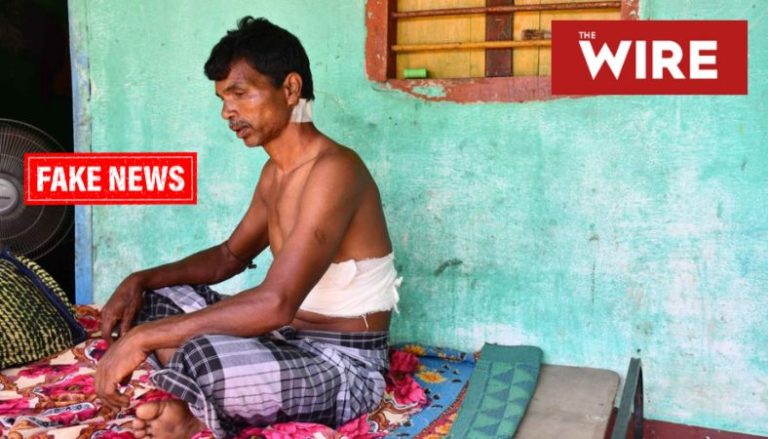
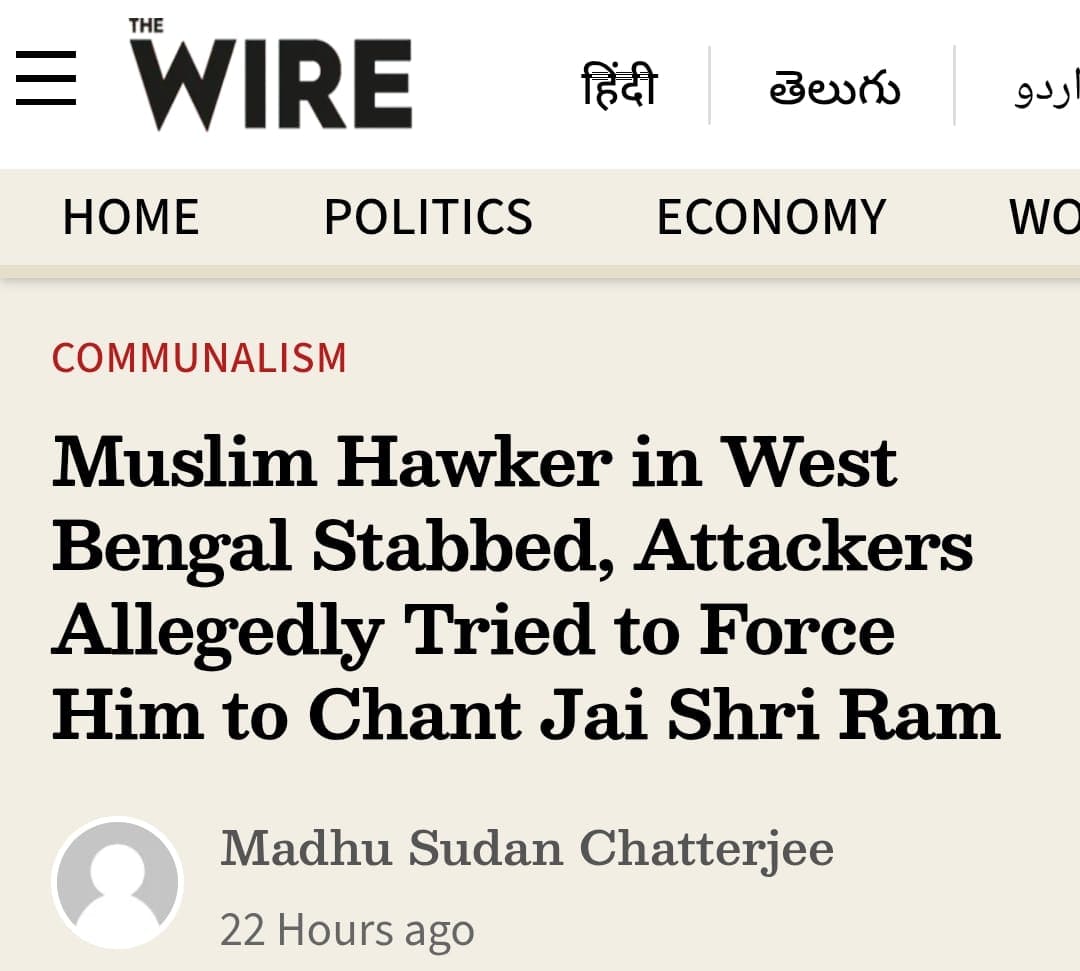
On Monday (8th September), The Wire published an article wherein it falsely claimed that a Muslim hawker named Maimur Ali Mandal was forced to chant the Hindu religious slogan ‘Jai Shri Ram’ in Bankura district of West Bengal.
The leftist propaganda portal ran the piece (archive) with the headline, ‘Muslim Hawker in West Bengal Stabbed, Attackers Allegedly Tried to Force Him to Chant Jai Shri Ram.‘
The Wire alleged that the incident occurred on Saturday (6th September) and attempted to give the isolated case of assault a ‘communal spin.’
Screengrab of the article by The Wire
“Mandal says that the accused also hurled abusive remarks targeting his community,” the propaganda portal claimed.
The Wire set out to defame the Hindu religious slogan of ‘Jai Shri Ram’ and posed some rhetorical questions. “Why did such violence erupt in Bankura – a place with no history of such communal incidents? Who is responsible for poisoning the atmosphere?” it claimed.
It quoted the ‘victim’ Maimur Ali Mandal as saying, “One of the youths who was in the vehicle demanded Rs. 200 from me. When I refused, he stabbed me in the neck with a bhojali (sharp weapon) and asked me to chant ‘Jai Shri Ram.’ When I refused again, he stabbed me in the stomach.“
The Wire weaves narrative in favour of ruling TMC govt
The over-emphasis on the religious identity of Maimur Ali Mandal and repeated references to ‘Jai Shri Ram’ were not without a reason.
The Wire attempted to weave a narrative ahead of the upcoming West Bengal election in favour of the ruling TMC government about the supposed threat of ‘Hindutva’ to West Bengal.
“Incidents like these underline a disturbing trend: the growing influence of Hindutva the ideology, propagated by the BJP,” the propaganda outlet concluded.
The Truth behind the incident
The Bankura police, which investigated the matter, found no evidence of Maimur Ali Mandal being forced to chant ‘Jai Shri Ram.’
“It has come to notice that some social media handles have posted that a hawker from Punisole was assaulted yesterday in Bankura town by someone and forced to chant religious slogans, portraying it as a communal incident. This is factually incorrect and misleading,” the police said in a statement on X (formerly Twitter).
While it is true that the hawker was attacked with a knife, there was no communal motive behind the incident. The attacker happens to be a drug addict who attempted to solicit ₹200 from Maimur Ali Mandal.
It has come to notice that some social media handles have posted that a hawker from Punisole was assaulted yesterday in Bankura town by someone and forced to chant religious slogans, portraying it as a communal incident. This is factually incorrect and misleading.
When he refused to comply, the accused attacked him with a knife. The attacker was arrested within a hour’s time and placed in police custody.
“Preliminary investigation confirms that the incident was criminal in nature and not religious. Allegations about forcing the victim to chant religious slogans remain unsubstantiated. Citizens are requested not to believe or spread false information on social media without verification,” the Bankura police emphasised.
This, however, did not stop ‘The Wire’ from amplifying the fake news about a Muslim hawker being forced to chant ‘Jai Shri Ram’ in West Bengal’s Bankura
This research paper undertakes an exhaustive investigation into the Centre for the Study of Developing Societies (CSDS), scrutinising its history, ideological orientation, funding ecosystem, and collaborations with foreign entities. The analysis contends that CSDS operates as a node in a transnational network of NGOs, think tanks, and media organisations that are ideologically opposed to India’s interests—particularly those of its majority Hindu population and the democratically elected government led by Prime Minister Narendra Modi. This executive summary distils the paper’s major revelations, critiques the intentions and motivations at play, and exposes the coordinated efforts of CSDS and its funders to influence India’s political and social discourse, furthering foreign interference in India’s democracy and undermining India’s sovereignty at the behest of foreign powers and furthering the foreign policy agenda of other countries under the pretext of research and civil society activism.
Origin and Ideological Leanings of CSDS
CSDS was established in 1963 by Rajni Kothari, whose early academic work and later activism display a consistent bias against Hindu society, secularisation of the state, and a tendency to launder divisive, caste-based, and anti-majority narratives through academic jargon. The paper traces CSDS’s roots to foreign-sponsored entities such as the Asia Foundation—a CIA front—making it clear that its founding moment was tainted by external influence. Over decades, CSDS leadership and faculty have cultivated an intellectual project that pathologises India’s majority community, champions false minority victimhood, and provides ideological ammunition for adversarial foreign policy goals, particularly those aimed at undermining the sovereignty and unity of India.
The Foreign Funding Web: Cash, Collaboration, and Confluence of Interests
CSDS’s operational and research budgets are sustained not only by Indian government grants (primarily through the Indian Council of Social Science Research, ICSSR) but also reveal a heavy and steadily increasing reliance on foreign funding. Since 2016, CSDS has received at least ₹15.6 crore via FCRA, though actual foreign receipts are likely far higher due to incomplete disclosures. Major foreign contributors include:
Konrad Adenauer Stiftung (KAS): The German government-funded foundation, directly affiliated with the ruling Christian Democratic Union (CDU), has donated over ₹2.6 crore since 2016. KAS’s explicit mandate is to advance German foreign policy and Western democratic values, which often align with undermining or “reforming” target countries’ political cultures and supporting regime change operations.
International Development Research Centre (IDRC): A Canadian crown corporation, IDRC provided up to a third of CSDS’s annual budget (over 8 years) under its Think Tank Initiative. IDRC is an arm of Canadian foreign policy, and its support focused on amplifying identity-based and separatist agitations. Canada’s open patronage of Khalistani secessionists further compounds the strategic risk posed by its funding of Indian civil society and think tanks.
Siemenpuu Foundation: This Finnish NGO, bankrolled by Finland’s Ministry of Foreign Affairs, funds “ecological democracy” projects via CSDS and its offshoots (notably SADED). Siemenpuu’s India interventions are framed around “supporting Adivasis,” but their networks and dialogue platforms routinely provide oxygen to Naxal-aligned and anti-Hindu intellectuals and activists, often amplifying Western narratives about oppression and dispossession in India.
Berggruen Institute: Founded by a globalist billionaire, the BI’s anti-India and anti-Hindu output is disseminated through its magazine “Noema,” which repeatedly denigrates India as authoritarian, communal, and backward—often using overtly ideological and factually selective authors, including those with links to hostile Pakistan and anti-Indian Western lobbies.[1]
Ford Foundation, Henry Luce Foundation, Omidyar, Open Society Foundations: These U.S.-based entities are well-documented for funding regime change, “civil society empowerment,” and promoting identity politics internationally. Their support to CSDS directly or via collaborative projects (such as the “Indian Muslims Project”) habitually seeds, amplifies, and exports the victimhood and “rising fascism” narrative about India and its government.
Sciences Po/FNSP: France’s premier political science institution, through the FNSP, made substantial financial contributions to CSDS. Its faculty, notably Christophe Jaffrelot, has routinely produced research critical of Hindu identity politics and the Modi government, contributing to a hostile international narrative.
Collusion with Western Media, “Investigative” Networks, and Regime Change Actors
The research details how CSDS and its research/policy ecosystem—Lokniti, SADED, and affiliated academics—are intricately connected to and promoted by Western “media freedom” and “investigative journalism” networks (such as GIJN, OCCRP, Bellingcat, Reporters’ Collective, RSF, and others). The overlap is not accidental: these global networks have documented histories of receiving support from the U.S. State Department, NED (an acknowledged CIA offshoot for regime change), Soros’s Open Society, and European government agencies. Through these channels, Western intelligence and political actors shape India’s media and research discourse, selectively funding those who amplify Western policy priorities and narratives of India’s failure, oppression, or “authoritarian drift”.
This nexus generates a feedback loop: foreign-funded Indian researchers produce alarmist reports on India’s democracy, media, or communal situation; these are then cited in global “freedom indices” and media exposés, which, in turn, justify more foreign funding and “democracy assistance” to a curated set of Indian actors—many of whom have either direct or indirect links to urban Naxals, separatists, and radical activists.
Intellectual Strategy: Caste, Minority Victimhood, Anti-Hindu, and Anti-Nationalism
The CSDS’s research, publications, and “surveys” are found to advance four strategic goals consistently:
Divide Hindus: CSDS research uses Western sociological categories and caste frameworks to amplify intra-Hindu divisions—especially by alienating Dalits, Adivasis, and OBCs from their Hindu identity, and by framing political outcomes through the lens of caste oppression and “majoritarian tyranny.” The creation and perpetuation of these fault lines mirror the strategies advocated by known separatist outfits like PFI and global anti-India campaigners.
Promote Dalit-Muslim Unity narrative: The CSDS repeatedly attempts to hyphenate Dalit and Muslim victimhood, asserting that both face oppression from Hindus or the state, and that unity between them—often at the expense of Hindu social cohesion—is necessary for “democracy”.
Demonise Hindus and the Indian State: CSDS scholars, affiliated journalists, and collaborators like Ashis Nandy and Ananya Vajpeyi, systematically paint Hindus as fascists, bigots, or perpetrators of violence, even when evidence disproves these claims (e.g., Godhra 2002, Delhi 2020). Their research is weaponised to delegitimise Indian nationalism, justify external intervention, and feed global media outrage cycles.
Undermine Indian Sovereignty: Foreign-funded CSDS research and agenda provide spin and intellectual cover for “civil society” agitation, street protests, and social media campaigns that regularly challenge the legitimacy of the Indian state, undermine national unity in Kashmir or the Northeast, and advocate for changes in laws or policies that align with foreign interests—often directly at odds with democratic majorities or the elected government.
Alliance with Hostile Foreign Stakeholders and Adversarial Groups
The paper demonstrates that CSDS’s ecosystem is not only ideologically aligned with, but is sometimes directly patronised by, entities and individuals openly hostile to India:
Association with US Deep State Proxies: Several CSDS partners and funders (NED, IDRC, Open Society, Ford Foundation) have well-documented involvement in regime change operations across Latin America, Eastern Europe, and Asia.
Links to Pro-Khalistani, Pro-Pakistani, Islamist, and Leftist Groups: IDRC’s own staff and grantees have participated in farmers’ protests and anti-CAA/Delhi riot networks. Key actors in CSDS or its partner NGOs routinely appear in agitation circles alongside urban Naxals, Khalistani backers, and anti-India lobbies.
China Factor: By hosting, funding, or affiliating with academics and journalists (and even a former Pakistani PM) known for anti-India activism, Western and Chinese funding channels (via the Berggruen Institute) further compromise any pretense of neutrality.
Recurring Patterns and Motivations
A systemic pattern emerges: foreign foundations and governments—with explicit foreign policy goals—collaborate with Indian think tanks and activists who embrace critical or adversarial stances toward India’s government, majority community, and nation-building projects. Their combined efforts amplify negative narratives globally, pressurise India’s policy space, and attempt to create internal social divisions and political instability. This coordinated campaign, the paper argues, is designed to constrain India’s sovereignty, undermine its global standing, and—when possible—influence regime changes through intellectual, media, and activist “soft power”.
Furthermore, the selective silence of these organisations on anti-Hindu violence, religious conversions, and the global targeting of Indian interests—contrasted with overt activism on any perceived or manufactured minority issue—reveals an entrenched, ideologically motivated bias.
This is the full spider web, or the mindmap of the network around CSDS. You can download the high resolution picture (6 MB size) of this mindmap by clicking here.
The Centre for the Study of Developing Societies and its web of allied NGOs, media platforms, and funders operate as part of a coordinated ideological challenge to India’s sovereignty, cultural integrity, and democratic legitimacy. Foreign funds systematically steer their research, outreach, and activism from governments and billionaire foundations invested in global regime change and social engineering. The case study of CSDS exposes how “civil society” and “academic” institutions can be transformed into instruments of narrative warfare against democratic states. For India to maintain its autonomy and national stability, the agendas, funding sources, and linkages of such organisations must be subjected to rigorous scrutiny, regulatory oversight, and public accountability.