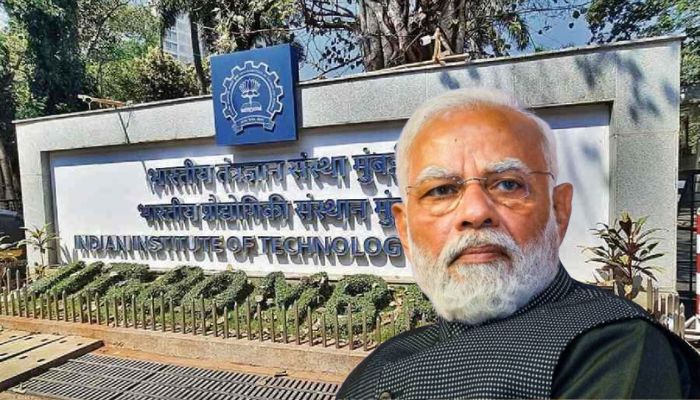
The Indian Institute of Technology (Bombay), one of the esteemed engineering institutes in the country, has come under the scanner for sponsoring a controversial event targeting Prime Minister Narendra Modi, Union Home Minister Amit Shah and Uttar Pradesh Chief Minister Yogi Adityanath.
The event is a 2-day workshop titled ‘South asian Capitalisms (s)’, which is co-sponsored by UC Berkeley and the University of Massachusetts-Amherst.
A poster of the contentious workshop was shared on X (formerly Twitter) by columnist Harshil Mehta, which depicted a so-called ‘pyramid of capitalist India.’
One section of the pyramid, which read ‘We fool you’, had caricatures of Prime Minister Narendra Modi, Union Home Minister Amit Shah and Uttar Pradesh Chief Minister Yogi Adityanath.
New Political Economy Initiative works under Central for Liberal Education, IIT Bombay. It was co-organiser of South Asia Capitalism event.
This NPEI is headed by IIT Bombay faculty member and UK citizen Anush Kapadia. He is on Indian government payroll.
The free-for-all workshop, which is scheduled to take place on 12th and 13th September, vows to explore how ‘capitalist accumulation is socially structured across South Asia’.
The event is being hosted by the New Political Economic Initiative (NPEI), which works directly under IIT Bombay. NPEI is headed by Anush Kapadia and has received $4 million (~₹35 crore) from the Ford Foundation.
Interestingly, Kapadia is a UK citizen and works as an ‘Associate Professor’ at IIT Bombay.
This is despite the fact that he has written only 2 journal papers in 10 years and has a H-index of just 7 (a measurement of scientific productivity and impact of a researcher’s publications).
Following the controversy, the Indian Institute of Technology (Bombay) issued a clarification on X (formerly Twitter). It claimed to not know the workshop.
The official handle of the institute alleged, “IIT Bombay has a project related to New Political Economic Initiative. However, we were totally unaware about the published flyer. Upon hearing about this post, we issued immediate instructions to the organisers to take down the flyer from all social media platforms and remove IIT Bombay’s name from everything to do with this event.”
“The details of the programme have been removed from the website of New Political Economy Initiative with immediate effect. No one from IIT Bombay is attending the conference. The Institute was not at all consulted about the flyer. We are deeply shocked and upset by its content,” it added.
IIT Bombay also publicly vowed to sever ties with faculty members of UC Berkeley and theUniversity of Massachusetts-Amherst.
A post regarding a flyer of a workshop on South Asian Capitalism was brought to the attention of the Institute authorities. This workshop is to be held at University of Berkeley in partnership with UC Berkeley and University of Massachusetts-Amherst for young scholars. IIT Bombay… pic.twitter.com/BhMZV8A4Ds
Soon after, it came to light that IIT Bombay had blocked columnist Harshil Mehta on social media.
He asked, “Why IIT Bombay’s official account has blocked me? Is questioning public institutions and mis governance a crime? This is a public and official account. Then why this childish behaviour? Is defending @narendramodi a crime?”
Why IIT Bombay’s official account has blocked me? Is questioning public institutions and mis governance a crime?
This is a public and official account. Then why this childish behaviour?
Columnist Harshil Mehta previously pointed out how a faculty member of IIT Bombay named Prabhir Vishnu Poruthiyil, who is essentially on the payroll of the Indian government, published a paper dubbing big businesses as collaborators of fascism.
Prabhir Vishnu Poruthiyil was seen advocating the talking points of Congress leader Rahul Gandhi about ‘wealth redistribution.‘
IITB’s faculty Prabhir Vishnu Poruthiyil claims corporators are collaborators with fascism.
He advocates a communist principle of redistribution of wealth.
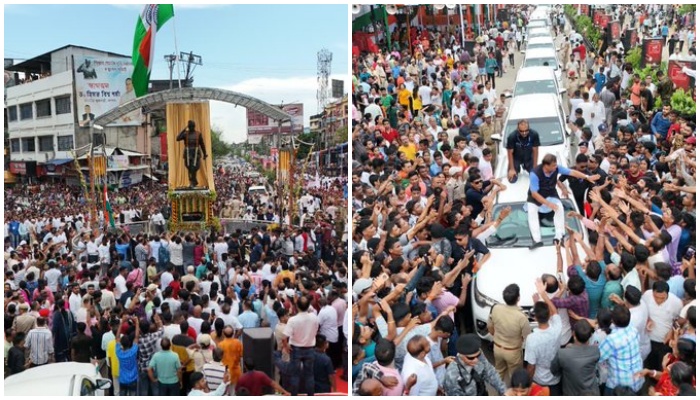
On August 31, Assam Chief Minister Himanta Biswa Sarma addressed a public gathering in Silchar and forcefully refuted the controversy over Bengali being labelled a “Bangladeshi language.” His remarks carried a political sharpness and cultural clarity that went beyond mere firefighting. At a time when identity politics in the Northeast is repeatedly stirred for partisan gains, Sarma’s words offered a counter-narrative of Hindu civilizational unity, rejecting the manufactured binary of Assamese versus Bengali.
This is Silchar- the heart of Barak Valley and the predominantly Bengali speaking region of Assam.
See the sea of people who came out today ?.
Support for us is coming from every corner and community of Assam. Together we are building an Assam of everyone's dreams. pic.twitter.com/tq1aPPhMUs
Sarma’s central claim that “there is no Assamese versus Bengali issue in Assam; we are all Hindus” was both a reassurance to the Bengali Hindu population of Barak Valley and a political statement directed at his rivals. By directly naming Congress leader Sushmita Dev as one who benefits from fanning identity disputes, Sarma turned the spotlight on how identity is manipulated in electoral politics. His remark that he would win Silchar with an even larger margin than Jalukbari was more than bravado; it was a signal of BJP’s growing appeal among Bengalis in the Barak Valley, long considered a Congress stronghold.
The immediate controversy had begun with the Delhi Police describing Bangla as a “Bangladeshi language” in an official communication. The Trinamool Congress (TMC) seized the opportunity to attack the BJP, portraying the phrasing as an insult to Bengali identity. While Amit Malviya, head of the BJP’s IT cell, attempted to justify the terminology by linking it to shorthand identifiers for illegal immigration, his explanation lacked the cultural sensitivity necessary in matters of language and identity. Bengali is not merely a language it is a civilizational identity tied to Rabindranath Tagore, Bankim Chandra, Vivekananda, and countless intellectuals whose legacy belongs as much to India as to Bengal.
Sarma wisely drew upon this cultural history, asking rhetorically, “Was Rabindranath Tagore from Bangladesh or West Bengal? Prime Minister Modi has granted classical language status to Bengali. How can the BJP insult the Bengali language and its people?” By invoking both Tagore and Modi, Sarma sought to anchor Bengali identity firmly within the Indian nationalist fold, countering the opposition’s charge that the BJP was undermining Bengalis. This rhetorical move was significant it separated the question of illegal immigration from Bangladesh from the cultural identity of Indian Bengalis, a distinction that political opponents often blur for electoral advantage.
The context of Silchar also mattered. The Barak Valley, with its Bengali-speaking majority, has long felt marginalized in Assam’s political imagination. The violent history of the 1961 Language Movement in Silchar, where 11 protestors were killed while demanding recognition of Bengali, still haunts the collective memory of the valley. Sarma’s message that there is “no Assamese versus Bengali issue” sought to heal this historical wound. By dedicating statues of Netaji Subhas Chandra Bose and Mangal Pandey during his visit, he reinforced a shared nationalist narrative that transcends linguistic divides. Bose remains an icon of unity and sacrifice across India, while Mangal Pandey symbolizes the pan-Indian roots of the freedom struggle. The symbolism was deliberate: to remind Sylheti Bengalis in Silchar that their heroes are also India’s heroes.
From a political perspective, Sarma’s intervention highlights the BJP’s strategy in the Northeast. The party cannot afford to alienate Bengali Hindus, who are a decisive demographic in Assam’s Barak Valley and in parts of Tripura. At the same time, the BJP must continue its tough stance against illegal immigration from Bangladesh, which has been its most potent political plank in Assam. The delicate balance lies in ensuring that the anti-illegal immigration narrative does not spill over into an anti-Bengali sentiment. Sarma’s speech was a masterclass in walking this tightrope denouncing divisive rhetoric while keeping the core ideological message intact.
The larger question, however, is whether such unity narratives can withstand the churn of identity politics. For decades, Assamese-Bengali tensions have been fuelled by competing claims over land, resources, and political representation. While Sarma’s Hindu civilizational framing may help consolidate communities against a common adversary, the persistence of historical grievances and the constant provocation by rival parties will test the durability of this unity.
Nevertheless, the Silchar speech stands out as an attempt to rewrite the script of Assam’s politics. By emphasising Hindu identity over linguistic differences, Sarma reminded both Assamese and Bengali Hindus that their destinies are intertwined in resisting external threats, whether cultural or demographic. In doing so, he also exposed the opportunism of parties like Congress and TMC, which thrive on stoking linguistic and ethnic sensitivities.
In the end, the debate over whether Bangla is a “Bangladeshi language” is less about semantics and more about political symbolism. By stepping into the controversy with clarity and conviction, Himanta Biswa Sarma not only defended the cultural dignity of Bengalis but also projected himself as a leader capable of bridging divides. In the turbulent politics of Assam and the Northeast, that is no small achievement
At the 60th session of the United Nations Human Rights Council (UNHRC) in Geneva, India sharply retorted to comments made by the Swiss representative on India, and offered to help Switzerland in combating racism in the country. This came after the Swiss representative on September 9 urged the Indian government to “take effective measures to protect the minorities and uphold the rights to the freedom of expression and the freedom of the media.”
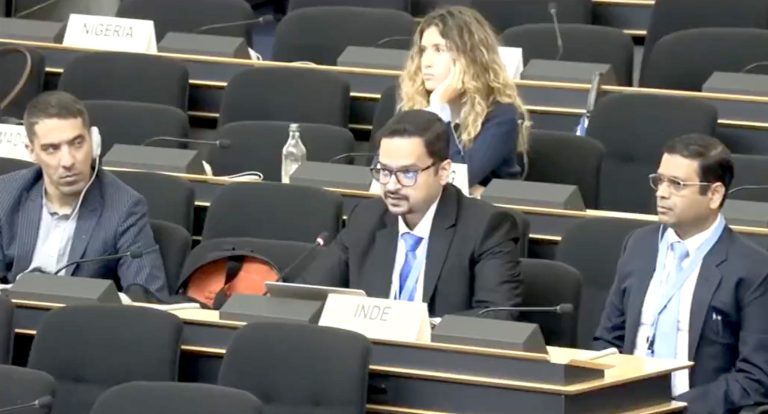
This statement came amid broader discussions on global human rights, with Switzerland holding the UNHRC presidency, emphasizing protections for vulnerable groups and press freedoms in India. In a pointed response on September 10, 2025, Indian diplomat Kshitij Tyagi dismissed the Swiss remarks as “surprising, shallow, and ill-informed.”
Speaking at the council’s 5th meeting, Tyagi highlighted Switzerland’s role as president, urging it to refrain from propagating “blatantly false” narratives that misrepresent India’s reality. He redirected attention to Switzerland’s internal challenges, including racism, systematic discrimination, and xenophobia, suggesting the Alpine nation address these first instead of talking about minorities and freedom of expression in India.
#WATCH | At the 5th Meeting- 60th Session of Human Rights Council, Indian Diplomat Kshitij Tyagi says, "We would also like to respond to the surprising, shallow and ill-informed remarks made by Switzerland, a close friend and partner. As it holds the UNHRC presidency, it is all… pic.twitter.com/22R1vRJg67
Tyagi underscored India’s position as the “world’s largest, most diverse, and vibrant democracy” with a “civilizational embrace of pluralism,” and extended an offer of assistance to help Switzerland tackle its issues.
Kshitij Tyagi said, “We would also like to respond to the surprising, shallow and ill-informed remarks made by Switzerland, a close friend and partner. As it holds the UNHRC presidency, it is all the more important for Switzerland to avoid wasting the council’s time with narratives that are blatantly false and do not do justice to the reality of India. Instead, it should focus on its own challenges such as racism, systematic discrimination and xenophobia. As the world’s largest, most diverse and vibrant democracy, with a civilizational embrace of pluralism, India remains ready to help Switzerland address these concerns.”
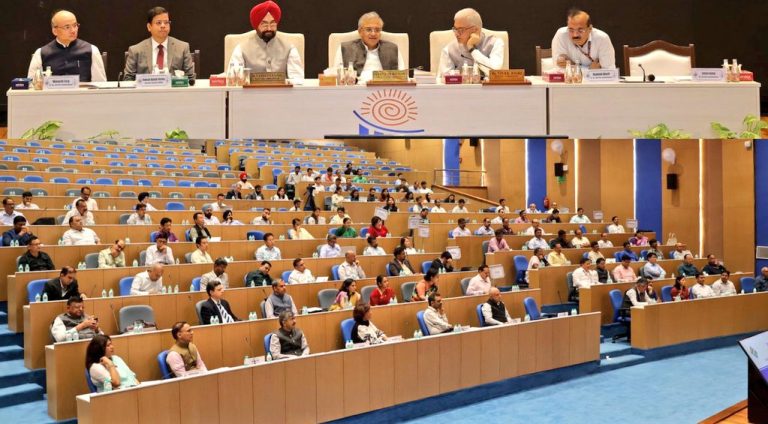
The Election Commission of India (ECI) on Wednesday convened its third Conference of Chief Electoral Officers (CEOs) this year to evaluate preparations for the nationwide Special Summary Revision (SIR) of electoral rolls. The conference at the India International Institute for Democracy and Electoral Management (IIIDEM) in New Delhi, inaugurated by Chief Election Commissioner Shri Gyanesh Kumar, was attended by Election Commissioners Dr. Sukhbir Singh Sandhu and Dr. Vivek Joshi.
The primary focus of the conference was to assess the readiness of CEO offices across all States and Union Territories (UTs) for the SIR exercise, a critical process to update and maintain accurate electoral rolls. The event featured a detailed presentation by the CEO of Bihar, highlighting strategies, challenges, and best practices adopted during their SIR process, offering valuable insights for other States and UTs to emulate.
CEOs from various States and UTs presented comprehensive updates on their respective electoral rolls, including the number of electors, the qualifying date of the last SIR, and the status of digitization and online availability of electoral rolls on State/UT CEO websites. They also discussed efforts to map current electors against those listed in the previous SIR to ensure accuracy and completeness.
A key agenda item was the rationalization of polling stations to ensure no station exceeds 1,200 voters, a directive aimed at enhancing voter convenience and electoral efficiency. The Commission reviewed the progress of this initiative to ensure uniform implementation nationwide.
To maintain the integrity of the electoral roll, CEOs proposed documents to verify eligibility, emphasizing ease of submission for eligible citizens while preventing the inclusion of ineligible individuals. The Commission reiterated its commitment to ensuring no eligible voter is excluded and no ineligible person is enrolled.
The conference also evaluated the appointment and training of key electoral officials, including District Election Officers (DEOs), Electoral Registration Officers (EROs), Assistant Electoral Registration Officers (AEROs), Booth Level Officers (BLOs), and Booth Level Agents (BLAs), to ensure smooth execution of the SIR process.
The ECI’s proactive measures underscore its dedication to strengthening India’s electoral framework, ensuring transparency, inclusivity, and efficiency in the democratic process.
The violent protests in neighbouring Nepal, which have brought the entire country to a standstill over the last two days following widespread arson and vandalism, seem to have found takers in India.
As the Himalayan country is grappling with a complete collapse of law and order after the so-called ‘Gen Z’ led anti-corruption protests turned violent, leading to public and private properties being vandalised and burned down, and politicians being killed and assaulted, some sadistic elements in India are dreaming of a similar situation at home.
One such element is Arpit Sharma, reportedly the son of Aam Aadmi Party (AAP) leader Vikas Sharma, who is fascinated by the way the protestors in Nepal have ransacked government buildings, including the Parliament, the Supreme Court, and chased, assaulted and even killed the Nepalese politicians and ministers, during the two-day-long violent protests between 8th and 9th September.
Arpit Sharma, a popular Congress troll, posted a video on X, heaping praises on the ‘courageous’ young Nepali protestors who marched through the streets of Nepal, vandalising and destroying anything and everything that came in their way.
A starry-eyed Sharma hailed the Nepalese Gen Z for raising their voice against the corruption in their country. However, he lamented that the Indian youth were not courageous enough to organise similar violent demonstrations against the Indian government.
In the video, Sharma went on to suggest ideas, including Congress leader Rahul Gandhi’s Vote Chori lie, to the Indian youth to organise Nepal-like violent demonstrations in India. He claimed that 60 crore young voters in India can come together and shake the “power structure” in the country. Sharma’s father, Vikas Sharma, contested the 2022 Uttar Pradesh Assembly Elections on the ticket of AAP. However, he lost the election.
For the past two days, Nepal has been struggling with violent protests, which erupted following a social media ban by the Nepalese government. The protestors torched government buildings, offices and residences of politicians and ministers. Around 22 people reportedly died during the protests, while over 300 were injured.
The wife of former PM Jhalanath Khanal died of burn injuries after protestors set his house on fire. Nepal’s Prime Minister KP Sharma Oli tendered his resignation after his house was burned down by protestors. The situation was controlled after the Nepalese Army dissuaded protestors and imposed curfew in many parts of the country.
In steps that indicate a socialist turn, the Donald Trump administration has now demanded a share of income generated by universities from state-funded researches. This comes after the US govt acquitted a 10% stake in Intel, and allowed NVIDIA and AMD to sell their chips to China in exchange of 15% of the revenue.
On 10th September, Commerce Secretary Howard Lutnick announced the initiative forcing universities to give a share of their income, potentially 50%, to the federal government. In an interview with Axios for the inaugural episode of “The Axios Show,” Lutnick revealed plans to target the lucrative patent portfolios of major universities, particularly those developed with federal funding. He made the revelation when asked about what other steps the administration is considering to raise revenues.
He said, “I think universities, who are getting all this money. The scientists get the patents, the universities get the patents and the funder of $50 billion, the U.S. government, you know what we get? Zero.” He then added that if the govt is funding the research, the govt should get a share of the income generated by the result of the research. He demanded a 50% share of the income.
Lutnick said, “if I gave them 100% of their money, I would get half the profits, with the scientists. So I think if we fund it and they invent a patent, the United States of America taxpayer should get half the benefit.”
Notably, he sent a letter to Harvard University last month, demanding a comprehensive list of all patents stemming from federally funded research grants, and plans to extend similar demands to the University of California system. Lutnick claims that sharing patent profits could secure enough revenue to fund the Social Security system and reduce federal deficits.
Taxpayers deserve the benefit of the bargain. If Harvard won’t honor the Bayh-Dole Act, then we will find someone who will. pic.twitter.com/8U7yJtYacS
He stated, “If we are paying for the research, if we’re paying for the lab, if it’s our money, the American taxpayer’s money, the American taxpayer should be a partner in the upside.”
The proposal hinges on the Bayh-Dole Act of 1980, which allows universities to retain ownership of patents developed with federal funds to encourage commercialization. American Universities develop many cutting edge technologies, and they earn substantial income from businesses by licencing those technologies.
This move comes amid heightened tensions with Harvard, where Lutnick has already initiated a review of the university’s compliance with the Bayh-Dole Act. In a letter to Harvard President Alan Garber, he accused the institution of failing to meet disclosure and manufacturing requirements, threatening to exercise “march-in rights” to seize patents or grant third-party licenses if non-compliance is found.
Harvard, holding over 5,800 patents and 900 technology licenses as of July 2024, called the action “retaliatory,” citing its ongoing legal battles with the administration over other issues, including federal funding and international student policies.
The latest move comes amid a series of actions against universities by the Trump administration. First, several universities were widely criticised for massive antisemitism displayed on the campuses, and faced the wrath of the new govt. The administration froze billions of dollars in research grants across elite universities like Harvard, Columbia, Princeton, Cornell, Northwestern, and others.
Trump has also issued sweeping executive orders aiming to dismantle DEI programs, curb “gender ideology” and participation of trans in sports in universities. While these measures are in line of the ideology of the Republicans, the proposal to take share of income of universities go against it.
Earlier in August, the U.S. government acquired a 9.9% equity stake in Intel, investing $8.9 billion to convert unused grant funds from the CHIPS and Science Act and the Secure Enclave program into capital support. Therefore, US govt got the stake without paying for it, as already committed grant was converted to equity share. This passive investment, as it lacks board representation, also includes a five-year warrant to acquire an additional 5% if Intel ever loses control of its foundry division.
In the same month, the administration struck a controversial deal allowing Nvidia and AMD to sale their chips to China in exchange of 15% of their revenue. This deal allowed the advanced AI chips like Nvidia’s H20 and AMD’s MI308 to China, which was earlier banned. Ironically, China has now said that it does not need American chips, as they have developed their own AI chips after US banned sale of the same to the country.
One of the accused in the rape case of a 20-year-old woman last week, after being called for a birthday party, has been arrested by the Kolkata Police. The arrested man is Chandan Malik, who was detained by Kolkata police on Tuesday, 9th September, at Burdwan Station. The police added that another accused in the case, Debangshu Biswas, is still on the run.
As per the media reports, the crime was committed on Friday (5th September) in Haridevpur locality of Kolkata. A young woman was raped by a Trinamool Congress (TMC) worker and his aide. The victim went to a house with Malik after being told about a ‘birthday party.’ She had known the accused for a few months before then.
“The woman’s birthday was on Friday. On that occasion, the accused Chandan and Deep took the victim to the latter’s flat. There, they had a meal. She said that when she wanted to return home, the accused stopped her. They allegedly locked the door and gang-raped her,” a cop informed.
In her complaint, the woman said that both Malik and Biswas took turns to rape her around 10:45 pm that night. She further said that she was confined in the house through the night and was able to escape only the next morning, on Saturday (6th September). She then went to the Haridevpur police station and lodged a formal complaint.
A case was registered under several sections of the Bharatiya Nyaya Sanhita (BNS), including kidnapping, rape, stalking, voluntarily causing hurt, causing grievous hurt, and wrongful confinement.
Investigators have also spoken to the owner of the house, who said that the property had been rented to Biswas. He informed the police that Biswas introduced himself as a government employee who would be staying there with his mother.
It has come to light that Biswas is not only a government employee working as a revenue inspector with the state’s land reforms department but is also a worker of the ruling Trinamool Congress (TMC). Local reports suggest that the ground floor of the building where the crime took place had been rented to Biswas.
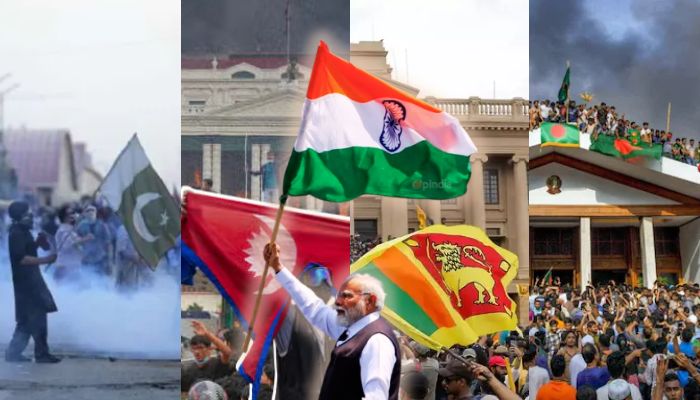
In the recent past, South Asia has become a hotspot for political upheaval. India’s neighbours have witnessed protests-driven regime changes. Nepal has descended into chaos after a Gen-Z uprising toppled the Prime Minister KP Sharma Oli-led government on 9th September 2025. While a social media ban became an immediate trigger, the Nepali youth have been protesting against rampant corruption in the now-overthrown government.
Prime Minister KP Sharma Oli’s resignation, after one of the deadliest crackdowns in years that left 19 young protesters dead, has plunged the country into political turmoil. His Bhaktapur residence was set ablaze, the homes of former prime ministers Pushpa Kamal Dahal “Prachanda” and Sher Bahadur Deuba vandalised, and three of his ministers forced to resign.
The protests in Nepal have taken a violent turn as angry mobs storm into official residences of ministers. At least 17 people were killed in clashes in Kathmandu alone, police confirmed, while two more deaths were reported in Sunsari district. On Tuesday, protesting mobs stormed into the residence of Foreign Minister Arzu Rana Deuba, who is the wife of former PM Sher Bahadur Deuba. The Deuba couple have also been physically attacked by the mob after angry protestors stormed into their residence.
#WATCH | Nepal | Aftermath of the violence that broke out in the Parliament building, which was set on fire on 8th September, as the protest turned violent in Kathmandu.
The Nepali PM resigned yesterday amid demonstrations against the Government over alleged corruption. pic.twitter.com/EJNZS6o7OS
Nepal’s parliament, the famous Hilton Hotel and many buildings were set ablaze. The protestors also broke into the Singha Darbar premises, a large complex in Kathmandu which houses Nepal’s administrative offices, and set its gate on fire while forcing their way into the central administrative complex. The ancient Pashupatinath Temple is being protected by the Nepalese Army as hooligans attempted to enter the Hindu temple. The wife of former Prime Minister of Nepal, Jhalanath Khanal, succumbed to burn injuries on Tuesday after Khanal’s residence was set on fire by protestors.
Nepal government’s ministers are being chased and assaulted by mobs. Protestors even said that they want to beat up KP Sharma Oli but he is nowhere to be found. Now the army has taken over control and enforced curfew.
Amidst the chaos, Nepali GenZ protestors have issued statements claiming that they have fallen back and those indulging in arson and destruction of public property are not a part of their anti-corruption agitation.
Meanwhile, political manoeuvring has intensified in the unrest-hit Himalayan nation, as former PM Oli is likely to flee. Names of rapper-turned-politician and Kathmandu mayor, Balen Shah, Hami Nepal founder Sudan Gurung, who led the anti-government protests, are emerging as the popular choices to fill the power vacuum. OpIndia earlier reported about their activities, controversies and US connection.
What is happening in Nepal has become so ‘normal’ in South Asia that it no longer surprises those closely following geopolitics. Such regime changes stem from economic crises, allegations of corruption, authoritarian crackdowns, and youth-led agitations demanding ouster of the ‘corrupt’ and accountability. Although in Afghanistan’s case, the regime change stemmed not only from economic factors and domestic power tussle but also from the US military withdrawal in 2021, resulting in a Taliban takeover.
Myanmar: The first successful regime change in the region in the recent past
In February 2021, the military of Myanmar staged a coup d’état and ousted the democratically elected government led by popular leader Aung San Suu Kyi. The National League for Democracy (NLD) government was illegally ousted from power after it emerged victorious again in the 2020 elections receiving even more votes than in 2015. The military in its coup orchestrated a crackdown in which several political leaders including Aung Suu Kyi were arrested.
In no time, massive nationwide protests, strikes and civil disobedience erupted, which evolved into the ‘Spring Revolution’. Much like Nepal, this spring revolution was led by Gen Z. These youths and civil servants demanded release of Suu Kyi and sought restoration of democracy. However, the military junta employed brutal force to crush the agitation and killed over 1,500 people and arrested thousands.
Protestors in Bago in 2021 (Image source: KenRoth/X)
The chaos magnified into armed resistance and People’s Defence Force and other armed groups came into existence. By 2025, the pro-democracy protest has escalated into a full-scale civil war. Millions have been displaced, thousands have died. Junta’s violent crackdown, suspension of constitutional rights and internet shutdowns have entrenched the authoritarian rule.
The Military had ruled Myanmar for five decades before the power was handed over to democratically elected leaders. However, with Suu Kyi ousted from power, Myanmar has neither seen democracy nor normalcy, return.
‘Aragalaya’ in Sri Lanka ousted the Rajapaksa family from power in 2022
Economic crisis, soaring debt, tax cuts, COVID, failed organic farming policy, fuel shortage, food and medicine scarcity, depleting foreign exchange reserves and a increase in inflation to 70 percent, prompted Sri Lanka’s first sovereign default in April 2022.
President Gotabaya Rajapaksa and his family were accused of corruption and mismanagement and citizens demanded his resignation.
In July 2022, Sri Lanka erupted. Protesters, mostly youth, stormed President Gotabaya Rajapaksa’s official residence in Colombo, sending him fleeing to safety. Images of citizens swimming in his pool and cooking in his kitchen captured global imagination. Later that day, the private residence of Prime Minister Ranil Wickremesinghe was set ablaze. Both leaders were forced to resign as the “Aragalaya” (struggle) movement brought down a political dynasty amid the island’s bankruptcy.
Pakistan: Imran Khan ousted from power under a US-backed regime change operation
Cricketer-turned-politician, former Prime Minister of Pakistan, Imran Khan was ousted from power in April 2022, through a no-confidence vote. This came amidst allegations of economic mismanagement and a fallout with Pakistan’s de facto ruler—Pakistan Army. Imran Khan had openly accused the US of orchestrating a regime change conspiracy against him. Khan was trying to curb military interference in governance; however, this did not go well the military. Interestingly, Khan had cited a diplomatic cable “Cypher”, to back his claim of US involvement in his ouster.
In May 2022, Imran Khan called for a Azadi March, drawing thousands of Pakistan Tehreek-e-Insaf (PTI) supporters to Islamabad demanding early elections. The protests turned violent and were brutally crushed down by the police. While Shehbaz Sharif became Army-backed Prime Minister, Imran Khan was arrested in May 2023. His arrest sparked nationwide riots, including attacks on military establishments. Imran Khan continues to be confined in jail in corruption cases, while Pakistan’s military-backed government which grabbed power after farcical elections were conducted, has now signed a deal with the US to squeeze natural resources of occupied Balochistan and make billions while Baloch people get tormented, kidnapped and killed by the army.
Image Source: Dawn
Meanwhile, once harboured by Pakistan Army itself, the Pakistani Talibans have been creating ruckus in northwest Pakistan. While Pakistan was never a quite politically stable and economically sound nation, toppling of Imran Khan government has not proven very beneficial for common Pakistani populace. Their economy is still in shambles, Islamabad is still breathing on IMF’s loan ventilator, Army still attacks its own civilians, be it Balochs, Pashtuns or PTI supporters.
Bangladesh: Sheikh Hasina illegally ousted from power by Gen Z ‘student’ protestors months after she alleged US regime change plot
On 5th August 2024, Bangladesh witnessed its own “Bangla Spring.” What began as student protests, led by the Students Against Discrimination movement, against a controversial job quota system escalated into nationwide violence. Jubilant protesters carrying flags, chanting slogans, and even dancing atop captured tanks stormed Sheikh Hasina’s official residence. By then, Hasina had already fled. Army Chief Waker uz Zaman confirmed her resignation, announcing an interim government would assume power.
According to reports, Hasina’s helicopter landed in Agartala, India, after New Delhi allowed her emergency entry.
Protesters ransacked her residence, looting sarees, utensils, and other personal items, brandishing undergarments, celebrating what they called the “reclaiming” of the palace from which “illegal orders to murder citizens” were issued. The scale of violence was staggering: on just one Sunday, 91 people were killed, making it the deadliest day of the uprising. By early August, at least 300 people had died since the protests began in July.
Hasina’s son, Sajeeb Wazed Joy, based in the US, had desperately urged the security forces to prevent the fall of his mother’s 15-year rule. “You must keep our people and country safe and uphold the constitution,” he pleaded on Facebook. But the army, much like in 2007 when it installed a caretaker government, chose to “stand by the people.”
While protests turned violent as conflicts between protestors and police became frequent, the violence worsened when the Jamaat-e-Islami (JeI) and the Bangladesh Nationalist Party (BNP) started to magnify the mayhem, using it to undermine the ruling Awami League government. Both Jamaat and BNP are notorious for their anti-India agenda and Islamist jihadist activities.
The sequence of events and Sheikh Hasina’s statements regarding attempts being made to destabilise Bangladesh and oust her from power illegally, fuel the speculation that the Awami League leader’s forced resignation and escape from her homeland was not simply a consequence of student protests but that of a US-orchestrated regime change operation.
Months before her resignation, Sheikh Hasina had alleged that the United States is attempting regime change in Bangladesh via the opposing BNP and Jamat-e-Islami. Last year, the US also extended support to the Islamist Bangladesh Nationalist Party (BNP) and its ally Jamaat-e-Islami during its protests against the PM Hasina-led government.
In September 2024, Sheikh Hasina accused the United States of orchestrating her removal from the post of PM because she refused to hand over Saint Martin Island to the US, which would have enabled the western superpower to have “sway over the Bay of Bengal”. Sheikh Hasina’s attempts to thwart an alleged US orchestrated regime change failed and she had to flee her homeland.
One year after Sheikh Hasina’s ouster, Bangladesh has fallen into the hands of Islamists and remains mired in instability, economic crisis and persistent Islamist crimes against Hindu minorities.
Myanmar, Sri Lanka, Pakistan, Bangladesh and now Nepal: Surrounded with countries grappling chaos and democratic collapse, India stands strong
In a stark contrast to its neighbours, who have undergone violent protests that resulted in regime change, violence, democratic collapse and economic pushback, India has braved all storms displaying its resilience as a stable democratic force. Vast in size, population and regional, religious, socio-political and linguistic diversity, India has maintained remarkable democratic stability and takes pride in being the world’s largest democracy.
India continues to have a stable and functioning democracy, a popular prime minister who has been in power for three consecutive terms, a free media and free social media. India has not only enjoyed internal stability but has also become a leader of the Global South. India’s economic growth, defence robustness and potential as massive market has impressed the world. However, it is not that India has never faced foreign entity-backed regime change operations or violent massive anti-government protests.
While I.N.D.I. Alliance parties, particularly, Congress has been trying to sow public distrust in India’s electoral system by repeatedly casting aspersions on the integrity of the Election Commission, the nation conducts regular, free, fair and peaceful elections, as prescribed in the constitution.
In the past, India braved emergency imposed by Prime Minister Indira Gandhi, fragile coalition eras without complete collapse. In the recent years, particularly, after 2014, the general election which positively altered India’s growth trajectory, the country has faced large-scale protests which were either meant to or had the potential to cause a regime change.
The 2019-2020 protests against the Citizenship Amendment Act (CAA), which granted Indian citizenship for persecuted Hindus and other non-Muslim minorities from neighbouring countries, snowballed into anti-Hindu riots in Delhi and in other states. However, the Central government tackled the situation well and the common public also saw through the conspiracy at play and did not significantly back the anti-CAA/NRC protests.
Soon after, the farmers protest erupted against three farm laws passed in September 2020. What began as a protest against alleged ‘dismantling’ of minimum support price (MSP) and state procurement, magnified into a massive anti-government agitation. While farmers from other states backed the reforms, farmers from Punjab and a section of Haryana farmers blockaded Delhi borders. Tractor Rally was taken to Delhi and religious flags were hoisted near the Red Fort. Violent incidents were reported. It also emerged that the farmer’s protest was being hijacked by Khalistan separatist elements.
However, unlike the Nepalese, Bangladeshi, Sri Lankan or Pakistani government, the Modi government did not resort to violent crackdown on the protestors. It would not be an exaggeration to say that the Modi government was one bullet fire on protestors away from a regime change. PM Modi, showed political tact and repealed the farm laws and appealed to the protestors to retreat.
Now, the opposition is peddling the ‘vote chori’ (vote theft) bogey to accuse the Election Commission and the BJP of colluding to steal the mandate in their BJP’s favour. Such attempts have seen a renewed intensity after the 2024 Lok Sabha elections. The Congres party and its leftist media allies, who have been mindlessly alleging EVM hacking, VVPAT tampering, is now alleging that the BJP supportive ECI is arbitrarily adding and removing names from electoral rolls. These claims, however, have been debunked by the ECI with facts.
The way the opposition is going about its sinister ‘vote chori’ narrative, it may be considering replicating the Khaleda Zia playbook: sow distrust in public’s mind against electoral process, boycott the elections, incite violent protests and oust the democratically elected leader, to become the sole runner in the race of power and come first.
OpIndia has reported many a times how Rahul Gandhi during his foreign trips has been seeking foreign intervention in India’s internal affairs, levelling ‘Democracy khatre mein hai’ allegations, casting aspersions on the integrity of the ECI while on foreign soil. From seeking foreign interference to relying on dubious foreign reports often prepared by outfits funded by the likes of regime change specialists, George Soros, to attack Indian businessmen like Gautam Adani, eulogising China to even recently parroting US President Donald Trump’s ‘India’s a dead economy’ jibe, the leading opposition party of India has been toeing the line of those foreign players who want to destabilise India.
So far, these forces have failed to incite Indians into going the Bangladesh, Nepal, or Pakistan way, rather, they have faced strong backlash. It reflects the faith people have in PM Modi’s leadership. No wonder, even some of the protesting Nepali youth have said that had there been a leader like PM Modi in Nepal, the country would have progressed way better and the need for street protests would never have arose.
Congress spends obscene amounts of money projecting Rahul Gandhi as a Gen Z “sex symbol” — with silly reels of him flaunting his abs, riding bikes, doing push-ups, or diving around.
But the reality is stark: Gen Z in Nepal, like in India, aspires for a leader like PM Modi,… pic.twitter.com/yIrS0n4ANW
Under a stable and strong government, India has transformed itself into an economic giant becoming fourth largest and one of the fastest-growing economies in the world. Bharat is an ancient civilisation yet a young nation, with its young workforce, digital innovation, thriving trade relations with other countries, and timely economic reforms, contrast with economic instability of its neighbours.
As a leader of the Global South, India has also been a peacekeeping forced in the chaotic world. India provides humanitarian assistance as seen during Covid era (Vaccine Maitri) to its partners or disaster relief aid, be it to Nepal or Turkey. India also provides financial and infrastructure support to allies in need as seen in the case of $4 billion financial aid to crisis-hit Sri Lanka in 2022, and $50 million aid to Maldives. India is also a top contributor to UN peacekeeping missions. Indian navy ensures maritime security in the Indian Ocean, securing trade routes and countering piracy.
Despite the internal challenges and foreign threats, India has managed to sail through all the storms. The credit not only goes to the government but also to the India’s largely nationalist populace that has believed in responding vote not violence, dissent not destruction, and legal recourse than lawlessness.
If anyone is caught on suspicion of being an illegal infiltrator in Assam, he will now have just 10 days to show proof of his Indian citizenship. Chief Minister Himanta Biswa Sarma announced this on Tuesday, 9th September, after the state Cabinet meeting in Guwahati. He also revealed that Assam has already deported 30,128 infiltrators to Bangladesh so far.
The Assam Cabinet has approved a new Standard Operating Procedure (SOP) to deal with the long-standing problem of illegal infiltration. Sarma said this move is a “big and historic step” to push back intruders and safeguard Assam’s cultural identity and demographic balance.
The new SOP has been brought under the Immigrants (Expulsion from Assam) Act, 1950. It gives more power to the local administration. According to CM Sarma, “Now we don’t have to go to court every time. The District Commissioner can directly identify infiltrators and issue orders for their expulsion or deportation.”
This means that earlier, every suspected case had to go through the Foreigners’ Tribunals, which led to huge delays. But now, the administration can act much faster and more directly.
What the new SOP says
According to the new SOP implemented in Assam, if a person is found to be a suspected intruder, he will be given 10 days to prove his Indian citizenship. If he is unable to prove his citizenship in 10 days , the district administration can issue a deportation order for him within 24 hours.
अब प्रशासन संदिग्ध घुसपैठियों को अपनी नागरिकता प्रमाणित करने के लिए 10 दिन की अवधि देगा।
Today Assam has issued a detailed Standard Operation Procedure to detect and deport illegals pic.twitter.com/hL5yMPaLv1
After this, the person will either be sent to a holding center or deported out of the country with the help of the Border Security Force (BSF). This process can now be done directly at the administrative level, bypassing the Foreigners’ Tribunals.
Chief Minister Himanta Biswa Sarma called the decision ‘historic and decisive’. He said, “More than 82,000 cases are pending in our tribunals and this SOP bypasses that system.” He also said that this SOP will also apply to those whose citizenship is doubtful even after their name is included in the NRC.
If caught entering the border, to be sent back in 12 hours
Another key decision taken by the Cabinet is that if a person is caught trying to cross the border illegally, they can be sent back within 12 hours. There will be no need for any long legal process in such cases.
The government has also ordered that biometric and demographic details of all suspected infiltrators must be recorded on the Foreigners Identification Portal. This will help in monitoring such individuals and making sure they cannot come back easily.
Supreme Court’s 2024 ruling and a ‘forgotten’ law
The Assam government has taken this step after a Constitution Bench of the Supreme Court, in October 2024, gave the state full freedom to use the 1950 law for handling infiltration. This ruling cleared the way for the state to take strict action directly through administrative powers.
Before this, it was assumed that every case of illegal infiltration has to go through the Foreigners Tribunal. It takes years and decades to resolved through the Tribunal system. But now the Supreme Court has clarified that there is no such requirement, and the administration can directly deport illegal infiltrators.
In June this year, CM Sarma said that the provision of the Immigrants (Expulsion from Assam) Act, 1950 was actually forgotten. During hearing on Section 6A of the Citizenship Act, the constitutional bench of the Supreme Court said that this Act is still valid. Under its provisions, even a District Commissioner can issue an order for immediate pushback of illegal immigrants.
While upholding the validity of Section 6A of the Citizenship in Assam in the judgement issued in October 2024, the Supreme Court said, “The provisions of the Immigrants (Expulsion from Assam) Act, 1950 shall also be read into Section 6A and shall be effectively employed for the purpose of identification of illegal immigrants.” The Supreme Court also stated the Immigrants Expulsion law is not contradictory to the of Section 6A of the Citizenship Act, and both can co-exist.
The court had said that the fact that the parliament had enacted the law in 1950 shows that “the huge influx of migrants from Bangladesh to Assam has always been a ‘cause for concern’ and Parliament has taken steps to address the issue previously.” The Supreme Court also said that the Immigrants (Expulsion from Assam) Act 1950 was enacted because the Foreigners Act did not include immigrants from Pakistan.
Notably, a similar law for the western border, the Influx from Pakistan (Control) Act, was repealed in January 1952. But the law for the eastern border that applied only in Assam remained in force. The Act was applicable to undivided Assam at that time, therefore it is also applicable to Meghalaya, Nagaland and Mizoram.
After the Supreme Court verdict, the state government thoroughly studied the provision, and accordingly issued the SOP, allowing district administration to push back illegal immigrants, without filing any case at the Foreigners Tribunal.
Now, only those cases that can’t be resolved by administration, for example suspected foreigners holding suspicous citizenship documents, will be sent to the Foreigners Tribunals. Therefore, the workload and pending cases in the Tribunals will come down drasitcally.
CM Sarma said that while the 42,000 cases already pending in Foreigners’ Tribunals will continue to be heard, the new SOP will apply to fresh cases where no tribunal case is registered yet.
A decades-long problem
Illegal immigration has been a sensitive issue in Assam for decades. According to old records, around 1,68,000 cases were filed in Foreigners’ Tribunals. However, many of the accused have disappeared and their cases remain unresolved. This has become a huge challenge for the state.
With the new SOP, the government believes it can move much faster and keep infiltration under check. CM Sarma said the state will not compromise when it comes to protecting the rights of its people, their cultural identity, and the state’s demographic balance.
He had earlier said that the detection process of illegal immigrants had slowed down during the updation of the NRC, and now that same is accelerated.
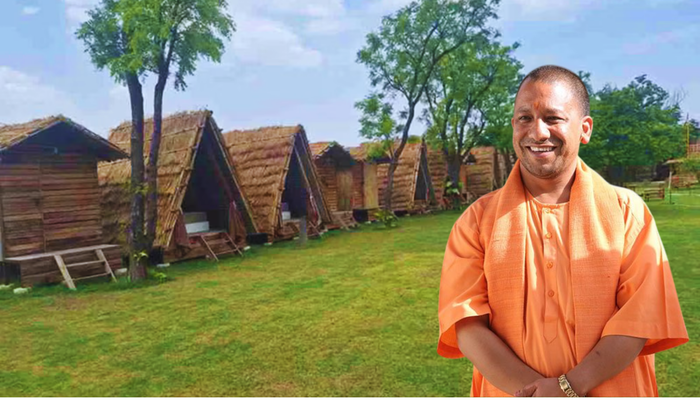
The Yogi government in Uttar Pradesh has launched a first-of-its-kind initiative to transform villages into hubs of Agri-tourism. The government has invited proposals from investors to develop and operate farm stay accommodations in rural areas in the state. The initiative is intended to boost Agri-tourism in the state and establish it as a pioneer of Agri-tourism in the country. It celebrates rural life and proposes to provide an experience of farming life, village culture and rural hospitality to tourists.
Welcoming the initiative, Uttar Pradesh Tourism Minister Jaiveer Singh said, “Uttar Pradesh is taking rural tourism to the next level with a vision that is entirely new. This initiative is not just about creating farm accommodations – it is about turning our villages into vibrant centres of culture, livelihood, and learning. Tourists today are eager to escape concrete jungles and experience authentic farm life – from milking cows at dawn to sharing meals in rural kitchens. We are ready to provide that warmth, simplicity, and authenticity.”
Principal Secretary Tourism, Mukesh Meshram said that the project aims to bolster rural economies by relinking urban tourists with the country’s agrarian roots. “Our focus is clear — this new farm stay initiative must translate into real benefits for rural households. From ensuring authentic farm-based experiences to providing modern facilities, every project will be guided to meet global standards while staying true to local culture. With strong incentives and transparent processes, this initiative will not only strengthen rural economies but also reconnect urban visitors with India’s agrarian roots,” said Meshram.
What the Farm Stay scheme offers
The scheme envisages setting up farm stays, as tourist accommodations, on or close to a working farm. It lays down certain requirements for the farm stays, such as the farm stay should be separate from the residence of the owner, it should have two lettable rooms and a reception area. The scheme aims to attract tourists by ensuring that the farm stay offers a first-hand rural experience, like Agri-farming, horticulture, fishponds, dairy farming, animal husbandry, farm tours, or other approved rural activities.
The initiative offers financial incentives and subsidies to attract investors. Here are the key incentives offered by the Uttar Pradesh government under the scheme-
Capital Investment Subsidy: The state government will provide varied amounts of subsidies under the scheme for different categories of projects. For projects between ₹10 lakh–₹10 crore, the government will offer a 25% subsidy (up to ₹2 crore), while a 20% subsidy (up to ₹7.5 crore) will be provided for a project up to ₹50 crore (up to ₹20 crore). For projects up to ₹200 crore and ₹500 crore, the government will offer 15% (up to ₹20 crore) and 10% (up to ₹25 crore), respectively. And for projects above ₹500 crore, a subsidy of 10% (up to ₹40 crore) will be provided.
Additional Subsidy: The Uttar Pradesh government will provide an additional subsidy for certain categories of investors. Up to 5% extra subsidy will be offered to women entrepreneurs, SC/ST/Backward Class investors, or for projects located in focus tourism destinations, with an overall ceiling of 30%.
Interest Subsidy: An interest subsidy of 5% will be offered on bank loans up to ₹5 crore, with a limit of ₹25 lakh per year for 5 years (in place of capital subsidy).
100% Exemption: There will be a total exemption of stamp duty, land conversion fees, and development charges for eligible projects.
Employment Subsidy: The employer’s EPF contribution for 5 years will be reimbursed for units employing 50+ local workers.
Support for Differently-Abled Friendly Units: ₹1,500 per month per worker will be provided to units employing disabled workers, with a limit of 5 workers per unit.
State government identified villages for the initiative
Taking swift steps, the Yogi government has already identified villages with high tourism potential. The scheme will add to the existing network of homestays and B&Bs. It will empower farmers and rural entrepreneurs by offering them an opportunity to diversify their income sources and, at the same time, preserve their traditional lifestyle. The initiative will also help in promoting local crafts by linking rural culture with tourism.