Home Blog Page 211

Chhattisgarh: 10 Naxal terrorists killed in an encounter, including senior Naxal leader Modem Balkrishna, who carried a reward of ₹1 crore

0

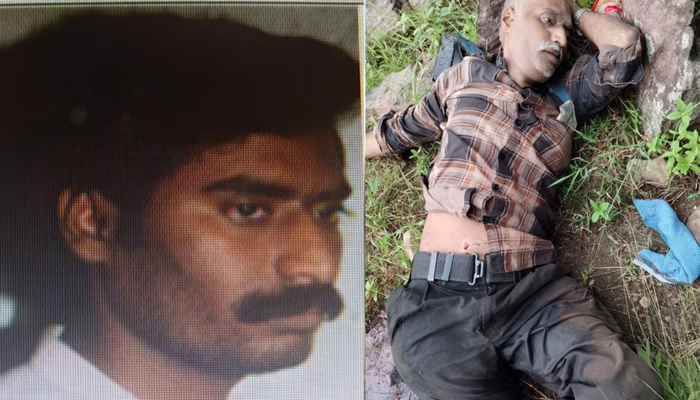
In a major anti-Naxal operation in the Gariyaband district in Chhattisgarh, the security forces eliminated 10 Naxal terrorists, including senior Naxal leader Modem Balkrishna alias Manoj, who had a bounty of ₹1 crore on him. Balkrishna was killed during an encounter on Thursday afternoon (11th September) in the forest of the Matal area.

Union Home Minister Amit Shah hailed the security forces for the achievement and urged the remaining Naxal cadres to surrender. “Our security forces have achieved another major success against the Naxalites today. In Chhattisgarh, CRPF’s Cobra commandos, Chhattisgarh Police, and DRG conducted a joint operation and eliminated 10 notorious Naxalites, including CCM Modem Balakrishna alias Manoj, who carried a bounty of ₹1 crore. The remaining Naxalites should surrender in time. The complete eradication of red terror is certain before March 31st,” Shah wrote on X.

The security forces reportedly received intelligence inputs about the presence of Naxals in the Mainpur forest region. Acting swiftly on the inputs, joint teams of E-30, STF, and COBRA launched an anti-Naxal operation on Wednesday night (10th September). Sporadic encounters began between the security forces and the Naxals in the morning, which continued till the afternoon.

The security forces have been conducting search operations in the area to see if more Naxals have been injured or killed in the encounter. “The encounter began in the afternoon. The Maoists discriminately opened fire on our forces, after which we retaliated. The exchange of firing continued till evening. After the encounter ended, search operations were conducted, and the bodies were found. Their identities are being ascertained. Weapons, including automatic ones, have been recovered,” Inspector General of Police Amresh Mishra said. He added that the security forces cautious and vigilant as Naxals usually target the security forces using the improvised explosive devices (IEDs) when they return from operations.

Who was Modem Balkrishna

Modem Balkrishna alias Manoj was a senior Maoist leader who hailed from the undivided state of Andhra Pradesh. He is said to have joined the Maoist cadre decades ago and was a member of the Central Committee, the second-highest body of the Maoists after the Politburo. Balkrishna was wanted by the security forces and carried a reward of ₹1 crore. He was involved in several incidents of murder, robbery and attacks on local police.

Intensifying their operation against Naxals, the security forces eliminated several Naxal leaders, including dreaded Nambala Keshav Rao alias Basavaraju, this year. The elimination of Maoist leadership by the security forces has weakened the Maoist cadres, which are now staring at a certain end.

Modi government has committed to eradicate Naxalism by 2026

In pursuance of its zero-tolerance policy towards Naxalim, the Modi government launched Operation Kagar in January 2024. It is a multi-pronged strategy combining aggressive military operations, enhanced coordination between Central and State forces, and development efforts to address the root causes of Naxalism. Under this operation, around 1 lakh para-military troops, including the Central Reserve Police Force (CRPF), its elite CoBRA units, District Reserve Guards DRG), and state police, have been deployed in the left-wing terrorism affected areas. These security personnel are equipped with modern technology like drones for information gathering, AI for intelligence gathering, and satellite imagery, among others.

Union Home Minister has declared to eradicate Naxalism by March 2026. As of 2015, approximately 106 districts across 10 states were classified as naxal-affected. This number was reduced to 38 by 2024 and further to 18. Out of these, 12 were considered the most impacted by naxal activities, yet this figure has now fallen to just 6.
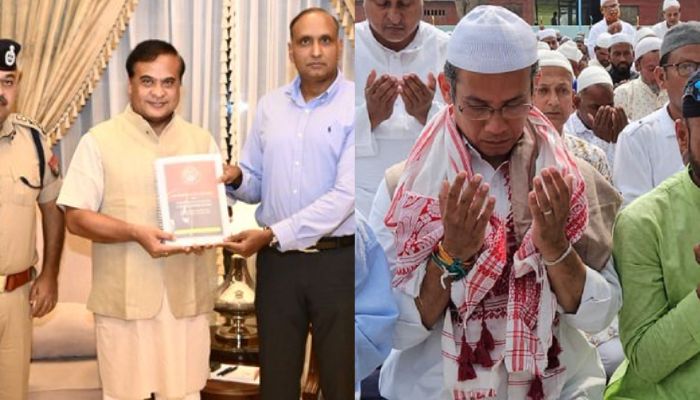
Congress MP Gaurav Gogoi Pakistan links case: SIT submits its report to Assam govt, CM Sarma says a conspiracy was underway to undermine India’s sovereignty

On Wednesday (10th September), the Special Investigation Team (SIT) constituted by the Assam government to probe the alleged links of Congress MP Gaurav Gogoi with Pakistan submitted its 96-page report to Chief Minister Himanta Biswa Sarma.

The report was handed over at Lok Sewa Bhawan in the presence of SIT members Munna Prasad Gupta, Rosie Kalita, Pranabjyoti Goswami and Maitrayee Deka.

In a post on X, CM Sarma said that the Assam Cabinet had constituted the SIT to investigate the “anti-India activities” and “have unearthed startling facts.”

He wrote, “On 17th February, 2025, the Assam Cabinet constituted a Special Investigation Team (SIT) to investigate the anti-India activities of one Pakistani national, Ali Tauqeer Sheikh, and his associates. During the course of this exhaustive investigation, the SIT has unearthed startling facts which point towards a larger conspiracy aimed at undermining the sovereignty of our nation.”

He further said that the inquiry also shed light on how Pakistan’s Ministry of Interior facilitated the visit of an Assam MP to the neighbouring country.

He wrote, “The SIT has also established the involvement of a British national, who is also married to an Indian Member of Parliament, in the larger nefarious activities of Ali Tauqeer Sheikh. Furthermore, the investigation also sheds light on how the Ministry of Interior, Govt of Pakistan, facilitated the visit of an Hon’ble Member of Parliament from Assam in their country.”

The Chief Minister added that the state government will now examine the SIT’s findings in detail. CM Sarma alleged that out of four members of Gogoi’s family, three hold foreign citizenship.

“The Assam Government will now examine the report of the SIT in detail and place it before the State Cabinet. Once the matter is discussed in the Cabinet, the information gathered during the enquiry will be made public,” the Assam CM wrote on X.

Meanwhile, Congress leader Gaurav Googi has claimed that CM Sarma’s allegations are based on a “fabricated story.”

“He (Assam CM Himanta Biswa Sarma) thinks that people of Assam are foolish enough to believe his wild allegations. He does not respect the intelligence and the wisdom of the people of Assam. The people of Assam know that he has built a fabricated story based on allegations only to hide the corrupt rule of his government and how he has used the chair of the Chief Minister of Assam to enrich his family and amass huge properties and illegal wealth…” Gogoi said.

It must be recalled that during a parliamentary discussion of Operation Sindoor 29th July, Union Home Minister Amit Shah blasted Congress MP and party’s deputy leader in Lok Sabha, Gaurav Gogoi, for his previous trips to Pakistan and asked as to whether he had ever visited the India-Pakistan border.

As OpIndia reported earlier, Elizabeth Coulburn, Gogoi’s British wife, is a project manager at Delhi’s Climate and Development Knowledge Network (CDKN). Surprisingly, Ali Tauqeer Sheikh, a Pakistani native, serves as the Regional Director of CDKN for Asia. He has a history of spreading misinformation against India, especially via his X account. He even posted in support of Gogoi for raising Delhi riots issue in the Parliament.

Sarma has repeatedly made grave allegations against him. “Serious questions need to be answered regarding allegations of ISI links, leading young individuals to the Pakistan Embassy for brainwashing and radicalization. and the refusal to take Indian citizenship for the past 12 years. Additionally, participation in a conversion cartel and receiving funds from external sources, including George Soros, to destabilize national security are grave concerns that cannot be ignored,” CM Sarma asserted in February of this year.

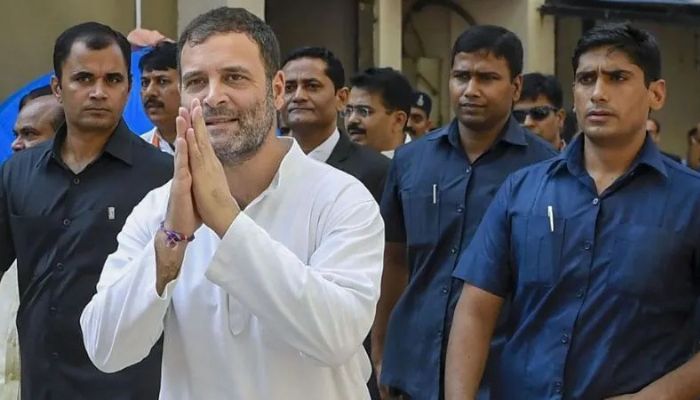
Rahul Gandhi violated security protocols 113 times since 2020, CRPF forced to write letter to Congress President: Read about the ‘yellow book’ for VIP security followed by the paramilitary force

The Central Reserve Police Force (CRPF) has been compelled to write a letter to Congress President Mallikarjun Kharge regarding the repeated violations of security protocols, outlined in its ‘yellow book’ for VIP security, by Rahul Gandhi.

The leader of the Opposition enjoys a ‘Z plus (Advanced Security Liaison)’ armed protection, which implies that about 10-12 CRPF commandos provide security cover to the Congress leader.

They also carry out reconnaissance of the locations which are set to be visited by Rahul Gandhi. However, the leader of the Opposition has repeatedly made unscheduled movements without prior imitation to the CRPF.

This gross violation of security protocol was witnessed during both domestic and international visits to countries like Italy, Vietnam, UAE, Qatar, UK, and Malaysia.

CRPF highlighted that such unannounced movements by Rahul Gandhi posed ‘high risk’ to his own security.

It urged the Congress leader to adhere to guidelines, which are mandated in the ‘yellow book’ of the CRPF meant for VIP security.

The Central Reserve Police Force pointed out that it was important for the protectee to keep the paramilitary force in loop at all times.

According to a report by The Indian Express, Rahul Gandhi has violated security guidelines 113 times since 2020. He flouted protocols during the Delhi leg of Bharat Jodo Yatra as well.

In a tweet, BJP spokesperson Amit Malviya highlighted, “Under the yellow book protocol, individuals under high-category security are required to provide prior intimation about their movements, including foreign travel, to enable deployment. Rahul doesn’t.”

In the meantime, the Congress party has cast aspersion on CRPF, which provides armed protection to Rahul Gandhi.

Malikarjun Kharge has questioned the ‘timing’ of the letter at a time when the Congress leader is busy peddling ‘vote chori’ conspiracy theories.

Spokesperson Pawan Khera alleged in a tweet on Thursday (11th September), “Is this a veiled attempt to intimidate the Leader of Opposition, who has already announced another imminent disclosure? Is the government rattled by the truth he is about to reveal?”

Yellow book of CRPF for VIP security

It must be mentioned that the Union Ministry of Home Affairs (MHA) has issued special guidelines for providing security to VIPs. It is called the ‘Yellow Book.’

The security protocols of all VIPs, barring the President, Prime Minister and Vice President, are outlined in the the ‘yellow book.’

Public personalities who have Z or Z+ security are mandated to notifiy CRPF about their travel plans and activities in advance. This helped the paramilitary force to assess and mitigate threats and keep the protectee safe.

If Congress leader Rahul Gandhi continues to break security protocols and flout guidelines, then, he could potentially risk his life like his father Rajiv Gandhi (who was killed during a targeted assassination in 1989).

Despite Trump’s pressure to impose 100% tariff on India, EU is all set to sign FTA with India, its Trade Commissioner arriving in New Delhi to conclude negotiations

In a move underscoring Europe’s independent trade strategy, the European Union is accelerating negotiations for a Free Trade Agreement (FTA) with India, even as U.S. President Donald Trump urges the bloc to impose up to 100% tariffs on Indian for continued purchase of Russian oil. Commerce Minister Piyush Goyal said that 60%-65% of the chapters have already been finalised, and the agreement will be concluded substantially soon.

The 13th round of EU-India FTA talks kicked off in New Delhi on Monday, with EU Trade and Food Commissioner Maroš Šefčovič and Agriculture Commissioner Christophe Hansen scheduled to arrive in India on 12 September. Minister Piyush Goyal said, “By the time my counterpart Mr Maros Sefcovic, the EU trade commissioner, and Mr Christophe Hansen, the EU agriculture commissioner, come to India, I think we will be quite set to try and conclude the agreement substantially.”

Goyal stated that the agreement could be substantially concluded by the end of 2025, paving the way for a joint strategic agenda at the next EU-India summit in early 2026.

Like the trade deal discussions with the US, agriculture remains the most complex subject, with India unwilling to open up the sector to protect the domestic farmers. In that context, participation of the Agriculture Commissioner of the EU is significant. Wine and spirits, processed agricultural products, dairy, sustainability commitments, and business visas are some of the thorniest issues.

An EU official told media that the broad agri-food market access offer involved in any agreement would be discussed along with negotiations on the EU-India Geographical Indications (GIs) agreement, and general cooperation with India on agricultural matters.

The FTA, relaunched in 2022 after a seven-year hiatus, aims to boost bilateral trade, currently valued at around €120 billion annually, by addressing market access for goods, services, investment, and contentious issues like agriculture and non-tariff barriers.

Sources indicate that chapters on digital trade and anti-fraud measures have been closed, with agriculture now formally on the table, a sign talks are nearing completion. The deal could enhance India’s exports in sectors like pharmaceuticals, garments, and steel, while providing the EU access to India’s burgeoning consumer market.

This progress comes against the backdrop of Trump’s recent actions against India. According to multiple reports, the U.S. president has pressed EU leaders to slap tariffs of up to 100% on imports from India and China, citing their purchases of Russian oil as fuelling Moscow’s war in Ukraine. Trump, who earlier this year raised U.S. tariffs on Indian imports to 50%, argued the measures would isolate Russian President Vladimir Putin economically. However, EU officials have dismissed the idea as unlikely, pointing to legal hurdles, ongoing FTA negotiations, and the bloc’s own trade priorities.

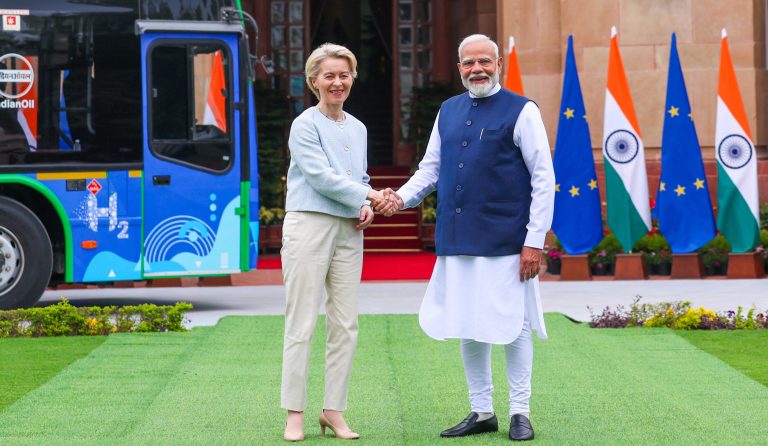
EU Commission President Ursula von der Leyen, in a recent call with Prime Minister Narendra Modi, reaffirmed the bloc’s commitment to wrapping up the FTA by year-end, while welcoming India’s role in Ukraine peace efforts. Danish Ambassador to India Rasmus Nørgaard, in an interview, countered Trump’s characterization of India’s economy as “dead,” calling it “the world’s fastest growing economy” and praised the EU’s investment push.

The EU-India FTA, if signed, could add billions to both economies and reinforce multipolar trade dynamics, potentially mitigating the impact of U.S. tariffs estimated at 0.3-0.4% of India’s GDP in the short term. As negotiations intensify, all eyes are on whether Brussels will yield to Washington’s demands or chart its own course with New Delhi.

Supreme Court quashes false rape case filed by a woman, frames four-step test for HCs to quash frivolous complaints

0

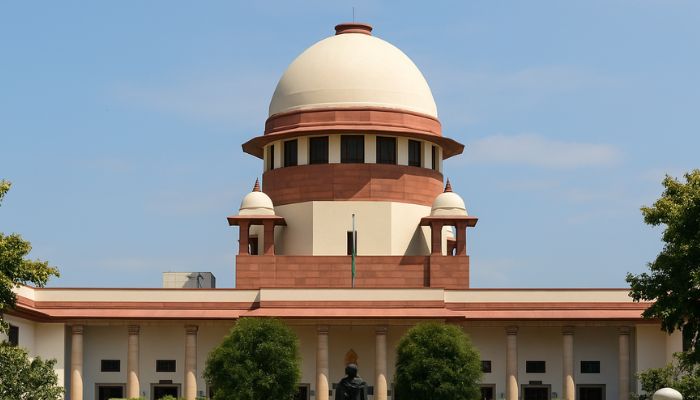
In a recent ruling, the Supreme Court quashed a criminal case involving allegations of rape on the false promise of marriage. The court noted that continuing proceedings in this case would amount to a gross abuse of judicial process.

While dismissing the case, a bench comprising justices JB Pardiwala and Sandeep Mehta on Wednesday (10th September), said that there is a “clear distinction between rape and consensual sex”.

In the present case, the woman filed a complaint against the man after four years, and did not give any explanation for the delay in doing so. The court noted that her allegations were vague, details regarding the alleged offences, even basic information like dates and places were not satisfactorily clear.

“…the complaint doesn’t inspire any confidence… There is no good explanation offered why it took four years for the complainant to file a case,” the court noted.

The Supreme Court was hearing an appeal against a 2019 order of the Allahabad High Court, which denied quashing criminal proceedings against the accused. The case stemmed from the complaint filed by a woman who accused the man rape, unnatural sex, assault and caste atrocity against the accused in 2014 for alleged incidents dating back to 2010.

The case filed by the woman came across a vindictive since the court noted that the accused man’s parents were also made parties, along with unrelated charges. Moreover, independent evidence was produced by the woman to back her allegations against the accused.

In addition, the court noted that the complainant refused to accept notice issued by the Supreme Court. The court opined that the complainant was not serious about the case and this move of hers further undermined her credibility.

The Supreme Court bench also highlighted that the Additional Chief Judicial Magistrate committed an error by issuing summons. Similarly, the Allahabad High Court also failed to exercise its inherent powers under Section 482 of the Code of Criminal Procedure.

“The Magistrate committed an error in passing the summoning order. The High Court too overlooked relevant aspects while rejecting the Section 482 application,” the bench said, adding that the High Courts should intervene to avert misuse of criminal process when complaints are frivolous and vindictive.

The apex court stated that the courts must carefully assess the accusations of sexual abuse made on the promise of marriage. The court added that if the accused person never intended to marry and made a false promise with sexual intentions, such “conduct would amount to cheating or deception.”

The court further stressed that false complaints of sexual assault against men not only tarnish their image but also amount to an abuse of legal process.

“It is by now well settled that summoning any person on the basis of a frivolous or vexatious complaint is something very serious. This would tarnish the image of the person against whom false, frivolous and vexatious allegations are levelled,” the court ruled.

The Supreme Court also laid down guidance for high courts handling petitions under Section 482 of the Code of Criminal Procedure (now Section 528 of the Bharatiya Nagarik Suraksha Sanhita). The court framed a four-step test to examine if criminal proceedings should continue or be quashed.

First the court needs to be convinced that the accused’s material is flawless and beyond doubt.

If accepted, it must then determine whether the evidence is enough to undermine the core of the claims and convince a reasonable person that they are untrue.

Third, the court should take into account whether the material that has been put on record has been denied by the complainant or the prosecution, or if it is of a type that cannot be justifiably disputed.

Fourth and last, the High Court has to decide whether permitting the proceedings to go forward would constitute a misuse of the legal process and not further the goals of justice.

Notably, with the rise in cases of false rape cases being filed due to failed relationships or the breach of promise of marriage, the Indian courts are now exercising caution in entertaining such cases. In August, the Uttarakhand High Court dismissed false rape case filed against a minor boy. In June this year, a court in Lucknow sentenced a woman named Rekha Devi to 7.5 years in jail for falsely accusing two men of raping her and for offences under the SC/ST Act.

Hundreds of South Korean women, who were forced to work as prostitutes for the US Army, file a lawsuit demanding justice and apology

0

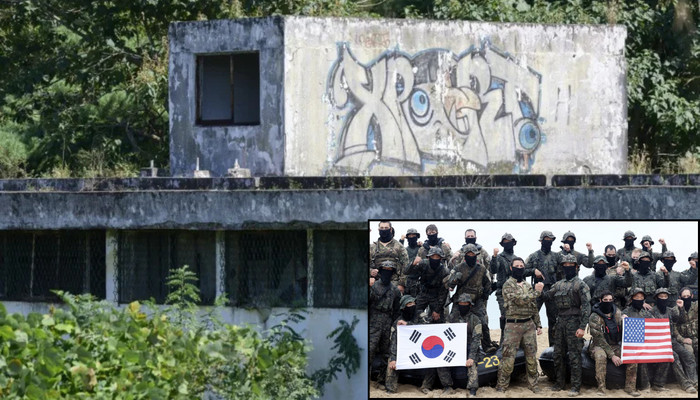
Hundreds of South Korean women, who were forced to work as sex workers for the US Army stationed in South Korea, have filed a lawsuit seeking an apology from the US Army. 117 South Korean women filed the lawsuit last week, accusing the US Army of abuse, as informed by their lawyers on Tuesday (9th September).

As per reports, thousands of South Korean women were forced to work in state-backed brothels between the 1950s and 1980s to serve the American troops, who were stationed in South Korea to protect the country against North Korean aggression. The lawsuit comes after South Korea’s top court, in 2022, held the South Korean government responsible for illegally establishing, managing and operating brothels for the US military. The court ordered the government to pay compensation to around 120 plaintiffs.

Every night, we were dragged to the US soldiers and abused: Victim

In the current lawsuit, the victims have sought compensation of 10 million won ($7,200) per victim. Recalling the brutalities she had to undergo while working as a prostitute for the US military, a 60-year-old plaintiff told AFP, “I still cannot forget being beaten by US soldiers – slapped for lowering my head while pouring drinks, for not smiling, or for no reason at all.” She said that she was 17 when she was tricked into working as a prostitute for the US Army soldiers in the name of working as a bartender.

She could not even escape as she was in debt. “Every night, we were dragged to US soldiers and sexually abused. Every week, we were forced to undergo venereal disease tests. If there was the slightest abnormality, we were locked in a small room and injected with a thick needle of strong penicillin. The shots were so harsh that my legs gave out and I couldn’t even walk,” she added.

A joint statement was reportedly released by some women’s rights activists in support of the victims. The statement said that the US military “ignored the South Korean Constitution” and robbed these women of their personal freedom and “destroyed their lives”.

South Korean government made a defendant in the suit

The South Korean government has been named as a defendant in the lawsuit, as under the existing laws, the onus to compensate the victims of illegal acts committed by the US soldiers on duty lies on it. Although the South Korean government can claim reimbursement from the US. “This lawsuit seeks to hold both the South Korean government and the US military authorities jointly liable for the unlawful acts,” a lawyer named Ha Ju-hee was quoted by the AFP as saying.

At present, the US maintains around 28,500 troops in South Korea. Commenting on the lawsuit, the United States Forces Korea (USFK) said, “We affirm that we do not condone any behaviour that violates Republic of Korea laws, rules, or directives, and we remain committed to maintaining the highest standards of good order and discipline”.

According to reports, the economy in the South Korean towns with US military bases, including restaurants, barbershops and bars catering to American GIs, accounted for about 25% of South Korea’s GDP during the 1960s and 70s. The issue of these women has not been addressed as the US and South Korea are long time security allies.

PM Modi visits Dehradun and assesses damage caused by floods in Uttarakhand, announces financial assistance of ₹1,200 crore for the state

0

Prime Minister Narendra Modi visited Dehradun on 11th September 2025 and reviewed the flood situation and damage caused due to cloudbursts, rains and landslides in affected areas of Uttarakhand. He reached Dehradun from Varanasi where he hosted visiting Mauritius PM Navinchandra Ramgoolam.

The Prime Minister had an official meeting in Dehradun to review the relief and rehabilitation measures undertaken as well as to assess the damage that has occurred in Uttarakhand. He announced financial assistance of ₹1,200 crore for Uttarakhand.

Prime Minister Modi emphasized the need for a multi-dimensional approach to help the entire region and its people recover. This would include measures such as rebuilding homes under the PM Awas Yojana, restoring national highways, reconstructing schools, providing relief through the Prime Minister’s National Relief Fund, and distributing mini kits for livestock.

It was announced that under the Pradhan Mantri Awas Yojana – Gramin, financial assistance will be extended under “Special Project’’ submitted by Government of Uttarakhand for reconstruction of houses in rural areas to eligible households whose houses have been damaged due to floods.

The Union Government has already sent Inter-Ministerial Central teams to visit Uttarakhand to assess the extent of damage, and further assistance will be considered based on their detailed report.

The Prime Minister expressed his condolences to the family members of those who have lost their lives in the natural calamity. He stated that the Union Government will work closely with the State Governments at this difficult time and extend all possible assistance.

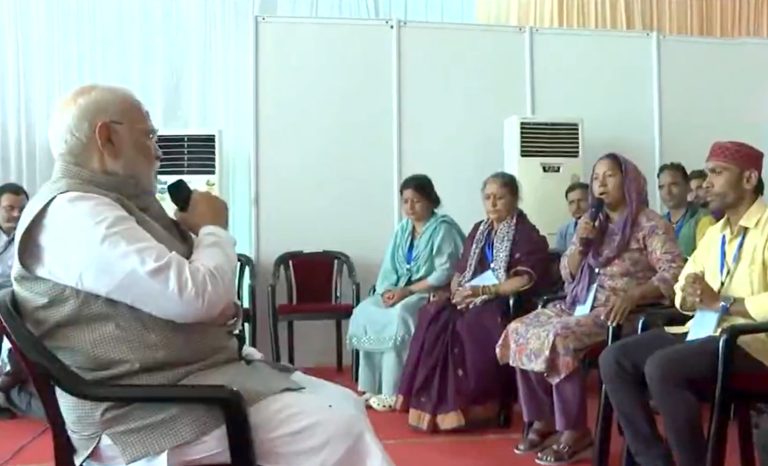
PM Modi also met families from Uttarakhand who had been affected by the recent natural calamities, including landslides and floods. He conveyed his solidarity with all those who had suffered and offered heartfelt condolences to the families who lost their loved ones. He also announced an ex-gratia of ₹2 lakh for the next of kin of the deceased and ₹50,000 for those seriously injured in the floods and related disasters.

The Prime Minister declared that children orphaned by the recent floods and landslides will receive assistance through the PM CARES (Prime Minister’s Citizen Assistance and Relief in Emergency Situations) Fund for Children scheme, ensuring their long-term care and welfare.

Prime Minister Narendra Modi also stated that the assistance under the purview of the Disaster Management Act and Rules including advance disbursements to the States being announced at this stage are for the interim period. The Central government will further review the assessment based on the memorandum of the State as well as the report of the Central teams.

He appreciated the efforts of the personnel of NDRF, SDRF, Army, State administration and other service-oriented organisations for making efforts in immediate relief and response. The Prime Minister acknowledged the gravity of the situation and assured that the Central Government will make all efforts to address the situation.

‘Nepo Kids’ of Nepal: Read how mass anger against luxury life of children of politicians Vs the abject poverty for common people drove Gen Z protests

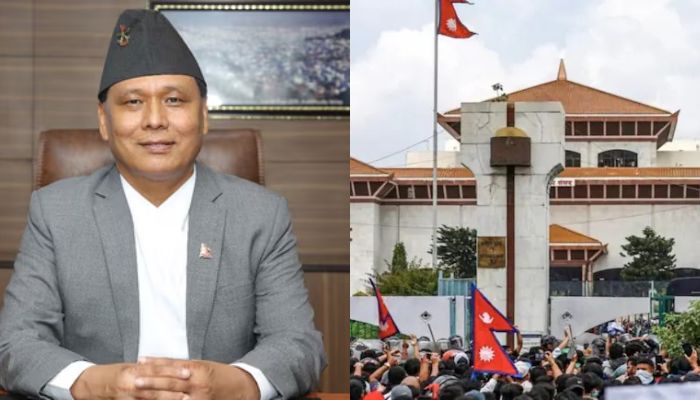
Nepal remained under tight restrictions and curfew on Thursday (11th September) after days of violent protests shook the small Himalayan nation.

The protests, led largely by Gen Z, have left 31 people dead and more than 600 injured so far. In Kathmandu, the Army asked people to stay indoors after troops came out in large numbers overnight to control the situation.

Protesters had set government buildings on fire earlier in the week, which eventually pushed the government to collapse.

Authorities also confirmed that around 13,000 prisoners were released from jails across all 77 districts of Nepal during the chaos.

On Wednesday (10th September), representatives of the protesters sat down with military officials at the Army headquarters in Kathmandu to discuss who could lead a transitional government. Some voices within the movement backed Sushila Karki, a respected former Chief Justice of Nepal’s Supreme Court, as the interim Prime Minister.

Kathmandu’s young mayor, Balen Shah, who is only 35 and was once a rapper before becoming an engineer and politician, has urged protesters to remain calm and wait for an interim administration to take shape.

From social media ban to street protests

The demonstrations first broke out on Monday, 8th September, after the government briefly banned social media platforms. Police fired into crowds, fueling further fury.

By Tuesday, 9th September, the demonstrations had gained pace, and government offices were being attacked by thousands of youths, with buildings were set on fire. The ban itself followed after 26 platforms, such as Facebook, YouTube, and X, failed to register under a new controversial law within a deadline.

Nepal’s government has said social media users create fake IDs and use them to spread hate speech and fake news, commit fraud and other crimes on these platforms. A government notice directed the regulator, Nepal Telecommunications Authority, to deactivate unregistered social media but gave no details of which platforms faced action. The services will be restored once the platforms comply with its order.

Officials claimed it was meant to stop fake accounts and cybercrimes, but for the youth, it felt like an attack on their voice.

The rising trend of #NepoKids

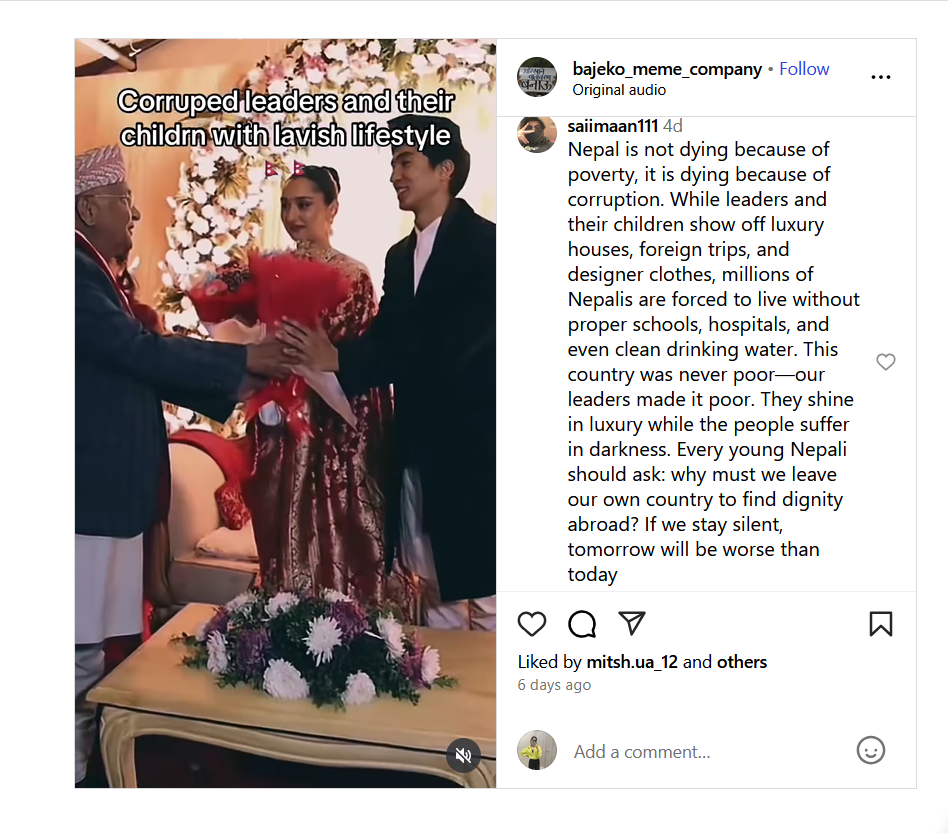
But the roots of this protest go deeper than just the ban. Even it started online a weeks ago. Over last few days, a series of videos and tweets erupted on Instagram and other social media under the banner #NepoKids. They featured the kids of senior politicians flaunting their Gucci handbags, private aircraft, and overseas university degrees. Their glamorous lives contrasted starkly with the struggle of poor Nepali families.

“Nepobabies live lavishly on the vast sums their corrupt parents steal from taxpayers-hard-earned money sent home through the sweat of migrant labor,” read a post.

For some, this tag was more than a trend. It revealed the lifestyle of Nepal’s political class children while living in comfort, compared to the ordinary youth who suffer unemployment and uncertain futures. The anger that built up online soon spilt onto the streets, turning into one of the biggest movements the country has seen in decades.

Two worlds, one country

On the one hand, the children of influential leaders reside overseas, travelling business class, living in high-rise apartments, and leading lives paid for by the money which belongs to the people of Nepal

On the other hand, millions of Nepalis are struggling daily for the fundamentals: affordable education, good healthcare, and secure employment. Young people are leaving the country to work overseas just to be able to sustain their families at home.

Screengrab of Instagram post

People started sharing videos under hashtags such as #NepoKid #NepoBabies #PoliticiansNepoBabyNepal, questioning whether privilege or personal effort drives politicians’ children’s success. Some are calling for street protests.

The divide became impossible to ignore. For the youth, it was not a matter of jealousy; it was about fairness and survival. How long, they asked, could they watch politicians’ children live in luxury while they fought for the bare minimum?

A generation that refuses to stay silent

This anger did not appear overnight. For years, Nepal’s youth have felt ignored by their leaders. Even past governments, including that of former Prime Minister K.P. Sharma Oli, failed to communicate with the public or deliver on promises. People’s concerns were brushed aside, and promises of reform never turned into reality.

This time, when the government tried to silence them with a social media ban, it backfired. Gen Z, already angry over years of corruption and nepotism, decided enough was enough. They did not just protest against the ban; they made it a voice to end corruption, nepotism, and privilege of the elite.

A protest that transformed Nepal overnight

The hashtag #NepoKids is now the face of this national rebellion. What began as a online debate has become a political earthquake. The demonstrations compelled the Prime Minister and some ministers to resign, showing just how strong people’s rage has become.

With the death count rising and thousands injured, the presence of the Army in Kathmandu demonstrates how grim the situation is. But the movement has already changed Nepal’s political landscape. It has been shown that in today’s digital age, a hashtag can bring down a government, and that a generation once dismissed as “too young” is now leading the fight for a fairer country.

When we look deeply into these protests, there is a simple truth. Nepali youths were not responding to a social media ban. They were responding to decades of discontent, never-ending corruption, politicians who use people’s money like their own, and a political elite whose children parade luxury in foreign lands while ordinary Nepalis fight for the basics back home.This profound rift was finally lashed out at in anger. Tired of being unheard, Gen Z hit the streets, not just over a social media ban, but to demand an end to corruption, nepotism, and elite privilege.

Nepal under curfew after violent Gen Z protests, no decision yet on interim chief, now Kulman Ghising emerges as frontrunner after Sushila Karki

Nepal stayed under tight restrictions and curfew on Thursday, 11th September, as the country tried to recover from days of violent Gen Z-led protests. The protests, led largely by youths calling themselves Gen Z, have left 31 people dead and more than 600 injured so far. In Kathmandu, the Army requested citizens to remain indoors while soldiers continued to patrol streets following protesters burning down government buildings earlier this week.

The unrest has also resulted in over 13,000 prisoners being released from prisons in Nepal‘s 77 districts. With the government having collapsed, attention has now shifted to forming an interim administration. Protest leaders and the Nepal Army, which has temporarily taken control, are holding talks on who will take charge next.

No decision yet on interim chief

With no government at place, the army has taken the responsibility of maintaining law and order. At the same, initiatives have started to form an interim government led by a interim chief who will oversee the conduct of a national election. Several names have emerged for the post of interim chief.

As discussions continue, three names are now being considered for the interim chief: former Chief Justice Sushila Karki, Kathmandu’s 35-year-old mayor Balen Shah, and Kulman Ghising, the former head of the Nepal Electricity Authority (NEA). The final choice will be made after protest leaders and Army officials sit together to reach an agreement. If things move smoothly, the country could soon see a new interim government taking charge.

At first, the strongest name that came up was that of Nepal’s first female Chief Justice, Sushila Karki. Reports suggested that Karki had even agreed over a phone call with the Army to take charge as interim Prime Minister after GenZ members elected her in an online poll. However, no final decision has been made so far. Now, another figure has emerged as a frontrunner, Kulman Ghising, the man credited with ending Nepal’s long and painful electricity load-shedding.

Background of Kulman Ghising

Kulman Ghising has become a name familiar to every household in Nepal due to his contribution to ending one of the nation’s largest issues, decades of debilitating power outages. 

A trained electrical engineer, Ghising started his professional journey with the Nepal Electricity Authority way back in 1994. In 2016, he was made managing director of NEA, a position in which he was instrumental in ending up to 18 hours a day of load-shedding that had exasperated the whole country.

Ghising graduated from India

Ghising was born in eastern Nepal, but he graduated in electrical engineering from the Regional Institute of Technology in Jamshedpur district of Jharkhand, India. He further took a master’s degree in power systems engineering from Tribhuvan University in Kathmandu. His success earned him universal public admiration, but his career was also marred by political obstacles. 

In March 2025, the then-Premier K.P. Sharma Oli axed Ghising as NEA chief a few months shy of the end of his term. The action drew immense criticism from opposition leaders and civil society, who felt his removal was political, not based on performance.

Ghising, however, remains immensely popular as an effective technocrat who has produced results for the common people. His image as a problem-solver has now catapulted him to centre stage again, this time as one of the front-runners to steer Nepal through one of its largest political crises in years.

Delhi police bust ISIS module running Pakistan sponsored ‘Khilafat model’, arrested terrorist Ashhar Danish had a postgraduate degree in English

0

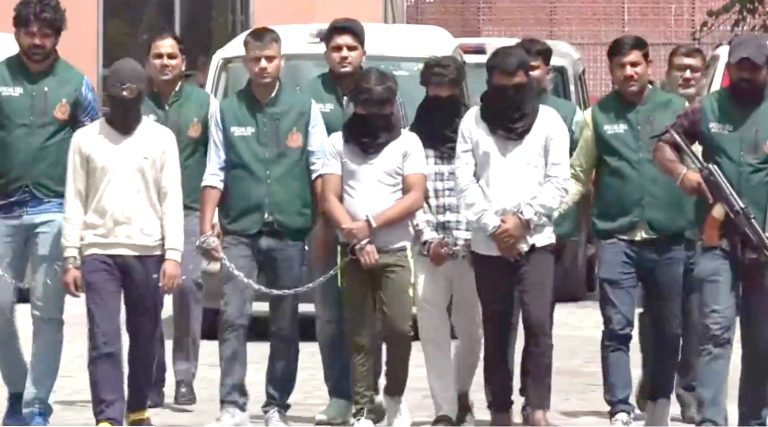
Delhi Police’s special cell has busted a ISIS terror module which was hatching a Pakistan handler-sponsored “Khilafat model” in the country. The police nabbed five people from four different states identified as Ashhar Danish, Sufiyan Abubakar Khan, Aaftab Ansari, Huzaifa Yaman and Kamran Qureshi.

Additional commissioner (special cell) Pramod Kushwaha said that the accused had hatched a “two-fold plan,” first forming a Khilafat-style group and then executing Ghazwa-e-Hind style jihad.

“Their plan was two-fold. First, they had to form a Khilafat-style group. They have their own team, which is called Lashkar, and after that, they had to do jihad, Ghazwa-e-Hind type, on the basis of their distorted concept of understanding of Islam. Plus, some targeted killings were to be tasked to them,” Kushwaha said.

The police recovered large quantities of objectionable material from them, like Sulphur powder, sulphuric acid, nitric acid, sodium bicarbonate, pH weighing checker, ball bearings and equipment which can be used for making an IED, wires, motherboards, laptops and mobile phones, plus weapons and cartridges.

A total of 11 people were picked up in the case, out of which five have been arrested. As per police, Ashhar Danish from Ranchi is the leader of the group who was pretending to be running a professional company. Therefore, he used to code CEO, and in his inner group, his code was Ghazwa leader. They were also trying to acquire land using the name of an NGO.

He reportedly had a postgraduate degree in English. Ashhar Danish came from an educated background. His father is a lawyer while his mother is a teacher. He is an expert in making bombs

“They had an internal group, these are highly radicalised boys,” added Kushwaha.

Ashhar Danish was nabbed from Ranchi, Sufiyan Abubakar Khan and Aaftab Ansari were arrested from Delhi, while Huzaifa Yaman was arrested from Nizamabad, Telangana, and Kamran Qureshi was arrested from Rajgarh, Madhya Pradesh.

Delhi Police said that the accused were trained in making IEDs and even cartridges. Police also recovered “incriminating drawings” from the accused. According to the police, the suspects revealed that their handler was teaching them to assemble IEDs online and told them to buy various of items including chemicals to make a bomb.

Kushwaha said, “This was a homegrown operation. So, acquiring weapons, including making IEDs, even cartridges, they were told to prepare on their own. Some incriminating drawings have also been found from them.”

Delhi Police have filed an FIR against the accused under offences of promoting propaganda to create enmity between communities, disturbing religious harmony, and possessing illegal weapons.

The central agencies are analysing the digital devices seized from the suspects to track their contacts and possible international links. The police added that the arrests have averted a possible terror strike in the country.