Home Blog Page 3095

After profiling Osama Bin Laden as ‘good husband’ and Terrorist Burhan Wani as ‘son of teacher’, whitewashers now profile Zubair

On July 3, Alt News co-founder Muhammed Zubair was sent to 14-days of judicial custody by Patiala House Court. Zubair has been accused of hurting religious sentiments, allegedly accepting donations from countries like Pakistan and Syria, and the Police are also probing if he was running any kind of nexus online to push an agenda on social media. Amid the array of allegations against the so-called fact-checker, the professional ‘whitewashers of the crimes’ have come to save the day for Zubair.

The News Minute has described him as some superior gully cricketer who had spent his younger days being the one who would call everyone to play cricket on the weekends. According to TNM, Zubair was never interested in politics before 2014. The portal seemed to have talked to his friends and colleagues, who claimed they do not recall any instance where he had shown interest in fact-checking and politics.

Suggesting he was a telecom engineer, TNM said he left his “comfortable life” to “draw attention towards misinformation”. Interestingly, Zubair himself ran a parody page where he “satirically” spread misleading information using the name of BJP leader Subramanyam Swamy. It was only after Swamy threatened him with consequences that he added the word “unofficial” to the Facebook page. This is not something we are claiming, but it was written in TNM’s report.

Eldest of the siblings, someone who was told by his father to “be an example” for his siblings, a quiet and studious person who was the “first to graduate in his family”. This is how portals like TNM and The Quint have described Zubair in their attempts to whitewash the alleged crimes he has committed.

Interestingly, knowingly or unknowingly, The Quint pointed out how strong the ecosystem is of which Zubair is a part. It said, and we quote, “Many had come out in support of Zubair, including followers of his work, leaders from several opposition parties, as well as international journalist networks. #IStandWithZubair was trending at number 1 on Twitter globally just hours after his arrest.”

Within hours of his arrest, the ecosystem managed to trend demand for his release on Twitter. Zubair, a person who was literally nothing in the political arena before 2014, became so strong in just eight years that a whole cabal of the international ecosystem came running to rescue him from the Indian legal system.

The Hindu, while profiling him, started their report with a quote from an interview that Zubair had given in October 2021. It read, “They cannot file a complaint against me for writing a story because we have facts with us in our stories.” Well, this is not the first time someone has claimed that Zubair or Alt News do not lie or spread misinformation. However, OpIndia documented ‘the tip of the iceberg’ by making a list of 20 instances where Zubair was caught red-handed, and he had to either apologise or simply delete the fake claims he made quietly. The list was prepared for Shiv Sena leader Priyanka Chaturvedi after she demanded to show one instance where Zubair had spread fake news.

The Hindu even moved a step forward and mentioned Zubair and Pratik Sinha’s so-called Nobel Prize nomination by the director of the Peace Research Institute of Oslo. Interestingly, the author who wrote the profile missed mentioning that PRIO’s list was unofficial, and the institute itself says that the list the director releases every year has literally no impact on the nominations for the Nobel Prize.

Everyone, including these three portals and media houses, has questioned the arrest because of the tweet that was posted in 2018. Five years have passed, and according to them, it is not an old tweet that should not be dug. Interestingly, many of them have targeted filmmaker Vivek Agnihotri for his old tweets to mock him for his current stand for Hindu rights.

The Quint wrote, “A day after Zubair’s arrest, PM Modi signed the ‘2022 Resilient Democracies Statement’ along with G7 countries in Germany pledging to “protecting the freedom of expression and opinion online and offline”. Many commentators pointed out the irony.” The irony is not what PM said. The irony is The Quint is pointing fingers at the arrest of Zubair but completely missing out on the point that if that is the case, the Halla bol against Nupur Sharma should also have never happened. What PM said should apply to each and everyone irrespective of his or her caste, religion, race, gender and more.

How media houses have whitewashed crimes in the past

This is not the first time a media house or a left-liberal portal has tried to whitewash the crimes. Newslaundry, in 2021, was accused of misquoting Sreedathan, the founder and managing director of the website Indus Scrolls in a quest to whitewash the terror links of the Islamist organisation Popular Front of India (PFI) member and ‘dubious’ journalist Siddique Kappan, who was arrested in UP for conspiring to create communal tension in Hathras.

The Quint whitewashed Delhi anti-Hindu riots and accused Shahrukh Pathan, who had brandished a gun at the Police and threatened them. The writer of Pathan’s profile romanticised his criminal act. “Unfazed by the policemen in riot gear, he shot bullets in the air while media persons captured his acts in astonishment. The fact that the gym enthusiast, who was also a local, did not wear a mask to hide his identity made his ‘bravado’ seem peculiar and odd,” the author said. It also brings in his family because there is nothing like showing him as a regular ‘biryani loving guy’. The Quint does not even try too hard to break the stereotypes.

Not to forget, the same portal, which claims to be the actual flag bearers of liberty, has portrayed terrorists like Osama Bin Laden as magnanimous and great saints like Swami Vivekananda as an ordinary “cigar-smoking monk”! Similarly, terrorist Burhan Wani was championed as the son of a teacher.
Maharashtra: NCP leader Jayant Patil makes casteist remarks on Deputy Speaker Narhari Zirwal, backtracks after Dy CM Fadnavis objects

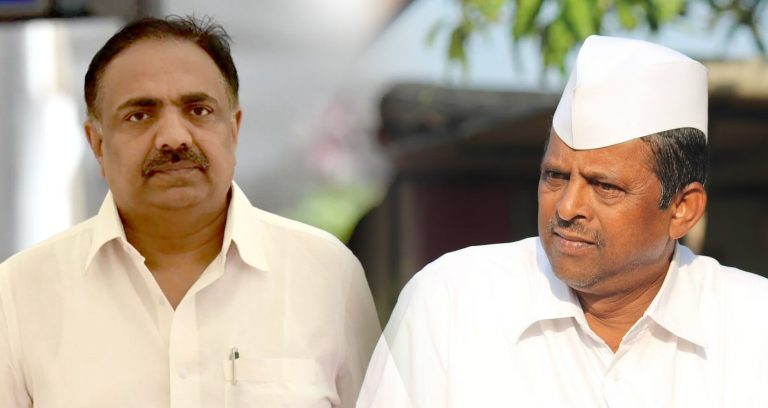
During a motion to greet the newly elected Speaker of the Maharashtra state legislature, Nationalist Congress Party (NCP) legislator Jayant Patil made casteist remarks about the house’s Deputy Speaker. Jayant Patil noted during his address that the deputy speaker, Narhari Sitaram Zirwal, performed a good job even though he is a tribal. He said, “Despite being a tribal, Narhari Zirwal did a good job.”

Narhari Zirwal is a NCP MLA and he had been presiding over the sessions in assembly after previous speaker and Congress leader Nana Patole resigned to become the chief of Maharashtra Congress.

Following Patil’s remarks, Deputy Chief Minister Devendra Fadnavis objected to what he stated. Fadnavis said that Patil should not be using such a language for a respected member of the house and that such a language has no place in the house. Several members also objected to the same and requested that the remarks made by Patil be removed from the recordings of the proceedings of the house. Following the demands, the comment was expunged from the records of the assembly.

Later commenting on the issue, Jayant Patil said that as his remarks have been expunged from the records, the matter is over. He also said that he was only appreciating the work done by Narhari Zirwal, and his remarks were misinterpreted.

Bharatiya Janata Party Member of Legislative Council Gopichand Padalkar lambasted NCP State President Jayant Patil for his remarks. Talking to reporters, Padalkar said, “The party has gone from power but the attitude has not gone. When NCP leader Jayant Patil came to speak, he talked about Deputy Speaker Narhari Jirwal and said that he did a good job even coming from the tribal community. How does it matter if he belongs to a tribal community?”

Padalkar continued, saying, “Your hatred isn’t quite ready to leave. What’s in your stomach makes its way to your lips. Is it impossible for someone from a tribal, backward class, nomadic tribe, or nomadic poor caste to do anything here?”

It is worth noting that Jayant Patil was caught making a mockery of Hindu rituals in April of this year while sharing the podium with another politician, Amol Mitkari. Amol Mitkari, an MLC from the Sharad Pawar-led NCP, mocked Hindu practises such as Kanyadaan during weddings while speaking at the NCP Pariwar Samwad Yatra in Islampur, Sangli district, Maharashtra, on April 19, 2022. Jayant Patil was there in his company and burst out laughing when Amol Mitkari made the remarks.

Curious case of Alt News co-founder’s ears: Netizens wonder why Mohammed Zubair keeps hiding his ears from the camera

On June 27, the co-founder of Alt News, Mohammed Zubair, was arrested by Delhi Police for allegedly hurting religious sentiments based on the complaint filed by Sub Inspector Arun Kumar, posted at IFSO/Special Cell, Dwarka, New Delhi. Since then, police have added sections of criminal conspiracy, destruction of evidence, and FCRA violation to the case against him.

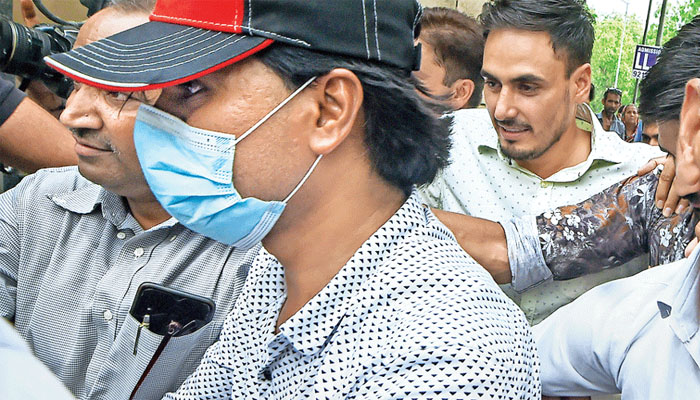
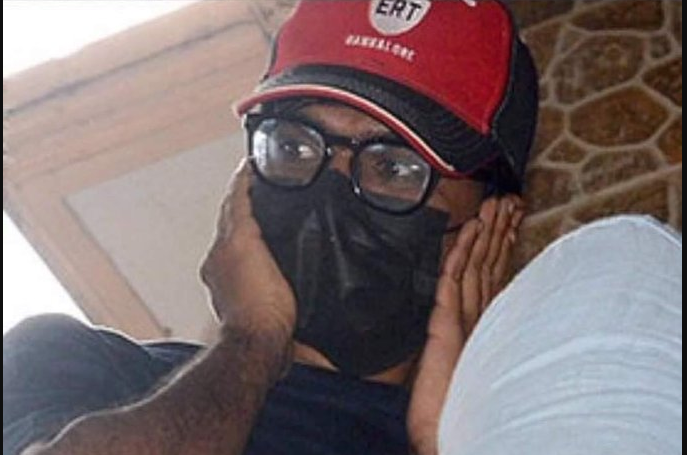
On Saturday, July 2, the Delhi Court rejected his bail application and sent him to 14-day judicial custody. Since his arrest, Zubair has come across cameras several times while appearing for his bail hearings, or when police took him to his residence for collection of evidence. Whenever he has come across the camera, Zubair has understandably tried to hide his face by wearing a mask, and pulling a baseball cap low over his face.

However, one more interesting thing has caught the eye of several netizens. Most of the time, Mohammed Zubair has made a conscious effort to hide his ears from the camera while making these appearances. This weird act has left the netizens confused as to whether it is just an idiosyncrasy or something more.

A swayamsevak and Twitter user Rahul Kaushik tweeted, “Who’s Zubair? Every single photo he’s hiding not only face, but ears too.”

National Security Affairs Analyst Divya Kumar Soti said that the way Zubair hides his ears, he seems to be highly trained.

Another Twitter user @thinkerspad shared the curiosity of the other internet users and raised questions about the identity of the arrested person and whether it is the same person as in Zubair’s Twitter profile.

Whether it is something innocuous or inconsequential, or something far more sinister, we can not know, but this act of Mohammed Zubair covering his ears in front of the camera has definitely got social media talking.

Justice Pardiwala of Supreme Court roots for regulating social media, day after he was criticised for blaming Nupur Sharma for Udaipur murder in an oral observation

After attracting severe criticism over the unwarranted oral remarks by a Supreme Court bench of Justices Surya Kant and JB Pardiwala, today justice JB Pardiwala advocated for censorship of social media and digital media. He made the comments while speaking at the 2nd Justice H R Khanna Memorial National Symposium hosted by Dr Ram Manohar Lohiya National Law University, Lucknow, National Law University Odisha, Cuttack, and CAN Foundation on July 3. He advocated for the regulation of social and digital media in the context of sensitive trials that are pending, and said that Parliament should bring law for the same.

Justice JB Pardiwala said that regulation of social and digital media, especially in the context of sensitive trials which are sub-judice, must be looked at by the parliament, citing incidents of ‘media trials’. He said that Social and digital media leads to legal issues becoming political.

Speaking at the conference, Justice Pardiwala said, “Social and digital media is primarily resorted to expressing personalised opinions more against the judges, rather than a constructive critical appraisal of their judgments. This is what is harming the judicial institution and lowering its dignity.”

“This is where digital and social media needs to be regulated throughout the country to preserve the rule of law under our constitution. Attacks on judges for their judgements lead to a dangerous scenario; where the judges have to think what the media thinks, rather than what the law actually says. This puts the rule of law on the burner,” Pardiwala further said.

According to Justice Pardiwala, the remedy for judgments lies not with social media but with higher courts in the hierarchy. Legal concerns become political as a result of social and digital media. He cited the Ayodhya judgement as an example of how a controversial civil case became a political issue.

He went on to rant against social media, saying social media is about personal opinions against the judges instead of providing opinions criticizing the judgements. This is what harming the judiciary in the country, justice Pardiwala alleged.

He also said that personal attacks on judges for their judgements lead to a dangerous scenario where the judges have to think about what media thinks instead of what the law really thinks.

It’s worth mentioning that Justice Pardiwala was recently criticized for his comments in a case involving ex-BJP spokeswoman Nupur Sharma. Nupur Sharma had petitioned the Supreme Court for the transfer of all FIRs filed against her in various states to Delhi for further probe. Sharma mentioned in her application that she is constantly being threatened with death. 

During the hearing, the bench of Justice Surya Kant and Justice JB Pardiwala blamed Nupur Sharma for the gruesome Udaipur murder, claiming that her “loose tongue” set the entire country on fire and that she owed an apology to the entire country.

While Justice Pardiwala demanded the Parliament to enact law to regulate social and digital media, actually the union government has already taken steps in this regard. The IT Rules 2021 are aimed at regulating content on social media and digital media only.

Legal Rights Protection Forum urges President of India to call a meeting with CJI regarding Justice Surya Kant’s comments on Nupur Sharma

Legal Rights Protection Forum urged President of India Ramnath Kovind to call a meeting with the Chief Justice of India (CJI) N.V. Ramana regarding Justice Surya Kant’s comments on Nupur Sharma. The Forum has said that the comments by the Supreme Court judge have shaken the conscience of the entire nation and eroded people’s faith in the judiciary.

The Forum tweeted, “Legal Rights Protection Forum urged the Hon’ble President of India to call for a meeting with Hon’ble CJI in regard to comments made by Js Surya Kant which have shaken the conscience of entire Nation & eroded its faith in the fairness of the highest office of the Indian judiciary.”

They further added, “Urged to impress upon the CJI to get unwarranted remarks expunged & reiterate His valuable suggestion made earlier that, it is also incumbent upon judges to exercise the utmost discretion in what they say in courtrooms.”

On 1st July 2022, the Supreme Court of India Judge, Justice Surya Kant, blamed former BJP spokesperson Nupur Sharma’s comments for the brutal Udaipur murder. He stated that Sharma’s ‘loose tongue’ has set the entire country on fire and she should apologize to the whole country. Nupur Sharma had moved the SC seeking the transfer of all the FIRs registered against her, across several states, to Delhi for further investigation. Sharma, in her application, stated that she is facing constant life threats.

Meerut: Gay friends Imran, Shavej, Ali and Salman kill youth Yash Rastogi suspecting he had their video, chop body into pieces

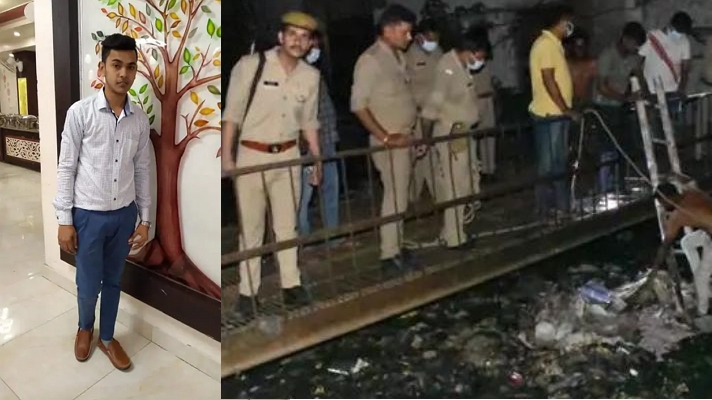
In a shocking incident that took place in the Pilokhadi area of Meerut on 26th June 2022, a group of gay Muslim friends killed a 22-year-old Hindu youth Yash Rastogi and then chopped his dead body into pieces and threw it into a drain. The Meerut police have arrested all the four accused and further investigations are going on. The deceased youth Yash Rastogi was a law student.

According to a report by Dainik Bhaskar, LLB student Yash Rastogi, a resident of the Jagriti Vihar Sector 6 of the Medical police station area, was killed by his gay Muslim friends after which the killers chopped and threw his dead body into a drain near Pilokhadi in the Lisadi Gate area of Meerut. The Meerut police recovered the dead body parts from the drain on Saturday, July 2 late at night. The arrested accused have told during the police investigation that they had sodomised the deceased youth before killing him.

According to Meerut city SP Vinit Bhatnagar, this was a group of gay friends. Yash Rastogi was killed by his gay friends in the same group. A post-mortem of the recovered dead body was conducted on Sunday and then last rites were performed at the Surajkund crematorium. A heavy police force was deployed at the deceased youth’s home, medical college, and Surajkund considering the sensitivity of the situation. The students studying with Yash Rastogi have demanded that the accused should be charged with the National Security Act. The locals have also demanded the administration that the houses of the accused be bulldozed.

As it happened

On June 26, Yash Rastogi left his home in the evening on his scooter saying that he will return in a while. His family members lodged a complaint in the Medical police station as he did not return. The police traced the last location recorded by his mobile phone. It turned out to be Pilokhadi near the Lisadi Gate area. On the basis of the call detail records of his phone, the Meerut police arrested four suspected accused Imran, Shavej, Ali and Salman. All of them were Yash Rastogi’s friends.

The arrested accused first tried to dodge the questions from the police. A stricter investigation revealed that Shavej met Yash at Lisadi Gate. Yash Rastogi refused to show his mobile phone to these friends. Other three friends suspected that Yash must be hiding their video which he might have made. After a brief exchange of abusive words between Yash Rastogi and his friends, the accused friends strangled Yash Rastogi to death. After his death, Yash was also stabbed in hands and legs with a knife. The police said that the reason for death will be known after the post-mortem report is received.

According to the police, Shavej and Ali alias Alijaan told during the interrogation that they and Yash had a homosexual relationship. He was murdered on June 26. Before killing Yash, the accused made homosexual relationships with him. Later they cut off his neck with a knife. Then they cut his body into several pieces and packed it in a sack to throw into the drain.

As indicated by the accused, the police recovered the dead body from the drain. Hapud Adda, Lisadi Gate and Shastri Nagar are very sensitive areas in Meerut. The dead body was recovered late in the night to avoid any kind of ruckus by the crowd that would gather on the spot to support the accused. The police staff from three police stations and three commanding officers were present in the night while recovering the dead body.

Netizens surprised as Congress credits Modi govt-led PMGSY scheme for development work in Rahul Gandhi’s constituency Wayanad

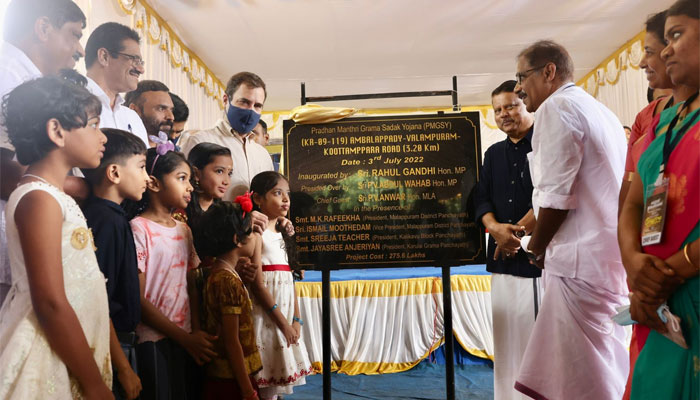
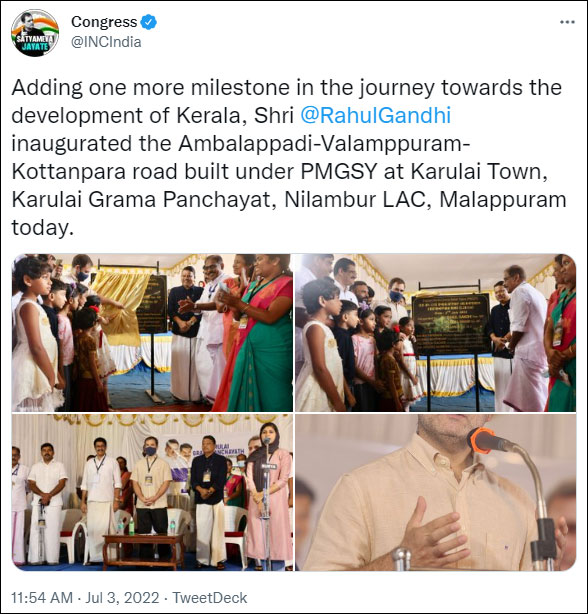
On July 3, Congress leader Rahul Gandhi inaugurated the Ambalappadi-Valamppuram-Kottanpara road built at Karulai Town, Malappuram, that falls under his parliamentary constituency, Wayanad in Kerala. From the official Twitter handle, Congress wrote, “Adding one more milestone in the journey towards the development of Kerala, Shri Rahul Gandhi inaugurated the Ambalappadi-Valamppuram-Kottanpara road built under PMGSY at Karulai Town, Karulai Grama Panchayat, Nilambur LAC, Malappuram today.”

Tweet by Congress. Source: Twitter

The scheme under which the road was built is Pradhan Mantri Gram Sadak Yojna (PMGSY), a central government initiative to strengthen the road network in rural areas and increase the connectivity between rural and urban areas. It is noteworthy that PMGSY is 100% funded by the central government. The scheme was launched in December 2000 during former PM Atal Bihari Vajpayee’s tenure. Rahul Gandhi inaugurated a 3.2 KM long road that was built under the scheme at the cost of approx 2.75 crores.

It came as a shock and amusement to netizens as they witnessed Congress praising and crediting Modi government-led scheme for development work in Rahul Gandhi’s constituency.

Union Minister of State for Entrepreneurship, Skill Development, Electronics & Technology Rajeev Chandrasekhar said, “Even in mostly absent #Kerala MP Rahul Gandhi’s constituency Wayanad, development is only because of Narendra Modi govt schemes and funds.”

Replying to Congress, political observer Rishi Bagree also pointed out that “PMGSY funds are allotted by Centre.”

Highlighting the origin of the scheme, Twitter user Pawan Khajuria said, “Pradhan Mantri Gram Sadak Yojna (PMGSY) was started by Atal Ji in the year 2000 because Congress never bothered about pathetic road conditions in rural India.”

Another Twitter user Shiv Seeker said, “Wayanad Congress MP takes credit for Kerala’s development by “inaugurating” a road, built under PM Shri Narendra Modi Ji’s Pradhan Mantri Gram Sadak Yojana, launched by erstwhile PM Swargiya Shri Atal Bihari Vajpayee Ji, under a Centrally Sponsored Scheme in the year 2000.”

Twitter user Mee2Wee_ said, “PMGSY – Pradhan Mantri Gram Sadak Yojana. Thank you, Narendra Modi Ji, for adding another milestone in the journey towards the development of Kerala. Happy to see Congress acknowledging it and also appreciating Modi Ji for sending Rahul Gandhi to inaugurate it!”

Appreciating Congress for this gesture, Twitter user The Hawk Eye said, “It’s rare nowadays opposition endorsing central govt schemes. Respect.”

Twitter user A Ram said, “Why do we need Rahul Gandhi of Congress to inaugurate a road funded and built by Narendra Modi project. LOL Rahul Gandi can’t find anything else to inaugurate?”

It is noteworthy that Congress has a habit of mocking the central government schemes to satisfy their political agenda. Let it be the Agnipath Scheme, CAA, NRC, or any other scheme by the BJP-led NDA government at the centre, Congress has actively opposed most of them irrespective of their merits and benefits for the public.

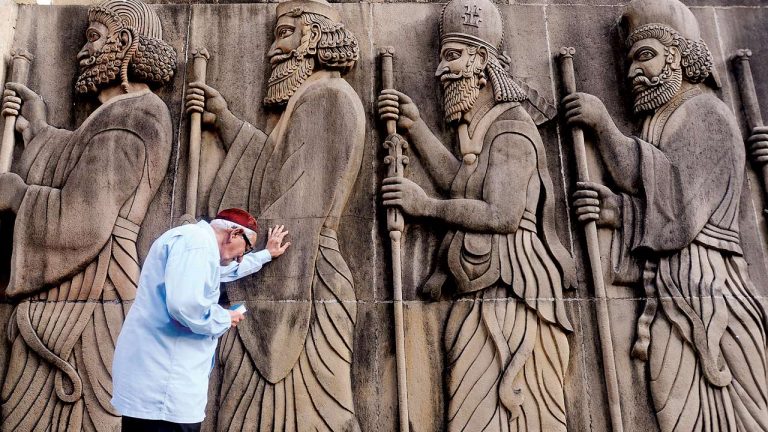
The history forgotten: The persecution of Parsis by Muslims in Persia and their migration to India

The spread of Islamic radicalism has resulted in the migration of native communities from their motherland on multiple occasions in the past. The departure of Parsis, or Zoroastrians, from Persia to other areas of the world as a result of the expansion of Islam in the 7th century AD is one such instance. We shall cover the entire history of the Religion with reference to the infamous events of religious persecution as we delve deeper into the exodus of Zoroastrians as a result of Islamic invasions and their migration to India.

The Parsis are an ethnoreligious minority currently residing in the Indian subcontinent. Following the invasion of Sassanid Iran by Arab Muslims under the Rashidun Caliphate in the 7th century AD, their ancestors moved to India. Parsis adhere to Zoroastrianism, also known as Mazdayasna in its original form, one of the world’s oldest religions. Until the middle of the seventh century, Persia (modern-day Iran) was a politically independent state with a Zoroastrian majority. For about 1000 years, until the Sassanian Empire, Zoroastrianism was the recognised official religion of the state.

History of Zoroastrianism

According to scholars, the origin of Zoroastrianism dates to the Bronze Age, when the Prophet Zarathushtra first revealed and preached “the Good Religion.” Around 1750 BC, Zarathushtra spread his ethical monotheistic doctrine across ancient Persia and Central Asia, converting a limited number of faithful men and women. Legend has it that Zarathushtra was invited to impart his teachings to King Vishtasp, who became one of the first of many Central Asian kings to adopt this new and revolutionary faith.

Zoroastrianism ultimately acquired widespread recognition, eventually becoming the religion of Cyrus the Great’s Achaemenian Empire (550-330 BC). Alexander the Great vanquished the Achaemenians in 330 BC, and the city of Persepolis, together with its collection of holy manuscripts, was destroyed by fire. After almost a century of Greek domination under the Seleucids, the Parthians (256 BCE-226 AD) ascended to power and dominated Iran for a number of years. The Sassanian Empire (226–652 AD) succeeded the Parthian Empire, and during the next 400 years, its monarchs made Zoroastrianism Iran’s official religion. With up to 30 million followers, this was the heyday of Zoroastrianism.

Persecution of the Zoroastrians

The Sassanian Empire was overthrown by Arab Muslims in 652 AD. A major portion of Zoroastrians converted to Islam; some practised their faith privately and were frequently persecuted. Forced conversions and intermittent violence were used as forms of discrimination and harassment against Zoroastrians both during and after the Arab Muslim conquest of Persia.

Throughout the history of Zoroastrianism, there is abundant documentation of Zoroastrians being persecuted. It is known that Muslims who came to the region during the Rashidun Caliphate invasion destroyed Zoroastrian temples. Many Zoroastrian temples were demolished, and mosques were built instead, with many Persian libraries set ablaze. Many Iranian fire temples were converted to mosques by the Muslim rulers. In territories that had been taken over by Muslims, Zoroastrians even had to pay a tax called Jizya.

In order to escape persecution and the negative effects of being treated like a second-class citizens during the Islamic caliphates, many Zoroastrians converted to Islam. Their children were sent to an Islamic school to learn Arabic and memorise the Quran, among other religious lessons, when a Zoroastrian subject converted. In an effort to persuade Zoroastrians to convert to Islam, the number of laws governing their behaviour rapidly increased, reducing their ability to participate in society and making life difficult for them. Zoroastrianism’s supremacy over religion in Persia was eventually toppled by the Arab invasion, which also made Islam the state’s official religion.

Migration of Zoroastrians to India

As Muslims began to Islamize Persia, many Zoroastrians fled to India, where they were granted sanctuary. According to legend, the Zoroastrians fled to northern Iran first, then to the island of Hormuz, and finally to India to save themselves and their faith. According to the Qissa-i Sanjan, the only documented chronicle of Zoroastrian emigrants in India, a small handful made their way to Gujarat, where they were given the name “Parsi”—literally, those from Paras or Fars, which is the traditional word for Persia.

Modern-day Parsis narrate a legend about Zoroastrian ships arriving in Sanjan and being received by Jadi Rana, a native ruler in Gujarat. Rana offered the immigrants a full glass of milk to indicate that there was no place for them. The Zoroastrians responded by adding a spoon of sugar to the milk, demonstrating their intention to blend in and subtly sweeten the figurative glass of milk without filling it to the brim. It is believed that following this incident, Jadi Rana granted the immigrants permission to stay on the condition that they learn Gujarati and wear the local attire Saree. The immigrants agreed to the requests and founded the town of Sanjan in Gujarat, named after their hometown in Iran. They began to live there as agriculturalists for a long time after their arrival.

Parsis gaining affluence

Many Parsis who had previously resided in rural villages around Gujarat moved to the English-run towns as soon as British commercial posts were established in Surat and throughout India in the early 17th century to take advantage of the new employment opportunities. Due to their increased openness to European influence and aptitude for trade and business, the condition of Parsis changed drastically.

After the East India Company seized power in Bombay in 1668, Parsis from Gujarat started to emigrate there. Their work and skill as merchants were largely responsible for the city’s expansion in the 18th century. By the nineteenth century, they were a distinctly wealthy society, and starting around 1850, they had great success in heavy industries, particularly those connected to railways and shipbuilding. The Parsis gained notoriety in India’s social, industrial, and educational domains over the ensuing decades. They were at the vanguard of progress, earned enormous wealth, and donated generously to the underprivileged.

Present status of Parsis in India

The Parsi community in India is one of the most prosperous minority and migrant communities in the world. Despite accounting up only 0.0005% of India’s population, they have had a significant impact on the country’s economy. According to the 2011 Indian Census, there are 57,264 Parsis in the country. The entire Parsi population in 2001 was 69,601. The population of the Parsi community was 91,266 in 1971 and 71,630 in 1981. The drop has eased in successive years, but the 2011 census revealed that their numbers are once again declining.

Maharashtra has the largest Parsi population of 44,854, followed by Gujarat with 9,727. There are just 221 Parsis in Delhi. In Andhra Pradesh, there are 609 Parsis, whereas in Karnataka, there are 443. Some of the Prominent Parsis from India are Jamsetji Nusserwanji Tata – founder of the Tata group, Homi Jehangir Bhabha – renowned Indian physicist, Field Marshal Sam Manekshaw – former Chief of the Army Staff, Ardeshir Godrej – Founder of the Godrej Group of companies, Dr. Cyrus Poonawalla – founder of the Serum Institute of India.

Kanhaiya Lal beheading: Witness seeks for government help through media, currently living in hiding, report says

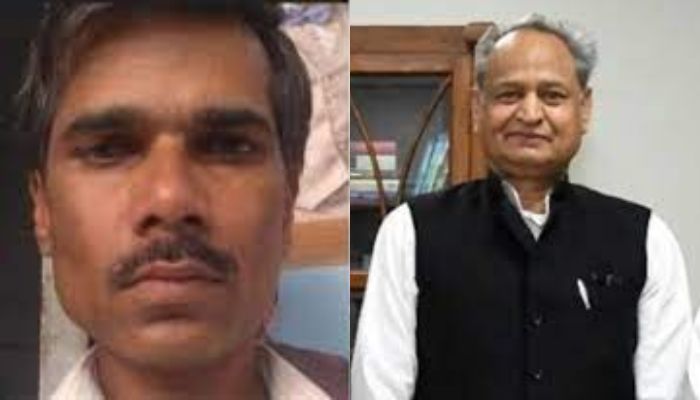
Rajkumar Sharma, one of the witnesses of the Kanhaiya Lal beheading incident, is currently living in anonymity due to fear. Rajkumar Sharma’s family members, while talking to the media, have asked for help from the government. Kanhaiya Lal, a Hindu tailor in Udaipur, was beheaded by two Islamists on 28th June 2022 for a social media post supporting the former spokesperson of Bharatiya Janata Party Nupur Sharma.

In an interaction with The New Indian, Rajkumar Sharma’s wife told, “We thought that it is our duty to ensure that this thing never happens with anyone else again. This is why we are cooperating with the government. All I wish is that my husband gets to do a job in a safer place. Government should help us for financial and security purposes. I request you to convey our request to the government. I cannot tell the government and the chief minister directly. Otherwise, I would go there and urge them to help us. Therefore, I am asking them for help. We have cooperated with the government and we expect help from the government in return. So, please take our voice to the government or please tell me the address and contact details of the chief minister so that I can tell him the same.”

Rajkumar Sharma used to work in Kanhaiya Lal’s shop. He was present in the shop when the murderers attacked. Rajkumar Sharma provided the details of the brutal attack as he spoke to the media. Rajkumar Sharma and Ishwar Gaud are the two eyewitnesses to the incident. Right now, he is forced to live in anonymity as he fears that he will be attacked by some Islamists in a similar manner. Rajkumar Sharma is not stepping out of his home due to fear. Another eyewitness Ishwar Gaud is injured as he tried to save the deceased Hindu tailor Kanhaiya Lal.

TMC’s Saket Gokhale asks AG to initiate contempt proceedings against us: Here is why this is a hill I am willing to die on

On the 1st of July, ex-spokesperson for BJP Nupur Sharma approached the Supreme Court to save her life. All she wanted was for multiple FIRs filed against her to be clubbed, so she does not have to travel from city to city in order to cooperate with the investigation against her. Her argument? She has been getting death and rape threats constantly and owing to security concerns, it would be dangerous for her to travel.

She did not refuse to cooperate with the investigation. She did not tell the Supreme Court to quash the FIRs against her. She merely wanted her life not be endangered in the process of the investigation.

The Judges of the Supreme Court made shocking observations while refusing to grant her request. She was mocked for being under threat when the Judges asked her if she was under threat or had she become a threat, she was the recipient of sarcasm when the Judges remarked “they must be red carpeting you” to her lawyer saying she was cooperating with the investigation and worst of all, the Judges held her “loose tongue” responsible for the beheading of Kanhaiya Lal by Islamists. Why was Kanhaiya Lal beheaded? Because he supported Nupur Sharma.

The observations by the Judges while dispensing the case did not make it to the written order making these remarks their personal opinions and not the opinions of the Supreme Court – the institution.

OpIndia, on its part, criticised the observations by the Judges, as it should have. As the Editor-in-Chief, I wrote an article where I questioned the Judges, asking them if they would blame the “loose tongues” of their fellow Judges for the threats they receive by Islamists after pronouncing the judgements in certain cases – The Ram Janmabhoomi case, the Hijab verdict, the Gyanvapi case, to cite a few examples.

It should be kept in mind that one of the Judges who made these remarks had earlier pulled up security agencies for not doing enough when Judges are at the receiving end of threats – this is the same Judge who dismissed the threats that Nupur Sharma was receiving.

In another report, we wrote that the Judges had emboldened Islamists. Our earlier headline had said that the Supreme Court had spoken the language of Islamists but once the observations did not make it to the written order, we had to change it and criticise the Judges specifically and not the Supreme Court.

TMC leader Saket Gokhale, who has taken donation money from unsuspecting Muslims to fund his own lifestyle, took offence. Today, he wrote a letter to the Attorney General of India, demanding that criminal contempt charges be brought against OpIndia and me, as the editor-in-chief of the platform and author of the article, because we lowered the majesty of the Supreme Court.

Saket Gokhale claims that we insulted the Supreme Court and “twisted” its observations in the Nupur Sharma case. He is, of course, just saying this. He wants to go after OpIndia and prove a point – when the Judges decide in our favour, they absolutely cannot be criticised.

While we should be terribly worried about the contempt proceedings and what happens if the AG accepts the demands of Saket Gokhale, I write this article today to say, with utmost conviction – We did no wrong and this is a hill I am gladly willing to die on.

First and foremost, the Judges, in this case, extended their brief when they made these observations. They proclaimed Nupur Sharma as guilty in a case where they had no jurisdiction to go into the merits of the case at all. They had to decide if there is sufficient threat against her for the FIRs to be clubbed – as they have done before in the case of Kamlesh Tiwari. Legally, the comments were unnecessary and against their brief. Retired Judge, SN Dhingra, has himself slammed the Judges for their “political comments”.

Retired high court judge SN Dhingra said, “Supreme Court has apparently said that Nupur Sharma was high on the power she had as a member of the ruling party and she carelessly went on to make those comments. As per my conscience, the same things also apply to the Supreme Court. Supreme Court itself cannot hold anyone guilty without any investigation. The case was put in front of the Supreme Court only for transferring the FIRs and not for proving any charges against her. I don’t understand how the Supreme Court can make such oral observations? If the Supreme Court had guts, it would have given those comments as a part of the written order. The Supreme Court has only written in the order that the petition is dismissed as withdrawn. Why? Why did the court not include its comments in the written order so that the Supreme Court could be held answerable to the questions like – how is it righteous of you to consider her guilty without any trial of the case, to become a prosecutor yourself, to charge the accused on your own, and declare her guilty only to deliver your judgment orally?”

This absolute shock was not only expressed by SN Dhingra but the public at large. Average citizens who have reposed their faith in the legal system time and again felt dejected and infuriated by these “political comments” by “judges drunk on power” (SN Dhingra’s words, not mine).

Here are some samples:

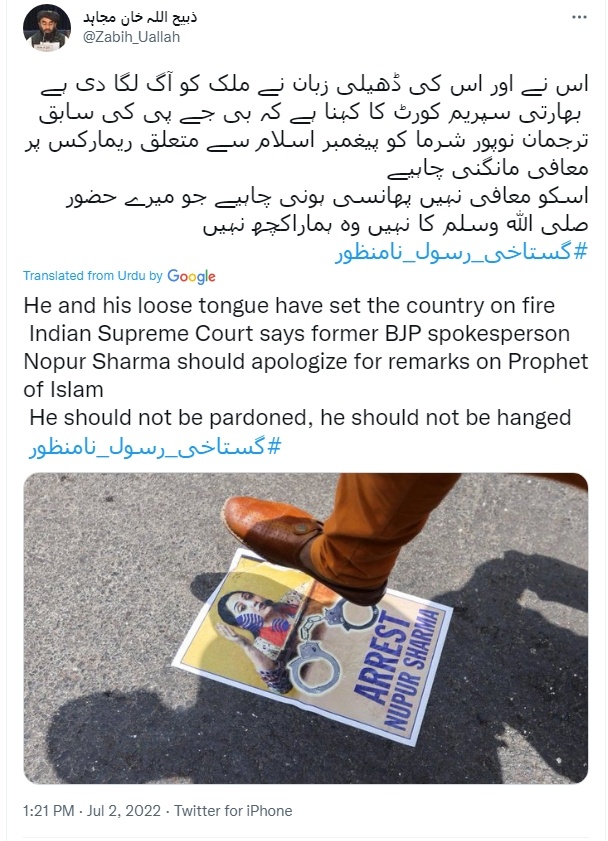
And these are just samples. One can cite millions of such tweets expressing absolute shock and dismay at the conduct of the Judges. The support that accrued for these observations, unironically, came from the Taliban.

Taliban Spokesperson supporting Judge’s comments on Nupur Sharma

Is it the contention that I have to agree with arguments that the Taliban agrees with simply because they came from two Judges? As a journalist and a woman who has watched another woman be thrown to the wolves by all and sundry, I refuse to submit and I refuse to “behave”.

The upside of this petition by Saket Gokhale is that at least, fundamentalist allies like him have essentially admitted that Islamism is a bad thing. If they believe us saying that the Judges spoke the language of Islamists and that, according to him, is liable for contempt, then he also admits that Islamism should be condemned. I will take that small victory that he and his supporters unwittingly delivered to us.

The other upside to this is we will finally find out if the Courts are willing to treat a Nupur Sharma and a Prashant Bhushan equally. I am but a dispensable cog in the system and an average citizen who picked up her pen because others had sold theirs. I am no Prashant Bhushan who can get the courts to open their doors at 12 AM for a convicted terrorist. The lower court has in the past treated Hindus and Muslims differently, I would hope and pray that the Supreme Court treats Prashant Bhushan and a dispensable journalist the same as well. We will find out, at least. That is a small victory I am also willing to accept as a consequence of Saket Gokhale’s letter to the AG.

Let me state my position as clearly as I possibly can without going into the merits of Nupur Sharma’s case because that is not the purpose of this article. A woman is being told that she will soon be beheaded. She is being told that Islamists will find her and gang-rape her. She is being told that she will be chopped into pieces and thrown in the gutter. The ones issuing these threats have proved that they will act upon it – they beheaded Kanhaiya Lal for supporting Nupur Sharma, they beheaded Umesh Kohli for supporting her and have rioted on the streets demanding “Sar Tan Se Juda”. The Judges, in this case, provided sanctity to the offence that allows them to murder by saying Nupur Sharma was responsible for Kanhaiya Lal’s murder, thereby almost exonerating the Islamists and their religious hate that led to the murder. I, as a journalist and a woman, will not stand quietly. I, as a journalist and a woman, stand by every word I have written against the observations of the Supreme Court. If contempt charges are brought against me – I will fight them. If Bharat, this ancient civilisation, can bring itself to have a discussion around the restraint that Judges should exercise in making unnecessary comments because of my “loose tongue”, so be it. Bring it on.