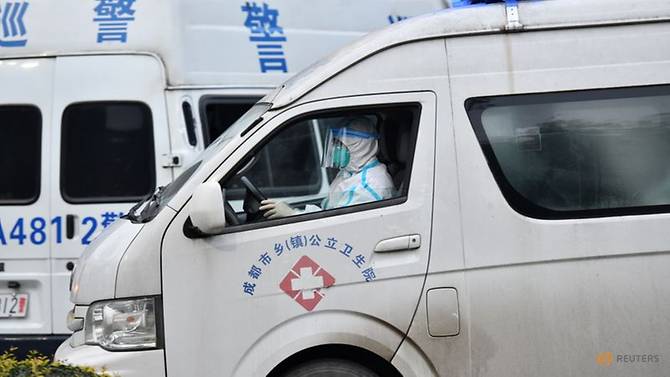
There are Covid-19 outbreaks in clusters occurring throughout China, the Epoch Times has reported. Authorities in Chinese cities are also announcing “wartime” mode one by one, the report claimed.
“At present, the epidemic in our country has entered the stage of ‘multi-point outbreak.’ … Over 20 cluster outbreaks have occurred in different regions,” Zhang Boli, a member of the Chinese Academy of Engineering and president of Tianjin University of Traditional Chinese Medicine, is quoted as saying.
As per the report, the Chinese language Epoch Times was told by locals in Beijing and southwestern city of Chengdu that they do not believe the official narrative and suspect that there have been more diagnosed cases than announced. The outbreak in Beijing is believed to have been sparked by a 27-year old male from Jilin Province.
The man arrived in Beijing through Hong Kong. He tested negative at the quarantine center but developed fever and diarrhea soon afterwards. Meanwhile, the new cases are reportedly triggering a panic about possible lockdowns and supermarket shelves have been cleared out already.
China recorded 23 new cases on Saturday, up from 17 the previous day, with at least 1 case of local transmission. The National Health Commission said that that 22 of those cases were imported with 1 local transmission in the northeastern province of Liaoning. The cases were primarily from Dalian city, Liaoning Province, and Heilongjiang Province.
Mainland China recorded 15 more cases on December 21st. 13 of the new cases were said to be imported while two were cases of local transmission, again in Liaoning. 17 asymptomatic cases were reported as well, up from 15 the day before. China does not include asymptomatic cases in its total confirmed cases tally. Thus far, the mutated form of the virus emerging from the United Kingdom has not been spotted in China.
On Monday, a 21-year-old woman named Asha was brutally attacked in broad daylight in Deshpande Nagar in Hubballi district of Karnataka. The accused, identified as a 25-year-old auto driver named Ismail, has now been arrested.
As per reports, the accused was in a 2 year-long relationship with the woman. The victim, who hails from Moraba village in Dharwad, ended the relationship with Ismail and got into a relationship with another man. She also stopped picking his calls for the last 5 months. This angered the accused who then sought to take revenge.
In a video that has now gone viral on social media, the accused could be seen attacking the victim with a machete while she collapsed on the middle of the road. A passerby, stopped his bike and intervened to pacify the situation, even when Ismail was armed with the deadly weapon.
Spurned #lover attacks woman with #machete in #Karnataka‘s Hubbali. Asha is admitted in the #hospital nearby. Ismail is #arrested. While all may refrain from interfering, one must appreciate this #man, who walked up to the attacker and attempted to thwart further assault. pic.twitter.com/A4m4dWnAIW
The incident took place when the victim was en route her workplace at a jewellery shop. Ismail stopped her on the way and attacked her brutally with a machete from behind. Republic TV reported that Ismail had also tried to commit suicide a few days ago but was saved by his relatives. The accused works as an auto driver in Rampura in Dharwad district.
Ismail arrested, victim undergoing treatment
Hubballi Police Commissioner Labu Ram stated that the accused has been arrested and that the deadly weapon, used in the assault, has been recovered. “An investigation is going on. The girl has been shifted to a private hospital and is undergoing treatment. The doctor told us that she is out of danger. Once she regains consciousness, we will take her statement,” he added.
While speaking about the incident, investigating officer SK Holeyannavar informed, “The woman apparently ended the relationship and is now in a relationship with another man and this angered him. We are investigating the matter fully and speak to the woman in detail after she has recovered from the attack.”
Nikita Tomar shot dead in Mewat
Earlier in October, a 21-year-old student named Nikita Tomar was shot dead in full public view by two men outside the Aggarwal college in Ballabgarh, Faridabad. Her family has now alleged that he was forcing her to convert to Islam and marry him. A relative stated that Taufeeq alias Sajeed started harassing Nikita three years ago. A few months back, too, a complaint was lodged against him for harassment and molestation.
However, the family later dropped the case. Lately, the accused again allegedly started hounding her and pressuring her to embrace Islam. The relative confirmed that the accused initially wanted to abduct her but killed her when she resisted to his demands. The family has now demanded that a Special Investigation Team (SIT) should be constituted to probe the case.
The Trump administration had recently decided to ban cotton imports from one of the largest cotton producers in China, Xinjiang Production and Construction Corps (XPCC). On Wednesday last week, the US Customs and Border Protection agency said that its “Withhold Release Order” would ban cotton and cotton products” from XPCC, which is a powerful Chinese quasi-military organization. It is believed that the company uses the detained Uighur Muslims as slave labour, reported Nikkei Asia.
The ban on XPCC will have a notable effect on its involvement in the global business of textiles and apparels. In 2015, the 66-year old company produced 30% of the total cotton produced in China. The Treasury Department has already banned all dollar transactions with XPCC in July this year.
China-made cheap cotton goods are a product of slave labour
Kenneth Cuccinelli, Security Secretary, Department of Homeland, has called “Made in China” a “warning label.” He said, “The cheap cotton goods you may be buying for family and friends during this season of giving, if coming from China, it may have been made by slave labour in some of the most egregious human rights violations existing today in the modern world.”
Brenda Smith, CBP’s executive assistant commissioner for trade, said that this ban would force apparel firms and other companies using XPCC-produced cotton to change their supplier, eliminating the company’s presence from many stages of the supply chain.
Reaction from China
Hua Chunying, China’s foreign ministry spokeswoman, said that the claim that Chinese firms use forced labour is false. She said, “All workers in Xinjiang choose their occupations based on their own volition and sign labour contracts with firms based on the principle of equality and free will.” She further added that the ban is in contradiction to the international trade rules, and it is going to hurt consumers everywhere.
Identifying XPCC cotton may be difficult, say traders
Reuters quoted a trader from China who said that ban on XPCC would pretty much block all Chinese textile imports. Identification of the supplier will increase the manufacturing cost. He said that only a few companies are capable of guaranteeing that they were not using XPCC cotton. “It really depends on how much proof they want. If they want real proof that this cotton has not been used, that’s going to be extremely difficult,” he added.
Reuters had quoted major clothing brands including Gap Inc., Patagonia Inc. and Zara owner Inditex said though they do not source from factories in Xinjiang, it is not possible to confirm if their supply chains are free of cotton from XPCC.
Earlier, the US apparel makers had criticized the proposal of a broader ban on cotton from Xinjiang, but they welcomed the XPCC-specific ban on Wednesday. The group that includes groups like the American Apparel and Footwear Association and the National Retail Federation issued a statement in which they said they were on the “front lines of efforts to ensure forced labour does not taint our supply chains or enter the United States.”
US companies lobbying against Uyghur labour bills
Jennifer Wexton, U.S. Democratic congresswoman, has called out Coca Cola, Nike and Apple for allegedly lobbying against Uyghur labour bills on December 2. She said these companies should prove they are not using forced labour in China. During an interview, Wexton said that there is evidence that China is building more camps to forcefully keep ethnic people of the Xinjiang region. She added that though these companies have not approached her, the “word is that they’re trying to water down some of the enforcement provisions while publicly proclaiming that they are very much against and condemning forced labour. They’re going behind the scenes and trying to change the law.”
Problems for Biden
President-elect Joe Biden may find it difficult to ease US-China tension after this ban imposed by the Trump administration. Biden has pledged to work with the United Stated allies to increase pressure on China to curb human rights and trade abuses. However, he also wanted to ease the tension between the two nations that have increased during the Trump administration due to action against major Chinese state companies. The Trump Administration has banned access to US technology and investments for many companies, including Huawei and others.
The ‘slave labour’ in China
In 2018, a United Nations human rights panel said in a statement that they have a credible report that China is holding over one million ethnic Uyghurs in China in what resembles a “massive internment camp that is shrouded in secrecy.” Gay McDougall, a member of the UN Committee on the Elimination of Racial Discrimination, stated that in the western Xinjiang autonomous region, an estimated two million Uyghurs and Muslim minorities were forced into “political camps for indoctrination.”
We remain deeply troubled by reports of an ongoing crackdown on Uighurs and other Muslims in China. We call on China to end their counterproductive policies and free all of those who have been arbitrarily detained. https://t.co/UeYxNQGsdb
China has said that it is facing a severe threat from Islamist militants and separatists. The Communist Party of China-led government has said that these militants and separatists stir up tension between the Muslim Uyghur minority who are native to the Xinjiang region and the ethnic Han Chinese majority.
At that time, the U.S. mission to UN said in a statement that they are deeply troubled by the reports of an ongoing crackdown on Uyghurs and other Muslims in China and had called on China to end counterproductive policies and free all of those who have been arbitrarily detained.
‘Uyghurs for sale’ – Australian Strategic Policy Institute report
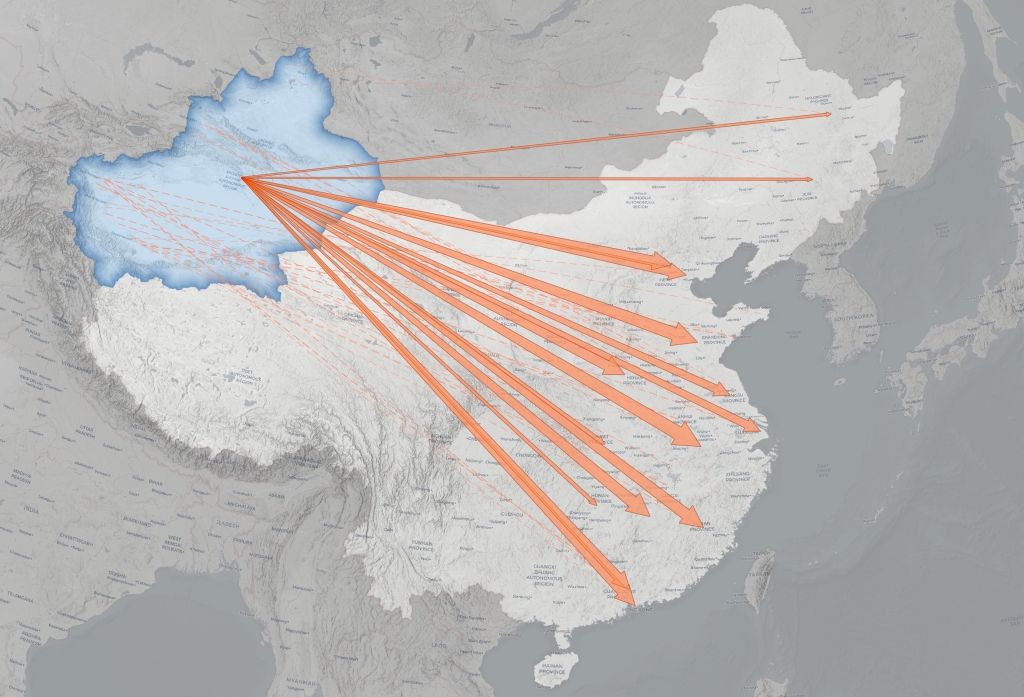
In Match 2020, the Australian Strategic Policy Institute (ASPI) had released a report on the condition of Uyghur and other ethnic minority citizens from the far west region of Xinjiang. The report detailed out how ethnic people from the said region have been mass transferred across the country. The conditions they work in suggest forced labour. The report suggested that as many as 82 well-known global brands in sectors including technology, clothing and automotive sectors have such workers in their suppliers’ factories in China. These companies include major names such as Apple, BMW, Gap, Huawei, Nike, Samsung, Sony and Volkswagen.
Uyghur transfers to other parts of China from 2017 to 2020 (Image: ASPI)
As per the report, there are more than 80,000 Uyghurs who were transferred to different parts of the country between 2017 and 2019. Some of them were sent directly from the detention camps. The number included in the report was conservative, and the actual numbers can be much higher. These workers not only work as forced labour but have to undergo compulsory organized Mandarin and ideological training outside working hours. They are constantly under surveillance and not allowed to take part in any religious observations.
The Nike Factory in China
Qingdao Taekwang Shoes Co. Ltd employed over 600 ethnic workers from the Xinjiang region, comprising mainly Uyghur women from Hotan and Kashgar. These regions are located in the remote area of southern Xinjiang, which the Chinese government describes as a “backward region that is affected by religious extremism.” These workers work in the factory during the day time and then attend a night school where they study Mandarin, sing the Chinese national anthem and receive ‘vocational training’ and ‘patriotic education,’ the report suggested. This factory makes around 70 lakh shoes for Nike every year. A report in the Washington Post suggested that these workers are not allowed to go home on holidays.
Adidas’ connection with forced labour in China
The Haoyuanpeng Clothing Manufacturing Co. Ltd is a part of the program. On its website, it suggests that the company supplies products to Italian–South Korean fashion label Fila, German sportswear companies Adidas and Puma, and Nike. As many as 63 forced labourers were transferred to its factory in 2018. When Adidas was asked about its association with the company, a spokesperson said that they do not have a direct relationship with the company and they will investigate the issue further.
Apple one of the beneficiaries of ‘forced labour’ in China
O-Film Technology Co. Ltd, which manufactures selfie cameras for Apple’s iPhone 8 and iPhone X, has been allegedly using forced labour in China. In, 2017, around 700 Uyghurs were reportedly transferred from Lop county, Hotan Prefecture, in Xinjiang to work at O-Film’s factory in Nanchang, Jiangxi province, the ASPI report had stated.
In December 2017, Apple CEO Tim Cook had visited the Guangzhou factory of O-Film. At that time, Cook praised the company’s humane approach towards its employees. The press release has now been deleted from Apple’s website. O-Film’s other major customers include Acer, Samsung, Mi, Asus, HTC, Sony, H.P. and many others.
Labour transfer from Xinjiang and labour trade
In recent years, the transfer of ‘forced labour’ has increased from Xinjiang. As per the media reports, 20,859 ‘rural surplus labourers’ from Xinjiang were transferred to other Chinese regions in 2017. In 2018, the number increased to 28,000, and in 2019 approx 32,000 people were transferred out of Xinjiang.
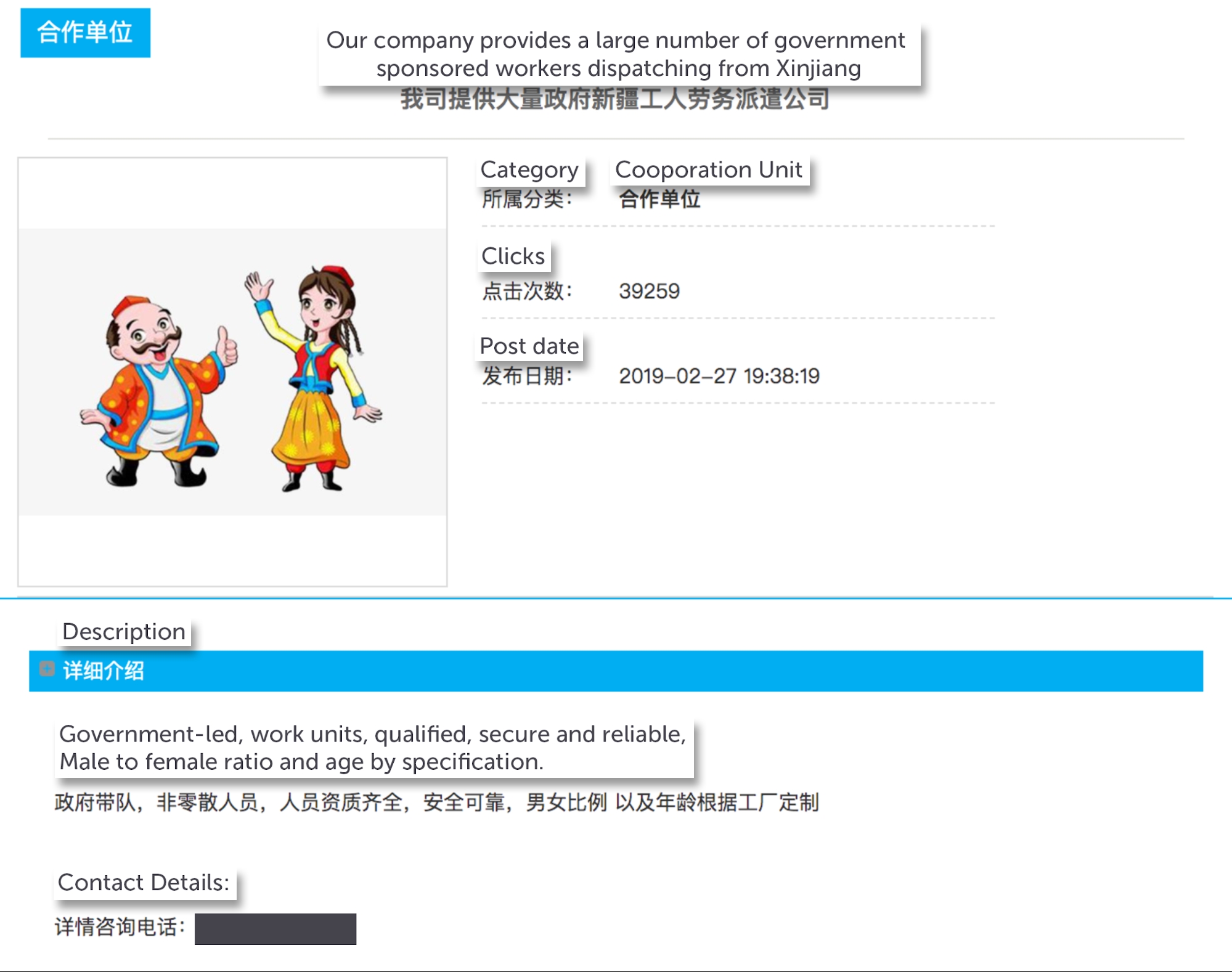
In recent tims, ‘government-sponsored Uyghur labour’ ads started to appear online in China. A company based in Qingdao in 2019 published an ad in which it mentioned that a large number of government-led qualified, secure and reliable’ Uyghur workers were available for transfer to up to 10 provinces in China. In the ad, two cartoon figures wearing traditional Uyghur clothing were seen dancing.
Ad stating availability of Xinjiang workers dressed in traditional clothings (Image: ASPI)
Another advertisement read, “The advantages of Xinjiang workers are: semi-military style management, can withstand hardship, no loss of personnel … Minimum order 100 workers!’. The advertisement also said that factory managers can apply for current Xinjiang police to be stationed at their factory 24 hours a day, and that the workers could be delivered (along with an Uyghur cook) within 15 days of the signing of a one-year contract.” This particular ad suggested that the workers are young and efficient and can work for a long duration every day in the factories.
United Nation’s stand on the Xinjiang issue
On October 6, Ambassador Christoph Heusgen, Permanent Representative of the German Mission to the United Nations, said that 39 countries including United States, Germany, Australia, Austria, Canada, Denmark, Italy, Japan, New Zealand, Poland, Spain and others were gravely concerned about the human rights situation in Xinjiang. He said, “We call on China to allow immediate, meaningful and unfettered access to Xinjiang for independent observers including the UN High Commissioner for Human Rights and her Office, and relevant special procedure mandate holders; to urgently implement CERD’s eight recommendations related to Xinjiang, including by refraining from the arbitrary detention of Uyghurs and members of other minorities. In view of our concerns about the human rights situation in Xinjiang, we call on all countries to respect the principle of non-refoulment.”
In June 2020, 50 UN Special Procedures mandate holders issued an exceptional letter of concern, calling on the People’s Republic of China to respect human rights in the Xinjiang region. In October 2019, over two dozen countries called on China for its brutal policies against 13 million Uyghurs and other Turkic Muslims in Xinjiang as part of its “Strike Hard Campaign against Violent Extremism.”
China’s denial of Human Rights abuse claims
So far, China has claimed that the news about mistreatment and human rights abuse in the Xinjiang region are false. However, reports have suggested that China is changing the demographic situation in the region. Several reports have suggested that China has demolished a number of mosques in the region. Interestingly, its Islamic ally Pakistan has been quiet over the issue, and PM Imran Khan has categorically denied knowledge of any such human rights abuse in the Xinjiang region. In October 2020, Pakistan’s National Security Analyst (NSA) Moeed Yusuf said that human rights abuse in the Xinjiang region is a non-issue.
The general administration department of Bihar has issued a notification sanctioning the dismissal of three lower court judges, who were implicated in a 2013 Nepal sex scandal, reports Hindi daily Jagran. According to the notification, their dismissal will be effective from February 12, 2014. They will not be eligible to get their salaries, any kind of allowances or pensions.
The three judicial officers are Nawada sub-judge Komal Ram, who was the judicial magistrate in Araria at the time of the alleged incident, Ara additional district and sessions judge Jitendra Nath Singh and Muzaffarpur family court’s principal judge Hari Nivas Gupta, who held these positions at that time.
The Supreme Court had last year vacated its 2015 stay on the proceeding and allowed the Bihar government to initiate action against the judges.
The 2013 Nepal sex scandal in which the three judges were implicated
The case had come to light in January 2014, when a Nepali newspaper ‘Udgosh’ reported that the Nepal police raided Biratnagar’s Metro hotel and found these officers in ‘indecent positions’ with several Nepali women. The paper reported that these men were taken into custody on January 26, 2014, after found in compromising positions in the hotel but subsequently released.
Following the report, Union Home Ministry deputy secretary SM Kandwal wrote to the Patna High Court’s registrar general asking for a probe in the matter. The Patna High Court, in turn, directed the Purnea district and sessions judge to probe the matter. The latter in his report wrote that the three judges said that at the time when the incident was reported they were not in Nepal but in India. The Purnea district and sessions judge, Sanjay Kumar in his report also mentioned that the Nepali daily ‘Udgosh’, which had first reported the incident, had tendered an apology for publishing a wrong story.
However, not satisfied by the probe conducted by Sanjay Kumar, the Patna High Court asked Home Ministry to intervene.
An agency of the MHA tracked the mobile phone history of the accused judges and found that their phones had been simultaneously switched off on January 26-27, 2013, and when it became active again it was traced somewhere near Nepal’s Forbesganj town, indicating that the three were in Nepal and not in India as claimed by them.
The report filed by the home ministry also mentioned that the hotel bills the accused judges had submitted to substantiate their claims that on the day of the incident, they were in Purnea, Bihar and not in Nepal were fabricated. The report said that the hotel bills were prepared and signed by one of the accused judge himself. Based on the findings, a resolution was passed approving the dismissals of the three judges.
Meanwhile, in February 2014, the three accused judges filed a petition in the High Court against their dismissal. The judicial officers thereafter moved the SC contending that they cannot be dismissed without a disciplinary inquiry be held against them.
In the meantime, the full court of Patna HC passed orders recommending their dismissal in compliance of the HC order but the Supreme Court had in 2015 stayed the proceedings against them restraining the State Gov. from acting on the recommendation.
However, in 2019, a bench of Justices Indu Malhotra and Sanjiv Khanna dismissed the petition of the accused judicial officers and upheld the High Court verdict and vacated the stay. It allowed the State government to take a decision on the HC’s recommendation on their dismissal. It said that the judges could challenge the dismissal orders once passed by the State government.
On Monday, the Basti Jodhewal police arrested a 30-year-old man named Ajay Kumar, accused of murdering one Arhtiya (commission agent) Gharjit Singh Chaudhary in 2018. Following the murder, he assumed a new identity and started working as a Christian pastor.
As per reports, Kumar, and his brother-in-laws Yograj and Vishal had provided an illegal murder weapon to one Gaurav Goru to kill Gharjit Singh Chaudhary at a vegetable market on June 28, 2018. Goru had snatched money from the victim in Phillaur, post which a First Information Report (FIR) was registered against him. It later culminated into a rivalry that took Chaudhary’s life.
While all accused were nabbed, Kumar had managed to flee. He went absconding from the law enforcement authorities for a span of 2.5 years and had fled to Palampur in Himachal Pradesh. Meanwhile, the accused assumed a different identity and graduated with a college degree. He also worked as a pastor in Mission Compound Church in Jandiala Guru.
The Additional Deputy Commissioner of Police-I Deepak Pareek said at a news conference here that during preliminary interrogation, he told the police that fearing arrest, he had gone to Palampur in Himachal Pradesh where he was pursuing a BTH course and lived under an assumed name and identity. Later, Ajay Kumar shifted his place of residence to Jandiala Guru and served as a pastor in Mission Compound Church there.
Christian priest arrested following a tip-off
Ajay Kumar visited his family in Ludhiana on several occasions and would change his appearance every time to evade suspicion. While speaking about his arrest, Additional Deputy Police Commissioner Deepak Pareek said that the police received a tip-off about Kumar working as a Christian priest at a church in Jandiala Guru. As such, they conducted raids at the church premises and arrested the accused. “The accused had also confessed that he, along with his brother-in-law Vishal, had provided the murder weapon to the prime accused Gaurav, alias Goru, who had committed a murder in broad daylight,” he added.
Kumar, a resident of Ashiana Colony in Jassiyan village of Ludhiana, is accused under Arms Act (Sections 25/27/54/59) and Indian Penal Code Sections 34 (acts done by several persons in furtherance of common intention), 302 (murder), 341 (wrongful restraint) and 506 (criminal intimidation). He was declared a proclaimed offender (PO) on August 20, 2019, by a Court. Reportedly, the accused had applied for anticipatory bail but when the Court directed him to join the police investigation in 2018, he fled.
Amidst the ongoing agitation against the historic farm laws, over 2000 farmers have come out in of support the government in Indirapuram, Ghaziabad.
Equipped with over 300 tractors, the farmers took out a rally and tried to reach the National Capital via the UP gate on Monday. However, they were stopped at the border and only a 5-member delegation from Hind Mazdoor Kisan Samiti (HMKS) was allowed to go. The delegation met Union Agriculture Minister Narendra Singh Tomar on Monday and handed him a memorandum of demands.
While speaking on the development, HMKS Secretary Satish Kumar said, “We met the Union minister and extended our support to the government. We also handed over a memorandum of our demands in which we said that the new laws would end the exploitation by middlemen. We supported the continuation of the minimum support price (MSP), demanded that it be hiked and that the farmer should have the right to sell their produce anywhere.”
दशकों पुरानी मांग पूरी होने की खुशी में किसानों ने मेरठ से गाजियाबाद तक हज़ारों ट्रैक्टरों पर सवार हो कर कृषि बिल के समर्थन में रैली निकाली है।
Reportedly, the delegation of Hind Mazdoor Kisan Samiti’ (HMKS) emphasised that they must be included in government-level talks with anti-farm law protestors. Kumar added, “It seems that opposition to the three laws has some political motive behind it. When the Prime Minister has several times said that the new laws will not harm the interests of farmers, other groups are continuing to oppose the laws. However, we have no personal differences with them as they are also farmers like us.”
He added that HMKS had demanded the withdrawal of cases against farmers for stubble burning. The delegation highlighted that a buyer’s right is restricted to the produce and not the field. “We also submitted some of our issues pertaining to waiver of electricity bill, timely purchase of crop so that we can prepare for the next crop in time and also get our payments in time,” Satish Kumar emphasised.
We will sit for five years if needed, say farmers
In a video of a TV channel talking to farmers in Noida in UP, a farmer stated, “The three bills passed by PM Modi are beneficial to farmers. We have got out tractors and trolleys.” On being informed that the anti-farm law protestors have been refusing to vacate the protest site for 2 years, he replied, “If necessary, then, we will sit for 5 years in support of PM Modi.” Another farmer said, “We are all in support (of farm laws). If Anti-CAA protestors are sitting on protest for 2 years, then, we are ready to sit for 5 years.”
The slogan, “Go Corona Go,” that Union Minister Ramdas Athawale gave earlier this year is showing its power, and the cases are subsiding as per the minister. On Monday, Union Minister Ramdas Athawale said that the vaccine for Covid-19 would be available within a month or two.
The Covid-19 will have to go ultimately. He said, “COVID-19 vaccine will be available in a month or two. I gave the slogan ‘go corona go’ on February 20, and now the cases are subsiding. It will remain for 6-7 months, ultimately it will have to go away.” The video of him chanting had gone viral sometime in March 2020.
In February, Athwale coined the slogan “Go Corona, Go,” which caught the eye of netizens, and the catchy tune was all over social media for quite some time. The slogan that became the centre of countless memes has brought a smile to many faces during the hard times.
Union Minister Athawale himself had eventually tested positive for coronavirus and has since recovered.
Covid-19 situation in India
According to Ministry of Health and Family Welfare, a total of 1,00,75,116 cases so far have been reported in India. 19,556 new cases were reported on Monday. As of now, there are 2,92,518 active cases, and 96,36,487 have recovered. 1,46,111 people have lost their lives to Covid-19.
Flights of UK origin suspended after mutated virus
A new strain of Covid-19 was reported in the UK, after which the civil aviation ministry has suspended flights originating from the United Kingdom from December 22. All passengers coming from Europe and the Middle East in Maharashtra will undergo mandatory 15-days institutional quarantine. Those who are coming from other destinations will have to undergo home quarantine.
It is no secret that India is targeted by many external forces, hell-bent on conquests of many kinds. Islamists want to wreck the last pagan civilization, Christian missionaries want to harvest souls, Marxists want to use India as a canvas to run an economic experiment that has worked nowhere else in the world, and the Western powers see India as a market for their digital and physical products.
While India looks to become atmanirbhar in matters of the economy, standing up to some of these forces will require the country to play ‘offence’ rather than only deploy ‘defensive’ strategies. One area where Indians have been on the defensive is regarding the International Church and its efforts to convert, especially amongst the poor. The mechanisms suggested are usually defensive in nature, e.g. anti-conversion laws or perhaps shutting down of NGOs but what’s needed is to get these Abrahamic forces to start defending their own position. There are three key areas that are ripe for public and government pressure.
Land use
The Church in India is the largest non-agricultural landowner including prime real estate in many cities. The land was given by the British on leases that are no longer valid since the Indian Churches Act of 1927 was repealed post Independence. The Government of India wrote to states in 1965 confirming that ‘the ownership of all Church properties under the repealed act is now with the Government of India’. The Modi government has shown itself more than capable of taking tough decisions and the auctioning of this land for development purposes will have many winners.
Another issue around Church control of land has to do with graveyards. While this is more of a challenge with kabristans due to the much larger Muslim population, the same challenge is faced with Catholic churches taking up ever-growing space for graveyards. There are several measures that can be taken to encourage cremation or introduce better practices related to managing burial lands in order to avoid continued expansion of burial grounds which offer no productive return for the public. While controversial in the Indian context, a societal shift towards cremation has already started in the Western world, e.g. US, Europe, and Australia. Most of these modern Christian countries now have more than 50% of their dead being cremated versus being buried. There is no reason why the archaic practice of burying the dead forever needs to be maintained as a standard process.
Child and Sexual Abuse
While barely covered in the Indian media, the Church worldwide has been rocked by an unending set of sexual abuse crimes. These crimes are not limited to specific geography, as thousands of verified abusers (mostly priests) and victims (mostly minors, the majority of whom are boys) have emerged all over the world, including developed and developing countries. There is also a pattern of systemic cover-up by Church officials, going all the way up to the Vatican.
Given the power of the Church in India, the only recent case that’s in the public sphere is of Bishop Franco Mulakkal, who’s accused of raping a nun multiple times over the course of several years. The nun and her supporters have faced extreme pressure from Church officials and have been ostracized from the community. There are also additional cases that have come to light including one a few years ago where the Church forced an underage rape victim’s father to falsely confess to the rape in order to protect the priest who did the crime. Given the widespread nature of the issue – it is estimated that roughly 5% of Church priests worldwide are sex offenders – there are many children and women who have been abused and many more in harm’s way as we speak. A wide-ranging investigation by Indian authorities is in order.
Convent education
The third and last issue is one that is seen as a positive aspect of the Church but in reality, does innumerable harm to children and the Dharmic psyche. Given the poor standards of Government schools, many parents opt for Convent schools due to their reputation as providers of a ‘good education’. Unfortunately, along with the education, children are subtly indoctrinated to disapprove of their Dharmic identity, e.g. no teeka. mehndi or Hindu religious symbols allowed in school, while the schools’ staff continues to shower positive messages about Catholicism.
This passive brainwashing during a child’s formative years has traditionally been offset by strong community and family links to Hinduism, but those are under continued threats as the state punishes Hindu traditions e.g. fireworks during Diwali, and the family unit becomes atomized into nuclear households. To make it worse, these nuclear households are headed not by elders but by overworked and overstressed working parents. The convent school brainwashing leads to many Hindus growing up with a minimum or without a sense of pride in the Hindu Dharma and at worst, spouting atheistic or Catholic leaning ideologies.
Fortunately, the post-Covid world will see an acceleration of trends that shall close the gap between a quality education versus what is offered today through the Government school system. Cheap data, quality content in the language of choice delivered through several formats, and affordable devices will be stitched together through online and offline platforms. While high-quality alternatives will take some time to get launched, Hindu organizations need to put societal pressure on the Convent school administrations to at least respect the majority’s sentiments while also educating society about the harms of a Convent education.
The threat of the Global Church is real as the Vatican and others look to make inroads in India and Africa to offset the increased shedding of Christian identity in the US and Europe. Hindus need to attack this threat in a proactive manner.
Renowned Balochistan activist, Karima Baloch, who had escaped from Pakistan a few years back and sought refuse in Canada, was found dead under mysterious circumstances, reports The Balochistan Post. She was last seen on Sunday, December 20, 2020 at around 3 PM in the Bay Street and Queens Quay West area in Toronto.
Baloch has been a vocal critic of Pakistani Army and the atrocities carried out by Pakistani government on Baloch citizens. She is believed to be one of the most prominent women leaders from Balochistan and had also raised the issue of Balochistan at United Nations sessions in Switzerland.
She had recently accused the Justin Trudeau government in Canada of facilitating Pakistani army officials by giving them refuge.
????? #EXCLUSIVE In a recent speech in #Canada, @KarimaBaloch had raised alarms about #PakistanArmy officials settling in Canada & questioned Canadian govt for allowing this.
She feared that this will lead to attacks against #Baloch in Canada.
“I belong to students organisation in Balochistan. I have seen bodies of so many of my friends whose bodies can also not be identified. These bodies were returned by this (Pakistani) army which believes in brutality. They had poured acid over the bodies. Now the same army is taking asylum in Canada. The army that entered our house and killed us, raped us, took away our children, the same army is given refuge and facilities. So that they become more equipped to kill us,” she called out Canadian government.
Recounting the Pakistani army’s brutality on Bangladeshi people, she had said the same brutality is being conferred on the people of Balochistan since 1947-48. “The same war crimes, same genocide, same kidnapping women and making them sex slaves. The same Muslim army is being given refuge by Iqra Khalid,” she said. Iqra Khalid is Pakistan-born Canadian MP.
Earlier this year, another Baloch activist, Sajid Hussain, went missing in Sweden. His body was recovered from a river. His friends and family believe he was murdered. Reporters Without Borders, a Paris-based journalists’ organisation had raised concerns that Pakistani intelligence agency ISI could have a hand in Hussain’s disappearance and subsequent death because of his work as a journalist.
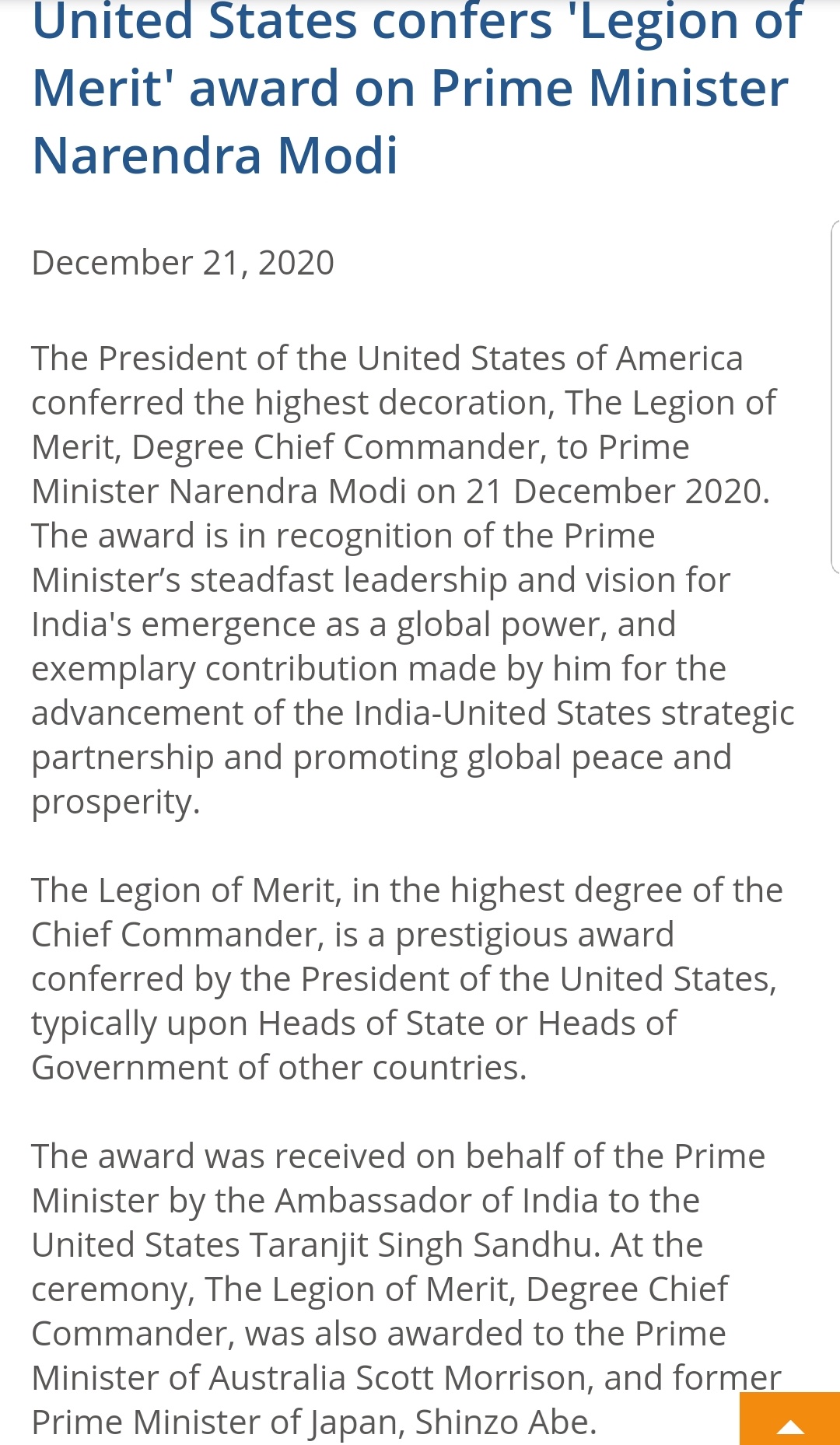
In a big development on Monday, incumbent US President Donald Trump presented the Legion of Merit to Indian Prime Minister Narendra Modi for his leadership in improving bilateral ties between the two countries and elevating the status of India as a global power.
The Legion of Merit, in the highest degree of the Chief Commander, is a prestigious award conferred by the US President, typically upon heads of state or heads of government of other countries, said Ministry of External Affairs (MEA) in a statement.
As per reports, the prestigious award was collected by Ambassador Taranjit Singh Sandhu, on behalf of Narendra Modi from NSA (US) Robert O’Brien at the White House.
“President @realDonaldTrump presented the Legion of Merit to Indian Prime Minister Narendra Modi for his leadership in elevating the U.S.-India strategic partnership. Ambassador @SandhuTaranjitS accepted the medal on behalf of Prime Minister Modi.” –NSA Robert C. O’Brien pic.twitter.com/QhOjTROdCC
The US President has also awarded the Legion of Merit to ex-Japanese Prime Minister Shinzo Abe and Australian Prime Minister Scott Morrison. The awards were received by the ambassadors of the US countries. While Abe was bestowed with the Legion of Merit for his vision of free and open Indo-Pacific, Scott Morrison was awarded for the promotion of collective security and addressing global challenges.
The Ministry of External Affairs statement in this regard said that the award was conferred upon PM Modi on the 21st of December.
Statement by MEA
It further said, “The award is a recognition of the Prime Minister’s steadfast leadership and vision for India’s emergence as a global power, and exemplary contribution made by him for the advancement of the India-United States strategic partnership and promoting global peace and prosperity”.
Awards received by PM Narendra Modi
The United States has now joined the list of several other countries who have accorded their honours on PM Narendra Modi. In 2019, Russia had accorded its highest civilian honour, The Order of St Andrew the Apostle, to PM Modi. Similarly, Maldives honoured the Indian Prime Minister with the Order of the Distinguished Rule of Nishan Izzuddin.
Before that, the United Arab Emirates had awarded Prime Minister Modi with the highest civilian honour ‘Zayed Medal’ for boosting the relations between India and the Emirates. PM Modi had also received the 2018 Seoul Peace Prize in South Korea. He has also received the Amir Abdullah Khan award, the highest civilian honour of Afghanistan and the King Abdullaziz Sash award, the highest civilian decoration of Saudi Arabia in 2016.