Home Blog Page 4761

China’s Communist Party member worked in Indian consulate, 7 branches of CCP have India connections: Report

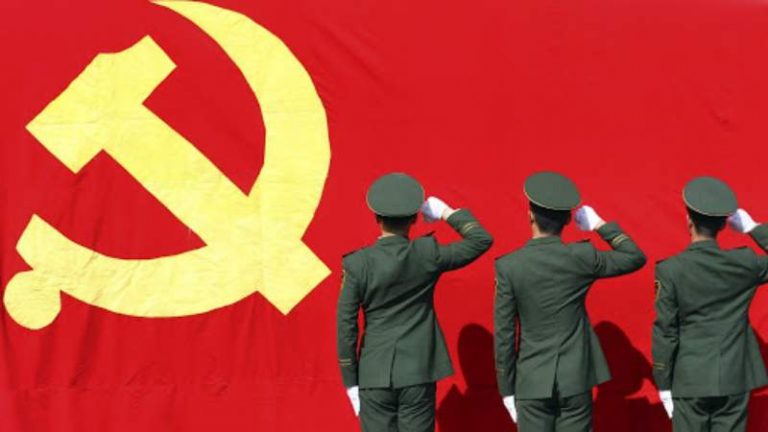
The recent investigation by ‘The Australian’ highlighting the extent of infiltration of Chinese citizens into global institutions has a created a new threat perception for the rest of the world. The fresh data leaks have revealed that nearly two million members of the Communist Party of China (CPC) are living and working across the world. 

The explosive data leak hinted that these Chinese nationals have infiltrated some of the world’s biggest corporations in the areas of defence, banks and pharmaceutical giants manufacturing coronavirus vaccines. According to the data leaks, the CPC members have also infiltrated into Indian public institutions and organisation.

A report by Indian Express suggested that at least one CPC member was hired by the Indian consulate in Shanghai using the services of a Chinese state-owned recruitment agency. The said CPC member had served in the Indian consulate in Shanghai for three years from mid-2014 to mid-2017. Further, seven affiliates of the Communist Party of China (CPC) also have an India connection.

The dataset reveals that at least seven CPC branches have an India connection and cumulatively these seven affiliates have 91 party members belonging to CPC.

The seven branches with an India connection are Shanghai Electric Power Plant Engineering Corporation’s India Project Branch Committee with 31 members, India Research Institute Joint Branch with 17 members, India Research Institute Management Branch with 13 members, City India Tenth Factory Branch with 11 members.

Further, 10 CPC members are linked to CPC Shanghai Urban Construction International Engineering Co., India Regional Centre Branch Committees, Committee of the CCP Shanghai Chilling India Branch has 7 members and New Delhi Sales Department Party Branch includes 3 CPC members, as per the Indian Express report.

Chinese Communist Party infiltrated at least 30 consulates

The recently leaked datasets shed light on the branch and membership structure of the Chinese Communist Party. In China, the Communist Party is divided into branches and Party Committees exist in most big corporations.

The data leak obtained by ‘The Australian’ newspaper has revealed how the alleged CPC members have infiltrated into at least 30 consulates in the eastern Chinese metropolis Shanghai. These CPC members have been allegedly employed as senior political and government affairs specialists, clerks, economic advisers and executive assistants.

The access to foreign consulates has been termed as a coordinated effort by the CPC for over a decade. This includes consulates of the UK, US, India, Australia, New Zealand, Switzerland, Italy and South Africa.

The leak has alleged that the ruling CPC has infiltrated the Australian, British and US consulates in Shanghai, with the Department of Foreign Affairs and Trade using a Chinese government agency, the Shanghai Foreign Agency Service Department, to hire local staff.

CPC members are employed in big corporations across defence, banking, etc

The data leaks have also disclosed how CPC members have joined several multinational corporations across banking, defence, pharmaceutical and financial sectors. The companies include ANZ, HSBC, Pfizer, AstraZeneca, Volkswagen and Boeing.

It has further revealed about 79,000 branches of the CPC, many of them have been working inside companies, universities and even government agencies.

The leak has exposed details of nearly 2 million CPC members after data got released from a Shanghai server by whistle-blowers. The data was extracted from a Shanghai server by Chinese dissidents, whistle-blowers, in April 2016.

Earlier, we had reported on how the Communist Party of China has gained access to top-most universities in the United States and infiltrated its research departments. Not just it, the China has also been running a spy network inside top universities in US to gain access to relevant research projects that it considers important for its national development.

‘Poor Adivasi girls are trafficked and sold’: Gujarat MP Mansukh Vasava writes to CM Vijay Rupani to bring strict laws on Grooming Jihad

Raising the issue of trafficking of Adivasi girls and increasing cases of grooming jihad, Gujarat MP Mansukh Vasava has written to Gujarat CM Vijay Rupani to bring in stringent laws.

In a letter dated 3rd December, 2020, Vasava said that people of all religions and caste live in India. However, sometimes Hindu girls lured and entrapped by some Muslim men who then force them to convert their religion to Islam. “Some organisations also impart training for carrying out such deeds. Many leaders of Hindu society have reached out to me regarding this,” he wrote in his letter.

Just as Uttar Pradesh government made stringent laws against forced religious conversions, Gujarat government should also enforce such laws, he said.

“More importantly, the girls of poor families in Gujarat, especially girls from Adivasi families in tribal areas are highly affected. In such areas, the sex ratio is low. These areas as distributed to such gangs where teams of agents work to lure these poor girls. These girls are then trafficked and sold. This should also be taken care of,” he wrote.

The Uttar Pradesh government recently passed the anti-forced religious conversion law to prevent forced conversions under the pretext of love and marriage. Under the new law, a jail term of 1-5 years is awarded to the accused (extended to 3-10 years in case of SC/STs) and a fine of ₹15,000 (₹25,000 in case of SC/STs). Moreover, the offender’s proven guilty for mass conversion will attract a jail term of 10 years.

BSF eliminates two armed Pakistani infiltrators trying to enter India near Amritsar

0

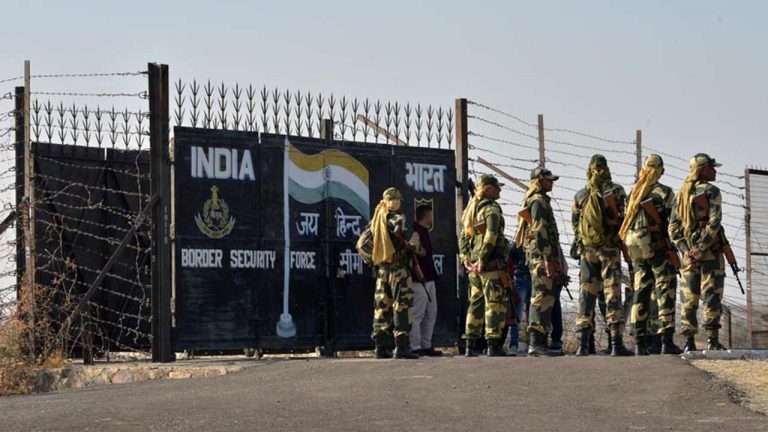
On Thursday, India’s Border Security Force (BSF) eliminated two Pakistani intruders at the Attari border area in Punjab. The security personnel have recoverd several weapons from the spot.

According to the reports, the Border Security Force (BSF) has shot dead two Pakistani armed intruders who were trying to sneak to India on the wee hours of Thursday by taking advantage of the thick layer of fog.

A patrolling party of BSF spotted some suspicious movement in the area near the border outpost Rajatal in Amritsar sector. The BSF troops initially warned the intruders, however, they continued towards the international border. The intruders opened fire on BSF jawans.

In a retaliatory action BSF shot dead two Pakistani intruders who were carrying AK-47 rifles.

Last week, Pakistani drones were noticed at the international border in Ranbir Singh Pura sector of Jammu and Kashmir. The BSF had said the drone went back after the Indian forces had fired at it.

Uttar Pradesh: Saqib became Sonu to entrap a minor Dalit girl, forced her to convert to Islam

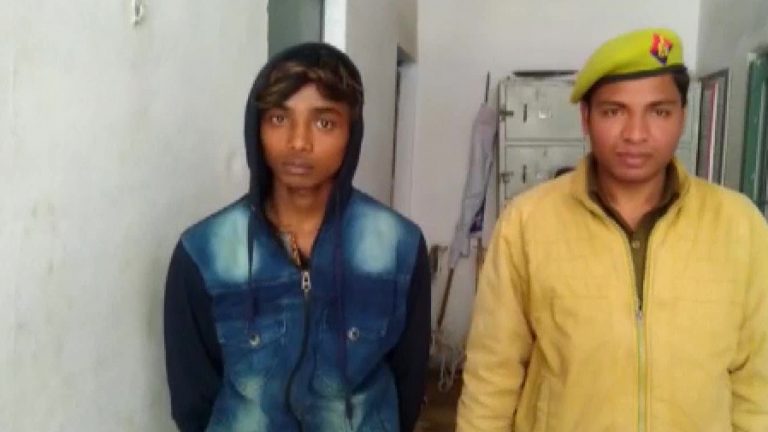
A case of Grooming Jihad has emerged from Bijnor in Uttar Pradesh where 19-year-old Saqib concealed his religious identity to entice a 14-year-old Dalit girl into forced religious conversion. As per reports, a case has been registered under the new UP Prohibition of Unlawful Conversion of Religion Ordinance 2020 and various sections of the IPC. A case has also been registered under the SC/ST Act.

As per the police, Mohd Saqib enticed the minor Dalit girl by pretending to be Sonu. They were allegedly in a ‘relationship’ for a year. On December 14, the duo decided to elope. They were apprehended by police when they reached Nahtaur. The police said that during interrogation, the girl said that Saqib hid his religious identity and had subsequently tried to force her to convert to Islam.

According to the girl’s parents, the girl used to study in a school in Dhampur and Saqib used to follow her after school hours. He lured her by pretending to be a Hindu, the father alleged.

This is second case registered under the anti-forced religious conversion laws in Bijnor and eighth in the state.

Saqib has been arrested and sent to jail. A case has been registered under Sections 363 (punishment for kidnapping), 366 (kidnapping, abducting or inducing a woman to compel her marriage) of the Indian Penal Code, provisions of POCSO (Protection of Children from Sexual Offences) Act, Scheduled Castes and Scheduled Tribes (Prevention of Atrocities) Act and the new ordinance against forced and dishonest religious conversion.

The incident comes close on heels of another incident wherein a man had introduced himself as Sonu alias Bhure and worked as painter in Chandigarh. He befriended another man from Bijnor. Both returned to their native place on December 4 to attend a wedding. Here Sonu lured the daughter of his friend and eloped. The girl’s family got to know of his religious identity when they reached his home.

Filmmaker Navjot Gulati claims airport security ‘refused’ to search him over farmer protest. Here is what minister of civil aviation said

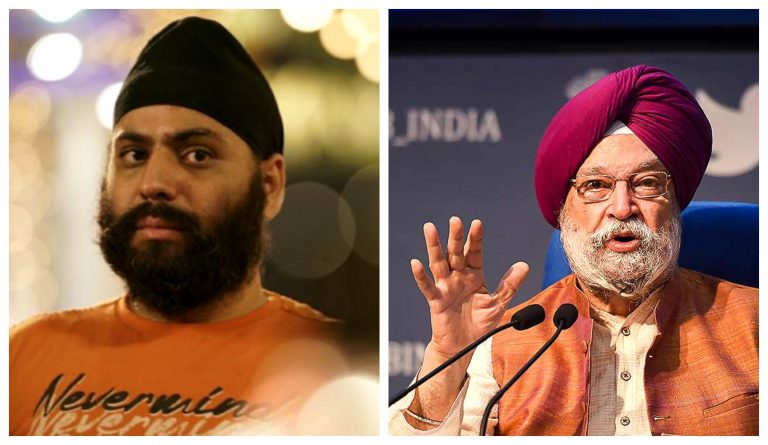
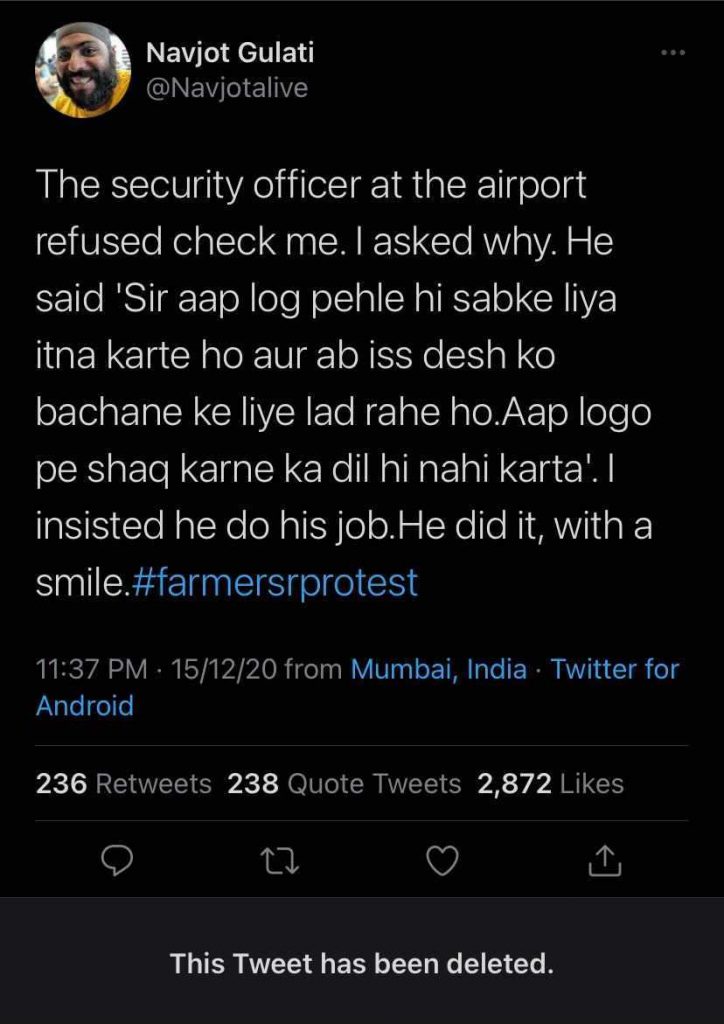
Showing support for the ongoing farmer protest, filmmaker Navjot Gulati posted a boastful tweet yesterday that caught the attention of Civil Aviation Minister Hardeep Singh Puri. Gulati tweeted that a security officer at refused to frisk him at the airport saying, “Sir, you people are already doing so much for all of us and now you are fighting to save the country. My heart does not allow me to suspect you.”

Screenshot of Gulati’s tweet

Apparently, Gulati was trying to insinuate that the security officer was reluctant to frisk Gulati out of gratitude towards the ‘farmers’ protesting against the three farm laws. However, Gulati did not mention how come the security officer assumed that Gulati was a farmer or was in any associated with farmer protest. It is also notable that Gulati is a film maker, and it is not known how he has been contributing to the nation by making movies.

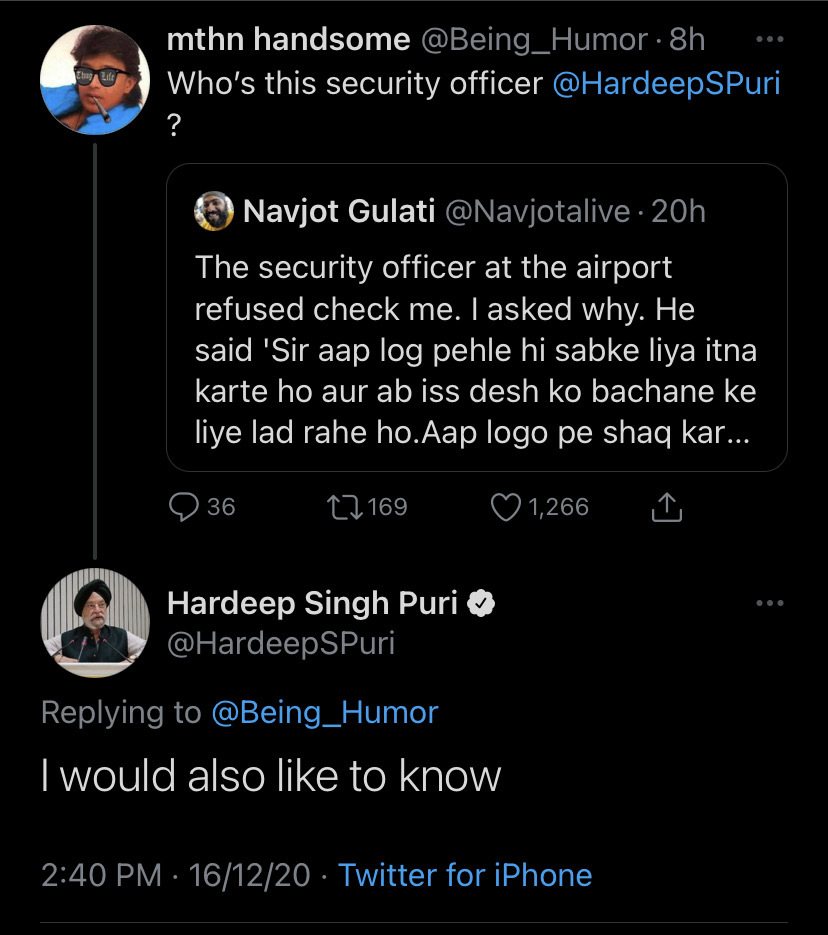
Interestingly, Gulati’s tweet caught the eye of the Civil Aviation Minister Hardeep Singh Puri whose response to Gulati’s tweet made him delete the tweet. One popular Twitter user tagged the Minister on Gulati’s tweet and wrote, “Who’s this security officer?” To this, the Minister responded that he would also like to know about the security officer who refused to frisk Gulati.

Screenshot of Civil Aviation Minister’s tweet

It may be noted that airport security is handled by CISF in India, which is known as a very professional force. They don’t make any difference while checking people at airports and other places where they are deployed. Even if someone working at CISF has an affinity to a cause, they will not neglect their duty to show such affinity. By claiming that a CISF personnel refused to frisk him, Gulati actually ended up insinuating that the security officer was disregarding his duties.

Perhaps realising that the tweet could land him in trouble, Gulati deleted his tweet later, and also made his Twitter account protected. However, his tweet already sparked memes on Twitter with several people tweeting along the lines of Gulati’s tweet. JNU scientist and author Dr. Anand Ranganathan picked up the trend and posted a tweet similar to Gulati’s weaving a story about how a staff member at Saravana Bhawan at Connaught Place in Delhi refused to accept payment from him out of gratitude for his work.

Another popular Twitter user who goes by Twitter id @theskindoctor13 took a dig at Gulati’s tweet and sarcastically wrote how once a patient refused to pay his consultation fee because the patient thought that he was not doing enough and was not even fighting to save the country.

Joining the trend journalist Abhijit Iyer Mitra also posted an amusing story about his similar experience at a Rolls Royce showroom where the showroom owner refused to take money from him for a Phantom car that he bought from the showroom.

Taking advantage of the meme, OpIndia CEO Rahul Roshan also jokingly pulled a leg of OpIndia Editor Nupur J Sharma and tweeted how she refused to accept the salary for this month out of gratitude for whatever he did for the whole OpIndia team. He also mentioned how she got emotional when he insisted to pay.

Twitter in India was filled with such tweets today, with people making up stories to mock the claim made by Navjot Gulati.

The ongoing farmer protest is being used by several media outlets to peddle their agenda and built a fake narrative. Several media outlets have been trying to fearmonger about use of force by government against the protesting farmers.

‘TMC Fail Card’: A comprehensive report on TMC’s misgovernance in West Bengal during the last decade

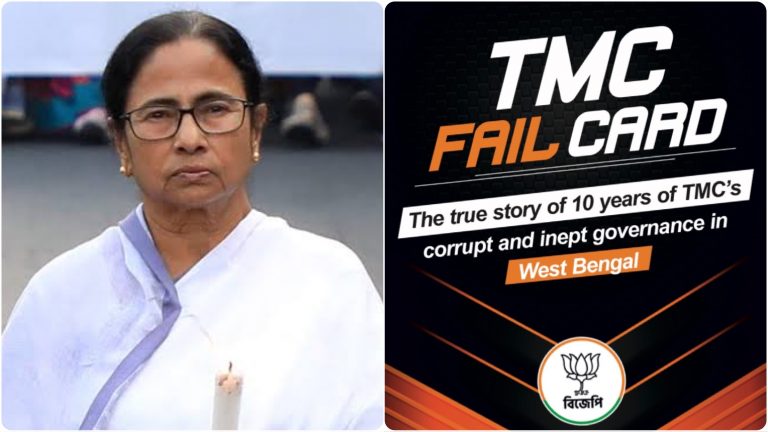
As the state of West Bengal gears up for the upcoming assembly elections scheduled to take place in 2021, a ‘TMC fail card’ has been released by BJP that describes the corrupt and inept governance for the last 10 years when the Mamata Banerjee-led Trinamool Congress(TMC) was in power in the state. The card was released by senior BJP leaders Swapan Dasgupta, Shishir Bajoria and Shamik Bhattacharya

From busting lies about the proclaimed economic growth in the state to the total collapse of law and order in the state, from the marked deterioration of the education system in the state to the abandonment of economically backward, and the appalling state of healthcare in the state, the ‘TMC fail card’ debunks the false claims made by the Mamata Banerjee government and carries in details the missteps taken by the regime during the last decade of being in power.

Lies about the economic growth in the state

The fail card states that the TMC government in West Bengal has often resorted to lying to portray a deceitful picture of the economic growth in the state. It contended that TMC’s claim that the average per-person income has more than doubled under their rule is “absolutely incorrect” and “deliberate misrepresentation”. It further adds that the quoted per capita income numbers do not account for inflation and are not at constant prices that provide a more accurate assessment.

At constant prices, the card asserts that the average per-person income of West Bengal has risen from Rs 51,543 in 2010-11 to Rs 71,757 in 2019-2020. At the constant prices, West Bengal also ranks a poor 24th out of the 32 states and UTs benchmarked in 2018-2019 and 15th out of the 20 states and UTs benchmarked in 2019-2020 on average per-person income.

Besides, the pamphlet released by the senior BJP leaders also states that TMC claims on growth in GSDP, agriculture, industry and service sectors are also misleading. It asserts that West Bengal has underperformed as compared to the rest of the country during the decade of TMC rule and which is reflected in the GDP numbers that have slipped from 6.03 per cent in 2010-11 to 5.25 per cent in 2018-19. Similarly, the growth of the agriculture sector, industry and services sector has also been dismal.

The TMC government is also accused of withholding crucial information about the state’s budget. The fail card says that the state’s debt estimate stands at a staggering Rs 4.5 lakh crore and out of Rs 2.34 lakh crore budget announced in February 2020, just Rs 75,073 crore is from the state’s own revenue, tax and non-tax.

On the foreign investment front as well, the TMC government has been equally disappointing. The foreign direct investment in the state even after a decade of TMC government remained stuck at 1 per cent, demonstrating that the government has thoroughly failed in attracting new investment to the state.

Total collapse of law and order in West Bengal

The ‘fail card’ paints a grim picture of the abysmal state of law and order in West Bengal. It has stated that the protection given to the criminals by the TMC in exchange for money and muscle has created anarchy in the state. The pamphlet draws on the statistics to allege that Bengal has witnessed the fourth-highest number of murders in the country. West Bengal has recorded the highest number of attempt to murder cases and the highest number of grievous hurt.

The state has also seen political violence as a tool to silence the dissenting opposition voices. The brand of politics practised by the TMC, the pamphlet states, has provided a breeding ground for terror networks such as Al Qaeda to flourish. Left-wing extremism has also seen an uptick and so has incidents of communal violence across the state.

Trinamool Congress has also been accused of turning the administration into its personal army. It alleges that administration officials such as state police are routinely used to quell the opposition protest, other officials help the TMC government in covering up murders of opposition workers and act as mouthpiece to exonerate the party cadres. “The politicisation of the administration has happened to such an extent opposition workers are being killed in police custody and in police firing on peaceful protests,” the released pamphlet said.

Marked deterioration in Bengal’s education system under the TMC rule

The ‘TMC fail card’ released by the BJP leaders has noted that there is a marked deterioration in the state’s education system. It contended that about 90 per cent of the government-run elementary schools do not have basic furniture like desks and tables for all students. The situation is notably similar in higher secondary and secondary schools. About 16,289 government-run schools do not have the requisite number of teachers as per the RTE norms.

Even education related schemes such as Kanyashree Prakalpa and Sabooj Sathi have become a source of cut-money for the TMC government, the leaflet says. Notably, Kanyashree Prakalpa has failed to deliver on its promises, as West Bengal has been one of the worst performers with regard to early age marriage. About 42 per cent of women are married before attaining the age of 18 while the national average hovers around 26 per cent.

Even in the field of higher education, Mamata Banerjee’s TMC government has spectacularly failed. With an alarming ratio of 13 colleges per lakh population, parents and guardians in West Bengal are forced to pay huge amounts of cut money to TMC workers to secure admissions for their kins in colleges.

Dismal state of healthcare in West Bengal under TMC

The glaring gaps in healthcare infrastructure have caused tremendous suffering for the people of West Bengal. The state faces shortfall in all categories of healthcare centres—Sub Centres, Primary Health Centres, and Community Health Centres.

The fail card observes that not just health centres, but the state is also facing an acute shortage of trained healthcare personnel. About 516 positions for doctors at rural PHCs are lying vacant out of a sanctioned 1,326 positions. Out of 574 sanctioned positions for specialists in CHCs in rural West Bengal, 503 positions are vacant.

Mamata Banerjee’s persistent denial to implement Ayushman Bharat in West Bengal has left the poor and the weak vulnerable and without a safety net. Hundred of crores could have been saved if Ayushman Bharat had been accepted by the TMC and the funds could have been used for ramping up the healthcare infrastructure to fight the coronavirus pandemic.

The pamphlet also notes that the TMC government has failed remarkably in controlling the spread of the disease in the state. As per the National Health Profile 2019, Bengal has recorded the highest number of acute diarrhoeal diseases in the country with 21,15,771 cases. Likewise, it also registered the highest number of dengue cases in the country with 37,746 cases that amounted to 20 per cent of the total cases. Furthermore, West Bengal registered the highest number of measles, rabies, meningococcal meningitis cases in the country.

The COVID-19 pandemic has served to highlight the terrible state of healthcare in Bengal. As of 11 December 2020, West Bengal has reported the third-highest number of active coronavirus cases. “Significant inefficiency, dysfunctional decision-making and acute shortage of healthcare capacity have further exacerbated the issue,” the pamphlet said.

TMC government has shunned Bengal’s economically backward population

In their report card for the TMC, the BJP leaders have alleged that the Trinamool Congress has failed even in the most fundamental job of providing basic necessities of food, shelter, and water to the economically backward people in the state. It stated that besides repackaging central government’s schemes, TMC has blocked efforts to seeding of Aadhar cards that plays a crucial role in ending corruption.

The national Aadhar seeding rate is 83 per cent but it is 64 per cent in West Bengal. The TMC has also opposed One Nation One Ration Card because it would deprive them of carrying out corruption in PDS, the pamphlet read.

About 26 per cent of Bengal households still don’t have access to pucca housing. 19.5 per cent of rural housing and 11 per cent of urban housing were classified as bad in the 76th round of the National Sample Survey. 70 per cent of rural and 25 per cent of urban houses have no access to drainage facilities. Even sanitation coverage was improved only after PM Modi launched Swachh Bharat mission.

Furthermore, West Bengal has installed a paltry 2.2 lakh taps against a steep target of 55.5 lakh under the Jal Jeevan Mission to provide access to clean water to rural households.

The TMC’s misgovernance exacerbated the impact of COVID-19 and Cyclone Amphan on the economically backward population. Widespread corruption was reported in the distribution of relief materials, including food during the COVID-19 induced lockdown. There was no cooperation extended by the Mamata Banerjee to the Central Government in bringing back state’s migrant workers and she even called the special trains designated for this purpose “Corona Express”.

Rs 5000 crore granted to Bengal government to rebuild dams and barrages in Sundarban area were misused. The TMC was also accused of presiding over corruption in the funds granted by the Centre under PMAY.

Injustices meted out to SC, ST and OBC communities under Mamata Banerjee’s regime

The communities of SC, ST and OBC had to suffer grave injustices under the TMC government in West Bengal. The National Commission for Scheduled Castes’ repeated admonition to the Mamata Banerjee government only illustrated the regime’s apathy towards the welfare of the SC population.

Despite making promises of revision in the salaries of the Tea Plantation workers, the majority of which belong to the SC community, the TMC government has failed in providing any relief to them. It has also failed in ensuring that the ST population gets their substantive rights under the Forest Rights Act. By opposing the Citizenship Amendment Act, the TMC government preventing a large portion of the SC community from living a dignified life.

The TMC government is also accused of expanding the OBC category to 97 per cent of their vote bank, thereby depriving the real beneficiaries belonging to the OBC community.

West Bengal infrastructure in ruin due to TMC’s misgovernance

Bengal’s infrastructure is in ruin due to the apathy and indifference of the Mamata Banerjee government. Even after 73 years of independence, electricity remains both unavailable and unaffordable. Kolkata is infamous for having the highest electricity rates in the country, making it highly unaffordable for the poor in the city.

The collapse of the Ultadanga and Majerhat bridges in West Bengal demonstrates the government lack of supervision towards the state’s debilitating infrastructure.

Road connectivity is often hailed as a pathway to prosperity and development. But, the TMC regime has constantly failed in providing good quality road network in the state. Only 15 per cent of the total roads in the state are surfaced since 2017. Bengal ranks a lowly 14th out of the 31 states and UTs in terms of length of state highways.

Cities also play a crucial role in the growth and act as drivers of development. However, the TMC government has turned a blind eye to the pathetic state of cities in Bengal. It has failed to utilise the 30 per cent of the total funds released by the centre under the Smart Cities Mission and AMRUT.

TMC’s betrayal of trust of the West Bengal farmers

Far from helping farmers, the Mamata Banerjee government in West Bengal has worked against their interests. The TMC government did not allow PM KISAN in the state, depriving over 70 lakh farmers in the state from receiving an annual support amount of Rs 6,000. Instead, an alternative of PM KISAN was announced but it was poorly implemented, with over 35 per cent of the farmers eligible for the scheme left out.

The TMC government also denied the MSP bonus for paddy to the farmers. It replaced Pradhan Mantri Fasal Bima Yojana with an inferior state scheme that covered far fewer crops and was shoddily implemented.

The agri-infrastructure is also in poor shape in West Bengal. The state lacks irrigation facility in 45 per cent of the arable land and due to deficient cold storage facilities, a large portion of agriculture produce is laid to waste.

The West Bengal government has failed in enhancing the income of farmers. According to survey by NABARD, Bengal ranked a lowly 24th out of 29th in terms of average monthly income for agriculture households.

TMC failed in empowering and protecting the women of the state

The TMC government in West Bengal also has a poor track record in empowering and protecting the women. It recorded third-highest number of cases against women in 2018. The state also recorded highest number of acid attack against women in the entire country in 2018.

Even the conviction rate of accused caused in a crime against women is abysmally low. While nationally it is 23 per cent, in West Bengal, the conviction rate is around 5 per cent.

Contrary to the TMC’s claims regarding employment provided to women in the state, West Bengal has one of the lowest labour force participation rates(LFPR) in the country.

Unprecedented growth in unemployment during the TMC rule

There has been an unprecedented growth of unemployment under the TMC rule. Between October 2016 to 2020, unemployment in West Bengal has grown by an astounding 217 per cent.

The poor employment meant that lakhs of West Bengal residents had to leave the state in search of jobs elsewhere. In the times of COVID-19, about 10.5 lakh Bengali migrant workers returned to the state, compared to 5.8 lakh as per Census 2001 and 2011.

Besides, West Bengal also has the highest percentage of delayed MGNREGA payments and it is plagued by TMC’s cut-money across the state, where workers are forced to pay hefty sums to avail work under the scheme.


China retains top position in global rankings on countries with maximum number of imprisoned journalists

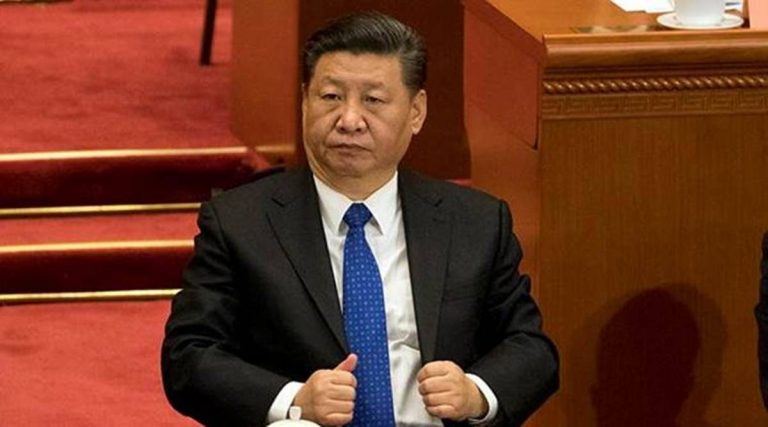
For the second year in a row, China is leading the global rankings on the maximum number of imprisoned journalists in 2020. As per a report of the Committee to Protect Journalists (CPJ) published yesterday, 47 journalists were lodged in Chinese jails as on December 1, including those jailed this year and those serving longer sentences. Last year, 48 journalists were jailed in the country.

Steven Butler of the CPJ, who assembles annual data based on public records, media reports and calls to local officials, prosecutors and prisons, said that about half of those imprisoned in China this year were Uyghurs living in the Xinjiang Uyghurs Autonomous Region. “Many of these journalists (in Xinjiang) are in jail for things like being ‘two faced’ which means, of course, in name of supporting the Communist Party but (being) accused of undermining it in secret”, said Butler.

Jailed for critical reporting on pandemic

According to the report, there are 274 journalists lodged in prisons across the globe this year as compared to 272 journalists imprisoned in 2016. This numbers for this year do not include the journalists who had been released, paroled or assaulted in the course of performing their duties. Researchers have reportedly attributed the imprisonment of these journalists to criticial coverage of the pandemic by them. Among the journalists jailed in China are citizen journalists who publish reports or videos largely through social media. The CPJ report said that some citizen journalists were jailed for their coverage of the government’s response to the pandemic. Zhang Zan is one such journalist who is under detention since the month of May was formally indicted last year for charges of spreading false information. 37-year old Zhan who is a former lawyer was accused of “picking quarrels and provoking trouble” which is said to be very common charge invoked against critics and activists in China.

Restrictions on press worsened under Xi Jinping

According to reports, the Chinese government had imposed restrictions on free speech and the freedom of media outlets to publish reports not approved by the Communist party. The situation is said to have worsened under the Jinping regime as in 2016 he had directed the state-owned media outlets to have the party name as their family name.

The CPJ attributed the deteriorated situation of journalists in China working with foreign news outlets to the growing hostility in the relations of China with other major countries. In August this year, an Australian news anchor Cheng Lei was detained in China on the suspicion of endangering national security. A journalist, Haze Fan, who was working for Bloomberg in Beijing was detained was last week on similar charges. Chinese officials had declared the case as an internal affair of China.

As per the CPJ report, dozens of journalists were arrested in Belarus included 10 currently lodged in jail. At least seven journalists were imprisoned in Ethiopia mostly charged with anti-state crimes. Iran had 15 journalists in jail till December 1. A journalist named Ruhollah Zam was executed in Iran on December 12.

How the New York Times reduced a 40-minute conversation with Sanjeev Sanyal to merely 2 words to prove that Shramik trains were ‘virus trains’

With the world trying to grapple with the Chinese Coronavirus, every country’s political administration and health system was put through the ultimate test – how prepared were countries to deal with catastrophe? How prepared was any country’s health system to deal with an unprecedented and unknown pandemic that was plaguing the world, coupled with a heady mix of propaganda, fake news, subversion from authoritarian regimes and the public seeking answers.

While several countries came close to crumbling under the weight of the pandemic, India, with a population of over 1.3 billion people, spectacularly managed to hold its own. At the time of writing this article, the United States of America had over 17 million cases and over 3 lac deaths, and India had about 9.9 lakh cases with less than half the deaths. With India already gearing up to vaccinate over 60% of its population, India has emerged as a frontrunner. While several other countries like Germany, Italy etc erupted with protests against the lockdown, Indians calmly abided by an early lockdown that slowed the spread of the virus in its initial stages to a large extent.

While India’s track report in dealing with the raging pandemic is being hailed by several experts, the western media has been rather grudging in accepting that a so-called ‘third world country’ managed to handle a pandemic foisted upon the world by a country they quintessentially thought was far ahead in the development scale compared to India – China. The Western Media, that is often caught peddling propaganda for money on behalf of China, was seen covering India’s response to Covid-19 with extremely biased lenses.

One such article that recently surfaced was one in the New York Times, which reportedly get millions to run Chinese propaganda. The article titled The virus trains: How lockdown chaos spread COVID-19 across India published by NYT is filled with prejudice against the Modi govt, blaming the govt for the spread of Coronavirus in the country.

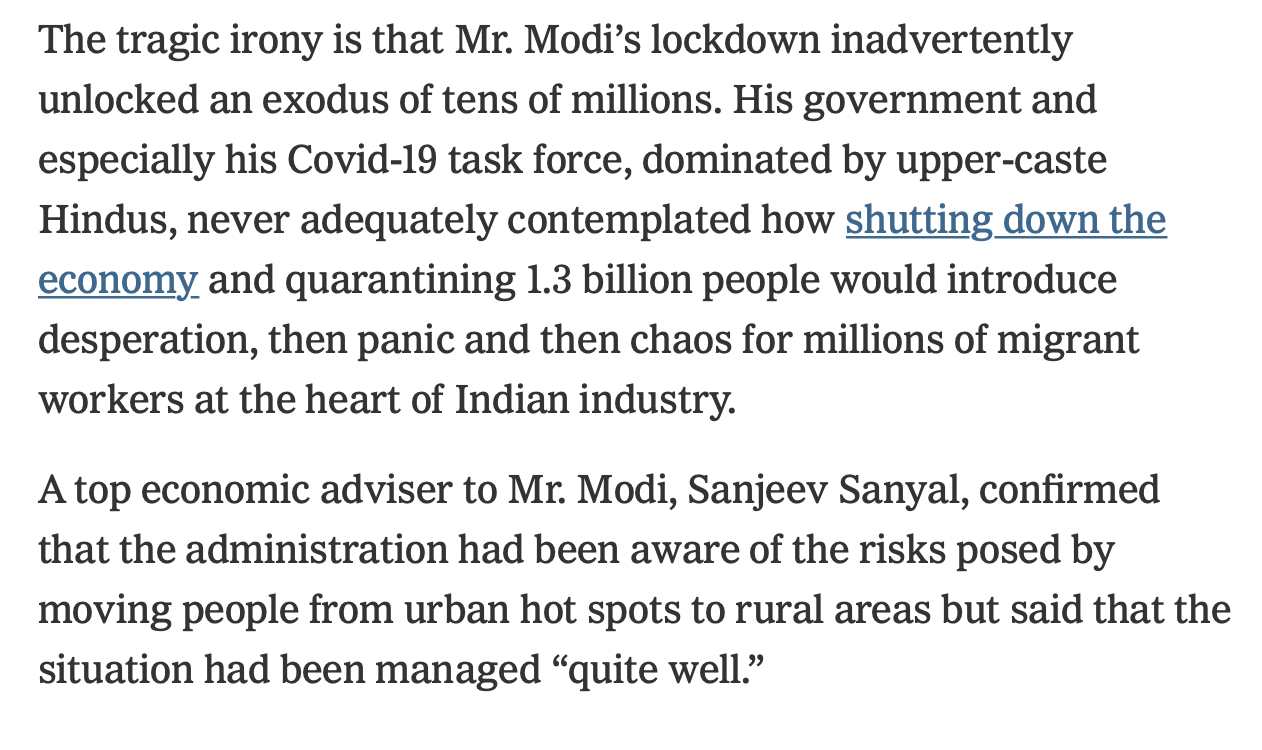
The bias of New York Times becomes apparent at the very outset when, for some reason, it mentions that the Modi govt’s Covid-19 task force is dominated by “upper-caste Hindus”, and claims that it didn’t contemplate how imposing the lockdown will induce desperation, panic and chaos for millions of migrant workers.

Excerpt from NYT article

For the report published by NYT on how the migrants carried the Coronavirus to every nook and corner of the country by travelling special trains arranged by the Govt of India, the authors had talked to a number of people, including Sanjeev Sanyal, author and the Principal Economic Adviser in the Ministry of Finance. But now Sanjeev Sanyal has exposed how the left-wing publication chose what to include and what to not, to build up a narrative they had already decided.

The article mentions that Sanjeev Sanyal had confirmed that the administration had been aware of the risks posed by moving people from urban hot spots to rural areas, and adds that he said that the situation had been managed “quite well.” Only the two words “quite well” were quoted from the interview they had taken with him.

OpIndia has now acquired the full recording of the conversation that took place between Sanjeev Sanyal and the journalist from the New York Times, who was researching the story for the publication. Suhasini Raj, one of the co-authors of the article in NYT had reached out to Sanjeev Sanyal and spoken to him at length about government’s response to the Covid-19 pandemic. The conversation spanned over 40 minutes.

That the New York Times thought that only two words – ‘quite well’ – should be quoted in their article out of a 40-minute conversation does not really come as a surprise. If publications don’t wildly misquote people they speak to, as the Washington Post did during the Delhi Riots, their standard tactic is, essentially, to pick and choose only the parts that fit in well with their narrative and leave the rest of it out. It would appear that Sanjeev Sanyal perhaps did not give them enough material to support their pre-decided narrative about India’s response to Covid-19, and hence, as a mere formality, they decided to ensure that at least 2 words out of the 40-minute conversation were included in the article.

What is also interesting is that the New York Times decided to quote the two paltry words from the 40-minute conversation with Sanjeev Sanyal, right after they had spewed pointless homilies about the task force being dominated by “upper-caste men”, thereby, attempting to already prejudice their readers against his comments – even if they were two words. This simply proves that NYT perhaps never really wanted to engage with Sanyal in good faith and from the very beginning, they knew exactly that talking to Sanyal was a mere formality.

What Sanjeev Sanyal said in his 40-minute long conversation with New York Times, out of which, NYT decided to quote only two words – ‘quite well’

In the recording that OpIndia has now perused, it is clear that Sanjeev Sanyal shared a lot more information than what they chose to incorporate (which we cannot reiterate enough – was merely two words). What is far more important though, is how the journalist also tried to make him say certain things, which indicates that they were looking for a certain type of answers.

At the outset, Sanyal explained how the situation in March was uncertain and unclear, with no clear information from WHO on the pandemic. He mentioned how different people took the situation differently, and how different countries adopted different approaches to deal with it at that time.

He then went on to explain the rationale behind the decision of the Modi government to impose a nationwide lockdown. He said that when the situation was uncertain, one common strategy to be adopted is the barbell strategy. According to this well-known strategy, one hedges for the worst outcome, and then takes a step by step approach as more and more information becomes available.

Sanyal further explained that according to the strategy of ‘hedging for the worst outcome’, the government had decided to impose total lockdown in the month of March. He narrated that there was more than one reason for imposing the lockdown. First, to stop the spread of the disease. Along with this, the lockdown period also gave the government to create testing capacities, quarantine facilities, getting people trained, gather information about the infection from across the world etc.

After a couple of months, more information became available, facilities were ready, and also economic costs of the lockdown were beginning to reflect. Due to these reasons, the government started to open up the country by April-May, Sanyal told the NYT journalist.

Sanjeev Sanyal gave an incredibly detailed explanation of the steps taken by the government at various points of time in dealing with the Wuhan Coronavirus, but NYT chose to reduce his comments to just two words. Moreover, he said that the government was aware of the economic impact of a total lockdown. He said that the govt was aware that they will have to pay a big price for the lockdown.

Completely disregarding his comments or even his detailed explanation, the article wrote that the ‘Hindu Upper Caste Modi government’ had no clue about the possible impact of those decisions. This clearly demonstrates how NYT had a pre-determined agenda to paint the Modi govt as clueless, and when they received a contrary viewpoint from the principal economic advisor, they simply decided to not publish his comments at all.

How the New York Times journalist tried to put words into Sanjeev Sanyal’s mouth, so she could get a comment that would suit the NYT’s agenda

Towards the latter part of the conversation, the NYT journalist tried to get Sanjeev Sanyal to say that the Shramik Special trains run by the Railways to move migrant workers were responsible for the spread of Coronavirus to several states. She said that their ‘study’ has found that migrants coming from cities like Mumbai and Surat carried the virus with them to eastern states like Bihar and Odisha. Responding to this, Sanyal explained how before the trains were started, villages were asked to prepare quarantine facilities for incoming migrants. He said that most of rural India managed the situation well, and given the size of India, the spread of coronavirus in rural places is very low.

Despite such categorical assertions, NYT completely omitted them from their article, and claimed that the trains spread the virus across the country.

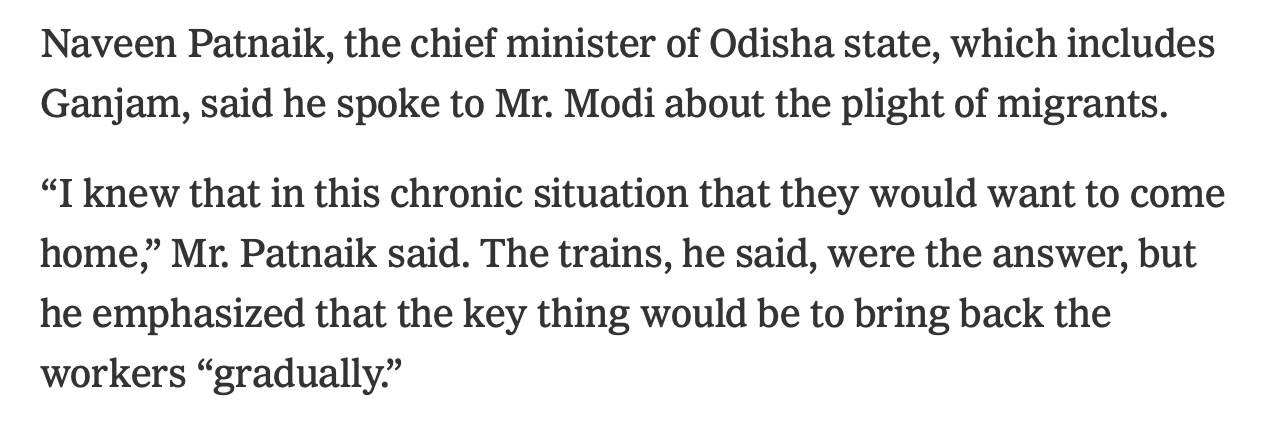
What makes it rather evident that the New York Times interviewed Sanjeev Sanyal with a predetermined narrative in mind, becomes evident from the fact that the NYT article chose to quote what the Odisha administration said about the above segment, but conveniently decided to omit Sanyal’s explanation to the entire fiasco.

Excerpt from NYT article

If the New York Time was genuinely interesting in painting an authentic picture of India’s response to Covid-19, it would make sense for them to add both comments by the Odisha CM and Sanjeev Sanyal, however, since one of the comments (the one by Sanyal) did not really fit their narrative and because Sanyal refused to fall for their strategy of putting words in his mouth, they simply decided to drop the comments altogether.

Sanjeev Sanyal also mentioned various schemes launched by the government to help people and businesses in coping with the effects of the lockdown, by NYT didn’t deem them necessary to mention them in the article while talking about troubles faced by poor during the lockdown.

The article labels the Shramik Special trains as Virus Trains, and blames the trains for the spread of the virus in the country, and blames the Modi government for running them. But the article fails to mention a very important aspect of the trains. Initially, the union government was not in favour of transporting migrants to their native places. The objective of the lockdown was to keep people where they already were so that the infection is not spread. But several states, especially opposition ruled states like Maharashtra, Rajasthan and Delhi used various tactics to force the central govt to run the trains. But the article blames the Modi govt alone for the decision.

Talking to Sanyal in detail about the govt’s handling about the Coronavirus pandemic, but not including them in their article shows that New York Times had already decided to attack the Modi govt on the issue, and as Sanyal’s comments didn’t suit them, they didn’t include them in the article at all. This shows how international media tries to paint a negative image of India with a preconceived notion.

Although the number of India’s total Coronavirus cases is second only to the USA, it does not tell the full story, it does not tell how well India has managed the pandemic. India’s recovery rate is one of the highest, and the fatality rate is very low. Although the Shramik Special trains did contribute to spreading coronavirus, it was not at the scale the New York Times is trying to say. The Indian states most hit by Coronavirus remain the states with large number of migrant workers, not the native states of those workers. Therefore, calling the Shramik Special trains as Virus trains is also not correct.

The full conversation between New York Times journalist Suhasini Raj and Sanjeev Sanjyal can be listened on YouTube below. Please note that around 1.30 minutes at the beginning of the audio has no sound, hence you may skip to the 1.30 minute mark to listen to the audio.

It is also notable that although the audio recording is over 40 minutes long, the first half an hour has nothing to with the Shramik Special trains. They talk about the lockdown in general first, and it was towards the end where the journalist came to their point, and tried to put words in his mouth. In the entire conversation, the journalist sounded entirely disinterested in what Sanyal said and hardly bothered to ask follow up questions.

The entire saga by the New York Times is a classic example of how the western media manipulates facts when it comes to India. It is also a classic example of the strategies employed by the western media to ensure that no matter what the facts are, the narrative that they publish is not only pre-determined to deride India, but every attempt is made to ensure that the facts are not provided to the readers. When the media is not twisting words, insulting India or misquoting experts, they craftily leave out any comment, or even 40-minute long conversations that don’t suit their narrative. What is refreshing, however, is to see a government functionary not fall for these tactics. The fact that Sanjeev Sanyal recorded the conversation and refused to give the New York Times journalist a ‘controversial statement’ for them to use, shows that perhaps dealing with the media knowing fully well the strategies than can be employed to catch them on the wrong foot, should be a mandatory part of training, for every individual who wishes to. speak on behalf of the government of India, especially to the western media.

Gujarat Congress president Amit Chavda and LoP Paresh Dhanani submits resignation over defeat in by-polls in all 8 assembly seats

As per the reports, Gujarat Congress president Amit Chavda and Leader of Opposition in the State assembly Paresh Dhanani have offered their resignations after Congress lost by-polls in all eight assembly seats. They handed over their resignation letters to Rajeev Satav, the state party in-charge. Satav has confirmed the report. He said the Congress party would decide on the resignations by month-end. The announcement about the resignations and other changes in the party’s state organizations will be made from Delhi.

The eight constituencies for which by-polls were held are Abdasa, Karjan, Morbi, Gadhada, Dhari, Limbdi, Kaprada and Dangs. These seats were earlier held by the Congress party. The bypolls were needed after those eight Congress MLAs had resigned and left the party. Five of them had joined BJP later.

The resignation of 8 Congress MLAs had also cost the party one Rajya Sabha seat, as it had helped BJP in getting Narhari Amin elected to the upper house.

Chavda and other Congress leaders and supporters have recently faced backlash for sharing fake news about Ahmedabad Airport. In a tweet, he had claimed that Sardar Vallabhbhai Patel International Airport’s name was replaced with Adani Airports. In reality, the central government has not transferred the ownership of the Sardar Vallabhbhai Patel International airport in Ahmedabad to Adani Airports for “free.” Adani Airports had won the contract to manage the airports through a competitive bidding process. The group will oversee the airport’s operations just like the GMR group that contains the functions of the Indira Gandhi Airport in Delhi.

Series of misfortune for Congress in 2020

Congress party lost eight MLAs out of which five have joined Bharatiya Janata Party. Due to the defection of eight MLAs, the party lost one Rajya Sabha seat. The death of veteran leader Ahmed Patel is another shock for Gujarat Congress. Influential leaders like Bharatsinh Solanki and Shaktisinh Gohil have to stay away from the ground level work due to Covid-19 infection.

Great days for Gujarat BJP

On the other hand, Gujarat BJP is doing well in the state. The party has won all eight seats in the recent by-poll elections. State BJP president C R Patil and CM Vijay Rupani managed to retain popularity in the state. In February 2021, Gujarat will have local body elections. The current state of Congress party in the state is pointing towards another win for the BJP in coming local body elections.

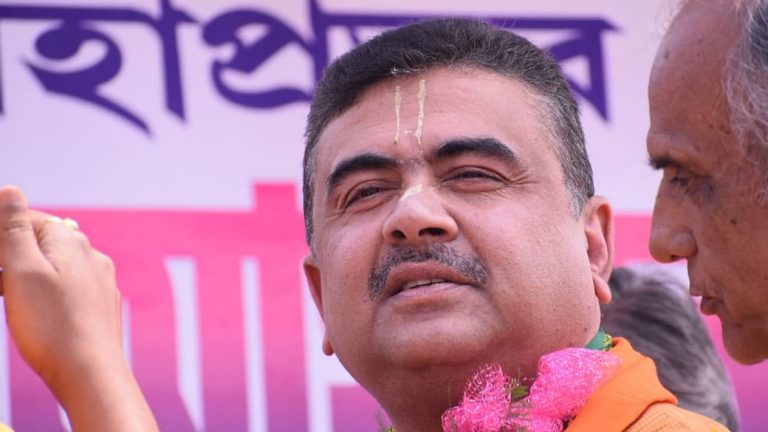
TMC leader Suvendu Adhikari resigns from West Bengal Assembly ahead of Amit Shah’s visit to the state, BJP welcomes the move

Trinamool Congress (TMC) stalwart Suvendu Adhikari has submitted his resignation today as MLA from the West Bengal Assembly amid the speculations of him joining the BJP. Last month, Adhikari had resigned as the Transport Minister of the state after he was replaced as the Chairman of the Hoogly River Bridge Commissioners (HRBC).

The political sphere is rife with rumours of resentment between Adhikari and his party. These rumours grew stronger after he did not mention the name of his party and party’s head Mamata Banerjee while speaking at a rally in Nandigram last month. The party had even accused Adhikari of helping the BJP. Adhikari had reportedly been skipping important cabinet meeting for some time and had been holding rallies without using the flag of the TMC. He had also refused to meet election strategist Prashant Kishore.

Adhikari’s resignation from the state Assembly is being seen in connection with the Home Minister Amit Shah’s visit to West Bengal on December 19-20. Recently, the party had expelled Kanishka Panda, who is perceived to a close aide of Adhikari. Panda, who was the general secretary of the party at East Midnapore, had reportedly questioned the party leadership for withdrawing Adhikari’s security.

BJP welcomes the resignation of Suvendu Adhikari

Former TMC leader and BJP vice-president Mukul Roy welcomed the news of Adhikari resigning from the assembly. He said: “The day Suvendu Adhikari had resigned from the ministerial post, I had told I will be happy if he leaves TMC and we will welcome him. Today he has resigned from the membership of West Bengal legislative assembly and I welcome his decision.”

West Bengal BJP chief Dilip Ghosh also commented on the development, saying,  “It was bound to happen. Many MLAs left TMC earlier too and joined our party. There’s no democracy or respect for people in TMC. Those who want to join in the change in Bengal and contribute to its development are leaving TMC and joining us”.

Yesterday, BJP MP  from Cooch Behar Nisith Pramanik had said that Suvendu Adhikari is likely to join BJP soon. “The wait is about to end and we might hear the good news soon that Shubhendu Adhikari is joining BJP. Shubhendu Adhikari is a popular leader and has made important contributions towards the betterment of his constituency. If such a leader will join the BJP, the party will be prosperous. We believe that we are going to get the good news soon,” Pramanik had told ANI.

Patnaik had added that many other seniors as well as junior leaders are in touch with BJP and they might join the party soon. “If we take all the TMC leaders who are in touch with us, then TMC’s numbers (in legislative assembly) will lessen before 2021 assembly elections,” he had stated.

Adhikari’s exit might be a setback for the TMC

Adhikari is expected to join the BJP during the Home Minister’s visit to the state. If that happens, the TMC might be looking at a major setback ahead of Assembly elections in the state. Adhikari’s exit from TMC might prove fatal for the party as he is believed to have influence in more than 80 Assembly seats in addition to the clout he retains in the party.

If Subhendu Adhikari joined BJP, it will have a huge impact mostly in South Bengal, old Midnapore, West Midnapore, and many other areas like Murshidabad, Nisith Pramanik had said. He had added, “In 2019, the people of North Bengal had overthrown the Trinamool Congress. The party has a bit of grip in South Bengal. But if Shubhendu Adhikari joins BJP, they’ll lose that too.”