In a horrific incident, three priests of Arkeshwara temple in Mandya, Karnataka were brutally killed by unknown miscreants on Thursday.
Police said the bodies of Ganesh (55) Prakash (58) and Anand (40) were lying in a pool of blood in the temple premises situated in Guttalu on the outskirts of Mandya town. The miscreants had brutally stabbed the three priests, smashed their heads with boulders and decamped with currency notes in the temple hundi (donation box), leaving the coins behind. The miscreants had allegedly also ransacked the sanctum sanctorum of the temple in search of valuables.
The three priests, who also worked as the caretakers and lived on the temple premises, were asleep when the miscreants broke into the temple, the police said.
The horrific incident came to the fore when villagers went inside the temple early on Friday morning after finding the main door ajar. After they found the priests brutally hacked to death, lying in a pool of blood in the temple premises, they informed the police.
All senior police officials, including the Inspector General of police, reached the spot and initiated an investigation into the case. Forensic teams and sniffer dogs were also brought in to investigate the crime scene.
Karnataka CM announces exgratia of Rs 5 lakh next to the kin of the deceased priests
Karnataka Chief Minister B S Yediyurappa has offered condolences the death of the priests and announced an exgratia of Rs 5 lakh next to the kin of each of the deceased. The CM said: “It is very disturbing to learn that the priests of the Arakeshwara temple in Mandya Ganesh, Prakash and Anand have been murdered by the burglars. A compensation of Rs 5 lakh per family of slain temple priests will be given. Immediate legal action will be initiated against the guilty.”
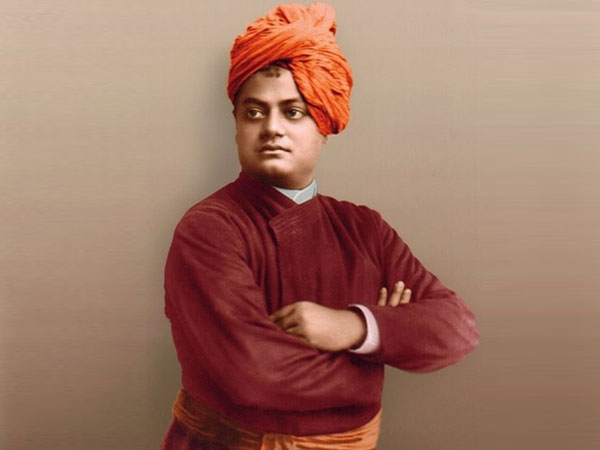
We saw how much power can be achieved in just five words when Swami Vivekananda stood up to respond to the warm reception he received at the first World’s Parliament of Religions held in Chicago on the 11th of September 1893. He started his speech with these words – “Sisters and Brothers of America” addressing about seven thousand people who had assembled from around the globe under one roof. His speech was followed by applause which lasted for more than two minutes.
These claps were for the monk who came from a slave country and faced troubles in adjusting in America till a day ago. He was racially discriminated, struggled with his eating habits, and didn’t have enough clothes to wear during cold days. Even after suffering all this, not a word of hatred or a word of complaint was expressed by Swamiji. Despite all this, words that came from his heart while addressing the crowd was, “My dear Sisters and brothers of America”, which became one of the most prominent or historic events of the 19th century.
In a letter to his Madras disciple, Alasinga Perumal, on 2 November 1893, in reference to his 11 September 1893 speech, Swamiji writes “All the rest of the delegates had prepared the speeches and I was without preparation. I bowed down to Devi Sarasvati and stepped up”. [1]And everything else became history. Swamiji became famous throughout America. In his speech, Swamiji thanked each and everyone present there on behalf of all the Hindu people of all classes and sects.
Swami Vivekananda placed before the audience the age-old tradition of acceptance of all religions to be true. He said “I am proud to belong to a religion which has taught the world both tolerance and universal acceptance. We believe not only in universal toleration, but we accept all religions as true.I am proud that I am from the country which gave shelter to the oppressed and the refugees of all religions and all countries. I am proud to tell you that we have gathered in our bosom the purest remnant of the Israelites, who came to southern India and took refuge with us in the very year in which their holy temple was shattered to pieces by Roman tyranny. I am proud to belong to the religion which has sheltered and is still fostering the remnant of the grand Zoroastrian nation.’’ He reminded the audience what narrow religious ideas can do. He said, “Sectarianism, bigotry, and it’s horrible descendant, fanaticism, have long possessed this beautiful earth. They have filled the earth with violence, drenched it often and often with human blood, destroyed civilization, and sent whole nations to despair. Had it not been for these horrible demons, human society would be far more advanced than it is now.”[2]
According to the book, ‘A Comprehensive Biography of Swami Vivekananda’ by Sailendra Nath Dhar, the Parliament of World’s Religions had representatives of 10 major religions from around the world which includes – Judaism, Hinduism, Islam, Buddhism, Tao, Confucianism, Shinto, Parsi, Catholic, and Protestant. But, Swamiji’s statement was the most successful one. Parliament’s President John Henry Barrows said “India, the Mother of religions was represented by Swami Vivekananda, the Orange-monk who exercised the most wonderful influence over his auditors”[3]
Why Swamiji’s 11 September 1893 speech is still relevant
It was a coincidence that on the same day in the year 2001, around 19 militants associated with the Islamic extremist group al-Qaeda hijacked airlines and caused enormous destruction in the United States of America. Known as the 9/11 attacks, this event killed approximately three thousand people and injured more than 6,000.[4]
It was the same land where Swamiji delivered his lecture, but it seems the gift was not opened by the world. Even today, when the world is divided into different religions and sects, and when people impose their belief on each other – Swamiji’s message of universal brotherhood is perceived as a way forward for the welfare of the world. It is a message to everyone – ‘not to tolerate but to accept everyone with wholeheartedness’.
Swamiji, who spoke about the ‘’Hindu thought of acceptance’’ at the World Parliament of Religions in Chicago in 1893, is appreciated and followed by every Hindu in India today. It is our country ‘Bharat’ that has celebrated secularism in the true sense and has not only remained in constitutional papers. Even after 1947 partition, when Hindustan was divided into three parts India, West Pakistan (present-day Pakistan), and East Pakistan (present-day Bangladesh), out of the three only India remained secular.
It is noted that the majority Hindu religion has declined from 84.1 percent in 1951 to 79.80 percent in the 2011 census, whereas the Islamic religion has grown from 9.8% in 1951 to 14.23 in 2011 (according to the 1951 census and 2011 census).[5] Not only the population but in every field – from cricket to business, music to acting, the minority communities in India are growing in every field. However, the picture is not the same in Pakistan and Bangladesh. East Pakistan (present-day Bangladesh) had 22 percent Hindus in 1951 and 8.3 percent in 2011 (according to the census).[6] In Pakistan, religious fanaticism has increased since the days of partition.
On one hand, India gave its ancient cultural heritage – ‘Yoga’ to the world which is celebrated every year on 21st June from 2015 onwards as International Yoga Day world. While, Pakistan erased the thousand years old cultural heritage by breaking a hundred years old temples, gurudwaras, and churches resulting in religious fanaticism throughout the country. It was once this same land Lahore, Pakistan (then Hindustan) where Swami Vivekananda delivered his famous lecture, “The Vedanta”, on 12th November 1897. [7]
So it’s time for the world to open the gift of Universal brotherhood given by Swamiji 127 years back. India must show the way. For centuries with diversity in custom and rituals in religion, in the language in appearance and diversity in every other way comprehensible, without having any central authority this Nation of ours have remained united till today. India must give that mantra to the world’. We see the earth burning in the fire of communalism more than global warming today and every sect is vying to show itself over the other.
Onecountry is engaged in grabbing the land of another. In the midst of this situation, this message of universal brotherhood by Swamiji looks like a path to the world which excludes human society from bitterness and gives the vision to see the whole world as one family. I would like to conclude this abstract with Swamiji’s words which he spoke while addressing the final session of Parliament of World’s Religions on 27 September 1893 – “The Christian is not to become a Hindu or a Buddhist, nor a Hindu or a Buddhist to become a Christian. But each must assimilate the spirit of the others and yet preserve his individuality and grow according to his own law of growth.” [9]
Author: Nikhil Yadav is a State Youth Head at Vivekananda Kendra, Uttar Prant. He obtained his Masters in History from the University Of Delhi and is pursuing COP in Vedic Culture from the Jawaharlal Nehru University.
Have you ever been frustrated at the pace at which things move in our country? Of course, you have. You know the drill. They announce a megaproject. With much fanfare, a politician lays the foundation stone. Everyone knows that the target date for completion is just pure fantasy. Everything seems to run into delays, missed deadlines and humongous cost overruns.
We don’t expect anything in this country to be completed on time. Generally speaking, we blame either politicians or bureaucrats for this. But it’s not always their fault. Sometimes, we could just be paying the price for traps left behind by governments from decades ago, to sabotage our progress.
You must have heard about PM Modi’s ambitious Char Dham road project, a 900 km long all-weather system of national highways connecting the Kedarnath, Badrinath, Gangotri and Yamnotri in Uttarakhand. Think of the jobs created, the boost to tourism and industry in the tiny hill state. And of course, there is the unsaid part: we would have 900 km of the highway close to the border with China.
PM Modi laid the foundation for the project on Dec 27, 2016. So what are we waiting for? Let’s do it, right?
WRONG!
Let me take you to step by step through the frustrations involved. For starters, you can’t just order 900 km of new highways in Uttarakhand. The prospective highway would cut through ecologically sensitive regions of the Himalayas. You would need an extensive environmental impact study as per our laws. All sorts of activists, foreign-funded NGOs and lobbies want their pound of flesh before we can start. In other words, see you in a few decades.
So what does the government do? There is a small loophole for small “civil works” that are less than 100 kms in length. So, in order to bypass the environment lobby, the Central govt first breaks down the single 900 km project into 53 different “civil works.” Imagine the loss of efficiency this causes and the bureaucratic nightmare this creates.
Not so fast. Do you think that “activists” will just let the government get away with this? The road will create jobs, economic growth and give us a strategic asset against a powerful neighbour.
This one time, can’t the activists just let it be? Of course not. This road project is in too much national interest to be acceptable to the NGO ecosystem of our well-wishers. And with an evil Hindu name like “Char Dham road,” how could we even hope for mercy?
And so the activists get together and sue. Their friend is the Environmental Impact Assessment (EIA) notification of 2006. The 2006 notification makes sure India can neither develop too much nor too fast. Otherwise, who would vote for…?
Well, the law is the law and the Supreme Court can only rule according to the law. This week, the activists have won in the Supreme Court. As expected. You can check the usual liberal mouthpieces. The usual suspects are thrilled that they have nailed the “lies” of Modi sarkar. They are salivating. They are celebrating. Everyone is happy. Especially China.
The Center had requested for a width of at least seven meters so that military vehicles could ply on the road. The request was denied. The planned two-lane highway is now down to a single lane.
Do you think China is stopping work on any of its strategic roads near the border due to environmental considerations? Ha!
Not a chance. We are in this fight, blindfolded and with our arms and legs tied behind us. These environmental rules were slipped into the system in 2006 and fourteen years later, we are still suffering.
One final note. You might ask: If these laws are such a bother, why doesn’t Modi sarkar just get rid of them? That’s exactly the plan, now that the government has the numbers in the Rajya Sabha. The new draft EIA notification 2020 is ready. And look who is unhappy.
Article by the Economic Times
These days, Sonia ji rarely speaks. But when she does, it is always on the most important issues of all.
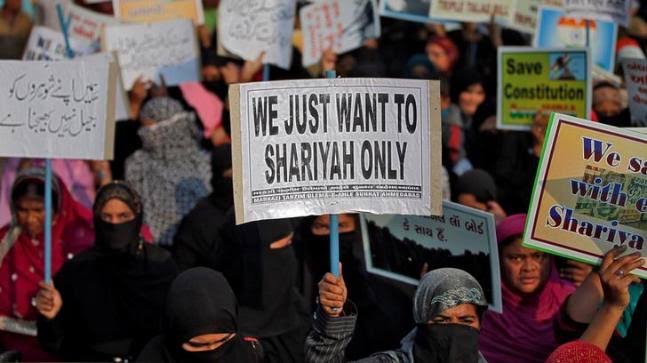
In what appears as a move to set up kangaroo courts governed by Sharia law, Telangana government is reportedly contemplating on extending judicial powers to Waqf Boards, a report published by Telangana Today said.
The Minority Welfare Minister Koppula Eshwar said that the issue of granting judicial status to Waqf Board will be soon considered by the Chief Minister.
While answering to the question raised by AIMIM floor leader Akbarududdin Owaisi, the minister assured that the government is committed to protecting the Waqf properties across the state and it would soon call a meeting with respect to the delay in gazette notification of the details of the second survey of the Waqf lands.
Since a long time, fundamentalist Muslim bodies, including the All India Muslim Personal Law Board(AIMPLB) had expressed its desire of setting up Sharia courts in India. AIMPLB had gone to the extent of claiming that it wants to establish Sharia courts in each district of the country.
Granting legitimacy to Sharia court would invite disaster for the country’s judicial system
The Telangana government’s decision to consider legitimising Sharia courts is fraught with dangerous consequences and might spell doom for the law and order situation in the country. If authorised, the precedent set by the Telangana government, might be exploited by other state governments, who would use it to pass similar orders in their respective states to garner the support of Muslim fundamentalists.
The Sharia courts would undermine the authority of the judicial courts and would be akin to a parallel judicial system in the country.
It would also provide an opportunity to the Mullahs to establish a more puritanical form of Islam, and conferring them with the authority of punishing those who are seen infringing it. The rabid Mullahs, with their overzealous penchant for imposing medieval versions of Islam, would run amok with the newfound legitimacy, resulting in the total collapse of the judicial order in the state.
Once in a while, opinion pieces are published that seek to mollify upper-middle-class Hindu anxiety about rapid conversion by Christian denominations. One such piece by the business journalist turned archaeogenetics expert Mr Tony Joseph appeared in Outlook in 2015, which was rebutted in this Indiafacts article.
In a fresh edition of Church apologetics masquerading as opinion, Mr Dilip Mandal again seeks to allay fears by declaring people should not pay attention to VHP because the Church’s mission in India a failure. To begin with, our position is that the Church in India wields power and influence far in excess of simple headcount. Their ability to influence public opinion has been taken for granted, to such an extent that one may point to such artefacts as the Hindu Civil Laws that largely reflect Christian values and ethical positions.
Be that as it may, we will turn our attention to the specific four claims he makes as part of his argument and examine the veracity in each of them.
The demographic claim
Mr Dilip Mandal quotes figures of Christian demographics in large cities, but ignores the fact that large swathes in the North East of India – Nagaland, Mizoram, Meghalaya, Eastern Manipur – are Christian majority. Native Meitei of Manipur are facing demographic pressures, such smaller tribes as the Bru-Reang have been ethnically cleansed from their original homelands.
Nagaland went to becoming a 100% Christian State from a small Christian minority in the space of a century. Arunachal Pradesh has seen a rise in Christian population to more than 30% in just a few decades of missionary activity. The forest regions of Central India, South Tamil Nadu, coastal Andhra Pradesh and Central Kerala are regions where local politics, voting patterns and even environmental policy is decided by the Church.
Liberation Theology
Mr Mandal points to the absence of a liberation theology driven approach of the Church as a reason for it’s failure in India. To posit that liberation theology is a theological approach that builds greater adherence to the Church is to ignore historical facts, especially the history of the last 4 decades.
The Church’s ecclesiastical authorities until the current Pope have been strongly against such theological innovations – both Pope John Paul II and Pope Benedict XVI were conservative. On the ground, one may note that such regions as Chile, Argentina, Southern Mexico and the Andean regions where priests preaching liberation theology, viz, attributing redistributive economic philosophy to Jesus Christ, are the where the Church has seen the highest erosion in congregational strength. On the other hand, in regions where the Church took positions in favour of traditional conservatism such as the United States, Northern Mexico, Brazil, Poland, Philippines and Romania are still strongholds of Catholicism.
All other denominations have not taken such a route to preach. It may also be noted that the elevation of Pope Francis, a leading liberation theologist, to the papacy does not have much to do with winning and retaining congregants, but to do with a sex scandal involving the highest members of the Papal Curia. This claim of Mr Mandal’s is thus a totally irrelevant one. However, Mr Mandal neglects to look at the Church’s role in ethnolinguistic sub-nationalist movements like Nagalim for Christ, the Mizo insurrection, it’s covert support of Kashmir separatism or its recent role in such chaotic events as Kudankulam agitations, Sterlite agitation, Niyamgiri agitation and Jallikattu protests.
Christianity and the Freedom Movement
The leaders of the freedom movement, including the all-powerful Gandhi-Nehru faction, never expressed hostility to the Church. They may have expressed misgivings about conversions, but always held that the Church’s message was one of service and love to fellow human beings. The role of the Church in incubating and fostering the Dravidian movement, which played an obstructionist role in the Indian freedom struggle, has largely remained out of sight until very recent times.
Christianity and Caste
The Church has several tools for take-over of a new region. One such is the rapid conversion of social and political elites. This was the technique that succeeded spectacularly in Europe. However, it largely failed in India, since the first converts in South India turned Christianity into yet another bastion of privilege. Instead, when we look at newer Protestant denominations such as Baptists, Pentecostals and Lutherans, we note that they are making rapid strides in conversion among the downtrodden masses.
Mr Mandal also makes the mistake of taking Christian claims of Brahmin ancestry at face value. Christian converts have carried their caste to their new faith but for a few generations. Oldest Christian congregations often make claims of Brahmin ancestry for themselves, since the advantages conferred by early entry into the Church far outweigh those for new converts. They utilize their superior educational attainments and economic status to create a Brahmin or Kshatriya origin for themselves. The claims of Catholics in Central Kerala or that of Goan Catholics must be seen in this regard.
Schooling by Christian Church
Mr Mandal’s final claim that the Church runs separate schools for elites and the poor is indeed true. In recent times the Church’s dominance in elite English-medium schools is being challenged by private schools run by education entrepreneurs. But a quick glance at the list of aided Tamil medium schools in Pondicherry demonstrates a near-total dominance of schools run by Christian denominations. It is obvious that education for poorer people is in the hands of the Church
Specious claims such as Mr Mandal’s are done with a view to discredit and vilify organizations such as VHP and RSS that are doing a service in alerting the general Indian public of possible threats to India’s secular fabric.
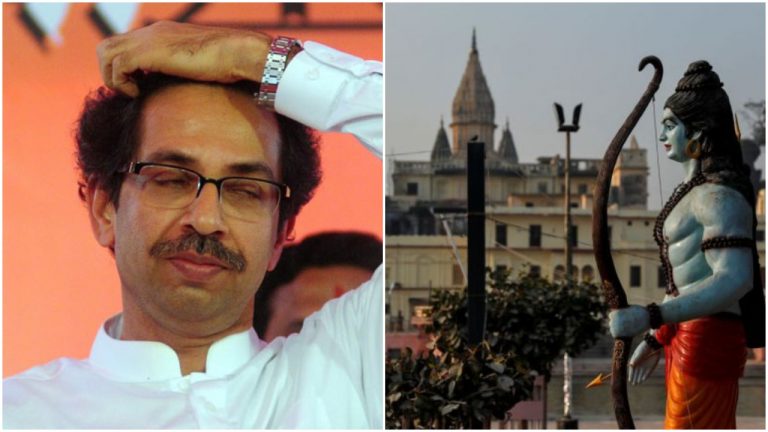
Amidst the ongoing face-off between Shiv Sena-led Maharashtra government and Bollywood actress Kangana Ranaut, the Sena chief Uddhav Thackeray faces yet another embarrassment as the Hindu seers of Ayodhya on Thursday said that Maharashtra chief minister Uddhav Thackeray was no more welcome in the temple town of Ayodhya.
According to the reports, the Hindu sadhus of Ayodhya, extending their support to Bollywood actor Kangana Ranaut, questioned the action of Maharashtra Chief Minister against the actress.
Mahant Raju Das, priest of the Hanuman Garhi temple on Thursday said that Uddhav Thackeray and Shiv Sena are no more welcome in Ayodhya. The Hindu seer added that if Maharashtra Chief Minister visits Ayodhya, he will face stiff opposition from seers of Ayodhya.
Questioning the action of Shiv Sena-led BMC against Kangana Ranaut, Mahant Raju Das said, “The Maharashtra government acted without wasting any time against the actress. But the same government is yet to take action against the killers of two seers in Palghar.”
Maharashtra govt shielding anti-social elements, says Mahant Kanhaiya Das
Similarly, another Hindu seer Mahant Kanhaiya Das, head of the Ayodhya Sant Samaj, alleged that the Maharashtra government was shielding those who are involved in anti-social activities and also issued a warning to Uddhav Thackery against coming to Ayodhya.
“Now, Uddhav Thackeray is no more welcome in Ayodhya. Why is the Shiv Sena is attacking Ranaut? Everyone can understand. It is not a mystery. The Shiv Sena is not the same what it used to be under Balasaheb Thackeray,” said Mahant Kanhaiya Das.
Extending their support to the national award winning actress, Vishwa Hindu Parishad, said that the action against Kangana Ranaut is very clear that the Shiv Sena is deliberately targeting the actress because of her support to nationalist forces, who has raised her voice against drug mafia of Mumbai.
Sharad Sharma, the regional spokesperson of VHP, said that the Maharashtra government was acting with malafide intention against Kangana Ranaut.
The face-off between Maharashtra govt and Kangana Ranaut
The Kangana vs Shiv Sena standoff began after Shiv Sena leaders as well as NCP leaders had abused and threatened Kangana Ranaut for referring to Mumbai as Pakistan-occupied-Kashmir after Azadi slogans were spotted on graffiti on the streets of Mumbai.
Joining the Maha Vikas Aghadi government, Mumbai Commissioner of Police had also ‘liked‘ that asked for public shaming of Kangana Ranaut. Adding salt to the injury, Shiv Sena MP and chief spokesperson Sanjay Raut had gone on to refer the national award-winning actress as ‘haramkhor ladki’.
In addition to the abusive tirade against Kangana, the Maharashtra government had also decided to launch a probe into the alleged consumption of drugs by actor Kangana Ranaut.
The stand-off escalated after Sanjay Raut had threatened the actress not to visit Mumbai ever again. Taking the threat as a challenge, Kangana Ranaut landed at Mumbai on Wednesday, leading to a massive embarrassment to the Maha Vikas Aghadi government.
Besides ad-hominem attacks, the state apparatus had pushed into taking punitive action against the actress for her remarks that were at odds with the Maha Vikas Aghadi government. The distraught actor had shared videos on Twitter, alleging that Brihanmumbai Municipal Corporation (BMC) officials had raided her office premises and threatened to demolish her property.
The BMC officials demolished a portion of the property even as the actor was on her way to Mumbai from Manali. However, the courts came to her rescue by staying further demolition of Kangana Ranaut’s property.
The normalisation of Paedophilia has been underway in the West for quite some time. We have seen TedX speakers offer sermons on how society is risking the safety of children by demonising and marginalising paedophiles. We have seen how ‘Drag kids’ have become a phenomenon and one of them Desmond is Amazing was spotted dancing at a gay bar in New York while adult men threw money at him. ‘Virtuous Paedophiles’ is actually a phrase that the media is seeking to normalise. However, the most audacious bid on that front is undoubtedly the movie Cuties by Netflix.
Cuties has been at the centre of controversy ever since its posters were first released by Netflix. People had slammed the platform for what was obviously the hyper-sexualisation of children. Netflix then offered an apology, not for the movie itself but for its advertising campaign. The platform had also said it could not comment on whether it supports paedophilia or not.
The warning signs were all there from the very beginning. Its description read, “Amy, 11, becomes fascinated with a twerking dance crew. Hoping to join them, she starts to explore her femininity, defying her family’s traditions.” That, too, attracted a lot of outrage. However, its defenders damned those offended by it claiming that they could not criticise a movie before actually having watched it.
Unfortunately for them, the movie has released and it is even worse than we previously imagined it to be, a million times worse. We shall not link the problematic clips doing the rounds on social media as many people are likely to find it extremely disturbing. From the clip, it is evident that such content should never be permitted on screen, regardless of the intent on the part of the filmmakers. However, the mainstream media is continuing its brave defence of the paedophilia content.
The mainstream media often pretends to be the voice of the masses. But time and again, on every contentious issue, they invariably tend to take the stand that the masses stand strongly opposed to. It is all the more clear in light of the movie on Netflix that the media is not a friend to the masses, and in fact, is an enemy towards all values cherished by ordinary citizens.
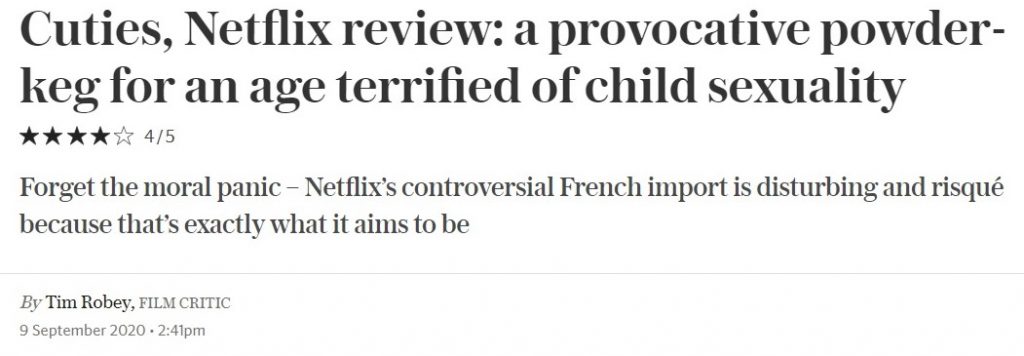
The Telegraph described Cuties as “a provocative powder-keg for an age terrified of child sexuality”. Quite clearly, the ‘reputed’ newspaper wants people to celebrate ‘child sexuality’, whatever that means. If I were in law enforcement, I would definitely want to pay that critic a visit and everyone at Telegraph, just to be sure.
Cuties Telegraph review
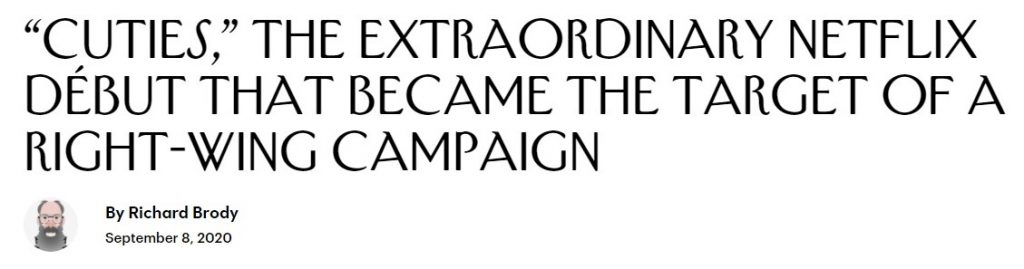
The New Yorker, too, defended the movie claiming in its review that Cuties became the target of a ‘right-wing campaign’. The implication appears to be that those in the left-wing should naturally defend the content that appears to be paradise for paedophiles since right-wingers are outraging about it. The critic misses the point completely. Paedophilia is not a left-wing or right-wing issue, sexualisation of children is a phenomenon that ought to be opposed by every sane individual.
Cuties the New Yorker review
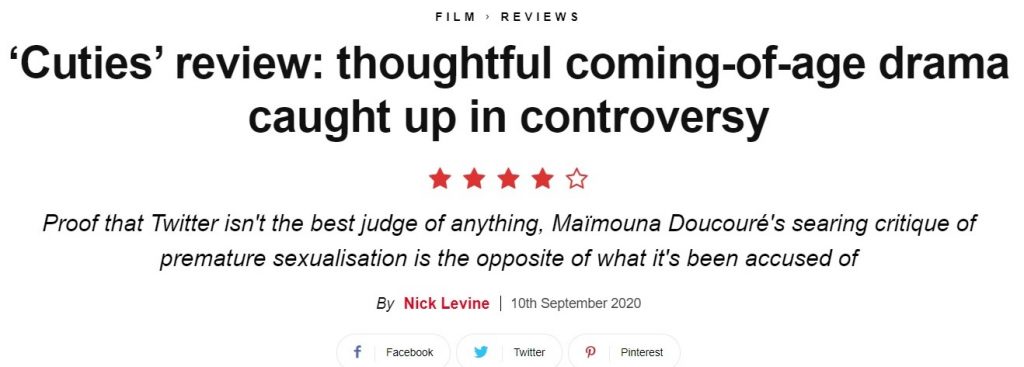
Others defended the movie calling it a ‘thoughtful coming-of-age drama’. It may be thoughtful indeed, in fact we have no doubt that it is thoughtful, which makes it even worse. To claim that a lot of thought went into a movie that sexualises children is not precisely a good-look for the filmmakers. Again, it ought to be emphasised that the intent does not matter when it comes to content that serves the sexual desire of paedophiles.
Cuties NME review
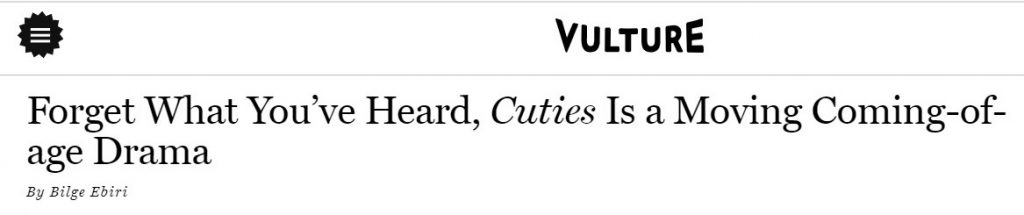
Vulture says in its review of Cuties, “The movie was condemned sight unseen by many online, even as those who’d actually viewed the film insisted that it was in no way exploitative. Since then, perhaps unsurprisingly, the anti-Cuties cause has also been embraced by various trolls and conspiracy nuts; I’ve heard from a couple of defenders of the film that they’ve been targeted for harassment.”
“Even so, on the surface, you’d think that this controversy might prove to the picture’s ultimate benefit, turning it from a foreign-language obscurity (the kind of movie that tends to get lost on Netflix) to a must-see flash point. And Cuties certainly deserves to be seen. But it’s also a delicate work that strikes a very careful balance in its portrait of the world, and that balance is upset if a viewer is more worried about social propriety than the truth of lived experience,” it added.
Cuties Vulture review
Quite conveniently, Vulture claimed that the movie was a target of ‘trolls’ and ‘conspiracy nuts’ despite the fact that the movie has been opposed by people across the board. It also attempted to evoke sympathy for the filmmakers and defenders of the movie claiming that they had been subject to death threats.
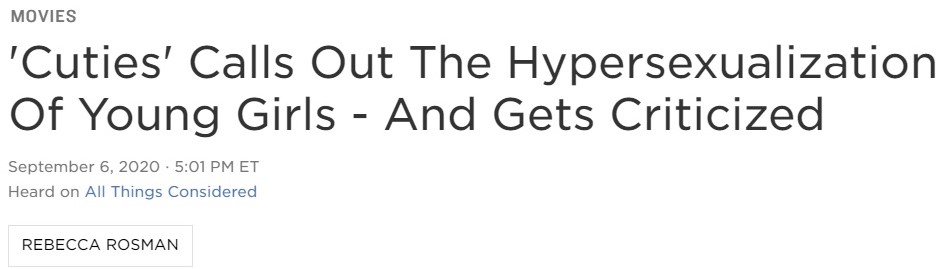
NPR went a step further and claimed that the filmmakers were being criticised for ‘calling out’ the sexualisation of children. It said in its review, “The French film, Cuties, is being praised for its critique of the hyper sexualization of young girls – and the consequences of that – as they rush to become adults in the age of social media.”
Netflix NPR review
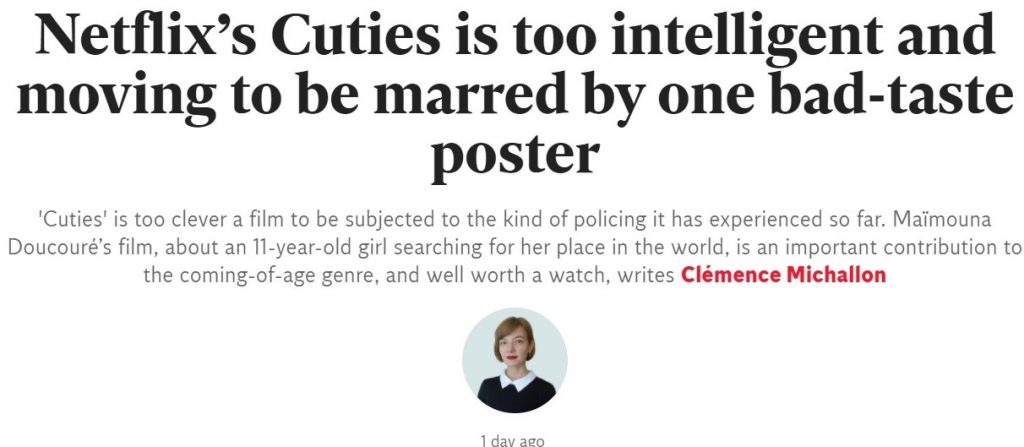
It is almost as if these movie critics are living in a parallel universe and have found their way here through a glitch in the matrix. The Independent, too, bemoaned the criticism the movie was receiving and said, “Netflix’s Cuties is too intelligent and moving to be marred by one bad-taste poster”. The poster is the least troublesome issue here, given what the clips doing the round tell us about the movie.
Cuties Independent review
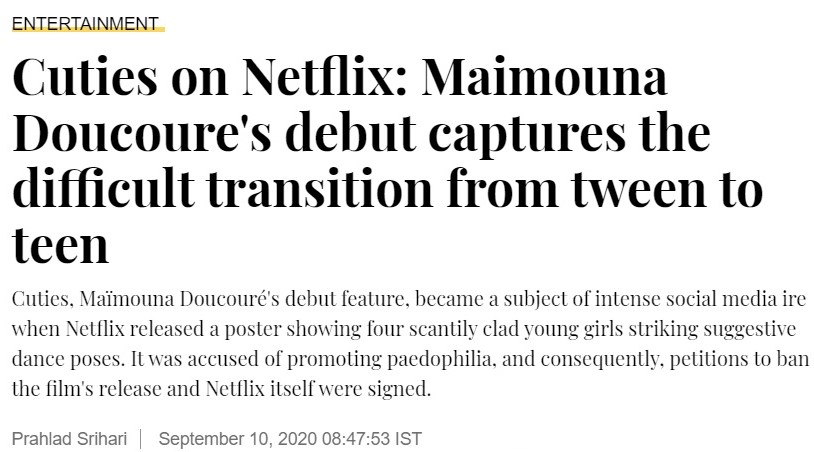
One would have expected the critics in India to be more aware of the problematic aspects of the movie but that was certainly not the case. In their bid to ape the West, Indian critics too appear to have lost all their sense of proportion. The Firstpost review claimed, “Maimouna Doucoure’s debut captures the difficult transition from tween to teen”.
The critic writes, “Watch a two-minute clip or a single representative image, and the chronically angry feel obliged to participate in every debate, and throw in a casual death threat like it were a legitimate form of criticism. Of course, these people have not seen the movie. Perhaps, they never will.” It says a lot about the sorry state of the media, indeed, when they attempt to shame people for opposing the sexualisation of children.
Cuties Firstpost review
At least, the Firstpost review does acknowledge that it is an excruciatingly difficult watch. It says at one point, “Surveying this minefield will definitely test viewers with low discomfort threshold, but it compels us to question our own gaze.” It concludes with the declaration, “It’s a young girl experiencing joy, freedom and innocence in its purest forms.”
The moral compass of the media appears to be utterly beyond recognition. Instead of recognising the problematic aspects of the movie and its disgusting sexualisation of children, it seeks to blame those opposing it for the controversy. The argument appears to be that the movie actually critiques the sexualisation of children. Sexualising children to critique the sexualisation of children does appear a rather strange way of doing it. As one right-wing journalist correctly pointed out, it is akin to arguing that snuff movies are actually meant to condemn senseless violence.
It is also pertinent to mention here that Cuties has the endorsement of the entire movie industry. It is not surprising given the fact that the movie industry has long been the cherished home of sexual predators and paedophiles. It also received an award at the Sundance movie festival, one of whose co-founders is in jail currently on charges of child sex abuse.
As it turns out, the movie is far more outrageous than previously thought. One of my colleagues watched the movie so you don’t have to. You can read her review here.
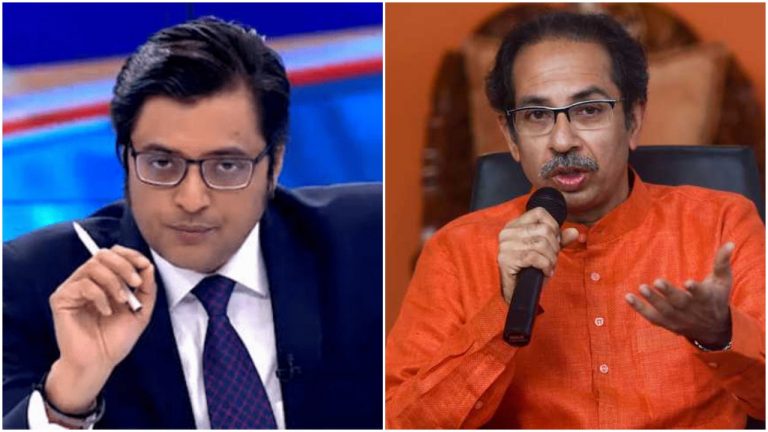
Days after Shiv Sena-led Maharashtra government arrested two Republic TV reporters and asked cable TV operators to stop airing the Republic TV and Republic Bharat channels, Arnab Goswami – the chief of Republic TV network on Friday demanded the immediate release of the reporters and warned Maharashtra Chief Minister Uddhav Thackeray against blocking his news channel. Republic Media Network’s reporter Anuj Kumar, video journalist Yashpaljit Singh were detained by the Maharashtra police a few days ago.
Launching a scathing attack against Shiv Sena chief Uddhav Thackeray, Republic media network chief Arnab Goswami demanded the immediate release of two Republic TV journalists, who were picked from Raigad for carrying out an investigative assignment.
“Uddhav Thackeray, release my journalists. You have broken the law and we will not allow this illegality. You did not write the constitution and you have no right to turn it upside down,” said Arnab Goswami in a blistering attacking against Maharashtra Chief Minister.
On the issue of Shiv Sena attempting to muzzle the voice of Republic network by blocking the channels, Arnab Goswami said that Shiv Sena had sent letters to cable operators to illegally blackout Republic TV and Republic Bharat, that amounted to allowing and approving a series of illegalities.
“Release my journalists immediately and perform your constitutional duty by arresting your party leaders who have been caught red-handed sending threats to cable operators,” Arnab Goswami arrested
“I am a Mumbaikar”, said Goswami, pointing out on how had built the Republic with hard work and effort. Issuing a warning against the arbitrary ban on his channels, Arnab Goswami said that Shiv Sena cannot touch his network as the people of Mumbai, Maharashtra and India are with him.
The Republic TV Editor-in-Chief said that if Uddhav Thackeray fails to release the journalists, he will be fighting him in both the courts of public opinion and our country’s highest courts.
Republic TV has also informed that Maharashtra govt is attempting at forced interrogation of its reporter of Anuj Kumar.
Maharashtra govt intimidates and threatens Republic TV
Arnab Goswami’s attack against Maharashtra Chief Minister and Shiv Sena chief Uddhav Thackeray comes at the backdrop of the recent attempts by the Maharashtra government to intimidate and threaten the Republic TV for carrying extensive coverage in both Sushant Singh Rajput suicide case and also Palghar Hindu Sadhu lynching case.
Earlier in the day, it was reported that Shiv Sena had asked the local cable operators in Maharashtra to ban the channels of Republic media network or face consequences.
In a letter issued on Thursday, the Shiv Cable Sena, an affiliate to Shiv Sena, has asked the cable TV operators to ban Republic Media network in the state. The Shiv Sena has also issued veiled threats to the cable operators to ban the Arnab Goswami-led media network or face consequences.
The crackdown on Republic TV by Shiv Sena comes at the backdrop of Republic TV’s relentless coverage into the recent controversial demolition drive carried out Sena-led BMC against Bollywood actress Kangana Ranaut.
Just a few days back, Shiv Sena had moved two breach of privilege motions against Arnab Goswami, accusing him of attempting to malign the image of Chief Minister Uddhav Thackeray and NCP chief Sharad Pawar.
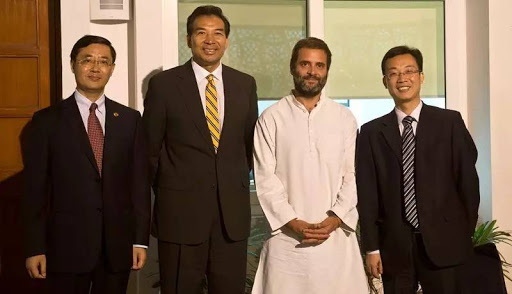
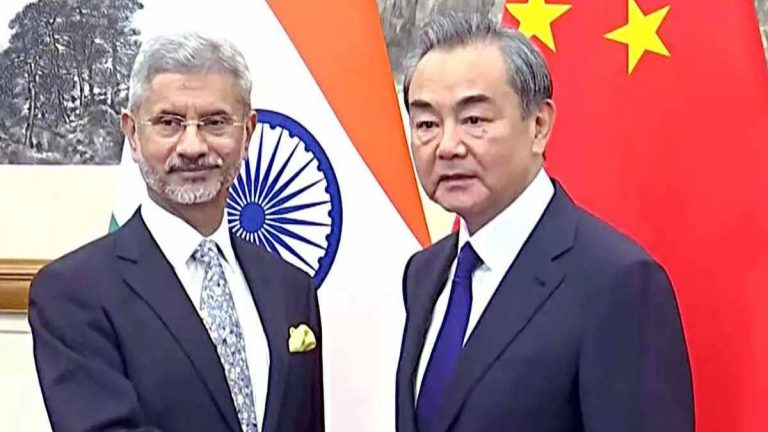
Amid the rising tension at the Line of Actual Control, Indian and the Chinese Foreign Ministers met for a meeting at Moscow in Russia yesterday. The bilateral talks between the Indian Foreign Minister, S Jaishankar and his Chinese counterpart Wang Yi were preceded by a meeting at the Shanghai Cooperation Organisation (SCO) and a luncheon meeting between Russia, India and China (RIC).
The meeting resulted in a five-point course of action on which both the countries agreed. However, a document released by the Chinese Foreign Ministry made certain claims in relation to the agreement reached in the meeting which were categorically rejected by the Indian side. The document claimed that the Indian side did not consider the relations to be dependent on the settlement of the boundary question.
The document further claimed that the Indian side believed that the policy of China towards India has not changed. Both the claims are in direct contrast to the position maintained by India. The Indian Foreign Minister had clearly stated several times that the status of bilateral ties cannot be delinked from the situation at the LAC.
Besides, the five-point plan released by the Ministry of External Affairs does not include any of the claims made in that document. The things agreed upon by both the countries as per the five-point plan are:
Both the sides should take guidance from the series of consensus of the leaders on developing India-China relations which included not allowing differences to become disputes.
The present situation at the border areas is not in the interest of the either side and therefore the border troops of both sides should continue their dialogue, quickly disengage, maintain proper distance and erase tensions.
Both the sides shall abide by all the existing agreements and protocol on China-India boundary affairs, maintain peace and tranquility in the border areas and avoid any action that could escalate matters.
Both sides should continue to have dialogue and communication through the Special Representative mechanism on the India-China boundary question. And in this context the WMCC (Working Mechanism for Consultation and Coordination) on India-China border affairs should also continue its meetings.
As the situation eases, both sides should expedite work to conclude new Confidence Building Measures to maintain and enhance peace and tranquility in the border areas.
China’s position regarding the ongoing stand off at the LAC has been ambiguous. While on hand it claims to be in favour of maintaining peace at the LAC and abide by the existing protocols, it also accuses India of aggression and expansionism giving itself a clean chit.
The sudden and tragic loss of a relative, especially one’s parents, could be an agonising moment of sombre, sadness and despair in their life. It could wreak psychological devastation to the individual who had recently lost one of his or her loved one to death.
Usually, at a time of such a profound misery, not just friends, but foes too express their sympathy and solidarity with the bereaved individual. However, there exist some perverse individuals, for whom such moments of grief is an opportune moment to express their hatred against the concerned person.
One such individual is Newslaundry columnist and serial propaganda peddler, Jas Oberoi, who did not shy away from moralising a social media user named Sheetal Mishra on the tragic demise of her father. Oberoi, an avowed left-leaning columnist, who had, time and again, expressed his unmitigated contempt for the aspirations of millions of Hindus who want to see a magnificent Ram Temple in Ayodhya, went so far as to create a collage of tweets demonstrating Ms Mishra’s unwavering demand for building a Ram Temple in Ayodhya.
Sheetal Mishra had posted a heart-rending tweet on September 9, stating that she lost her father to the abject health care system in the country which forced her brother to run pillar to post across Bhubaneswar for getting an ambulance to shift their father to a hospital. Ms Mishra implied that the delay in getting her father admitted to a hospital cost them his life.
However, the saddening death of Ms Mishra’s father was seen as an opportunity by Oberoi to peddle his grouse against the social media user. For Oberoi, demanding the construction of arguably the holiest site for Hindus, which was demolished by marauding Mughals in the 16th century, was akin to “spreading bigotry”. He took to Twitter, dredging up old tweets by Ms Mishra and sermoning her on her father’s death that the incident might serve as a lesson to her and she would do better things than “spreading bigotry”.
In fact, Oberoi posted a subsequent tweet sharing an image of Ms Mishra’s recent tweet in which she is seen pledging her life for the construction of the Ram Temple. Oberoi derisively commented, “some people don’t change I guess”.
Jas Oberoi rattled by the Supreme Court’s verdict in favour of Hindus in the Ayodhya dispute
The construction of Ram Temple has been a persistent thorn in the side of Jas Oberoi. Ever since the Supreme Court of India sanctioned the construction of Ram Mandir, in its landmark judgment last year, Oberoi has been thoroughly rattled by the top court’s verdict.
Oberoi was so vexed by the judgment that he couldn’t stop himself from sharing a preposterous article published on the leftist online rag ‘The Wire’, claiming Sikhs were furious with the Ayodhya judgment. He had also once referred to a VHP meet for the temple as “Hindu terrorist recruitment drive”.
Why Sikhs Are Angry With the Ayodhya Judgment :
1. Supreme Court called Sikhism a cult
2. They got a nobody on the stage & made him say that Guru Nanak was a Ram Bhakt & went to Ayodhya on a pilgrimage in 1500’s to visit Ram Janambhoomi
Jas Oberoi, a bigot who liberally shares fake news to support his propaganda
While Oberoi goes around social media, dishing out certificates of “bigotry” to others, his own past record suggests that he is a rank bigot. In 2017, Jas Oberoi exhibited an egregious display of bigotry when asked the BJP spokesperson Tajinder Singh Bagga to give up Sikhism for merely expressing his support for a Hindu festival.
In 2017, he had displayed his bigotry in all its glory, by trying to pass off a 2016 video of Prime Minister Narendra Modi meeting Sayed Fakhar Kazmi Chisty of Ajmer Sharif, as a new video. Not only that, he had said that this was Modi’s attempt to appease the Muslim minority in Gujarat which was about to go to polls at that time.
Propagandists like Jas Oberoi have also never shied away from peddling fake news or bothering to check the veracity of news being peddled in the social media if it aligns with his agenda. Jas Oberoi had lied blatantly when he had asserted that the press conference held by Judge Loya’s son to implore journalists and activists to leave his family alone, was organised by Amit Shah, the President of BJP.