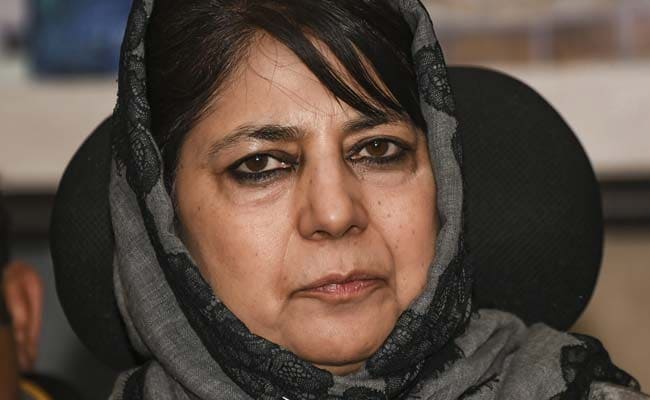
Former Jammu and Kashmir Chief Minister Mehbooba Mufti on Friday accused the Indian government of abrogating Article 370, which made Jammu and Kashmir an integral part of India without any riders attached, so that it can “gift territory to China”.
Illegal abrogation of Article 370 was done to take over land & disempower locals. Today China has grabbed Galwan valley & GOI isnt even acknowledging it. Was J&K dismembered to gift territory to China?
Mufti accused that the abrogation of Article 370 was “illegal” and was done to “disempower locals”. She further accused that China has “grabbed” Galwan Valley and the government of India is not acknowledging it. She then questioned whether the erstwhile state was bifurcated into two union territories done so that it can “gift territory to China”.
Her accusations came hours after Prime Minister Modi assured that no land is lost in the violent face-off with China in Galwan Valley in Ladakh. PM Modi on Friday issued a stern message to neighbouring China saying that India wants peace and friendship but it won’t compromise on its sovereignty.
भारत, Peace और Friendship चाहता है, लेकिन अपनी Sovereignty की रक्षा हमारे लिए सर्वोपरि है। और आप सबने भी इसी भावना को प्रकट किया है: PM @narendramodi
He also asserted that there has been no intrusion by the Chinese soldiers in the Indian territory. “No one entered Indian territory, nor were Indian posts taken over, Prime Minister Narendra Modi said in an all-party meeting this evening to discuss the Ladakh clash in which 20 Indian soldiers were killed. “20 jawans did die, but they taught a lesson to those who had cast their evil eyes on Bharat Mata (India),” PM Modi said.
Mufti is one of the last mainstream politicians in Kashmir who has been booked and detained under the Public Safety Act (PSA) since August 2019 after the abrogation of Article 370. Former J&K Chief Ministers Omar Abdullah and his father Farooq Abdullah, who were also detained, were released in March this year.
Violent clashes between India and China in Galwan Valley
At least 20 Indian soldiers, including Commanding Officer, had attained martyrdom in the violent clashes with the Chinese troopers in Eastern Ladakh’s Galwan Valley, the Indian Army said on Tuesday. The Army had initially claimed that 3 soldiers, including one Commanding Officer, were killed in the skirmishes but later in the evening it revised the figure to 20 saying 17 others had succumbed to their injuries due to the prolonged exposure to sub-zero temperatures.
Though Beijing remained reticent on the number of casualties suffered by it, the Indian Government said that the Chinese side endured heavy casualties with close to 43-45 PLA soldiers been seriously injured or killed in the clashes. Now, a US intel report has stated that at least 35 Chinese soldiers have perished in the brawl at the Galwan Valley.
The killing of the Indian soldiers marks the Indian Army’s worst losses since the Kargil War in 1999 and signifies the most intense military combat between India and China since 1967 when about 80 Indian soldiers and at least 300 Chinese PLA troops were killed in the course of the savage skirmishes that broke out near the Nathu La and Cho Lo passes, the strategic gateway to the crucial Chumbi valley.
The perennial clashes along India’s borders with Pakistan and China, which has recently again taken a more aggressive turn at the Chinese side after the attack on Indian soldiers by the Chinese troops, has yet again ignited a debate regarding the cost India has been paying due to the strategic blunders that were committed during the Nehruvian era.
Not just the gifting of territories to Pakistan and China, the Congress party under the leadership of former Prime Minister Jawaharlal Nehru is responsible for India ceding territories with much crucial strategic significance. The indecisions of the then Prime Minister Jawaharlal Nehru has cost the country much more than just vast swathes of Jammu Kashmir and Ladakh.
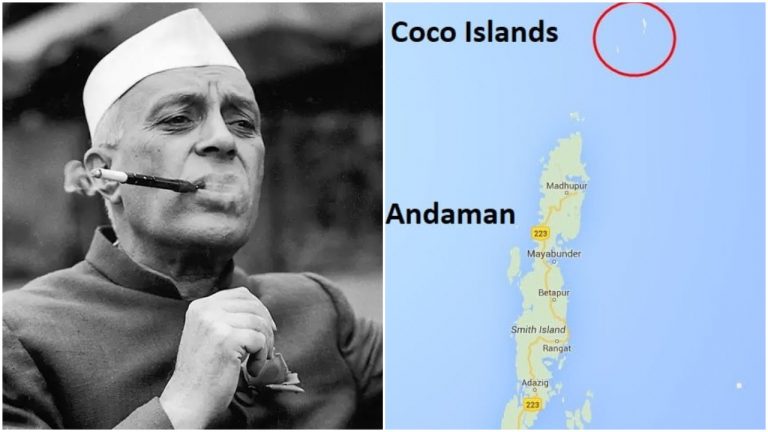
Nehru’s lack of strategic comprehension and his inability to bargain hard with the Britishers has resulted in India losing one of South Asia’s most strategic islands after the Andaman and Nicobar Islands – the Coco Islands.
Historical claims on Coco Islands
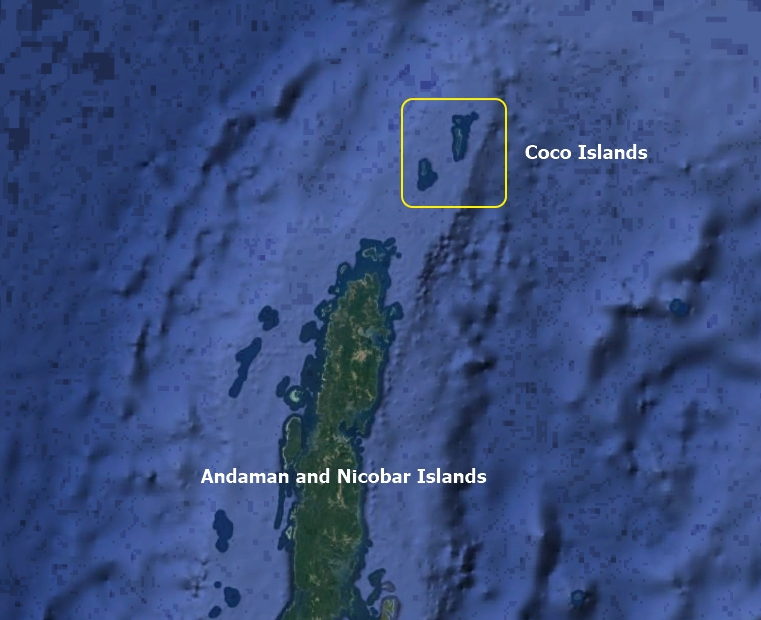
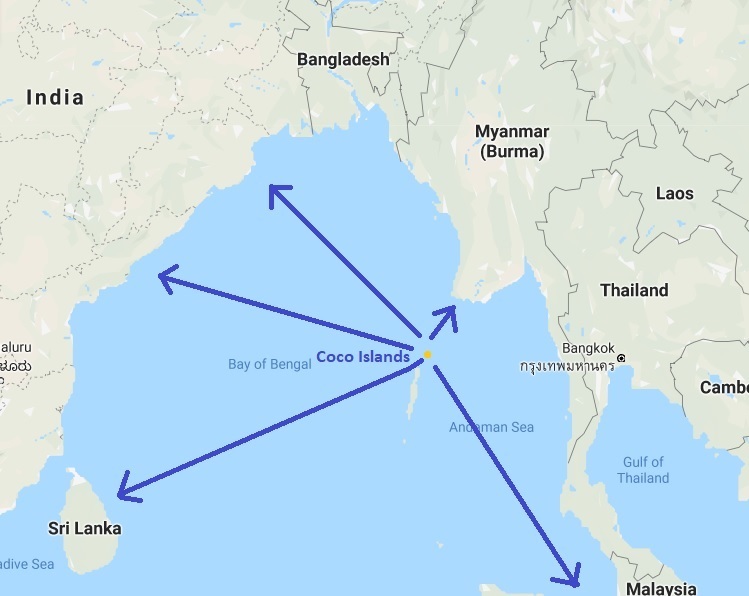
Coco Islands, which lies to the 1255-km south-east of Kolkata, is one of the most important islands of South Asia. The Coco Islands, which is geologically an extended division of the Arakan Mountains or Rakhine Mountains, submerges as a chain of islands in the Bay of Bengal for a long stretch and emerges again in the form of the Andaman and Nicobar Islands. These strategic islands, lying north to Andaman islands are part of the same topography as India’s Andaman & Nicobar Island. However, the Coco islands are now part of Myanmar, the reason being reluctance of the Indian leadership to hard press for the claim on these islands.
In the early 19th century, the British government in India established a penal colony in the Andaman for the convicts in the Indian subcontinent and the Coco Islands were a source of food for it. The British government had reportedly leased out the islands to Jadwet family of Burma.
Coco Islands – Google Earth Image
The leasing of control of the Coco islands resulted in poor governance of the islands, which made the British government in India to transfer its control to the government of Lower Burma in Rangoon. In 1882, the islands officially became part of British Burma. The islands became a self-governing crown colony even after Burma was separated from British India in 1937.
Just like Lakshadweep Islands and Andaman and the Nicobar Islands, the status of Coco Islands was in limbo when the Britishers decide to quit India in 1947. During the last few days of the British rule in India, the imperialists were contemplating every possible action that could sabotage the emergence of a strong India.
In such a context, the British Raj was planning to deny the free India certain strategic locations including the islands of the Lakshadweep, the Andaman and Nicobar Islands and also the Coco Islands. The British wanted India to break into different parts which would make them dominant and could still hold power.
British wanted to deny India its strategic islands
The imperialists had their eye on many strategic islands in the Indian Ocean, Bay of Bengal and the Arabian Sea, which they thought could be useful for keeping their dominance intact in the region. The Britishers thought that the non-inclusion of these islands with free India would also devoid India a strategic influence in the region, which will enable them to keep India in check.
As per an article in The Tribune India, written by KRN Swamy, the official documents accessed many years after Independence revealed information pertaining to British empire’s plans over these strategic islands.
The report dated June 13, 1947, by the Joint Planning Staff of the British Army stated, “The Lakshadweep Islands, which are sparsely inhabited coral strips, assume strategic importance from the airport of view if we cannot retain all the facilities we require in India. In such circumstances, they would be essential for our air reinforcement and the support route to Australia, New Zealand and the Far East. British Navy cannot use the islands as they are only open anchorages. If we cannot assume that the successor states in India will give us these facilities then we will have to rely on Ceylon, provided we can exclude the Andaman and Nicobar Islands from the transfer of power”.
The same day, the Indian and Burma Committee of the British cabinet considered the report of the chiefs of staff. In their minutes they stated, “The claim by Pandit Nehru is that Hindustan will automatically succeed to the position of India as an international entity… and Pakistan is merely a seceding minority”.“This claim, is naturally enough, contested by Mr Jinnah!” wrote the cabinet.
On July 5, 1947, Jinnah wrote to the secretary of state for India.
“Clause 2 of the India Independence Bill allots Andaman and Nicobar Islands to the Dominion of India. These islands have never formed the subject of discussion or agreement between parties any time. Their sudden inclusion in India raises a very grave issue. They are not part of India, historically or geographically. They were British possessions administered by Government of India and are not in the same category as other chief commissioner’s provinces, being reserved to Governor General under Constitution Act of 1935. Majority of population consists of tribes who are not connected with peoples of India by ethnical, religious or cultural ties. Pakistan’s claim to these islands is very strong since the only channel of communication between eastern and western Pakistan is by sea and, these islands occupy important strategic position on sea routes and provide refuelling bases. Dominion of India has no such claim. They should form part of Pakistan.”
Australia, a former colony of the British empire became aware of this plan of British and wanted clarity as to whether the British would keep full control over Andaman Nicobar Islands as they wanted full consideration could be given to vital concerns of Australia.
“Keeping back Andamans and Nicobars would be particularly useful against an aggressor which was ‘strong in land but weak in sea and air power.’ Australia felt that minimum Britain could do, if they could not retain the islands, was to secure long term leases for naval and air facilities,” the Government of Australia wrote to the British empire.
On the other hand, the Lakshadweep Islands were under the surveillance of Pakistan which wanted to occupy them desperately.
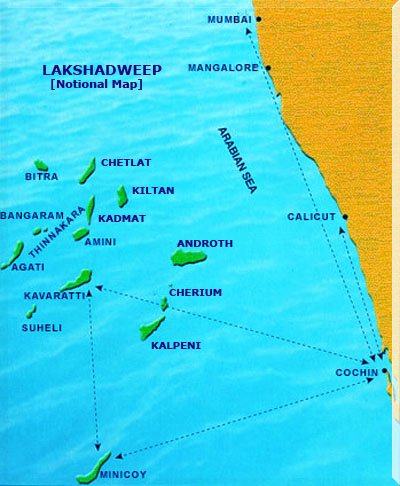
Lakshadweep Islands/ Image Source: Neostencil
Sardar Patel intervened to save Lakshadweep
However, the statesmanship of Sardar Patel saved these Islands for the country as he put strong negotiations with the Britishers and did not yield to the British pressure. Keeping in mind of the strategic importance of the Lakshadweep islands, Sardar Patel made sure that the Indian Navy was placed in Lakshadweep even before Pakistan could think and made sure the islands were under Indian control.
The British empire, who were aware of the tactfulness of Sardar Patel, was not ready to take any risk in negotiating Andaman & Nicobar Islands. The British were aware that any non-inclusion of Andaman would trigger National sentiments and could spoil their game.
British empire convinced Nehru to let go Coco Islands
As the British Empire lost both Lakshadweep and the Andaman Islands, they prepared to take control of at least one strategic islands in the Bay of Bengal and began negotiating for the Coco Islands, comprising Great Coco Island and Little Coco Island. The British, who wished to take control of these islands, sought to secure its defence requirements by proposing for a tripartite agreement for strategic use of these Islands.
The chiefs of staff of the empire never wanted the Coco Islands to become part of free India, but instead wanted it to be governed by Commissioner under the Governor-General of India till the agreement ended. They wanted the Governor to convince Indian leaders that the Coco Islands belong to two new dominions and not free India.
Strategic Importance of Coco Islands
So, the Viceroy Lord Mountbatten knowing the shrewdness of Sardar Patel, took the matter to Nehru and convinced the proposal in an informal terms in which he highlighted that India would lease these Islands to Britain for communication purposes.
Lord Mountbatten on July 19, 1947, reported that he had spoken to Nehru, who was quite friendly and had said that there was no objection to an official approach being made, though he could not commit himself until all implications had been considered. Following this talks, an official request to make the proposed arrangements was sent to Government of India, who agreed to it “without prejudice”.
The decision of Nehru not to hard press the British for the control of Coco Islands has emerged out to be another historical blunder of the former Prime Minister. These islands, which were later taken over by Burma, has now been used by Chinese to keep an eye on India. The strategic islands are now utilised by the Chinese military to spy on the country, where they have already built an airstrip and radar station.
If it was not for Sardar Patel’s brinkmanship, perhaps, India would have lost Lakshadweep and Andaman & Nicobar Islands just like former Prime Minister Nehru gave away the opportunity to take control of the strategic Coco Islands, which has now emerged as a national security risk to India.
Chinese presence in Coco Islands
The Coco Islands give Indian an immense strategic advantage in the region, considering its proximity to the strait of Malacca which is a crucial point for the global supply routes of oil from the Gulf. With the reports of increasing military activities of China on the Myanmar-controlled Coco Islands, the region becomes another hotspot for potential Chinese notoriety.
Coco Island, which is north of Andamans is strategically important to India. China, which has been eyeing to encircle India in the Indian Ocean Region with its aggressive ‘String of Pearls’ policy has shown keen interest in this island since last four decades. Since the early 1990s, there have been frequent reports of China using those islands for military and naval purposes. There are even reports that the islands have been leased out to China in 1994, but Mynamar denies it.
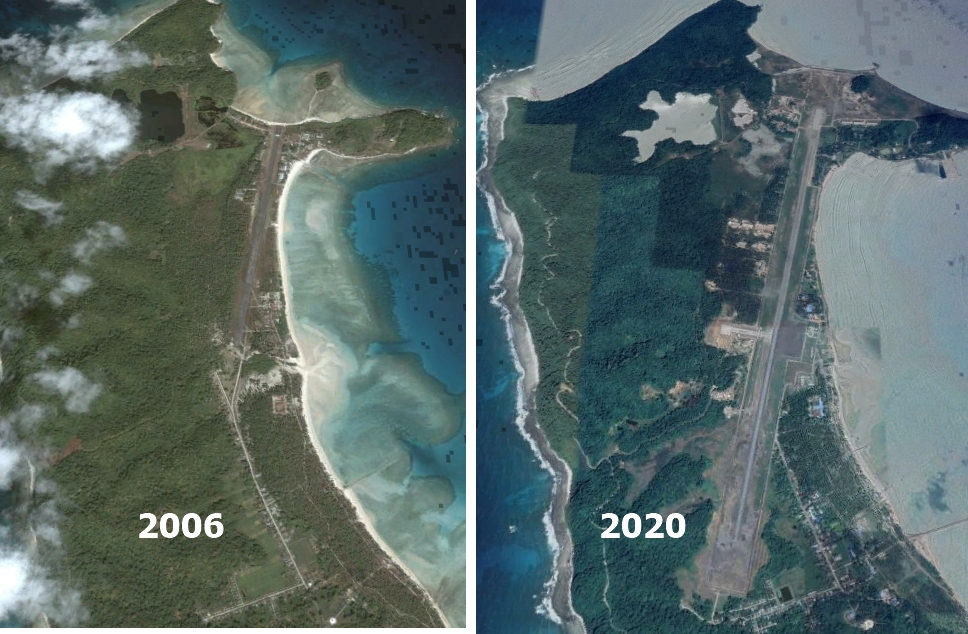
But it is well known in defence circles that the islands, specifically the Great Coco Island, is under the Chinese control and they have established a strong military presence there. They have signal intelligence facilities, maritime bases, and radar facilities that they use to monitor the activities of Indian armed forces, especially the Indian Navy based in nearby Andamans. The Great Coco Island had a short airstrip or around 1000 metre that allowed operation of small aircraft. But the Chinese have now extended it to an almost 2500 metre runway, which is used solely for military planes as no civilian plane fly to there.
Airstrip at Great Coco Island extended by China in the past decade (Google Earth photo)
An analysis of satellite images shows that the runway was extended only 5-6 years ago, during the time when China increased its military presence in other countries. Apart from extending the runway inward, the Chinese also reclaimed lots of area on the coast to extend it towards the sea also, which can be clearly seen in the two images from Google Earth given above, from 2006 and 2020.
China has also installed a SIGINT facility to monitor Indian missile launches into Bay of Bengal and the Indian Ocean. It is noteworthy that all Indian missile tests happen on the eastern coast along the Bay of Bengal, and thanks to the monitoring station at the island, now China can closely watch such launches and estimate even the classified details of the missiles, apart from being able to monitor movements of Indian navy.
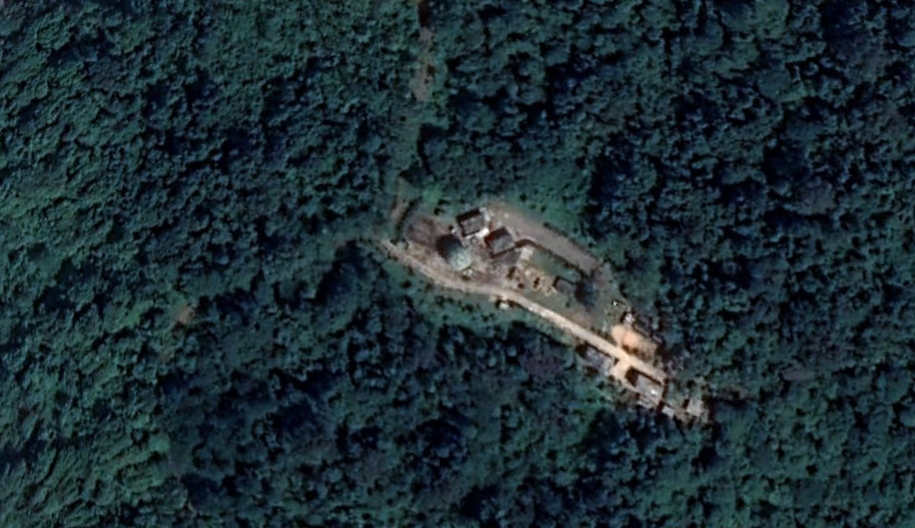
Chinese Radar station at Great Coco Island (Google Earth photo)
The Radar station at the island is located at the highest point of the island at around 90 metre altitude, giving it the best monitoring capabilities.
Therefore, thanks to its strong military presence at the Coco Islands, the Chinese are able to maintain a close watch on India’s defence preparedness. Had the Island not went to Myanmar and remained with India, China would not have such a strong military presence so close to India. Hence, not being able to retain Coco Islands cost India dearly, and it must be considered as a costly strategic blunder by the Nehru government.
China has already established its presence in several seaports around India. It has taken the control Hambantota port in Sri Lanka using its ‘debt-trap’, they are developing the Gwadar port in Pakistan as part of the China Pakistan Economic Corridor (CPEC), invested in the Chittagong port in Bangladesh and has won the rights for the Kyaukpyu port project in Myanmar. Along with all these, the Coco Islands located so close to Indian territories provide China a great advantage over India, which not have happened if history went in a different direction at the time of independence.
Amidst the simmering tensions along the Line of Actual Control in Eastern Ladakh following violent clashes between the Indian and Chinese troops, an all-party meet was called by PM Modi to discuss the tense situation in Ladakh. PM Modi on Friday issued a stern message to neighbouring China saying that India wants peace and friendship but it won’t compromise on its sovereignty.
भारत, Peace और Friendship चाहता है, लेकिन अपनी Sovereignty की रक्षा हमारे लिए सर्वोपरि है। और आप सबने भी इसी भावना को प्रकट किया है: PM @narendramodi
Modi also asserted that there has been no intrusion by the Chinese soldiers in the Indian territory. “No one entered Indian territory, nor were Indian posts taken over, Prime Minister Narendra Modi said in an all-party meeting this evening to discuss the Ladakh clash in which 20 Indian soldiers were killed. “20 jawans did die, but they taught a lesson to those who had cast their evil eyes on Bharat Mata (India),” PM Modi said.
PM Modi assured that the Indian Armed Forces– Navy, Army and Air Force are all prepared and competent to protect the country. “I am also assuring you that our army is leaving no stone unturned to protect the country. Deployment, Action, Counter Action, Our Army, Navy and Air Force are doing what they have to, to protect the country,” PM Modi said.
While claiming that China has been conveyed about India’s stand on the issue in no uncertain terms, PM Modi said that the armed forces have been given full freedom to take any action that it deems necessary.
Speaking about India’s readiness in protecting its territorial integrity, PM Modi said that India has prioritised infrastructural development in border areas in the last few years for securing its borders. He also emphasised that the Indian Armed Forces are today powered with fighter jets, modern helicopters, missile defence systems inter alia.
बीते वर्षों में देश ने अपनी सीमाओं को सुरक्षित करने के लिए, बॉर्डर एरिया में इंफ्रास्ट्रक्चर डवलपमेंट को प्राथमिकता दी है।
हमारी सेनाओं की दूसरी आवश्यकताओं, जैसे Fighter Planes, आधुनिक हेलीकॉप्टर, मिसाइल डिफेंस सिस्टम आदि पर भी हमने बहुत बल दिया है: PM @narendramodi
PM Modi extolled about Indian Army’s augmented capability of patrolling areas which were earlier difficult to monitor. “Our soldiers are now able to monitor and patrol areas which were earlier not kept on the watch. Till now, no one was questioned but today our jawans intercept and stop the interlopers,” PM Modi said.
In a covert message hinted at China, PM Modi said that India has never cowed down to intimidation and it will continue to work towards achieving its goal.
“Be it trade, connectivity, counter-terrorism, India has never buckled under external pressure. Whatever is essential for national security and for strengthening the infrastructure in border areas will continue at the same pace,” PM Modi said.
Violent clashes between India and China in Galwan Valley
At least 20 Indian soldiers, including Commanding Officer, had attained martyrdom in the violent clashes with the Chinese troopers in Eastern Ladakh’s Galwan Valley, the Indian Army said on Tuesday. The Army had initially claimed that 3 soldiers, including one Commanding Officer, were killed in the skirmishes but later in the evening it revised the figure to 20 saying 17 others had succumbed to their injuries due to the prolonged exposure to sub-zero temperatures.
Though Beijing remained reticent on the number of casualties suffered by it, the Indian Government said that the Chinese side endured heavy casualties with close to 43-45 PLA soldiers been seriously injured or killed in the clashes. Now, a US intel report has stated that at least 35 Chinese soldiers have perished in the brawl at the Galwan Valley.
The killing of the Indian soldiers marks the Indian Army’s worst losses since the Kargil War in 1999 and signifies the most intense military combat between India and China since 1967 when about 80 Indian soldiers and at least 300 Chinese PLA troops were killed in the course of the savage skirmishes that broke out near the Nathu La and Cho Lo passes, the strategic gateway to the crucial Chumbi valley.
The Delhi court on Friday denied the extension in interim bail granted earlier to the Congress municipal Councillor Ishrat Jahan who is booked under stringent Unlawful Activities Prevention Act (UAPA) in connection with the Delhi riots case.
The Congress leader had earlier moved a Delhi court seeking an extension in the interim bail period for 10 days. Ishrat Jahan was granted interim bail on May 30 for her Nikaah on June 12. However, the bail period had ended on Friday.
The Additional Sessions Judge Dharmendra Rana ordered the Congress leader to surrender in the jail ‘today itself’ after dismissing her plea.
The court said, “The Jail Superintendent is directed to ensure adequate medical care to the accused and shall also follow all necessary protocols required in this regard.”
Ishrat Jahan in her application asserted that her husband came in contact with a coronavirus patient relative and later developed symptoms. She informed that her husband is advised to undergo a test. In her plea, she added she also had developed symptoms and is advised by the doctor to remain in self-isolation for the next seven days before getting tested.
Public Prosecutor refuted the claims of Coronavirus infection
During the Court proceeding, the Additional Public Prosecutor, Irfan Ahmad refuted the claims mentioned in her plea and told the court that it was a simple case of flu and the doctor has not prescribed any kind of test.
The lawyer defending her also stated that her husband’s Covid report came out negative.
After observing claims from both sides, the court ruled, “It is a settled principle of law that interim bail can only be granted in exceptional circumstances. Mere apprehension cannot constitute a valid ground for extension of Interim bail.”
Ishrat Jahan was detained by Delhi police for instigating riots during Anti-CAA protests
Congress leader and Municipal Councillor Ishrat Jahaan was detained by Delhi police for allegedly attempting to incite violence during the anti-Hindu riots in the national capital’s Khureji Khas area in the month of February.
Jahan has been charged under IPC sections 147 (rioting), 148 (rioting, armed with a deadly weapon), 149 (unlawful assembly), 186 (obstructing public servant in discharge of public functions), 353 (assault on public servant), 332 (voluntarily causes hurt to public servant), 307 (attempt to murder), 109 (abetment), and 34 (common intention) of the IPC and relevant sections of the Arms Act.
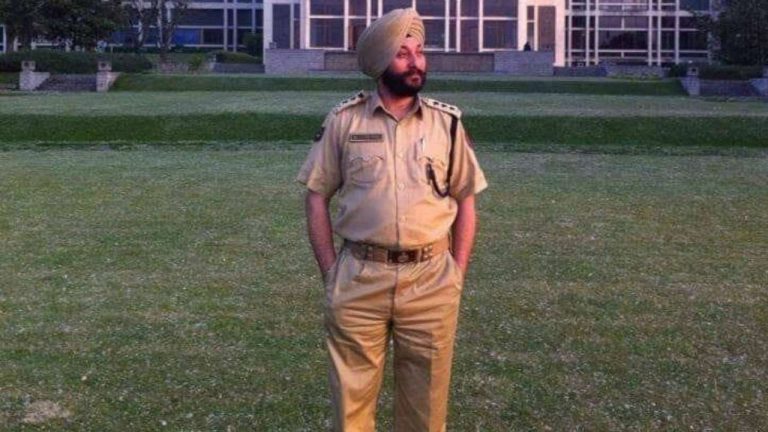
Social media was abuzz today after news broke out that suspended J&K DSP Davinder Singh had been granted bail by a Delhi Court after Delhi Police failed to file a charge-sheet within a stipulated time. He was arrested after he was found travelling with Islamic terrorists in the Jammu & Kashmir.
The Court granted bail to Davinder Singh and lawyer Irfan Shafi Mir in connection with the case filed against them by the Special Cell of the Delhi Police. The bail was granted after the Court noted that the charge-sheet was not filed even after the mandatory statutory period of 90 days had passed. The accused had to furnish a personal bond of RS. 1 lakh each with two sureties of each amount.
The IO in the case submitted a status report before the Court and said, “investigation in the instant case has not been concluded yet, hence chargesheet has not been filed.” It is important to note that bail was granted by the Court only in the case filed by the Delhi Police. There is a separate case that was registered against him by the National Investigation Agency in which he has not been granted bail and thus, he will not be walking out of jail.
Usual suspects had cast aspersions on the government and pretended that the disgraced cop was going to walk free. However, it has now come to light that bail was awarded to Davinder Singh in a separate case and he will continue to remain in judicial custody in the NIA Case. The NIA assured that they have sufficient evidence against him and he will be charge-sheeted in due course.
Accused J&K DSP Davinder Singh continues to be in judicial custody in the NIA case. We have adequate evidence against him and he will be charge-sheeted in due course: National Investigation Agency
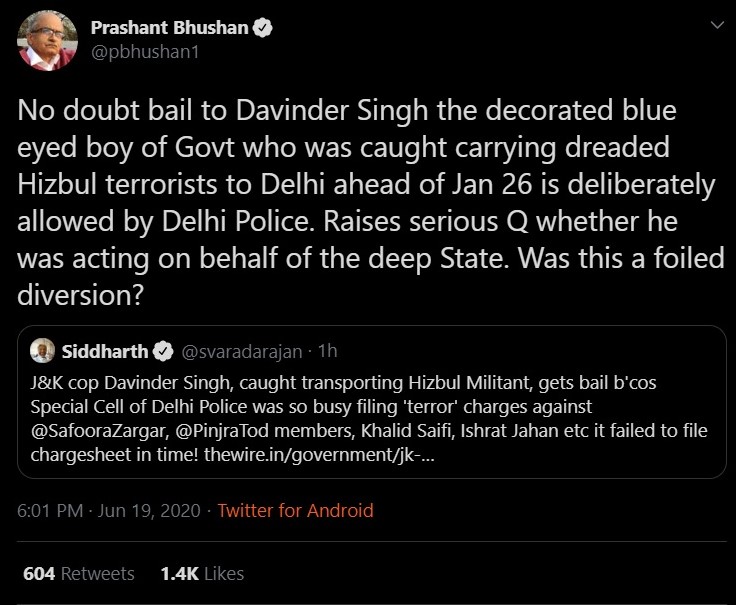
The statement by NIA busts the narrative that certain individuals have invested heavily in ever since the news of bail broke out. Siddharth Varadarajan of The Wire claimed that Delhi Police was so busy filing charge-sheets against the ‘activists’ in the Delhi Riots case that the disgraced cop had now gotten bail.
‘PIL’ Activist’ Prashant Bhushan went so far as to claim that Davinder Singh is a ‘blue-eyed boy’ of the government who was working on behalf of the ‘Deep State’.
Prashant Bhushan quote tweeted a tweet by Siddharth Varadarajan sharing a link to Th Wire report
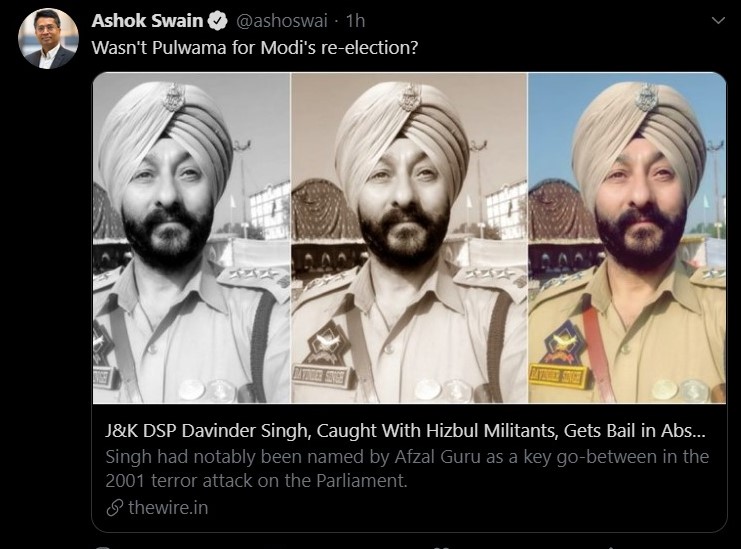
Ashok Swain, a professor at Uppsala University in Sweden, insinuated that the bail was evidence that the Pulwama Terror Attack was orchestrated by the Indian government to ensure his reelection as Prime Minister. This is a claim he has repeatedly made in the past and Pakistan news channels had latched on to his tweets to absolve the country of all sins.
Tweet by ‘Professor’ Ashok Swain
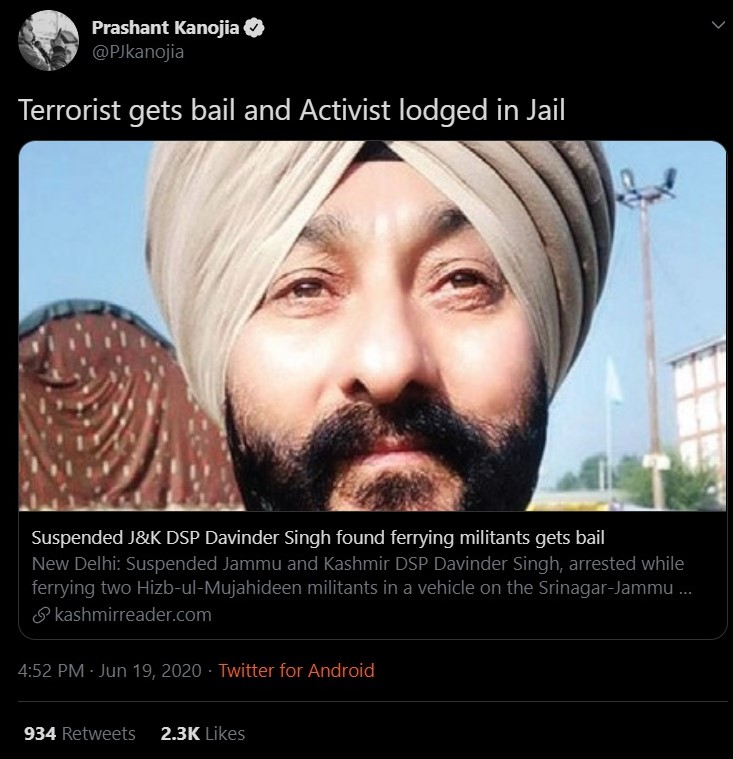
Another individual who latched on the piece of news for their personal agenda was Prashant Kanojia. He is a habitual fake news peddler who was arrested in the past for making derogatory remarks against Hindu Gods. He had also equated Dalits to animals.
In the current instance, he said, “Terrorist gets bail and Activist lodged in Jail”, in an obvious effort to undermine the efforts of Delhi Police in bringing to justice those accused of inciting riots in the national capital.
Tweet by Prashant Kanojia on the bail that was awarded to Davinder Singh
Thus, a coordinated attempt was made to mislead the public regarding the matter. Despite the fact that there was never the possibility of Devender Singh walking free, usual suspects gave the impression that it was the case and based on their false premise, they reached far-fetched conclusions in order to target the Prime Minister and his government.
Davinder Singh was arrested along with Hizb-ul-Mujahideen terrorists Naveed Babu and Asif Rather on the 11th of January when they were travelling together in a car. Later, it was reported that he was on the payroll of the Islamic terrorist organisation. Subsequently, his case was handed over to the NIA. The NIA had taken over the case on the 18th of January.
It is important to understand why only Hinduism mentions the universe. The reason is that only Hinduism knows about the vast dimensions and the huge timeframes of the universe of which our earth is just a speck. Ancient cultures like Maya, Inka, Sumeria, and others may also have reached out to the stars, but they were all destroyed either by Christianity or by Islam, and Bible or Quran were enforced as “the truth”.
Only Hindus have still preserved this knowledge which in all likelihood originated in India itself. There are still millions of valuable ancient texts in India, even though millions of others were burnt by invaders on the premise that only one book is needed. In Greece in contrast, there are estimated to be only some 20,000 texts.
Surya Sidhanta is a major text with incredible knowledge about the universe dated – hold your breath – at least 10,000 years ago. The ancient Indians knew that the earth is round or rather elliptical, that it goes around the sun, they knew the distance to the sun and moon; they knew that the distance is 108 times the respective diameter – the reason why sun and moon appear of the same size from the earth. Their knowledge was truly inspired or ‘God-given’.
The Puranas (purana means old and according to tradition were composed by Veda Vyasa around 5000 years ago), which are often dismissed as mere myths, are also a treasure trove of knowledge. They talk among other things about the creation of the universe (the ‘Big Bang’ and ‘expanding universe’ theory were in all likelihood inspired by them) and about the periodic withdrawal after billions of years, about the original, unmanifested One Source and the gods in charge of creation, sustenance and dissolution, who evolved from the One Source. Clearly, the ancient Indians were at home in the universe.
The Srimad Bhagavata Mahapurana even claims that there are ‘myriads of universes’, a view which may now be taken more seriously by science after certain experiments in Antarctica had strange results. The timescales which the ancient Indians proposed are incredibly huge.
Now compare this with the Abrahamic religions. Judaism, the parent religion, as it were, of Christianity and Islam, claims that the earth is some 6000 years old. Christianity and Islam didn’t challenge this view. Both did not look beyond this earth and actually hold very primitive ideas about it. Christianity taught that the earth is flat and static and that the sun moves over it until 400 years ago. Giordano Bruno, an Italian philosopher, was burnt to death in 1600 CE because he refused to disown the theory that the earth goes around the sun. Imagine – he was brutally killed for stating the truth and only 400 years ago.
Islam too considers the earth as flat and mountains were placed to stabilize it (Q19.15). Like Christianity, Islam also says that not the earth, but the sun moves, and runs to its resting place at night. There was clearly no idea about the vastness of the universe, as Q 67.5. says “We have decorated the heaven of this world with lamps and we made them as missiles for pelting the shaitans and thus prepared for them the scourge of flames.”
So naturally, these religions don’t mention the universe, because they had no clue about it. They destroyed the natural urge to discover the truth about us and the universe. Only since Christianity lost its power to punish views which are not in tune with the teaching of the Church, science took off in the West.
There is no doubt that the sudden tremendous progress of science in the recent few centuries was greatly inspired by Indian knowledge. Some western scientists themselves acknowledged this. Einstein said, “We owe a lot to the Indians.” Famous scientists like Heisenberg, Schroedinger, Oppenheimer or Tesla studied India’s ancient wisdom. And Mark Twain opined: “Our most valuable and most constructive materials in the history of man are treasured up in India only.”
Even in the 1970s and 80s, India’s wisdom had a rather good image, after the Beatles were inspired by Maharishi Mahesh Yogi’s Transcendental Meditation. The contribution of India for example to Transpersonal Psychology was also acknowledged at that time, yet was meanwhile erased at least from Wikipedia.
However, in our modern times, this has changed. Hindu Dharma and Hindus, especially Brahmins, who preserved the knowledge system over many millennia, are unfairly vilified and ridiculed by the mainstream religions. They are accused of ‘oppressing minorities’, of ‘rape culture’ and even of terrorism. It happens rarely that anything positive is said about the Hindu tradition, when it actually produces the most humane mindset, as it is based on Dharma, which means to do what is right under the given circumstances.
Are the institutionalized religions afraid that they lose their followers, if they come to know about the knowledge still stored up in India?
The law enforcement officials in Britain’s Hampshire have booked a 14-year-old minor boy for plotting an Islamic terror attack in England.
The juvenile who hailed from Eastleigh, Hampshire, was due to appear before Westminster Magistrate’s court on Thursday, the Counter-Terrorism Policing South East (CTPSE) said. The boy was charged on Wednesday on one count of preparation of terrorist acts in gross violation of section 5(1)(a) of the Terrorism Act 2006 connected to Islamist terrorism.
The police officials arrested the boy last week Friday from Hampshire Constabulary and the juvenile was later held under custody section 41 of the Terrorism Act by CTPSE sleuths.
“The arrest of the boy in Hampshire on charges of Islamic terrorism might concern the community of Eastleigh but Hampshire Constabulary have been working closely with colleagues in Counter Terrorism Policing South East on this investigation and we want to reassure you that the case is an isolated one with no known wider risk to the community,” the statement released by the CTPSE said.
The police also asked the residents of Eastleigh to report suspicious activities that they might have noticed in the neighbourhood in recent times. “If you believe, you saw something suspicious that raises your concern and might be remotely linked to terrorist activities, feel free to report them. Have belief in your notion, don’t rely on others and if you have detected any particularly dubious behaviour at a specific place or at a particular time of day, share those doubts with the police,” the CTPSE said.
In a Twitter post on Friday, Manikarnika actress Kangana Ranaut hit out at one section of the media for character assassination of the 34-year-old Sushant Singh Rajput who committed suicide on June 14 at his residence in Bandra, Mumbai. She cited a statement by the father of Sushant Singh Rajput wherein he revealed that the late actor was under severe stress, prior to his death.
Kangana quoted director Abhishek Kapoor who dubbed the tragic incident as “systematic dismantling of a fragile mind.” Kapoor had worked with Sushant Singh Rajput in the 2018 move ‘Kedarnath.’ The actress also quoted the late actor’s long -term partner Ankita Lokhande who stated that the suicide of Sushant was triggered by social humiliation.
Kangana Ranaut also stated that the movie mafia not only banned Sushant from his movies but also inflicted hard on his psyche. “Blind items are written to spread fake news but no legal action can be taken as your name is not mentioned. But the description (is obvious). If they have to write (a blind item) on me, then, they will describe me as an actress will curly hair, recipient of national awards, psychotic, and native of Manali without mentioning my name,” she emphasised.
Emotional, psychological & mental lynching • On an individual happens openly and we all are all guilty of watching it silently. Is blaming the system enough? Will there ever be change? Are we going to see a monumental shift in the narrative on how outsiders are treated? pic.twitter.com/DKmR1JhlDV
She highlighted news reports that sought to tarnish the image of Sushant Singh Rajput. “On August 23, 2017, Bollywood Live wrote an article claiming that Sushant is narcissistic and listened to his own songs while having sex. On December 16, 2016, Mumbai Mirror wrote that Sushant Singh Rajput looks like a truck driver. On February 22, 2019, Mumbai Mirror again wrote that the actor threw a bottle at a director at a party. On October 18, 2018, DNA wrote that Sushant Singh Rajput raped his co-actor and that he may go to jail during the #MeToo Movement,” she highlighted. He said that the entire mafia killed him Sushant bit by bit.
Stooges of Movie Mafia target Kangana Ranaut
Kangana Ranaut pointed out that several other reports were published in the mainstream media that peddled similar lies about the late actor. She called out the stooges of the movie mafia who dawn the cloak of journalists to carry out ’emotional, psychological & mental lynching.’ She sighed, “I did not take action when things were said about me. But, when a freedom fighter was trashed by a journalist, I spoke up and confronted the journalist. On the same night, four other journalists declared to shun my movies so that they become flop (at the box office). 3000 journalists target one girl and emotionally lynches her but the society stays silent.”
Star Kids untouched
Kangana said that she tried to sue the journalists but they disappeared, following the release of her movie. She stated that society is standing on the pillars of injustice and maintains stoic silence when it should raise its voice. Addressing the viewers, The actress concluded, “You seek pleasure (reading the scandals about actors) but did you wonder why such stories are not published about star kids?”
Kangana Ranaut blames ‘lobby’ for Sushant’s suicide
Earlier, the actress said that Sushant had expressed his grief, in several interviews, over not being accepted as a part of the film industry. She added that he was treated as a ‘leftover’ by the same lobby that was shedding crocodile tears after his tragic death. “Is this possible that the ill-treatment meted out to him has no connection to his suicide?”, she asked. Kangana also pointed out the lack of integrity and professional ethics amongst some journalists. She lambasted tabloid writers who have vilified Sushant Singh Rajput with adjectives such as ‘psychotic’, ‘neurotic’, and ‘addict’.
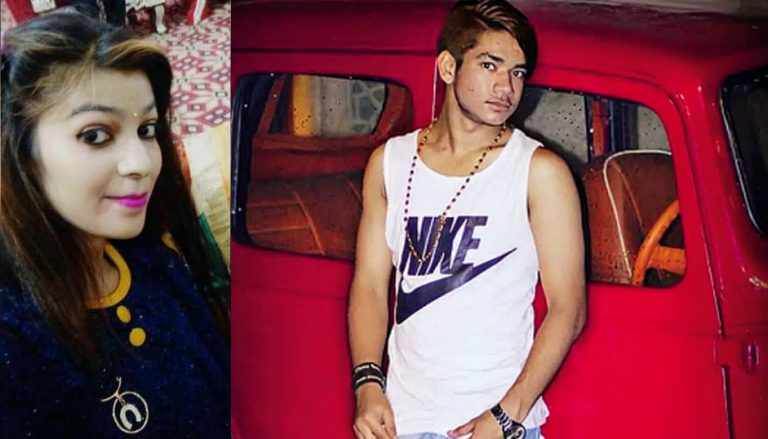
In Ghaziabad’s Tulsi Niketan, Sheru Khan alias Shah Rukh stabbed a 19-year old woman multiple times and murdered her in the middle of the road along with two of his friends on Wednesday. The victim was taken to the hospital immediately but she succumbed to the injuries on Thursday morning.
As per reports, the deceased, Naina Kaur (19) was a resident of Tulsi Niketan’s Vivek Vihar colony where she lived with her father Baldev Singh (62) and Neelam Kaur (58). Naina had just completed her intermediate last year and was pursuing a course in Nursing. Her wedding was scheduled for June 22 in Indore. Her elder sister is married.
While speaking to TOI, Baldev Singh said that the family had been to market to buy a sim card at around 8 pm. Baldev, who works as a clerk in a private firm said, “Naina wanted to eat chilli potatoes and stopped at a Chinese food outlet with her mother. I turned back to go as it was very humid.”
He added, “I had only gone 50 meters away when three men arrived on a bike. One of them, with his face covered in a mask, pulled Naina’s hands and thrashed her, after which she fell. When my wife tried to rescue her, he slapped her and she fell unconscious. One of them stopped me from trying to reach my wife and daughter. When Naina saw her mother lying on the road, she got up and slapped the accused several times. Suddenly, he stabbed her with a knife- first on her neck, abdomen, and other parts. He then fled with two others on the bike.”
The father of the deceased said that people present during the incident in the market became a mute spectator, no one came forward to rescue her.
A police officer said that during the fight the mother of the deceased tore the mask of the main accused and identified him as Sheru Khan (22) who is a resident of Delhi’s Sunder Nagri. He added, “He said he was in love with Naina since the time she used to go to school in Sunder Nagri.”
According to the family, he had known Naina for two years. Baldev Singh informed that they both studied computers together in Durgapuri in Delhi. He alleged that Sheru khan often harassed her and wanted to marry her. Around a week ago, he even came to their resident to threaten his daughter.
SHO of Tila Mor informed that two of his friends and those who were involved in a crime with prime accused have been arrested. They have been identified as Asif (22) and Aamir Chaudhary (20). Aamir lives in Sunder Nagri while Asif lives in Sahibabad. The Prime accused is still absconding. On the basis complaint filed by Baldev, an FIR has been registered under IPC Section 302 (punishment for murder).
The dead body has been sent for autopsy and the report is awaited.
As per the report of Dainik Jagran, the spot where the crime was committed is just 200 meters away from the local police station. The accused Sheru Khan has uploaded many videos on Tik Tok based on the villain characters. The police have announced a reward of 20000 rupees on Sheru khan. Two teams have been formed by the police to search for the criminal under the leadership of Police officer Keshav Kumar and Rakesh Kumar Mishra.
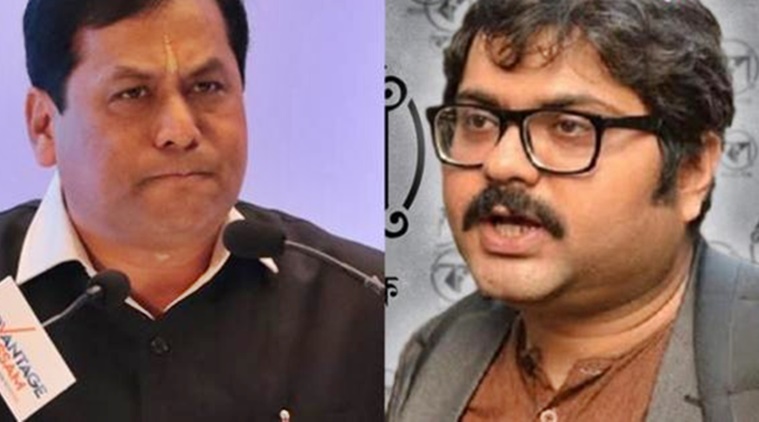
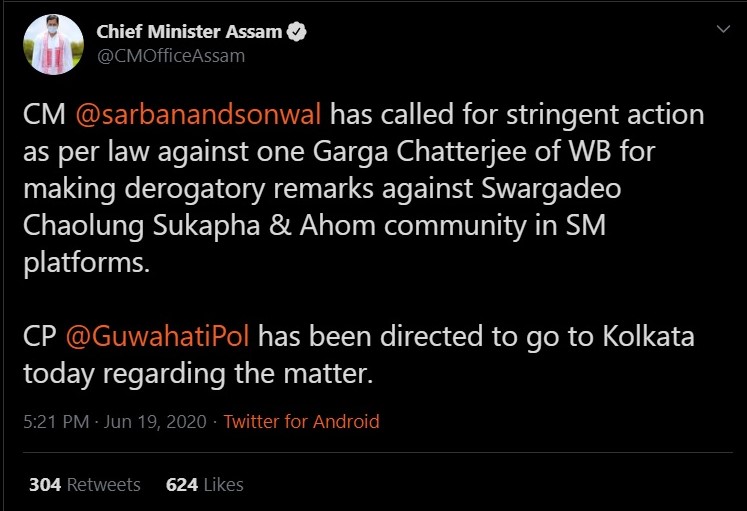
Chief Minister of Assam Sarbanand Sonowal has called for strict action against TMC troll Garga Chatterjee for making derogatory remarks against Chaolung Sukapha, the founder of the Ahom Dynasty. It was announced on social media that Guwahati Police has been directed to visit Kolkata today regarding the matter. As per reports, the Police has been directed to arrest him.
Earlier, an FIR was registered against Garga Chatterjee for calling Sukaphaa a ‘Chinese invader’ in the wake of the Indo-China conflict at the Line of Actual Control (LAC). By slandering the founder of the Ahom Dynasty, the TMC troll attempted to attack the Chief Minister for eulogising him.
In a tweet that was later deleted, Garga Chatterjee wrote, “There is a state in India where the State Day is celebrated by Assam BJP to commemorate a Chinese invader who brutally attacked India with Chinese troops.”
Following the tweets, a complaint was filed against him by advocate Bhaskar Gogoi. The complainant said, “These tweets coming in the wake of tense border standoff in Ladakh and general antagonism against the Chinese government at large, might lead to targeting of Assamese people in rest of India.”
Garga Chatterjee spreads hate against Non-Bengalis
This is not the first time that the foul-mouthed TMC troll had tried to spread hatred against Non-Bengalis. Earlier, Garga Chatterjee went on to insult the Marwari community by referring to them as ‘dishonest community that indulges in black-marketing’. He had also suggested that all of India’s problems could be solved if Biharis, people from Uttar Pradesh, Marwaris and Gujaratis were restricted to their own states for their livelihood. Chatterjee had also issued veiled threats against non-Bengalis living in West Bengal.