Home Blog Page 78

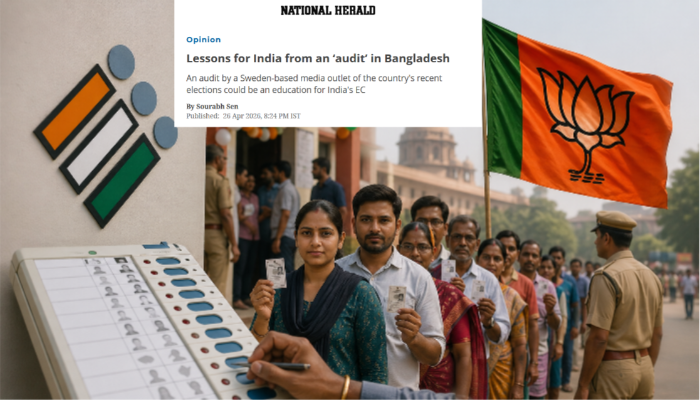
Congress mouthpiece ‘National Herald’ simps on Bangladesh to discredit ECI, bats for return of ballot boxes and manages to cry foul over women reservation after opposing it in Parliament: Here is what happened

The Indian National Congress and its entire ecosystem have been engaged in a concerted effort to undermine Indian democracy and Constitutional institutions since it was ousted from power in 2014, which was followed by their persistent inability to win over voters despite multiple efforts. The party and its supporters resolved to criticise the Bharatiya Janata Party and the Election Commission of India after consistently falling short of their own expectations in various elections.

They have made several claims, ranging from a compromised electoral body to the manipulation of Electronic Voting Machines (EVMs) and registered strong objections to the Special Intensive Revision (SIR) drive, contending that their losses are orchestrated by the ruling party rather than being a natural outcome. However, they have failed to sway public sentiment in their favour. Hence, an alternative strategy has been devised to cast aspersions on the integrity of the nation’s electoral system, as their usual propaganda could not resonate with the people.
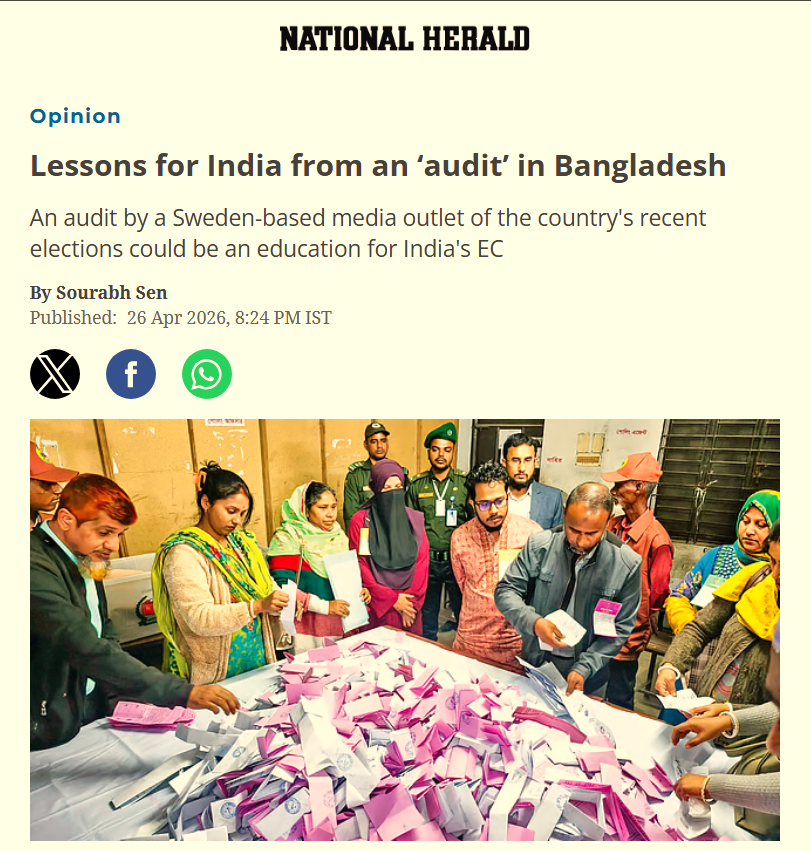
Screengrab of the article by National Herald

Bengali “Netra News” used to glorify Bangladesh’s election system

Now, comparisons are made with fractured democracies, and sermons are delivered to “learn” from them in a renewed, desperate initiative by this group. On 26th April (Sunday), the Congress mouthpiece “National Herald” published a column titled “Lessons for India from an ‘audit’ in Bangladesh” by Sourabh Sen, which directed the Modi govt to draw insights from the recently concluded national parliament polls in the neighbouring country.

The glorification was founded on an audit conducted by a Sweden-based Bengali media outlet, “Netra News,” and concluded that it could serve as an “educational moment” for the Indian Election Commission. According to the author, the organisation discovered that the elections marked by a notable ascent of the Bangladesh Nationalist Party (BNP) to power were “free and fair.”

Das asserted that it was determined after the Bangladesh Election Commission (BEC) official data was compared to the information acquired independently by the company on the polling day which was 12th February. The investigation reportedly found nearly no discrepancy, dismissing charges of rigged elections.

The article highlighted that the matter was brought up by Jamaat-e-Islami (JeI), which challenged the election’s legitimacy because it did not achieve the desired results and accused that the defeat was the product of “extraordinary engineering.” It referenced Mia Golam Parwar, the secretary-general of the party who stressed that alterations took place “between the counting of the votes and the declaration of results” alongside other party leaders who raised similar allegations against the BNP.

Parwar was could not win from his stronghold, Khulna-5 constituency. The piece quoted him, declaring, “They sidelined a mainstream political party (JeI) through election engineering. We have raised the issue publicly through official statements and press conferences and have also lodged complaints before the tribunal about this.”  

The irony is either evidently lost on Das or he has intentionally chosen to disregard the parallels between the statements of the hardliner party and the Congress-led opposition, which also takes refuge in conspiracy theories and finds faults with the election procedure in India after each setback. The latter attacked the election commission with provocative comments to foster distrust and even insult the voters instead of addressing its own shortcomings and policies.

The subtle advocacy for the execution of ballot boxes

The article stated that News Netra dispatched hundreds of “correspondents” around Bangladesh in the months preceding the elections. “The election, in over 43,000 polling stations across 300 constituencies was held with paper ballots,” it outlined before delving into the rigorous process undertaken by the platform.

Afterwards, Das expressed, “The audit matches the party-wise number of ballots present in the boxes before the BEC’s final counting. But, as critics point out, election engineering can still occur if ballot boxes were stuffed during polling or if the numbers are deliberately manipulated by the BEC. Parwar points out that the audit cannot reveal whether voters were intimidated before they cast their votes.”

Interestingly, he again failed to mention that this measure was employed to facilitate elections in India but the shocking images of the ballot boxes being looted by members and thugs of the parties of the current I.N.D.I. Alliance continue to linger in the memories of many citizens. These scenes came to an end with the implementation of the EVMs.

However, their reintroduction would revive the perilous scenario where hooliganism and brazen exercise of authority would influence election turnout in place of the rightful adult franchise, as was visible during the panchayat elections in West Bengal, where political “workers,” specifically from the All India Trinamool Congress (AITC or TMC) were charged with stealing ballot boxes.

Das then sprang onto the objective for which he had set the frivolous stage and wrote, “Is there a lesson for India here? The Election Commission of India has the experience, resources and manpower to initiate an even more robust, independent and transparent audit of elections and election results, if it wants to restore the severely eroded credibility of elections conducted under its watch.”

He predictably did not mention how the “credibility” has been diminished, aside from the usual rhetoric from the opposition, as neither the people have endorsed these groundless allegations, nor has the judiciary suggested any such inclination. On the contrary, it has reinforced the commission’s independence and decision-making capability.

Surely, Das did not imply that the authenticity of the body can be called into question because the grand old party and its allies are not succeeding in elections? However, how can it be surprising when this cabal’s dedication to constitutional institutions is contingent upon decisions that align with its interests and support?

Furthermore, the Election Commission, on many occasions, asked the opposition to prove their assertions about the EVMs through hacking and manipulation. However, they could not provide any solid or empirical proof to back the charges apart from doubling down on the demonisation and disparagement.

A temporary “arrangement” to replace 33% women’s reservation

After the assault on the election commission, the article proceeded to condemn the Bharatiya Janata Party for having the audacity to present the “previously-gazetted women’s reservation bill through Lok Sabha, knowing full well they did not have the numbers to push it through just to generate talking points before the elections in Tamil Nadu, West Bengal, Kerala and Puducherry.”

It inadvertently exposed the Congress and other parties by conveying that even the critical subject of women’s representation is not beyond politics for them and the BJP can enact the bill when it achieves a majority in the Lok Sabha.

Interestingly, the Congress had been lashing out at the Modi government for making insincere promises to lure women voters, only to conveniently refuse support when the centre acted on its assurance. This is clearly more indicative of the reality of its pro-women posturing than of the saffron party’s motivations.

“Bangladesh, on the other hand, has quietly allocated the 50 seats reserved for women in the Jatiya Sangsad (House of the Nation), over and above the 300 contested seats to winning parties. These seats were allocated in proportion to the number of general seats each party won. Women nominated to these seats are full members of parliament, with the same rights and privileges as those in general seats, though they do not represent any specific geographic constituency,” Das pointed out in yet another deceptive analogy.

He added that women will be around 16% of Jatiya Sangsad with 57 out of 350 members and proposed, “A similar experiment could be carried out in India, by raising the strength of the Lok Sabha to 643 or 743 and allowing each state to nominate women for the additional seats. Similarly, the Rajya Sabha can fix the number and criteria for nominated seats for women. This arrangement for the next 15 years is well worth trying without the complications involved in reserving 33 per cent seats in parliament at its existing strength.”

The piece first tried to downplay the massive complexities, in terms of both size and population, of a massive country like India in relation to Bangladesh which has a substantially different parliamentary system. It then demonstrated how Congress and its cheerleaders can not only swiftly forsake their commitments but defend the same with nonsensical explanations, as their lofty proclamations seem to be election ploys that are never aimed to be realised.

This stands as one of the key reasons for the opposition bloc’s rapidly declining trust among the populace. However, this faction has opted to use the Election Commission as a scapegoat and vilify the BJP, instead of confronting the truth. They illustrate an example of a country where the blood of vulnerable minorities, particularly Hindus, was spilt on the streets during an absolute collapse of law and order instigated by the Islamists and a sitting prime minister was forced to escape to protect her life.

Therefore, it is not India that requires correction or guidance from others. However, the opposition does need to introspect instead of ignoring blunders and hunting for targets or unnecessary illustrations elsewhere just to conceal its continuous hypocrisy alongside incompetence.
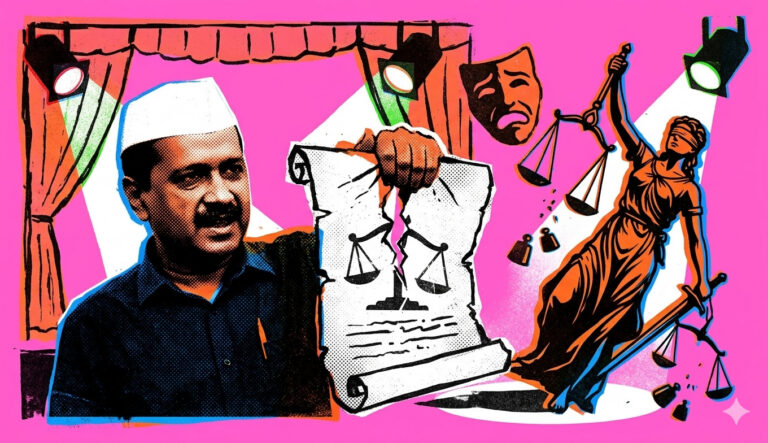

Kejriwal launches a new drama after recusal stunt was dismissed by Delhi HC: Calling it ‘Satyagraha’ won’t change the fact that he is all about theatrics

Arvind Kejriwal shared what he described as a letter of conscience this morning on X. He said that he would not appear before Justice Swarana Kanta Sharma in the Delhi excise policy case, either in person or through counsel, citing the ‘Gandhian concept of satyagraha’. The letter, addressed directly to the judge, was both theatrical in its fake humility and bizarre in its implication. ‘Justice Sharma’s court cannot give justice to him’, this is a remarkable claim. And it’s almost entirely inaccurate.

What had Justice Swarana Kanta Sharma said

One must first comprehend what the court did in order to comprehend what Kejriwal is doing. A trial court order that had acquitted Kejriwal and his co-accused in the liquor policy case was being challenged by the CBI at the Delhi High Court. Kejriwal filed a recusal plea against Justice Sharma, accusing her of bias on three grounds, that her children were appointed as Central Government counsel, that she had attended events connected to organisations he believed to be ideologically opposed to his party, and that her impartiality had been compromised by earlier judicial observations in related matters.

The court rejected the accusations of bias, stressing that unsupported charges cannot compromise judicial independence. The plea was based on ‘conjectures and insinuations’ and did not reach the legal threshold for recusal, according to Justice Sharma, who maintained that accusations of bias must be substantiated by tangible material rather than just perception. She firmly declared, A judge cannot recuse to satisfy unfounded suspicions or manufactured allegations made by a litigant, and added, I will not recuse. I’ll listen to the case. 

The court went one step further, issuing what might be the episode’s harshest criticism that ‘the courtroom cannot become a theatre of perception,’ and warning that even influential politicians cannot level accusations against judges in the absence of proof. Kejriwal’s reaction to this rational, legally sound decision? To post on Twitter that his hopes for justice had been shattered and that he would not take part in the court proceedings that would ultimately decide his fate.

What the law says about the stunts Kejriwal is trying to pull

Kejriwal’s Gandhian analogy completely breaks out at this point. The objective of Mahatma Gandhi’s Satyagraha was to overthrow a colonising power that lacked democratic legitimacy and against an unfair colonial law. What Kejriwal is opposing is the jurisdiction of an independent Indian constitutional court, which he willingly invoked when filing the recusal plea in the first place. A court cannot be declared illegitimate after you have petitioned it and lost. That is forum shopping wrapped in a khadi shawl, not civil disobedience.

Wilfully refusing to appear in court has established and severe legal repercussions. Contempt of court is defined by Indian law as either disobeying a court order (civil contempt) or saying or doing anything that scandalises, prejudices, or interferes with legal proceedings and the administration of justice (criminal contempt). Before the merits of a case are even heard, writing a public letter to a sitting judge that is shared on social media and accuses her of being incapable of delivering justice falls dangerously close to the second category.

The Supreme Court has said unequivocally that scandalising the court refers to attacks on individual judges by making unjustified and defamatory remarks about their abilities or character. It would be criminal contempt to write or draft statements that make defamatory accusations against a judge. This is exactly what Kejriwal’s letter, which was released publicly and written to garner the maximum amount of political sympathy, does.

What happens when an accused wilfully refuses to appear?

Kejriwal’s chosen stance is likely to fall apart on its own terms once the law becomes both fair and firm. The Supreme Court established the guiding principle for criminal appeals and revisions in cases where the accused or his counsel is not present in K.S. Panduranga v. State of Karnataka. The court is free to proceed and make a decision on the merits of the case, but it must make sure that natural justice is upheld, usually by designating an amicus curiae to support the court in the accused’s absence. When the accused’s freedom is in jeopardy, the court cannot simply dismiss the case for lack of prosecution or leave him completely unrepresented. 

It was never intended to act as a shield for an accused who has been duly served, is free, has the means to retain the best legal expertise in the country, and declares on social media that he has intentionally chosen not to appear. Kejriwal has already been served. He isn’t in jail. He is not without advice. Natural justice principles are not being violated against him; rather, he is attempting to use them as a political weapon. Applying Panduranga, the court will be well within its rights to proceed, appoint an amicus, and consider the case on its merits. 

Kejriwal’s absurd drama: A pattern, not a principle

Kejriwal’s in-person appearance before the bench, where he personally argued the recusal plea, was sharply referred to by the Indian Solicitor General as theatrics. That evaluation holds weight when compared to Kejriwal’s well-documented history of turning legal issues into political theatre. After just 49 days in office, he resigned as Delhi’s chief minister in 2014, portraying his surrender to political pressure as a moral stance. Then, in 2020, he came back to power after discreetly giving up on the very matter for which he had resigned. Kejriwal was arrested in 2024 after failing to show up for interrogation by the Enforcement Directorate despite receiving nine summons.

Each of these was characterised at the time as Kejriwal standing up to a compromised system. Despite being slower, quieter, and far more patient each time, the system continued. The pattern is consistent, the formalities of law itself are targeted when it fails to produce the desired result. When the courts decided against him on recusal, they became suspect. When the ED summoned him several times, it became a tool of political retribution. The grievance is usually legitimate in its framing, but the evidence is always noticeably lacking.

What lies ahead

Justice Sharma’s court is open to the choice of hearing the CBI’s appeal against the discharge judgement, which would address the actual merits of the liquor policy case. The court will hear the case with the prosecution’s arguments on record and render a decision if Kejriwal fails to show up and refrains from sending a legal counsel. When that verdict is issued, it will most likely be challenged in the Supreme Court, at the course of which Kejriwal will reemerge in the judicial system he claims to have abandoned.

When that happens, there will almost certainly be another letter, a press conference, an invocation to Gandhi, Bhagat Singh, or the Constitution. The language will differ. The drama won’t change.

The Delhi High Court dismissed the recusal plea, stating that ‘justice cannot be managed through perception.’ It’s a sentence that rings especially true given what happened this morning. Kejriwal’s letter is a master class in perception management, it is sympathetic in tone, vague in content, and only intended to win in the court of public opinion as the case moves forward.

The judiciary has witnessed this before. The Supreme Court was faced with the exact argument that a person should be shielded from the repercussions of scandalising judicial authority by principled dissent in the contempt case against Prashant Bhushan. Advertised willingness to be a martyr does not equate to righteousness.

Conclusion

Arvind Kejriwal is aware that a letter to a judge posted on Twitter receives significantly more column inches than a court judgement in the current Indian media landscape. He is aware that the phrase ‘recusal plea dismissed’ lacks the emotional impact that ‘Satyagraha’ conveys. He is not presenting a legal argument. He is performing a political stunt to entertain his supporters. The law will wait, just as it always has. There will be another hearing. The sequence shall be followed. And whatever it’ll be, it would have been decided without Arvind Kejriwal’s perspective because he chose social media over the courtroom.

What is The Timothy Initiative, a Christian MLM scheme: How a foreign entity under ED scanner spent an average of Rs 1 crore a month to convert Hindus, especially in Naxal affected areas of Chhattisgarh

0

On 18th and 19th April, the Enforcement Directorate conducted raids at several locations linked to an organisation named The Timothy Initiative, TTI. In a press release, the ED said that it is investigating how TTI channelled over Rs 95 crore into India using foreign bank issued debit cards while completely skipping FCRA regulations.

Notably, TTI is not registered under the Foreign Contribution Regulation Act, FCRA, which means any programme run by the organisation in India cannot be funded by foreign donations. However, the ED stated that crores of funds were withdrawn using foreign bank debit cards between November 2025 and April 2026.

The ED has stated that TTI followed a specific method. Foreign bank debit cards linked to Truist Bank in the United States were brought into India and used for repeated cash withdrawals from ATMs across multiple states. The money was then used for meeting expenses connected to the conversion activities of TTI’s India chapter.

The searches were conducted at six locations in multiple states in connection with the suspected withdrawal and utilisation of funds. The agency said 25 foreign bank debit cards, Rs 40 lakh in cash, various incriminating digital evidence, devices and documents were seized during the searches.

Furthermore, 24 foreign debit cards were found in the possession of one Micah Mark, who was intercepted by the Bureau of Immigration at Bengaluru International Airport against a Look Out Circular issued by the ED while he was bringing the cards into India. The ED stated that the investigation revealed that there had been unusual and suspicious cash withdrawals using these cards in Left Wing Extremism, Naxal affected regions, including Dhamtari and Bastar in Chhattisgarh. According to the ED, around Rs 6.5 crore had been withdrawn in these areas in the past few years.

The ED further stated that these cards were being used to withdraw large amounts of cash in a planned manner, which indicated the possibility of organised networks. The agency further said that the emergence of a parallel cash based economy in Naxalite affected areas poses a serious threat to the security and financial integrity of India, as it can facilitate the movement of illicit funds for unlawful activities.

Furthermore, TTI was using a billing and accounting online platform for maintaining records of such cash withdrawals from ATMs and their utilisation. The platform, according to the ED, was purportedly controlled by foreign entities, which indicates that the withdrawals were not random or isolated.

What is The Timothy Initiative

According to The Timothy Initiative’s website, which is geo blocked in India, it is a global Christian movement that makes and multiplies disciples, churches and leaders. Its own material accessed by OpIndia states that it is committed to getting a church in every village, everywhere. Its published material, history page and promotional content show that church planting is its central measurable objective.

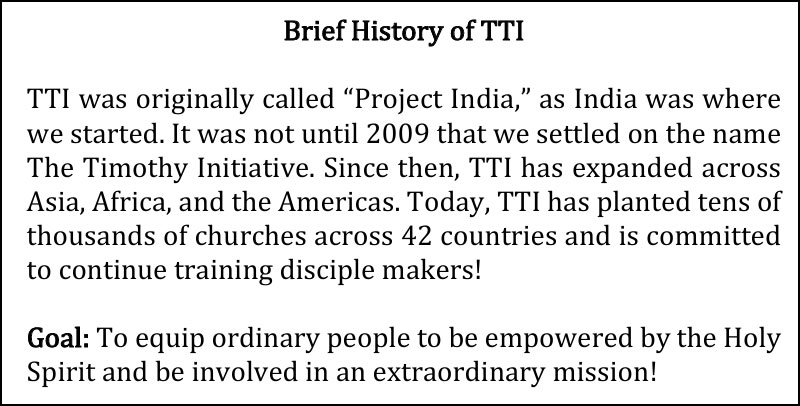
Originally called “Project India” as it was started to target India, the organisation adopted the name “The Timothy Initiative” in 2009.

Source: TTI

According to its “Kingdom Impact” material, it has planted over 2,68,750 churches since 2007 across 50 countries, including India. It claims that 23,92,427 people have been converted to Christianity, including 2,01,954 widows and orphans, making it a serious issue.

Source: TTI

TTI claims that the disciple count is an estimated number based on historical averages of new believers per church planted. It means the number of disciples could be much higher compared to what it claims on the website.

The ministry model of TTI is based on the Biblical verse 2 Timothy 2:2, hence the name. The verse refers to entrusting teachings to reliable people who will also be qualified to teach others. In simple terms, this is a replication model. One person trains another set of people, those people train others, and the network continues to grow through successive layers of trainees, leaders, pastors, church planters and disciples. It can also be seen as a Multi Level Marketing, MLM, project, and the only difference is that people do not buy products but convert to Christianity.

Source: TTI

Just like MLM, one person trains another set of people, those people train others, and the network continues to grow through successive layers of trainees, leaders, pastors, church planters and disciples.

In one of its promotional explanation videos, TTI stated that everything it does, directly or indirectly, goes towards planting churches around the world. This is an important statement as it means even expenses that may look administrative, logistical or welfare oriented are ultimately tied by TTI itself to the objective of church planting and converting people to Christianity. Notably, majority of the visuals in one of its main videos are from India.

Screenshot of India-centric visuals in one of TTI’s videos. Source: TTI

According to TTI, it has five levels of leadership, each with its own funding needs. In the information shared on its website and in the video, it mentions Titus, Timothy, Pauls, master trainers and movement leaders. It is very similar to MLMs, where there are Gold, Silver, Diamond and Platinum members based on the number of members under them.

Titus level workers are trained through two books. Timothy level workers are trained through 12 books, with thousands of pages of material that need translation. Pauls receive a master trainers manual, eight quarterly trainings and travel stipends.

The organisation further says master trainers and movement leaders receive funds for food, travel and accommodation while leading trainings. It also says they receive a small monthly stipend to help with the cost of living. This is important because the model is not simply voluntary preaching by individuals. The organisation’s own material says funds are used to support certain categories of leaders and trainers who are part of the church planting chain.

The same promotional material says donor funds also pay for vision castings to mobilise more labourers. In simpler terms, these are events or meetings used to inspire and recruit more people into the mission. It also says TTI field representatives visit the field to verify that churches and fellowships actually exist. This shows that TTI has not only a training model, but also a reporting and verification system.

The organisation says funds are also used for expansion into new countries. It mentions buying flights, funding offices and translating material into new languages. Beyond this, the promotional material lists a wide range of expenses, including village mapping software, launches, reporting, leadership development, mentoring, continental offices, printers, new training material, Jesus films, benevolence, videos, audio Bibles, book printing, metrics, staff salaries, leadership filtering, regional leadership meetings, local fundraisers, partnerships, graphic design, editing books, ministry statistics, church planter graduations, ministry pictures, national offices, computers and coalition meetings.

In simple language, TTI’s model appears to work like a large religious expansion machine. Donor money funds training material, translations, travel, meetings, stipends, office infrastructure, digital systems, local leaders, verification and reporting. These resources are then used to train people who are expected to create more disciples and plant more churches.

TTI’s own history also supports this reading. In 2010, the organisation says it developed its 10 book core training material with the expectation that each disciple would plant one church by the end of training. In 2013, it implemented a multiplication model called Disciples Making Disciples, DMD. By 2020, it was talking about mapping 700,000 villages. By 2021, it was speaking of mapping 5 million villages through the Coalition of the Willing.

TTI may not be a commercial MLM, but its church planting system follows a multi level replication model. It creates layers of leadership, trains people through standardised material, funds movement leaders and trainers, tracks expansion, verifies field output and measures success through the multiplication of churches and disciples.

Foreign churches, India focus and Hindu majority regions

The material shared by TTI linked partners shows that the India connection is not limited to the ED investigation in Chhattisgarh. Social media posts indicate TTI associated activity in other Indian regions, including Rajasthan and northern India.

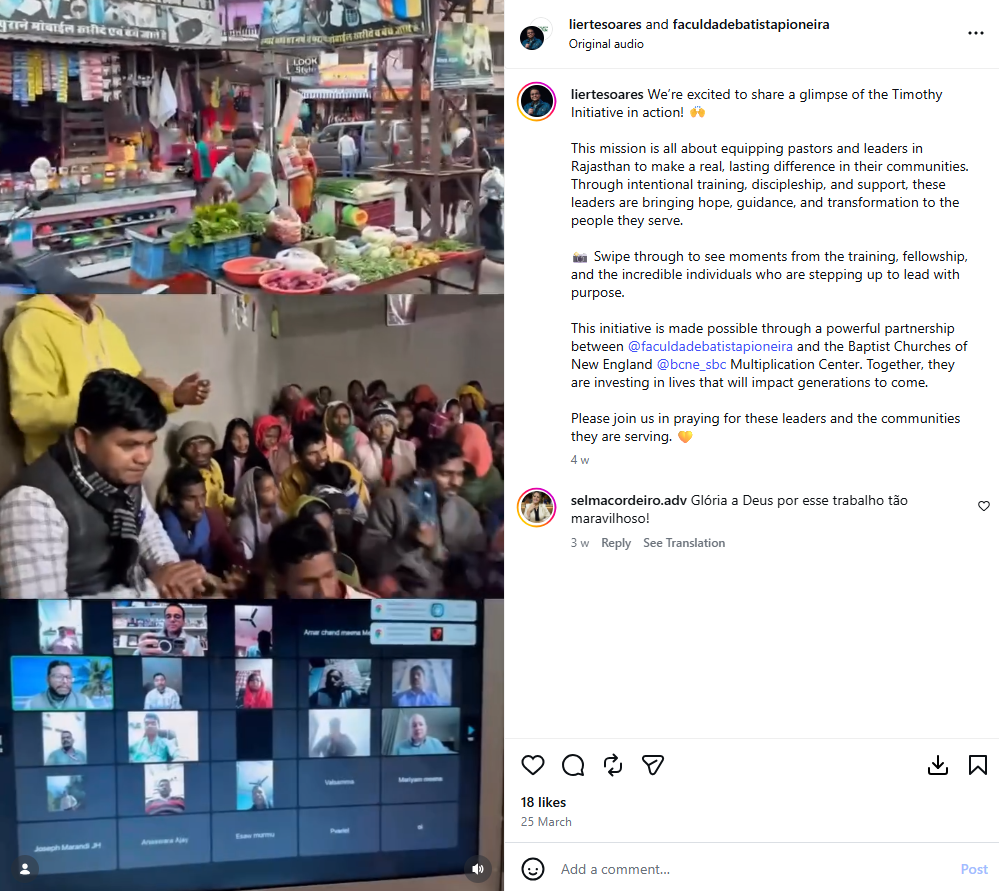
One post said The Timothy Initiative was active in Rajasthan through a mission focused on equipping pastors and leaders. It described the work as involving intentional training, discipleship and support. It also said the initiative was made possible through a partnership involving Faculdade Batista Pioneira and the Baptist Churches of New England Multiplication Center. This shows that foreign or international church networks were linked to training activity in Rajasthan.

Source: instagram

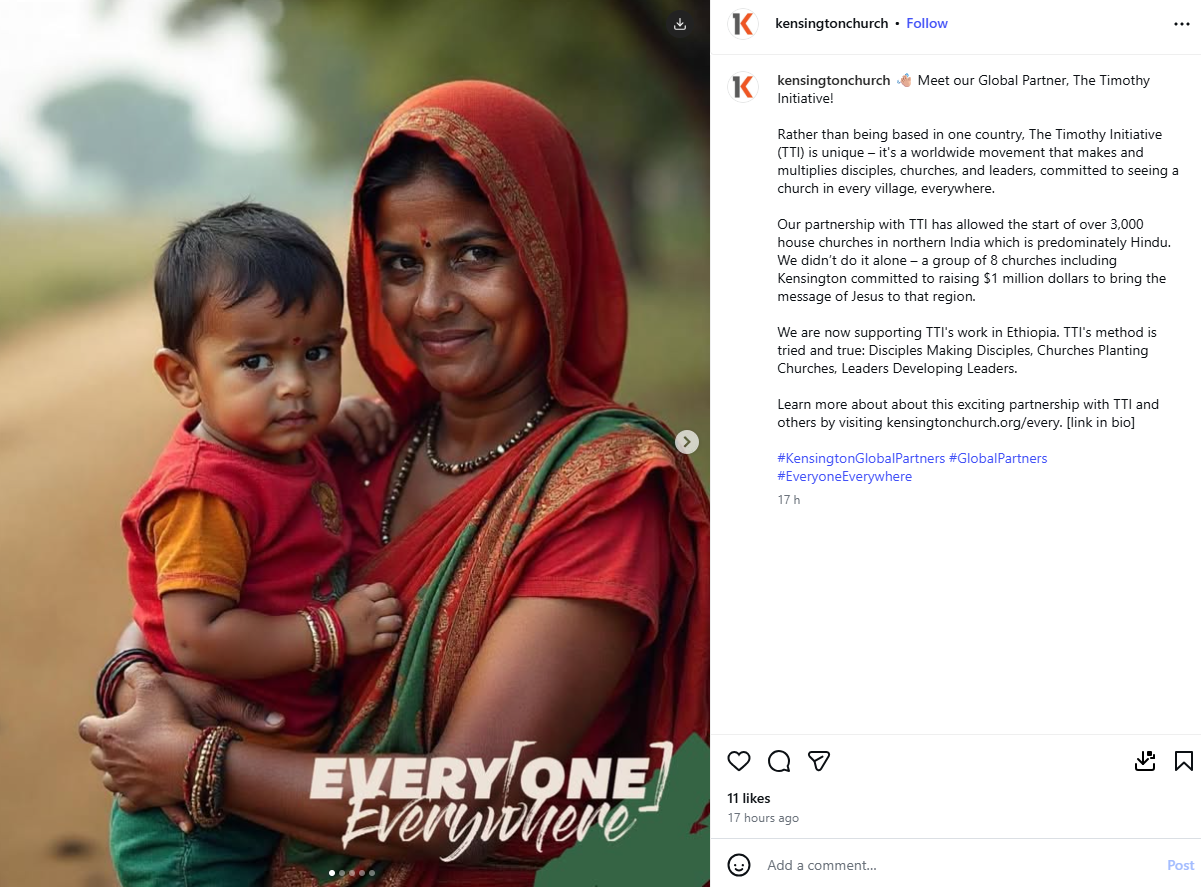
Another post by Kensington Church described TTI as a worldwide movement that makes and multiplies disciples, churches and leaders. It stated that the church’s partnership with TTI had allowed the start of over 3,000 house churches in northern India, a region it described as predominantly Hindu. The same post said a group of eight churches, including Kensington, had committed to raising $1 million to bring the message of Jesus to that region.

Source: Instagram

The ED press release mentions alleged withdrawals in Left Wing Extremism affected regions such as Dhamtari and Bastar in Chhattisgarh. But TTI linked partner material points to a broader India focused church planting network, including Rajasthan and northern India. It also specifically refers to work in a predominantly Hindu region.

According to a Bhaskar report, Chhattisgarh adds further context to the ED findings. The report claimed that in tribal villages across Jashpur, Ambikapur, Raigarh, Bastar and Surguja, Hindus have become a minority while Christians are now the majority. It said villages without a single temple but with three or four churches have become common, and traditional cremation has been replaced by burials with crosses on graves in several places.

The report also suggested that poor, sick and socially neglected families were being targeted by two or three salaried pastors active in several villages. It further said 146 NGOs are FCRA registered in Chhattisgarh, including 50 missionary organisations, out of which 30 work in Jashpur, Ambikapur, Raigarh and Bastar, the same districts where conversions are said to be highest. These NGOs are also registered with Chhattisgarh Firm and Society, but the society does not audit them and the NGOs submit their own audit reports. The report said the state government has no concrete information on their foreign funding.

TTI’s timeline shows how church planting became a measurable expansion project

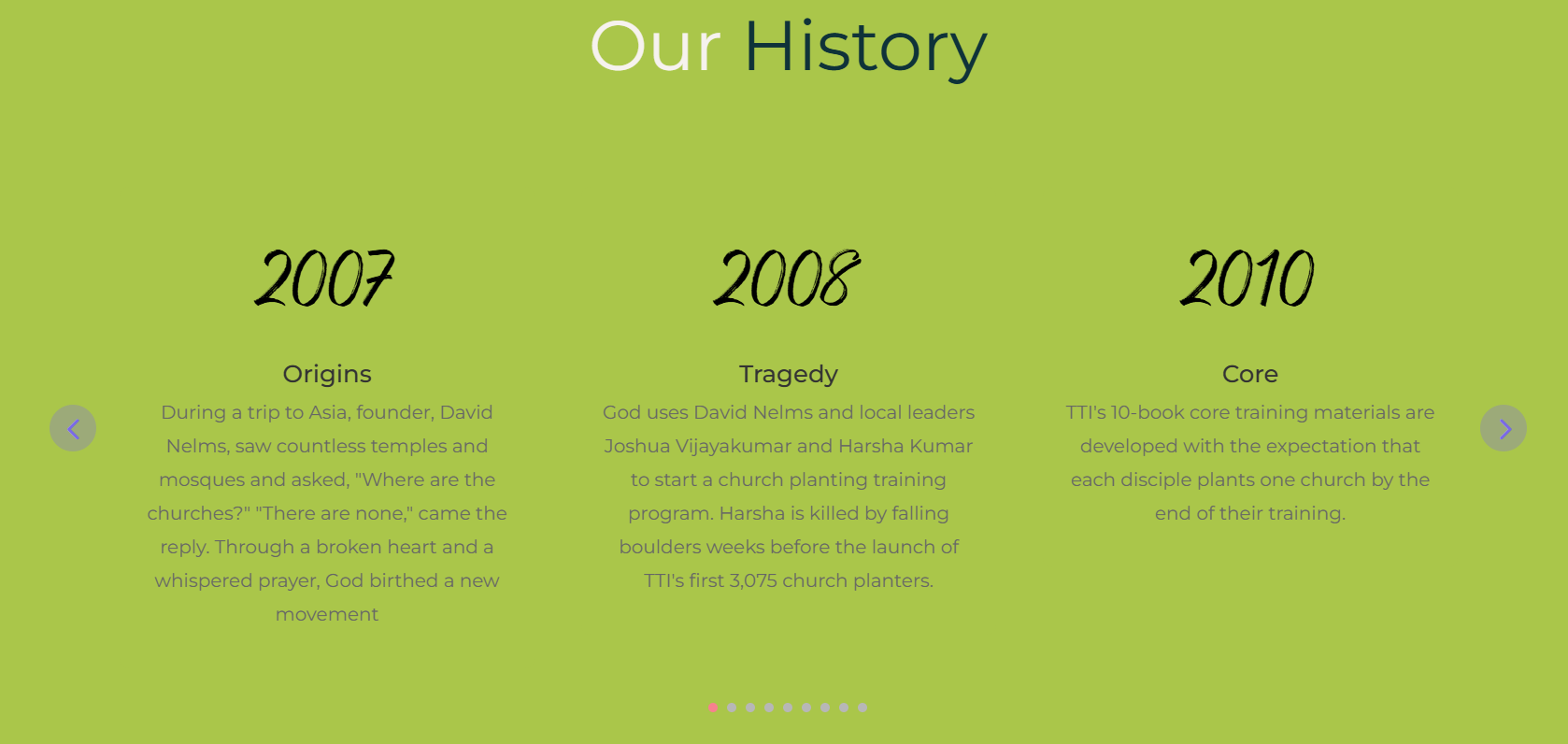
According to TTI’s history section, the movement began in 2007 after founder David Nelms visited Asia. The organisation says he saw countless temples and mosques and asked, “Where are the churches?” The reply, according to TTI’s own account, was, “There are none.” TTI presents this moment as the “spiritual beginning of the movement” to target Hindus in India.

Source: TTI

In 2008, TTI says David Nelms and local leaders Joshua Vijayakumar and Harsha Kumar started a church planting training programme. The organisation also says that this was the launch of TTI’s first 3,075 church planters. This is a significant number for the initial stage of a religious movement. It shows that the organisation’s early model was not merely personal evangelism or small scale fellowship work, but structured training of church planters.

In 2010, TTI says its 10 book core training material was developed. The stated expectation was that each disciple would plant one church by the end of their training. This is perhaps one of the clearest admissions of the model. The disciple is not just expected to learn. The disciple is expected to produce a church. In other words, training and church creation are directly linked.

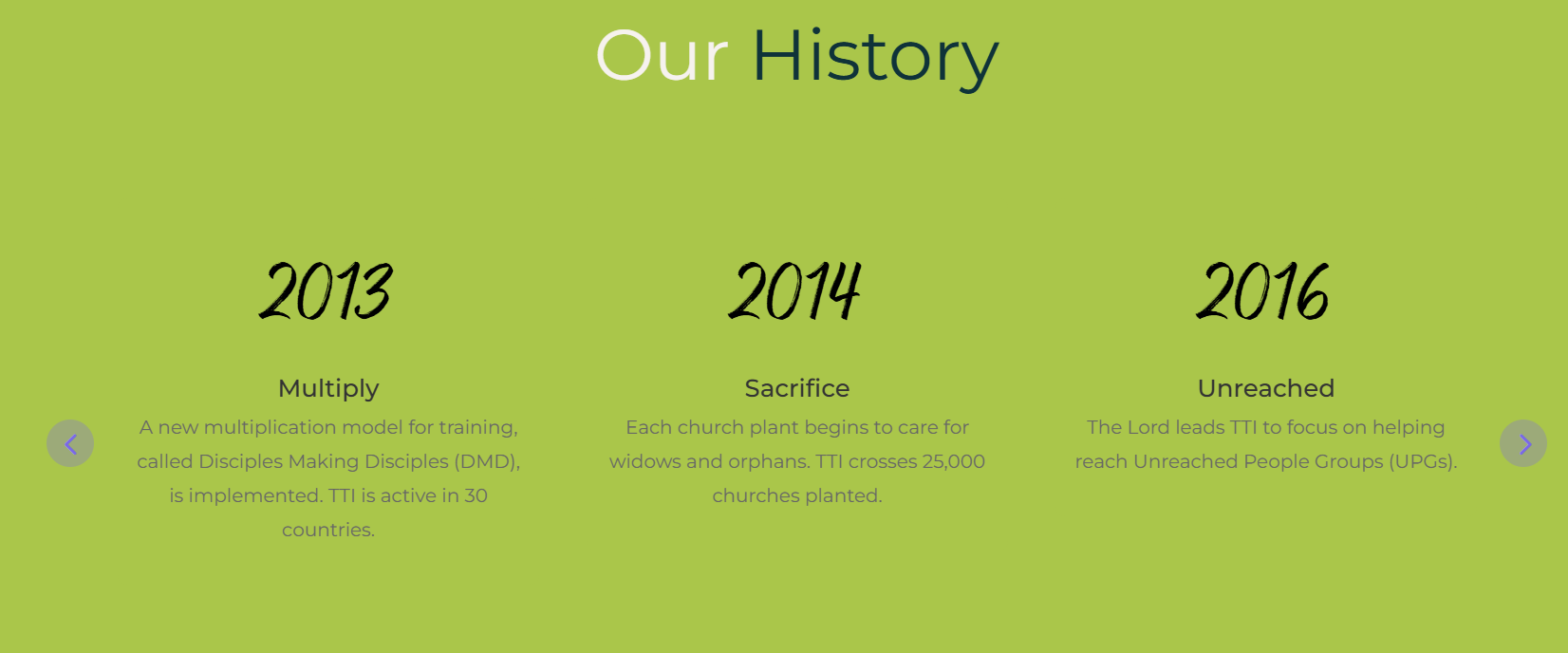
In 2013, TTI says it implemented a new multiplication model for training called Disciples Making Disciples, or DMD. It also says TTI became active in 30 countries. The phrase itself explains the model. A disciple is trained not merely to remain a disciple, but to create more disciples. This is where the structure begins to look like a replication chain. Each trained person becomes a possible node for further expansion.

Source: TTI

In 2014, TTI claimed that it had crossed 25,000 churches planted. In just a few years, the organisation was already presenting church planting numbers as an achievement marker. This also shows that TTI measured its work not only through welfare or community service but through the number of churches planted.

In 2016, TTI says it began focusing on helping reach Unreached People Groups, or UPGs. These are communities where Christian presence is limited or absent. This again underlines the target based nature of the movement. The goal is not simply to serve wherever help is needed, but to reach communities identified as unreached from a Christian missionary perspective.

In 2020, TTI launched ACHIEVE, described as “A Church in Every Village, Everywhere”. The organisation says two Asian countries began surveying and mapping 700,000 villages so each could have a church. It also claimed that a new church was being planted through TTI every 40 minutes. This is a very important stage in the timeline because it shows the use of mapping, surveying and village level targeting for church planting.

Source: TTI

In 2021, TTI moved into what it calls Pursuit. It says that in pursuit of ACHIEVE, TTI knew the goal could happen only in partnership. This is when COTW, the Coalition of the Willing, was born. TTI says ministries worked together to map 5 million villages. The organisation claimed at this stage that a new church was being planted through TTI every 20 minutes.

In its “today” section, TTI describes the phase as acceleration. It claims that it has surpassed 260,000 churches planted, has 2.3 million new disciples and is expanding towards 50 countries. It also claims that a new church is planted through TTI every 11 minutes.

Current leadership and the role of Dr Jared Nelms

TTI’s website names Dr Jared Nelms as its President and CEO. His profile says he is passionate about serving, equipping and partnering with indigenous leaders across the globe with the overarching aim of getting the Gospel to every people and place.

Source: TTI

Conclusion

While the ED’s investigation has put focus on TTI’s activities in Naxal hit areas of Chhattisgarh, the larger play of the organisation is not limited to one state but the whole of North India. The MLM style working and “passionate” members who are running pillar to post to install churches and convert Hindus to Christianity are serious concerns that need deeper investigation.

Madhya Pradesh: Khandwa Police arrest Anwar Qureshi for manufacturing fake ghee made using animal fat, bones and skin, read exclusive details of the FIR

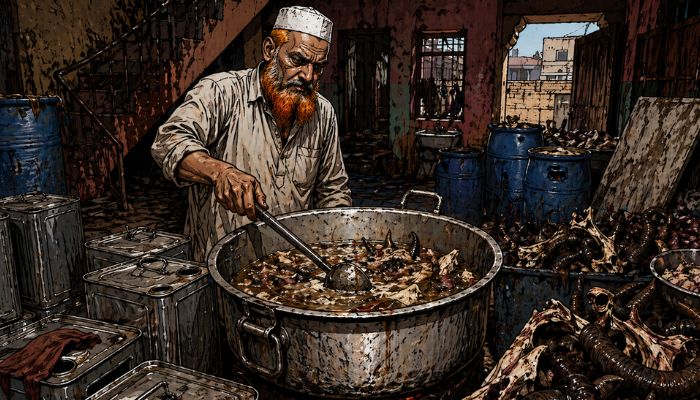
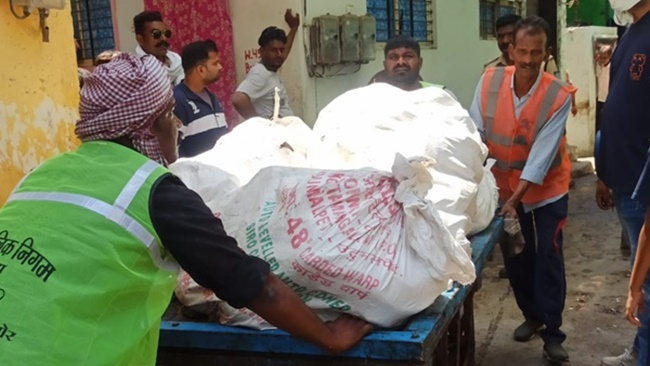
On 24th April, Khandwa Police in Madhya Pradesh arrested a man identified as Anwar Qureshi for manufacturing and selling fake ghee. Qureshi was making the ghee like substance using animal fat, bones and skin. The manufacturing unit was operating from a narrow lane near Begum Park in the Imalipura area. The authorities raided the place after receiving repeated complaints that animals were being cut at the premises and their fat, bones and skin were being processed for use in food like products.

Authorities at Qureshi’s house (Image: Jagran)

The district administration, municipal corporation, veterinary department and police formed a joint team and raided the place. The authorities suspect that Qureshi was selling fake ghee in the local market, including food joints and restaurants.

During the raid, officials recovered sacks filled with animal skin and bones. They also found drums and containers filled with fat based material. Authorities recovered a large quantity of raw material, finished liquid, and a ghee like substance from the spot.

9 drums and 79 containers seized

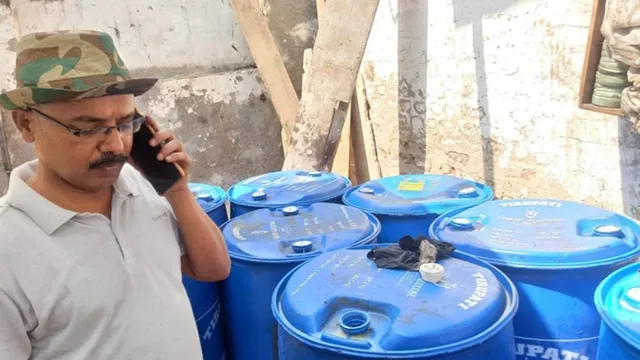
Speaking to the media, City Magistrate Bajrang Bahadur said that the team recovered 79 containers from the premises and each container had around 30 kg of suspicious material. Furthermore, the authorities also recovered nine large drums of 200 kg capacity, which were filled with animal fat.

Authorities at Qureshi’s house (Image: Jagran)

The veterinary department collected samples, which were sent for laboratory examination. Officials stated that the material found in the drums appeared to be animal fat at first sight. However, the exact nature and intended use of the seized material would be confirmed after the lab report.

What the FIR says

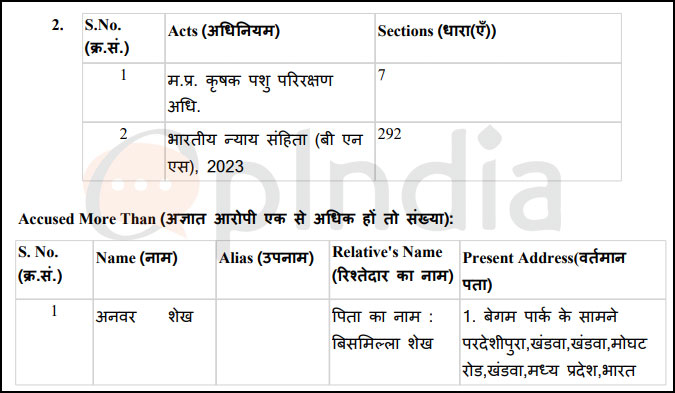
OpIndia accessed the FIR in the matter. It has been registered on the complaint of the zone in charge of the Municipal Corporation of Khandwa at Moghat Road police station, Khandwa, Madhya Pradesh, under Section 7 of the Madhya Pradesh Agricultural Cattle Preservation Act and Section 292 of the Bharatiya Nyaya Sanhita (BNS) against Anwar Sheikh Bismillah Qureshi.

Source: Khandwa Police, Madhya Pradesh

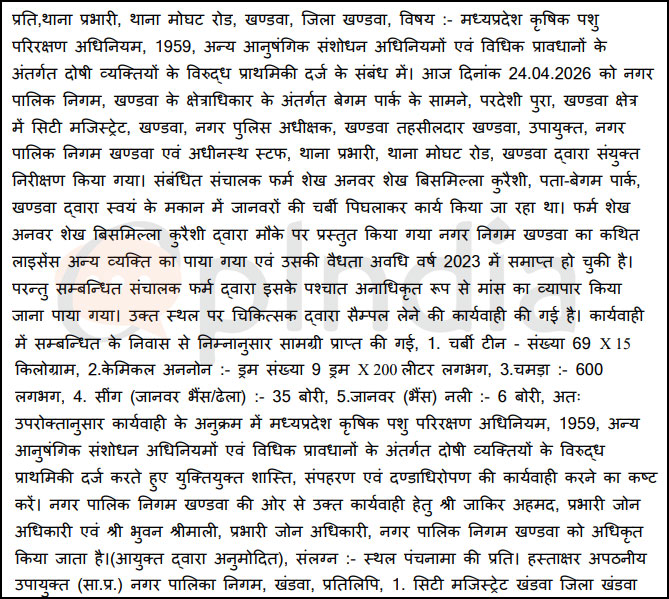
SHO Dharwal stated that he received a letter from the Municipal Corporation, Khandwa, signed by Zakir Ahmed and Bhuvan Shrimali, in charge zone officers, to register an FIR in the matter.

According to the complaint, a joint inspection was carried out in the area opposite Begum Park, Pardeshipura, Khandwa, by the City Magistrate, City CP, Tehsildar, Deputy Commissioner of the Municipal Corporation, SHO of Moghat Road PS and other subordinate staff. The premises belonged to Sheikh Anwar Sheikh Bismillah Qureshi, where he was melting animal fat inside his own house.

Source: Khandwa Police, Madhya Pradesh

The so called licence of the Municipal Corporation Khandwa produced on the spot by Anwar was found to belong to another person and its validity had expired in 2023. Despite this, Anwar was found to be storing and trading animal remains, including fat, skin, horns, and other material, in an unauthorised and illegal manner.

During the raid, the authorities recovered 69 tins of fat with a capacity of 15 kg each, nine drums of 200 litres capacity containing an unknown chemical, 600 pieces of leather, 35 sacks of horns of buffalo or similar animals, and six sacks of pipes or tubular parts of buffalo and similar animals.

Locals question how the unit was running without action for so long

In a statement, Khandwa CSP Abhiram Warange said that Qureshi, the owner of the premises, was detained for questioning. Police were trying to find out since when he was running the business and who else was involved in the network.

According to media reports, locals had complained several times about suspicious activities at the premises. However, no action was taken till the recent raid. According to complaints, animals were being brought to the location, cut there, and their fat, bones and skin were being cooked and processed. Following the raid, the residents questioned how such activities were allowed to run for such a long time without being stopped.

MLA Kanchan Tanve reacted to the incident

Following the raid, Khandwa MLA Kanchan Tanve reached the spot and described the incident as extremely serious. She demanded strict action from the district administration and called for tough steps against those found guilty.

As Bihar DGP bars cops from wearing religious symbols like tilak and mangalsutra with uniform, here are past incidents wherein Hindus were targeted in govt departments over visible Dharmic markers

In an alarming assertion of ‘uniformity’ reeking of selective secularism, Bihar DGP Vinay Kumar has directed police personnel to erase visible markers of their Hindu faith while in uniform. On 26th April, Bihar’s Director General of Police issued a directive barring officers from wearing or displaying Hindu religious symbols like Tilak, Chandan, Mangalsutra when they don the Khaki.

Media reports say that this move is a part of the police’s efforts to improve ‘discipline’ within the police force. As per the directive, police personnel are not allowed to display religious symbols such as a chandan tilak while on duty. Similarly, female constables are barred frm from wearing visible jewellery or make-up while in uniform. According to the order, women personnel must refrain from wearing churis, kangans, mangalsutras, nose rings, or jhumkas that are visible over their uniforms. 

The Bihar DGP’s directive has stirred outrage, with people questioning the rationale behind linking Hindu religious symbols with discipline and forcing officials to suppress their religiosity, while no such explicit bars are imposed on police personnel belonging to other religions. Many local Hindu rights groups have registered a protest and called the move unnecessary, unfair and discriminatory.

This, however, is not the first case of blatant overreach imposing restrictions on Hindu religious symbols in police and government offices. Over the years, many such incidents have been reported.

While restricting excessive jewellery and heavy makeup is understandable,

Bihar Agriculture Department was suspended for refusing to remove Tilak in 2007

Back in September 2007, a senior Bihar Agriculture Department official, Lakshman Mishra, faced suspension proceedings for refusing to remove his Tilak. The Hindu Brahmin official had worn the Tilak to work for around three decades. However, a new dress code was cited as justification behind enforcing a ban on Tilak at the workplace. Mishra was reported to have been threatened by department secretary CK Anil with suspension for not complying with the anti-Hindu diktat.

Several Agriculture Department Tilak-wearing employees had staged a protest outside the IAS officer’s office and condemned the ban as a blatant assault on the Hindu religious beliefs.

Bihar DGP Anand Shankar faced protests from police association in 2009 for wearing Tilak to office

In 2009, then Bihar DGP Anand Shankar had faced protests by the Bihar Police Men’s Association, an organisation of constables, for wearing a Tilak on his forehead while on duty in uniform. The Association had accused him of violating the rules of the police manual. The protesting constables targeted DGP Kumar, a devotee of Lord Krishna for his Tilak and religiosity, after he directed all association office-bearers, who otherwise mostly wore Kurta-pyjama, to wear police uniform and report on duty like regular policemen. While DGP Kumar reprimanded the constables for violating the discipline by shirking their duty and not wearing proper uniform, the Association played the same card against him but by targeting his practice of wearing a conspicuous Tilak.

Bihar ADG issued circular banning police personnel from wearing Bindi, Mangalsutra, Tilak in 2025

In July 2025, Additional Director General (Law and Order) Pankaj Darad had issued a circular imposing restrictions on wearing churis, kangans, Mangalsutras, nose rings, or jhumkas that are visible over their uniforms. The order cited discipline, simplicity, and dignity in the police force’s appearance as the reason behind banning the use of Hindu religious symbols for police personnel. It further stated that violation of these guidelines would attract disciplinary action.

Does Tilak or Mangalsutra impair duty? Banning Hindu religious symbols at government and private workspaces is not grooming or discipline, but Hinduphobia

The Bihar Police DGP’s reported diktat banning Hindu religious symbols for police personnel, while imposing no such restrictions on Hijab or religious symbols of other faiths, is appalling. In addition to the above-discussed instances of government departments targeting Hindu religiosity in the guise of ‘grooming’ and maintaining ‘professional image’, there have been cases wherein Hindu candidates have been forced to remove their Kalava and Janeu before appearing for government recruitment exams, while Muslim Hijabs, Muslim beards (without moustache) and Sikh Turbans, etc, are left untouched.

In fact, in 2024, the Madras High Court allowed Muslim police officials to keep beards in Islamic style, citing religious freedom. If Muslim cops can be allowed to sport beards according to their religious beliefs, why can’t Hindu officials wear a Tilak or other religious symbols?

This pattern of small and non-obstructive Hindu markers like Tilak, Mangalsutra, Kalava, etc, while the religious markers of other faiths are conveniently accommodated, is not confined to government institutions; it is rampant in the private sector as well.

Are Hindu sentiments and religiosity not as significant and constitutionally protected as those of other religions?

Recently, a major eyewear company, Lenskart, courted controversy after its employee grooming policy document, which restricted staff from wearing Hindu religious symbols, went viral online. The document stated that Lenskart employees are prohibited from wearing sacred threads (kalava) and bindis (bindis), while they may wear hijabs and Sikh turbans. The document also stated that if someone applies vermilion, they should apply it sparingly and should not spread it across the forehead.

Air India has also recently faced a backlash over a similar alleged grooming policy bias against Hindus.

Government office or private company, Hindu employees do not cease to be human beings while on duty, so they are expected to forget their faith and conceal their religious identity to appear proper professionals. Hindus have the right to express their religiosity, and no Tilak, no Mangalsutra, no Sindoor, or Kalava obstructs the discharge of duty. Hindu religious symbols are not optional adornments that can be scrubbed away or banned for ‘discipline’. If turban or Kada-wearing Sikh employees do not become unprofessional or undisciplined merely by wearing their religious symbol, how does this logic not apply to Hindus?

The Bihar DGP’s directive targeting Hindu symbols demonstrates that the corporate over-caution and bias have gradually metastasised into state policy for ‘secularism’, ‘professionalism’, ‘neutrality’ and whatnot. Secularism, however, does not mean erasure of Hindu religiosity. A Tilak or Sindoor or Mangalsutra or Kalava does not impair duty, and yet, time and again, Hindus have been made to feel that their religious expressions are inherently less legitimate.

As Raghav Chadha and 6 other AAP Rajya MPs defect and merge with BJP, here’s what the Anti-Defection Law is and how AAP’s attempt to have them disqualified is futile

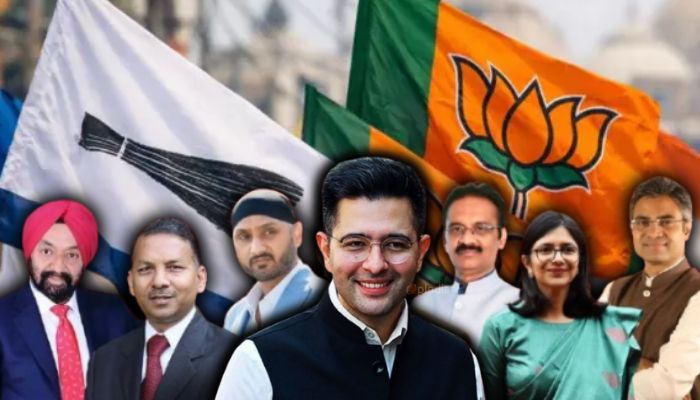
The resignation of Rajya Sabha MPs Raghav Chadha, Ashok Mittal, Sandeep Pathak, Harbhajan Singh, Rajinder Gupta, Vikram Sahney, and Swati Maliwal, from the Aam Aadmi Party (AAP) and merger with the Bhartiya Janata Party (BJP) has not only stirred a political storm but also triggered a constitutional debate. This debate centres on the Anti-Defection Law and its applicability in the present case of seven MPs defecting from AAP and merging into the BJP.

AAP Rajya Sabha MPs invoke provision of the Anti-Defection Law

An internal power tussle was ongoing among the top echelon of the Aam Aadmi Party for months. From early speculations that former Delhi CM Arvind Kejriwal was growing insecure about Raghav Chadha’s supposedly surging popularity to AAP formally removing him as its Rajya Sabha deputy leader, the infighting came out in public.

Before this, Swati Maliwal already had a public spat with Kejriwal, and people actually wondered why she was still in the party. She had alleged that she was assaulted by the CM’s aides in his official residence in May 2024.

Days after, AAP began “silencing” him amidst his growing clout, Rajya Sabha MP Raghav Chadha announced his resignation from the party and merger with the BJP on 24th April. Whether the meteoric rise in Chadha’s online popularity is fully organic or not could be a discussion; his departure would have been a big blow for AAP. However, Chadha decided to inflict an irreversible shock and took away six more MPs, including Swati Maliwal, who has been at loggerheads with Kejriwal over alleged harassment by his aide Bibhav Kumar in May 2024.

The seven MPs, constituting more than two-thirds of AAP’s 10-member Rajya Sabha contingent, submitted signed letters and documents to the Rajya Sabha Chairman this morning, formally triggering the merger under the anti-defection law’s exception for two-thirds splits.

During a press conference, Chadha said, “We have decided that we, the ⅔rd members belonging to the AAP in Rajya Sabha, exercise the provisions of the Constitution of India and merge ourselves with the BJP.”

Speaking about the legality of the merger with the BJP, Chadha said, “As per the Constitution, two-thirds of the total MPs of a party can merge with another party. We have submitted a letter to Rajya Sabha Chairman C P Radhakrishnan in this regard today… submitting all the documents required.” 

The AAP leadership, however, not only accused Chadha and other defectors of ‘betraying’ the party but also announced plans to challenge what they described as an “unconstitutional defection”.

AAP Rajya Sabha MP Sanjay Singh said the party would petition the Rajya Sabha chairman seeking the disqualification of the defected MPs under the anti-defection law. Singh contended that this was not a case of a genuine party merger but of individual defections that should be penalised.

“Anti-defection law clearly states that no form of split is permissible in the Assembly, Rajya Sabha, or Lok Sabha… It does not carry any legal recognition, even if it’s a two-thirds majority… Therefore, the defection of these seven Rajya Sabha MPs from the AAP is entirely illegal, incorrect, unconstitutional, and against parliamentary rules. Even if the number rises from seven to eight members, it would still have no legal validity under the Tenth Schedule. It has no legal recognition, and this has also been clearly established in the Shiv Sena case,” Sanjay Singh said.

The AAP leader, however, conveniently forgot that in the Shiv Sena Eknath Shinde faction versus Uddhav Thackeray faction case, the Shinde faction never claimed a formal “merger” with the BJP or any other party. Instead, they claimed to be the “real” Shiv Sena and not defectors at all. Although the Supreme Court deemed the actions of the Shinde faction as ‘defection’, the decision was left with Maharashtra Assembly Speaker Rahul Narwekar, who decided in favour of the Shinde faction since they had the majority number.

While a disgruntled Aam Aadmi Party is desperate to have the membership of the seven MPs terminated, citing the anti-defection law, the same legislation has provisions that ensure that Chadha and six others will most likely remain unaffected.

Anti-Defection Law

Brought in the Tenth Schedule of the 52nd Amendment to the Constitution of India during the Rajiv Gandhi Government in 1985, the Anti-Defection Law is aimed at stopping what is colloquially described as the “Aaya Ram, Gaya Ram” style defections that previously toppled governments. This law was further tightened by the 91st Amendment in 2003, which removed the earlier one-third split exception.

Back in 1967, when Lok Sabha elections were held, out of 3,500 MPs that were elected to legislative assemblies of various states and union territories, around 550 later defected from their original parties. To tackle this political opportunism-based defection, a committee was formed under Congress leader Yaswantrao Chavan. However, a proper legislation to address this issue could be brought only after Rajiv Gandhi-led secured a majority in the 1984 elections and introduced the Anti-Defection Bill in 1985.

When it comes to elected representatives, the Anti-Defection Law recognises two types of defections. First, wherein members voluntarily relinquish membership of their party and the other in which an independently elected member joins a political party.

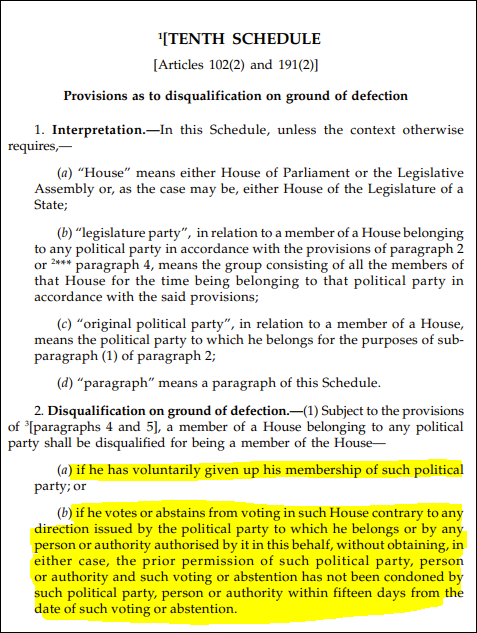
As per Paragraph 2 of the Tenth Schedule, a Member of Parliament or state legislature is disqualified if she or he voluntarily gives up membership of the party on whose ticket she or he was elected, or votes or abstains from voting in the House contrary to any direction or whip issued by the party, unless the party condones it within 15 days.

“(a) if he has voluntarily given up his membership of such political party; or (b) if he votes or abstains from voting in such House contrary to any direction issued by the political party to which he belongs or by any person or authority authorised by it in this behalf, without obtaining, in either case, the prior permission of such political party, person or authority and such voting or abstention has not been condoned by such political party, person or authority within fifteen days from the date of such voting or abstention,” the law states.

Apparently, the Aam Aadmi Party is placing its hopes on having the defected MPs disqualified, in the provision “An elected member of a House who has been elected as such otherwise than as a candidate set up by any political party shall be disqualified for being a member of the House if he joins any political party after such election.”

Clearly, Raghav Chadha had the legal aspects of defection and merger analysed beforehand. Out of 10 AAP MPs, one resigning would have made no big difference; however, with 7 defecting and merging with the BJP, they secured both their Rajya Sabha membership and political interests.

The question arises as to how their Rajya Sabha memberships could remain unaffected when the Anti-Defection Law says that an elected MP will be disqualified if he or she was elected on a ticket of one party but defected to another after winning the election?

The answer to this lies in the Anti-Defection Law’s provision that disqualification on the grounds of defection does not apply in the case of merger.

Paragraph 4 of the law states, “A member of a House shall not be disqualified under subparagraph (1) of paragraph 2 where his original political party merges with another political party and he claims that he and any other members of his original political party

  • have become members of such other political party or, as the case may be, of a new political party formed by such merger; or
  • have not accepted the merger and opted to function as a separate group, and from the time of such merger, such other political party or new political party or group, as the case may be, shall be deemed to be the political party to which he belongs for the purposes of sub-paragraph (1) of paragraph 2 and to be his original political party for the purposes of this sub-paragraph.

(2) For the purposes of sub-paragraph (1) of this paragraph, the merger of the original political party of a member of a House shall be deemed to have taken place if, and only if, not less than two-thirds of the members of the legislature party concerned have agreed to such merger.”

The entire game relies on the word “deemed” as the law does not require the national party leadership or party president to formally announce a merger. Basically, if two-thirds or more of the MPs or MLAs of a party in a specific House agree, the merger is automatically considered to have happened.

In the present case, the concerned party is AAP’s Rajya Sabha group. With 10 MPs, two-thirds means at least 7. In a well-calculated move, the seven MPs who left AAP satisfy this legal threshold exactly. Therefore, the law deems that AAP’s Rajya Sabha legislature party has merged with the BJP. If the number of rebel MPs was less than the two-thirds threshold, then they would have been disqualified under the Anti-Defection Law.

Paragraph 4 (2) essentially kills AAP’s argument that a ‘real’ merger must involve the national party structure and not just one House’s lawmakers. This constitutional provision rejects the interpretation of the Anti-Defection Law, AAP leadership is putting forth.

While the final decision regarding any disqualification petition AAP moves, remains with the Rajya Sabha Chairman, the statutory text and legal reading of the law go easily in favour of the seven MPs.

Interestingly, the Tenth Schedule also bars the jurisdiction of the court regarding the disqualification of a member of the House in this context. The law states, “Notwithstanding anything in this Constitution, no court shall have any jurisdiction in respect of any matter
connected with the disqualification of a member of a House under this Schedule.”

In short, the seven MPs who joined the BJP are protected, and no sword of disqualification hangs over their head. In accordance with the provisions of the Anti-Defection Law, Raghav Chadha, Ashok Mittal, Sandeep Pathak, Harbhajan Singh, Rajinder Gupta, Vikram Sahney, and Swati Maliwal shall legally retain their seats.

Past cases of defections based on the merger provision

While the 1985 Anti-Defection Law was brought with the intention of curbing defections, the practice has continued over the years. It is obvious that the anti-BJP parties and ideological ecosystem is framing the defection and merger of seven AAP MPs into the BJP as some exploitation of constitutional provisions as loopholes, political leaders across parties with varying ideologies have indulged in this practice.

Back in 2019, when state assembly elections were held in Goa, ten Congress MLAs, who constituted more than two-thirds of the INC’s legislature group in the 40-member assembly, voluntarily gave up their membership and merged with the BJP. Just as it happened in Raghav Chadha and others’ case, these Congress MLAs had also invoked Paragraph 4 of the Tenth Schedule. Their merger with the BJP was deemed valid by the Goa assembly Speaker and later upheld by the Bombay High Court’s Goa Bench. In fact, from 1970, 2019 to 2022, Goa has a history of defections This essentially confirmed that the consent of two-thirds of a legislature party alone suffices for protection from disqualification even without a formal full-fledged national-level party merger.

In 2018, six Bahujan Samaj Party (BSP) MLAs representing the entire BSP legislature group in Rajasthan’s state assembly announced their merger with the Congress party after elections. The BSP MLAs had cited the two-thirds merger exception in the Tenth Schedule, and their move was accepted without attracting any penalties.

In June 2019, 12 of the 18 Congress MLAs resigned and joined the Telangana Rashtra Samiti (TRS) after elections, invoking Paragraph 4 of the Tenth Schedule. The Telangana Assembly speaker has also endorsed their merger with Congress since the defectors constituted two-thirds of the legislature party.

Conclusion

The history of defection and merger cases shows exactly why the defected AAP MPs collectively and publicly emphasised the “two-thirds” figure because they knew that their move fell squarely within the merger exception of the Tenth Schedule and would not invite disqualification. The ‘damage’ AAP and the anti-BJP cabal can inflict is online criticism, run an ‘unfollow Raghav Chadha’ campaign on Instagram and performative political manoeuvres.

Exclusive: Delhi HC documents reveal how Salim Khan alias ‘Ex Muslim’ Salim Wastik was convicted for kidnapping & killing a 13-year-old boy, jumped bail for 26 years; got exposed after Islamists slit his throat

On 25th April, Delhi Police arrested YouTuber and self-proclaimed ‘ex-Muslim’ Salim Wastik in connection with a 31-year-old kidnapping and murder case. The man who recently made headlines after surviving a brutal attack by Islamists at his Ghaziabad home was, in fact, a convicted murderer who had jumped bail and remained absconding for over 26 years.

Salim Wastik’s real name is Salim Khan. In 1997, a Sessions Court in North-East Delhi convicted him for the kidnapping and murder of 13-year-old Sandeep, son of a businessman. Following conviction, Salim appealed against the judgment in the Delhi High Court. In 2000, he was granted bail for two weeks. He never surrendered after that.

For decades, Salim lived under different names, moved across several places in Uttar Pradesh and Haryana, rebuilt himself as Salim Wastik or Salim Ahmed, ran a local business and projected himself as a social activist. While doing so, he gained public visibility as a YouTuber known for his controversial views on Islam.

However, his decade-long escape from the law came to an end only after he was attacked by Islamists in February this year. Based on the information, the Delhi Police’s Crime Branch confirmed his identity using old records, photographs, and fingerprints, which led to his arrest. Reports suggest that he admitted during questioning that he was indeed the same Salim Khan who had been on the run since 2000.

OpIndia accessed case documents from the Delhi High Court. Here is the complete chronology of events starting from kidnapping, ransom, murder, arrest, conviction, and eventual arrest after remaining absconding for 26 years.

The 1995 kidnapping and murder case

The case dates back to 20th January 1995. 13-year-old Sandeep had a routine. He used to leave for school at around 11:30 am as he studied in the second shift at Ramjas School, Darya Ganj, which ran from 12:30 pm to 6:30 pm. Every day, he used to return home by around 7:30 pm. However, on that fateful day, Sandeep did not return.

At around 8:30 pm, his father, Sita Ram, became worried and informed his brother-in-law, Rajesh Goel, that Sandeep had not returned. The family searched for him through the evening and night. However, they could not trace the child.

On 21st January 1995, the case took a darker turn. At around 12:10 pm, Rajesh Goel received a phone call at the family shop in Kartar Singh Market, Sherpur Chowk, Kabul Nagar Road, Delhi. The caller asked whether the family knew where Sandeep was. When Rajesh said they did not know, the caller claimed that Sandeep was with them and that they would call again.

The family of the missing child immediately informed the police. Rajesh Goel’s statement was recorded, and an FIR was registered at Gokal Puri police station. The kidnappers made the second call at around 3 pm on the same day, and this time, the caller demanded Rs 30,000 as ransom.

The instructions were specific. Rajesh was told to bring the cash at 4:30 pm to the bus stand near Loni flyover. He was instructed to place the money in a bus going towards Baghpat, at the place where luggage is normally kept. The caller said the money would be collected from that, and then they would release Sandeep the next day. The caller also warned not to inform the police, otherwise Sandeep would be killed.

Police swung into action following the second call, and suspicion fell on Salim Khan. It was not a random suspicion. A neighbour, Ram Avtar, informed the police that on 20th January, at around 11:30 am, he had seen Sandeep sitting in a rickshaw with a tall boy. When Sandeep passed by him, he told Ram Avtar that he was going to school with “Masterji”. That “Masterji” was Salim Khan.

Salim Khan was a martial arts instructor at Ramjas School. He was known to Sandeep and his family. He had also visited their home and shop earlier. This familiarity became important as it explained why the child could have trusted him and gone without resistance.

Based on this information, the police went to Salim’s house. Sandeep’s father, uncle and neighbour accompany the police. When Salim saw the police, he got startled. During the interrogation, Salim made a disclosure statement and stated that he could get Sandeep’s dead body recovered from a drain in Mustafabad near the Bhagirath water pump.

He was taken to the spot, and Sandeep’s body was recovered from the ‘ganda nalah’ at Mustafabad. Sandeep’s father later identified the body. The recovery of Sandeep’s body on Salim’s instance became one of the strongest pieces of evidence against him.

During the investigation. Salim named Anil as his accomplice. On 22nd January 1995, the police searched Anil’s jhuggi but did not find anything. Anil was not present at that time. On 4th February 1995, Anil surrendered in court. According to presecution, Sandeep’s watch, tiffin box and school bag were recovered from Anil’s jhuggi on his instance. He had buried them in a plastic bag. The prosecution also relied on Rajesh Goel’s claim that he recognised Anil’s voice as the voice of the person who had made the ransom calls.

In 1997, the trial court convicted both Salim Khan and Anil. They were sentenced to life imprisonment for murder, along with punishment for kidnapping and kidnapping for ransom.

Following the conviction, Salim Khan and Anil approached the Delhi High Court and filed an appeal against the judgment. The High Court noted that the case was based on circumstantial evidence. This meant the prosecution had to establish every circumstance beyond a reasonable doubt, and those circumstances had to form a complete chain pointing only towards the guilt of the accused.

In Anil’s case, the High Court found the chain broken. The prosecution’s case against Anil rested mainly on two things. First, the alleged recovery of Sandeep’s watch, tiffin box and school bag from his jhuggi. Second, Rajesh Goel’s claim that he recognised Anil’s voice as the voice of the caller.

The court found the recovery doubtful. It noted that Anil had surrendered after 14 days and that his jhuggi had already been searched earlier on 22nd January, when nothing had been found. The court also observed that the items were generic in nature, and it was not certain that they actually belonged to Sandeep.

The court further said it was unlikely that a person who was about to surrender before the judicial process would keep incriminating evidence hidden in his own jhuggi.

The voice identification was also rejected. Rajesh Goel claimed that he recognised Anil’s voice when Anil was allegedly making his disclosure statement before the police on 4th February 1995. However, he never disclosed this fact to the police at that time. He mentioned it for the first time only during his court testimony on 10th October 1996, more than one year and nine months after the incident.

The High Court also observed that a voice heard over the telephone and a voice heard in person may sound different. It added that recognising a telephone voice after a brief conversation and after such a long gap was difficult. The court also noted the issue of the question being a leading question under the Evidence Act.

The ransom call itself was also found doubtful. Sandeep’s father, Sita Ram, stated that there was only one call, while Rajesh Goel spoke about two calls. Rajesh Goel said no police officer was present when the second call was received, whereas a police witness said he was present at the shop when the second call came.

The medical evidence also complicated the ransom story. The doctor’s opinion suggested that the death had occurred roughly around the afternoon of 20th January, while the ransom calls were allegedly made on 21st January. This created doubt about whether Sandeep was even alive when the ransom call was made.

For these reasons, the High Court gave Anil the benefit of the doubt and acquitted him.

Salim Khan’s case, however, stood on a different footing. The court found that the testimony of neighbour, Ram Avtar, remained unshaken. The court also placed strong reliance on the recovery of Sandeep’s dead body at Salim Khan’s instance.

The High Court held that when the last seen evidence was coupled with the recovery of the body at Salim Khan’s instance, there could be no doubt that Salim Khan was responsible for Sandeep’s death.

The court also noted that Salim Khan failed to offer any explanation regarding these incriminating circumstances. However, due to doubts surrounding the ransom calls, the High Court set aside Salim Khan’s conviction for the same. His conviction for murder and kidnapping was upheld.

The court records also revealed that Salim Khan did not remain within the judicial process after conviction. He was granted bail for two weeks on 24th November 2000. He was supposed to surrender after the bail period ended, but he did not.

In July 2004, the Delhi High Court was formally informed that Salim did not surrender after the bail period was over. On 17th July 2004, the court directed the State to make all efforts to arrest him. On 25th September, the court issued non-bailable warrants (NBW) against Salim Khan to be executed through the SHO of Police Station Gokal Puri.

On 20th November 2004, the court noted that (NBW) could not be executed. Fresh NBW was issued, which again came back as Salim was untraceable. On 14th February 2005, the court again directed fresh non-bailable warrants against Salim Khan.

By 19th May 2005, the High Court made it clear that Salim Khan’s absence would not stop the appeal from being heard. The court observed that “the absence of the appellant need not detain us” and appointed advocate Sumeet Verma as Amicus Curiae on behalf of Salim Khan.

This means Salim Khan was not merely unavailable once. He had jumped bail, ignored the process of law, evaded repeated non-bailable warrants, and remained absconding even while his appeal was pending before the High Court.

In 2011, the Delhi High Court finally decided the appeal. Anil was acquitted. Salim Khan’s conviction for kidnapping and murder was upheld. The court set aside only the ransom charge under Section 364A IPC.

The High Court also noted that Salim Khan had been absconding after being released on bail and directed that he be taken into custody to serve the remainder of his sentence. However, Salim Khan continued to evade arrest for years.

A new identity as Salim Wastik

According to media reports, during his years on the run, Salim Khan lived under different aliases and moved across Shamli, Muzaffarnagar, Meerut and Ghaziabad. He worked as a furniture maker before settling in Loni, Ghaziabad. There, he reportedly ran a shop selling women’s clothing and accessories.

Over time, he built a public profile under the name Salim Wastik or Salim Ahmed. He projected himself as a social activist and operated a YouTube channel. Online, he became known as an ‘Ex-Muslim’ and posted controversial views on Islam.

He was not living like an unknown fugitive hiding in a remote corner. He had built a new public identity. Reports also suggest that he had recently signed a Bollywood biopic based on his life, even as his original identity as a convicted murderer remained hidden for years.

The February attack on Salim Wastik

On 27th February this year, Salim Wastik was brutally attacked at his residence in Ghaziabad. Two Islamists entered his house and attacked him with sharp objects. His throat was slit, and he suffered multiple deep stab wounds. In a purported video of the incident, two men wearing kurta pyjamas and helmets were seen approaching him while he sat on a sofa inside his home office. One of them took out a paper cutter and slashed at his neck. He was dragged to the ground and attacked repeatedly.

Salim Wastik survived the attack but remained hospitalised for weeks. The attackers were identified as brothers Gulfam and Zeeshan. Police described them as fanatics who were angered by Salim Wastik’s views on Islam.

Zeeshan was killed in a police encounter in Loni on 1st March. Gulfam was killed in another encounter in Indirapuram on 3rd March. Police said both fired at the police and were shot in self-defence. Both carried a bounty of Rs 1 lakh each.

Ironically, the attack that nearly killed Salim Wastik also brought renewed attention to his identity. After the attack, Salim Wastik was under treatment and police protection. Meanwhile, the Delhi Police Crime Branch received intelligence that the man known as Salim Wastik could be the absconding convict Salim Khan from the 1995 kidnapping and murder case.

A team of the Anti-Robbery and Snatching Cell of the Crime Branch began verification. Inspector Robin Tyagi and ACP Sanjay Kumar Nagpal, along with police personnel, including Mintu Yadav, were tasked with tracing long-term fugitive offenders and parole jumpers. The team checked old records, photographs and fingerprint details.

The verification confirmed that YouTuber Salim Wastik was indeed Salim Khan, the convict who had been sentenced to life imprisonment in 1997 and had absconded after securing interim bail in 2000. With the help of the local police in Loni, Delhi Police finally arrested him.

During interrogation, Salim reportedly told the police that after jumping bail, he continuously changed locations and identities to avoid arrest. After completing legal formalities, Salim Khan has been sent to Tihar Jail to serve the life sentence awarded to him in 1997 and upheld by the Delhi High Court in 2011.

For over 26 years, Salim Khan was not merely a wanted man. He was a convicted murderer who had killed a child and absconded for decades. While ignoring court proceedings, he became so confident that he reinvented himself under a new identity and lived publicly as a YouTuber and social activist.

The attack on him made headlines, and eventually, his dark side was revealed.

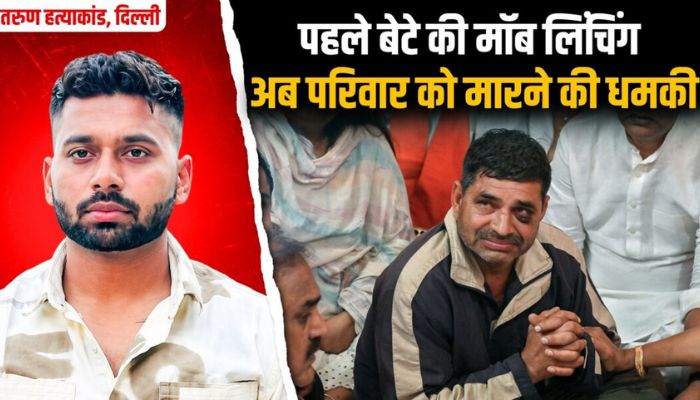
‘Threatened to kill second son’: Accused in Tarun Khatik’s lynching pressuring family to withdraw the case, read the family’s ordeal as they prepare to leave the place – OpIndia Exclusive

The mob lynching of Tarun Khatik on Holi in Uttam Nagar, Delhi, has now taken a new turn. While the victim’s family is fighting for justice, the accused have barged into their home and issued open threats of murder. Distressed by this, Tarun’s family is now preparing to flee Uttam Nagar.

Meanwhile, the Delhi High Court has ordered the Delhi Police to provide security to the victim’s family and remove inflammatory videos from social media. OpIndia spoke with the victim’s family to learn about their well-being. Tekchandra, the uncle of the deceased, Tarun Khatik, told OpIndia that on 13th April, some women from the accused family visited their home.

No men were present at the house at the time. Tarun’s mother and other women were present. The women of the accused family abused them with casteist slurs, and when they refused to withdraw the case, they threatened to kill the second son in the middle of the crossroads.

Tarun’s family forced to flee

Tekchandra said, “Our entire family is terrified after this threat. Now we want to sell this house and move away. We are looking for a better place where we can live safely. We don’t want to face any trouble again.”

Regarding the Delhi Police deployment in front of his house, Tekchandra says, “The Delhi Police may be stationed here. Recently, the ACP came to meet and talk with us, and he also assured us of security. But for how long will the police stay with us or protect us? If the police leave here one day, who will protect us? Therefore, we should leave. We will flee from here.” Tekchandra said that he has also filed a complaint with the Delhi Police regarding the threats posed by the accused family.

Delhi High Court orders security for the family

Meanwhile, the Delhi High Court, hearing a petition filed by the victim’s family, has ordered the Delhi Police to provide security. It also ordered the removal of inflammatory videos from social media. The High Court has directed the Police Commissioner to instruct the concerned SHO to provide his personal number to the victim’s family so that they can contact him for assistance in case of any situation.

A Muslim mob lynched Tarun on Holi

The incident happened on Wednesday (4th March), on the festival of Holi. According to police and family accounts, an 11-year-old girl from Tarun’s family was playing Holi on her terrace. She threw a water balloon, aiming at her father, who was standing below. However, the balloon fell on the road and splashed water on a Muslim woman from the neighbourhood, leading to an argument between the two households.

The Hindu family and the girl apologised, and the matter appeared to be resolved. But the tensions escalated when Tarun returned on his bike in the evening after celebrating Holi with a friend. Tarun was stopped by a group of 15 to 20 people belonging to the Muslim community and was brutally assaulted with iron rods, bricks, stones, and other objects. The attackers also beat his family members and others, who rushed to the spot to protect him. Tarun was taken to the hospital, where he succumbed to his injuries the next day.

The incident sparked tension in the area, and angry people protested, demanding action against the accused. Thousands of Hindus who attended a massive protest rally in Uttam Nagar threatened to prevent Muslims from celebrating Eid. This further escalated the situation. 


(This article is a translation of the original article published on OpIndian Hindi.)

BJP needs to win substantial seats in the second phase to clinch West Bengal election: Read why breaching Mamata’s bastion and undoing the past record is crucial

A highly competitive 1st phase of the West Bengal state assembly elections has instilled the BJP, yearning for its maiden victory in the TMC-dominated state. The highest-ever voter turnout, 92.9%, during the polling of 152 seats has indicated that the Bengali voters are in a mood to bring a historic change, apparently in favour of TMC’s arch-nemesis, BJP. However, this ‘historic change’ is contingent on the BJP managing to win big in the final phase on 29th April, as many seats in this phase are in CM Mamata Banerjee’s bastion.

142 seats, Mamata Banerjee’s stronghold, the BJP’s past below-par performance and the renewed hopes of conquering the TMC heartland

The second and final phase of the 2026 West Bengal elections is a make-or-break phase for the BJP. This phase covers the large pasts of South Bengal, including 11 seats in Kolkata, North 24 Parganas has 33, South 24 Parganas has 31, Howrah has 16, Hooghly has 18, Nadia has 17, and East Burdwan has 16. These seats have been the Trinamool Congress’s core bastion.

In the controversial 2021 assembly elections, the TMC swept 124 out of 142 seats, registering an around 86% strike rate. The BJP, on the contrary, could secure only 18 seats. Similar equations emerged in the 2024 Lok Sabha elections as well, although considering the TMC’s dominance both through politics and street veto, the BJP securing overall 77 seats and becoming the principal opposition party, was also no less than moving mountains.

While a supposed upper hand in the first phase definitely improves the BJP’s prospects, to become the giant slayer, the party needs to crack TMC’s loyal voter base in the latter’s stronghold.

To form a government, competing parties need to achieve the magical figure of 148 out of 294. Even if the BJP fares well in the 1st phase, it is unlikely that the party would manage to hit the majority mark. Securing substantial gains in phase 2, say 45 to 60 seats at least, would make it numerically possible to reach or exceed 148.

TMC’s organisational depth and syndicate raj grip have allowed it a near-invincible dominance in the phase 2 seats, which had delivered the party sweeping a third term. BJP has historically struggled to gain ground here; however, this time there is a possibility of the BJP pulling off a historic show, as it did in the 2014 Lok Sabha elections at the national level.

BJP’s aggressive campaign, focus on real issues people of Bengal are facing, be it unemployment, lack of industries, as well as its messaging of preventing demographic change, has resonated well with the people. In fact, the TMC is rattled at the prospect of losing the 2026 Vidhan Sabha election, and even unleashed its hooligans to create chaos and conflict during the 1st phase of the polling. 

Phase 2 will witness the biggest fight of the 2026 Lok Sabha elections in Bhabanipur, where Chief Minister and TMC supremo Mamata Banerjee will defend her home turf against BJP’s Suvendu Adhikari, who has inflicted an embarrassing defeat on Banerjee on the Nandigram seat in 2021.

Besides Mamata, many TMC heavyweights, including Kolkata Mayor and notorious Islamist Firhad Hakim in Kolkata Port, Minister of State for Finance Chandrima Bhattacharya in Dum Dum Uttar, Minister of Commerce and Industries Shashi Panja in Shyampukur, Power Minister Aroop Biswas in Tollyganj, Education Minister Bratya Basu in Dum Dum, and Minister of State for Fire and Emergency Services Sujit Basu in Bidhannagar, will have their electoral fate decided on 29th April.

BJP’s Kalyan Chakraborty has been aggressively holding roadshows and public events in Khardaha to breach this TMC-leaning suburban seat. Recently, BJP national president Nitin Nabin has held a roadshow here to seek votes for Chakraborty.

Another key BJP candidate is Rekha Patra, who gained national attention when the Sandeshkhali women’s harassment case involving TMC strongmen was exposed in 2024. Patra is contesting from the Hingalganj seat. Her victory here would not only contribute to the BJP’s chances to power but also hand the TMC an unescapable embarrassment since not only were TMC strongmen like Sheikh Shahjahan the main accused perpetrators of sexual crimes against women in Sandeshkhali, but CM Mamata Banerjee had even downplayed these crimes as ‘minor incident’.

From Panihati, the BJP has fielded Ratna Debnath, the mother of the doctor who was raped and killed at the RG Kar Hospital in Kolkata in 2024. The Mamata Banerjee government’s mishandling and insensitivity in this case had sparked protests and national outrage against her. Recently, Prime Minister Narendra Modi campaigned for Ratna Debnath, called TMC an “anti-woman” party, and promised a fresh probe in the RG Kar rape case.

From Rekha Patra to Ratna Debnath, the BJP carefully picked its candidate. Fielding victims of the TMC regime’s misrule in elections, sending out the message that the BJP is not just raising their issues but also actively working towards empowering them.

From Krishnanagar North, the BJP has fielded Tarak Chatterjee. This seat is a major border-region test for the party since it has been a vocal critic of the illegal influx of Bangladeshi Muslims and has accused the TMC of allowing not only Krishnagar North but the entire Nadia district to be a hub of Bangladeshi infiltrators.

This seat’s significance can be understood from the fact that PM Modi held a major rally here and raised the issue of CAA and infiltration.

Another important seat is Bidhannagar constituency, wherein TMC’s Sujit Bose is competing against BJP’s Dr Sharadwat Mukhopadhyay.

In Barrackpore & Howrah seats, the BJP is targeting jute-mill and working-class voters, while Mamata Banerjee addressed rallies in the student politics hub, Jadavpur.

While the TMC portrays high voter turnout in phase 1 to mounting public anger against the SIR exercise concluded recently, the BJP and electoral pundits attribute it to a collective public mood to bring a change is Bengal’s politics.

BJP’s top leadership, from PM Modi, Home Minister Amit Shah, Assam CM Himanta Biswa Sarma, to UP CM Yogi Adityanath, has aggressively campaigned and seemingly managed to turn the winds in the party’s favour.

From Mathurapur/Kakdwip in South 24 Parganas, Krishnanagar in Nadia, Panihati, Jadavpur, Baruipur, Howrah to Dum Dum, Prime Minister Modi’s intense campaigning so far, and the scheduled final day roadshows in Bongaon, Hooghly’s Arambagh, and roadshow between Bhabanipur and other South Kolkata seats, shows that the BJP is leaving no stone unturned to register a historic victory.

RBI cancels banking licence of Paytm Payments Bank: Read why the decision was taken and what it means for users

The Reserve Bank of India (RBI) on Friday, 24th April, cancelled the banking licence of PayTM Payments Bank, bringing an end to its operations as a bank after years of regulatory scrutiny. The decision comes more than two years after the central bank had first imposed restrictions on the entity over multiple rule violations.

Why RBI canceled the licence

As per the RBI’s order issued on Friday, 24th April, Paytm Payments Bank will not be allowed to continue banking activities under the Banking Regulations Act. Further, the central bank clarified that running the bank the way it was doing was in no way beneficial for the depositors and the public at large.

“Banks’ affairs or management are not in the interests of the depositors or the public,” says the RBI’s statement. Additionally, it added that the bank did not meet the stipulated requirements of getting a payments bank license.

The RBI further said that the management’s conduct was “prejudicial to the interest of the depositors,” which is a serious concern for any financial institution. Based on these findings, the central bank has decided to close down the banking firm. However, it has assured the clients that the bank has enough capital to return all deposits made.

The Paytm Payments Bank is an Indian payments bank company established in 2015 under One 97 Communications. The bank started as a payment bank where it could only accept small savings and deposits, but without offering any loan services like traditional banks. 

What the RBI said in its order

Explaining its decision, the RBI cited specific legal provisions under the Banking Regulation Act, 1949. It said that the bank failed to meet the conditions required to continue holding a banking licence.

“Thus, the bank is not complying with provisions of Section 22 (3) (c) of the Banking Regulations Act. No useful purpose or public interest would be served by allowing the bank to continue,” the RBI said.

The central bank also noted that the bank did not comply with the terms of its licence, which is a violation under Section 22 (3)(g) of the Act. As a result, it has now been barred from carrying out any form of banking business with immediate effect.

Under the RBI scanner since 2018

Paytm Payments Bank has been facing regulatory scrutiny for several years now. As far back as 2018, the RBI had flagged multiple issues related to compliance, especially around know-your-customer (KYC) norms.

One major concern was that a single PAN card was linked to multiple accounts, raising fears that rules could be bypassed. The RBI also found that transactions were being allowed beyond prescribed limits in some cases, which increased the risk of money laundering.

An audit conducted in June 2018 revealed serious gaps in how new customers were being onboarded. Proper verification processes were not always followed, leading the RBI to order the bank to stop adding new customers until it fixed these issues.

Over time, the RBI continued to tighten its grip on the bank. RBI’s decision comes more than two years after it first imposed restrictions on PPBL and over a year after severe business curbs were placed on the entity. The RBI’s scrutiny of Paytm Payments Bank dates back to at least March 2022, when the regulator directed the bank to stop onboarding new customers with immediate effect due to “material supervisory concerns.”

The situation became worse in January 2024 when the RBI instructed the bank not to accept any more new deposits owing to concerns related to customer identification, fund usage, and weak technology systems. The restrictions were originally set to take effect from February 29, 2024, but were later extended to March 15, 2024, to allow customers and merchants time to make alternative arrangements.

Customers were allowed to withdraw or utilise their existing balances without restrictions, and pipeline transactions initiated before the cutoff were to be settled by mid-March 2024. The 2024 curbs effectively halted most banking activities at PPBL while the parent company, One97 Communications (Paytm), worked to migrate operations and partnerships. Despite these measures, the bank continued to operate in a highly restricted manner until the full licence cancellation.

The RBI also imposed a penalty of ₹5.39 crore in October 2023 for non-compliance with regulatory guidelines. Among the concerns raised were violations of KYC norms and the failure to maintain a clear separation between the bank and its parent company, One 97 Communications.

Impact on Paytm and its ecosystem

The RBI’s action had a major impact on Paytm’s overall business. Shares of One 97 Communications saw a sharp fall, and its integrated payments system faced disruptions. Services like wallets, FASTag, and merchant settlements were affected.

To deal with the situation, Paytm had to partner with other banks like Axis Bank and Yes Bank to continue offering payment services, including UPI. It also had to shift its infrastructure and users, which increased costs and led to some customers and merchants moving to competitors like Google Pay and PhonePe.

What it means for users

For banking customers, the RBI has clarified that their money is safe. The central bank has stated that it has enough liquidity to repay all depositors during the winding-up process.

At the same time, services on the Paytm app will continue as usual. The company has said that features like UPI payments, mobile recharges, QR payments, and payment gateway services will not be affected. This is because Paytm Payment Bank is a separate entitty, and not linked to the payment services platform.

One 97 Communications has also clarified that it has no financial exposure to the payments bank, as it had already written off its investment earlier. It added that other services like Paytm Money and Paytm Gold will continue to operate normally.

The cancellation of Paytm Payments Bank’s licence sends a strong signal from the RBI about the importance of compliance in the financial sector.