Home Blog Page 21

Census and syllabus: How British Raj played a long game to brand tribals of India as ‘not Hindu’

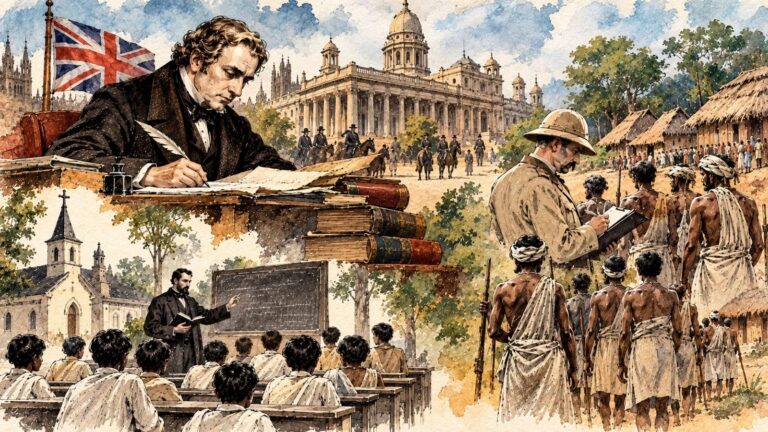
Leftists have been trying for a long time to claim that the tribals of India are ‘not Hindu’. This is not a modern phenomenon. This is a systematic social engineering that was codified and worked into a brilliantly designed machine by the British rulers of India in the 1800s. 

The game has two primary tools: syllabus and census. In 1835 Macaulay put English at the centre of higher education. Sanskrit and Arabic funding shrank. A year later, in a letter home, he wrote, “No Hindu who received an English education stayed sincerely attached to his religion. Not by force, he added, but by “knowledge and reflection.”

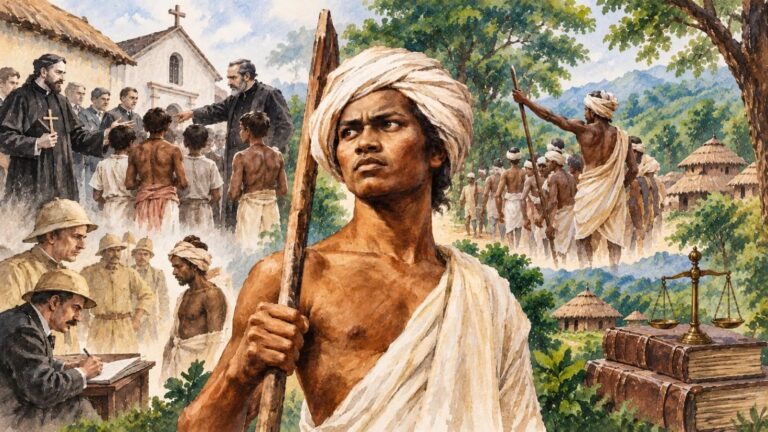
Shame first. Conversion later. That syllabus reached the forests. At Chaibasa, Birsa sat in a German mission classroom built on the same idea: “your gods are superstition; the West is the future.” Birsa walked out of that frame. He went to a Vaishnav teacher, took the sacred thread, and returned to Singbonga, the ancient God of his land. The classroom had failed him. But the game that was played in the classroom was already evolving into administrative reality in the British Raj.

Census. The British played a long game to forcefully separate the tribal identity from the Hindu identity of Indians. In 1871, tribals were parked in the ‘Others’ category. In Chhotanagpur, they were still mostly counted with Hindus; their own report even admitted the line between “Hindooism” and tribal faith was almost impossible to draw. 

Then census grouping kept changing: Aboriginal, Animist, Tribal Religion. The same work continued for sixty years. By 1881, many tribal families told enumerators they were Hindu. Officials still hesitated to write it down. “What is a Hindoo?” a Bengal officer asked, and answered that no definition existed, and the counting continued anyway. By 1931 the split was complete on government papers. Tribals were officially listed as ‘not Hindu’, and therefore, the Raj subtly implied, ‘available’.

It was a long, calculated game to legally declare an entire population “not Hindu.” To create on paper a category of Indians who were officially outside the boundaries of Hindu civilisation and therefore officially available for conversion.

The full article can be read here on Chapter One Magazine.

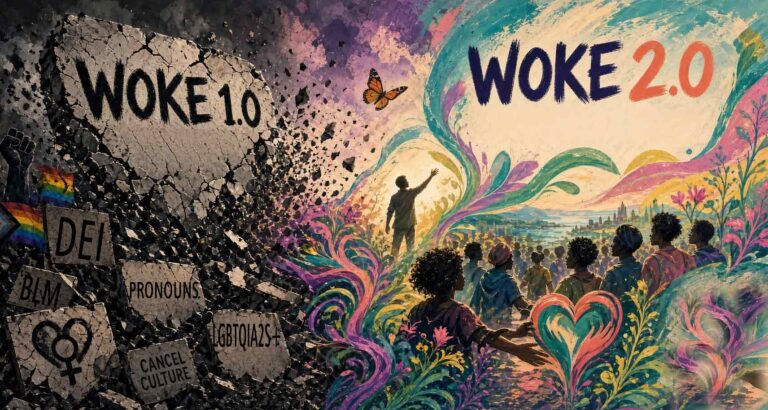
Trading pronouns for power: The strategic mutation of Woke 1.0 into Woke 2.0

When Democratic Representative Alexandria Ocasio-Cortez casually admitted that “Woke 1 was crazy,” it functioned as a profound acknowledgement of ideological overreach. This concession officially consigned the hypersensitive cultural climate of the early 2020s—defined by aggressive language policing, fragile academic jargon, cancel culture, and performative corporate diversity initiatives—to history. However, the demise of “Woke 1.0” does not signal an ideological retreat. Instead, having alienated the working-class demographics they sought to liberate, the progressive left is executing a strategic reboot. The sequel, “Woke 2.0,” is a calculated mutation designed to trade easily mockable aesthetics for durable, long-term institutional leverage.

If the first iteration was defined by fleeting cultural protests and moral scolding, the emerging architecture of Woke 2.0 represents a comprehensive structural re-engineering. This new era abandons niche cultural grievances to aggressively re-centre organised labour and economic populism, targeting corporate monopolies and demanding sweeping wealth redistribution. To champion this, activists have adopted a “Dark Woke” aesthetic—a gritty, unapologetically combative, and meme-heavy communication style that rejects polite decorum to aggressively dominate the digital news cycle.

Crucially, Woke 2.0 shifts its focus from chaotic online mobs to the quiet capture of epistemic and institutional power. The objective is no longer to secure a public apology from a corporate executive, but to embed ideological allies within medical associations, scientific research boards, and judicial circuits. By controlling these credentialed positions, the movement aims to translate social justice principles into durable regulatory baselines and official scientific consensus, effectively deciding what society must legally accept as truth.

Furthermore, this iteration operates as a totalitarian purity spiral that explicitly rejects the existence of neutral ground. Under an unyielding moral binary, standard administrative benchmarks—such as objective grading, merit-based hiring, and standardised testing—are actively dismantled and framed as hidden artefacts of systemic bias and white supremacy.

This structural re-engineering is already manifesting within the Indian socio-political landscape. The Woke 2.0 rejection of institutional neutrality mirrors factions within the contemporary Ambedkarite movement, which increasingly attack merit-based selection as fundamentally contrary to social justice. Simultaneously, the global pivot toward class warfare translates locally into aggressive demands for a nationwide caste census, weaponising demographic data to justify massive wealth redistribution and the dismantling of private-sector autonomy.

Ultimately, the cultural fever of street-level virtue-signalling has broken, seamlessly replaced by a calculated pursuit of raw governing majorities and regulatory dominance. The definitive battles of this new decade will not be fought over mandatory pronouns, but over the foundational integrity of state institutions.

Read the full article on Chapter 1 Magazine

Who was Birsa Munda’s enemy?

On November 15 every year, India celebrates Janjatiya Gaurav Diwas, the day of Tribal pride. That day is the birthday of Birsa Munda, who is the first tribal leader of the country whose portrait adorns the Indian Parliament. He is a national hero, but Leftist groups frequently use his name in their posters that claim he was somehow against Brahmins.

The slogan “Brahmanvaad ki chaati par, Birsa, Phule, Ambedkar” has been a common feature in Leftist protest posters and social media posts for some time. But how did that happen?  How did Birsa Munda end up here?

That slogan says Brahmanvaad. Not Hinduism. That choice of word is deliberate. Because Brahmins, in the context of this slogan and in the history behind it, are not merely a caste. They represent the cultural, intellectual and spiritual custodians of Hindu civilisation.

When Xavier wrote centuries ago, “If it were not for the opposition of the Brahmins, we should have them all embracing the religion of Jesus Christ”, he knew something. Morphing and twisting Birsa Munda’s ideas into anti-Brahminism is a part of the same manual. 

Birsa Munda left Christianity. He was betrayed by the very missionaries who had promised his people salvation and land. He named the British and the Church as his enemies, not Hindus or Brahmins. A British government report from 1895, informed by missionaries themselves, recorded in black and white that he was “no longer a Christian”. And standing outside the mission school that had just expelled him, twenty years old, betrayed, with nothing left but clarity, he said five words:

“Saheb? Saheb ek topi hai.” (Saheb is just a cap)

This article explores the journey of Birsa Munda. Who was his enemy? What was his struggle, and how did a 20-year-old Munda tribal boy become Dharti Aba? We lay down the facts and let the readers think for themselves: who exactly was Birsa fighting against? Who was his enemy? Was it the Brahmins?  Let’s travel to Chhotanagpur of the late 1800s and trace Birsa’s life journey. 

The full article “Who was Birsa Munda’s enemy?” can be read in Chapter One Magazine here. 

NHRC directs Etah Police to register FIR, Meta to respond after complaint against ‘home tutor’ Pratibha, who was brainwashing children with anti-Modi hate: Details 

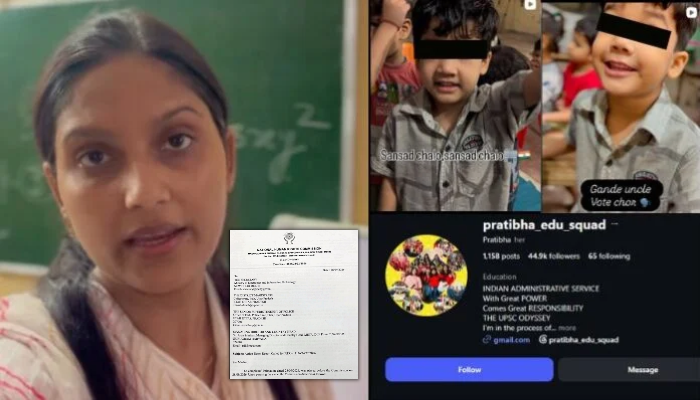
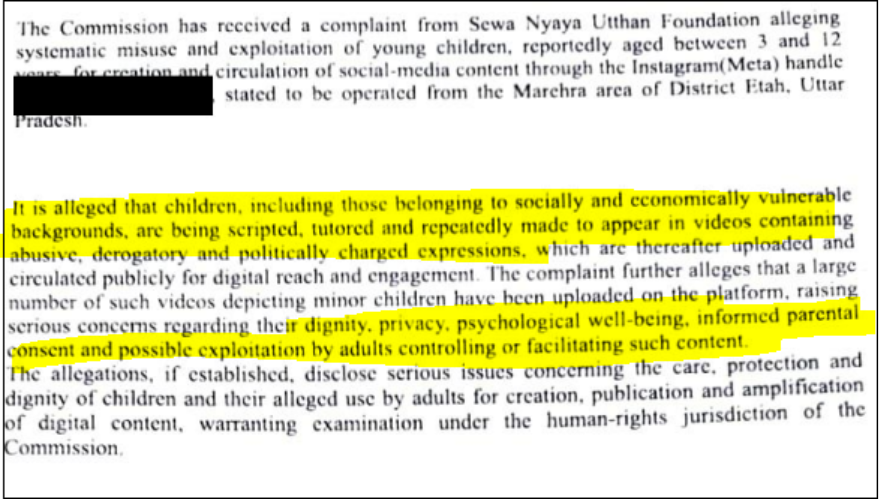
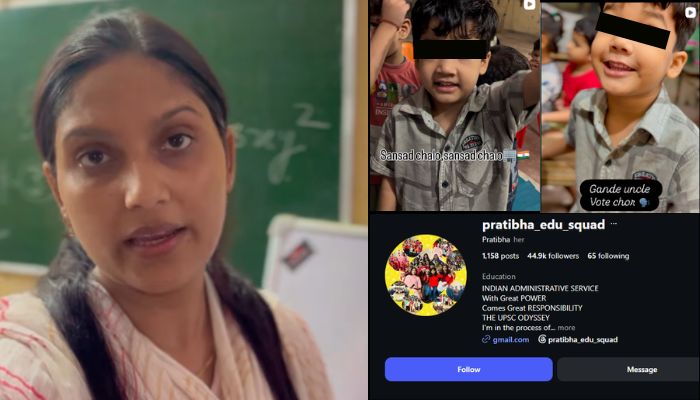
On 28th September, the National Human Rights Commission took cognisance of a complaint filed by the Sewa Nyaya Uthhan Foundation against exploitation of minor children for creation and circulation of abusive and derogatory content on Instagram by a purported coaching centre with account name “Pratibha_ed_squad”. The coaching centre publishing politically charged videos using children, operates from Uttar Pradesh’s Etah district. 

The complaint alleges that children are being scripted, tutored, and frequently made to appear in videos containing abusive, derogatory, and politically charged expressions. The videos are recorded and uploaded on the Instagram handle “Pratibha_edu_squad” for reach and engagement. 

“It is alleged that children, including those belonging to socially and economically vulnerable backgrounds, are being scripted, tutored, and repeatedly made to appear in videos containing abusive, derogatory, and politically charged expressions, which are thereafter uploaded and circulated publicly for digital reach and engagement. The complaint further alleges that a large number of such videos depicting minor children have been uploaded on the platform, raising serious concerns regarding their dignity, privacy, psychological well-being, informed parental consent and possible exploitation by adults controlling or facilitating such content,” the NHRC notice states. 

“The allegations, if established, disclose serious issues concerning the care, protection and dignity of children and their alleged use by adults for creation, publication and amplification of digital content, warranting examination under the human-rights jurisdiction of the Commission,” it adds. 

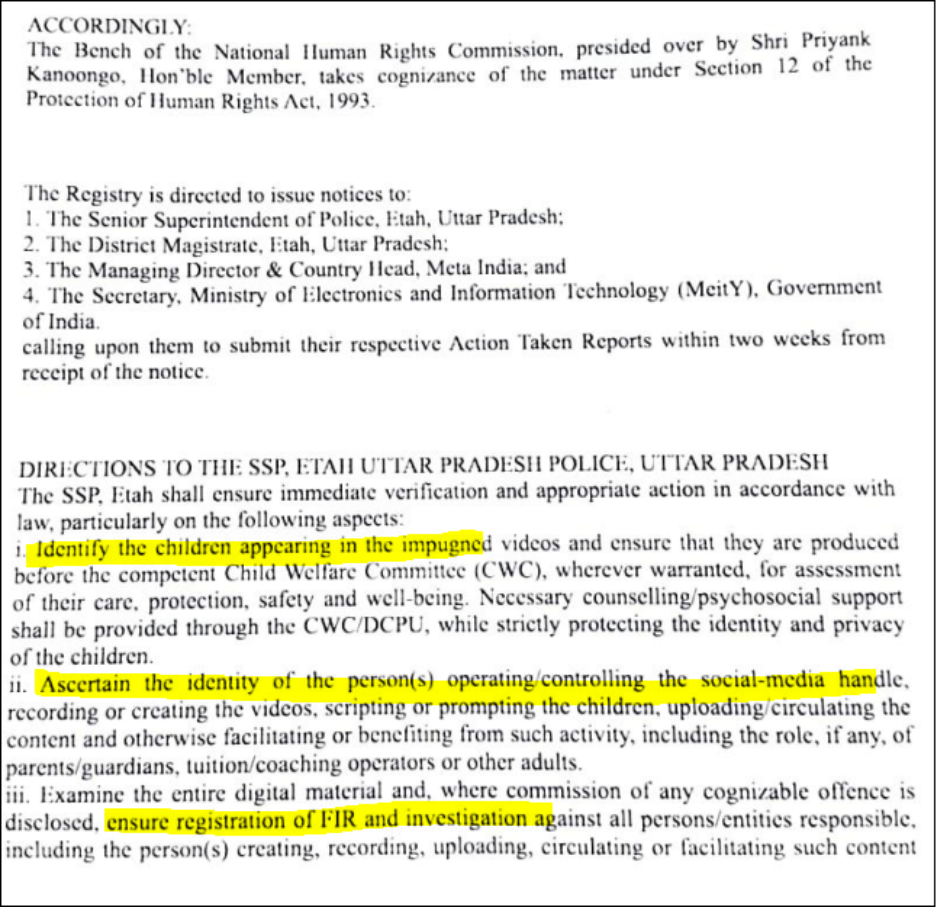
The NHRC Bench headed by Member Priyank Kanoongo has issued notices to the Etah Senior Superintendent of Police, District Magistrate, Meta India’s Managing Director and Country Head, in addition to the Secretary of the Ministry of Electronics and Information Technology (MeitY). 

The Commission has directed Etah Police to identify the children seen in the derogatory videos uploaded by ‘Pratibha_ed_squad’ and ensure that they are provided appropriate protection and counselling. 

“Identify the children appearing in the impugned videos and ensure that they are produced before the competent Child Welfare Committee (CWC), wherever warranted, for assessment of their care, protection, safety and well-being. Necessary counselling/psychosocial support shall be provided through the CWC/DCPU, while strictly protecting the identity and privacy of the children,” the notice reads. 

In addition, the police have been directed to identify the individuals running the social media in question and probe the role of adults involved in scripting, recording, uploading, or otherwise facilitating the content. 

“Ascertain the identity of the person(s) operating or controlling the social-media handle. recording or creating the videos, scripting or prompting the children, uploading, circulating the content and otherwise facilitating or benefiting from such activity, including the role, if any, of parents/guardians, tuition/coaching operators or other adults,” the notice adds. 

Furthermore, the NHRC has directed the police to examine the digital material in question, identify commission of cognisable offence, and register FIR against those involved in creating, recording, uploading, circulation, or facilitation of such concent as well as the concerned social media platform Meta/Instagram. 

“Examine the entire digital material and, where commission of any cognizable offence is disclosed, ensure registration of FIR and investigation against all persons/entities responsibly, including the person(s) creating, recording, uploading, circulating or facilitating such content and the concerned social-media platform/intermediary, wherever its role or liability is disclosed, under the applicable provisions of the Juvenile Justice (Care and Protcction of Children) Act, 2015, Bharatiya Nyaya Sanhita, 2023, 1nformation Technology Act, 2000 and other applicable law,” it stated. 

The NHRC asked the Etah Police to ensure that children are no longer made to appear in such derogatory and abusive videos in the future. 

The police have also been directed to ensure that at no point is the privacy of the concerned children violated. 

The police is required to submit an Action Taken Report which will “specifically indicate the number and age of c identified. action taken by the CWCDCPU. Counselling and protection measures provided, persons identified as operating and creating/uploading the content, FIR/action taken, if any. and steps taken for preservation/removal of the impugned digital material.” 

NHRC directions to Meta India 

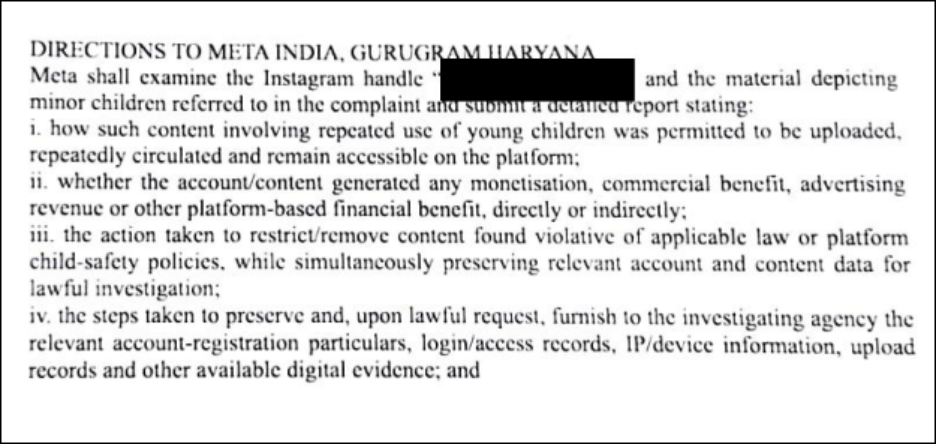
The NHRC has directed Meta to examine the Instagram handle ‘Pratibha_edu_squad’ and the derogatory videos involving minor children.  

Meta has been asked to submit a report with responses to several questions, including how such content was permitted to be uploaded and repeatedly circulated,and whether the content in question generated any financial benefits through advertising or platform-based monetary gains. In addition, Meta is also required to reveal what action it took to restrict or remove the violative content, and steps taken to preserve the account-registration credentials of the Instagram handle in question. 

NHRC directions to MeitY 

The notice also includes directions from the NHRC for the Ministry of Electronics and Information Technology. Addressing the MeitY Secretary, the notice directed examination of how children, particularly those stated by the complainant to be from socially and economically vulnerable backgrounds, are “being repeatedly used such content and how the platform has permitted its continued hosting, circulation and amplification. MeitY shall examine the platform’s due diligence, child-safety and grievance redressal mechanisms, ensure appropriate action in accordance with law, and submit an Action Taken Report within two weeks.” 

OpIndia reported about Pratibha the ‘home tutor’ with misleading Instagram bio, brainwashing minor school children with anti-Modi hate 

On 28th September, OpIndia reported about a home tutor, identified as Pratibha, who has been indoctrinating young kids (some below the age of 5 years) with political propaganda and anti-Modi hatred. 

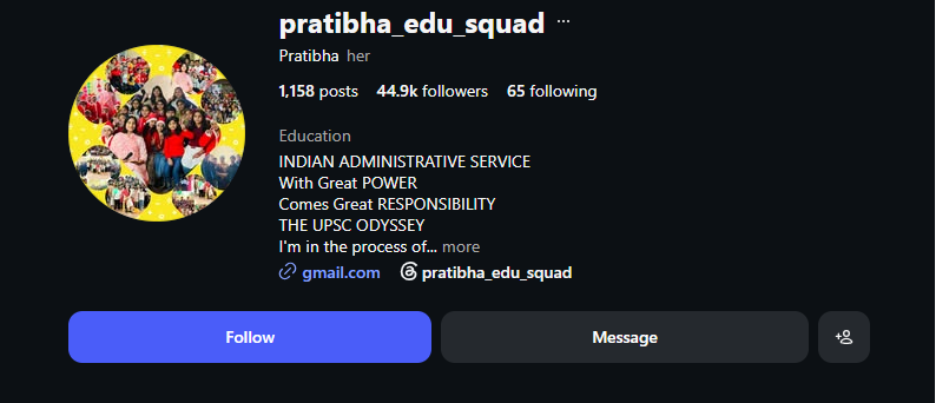
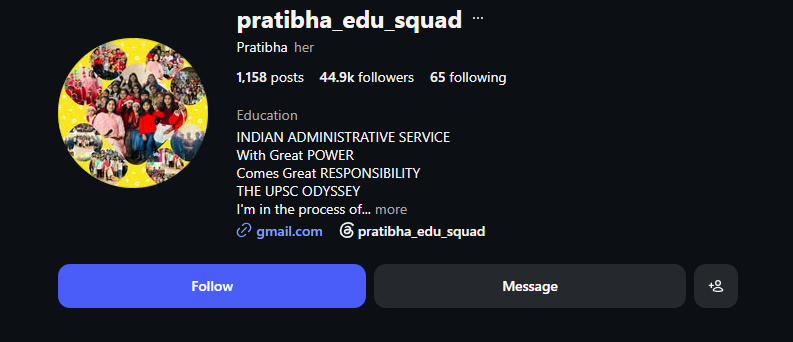
The Instagram handle @pratibha_edu-squad’s bio reads, “Indian Administrative Service (IAS)” and “The UPSC Odyssey”. However, OpIndia could find no publicly available information about Pratibha clearing the IAS exam and becoming an officer. 

Pratibha did not post content using children as ‘political props’ until the unrest and chaos were unleashed in India’s National Capital by the Cockroach Janta Party (CJP). 

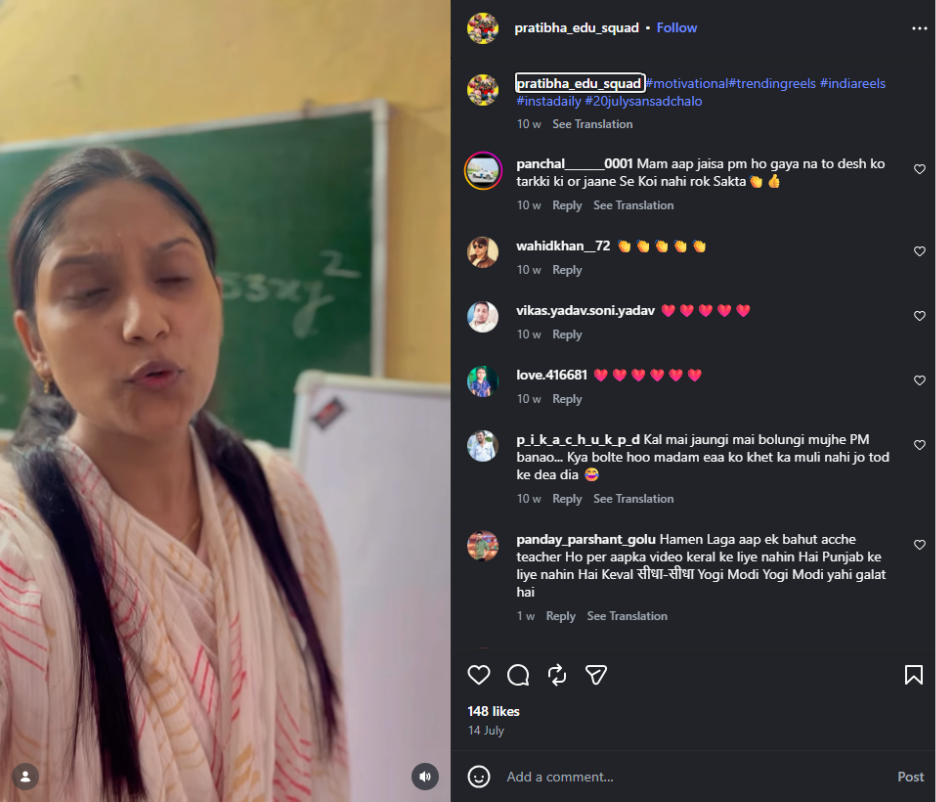
The first politically charged video was uploaded on 14th July 2026. She claimed, “Hunger strike is the last resort for anyone. Imagine the condition of a country where people need to take to the streets and fast to demand the resignation of a Minister.” 

Pratibha had also tagged the Instagram handles of Abhijeet Dipke and the Cockroach Janta Party in that video. Receiving better traction, Pratibha began using children for such videos more frequently. 

The caption of one video reads ‘Sharm karo Modi Ji’ while another says ‘Modi Baba Chor.’ 

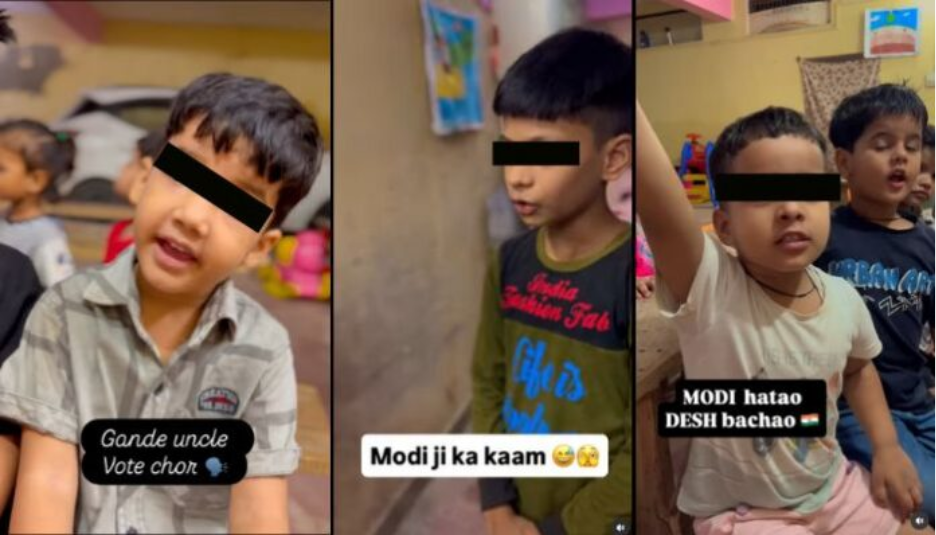
A child who is unable to speak coherently is forced to say ‘Gande Uncle Vote Chor.’ Another kid is heard saying, “Modi hatao Desh bachao.’ Two other students were forced to mock ‘Mann ki Baat’ radio programme of Prime Minister Narendra Modi. 

Violent protests rock LPU: Read the story behind the ‘Lovely’ in Lovely Professional University

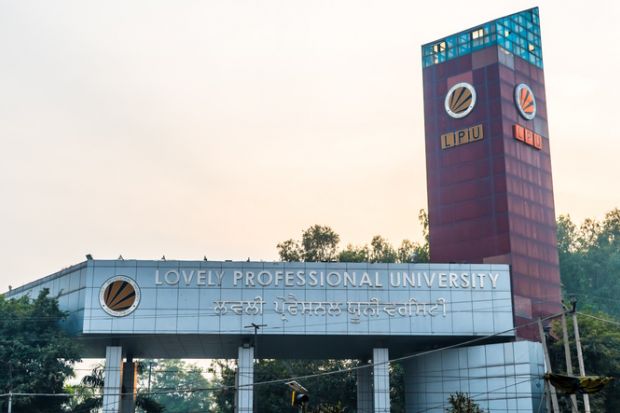
Lovely Professional University (LPU) is under the spotlight due to protests over the rape of a girl on campus. What began as a protest over the incident soon turned violent, with students clashing with police, damaging property and blocking the Jalandhar-Phagwara National Highway.

Protest turns violent at LPU

The protest began late on Saturday, September 26, near the girls’ hostel after information about a sexual assault involving a female student started circulating among students. By around 2 am, students from different hostels had gathered and moved towards the university’s main gate. Videos from inside the campus, including the university mall and other areas, showed agitated students protesting against the sexual assault.

The situation escalated on Sunday, September 27, when protesters damaged property, pelted stones at police and set vehicles on fire. Four to five police vehicles were damaged, while at least two vehicles were set on fire, according to police. Several police personnel were injured in the clashes.

Students later blocked NH-44 outside the university from around 4 am, leading to major traffic disruption. Police said the situation became tense when officers tried to clear the highway blockade, and some protesters threw water bottles at them. Police then used a lathi charge, after which the students moved back towards the campus.

In the aftermath, LPU suspended classes for 10 days from September 28 and postponed the midterm examinations until further notice.

But as LPU finds itself in the headlines, the institution’s history offers another story, one that begins not in education, but with a small sweet shop in Jalandhar.

LPU came into existence in 2005

The Lovely Professional University came into existence in 2005, when the Lovely Professional University Act, 2005, was passed by the Punjab State Legislature. The Act received the Governor’s assent on December 23, 2005. The university started its first academic session in 2006, after receiving recognition from the University Grants Commission (UGC).

But even before the university was established, the name “Lovely” had already become a familiar name in Punjab. The name came from the business started by the Mittal family decades earlier.

How the ‘Lovely’ name began

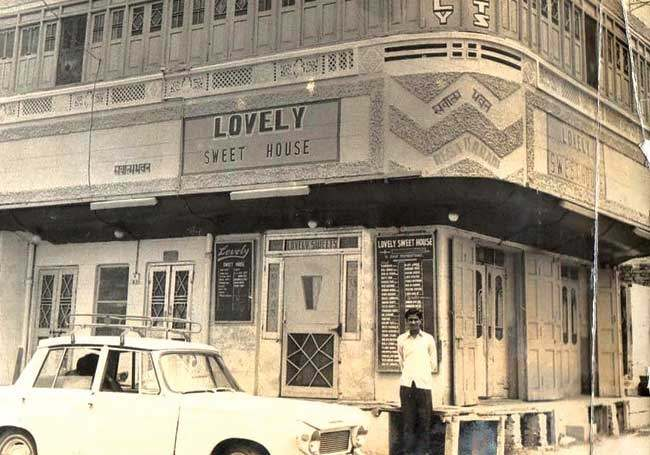
Lovely Sweets (Image via CIIM)

The story of Lovely goes back to 1961, when Baldev Raj Mittal opened a small sweet shop in Jalandhar Cantt. He named it “Lovely Sweets.” Baldev, who was originally from Rajasthan, had earlier helped his father run a canteen for soldiers in Sialkot. After Partition, the battalion moved to Ferozepur.

With a Rs 500 loan from the battalion’s commanding officer, Baldev started the sweet shop in Sadar Bazaar, Jalandhar Cantt. The shop became known for its sweets, especially because of its focus on purity and taste. The family later expanded the business and opened another shop and a manufacturing centre in Jalandhar city in 1986.

Baldev’s sons Ramesh Mittal and Naresh Mittal joined the family business and continued the sweets trade. The family followed a high-volume, low-margin business model, selling products such as laddoos and pedas.

From sweets to automobiles and education

The youngest son, Ashok Kumar Mittal, later took the family business into automobiles. In 1991, he secured a Bajaj dealership through Lovely Autos, followed by a Maruti dealership around 1996.

By the late 1990s, the family had entered the private education sector. They started an engineering college in 2000, after earlier efforts to get AICTE approval for a management college faced a delay of two years. The family’s background in the sweets business was also discussed during that period.

The Lovely name continued with each new business. When the Punjab legislature passed the university law in 2005, the family carried the same name into higher education, leading to the establishment of Lovely Professional University.

The university was set up after an agreement between the Punjab government and the Lovely International Trust on July 25, 2005. The law received support from both the then-ruling Congress and the opposition Akalis.

Ashok Kumar Mittal is the university’s Chancellor and a Rajya Sabha MP, while Dr Rashmi Mittal, his wife, serves as Pro-Chancellor and is involved in the university’s administrative and academic work. Ramesh and Naresh Mittal continue to be associated with the family’s other businesses, including sweets, automobiles and real estate.

From a small sweet shop called Lovely Sweets in 1961 to a private university carrying the same name in 2005, the word “Lovely” has remained at the centre of the Mittal family’s business journey.

Did priests just sit and sing Bhajans outside when the Jihadi armies of Mahmud of Ghazni destroyed and plundered Somnath Temple? Debunking lies of Congress stooge Mrinal Pande

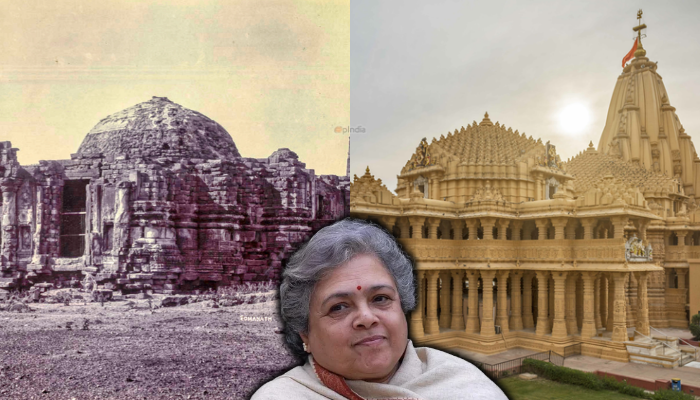
The Somnath Temple in Gujarat has been a symbol of devotion, resistance, and civilisational continuity. The holy abode of Someshwara Mahadev has been witness to around 18 Islamic jihadist attacks. While historical records document and folklore glorify how the temple priests and local devotees fought against Mahmud Ghazni’s Jihadis, Islamo-leftists today discredit their resistance using imaginary claims. In this vein, leftist propagandist Mrinal Pande recently claimed that the priests of Somnath Temple sat outside singing Bhajans when Islamic armies from Ghazni plundered the temple. 

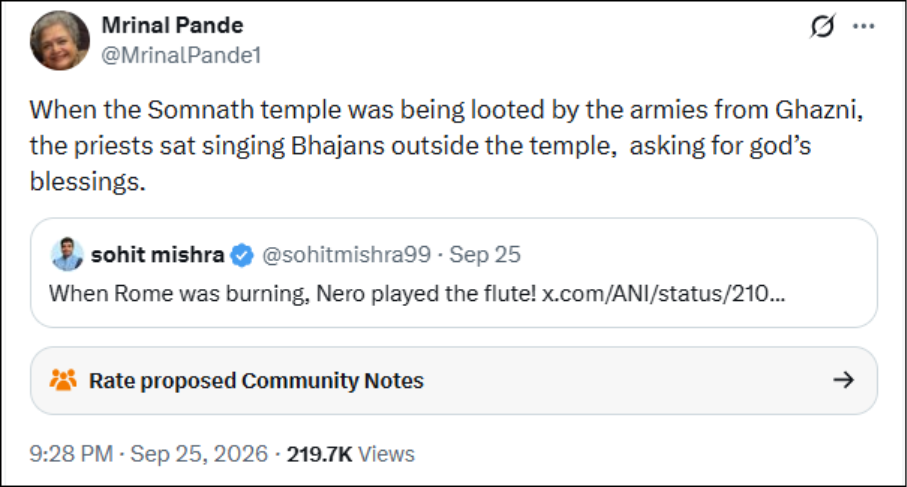
In an X post published on 25th September, Mrinal Pande wrote, “When the Somnath temple was being looted by the armies from Ghazni, the priests sat singing Bhajans outside the temple, asking for god’s blessings.” 

Source: X

Pande drew equivalence between the myth of Roman Emperor Nero playing a flute while Rome burned, and the Islamo-leftists-concocted lie that Somnath Temple priests were singing Bhajans instead of fighting back when Mahmud Ghazni campaigned against the Hindu temple. 

Before delving into the truth of whether Somnath Temple priests actually just sat outside and sang Bhajans or posed a strong fight against Jihadi invaders, let us revisit the history of Somnath Temple and its destruction. 

The Somnath Mandir is a majestic temple situated near Prabhas Patan of Veraval in Gujarat.  It is one of Lord Shiva’s twelve sacred Jyotirlingas and is mentioned in Chapter 13 of the Shiv Purana. Somnath is also described as Triveni Sangam, much like the one in Prayagraj, due to the meeting of the Kapila, Hiran, and Saraswati rivers.  

For Muslims, especially the Islamic invaders in the medieval era, destroying the temples and idols of the Kafirs was upheld as their “religious duty,” and despite changes in times, this Islamist desire has not subsided. Although numerous Hindu temples were desecrated and destroyed during the Islamic invasions, Somnath in Gujarat and Jagannath Temple in Puri, Odisha, faced the maximum attacks, with each being invaded 17 and 18 times. 

The first attack on the Somnath Temple came in 725 CE from an Arab named Junayd ibn Abd ar-Rahman al-Murri, also known as Al-Junayd during the Umayyad Caliphate. Junayd was appointed the governor of Sindh in 723. He invaded Gujarat and Rajasthan and ravaged, looted, and destroyed the Somnath Mandir in 725.  

It was only in 815 CE that Nagabhata II, a Gurjar Pratihar monarch, visited the ruins of the Somnath Temple and rebuilt the temple using red stones. 

The next major attack on the Somnath Temple was in 1025 by Mahmud of Ghazni, who went on to lead 17 invasions of Hindu temples. 

In 1025, he plundered the holy idol of Somnath during his sixteenth expedition to India. “Somnath” is Sanskrit for “moon master.” Mahmud of Ghazni is said to have sworn to wage an annual Jihad against the country of Kafirs. Ghazni overthrew Hindu king Jayapala, defeated his successors Anandpala (in 1008) and Trilochanpala (in 1013). 

In 1011, Mahmud of Ghazni attacked Thaneshwar and destroyed idols.  He burned the temples in Mathura during 1018–1019, and the idols were taken to Ghazni. His Jihadi fanaticism also devoured Mathura, Kannauj, and the many temples on the way. However, Ghazni’s Somnath invasion became an unforgettable chapter in Bharat’s history, reflecting both the obsession and abhorrence Muslims harbour for Hindus, and the resilience of the Hindu civilisation to rise every time and continue the fight until the ultimate victory, no matter how long it takes. 

Despite enduring heavy losses and fierce opposition, the Jihadi army of Mahmud of Ghazni demolished the sacred temple. 

Defenceless guardians of the Somnath Temple fought till the end of their lives 

Contrary to the ‘sat outside singing Bhajans’ claims Mrinal Pande and her ilk have been making for long, the guardians of the Somnath Temple, including the Brahmin priests and local devotees, fought bravely till the end. Thousands sacrificed their lives. Mahmud Ghazni fought a battle against not trained warriors but common Hindus comprising the temple guards, Brahmins, and locals defending the temple; the battle resulted in over 50,000 deaths. 

After the slaughter, Mahmud entered the temple’s sanctum sanctorum, dismantled the Shivalinga and stole all the riches, which totalled over 20,000,000 Dirhams.  

The cruel ruler of the Ghaznavid Empire earned the disgraceful moniker ‘Butshikan’ or idol breaker due to his Jihad against Hindu temples. 

In fact, the Brahmin priests of the Somnath Temple did everything in their capacity and what the short time span allowed to protect the temple and Jyotirlinga from destruction. 

After the protectors of the Somnath temple were defeated, it is stated in Tariki-e-Alfi, a historical work compiled by a committee formed by Akbar, that Brahmins offered Mahmud of Ghazni an unheard-of amount of wealth in exchange for leaving the ling of Somnath undamaged. Mahmud, in response, said that after he died, he would rather love to be known in the presence of Allah as Butshikan (the destroyer of idols) rather than ButParast (the devotee of idols). He rejected the Brahmins’ offer and demolished the Somnath idol. 

Source: Tariki-e-Alfi

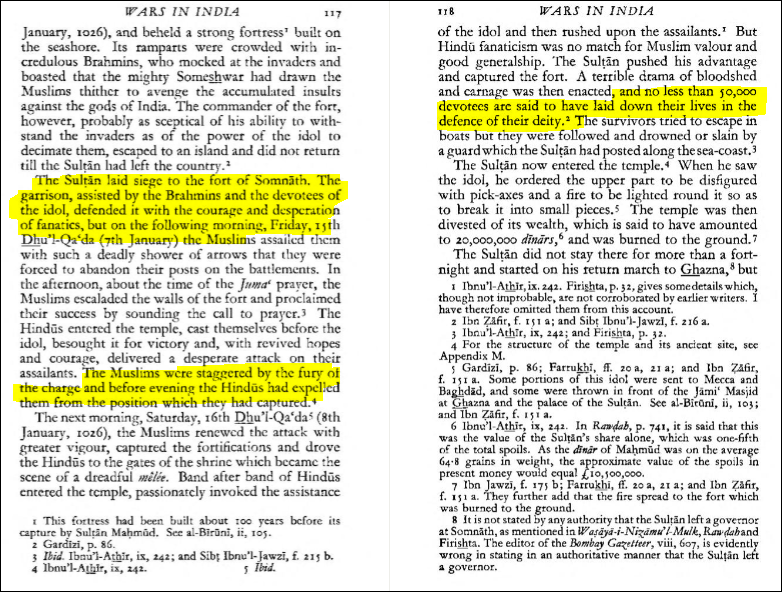
Moreover, Muhammad Nazim’s 1931 book The Life and Times of Sultan Mahmud of Ghazni, which elaborately documents Ghazni’s Somnath expeditions, mentions how Brahmin priests of the Somnath Temple and devotees not just prayed to Mahadev but also “defended it with the courage and desperation of fanatics…” 

Historian Nazim synthesised earlier Persian and Arabic sources, principally Gardizi’s Zayn al-Akhbar, Ibn al-Athir’s al-Kamil fi al-Tarikh, and Sibt Ibn al-Jawzi. 

“The Sultan Said siege to the fort of Somnath. The garrison, assisted by the Brahmins and the devotees of the idol, defended it with the courage and desperation of fanatics, but on the following morning, Friday, 15th Dhu’!-Qa‘da (7th January), the Muslims assailed them with such a deadly shower of arrows that they were forced to abandon their posts on the battlements. In the afternoon, about the time of the Juma‘ prayer, the Muslims scaled the walls of the fort and proclaimed their success by sounding the call to prayer.3 The Hindis entered the temple, cast themselves before the idol, besought it for victory and, with revived hopes and courage, delivered a desperate attack on their assailants. The Muslims were staggered by the fury of the charge, and before evening the Hindis had expelled them from the position which they had captured,” it reads.  

Source: The Life and Times of Sultan Mahmud of Ghazni

Neither the more contemporary accounts, be it by Al-Beruni nor by Gardizi, make any mention of Somnath Temple priests invoking their revered deity alone and leaving the Lingam and temple’s protection in Mahadev’s hands, while they just sat and sang hymns.  

One has to be as retarded as Mrinal Pande to even think of an implausible scenario that a Jihadist raiding army driven by Islamic zeal to subjugate top-tier Kafirs like Hindu would let priests sit comfortably and sing hymns as a sideshow instead of slaughtering them at the first instance.  

Yes, the temple priests and devotees prayed to their deity, but those prayers did not follow abject surrender; rather, what followed was unimaginable resistance, a fight till their brutal end, and a legacy that ensured that those non-martial Hindus are remembered for their valour even after the passage of centuries.  

The controversial shenanigans of Congress stooge Mrinal Pande  

‘Journalist’ Mrinal Pande is no stranger to controversies. In 2024, she mocked BJP leader Tajinder Bagga over his visit to a Mahakaal Temple. “Bow your head in the Golden Temple too, or are you only following Sanatan Dharma?” she wrote. 

While celebrating the release of controversial doctor Kafeel Khan’s release on bail from Mathura jail, Pande went on to compare him with Lord Krishna in 2021. Comparing his release from Mathura jail to Lord Krishna’s escape from the jail where he was born, Pande insinuated that he too will bring about the end of Uttar Pradesh Chief Minister Yogi Adityanath, just like Lord Krishna had eliminated Kans.   

In 2020, Mrinal Pande made transphobic comments when she responded to an X post of another controversial ‘krantikari’ journalist, Punya Prasoon Bajpayee. PP Bajpayee, who had been thrown out of the job, had made a lewd comment asking people why PM Modi claps frequently during his campaign speeches. In a hurry to mock Prime Minister Modi, the Congress journalist Mrinal Pande tweeted to ask whether PM Modi does that to garner votes of the “Kinnars” — the transgender community.   

Mrinal Pande has a penchant for peddling falsehoods about historical Hindu temples. In December 2021, she published a series of X posts, in which she claimed that in the Temple of Avimukteshwar, Shiva was the head of Old Kashi. Vishweshwara dates back to the 15th century. She added, “Padma Purana, Brahmavaivarta Purana, and Kashikhand have considered these two lingas as separate and Avimukteshwar as Swayambhu Adi Linga. It was destroyed along with the temple. Worshipping an ordinary Linga instead of Swayambhu Linga is not prescribed.” 

However, he blatant lies were rebutted by X users with facts highlighted from historical sources.  

More recently, in February 2026, Mrinal Pande joined an Islamo-leftist coterie in mocking an Indian national, Nikhil Gupta, who pleaded guilty after he was accused of being involved in the failed assassination plot of Khalistani terrorist Gurpatwant Singh Pannun. 

Pande invoked the Dhurandhar analogy to mock India’s intelligence agencies, and wrote, “Dhurandhar ban gya chukandar”. 

In another post, Pande insinuated that the intelligence agencies are inept; she wrote, “Dhurandhar destroyed the game of diplomacy…” 

Ujjain’s ‘street veto’: When court-backed removal of Shahi Mosque portion for road widening triggered stone pelting and violence by Muslim mob

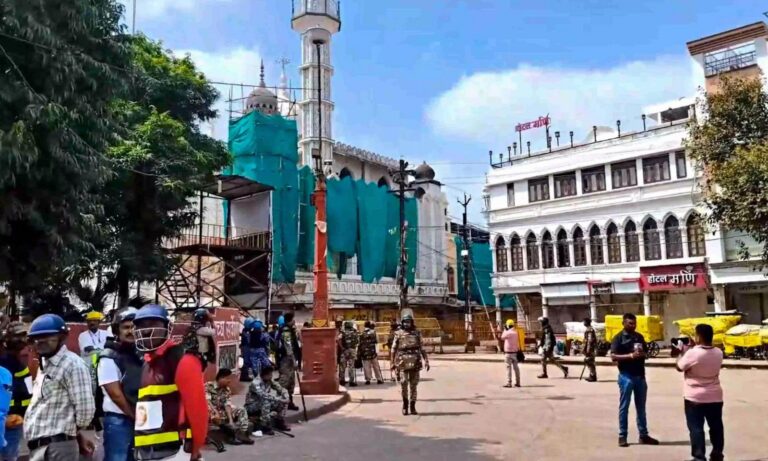
Tensions flared on Monday morning after a Muslim mob gathered to oppose the removal of a portion of the Shahi Masjid as part of a road-widening project in Ujjain being undertaken ahead of Simhastha 2028.

The situation escalated when protesters allegedly pelted stones at police and pushed against barricades, prompting the police to use tear gas and lathi-charge to disperse the crowd. A police personnel member was injured in the stone-pelting, while additional forces, including RAF personnel, were deployed to bring the situation under control.

The violence also brought parts of Ujjain to a standstill, with markets in several areas shut and some schools closing early as a precaution. Police divided the affected areas into four sectors and deployed a large force, while FIRs were registered and several people were detained or arrested. AIMIM Madhya Pradesh president Mohsin Ali Khan was also taken into custody while he was reportedly travelling to Ujjain in connection with the dispute.

There is a very simple question at the heart of the Ujjain controversy: Can a religious structure claim immunity from a development project merely because it is a religious structure?

If the answer is yes, then every road-widening project, highway, metro line and public infrastructure project in India will have to first negotiate the religious identity of every structure standing in its path. If the answer is no, then the same rule must apply equally to temples, mosques, churches and every other religious structure.

That is why what happened in Ujjain on September 27 is far more important than the partial removal of one mosque.

Ujjain is preparing for Simhastha 2028, which is expected to bring millions of pilgrims to the city. As part of the infrastructure plan, a 15-metre road is being developed along a stretch between Kanthal Chauraha and Gopal Mandir. Several structures fall within the proposed alignment.

One of them is a portion of the Shahi Masjid.

The matter did not remain outside the legal system. It went to court. The Madhya Pradesh High Court rejected petitions challenging the demolition notices and found no discriminatory treatment by the authorities. Most importantly, the court recorded that portions of 10 temples and another mosque had already been removed along the same road. It also noted action against numerous religious structures elsewhere in Ujjain.

So the claim that the administration suddenly decided to target a Muslim religious structure is difficult to sustain.

The road does not know whether the building standing in its alignment is a temple or a mosque.

Apparently, some protesters wanted the street to make that distinction.

When the administration moved to implement the decision, a confrontation broke out. Protesters allegedly pelted stones at police and pushed through barricades. Police responded with tear gas and a lathi-charge. A police officer was injured, additional forces were deployed and large parts of the surrounding area were placed under heightened security.

This is where the phrase “street veto” becomes relevant.

You can disagree with the government. You can oppose a demolition notice. You can suggest an alternative alignment. You can approach the courts. You can appeal. You can hold a peaceful protest.

But once a crowd attempts to physically prevent the State from implementing a decision that has already survived judicial scrutiny, it is no longer simply exercising a democratic right. It is attempting to replace the legal process with mob pressure.

And that is a dangerous precedent.

If a temple can make way for a road, so can a mosque

This principle really should not be controversial.

If a temple stands in the path of a legitimate road-widening project, the temple cannot automatically demand immunity because it is a temple.

If a mosque stands in the same alignment, the mosque cannot demand immunity because it is a mosque.

If religious structures are automatically exempt, then India’s historic cities can never modernise. Every road, railway, metro corridor and drainage project could be blocked by whichever religious structure happens to stand in the way.

That is not secularism. That is religious exceptionalism.

The law must therefore apply uniformly. Religious sentiment can be considered. Heritage can be considered. Alternative alignments can be considered. Compensation can be provided where applicable.

But religious identity cannot become an automatic veto against development.

And this is exactly why the Ujjain High Court order matters. The court did not merely rubber-stamp an action against a mosque. It examined the broader road-widening exercise and noted that Hindu and Muslim religious structures alike had already been affected.

That inconvenient fact destroys the simplistic narrative of “Muslims being targeted.”

The foreign-media framing is even more revealing

And then came the predictable international coverage.

Al Jazeera described hundreds of Muslims gathering to protest the partial demolition of a mosque and highlighted that the road widening was being undertaken ahead of the 2028 Hindu pilgrimage.

Notice what this framing does. Apparently, only demolitions of mosques in India get such wide coverage. Such developments taking place in Saudi Arabia or UAE, Australia, or even China hardly get the kind of coverage that Al Jazeera devotes to India. But more importantly, it is the manner in which Al Jazeera and similar foreign-based media outlets try to stoke unrest in India.

The story becomes:

Muslims + mosque + demolition + BJP government + Hindu pilgrimage.

What gets pushed into the background?

The road-widening project.

The wider master plan.

The other temples and mosque affected by the same project.

The High Court judgment.

And the stone-pelting and confrontation with police.

This is how narrative laundering works.

You do not necessarily have to publish an outright falsehood. You simply select the facts in such a way that the reader is nudged towards a predetermined conclusion.

Suddenly, a civic infrastructure project becomes a communal project.

A court-backed administrative decision becomes an attack on Muslims.

And a violent confrontation becomes merely a story about a minority community “protesting” against a mosque demolition.

Why is the fact that this is being done ahead of Simhastha repeatedly highlighted?

Because it allows a road-widening project to be presented as something being done for Hindus.

But the road will not disappear after Simhastha.

The widened road will remain.

The infrastructure will remain.

The traffic benefits will remain.

Ujjain residents, be it Hindu, Muslim, Jain, Sikh, Christian or otherwise, will use it.

A road does not check the religion of the person travelling on it.

Where was this outrage in Ayodhya?

The selective outrage becomes even more obvious when one remembers the road-widening projects in Ayodhya.

Around 30 temples were reportedly affected by the Ram Path widening project, along with hundreds of shops and other structures.

The existence of a temple did not automatically invalidate the road project.

And nor should the existence of a mosque automatically invalidate one in Ujjain.

That is the only consistent position.

If the rule is that religious structures can never be touched, then say so openly.

But if temples can be affected by development, then mosques can be affected too.

And if mosques can be affected, temples cannot subsequently demand a different standard.

Equal treatment means equal inconvenience as well as equal protection.

The Chief Minister’s own house makes the narrative even harder to sustain

There is another detail that conveniently disappears from much of the communal framing.

Madhya Pradesh Chief Minister Mohan Yadav himself initiated the demolition of part of his more than 50-year-old ancestral house because it fell within the road-widening alignment.

His own ancestral property is making way for the project.

Yet we are expected to believe that the same administration has suddenly designed the entire exercise around targeting Muslims?

That does not mean every administrative decision is automatically correct. It does mean that the lazy explanation that “the government is demolishing Muslim property because it is Muslim” deserves far more scrutiny than it receives.

The eventual cooperation is the correct model

Interestingly, after the confrontation, Ujjain City Qazi Khali Kurre Rahman appealed to people not to pay heed to rumours or unnecessarily gather at the site. The administration subsequently said members of the community were voluntarily cooperating in removing the affected portion.

That is how the matter should have been handled.

Disagree.

Argue.

Litigate.

Appeal.

Propose alternatives.

And if the final lawful decision goes against you, accept it.

That is how a constitutional democracy works.

Not by throwing stones until the government backs down.

Because once we accept the principle that a sufficiently large crowd can physically prevent implementation of a lawful decision, the same principle will inevitably be used by every other community.

Today it is a mosque.

Tomorrow it could be a temple.

Then a church.

Then a gurudwara.

Eventually, no road can be widened unless the government first obtains the permission of whoever happens to have the strongest crowd outside the structure.

That is not democracy.

That is mob arbitration.

Ujjain therefore presents India with a very simple test.

The State must not demolish a religious structure merely because it belongs to a particular religion.

But equally, a religious structure must not become untouchable merely because it belongs to a particular religion.

If a temple can make way for a road, so can a mosque. The mob cannot dictate what rules the administration can enforce.

The rule must be the same. The law must be the same. And the street must never be allowed to become a substitute for the courtroom.


How a ‘home tutor’ with a misleading Instagram bio is brainwashing school children with anti-Modi hate

A home tutor, identified as Pratibha, has been indoctrinating young kids (some below the age of 5 years) with political propaganda and anti-Modi hatred.

The matter came to light after videos of children spewing vitriol against India’s Prime Minister and sprouting political rhetoric of the Congress party went viral on social media.

It is evident from her Instagram page (username: @pratibha_edu-squad) that Pratibha is brainwashing the young, impressionable minds for social media traction and her own political opportunism.

Screengrab of the Instagram profile of Pratibha

Interestingly, her Instagram bio reads, “Indian Administrative Service (IAS)” and “The UPSC Odyssey”. However, OpIndia could find no publicly available information about Pratibha clearing the IAS exam and becoming an officer.

It is thus unclear whether she had amassed 44,900 followers by misleading her viewers as an ‘IAS officer’ while teaching in a makeshift classroom or by weaponising children for her political content.

But one thing is crystal clear. Pratibha did not post content using children as ‘political props’ until the unrest and chaos were unleashed in India’s National Capital by the Cockroach Janta Party (CJP).

Screengrab of the Instagram reel by Pratibha

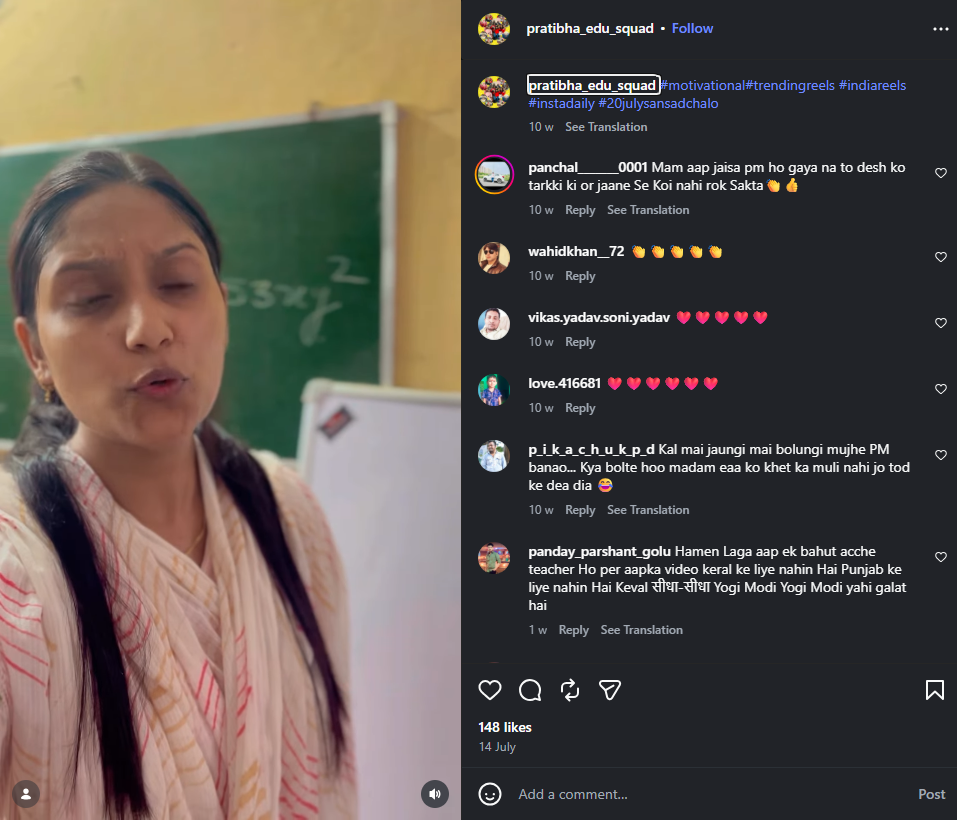
On 14th July, the ‘home tutor’ published her first politically charged video. She claimed, “Hunger strike is the last resort for anyone. Imagine the condition of a country where people need to take to the streets and fast to demand the resignation of a Minister.”

Pratibha had also tagged the Instagram handles of Abhijeet Dipke and the Cockroach Janta Party in that video. The video fetched around 148 likes.

Soon after, the make-believe ‘IAS officer’ realised that she could capitalise on the growing wave of public resentment and increase her Instagram following. As such, she deserted her motivational reels and shifted her focus to politics.

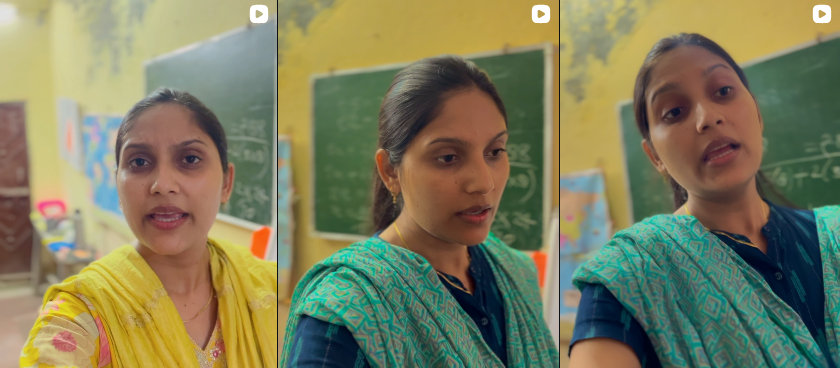
Screengrab of the 3 Instagram reels of Pratibha

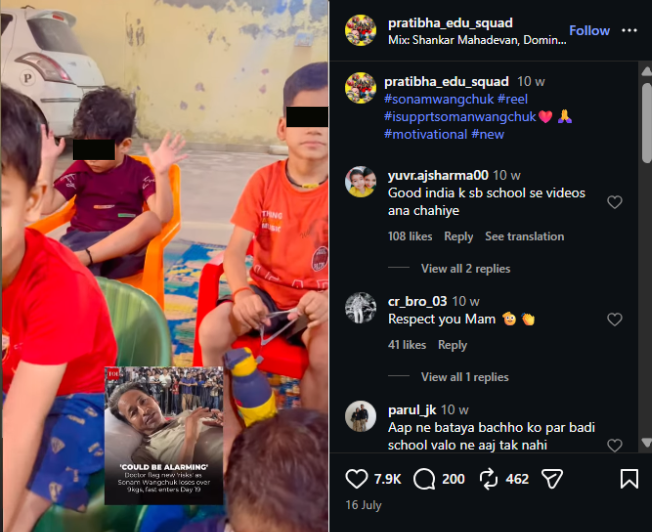
Pratibha had started receiving an average of 200-250 likes per reel on Instagram. Her fortunes changed on 16th July when she used children, who used to take tuitions in her classroom-cum-garage, to appeal to Sonam Wangchuk (who was on a hunger strike at that time)

That video amassed a whopping 7,900 likes for the first time. While Pratibha was elated by the traction, she was further encouraged by CJP supporters in the comment section to indoctrinate children with their political ideology.

Screengrab of the first political video featuring kids

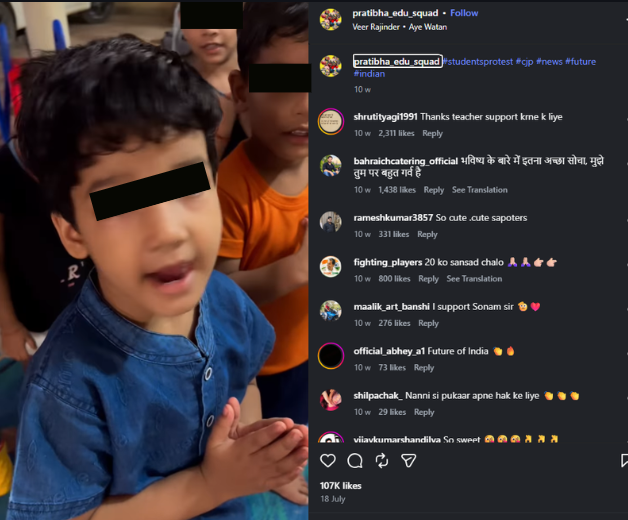
It has been more than 2 months since that day, and Pratibha has not stopped using underage children for her politically charged videos. Some of her videos have fetched upwards of 1 lakh likes. This begs the question – Are anti-Modi propagandists going to now normalise use to children in this fashion?

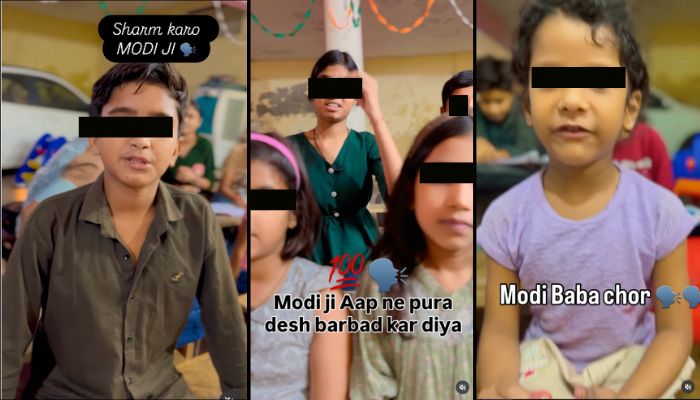
The caption of one video reads ‘Sharm karo Modi Ji’ while another says ‘Modi Baba Chor.’

Another video features kids saying that Narendra Modi has destroyed India completely. It is clear from the footage that the children are tutored by Pratibha to mock and berate the Indian Prime Minister.

While we often complain about the downfall of political discourse in India, Pratibha has hit a new low by using minors as political pawns and exploiting them to her advantage.

Screengrab of the anti-Modi videos featuring children

Almost every student who joined her class was used in malicious political propaganda videos. Kids who were a little more articulate than the rest were featured in multiple videos to make politically charged remarks.

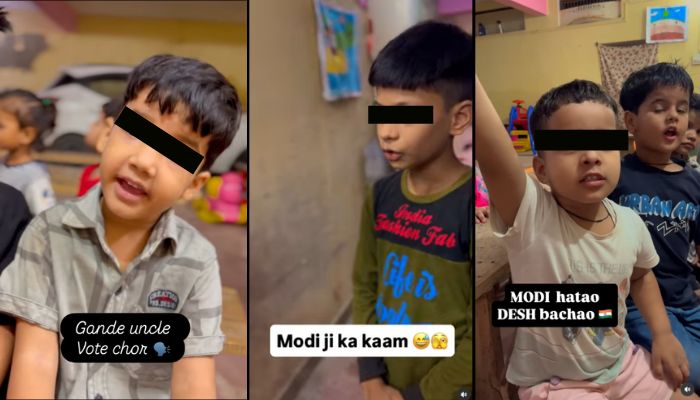
A child who is unable to speak coherently is forced to say ‘Gande Uncle Vote Chor.’ Another kid is heard saying, “Modi hatao Desh bachao.’ Two other students were forced to mock ‘Mann ki Baat’ radio programme of Prime Minister Narendra Modi.

Screengrab of the anti-Modi videos featuring children

It is unclear whether Pratibha is being paid by certain political parties for this vicious level of propaganda. But there is no iota of doubt that the political grooming of underage children, their indoctrination and strategic brainwashing is not just immoral but illegal.

OpIndia had previously reported how coaching centres had weaponised their students for political objectives, including incitement of violence during protests over the Agniveer scheme and paper leaks.

However, the antics of Pratibha take it to a whole new level. The students who were brainwashed by the coaching centres were adults. The ones she is indoctrinating with political vitriol are underage children, which makes it even more heinous

As such, it raises serious concerns about lapses in parental supervision as well as the child protection department. This unchecked use of children as pawns for ulterior motives by a tuition teacher is alarming and needs immediate legal action.

The National Commission for Protection of Child Rights should take immediate cognisance of the matter and protect the well-being of the children against this rabid form of political exploitation.

As for Pratibha, she should face the music of the law for pushing vulnerable kids to the path of destruction.

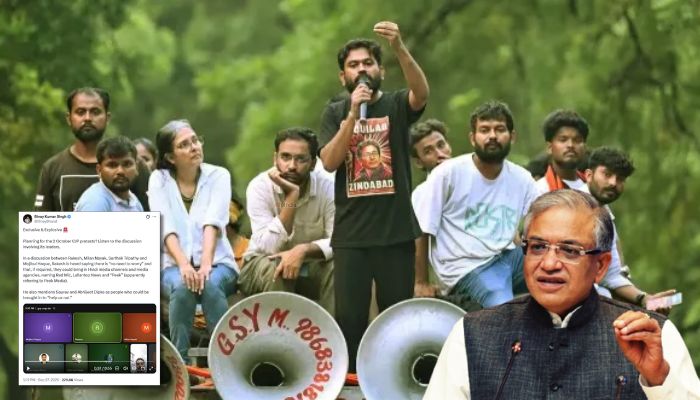
Leaked online discussion of CJP supporters reveals regime change plans, ‘cockroaches’ boast of having 500-2000 lawyers, News Pinch, Lallantop and leftist media allies: Details

Ahead of the Cockroach Janta Party (CJP) protest on 2nd October against Chief Election Commissioner Gyanesh Kumar over SIR, it has emerged that CJP supporters are mobilising nationwide support and allegedly planning to replicate Nepal and Bangladesh-like violent regime change if the Modi government acts against CJP protestors.

CJP supporters planning a Nepal-Bangladesh-like violent regime change: Leaked Google Meet discussion reveals

In the purported undated online discussion, CJP supporter participants Rakesh, Milan Nayak, Sarthak Tripathy and others levelled alarmist allegations against the Central government to the extent of claiming that the government is “killing” journalists. Most of the discussion is in Odia, Hindi and Bangla.

“The government is killing journalists, those who are trying to raise their voice against the government,” one participant, Milan Nayak, said.

One Rakesh boasted about 300 to 500 Supreme Court lawyers at their disposal to handle cases of CJP protestors, if the need arises.

Rakesh goes on to claim that if the government acts against CJP ‘cockroaches’, the government will “collapse within 30 days” after a Nepal, Sri Lanka and Bangladesh-like violent agitation.

“We have 300–500 lawyers who are working in the Supreme Court. If the Government of India touches anyone from CJP, I am giving it in writing that the government will collapse in 30 days, just like what happened in Nepal, Sri Lanka, and also in Bangladesh. So there is no need to worry or get scared, because if anything happens, then the entire CJP will come for our rescue,” he said.

Further, the CJP supporters discuss how those who allegedly ‘touched’ CJP supporters, be it the one who allegedly assaulted one Abdul’s father, or Swatantra Bhardwaj, who is accused of attacking Hinduphobic activist Nishu Azad’s father, are all “in jail now”.

The discussion further goes as:

  • “They touched Abdul’s father, right?” 
  • “They are in jail now.”
  • “The one who touched Nishu Azad’s father… he beat him up, right?”
  • “What happened? He is in jail.”
  • “He is very close to all the ministers.”
  • “He is like a brother and a son to the big BJP ministers.”
  • “What happened? He is in Tihar jail now…”
  • “So that is the power.”
  • “Exactly. That is our power.”

In another clip shared on X by Binay Kumar Singh, the Director of Dr Shyama Prasad Mukherjee Research Foundation on 27th September, two CJP supporters, Rakesh and Sushrut Das, can be heard saying, “A big thing that the BJP Govt has done is that they have removed names of Muslims from the voter list using SIR. Rakesh Singh says, Do not worry about it; in the upcoming Oct 2 protests, that topic will be covered & SIR will be completely boycotted and Stopped/banned.”

CJP Odisha activist asks about legal support, another ‘cockroach’ claims to have a team of 2000 lawyers nationwide, and Lallantop, Red Mike, Peek TV and other leftist media outlets

In another clip from the same discussion, shared by Binay Kumar Singh, CJP supporters Rakesh, Mojibul Haque and Milan Nayak discuss legal aid for supporters in Odisha.

As Mojibul and Milan Nayak asked about legal support for CJP Odisha volunteers, one Rakesh claimed that he is connected to the CJP’s legal team of “2000 lawyers” active across India. He added that it is not difficult for them to quash any FIR against any CJP worker, should the BJP governments at the Centre and in Odisha file cases against CJP workers. They even expressed readiness to pursue their cases to the Supreme Court. Thus, CJP cadres need not be scared of any cases against them; no matter what happens, they will be provided legal support.

The CJP supporters Rakesh, Milan Nayak, Sarthak Tripathy and others also discussed holding an online training session between CJP’s West Bengal and Odisha units on 27th September for the upcoming 2nd October protest.

“WB CJP unit’s Abdul who runs Social media Cell & Prakruti who is a Professor of a University will be training CJP odisha unit today. CJP WB has said if CJP Odisha karyakartas wants to join Protests in West Bengal, then travel expenses, food, Stay will be taken care by CJP WB unit & when Protests will take place in Odisha as well then CJP Odisha will take care of CJP WB karyakartas. This is basically a Synergy cooperation. Also Plan will be discussed for Big Protest in Odisha today in a meeting,” Binay Kumar Singh summarized the discussion in his X post.

In addition to lawyers, the CJP supporters also discussed having the backing of several Leftist media outlets and journalists, who will help weave the narrative in their favour if and when the protests escalate.

The CJP supporters named Lallantop, Red Mike, News Pinch, and Peek TV. They also discussed soliciting help from CJP top leadership, including Abhijeet Dipke, Saurav Das and Ashutosh Ranka.

CJP desperate to implement a violent Nepal-Bangladesh regime change template in India?

The threats of replicating a Nepal-, Sri Lanka-, or Bangladesh-like violent regime change in the purported online group discussion are not new. OpIndia reported in July this year, during the CJP protests, how several ‘cockroaches’ issued ‘Nepal Bana Denge’ threats and even resorted to violence.

NEET paper leak issue back then to the SIR-Gyanesh Kumar issue now, it appears that the CJP and its supporters are deliberately picking up issues that could turn the political winds in the favour of the Opposition, with regime change being the ultimate objective even if that requires resorting to violence. To ensure that the CJP protestors go unharmed and the narrative remains in their favour, CJP supporters, who label non-aligned media as ‘Godi Media’, boasted about having the backing of hundreds of lawyers and leftist media outlets and journalists.

Evangelism advocacy, Palmolein graft case, Congress bonhomie and more: Who is ex-Kerala chief secretary Jiji Thomson attacking CEC Gyanesh Kumar

As the political Opposition and its media allies are sharpening attacks on the Chief Election Commissioner of India (CEC) Gyanesh Kumar over SIR, based on half-truths and conspiracy theories, former Kerala Chief Secretary Jiji Thomson has also jumped on the bandwagon.  On 26th September, still Kerala’s Chief Secretary, Jiji Thomson claimed that in 2016, then IAS officer Gyanesh Kumar asked him to contest the 2019 Lok Sabha election as a BJP candidate from Pathanamthitta, very persuasively.

During an interaction with a local media outlet, Jiji Thomson claimed that he met Gyanesh Kumar on a flight to Delhi in 2016. Thomson said that Kumar heaped praise on Prime Minister Narendra Modi and asked him if he was interested in contesting the election on a BJP ticket from Pathanamthitta in the 2019 general elections.

Jiji Thomson claimed that Gyanesh Kumar was quite persuasive and that he said that if Thomson wins the election, he could become an MP and also a Cabinet Minister. Thomson claimed that he promptly declined the alleged offer.

“I was serving as the Kerala Chief Secretary then. We were together on a flight. He was waxing eloquent about Prime Minister Modi and openly asked me if I was interested in contesting as a BJP candidate from Pathanamthitta in the 2019 general elections. He was very persuasive; I declined it promptly,” Manorama quoted Thomson as saying.

The timing of Jiji Thomson’s allegation against Gyanesh Kumar indicates an apparent bid to provide the Opposition parties with more ammo to cast aspersions on Gyanesh Kumar’s integrity as a public servant and portray him as an unofficial member of the BJP.

The objective appears to be lending ‘insider’ credence to the Opposition’s allegations that CEC Gyanesh Kumar has been using his Constitutional authority to ‘deliver’ election victories to the Bharatiya Janata Party by ‘manipulating’ electoral rolls through SIR.

Congress uses claims by Jiji Thomson to declare CEC Gyanesh Kumar a ‘BJP agent’

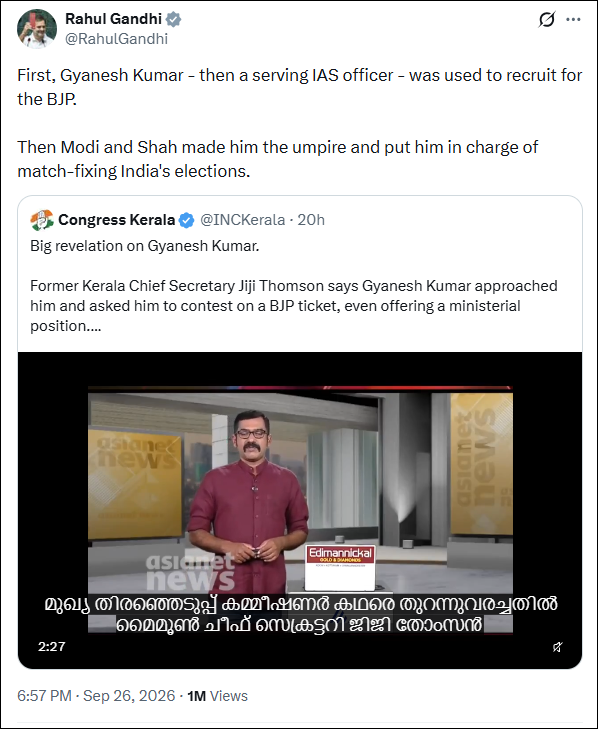
Unsurprisingly, Congress leader Rahul Gandhi quickly used Thomson’s claims to attack CEC Gyanesh Kumar. Gandhi claimed that Gyanesh Kumar was first used to recruit for the BJP and later the BJP made him “the umpire” for “match-fixing” elections.

In an X post published on 26th September, Gandhi wrote, “First, Gyanesh Kumar – then a serving IAS officer – was used to recruit for the BJP. Then Modi and Shah made him the umpire and put him in charge of match-fixing India’s elections.”

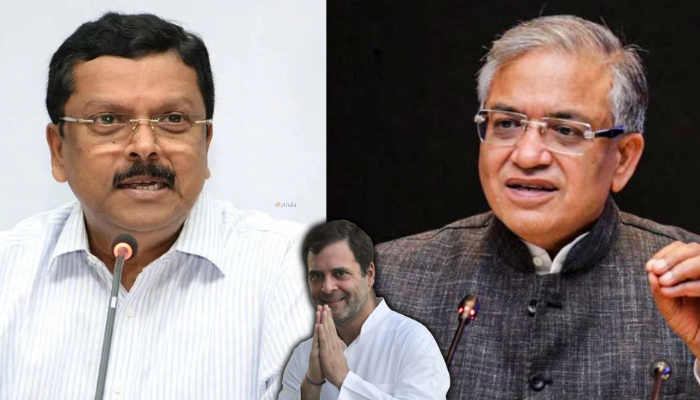
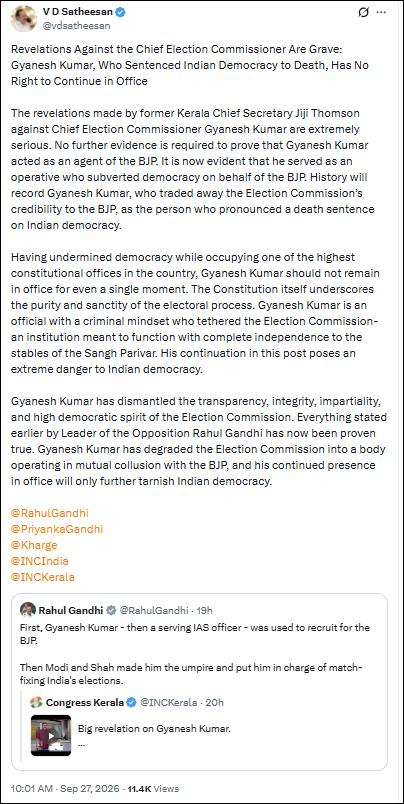
Congress leader and Keralam Chief Minister V D Satheesan outrightly declared Gyanesh Kumar a “BJP agent” and pressed the demand for his resignation as the CEC.

“The revelations made by former Kerala Chief Secretary Jiji Thomson against Chief Election Commissioner Gyanesh Kumar are extremely serious. No further evidence is required to prove that Gyanesh Kumar acted as an agent of the BJP. It is now evident that he served as an operative who subverted democracy on behalf of the BJP. History will record Gyanesh Kumar, who traded away the Election Commission’s credibility to the BJP, as the person who pronounced a death sentence on Indian democracy… Having undermined democracy while occupying one of the highest constitutional offices in the country, Gyanesh Kumar should not remain in office for even a single moment,” he wrote.

Similarly, TMC MP Mahua Moitra launched an unhinged attack against Gyanesh Kumar. “Former Kerala Chief Secretary Jiji Thomson says Gyanesh Kumar approached him in 2016 to contest as MLA on BJP ticket with ministerial post on offer. Chor Dalal Gyanesh been BJP’s agent for a while clearly,” she wrote.

While Jiji Thomson’s sensational claim has gained expected political traction, an obvious question remains unanswered: Why didn’t Jiji Thomson make this revelation at that time, or when Gyanesh Kumar took over as CEC? Did he perfectly time the supposed revelation for maximum political mileage?

As Jiji Thomson is in the spotlight and emerged as the new ‘hero’ of the anti-BJP cabal, it is important to know about him beyond the known credentials of a civil servant.

Who is Jiji Thomson, the man of many controversies

Jiji Thomson is a 1980-batch Kerala cadre IAS officer, holding degrees in Economics. Thomson served as Keralam Chief Secretary from January 2015 to 29 February 2016 under the Congress-led UDF government. Before this posting, Thomson served as the Managing Director of the Kerala Civil Supplies Corporation. Post-retirement, Jiji Thomson serves as the Managing Director of Bharat Bhaavika Foundation. Thomson belongs to the Malankara Orthodox Church.

Throughout his career, Jiji Thomson has seen many highs and lows, and courted several controversies. The first major controversy Thomson was embroiled in goes back to the 1991 Palmolein imports graft case.

Palmolein imports graft case

Jiji Thomson served as MD of the Civil Supplies Corporation during the K. Karunakaran UDF government, when he was named as an accused in alleged irregularities in 15000 tons of palmolein imports from Malaysia via a Singapore-based company at an inflated price that caused around Rs 2.32 crores.

Thomson contended that it was a cabinet decision he merely implemented. The scam occurred when Chief Minister Oommen Chandy was the Finance Minister in the government headed by late K Karunakaran.

The matter remains pending before the Supreme Court, and Jiji Thomson’s half pension was withheld pending resolution.

In May 2016, the Supreme Court rejected the petitions filed by Jiji Thomson, PJ Thomas and TH Mustafa, who sought dismissal of the Palmolein imports graft case. Before this, Jiji Thomson’s plea seeking to stop all further proceedings in the case against him until the Supreme Court disposes of the Special Leave Petition (SLP) was rejected by the Kerala High Court. His other similar pleas faced rejection from both lower and higher courts.

‘Spread the Gospel’: Jiji Thomson advocated propagation of Christianity through evangelism while holding Constitutional office

Back in 2015, then Kerala Chief Secretary Jiji Thomson, while serving as Chief Secretary, delivered a speech at the bicentenary of the Orthodox Theological Seminary in Kottayam. Thomson said that spreading the Gospel is the Church’s core mission. He said that bringing non-Christians to Christ is a “Biblical imperative”, while listing personal, church, and mass evangelism.

“Bringing others to God is a Biblical imperative. The biggest mission of the Christian church now is spreading the gospel,” he said. “Gospel means Go and Spel. They are personal evangelism, church evangelism and mass evangelism. Everyone can do personal evangelism. For that there is no need for clergy…” Thomson said, in the presence of then governor and Supreme Court Justice (retired) P Sathasivam.

Back then, Thomson’s speech had received flak from the Hindu community, who accused the Chief Secretary of making “anti-Constitutional” remarks, and demanded his expulsion from government service.

When row erupted over cabinet rank for Jiji Thomson

In February 2016, the Congress-led UDF government appointed Chief Secretary Jiji Thomson as advisor to Chief Minister Oommen Chandy, ahead of his retirement.

In fact, the Congress government had unsuccessfully tried to secure a three-month extension for Thomson.

Thomson was given a cabinet rank while former Home Secretary L Radhakrishnan, who was the incumbent advisor to the CM, was not given cabinet rank.

Back then, the Opposition had strongly objected to the Congress government’s manoeuvres to grant a plum position to Jiji Thomson right before his retirement.

Jiji Thomson faced scrutiny for Rs 1 crore renovation of official residence

In August 2016, the Vigilance and Anti-Corruption Bureau initiated an investigation against former Chief Secretary Jiji Thomson over expenditure of Rs 1.35 crore on renovation of the official residence even as the government sanctioned constructing another facility for him. The complaint was filed by the All-Kerala Government Contractors’ Association. Based on this complaint, the vigilance team inspected the residence.

The honeytrap controversy

Back in 2017, a leaked audio of conversations with sexual undertones, involving former Tehelka editor Mathew Samuel and an associate, triggered claims that Jiji Thomson was honey-trapped and paid Rs 5 crore to suppress it. These conversations were reported to be a part of a sting operation that was conducted by the news portal back in 2015 on Thomson.

Hindu rights group Hanuman Sena had filed a complaint against Jiji Thomson, alleging that the IAS officer was honey-trapped and had to pay up Rs 5 crore after being blackmailed.

BJP hits back

Amid escalating political tensions over Thomson’s claims casting aspersions on Gyanesh Kumar’s credibility, the BJP has highlighted Thomson and Congress’s old bonhomie.

“Hello @RahulGandhi The man you are waving as proof is Jiji Thomson, MD of Kerala Civil Supplies during the Karunakaran UDF palmolein import, named an accused with Karunakaran himself. CPM called it UDF corruption. Your own UDF later tried to bury the case. Then Chandy made him Chief Secretary. A 2016 flight chat you cannot prove. A case file you already tried to withdraw. That is not a whistleblower. That is your old file wearing a new mic.

In a Facebook post, Kerala BJP leader Jiji Joseph alleged that Jiji Thomson wanted to join the BJP earlier and even attended a BJP Minority Morcha event in June 2017. Thomson not only attended the event but also showered praise on Prime Minister Narendra Modi.

Joseph also shared several images from the said event.

He added that Jiji Thomson was eyeing bigger posts. Joseph said that Thomson’s allegations against CEC Gyanesh Kumar and the BJP perfectly exemplify the saying ‘grapes are sour’.

“Jiji Thomson has made his ‘revelations,’ so now I shall share mine. Usually, details of secret discussions and meetings held by politicians are kept confidential. However, since the former Chief Secretary acted improperly, I am setting that convention aside for the moment. His claim is that Gyanesh Kumar invited him to become a BJP candidate and promised him a ministerial post if he won. On June 26, 2017, the Minority Morcha organised a function in Kochi to honour Mar Chrysostom Thirumeni; I was the State President of the Minority Morcha at the time. A senior leader—deeply respected by Sangh Parivar activists in Kerala—called me and instructed me to invite Jiji Thomson to the event, mentioning that Thomson had expressed an interest in joining us. Accordingly, I extended the invitation,” he wrote.

“He attended the event and spoke glowingly of Shri Narendra Modi and the actions of the Central Government. Following his participation in the BJP meeting, he was appointed as an Independent Director of the Cochin Shipyard—a Central Government undertaking—serving from 2017 to 2020. I suspect he had his heart set on an even more significant position. In any case, my regards to the former Chief Secretary, who has once again demonstrated the truth of the saying, “The grapes one cannot reach are sour,” he added.