Home Blog Page 22

77 delegations walk out of Netanyahu’s UN speech, India stayed: Why Modi govt refused to follow the herd and triggered leftist meltdown

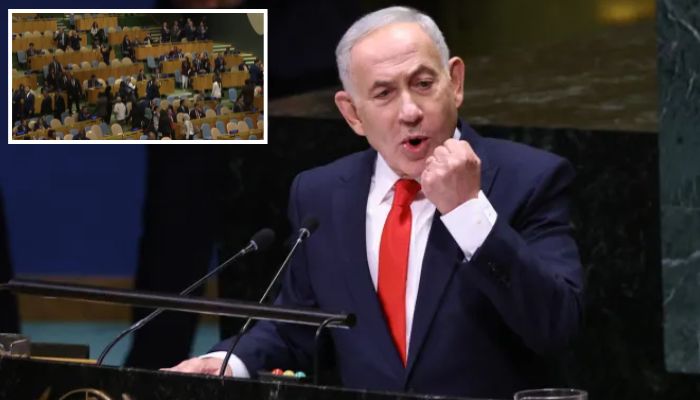
Israeli Prime Minister Benjamin Netanyahu’s address at the 81st session of the United Nations General Assembly in New York on Thursday, 24th September, was met with a major walkout by diplomats from several countries. Reports put the number of delegations that walked out at around 77, although a complete official list of all the countries that left the chamber has not been released. The walkout was encouraged by the Palestinian Mission to the UN, which had urged delegations to collectively leave the hall when Netanyahu took the podium. India, however, did not join the boycott and remained present during the Israeli Prime Minister’s address.

The episode soon triggered criticism from Islamo-leftist and pro-Palestinian commentators on social media, who questioned why New Delhi did not join the walkout. Even as it underscored New Delhi’s commitment to pragmatic foreign policy and long-standing strategic partnerships.

What Netanyahu said at the UN and which countries walked out

Netanyahu began his speech as diplomats were leaving the chamber. The Israeli Prime Minister responded directly to the walkout and described those leaving as “moral cowards”. He also challenged those who remained in the hall to leave if they opposed Israel. “If there are any other moral cowards who haven’t yet left this hall, please do so now,” Netanyahu said.

He used much of the address to defend Israel’s military actions in Gaza and against Iran while rejecting allegations that Israel was committing genocide in Gaza. Netanyahu described the genocide accusation as “the biggest lie of the century” and argued that Israel was acting in self-defence. He also said that Israel’s military action against Iran was necessary to prevent a nuclear threat and said the decision to strike Iran had been “one of the easiest decisions” he had made.

Netanyahu also revealed that some countries whose representatives had walked out had privately thanked Israel for its military actions against Iran. “Many of their leaders even thanked us privately for taking out Iran’s nukes,” he said, accusing them of hypocrisy.

The scene inside the UN chamber was striking. Footage showed diplomats streaming out as Netanyahu prepared to speak, while members of the Israeli delegation and some supporters applauded him. A large number of seats remained empty as he continued his address.

A complete confirmed list of all 77 countries has not been publicly established. Reports and photographs from the chamber showed empty seats belonging to several countries, including Saudi Arabia, Iran, Sudan, Tunisia, Uzbekistan, Sri Lanka, Bangladesh, Algeria, Malaysia, Montenegro and Kyrgyzstan. Jordan, Libya, Mauritius and the Marshall Islands were also reported to have empty seats, although in some cases a country may have had individual representatives remaining in the chamber.

Other reports said representatives of several Arab, Muslim-majority and other countries, including Colombia, South Africa and Indonesia, were among those who left. 

India’s decision to remain in the chamber stands out in this context. New Delhi did not participate in the coordinated walkout, even as dozens of delegations left Netanyahu’s address. The decision does not mean that India has abandoned its support for Palestinian statehood or a peaceful settlement. Rather, it is consistent with India’s long-standing effort to maintain relations with both Israel and Palestine while keeping its foreign policy focused on its own strategic interests.

Decades of friendship: India and Israel’s deep strategic partnership

These leftist ecosystems just know how to criticise every second decision of the country without considering the facts. They overlook the deep-rooted, decades-long friendship between New Delhi and Tel Aviv, which has consistently delivered tangible security benefits. 

India and Israel have developed a strong partnership over the last three decades. Although India recognised Israel in 1950, full diplomatic relations were established in 1992. Since then, ties between the two countries have expanded significantly in areas such as defence, technology, agriculture, cybersecurity and trade.

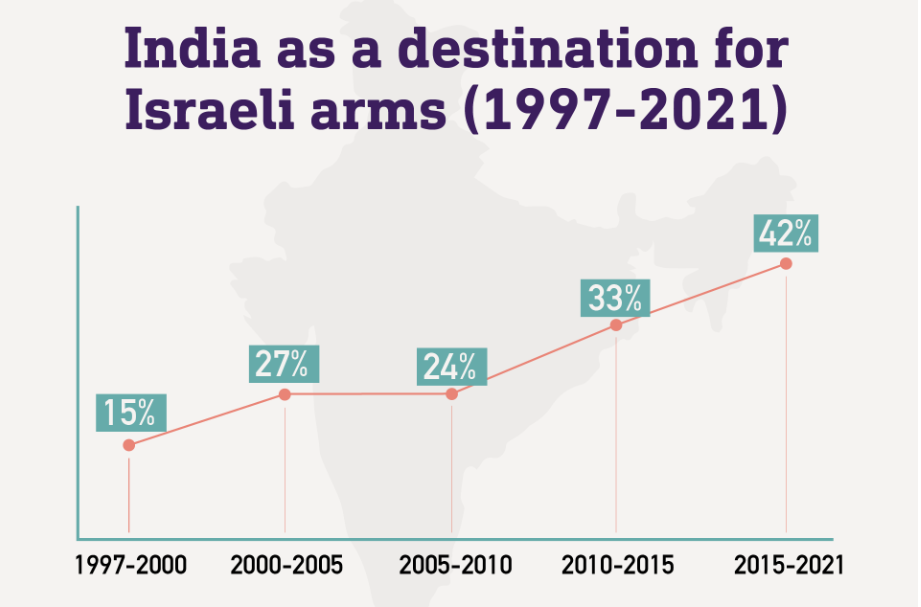
During the current government’s tenure, India has become Israel’s largest weapons buyer, with bilateral trade expanding dramatically from USD 200 million in 1992 to more than USD 6 billion by 2024. This economic and defensive bond is backed by a Bilateral Investment Treaty signed in September 2025, which has given a further fillip to trade in sectors like petroleum, chemicals, engineering goods, and polished diamonds.
Security experts emphasise that Israel has consistently proven to be a vital defence partner during times of acute national crisis when other global powers were reluctant to provide immediate assistance. 

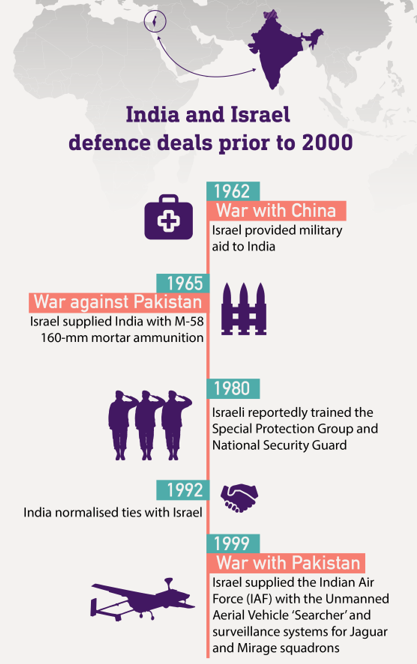
India’s defence deals with Israel date back to 1962, when Israel provided military aid to India in its war against China. In 1999, during India’s war with Pakistan, Israel supplied the IAF with the Unmanned Aerial Vehicle ‘Searcher’ and surveillance systems for Jaguar and Mirage squadrons. The defence ties with Israel have increased since 2014, with around 42.1% of all arms exports from Israel landing in India, with Azerbaijan, Vietnam, and the US making up the other major customers.  
The relationship has also increasingly involved cooperation between Indian and Israeli defence companies. This means the partnership is no longer limited to buying finished weapons. Joint development, local manufacturing and technology cooperation have become important parts of India’s defence strategy.

India’s partnership with Israel is not limited to defence. Exports are, however, concentrated across a few key sectors, like gems and jewellery, especially cut and polished diamonds, which are sent to Israel’s large diamond trading hubs. Apart from this, petroleum products, organic chemicals, plastics, and engineering goods also form a major portion of the exports. In very recent years, there has been a sharp drop in Indian exports to Israel – PM Modi’s visit can supposedly perk up the exports again, courtesy of strategic deals and tie-ups across areas.  

India-Israel partnership and Operation Sindoor

The practical value of the defence relationship was again visible during Operation Sindoor in May 2025. The practical value of this defence partnership was put on full display during Operation Sindoor in May 2025. The conflict escalated sharply following a deadly attack by Pakistani terrorists on 22nd April, 2025 in the Baisaran Valley of Pahalgam, where 26 Hindu tourists were killed by cross-border militants. In response to this provocation, the Indian Armed Forces launched a fierce, targeted counter-attack codenamed Operation Sindoor. 

The 23-minute operation, which commenced at 1:05 AM on 7th May, relied heavily on sophisticated Israeli-manufactured technology alongside indigenous and Russian systems to strike enemy positions and secure Indian airspace against incoming retaliatory threats. Israeli military hardware played a decisive role in ensuring the operation’s success:

  • Harop Loitering Munitions: The Indian Armed Forces deployed Israeli-made Harop kamikaze drones specifically designed to destroy air defence systems and radar units. Capable of staying over target areas for up to nine hours and equipped with a 50-pound warhead, these drones operated with high autonomy. During the operation, they successfully struck and eliminated a crucial Pakistani air defence facility in Lahore.
  • Heron Mk2 UAVs: For surveillance and reconnaissance, the air force used Heron Mk2 drones, which can cruise at altitudes up to 35,000 feet and stay airborne for over 40 hours. Operating from forward bases, these long-endurance drones provided real-time intelligence, target acquisition, and battle damage assessments across the rugged northern terrain, remaining safely out of reach of conventional ground-based anti-aircraft weaponry.
  • SkyStriker Drones: Manufactured through a partnership between Israel’s Elbit Security Systems and India’s Alpha Design Technologies in Bengaluru, these quiet, electrically propelled loitering munitions were used for covert low-altitude strikes. Carrying 5 to 10-kilogram bombs, they successfully engaged specific tactical targets even in environments where GPS signals were disrupted.
  • Barak 8 Missile Defence System: Developed jointly by India’s DRDO and Israel Aerospace Industries (IAI), the Barak 8 long-range surface-to-air missile system proved critical in protecting the domestic front. When Pakistan attempted a retaliatory strike by firing a Fatah-II ballistic missile aimed toward Delhi, the Barak-8 system successfully intercepted and destroyed the incoming missile over Sirsa, Haryana.
  • Spice-2000 Precision Bomb Kits: Indian warplanes used Israeli-designed Spice-2000 guidance kits to convert standard general-purpose bombs into smart, “fire-and-forget” precision stand-off weapons. Using advanced scene-matching algorithms, these bombs accurately penetrated the roofs of targeted terror camps while minimising collateral damage to surrounding civilian areas.
  • Tavor X95 Assault Rifles: On the ground, elite special forces units, including MARCOS and Garud commandos, were equipped with compact, bullpup-shaped Tavor X95 rifles manufactured under license in India. These rifles provided high reliability and manoeuvrability during close-quarters security operations.

The clean sweeps achieved during Operation Sindoor, which resulted in the elimination of nearly 100 terrorists, including close relatives and top commanders of JeM chief Masood Azhar and LeT strategist Abu Jundal, demonstrated how deeply embedded Israeli defence tech is within India’s operational readiness.

Social media outrage by the Islamo-leftist ecosystem

Following the speech, several prominent voices from the domestic left-liberal and opposition ecosystem flooded social media with harsh criticisms of India’s neutral and pragmatic stance. Congress Karnataka general secretary Lavanya Ballal criticised India’s position on X, writing, “77 countries walked out while Netanyahu started to speak in the UN. India was not among the 77 countries.” Her post was widely circulated as the walkout became a major talking point online.

Another online user expressed deep frustration, writing, “I feel grotesquely disgusted and disappointed that my country, India, didn’t walk out when War Criminal Benjamin Netanyahu started his address to the UN General Assembly.” The same post went on to criticise India’s broader foreign engagements, including the recently concluded BRICS Summit in New Delhi, claiming a disconnect between international declarations and bilateral ties.

Journalist Ranjona Banerji also weighed in by sharing a map of the countries that boycotted the speech, adding, “Sigh. India would have been on that list once. Before…” Banerji is a part of the left ecosystem. A simple scroll through her timeline shows how well she spreads anti-Hindu propaganda

Another social-media user, Pragnya Gupta, expressed strong criticism of Netanyahu while referring to his appearance before the UN. In a long post, she described him using terms including “Genocidal Maniac” and referred to him as a “Dear Friend of India’s PM, Narendra Modi”.

Another user, Prashant Pundir, responding to a post about the countries that walked out, wrote, “India is in a very grey area.”

Hamas and Pakistani terror groups in PoK

While the Islamo-leftist ecosystem demands total estrangement from Israel, geopolitical realities present a starkly different picture, particularly regarding transnational terror networks. In February last year, Hamas, the terror outfit governing the Gaza Strip, publicly aligned itself with Pakistan-based terrorist organisations Jaish-e-Mohammed (JeM) and Lashkar-e-Taiba (LeT) during a conference in Rawalakot, PoK.

Speakers at the event, including JeM leadership and Dr Khalid Al-Qadoumi, the Hamas representative in Iran, openly called for renewed violence against India. This alarming development highlights how terrorist outfits responsible for attacks like the 2008 Mumbai carnage and the 2019 Pulwama bombing are forging direct operational ties with Middle Eastern terrorists groups. Given that Hamas launched the devastating 7th October, 2023, terror attacks against Israeli civilians, its expanding footprint near India’s borders makes robust intelligence and counter-terrorism cooperation with trusted allies like Israel more critical than ever.

India’s balanced approach: Supporting peace and humanitarian aid for Palestine

At the same time, India’s decision not to walk out of Netanyahu’s UN speech should not be interpreted as a rejection of the Palestinian cause. India has consistently maintained a balanced foreign policy that refuses to abandon Palestine. New Delhi officially supports a two-state solution, advocating for the establishment of a sovereign, independent, and viable Palestinian state living side-by-side in peace with Israel, alongside supporting Palestine’s membership at the UN.

India has also supported Palestine’s membership of the United Nations and has repeatedly called for a ceasefire, the release of hostages and the peaceful resolution of the conflict through dialogue and diplomacy. New Delhi has also expressed concern over civilian casualties and stressed the need for safe and sustained humanitarian assistance to Palestinians.

India has backed these diplomatic statements with humanitarian assistance. According to data presented by the Ministry of External Affairs in the Lok Sabha in August last year, India provided around 70 tonnes of humanitarian assistance to Palestine during the initial phase of the Gaza crisis, including 16.5 tonnes of medicines and medical supplies sent in October and November 2023. India subsequently sent nearly 65 tonnes of life-saving medicines to the UN Relief and Works Agency for Palestine Refugees in the Near East (UNRWA) and the Palestinian Ministry of Health in October and November 2024.

India has also contributed financially to UNRWA. MEA data shows that India’s contribution to UNRWA from 2002 to 2024 totalled about $39.53 million, including annual contributions in recent years. India has also supported developmental assistance and capacity-building programmes in Palestine through scholarships and technical cooperation.

This is important because India’s policy is not simply “Israel vs Palestine”. New Delhi has condemned the 7th October 2023, Hamas attack on Israel while simultaneously supporting Palestinian statehood and humanitarian assistance for Palestinians. The Indian position has therefore involved maintaining diplomatic engagement with Israel while continuing to support Palestine’s political and humanitarian interests.

Conclusion: National interest above personal sentiments

Ultimately, international diplomacy cannot and must not be dictated by emotional sentiments, ideological alignments, or the transient outrage of this leftist ecosystem. A nation’s primary obligation is to protect its citizens, safeguard its territorial integrity, and secure its strategic and economic future. While India maintains a principled, humanitarian commitment to the Palestinian people through aid and diplomatic advocacy, getting swept up in distant ideological boycotts offers no tangible security returns. By refusing to follow the herd at the United Nations, New Delhi once again proved that India’s foreign policy is anchored firmly in national interest, realism, and unwavering pragmatism.
Delhi High Court sends Muslim husband to jail for impregnating 16-year-old wife, says secular POCSO is above communal personal laws

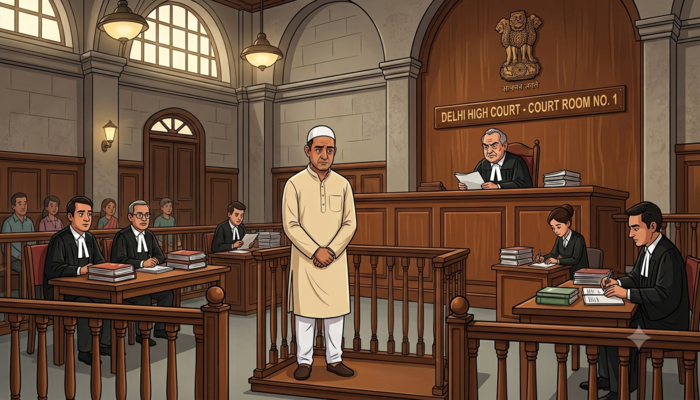
The Delhi High Court recently held that Muslim personal law cannot protect a Muslim husband from prosecution for rape under the POCSO Act if he has sexual intercourse with his wife who is under 18 years of age. The decision came in a petition seeking quashing of an FIR filed against a Muslim man for having sexual intercourse with his minor wife. A Bench of Justice Sanjiv Narula said that the husband cannot claim immunity from criminal provisions by taking refuge under Muslim personal law.

Before moving on to the High Court’s observations on the point of law, let’s take a look at the brief facts of the case.

Brief background of the case

The case concerns a Muslim couple who married on December 20, 2024. At the time of the marriage, the wife was 16 years and 3 months old, and the husband was about 28 years of age. In May 2026, when the wife was about 8 months pregnant, she visited a government hospital. The hospital authorities noticed that she was a minor and informed the police.

The police verified the minor wife’s age from her school certificate and proceeded to register an FIR against her husband under Section 64(1) of the Bharatiya Nyaya Sanhita (BNS) and Section 6 of the Prevention of Children from Sexual Offences Act (POCSO). The wife said that the marriage was performed with her consent and was also consummated with her consent.

In her statement before the Special Judge, she maintained that she was under no compulsion to marry her husband or have sexual intercourse with him. The wife subsequently gave birth to a stillborn child on June 6, 2026. The child was buried but later exhumed with the permission of the Sub-Divisional Magistrate for DNA profiling and collection of evidence.

The present petition sought the quashing of the FIR filed against the husband, and action against police officers, concerning allegations of false implication and harassment. The petition has relied on Muslim personal law to claim immunity for the husband from penal action for having sexual intercourse with his minor wife.

What the Muslim husband told the High Court

Citing Muslim personal law, the Muslim husband argued that his wife had attained puberty before their Nikah, as required under the personal law. As per Muslim personal law, puberty is presumed if the wife has completed 15 years of age at the time of Nikah. The petitioner argued that it was a valid marriage under Muslim personal law and therefore, subsequent cohabitation or sexual intercourse is also valid and cannot attract criminal liability.

Legal question before the High Court

The task before the High Court was to decide on the point of convergence of Muslim personal law and the criminal law meant to protect minors against sexual abuse. The High Court divided the legal issues in the case into two parts: first, the legal character and consequences of a Nikah performed with a Muslim minor girl who has attained puberty; and second, whether a Nikah excludes sexual intercourse with a minor wife from the ambit of the BNS and the POCSO Act. The court refused to decide the question relating to the validity of the Nikah and limited the scope of its examination to the second issue.

The question, precisely, before the High Court was “whether consent and the asserted validity of the marriage can displace that protective framework where the law itself fixes eighteen as the age below which consent to sexual activity has no legal efficacy”. In other words, the High Court examined whether a Nikah, even if valid, can grant a Muslim husband, who had sexual intercourse with his minor wife, immunity from the legal provisions that treat sexual intercourse with minors as an offence.

Observations of the High Court

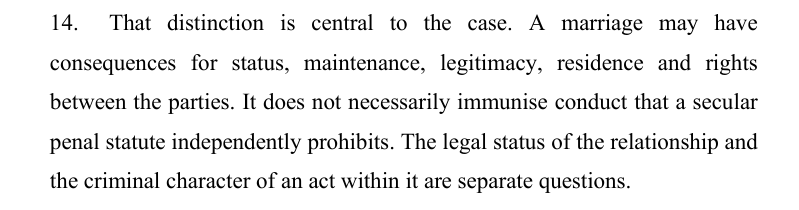
The High Court drew the distinction between the legal status of a relationship and the criminal character of an act committed within the relationship. The court said that a valid marriage cannot grant immunity from criminal liability.

A valid marriage does not immunise conduct criminalised under a secular statute

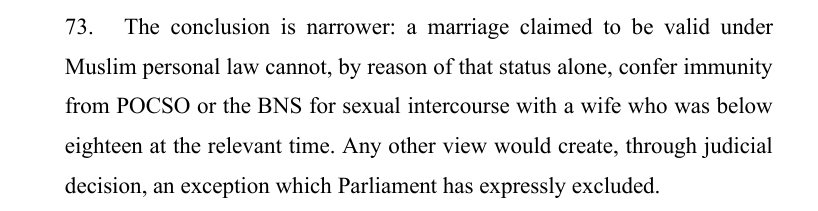
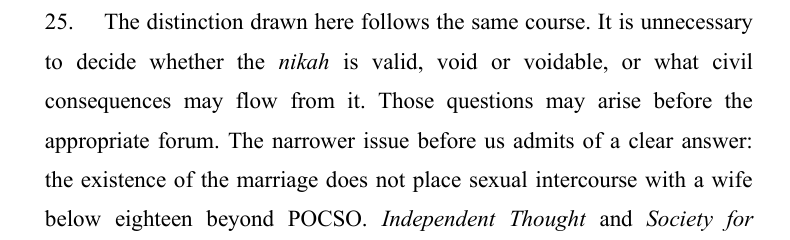
“…a marriage claimed to be valid under Muslim personal law cannot, by reason of that status alone, confer immunity from POCSO or the BNS for sexual intercourse with a wife who was below eighteen at the relevant time. Any other view would create, through judicial decision, an exception which Parliament has expressly excluded,” the High Court observed. The court said that a valid marriage “does not necessarily immunise conduct that a secular penal statute independently prohibits”.

“There is therefore no textual basis for treating a marriage recognised under personal law as reviving an immunity which the present penal law expressly withholds,” the court stated.

Personal law is not an exception to criminal laws

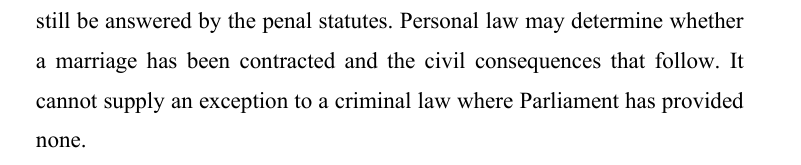
On the role of personal law, the court said that it is relevant for determining the status and consequences of a marriage, but it cannot act as an exception to a criminal law. “Personal law may determine whether a marriage has been contracted and the civil consequences that follow. It cannot supply an exception to a criminal law where Parliament has provided none,” the court said.

Consent of a minor victim irrelevant under criminal law

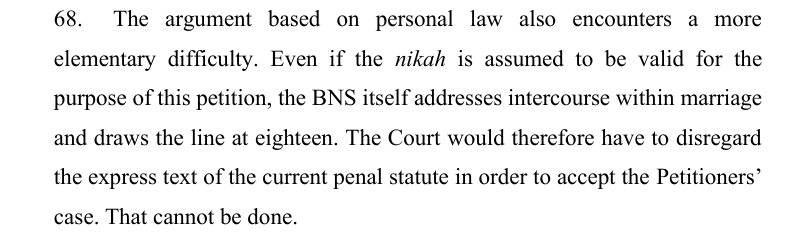
The court examined the legal scheme under the BNS and the POCSO Act and noted that both laws penalised sexual intercourse with a woman under 18 years of age. The BNS penalises sexual intercourse with a woman under 18 years of age, and the POCSO Act makes sexual intercourse with a child, male or female, under 18 years of age punishable. None of the laws take the consent of the victim into account for deciding the commission of the offence. Additionally, Section 42-A of the POCSO Act gives it an overriding effect over any other law.

The High Court pointed out that both the BNS and the POCSO Act fix the age of 18 years as the threshold for sexual consent. Under the laws, consent is irrelevant if the victim is under 18 years of age. Besides, Section 63 of the BNS criminalises sexual intercourse by a husband with his wife, who is under 18 years.

Applying the law to the present case, the High Court held that a minor wife’s consent for sexual intercourse does not grant any protection to the husband from penal liability. The court clearly stated that a marriage cannot advance a child’s age. “A person who is sixteen before the ceremony remains sixteen afterwards. For POCSO and Section 63 BNS, that fact is determinative of the legal capacity to consent to the sexual act,” the court said.

The High Court noted that the petitioners did not seek quashing, claiming absence of the ingredients of the offences alleged. It said that the grounds relied on by the petitioners, including personal laws and consent of the wife, do not take the sexual act committed by the Muslim husband out of the purview of the secular statutes.

The High Court observed that a consideration of factors like a valid marriage, existence of consent of minor or the nature of individual relationship would defeat the purpose of the legislation, which aims to protect minor irrespective of the circumstances surrounding an offence.

Based on a reading of the facts and the examination of relevant legal provisions, the High Court dismissed the petition and refused to quash the FIR filed against the husband. The court also declined the request of the petitioners to initiate disciplinary proceedings against the concerned policemen.

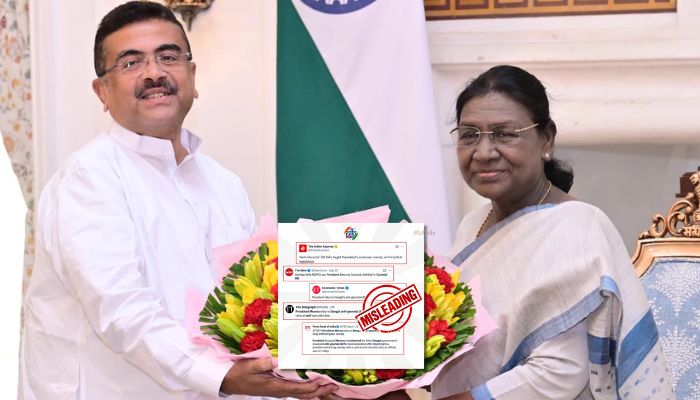
Centre, West Bengal CM refute fake MSM claims that the President has returned the Anti-Goonda Bill without granting assent: Here’s what happened

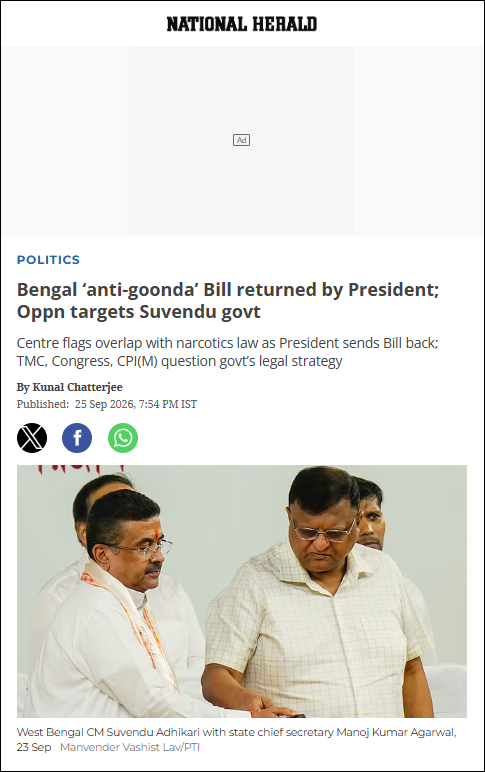
Since 25th September 2026, a section of the mainstream media has falsely reported that the President of India, Droupadi Murmu, has returned the West Bengal BJP government’s West Bengal Public Safety and Control of Anti-Social Activities Bill, 2026, commonly known as the Anti-Goonda Bill. However, both the Central and West Bengal governments have refuted these reports and confirmed that the Anti-Goonda Bill remains under consideration for Presidential assent.

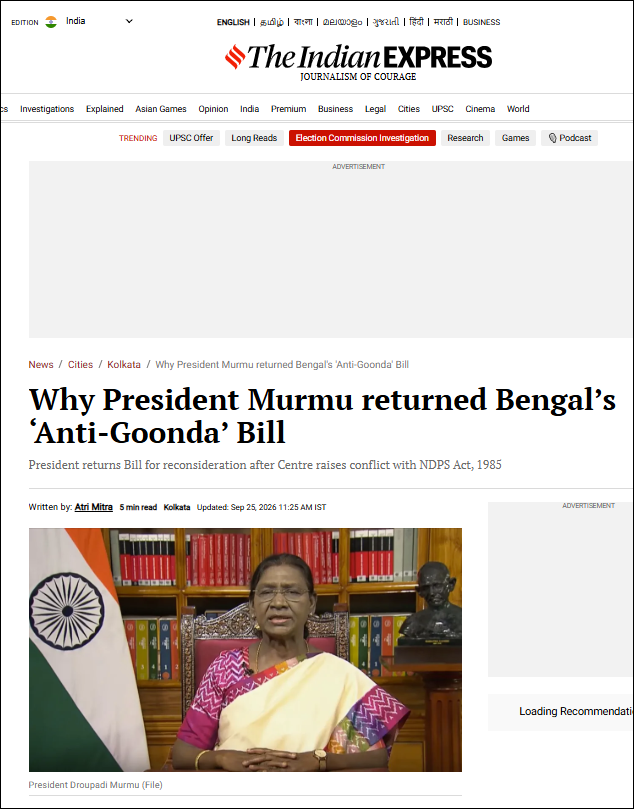
On 25th September, The Indian Express published a misleading report headlined, “Why President Murmu returned Bengal’s ‘Anti-Goonda’ Bill.”

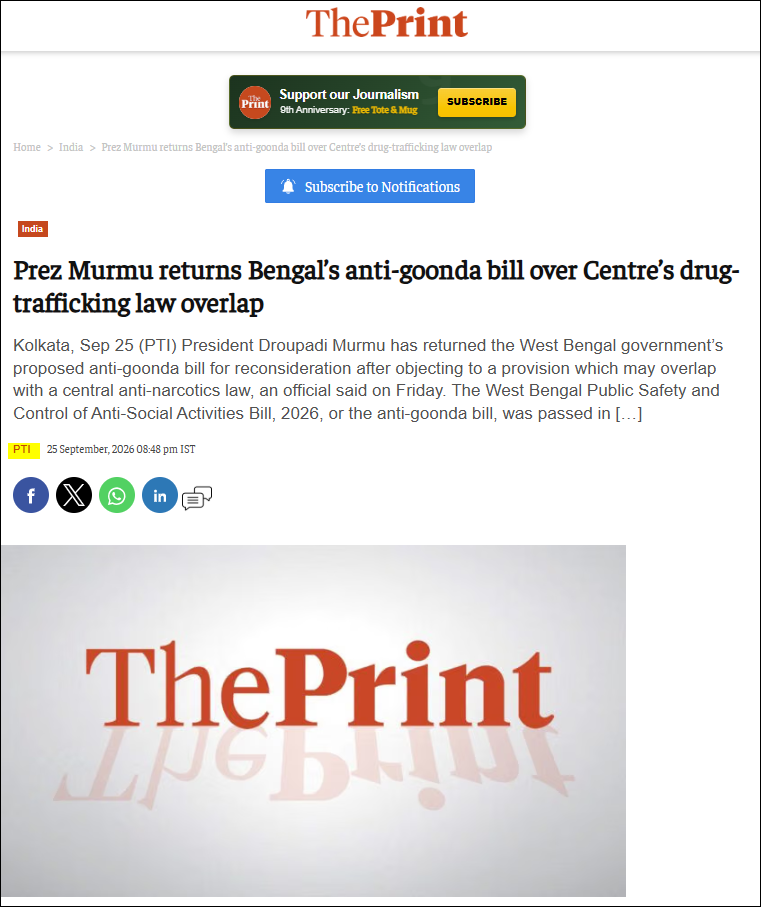
Similarly, The Print ran a PTI wire story headlined, “Prez Murmu returns Bengal’s anti-goonda bill over Centre’s drug-trafficking law overlap.”

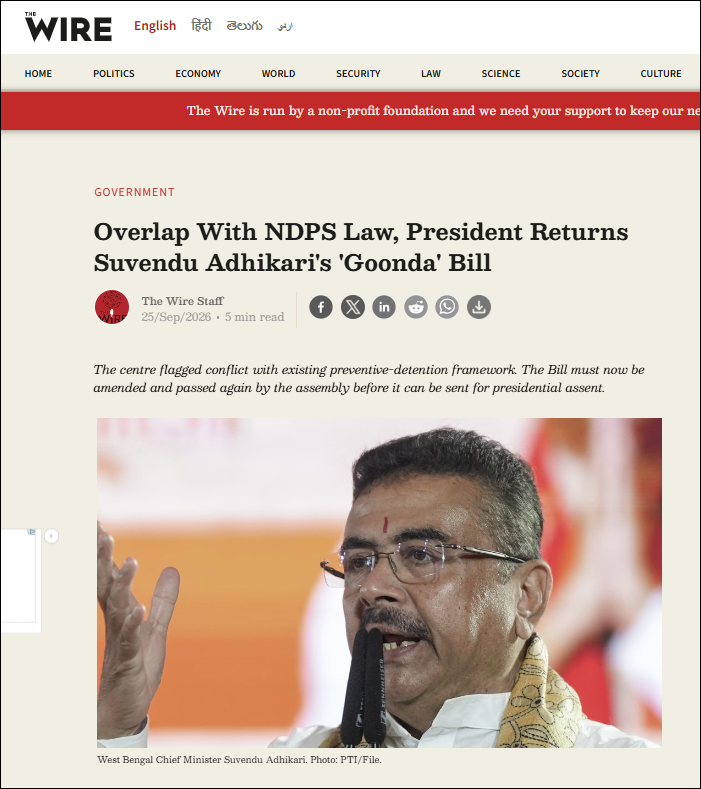
Meanwhile, Islamo-leftist propaganda rag The Wire reported, “Overlap With NDPS Law, President Returns Suvendu Adhikari’s ‘Goonda’ Bill.”

Congress mouthpiece National Herald also joined the mainstream media in peddling false claims about the proposed anti-Goonda bill.

Centre and West Bengal CM Suvendu Adhikari refute “Anti-Goonda Bill returned” media claims

While the media and anti-BJP voices peddled misleading claims about the West Bengal government anti-Goonda bill getting returned by President Murmu, the Central government’s Public Information Bureau refuted these claims.

On 26th September, PIB -Ministry of Home Affairs stated, “The Government of West Bengal sent “The West Bengal Public Safety and Control of Anti-Social Activities Bill, 2026”, reserved by the Governor of West Bengal, for consideration and assent of the President of India. The Bill was circulated among concerned Ministries/Department of the Central Government for examination and comments. The Bill is still under examination.”

Quoting the PIB clarification post on X, West Bengal Chief Minister Suvendu Adhikari wrote, “Setting the record straight against baseless propaganda and malicious rumors. A section of political adversaries and vested interests have been deliberately spreading fake news and misleading narratives claiming that the Hon’ble President of India has returned “The West Bengal Public Safety and Control of Anti-Social Activities Bill, 2026”. Do not fall prey to unverified rumors. Truth will prevail…”

Separately, the PIB Factcheck unit also refuted the mainstream media reports that claim the President has returned the West Bengal Anti-Goonda Bill.

“MISLEADING and FALSE Media Reports Misleading media reports state that the President of India has returned the “West Bengal Anti-Goonda Bill.” The Ministry of Home Affairs, Government of India, has clarified that the West Bengal Public Safety and Control of Anti-Social Activities Bill, 2026 is still under examination,” PIB Factcheck stated.

What is the West Bengal Anti-Goonda Act

The West Bengal Public Safety and Control of Anti-Social Activities Bill, 2026, also known as the Anti-Goonda Bill, was tabled in the state assembly on 29th June 2026 and passed.

The core objective of this bill is to prevent organised crime before it takes place. Under the proposed law, a District Magistrate, Commissioner of Police, or a police officer not below the rank of Deputy Inspector General (DIG), if authorised by the state government, can take action against a person if they believe that the individual is involved in or is likely to become involved in anti-social activities.

The authorities can, in such cases, order that person to leave a particular area, district or even multiple districts within a specified period. They can also stop the person from returning to that area for up to one year. During this period, the individual may also be asked to regularly report his or her movements or appear before authorities at fixed intervals.

Describing what counts as anti-social activities, the Anti-Goonda Act states that an anti-social activity is any act that directly or indirectly creates fear, alarm, danger or insecurity among the public. It also includes activities that seriously threaten people’s lives or property, disturb public peace, prevent people from carrying out their lawful business or profession, or illegally take over someone else’s movable or immovable property.

The scope of anti-social activities also extends to causing damage to public or private property, illegal mining, unauthorised quarrying, illegal sand extraction, smuggling of forest produce and wildlife-related offences that inflict significant financial losses on state exchequer.

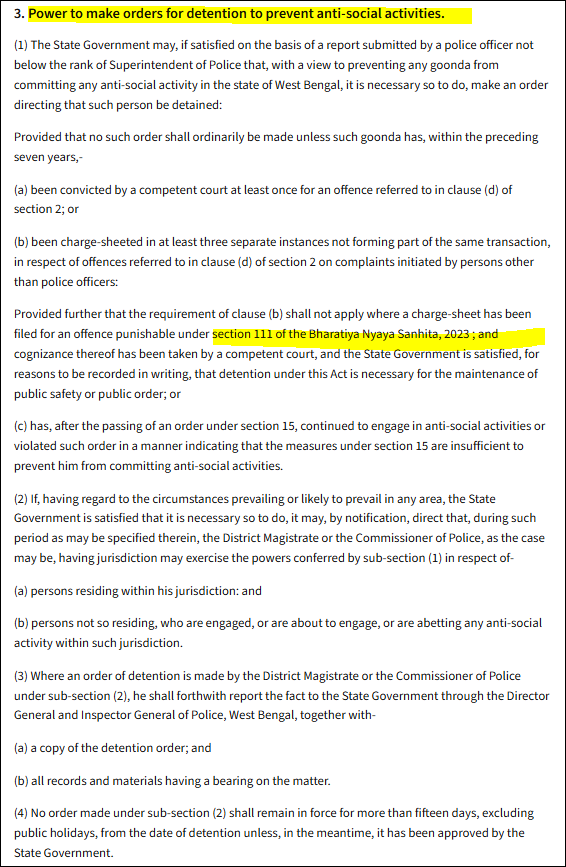
A key provision of this legislation that has triggered political outrage from opposition parties is preventive detention. Under the West Bengal Anti-Goonda Act, police will have the authority for preventive detention for up to 12 months without trial.

In addition, the legislation under the President’s consideration has also expanded the legal definition of the term “goonda”.

The definition describes a goonda as someone who habitually commits, attempts to commit, supports, finances or helps anti-social activities, either alone or as part of a gang, group or criminal syndicate.

It also includes people who have already been charged under Sections 111 or 112 of the Bharatiya Nyaya Sanhita (BNS), which deal with organised crime and petty organised crime.

If the government is certain that the person in question continues to pose a threat after being released, or is likely to return to anti-social activities, it can issue another detention order. Simply put, repeated preventive detention is also allowed under certain circumstances.

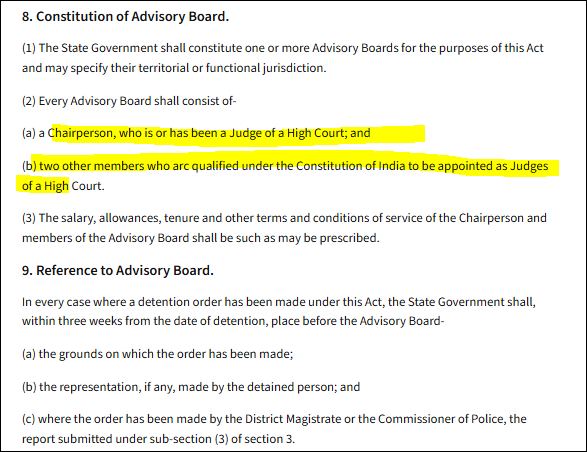
However, the law provides for setting up one or more three-member Advisory Boards. These boards will review detention orders, the proceedings of which will remain confidential, and in case of disagreements among the three members, the majority opinion will be considered the final decision. The members of the Advisory Boards will include a Chairperson who has been a High Court judge, and two other members who are qualified under the Constitution of India to be appointed as Judges of a High Court.

Notably, the preventive detention provision is akin to the National Security Act (NSA), 1980.

West Bengal government invoked its newly-passed Anti-Goonda Act against violent ‘student’ protestors

Although the Anti-Goonda Act has yet to receive the President’s assent, the West Bengal government has invoked some of its provisions against violent protestors. In late July 2026, violent ‘student protests’ unfolded in central Kolkata. In response, the BJP government invoked the Anti-Goonda Act against at least 70 people.

“I condemn the attack on our journalist friends on behalf of the entire House. An attack on journalists is unacceptable. We will take such action under the Goonda Act that these goons and even their next three generations will remember it. This is precisely why this law was enacted,” CM Adhikari said at that time.

In late August, it was reported that the West Bengal government invoked a special provision of the West Bengal Public Safety and Control of Anti-Social Activities Act, 2026.

Speaking to the media, CM Adhikari said Governor RN Ravi had granted his nod to the anti-Goonda Act, enabling the arrest of those attacking police and the recovery of costs for damage to public property.

“The government invoked a special provision of the West Bengal Public Safety and Control of Anti-Social Activities Act, 2026, with effect from today in the state. No one will be spared under this Act if government property is damaged,” CM Adhikari said.

As the Anti-Goonda Act is already enabling the arrest of violent hooligans who damage public property under the pretext of peaceful protests, the opposition and its media allies are rattled, even to the extent of peddling misleading claims.

Bombay HC imposes a total ban on firecrackers and loud music during festivities in Maharashtra: Read what the court said

0

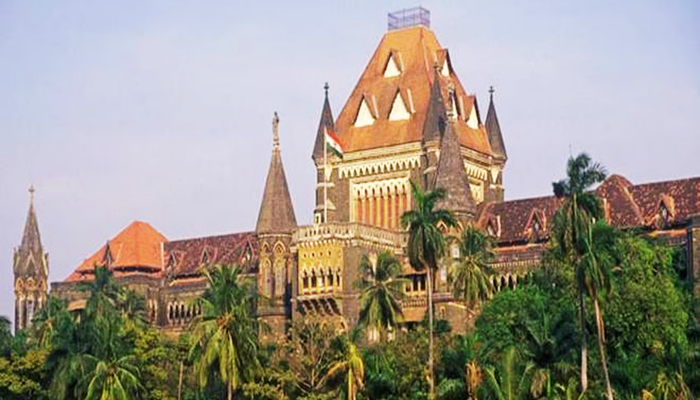
The Bombay High Court recently took suo motu cognisance of noise and environmental pollution being caused by various factors, including the bursting of firecrackers and the use of amplified music systems during festivals in public places. A Bench of Justices G. S. Kulkarni and Dr Neela Gokhale, on September 22, 2026, examined the factors contributing to the pollution and issued directions to the concerned authorities to curb it.

Celebrations need to be more “dignified” and “civilised”: HC.

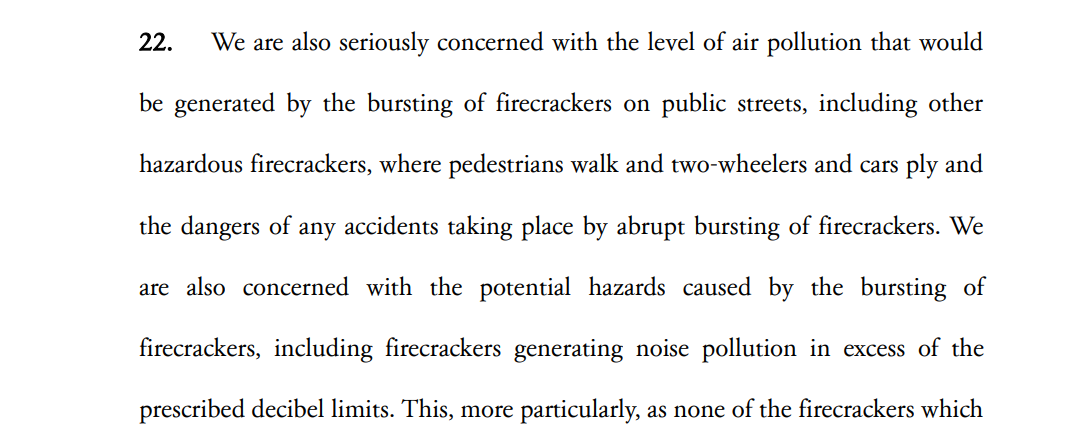
The High Court expressed concern over the noise and air pollution caused by the use of firecrackers and loud music systems during festivities in public places. “We are also seriously concerned with the level of air pollution that would be generated by the bursting of firecrackers on public streets…We are also concerned with the potential hazards caused by the bursting of
firecrackers, including firecrackers generating noise pollution in excess of the prescribed decibel limits,” the court said.

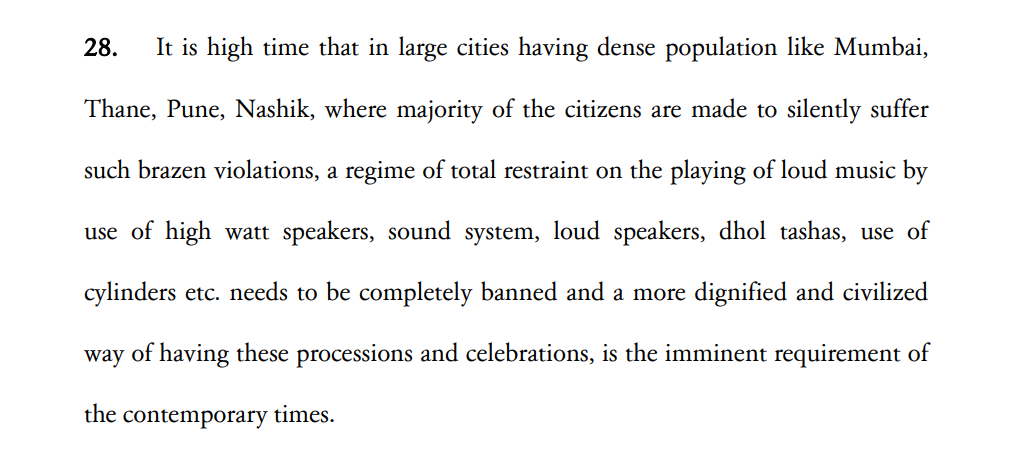
The High Court observed that the manner of celebrating festivals needs to change and become more “dignified” and “civilised”, keeping in mind the requirements of contemporary times. The Court said that the problem is magnified in large cities with huge populations, where the majority of people become silent sufferers of the brazen violations.

“It is high time that in large cities having dense population like Mumbai, Thane, Pune, Nashik, where majority of the citizens are made to silently suffer such brazen violations, a regime of total restraint on the playing of loud music by use of high watt speakers, sound system, loud speakers, dhol tashas, use of cylinders etc. needs to be completely banned, and a more dignified and civilised way of having these processions and celebrations is the imminent requirement of the contemporary times,” the court stated.

Rules have remained as mere paper provisions: HC.

The court adopted a strict stance and pulled up the authorities for insufficient implementation of the Noise Pollution (Regulation and Control) Rules, 2000 and the failure to act on violations under the rules. “…although robust provisions are available in law to control and regulate the levels of noise pollution being generated by the processions and venues in the festivities, mostly they have remained to be paper provisions, much less being effectively implemented in letter and spirit,” the High Court observed.

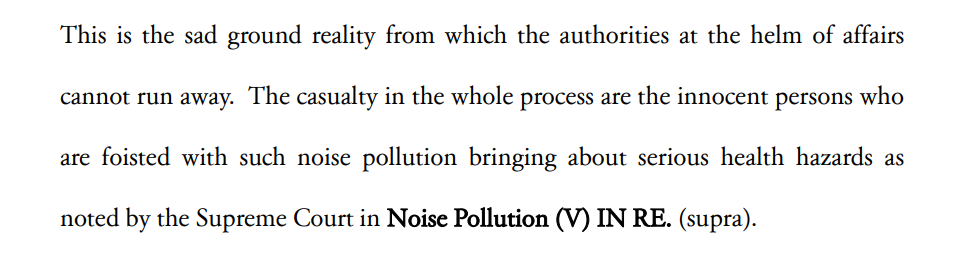
The court said that due to the laxity displayed by the concerned authorities in implementing the laws, the ordinary citizens are left to suffer the effects of noise and environmental pollution. “This is the sad ground reality from which the authorities at the helm of affairs cannot run away. The casualties in the whole process are the innocent persons who are subjected to such noise pollution, bringing about serious health hazards…” the court noted.

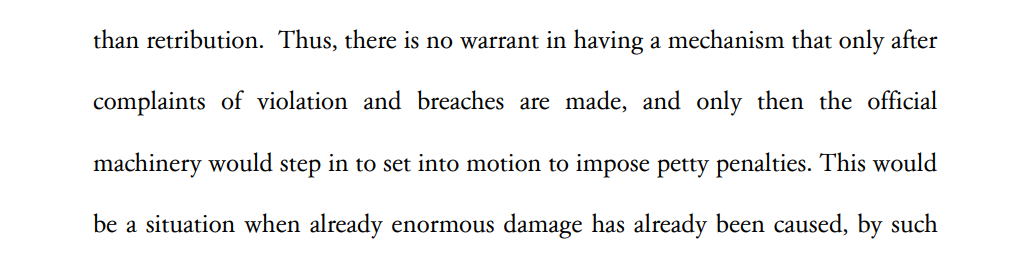
The High Court said that the authorities need to become proactive and take preventive measures to curb the problem instead of swinging into action only after a complaint is filed. “…there is no warrant in having a mechanism that only after complaints of violations and breaches are made, and only then the official machinery would step in to set into motion to impose petty penalties. This would be a situation when enormous damage has already been caused…” the court remarked.

The court added that the existing mechanism to address the problem of pollution cannot be reduced to a mere formality with the authorities silently allowing violations.

The High Court’s directions

The High Court issued a set of directions to the state authorities to prevent air and noise pollution across the State, which included a total ban on bursting firecrackers, use of laser lights, high-intensity lumen lights and beams during festivities or processions in public places. It ordered the authorities to take all measures, from preventive actions to punitive actions, to implement the direction.

The court directed the police and the concerned authorities to measure decibel levels during any festivity to catch violations and also empowered them to seize the offending devices or instruments.

The court also directed the authorities to consider collecting a security amount from individuals and groups seeking permission to use noise-causing instruments during festivities or processions. The court said that individuals should deposit at least ₹50,000 and groups at least ₹1 lakh while seeking such permission. If the individuals or groups violate the rules, the deposited amount will be forfeited by the authorities.

The court directed the organisers of such festivities or processions to furnish an undertaking that the sound systems to be used are fitted with internal sound compressors. Besides, the organiser will be required to install ‘Decibel Measurement Meters’ at every venue or procession. The court ordered the authorities to maintain a record of the decibel levels at all the festivities permitted under the 2000 Rules.

The High Court directed the authorities to take necessary action as per the existing laws in case of violations. Furthermore, it urged citizens to recognise their collective responsibility towards society.

‘India illegally occupies Kashmir’, ‘manhoos desh’: JNU leftist Nivedita Menon faces demands to cancel Udaipur lecture over past remarks

0

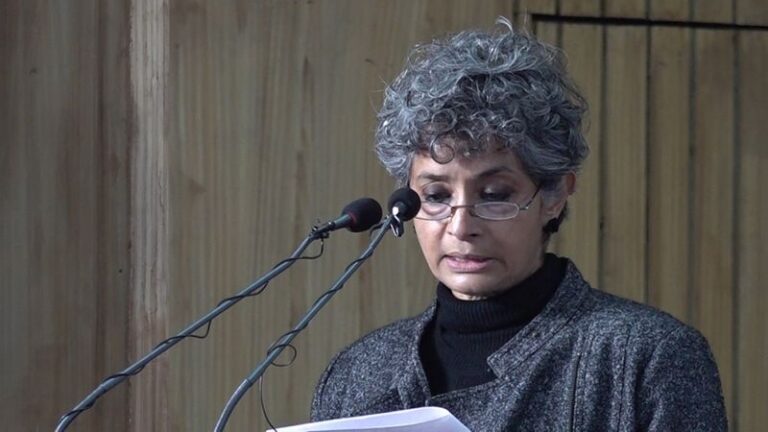
Former JNU professor Nivedita Menon has repeatedly courted controversy over her views on Kashmir, nationalism, Hindu society, the Uniform Civil Code and the political climate in India.

Now, one of those controversies has followed her to Udaipur.

A coalition of civil society groups in the Rajasthan city has demanded that the Rama Mehta Trust cancel Menon’s scheduled Rama Mehta Memorial Lecture at the Vidya Bhavan Auditorium. The groups held a press conference on Saturday, September 19, accusing Menon of making divisive and “anti-national” remarks and questioning why she had been invited to address the event.

Menon, who superannuated from Jawaharlal Nehru University (JNU) in November 2025, is a feminist ‘intellectual’ prominent in left-wing academic circles. She taught at JNU’s School of International Studies from 2009, after spending 15 years at Lady Shri Ram College and seven years in Delhi University’s political science department.

Her public interventions, however, have frequently extended well beyond conventional academic debates and sparked outrage over her remarks on India’s sovereignty, Kashmir, nationalism and the country’s political institutions.

‘India is illegally occupying Kashmir’

One of the most prominent controversies surrounding Menon erupted in 2016 during the intense political debate over nationalism at JNU.

While delivering a lecture on nation formation and Kashmir, Menon was reported as saying that “everyone knows that India is illegally occupying Kashmir”. She was also reported to have said that Kashmir and Manipur had been “illegally occupied” by the Indian state.

An ABVP student leader subsequently filed a police complaint against her.

Menon disputed some of the specific wording attributed to her and defended her lecture as an academic discussion about nationalism and Kashmir. No conviction followed from the complaint.

Another portion of the lecture nevertheless drew considerable attention. A video clip showed Menon describing Hindu society as “the most violent, to the root violent society in the world”.

The remarks triggered a backlash, with more than a dozen academics and activists subsequently issuing a statement condemning what they described as the “vilification” of Menon.

The controversy resurfaced in Jodhpur

The following year, i.e 2017, Menon’s lecture at Jai Narain Vyas University in Jodhpur became another flashpoint.

Menon had been invited to speak on “History Reinterpreted: Nation, Individual and Culture”. The university later filed a police complaint alleging that she had made objectionable comments concerning Kashmir and Indian soldiers, besides showing disrespect towards the national flag and anthem.

The university’s vice-chancellor told the media that Menon had said Kashmir was not an integral part of India and that soldiers worked for their livelihood rather than for the nation.

Menon rejected the allegations as baseless and alleged that the controversy had been manufactured by an RSS-affiliated former professor.

The episode led to ABVP-linked protests and a temporary shutdown of the university that day.

‘A stick to beat Muslims with’

Menon’s position on the Uniform Civil Code has also been a source of political disagreement.

Writing in The Hindu in 2016, she argued that the UCC debate “has nothing to do with gender justice” and was instead linked to a Hindu-nationalist agenda to “discipline” Muslims.

She described the proposed Code as “a stick to beat Muslims with” while arguing that aspects of Muslim personal law, including marriage as a civil contract and women’s property rights, were being overlooked in the debate.

It was a pointed intervention in one of India’s most contentious constitutional and political questions, and attracted criticism from those who viewed her argument as an ideological defence of personal law.

‘Is manhoos desh’

The latest controversy involves a much more recent remark.

In a recently surfaced interview uploaded on journalist Mandeep Punia’s YouTube channel, Menon discussed the political climate of the past decade, the Muslim community, student movements, bulldozer demolition drives and the political response to protests.

While discussing the political space available to Muslims, she referred to India as “is manhoos desh”, translated as “this accursed country” or “this cursed country”.

Menon was discussing the experience of Muslims in India in the context of the CJP protests when she said that the movement had provided “a little breathing room”, after which Muslims perhaps started feeling that “in this cursed country, there is a place for us too.”

The clip subsequently went viral and triggered criticism.

The wider context of the interview is relevant. Menon was making a broader argument about the political situation and the experiences of Muslims in India. Nevertheless, the description of India as a “cursed country” has become the latest flashpoint involving the former JNU professor.

But that was far from the only controversial assertion made during the interview.

Menon hails CJP protests as a ‘democratic victory’

Discussing the CJP protests, Menon described the movement as having made “accountability” part of everyday political vocabulary and called this the “biggest victory” of the movement.

She also discussed the role of its leadership, arguing that although the movement had become “organic”, such a movement did not emerge on its own and that there had to be a centre giving the call. She specifically referred to Abhijit Dipke and said his role could not be forgotten.

Menon further argued that the movement had broken what she described as a “dense silence” that had prevailed for 12 years and had brought different Left groups together, along with supporters from across India and abroad.

‘It has been a Hindu Rashtra here for 12 years’

Menon’s criticism during the interview was not confined to a particular government policy.

Speaking about India’s political direction, she said: “It has been a Hindu Rashtra here for 12 years; attempts were made to make it a Hindu Rashtra, and in a way, it has become a Hindu Rashtra. We are all living under the shadow of a Hindu Rashtra.”

She also sharply criticised the Union Government’s education policy and the Education Minister, while questioning the composition of a high-powered task force constituted for educational reforms.

The comments provide further context to why Menon’s proposed Udaipur lecture has become politically contentious. Her critics are not objecting merely to an academic discussing feminism or education; they are objecting to a speaker whose public interventions routinely extend into questions of nationalism, sovereignty, religion and the functioning of India’s democratic institutions.

‘EVM, ECI, SIR, delimitation’: Menon questions electoral system

Menon also questioned the functioning of India’s electoral system during the interview.

Discussing the government’s conduct, she argued that it showed an absence of concern about winning elections and referred specifically to EVMs, the Election Commission of India, SIR and delimitation.

Her argument was that the government had reached a point where it believed it did not even need to win elections anymore.

These are sweeping allegations about the functioning of India’s democratic institutions.

They are also precisely the kind of political claims that are bound to invite scrutiny when made by a former professor of one of India’s premier universities.

‘Seeds’ of anti-CAA and farmers’ protests

Menon further drew a line between earlier protest movements and the CJP protests.

She described the anti-CAA and farmers’ protests as having planted “seeds” that had subsequently emerged as a “continuity”, specifically mentioning young activists including Umar Khalid.

Her supporters can view this as an academic interpretation of the evolution of protest politics in India.

Her critics, however, see it as an attempt to place disparate political movements within a single continuum of resistance against the Indian state.

Either way, the comments make clear that Menon’s latest intervention is not confined to an old controversy from 2016. She continues to make strong political arguments about the nature of the Indian state, its institutions and the direction of Indian democracy.

Udaipur groups now demand cancellation

It is against this backdrop that the Udaipur controversy has erupted.

Dr Parmveer Singh Dulawat, representing the group, cited Menon’s past remarks while demanding that the Rama Mehta Trust withdraw the invitation.

The group questioned why an organisation in Udaipur would invite Menon and demanded that the trust’s office-bearers explain the decision.

Dulawat also pointed to the fact that trustees associated with the Rama Mehta Trust, including Ajay Singh Mehta and Hemraj Bhati, are also associated with Vidya Bhavan Society and Seva Mandir.

According to the group, these overlapping institutional positions make the organisers’ decision even more worthy of scrutiny.

The group has warned that a larger protest could follow if the event goes ahead.

As of the latest available information, neither the Rama Mehta Trust nor Vidya Bhavan Society had publicly announced that the lecture had been cancelled.

Menon’s lectures have faced disruption before

The Udaipur protest is not the first organised opposition Menon has faced at a public lecture.

In March 2024, her lecture at Gangadhar Meher University in Odisha was disrupted roughly 15 minutes after it began. Protesters shouted “Nivedita Menon Go Back”, following which she left the podium and the event was called off.

The JNU Teachers’ Association condemned the incident, arguing that scholars should not be intimidated because of their political views.

That position raises an important distinction.

There is nothing unusual or objectionable about protesting against a speaker’s views. Speakers who draw legitimacy from their lectures in universities across the country must bear with the possibility of facing calls for cancellation when they spew venom against the national flag, disrespect soldiers, or promote an integral part of its territory as disputed.

For JNU professors like Nivedita Menon, the Udaipur episode should serve as a reminder that contentious remarks on Kashmir, India’s sovereignty and national identity cannot simply be insulated from public scrutiny by invoking “freedom of speech”, “constitutional guarantees” and academic freedom. The right to speak is protected; so is the public’s right to question, criticise and protest against what is said.

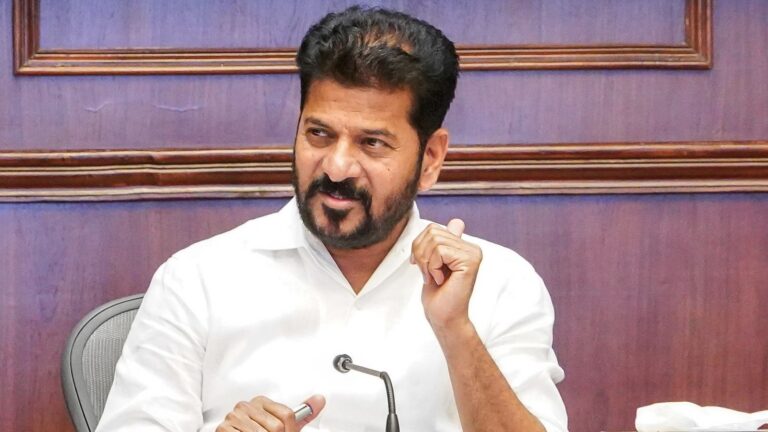
1000 days of Revanth Reddy: The ‘6 Guarantees’ that never arrived, the demolitions that did, and a government lost in bombast

Taking inspiration from none other than Hitler himself, Rahul Gandhi’s government in Telangana, led by Chief Minister Revanth Reddy, finished 1000 days of governance. 

No, I am not going overboard in bringing in Hitler. I am merely quoting what Revanth Reddy himself has very proudly claimed – that Hitler is his inspiration. 

Now, you would be wondering that certainly there would have been some context to the statement and that I am merely twisting his well-meaning comparison (with Hitler). 

Revanth Reddy was being interviewed by N. Ram at The Hindu’s annual conclave. Revanth Reddy was asked about the demolitions his newly created department HYDRAA was carrying out in Hyderabad. Revanth Reddy proudly explained how he got inspired from Hitler, who had ahighly efficient assassin squad named Hydra. In case we got confused by what an assassin squad is, Revanth Reddy clarified to us that the assassin squad was very good at assassinating people that Hitler chose. So, he got inspired by Hitler and started a department called HYDRAA and he went about “demolishing like anything”, what he thought were illegal properties (even if scores of families were staying there for many years). In case we got confused by “demolishing like anything”, he compared it to the demolition in Gaza and Ukraine wars. 

Since the context is as clear as it can get, you must now be wondering what is this HYDRAA that Revanth Reddy is so proud of? Revanth Reddy created a new department – Hyderabad Disaster Response and Asset Protection Agency (HYDRAA). True to what Revanth Reddy claimed, they “demolished like anything”. When asked about poignant videos of innocent citizens and elderly citizens crying about being caught unawares by the mayhem, Revanth simply responded by saying that “In a war, it is natural for some people to get impacted”. 

Now, imagine the outrage if someone remotely related to the BJP would have said that Hitler is their inspiration. And now compare the absence of outrage by the usual suspects on this atrocious comparison. Infact, The Hindu did not even bother to publish this statement in their newspaper coverage (of their own event!). 

The total failure of “6 Guarantees in 100 days”

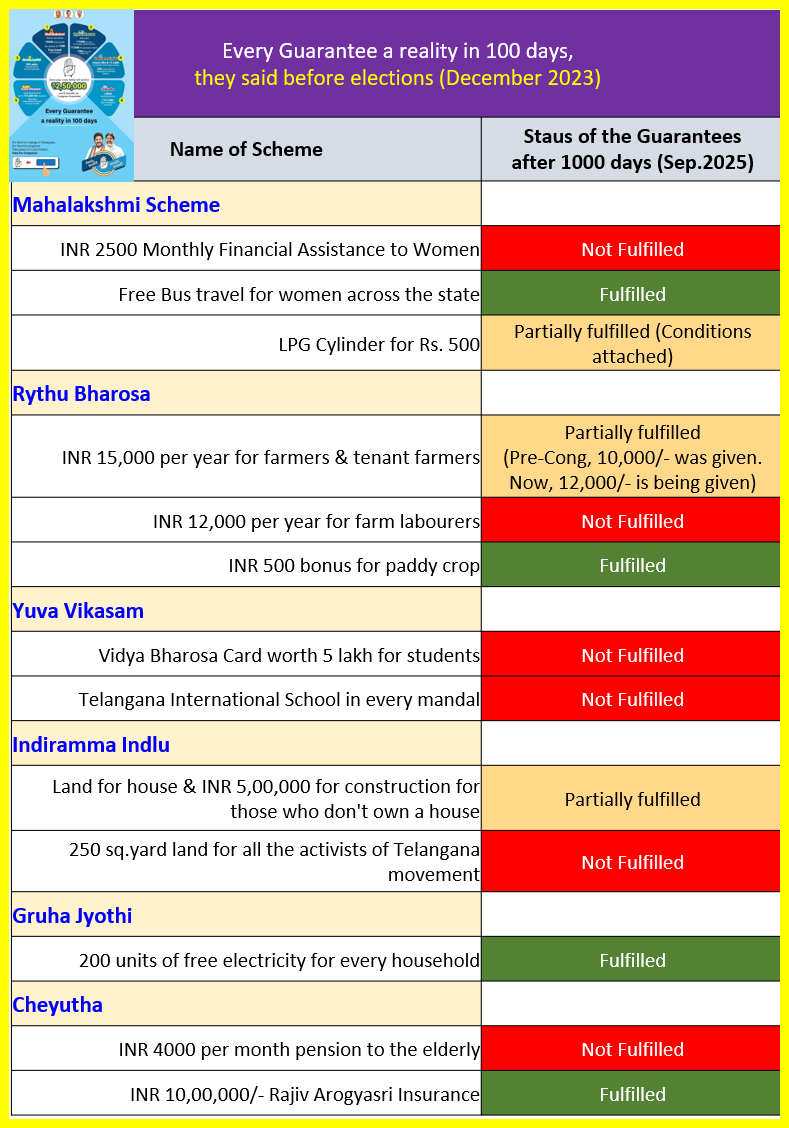
The inspiration from Hitler is perhaps not restricted to “demolishing like anything”. It extends to cheating the people to a baffling extent never seen in recent times. Rahul Gandhi’s government came to power in Telangana on the back of “6 Guarantees in 100 days”. Day-in, day-out, the entire army of Rahul Gandhi (starting from man himself) told people that ALL the guarantees in the “Guarantee Card” will be fulfilled within 100 days of coming to power. 

A full 1000 days later, Rahul Gandhi’s government in Telangana has NOT fulfilled even half of their promises. Old time watchers of the Congress are well aware of the chicanery Congress is capable of. Despite the known history, people trusted that the Congress may have changed after so many losses and will stand by their word, but clearly you cannot change the stripes of a Zebra. 

A simple table to show how the government has miserably failed to fulfil their core promises made before the election. Revanth Reddy’s justification for his chicanery is even more amusing – he doesn’t have money even if you “cut him up”! 

His constant cry of helplessness is not cutting any ice with the people because, during the campaign, he was very vocal about how awesome he is with respect to managing the budget of the state. We were all asked to just wait and watch how he will set a trend in managing budget just within 100 days! 

The Caste Census

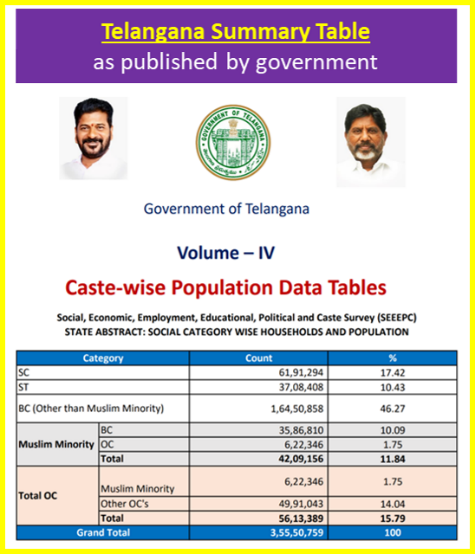
Rahul Gandhi’s another favorite governance issue is Caste Census. So, he got his government in Telangana to conduct one. Rahul Gandhi thundered in Lok Sabha how his government in Telangana finished a caste survey and shocking results came to light. I don’t know if the results are shocking, but the classification of the results is certainly very shocking.

Rahul Gandhi’s government didn’t conduct just a caste survey. They conducted a “Socio, Economic, Educational, Employment, Political and Caste Survey” of the entire state (how many vehicles you own, how many properties you own etc)! Lakhs of people were left out, but let’s keep that statistic aside. The government also commissioned an “Independent Expert Working Group” to study this survey. The Chairman? Justice B. Sudarshan Reddy (VP candidate of INDI bloc). The Vice-Chairman? Kancha Iliah. The Convenor? Praveen Chakravarty(Congress member)!

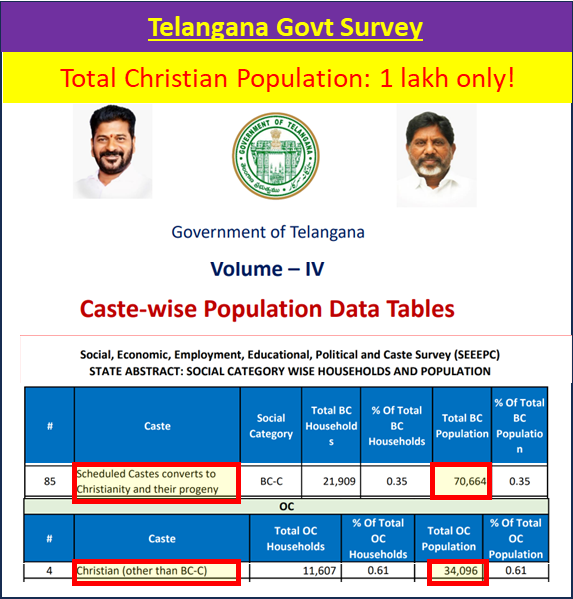
The first and the most obvious thing that strikes to you when you see the summary table released by the government is the fact that a whopping 80% of the Muslim population in the state is classified as a Backward Caste (BC-E). 35.76 lakh Muslims out of the 44.57 lakh Muslims have been classified as a Backward Caste-E; the same BC-E that was stuck down by High Court and is under review in the Supreme Court (the survey report mentions that also!)

Now you may ask if other religions also got the same honour. The summary report released by the state government doesn’t even mention other religions. The detailed report by the Commission tells us that there just 1 lakh Christians in the state of Telangana. And within this 1 lakh, 70,000 of them are “converts” and receive yet another special classification – BC-C. Can you really believe it? That there are only 1 lakh Christians in the entire state of Telangana?

Revanth Reddy passed a resolution in the Assembly asking the central government to increase the BC reservations from the current 29% to 42%, based on this survey. Essentially Rahul Gandhi’s “shocking” proposal is to increase the number of BCs by 10% with the addition of Muslims and the demand and increase in the quota to BCs by 13%! 

We can discuss many such aspects of the report in greater detail but then we will miss out on discussing the other phenomenal achievements of this government, so let’s move on. 

The 1000-day advertisement

It is natural for you to think that I am just writing about the wrong things of this government. You must be thinking that surely there must have been something great that this government must have done in 1000 days. Afterall, Rahul Gandhi has delivered so many powerful speeches on how awesome his governance will be. So, let’s just take a look at the front page advertisement issued by his government in all telugu newspapers (the below image is an English translation from AI – and it’s accurate). 

Please notice the absence of caste survey from this list. Please notice the absence of a single new infrastructure project in the last 1000 days? The entire list is about how the govt has distributed money to various sections. Even that distribution is either mired in scams or is just a partially fulfilled election promise. 

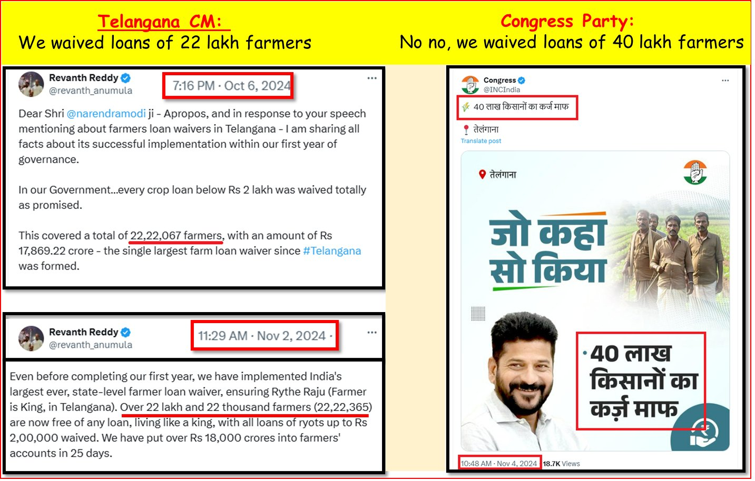
Take the first item on the list – Farm loan waiver for 25 lakh farmers. Prime Minister Narendra Modi, in one of his speeches mentioned about the collection of “RR Tax” – a reference to the two leaders of Congress (in the state and in Delhi). And while speaking about it, the Prime Minister mentioned about the failed promise of waiving loans of farmers. Revanth Reddy immediately shot a letter to the Prime Minister claiming how awesome he is because he waived the loans of 22 lakh farmers. 

The central Congress immediately joined the party and released another infographic – “Jo Kaha, So Kiya”. And they mentioned that loans for 40 lakh farmers have been waived! 

Now, which number do we trust? 22-lakh released by Revanth Reddy? 40-lakh released by Rahul Gandhi? Or the new number – 25 lakhs? We can do a similar deep dive into all other claims but suffice it to say that where there is Congress, there is always a scam. The reason citizens have developed a disgust towards scams & politicians is primarily the Congress party. They learn nothing; they treat citizens as dumb; and they focus only on amassing money. 

The infrastructure announcements (only)!

Revanth Reddy is very high on bombast though. He announced the building a new city in Hyderabad – called Bharat Future City! Hyderabad already has 3 cities in it – Hyderabad, Secunderabad and Cyberabad. No one is able to understand why a 4th city needs to be built, when the existing city is organically expanding. Until people realised that this is just a real-estate game. Revanth Reddy cancelled all plans of a Pharma City and instead announced grandiose plans of a Future City there. He accused KCR of wanting to create a Pharma city to benefit his friends in real estate. Logic simply follows that Revanth Reddy is perhaps doing this to benefit his friends in real estate?

Speaking of real estate, the latest “demolition” by Revanth Reddy (just in the last month) is the sudden addition of lakhs of houses, lakhs of house plots, and thousands of agricultural survey numbers into the “Prohibited Properties List” under section 22A on Registration Act. By a conservation estimate, nearly 1 crore acres were suddenly added to the “Prohibited properties list”! This total lack of grip on actual governance while being high on bombast is really frustrating the people. 

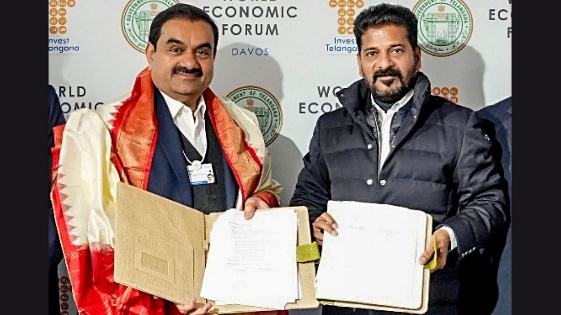
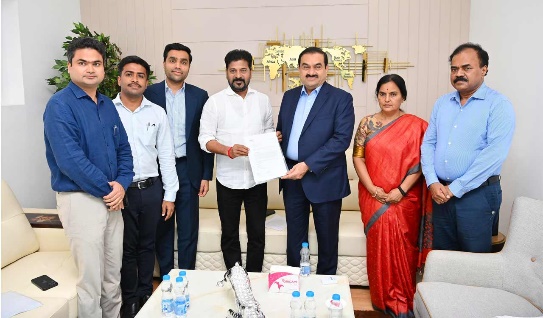
Revanth Reddy announced the setting up of a skills University. He unhesitatingly took a 100-crore cheque from Adani for this university. Quite obviously, there was an uproar as to how Rahul Gandhi abuses Adani day-in and day-out, and doesn’t hesitate a bit to take money from Adani! 

Revanth Reddy announced the setting up of a sports University. We will have to wait to see what shape and form it will even take. He announced that he will build “Tallest Mahatma Gandhi Statue”. He announced the “Largest Stadium” in competition to the Narendra Modi stadium in Gujarat, will be built in the Future City. 

Revanth Reddy is obsessed with the clean-up of the Musi River. You would ask – what is wrong?There is nothing wrong in the vision. But if the vision is not backed by a concrete plan, the vision will merely remain as yet another bombast. Revanth Reddy went on an overdrive claiming that he will spend a whopping 1 lakh 50 thousand crore for the development of Musi – he himself went to London to study their riverfront projects; he sent a delegation of ministers, officers and journalists (yes, journalists) to study the riverfront projects in Seoul! 

He said the project with reflect “religious harmony” because he will build a replica of Mecca Masjid, Ramappa temple, Medak Church and the Golden Temple! With opposition parties successfully showing to the people how nothing has happened, Revanth has ended up challenging Prime Minister Modi to fund 1 lakh 50 thousand crore for this! Why should the central government fund his haphazard requests for money?

Gen-Z and education

With Gen-Z being in the news so much, no review of any governance model is incomplete without talking about what is being done in education. Revanth Reddy, who also has the education portfolio, has called the 1.3 lakh engineering graduates of the state as a “criminal waste”. He has not released nearly 15,000 crores worth of fee reimbursement money to degree colleges, thus impacting the lives of lakhs of students. He promised a lot of new schools in each mandal and hasn’t built any. He promised a INR 5 lakh guarantee for higher education and hasn’t given a single pie. His singular achievement in the field of education is to provide breakfast to government schools (look at the ad above!).

The zero grip on governance

Revanth Reddy is often angry with officers. We have been treated with many front page banner items on how “Revanth is angry”. Infact, Revanth Reddy has affected nearly 30 large-scale transfers of IAS & IPS officers in the nearly 30 months he has been in power. These are not some routine administrative transfers of an officer here and there. These are bulk transfers of officers(sometimes they are in a position just for a few months!). 

Why would officers be serious about their work if they don’t know when they will be transferred arbitrarily? Infact, the mistrust that Revanth has on the officers in Telangana is so high that he has chosen an officer deputed in Delhi, Sanjay Jaju, to be the Chief Secretary of the state (this report in The Hindu clearly indicates the trust issues). 

Revanth Reddy’s mouthpiece in Telugu, infact published a story of how a tender clash between 2 ministers led to a suicide attempt by an IAS officer

Revanth Reddy makes a trip to Delhi at least two times a month. He relies excessively on the Modi government to help him run the state. He is constantly meeting central ministers to seek help and more often than not gets the required help also. His frequent trips to Delhi are not because he has to meet the central ministers though. If you are a congress Chief minister, then you will have to mark your attendance with the high command, even if it means frequent absence from the state. 

The zero grip on governance also shows up during various crisis times, such as rains or droughts. There is very little coordination between the ministers and when questioned, Revanth goes on an overdrive to abuse the opposition leaders. 

Ah, the abusive language!

In recent times, abusive language has been a trending topic. The trend has completely missed the abusive language that Revanth Reddy so frequently uses. Take for the instance the time he called protesting students as “Cunning Foxes” (they won a stay from the Supreme Court regarding an auction of 400-acre land). He called the 1.3 lakh Engineering graduates from the state as a “criminal waste”. 

He went to Delhi and threatened the entire country – “Whoever it is, whether rich or in any position, if he comes against Rahul Gandhi’s command or rule, Telangana is going to write his death order”. Who exactly is Rahul Gandhi to command us? Why must the state kill anyone who doesn’t follow the orders of Rahul Gandhi?

Revanth has constantly abused the opposition leaders with the choicest of words. “I will put lizards in your pants”; “Drought in state will end if we spray their blood on the crops”; The language plumbed to such depths that his most friendly newspaper, The Hindu, had to publish an article deploring “Telangana’s political lingo”. 

“Owaisi saab, if you give me permission…”

The bending and crawling before the Owaisi brothers is simply unbelievable. This one time, standing in the Assembly, Chief Minister Revanth Reddy literally sought the permission of Owaisi to speak in Telugu (after answering him in Hindi). On another day, Owaisi Jr. was going on a full out attack on the government in the Assembly. What was Revanth Reddy’s response? “You are scolding me like anything”!! The Owaisi clan is never subjected to the flowery abusive language that other leaders of the state are subjected to. 

In Conclusion

There are many on social media who are trying to remind the current generation of the disastrous rule of Sonia Gandhi and Rahul Gandhi. In my view, while it’s important to do that, we don’t have to go back in time to show people how bad a Congress rule can be. We can study the governance in the handful of states they are in power. There is a reason the Congress party hasn’t won a single state twice (after 2011). Everywhere they have won, it has been on the back of an anti-incumbency factor in those respective states. Congress party has not gotten over its habit of lying to people to gain power, only to ditch them. If they can be this blatant in today’s day & age, can you imagine how bad they were back when information was not so easily available?

As NIA court releases foreign mercenary Matthew VanDyke, read about 4 criminals who left India never to return again

American national Matthew Aaron VanDyke, who describes himself as a mercenary, has walked out of Delhi’s Tihar Jail after nearly six months behind bars. A special National Investigation Agency (NIA) court has now allowed him to fly back to the United States for a month to meet his family. Six Ukrainian nationals who were arrested along with him have been given the same relief.

The recent development has brought attention to several older Indian cases in which foreign nationals facing serious legal proceedings were allowed to leave the country and subsequently did not return.

Unlike the older cases, the court has currently permitted the seven accused to leave only for a limited period, and the NIA investigation remains open.

What is the case against Matthew VanDyke?

VanDyke and the six Ukrainians were arrested as part of a major counter-terrorism probe. The NIA had first booked all seven under the tough Unlawful Activities (Prevention) Act, or UAPA. According to the agency, the group had entered India on valid travel papers but travelled to the northeast without the special permits needed to visit those areas, and then crossed over into Myanmar through Mizoram. Investigators had claimed the group was running training sessions for armed ethnic groups in Myanmar, teaching them things like drone warfare, drone building and drone jamming. VanDyke was picked up at Kolkata airport, while the others were caught at different airports around the country.

But things changed once the NIA actually filed its chargesheet. The agency dropped the serious terror charges under UAPA, saying it simply didn’t have solid proof that the group’s activities had hurt India’s security or its people in any direct way. Instead, the chargesheet only carried charges under Sections 21 and 23 of the Immigration and Foreigners Act, basically charges about entering the country illegally and overstaying visas. So a case that started out looking like a major terror investigation ended up being about visa violations.

Because the NIA couldn’t finish its probe into the original charges within the 180-day limit set by law, VanDyke and the others got what’s called default bail, a right that kicks in automatically when investigators miss their deadline. Once the immigration matter was cleared up through the Foreigners Regional Registration Office (FRRO), VanDyke’s lawyers asked the court for permission to let him travel home. Special NIA Judge Prashant Sharma agreed, allowing him to leave India for a month and getting his passport unblocked for the trip. The same order applies to the six Ukrainians.

This isn’t the first time India has let foreign nationals accused in big, high-profile cases walk out of the country on the promise or the hope that they’d come back. Here are three cases where foreigners were let go and never returned to face the Indian justice system.

The Bhopal Gas Tragedy: How Warren Anderson got away

On the night of December 2-3, 1984, a gas leak at the Union Carbide India Limited pesticide plant in Bhopal turned into one of the worst industrial disasters the world has ever seen. Over five lakh people were exposed to a highly toxic gas called methyl isocyanate that night. Official figures put the death toll at around 3,700, though many believe the real number is closer to 16,000. The gas didn’t just kill people immediately; it altered how survivors’ bodies functioned at a basic level, including in pregnant women, causing birth defects and disabilities that families are still dealing with generations later.

Just four days after the leak, Warren Anderson, who headed Union Carbide at the time, landed in Bhopal and was arrested. But he was in custody only briefly before getting bail and leaving the country almost right away, and he never returned to face trial. Anderson died years later, still officially wanted in the case, having never once stepped into an Indian courtroom.

Several news reports over the years have pointed to the Congress government of the day, led by Rajiv Gandhi, for making this quiet escape possible. One widely reported version is that Gandhi agreed to let Anderson go in exchange for the release of his childhood friend Adil Shahryar, who was in an American prison at the time. Shahryar was the son of Muhammad Yunus, a former Indian ambassador to Spain, Indonesia and Turkey, and someone very close to the Gandhi family. Shahryar had been arrested in August 1981 and was serving a 35-year sentence in the US for setting fire to his room at a Sheraton hotel, along with fraud charges in Florida. Rajiv Gandhi had taken over as Prime Minister just a month before the tragedy, following his mother Indira Gandhi’s assassination, which makes the way this case was handled and Anderson’s swift exit, all the more striking.

The Italian Marines case: Two fishermen shot dead off Kerala

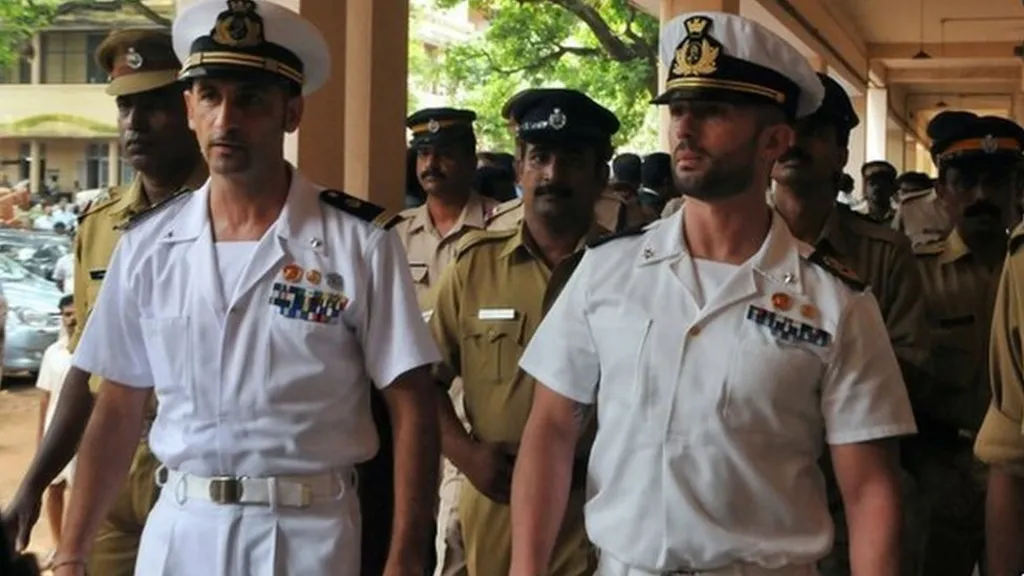
In February 2012, two fishermen, Jelestin, 45, and Ajeesh Pinku, 22, both from Kanniyakumari in Tamil Nadu, were shot dead in the sea off Ambalapuzha, Kerala. They had gone out on a boat called St Antony from the Neendakara Fishing Harbour. The shots came from an Italian oil tanker called the Enrica Lexie, whose security team said they mistook the fishermen for pirates.

Massimiliano Latorre (left) and Salvatore Girone (right) (Image via The Hindu)

Kerala Police arrested two Italian marines, Massimiliano Latorre and Salvatore Girone, on February 19, 2012, just days after the shooting. They were kept in judicial custody, and their case quickly turned into a full-blown diplomatic standoff between India and Italy. Italy kept insisting the marines had immunity because the shooting happened in international waters on an Italian-flagged ship. India disagreed, saying it had every right to try the case.

Along the way, the families of the two fishermen settled with Italy; each family was paid Rs 1 crore in compensation, and the boat owner separately accepted Rs 17 lakh. The marines got bail in May 2012 after spending about 105 days in custody, and were later allowed to travel home to Italy multiple times, first for Christmas in 2012, then again to vote in elections, and later on medical grounds. Latorre went home for good in 2014 due to health issues and never returned, while Girone stayed on, holed up for a while at the Italian embassy in Delhi, before he too was allowed to leave in 2016.

The case eventually went to international arbitration at The Hague. In 2020, the tribunal ruled that the marines had immunity from prosecution in India but should instead be tried in Italy and that Italy owed India compensation for the loss of life and damages. India accepted this, and Italy agreed to pay Rs 10 crore in compensation. In 2021, India’s Supreme Court finally closed the long-running case once the compensation came through, with Rs 4 crore going to each fisherman’s family and the rest to the boat owner. Italy’s government was told to start its own criminal proceedings against the marines back home, but neither marine ever faced trial in India.

Ottavio Quattrocchi and the Bofors scam

Back in 1986, India signed a massive Rs 1,437 crore deal with the Swedish company Bofors to buy 400 Howitzer guns for the Army. A year later, Swedish radio broke the news that the company had paid off top Indian politicians and defence officials to win the contract. The scandal shook Rajiv Gandhi’s government and became one of the biggest political controversies in Indian history it’s even said to have cost his party the 1989 general election.

Italian businessman Ottavio Quattrocchi, who was close to the Gandhi family, was accused of acting as the middleman who pocketed around $7 million in kickbacks from the deal. The CBI named him in its first chargesheet in 1999, along with Bofors’ Indian representative Win Chadda, former defence secretary S K Bhatnagar, and the company itself. But Quattrocchi had already left India in 1993 to dodge arrest, and he never came back to face any court in the country.

India tried for years to get him extradited but lost the fight first in Malaysia in 2002, and then in Argentina in 2007. A Malaysian court eventually set him free, and the CBI called the verdict disappointing but couldn’t do much more. Back home, courts gradually let the case fade away a Delhi court cleared Rajiv Gandhi’s name in 2004, another quashed the CBI’s case in 2005, and finally, in March 2011, a special CBI court dropped the case against Quattrocchi altogether, saying India had already spent around Rs 250 crore trying to extradite him and it just wasn’t worth spending more. Quattrocchi died in Milan in 2013 of a heart attack, having never set foot in an Indian courtroom.

The pattern repeats

By looking at these cases side by side, a clear pattern shows up. Warren Anderson, the two Italian marines, and Ottavio Quattrocchi were all, at some point, allowed to leave Indian soil during ongoing legal proceedings against them and not one of them ever returned to face a full trial. Some died abroad still officially wanted; others simply outlasted India’s patience and legal resources.

Matthew VanDyke and six Ukrainian nationals have been granted the very same kind of exit permission to fly home while questions about their activities near the Myanmar border remain nowhere close to fully answered.

History is proof enough that once foreign nationals accused in serious cases are allowed to step outside India, bringing them back becomes an uphill task, if not impossible. That raises a fair question: can the NIA court really guarantee that VanDyke and the six Ukrainians will return after their month abroad? And if there’s no real way to enforce that promise, what exactly was the reasoning behind letting them go in the first place?

Co-kingpin arrested, Rs 94000 crore generated in criminal proceeds and more: Fresh disclosures in Mahadev betting app scam which unfolded under Congress-led Chhattisgarh govt

On 24th September (Thursday), Abhishek Kumar, a main accused in the multi-crore Mahadev internet betting application racket, was arrested by the Central Bureau of Investigation (CBI) upon his arrival at Hyderabad’s Rajiv Gandhi International Airport after he was deported from Dubai. The agency stated that incriminating evidence has been recovered from him.

Notably, the scam unfolded during the Congress-led government in Chhattisgarh and former Chief Minister Bhupesh Baghel was named as an accused and beneficiary in the case, while his associates had also been booked and arrested. Furthermore, state governments are in charge of gaming and betting under the Indian Constitution.

A CBI spokesperson informed, “The investigation has found that he played an active role in coordinating betting panels, collecting funds, and acquiring immovable assets in Dubai using alleged proceeds from the illegal operations.” Kumar was brought before a Hyderabad local court and granted a three-day transit remand. Later, he was brought before a Raipur court and taken into custody by the police for two days.

Kumar, a close aide of key accused Sourabh Chandrakar and Shubham Soni, was evading capture. The extradition of Chandrakar, another kingpin behind the betting scheme, is being pursued in Oman after he was apprehended there in June. Last year, Indian agencies learned that Ravi Uppal, his partner and co-mastermind, had fled to Vanuatu from the United Arab Emirates.

The official mentioned, “The Mahadev Betting App case was transferred to the CBI after the Chhattisgarh government handed over 13 FIRs registered at different police stations in the state. The agency subsequently took over the cases and has so far filed eight chargesheets against 100 accused persons, including the app’s main promoters, panel operators, hawala operators and public servants of the government.”

According to officials, further inquiry is in progress to find the other perpetrators who have escaped. Additionally, attempts are being undertaken to prosecute the app’s primary promoters in India. “Efforts are being made to bring the main promoters – Chandrakar and Uppal – of the Mahadev Betting App back to India to face trial. Seven Red Corner Notices and two extradition proposals have been sent so far, and extradition proceedings against two accused are underway,” the spokesperson added.

Charge sheet points to police-politician nexus, Rs 94,400 crore in criminal gains

Earlier this month, the Enforcement Directorate (ED), which is carrying out a simultaneous money laundering probe in the case, submitted its sixth charge sheet against 42 people and businesses before a Special Prevention of Money Laundering Act (PMLA) Court in Raipur. 

The charge sheet unveiled that the app and its sister websites have made Rs 94,400 crore in criminal gains over the past ten years, with the main platform still functioning with a “huge” number of panels. “As per the latest findings of the investigation under PMLA, 2002, it is found that Mahadev Online Booking Application is still in operation and running a huge number of panels,” the charge sheet read.

The ED pointed out that local police and Chhattisgarh politicians provided “active support and connivance” for the “systematic” workings of the app. It stressed, “The bureaucrats and politically exposed persons have been receiving illegal gratification for turning a blind eye to this illegal betting racket.”

The charge sheet highlighted that the app was a combination of unlawful betting websites housed overseas, with its primary promoters and panel members being from Chhattisgarh. According to the agency, foreign portfolio investments (FPIs) have invested more than Rs 1,000 crore in Indian share markets. The accused reportedly made over Rs 11,000 crore a year from illicit internet gambling and betting activities over the past few years.

The ED stated that “it can be estimated that proceeds of crime worth Rs 11,400 crore (approximately) must have been generated by illegal operations of Mahadev online book every year,” based on an examination of various digital evidence that was collected and statements made by the accused. The gambling network was established in 2019.

The charge sheet further asserted that the app probably generated between Rs 75,000 crore and Rs 80,000 crore in criminal proceeds in the last 7 years. Additionally, the agency stated that sister websites like Lotus365.com and Skyexchange.com produced between Rs 11,000 crore to Rs 12,000 crore and Rs 2,400 crore in similar revenue, respectively. Skyexchange.com has been functioning since 2016. “A majority of the proceeds of crime was layered and transferred to the promoters based in Dubai,” it conveyed.

The ED emphasised that these figures were “only a provisional estimate and in case any evidence which reflects a better estimate comes to surface, the same shall be presented before the court.” It stated that the app attracted thousands of young people with the promise of rapid money through betting and entertainment while promoting these websites through Facebook pages and private WhatsApp and Telegram groups. In October 2022, the agency launched a money laundering case after receiving seven police FIRs from West Bengal, Andhra Pradesh, and Chhattisgarh.

According to the agency, the app offered online venues for illegal betting on cricket, badminton, tennis, football, and other live games, including poker, card games, and other chance games. It included card games like Teen Patti, Dragon Tiger, and Virtual Cricket as well as apps that let users wager on various Indian elections.

A TV anchor who marketed these betting apps offered the agency two demand drafts for Rs 1.20 crore out of the Rs 1.50 crore she had made by the endorsements. According to her, she was unaware that such earnings were prohibited in India and volunteered to turn over the money. During a raid on her residences in Delhi and Mumbai in May, the ED confiscated Rs 30 lakh in cash, classifying the full Rs 1.5 crore as proceeds of illicit betting.

The agency mentioned that panel operators from locations including Bhilai, Raipur, Bhopal, and Delhi made between Rs 3.5 crore and Rs 60 crore, which they then used to finance weddings and purchase luxury sarees, real estate, gold, and automobiles. The ED has identified 116 accused across six charge sheets, searched 190 locations nationwide, nabbed 14 people, as well as seized and attached assets worth Rs 2,104 crore.

Interestingly, the app grabbed broader headlines after the ED summoned Bollywood A-listers like Ranbir Kapoor, Shraddha Kapoor, Huma Qureshi, and Hina Khan, who along with several Bollywood personalities, attended and performed at the wedding ceremony of Saurabh Chandrakar.

Links with Dawood, Baghel accused of taking Rs 508 crore and more: The background of the case

According to the Enforcement Directorate, in October 2023, agreements were made between the app’s promoters and the D-Company, operated by Dawood Ibrahim, one of India’s most wanted terrorists and the man behind the 1993 Mumbai bombings. His brother Mustaqeem Ali Kaskar contacted Chandrakar after the app’s popularity and asked for a similar betting platform for Pakistan that would deal in the nation’s currency.

During his trip to Dubai, the former also provided him with roughly thirty bodyguards. At least 500 hawala operators and over 70 shell companies were used to move the money used in the scheme to Middle Eastern countries, particularly Dubai.

On 3rd November of that year, the ED announced that fresh evidence from a search operation revealed that regular payments had previously been made, with the promoters having given Baghel almost Rs 508 crore thus far. A day earlier, the ED successfully conducted search operations in Chhattisgarh, intercepting cash worth Rs 5.39 crore after receiving reliable information.

On 6th January 2024, reports emerged suggesting that Baghel has been named in a supplementary charge sheet that the agency has filed in connection with the investigation. It was related to allegations that he had received Rs 508 crore from the promoters of the app. The agency outlined that the arrested accused, Asim Das, confirmed in his statement that he received instructions from Subham Soni to give Baghel a sizeable sum of cash.

According to the chargesheet, Subham Soni summoned Asim Das to Dubai and presented him with money to be passed to the Congress senior leader. The allegations were further supported by a voicemail that was found on Asim’s phone in which he was clearly instructed to transfer between Rs 8 and 10 crore to Baghel when he returns to India.

The ED declared that Asim’s confession and a forensic investigation had resulted in “startling allegations” that the app’s promoters had handed over more than Rs 508 crore to Baghel prior to the first round of the Chhattisgarh elections at the time.

A few months later, in March, the agency froze Rs 580.78 crore in assets relating to the case, stating that its operations are conducted from Dubai. The Economic Offences Wing (EOW) of Chhattisgarh lodged an FIR against Baghel and others in the same month. The officials indicated that the ED’s charge sheet served as the basis for the action.

The case was registered under various sections of the then Indian Penal Code (IPC), including 120B (criminal conspiracy), 420 (cheating), and 471 (using as genuine a forged document), and provisions of the Prevention of Corruption (Amendment) Act, 2018.

Last year, the CBI FIR also included the ED report, which identified Baghel as a beneficiary. It re-registered the FIR of Chhattisgarh police’s EOW as its own case in which Baghel is designated as accused number 6 out of 19.

“It has also been revealed by Chandrabhushan Verma (a police personnel who was the main link between Dubai-based promoters and Chhattisgarh-based powers that be) that Baghel’s OSD (Officer on Special Duty) and political advisor were being paid proceeds out of Mahadev Online Book regularly,” the ED report disclosed. The FIR was launched by the CBI on 18th December 2024, after which it raided Baghel’s house on 26th March 2025.

The matter escalated into a significant political controversy, with Baghel denying the grave allegations while the Bharatiya Janata Party (BJP) intensified its attack on him and his grand old party, pointing to the revelations and even accusing him of disrespecting Lord Mahadev.

Act East via Pangsau Pass: The strategic case for reopening the historic Stilwell Road to reshape India-Myanmar-China trade

0

The recent reopening of the historic India-Myanmar Border Haat at Pangsau Pass has revived local commerce and cultural exchanges. Yet, as merchants cross this 9,000-foot frontier, they traverse the remnants of a dormant engineering marvel: the Stilwell Road. This grassroots revival has reignited conversations about fully reopening this legendary 1,736-kilometre highway, a move that could fundamentally reshape trade across India, Myanmar, and China.

Forged in the crucible of the Second World War, the Stilwell Road (originally the Ledo Road) was born of absolute strategic necessity. When the advancing Japanese Imperial Army captured Burma in 1942, they severed China’s last overland supply link. The air route over ‘the Hump’ was very dangerous, and over 500 transport aircraft were lost. Under American General Joseph Stilwell, 15,000 US troops and 35,000 local labourers carved a high-capacity bypass from Ledo in Assam, through the impenetrable jungles of northern Myanmar, to Kunming, China. The human cost was devastating, earning the project the grim moniker of the “Man A Mile” road.

But the road was not used much; it was completed in January 1945, and the war ended just months later. Following the war, the road suffered decades of neglect and is now highly fragmented. The 61-kilometre Indian stretch is well-maintained up to Pangsau Pass, and China has transformed its 920-kilometre segment into a state-of-the-art expressway. However, the 755-kilometre Myanmarese stretch remains a severe bottleneck. While the eastern section from Myitkyina to the Chinese border hub of Ruili is paved and highly active due to Chinese investment, the western route traversing the Hukawng Valley towards India is an overgrown, largely impassable track.

The push to resurrect the full corridor is driven by its massive economic potential. For India’s landlocked Northeast, the road represents the ultimate manifestation of the ‘Act East Policy’. Currently, freight to Kunming must take a circuitous, three-week maritime detour via Kolkata and the Strait of Malacca. A functional Stilwell Road would slash transit time to just three or four days, cutting transportation costs by an estimated 50 percent and providing direct, lucrative markets for Assam’s tea, spices, and handloom sectors.

Despite these tantalising prospects, severe roadblocks remain. Myanmar’s ongoing civil conflict makes infrastructure development in the heavily contested Kachin State virtually impossible. Furthermore, New Delhi harbours deep strategic apprehensions, remaining inherently wary of establishing a direct, high-capacity expressway from China straight into its sensitive North Eastern frontier. Policymakers also fear that such a route could permanently suffocate local manufacturing by flooding Indian markets with cheap Chinese goods, while simultaneously streamlining the smuggling of contraband from the Golden Triangle.

While the bustling haat at Pangsau Pass offers a heartening glimmer of cross-border integration, a fully operational Stilwell Road requires a complex geopolitical alignment that, for now, remains elusive.

Read the detailed article here on Chapter 1 Magazine.

Bengaluru emerges as a new destination for Rohingyas evicted from Jammu: Read how a Muslim man is seeking shelter for hundreds of illegal immigrants

0

As the authorities in Jammu have intensified the action to remove illegal Rohingya settlements in the region, the evicted Rohingyas have found a new destination for shelter: Bengaluru. Their settlement in Bengaluru is apparently being facilitated by a Muslim man named Dr. Hashim Rifai.

According to Rifai’s Facebook profile, he is a former Coordinator at the University of Calicut, Kerala, and is the principal of a B.Ed Teacher Training institution called Al-Azhar Training College in Thodupuzha. Rifai wrote a post on Facebook, stating that Rohingyas evicted from Jammu are arriving in Bengaluru to settle there.

Rifai said that five Rohingya families had already arrived in Bengaluru and that 50 more are expected to arrive. He added that the families have been staying in temporary shelters and that he was searching for land to build shelters to accommodate 100 Rohingya families. Rifai urged people in Bengaluru to extend support to construct shelters for the illegal Rohingya immigrants.

Rifai’s Facebook page features many similar empathetic posts for the illegal Rohingya immigrants. In the posts, he portrays the Rohingya immigrants as victims and questions the valid action of the Jammu administrattion.

Notably, the Jammu authorities have been making efforts to prevent the evicted illegal Rohingya immigrants from settling elsewhere. Police stations across Jammu have been directed to watch the movement of Rohingya families evicted from illegal settlements. The authorities have also warned locals against providing shelter or facilitating the settlement of the illegal Rohingya immigrants.

The action of authorities in Jammu followed an inspection of illegal Rohingya settlements in Jammu by a delegation representing the Ministry of Home Affairs (MHA). The inspection was meant to assess the demographic change caused by the settlement of illegal Rohingya immigrants in the area. The authorities carried out the eviction drives across various areas, including Narwal, Bathindi, Sunjwan and Chowadi, where over 7,000 Rohingya infiltrators have been removed and more than 40 kanals of land were cleared.

Large numbers of Rohingyas settled in Jammu

Large numbers of illegal Rohingya immigrants have settled in Jammu & Kashmir over the past couple of decades. Interestingly, the Hindu-majority Jammu region has significantly more illegal Rohingya settlements compared to the Muslim-majority Kashmir region. Their numbers rapidly have rapidly grown from few hundreds to thousands. According to government data, 7,656 Rohingyas were found living across Jammu and Kashmir out of whom 6,737 were identified living across 10 districts of the Jammu region.

It it interesting to note that the Rohingya Muslims, who claim to face religious persecution in their homeland Myanmar, have traveled to vast distances, crossing a Muslim-majority nation like Bangladesh, to settle in Hindu-majority across in India. Illegal Rohingya immigrants began discreetly settling in Jammu & Kashmir in 2009 during the rule of Congress-NC government. The first Rohingya immigrant is said to have settled in Bathindi area in the Union Territory (formerly a state).

The negligence of the local government led to Rohigya settlements multiplying in the area. The Rohingyas even managed to obtain local government IDs such as the ration card and the Aadhaar cards. The influx of large number of Rohigyas, particularly in Hindu-majority regions and their smooth settlement using forged government IDs, raised suspicions of an underlying political conspiracy ton alter the demograohy of the region. Many NGOs are also said to have beeen involved in facilitating the settlement of these illegal Rohingya immigrants.

Rohingya infiltrators posing threat to national security

Apart from Jammu, illegal Rohingya immigrants have established settlements in states including Haryana, Uttar Pradesh and West Bengal. According to an estimate, about 40,000 Rohingya infiltrators are illegally residing in India and around 200 Rohingya Muslim infiltrators are enter the Indian territory every month.

The illegal Rohingya immigrants have been found involved in several crimincal activities involving serious offences such as theft and narcotics and human trafficking. They have been involved in activities that pose a threat to the law and order as well as the national security. Rohingya immigrants in India has also been found linked to terrorist activities.

In 2024, the National Investigation Agency (NIA) busted an international human trafficking ring involving illegeal Rohingya immigrants. The network had been helping Rohingya enter India using discreetly or using forged documents. The gang used to train Rohingya infiltrators in languages such as Hindi, Assamese and other local languages before settling in India to avoid detection due to their accents.

In light of rising threat to law and order and national security, the Centre has hardened its approach towards the menace of illgal imigrations. Last year, the Modi government has launched a nationwide crackdown on illegal immigrants, including Rohingyas and Bangladeshi infiltrators.